All posts by plthomasedd

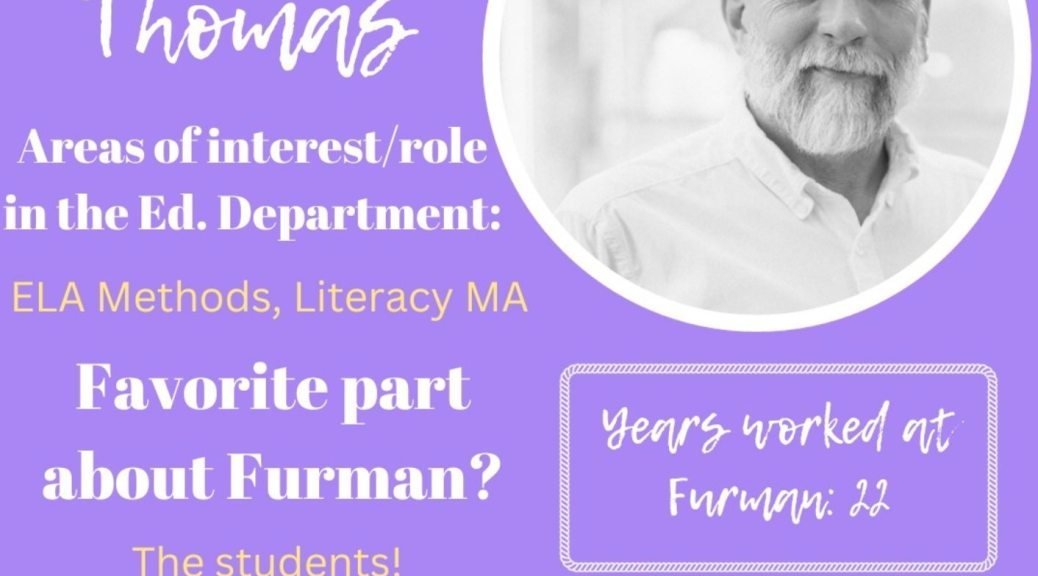
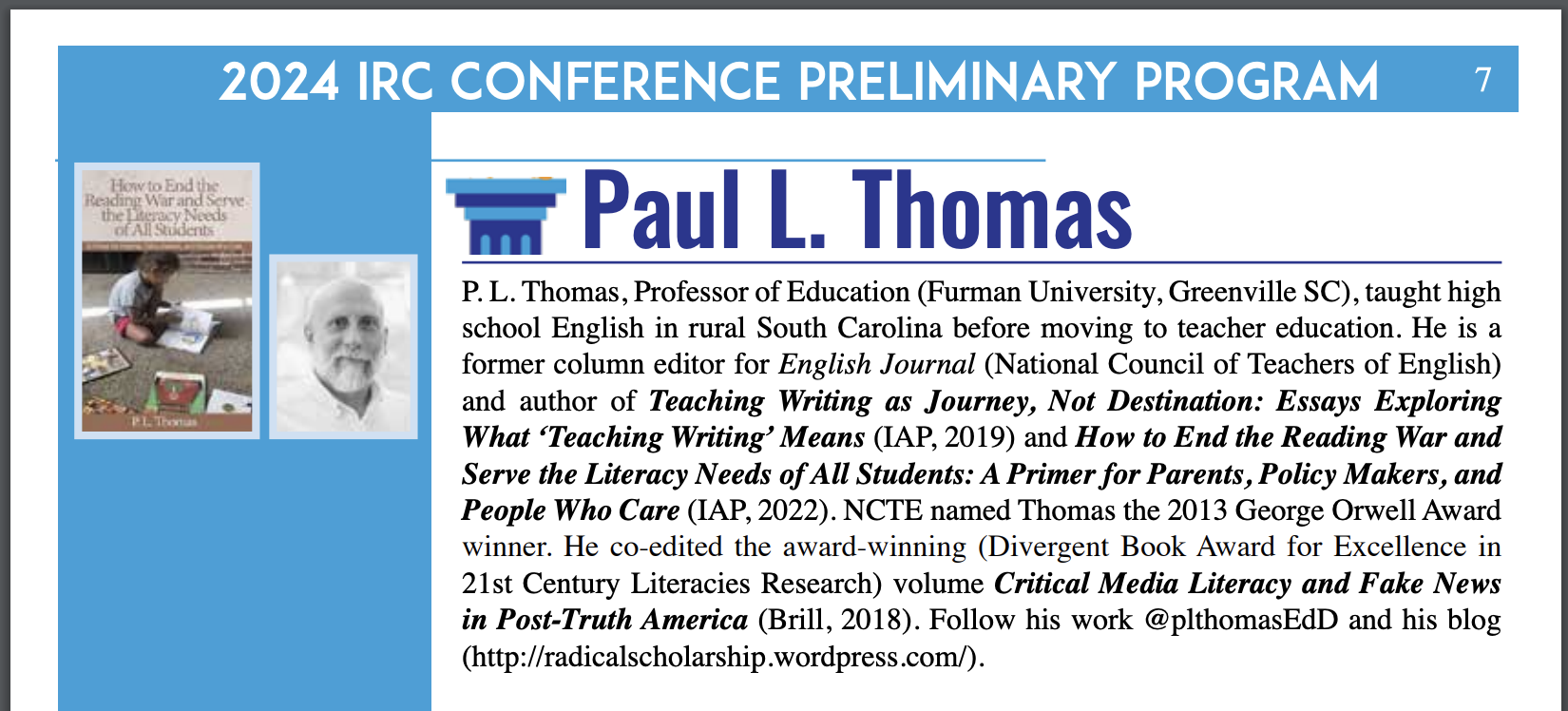
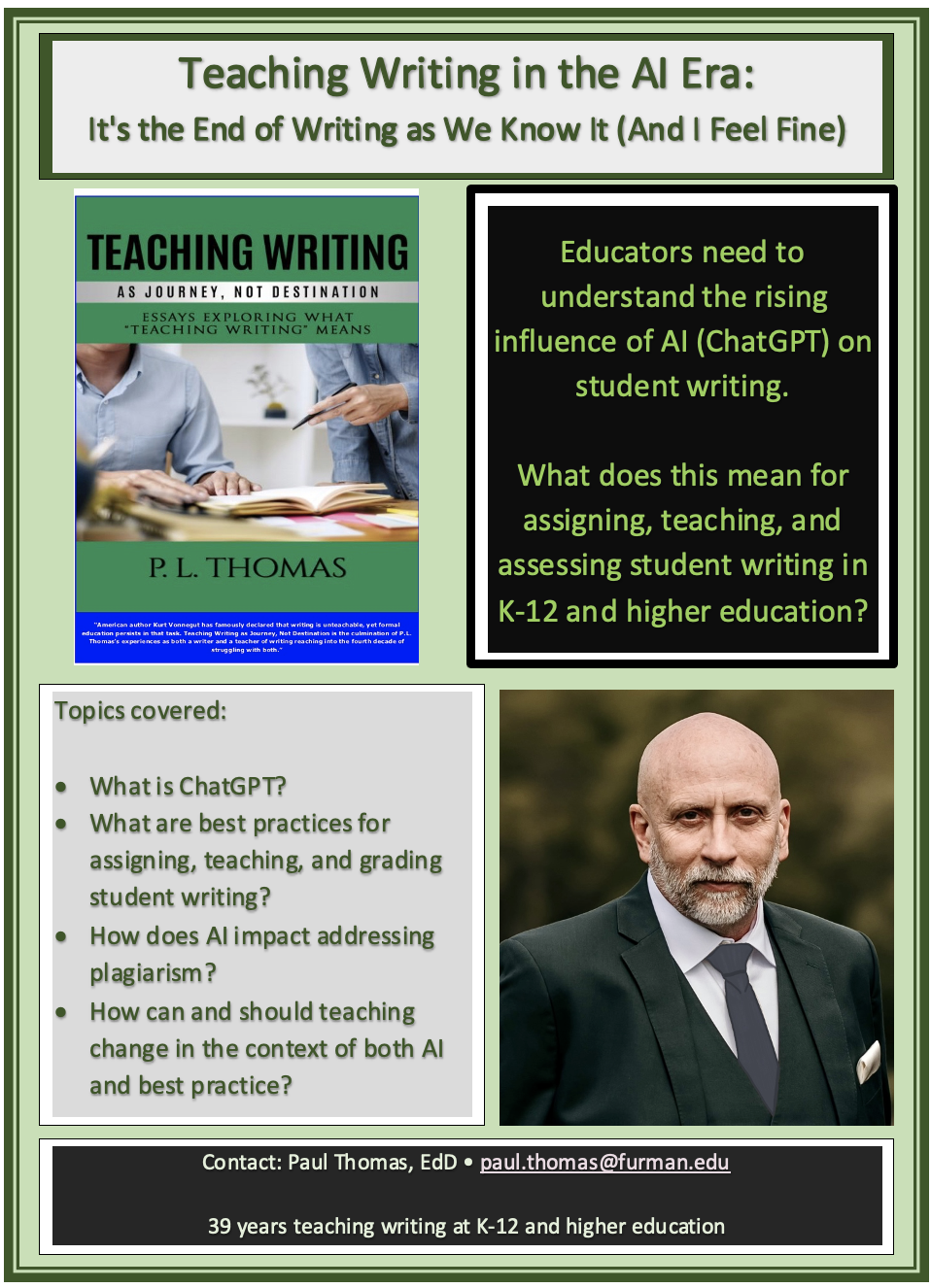
P. L. Thomas, Professor of Education (Furman University, Greenville SC), taught high school English in rural South Carolina before moving to teacher education. He is a former column editor for English Journal (National Council of Teachers of English), current series editor for Critical Literacy Teaching Series: Challenging Authors and Genres (Brill), and author of Teaching Writing as Journey, Not Destination: Essays Exploring What ‘Teaching Writing’ Means (IAP, 2019) and How to End the Reading War and Serve the Literacy Needs of All Students: A Primer for Parents, Policy Makers, and People Who Care (IAP, in press). NCTE named Thomas the 2013 George Orwell Award winner. He co-edited the award-winning (Divergent Book Award for Excellence in 21st Century Literacies Research) volume Critical Media Literacy and Fake News in Post-Truth America (Brill, 2018). Follow his work @plthomasEdD and the becoming radical (https://radicalscholarship.wordpress.com/).

ILEC Response: Toward Addressing and Resolving Disparities in Reading Outcomes: A Statewide Database of Curriculum, Instruction, and Assessments in Minnesota (CAREI, University of Minnesota, June 2023), Kimberly Gibbons, Robert Richardson, Eskender Yousuf, Annie Goerdt, and Mahasweta Bose

International Literacy Educators Coalition

ILEC Vision: To promote literacy learning practices that enable all children and youth to realize their full potential as literate, thinking human beings.

Download a PDF of the response.


ILEC Response: Toward Addressing and Resolving Disparities in Reading Outcomes: A Statewide Database of Curriculum, Instruction, and Assessments in Minnesota (CAREI, University of Minnesota, June 2023), Kimberly Gibbons, Robert Richardson, Eskender Yousuf, Annie Goerdt, and Mahasweta Bose

The report asserts: “Minnesota is in dire need of comprehensive literacy reform,” raising reading crisis claims from the “science of reading” (SOR) movement. Framing reading achievement as “alarming,” the report offers an ambitious body of data related to reading programs in the state, correlations of reading achievement and curricula, assessments used for screening and monitoring, and interventions implemented.

This report on Minnesota provides a needed model for understanding reading instruction and achievement in all states, but is seriously compromised by bias related to an uncritical acceptance of SOR stories. Claims made fail standards for “scientific,” and the report relies on media stories and surveys, and selected evidence while making a narrow case for “scientific” reading preparation and instruction.

Positive Aspects of the Report:

  1. Data gathered on key aspects of reading instruction should be a model for all states.
  2. The report highlights the significant inequity challenges represented by reading achievement data.

ILEC Concerns:

  1. The report makes sweeping inaccurate claims using “crisis” rhetoric and repeating stories from the SOR movement not supported by research, specifically misrepresenting reading programs and instructional practices (such as three cueing)[1] as ineffective or not supported by SOR.
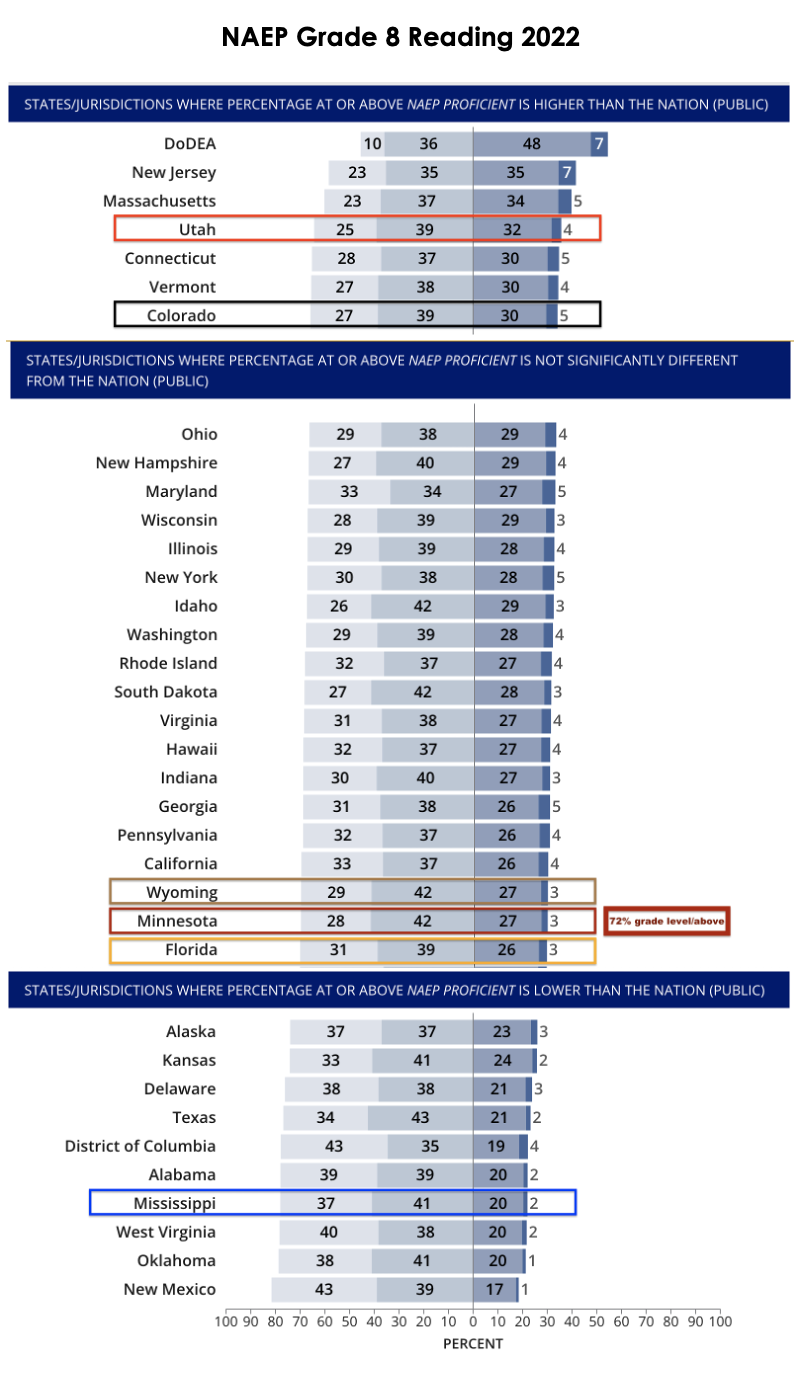
  2. The report notes MN’s stellar ACT scores and ignores that MN’s grade 8 NAEP reading scores (72% at/above grade level) are above Mississippi and comparable to FL, CO, UT, and WY while perpetuating SOR “miracle” myths. [See NAEP data below]
  3. Evidence in the report cites non-scientific sources (media) and cherry-picked research while making claims of a settled body of reading science that is never cited fully.[2]
  4. Analyses throughout the report treat correlation as causation, and thus, the analysis distorts the ambitious gathering of data through ideological claims.
  5. The report relies on outdated evidence (NRP) and endorses programs not supported by research (LETRS), for example, and thus does not practice the same standards the report expects of state reading policy decisions.
  6. Recommendations in the report are recycled approaches states have attempted for four decades without success, specifically calling for identifying effective reading programs and focusing on in-school-only reforms.
  7. Report authors have psychology and general education, not literacy, credentials: Kimberly Gibbons, Robert Richardson, Eskender Yousuf, Annie Goerdt, and Mahasweta Bose.

[1] Compton-Lilly, C.F., Mitra, A., Guay, M., & Spence, L.K. (2020). A confluence of complexity: Intersections among reading theory, neuroscience, and observations of young readers. Reading Research Quarterly, 55(S1), S185-S195. https://doi.org/10.1002/rrq.348; Mora, J.K. (2023, July 3). To cue or not to cue: Is that the question? Language Magazinehttps://www.languagemagazine.com/2023/07/03/to-cue-or-not-to-cue-is-that-the-question/

[2] See The Negative Legislative Consequences of the SOR Media Story: An Open-Access Reader  

Telling Stories

[Header Photo by S O C I A L . C U T on Unsplash]

My father wasn’t a reader or very well educated, but he loved telling stories. Mostly about his growing up and then his courtship and marriage of my mother.

Born and raised in rural South Carolina with one set of grandparents in rural North Carolina, I was repeatedly warned as a child not to “tell stories.”

My father’s storytelling and those warnings never confused me as a child because I knew this about “telling stories”:

That I became an avid (even voracious) reader and writer is easily traced back to my father’s oral storytelling. But as I evolved from a writer of fiction and poetry into being mostly an academic writer (although still a poet), I remained grounded in narrative.

While it has been a struggle, as my status as a scholar has grown, I became more assertive when editors asked me to cut narrative openings from my academic submissions. I stood by print it as is or don’t print it at all, and mostly, that has worked.

Over 40 years of teaching students to write, I have also remained committed to fostering students as effective and compelling writers. Specifically I urge that openings be narrative even as I caution students that academia shuns anecdotes and narrative writing.

The academic rejection of anecdote and the narrative mode is simplistic, I think. Writers should not avoid anecdotes and narrative mode (both of which are very compelling), but must use them ethically, making sure the anecdote and narrative reflect valid claims supported by empirical evidence.

For example, scholars and students as writers should never start with the anecdote or narrative since they can (and often are) outliers that do not support making valid and generalizable claims.

Instead, I teach students to do their research first, and once they have a credible literature review, to seek out anecdotes and narratives that fairly represent that data set.

Scholarly claims can often be abstract or complex, but giving readers what those claims look like in reality—real people doing real things—provides a concrete basis for reader understanding.

As a concrete example, if a student, journalist, or scholar were writing a piece on police in the US shooting and killing citizens, there are options for writing compelling openings.

A retelling of George Floyd’s death would be a valid opening for a piece making the claim that police shoot and kill Black people at about a 2.5 times greater rate than white people.

This narrative opening is both compelling and valid because the data supports that this narrative is representative of a supportable generalization.

However, opening with a narrative about police shooting and killing a white person to make the claim that police shootings of citizens is not racist is a not a valid opening because white people are underrepresented in police killings by rate.

This is a brief but specific example of why anecdotes or narrative mode is not the problem. The problem—one that is persistent in mainstream journalism—is that relying on compelling narratives that are not representative of valid generalizations is an ethical failure of writers.

Over the years I have interacted with many journalists, and their pursuit of stories is vivid. In recent years, the media obsession with reading has been hyper-focused on stories, grounded in a podcast titled Sold a Story.

The problem with the “science of reading” (SOR) movement is ironically grounded in telling stories.

The stories of parents and students trapped in situations where children are not progressing as readers are very compelling and likely credible individual stories. Some documentaries include equally compelling stories of adults who struggled in life due to low literacy.

Again, individual stories are deeply moving and are themselves mostly credible anecdotes.

But the SOR movement’s reliance on stories has two essential problems: First, those stories are paired with false definitions and misleading claims without taking any scientific effort to match the stories in causal ways to the claims; and second, the SOR movement (notably in the media) is calling for a narrow application of “scientific” in reading instruction while relying on non-scientific claims based on stories.

In short, journalists are telling stories that are also breaking the rule I warned about as a child—telling stories.

Yes, anecdotes and narrative mode are compelling ways to communicate, and I strongly endorse those approaches.

However, what is too often missing in mainstream media is a rich and nuanced understanding of education and literacy that must inform what stories are told and what claims those stories can offer valid evidence for.

Mainstream media fails the ethical standard of using narrative because of a nearly all-consuming pursuit of stories that will grab readers, listeners, and viewers.

Yet, as my grandparents and parents warned me, we shouldn’t be telling stories, especially at other people’s expense.


Recommended

The NY Times Again Goes After Public Schools, Susan Ohanian

Telling the Truth in a Story-Haunted South

ILEC Response: Mainstream media coverage of reading proficiency, teachers of reading, NAEP scores, and teacher preparation

International Literacy Educators Coalition

ILEC Vision: To promote literacy learning practices that enable all children and youth to realize their full potential as literate, thinking human beings.

Download a PDF of the response.


ILEC Response: Mainstream media coverage of reading proficiency, teachers of reading, NAEP scores, and teacher preparation

Mainstream media such as Education Week, the New York Times[1], APM, and Forbes persist in recycling a compelling but misleading story about reading proficiency, teachers of reading, NAEP scores, and teacher preparation that is not supported by the full body of evidence. As Aukerman explains:

From how much of the media tells it, a war rages in the field of early literacy instruction. The story is frequently some version of a conflict narrative relying on the following problematic suppositions:

  • a) science has proved that there is just one way of teaching reading effectively to all kids – using a systematic, highly structured approach to teaching phonics;
  • b) most teachers rely instead on an approach called balanced literacy, spurred on by shoddy teacher education programs;
  • c) therefore, teachers incorporate very little phonics and encourage kids to guess at words;
  • d) balanced literacy and teacher education are thus at fault for large numbers of children not learning to read well.[2]
The Science of Reading and the Media: Is Reporting Biased?, Maren Aukerman

In fact, Reinking, Hruby, and Risko concluded, “there is no indisputable evidence of a national crisis in reading, and even if there were a crisis, there is no evidence that the amount of phonics in classrooms is necessarily the cause or the solution.”

ILEC Concerns:

  1. Hoffman, Hikida, and Sailors note that “the SOR community do[es] not employ the same standards for scientific research that they claimed as the basis for their critiques.” While individual stories of parents and students are compelling, anecdotes are not scientific and do not provide valid evidence for generalizations about reading proficiency or reading instruction.
  2. Longitudinal and recent NAEP scores on reading are misrepresented by mainstream media. “Proficiency” on NAEP is well above grade level, and “basic” is a closer measure of grade level (Loveless, 2023; Loveless, 2016).
  3. Any claim of “crisis” or “miracle” in education is misleading. Specifically, the Mississippi “miracle” does not have scientific evidence to show NAEP increases are caused by instructional reform, but appear linked (as with Florida) to punitive uses of grade retention that disproportionately impact minoritized students.[3]
  4. Mainstream media misrepresents teacher education, reading programs, reading instructional practices, brain research, and the complex body of reading research to promote a compelling story that is melodramatic and anecdotal.
  5. Citing NCTQ, NRP, and surveys fails to meet the level of “scientific” that SOR advocacy requires of teachers.

[1] The NY Times Again Goes After Public Schools, Susan Ohanian

[2] See The Science of Reading and the Media: Is Reporting Biased?, Maren Aukerman; The Science of Reading and the Media: Does the Media Draw on High-Quality Reading Research?, Maren Aukerman; The Science of Reading and the Media: How Do Current Reporting Patterns Cause Damage?, Maren Aukerman

[3] A Critical Examination of Grade Retention as Reading Policy (OEA)

Education in the Media: A Reader, August 2023

Fall sessions of a new school year have begun or are soon beginning across the US.

Just as predictable as a new academic year, the media maintains its constant negative drumbeat about schools, education, students, and teachers. Below is a reader of some of the issues and coverage of education, including the rise in censorship and curriculum bans as well as the tired arguments about a reading crisis.

Notable is Susan Ohanians piece about the NYT, but this reader includes both samples of really bad journalism and excellent coverage of key education issues:

Schedule: Fall 2023 – Winter/Spring 2024

Below I will keep an updated listing of presentations and other public work for Fall 2023 through Spring 2024.

I am available for webinars, podcasts, presentations, white papers, blog posts, etc., on a number of education and literacy topics (browse my blog posts for topics):

  • Censorship, CRT/Curriculum Bans
  • Reading Legislation/Policy, “Science of Reading”
  • Writing
  • Education Reform
  • Politics and Education
  • NCTQ

New York State Reading Association

Leadership Workshop: Making Sense of the Science of Reading

August 5, 2023, 12:45 – 1:45


Furman University/ Cultural Life Program

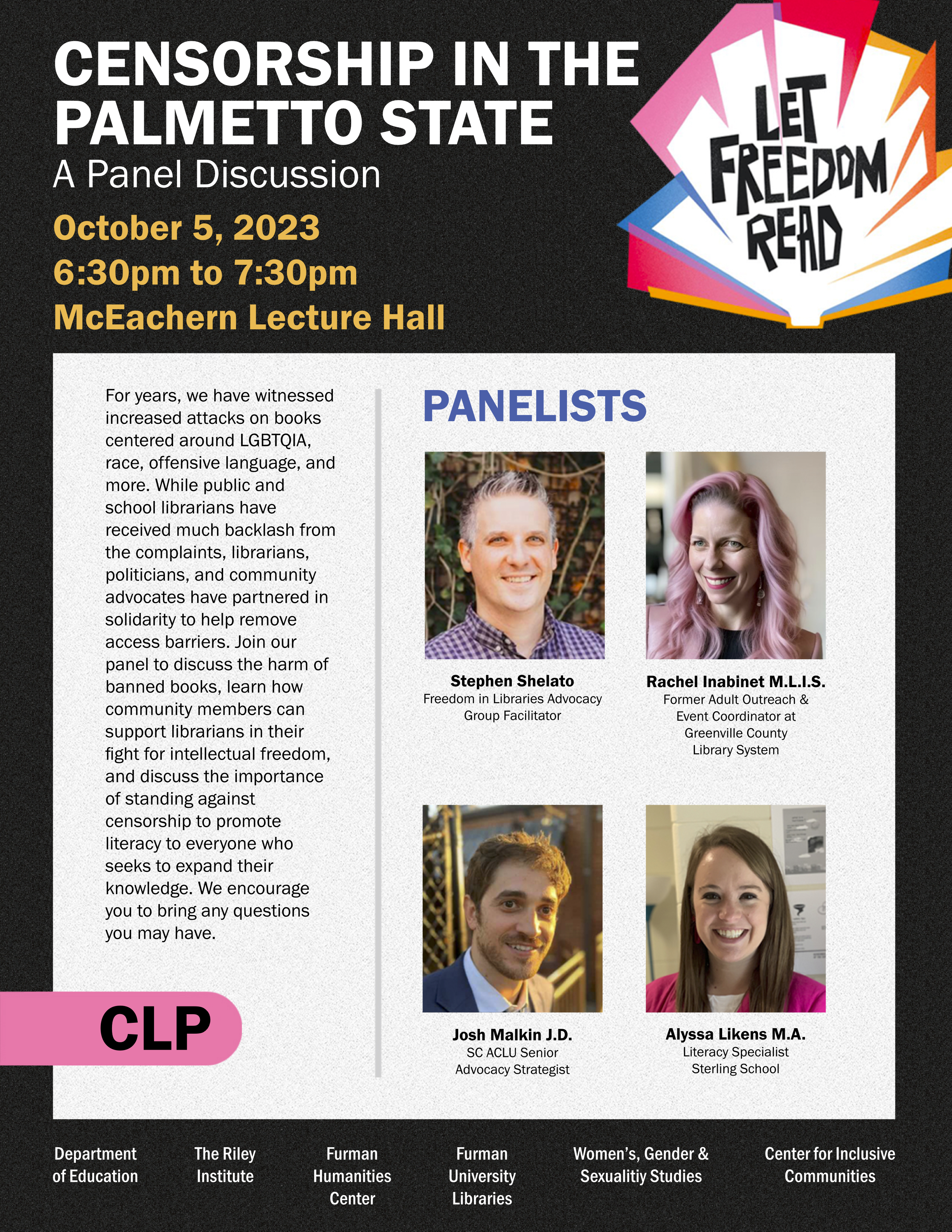
Title: Censorship in the Palmetto State: A Panel Discussion

Date: October 5

Time: 6:30 PM

Location: McEachern Lecture Hall – Furman Hall 214

Description: For years, we have witnessed increased attacks on books centered around LGBTQIA, race, offensive language, and more. While public and school librarians have received much backlash from the complaints, librarians, politicians, and community advocates have partnered in solidarity to help remove access barriers. Join our panel to discuss the harm of banned books, learn how community members can support librarians in their fight for intellectual freedom, and discuss the importance of standing against censorship to promote literacy to everyone who seeks to expand their knowledge. We encourage you to bring any questions you may have.  

Title: Libraries are Worthwhile: Why We Need Them and How We Will Keep Them

Date: October 10

Time: 7:00 PM

Location: Hartness Pavilion 

Description: Emily Drabinski, interim chief librarian at The Graduate Center, City University of New York and the 2023-2024 president of the American Library Association (ALA) will give a talk on the importance of libraries and librarians and how we can protect them in the face of ongoing censorship attempts.


NCTE Annual Conference

Conexiones 2023

Columbus, OH – November 16-19, 2023

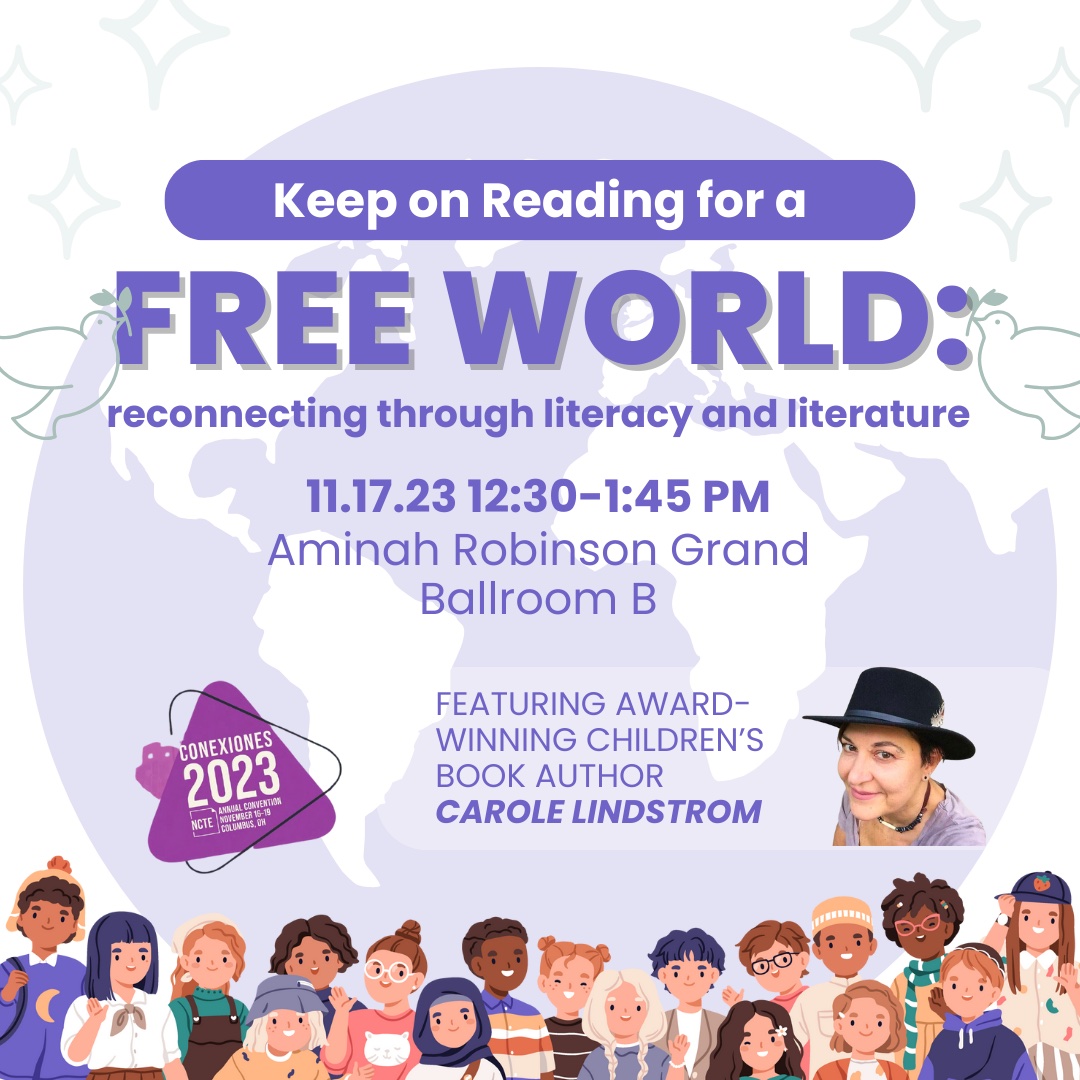
Keep on Reading for a Free World: Reconnecting through Literacy and Literature (Roundtable) – 11/17/2023 12:30 – 1:45; Aminah Robinson Grand Ballroom B [Reading Wars and Censorship: A Long and Shared History click for PDF]

Connecting Teachers with their Professional Autonomy in the “Science of Reading” Era click for PDF (Presentation) – 11/18/2023 – 11:00 – 12:15; A-214/215


LitCon 2024

Columbus, OH – January 27-30, 2024

Sessions

Featured Speaker

Where Are We Going, Where Have We Been?: Prioritizing Teacher Autonomy in the SOR Era

Download PP HERE

Over the last decade, states have passed new or revised reading legislation, often grounded in the “science of reading” (SOR) movement. The SOR movement has perpetuated many oversimplified and misleading stories that portray teachers negatively. This featured session will prioritize teacher autonomy by exploring the following topics: reading crisis, NAEP reading data, reading programs, teacher training and LETRS, dyslexia, and the complicated full body of reading research.

Sunday, January 28, 3:15 pm – 4:15 pm

Monday, January 29 4:15 – 5:45 pm


SCCTE 2024

West Beach Conference Center at Kiawah Island Resort, Kiawah, SC from Friday-Saturday, February 2-3, 2024

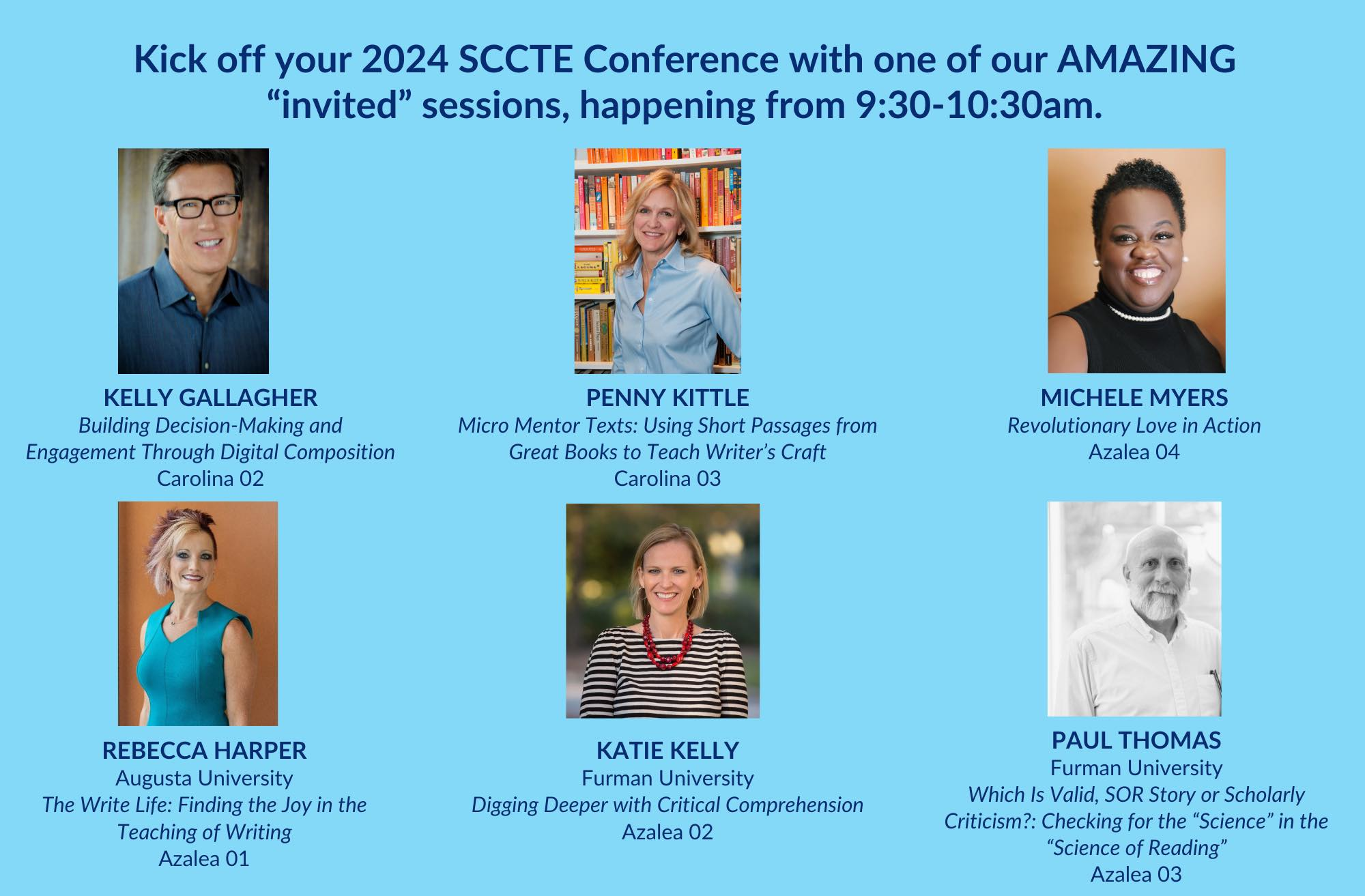
February 2, 2024, 9:30-10:30

Which Is Valid, SOR Story or Scholarly Criticism?: Checking for the “Science” in the “Science of Reading”

P.L. Thomas, Professor of Education, Furman University

Download PP HERE

The “science of reading” (SOR) movement has shifted from media stories to state legislation and instructional policy. This workshop invites teachers to critically examine media claims about reading, teachers of reading, and teacher educators against the full body of reading science. The topics will include history of reading crises, the simple view of reading, NAEP, the Mississippi “miracle,” balanced literacy and reading programs, dyslexia, three cueing, brain science, and an overview of reading science.


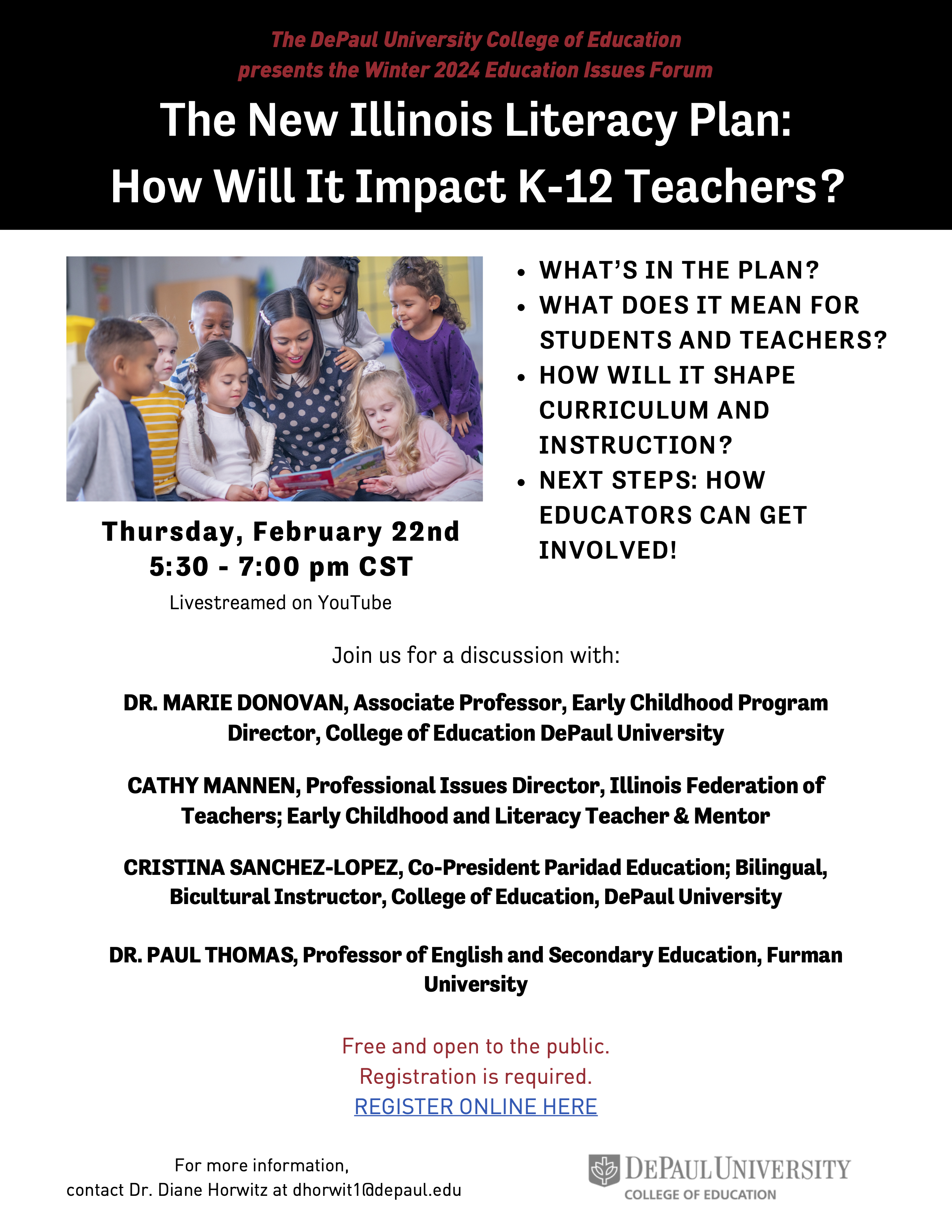
2024 COE Winter Education Forum

6:30 – 8:00 EST

Buyer Beware: Avoiding the Unintended (But Predictable) Consequences of SOR Legislation [access PDF here]


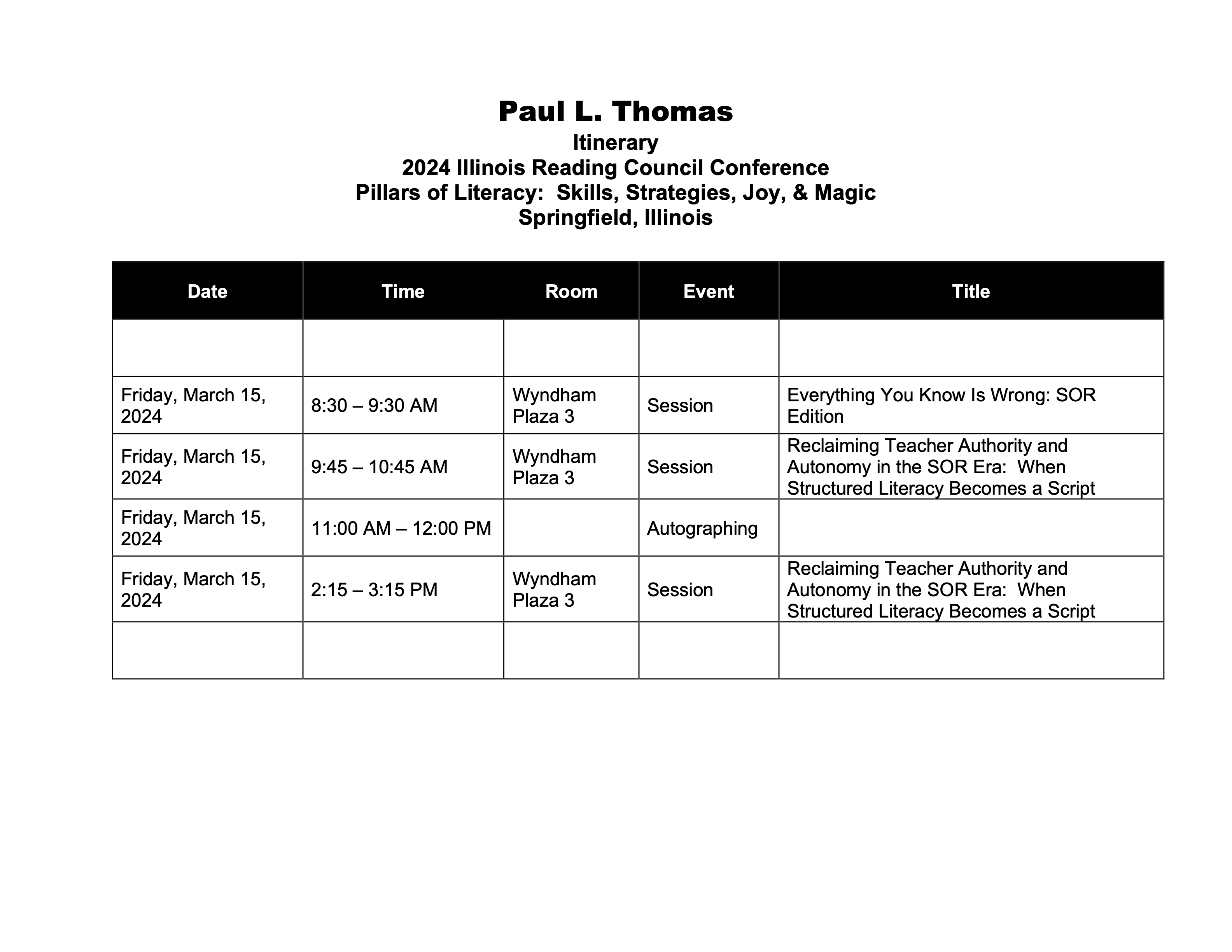
2024 Illinois Reading Council Conference

March 14-15, 2024 – Springfield, Illinois

Program

Everything You Know Is Wrong: SOR Edition

[Access PDF HERE]

Friday March 15 8:30-9:30

The “science of reading” movement has perpetuated several compelling and highly influential stories about reading; however, much of those claims are misleading or even completely false. This session will examine some of those stories and claims in the context of the full body of evidence. Topics include NAEP reading data, grade retention, the Mississippi “miracle,” phonics research, dyslexia, teacher education (NCTQ), multiple cueing, and reading programs and theories (balanced literacy).

Reclaiming Teacher Authority and Autonomy in the SOR Era: When Structured Literacy Becomes a Script

[Access PDF HERE]

Friday March 15 9:45-10:45; 2:15-3:15

Increasingly since 2013, states have adopted reading legislation identified as the “science of reading.” Since curriculum and instruction should be driven by classroom teachers, not media narratives, parental advocacy, or political mandate, this session examines key reading topics framed with current research to support teacher authority and autonomy.


BustED Pencils LIVE – Monday, March 25th, 2024


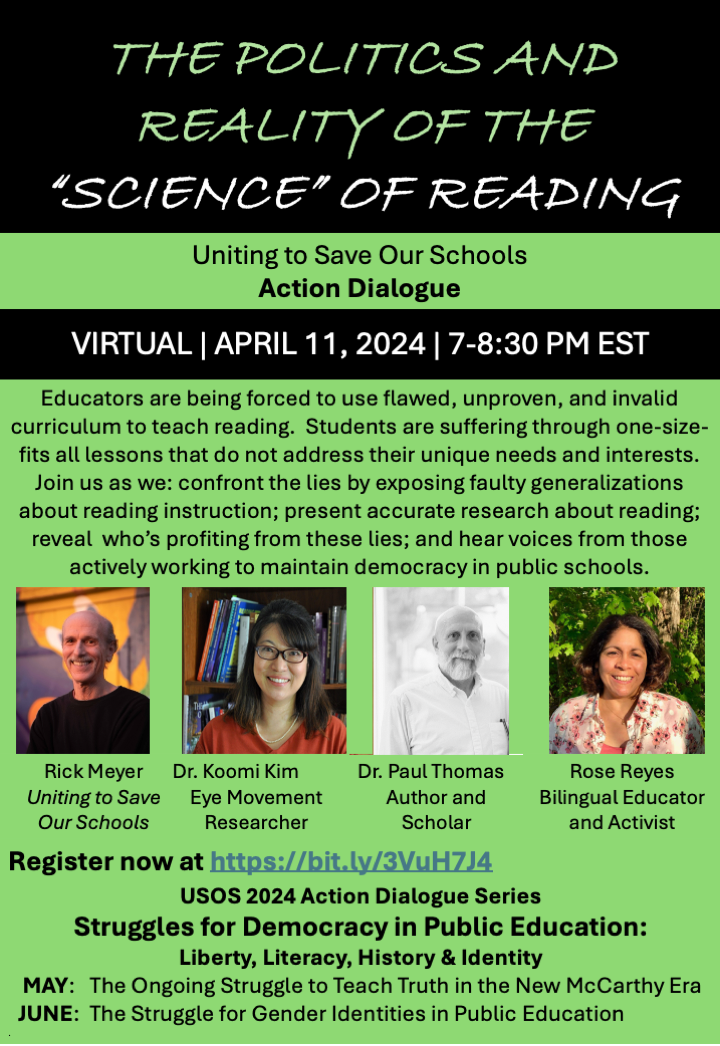
USOS: The Politics and Reality of the “Science” of Reading


The Fundamentalist Trap: Why We Should Be Losing Our Religion

[Header Photo by Joshua Hoehne on Unsplash]

Having watched Shiny Happy People a second time, I cannot emphasize enough that the documentary is far more than an expose on the Duggar family, Bill Gothard, or the Institute in Basic Life Principles (IBLP).

This is a warning for people living in a free society, a warning about the essential threat that authoritarian movements pose for a democracy grounded in the rights of individuals.

And it is a horrifying portrayal of the ways in which children are indoctrinated and groomed by organized religion and parents, the ways women are reduced to serving the purposes of men (primarily by reproduction).

For fundamentalists, there is a fixed Truth and it is their sacred duty to impose that fixed Truth not only on those within their belief community but everyone.

I grew up in the fundamentalist South, and repeatedly was taught that to be Christian you must witness. That sacred duty to witness, in part because media has helped promote fundamentalists as shiny happy people, has exploded into an aggressive political machine poised for national indoctrination.

As the documentary explains, IBLP built a political movement as part of its mission, a mission that is inherent across the US in all sorts of fundamentalist denominations.

Several so-called mainstream Republicans have started openly saying that the separation of church and state isn’t really a founding principle in the US; the same group that treats the Second Amendment as sacred, by the way.

Imposing dogma is the goal of fundamentalism, the only goal, by any means necessary.

Nothing represents that ends-justify-the-means mentality more than the idolatry around Trump among fundamentalists. Trump the person is irrelevant as long as he remains an effective mechanism for imposing their dogma.

Two realities face Americans.

First, the separation of church and state, religious freedom, asserts that everyone has the right to embrace or reject whatever religious dogma they choose, but no one has the right to impose that dogma on others, notably not through the mechanism of government.

Therefore, the separation of church and state is a threat to the essential mandates of fundamentalism, witnessing and converting everyone to a singular way of thinking and living.

Second, fundamentalism is at the core of all organized religion at varying degrees of intensity; fundamentalism also by its nature is authoritarian.

And as the documentary on the Duggars dramatizes, authoritarianism is a mechanism of centering male authority—women and children must be subservient. (See also Sister Wives.)

Authoritarianism is a threat to democracy and individual freedom—especially in the form of religious fundamentalism that asserts dogma as the word and will of God.

These tensions now represent the primary core of politics in the US. We are no longer faced with choosing the best candidate (if we ever were), we are no longer faced with choosing between Democrats or Republicans, but we are faced with choosing between democracy and authoritarianism.

The parental rights movement built on charges of indoctrination and grooming has its roots in fundamentalism, but that political movement is not about actual indoctrination or grooming of children in the public sphere (specifically K-16 education).

The parental rights movement is projection because fundamentalists are indoctrinating and grooming; any alternative to a fundamentalist way of thinking and living, again, is a threat to fundamentalist goals for everyone conforming to that singular world view.

Like “Shiny Happy People,” “Losing My Religion” is associated with the alternative rock group R.E.M., who introduced the Southern saying to the world.

“Losing my religion” isn’t about religion, but a metaphorical statement of exasperation. “Son, you’re about to make me lose my religion” is a warning that someone is about to lose patience, to act in ways counter to how they believe they should act.

So let me be clear here: I am calling for a literal use of “losing our religion.”

Despite their numerous flaws, the so-called Founding Fathers were mostly secular men who valued human reason; many of them ascribed to a non-dogmatic view of “god” and belief that allowed for a free people to govern themselves.

In many ways, this is idealistic but a wonderful thing, I think. The problem is that granting fundamentalists religious free is a paradox since fundamentalists will not (cannot) honor the freedom for the rest of us to believe or not as we choose.

No child or woman in a fundamentalist church or home is given that freedom, and fundamentalists believe that their soul depends on them demanding compliance from the rest of us.

Between democracy and authoritarianism, only democracy allows everyone life, liberty, and the pursuit of happiness.

Everyone should watch Shiny Happy People.

Everyone should step back and recognize this documentary is not a narrow snapshot of an outlier family or some rare religious cult.

Authoritarianism is coming for us. All of us.

If fundamentalists get their way, there is no choice.

This is our future.


See Also

Reading Wars and Censorship Have a Long and Shared History

Christian Nationalists Can’t Wait for This School in Oklahoma to Open

For Boebert and Greene, faith — and Christian nationalism — sells

Former Bob Jones University students describe experience, exit from evangelical college


Moving Beyond the Cult of Pedagogy in Education Reform

As a teacher for forty years and a teacher educator for more than half of that career, I have always struggled with the tendency to oversell teacher quality and instructional practice.

Does teacher quality matter? Of course.

Does instructional practice matter? Again, of course.

But both teacher quality and instruction (pedagogy) are dwarfed by teaching and learning conditions within schools and more significantly by the conditions of any child’s life.

As I have noted recently, the peak era of focusing on teacher quality, the value-added movement (VAM) occurring mostly under the Obama administration, instead of identifying high-quality teachers as a driver for improving student achievement found out something much different than intended:

VAMs should be viewed within the context of quality improvement, which distinguishes aspects of quality that can be attributed to the system from those that can be attributed to individual teachers, teacher preparation programs, or schools. Most VAM studies find that teachers account for about 1% to 14% of the variability in test scores, and that the majority of opportunities for quality improvement are found in the system-level conditions. Ranking teachers by their VAM scores can have unintended consequences that reduce quality.

ASA Statement on Using Value-Added Models for Educational Assessment (2014)

Teacher quality necessarily includes two types of knowledge by a teacher—content knowledge and pedagogical knowledge.

Yet the VAM experiment revealed something we have known for decades—standardized tests of student learning mostly reflect the student’s relative privilege or inequity outside of school.

Despite the refrain of Secretary Duncan under Obama, schools have never in fact been “game changers.”

While neoliberal/conservative education reforms leveraged the “soft bigotry of low expectations” and unsubstantiated claims that the Left uses poverty as an excuse, people all along the ideological spectrum are over-focused on instructional practices. And that overemphasis is used to keep everyone looking at teachers, students, and instruction instead of those more impactful out-of-school (OOS) influences on student learning.

A companion to the cult of pedagogy in education reform is the “miracle” school claim, but “miracle” schools rarely (almost never) exist once the claim is interrogated, and even if a “miracle” school exists, it is by definition an outlier and essentially offers no guidance for scaling outward or upward.

The paradox of the cult of pedagogy in education reform is that until will directly address OOS factor we will never have the context for better teasing out the importance of teacher quality and instructional practices.

The current education reform trapped in the cult of pedagogy is the “science of reading” (SOR) movement which oversells the blame for student reading achievement as well as oversells the solutions in the form of different reading programs, reading instructional practice, and teacher preparation and professional development.

The “miracle” of the day in the SOR propaganda is Mississippi, which is very likely a mirage based on manipulating the age of students being tested at grade level and not on teacher quality and instructional practices.

Not a single education reform promise since the 1980s has succeeded, and the US remains in a constant cycle of crisis and reform promises.

Yet, the evidence is overwhelming that many OOS factors impact negatively student learning and that social reform would pay huge dividends in educational outcomes if we simply would move beyond the cult of pedagogy in education reform.

For example, see the following:

My entire career has existed within the neoliberal accountability era of education reform that oversells education as a “game changer” and oversells teacher quality and instructional practices.

Like time-share frauds, we are being duped, and teachers and students need us to move beyond the cult of pedagogy in education reform and focus on the much larger influences on students being able to learn and teachers being able to show that their quality and instruction can matter.

FL Whitewashes Black History: A Reader

One of the many ways that Florida has been dismantling education in their state and influencing similar actions across the country is whitewashing Black history.

Below is a reader addressing this assault on history, Black people, and efforts to create a more equitable democracy:


See Also

“Every white person in this country…knows one thing,” James Baldwin (1979)

Listening to Langston Hughes about “Make America Great Again”

ILEC Response: Reading Reform Across America (The Albert Shanker Institute, July 2023), Susan Neuman, Esther Quintero, and Kayla Reist

International Literacy Educators Coalition

ILEC Vision: To promote literacy learning practices that enable all children and youth to realize their full potential as literate, thinking human beings.

Download a PDF of the response.


ILEC Response: Reading Reform Across America (The Albert Shanker Institute, July 2023), Susan Neuman, Esther Quintero, and Kayla Reist

The report asserts, “Our goal is to provide a basic yet systematic description of states’ efforts to improve reading instruction.” And is grounded in the following:

Furthermore, legislative efforts have at times been criticized widely, but our analysis reveals significant variation among states, rendering blanket characterizations unhelpful….Whether we see the current state of American students’ reading achievement as a new crisis or as part of a stable trend, the truth remains that more than one-third (37 percent) of the nation’s fourth-graders performed below the National Assessment of Educational Progress (NAEP) “Basic” level in 2022. Because there is no achievement-level description for below “Basic,” it is difficult to make full sense of this statistic. (p. 1)

Reading Reform Across America

While the report is ambitious, the increase in reading legislation is framed as a positive reform effort motivated by “answering teachers’ calls for better support with regard to reading.” This positive spin ignores the media, market, and political influences on another reading war and avoids confronting how many states are passing legislation that mandates and bans reading practices based on advocacy and not the full body of reading science.[1]

Positive Aspects of the Report:

  1. The report makes a strong case for reading achievement being significantly inequitable among marginalized groups of students.
  2. The report acknowledges the concerns raised about grade retention policy.

ILEC Concerns:

  1. State reading legislation is not a response to teachers, but to an orchestrated political reform movement grounded in misinformation about reading achievement, teacher expertise, and teacher education.
  2. The report fails to fully engage with patterns of extreme measures in several states’ legislation that bans three cueing, reading programs, balanced literacy, etc., as well as legislation that mandates universal dyslexia screening, structured literacy programs, etc.—both of which are based on advocacy and not the full body of research.
  3. The report does not address the contradiction of calling for scientific practice while mandating and funding programs and practices not fully supported by research; for example, mandating LETRS training for all teachers of reading.
  4. Posing the current reading legislation movement as positive is idealistic bordering on irresponsible.

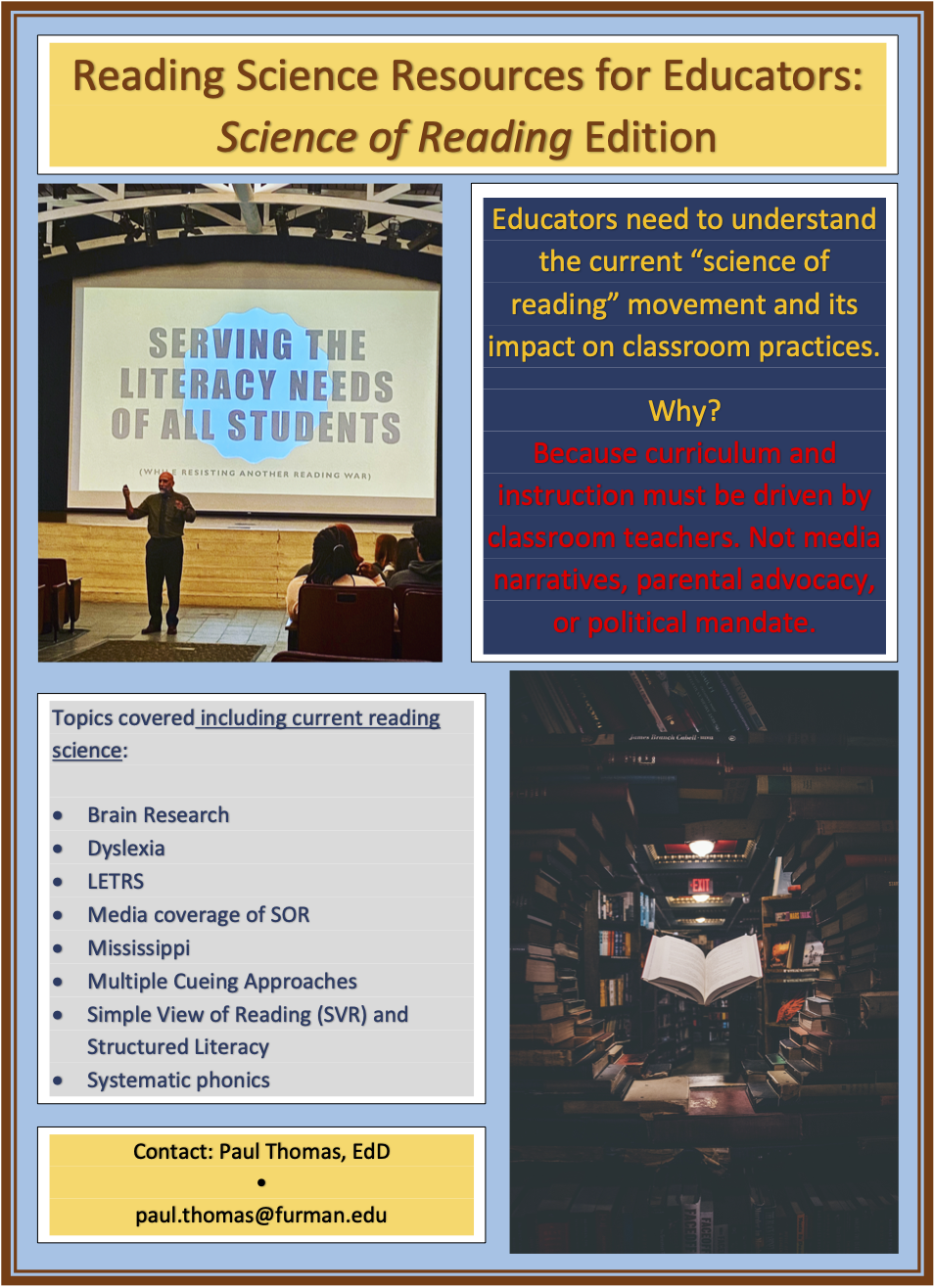
[1] Reading Science Resources for Educators (and Journalists): Science of Reading Edition [UPDATED]; The Negative Legislative Consequences of the SOR Media Story: An Open-Access Reader


Recommended

What Do We Really Know about Reading Proficiency in the US?

Neoliberal Education Reform: “Science of Reading” Edition

Something Compares: “I’m Not Down”

When I read that Dolores O’Riordan died, I experienced an irrational emptiness that defies explanation.

Then I cried.

I have cried several times since then as well.

Yesterday, from behind me as she sat at her desk looking at her phone, my partner said, “Sinéad O’Connor died.”

Once again, an irrational emptiness.

I resisted at first. But then I cried.

I have cried several times since then as well.

And now I carry the news of O’Connor’s death with me in my partner’s voice along side the emptiness I feel for the death of O’Riordan, who was only 46. A decade younger than O’Connor at her death, 56.

Like most people familiar with O’Connor, I associate her with tearing up the Pope’s picture on Saturday Night Live, which I watched live, and “Nothing Compares to U”—the mesmerizing and chilling video especially.

But the very first thing that comes to me when I think of O’Connor is the image of her with Kris Kristofferson.

When I was growing up, Kris Kristofferson was a famous actor and musician, but I wasn’t a fan of country music even though I enjoyed him in movies. It isn’t hard to do the right thing when you are a wealthy and famous white man, but Kristofferson did the right thing at that moment.

And when I think of that singular act of kindness, I have a Grinch moment—my heart swelling nearly out of my chest.

My first infatuation as a reader was science fiction, Arthur C. Clarke and others. But my first literary crush as a reader was British writer D.H. Lawrence, who believed in “blood consciousness”:

Lawrence had long believed in the duality of human consciousness, seeing a polarity between blood and mental consciousness. For him, mental consciousness was characterised by the exertion of human will, something that was demonstrated by an emphasis on science, mechanisation and materialism. In contrast, he viewed the consciousness of the blood as something inherent and more intuitive; it was as if the blood remembered older religious ideas than those imposed by Christianity, a different kind of relationship between humankind and the cosmos. Thus Lawrence’s particular interest in the notion of blood-consciousness indicates his preference for a more instinctive, rather than scientific, response to questions about man’s place in the world.

Lawrence’s “Best Adventure”: Blood-Consciousness and Cornwall

Then, and now, blood consciousness appeals to me because I often feel connections deep in me, in my bones, in my blood.

There was a hedonism to Lawrence, of course, that appealed to me as a late teen into my early 20s, but Lawrence’s work was also about language, the dialects that join us, the dialects that separate us.

Lawrence was writing about blood consciousness but class consciousness as well (priming me for reading Marx).

And there is a pattern to my affinities.

In college English courses, I found myself drawn to Irish writers, William Butler Yeats and James Joyce. Throughout my life, that Irish thread has repeated itself—George Carlin (who often spoke of his Irish heritage), Colin Farrell, Brendan Gleeson, and others.

Of course as well, there was music—U2, The Cranberries, and O’Connor.

Listening to Irish actors and singers resonates with my deep Southern drawl since we in the South owe a bit to Irish descendants who came to the Southern US among others from the British Isles. I am Scotch/Irish on my father’s side, which compels me to trust Lawrence’s faith in blood consciousness.

Regardless, there is something about language running through my love for the Irish, and that is where O’Connor and O’Riordan speak to me both literally and metaphorically.

These smallish women, physically frail, with powerful voices, daring to say what shouldn’t be said.

There is a deep humanity in O’Connor’s and O’Riordan’s lyrics, but there is also a confrontational politics that demands that we not just listen, but that we really hear what they are saying:

It’s the same old theme, since 1916
In your head, in your head, they’re still fightin’
With their tanks and their bombs and their bombs and their guns
In your head, in your head, they are dyin’

“Zombie,” The Cranberries

O’Riordan’s death came well past the pop stardom years for The Cranberries.

For O’Connor, the Pope incident on SNL likely derailed her career as a pop star because O’Connor committed the Great Sin for a woman.

Speaking with her own voice. Daring to claim her voice and body as if it were her own:

I don’t wanna be no man’s woman
I’ve other work I want to get done
I haven’t travelled this far to become
No man’s woman
No man’s woman

“No Man’s Woman,” Sinéad O’Connor

Yesterday, alone in the apartment, I played through several of O’Connor’s songs. Today, I did the same in the car with The Cranberries.

There was more crying, and my chest feels eerily empty even as my heart swells with each song.

In O’Connor’s and O’Riordan’s songs and voices, there is a longing, a humanity, a demand, and a frailty.

We humans can be very lonely and at times very lost. Longing for that Other to be by our side, to love and cherish.

To reach for, to hold.

But also wanting to be comfortable with ourselves, our true selves, the one in our bones, in our blood.

Crying and feeling sadness for people I did not know is irrational. It is uncomfortable to think about being able to listen to their songs any time, their existences somehow captured forever.

I am aware much of this sadness is about what these women and their death’s represent: We humans are incredibly frail.

And even as we may often admit physical frailty, we resist admitting our mental frailties.

We lose people all the time due to our own carelessness.

O’Connor’s death again makes me wish we could be better with and for each other.

We should all be willing, no, eager, to walk on stage into the jeers and booing of others, take that other person in our arms and say, “Don’t let the bastards get you down.”

Fecking hell. If only.


See Also

Should We Be Nice?: The Banshees of Inisherin

Sinead O’Connor Danced on the Edge of the Dark All Her Life, Susan McKay

Auden wrote of Yeats, “Mad Ireland hurt you into poetry.” Cruel Ireland hurt Ms. O’Connor into song. She called Ireland a theocracy. She was furious that in a country that had supposedly fought for and won its freedom, women and children were so silenced and disempowered. She understood and had experienced pain, neglect and injustice and sang for those who also knew these things….

On Wednesday night I watched videos of Ms. O’Connor performing and read some of the tributes on social media. Two stood out for me. One quoted the Yeats poem that inspired her extraordinary “Troy”: “What could have made her peaceful with a mind/That nobleness made simple as a fire. … Why, what could she have done, being what she is?/Was there another Troy for her to burn?”

Sinead O’Connor Danced on the Edge of the Dark All Her Life