P. L. Thomas, Professor of Education (Furman University, Greenville SC), taught high school English in rural South Carolina before moving to teacher education. He is a former column editor for English Journal (National Council of Teachers of English), current series editor for Critical Literacy Teaching Series: Challenging Authors and Genres (Brill), and author of Teaching Writing as Journey, Not Destination: Essays Exploring What ‘Teaching Writing’ Means (IAP, 2019) and How to End the Reading War and Serve the Literacy Needs of All Students: A Primer for Parents, Policy Makers, and People Who Care (IAP, in press). NCTE named Thomas the 2013 George Orwell Award winner. He co-edited the award-winning (Divergent Book Award for Excellence in 21st Century Literacies Research) volume Critical Media Literacy and Fake News in Post-Truth America (Brill, 2018). Follow his work @plthomasEdD and the becoming radical (https://radicalscholarship.wordpress.com/).
At my core, I remain an English teacher, and in that role, I have always loved inviting students into interrogating paired texts, especially texts that mix and blend various genres and media/forms.
I essentially do not go to the theater any more to see movies, having become pretty content to view films on streaming services. But I splurged and found myself in a nearly empty theater yesterday to watch Barbie.
I have been agnostic about the social buzz around the film, but I must confess that many years ago I accepted that any movie with Ryan Gosling in it is likely worth the time of viewing.
The film not only fulfilled all my expectations from what I have read, but far exceeded what I anticipated. The short response is Barbie is a very smart and purposeful film, filled with excellent writing, filming, and acting. But most of all, Barbie confronts complex topics in simple but not simplistic ways.
And the topics are quite extensive:
Gender
Social norms
Capitalism and materialism
Democracy
Idealism and reality
Patriarchy
Family
Self-awareness, identity, and the existential crisis of being human
Certainly, the film isn’t exhaustive on these topics, and there are moments that feel shallow. But it works so well at making the viewer able to enter into a consideration of issues that are, frankly, extremely difficult to maneuver because the human condition is complex and these topics are fraught with ideological and political triggers.
I suspect, however, that the people who need the invitation Barbie offers are still not likely to reconsider or even consider what the film graciously offers.
If you don’t feel compassion for the close ups of stereotypical Barbie after she is crying and you can see the tears have created little rivers of no make up on her face, well, I dont’ have much hope for you.
But the people I remain forever hopeful about are students.
As sequential art (comic book/graphic novel), this reimagining of Wonder Woman and the Amazons overlaps with Barbie as a feminist text that refuses to be simplistic.
What pairing the texts add is how the works use mythology as an entry point to interrogate gender, norms, and human frailty in ways that are deeply compelling. And of course, at the heart of both works is the insidious influence of power that can be arbitrary and corrosive to human dignity.
The Ken/patriarchy motif of Barbie is brilliant and provides an excellent space for discussing Historia and the Amazons.
The Barbies and the Amazons represent a woman-centered culture, but both are juxtaposed to the real world that is man-centric. And Historia weaves in classic mythology which is a wonderful pairing with the use of Barbies (women) and Kens (men) as types, even as the main Barbie expresses, stereotypes.
The two works also allow discussions of genres and media/forms since the film is primarily satire and has strong fantasy elements that contrast with the darker and more -hyper-realism of Historia.
Both, although in different ways, provide excellent texts for discussing the impact of the visual on engaging with and understanding these texts. Both works are visually stunning.
And finally, the most important aspect of pairing Barbie and Wonder Woman Historia: The Amazons as a unit for students is that the texts are the antithesis of the caricatures conservatives are attacking in the culture war against anything diverse, what they slur as “woke.”
Education is about asking hard and complex questions and coming to know what we don’t know, what we don’t yet fully understand.
Barbie and Wonder Woman Historia: The Amazons never stoop to indoctrination, never slip into unfair or sweeping ideological pandering.
Especially when experienced together, it is hard to be on the other side with more answers than questions. And that might be the most beautiful gifts they offer us as their audience.
Thomas, P.L. (2018). Wonder Woman: Reading and teaching feminism with an Amazonian princess in an era of Jessica Jones. In S. Eckard (ed.), Comic connections: Reflecting on women in popular culture (pp. 21-37). New York, NY: Rowman and Littlefield.
ILEC Vision: To promote literacy learning practices that enable all children and youth to realize their full potential as literate, thinking human beings.
ILEC Response: The Right to Read: The greatest civil rights issue of our time.
The Right to Read connects reading instruction, civil rights, and full participation in society by asserting that there is only one approach to teaching reading. The film provides few specific details about the research that supports this stance, and there is little to no discussion about other aspects of teaching and learning that impact student achievement.
Also, there are the repeated examples of what Maren Auckerman refers to as “Errors of Insufficient Understanding”or “errors that reflect inadequate grasp of the field.” Auckerman’s examples include: a weak connection to actual research, misrepresenting research findings and over-relying on a narrow slice of research. The narrators assert: “We know what works” without citing research to back up this claim. The film repeatedly uses wording that illustrates Auckerman’s points such as: “proven,” “what’s working,” “what’s not working,” “evidence-based”, “all research indicates,” “research”, and “consensus.”[1]
As we watched the film, Rachael Gabriel’s words continue to resonate: “Even as debates roiled about approaches to reading instruction, it was clear that individual teacher decisions were important for optimizing students’ opportunities to learn. If teacher decision-making is of paramount importance, then so is a teacher’s individual knowledge base for teaching” (Chapter 7, p. 173).[2]
Positive Aspects of the film:
The film highlights the racialized achievement gap and asserts that solutions are possible.
It emphasizes all people have the right to learn to read to attain a successful life.
The film stresses the critical roles of research and family members in literacy education.
ILEC Concerns:
There is no mention of culturally responsive, research-based practices or research-based practices for multilingual learners.
The film claims there is one right way to teach reading to all students, excluding all other research-based approaches.
The film includes false claims such as: “The root of the problem is that children are being taught in a way that is not working” and “When you tell me that you are choosing not to follow the research….”
The film endorses an approach that takes away teacher agency and decision making while ignoring the importance of ongoing professional learning and the value of teacher experience.
Relying on anecdotes, the film focuses on the story of one “rookie” teacher to make sweeping general claims about a specific reading curriculum.
The film ignores many aspects of literacy such as writing instruction, comprehension, or the joy of reading.
[1] Aukerman, M. (2022) The Science of Reading and the Media: Does the Media Draw on High-Quality Reading Research? Literacy Research Association Critical Conversations. CC BY 4.0 license; Aukerman, M. (2022). The Science of Reading and the Media: How Do Current Reporting Patterns Cause Damage? Literacy Research Association Critical Conversations. CC BY 4.0 license.
[2] How Education Policy Shapes Literacy Instruction: Understanding the Persistent Problems of Policy and Practice Edited by Rachael Gabriel (1st Ed 2022, Palgrave Macmillan).
Throughout my public school teaching career as a high school English teacher from 1984 until 2002, I always centered in my classes a love for popular music. In fact, my poetry unit was grounded in songs by R.E.M. (and a wonderful part of that is that my students drew me into their music in the late 80s and early 90s).
In the 1980s, however, students were well aware that my favorite music then included Dire Straits and Pink Floyd (among others).
Some where in that first decade, I had a student turn in a brief essay that praised lavishly the music of Pink Floyd—except that the student referred to Pink Floyd throughout as an individual performer, not a group.
The essay was equal parts very authoritative misinformation and somewhat impressive sentences that expressed absolutely nothing. This was many decades before ChatGPT; however, this essay was a harbinger of the sort of nonsense AI produces under the guise of human expression.
While this was an extreme example, many if not most students I have taught over the past 40 years are victims of two problems with both thinking and expression (writing)—the grand overstatement as a first sentence in an essay and the Dunning-Kruger Effect (“a lack of self-awareness [that] prevents them from accurately assessing their own skills”).
The impact of the Dunning-Kruger Effect is pervasive and complex:
The Dunning-Kruger effect effect occurs when a person’s lack of knowledge and skills in a certain area cause them to overestimate their own competence. By contrast, this effect also causes those who excel in a given area to think the task is simple for everyone, and underestimate their relative abilities as well.
To the latter point, I have seen in sports many examples of excellent athletes who struggle and even fail as coaches because they misread the simplicity of performing as an athlete. But the primary way this effect impacts students is the danger of expounding on a topic with which someone has little or no experience or expertise (see below for a parallel problem, epistemic trespassing).
Journalists, politicians, pundits, and public intellectuals often reinforce these behaviors, a naive arrogance, and students have seen far more evidence of inexpert bombastic pontification than valid and credible expressions of claims and explanations.
As well, a central cultural phenomenon in the US is a disproportionate trust in entrepreneurs and outside-the-box thinkers to the exclusion of people with a depth and breadth of experience and expertise; for example, the billionaire effect on a field such as Bill Gates performing as an expert on education.
Young people (more often than not, young men) routinely are compelled by and drawn to mainstream discourse that is overwhelmingly corrupted by the Dunning-Kruger Effect; Joe Rogan, Jordan Peterson, Christopher Rufo, and others are among the punditry who excels in almost exclusively holding forth with authority and certainty on topics with which they are provably wrong.
Podcasts, interviews, and written expression grounded in the Dunning-Kruger Effect are representations of the power of rhetoric and purposeful expression to supersede credibility and even facts. And there is a symbiotic relationship in that phenomenon because, for example, neither Rogan nor his audience have enough knowledge in the topics to know what they don’t know so Rogan’s bravado and certainty are compelling despite the lack of facts or even evidence.
Further, the political norms in the US allow politicians and political candidates (especially in formal debates) to gain power and influence through how they express and carry themselves even as they distort evidence and even outright lie. During the Trump/Clinton debates, Trump was declared a winner in one event even as most people acknowledged his responses were overwhelmingly false claims.
Here, I think, is an important distinction between the popular and scholarly world (and not to suggest one is somehow superior to the other, but substantially different and different in ways that could benefit humans broadly).
When a person, especially a young person, who hasn’t been formally educated—such as graduate school—in gaining and navigating knowledge (or “Knowledge”) has a “new” thought on a topic, that person often feels that the newness is universal, not just new to them. It is easy, as well, in a burst of excitement with a new idea to believe you now have something wonderful and new to share with others.
In the scholarly world, when a scholar has a new idea to them, the first thought is assuming other people with expertise have explored that idea thoroughly, and the rush of excitement, then, is to find out what knowledge there is on the topic, often as preparation for sharing their exploration of the ideas with others but grounded in an intense examination of other people’s authority on the topic; in academia, there is a culture of standing on the shoulders of giants, the exact opposite of popular trust in out-side-the-box thinkers and billionaire pundits.
I must stress here that even as this approach to knowledge is a norm of academia, scholars are too often victims of both the Dunning-Kruger Effect and epistemic trespassing; however, typically within the scholarly world, those failures are challenged and even shunned.
I have begun calling that norm “academic humility,” and I directly teach that in my first-year writing as part of expectations for student thinking and writing.
A great deal of instruction with first-year students is grounded in unlearning habits about writing and thinking instilled in K-12 schooling. A major concern I address is traditional essay elements, specifically the assertive introduction with a thesis statement.
Directly and indirectly, students are often encouraged to make blunt claims in essay writing, starting with the direct thesis. That expression comes after students are encouraged to draft and have approved an introduction and thesis sentence before they can draft their essays.
Also, students are taught to write conclusions that restate their introductions.
These traditional approaches foster static and narrow thinking and expression (especially writing an entire essay simply to restate what the beginning of the essay has already asserted).
Therefore, as we interrogate and then re-imagine essay writing, I emphasize the value in discovery drafting and raising questions to be considered in an essay instead of the thesis-sentence-as-proclamation.
Academic humility in thinking and writing allows for nuance and, ironically, for working toward ideas and expressions that do in fact bring something new to the conversation.
If we are careful when consuming media, public, and political discourse, we often notice a great deal of dogmatic expression grounded in ideology and not careful consideration or evidence.
Without academic humility we are left victims to not knowing what we don’t know.
Education rightly approached fosters in students ways to navigate the world with the sort of humility that can and will lead to a tentative authority that benefits not only them but all of us.
Writing in NCTE’s Elementary English (known as Language Arts since 1975), Lou LaBrant offered a bold proclamation that resonates still today: “This is not the time for the teacher of any language to follow the line of least resistance, to teach without the fullest possible knowledge of the implications of his medium” (1947, p. 94).
LaBrant entered the classroom in 1906, and after experiencing forced retirement in her 60s, she found ways to remain in the field at historically Black colleges, finally retiring fully in 1971 from Dillard University. This impressively long career sits at the center of an impressively long life, living until she was 102 after writing her memoir at 100.
The embodiment of Deweyian Progressivism, LaBrant was equally demanding of herself as she was of others—particularly educators. Her high standards and blunt speaking and writing style make her appealing and often intimidating.
Her piece from 1947 also includes other statements I have repeated in my public and scholarly work:
A brief consideration will indicate reasons for the considerable gap between the research currently available and the utilization of that research in school programs and methods…. (p. 87)
It is not strange, in view of the extensive literature on language, that the teacher tends to fall back upon the textbook as authority, unmindful of the fact that the writer of the text may himself be ignorant of the basis for his study. (pp. 88-89)
Seventy-six years later, LaBrant could just as easily be speaking into the current “science of reading” (SOR) debate that centers research (“science”) and the imbalance of authority often conceded to reading programs.
Some, in fact, may be compelled to assume LaBrant would be an outspoken advocate for SOR. However, LaBrant’s scholarship and practice offer a window into why the SOR movement is misguided and misleading, specifically about the central role of pursuing “scientific” instruction.
To understand that the current SOR is a misuse of the term “scientific” we should reach back a bit farther in LaBrant’s career to 1931:
The cause for my wrath is not new or single. It is of slow growth and has many characteristics. It is known to many as a variation of the project method; to me, as the soap performance. With the project, neatly defined by theorizing educators as “a purposeful activity carried to a successful conclusion,” I know better than to be at war. With what passes for purposeful activity and is unfortunately carried to a conclusion because it will kill time, I have much to complain. To be, for a moment, coherent: I am disturbed by the practice, much more common than our publications would indicate, of using the carving of little toy boats and castles, the dressing of quaint dolls, the pasting of advertising pictures, and the manipulation of clay and soap as the teaching of English literature. (p. 245)
In the first couple decades of the 1900s, John Dewey practiced and developed a progressive approach to teaching and learning that was grounded in his call for scientific instruction and holistic approaches to education. Many associate Dewey with “learning by doing,” a relatively fair summary but one that is ripe for misapplication.
Similar to what has been repeated in educational practice for at least a century, William Heard Kilpatrick seized onto Dewey’s concept but packaged it as the Project Method, the source of LaBrant’s “wrath” in 1931.
Dewey’s progressive education philosophy has a very odd history that includes progressivism routinely being blamed for educational failure even though public education in the US being historically and currently deeply traditional and conservative (read Kohn on this paradox).
Two dynamics are at play.
First, formal public education in the US has mostly grounded practice in efficiency since the 1920s—packing as many students per teacher into the classroom as possible and structuring curriculum and instruction around commercial programs and standardized testing.
Dewey and LaBrant were advocates for teacher autonomy and authority, which rested on the expectation that teachers know the current evidence base (the “science”) of their filed of literacy but in the context of their day-to-day classroom practice. Both, for example, would strongly reject teaching reading through a commercial reading program of any kind.
Dewey’s progressivism, then, is tethered to the real world in front of the teacher—student behaviors and classroom dynamics.
Philosophy and theory (based on evidence, some of which is generated by the scientific process) provide the teacher with a place to start instruction; however, the evidence in front of the teacher during the act of teaching perpetually shapes practice.
Dewey advocated for “scientific” teaching as an ongoing experiment, not teaching grounded to a template derived from a narrow body of experimental and quasi-experimental research.
Yes, as LaBrant lamented in 1947, public education has a long history of a “considerable gap” between research (“science”) and classroom practice, but another problem sitting between better instruction and greater learning by students is the never ending pursuit of “scientific” instruction that weaponizes “science” and fails to acknowledge the most powerful messages of Dewey’s progressivism—teaching and learning must be focused on the real students sitting in front of teachers daily.
Those unique and diverse students are best served by teachers who teach as scientists perform science—starting with informed hypotheses, implementing instructional practices, developing temporal and unique theories for each student, and adjusting practice based on that evidence for the benefit of each student.
Progressive ideas of “science” are ways to navigate the world in informed and practical ways; conversely, the SOR movement has once again reduced “scientific” to an ideological and political baseball bat used to batter anyone not conforming to their misinformation.
Although LaBrant left us over three decades ago, I can feel her wrath for the SOR movement growing somewhere in the universe, and regret we do not have her voice still to guide us—but we do have her words: “This is not the time for the teacher of any language to follow the line of least resistance, to teach without the fullest possible knowledge of the implications of his medium” (1947, p. 94).
However, using terms such as “neoliberal” or “conservative” means very little to most people since these are broad (and often shifting) terms about ideologies or beliefs.
Education reform since the early 1980s has been almost entirely conservative in the following ways:
The structure of reform has been entirely accountability, which has often been punitive (school report cards and grades that have led to school takeovers, value-added evaluation of teachers that resulted in ranking and firing teachers, exit exams that kept students from graduating, grade retention, etc.).
Reform has used standardized testing to justify reform and to monitor reform outcomes despite well-known concerns about inequity in such testing.
Reform has been entirely in-school only, depending on and perpetuating education guru marketing such as that by Hattie (although his research and ideologies [can’t do anything about poverty] have been refuted).
The rhetoric around reform has depended on a false crisis/miracle dynamic without either being verified by evidence; reform has primarily been perpetuated by political rhetoric and media stories.
Reform has surrendered public institutions (schools) to the marketplace, choosing indirect reform over directly reforming how schools works or addressing any social inequity that is reflected in school data.
Reform is grounded in rugged individualism myths—students and teachers just need to work harder (and they will do so only if held accountable), downplaying or ignoring systemic forces.
Reform is often trapped in over-sold programs and one-size-fits all approaches that seem more efficient.
Reform reaches for technology at the expense of teacher autonomy and authority as well as individual student needs.
Progressive education has never really been practiced in the US, and the US has certainly never implemented progressive education reform.
Considering what progressive education reform would entail may help clarify how our current cycle of education reform is essentially conservative. Progressive education reform would include the following:
Acknowledging that out-of-school factors (systemic forces) have the greatest impact on measurable student achievement, progressive education reform would reject either/or thinking and advance social reform and in-school reform grounded in equity, and not accountability.
Progressive education reform would reduce or eliminate the role of standardized testing in driving what reforms are needed and how well reforms work. Evidence for effective teaching and student learning would be much more broadly and deeply defined.
Collaboration, community, and transparency would replace punitive accountability.
Aspirational and idealistic outcome goals would be replaced by patience and realistic expectations for human behavior.
Progressive education reform would center individual student needs and teacher autonomy over market and political interests.
Progressive education reform would reject one-size-fits all solutions, crisis rhetoric, and competitive models that pit stakeholders against each others’ interests.
Progressive education reform would be critically skeptical of fads and pre-packaged programs.
Progressive education reform would put individual freedom and democracy above market/career goals.
I believe progressive (and especially critically progressive) education reform has great promise for serving the needs of students and society much better than our schools have done historically or currently.
I also recognize that we lack the political or public will to set aside our grounding of neoliberal/conservative ideologies.
Ironically, too often people are not well educated enough to step back and challenge their beliefs even as all the evidence around them shows those beliefs are not working.
I suspect that even though we find ourselves in a very deep neoliberal education reform hole, we are going to just keep digging.
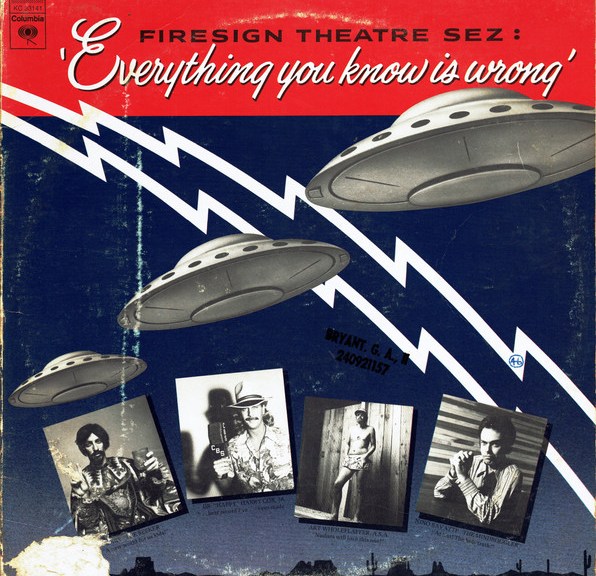
As a teenager in the 1970s, I was turned on to The Firesign Theater, and in those days, it was listening to their extended faux radio skits on vinyl (or as we said then, “albums”). One of their album titles lingers in my mind often: Everything You Know Is Wrong.
In fact, thinking about that title inspired me to post a couple polls on social media:
When was grade level reading proficiency “good enough” and/or better than now?
The first set of questions speaks to how we are often trapped in presentism, especially in the stories told by the media and messages perpetuated by politicians.
As I document in my reading policy brief and my book on reading wars, there has not been a single moment in the history of the US since at least the 1940s that we have not in the media and by politicians lamented low reading proficiency in students; as well, no standardized measurement of reading proficiency has ever been substantially different than now.
As with all measurements of student learning, reading proficiency has never been good enough and reading test scores have always correlated strongly with poverty, race, and gender.
Therefore, crisis rhetoric around reading is another manufactured crisis that is dismantled once we step back for historical perspective.
The second poll exposes how powerful media misinformation is, and how common it is for a claim to get into the public rhetoric without ever being interrogated.
The correct answer is “unknown,” although 30-35% not at grade level proficiency can be viewed as a credible estimate.
60-70% is definitely wrong, but represents the power of media messaging (based on not understanding NAEP). In 2018, Emily Hanford established this false claim: “More than 60 percent of American fourth-graders are not proficient readers, according to the National Assessment of Educational Progress, and it’s been that way since testing began in the 1990s.”
Then in 2023, Nicholas Kristof jumped into the long line of journalists who simply repeat this misinformation without ever checking the facts: “One of the most bearish statistics for the future of the United States is this: Two-thirds of fourth graders in the United States are not proficient in reading.”
We in the US love criticism of schools, students, and teachers, and making a negative claim about any of those will likely go unchecked.
Notice anything familiar about Susan O’Hanian’s experience at the Educator Writers Association (EWA) conference in 2003?:
Kati Haycock, though, was the one who really came up to the table for No Child Left Behind, reiterating these points:
Colleges of education are still teaching reading the way we thought it should be taught ten years ago.
There’s a “scientific” way to teach reading and teachers should be trained to do it.
The rhetoric and claims of those who want and need an education crisis are consistent, reaching back, again, to the 1940s, but also as recent as just 20 years ago when NCLB legislated “scientifically based” instruction and codified the National Reading Panel (NRP).
The media has taken a term, “proficiency,” and carelessly misinformed the public (because most journalists have little or no background in education, testing, statistics, etc.).
NAEP student achievement levels are performance standards that describe what students should know and be able to do. Results are reported as percentages of students performing at or above three NAEP achievement levels (NAEP Basic, NAEP Proficient, and NAEP Advanced). Students performing at or above the NAEP Proficient level on NAEP assessments demonstrate solid academic performance and competency over challenging subject matter. It should be noted that the NAEP Proficient achievement level does not represent grade level proficiency as determined by other assessment standards (e.g., state or district assessments). See short descriptions of NAEP achievement levels for each assessment subject.
NAEP “basic” is closer to what states have established as “grade level proficiency”; however, to further complicate the matter, the US has no standard definition for “grade level proficient,” and most people have never confronted that we should actually be using “age level proficiency.”
Thus, 60-70% is, in fact, absolutely not how many students are not reading at grade level. If we trust NAEP basic, it may be fair to say that about 30% or so are not at grade level.
But the most accurate claim we can make is that we have no real idea because we have failed to create the structures needed to know.
Why?
To be blunt, media and politicians benefit from constant education crisis, and if we actually implemented effective education reform, the profit of perpetual reform would disappear.
More historical perspective: None of the reforms have worked over the past 40 years of high-stakes accountability.
None.
The manufactured crises were all lies, and the solutions had little to do with education.
Reading crisis?
Nope.
Once again, the crisis rhetoric is a lie and the reforms benefit almost anyone except students and teachers.
Thanks to media and political misinformation, everything you know is wrong.
Although the “science of reading” (SOR) is now essentially the law of the land in the US—nearly every state has passed some form of reading legislation grounded in SOR—the Education Writers Association (EWA) has decided to double down on the media misinformation campaign about reading: Covering How Students Learn to Read: Tips to Get Started.
Not surprisingly, this brief overview for journalists relies heavily on the work of Emily Hanford (whose career was significantly boosted by EWA’s support for her relentless coverage of SOR) and repeats a number of claims in the SOR movement that have been discredited by scholars of literacy (see below).
The SOR education reform movement, however, is yet another neoliberal reform movement grounded in the “bad teacher” narrative (see the second excerpt below).
Education reform since the 1980s is mostly about creating churn and crisis for the benefit of media (sensational stories attract an audience for floundering outlets such as APM), the education marketplace (out with the old and in with the new—the same entities make money off Heinemann and the “new” structured literacy programs), and political grandstanding (despite none of the education reforms ever working).
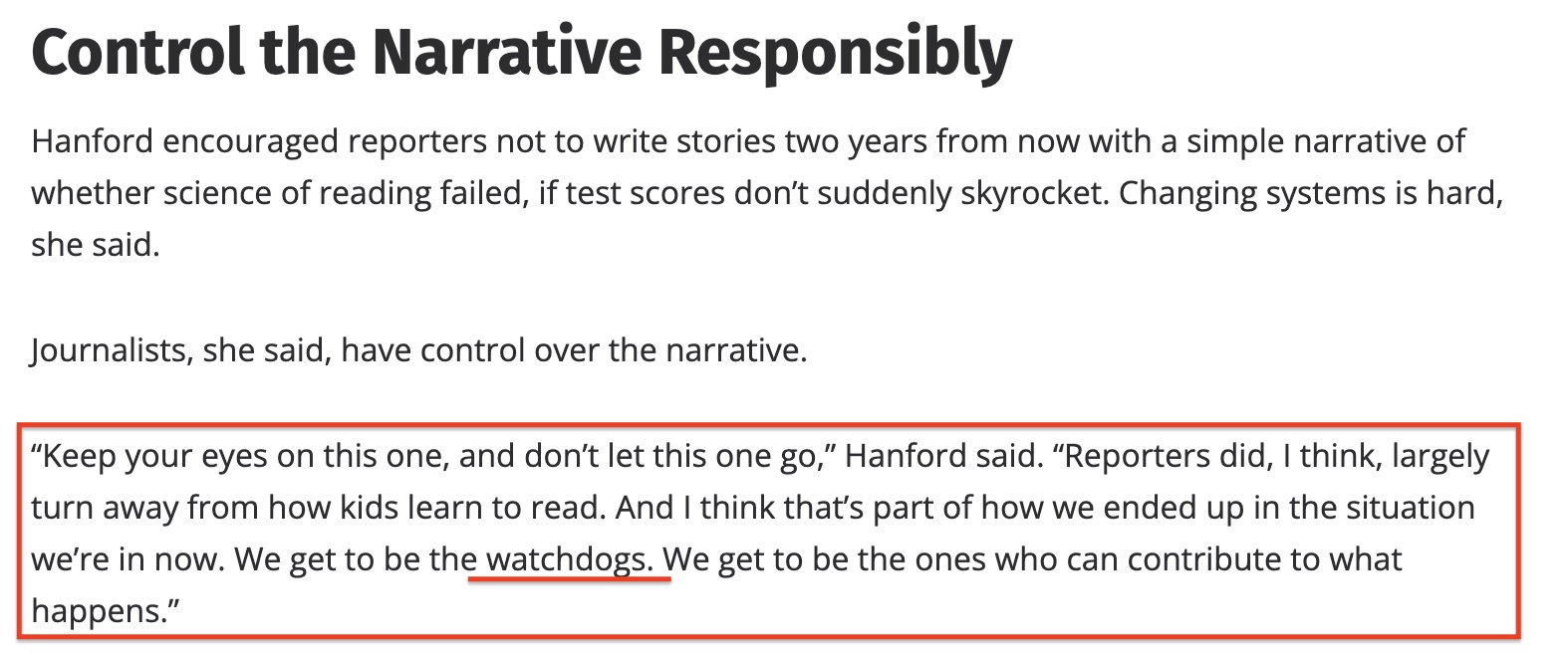
Let me draw your attention to two passages from EWA and then offer a reader that dismantles the false stories and offers the full picture of what we know (and don’t know) about teaching reading):
The research on reading is not in fact settled (see here) and this last passage exposes the fundamentally negative attitude (“watchdogs”) about teachers at the core of the SOR movement and its public and political appeal.
The media has been and seems determined to be irresponsible with their reporting about reading, students, and teachers.
For the full and complicated story, here are alternative texts:
Thomas, P.L. (2022). The Science of Reading movement: The never-ending debate and the need for a different approach to reading instruction. Boulder, CO: National Education Policy Center. http://nepc.colorado.edu/publication/science-of-reading









 dr. p.l. (paul) thomas