All posts by plthomasedd

P. L. Thomas, Professor of Education (Furman University, Greenville SC), taught high school English in rural South Carolina before moving to teacher education. He is a former column editor for English Journal (National Council of Teachers of English), current series editor for Critical Literacy Teaching Series: Challenging Authors and Genres (Brill), and author of Teaching Writing as Journey, Not Destination: Essays Exploring What ‘Teaching Writing’ Means (IAP, 2019) and How to End the Reading War and Serve the Literacy Needs of All Students: A Primer for Parents, Policy Makers, and People Who Care (IAP, in press). NCTE named Thomas the 2013 George Orwell Award winner. He co-edited the award-winning (Divergent Book Award for Excellence in 21st Century Literacies Research) volume Critical Media Literacy and Fake News in Post-Truth America (Brill, 2018). Follow his work @plthomasEdD and the becoming radical (https://radicalscholarship.wordpress.com/).

The Anti-Teacher (and Sexist) Roots of Rejecting Teacher Autonomy

[Header Photo by Katherine Hanlon on Unsplash]

One challenge of doing public work and advocacy addressing education, education reform, and teachers/teaching is framing clear and accessible messages that avoid being simplistic and misleading.

Since I am in my fifth year of challenging the overly simplistic and misleading “science of reading” (SOR) movement, I have attempted to carefully craft some direct and brief messages, including “not simple, not settled,” “teach readers, not reading,” and my core commitments to teacher autonomy and the individual needs of all students.

One would think that those core commitments attract support even among those who disagree on other aspects of teaching and education policy. However, I face a persistent resistance to supporting teacher autonomy.

At a fundamental level, teacher autonomy is essential for teaching to be a profession, but autonomy is also essential because education is a high-accountability field.

The problematic tension in education is that teachers are routinely held accountable for mandates (not their professional decisions and practices) and how well they comply with the mandates. Since many education mandates are flawed (such as current reading legislation) and for decades have failed, teachers are then blamed for that failure even though they didn’t make the mandates and were simply the mechanisms for practices.

Most education crisis rhetoric and education reform have been grounded for decades in anti-teacher sentiments. Currently, the reading crisis movement blames reading teachers for being ill-equipped to teach reading (failing children) and teacher educators for not preparing those teachers, for example.

One of the strongest elements of rejecting teacher autonomy, in fact, is among SOR advocates who promote structured literacy, often scripted curriculum [1] that reduces teachers to technicians and perpetuates holding teachers accountable for fidelity to programs instead of supporting teacher expertise to address individual student needs.

Let me be clear that all professions with practitioner autonomy have a range of quality in that profession (yes, there are some weak and flawed teachers just as their are weak and flawed medical doctors). To reject teacher autonomy because a few teachers may not deserve it is a standard not applied in other fields.

But there may be a gender-based reason for such resistance.

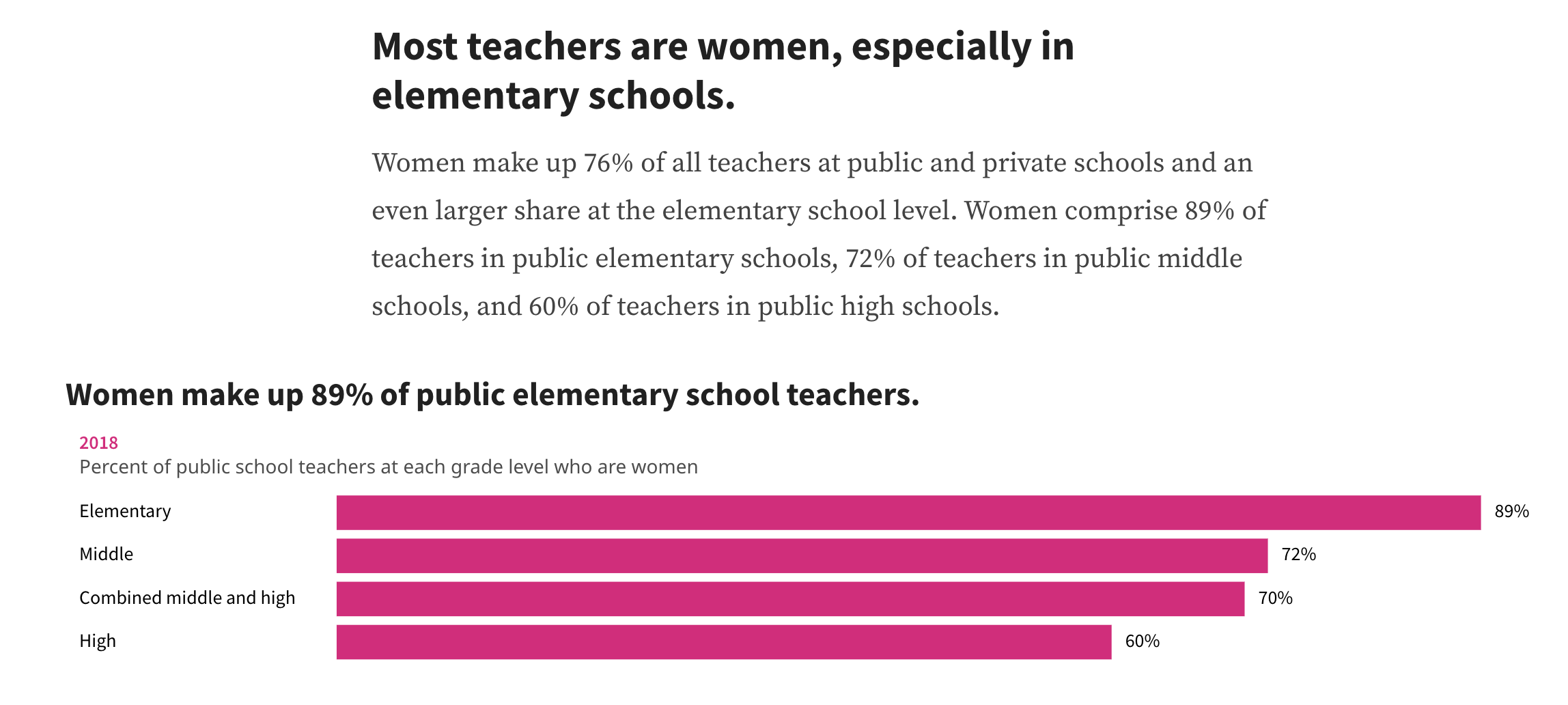
K-12 teaching (especially elementary teaching) is disproportionately a woman’s career:

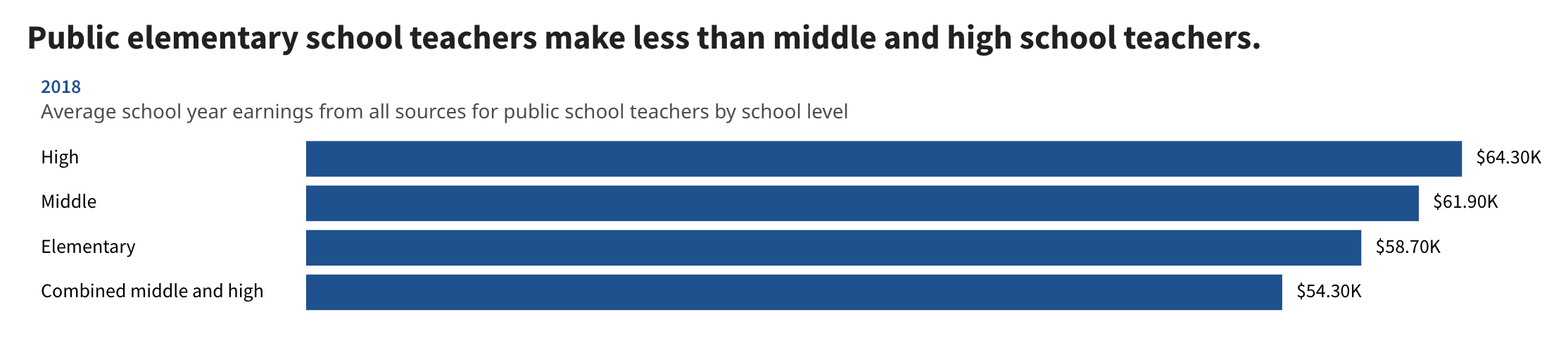
And while teacher pay is low compared to other professions, the pay inequity is more pronounced in areas where the proportion of women is even higher:

As a frame of reference, a more respected and better rewarded teaching profession is in higher education where professor have professional autonomy, except the gender imbalance exposes a similar sexist pattern:

While the gender balance is better in higher education than K-12, the pay and security of being a professor increases where men are a higher proportion of the field.

Autonomy, pay, and respect track positively for men and negatively for women in teaching, and the resistance to autonomy for K-12 teachers strongly correlates with the field being primarily women.

A key but ignored element of education reform must include better pay for all K-12 teachers and supporting teacher autonomy so that individual student needs can be met.

The historical and current resistance to teacher autonomy exposes the lingering sexism in how we view, treat, and reward educators.


[1] Compton-Lilly, C.F., Mitra, A., Guay, M., & Spence, L.K. (2020). A confluence of complexity: Intersections among reading theory, neuroscience, and observations of young readers. Reading Research Quarterly, 55(S1), S185-S195. https://doi.org/10.1002/rrq.348

Commentary: There’s no merit in merit pay plans for rewarding, retaining SC teachers (The Post and Courier)

Commentary: There’s no merit in merit pay plans for rewarding, retaining SC teachers

While the Editorial Staff of the Post and Courier rightfully raises cautions about newly elected Superintendent of Education Ellen Weaver, who has a history of extremely conservative positions on public education, that caution should also extend to Weaver’s plans for merit pay to address teacher needs in South Carolina.

I am in my fifth decade as an educator in SC, beginning as a high school English teacher in Upstate SC in 1984. Over that career I have witnessed one frustrating pattern: A constant state of education reform that recycles the exact same crisis rhetoric followed by the same education reforms.

Over and over again.

In fact, in very recent history, SC and the nation have experienced a high intensity focus on teacher quality, teacher evaluation, and teacher merit pay models under the Obama administration.

And just like in the so-called real world of business, merit pay models for teachers have failed.

Under Obama and then-Secretary of Education Arne Duncan, federal and state policy helped implement teacher evaluation and pay schemes modeled on Bill Gates’s use of stack ranking. Notably this value-added model of teacher evaluation and pay was famously heralded by the media when Michelle Rhee was chancellor of DC schools.

However, over time, Rhee’s tenure was unmasked as mostly a fraud but also as extremely harmful for teachers and students.

While merit pay remains a popular approach to recruiting and maintaining workers across many fields, research has consistently shown that merit pay does not work, and often has negative consequences, especially in education.

Research by Dan Pink and Alfie Kohn, for example, highlight the disconnect between what merit pay promises and how that plays out in the real world.

Gary Clabaugh challenged Obama’s merit pay polices, offering evidence that remains valid today and suggests not only caution about Weaver’s merit pay plan but also solid reasons not to try the same thing again.

Merit pay fails education, teachers, and students in the following ways:

  • Merit pay assumes workers need motivation to work harder; teachers are often overworked and their ability to be effective is not a result of how hard they are working, but the conditions under which they work.
  • Merit pay is often linked to standardized testing in education. As a result, merit pay incentivizes teaching to the tests and corrupts evaluation systems intended to measure learning.
  • Merit pay creates a culture of competition, instead of cooperation. Research also shows that competition is more harmful than cooperation, especially in the field of education where all educators should be invested in the success of all students.
  • Measurable student achievement, mostly through standardized testing, is more heavily linked to out-of-school factors (60-80%) than to in-school factors or teacher quality (10-15%). Therefore, merit pay overemphasizes direct and measurable teacher impact and often holds teachers and students accountable for factors beyond their control.

Policy makers in SC are faced with two facts: (1) Teacher pay is important to address and long overdue in the state; however, (2) merit pay is an ineffective and even harmful approach to addressing pay and teacher shortages.

Since SC has tried to use pay incentive to address teacher shortages in struggling districts already, we will better serve the needs of our students if we commit to new and different reforms.

The greatest need in SC is that elected officials directly address poverty across the state—access to healthcare, stable jobs with strong pay, and access to affordable housing.

But we can also do better with in-school reform.

If we want to bolster the teaching profession among our high-poverty districts, we must address teaching and learning conditions, which include the following:

  • Parent, community, and administrative support for teachers.
  • School facilities in good repair.
  • Fully funding teaching and learning technologies and materials.
  • Guaranteeing students who are struggling have access to experienced and certified teachers.
  • Recognizing that student success is linked to teacher quality, but that teacher quality is only one element in a complex network of forces that help children learn.

SC remains faced with a very old problem—high-poverty students struggle to achieve well enough or fast enough compared to their more affluent peers.

Those children deserve new solutions, and merit pay is a tired gimmick that has never worked and will fail children and teachers once again.


See Also

Edujournalism and Eduresearch Too Often Lack Merit

Teaching Reading and the Goldilocks’ Dilemma: A Case for Purposeful Literacy

Everyone teaching reading is confronted with the Goldilocks’ dilemma.

Using terms offered by Stephen Krashen, I see teaching children to read falling on a spectrum.

Intensive phonics (often called systematic phonics) is serving porridge that is too hot. Zero phonics is serving porridge that is too cold. But basic phonics is serving porridge that is just right.

The current reading war, the “science of reading” (SOR) movement, is little different than any of the proceeding reading wars; once again, the war is being framed as one between intensive/systemic phonics and zero phonics.

And once again, the “just right” option, basic phonics, is being left out of the rhetorical equation.

Let me be very clear. What I am doing is not a call for compromise or for a middle approach. I find the pendulum analogy to be one of the problems with the recurring reading war, in fact.

My proposal is more akin to the conclusions draw in England that showed systematic phonics has not achieved what was promised and that students would be better served with “balance.”

Of course, the word “balance” often triggers the caricature of “balanced literacy” (BL) offered in the SOR movement, a misrepresentation that erases the philosophical and theoretical framing intended in BL (teacher autonomy grounded in serving the individual needs of students).

Where people get lost, I think, and what I am proposing is that the balance isn’t about reading theories (such as balancing phonics and comprehension in instruction), but about how any teacher serves the individual needs of any student.

The balance is about balancing student needs with instructional goals, and then, making sure the teacher and student are provided the appropriate teaching and learning conditions for students to learn to read.

This sort of balance de-centers reading programs and standards, and centers students. As a result most any program or set of standards can be effective or not depending on the teacher’s ability to serve the student’s needs.

Another aspect of this dilemma, I think, is that intensive/systematic phonics will always prove to be too hot because it over-emphasizes the role of the letter-sound system. Nonsense words and decodable texts mislead students about the complexity of decoding and making meaning from text.

Students may be compelled to see phonics as a simple plug-and-play until they encounter “wind” or “dove,” two words that have differing pronunciations in different contexts.

Also consider the maze of problems when exploring the letter “C”:

Cease

Crease 

Cause

Cello

Checker 

Climb

Slime

Coach

Cat

Space

Cough

Coffee 

“C” shares sounds with “S” and “K,” but this series of words presents some satisfying patterns as well as some baffling exceptions that students could better navigate with some background in etymology and with greater experience reading (and thus building their toolbox for making meaning).

The question (which still hasn’t been fully answered by research) has never been if students need phonics, but how much, when, and how that is acquired (upfront v. by extensive reading).

Intensive/systematic phonics is too hot and misleading, I think, for the same reason that worksheet approaches to context clues are ultimately harmful. The “rules” for using context clues tend to work only in sentences designed to prove context clues strategies work.

As I have noted before, this is the training wheels versus balance bicycle dilemma.

The SOR reading war is fundamentally no different than any other reading war; see McQuillan’s debunking of the whole language reading war from the 1990s and note the similar patterns found in the current SOR movement.

Currently, the media misinformation and the misguided political response have made yet another claim that reading instruction has failed to provide systematic phonics (porridge too cold), and now state reading policy and reading program adoption are scrambling to implement structured literacy (scripted curriculum, porridge too hot).

In the US, we have never stepped back from the same old reading war rhetoric that centers all the adults and their (often petty) ideological biases.

Too often, everyone is caught up in selling their thing by demonizing other people’s things.

It is a tremendous failure of logic to shout that current popular reading programs have failed students because publishers and program creators are grabbing the cash, and therefore, we need to change to a different set of programs (with publishers and program creators who are also grabbing cash).

Again, we must stop centering adult ideologies and market interests, and start centering the students themselves and also providing teachers the resources and conditions to serve student needs.

What I propose is purposeful literacy, which has the following framing:

  • The teaching of reading begins with individual student artifacts of reading (strengths, needs, etc.)—not programs, standards, or mandates.
  • Centering the individual needs of students requires that we address the equity in their lives outside of school as well as in school.
  • The effective teaching of reading requires teacher autonomy and teaching and learning conditions that allow teachers to serve individual student needs.
  • Reading materials, programs, and standards must be tools that serve teacher instruction and not goals and frameworks for teacher accountability. The current “problem” with reading programs is not the quality of any program but that programs become the goal of teaching (fidelity, “is the teacher implementing the program” v. “is the student being served”).
  • Purposeful literacy places reading skills (such as phonics) in both the context of comprehension and critical literacy (moving beyond mere understanding to interrogating text).
  • The goal of purposeful literacy is students who are eager, independent, and critical readers.

The reading war approach to education reform is not a fairy tale; it is a horror story, and almost no one survives.

We must set aside the quest for THE program and the THE theory of reading.

Instead of centering all the adults and the concurrent pettiness, we must center the individual needs of students, which includes honoring the autonomy of teachers and providing both teachers and students the teaching and learning conditions that make a “just right” approach possible.

GOD. GUNS. TEXIDA. [Fiction]

1

“What are you, blind? You fucking GASR,” the screamer’s disorientingly swollen finger pointed aggressively at a sign reading:

No.

Fucking.

GASRS.

Allowed.

The screamer’s beard was huge, scraggly like a briar patch, and bright red, but more orangish than the red ball cap hiding their equally red hair and reading: “GOD. GUNS. TEXIDA.”

The cap’s bill was tattered and the wording on the crown had loose gold threads. A Texida flag patch seemed to have been recently sewn onto the side of the hat:

Terror Mustang simply kept walking after pausing briefly at the screamer pointing at the sign.

Terror came from a long line of Fords who had been living for many decades now in a huge automotive graveyard. The Ford name became such a stigma that a few generations ago, someone changed their name to Mustang, but it wasn’t fooling anyone, Terror knew all too well.

Everybody hated GASRS, people who sat at the bottom of the current food chain in Texida and continued to drive cars with combustible engines.

Terror’s grandfather told them often about the good old days when gas cars were normal, when gas prices were high, and when fear of running out of gas was always at the edge of people’s thinking.

And when there was one United States instead of Texida—where Terror was born, enveloping the Southern most part of the defunct USA—and the Northern and Western most area, New Cali.

Now, however, gas was nearly free for the taking, and Terror lived among hundreds of abandoned automobiles. They had rows and rows of old school busses that had been converted over the years into dozens of libraries and storage units—and of course living quarters.

Gas stations were rare, but the gas was really cheap or sometimes unattended and free. But Terror also had dozens of gas tanks around the automotive graveyard for their using.

Terror used to sit listening to stories of many ages ago when there were gas wars—prices for gas dropped at competing stations—and gas shortages that caused high prices and panicked lines for just a few gallons of gas. But the hardest part of the stories to believe were that people used to fear running out of gas, something that never happened and then gas became almost worthless.

In the school buses, books that had been banned and not burned, and thousands of automobile manuals that almost no one cared about were carefully stored from the elements and meticulously catalogued by several generations of Fords/Mustangs, and now watched over and used by Terror—possibly the last of the Mustangs for all they knew.

Among their stash, Terror had 37 bicycles as well—one of which they had been riding past the store when the screamer launched into their tirade, a store that Terror was, in fact, not going to enter.

But nearly daily mechanical work on the cars and the bicycles left Terror’s hands etched with lines of grease, and they usually smelled of gasoline, although Terror had long ago stopped noticing it.

Fuck. Off. MAGAT, Terror thought, but had learned simply to stay silent, not make eye contact, and go about their business.


Terror was nearly self-sufficient and could make it most of the time staying at the automotive graveyard, home. But trips into Town were necessary for supplies, usually food, and not becoming something of a solitary monster, they thought, often, lying alone in bed at 3 AM unable to fall back asleep.

Town had once been University before they all shut down after Texida formed and the Florida Education Act established School for everyone from 6 years old until their seventeenth birthday. After that, all were required to do Service—military, police, work, or the few who were urged to become doctors who needed Training for a few more years—for life.

Everybody gets Basic Skills, goddamit, the Governor said, and then you can just learn by doing it!

The Town was converted red brick buildings that had been the University, mostly Apartments and some Stores now.

Terror was heading to the Store when the MAGAT yelled, the Store where Apricot worked.

Terror and Apricot had been in School together, but they had never talked until Terror entered the Store one day many years after School and thought they saw Apricot with a book.

Not exactly Illegal but unusual.

Terror without thinking spoke, “Hi, I am Terror. Used to be Ford but it is Mustang now.”

“I know,” Apricot said. “Everybody calls me ‘Apricot,’ but my name is Apathy. We’re all Stones.”

Apricot held the book with their arm limp at their side. Terror recognized the artwork: The Very Persistent Gappers of Frip. Terror had three or four copies scattered among the libraries they had organized in several buses, books for reading mixed in with hundreds of automotive manuals.

For a long time, Terror assumed Apricot’s family were MAGATs, although they kept their Store open for anyone with the required Sign on their window: “Fucking. GASRS. Allowed.”

Before seeing Apricot with the book, Terror had noticed the sign had an ivy vine drawn in thin black ink snaking around the angry three words. The ivy was identical to the tattoo Terror noticed one day peaking out of Apricot’s tank top, across their collar bone, and then also, out the bottom of one shorts leg down their thigh.

That was the first day Terror regretted lying alone in the automotive graveyard, even with the books, even with no MAGATs screaming near them.

2

There had been other reasons Terror felt lonely, even abandoned, of course.

DK had been a talker, sometimes seemingly nonstop. Equal parts fascinating and annoying.

DK had died several years ago, But Terror could never keep very good track of time. Seemed really recent and forever ago. The thing that made it seem like maybe it was just yesterday was DK talking about a book they had read.

They never could recall the title and occasionally offered an author name but that seemed to change and DK often said they had no idea about that either.

Rayberry.

Brad-something.

Bradley or Raymond.

“Shit. No idea,” DK said most of the time.

All Terror had was a slightly changing plot that DK would ramble through when high as a kite. DK always added, “I am high as a kite” when rambling more than a couple hours.

Terror learned to grow Wana from DK, converted a few buses with DK’s help to make grow areas.

And Terror spent idle time walking through the dozens of buses that they had converted into libraries (the old kind) scanning every book hoping to find the one DK retold over and over.

Libraries in Texida were where everyone checked out their guns, each one nestled in a hollowed out book. All citizens of Texida had to either own or check out regularly a gun as well as complete target training and retraining.

DK had taught Terror about a glitch in the system, a way to fabricate checking out guns and registering for training and retraining. In fact, DK had shown Terror several Internet hacks, but they really believed the whole thing was a scam. DK could find no evidence that anyone monitored the training and retraining; bypassing the system and fabricating sessions were incredibly easy as well.

It was good enough that everyone believed they were being watched, that everyone was dutiful and maintained a system that ironically only continued because people believed it had to.


“So there is this book, you see, that is really very eerie, if you ask me,” and DK would launch into their retelling. It happened dozens and dozens of times for many years until they died.

Terror found DK dead beside one of the Wana buses, probably high as a kite and certainly dead as a rock.

The funny thing, DK narrated, was not all that funny but just clever as hell kind of funny was that the book had a bunch of firemen that didn’t put out fires but burned books because all books were illegal.

Terror noticed DK almost always started that way, but that huge parts were different and nearly incoherent at times. Maybe depending on how high the kite was that day.

But the other part that never varied was when DK seemed the most moved, sort of emotional and both really calm and deeply upset.

There were these fuckers, you see, DK slowly explained leaning forward and rubbing their gray beard, that dedicated themselves to memorizing whole fucking books to preserve them for the future or whatever. Jesus fucking Christ, man, that is really something. Really gets me, you know. Whole. Fucking. Books.

DK would pat their chest right at their heart. Usually triggering a cough and DK taking a long draw on his Wana.

That’s some kind of devotion, you know, fucking real devotion, DK often seemed about to cry. Son of a bitch.


Terror wanted to cry when they thought about DK retelling the story. But more than anything Terror wanted to find the book.

Read it.

Maybe memorize it. At least know it better than DK’s rambling.

After falling deeply asleep while high, Terror had a recurring dream about finding the book. Usually it burst into flames as Terror opened it.

Then Terror would jerk awake, maybe screaming.

Terror wanted to tell Apricot DK’s version, but also wanted to find the actual book and share that. And Terror wanted to tell Apricot she was now in that dream many nights.

Apricot would find the book, hold it up to ask Terror if they had found it, and then, Apricot would burst into flame.

When Terror jerked awake from those dreams, they were in fact screaming.

[More to come … maybe]

“Sell What We Do”: The Manufactured Crisis to Hide the Story Being Sold [Updated]

[Header Photo by Kelly Sikkema on Unsplash]

The Origin Story for the “science of reading” movement is popularly associated with a story published by Emily Hanford from 2018. And that movement has gained even more momentum by Hanford’s repackaging that initial (and deeply misleading) story as a podcast, Sold a Story.

The dirty little secret is that this story is not about the ugly underbelly of teaching reading or about creating a new and better way to teach reading. This story is cover for the selling of a different story to feast on the profitable education marketplace.

The single-minded blame-game in Sold a Story that creates reading Super Villains in the form of reading theory (balanced literacy) and reading leaders (Lucy Calkins, Fountas and Pinnell) is a tired and very old media and political strategy.

However the real Monster in the larger story is the marketplace itself, and the conveniently ignored backstory is several years before 2018.

The “science of reading” misleading and oversimplified story [1] about the teaching of reading spoke into a context that was fertile ground for misinformation to not only sprout but thrive—the dyslexia movement, specifically the Decoding Dyslexia structure [2] that was already in place in all 50 states.

Here is an interesting and revealing artifact from 2014:

At its July 1st meeting, the IDA Board of Directors made a landmark decision designed to help market our approach to reading instruction.  The board chose a name that would encompass all approaches to reading instruction that conform to IDA’s Knowledge and Practice Standards. That name is “Structured Literacy.”…

If we want school districts to adopt our approach, we need a name that brings together our successes. We need one name that refers to the many programs that teach reading in the same way. A name is the first and essential step to building a brand….

The term “Structured Literacy” is not designed to replace Orton Gillingham, Multi-Sensory, or other terms in common use. It is an umbrella term designed to describe all of the programs that teach reading in essentially the same way. In our marketing, this term will help us simplify our message and connect our successes. “Structured Literacy” will help us sell what we do so well.

Structured Literacy: A New Term to Unify Us and Sell What We Do

“If we want school districts to adopt our approach,” well, we need to clear space in the reading program marketplace, and that is exactly what the “science of reading” movement is doing with the help of media and complicit parents and political leaders.

Again, the goal announced in 2014: “‘Structured Literacy’ will help us sell what we do so well.”

The many recurring Reading Wars have been driven by people who are sincere and people with ulterior motives—and this “science of reading” movement is no different.

For those with good intentions, that simply is not enough if we are unwilling to confront all the stories being sold as well as the costs of these market wars to effective teaching and the most important outcome of all—students who are eager and critical readers.

Sold a Story [3] is a cover for another story being sold and packaged, literally, and the attacks are designed to clear market space, not support teachers or address individual student needs.

Update

If you want to understand how the education market and education reform machine overlap (or fuel each other), consider the Common Core > Great Minds > Wit & Wisdom (d)evolution as examined in the following:


[1] Media Coverage of SOR [access materials HERE]

Hoffman, J.V., Hikida, M., & Sailors, M. (2020). Contesting science that silences: Amplifying equity, agency, and design research in literacy teacher preparation. Reading Research Quarterly, 55(S1), S255–S266. Retrieved July 26, 2022, from https://doi.org/10.1002/rrq.353

MacPhee, D., Handsfield, L.J., & Paugh, P. (2021). Conflict or conversation? Media portrayals of the science of reading. Reading Research Quarterly, 55(S1), S145-S155. Retrieved July 26, 2022, from https://doi.org/10.1002/rrq.384

Cryonics Phonics: Inequality’s Little Helper – New Politics

The Science of Reading and the Media: Is Reporting Biased?, Maren Aukerman, The University of Calgary

The Science of Reading and the Media: Does the Media Draw on High-Quality Reading Research?, Maren Aukerman

The Science of Reading and the Media: How Do Current Reporting Patterns Cause Damage?, Maren Aukerman

Making sense of reading’s forever wars, Leah Durán and Michiko Hikida

[2] The Hidden Push for Phonics Legislation, Richard L. Allington, University of Tennessee

[3] Recommended: The Broken Logic of “Sold a Story”: A Personal Response to “The Science of Reading,” Tom Newkirk

Recommended

Education Week Finds Corporate Pals to Spread a Message, Susan Ohanian

Connecting Big Business with The Science of Reading: Replacing Teachers and Public Schools with Tech, Nancy Bailey

The Long and Tired History of Media-Driven Reading Wars

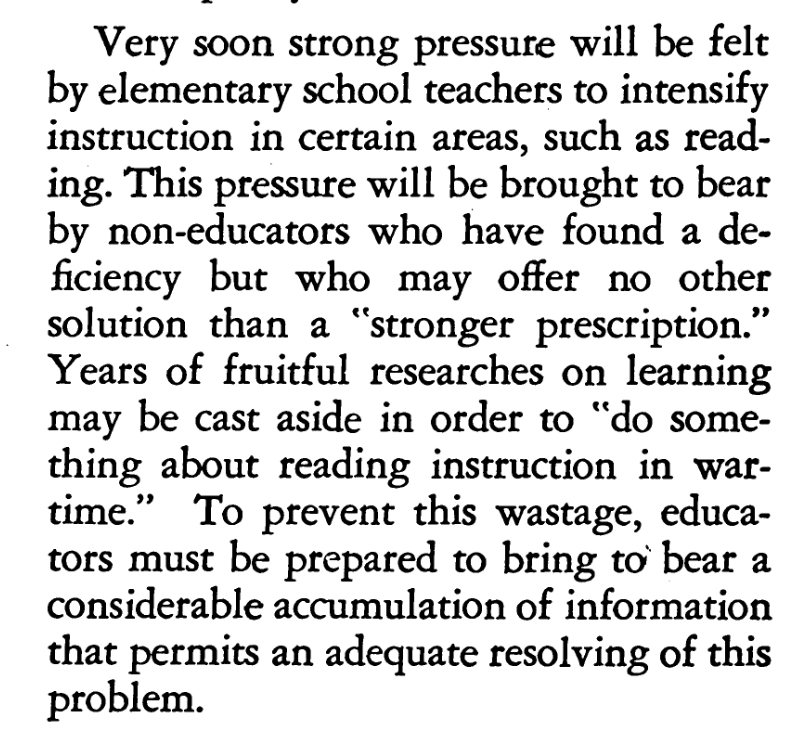
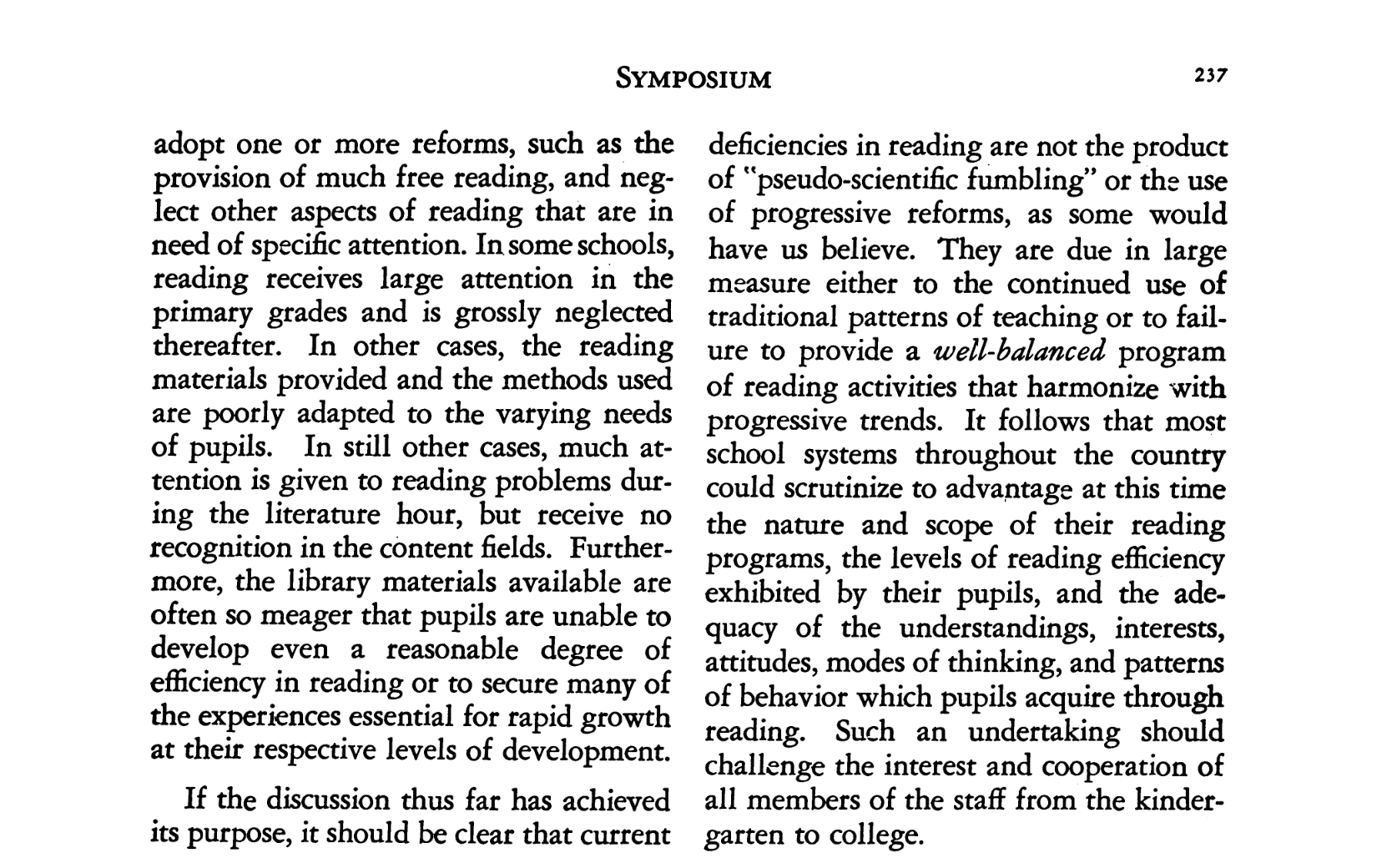
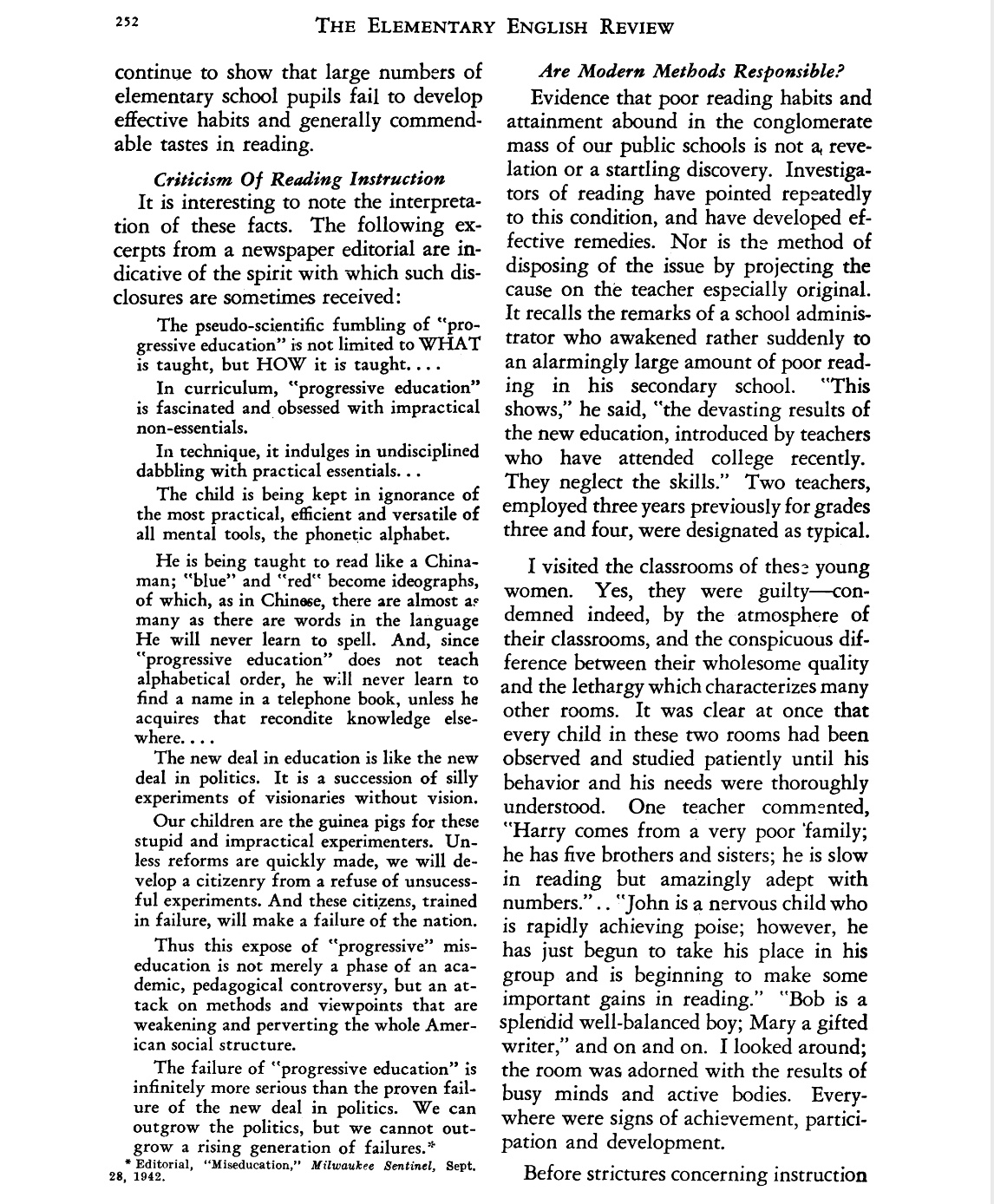
Consider the following excerpts from a scholarly journal of literacy. The articles included are responses from literary scholars to a political and media claim of a reading crisis.

First from Emmett A. Betts:

Next, from William S. Gray:

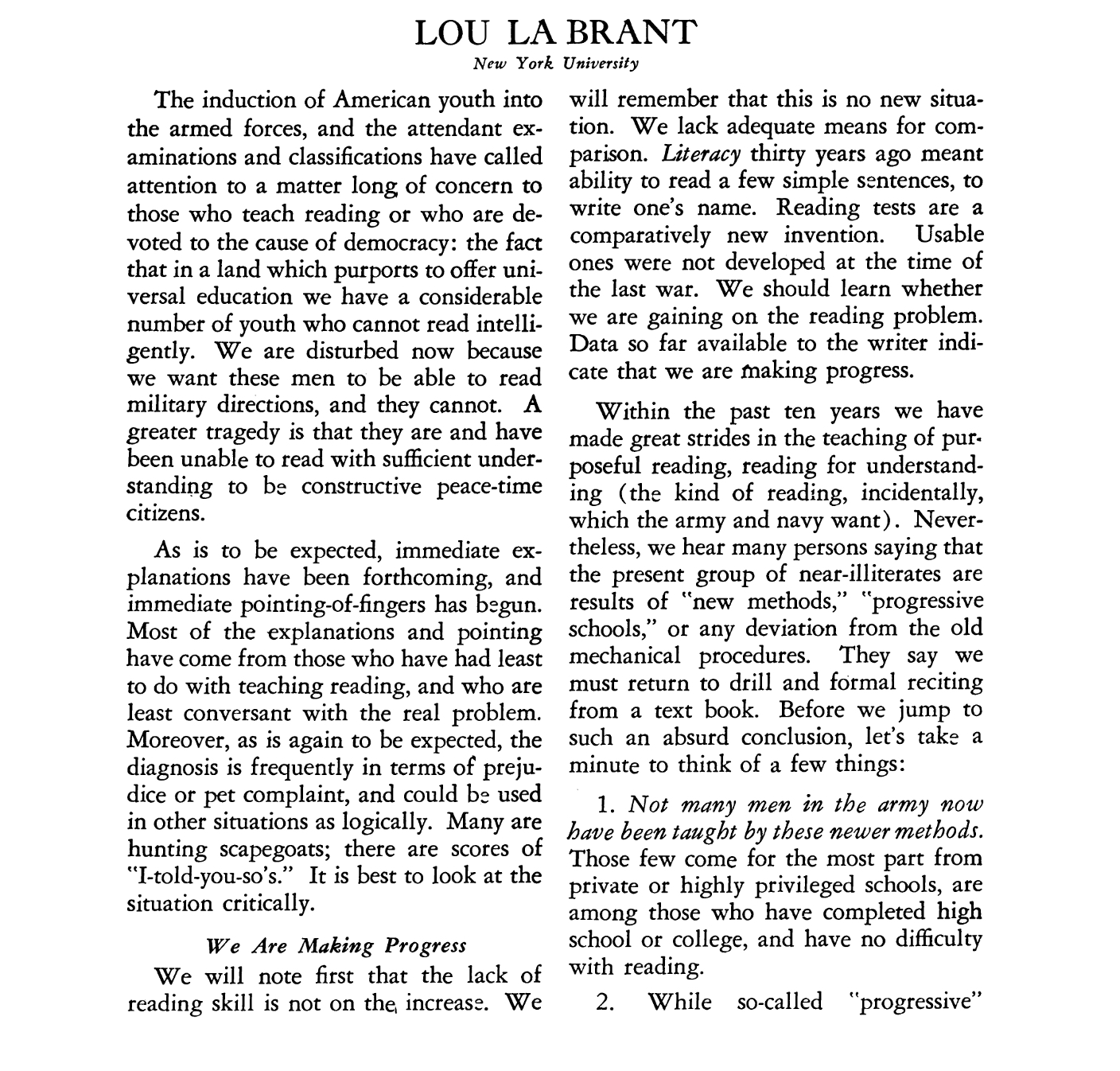
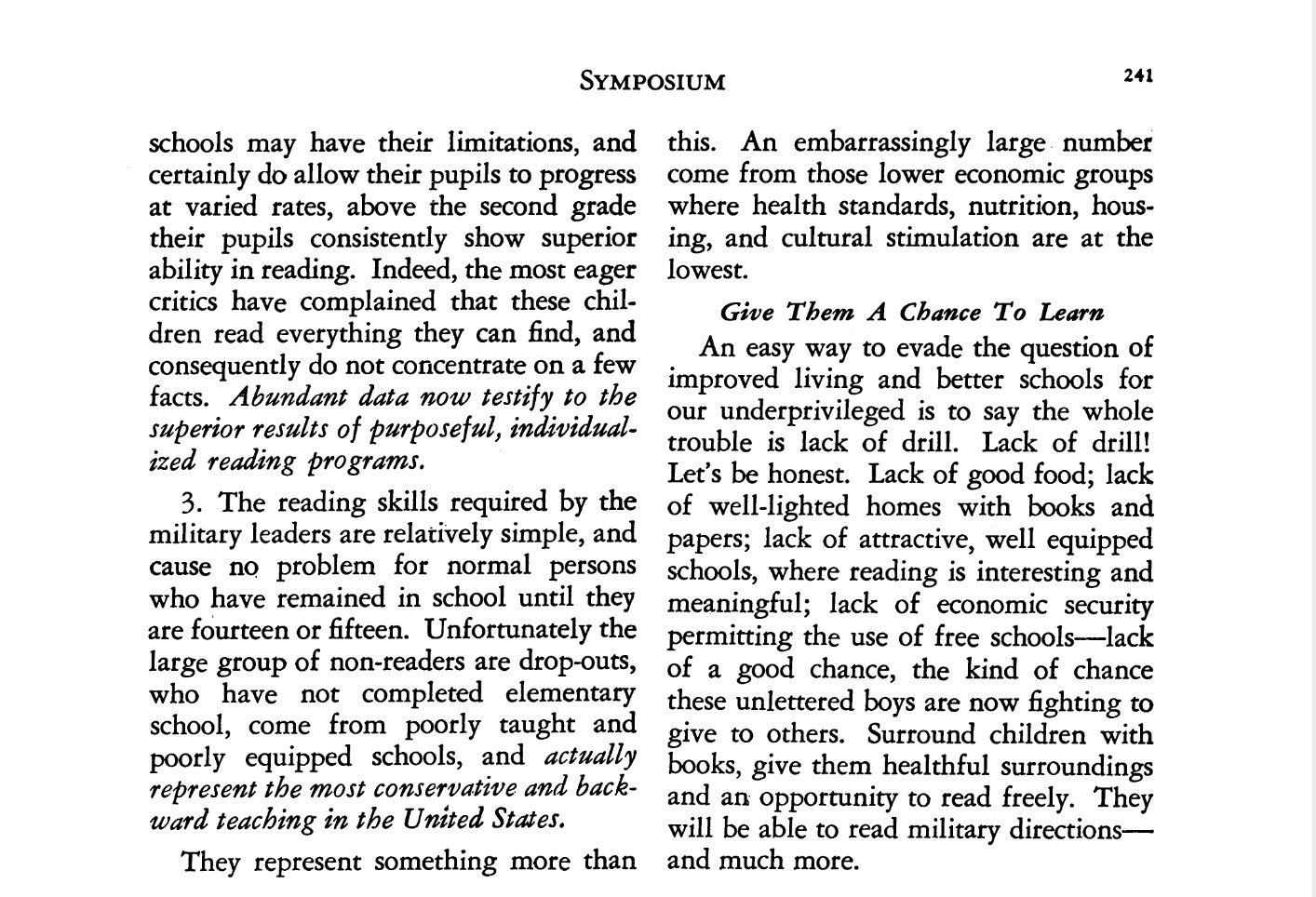
And then, from Lou LaBrant:

Finally, Paul Witty:

These patterns may seem familiar in 2023 to anyone following the “science of reading” movement:

  • Public schools are failing to teach adequately children to read.
  • Reading teachers are ill-equipped to teach reading.
  • Reading and teaching strategies are not scientific.
  • Political leaders and the media drive the criticism.
  • And literacy scholars carefully debunk the entire narrative, to no avail.

These excerpts are from 1942 and collected in The Elementary English Review (The National Council of Teachers of English), which would become Language Arts [1].

The reading crisis was spurred by high illiteracy rates in WWII draftees and Eleanor Roosevelt’s call to action and media coverage of the reading crisis.

The blame game, like now, is misguided and ill informed. Progressive education was the scapegoat, but LaBrant and others noted these soldiers had attended mostly traditional schooling.

Scholar after scholar also note that high illiteracy rates were caused by high poverty levels.

In 2023, as we are trying to stay afloat during the “science of reading” tidal wave of misinformation, we must acknowledge that this current reading war does not differ in any significant way from several since the 1940s.

We must also acknowledge that at no point has the US found reading achievement adequate regardless of teacher training, reading theories, or reading programs and instructional practices.

Reading Wars, then, are reductive, misleading, and ultimately ineffective—over and over.

The “science of reading” movement is another round of misguided blame, misinformation, and yet more hollow calls for “reform” that isn’t anything new or valid.

The “science of reading” is tired and lazy journalism, politics, and ultimately education.


[1] Betts, E., Dolch, E., Gates, A., Gray, W., Horn, E., LaBrant, L., . . . Witty, P. (1942). What shall we do about reading today?: A symposium. The Elementary English Review, 19(7), 225-256. http://www.jstor.org/stable/41382636 [access HERE]

The Return of Missionary Zeal in Education Reform: “Science of Reading” Edition

Increasingly, I am contacted by email or spoken to in person by teachers with a similar and disturbing series of experiences.

These teachers ask to remain anonymous out of fear of retaliation because they have already been reprimanded or dismissed for simply asking questions about their school/district’s implementing the “science of reading.”

One recent communication I received represents well that pattern (I am paraphrasing and reducing specifics to protect anyone trying to identify the specific teacher, and this is representative of dozens and dozens of similar communications).

The teacher has been a literacy educator well over a decade and also has earned a doctorate. A few years ago, this teacher had a first experience with LETRS training being required for university faculty where they were on one-year contracts.

After asking about why LETRS was being required and noting that the research base doesn’t support that training as effective, the teacher was shunned by their administrator and then their contract wasn’t renewed.

Before leaving that school, they noticed some faculty had simply stopped attending the training, but the administrator sought other faculty to log in to complete that training. The teacher grew concerned that there seemed to be some incentive for simply having many faculty trained.

At a new school, that teacher was immediately required to go through LETRS training. They described the training as a “cult” experience in which professional educators were handed pipe cleaners and asked to make models of the “simple view” of reading (Scarborough’s rope).

While I have repeatedly documented (along with several other scholars; access materials HERE) that the “science of reading” movement is primarily over-simplified narratives and misinformation, I want here to address that the central flaw in the movement is one we have seen in recent history regarding education reform: missionary zeal.

It is important to emphasize that I am aware of no one who rejects that a body of reading science/research exists and that should be a significant part of what drives classroom practice.

However, the media-driven SOR movement and the political consequences of that advocacy that has resulted in SOR-labeled policy are oversimplified and misguided versions of that research base.

And that new policy is often unscientific and harmful such as the pervasive implementation of grade retention.

Further the SOR movement fails to ground the narrative in the history of the field of reading and education reform.

For example, during the “miracle” school/teacher era spanning from George W. Bush through Barack Obama, missionary zeal drove Teach For America, charter schools, “miracle” school claims, and value-added methods for evaluating teachers.

At the core of these connected elements of education reform is a missionary zeal that ultimately failed to produce what was guaranteed, primarily because the reformers misidentified the problems and offered misguided solutions. In the case of the SOR movement, the same mistake is being made by claiming that reading science is simple and settled.

Currently, the “science of reading” movement has fallen into the missionary zeal trap as represented by The Reading League:

The similarities in these two recent movements are important and damning:

The criticisms I have raised are directly targeting the missionary zeal and misinformation found in the media story [1] and the political reaction [2] to that false narrative.

Reading proficiency in the US is about the same now as well before anyone implemented balanced literacy or current popular (and demonized) reading programs. And persistently over the last 80 years, scholars have lamented the “considerable gap” between research and practice in all aspects of K-12 education.

Throughout those 80-plus years, no one has ever been satisfied with student reading achievement regardless of the reading theory being implemented or the reading programs being adopted.

And teacher preparation has been significantly hampered for the past 40 years by top-down accountability mandates that have reduced most teacher certification to more bureaucracy than preparation. A dirty little secret that SOR advocates ignore is that how teachers are prepared to teach reading matters little because most teachers are bound to reading programs and reading standards once they enter the classroom. A huge gap exists between how teachers are prepared and how they are allowed to teach.

But manufacturing a crisis, perpetuating melodramatic stories, and casting simplistic blame are doing the same things we have done in education reform for decades without ever truly supporting teachers or better serving all students.

Just like the TFA and charter/”miracle” school era immediately behind us, the SOR movement is anti-teacher and anti-schools. The public and political leaders have been well primed since the 1980s to believe that schools are horrible and that teachers are incompetent. Regardless of what SOR advocates intend, that is what most people hear.

SOR advocates have falsely attacked teacher expertise, both that of K-12 teachers and that of teacher educators (many of whom had long careers as K-12 teachers); these attacks are often grounded in agendas and reports that are not themselves scientific (such as reports from NCTQ), and solutions offered (LETRS) lack scientific grounding as well.

Just as there is a robust and deep body of reading science, there are sincere educators who are engaged with that research base but also recognize that the SOR movement and SOR policy are not aligned with the complex and still developing reading science.

The SOR movement and much of SOR implementation are corrupted by missionary zeal that creates a veneer for the essentially anti-teacher elements—scripted curriculum (structured literacy), mandated retraining (LETRS), and caricatures of teacher educators, teacher education, balanced literacy, three cueing, and reading programs

An authentic embracing of reading science would acknowledge that current research is complex and evolving, that the causes of students struggling to read are also complex and include influences beyond and in the classroom (not just teacher practice but teaching/learning conditions such as class size and funding), that professionals engaging with research should raise questions and challenge conventional wisdom and traditional assumptions in order to serve the individual needs of students, that one-size-fits-all solutions for students and teachers don’t exist, and that educational practices should be grounded in teacher expertise—not journalists, parents, and politicians.

Missionary zeal is problematic in the same way as people who claim to know the mind of god (I unpack that in the newest arc of Daredevil), creating tunnel vision and arrogance while casting blame and judgment toward anyone or anything that dare raise a valid question or concern.

Just as TFA lured thousands into the program and thousands more to champion the idealistic (and unrealistic) blame-game as well as promises of miracles only to collapse under the weight of its own propaganda, SOR is following the same guaranteed-to-fail strategy.

And, yes, many good people jump on bandwagons with good intentions (I have several people I greatly admire who came through TFA), but eventually, we must all come to terms with the deeply flawed elements of this SOR movement. We must remain committed to individual student needs and teacher autonomy—not movements, slogans, and market boondoggles.

The reasons students have struggled for decades to acquire reading as well or as soon as we’d like are multi-faceted and mostly grounded outside of schools; therefore, the solutions are also complex and quite large.

From the TFA/”miracle” school era to today’s SOR movement, these false narratives are compelling because they are simple (simplistic), but they are destined to cause far more harm than good to students, teachers, and schools.

Beware missionary zeal—especially when dealing with why our schools and students struggle and what solutions advocates offer with passionate certainty.


Recommended

Trainwreck For America

[1] Media Coverage of SOR [access materials HERE]

Hoffman, J.V., Hikida, M., & Sailors, M. (2020). Contesting science that silences: Amplifying equity, agency, and design research in literacy teacher preparation. Reading Research Quarterly, 55(S1), S255–S266. Retrieved July 26, 2022, from https://doi.org/10.1002/rrq.353

MacPhee, D., Handsfield, L.J., & Paugh, P. (2021). Conflict or conversation? Media portrayals of the science of reading. Reading Research Quarterly, 55(S1), S145-S155. Retrieved July 26, 2022, from https://doi.org/10.1002/rrq.384

Cryonics Phonics: Inequality’s Little Helper – New Politics

[UPDATE]

The Science of Reading and the Media: Is Reporting Biased?, Maren Aukerman, The University of Calgary

The Science of Reading and the Media: Does the Media Draw on High-Quality Reading Research?, Maren Aukerman

The Science of Reading and the Media: How Do Current Reporting Patterns Cause Damage?, Maren Aukerman

Making sense of reading’s forever wars, Leah Durán and Michiko Hikida

[2] Thomas, P.L. (2022). The Science of Reading movement: The never-ending debate and the need for a different approach to reading instruction. Boulder, CO: National Education Policy Center. http://nepc.colorado.edu/publication/science-of-reading

Mythologies of Control

“Hell is real.”

“Jesus is real.”

As I drove from Upstate South Carolina to Chicago, I watched as billboards offered a refrain about “real” and aspects of religious faith that are not real, or at best cannot be proven real.

I always imagine the same sort of signage about Harry Potter novels: “Harry Potter is real.” “Hogwarts is real.”

There is very little real difference among all sorts of fantasy writing along with the mythologies and stories throughout the Bible; yes, fictional narratives can be powerful in terms of themes and motifs that add meaning to our human condition, but the compulsion to render them (falsely) as “real” actually erodes that power.

But this compulsion that these myths and stories must be factual, real, literal (when, again, they either are not real or simply cannot be proven real) is something rarely challenged or interrogated because belief is so pervasive in how humans function.

This claim of “real” ultimately is a veneer designed to give the myths more weight, more power, because the real intent of these myths is control.

Gilles Deleuze examined the shift from societies of discipline to societies of control, targeting specifically “prison, hospital, factory, school, family” as structures under perpetual reform.

The narrative driving this should be familiar to everyone: “Institution A is failing and thus must be reformed.” Somehow this is a compelling narrative even though it falls apart under its own weight since the perpetual cycles never fully demonstrate the source of the failure and then any set of reforms always lead to yet another round of crisis: “Institution A is failing and thus must be reformed.”

As a educator in the US for the forty-plus year accountability era, I have witnessed that the perpetual state of reform is not about reform at all, but about control (both political and market interests being served).

If schools are always failing (and by direct and indirect implication) then teachers are always failing, students are always failing; therefore, top-down authoritarian mandates are needed to right the ship, to “fix” schools, teachers, and students.

Deleuze’s examination is a subset, I think, of an even larger force in US culture, mythologies of control.

From Christian myths to rugged individualism, boot strapping, and the American Dream, these mythologies of control serve authoritarian structures by maintaining a culture of failure and fear among most people who feel compelled to conform to these unrealistic mythologies.

The consequences of failing to acknowledge and reject mythologies of control are watching as the US morphs from the Trump era into the era of DeSantis, who has embraced the logical next steps after Trump’s jumbled attack on the 1619 Project: Political control of education is one of the ultimate goals of authoritarianism.

Dismantling schools/universities and gutting libraries have been made possible by decades of education bashing begun under Reagan and then almost gleefully embraced by Democratic and Republican leaders.

The failing schools myth, the incompetent teachers myth, and the failing students myth are little different than the false but pervasive high-crime myth that political leaders and the media repeat endlessly, despite evidence to the contrary.

Americans embrace our disproportionate police state and prison culture because a mythology of control about crime maintains irrational public fear and promotes a willingness to sacrifice Other People (disproportionately Black and brown).

It is extremely important, however, to recognize that these myths are made more powerful and compelling because of foundational myths such as Original Sin, “hell is real,” and the relentless myths of rugged individualism and boot strapping.

Florida has reduced their education system to these myth by directly rejecting even discussing systemic forces such as racism.

Anyone who doubts that reform and religious narratives are about control must unpack why authority always resorts to banning books, censoring ideas, and taking full control of education.

Mythologies of control are dehumanizing, and there are far more compelling narratives. Kurt Vonnegut explains:

My parents and grandparents were humanists, what used to be called Free Thinkers. So as a humanist I am honoring my ancestors, which the Bible says is a good thing to do. We humanists try to behave as decently, as fairly, and as honorably as we can without any expectation of rewards or punishments in an afterlife. My brother and sister didn’t think there was one, my parents and grandparents didn’t think there was one. It was enough that they were alive. We humanists serve as best we can the only abstraction with which we have any real familiarity, which is our community.

A Man without a Country

And yet, you will not see humanists purchasing billboards announcing “Billy Pilgrim is real.” “Tralfamadore is real.”

The call to behave decently, well, it is enough and fabricating ways to coerce that behavior simply destroys the very thing that makes being human being human.

As Ralph Waldo Emerson argued, to abdicate our mind is to abdicate our full humanity:

Whoso would be a man must be a nonconformist. He who would gather immortal palms must not be hindered by the name of goodness, but must explore if it be goodness. Nothing is at last sacred but the integrity of your own mind. Absolve you to yourself, and you shall have the suffrage of the world. I remember an answer which when quite young I was prompted to make to a valued adviser, who was wont to importune me with the dear old doctrines of the church. On my saying, What have I to do with the sacredness of traditions, if I live wholly from within? my friend suggested,–“But these impulses may be from below, not from above.” I replied, “They do not seem to me to be such; but if I am the Devil’s child, I will live then from the Devil.” No law can be sacred to me but that of my nature. Good and bad are but names very readily transferable to that or this; the only right is what is after my constitution, the only wrong what is against it.

“Self-Reliance”

Postscript on the Societies of Control, Gilles Deleuze, October, 59(Winter 1992), pp. 3-7

Who Do I Work For?

On balance, I have been fortunate with engaging on social media, specifically Twitter and my blog. However, over the past few years, my work on the “science of reading” (SOR) has attracted more and more angry and confrontational responses.

As a result, I muted a large number of accounts in 2022, usually because the person either responded with attacks or misrepresentations and were unwilling to reconsider their antagonism or my clear refuting with evidence that they had in fact misrepresented me and my work.

None the less, I occasionally have other people alert me of even more and extreme misrepresentations from those muted accounts. One in particular seems popular among SOR zealots—the swipe that people should not listen to me because I work for Reading Recovery (I don’t and never have).

So let’s set the record straight about who I work for, and what that means.

I have a 39-year professional life as an educator across five decades. I have worked on payroll as a public school teacher in South Carolina (18 years), as an adjunct at several universities and colleges, and as a professor at Furman University since 2002 (now as a tenured full professor).

Simply stated, that is who I have and currently work for. The most important aspect of that disclosure is that as a university-based scholar, I am an independent scholar in that no one pays or directs me to do any particular scholarship or public work, and certainly, absolutely no one tells me what to express in that scholarship and public work.

My scholarly and activist agendas are entirely my choice and my responsibility (which I take very seriously).

Over my five decades in teaching, I have presented at dozens of conferences sponsored by dozens of organizations. Conservatively, I have done so for free or at costs to me in about 90% or more of those.

I have participated in dozens and dozens of interviews, podcasts, and webinars—virtually all of them for free.

My extensive publishing record has also been almost entirely either for free or at a cost to me—with a few projects done for a stipend or honorarium (although even then, my work is entirely my choice and my responsibility).

I have never and will never do work for hire to endorse or promote any organization or person. Period.

Since last November, I have presented (or will present) at 6 major conferences for different professional organizations. Presenting at a conference or for an organization is not working for or endorsing that organization. Again, I have never and will never present as a spokesperson for any organization or anyone (except myself).

When invited and/or paid, I accept based on interest in my work or my reputation as a thorough scholar on a topic, but I do not respond to requests for what I will present or for any sort of endorsement.

For about a year now, I have monetized my blog, but that is a very small amount of money that basically pays for having a website with WordPress; and I maintain a blog in order to make my work accessible to anyone without cost to them because I see my work primarily as activism.

I have a book on the “science of reading,” in a second edition. To date I have received $0 in royalties for that work (academic publishing is rarely profitable).

The purpose of my extended commitment to challenging the SOR movement is to correct a false story and to challenge misinformation, baseless blaming, and unfounded personal attacks.

And broadly, my SOR work is targeted at identifying misguided reading policy and practice driven by a false story.

I don’t endorse reading programs (I repeatedly have called for an end to purchasing and implementing reading programs), and although I belong to a few professional organizations, I very carefully do not endorse or associate my scholarship with ideological agendas or profiteering.

My experience is those who attack and misrepresent are either projecting (Sold a Story is selling a story, and education products), unable to engage with the evidence, or both.

The great irony of those attacking me to discredit me by association is that if they would simply read my blog or talk to people who actually know me, I have a really solid reputation as being my own person; I simply do not carry water for anyone or any organization.

That a faction of the SOR movement persists in attacks, misrepresentations, and outright lies says far more about them and their lack of credibility than it does about me.

Recognizing there are problems beneath the surface of his works and many of his aphorisms, I remain compelled by Henry David Thoreau in “Civil Disobedience”: “Any man more right than his neighbors constitutes a majority of one already.”

In terms of my scholarship and public work, I work for me. Anyone posting otherwise is, frankly, lying and should not be considered credible.