P. L. Thomas, Professor of Education (Furman University, Greenville SC), taught high school English in rural South Carolina before moving to teacher education. He is a former column editor for English Journal (National Council of Teachers of English), current series editor for Critical Literacy Teaching Series: Challenging Authors and Genres (Brill), and author of Teaching Writing as Journey, Not Destination: Essays Exploring What ‘Teaching Writing’ Means (IAP, 2019) and How to End the Reading War and Serve the Literacy Needs of All Students: A Primer for Parents, Policy Makers, and People Who Care (IAP, in press). NCTE named Thomas the 2013 George Orwell Award winner. He co-edited the award-winning (Divergent Book Award for Excellence in 21st Century Literacies Research) volume Critical Media Literacy and Fake News in Post-Truth America (Brill, 2018). Follow his work @plthomasEdD and the becoming radical (https://radicalscholarship.wordpress.com/).
Abstract: The current reading crisis, the “science of reading” (SoR) movement, is a subset of the perpetual education crisis begun under Ronald Reagan with A Nation at Risk. Ultimately, “crisis” education reform is a sort of industry that works as a distraction and erasure. Consequently, marginalized and minoritized students, often significant populations within Urban education, are never directly served in education reform grounded in accountability instead of equity. The SoR movement, through legislation and policy, is working indirectly to drive book censorship, book bans, and the whitewashing of texts in classrooms and libraries.
Education scholar, leader, wit, gadfly, mentor, father, friend and NEPC Fellow David C. Berliner died September 26th, 2025. He was 87.
As an academic who specialized in educational psychology, Berliner received many of the most prestigious accolades awarded to those in his field. He was elected to the National Academy of Education and the International Academy of Education, and he was given award after award: the E.L. Thorndike Award in educational psychology, the AERA’s Distinguished Contributions Award and its Outstanding Public Communication of Education Research Award, the Friend of Education award of the NEA, and the Brock Prize in Education Innovation. He served as president of AERA and Dean of the College of Education at Arizona State University. He taught at universities around the nation and the world.
David’s Bar Mitzvah, 1951
Although he excelled in the Ivory Tower, Berliner was probably best known as a public intellectual who intrepidly pushed back against lawmakers and education policy that flew in the face of research and (quite frequently) common sense. This work is represented, for instance, in his general-interest books The Manufactured Crisis (1996, co-authored with Bruce Biddle), Collateral Damage (2007, co-authored with Sharon Nichols), and 50 Myths and Lies that Threaten America’s Public Schools (2014, co-authored with Gene Glass).
David and Ursula, March For Our Lives
“In the raging battle over school reform, David wanted to fight—and fight he did,” said NEPC’s Alex Molnar.
In books, articles, op-eds, and speeches, he relentlessly exposed the lies and hypocrisy of neoliberal school reform advocates and the danger posed by their market-based vision of public education. He fought hard but he was a joyous warrior—dancing would have definitely been allowed at David’s revolution! I have never met anyone more full of life. I will miss you terribly, my friend.
David and Ursula
David enjoying the waters of Hawaii, 2025
The 200-plus articles, reports, chapters, and books Berliner authored during his lifetime ranged from scholarly writings on psychology, pedagogy, and assessment to accessible books that used plain language to explain how education research was applied—and misapplied—in the real world. He remained prolific to the end, publishing a book of 19 personal and reflective essays, Public Education for Our Nation’s Democracy: Commentaries on Schooling in America, the month he passed away.
“David was an acerbic critic of the past two+ decades of what was called ‘education reform,’” his friend, the education scholar Diane Ravitch, wrote upon his death.
David laughed at the nonsensical but heavily funded plans to ‘reform’ education by imposing behaviorist strategies on teachers, as if they were robots or simpletons. David had no patience with the shallow critics of America’s public schools. He respected the nation’s teachers and understood as few of the critics did, just how valuable and under-appreciated they were.
Although his work grappled with serious topics, David was known for his lighthearted approach. He was our enthusiastic host of The Bunkum Awards, a satirical “honor” that NEPC used to bestow on the most appalling educational think-tank reports of the year. The videos, which are from 2013 and 2014, are still fun to watch, as David joyfully skewers the award recipients.
2014 Bunkum Awards
David also took great joy in the simple pleasures of life, from sunsets to seltzers to real honest-to-goodness New York City bagels, especially when enjoyed with his many friends, his children and grandchildren, and his beloved wife, Ursula Casanova.
David and Kevin in 2023
At an online memorial held October 4th in his honor, the word repeatedly used to describe him was “mensch.” “Just thinking of David always made my heart smile,” said NEPC’s Kevin Welner. “His presence among us, effusing decency and empathy, was a reminder of why we’re here on earth.”
“He was a great guy, in so many ways,” his daughter BethAnn Berliner told us. “We’ve heard from people how he was a giant in the field, a scholar, a teacher, a mentor, and an advocate. But to me, he was just dad and that was far greater.”
I am teaching for the second time a new course in my department, an introduction to educational philosophy.
At about midterm, we have covered the primary educational philosophies to prepare them for a major project over the second half of the course. When we covered Essentialism, I noted that this philosophy drives reading and education reform in several English-speaking countries, notably in the “Science of Reading” (SOR) and “Science of Learning” (SOL) movements.
Essentialism is summarized in this online, open-access text on educational philosophies (see 3.2):
Essentialism adheres to a belief that a core set of essential skills must be taught to all students. Essentialists tend to privilege traditional academic disciplines that will develop prescribed skills and objectives in different content areas as well as develop a common culture. Typically, Essentialism argues for a back-to-basics approach on teaching intellectual and moral standards. Schools should prepare all students to be productive members of society. The Essentialist curriculum focuses on reading, writing, computing clearly and logically about objective facts concerning the real world. Schools should be sites of rigor where students learn to work hard and respect authority. Because of this stance, Essentialism tends to subscribe to tenets of Realism. Essentialist classrooms tend to be teacher-centered in instructional delivery with an emphasis on lecture and teacher demonstrations.
Key beliefs of Essentialism advocate for basic skills instruction in core courses (notably reading and math), teacher-centered direct instruction, and conservative cultural norms.
Often Essentialist movements are popularly labeled “back-to-basics” movements, raising some problems for these arguments since calls for back-to-basics have existed in cycles reaching well back into the early decades of the twentieth century in the US. [1]
A cautionary tale about returning to Essentialism to form reading policy exists in the UK where phonics-centered reading reform has been implemented since 2006. [2]
Research has revealed that reform in the UK, in fact, has been implemented (including annual phonics assessments for all early literacy students), but that those reforms have not achieved the essential goal of improving student reading comprehension; and thus, researchers called for a more balanced approach to reading instruction.
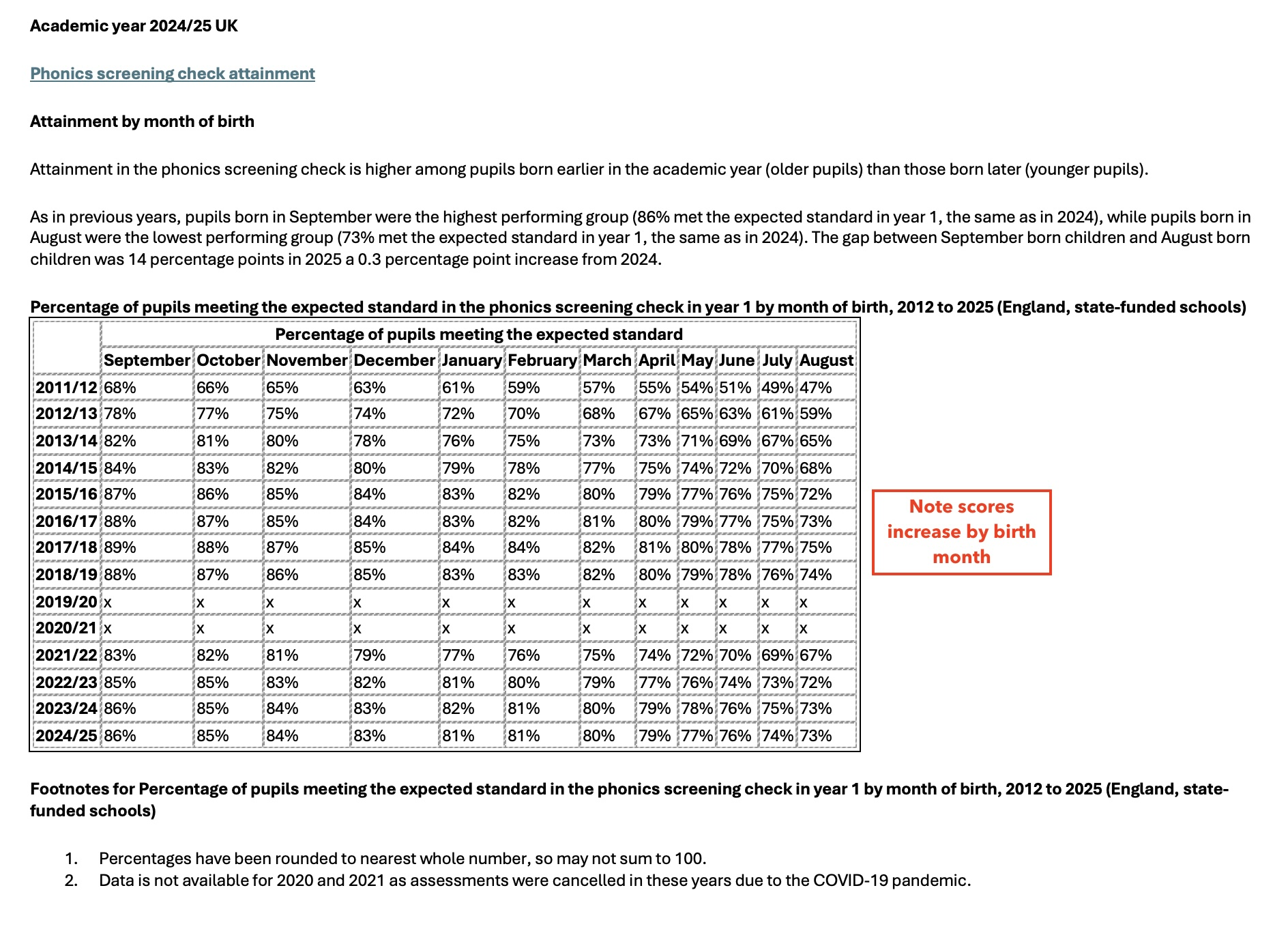
A key lesson from the UK is that skills-based assessments (phonics checks) produce student achievement strongly correlated with birth month, suggesting that child development may be a significant factor in this data (see HERE for all the data from the 2024 UK phonics check):
Another cautionary tale exists right here in the US, notably in the misunderstood and misrepresented National Reading Panel (NRP) report and the subsequent reading reform that occurred after No Child Left Behind (NCLB) mandates in 2001. Two lessons must be emphasized:
First, the NRP report found that systematic phonics instruction for the early grades tended to increase student acquisition of phonics but did not increase comprehension. Further, when compared to students who received more holistic reading instruction, students receiving systematic phonics early were not significantly ahead of those students in later grades in terms of comprehension achievement.
And the disturbing irony about the newest phonics gambit is that claims of a reading crisis directly caused by balanced literacy, popular reading programs, and a lack of phonics instruction are not grounded in evidence.
Now moving to the reading instruction, there’s a narrative that has been sold to the American public and policymakers. There’s a literacy crisis because teachers do not teach the science of reading because they were not taught the science of reading in colleges of education. I have tried to identify the evidence that was used to construct this claim, and I actually have not found this evidence yet.
A perceived crisis demands attention and creates an impetus for urgently needed solutions. The Course takes that tack, arguing that there is a national crisis in reading and then promoting phonics as the cause (there is not enough of it) and the solution (more of it is needed). As we argue here, there is no indisputable evidence of a national crisis in reading, and even if there were a crisis, there is no evidence that the amount of phonics in classrooms is necessarily the cause or the solution.
None the less, copy-cat SOR reading legislation has continued to gain momentum across the US, and some states such as Florida and Mississippi have produced over a decade of data on these reforms.
Further, just as the phonics gambit claims of a reading crisis are not supported by scientific research, the outcomes of SOR reform have not produced as promised (similar to the UK).
Notably, despite MS being touted as the gold-standard of reading reform, no research exists showing why MS continues to retain about 9000 K-3 students each years, why MS grade 8 reading scores drop back into the bottom 25% of states, and why the race/class achievement gap remains the same in MS as 1998.
Yet, driven by Essentialist beliefs about reading and teaching, reformers have continued to double down on the MS model.
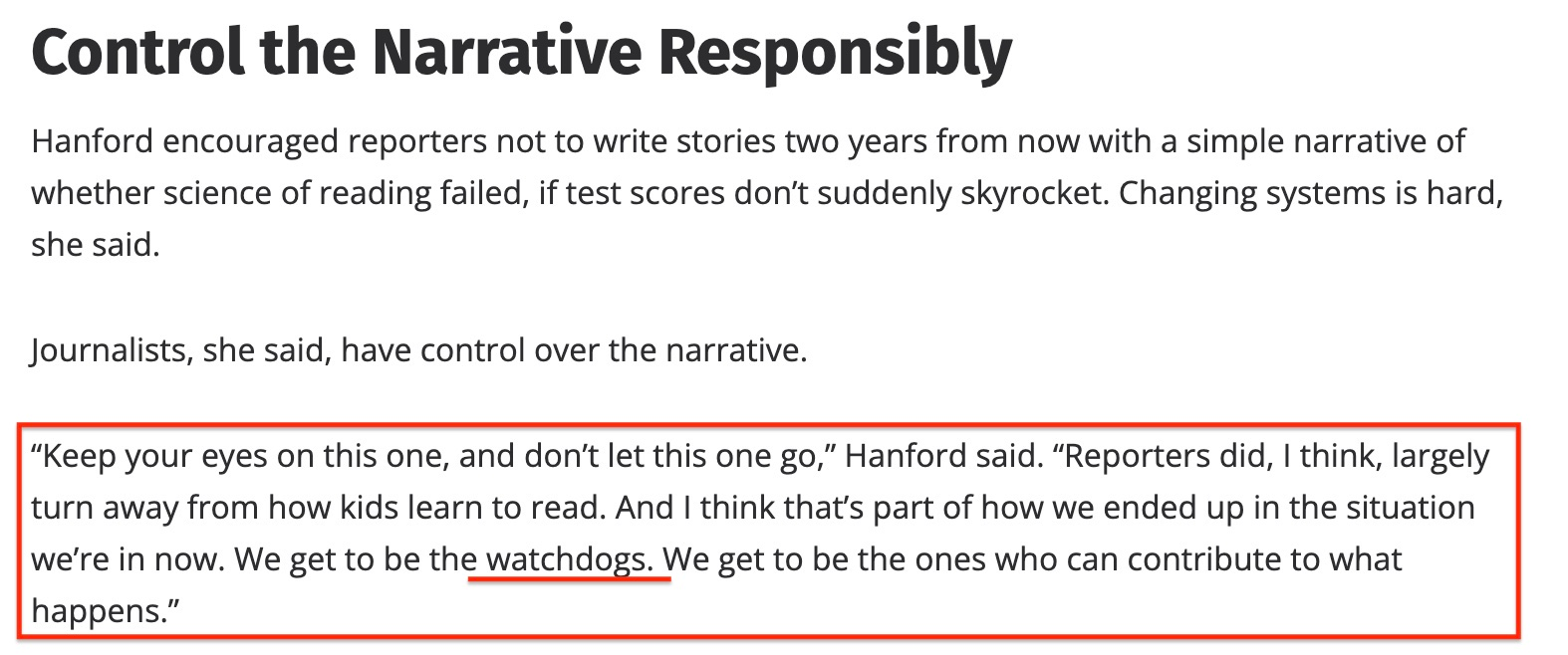
The mainstream media has played a significant role in this phonics gambit, even anticipating in 2023 both the lack of success from SOR reform and calling for advocates of SOR not to waver in the context of that evidence of failure:
And right on cue, two years after Hanford’s plea, we have this from North Carolina [3]:
Third graders experienced a two-point drop in reading proficiency — decreasing from 49% to 47% — though third graders who achieved an alternative pathway saw a two-point increase (from 31% to 33%).
First- and second-graders’ scores are based on their performance on the DIBELS 8 assessment. Third graders can pass the beginning-of-grade test, end-of-grade test, or the retest for proficiency. However, these students can also achieve proficiency through an “alternative pathway,” which include DIBELS 8, STAR Reading — the state-approved alternative assessment — or the Read to Achieve test, according to Dan Tetreault, DPI’s assistant director of Early Learning.
“We really need to freeze something around comprehension in grade three, and spend a lot of time in that area with our students so that we begin to see growth — some change in their achievement. And I think it’s buried somewhere in comprehension,” said Board member Dr. Olivia Holmes Oxendine….
The results reflect the first drop in reading proficiency results for third-graders since science of reading implementation officially began during the 2022-23 school year. Reading proficiency among third graders at the end of that school year was 47%, rose to 49% by 2023-2024, and has now dropped back to 2020-2021 levels.
During the back-to-basics movements under the Reagan administration (which gave us the flawed A Nation at Risk report spawning endless education reform), Lou LaBrant wrote her memoir, completed in 1987 as she approached 100. LaBrant taught from 1906 to 1971, and in her memoir, she lamented having taught through and rejected multiple back-to-basics movements throughout her career and life.
And here we are again, facing another phonics gambit that isn’t working, that will never work because we always start with the wrong problems and cannot resist reform typically given the veneer of “science” while being mostly driven by ideology and beliefs about teaching and learning.
Like the Queen’s gambit in chess, the phonics gambit is old, misleading, and only works on those who don’t really understand the context of the game being played.
The major difference, of course, is that the losers in this gambit, again, are our students, especially the most vulnerable students who deserve something other than a game and a mostly petty contest of “my beliefs can beat up your beliefs.”
The proportion of disadvantaged pupils meeting the government’s “expected standard” in their year 1 phonics screening test has fallen this year, as overall progress since the pandemic has plateaued.
Government data published today shows 67 per cent of disadvantaged pupils taking the test for the first time met the standard this year, compared with 68 per cent last year.
Overall, 80 per cent of pupils passed the test in year 1, the same figure reported last year.
Summer-born pupils remain less likely to meet the government’s benchmark. Seventy-three per cent of pupils born in August met the standard this year, compared to 86 per cent of those born in September.
Another flurry of over-the-top commentary has resurfaced on social media concerning reading reform in Mississippi; for example:
The fact that Mississippi cast aside decades of Department of Education recommendations and immediately saw its test scores skyrocket is all the proof you need that the Department of Education shouldn't exist.
Since 2019, the discourse around reading reform in MS has been consistently hyperbolic and misleading because, frankly, there is little solid evidence supporting the rush to copy the state’s reform.
Even a historically top-scoring state, Massachusetts, is poised to join the “science of reading” reform fad.
The relentless cycles of ever-new education reform since the 1980s and the fatal mistake of copycat reform movements are being replicated by the rush to “be like Mississippi.”
The belief that MS has performed a miracle in reading instruction and achievement is likely at least misleading if not a mirage (increased test scores due to manipulating the population of students being tested but not due to greater reading proficiency). Regardless, states must resist copycat education reform.
Questions Remain Unanswered about Popular Reading Reform: The Mississippi Model
Because of the state’s exceptional National Assessment of Educational Progress (NAEP) grade 4 reading scores in 2019, Mississippi was anointed as an education “miracle” in The New York Times.
However, one admission in that NYT’s christening has yet to be fully addressed: “What’s up in Mississippi? There’s no way to know for sure what causes increases in test scores, but Mississippi has been doing something notable: making sure all of its teachers understand the science of reading.”
At best, Mississippi’s grade 4 reading scores challenge the overwhelming evidence that standardized test scores mostly correlate with race and social class. However, in 2019, the outlier NAEP scores were merely correlated with Mississippi’s comprehensive reading reform that has now been implemented for well over a decade.
Much of that reform, unfortunately, has been the result of media, politicians, and reformers failing to understand test data—such as misunderstanding and misrepresenting NAEP achievement levels—and thus passing reform that fails to match the needs of students, teachers, and schools.
Despite the lack of robust research on why Mississippi has achieved and maintained outlier scores in grade 4 reading, many states have rushed to implement the Mississippi model of reading reform, often identified as the “science of reading.”
That reform has some common features: mandates about what reading programs meet the standard of “scientific,” teacher retraining in the “science of reading,” bans on some reading instructional practices, and third-grade retention based on state assessments of reading.
Research by Westall and Cummings offers insight into the current state of reading reform, acknowledging that those reforms have resulted in some short-term test score gains similar to Mississippi’s.
However, that study has an important caveat: Only states implementing third-grade retention are seeing those score increases. The researchers note that this study does not conclude why retention correlates with short-term score gains, however.
While Reading Wars are often contentious and driven by hyperbole and confrontational rhetoric, most people would agree that the US can and should do a better job of teaching children to read, and our most vulnerable populations of students are those being carelessly left behind despite a permanent state of education reform in the US for over five decades.
Before we commit to more reform, there are at least three questions needing to be answered about the Mississippi model for reading.
The first question may be the most important: What is the role of grade retention in reading reform?
Research on grade retention continues to raise red flags about the practice, often resulting in negative consequences for students and disproportionately impacting minoritized and impoverished students.
Mississippi has been retaining about 9,000+ K-3 students since 2014, and those retention numbers seem to be relatively consistent. If the reading reform is working, MS should have seen a significant drop in students being retained.
It seems possible that grade retention impacts the population of students being tested, and thus, distorts the test data. In short, grade retention may be raising test scores without improving student reading proficiency.
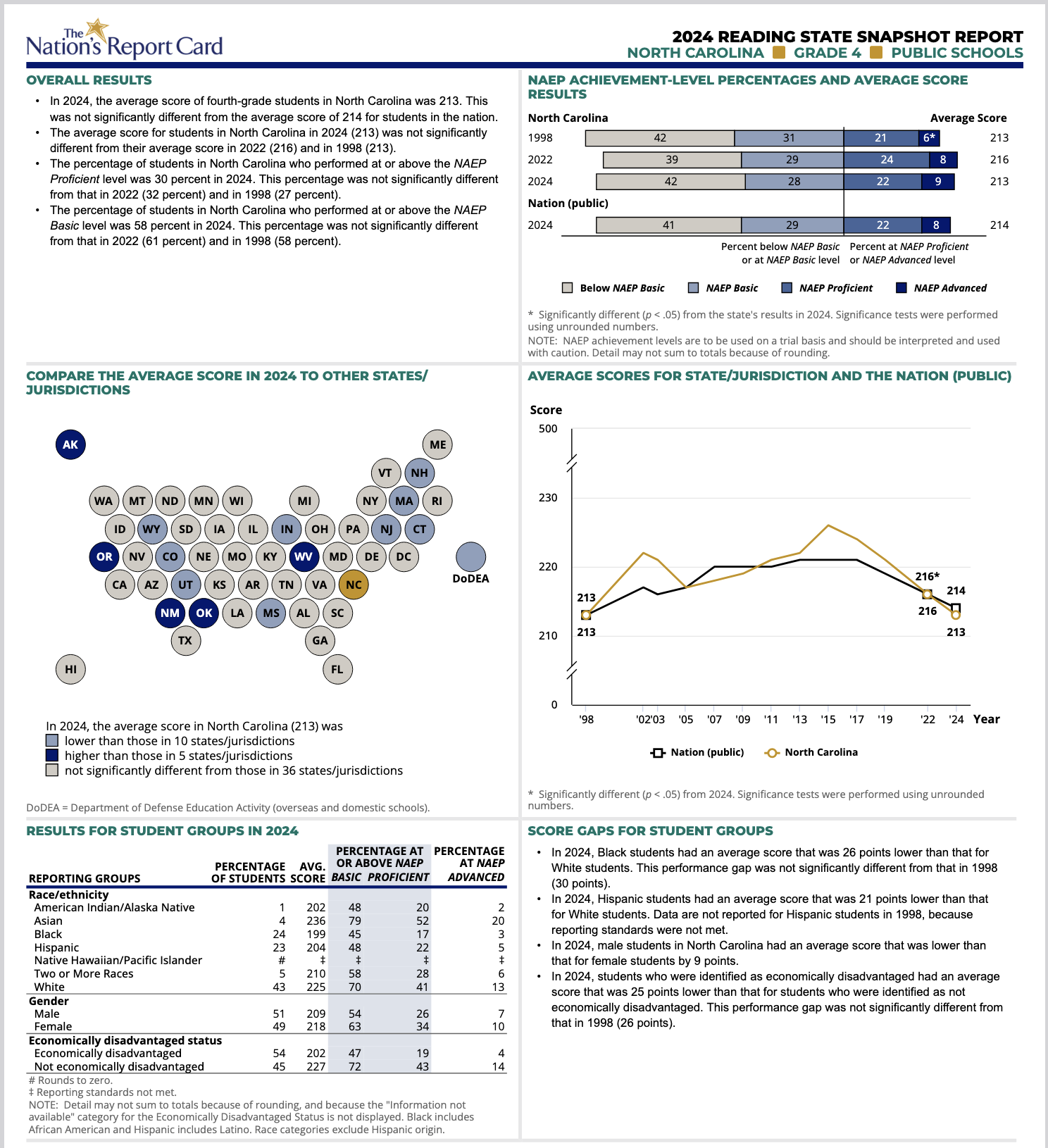
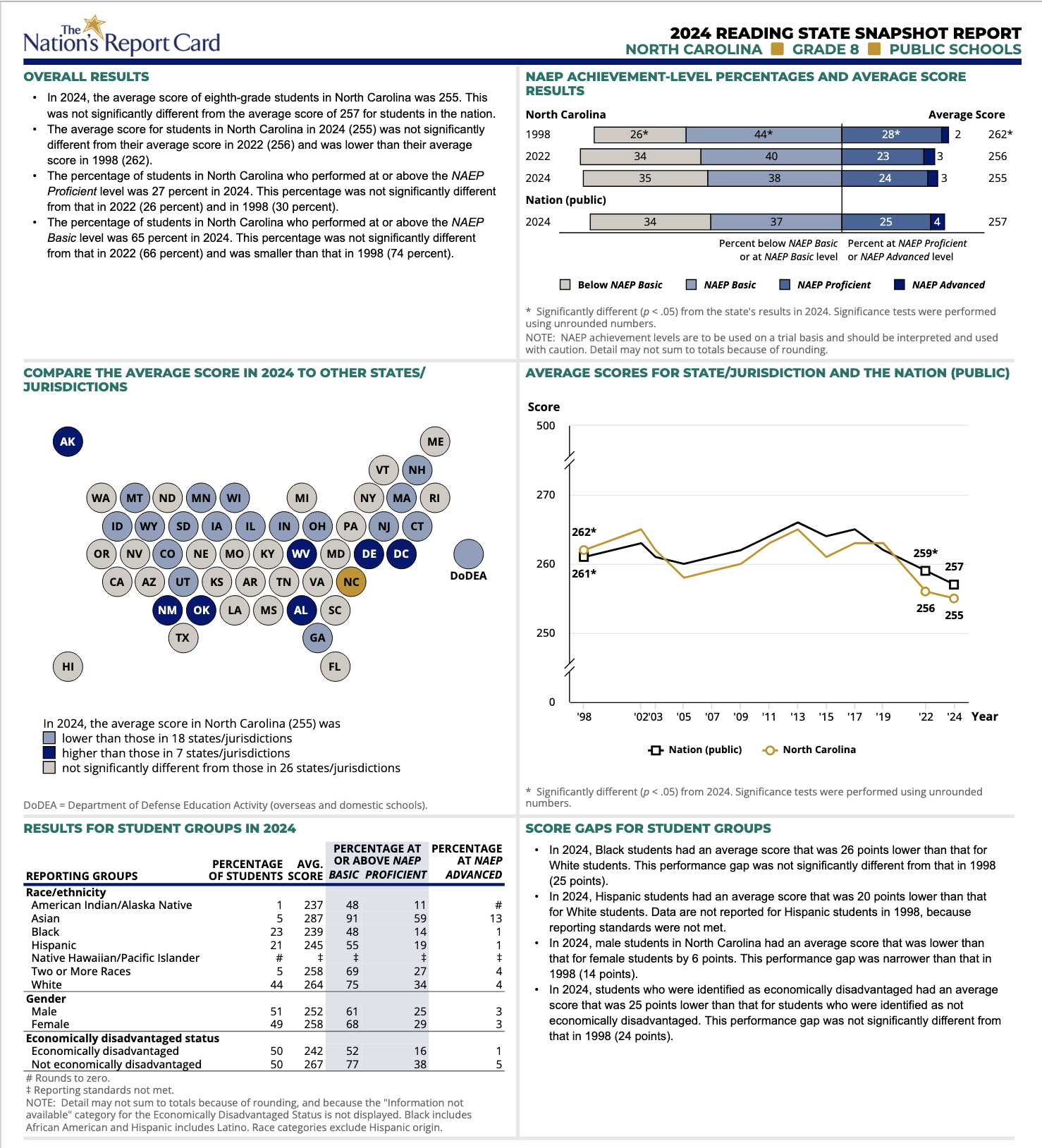
A second question must seek why Mississippi’s exceptional grade 4 scores do not erase the race or poverty gaps. As NAEP reports in 2024: “In 2024, Black students had an average score that was 25 points lower than that for White students. This performance gap was not significantly different from that in 1998 (26 points). … [And] students who were identified as economically disadvantaged had an average score that was 26 points lower than that for students who were identified as not economically disadvantaged. This performance gap was not significantly different from that in 1998 (26 points).”
The opportunity and achievement gaps in education in the US are by far the most pressing needs in our schools, and yet, these reforms seem to be inadequate for closing them.
The influence of family social capital variables manifests itself in standardized test results. Policy makers and education leaders should rethink the current reliance on standardized test results as the deciding factor to make decisions about student achievement, teacher quality, school effectiveness, and school leader quality. In effect, policies that use standardized test results to evaluate, reward, and sanction students and school personnel are doing nothing more than rewarding schools that serve advantaged students and punishing schools that serve disadvantaged students.
A final question concerns the evidence about short-term score increases among states implementing reading reform. Similar to another high-retention state, Florida, Mississippi has remained in the bottom 25% of states in grade 8 reading NAEP scores.
This data evidence also suggests that retention may be distorting test scores and not supporting robust or valid reading achievement by students.
Regretfully, the “science of” era of education reform is repeating a problem found in reform cycles since the Reagan era: Focusing on trends and failing to do the hard work of identifying what our problems are and then seeking reform to improve teaching and learning for all students.
The crisis/reform approach has not worked and likely is not working now.
However, the truth is that we simply do not know what is needed or what works because we are not committed to doing the complicated work needed and we remain too often trapped in market forces as well as political and ideological agendas that fail to serve the needs of the children who need reading the most.
I am not a Christian; I am not a religious person.
I have always held sacred the essential guarantees of the American Dream built on our individual liberties and the separation of church and state that is necessary for the integrity of both the church and the state.
The current and intensified efforts by Christian conservatives and Christian nationalists have moved past making the misleading claim that the US is a Christian nation, created by Christian founders, and toward establishing the sort of Christian nation that erases our democratic principals and appears more like the dystopian theocracy found in The Handmaid’s Tale.
In this new reality, I am willing to support and advocate for the sort of Christian nation that I have not seen from any Christians claiming the US is a Christian nation or calling for the US to become.
It is a beautiful idea in its simplicity, built on the foundation of two principles—one Christian and one democratic.
First, the Christian principle: “So in everything, do to others what you would have them do to you, for this sums up the Law and the Prophets” (Matthew 7:12).
And the second, the democratic principle: “We hold these truths to be self-evident, that all men are created equal, that they are endowed by their Creator with certain unalienable Rights, that among these are Life, Liberty and the pursuit of Happiness” (The Declaration of Independence [1]).
I know that what I want is to be safe and also free to be the person I know I am; I also know that life and liberty are nothing if each of us is not also free to pursue what makes us happy.
And none of that should be infringed upon by others or the force of government.
That life, liberty, and happiness is for me, but I cannot seek ways to impose what I believe is right for me onto anyone else. Notably, I do not have the right to use the force of government to impose my beliefs onto anyone or everyone else.
The essential role of government by a free people is to insure that freedom for everyone even as it looks different from person to person.
Even though I strongly disagree with fundamentalist Christians and Christian nationalists, I believe they have and must maintain the right to pursue those beliefs among all consenting adults who agree with them.
Safely, freely, and without the imposition of others or the force of government.
They should not, again, seek the force of government to impose those beliefs on anyone else. To me, that is a perversion of “Christian nation” that is a democracy into Christian nationalism that become a theocracy.
“Do to others what you would have them do to you” is a beautiful and concise expression of Christian love that, for me, is fully compatible with the grounding democratic principles of “life, liberty, and the pursuit of happiness.”
Free people do not have to choose between being a Christian nation and being a free people—that is, if we genuinely believe in both.
[1] I find the passage in full after this key phrase significant also:
That to secure these rights, Governments are instituted among Men, deriving their just powers from the consent of the governed, –That whenever any Form of Government becomes destructive of these ends, it is the Right of the People to alter or to abolish it, and to institute new Government, laying its foundation on such principles and organizing its powers in such form, as to them shall seem most likely to effect their Safety and Happiness. Prudence, indeed, will dictate that Governments long established should not be changed for light and transient causes; and accordingly all experience hath shewn, that mankind are more disposed to suffer, while evils are sufferable, than to right themselves by abolishing the forms to which they are accustomed. But when a long train of abuses and usurpations, pursuing invariably the same Object evinces a design to reduce them under absolute Despotism, it is their right, it is their duty, to throw off such Government, and to provide new Guards for their future security.
I am writing this as someone who is solidly on the Left, and not in the misleading way often expressed in the US where the Left really doesn’t exist in any substantial way. I fit into what would be seen as the Left in Europe or Scandinavian countries.
But my being on the Left is mostly about my scholarly view of the world, although, of course, that impacts how I navigate a very conservative country where ideologies of the Right are seen as the norm.
I also believe in nonviolence so I am very uncomfortable with current narratives that the Left is violent, and somehow uniquely violent.
I reject perpetuating and glorifying violence; I reject celebrating violence; and I strongly reject the violent gun culture of the US that is also tolerated as the norm.
I do not consider violence on or from the Left to be of the Left (although that is rare when compared to violence from the Right). Violence is a distortion of Leftist values and commitments.
As well, I do not feel any kinship with or endorse in any way the many celebrities that conservatives in the US describe as representative of the Left—such as Stephen Colbert and Jimmy Kimmel, who now have come to represent both the Left and concerns being raised about government censorship of the Left.
Colbert and Kimmel, to me, are vapid Hollywood, the performance of progressivism that is relatively common within celebrity culture. There is nothing radical in vapid Hollywood progressivism, and to be blunt, many celebrities who believe they are performing progressivism and activism are perpetuating conservative norms of the US.
I was born into, raised in, and continue to live in a very conservative state, South Carolina, and my upbringing in the rural Upstate was steeped in Southern Baptist religion and blunt racism, sexism, and homophobia.
Who I became by my second year of college and who I continue to evolve into—this Self is a person of the nonviolent Left, again nothing resembling the caricature and demonizing of the Left occurring today.
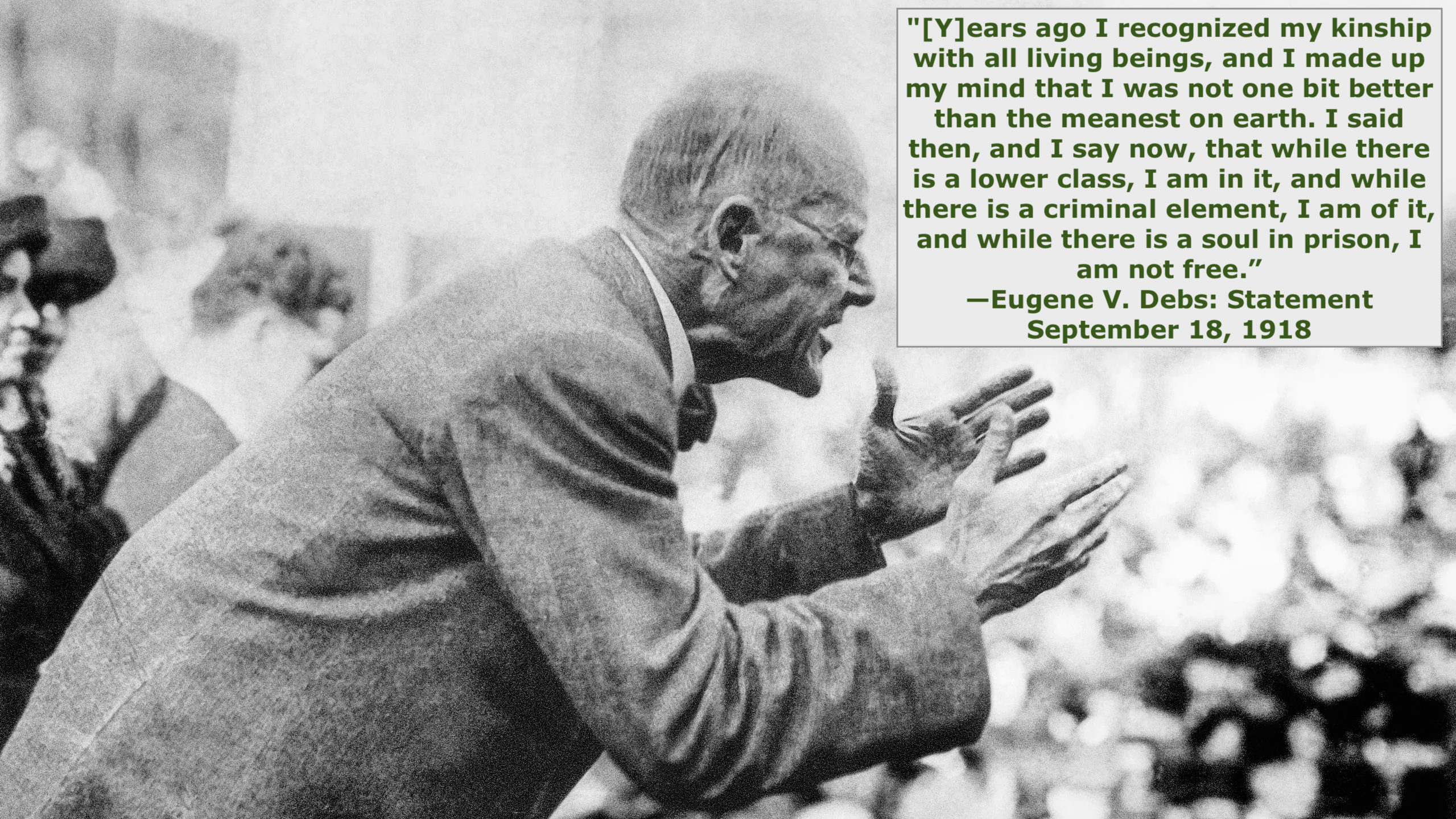
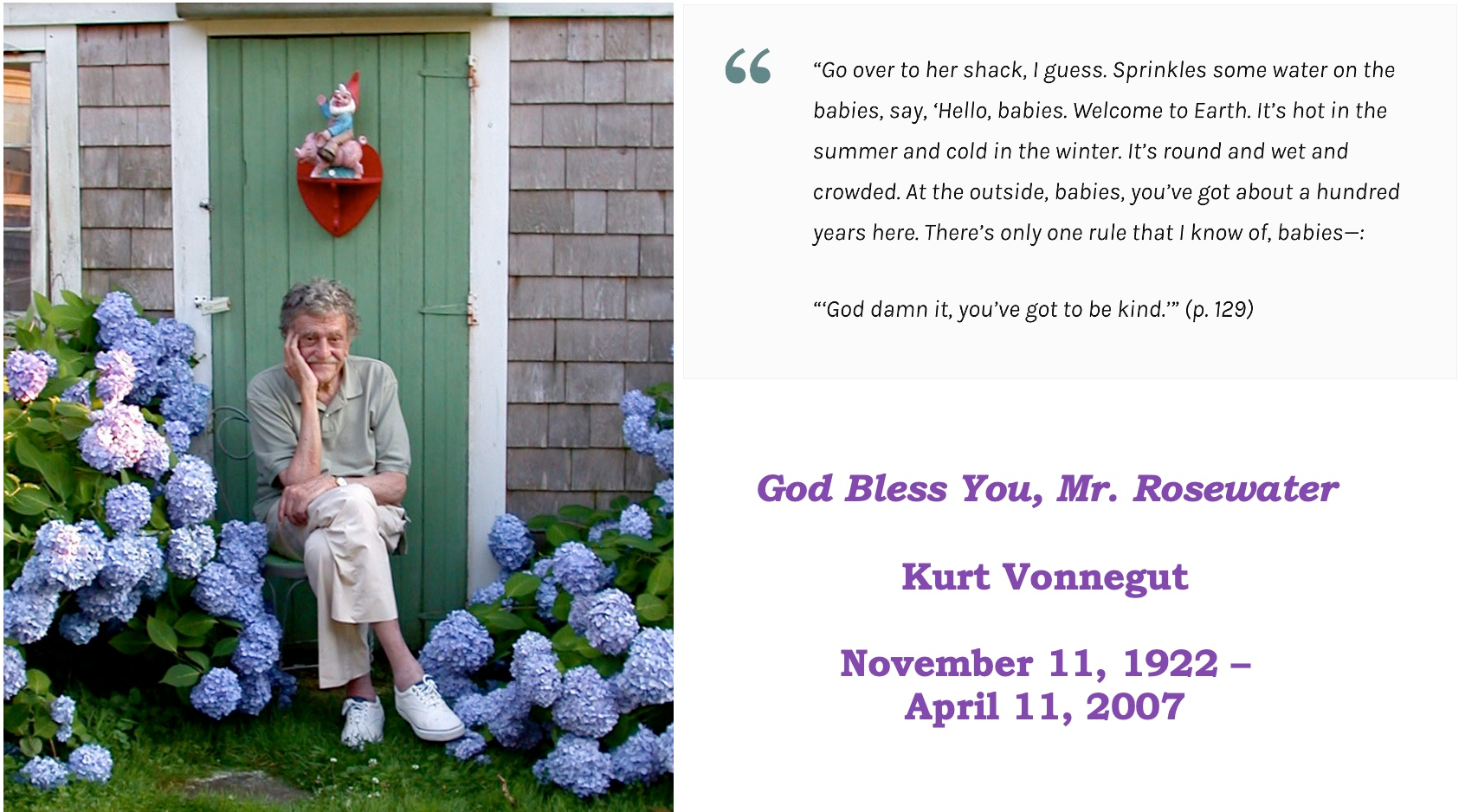
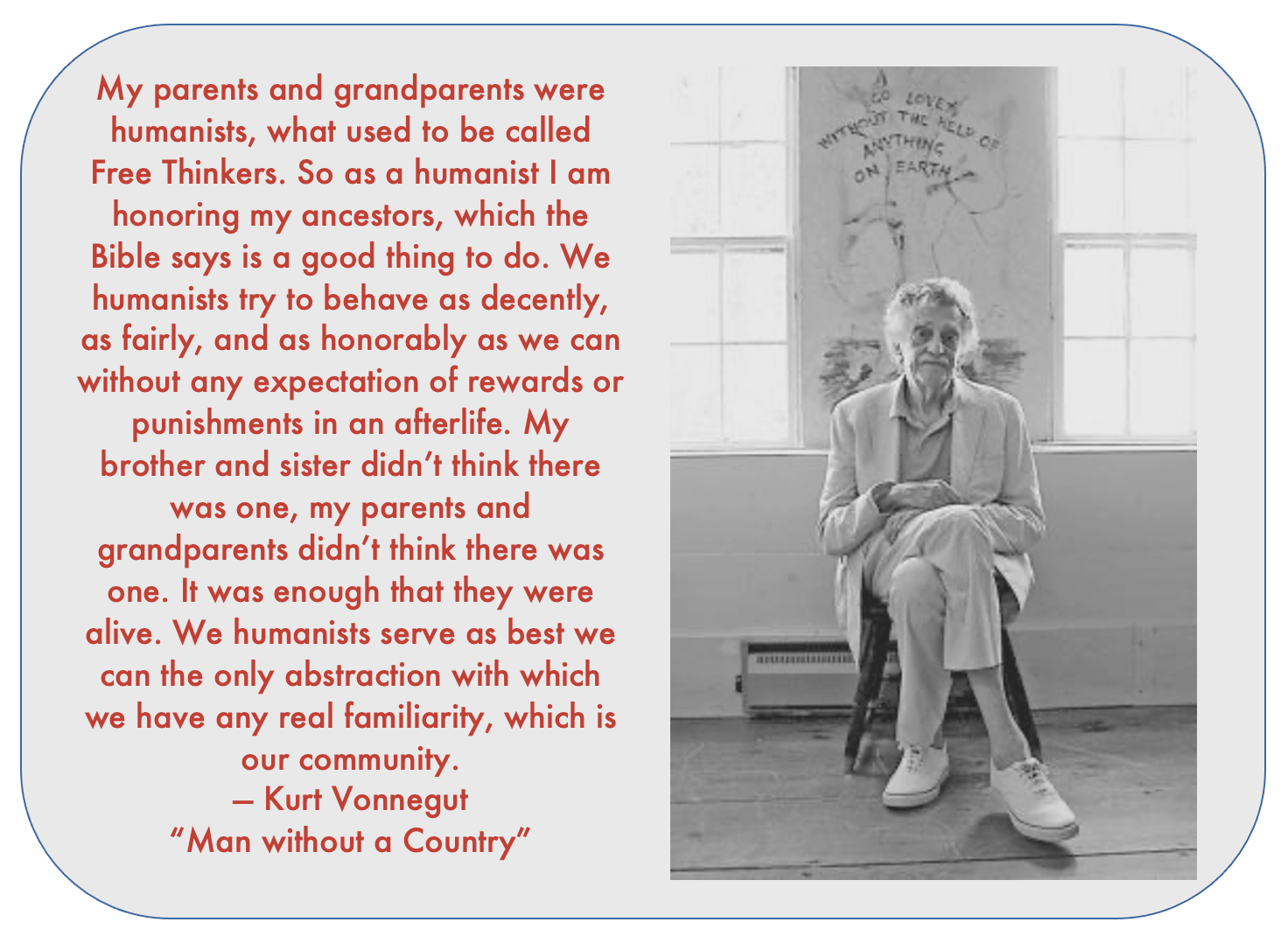
The Left I recognized in myself is grounded in the writing of Kurt Vonnegut, who was profoundly shaped by his Midwestern roots—free thinking and humanism. Vonnegut also was inspired by and introduced me to Eugene V. Debs, one of the most prominent socialists in US history.
I have never found a better way to express what I believe, what constitutes my moral compass, than the words written and spoken by Debs and Vonnegut:
And it is because of these words that I cannot say that I love America—because we have struggled as a country to meet these ideals—but I can say proudly that I love the promise of America, these words that I think are about the most poetic and beautiful promise humans can pursue, as expressed by writer John Gardner:
That idea—humankind’s inalienable right to life, liberty, and the pursuit of happiness—coupled with a system for protecting human rights —was and is the quintessential American Dream. The rest is greed and pompous foolishness—at worst, a cruel and sentimental myth, at best, cheap streamers in the rain.
But this wonderful promise—”humankind’s inalienable right to life, liberty, and the pursuit of happiness—coupled with a system for protecting human rights”—remains unfulfilled because we have failed to truly practice these ideals, we have been negligent about making this promise real—even when we are repeatedly reminded, as MLK expressed:
Moreover, I am cognizant of the interrelatedness of all communities and states. I cannot sit idly by in Atlanta and not be concerned about what happens in Birmingham. Injustice anywhere is a threat to justice everywhere. We are caught in an inescapable network of mutuality, tied in a single garment of destiny. Whatever affects one directly, affects all indirectly. Never again can we afford to live with the narrow, provincial “outside agitator” idea. Anyone who lives inside the United States can never be considered an outsider anywhere within its bounds.
Vonnegut, we must note, was profoundly shaped by being a prisoner of war, and both Debs and MLK were jailed for their moral causes.
We should acknowledge, then, that we all are prisoners of our negligence, our failure to create a safe society, a willingness to simply live with mass and school shootings, and the rising political tide that seeks to take away some people’s access to life, liberty, and the pursuit of happiness.
And the alternative, the path toward honoring the promise, is not even that difficult: “We humanists try to behave as decently, as fairly, and as honorably as we can without any expectation of rewards or punishments in an afterlife.”
Decently. Fairly. Honorably.
As Vonnegut was apt to quip, like a Christian nation.
And yet: “While there is a soul in prison, I am not free.”
That idea—humankind’s inalienable right to life, liberty, and the pursuit of happiness—coupled with a system for protecting human rights —was and is the quintessential American Dream. The rest is greed and pompous foolishness—at worst, a cruel and sentimental myth, at best, cheap streamers in the rain.
As summer was slipping into fall of 2025, I attended with my partner the Upstate Renaissance Faire held at the fairgrounds in Spartanburg, SC, just a few minutes from where I live. This was my first-time at what many call a “Ren Fair.”
I have a friend group connected with my partner made up of gamers, and a few of them were there along with us and my girlfriend’s sister and her boyfriend.
I was immediately shocked by the size of the crowd. Parking was an adventure, and despite the fairgrounds being quite large, the crowd left me a bit claustrophobic and overwhelmed.
However as we started making our way around—and once my partner kindly asked at the information desk where the beer was—I realized something that I have been mulling over in the context of the heightened social tensions in the US, especially since the inexcusable shooting of Charlie Kirk.
The atmosphere at the Faire was overwhelmingly happy and incredibly peaceful. Despite the abundance of ancient weapons and people dressed as knights—and even when attending a jousting demonstration that included a sword fight—I felt more safe there than in most public spaces.
I thought of October 2017 when several of us attended an open-air concert by The National in Pittsburg just after the horrific mass shooting in Las Vegas. Fireworks were set off behind us during that concert and everyone froze; in the US we have cultivated a culture of guns and as a result, a culture of fear.
As a lifelong educator, I was also involved in a school shooting in the 1980s.
At the Faire, there was a wide array of how people dressed and presented themselves. Yes, plenty of folk in medieval and Renaissance attire (the majority attending were dressed up, in fact), but there were those of us in our daily clothing along with Furries and even a guy in a Spider-Man costume.
Notable as well, many people blurred and broke the boundaries of gender norms. A person in all black and fishnet stockings turned around in the line for beer, and I was briefly caught off guard by his beard.
But as people made eye contact, they would smile and nod, often speaking pleasantly and with the general excitement everyone shared just being there.
This was one of the most diverse places I have ever been. And no one was offended, or angry.
No one was trying to change or judge anyone else.
I didn’t see a single MAGA hat or shirt (again, this was in Upstate SC where the Trump agenda is everywhere, on clothing and cars, and plastered across yards). Oddly, this space was absent partisan politics and a deeply political arena where the barriers of race, socioeconomic status, gender, and sexuality seemed to disappear.
Not to be overly idealistic, but this space is exactly what those of us calling for “life, liberty, and the pursuit of happiness” for all envision.
And I cannot understand how this is a radical or offensive idea.
This experience reinforced for me that the tensions in the US are not between two sides that are equal:
One side calling for all people, even the smallest minorities, to have the same rights to life, liberty, and the pursuit of happiness, guaranteed by our laws and political system.
The other side determined to impose their narrow beliefs on all Americans using the power of misinformation and government mandates.
These are not the same.
LGBTQ+ people who seek “life, liberty, and the pursuit of happiness”—they are not seeking to impose their lives on others. They are a minority who have had their access to “life, liberty and the pursuit of happiness” mostly denied, and then occasionally allowed begrudgingly.
And just as there seemed to be some possibility the US would extend full humanity to people who are LGBTQ+, a political wave of resentment, hate, and denial has swept across the nation, often scapegoating this community.
Now, there is a powerful conservative movement in the US who seeks to impose their narrow beliefs on everyone even as they do not practice those beliefs themselves.
These are not the same.
Too many people leading and following in the US have lost touch with reality and facts.
Too many people have abandoned a commitment to “life, liberty, and the pursuit of happiness” for all, pursuing the false sanctuary of imposing their beliefs on everyone.
Ironically, it is not the people cosplaying at a Ren Fair.
Denying “life, liberty, and the pursuit of happiness” to anyone is a threat to “life, liberty, and the pursuit of happiness” for everyone.
This may be the “cheap streamers in the rain” era of the USA that John Gardner rejected in 1976. This may be the final era with no renaissance possible.
Somewhere around tenth grade, I began to recognize in myself a strong belief in nonviolence.
One day in English class remains a seminal moment in my life—one that included people who would shape my life profoundly as an educator.
I was in Lynn Harrill‘s class. Lynn would become my mentor and friend, the man influenced who I am in ways that rivaled my own father’s influence.
Lynn’s English class was unlike any English class I had ever sat in before. We had to write essays (English classes in junior high had been mostly working in grammar textbooks and diagramming sentences), and Lynn grounded his teaching in robust class discussions.
And many of us loved those discussions, and him.
One class period, we found ourselves in a heated class debate about who would willingly fight in a war if drafted. Coincidentally, that day the principal, Mr. Clark Simpkins, was observing Lynn, and Mr. Simpkins was the husband of my 6th-grade math teacher (who I loved) and father of two sons around my age. Most significantly, Mr. Simpkins would be the person who hired me for my first job teaching English.
As the debate unfolded, a clear division developed—all of the male students eagerly expressed a desire to fight in a war, except for me, the lone male student speaking for nonviolence with the young women in the class.
The day of my interview about 7 years later, Mr. Simpkins reminded me of that day, and honestly, there was a bit more than a veiled implication that my beliefs could keep me from being hired—one of many moments when, even after I was hired, these implications were used to keep me in my place.
Being a advocate for nonviolence in the South was perceived as unmanly, unpatriotic; it certainly was one of many of my beliefs that made me unlike the culture of my home and my career.
None the less, one of my recurring units as a teacher, one that my students appreciated and seemed to strongly engage with, included an exploration of nonfiction writing through the writings and activism of Henry David Thoreau, Gandhi, and Martin Luther King Jr.
The thread running through these men and their lives, of course, was advocacy for civil disobedience and nonviolence.
The goals of this unit were primarily about helping students grow as critical readers and writers, but I also very much wanted my students to consider and reconsider their own beliefs about violence.
I had grown up in the same Southern culture of my students, and I know most of them had not had that opportunity.
This, of course, is a long way to say emphatically that I without qualification believe that celebrating violence is a type of violence.
And I reiterate that in the wake of the inexcusable killing of Charlie Kirk.
Here I want to add that I am also concerned about the aggressive whitewashing of Kirk’s rhetoric and agenda by many conservatives who are using Kirk’s death for political and ideological gain.
That, I believe, is almost equally as offensive as callously celebrating or joking about the gruesome public murdering of a person in what should be a free and safe society.
As just one example of the debates on social media about what Kirk did and did not promote, let’s look at the claim that Kirk advocated for the death penalty for being gay, linked to his quoting Leviticus 20:13 and calling that “God’s perfect law.”
[I will not link the video here because I do not want to platform Kirk, but this is easy to search and confirm. If you doubt anything here, please find the clip yourself.]
This moment by Kirk is, in fact, an example of words as violence because simply mentioning stoning gay people to death because of God’s law is, at best, a veiled threat to the lives of anyone who is gay.
It is a reminder of what has been. It is a warning about what could be again.
History is replete with religious and institutional torturing, imprisoning, and killing people simply for being gay, and often these acts were grounded in religious dogma.
If Kirk was as smart as his advocates claim, he was quite aware of what he was doing by citing Leviticus and saying the law is “perfect.”
This was a threat, a form of rhetorical violence.
But what strikes me as the most concerning aspect of this moment is that Kirk is grinning and smiling throughout. He sees this little reference to stoning gay people to death as a joke, just a cool guy making a “by the way” point to engage in civil debate and discourse.
Despite Kirk being framed as a champion of free speech and an advocate for civil discourse, the content of what Kirk said often contained misinformation and hostile claims about marginalized people; that isn’t civil discourse, and “free speech” doesn’t mean people are not held accountable for what they say.
If Kirk’s agenda cannot be fully articulated after his death, that suggests it wasn’t valid to begin with.
For LGBTQ+ people, quoting Leviticus devalues to their lives and threatens their happiness; it is not a podcast joke, not simply a way to play “gotcha” in an online debate.
This is their lives, and all they request is that they have the same access to life, liberty, and the pursuit of happiness that Kirk along with his family and followers also want and deserve.
To be blunt, there are many examples like this that discredit the whitewashing of Kirk being perpetrated by people with political and ideological agendas, people who seem unconcerned about using Kirk’s death for their gains.
There are only a few fair options among those of us who fully condemn and reject the killing of Kirk; we all must start with the truth about who Kirk was and what he advocated for, and then we must reject it or embrace it. The latter is the only way praise and honoring Kirk by his advocates can be taken seriously.
If anyone has to misinform or lie to praise someone, that calls into question whether that person, in fact, deserves praise.
For me the only way to honor Kirk is to condemn the senseless killing and then to accurately describe who Kirk was and what he championed.
To cheer for his death or to misrepresent his life’s work is to dishonor not only Kirk but all of use.
educator, public scholar, poet&writer – academic freedom isn't free














 dr. p.l. (paul) thomas