This fall was the start to year 42 for me as an education, the first 18 as a high school English teacher and the rest as a college professor. I have been noting that career in my presentations at NCTE 2025 in Denver, adding that I am toying with at least making it to year 50.
As I ponder that number, I often return to the sense of awe I always feel when I mention my doctoral work, an educational biography of Lou LaBrant—a former NCTE president (1954) who lived to be 102 and taught for a staggering 65 years (1906-1971).
I was thinking about LaBrant during my presentation yesterday, Recovering Our Reading Dream from a Long Crisis Nightmare, because in her memoir, LaBrant expressed her frustration with the back-to-basics movement during the Reagan administration that orchestrated the 80s education crisis with the melodramatic and misleading A Nation at Risk.
LaBrant noted that over eight decades as an educator she worked through several education crisis cycles and multiple back-to-basics movements—notably the 1940s reading crisis spurred by low literacy rates for draftees during WWII.
While my career pales in many ways compared to LaBrant’s, I feel her pain; with education crisis it is déjà vu all over again.
The only thing, it seems, as common as the media announcing yet another education crisis is people rejecting my arguments against education crisis rhetoric.
The media obsession with declaring an education crisis is so commonplace that I started to just scroll on, but, regretfully, I began to read:
Math scores in the U.S. have been so bad for so long that teachers could be forgiven for trying anything to improve them. Unfortunately, many of the strategies they’re using could be making things worse. It’s a crisis decades in the making.
In the early 20th century, education reformers including John Dewey and William Heard Kilpatrick developed a theory – drawing from the work of Jean-Jacques Rousseau – that came to be known as constructivism. The idea was that learning happens best when students immerse themselves in a problem and find their own solution. By the late 1980s, math standards had embraced “discovery-based learning.”
I expected the lazy and unsupported “math scores” opening, but that second paragraph is the stunner. In 2025, the media still looks for a way to blame John Dewey for the education crisis they repeatedly manufacture.
It was at the core of the reading crisis in the 1940s, and again, in Tomorrow’s Illiterates (1961) noted above
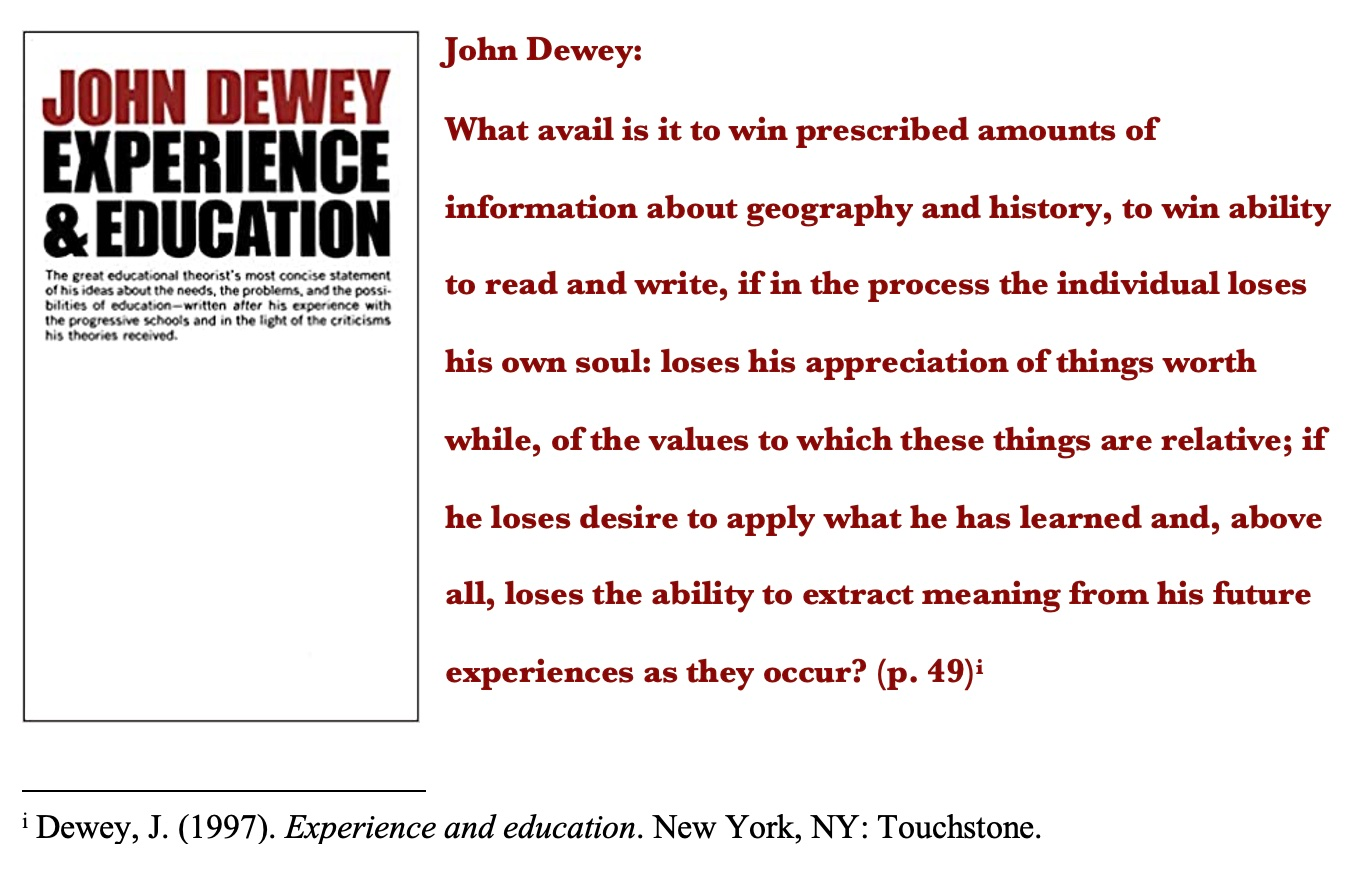
Also in my presentation yesterday, I uttered Dewey’s name and suggested the attendees track down Alfie Kohn’s Progressive Education: Why It’s Hard to Beat, But Also Hard to Find, which does an excellent job of detailing how Dewey’s progressive education is simultaneously blamed and almost never implemented in formal schooling [1].
I immediately posted on social media that the editorial writers could have just search on Wikipedia and avoided the utter nonsense they wrote about constructivism.
Just a few weeks ago, as well, I covered in my 100-level educational philosophy course that behaviorism and constructivism are educational theories (grounded in the scientific method), distinct from philosophies (grounded in rhetoric and logic, such as Dewey’s progressivism).
Learning theories like educational philosophies are contested spaces, but as I plan to share tomorrow in a roundtable presentation, this math crisis editorial triggers several red flags, notably opening the commentary by exposing the editors lack the basic expertise on education to be making any claim of crisis.
If they wanted to blame constructivism, they could have and should have invoked Piaget and Vigotsky (and plenty of “science of learning” folk have already been doing that, often badly and with the sort of caricature I expect).
The media’s education crisis narrative, however, follows a script you can count on—including misunderstanding or misrepresenting test scores, ignoring social context for educational outcomes, and blaming some cartoon version of a leftist education system that, again, has never existed in the US.
When I mentioned Dewey in my presentation, I joked that almost nobody understood Dewey, including Dewey, which, I think, is a pretty good joke because Dewey (and LaBrant) represented a sort of beautiful and illusive scientific approach to their philosophy of education and their instructional practices.
You see, when Dewey progressives say “scientific,” they mean an organic type of experimentation whereby the educator is always in the process of experimenting and drawing real world conclusions that are evolving (it is better, in fact, to think of Dewey’s ideology as pragmatism, associated with William James).
Theirs is a science of teaching and learning that is grounded in and starts with each individual student in the pursuit of skills, knowledge, and critical awareness. This is distinct from essentialist and perrenialist beliefs that begin with knowledge, basic skills, and Great Books, for example.
Teaching as an experiment only matters in the practical, not any Platonic ideal, and thus, is never settled (one red flag is when anyone makes a claim and bases that on settled science [2]).
A key reason blaming Dewey or progressive education for any education crisis is misguided is that Dewey himself refused to offer prescriptions, calling for every school and every teacher to seek what works best in the evidence before them, the unique set of students who always change.
In short, in teaching and learning, there is no silver bullet, no script, no program that can or will serve the needs of all students.
You can, if you must, insert any content area—math, reading, writing, civics, science, etc.—and shout “Crisis!” But you will be embarrassing yourself.
Just do a little searching, and I dare you to find a single moment over the past century when someone declared that “kids today” are excelling in math, reading, etc.
My point, which is often as misunderstood as Dewey, is not that current teaching and learning are fine, that I am somehow endorsing the status quo.
I am a critical educator; I became an educator to change teaching and learning, and I am disappointed to say that over my 5-decades career, very little has changed, including the popular urge to declare education crisis.
And what remains most disturbingly unchanged is that a vulnerable population of students have always been and continue to be under-served or nearly completely ignored.
But my point also includes that education reform alone (while needed, just not the mainstream way most often tried over and over) will never serve those vulnerable students, whose measurable education outcomes mostly reflect the inequity of their full lives of which the school day is only a fraction:
Almost 63% of the variance in test performance was explained by social capital family income variables that influence the development of background knowledge. Background knowledge is a known predictor of standardized test results. Family income variables are immutable by schools. Only public policies, outside the control of school personnel, can influence family income.
There is some math the education crisis folk never want to calculate.
If you find yourself worrying about your child’s ability to read or do math, I promise you that Dewey is not to blame.
If you find yourself worrying about other people’s children’s ability to read or do math, I promise you that Dewey is not to blame.
Crisis rhetoric, however, doesn’t help; it never has.
Finger pointing and blame probably aren’t very useful either, especially when those pointing fingers go out of their way to show their blame doesn’t quite add up.
In formal education, we have always had and will always have a range of students who excel, struggle, and fail.
As teachers, our job is to serve them all, and serve them better based on who they are and what they need.
However, teachers and schools alone can never be successful.
If evidence of student failure means anything (and those test scores often don’t), it is that we as a democracy are failing not only those students, but also those children, teens, and young adults—many of whom do not have adequate healthcare, food or home security, or the sorts of lives that universal public education, the so-called Founding Fathers, and, yes, John Dewey envisioned that a free people could guarantee.
If you are looking for someone to blame because of those disappointing math scores, well, I hate to tell you that the enemy is us.
[1] I highly recommend also: LaBrant, L. (1931, March). Masquerading. The English Journal, 20(3), 244-246. http://www.jstor.org/stable/803664. Here LaBrant rejects the misunderstood and misapplied project method in the teaching of literature:
The cause for my wrath is not new or single. It is of slow growth and has many characteristics. It is known to many as a variation of the project method; to me, as the soap performance. With the project, neatly defined by theorizing educators as “a purposeful activity carried to a successful conclusion,” I know better than to be at war. With what passes for purposeful activity and is unfortunately carried to a conclusion because it will kill time, I have much to complain. To be, for a moment, coherent: I am disturbed by the practice, much more common than our publications would indicate, of using the carving of little toy boats and castles, the dressing of quaint dolls, the pasting of advertising pictures, and the manipulation of clay and soap as the teaching of English literature. (p. 245)
[2] For example, the math crisis editorial announces authoritatively and with no links to proof:
Unfortunately, a robust body of research has since found that such approaches often fail early math learners (and readers, for that matter). Math rules and facts such as multiplication tables must be taught explicitly, memorized and mastered through practice. Only when this foundation is established can students progress to more complex concepts. Math, it’s often said, is cumulative.
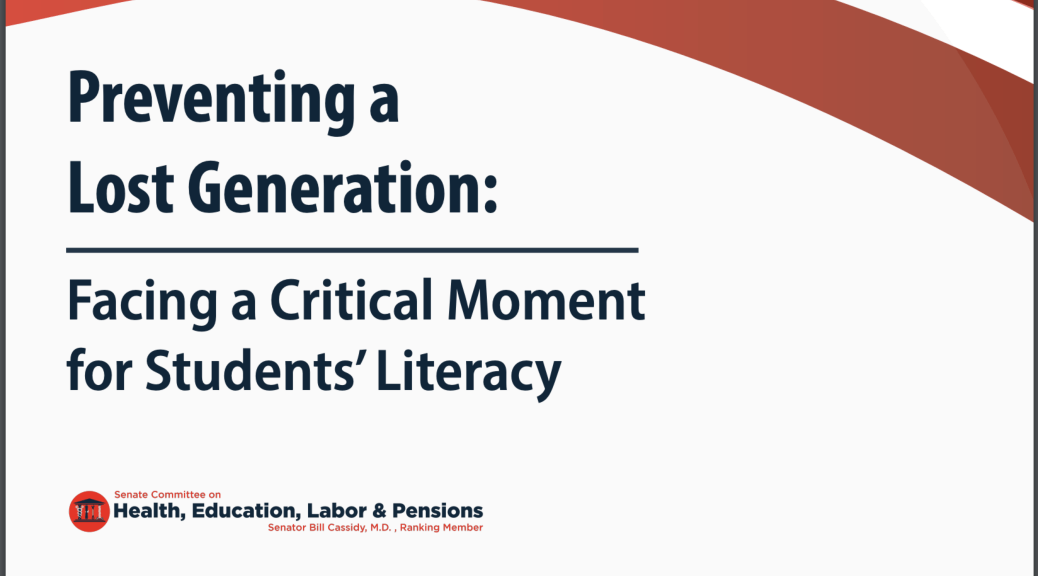
U.S. Senator Bill Cassidy, M.D. (R-LA) has released a report on literacy that opens with yet another example of misrepresenting NAEP reading scores to manufacture a reading crisis for political gain: “Two-thirds of America’s fourth and eighth graders are not proficient in reading.”
The report is an embarrassing recycling of the media misinformation campaign about reading in the US.
In fact, most of the footnotes cite news articles (including the Washington Times, a conservative outlet that lacks credibility) and conservative think tanks (ExcelinEd, Fordham). [1]
Notably missing are citations to scientific research on reading or credible analyses of NAEP data.
Responses are needed and can be sent to Literacy@help.senate.gov by April 5, 2024.
Good intentions are not enough and government policy on education has done more harm than good since A Nation at Risk. We can do better, and we should. But we must start with accurate claims and credible solutions.
A school for students with dyslexia continues to stay open despite two F grades from the BESE, Louisiana’s Board of Elementary and Secondary Education. The Louisiana Key Academy is run by Senator Bill Cassidy (R-LA) and his wife, Laura. Both are physicians. Neither are specialists in reading disorders, although they have a child with dyslexia.
Some Big Lies of Education start with politicians (even the biggest of politicians).
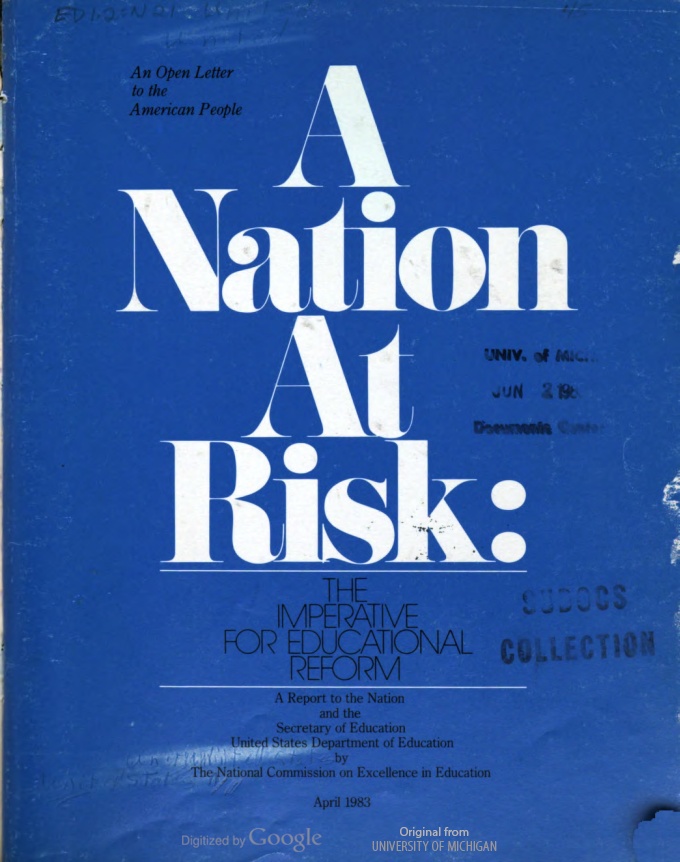
“And please abolish that abomination, the Department of Education,” implored Ronald Reagan as he established his goals for the committee charged with producing A Nation at Risk (1983). Reagan sought to shift the public’s support from public schools to school choice as well as, in his misguided words, return prayer to schools.
A Nation at Risk represents two important aspects of US education reform.
First, as noted by several scholars and committee members, the charge of the committee was primarily about partisan politics and not about substantive education reform.
Second, the report established the manufactured “crisis,” which is eagerly perpetuated by mainstream media, as the basis for decades of accountability-based reform that has resulted in an unproductive cycle of crisis/reform that never accomplishes any effective change for students, teachers, public education, or democratic society.
The narrative created by A Nation at Risk has none the less some enduring elements that are uncritically supported by mainstream media (complicit in the Big Lie):
Educational failure is grounded in the educational system itself, and thus, education reform has been in-school-only reform policies.
Identifying systemic societal, community, and home influences on measurable student learning is rejected as using poverty/inequity as an “excuse.”
Teachers are simultaneously the most important factor in education and the agents of failure due to poor training and/or low expectations for marginalized student populations.
The rhetoric is grounded in crisis/miracle binary and the primary evidence for those claims are standardized tests (mostly state-level accountability testing and NAEP).
Policies tend to be one-size-fits all solutions to overstated and unsupported problems.
Edling (2015) has identified similar patterns grounded in media rhetoric resulting in education policy internationally:
• Viewing education as being in more or less permanent crisis
• Taking the role as a spokesperson for teachers and on behalf of the field of education
• Excluding the knowledge and experiences of teacher(s), educators and/or educational researchers in the public press
• Simplifying the notion of being a good teacher through stereotypes and dualistic frameworks that overlook task and relational complexity.
The template established by A Nation at Risk can bee seen in every reform movement since the 1980s, first at the state level and then at the national level with No Child Left Behind (NCLB).
From the standards and testing reforms in the 1980s and 1990s to the charter schools and value-added methods for teacher evaluation under Obama and to today’s “science of reading” (SOR) movement, the essential elements noted above characterize the obsession in the US with crisis/reform in education with no real change ever accomplished.
Ironically, neither the claims of educational crisis nor the reforms proposed throughout the past five decades have been grounded in credible evidence.
A Nation at Risk established the manufactured crisis approach to education reform, which has created only political and market profits for those driving the crisis rhetoric and the reforms.
I recommend the following to understand the essential failure, the Big Lie, of A Nation at Risk as a template for crisis/education reform in the US:
Forty Years of Failure: When Caricature Drives Education Reform in Post-Truth America
P.L. Thomas
Reporting for NPR about A Nation at Risk, Anya Kamenetz (2018) noted:
When it appeared in April 1983, the report received widespread coverage on radio and TV. President Reagan joined the co-authors in a series of public hearings around the country.
The report’s narrative of failing schools — students being out-competed internationally and declining educational standards — persists, and has become an entrenched part of the debate over education in the U.S.
Years later, writing for The Answer Sheet in The Washington Post, James Harvey (2023) explains that the report under Reagan was “gaslighting” for political purposes, and not the clarion call to address education reform that media, the public, and political leaders claimed. In short, A Nation at Risk was a “manufactured crisis” (Berliner & Biddle, 1997).
Yet, education reform has become a central focus of the political agendas for governors and presidents since the 1980s, reaching a critical peak under George W. Bush who turned the discredited “Texas Miracle” (Haney, 2000) into groundbreaking and bipartisan federal legislation, No Child Left Behind (NCLB). In fact, public education in the US has been under an intense public and political microscope over forty years of high-stakes accountability. For educators, that accountability is indistinguishable regardless of the political party in the White House. The Obama administration in many ways continued and even doubled down on the crisis/miracle rhetoric found under W. Bush (Thomas, 2015).
Below, I examine how the current 40-plus year cycle of accountability reform in education represents the power of fake news and post-truth rhetoric to shape not only our perceptions of education, students, and teachers but also the policies and practices we implement in our schools to the detriment of teaching and learning. The following false narratives—fake news since these stories are nested in and perpetuated by the media and political rhetoric—are interrogated: the use of caricature in criticism of education, A Nation at Risk, reading crises, student reading proficiency and National Assessment of Educational Progress (NAEP) testing, balanced reading, the “science of reading” (SOR) and phonics advocacy, teacher knowledge and teacher education, and the crisis/miracle cycles of education criticism and reform.
Who controls the stories is central to who maintains power in the US. Public beliefs are created by the stories media and political rhetoric offer regardless of the facts or credibility in those stories. In education, fake news has been central to those stories well before the popular consideration of “fake news” and “post-truth” associated with Trump era politics.
Fake News, Post-Truth, and the Accountability Era of Education Reform as Caricature
“Fake news” as a term has an interesting history and represents how words and terms often shift in their meaning when they expand out from a narrow technical meaning to popular usage; also, once a word enters popular usage, we are wasting a great deal of energy if we persist in arguing “That’s not what the word means” (a good example being “epitome”).
However, “fake news” originally referred to online news stories that were intentionally fabricated to drive clicks and revenue; these stories were almost entirely false and often included provocative images and headlines—and the creators typically removed these false stories when revenue traffic dwindled. Once “fake news” entered the media and popular discourse, the term broadly identified false claims in news or public/political speech; eventually, during the Trump era, Trump and other conservatives co-opted the term as a paradoxical weapon, calling anything “fake news” that contradicted their ideological agendas (Goering & Thomas, 2018).
Because of these developments, we are in a post-truth era in which using the term “fake news” can mean either exposing false claims or masking false claims behind rhetorical histrionics. None the less, we must pull back from this current and convoluted status of “fake news” to place how we arrived here and to avoid framing either “fake news” or “post-truth” as an essentially Trump-based phenomenon. Consider, for example, how mainstream media has worked historically and currently in terms of shaping public narratives not grounded in valid evidence.
In 2017, the New York Times published an article shaming poor people for their grocery shopping habits (O’Connor, 2017), speaking into the “Food Stamp Fables” that were immediately debunked by a scholar of public service who cited and corrected the journalist’s misrepresentation of a USDA report (Soss, 2017). Further, the NYT’s article is eerily like a parody article in The Onion (Woman a leading authority, 2014) that offers an excellent window into how popularly held beliefs allow compelling stories to trump evidence, facts, and valid claims (Thomas, 2019a). There is a long history of media and political rhetoric speaking into and perpetuating false stories to appease and attract their customers and their voters.
Although the sections below examine in detail how the “science of reading” (SOR) education reform movement reflects the power of “fake news” to drive public perception and policy, that movement is paralleled by another powerful example of narratives, especially false stories, in media, public, and political discourse—the book banning and anti-CRT (Critical Race Theory) movement. At the core of book and curriculum bans is the use of “caricature”:
We put “CRT” in quotation marks throughout this report because so often the conflict campaign’s definition of “CRT” (like its description of actual K–12 practice) is a caricatured distortion by loud opponents as self-appointed “experts.” The conflict campaign thrives on caricature — on often distorting altogether both scholarship and K–12 educators’ efforts at accurate and inclusive education, deeming it (and particularly K–12 efforts to discuss the full scope of racism in our nation) wholly inappropriate for school. (Pollock & Rogers, et al., 2022, p. vi)
From Rush Limbaugh to Christopher Rufo (Beauchamp, 2023), conservative pundits have refined a strategy that involves misidentifying a term or phenomenon without credible evidence, but then moving quickly to attacking that misidentification as factual. This ideological use of “caricature” is a subset of “fake news” that is extremely effective, especially over the four decades of high-stakes education reform.
A Nation at Risk: The Original Manufactured Crisis
Ground zero of the use of caricature/fake news to drive public opinion about education and then a constantly recurring cycle of education reform (initially at the state level and then the federal level with NCLB) is the Reagan-era report, A Nation at Risk. What that report represents, however, is not credible evidence that US education was an international failure or that the US was on the precipice of collapse due to a crumbling education system, but a blueprint for politicizing education and education reform for partisan gain.
Many scholars have discredited A Nation at Risk as political propaganda, an effort by Reagan to shift public opinion in support of conservative agendas (school choice, prayer, etc.) regardless of the evidence about educational quality in public schools (Bracey, 2003; Holton, 2003). Over the past 20-plus years as well, A Nation at Risk has been characterized as a “manufactured crisis” (Berliner & Biddle, 1997) and “gaslighting” (Harvey, 2023). In short, announcing that the US was a “nation at risk” due to educational failures was both an extremely compelling story for media, public, and political consumption and a series of claims that represent the power of fake news to mask and even erase more nuanced and credible explanations for education quality as well as needed educational reform.
Although the report has been repeatedly discredited, the story has established a recurring belief that public schools, teachers, and students are failing as a crisis level in the US; further, we have entered several decades of perpetual reform. The narrative created by A Nation at Risk has some enduring elements:
Educational failure is grounded in the educational system itself, and thus, education reform has been in-school-only reform policies.
Identifying systemic societal, community, and home influences on measurable student learning is rejected as using poverty/inequity as an “excuse.”
Teachers are simultaneously the most important factor in education and the agents of failure due to poor training and/or low expectations for marginalized student populations.
The rhetoric is grounded in crisis/miracle binary.
Policies tend to be one-size-fits all solutions to overstated and unsupported problems.
A Nation at Risk has become the education “fake news” reform template, then, for a (never-ending) series of education crises that politicians must address.
The discussion to follow details how the SOR movement depends on and perpetuates that “fake news” template, as outlined by Aukerman (2022a):
From how much of the media tells it, a war rages in the field of early literacy instruction. The story is frequently some version of a conflict narrative relying on the following problematic suppositions:
a) science has proved that there is just one way of teaching reading effectively to all kids – using a systematic, highly structured approach to teaching phonics;
b) most teachers rely instead on an approach called balanced literacy, spurred on by shoddy teacher education programs;
c) therefore, teachers incorporate very little phonics and encourage kids to guess at words;
d) balanced literacy and teacher education are thus at fault for large numbers of children not learning to read well.
And as I have documented (Thomas, 2022b), the following elements of the media SOR story are misleading or “fake news”:
The US has a reading crisis because of reading programs not aligned with SOR and based in balanced literacy instead.
SOR is settled science that is reflected in NRP reports and the simple view of reading (SVR).
Students have not been afforded systematic phonics instruction that must be implemented for all students before they can comprehend or even “love” to read.
The reading crisis includes misidentifying and under-serving students with dyslexia, who represent a large percentage of students struggling to read at grade level.
The evidence of a reading crisis is NAEP data.
Next, the repeated reading crisis, our reading proficiency myths, and the nearly universal misunderstanding of NAEP data are examined in the context of education reform as “fake news.”
Perpetual Reading Crisis, Reading Proficiency Myths, and Misunderstanding NAEP
Since at least the 1940s (Thomas, 2022b), phonics-centered caricatures of a reading crisis have been compelling for the media, the public, and more recently political leaders; yet, “there is no indisputable evidence of a national crisis in reading, and even if there were a crisis, there is no evidence that the amount of phonics in classrooms is necessarily the cause or the solution” (Reinking, Hruby, & Risko, 2023). Even though no evidence exists to justify a reading crisis, major media outlets have repeated the same inaccurate claim over and over to manufacture that crisis: 60% (or more) students are not reading at grade level (see Hanford, 2018, and Kristof, 2023b, for examples).
While claiming the US has a reading crisis has been based in several “fake news” causes over the past eight or nine decades—progressive education, whole word readers, whole language, etc.—the current focus of a crisis in the SOR movement is NAEP data and the misleading achievement levels used for reading. NAEP uses “proficient” for student reading well above grade level and “basic” for what may be common across state-level measurements of grade level reading (Loveless, 2016, 2023; Rosenberg, 2004; Scale scores, 2021). As a result, SOR advocates claiming a reading crisis imply and directly state that 60-70% of students aren’t proficient readers based on the long-time trend of students scoring only about 35% at NAEP reading proficiency in reading. Historically that data point is relatively flat (so not a crisis) and is not a reflection of students reading at grade level (ironically, using NAEP fairly would mean claiming that about 60-70% of students are at or above grade level reading).
But more troubling than using NAEP reading data as “fake news” to manufacture a reading crisis is a rarely admitted fact about reading in the US: There is no standard measure of grade level reading; therefore, we genuinely have no real idea what the status of reading proficiency is in the US. We do know that reading achievement, like all measures of student learning, are significantly correlated with race and socioeconomics. Yet, we remain focused on grade-level reading, specifically grade 3, and misrepresenting test data because the reading crisis itself is far more lucrative for the media and political leaders than genuinely addressing reading or educational quality.
The caricature as “fake news” in the SOR movement is possibly most extreme, however, in the media’s targets of blame for the manufactured reading crisis—balanced literacy, three cueing, guessing, and reading programs (specifically programs by Lucy Calkins and Fountas and Pinnell).
Scapegoating Balanced Literacy and Reading Programs
The genesis of the intensified media-based reading crisis (Hanford, 2018) established both the manufactured reading crisis and a convoluted blame game that gradually included false claims that balanced literacy (identified primarily as lacking phonics instruction while depending on three cueing and prompting children to guess at words) and specific reading programs (Calkins’ Units of study and Fountas and Pinnell’s programs that constituted only a fraction of programs implemented in the US) were failing children as readers (see for example, Goldstein, 2022; Hanford, 2020).
Throughout mainstream media and among many political leaders—like how whole language was misrepresented in the 1990s (Krashen 2002a, 2002b)—SOR advocates offer descriptions of balanced literacy that range from oversimplification to outright misinformation. Balanced literacy is a philosophy of language acquisition that seeks to serve individual student needs, honor teacher autonomy, and neither prescribe nor ban any literacy practice that would serve a student’s needs (Spiegel, 1998). None the less, SOR advocates have blamed balanced literacy as the primary source of the reading crisis while also reducing balanced literacy to overly simplistic characteristics that include reductive definitions of three cueing and guessing.
Three cueing is better identified as multiple cueing, and despite SOR claims, multiple cueing has a wealth of research supporting the practice. However, SOR advocates, the media, and political leaders have successful created the “fake news” that three cueing is most of what balanced literacy entails and that it is essentially having students guess at words through looking at pictures instead of decoding:
This rally against multiple-cueing systems models has been reiterated by scholars (Paige, 2020) and journalists (Hanford, 2018, 2019, 2020). Although it may be true that as readers become more proficient, they attend less to illustrations, this does not negate the role that illustrations play in helping young students learn to attend to meaning while reading. In short, drawing students’ attention to illustrations is one means of helping them attend to the stories and information presented in texts. Learning to attend to meanings that emerge while reading is essential for understanding both the simple and increasingly complicated texts that students encounter as they become skilled readers. Describing multiple-cueing systems models as having students draw on “partial visual cues to guess at words (Adams, 1998; Rayner & Pollatsek, 1989; Solman & Stanovich, 1992; Stanovich, 1986)” (Paige, 2020, p. 13) misrepresents these models and ignores the important role of illustrations as tools for learning to access and monitor meaning construction. (Compton-Lilly, Mitra, Guay, & Spence, 2020, p. S187).
Connected to this caricature of three cueing is the SOR attack on guessing.
Ken Goodman (1967) established the roots of how SOR advocates can construct their caricature of balanced literacy as “guessing” when he identified “reading [as] a psycholinguistic guessing game”:
It involves an interaction between thought and language. Efficient reading does not result from precise perception and identification of all elements, but from skill in selecting the fewest, most productive cues necessary to produce guesses which are right the first time. The ability to anticipate that which has not been seen, of course, is vital in reading, just as the ability to anticipate what has not yet been heard is vital in listening. (p. 127)
While Goodman noted later that “guessing” may have not been the best choice, whole language proposed a theory of reading that valued holistic meaning making over decoding every word. And while the pervasiveness of whole language in K-12 education, I think, is greatly overstated, elements of holistic and workshop approaches certainly impacted practice and informed what would later be called “balanced literacy.”
The problem with “guessing” is the same as the problem with “theory”; both have very specific meanings in technical usage (as Goodman did) and quite different (and often negative) meanings in day-to-day use. And when theory/philosophy is translated into practice, it is entirely possible, even likely, that some practitioners misunderstand and misuse “guessing.” But it is quite a huge leap, as the SOR movement has done, to announce that we have a unique reading crisis now that can be traced to teacher education teaching “guessing” and a couple reading programs that rely exclusively on “guessing.”
In this context, the most problematic aspect of cause and effect in the manufactured reading crisis is the “fake news” that two reading programs—Calkins’s Units of Study and programs by Fountas and Pinnell—are the primary if not singular causes of that crisis. This campaign has resulted in Teachers College and Calkins parting ways (Calkins forming her own new entity) and several states effectively banning the use of these programs (Goldstein, 2022; Hanford, 2020). Reading programs across the US over several decades have varied greatly, not only in the programs themselves but also in their implementation; and over those decades, reading proficiency has remained relatively flat. Further, there simply is no research currently that draws any clear causal relationship on a national scale of reading programs and student reading proficiency.
Declaring balanced literacy and specific reading programs associated (often falsely) with balanced literacy as failing children as readers is simply “fake news” in the same way that media and political leaders demonized whole language throughout the 1980s and 1990s (and even after Ken Goodman’s death).
Bad Teachers Redux
Writing during a peak bad teacher movement in the US, Adam Bessie (2010) explains about the bad teacher stories represented by Michelle Rhee and perpetuated by the Obama administration and Bill Gates:
The myth is now the truth.
The Bad Teacher myth, [Bill] Ayers admits, is appealing, which is why it’s spread so far and become so commonly accepted. Who can, after all, disagree that we “need to get the lazy, incompetent teachers out of the classroom?” Even Ayers agrees that he, like all of us, “nods stupidly” along with this notion. As a professor at a community college and former high school teacher, I nod stupidly as well: I don’t want my students held back, alienated, or abused by these Bad Teachers.
This myth is also seductive in its simplicity. It’s much easier to have a concrete villain to blame for problems school systems face. The fix seems easy, as well: all we need to do is fire the Bad Teachers, as controversial Washington, DC, school chancellor superstar Michelle Rhee has, and hire good ones, and students will learn. In this light, Gates’ effort to “fix” the bug-riddled public-school operating system by focusing on teacher development makes perfect sense. The logic feels hard to argue with: who would argue against making teachers better? And if, as a teacher, you do dare to, you must be “anti-student,” a Bad Teacher who is resistant to “reforms,” who is resistant to improvements and, thus, must be out for himself, rather than the students. (n.p.)
Bessie concludes, “The only problem with the Bad Teacher myth, as anyone involved with education is intimately aware of, is that problems in education are anything but simple,” and ultimately, in 2023, these myths are not supported by the evidence, but are yet another example of “fake news” and caricature.
The bad teacher myth in 2023 is grounded in caricature and anecdotes (Hoffman, Hikida, & Sailors, 2020) that are very compelling but ultimately not only lack credible evidence (Valcarcel, Holmes, Berliner, & Koerner, 2021) and logic, but also cause far more harm than good in terms of reforming education, serving student needs, or recruiting and retaining high quality teachers. The bad teacher myth in the SOR movement sits within the “fake news” that students today are uniquely underperforming in reading achievement, yet the bad reading teacher myth is perpetuated by misrepresenting reading achievement through incomplete messages around NAEP reading data (noted above).
Again, as Bessie (2010) acknowledged over a decade ago, the real problems with education, teaching, and learning are very complex and far larger than pointing fingers at teachers as “villains.” For most of the history of US education, student reading achievement has been described as “failing,” and vulnerable student populations (minoritized races, impoverished students, students with special needs such as dyslexia, and MLLs) have always been underserved.
The ignored issues with teacher quality related to student reading proficiency is that those vulnerable students are disproportionately sitting in class with early-career and uncertified teachers who are struggling with high student/teacher ratios. Are too many students being underserved? Yes, but this is a historical fact of US public education not a current crisis. Are low student achievement and reading proficiency the result of bad teachers? No, but these outcomes are definitely correlated with bad teaching/learning conditions and bad living conditions for far too many students (Benson, 2022).
As a foundational element of “fake news,” the myth of the bad teacher is a lie, a political and marketing lie that will never serve the needs of students, teachers, or society. Teacher and school bashing, shouting “crisis”—these have been our responses to education over and over, these are not how we create a powerful teacher workforce, and these will never serve the needs of our students who need great teachers and public education the most. The myth of the bad teacher is a Great American Tradition in terms of the power of “fake news” to drive popular and political perceptions and ultimate policy.
The Crisis/Miracle Cycle that Never Ends
Finally, the “fake news” template in education reform begun with A Nation at Risk as a manufactured crisis relies on a duality of crisis/miracle. For the last forty years of educational crisis, the media has perpetuated several educational “miracles” that have all been debunked as “mirages” (Thomas, 2016)—the Texas “miracle,” the Chicago “miracle,” the Harlem “miracle,” to name the most high-profile examples. In the SOR movement, the media has perpetuated the “miracle” of this moment, Mississippi (Hanford, 2019), despite, again, there being essentially no credible research showing a causal relationship between Mississippi’s 2019 NAEP gains in grade 4 and policy changes (Thomas, 2019a, 2022b).
The media has persisted, however, to make dramatic and unsupported claims that Mississippi’s outlier grade 4 reading scores on NAEP in 2019 prove that SOR reading policies directly cause improved student reading proficiency even in the face of high populations of Black and impoverished students. The problems with claims of “miracle” lie in the likely distorting impact of grade retention (a similar dynamic as seen in Florida for decades) and disregarding that Mississippi, again like Florida, has a significant drop in reading scores in grade 8 even after enough years of policy implementation (over a decade) impacting those students (Thomas, 2022a).
Further, reducing Mississippi’s reading score improvements on NAEP lacks the appropriate historical context that notes the states steady score improvement over three decades, well before any SOR legislation or practices and excessive grade retention. In short, like claims of a reading crisis; the failures ascribed to balanced literacy, three cueing, and reading programs; and reading teachers as well as teacher educators, the claim of a Mississippi “miracle” is frankly absent any credible evidence, especially scientific evidence. The “fake news” dynamic of education reform includes manufactured crises and manufactured miracles.
Although we associate “fake news” with the most recent cycles in national politics, education reform in the US into its fifth decade reflects that same grounding in caricature and ideological misinformation. In politics and education reform, “fake news” serves the powerful as well as the political and market interests of those perpetuating misinformation. As a result, students, teachers, and our democracy lose, and we squander the resources needed to examine credibly how well or not our students are reading and what we can and should do better to serve the needs of every single student.
Bracey, G. W. (2003). April foolishness: The 20th anniversary of A Nation at Risk. Phi Delta Kappan, 84(8), 616-621.
Compton-Lilly, C.F., Mitra, A., Guay, M., & Spence, L.K. (2020). A confluence of complexity: Intersections among reading theory, neuroscience, and observations of young readers. Reading Research Quarterly, 55(S1), S185-S195. https://doi.org/10.1002/rrq.348
Goering, C., & Thomas, P.L., eds. (2018). Critical media literacy and fake news in post-truth America. Boston, MA: Brill.
Hoffman, J.V., Hikida, M., & Sailors, M. (2020). Contesting science that silences: Amplifying equity, agency, and design research in literacy teacher preparation. Reading Research Quarterly, 55(S1), S255–S266. https://doi.org/10.1002/rrq.353
Holton, G. (2003, April 25). An insider’s view of “A Nation at Risk” and why it still matters. The Chronicle Review, 49(33), B13.
Pollock, M., & Rogers, J., et al. (2022, January). The conflict campaign: Exploring local Experiences of the campaign to ban “Critical Race Theory” in public K-12 education in the U.S., 2020-2021. UCLA’s Institute for Democracy, Education, and Access. https://idea.gseis.ucla.edu/publications/the-conflict-campaign/
Reinking, D., Hruby, G.G., & Risko, V.J. (2023). Legislating phonics: Settle science of political polemic? Teachers College Record. https://doi.org/10.1177/01614681231155688
Rosenberg, B. (2004, May). What’s proficient? The No Child Left Behind Act and the many meanings of proficiency. Washington, DC: American Federation of Teachers. https://files.eric.ed.gov/fulltext/ED497886.pdf
Spiegel, D. (1998). Silver bullets, babies, and bath water: Literature response groups in a balanced literacy program. The Reading Teacher, 52(2), 114-124. www.jstor.org/stable/20202025
Thomas, P.L. (2015). Ignored under Obama: Word magic, crisis discourse, and utopian expectations. In P. R. Carr & B. J. Porfilio (Eds.), The phenomenon of Obama and the agenda for education: Can hope (still) audaciously trump neoliberalism? (pp. 45-68). Charlotte, NC: Information Age Publishing.
Thomas, P.L. (2016). Miracle schools or political scam? In W.J. Mathis & T.M. Trujillo, Learning from the Federal Market-Based Reforms: Lessons for ESSA (pp. 223-232). Charlotte, NC: IAP.
Thomas, P.L. (2019a). The ethical dilemma of satire in an era of fake news and the brave new world of social media. In K.H. Turner (ed.), The ethics of digital literacy: Developing knowledge and skills across grade levels (pp. 171-177). Lanham, MD: Rowman & Littlefield Publishers.
Thomas, P.L. (2022b). The Science of Reading movement: The never-ending debate and the need for a different approach to reading instruction. Boulder, CO: National Education Policy Center. http://nepc.colorado.edu/publication/science-of-reading
Valcarcel, C., Holmes, J., Berliner, D. C., & Koerner, M. (2021). The value of student feedback in open forums: A natural analysis of descriptions of poorly rated teachers. Education Policy Analysis Archives, 29(79). https://doi.org/10.14507/epaa.29.6289
Cliches become cliches often because they do capture a truth, and “fish don’t know they are in water” may sound trite, but the saying captures well our five decades of education reform in the US.
Since A Nation at Risk under Ronald Reagan and then reinforced and expanded under George W. Bush (with Rod Paige and Margaret Spelling as Secretaries of Education), education reform in the US has been grounded in neoliberal ideology, the foundational beliefs of Republicans and conservatives.
“Neoliberalism” is a challenging term. First, it is hard to define, and second, the use of the word “liberal” has two contrasting meanings in the US—”liberal” as in “classic liberalism” is “conservative” or politically “right,” yet in common usage “liberal” is typically associate with “progressive” or politically “left.”
However, to simplify, in education reform, we can fairly interchange “neoliberal” with “conservative” and “Republican”—even though, as I want to discuss here, it is incredibly important to understand that neoliberal education reform is embraced and perpetuated by both Republicans and Democrats.
Look at the education reform landscape since the 1980s to understand.
A Nation at Risk established the neoliberal education reform playbook: manufacture an education crisis; declare that students, teachers, and public schools are failing; and mandate accountability policies to “fix” students, teachers, and schools (in-school reform only).
Insiders exposed that Reagan gave marching orders to the committee that created A Nation at Risk; Reagan wanted the US to embrace school choice (neoliberalism is a market ideology) and to “put prayer back in schools” (although voluntary prayer has always been allowed in public education, Reagan and Republicans depended on culture wars).
A key component of neoliberal education reform is the buy-in of the media. Until decades later, after numerous scholars discredited the report as a “manufactured crisis,” the media uncritically declared US education—teachers and students—failures.
And thus we set out on several cycles of the same accountability reform grounded in new standards, new tests, and new political mandates.
Governors scrambled to show they took education seriously, and George W. Bush in Texas turned his role as education reform governor into a launching pad for the White House.
Here is another key element.
Although Bush claimed a Texas “miracle,” again as with A Nation at Risk, after the political success and media as well as public buy-in, scholars showed that the “miracle” was a “mirage” (or better yet, a lie).
None the less, Bush took Paige into his administration and No Child Left Behind (NCLB) was modeled in the Texas “miracle”/”mirage”—and just as Democrats rushed to embraced Reagan’s lie, Democrats joyfully made NCLB one of the most prominent federal bi-partisan accomplishments in recent US history.
Few things show how pervasive neoliberal (Republican/conservative) education reform has become the water to the fish (education) than the Barack Obama/Arne Duncan education era.
Instead of ushering in a progressive or critical response to the Bush education policy, Obama/Duncan doubled down—fueling the draconian value-added method era of teacher evaluation, launching the deceptive and austere education career of Michelle Rhee, and supercharging the charter school movement (a “school-choice lite” movement that fulfills the market beliefs of neoliberalism).
At 40 years since A Nation at Risk, all we have to show for the constant reform in education is a series of claims of “crisis” and a smattering of “miracles”—both of which are always manufactured.
SOR has its roots firmly in NCLB and the National Reading Panel (SOR cites the NRP report as much or more than any other evidence)—the peak of neoliberal education reform.
SOR was also fueled throughout the 2000s by the Florida model, which depends heavily on grade retention and laser-focusing on grade 3 reading.
Around 2013, states began to revisit or reimagine reading legislation, but in 2018, the media supercharged the SOR movement, echoing the “manufactured crisis” approach of A Nation at Risk.
Notably, the “manufactured crisis” of the SOR movement is firmly grounded in NAEP testing; first, the media misrepresents NAEP data, and second, NAEP is purposefully designed (the test is a neoliberal tool) to create the veneer of failure by students, teachers, and schools.
NAEP allows media and political leaders to shout that 2/3 of students are not proficient in reading even though that claim isn’t what most people think.
Therefore, at its core, the SOR movement is another neoliberal education reform movement, a tool of Republican/conservative ideology and politics.
SOR has the student/teacher/school failure rhetoric, the “miracle” that is a “mirage,” the eager and uncritical compliance of the media, and the compelling use of standardized tests data (NAEP). But most importantly to understand how SOR is neoliberal education reform, the policies are repackaging Jeb Bush’s Florida model, emphasizing punitive reading policies such as grade retention.
However just like all the other neoliberal education reform since the 1980s, it will not work because it isn’t designed to work.
We are only 20 years since NCLB/NRP which mandated scientifically based reading instruction, yet there is a reading crisis?
Here is the dirty little secret about neoliberal education reform: It is a distraction for political gain.
Neoliberalism keeps the public’s gaze on individuals (students, teachers) and away from systemic forces; SOR wants people to believe that a couple reading programs are to blame for reading failures instead of poverty and inequity.
And the neoliberal attacks in SOR on people are yet another swipe at progressive and critical educators.
Like fish, many educators cannot see they are willing participants in neoliberal education reform; almost all Democrats cannot see they are willing participants in neoliberal education reform.
Fish don’t know they are in water, but with the SOR movement (and whatever crisis comes next), the better analogy may be lobsters in a slowing boiling pot.
My foundations of American education course serves as an introduction to public education and our education majors, but the course also fulfills a general education requirement.
The class comprises mostly first- and second-year students, and those considering education as a major or career can be most of the class or very few. None the less, virtually all of them are a bit disoriented when we begin the course reading philosophers—Foucault, Deleuze, and Freire specifically.
I invite them to read some relatively brief passages from all three, warn them that reading philosophy is challenging, and then reassure them that we are simply using these ideas to begin our semester-long interrogation of how we have public schools and why.
When 2022 NAEP data were released, I immediately thought about a few things.
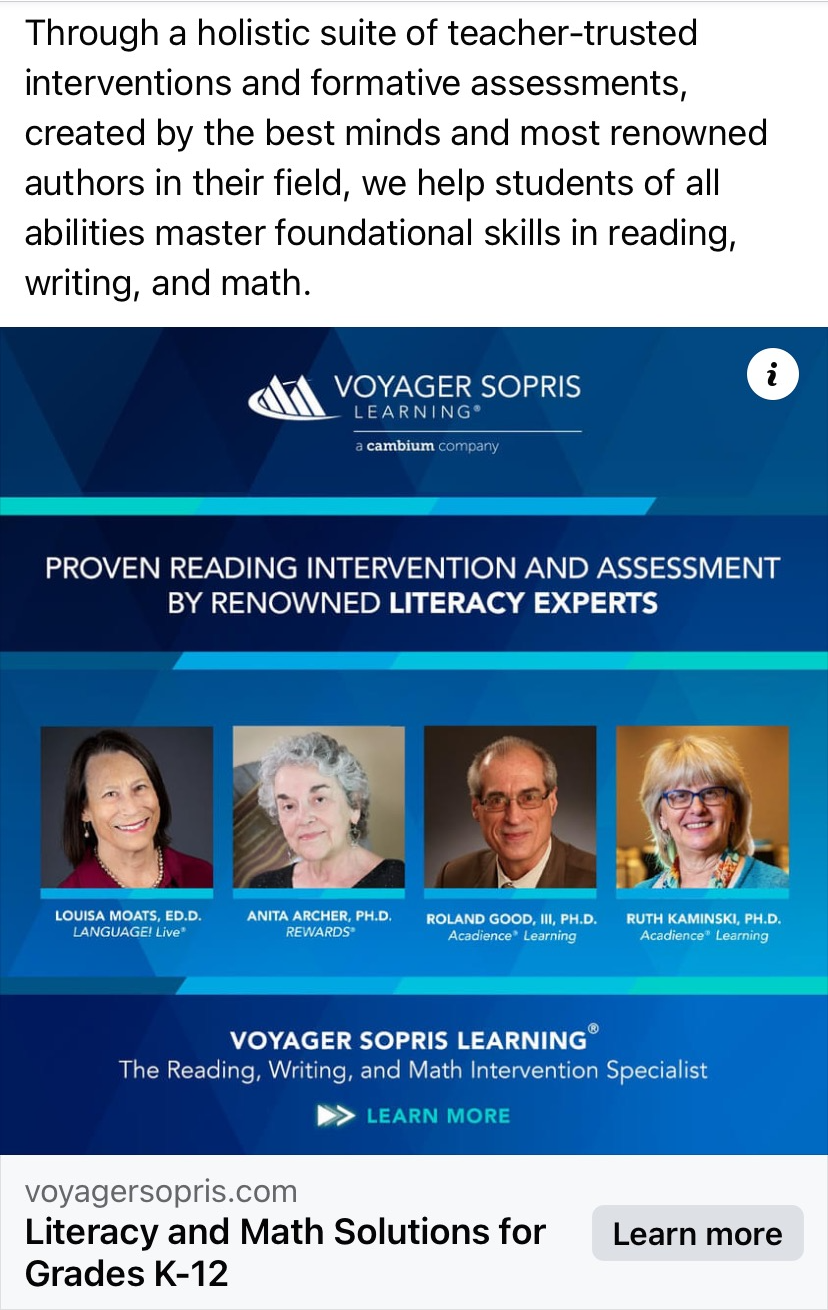
First, with the dramatic coverage of math scores dropping (see HERE and HERE), I told a few friends to brace themselves for the inevitable next step. And it took only about one day for my prediction to happen with an ad popping up on Facebook:
In the U.S., notably since the release of A Nation at Risk (see HERE and HERE) in the early 1980s, the easiest thing to predict is that the education market place is going to profit from educational crisis.
This fits into my second thought, which is the current and ongoing “science of reading” crisis that was prompted in 2018 by Emily Hanford, but was significantly boosted by the cries of “reading crisis” after the release of the 2019 NAEP data (see HERE, HERE, HERE, and HERE).
Now, I regret to note, math will be the next over-reaction, as the ad above shows now that edu-businesses scramble to add math to their offering for reading—solutions need a problem, and high-stakes testing is a problem machine. [1]
And the big picture thing I thought about was Deleuze, from the reading I have students consider:
We are in a generalized crisis in relation to all the environments of enclosure—prison, hospital, factory, school, family….The administrations in charge never cease announcing supposedly necessary reforms: to reform schools, to reform industries, hospitals, the armed forces, prisons….In disciplinary societies one was always starting again (from school to the barracks, from the barracks to the factory), while in the societies of control one is never finished with anything—the corporation, the educational system, the armed services being metastable states coexisting in one and the same modulation, like a universal system of deformation. (pp. 3-4, 5)
Deleuze builds to a powerful and prescient warning:
For the school system (emphasis in original): continuous forms of control, and the effect on the school of perpetual training, the corresponding abandonment of all university research, the introduction of the “corporation” at all levels of schooling. (p. 7)
As a key example, many (if not most) teachers of reading in the U.S. now are being told that their university training was useless, and that they need new training in the “science of reading.” And education corporations are lining up to sell schools that training, a story sold with the “science of reading” label (see about LETRS).
Just to be clear, this is not about the failure of teacher certification or about teaching teachers to teach or students to read; this is about profit through perpetual crisis and (re)training.
And here is the disconnect.
While I carefully help students over the course of a semester examine the claimed democratic foundations of public education (well documented in the writings of Thomas Jefferson and key figures in American education such as John Dewey), we quickly uncover that those democratic ideals are often secondary—or even erased—by market commitments.
So here we are in 2022 still riding the wave of accountability, standards, and high-stakes testing that began with A Nation at Risk and built to George W. Bush’s No Child Left Behind (NCLB).
As early as the 1990s, however, many education scholars warned that this education crisis was manufactured—essentially a political lie that was bolstered by a media frenzy and a market grab.
The education crisis/education market place dynamic has been in full swing for over forty years now, and the ugly truth is that all of the crisis rhetoric used to justify incessant accountability layered onto a constant process of new standards and new tests is, as Berliner and Biddle documented, manufactured, a lie.
As compelling as it is, we simply do not now have a reading crisis; we have never had a reading crisis.
And NAEP 2022 data do not expose a math crisis.
“Crisis” suggests something new, immediate, and pressing to address.
Student learning has been about the same for nearly a century. Some students thrive (mostly correlated with affluence and being white), many students learn in spite of the system, and too many students are neglected or mis-served (correlated strongly with poverty, minoritized race, multi-language learning, and special needs).
Just to swing back to reading, there is no decade (or even year) over the last 80 years that public, media, and political opinions expressed satisfaction in reading achievement; student reading proficiency has always been characterized as failing, and a crisis.
Always.
As we creep toward an election, we need to admit a few things.
First, the market and commercialism matter more in the U.S. than democracy or even freedom.
We not only want schools to produce (compliant) workers, but also have turned public education into a crisis-based education market place.
Take a little journey to Education Week‘s web site and note that flurry of ads for the “science of reading,” for example:
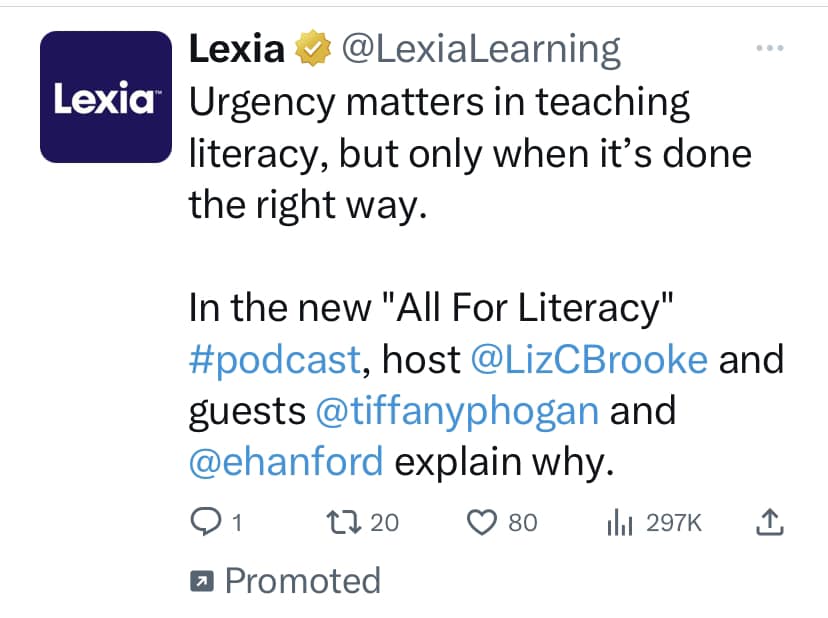
[Update] Or see what pops up “promoted” on Twitter:
And monitor over the coming weeks; you’ll see more and more addressing math.
Since 2018, media has generated millions of clicks with coverage of the “science of reading,” journalists are winning cash awards and receiving huge speaking fees to discuss the “science of reading,” and education corporations are pulling in millions for software, programs, and training labeled the “science of reading.”
Please take just a brief historical overview since the 1980s. Not a single reform has worked, not a single crisis/reform cycle has been deemed a success.
As Deleuze explains, the point of crisis/reform is to remain always in crisis/reform because that cycle creates a market, and for some people, that market generates profit.
But that crisis/reform cycle has a high cost for students, teachers, and society.
The “science of reading” crisis ironically follows just about two decades after the reading crisis identified by the National Reading Panel and at the center of NCLB—which mandated that teachers had to implement only scientifically-based practices (notably in reading).
That failed (apparently) and the current response is to shout (once again) “crisis!” and demand that mandates restrict teaching to the “science of reading.”
Four decades-plus into a crisis/reform hole and we continue to dig.
Part of me feels sorry for what is about to happen to math, and part of me feels really bad that I hope the coming math nonsense will relieve a little pressure from reading.
But mostly, I hate the lies, political, media, and commercial interests that are eager to shout “crisis!” because in the spirit of the good ol’ U.S. of A., there is money to made in all that bullshit.
Thomas, P.L. (2022). The Science of Reading movement: The never-ending debate and the need for a different approach to reading instruction. Boulder, CO: National Education Policy Center. http://nepc.colorado.edu/publication/science-of-reading
I entered the classroom as a high school English teacher in Upstate South Carolina in the fall of 1984, coinciding with the start of the high-stakes accountability movement in my home state as well as across the U.S.
Many people identify the Nation at Risk report under Ronald Reagan as ground zero for the accountability movement that entrenched patterns of school reform lasting until today—ever-changing standards, ever-changing high-stakes tests, and a never-ending refrain that schools are failing.
George W. Bush brought state-level education reform/accountability to the federal level with the bi-partisan No Child Left Behind, and then Barack Obama doubled down on the same basic concepts and approaches despite decades of accountability measures not working.
As a result, when I entered the world of blogging and public commentary during Obama’s administration, I found two enduring and powerful metaphors for the essential flaws of the accountability/education reform movement.
One is from Oscar Wilde: “But their remedies do not cure the disease: they merely prolong it. Indeed, their remedies are part of the disease.”
And the other is inspired by a scene from Alice Walker’s The Color Purple, detailed in a letter from Nettie to Celie:
The first thing I should tell you about is the road. The road finally reached the cassava fields about nine months ago and the Olinka, who love nothing better than a celebration, outdid themselves preparing a feast for the roadbuilders who talked and laughed and cut their eyes at the Olinka women the whole day. In the evening many were invited into the village itself and there was merrymaking far into the night. I think Africans are very much like white people back home, in that they think they are the center of the universe and that everything that is done is done for them. The Olinka definitely hold this view. And so they naturally thought the road being built was for them [emphasis added]. And, in fact, the roadbuilders talked much of how quickly the Olinka will now be able to get to the coast. With a tarmac road it is only a three-day journey. By bicycle it will be even less. Of course no one in Olinka owns a bicycle, but one of the roadbuilders has one, and all the Olinka men covet it and talk of someday soon purchasing their own.
Well, the morning after the road was “finished” as far as the Olinka were concerned (after all, it had reached their village), what should we discover but that the roadbuilders were back at work. They have instructions to continue the road for another thirty miles! And to continue it on its present course right through the village of Olinka. By the time we were out of bed, the road was already being dug through Catherine’s newly planted yam field. Of course the Olinka were up in arms. But the roadbuilders were literally up in arms. They had guns, Celie, with orders to shoot!
It was pitiful, Celie. The people felt so betrayed! They stood by helplessly—they really don’t know how to fight, and rarely think of it since the old days of tribal wars—as their crops and then their very homes were destroyed. Yes. The roadbuilders didn’t deviate an inch from the plan the headman was following. Every hut that lay in the proposed roadpath was leveled. And, Celie, our church, our school, my hut, all went down in a matter of hours. Fortunately, we were able to save all of our things, but with a tarmac road running straight through the middle of it, the village itself seems gutted.
Immediately after understanding the roadbuilders’ intentions, the chief set off toward the coast, seeking explanations and reparations. Two weeks later he returned with even more disturbing news. The whole territory, including the Olinkas’ village, now belongs to a rubber manufacturer in England. As he neared the coast, he was stunned to see hundreds and hundreds of villagers much like the Olinka clearing the forests on each side of the road, and planting rubber trees. The ancient, giant mahogany trees, all the trees, the game, everything of the forest was being destroyed, and the land was forced to lie flat, he said, and bare as the palm of his hand.
From this, I drew a conclusion that has served as a guiding metaphor for my criticism of the education reform movement and the title of one of my books, Beware the Roadbuilders: Literature as Resistance (Garn Press): “Beware the roadbuilders. They are not here to serve you, they are on their way to bulldoze right over you.”
I have come back to this metaphor as both ongoing criticism and confirmation that accountability is a failed approach to education reform.
One element of the tension between the accountability/education reform movement and those of us committed to education and social reform grounded in equity (and not accountability) is the shared acknowledgement that universal public education has a long history of failing marginalized and oppressed populations of students, reflecting the larger failures of communities, states, and the broader U.S. to serve marginalized and oppressed people.
It is 2021, and in my home state of SC, the metaphor I have depended on is being vividly and callously brought to reality:
The dismantling of Black communities for state and federal highways is not just a thing of the past. It’s happening now a few miles north of Charleston with the proposed West I-526 Lowcountry Corridor, at a time when President Biden and his transportation secretary have vowed to stop it.
South Carolina is proposing to sweep aside dozens of homes, and potentially hundreds of people, to widen a freeway interchange choked with traffic in this booming coastal region. The $3 billion project is expected to begin about two years after the plan becomes final. …
Under the state’s preferred proposal for the interchange upgrade, 94 percent of people and structures that would be displaced live in environmental justice communities mostly composed of Black and Brown residents.
It is 2021, and I must reach the same conclusion I drew in 2014: Beware the roadbuilders. They are not here to serve you, they are on their way to bulldoze right over you.
Racial and economic segregation in urban communities is often understood as a natural consequence of poor choices by individuals. In reality, racially and economically segregated cities are the result of many factors, including the nation’s interstate highway system. In states around the country, highway construction displaced Black households and cut the heart and soul out of thriving Black communities as homes, churches, schools, and businesses were destroyed. In other communities, the highway system was a tool of a segregationist agenda, erecting a wall that separated White and Black communities and protected White people from Black migration. In these ways, construction of the interstate highway system contributed to the residential concentration of race and poverty, and created physical, economic, and psychological barriers that persist.
Today, the interstate highway system is on the verge of transformational change as aging highways around the country are crumbling or insufficient to meet growing demand and must be rebuilt or replaced. The possibility of significant infrastructure development offers an opportunity to redress some of the harm caused by the interstate highway system, to strengthen impacted communities, and to advance racial equity. Still, there is a risk that federal, state, and local highway builders will repeat the sins of the past at the expense of communities of color whose homes, businesses, and community institutions again stand in the path of the bulldozers. Moreover, there is reason to believe that traditional civil rights laws, standing alone, are insufficient to redress the structural and institutional racism that shaped the interstate highway system and continues to threaten communities of color as the highways are rebuilt.
This Article is the first in the legal literature to explore in depth the racial equity concerns and opportunities raised by modern highway redevelopment. It also builds upon the work of legal scholars who advocate for addressing systemic racial inequality by requiring that policymakers conduct a thorough and comprehensive analysis of how a proposed action, policy, or practice will affect racial and ethnic groups. The Article concludes by proposing a way forward for highway redevelopment projects: requiring jurisdictions to complete comprehensive racial equity impact studies prior to any construction. Racial equity impact studies have been used or proposed in various contexts to reform racialized institutions and structures. This Article argues that highway redevelopment projects should join this growing list.
Archer, Deborah N., ‘White Men’s Roads Through Black Men’s Homes’: Advancing Racial Equity Through Highway Reconstruction (February 18, 2020). 73 Vanderbilt Law Review 1259 (2020), NYU School of Law, Public Law Research Paper No. 20-49, Available at SSRN: https://ssrn.com/abstract=3539889
Criticizing U.S. public education through international comparisons is a long-standing tradition in the U.S. media, reaching back at least into the mid-twentieth century.
This is one of many crisis approaches to covering education—Chicken Little journalism—that makes false and misleading claims about the quality of U.S. education (always framed as a failure) and that because of the low status of the U.S. in international comparisons of education, the country is doomed, economically and politically.
Oddly enough, as international rankings of education have fluctuated over 70-plus years, some countries have risen and fallen in economic and political status (even inversely proportional to their education ranking) while the U.S. has remained in most ways the or one of the most dominant countries—even as we perpetually wallow in educational mediocrity.
Yet, this isn’t even remotely surprising as Gerald Bracey (and many others) detailed repeatedly that international comparisons of educational quality are essentially hokum—the research is often flawed (apples to oranges comparisons) and the conclusions drawn are based on false assumptions (that education quality directly causes economic quality).
Media coverage, however, will not (cannot?) reach for a different playbook; U.S. public education is always in crisis and the sky is falling because schools (and teachers) are failing.
Next up? I am betting on the “science of science.”
Fewer than 1 in 4 high school seniors and a little more than a third of 4th and 8th graders performed proficiently in science in 2019, according to national test results out this week.
The results are the latest from the National Assessment of Educational Progress in science. Since the assessment, known as “the nation’s report card,” was last given in science in 2015, 4th graders’ performance has declined overall, while average scores have been flat for students in grades 8 and 12.
“The 4th grade scores were concerning,” said Peggy Carr, the associate commissioner of the National Center for Education Statistics, which administers NAEP. “Whether we’re looking at the average scores or the performance by percentiles, it is clear that many students were struggling with science.”
But it is even worse than we thought: “These widening gaps between the highest- and lowest-performing students, particularly in grade 4, mirror similar trends seen in national and global reading, math, and social studies assessments.”
Yep, U.S. students suck across all the core disciplines compared to the rest of the world!
Organizing instruction around phenomena is a key feature of many reforms aimed at meeting the Next Generation Science Standards, an ambitious set of standards adopted or adapted by 44 states in 2013. Phenomena are also an organizing feature of instructional reforms in countries outside the United States, likehigh-performing Finland. But what is phenomenon-based learning, and what evidence is there that it works?…
Our study found that students exposed to the phenomenon-based curriculum learned more based on a test aligned with the Next Generation standards than did students using the textbook. Importantly, the results were similar across students of different racial and ethnic backgrounds.
Up next, of course, is the media trying to understand why science scores are so abysmal (like reading and math), assigning blame (schools, teachers, teacher education), and proposing Education Reform. What should we expect?
Well, since fourth-grade scores are in the dumpster, we need high-stakes science testing of all third-grade students and to impose grade retention on all those students who do not show proficiency in that pivotal third-grade year.
We also should start universal screening of 4K students for basic science knowledge (or maybe use “science” to screen fetuses in utero).
Simultaneously, states must adopt legislation mandating that all science curricula are based on research, the “science of science.”
Of course, teachers need to be retrained in the “science of science” because, you know, all teacher education programs have failed to teach the “science of science” [insert NCTQ report not yet released].
And while we are at it, are we sure Next Generation Science Standards are cutting it? Maybe we need Post-Next Generation Science Standards just to be safe?
Finally, we must give all this a ride, wait 6-7 or even 10 years, and then start the whole process over again.
The magical thing about Chicken Little journalism is that since the sky never falls, we can always point to the heavens and shout, “The sky is falling!”
educator, public scholar, poet&writer – academic freedom isn't free









 dr. p.l. (paul) thomas