Category Archives: comic books

Black Widow Underestimated: “I Am What I Am”

In the Marvel Universe(s), including the MCU, Black Widow has endured just about every compelling and nonsensical plot line and character development that represent the larger sub-genre of superhero comic books. As I have been documenting, however, Marvel and even their best creative teams find ways to underestimate (and, of course, hypersexualize) Natasha/Black Widow.

With Marvel committing more issues and superstar teams in v.5 and v.6, readers may have held out hope that the fate of Black Widow (both inside the comic book universe and more broadly as a character Marvel would develop more substantially) had turned a corner. However, v.7 ultimately is a regression with only 5 issues, and then, the Web of Black Widow offers another brief 5-issue run after that.

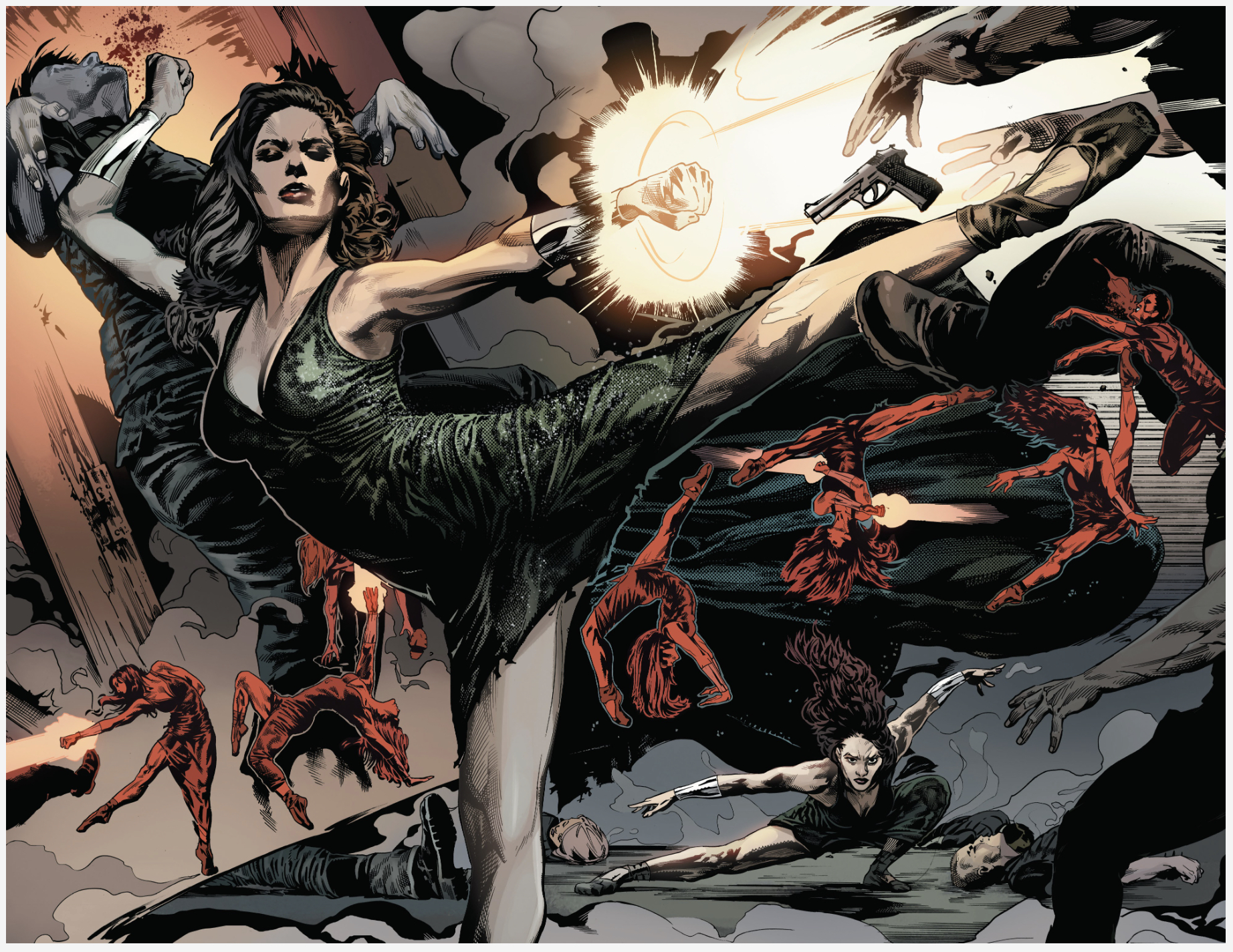
Black Widow v.7, issue 1 (cover art by Clayton Crain) and Web of Black Widow issue 3 (cover art by Jung-Geun Yoon) remind us that too often Black Widow is hypersexualized with her outfits and the relentless urge to show her bound.

Since we have the benefit of hindsight—this post sitting as it does after one of the best (if not the best) run on Black Widow, v.8 (thanks to Kelly Thompson, Elena Casagrande, and others)—many of us are now dealing with both the afterglow of a stellar 15-issue run and the recurring disappointment of Black Widow once again trapped in publishing limbo.

Here, I want to consider v.7 and Web as a stumbling journey to that excellent Thompson series, holding onto the hope that at some point Marvel will overcome underestimating and hypersexualizing Natasha/Black Widow.

Black Widow, Lost and Found

The creative team of Jen Soska and Sylvia Soska, writers, and Flaviano Armentaro, artist, are tasked with v.7 in the wake of Natasha Black Widow’s death in Secret Empire issue 7.

Cover art by Max Brooks.

The opening of v.7 issue 1 establishes, again, the double-identity and secret identity motifs very common in superhero comics, but especially in Black Widow narratives. Here, the dual Captain Americas (one of which has killed Black Widow in Secret Empire before she is resurrected through cloning and memory implants) face off again as Natasha helps—while trying to maintain the veil of people believing she is dead.

While Black Widow and the real Captain America fight the evil Captain America, this volume returns to considerations of dual and secret identities as well as the tensions at the core of being a superhero—fighting for good while trying to honor human life.
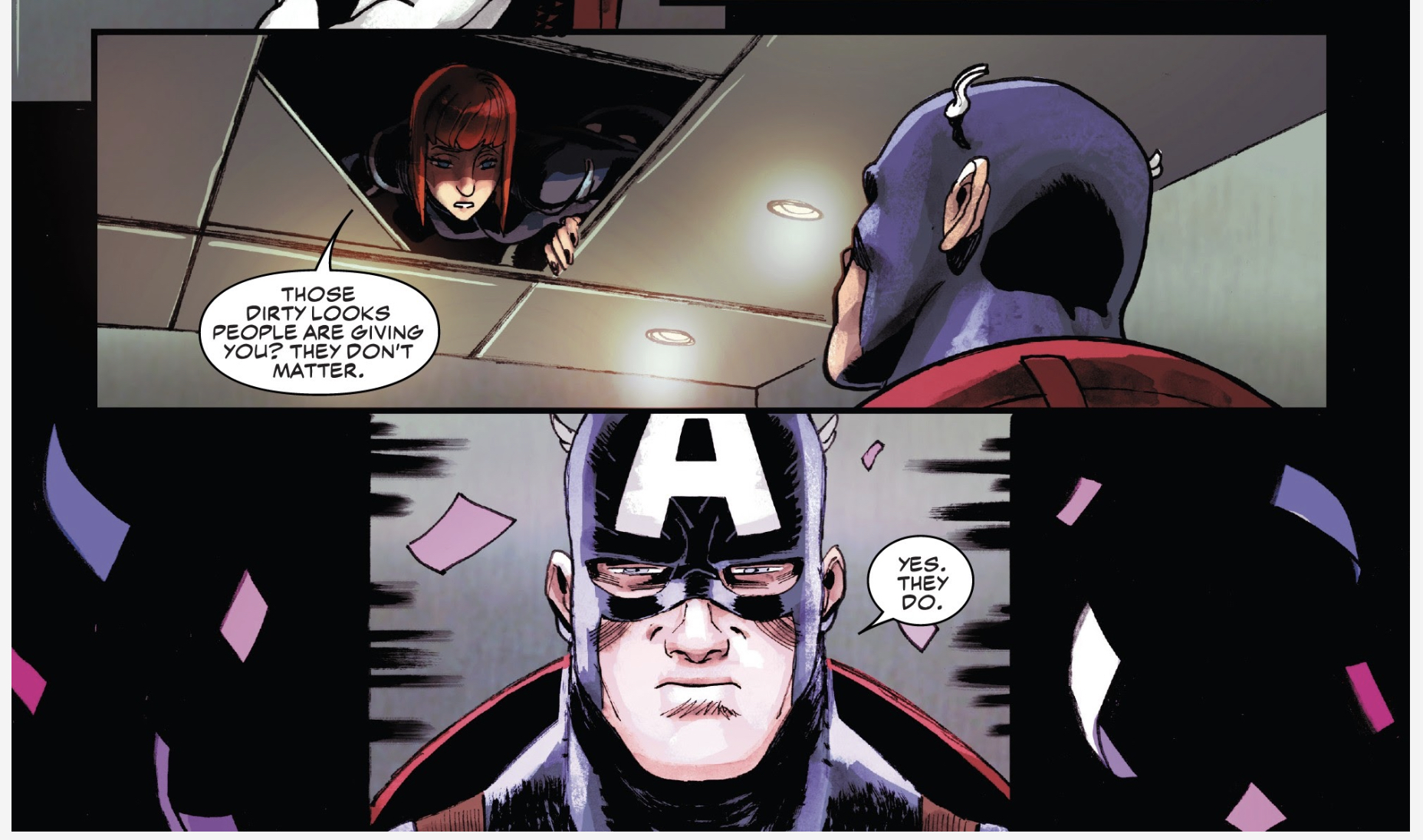
Natasha is a perfect pairing for Captain America’s identity crisis since she has long suffered doubt and suspicious about her loyalties despite her heroism.

The dynamic between Black Widow and Captain America works well here, but once again, sexual banter returns in a way that feel reductive and unneeded:
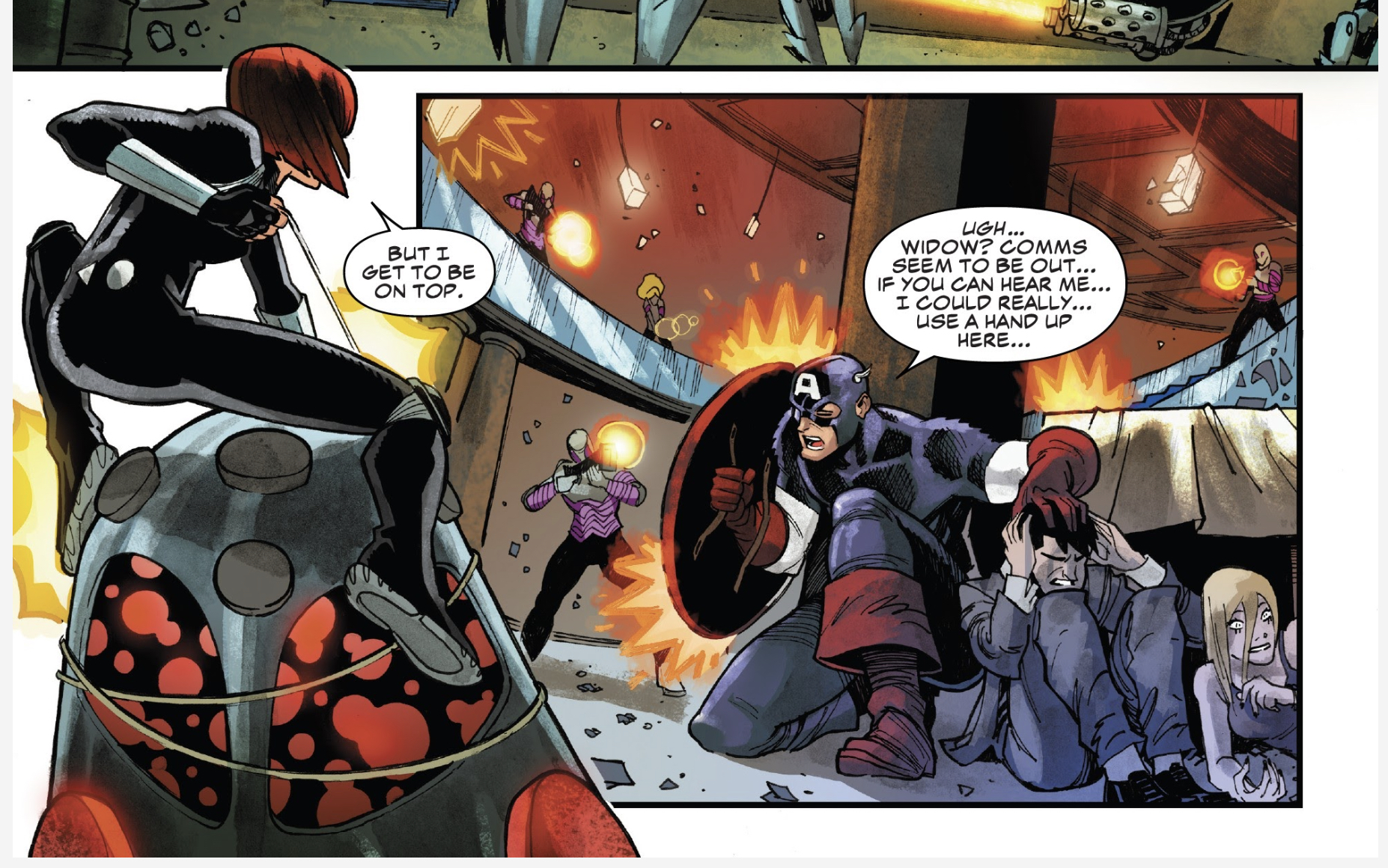
Hypersexualized Black Widow would not seem as abrupt in v.7 if not for the more nuanced and fuller explorations of the character in v.5 and v.6.

The core tension of this issue is one of the most enduring elements of the superhero subgenre, one that includes the problematic aspects of vigilanteism, embodied by Black Widow and Captain America arguing over taking a life:
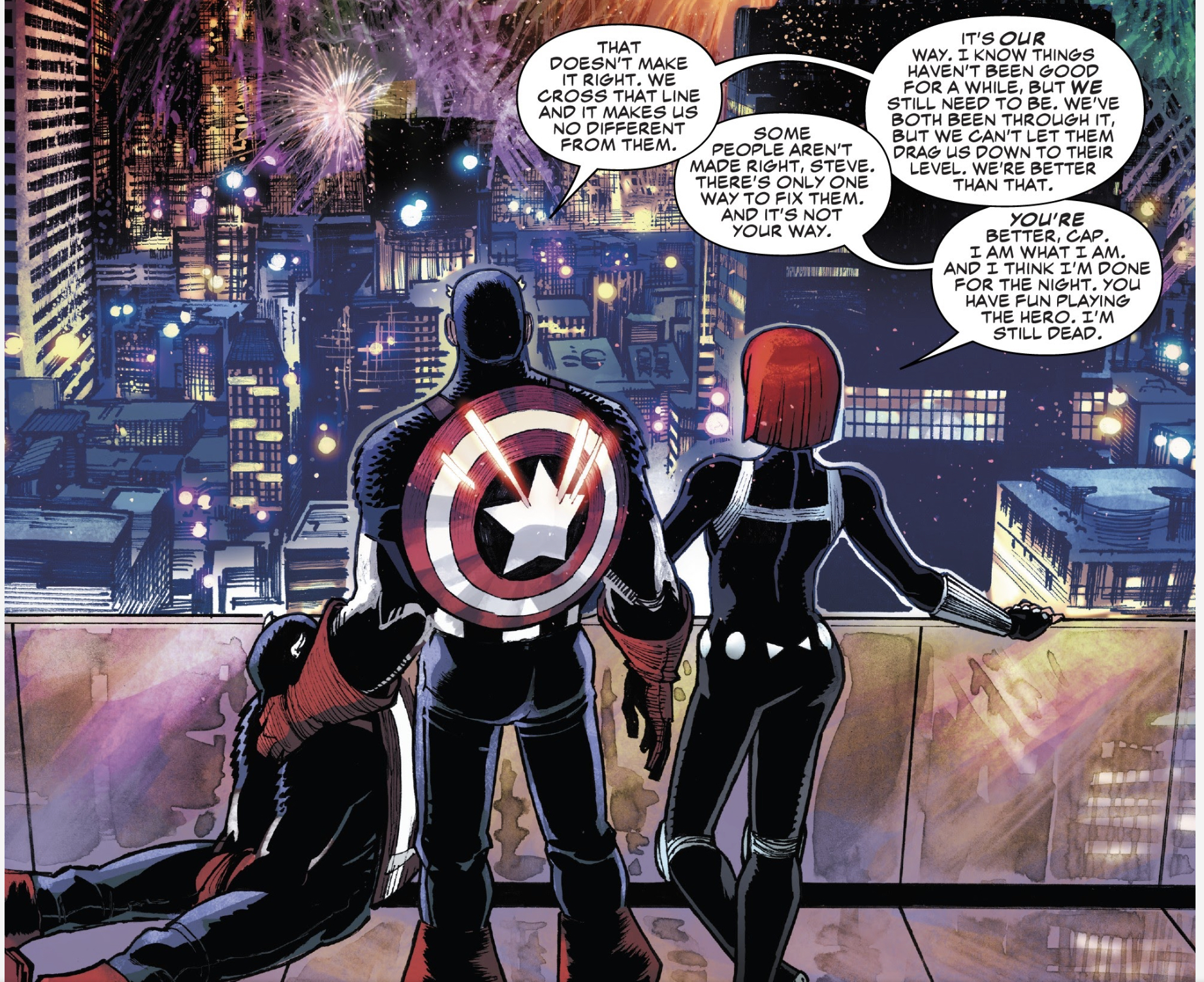
Black Widow, cold and practical, resists Captain America’s idealism with “I am what I am.”

And Natasha remains vividly aware of who she is: “The violence. The rage”:
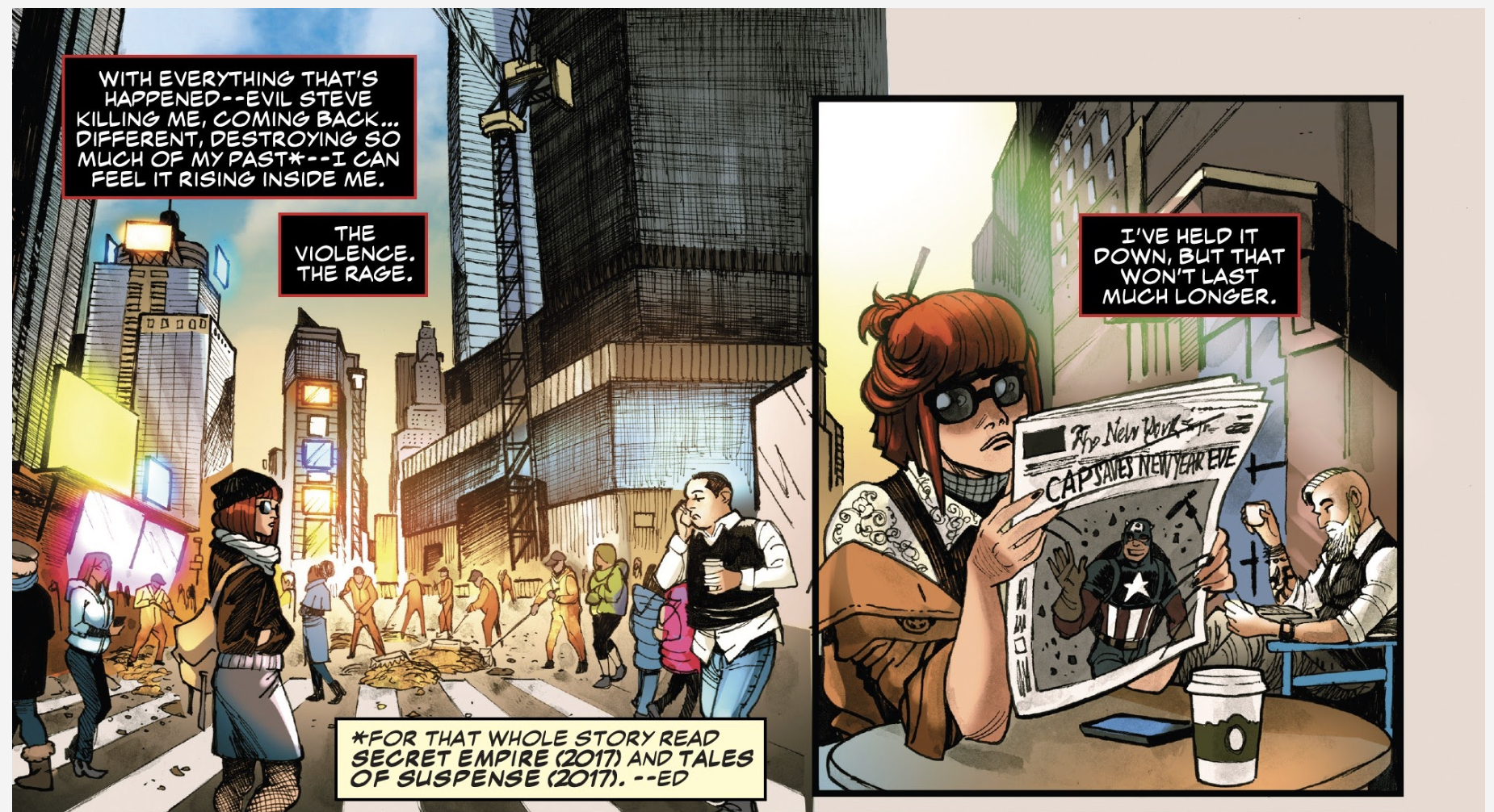
Ominous beginnings for v.7 highlight what likely are the strongest elements of the Black Widow narrative, a woman fighting herself because of the injustices she has suffered even as she seeks to fights for other people’s justice.

For v.7, the Soska sisters explain the are committed to “Black Widow … unleashed,” and placing Natasha motivated by avenging child sex trafficking provides fertile soil for just that—as Black Widow herself revels in the opportunity:
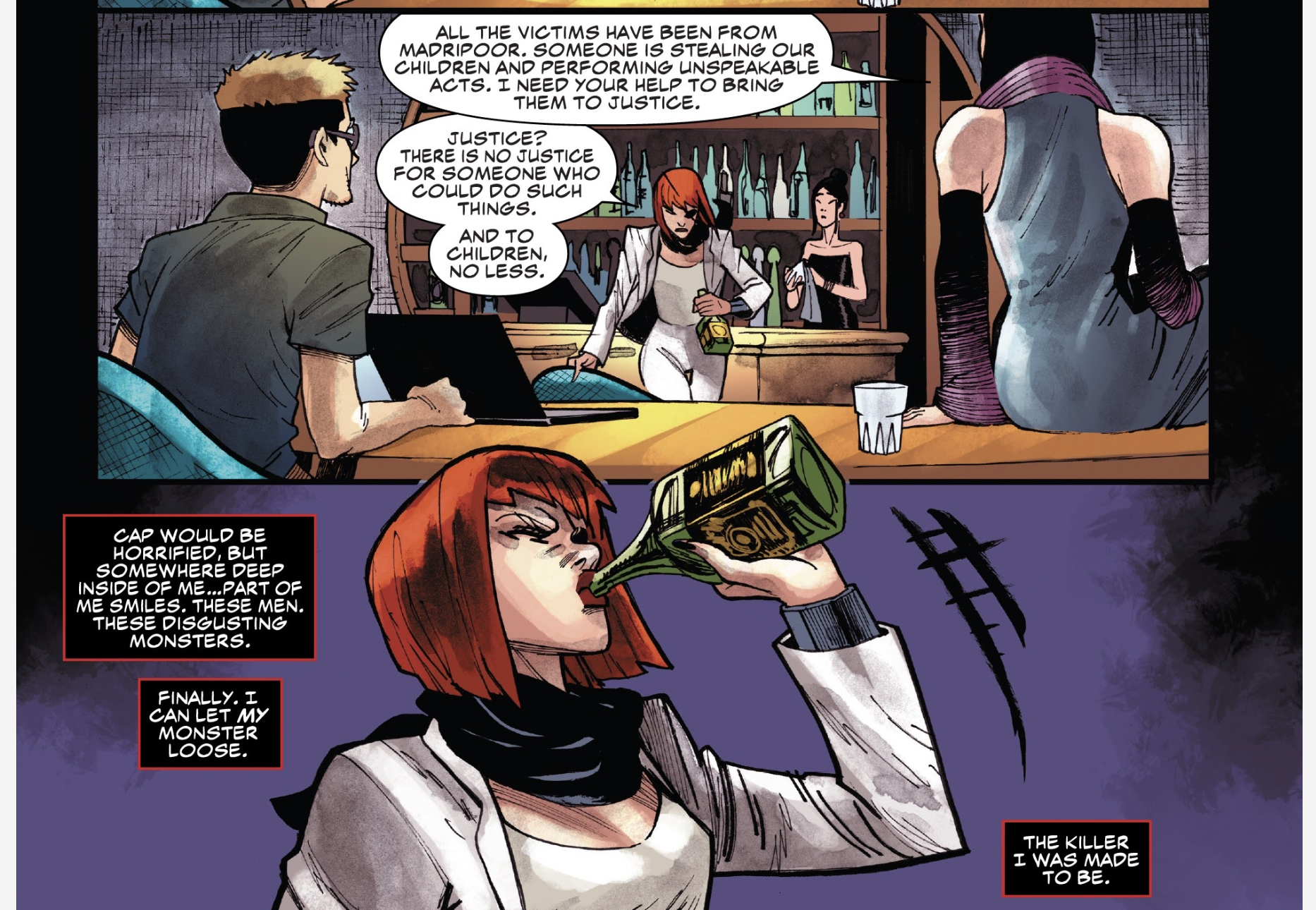
Natasha’s passionate resolve stand in contrast to Captain America’s naive view of the ugliest aspects of humanity.

And Black Widow unleashed shifts the reader’s gaze away from Natasha’s body (when creators underestimate the character) and highlights the violence she has embraced, and justifies. We must confront the allure along with the problems of ends-justify-the-means justice:

Placed side-by-side with Wilson Fisk’s infamous car door scene in Netflix’s Daredevil, v.7, issue 2 allows Black Widow to take no prisoners.

The focus of v.7 maintains the “unleashed” commitment of the writers, and much of the action involves several women characters—Black Widow, Tyger Tiger, Madame Masque—against the backdrop of the most horrific child sex trafficking (including a child recovered who had her hands cut off).

Throughout this series, I struggle with Flaviano’s artwork, however. Too often the style leans to the cartoon side, unlike the dynamic and even hyperrealism of previous artists such as Phil Noto and Chris Samnee. These concerns are more about my tastes than quality, I think, because Flaviano’s work suits well the “unleashed” tone throughout.

As one example, the creators of v.7 turn the tables on one of the most reductive ways Black Widow is portrayed—bound (and often nude or semi-nude):
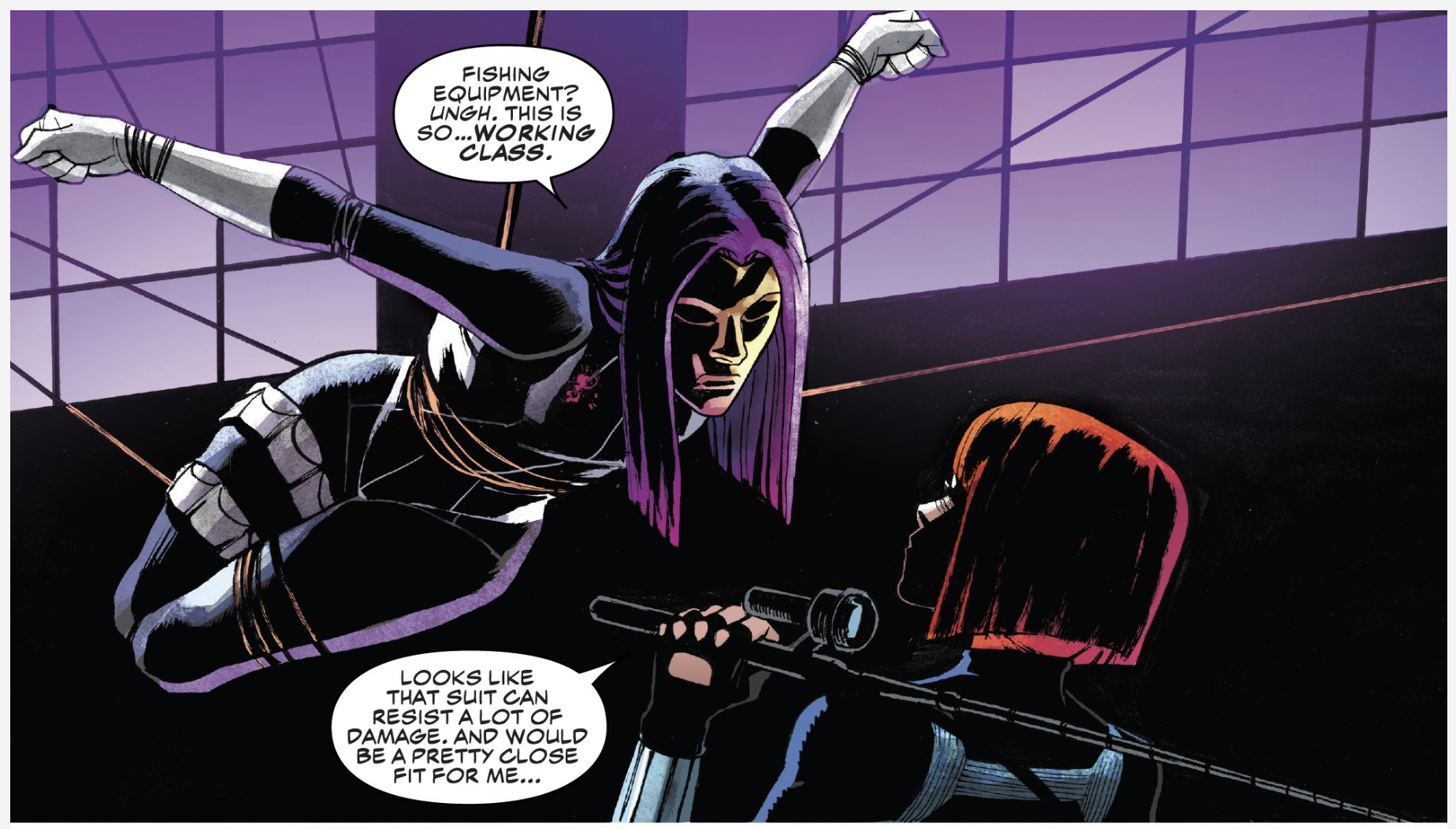
A great deal is at work here in v.7, issue 3—a twist on the bound motif, the working-class slur, and extended scenes between two women in what is too often a misogynistic media.

However, after Natasha takes on Madame Masque’s identity to infiltrate the child trafficking ring, issue 3 slips right back into old habits—Natasha exposed, and bound:
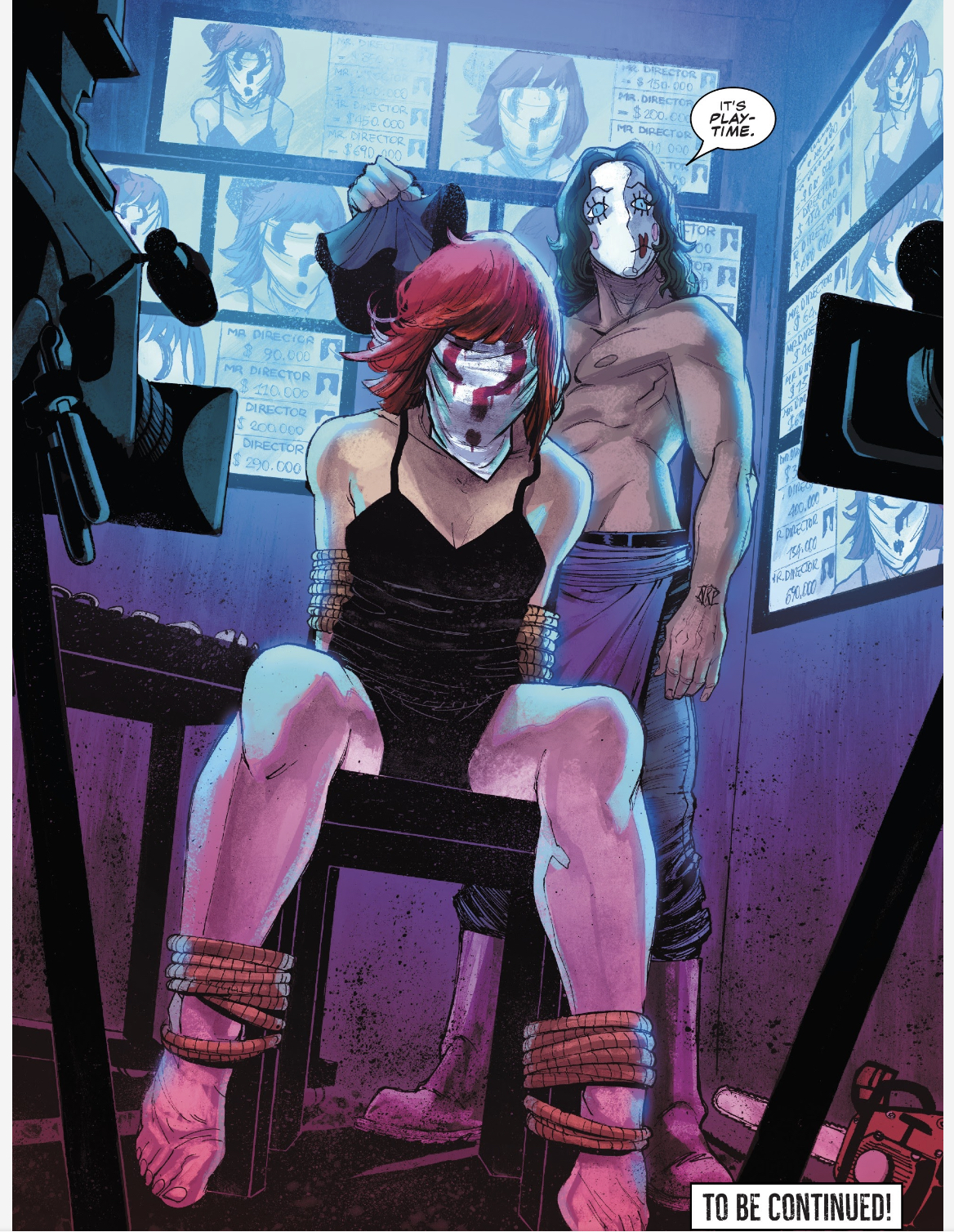
It is hard not to be disappointed when creative teams cannot resist Natasha returning to the role of victim and almost always finding herself bound, helpless, and exposed.

By issue 4, “unleashed” becomes hyperviolent and cathartic for Black Widow, and likely readers. Despite my concerns raised above, Flaviano’s paneling and design lend a powerfully dynamic look that reinforces the narrative.

And at the center of it all, the weight of Natasha’s past remains at the heart of Black Widow, super-agent, and Natasha, deeply traumatized woman:
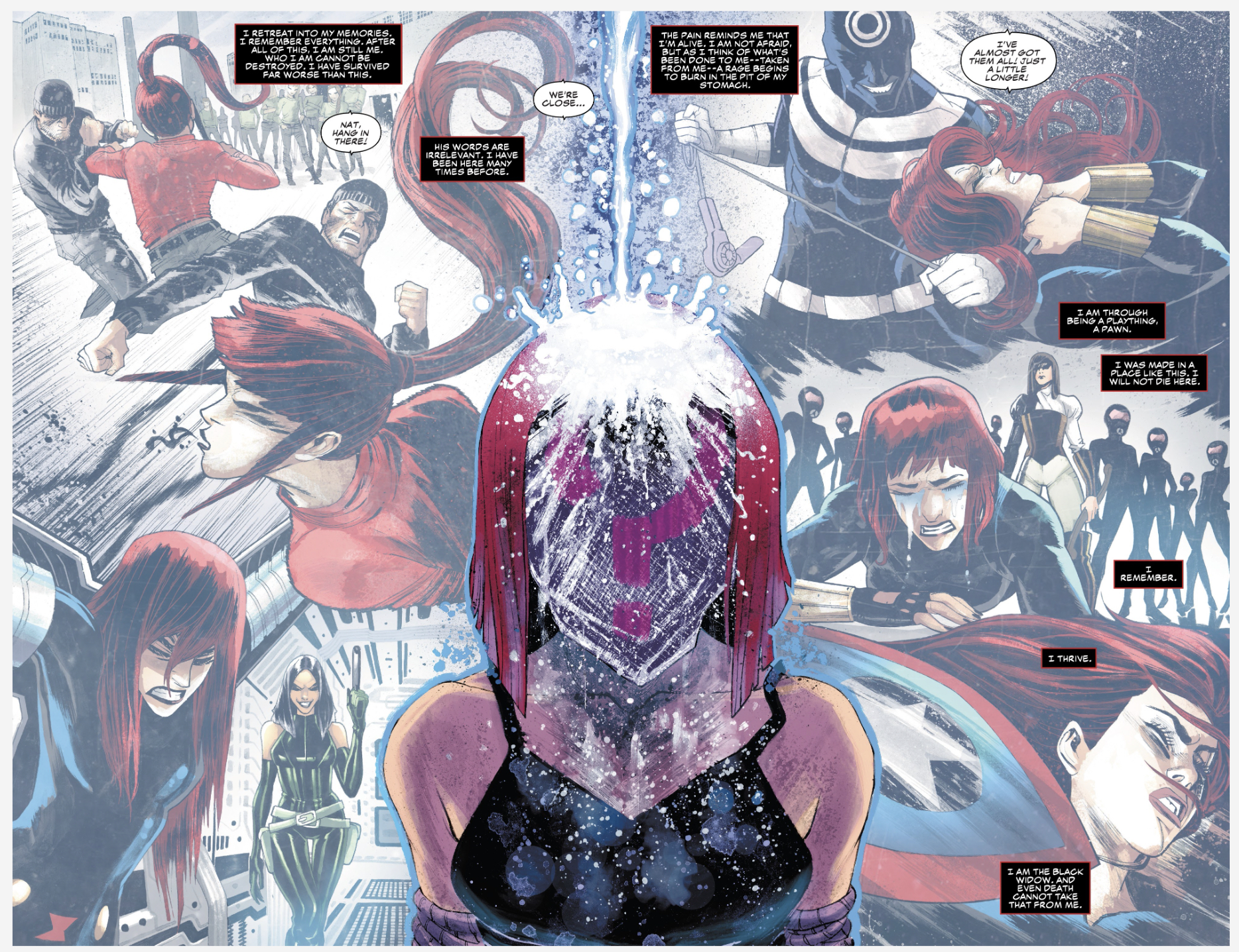
“I am through being a plaything, a pawn”—this refrain drives v.7, but also speaks to the essence of my series, raising concerns about underestimating and hypersexualizing this important character.

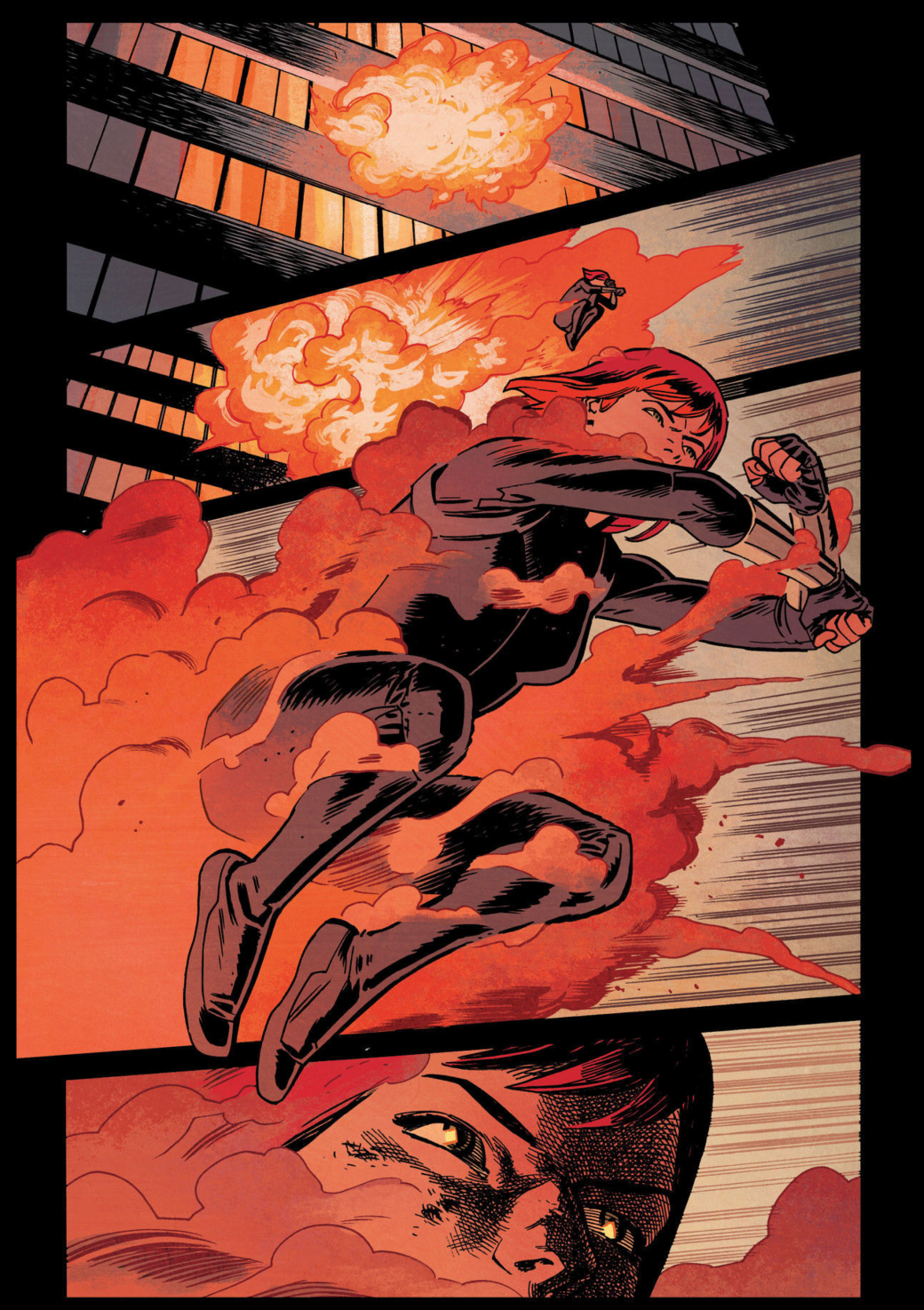
Identity and rebirth open the last issue of this series with Black Widow surviving a blast, portrayed with subtle phoenix imagery:
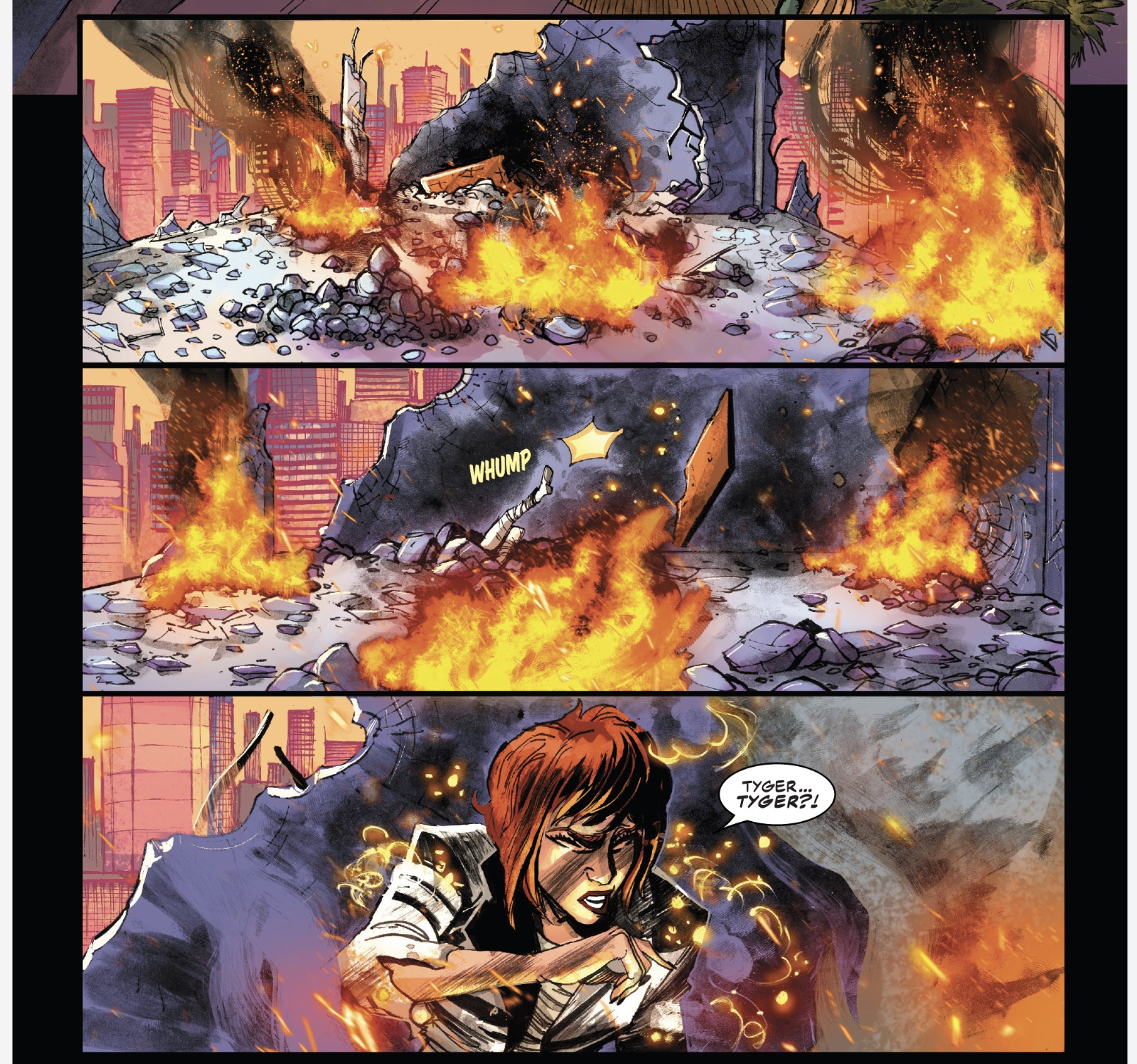
Survival and rebirth sits at the center of who Natasha is a woman and as a superhero.

The volume ends with some of the strongest aspects of this too-short series. Natasha/Black Widow imposes her world view—not Captain America’s—on her revenge, exposing the emptiness of the sex traffickers and fulfilling her own resolve to enact justice (even as that takes life).

The final pages reveal Natasha providing Winter Soldier-like hands to the mutilated girl and reuniting with Steve Rogers: “It doesn’t matter how our story started. It’s up to us how it’s going to end.”

This series becomes a story of power with the gender roles reversed—Natasha taking control of her world and urging Steve to let go of his fatalistic worldview.

Black Widow ends, again, yet the rage remains:
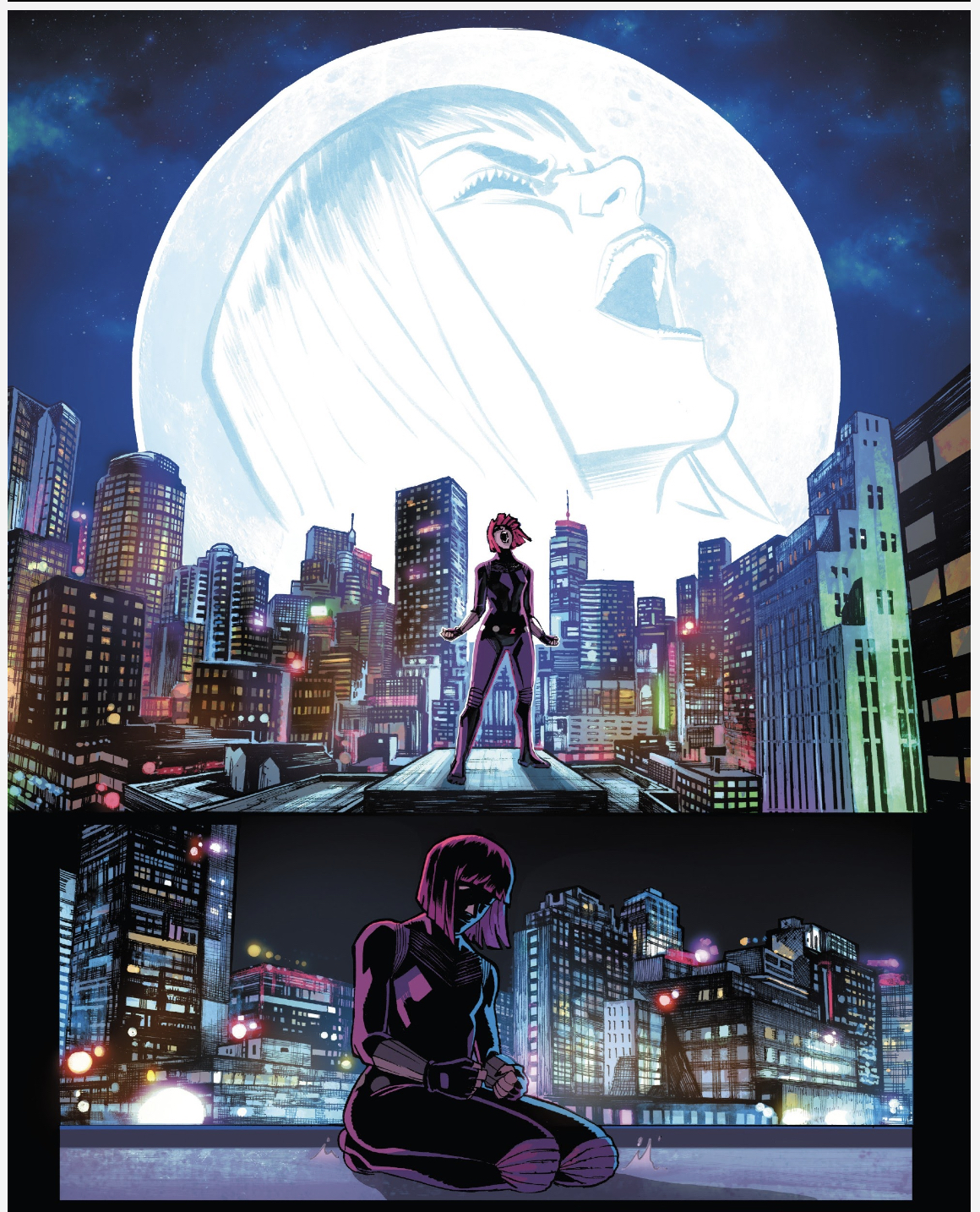
One of the best pages of v.7 occurs at the very end.

O, What a Tangled Web…

Marvel released a limited solo series, Web of Black Widow, after v.7 and before v.8, the celebrated Thompson run.

Web, regretfully, immediately introduces Tony Stark, and of course, Natasha’s cleavage:
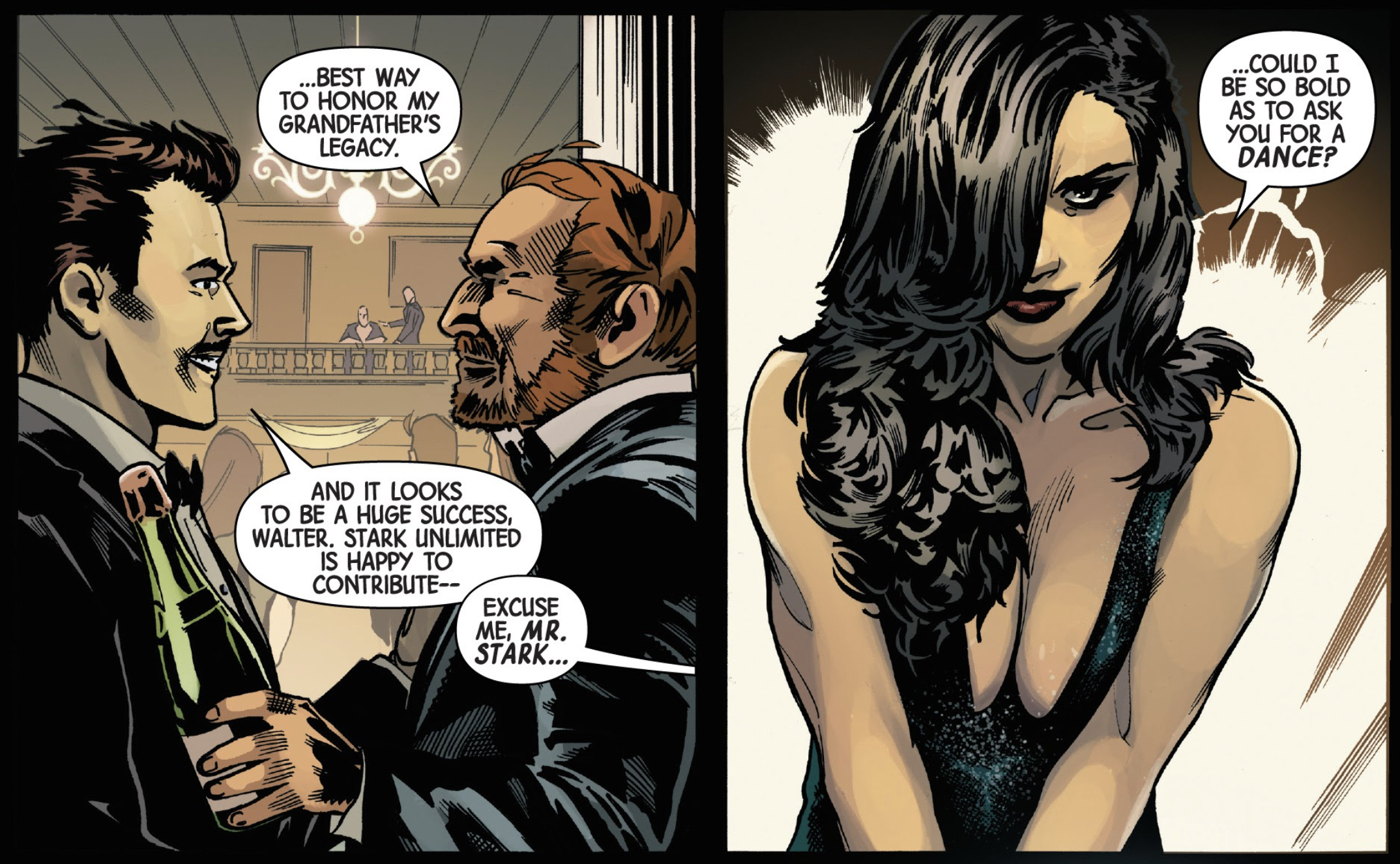
Web is written by Jody Houser with artwork by Stephen Mooney. Issue 1 doesn’t suggest another brief series, 5 issues, will rise above well-worn ground.

While issue 1 too often remains reductive and derivative, Mooney’s artwork soars none the less:
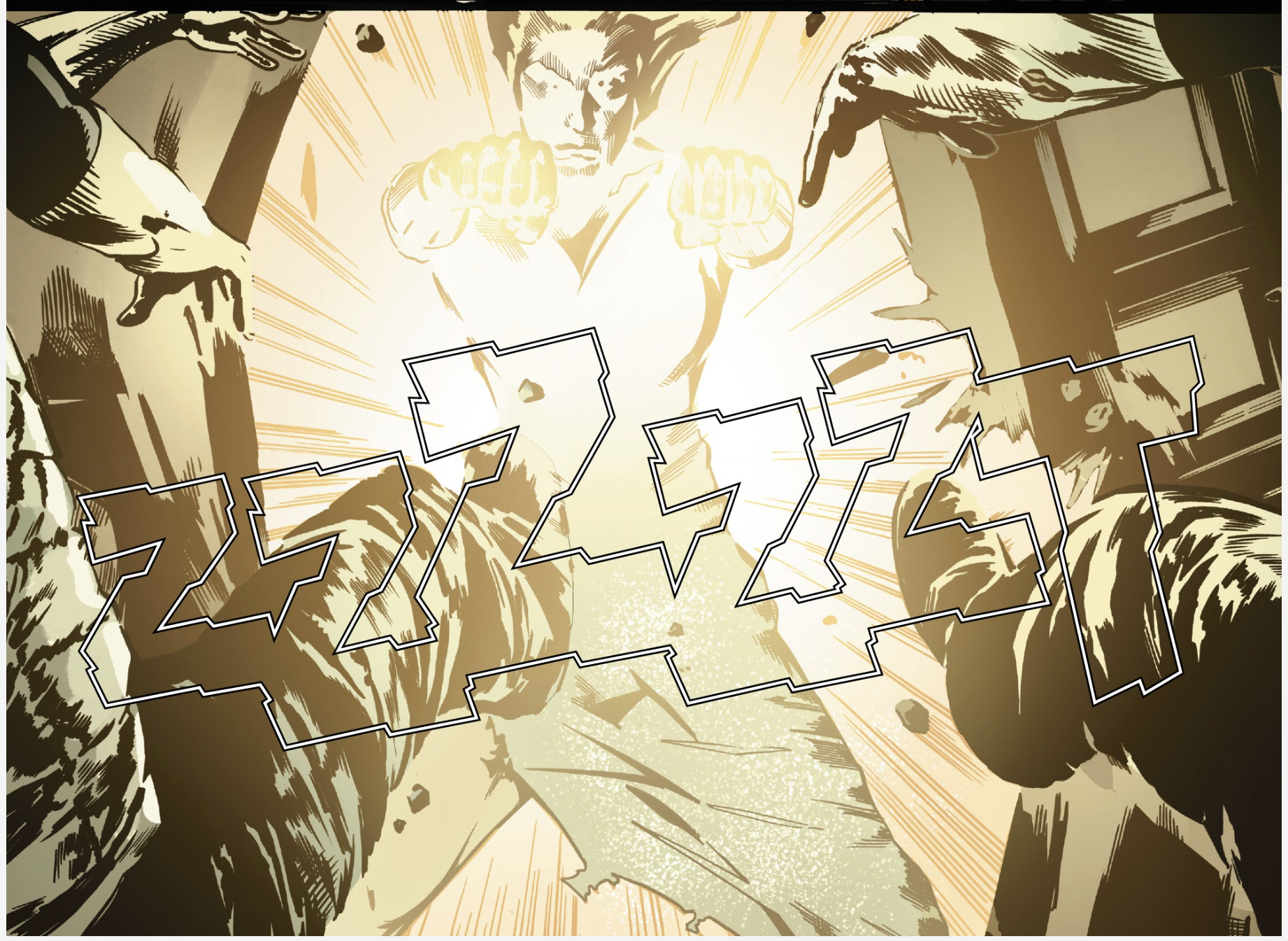
Mooney captures many of the best qualities found in superior runs of Black Widow.

Noted above, v.7 built to an issue of power; Web establishes the issue of history, switching the tension from between Natasha and Captain America to between Natasha and Iron Man.
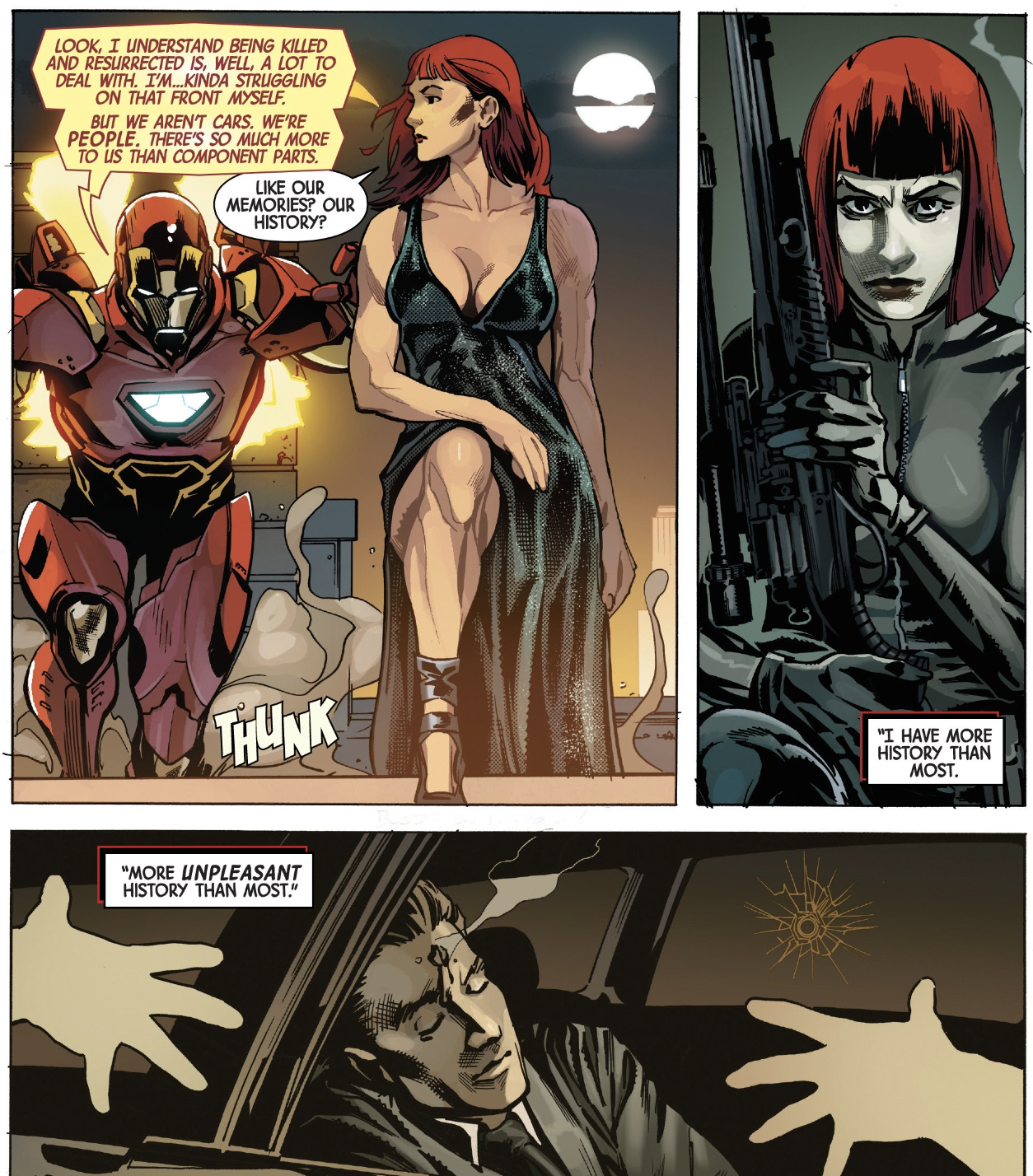
Natasha continues to build who she is on who she has been, and how her history has often been what others do to her.

Web is intended as a noir take on Black Widow, and as acknowledged earlier, the artwork certainly aspires to the very best of previous Black Widow series, but too much of this solo run falls back into the underestimated and especially the hypersexualized:
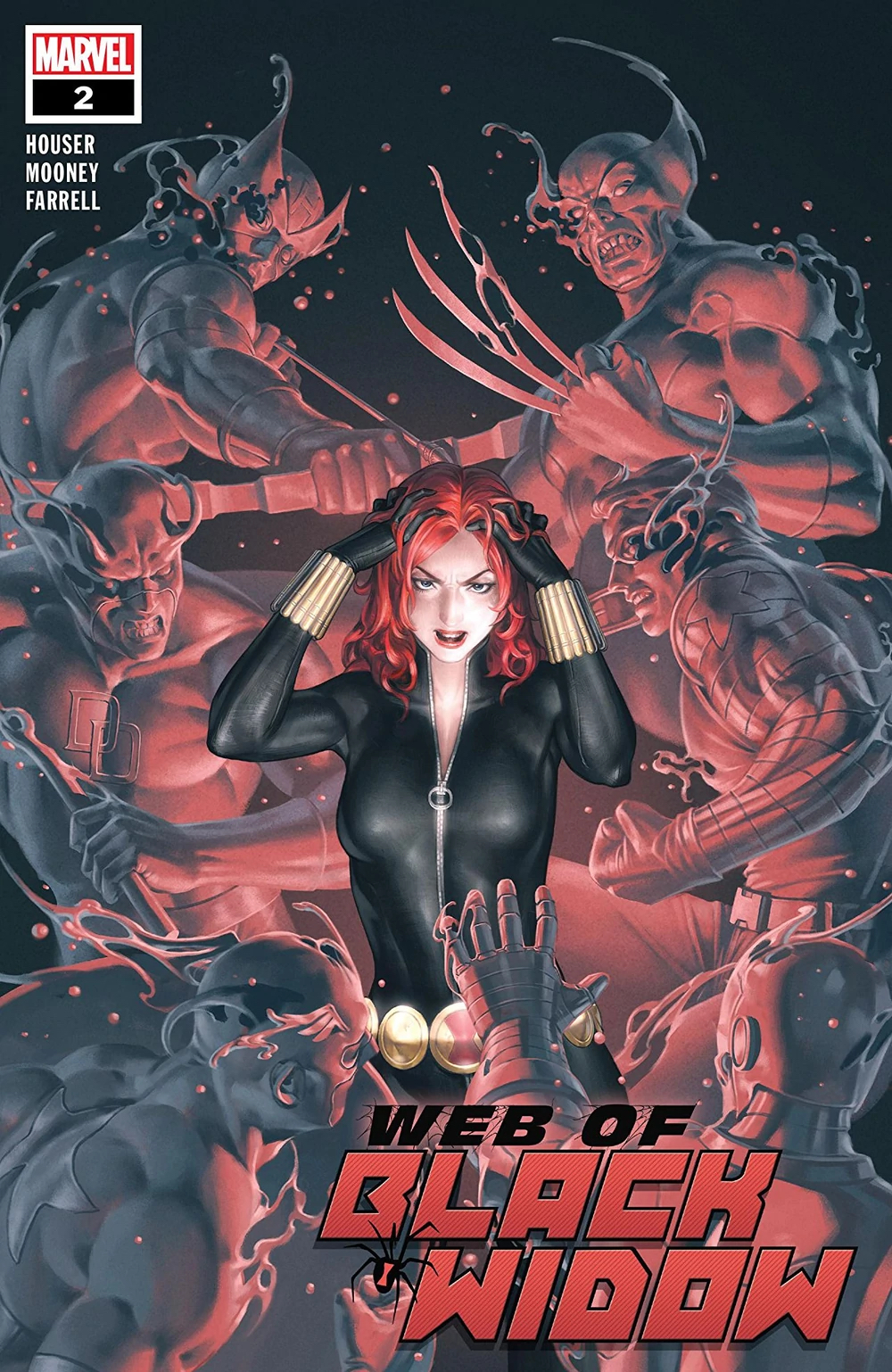
Cover art by Jung-Geun Yoon

Comic books have long suffered the misleading, unnecessarily provocative covers. Throughout Web, we are confronted not with Natasha’s cleavage, but the possibility of her cleavage behind that zipper. I am reminded of a scene in The Handmaid’s Tale: “They wore blouses with buttons down the front that suggested the possibilities of the word undone. These women could be undone; or not. They seemed to be able to choose” (p. 25).

I am unable to trust what choices are allowed for Natasha in Web, genuine power and autonomy, against the objectification of her throughout. But I do sense a strong grounding of Web in all that has come before, not just Natasha’s backstory but the many series I have been covering:

Issue 2 alludes to v.6, issue 9 as the Winter Soldier is introduced to this plot line.

Ultimately, Web proves to be a mildly interesting thought experiment, Black Widow noir, and it looks good while muddling through being mostly derivative.

Worse things can be said about a comic book series, but I continue to hope for better, and with my last post coming next, I can assure you that v.8 is better—if not the best.
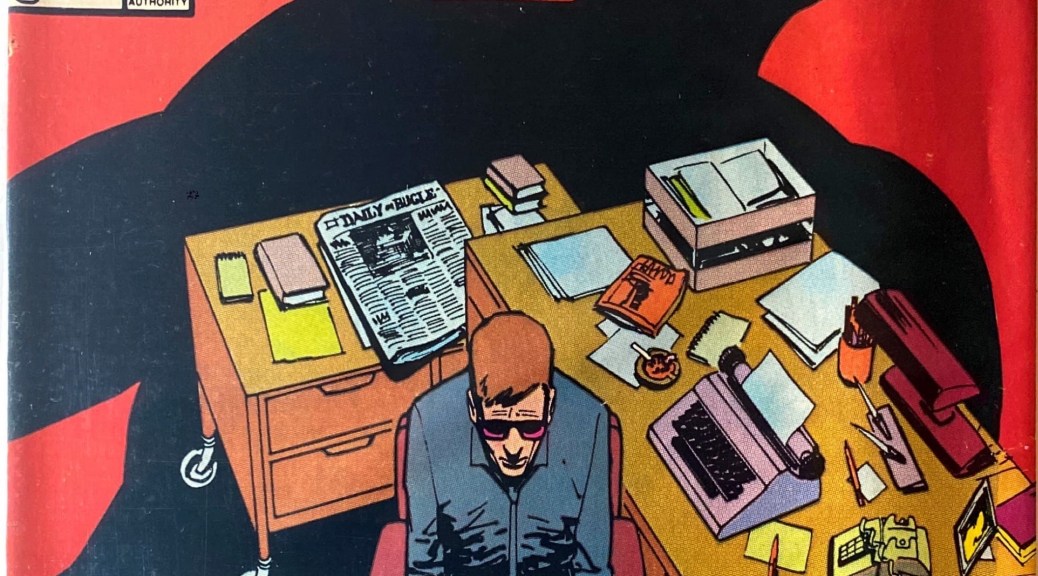
Daredevil’s Righteous Anger: “I’m asking forgiveness for what I’m about to do”

More often than not recently, many people have come to know Marvel superheroes through Netflix, the MCU, and now Disney+. That sets up tension between the recent fans and those of us coming from a comic book background.

I am a Marvel reader and collector from the 1970s, and fell in love with Daredevil when his comic book was co-titled with Black Widow. I also grew up a Marvel fan when shows such as The Incredible Hulk hit mainstream TV.

Once CGI allowed superhero movies to look the way we now-older fans always hoped, I have been mostly thrilled with the mainstreaming of Marvel comics—despite the many problems with that different universe compared to the too-often rebooted and jumbled universes of comic books.

I am also one of those fans who loved the Netflix Daredevil series because it captured almost everything that makes the Daredevil character and narratives nearly equally compelling and deeply problematic.

Matt Murdock becoming Daredevil incorporates the traditional silliness of superhero origins (a chemical spill doesn’t kill young Matt, but renders him superhuman) as well as some refreshing and compelling elements (Matt develops many of his superhero qualities because of his character, one grounded in a relentless righteous anger than is more than vengeance).

Although Daredevil is one of the earliest Marvel creations, debuting in 1964, and has endured almost 60 years and numerous reboots over 7 volumes, in many ways, the character is a low tier one, if not a top tier two figure in the Marvel Universes (certainly a notch down in the MCU).

Daredevil, however, is currently trending regularly on social media because, as many of us Netflix Daredevil fans have wanted, the character is being reintroduced to the Disney+ and MCU versions—although at a glacial pace. With that, we comic book fans who have been stung many times by various types of reboots have been fretting about a Disney+ series ruining the Netflix version, one that is incredibly violent (Kingpin’s car door scene, for example, is very not Disney) and one that owes a great deal to Frank Miller’s reboot of Daredevil that boosted Miller to superstardom and laid the foundation for his heralded Batman work.

Many comic book fans also fretted about Moon Knight, a much more clearly second tier Marvel superhero. However, in some ways, I think, the success of Moon Knight tempered our fretting about how Daredevil would be recreated (again).

Another element of the relevance of Moon Knight and Daredevil in the MCU is religion. Moon Knight being Jewish has been examined with the Disney+ series, in terms of how relevant his faith was portrayed in the series. Matt Murdock, and the entire ethos of Daredevil, Man without Fear, is grounded in Miller’s emphasizing Murdock’s Catholicism.

In similar ways to concerns about Moon Knight being Jewish, it seems important to interrogate whether or not Murdock’s Catholicism is being trivialized or honored in the MCU. Some fear Murdock’s faith is mere “stained-glass window dressing” (Cressler, 2022, p. 113).

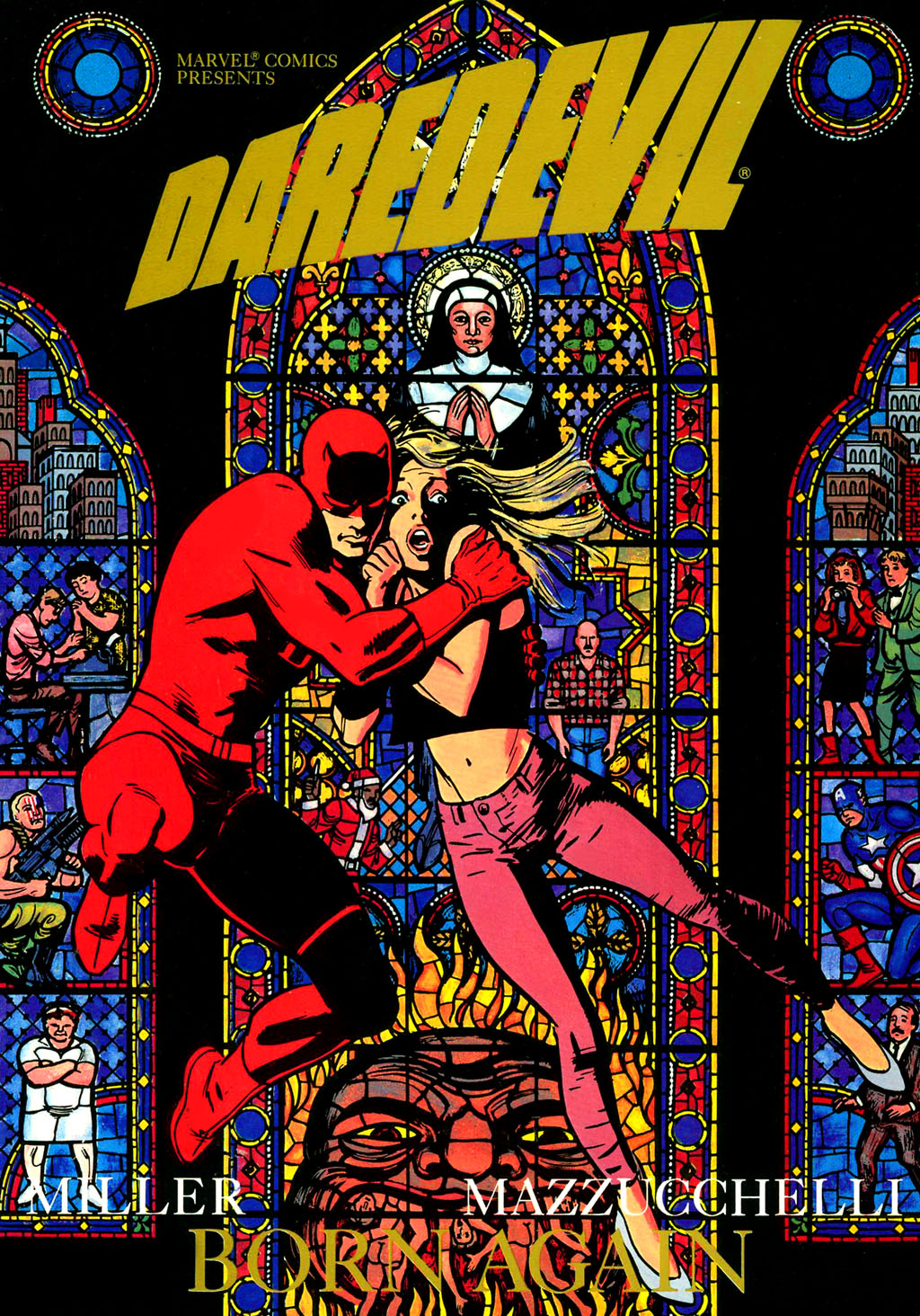
The Born Again trade paperback’s cover has reached iconic status, thanks to Miller emphasizing Catholicism and David Mazzucchelli’s run as artist.
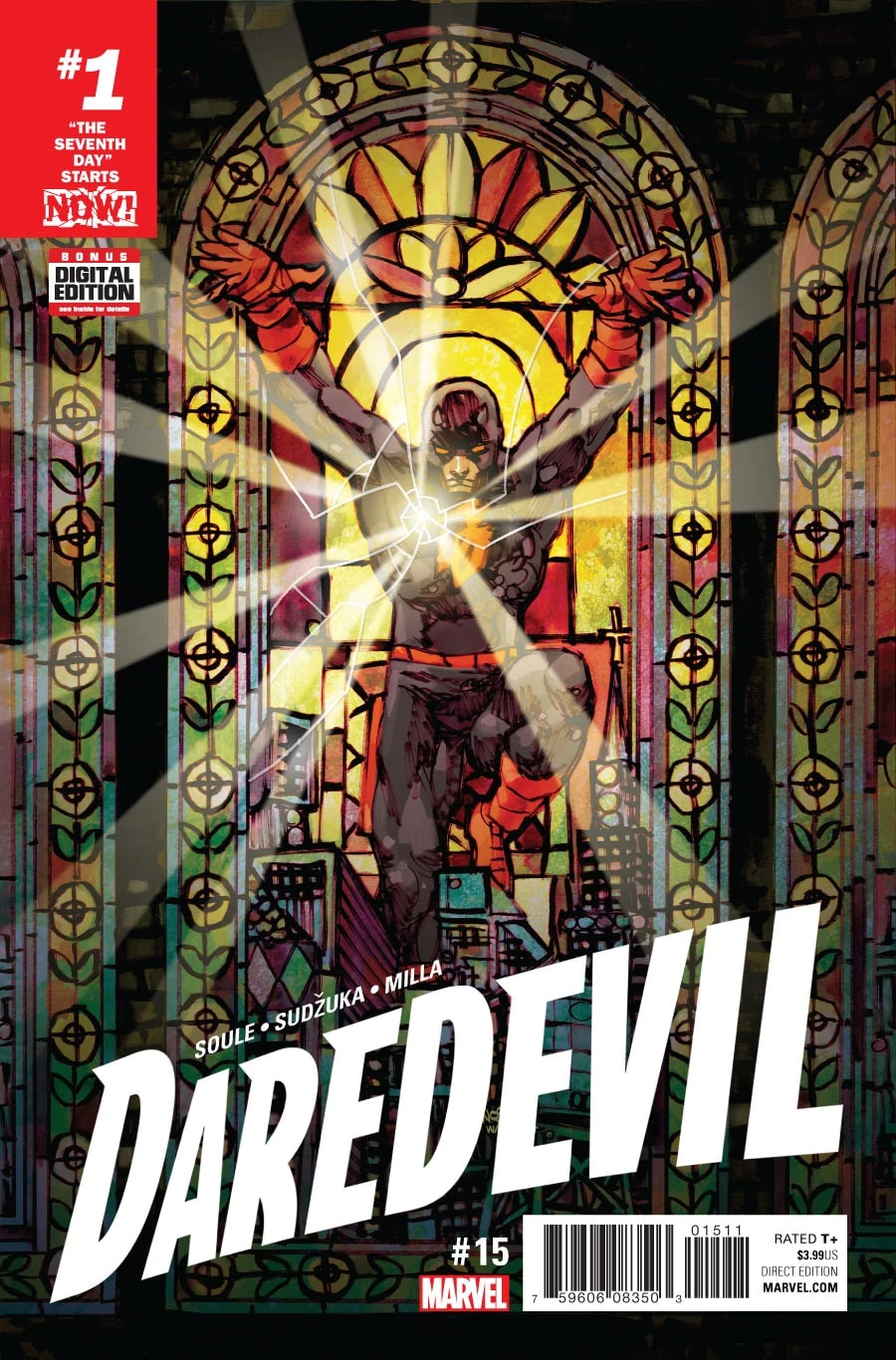
Daredevil 15 (v5) reflects Miller’s Man without Fear. (Artwork by Dan Panosian)
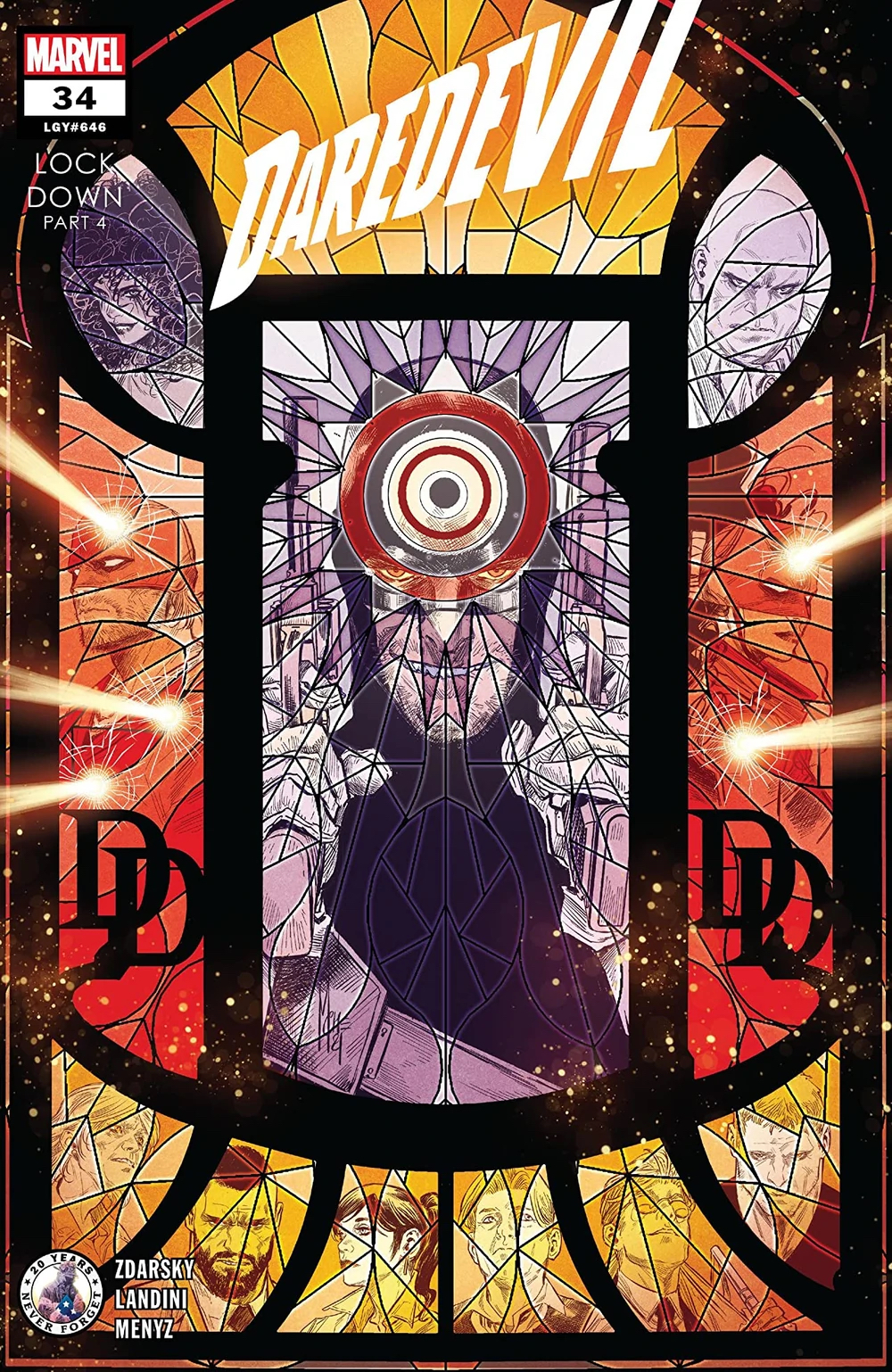
Daredevil 34 (v6) pays homage to the Miller reboot, and Chip Zdarsky’s version reads strongly grounded to Miller’s vision as well.

Ironically, Matt/Daredevil’s righteous resolve is the antithesis of glass. In many ways, people find Daredevil compelling because his superpowers are certainly skewed closer to being human, thus frail, than other superheroes such as Luke Cage, The Hulk, or Superman. Yet, Daredevil is often the most determined human in any conflict, counting on his ability to suffer and persevere—because he is certain (usually) that he is right.
That brings me to Matthew J. Cressler’s Daredevil: The Man Without Fear and White Catholic Masculinities. Like Miller, Cressler centers Murdock’s Catholicism and interrogates how that faith drives Daredevil in relationship to how well any version of Daredevil acknowledges his devoutness.
Cressler admits a concern I raised above (with the Netflix series a notable exception):

The extent to which Murdock’s religiousness features in any given story—and indeed, whether it features at all—depends of course on the artists involved. Some center other elements of the Daredevil mythos (secret ninja societies, for instance). Most of the time Catholicism seems more like stained-glass window dressing, offering a thematic or aesthetic palette without much depth: fistfights in front of altars, vaguely religious themes, jokes about Catholic guilt. (p. 113)

Daredevil: The Man Without Fear and White Catholic Masculinities

What makes Cressler’s analysis compelling is using Catholicism as a lens for understanding not only Matt/Daredevil but also portrayals of Daredevil as that intersects with who is drawn to the character and why. Citing Andrew Greeley and others, Cressler asserts, “Daredevil’s abilities accentuate what is often cited as the distinguishing feature of Catholic Christianity: the sensuousness of its religious culture,” including violence (p. 116).

But even more significant, I think, Cressler notes that Catholicism reinforces a central motif of most portrayals of Daredevil, suffering. In the Netflix series, for example, a motif of the show is how often people express disbelief in the amount of suffering Matt can and does endure. Nearly even more so than his blindness, Matt’s willingness—even eagerness—to suffer defines him.

Daredevil 2 (v7), by Chip Zdarsky (writer) and Marco Checchetto (artist), embraces the ever-suffering Daredevil who always gets back up—to kick ass.

Among the most informative aspects of Cressler’s analysis is his explaining how Miller’s own working-class Catholic background builds on the origin of Daredevil: “Daredevil thus presents a working class twist on the classic comic book origin story” (p. 120).

Miller’s working-class Catholicism, I think Cressler demonstrates compellingly, contributes to both why Daredevil is an enduring character (maintaining Miller’s stamp) and a very problematic one as well.

The best analogy I have is that Miller-influenced Daredevil (Netflix and Disney+ versions) are similar to why so many people are drawn to Breaking Bad and Better Call Saul despite the deeply problematic elements. When the craft is high, the work soars, but often with any work, the flaws of the artist and the world seem to inevitably creep in:

This reluctance to call white Catholics white and have that word signify something substantive is particularly problematic when talking about the era in which Miller came of age and eventually began a career in comics. In the 1950s, white Catholics defended “their turf” against Black migrants in the urban North. In the 1960s, some fled to federally subsidized and racially segregated suburbs while others fought on the frontlines of resistance to integration. The so-called “Catholic vote”—by which pollsters meant working-class white Catholics—helped usher in a half century of conservative rule, first as part of Nixon’s “silent majority” and then as members of the “Reagan revolution.” Born Again bears this influence….

By the time Frank Miller began drawing Daredevil in the late 1970s, white Catholics had thrown bricks at civil rights activists in Chicago, firebombed school busses in Boston, and brutally quelled a prison uprising in Attica, just to name a few notorious instances of white Catholic violence. (pp. 124-125,127)

Daredevil: The Man Without Fear and White Catholic Masculinities

Miller’s own misogyny and bigotries grounded in his upbringing tarnish even the best aspects of his run on Daredevil. Like too much of the comic book world, stereotypes often populate Miller’s narratives in the most reductive ways.

Yet, as Cressler explains, we must acknowledge the key role of Catholicism:

When Frank Miller said Daredevil “had to be Catholic,” the Catholic he created was a white working-class Irish American Catholic man prepared to save his woman and defend his block with brute force. This is the Catholic Daredevil brought to life in Marvel’s Daredevil. And this is not merely a work of fiction. (p. 127)

Daredevil: The Man Without Fear and White Catholic Masculinities

Ultimately one of the most interesting tensions here is between Matt’s devoutness and his righteous anger turned violent:

Daredevil’s religiousness, reviewers seem to say, can be found in biblical quotes, religious images, and theological themes. Violence is another matter, one that has to be forgiven in the confessional and reconciled with faith. (p. 128)

Daredevil: The Man Without Fear and White Catholic Masculinities

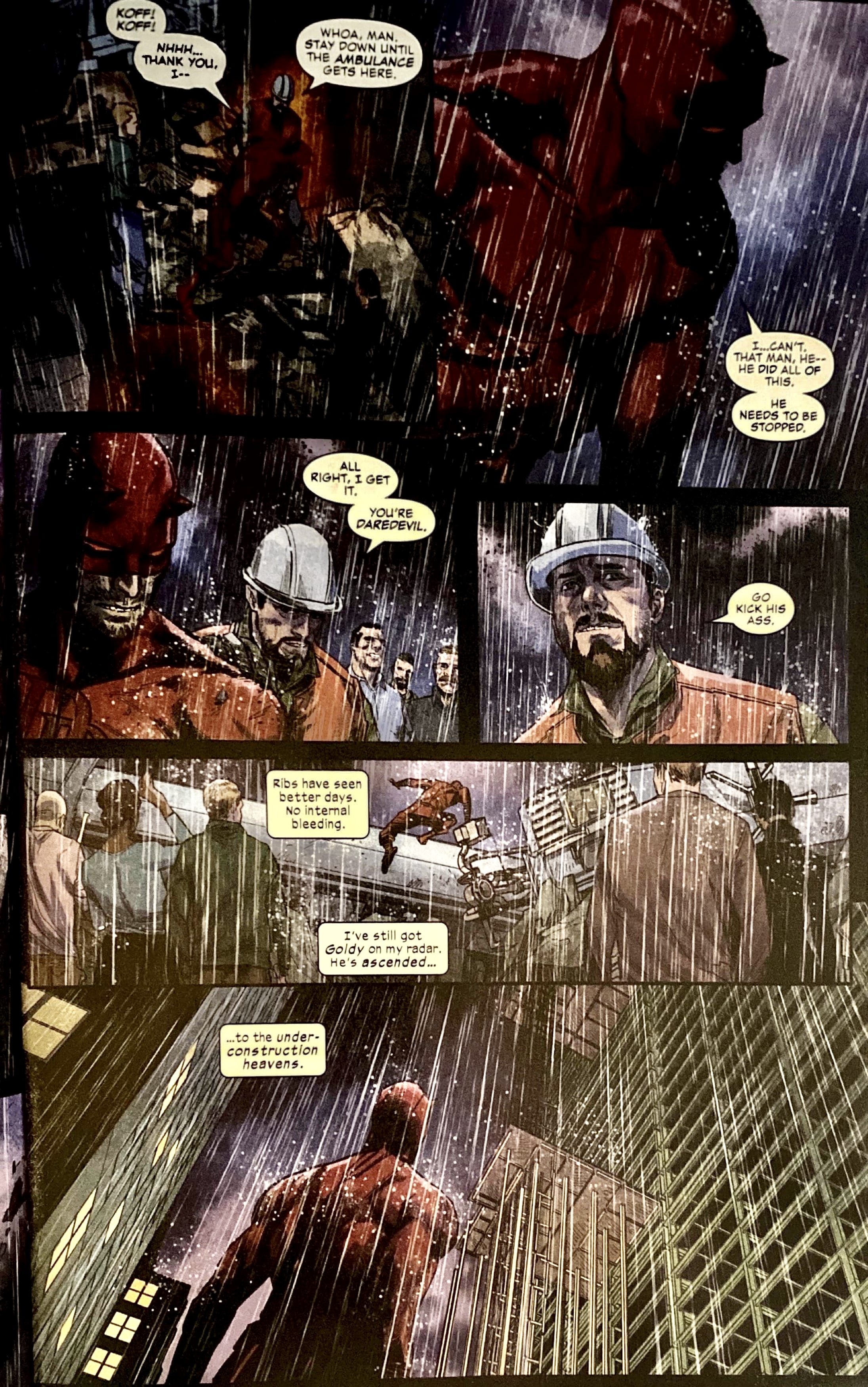
However, as Cressler shows, Matt—notably in the opening scenes of Netflix’s Daredevil—has fully embraced both his faith and his violence:

If we resist [the] urge to separate the two, however, it quickly becomes clear that religion and violence are bound together for both Frank Miller and Netflix’s adaption of his work. Recall how the series opens. We meet Matt Murdock in confession, where he admits “I’m not seeking penance for what I’ve done, Father. I’m asking forgiveness for what I’m about to do.” (p. 128)

Daredevil: The Man Without Fear and White Catholic Masculinities

The portrayal of Matt/Daredevil, by Charlie Cox in the Netflix series, I think, is at its best when viewers can see in the acting that Matt/Daredevil has switched to “violence is the only solution”—sometimes accompanied by a slight head tilt. And we feel a little rush of adrenaline as we anticipate that despite all the odds against him, Daredevil will leave the “bad guys” regretting not only their immediate actions but also being bad guys.

I do not see Daredevil as a base vigilante bouncing from act of vengeance to act of vengeance. I am compelled by the character Daredevil because of the tensions created through Matt being a lawyer and his Catholic drive to rid the world of evil (starting, of course, with saving all of Hell’s Kitchen). Cressler referencing Birzer notes that Daredevil embodies “righteous violence meted out in defense of moral order” (p. 129).

The Disney+ era of Daredevil has been announced, Daredevil: Born Again. There is no doubt that Miller will be lurking there, but what remains to be seen is how seamlessly the Disney+ era will grow from what Netflix established.

Will we have to endure mere “stained-glass window dressing,” or will we feel the hair raise on our arms anticipating Daredevil single-handedly pummeling the bad guys down a cramped and dark hallway?

Black Widow Underestimated: “I Reap What I Sow”

[NOTE: This is the next installment of a series begun at Comics Bookcase, which has made some changes; therefore, I am completing the series here, with this and then two final posts. I also hope to develop these posts into a book proposal because I think Black Widow deserves a deep dive into how the character has been underestimated (and hypersexualized) throughout Marvel’s less-than-adequate handling of the character.]


After Nathan Edmondson, writer, and Phil Noto, artist, set the bar very high in v.5 of Black Widow—avoiding the pitfalls of underestimating and hypersexualizing her—another all-star team took over with v.6, Chris Samnee handling pencils and co-writing with Mark Waid. This reboot repeats many aspects of previous volumes: a Daredevil team trying their hands at Natasha Romanov and portraying Natasha as possibly disloyal because of the ghosts of her abusive past that cannot be exorcized.

Yet, Samnee and Waid maintain the momentum set by Edmondson and Noto, especially with a visually compelling 12-issue run that also does not stoop to focusing on exposed cleavage and Black Widow bound by chains or rope.

A couple covers do involve Black Widow embraced—although these portrayals fit well into the tone and imagery of the run without reducing Black Widow’s agency as a character and a woman.

Covers for issue 002 and 009 feature Black Widow embraced. Pencil by Chris Samnee and ink by Matthew Wilson.

Enemy of S.H.I.E.L.D. (Again?)

Issue 001 opens with dynamic action and panels; Samnee (pencil and ink) and Wilson (colors) set the tone for the series by centering Black Widow’s athleticism and intelligence. However, once again, readers are in for another exploration of Natasha’s trustworthiness and how damaged she remains because of the trauma of her childhood training as an assassin.

Samnee and Wilson build to Black Widow’s dramatic escape in the opening pages of issue 001 in v.6, highlighting Samnee’s panel designs and Wilson’s brilliant coloring.

Similar to Noto, Samnee carries the narrative through textless panels and creates a film effect for much of the volume. After her dramatic escape from S.H.I.E.L.D., Natasha finds her foe for the volume in issue 002, Weeping Lion, and is again threatened with having her deepest secrets revealed. In many ways the focus of this series feels overworked already, but visually Samnee and Wilson maintain a compelling narrative.

Samnee and Waid also craft a smart approach to old topics because they clearly honor the complexity of Natasha/Black Widow as a rich and complicated human as well as superhero.

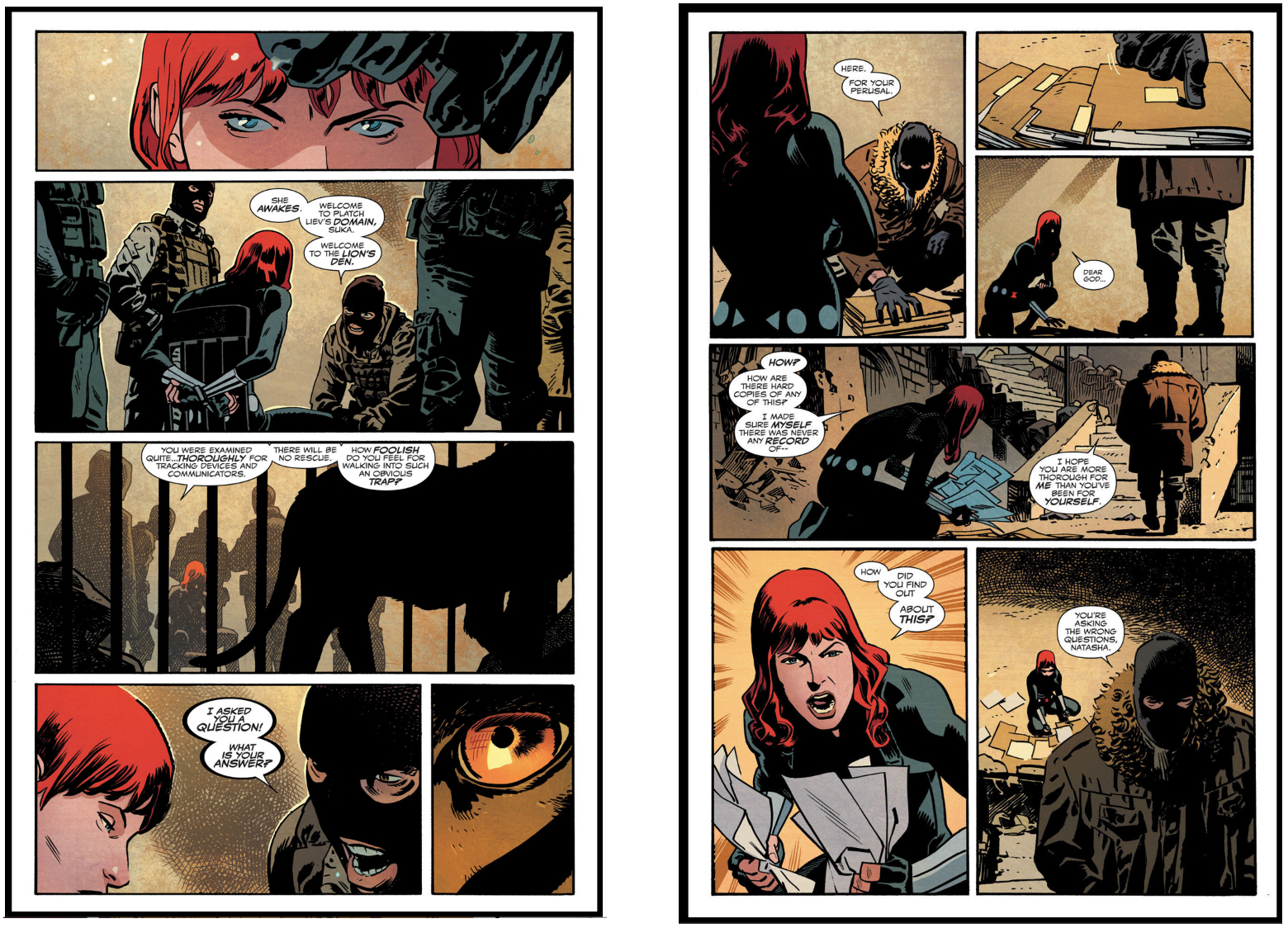
Once again, Black Widow finds herself bound and threatened in issue 002, but Samnee and Waid never stumble into the hypersexualized and reductive patterns in early volumes.

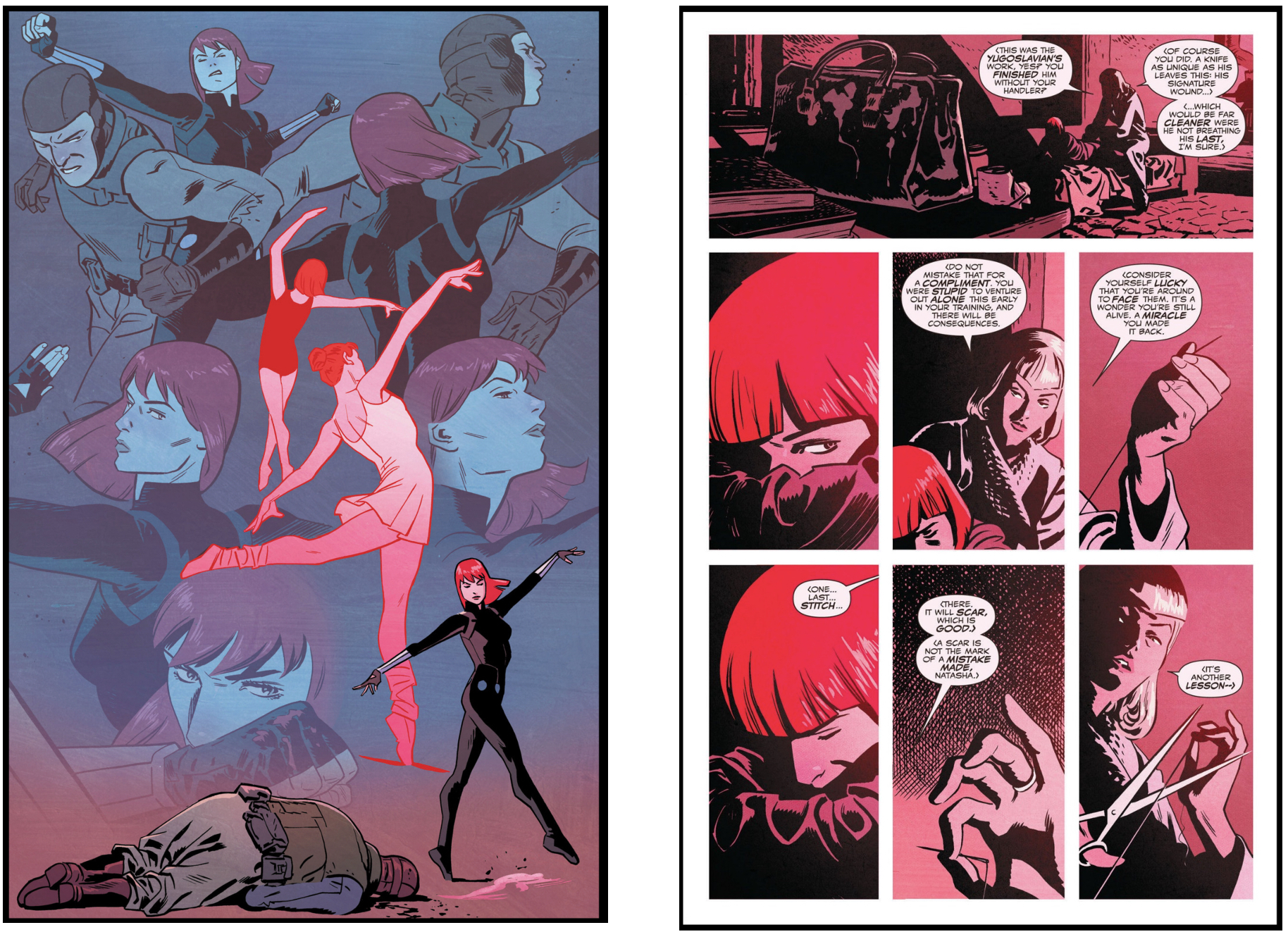
Instead of focusing on Natasha’s exposed body, Samnee depicts Black Widow in the context of images as a ballerina through the use of pastel colors and emphatic shading. As well, Natasha remains physically vulnerable, often battered, stabbed, and brought to exhaustion through a relentless parade of battles for her life.

A perfect scene for Natasha/Black Widow, in fact, in issue 003 involves her being stitched up in a flashback mixed in with her actual return to the Catacombs in the Red Room Academy. Natasha is told: “It will scar, which is good. A scar is not the mark of a mistake made, Natasha. It’s another lesson.”

Natasha as Black Widow is a life lived among scars, pain, and seemingly lessons that never end.

Issue 003 offers powerful uses of pastels—blues, pinks—contrasted with black shade and faded images.

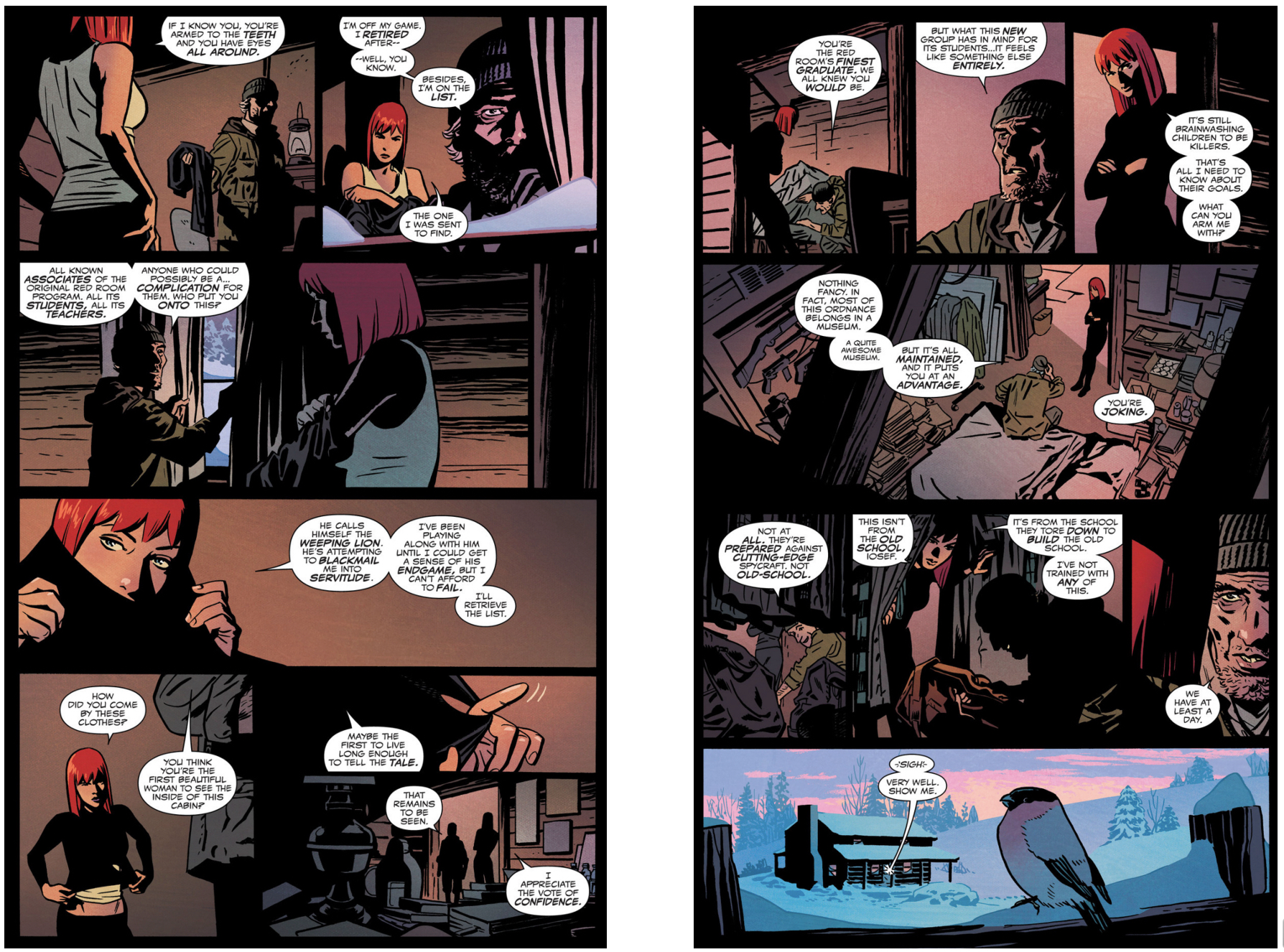
Natasha is badly wounded and finds the help of Iosef in issue 004. Caught between the Weeping Lion and S.H.I.E.L.D., Natasha must secure the tools, old weapons from Iosef, to confront the Headmistress and Recluse in the Dark Room Academy, a replacement of the Red Room Academy, where young girls continue to be trained as assassins like Natasha was.

Samnee and Waid use parallel narratives—present and flashback—and motifs well despite this being overworked ground with Black Widow. The issues continue to be visually dynamic and compelling, breathing life into stories and conflicts we have read again and again.

Natasha and Iosef are one of the better pairings used in Black Widow series, at times playful but absent the empty sexual banter and tension too often present in Natasha’s relationship with men.

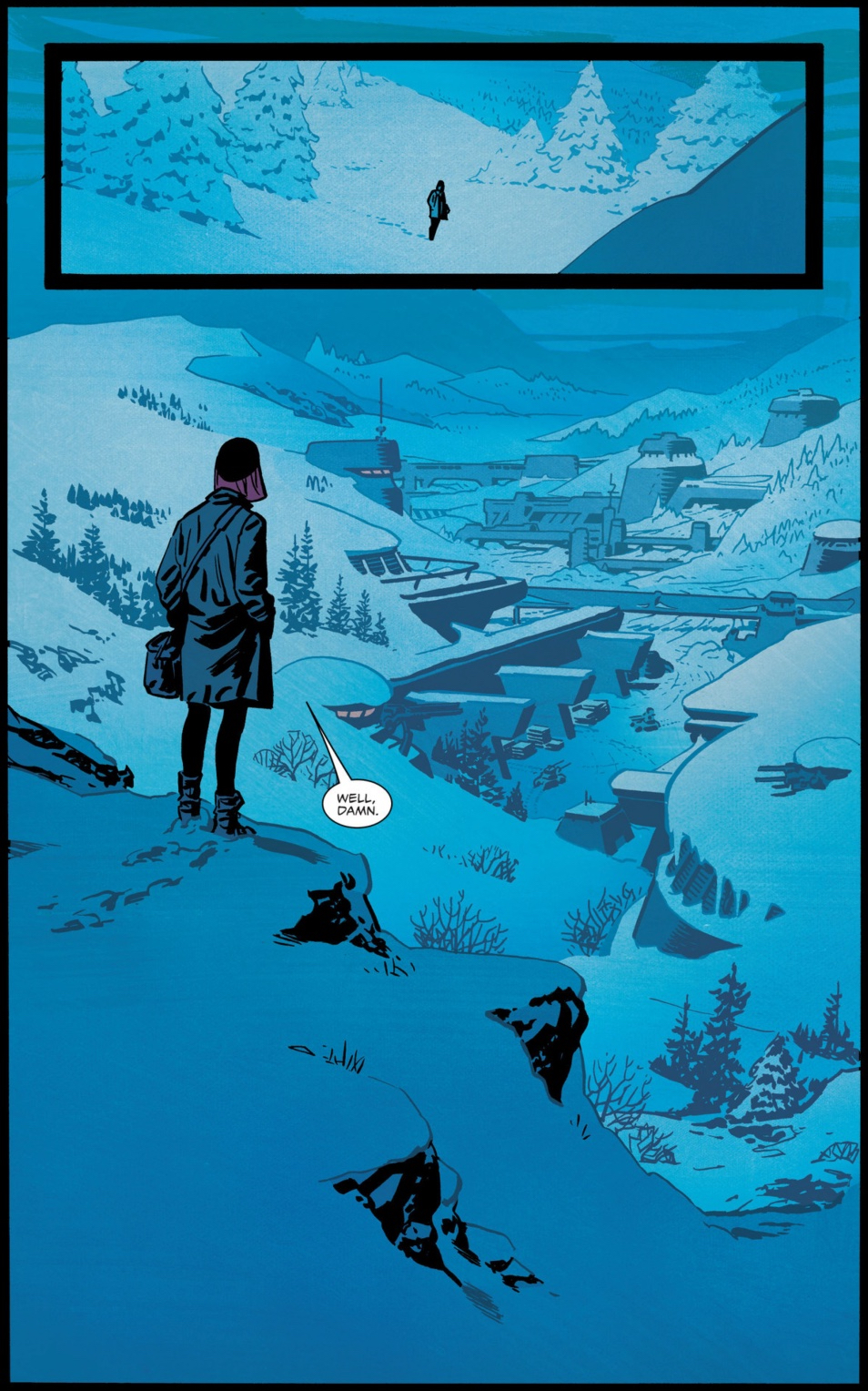
Issue 004 also highlights the power of images, the use of color and dynamic paneling, and either textless or sparse-text full-page spreads. Samnee gives this volume the same presence and visual weight that Noto provided in v.5.

The use of blue on this full-page panel and the simple “Well, damn” captures the vastness of Nastasha living in the present while continuing to fight the past.

The Arc of Black Widow’s Universe

After parallel stabbings—from her past and in the present, returning to the Catacombs—Natasha confronts the Red Room Headmistress and Recluse, complicating the main narrative involving S.H.I.E.L.D. and Weeping Lion. After recovering with Iosef’s help, Natasha moves to her mission to recover intel for Weeping Lion, which goes wrong, dramatically and violently with S.H.I.E.L.D. involved. The lingering question of Natasha’s loyalty is left in the balance.

The next test is Tony Stark/Iron Man joining issue 006, mixed with another flashback of Natasha’s life as a ruthless assassin. The Stark scene shows Natasha manipulating Stark: “Makeup and acting, Tony. You’ve always been a sucker for both. Thanks for the access.”

The “former lover” motif is a return to a pattern found in many Black Widow series; however, Samnee and Waid insert a power shift and portray Stark as the weaker of the two instead of hypersexualizing or reducing Natasha to stereotypes that do not suite her character.

The access she secures leads to Natasha discovering that Weeping Lion is part of a duo, including the telepath brother Ilija Knezevic in issue 006. Black Widow now turns the focus of the plot to her confronting the Headmistress and Recluse to rescue the girls from the Dark Room.

“No one gets into my head unless I let them,” Natasha informs Ilija Knezevic after turning Stark’s weapon on him. “And I rarely let them.”

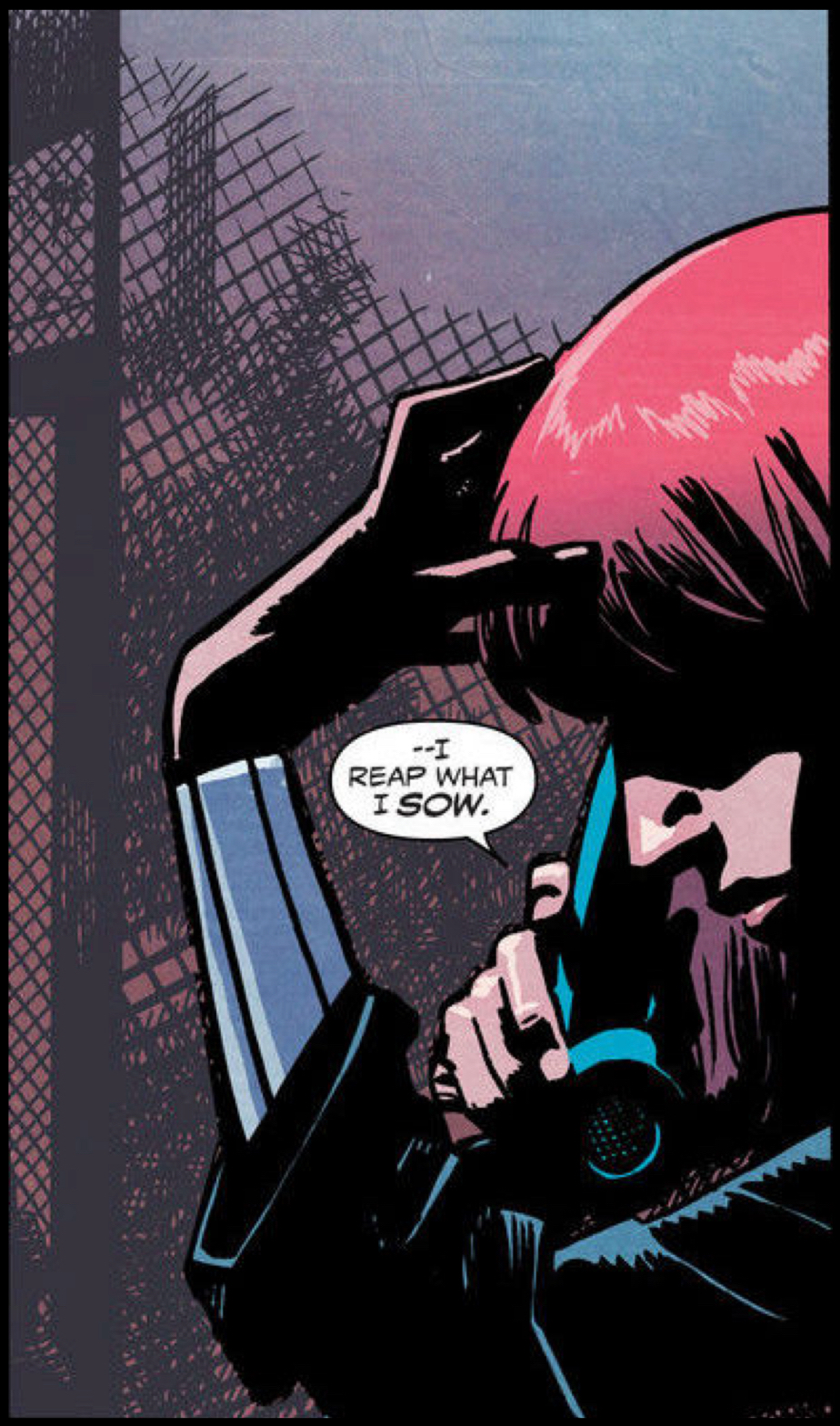
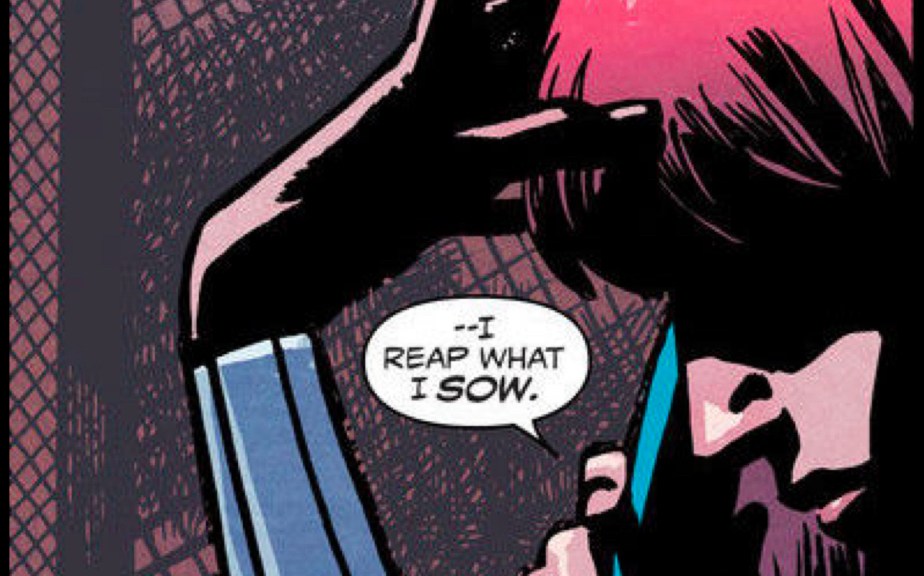
Possibly the perfect tagline for Natasha/Black Widow is found in issue 006: “I reap what I sow.”

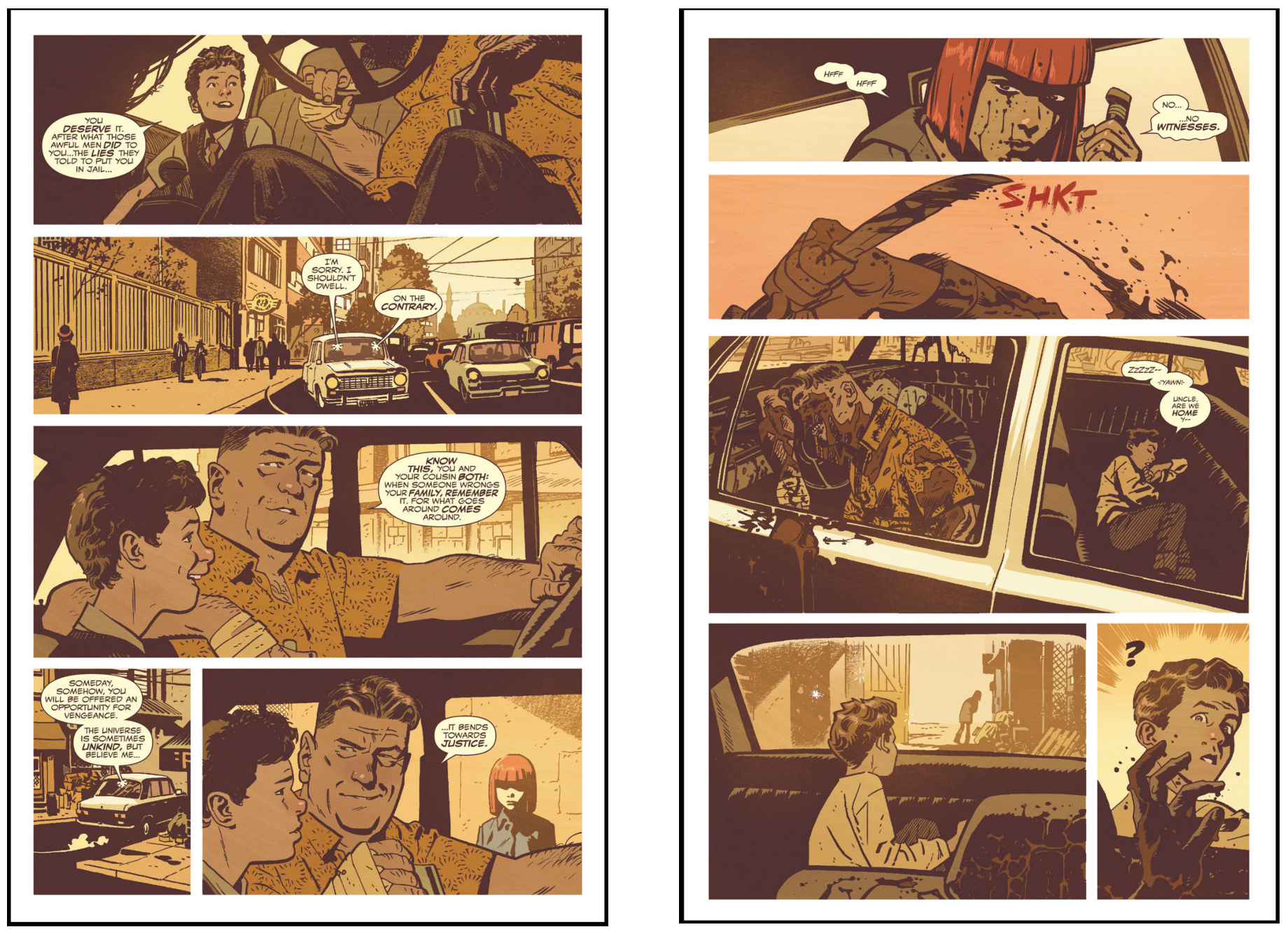
In issue 007, “No More Secrets,” readers witness a truly violent and disturbing flashback that centers both this series and Natasha/Black Widow by alluding to Martin Luther King Jr.’s “the arc of the moral universe is long but it bends toward justice.”

Natasha as a child assassin was supremely dedicated to her mission, a sort of moral code that is graphically displayed in the flashbacks depicting cold and calculated violence even in the face of innocence, notably other children—more of the weight of Natasha reaping what she has sown.

Issue 007 forces the reader to consider “justice” but also reveals the moral tension of the assassin’s mandate to leave no witnesses.

Natasha, the duo that is Weeping Lion, the Headmistress, and Recluse are all entangled by the end of issue 007 in a web of violence and an urge to seek justice warped by revenge and under the dark cloud of their pasts because Natasha failed to follow the full mandate of her assassin’s creed. After Headmistress’s death, Natasha claims, “…her mother did just die. I am not a monster.” The issue ends with Knezevic’s ominous, “Right.”

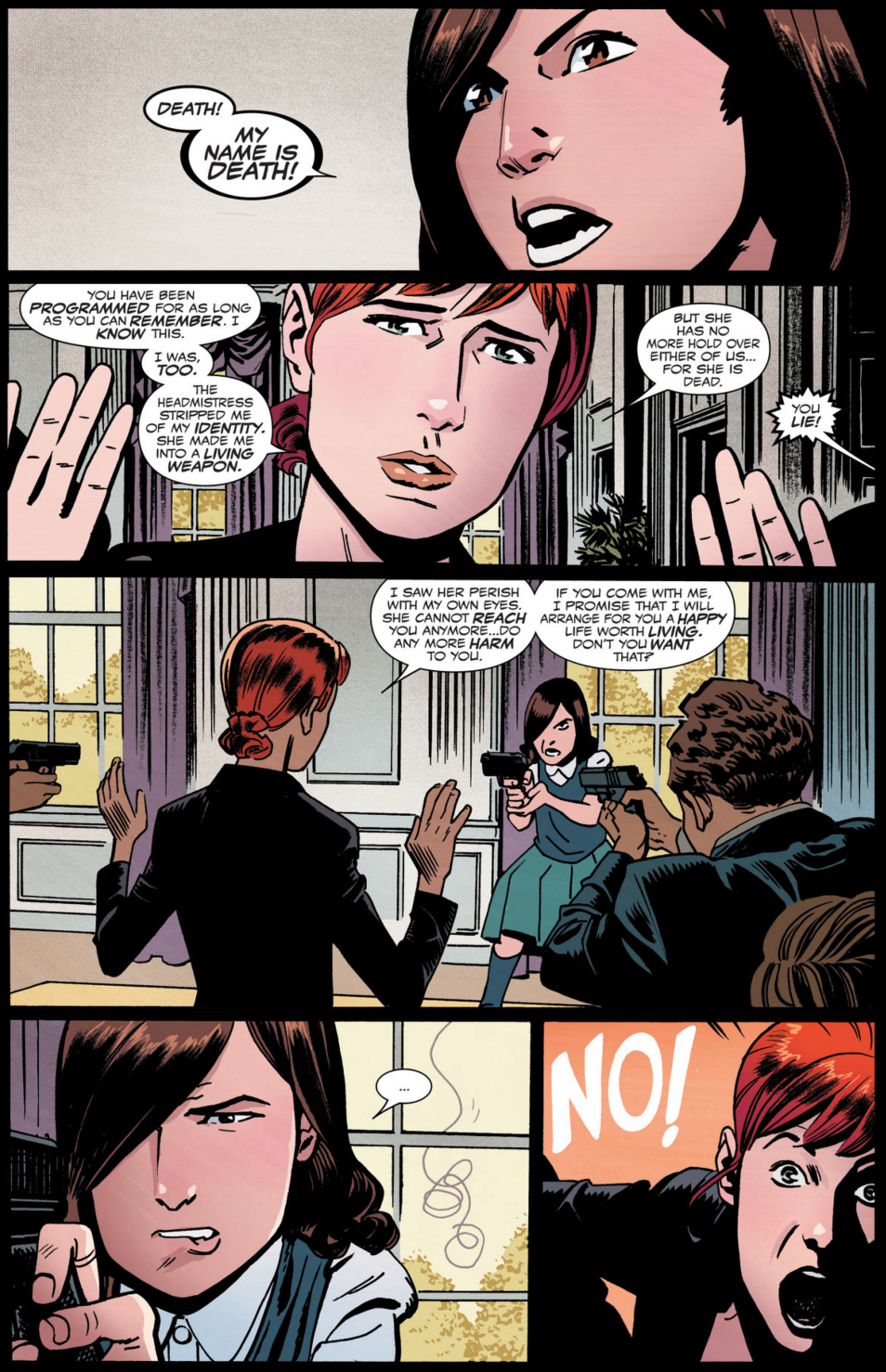
Issue 008 involves current-day child assassins in the White House with Natasha undercover. When the child assassins are exposed, Natasha confronts the girl calling herself “Death” with “You have been programmed for as long as you can remember. I know this. I was too.” Natasha adds that the Headmistress made her a “living weapon.”

Here, an important question about who is culpable and for how long when the actions are extreme, but the person is only a child, a child behaving in ways that they have been indoctrinated to believe and act upon.

Black Widow seeking to save these child assassins foreshadows later issues with Bucky Barnes involving tensions of savior and sacrifice.

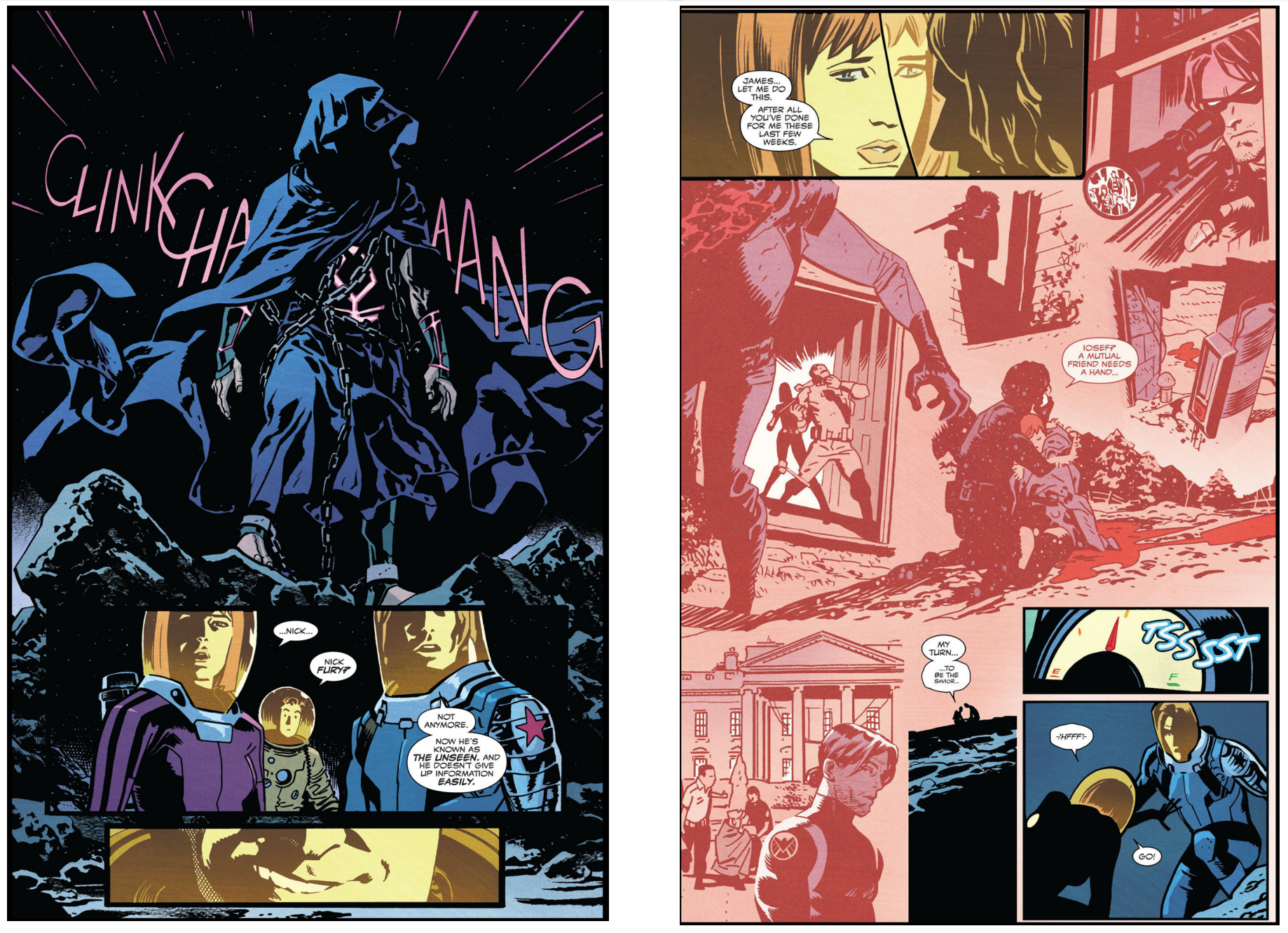
The killing of Iosef in issue 009 adds to Natasha’s fear of death in the wake of anyone knowing her, and sets up her confrontation with Recluse, who has captured Bucky Barnes. Natsha chastises Barnes for wanting to protect her, but Barnes has another mission, bringing Black Widow to Nick Fury, now The Unseen.

On the moon in issue 010, Black Widow, Weeping Lion (telepath), and Bucky meet Fury/The Unseen. This dense issue includes the death of the telepath, a child assassin stowaway, and a familiar plot element, Natasha demanding that she be sacrificed: “My turn…to be the savior.”

Paneling and color continue to stand out as some of the most powerful work on v.6.

In the final two issues, Natasha must subvert the plan of a group of child assassins, charged with destroying S.H.I.E.L.D. and eventually confront Recluse.

The determination and skill of Natsha/Black Widow are highlighted in v.6.

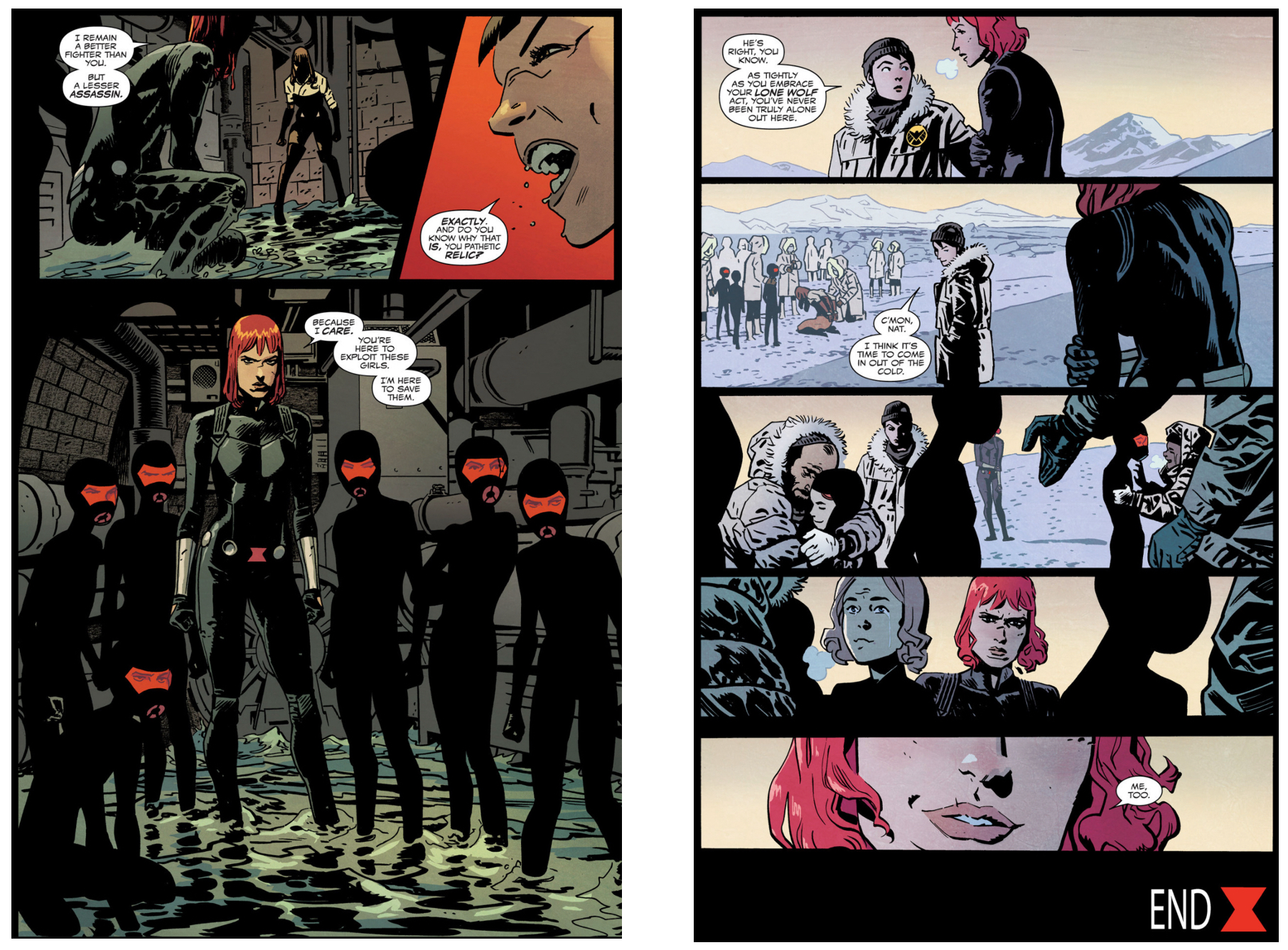
The series ends with a climactic battle between Black Widow and Recluse, displaying some of Samnee’s finest work. The issue is also well written by Samnee/Waid as the plot builds to Natasha surrounded by the child assassins stating to Recluse, “I remain a better fighter than you. But a lesser assassin.”

Here is Natasha as savior without being sacrificed.

Yet, when all is said and done (including another scene with Stark), Natasha is asked to confront that her “lone wolf act” doesn’t mean she is alone. To that, Natasha agrees to “come in out of the cold.”

Samnee and Waid’s run on Black Widow fulfills the message of the universe bending toward justice, at least momentarily, at least for some.

Regretfully, Marvel abandons Black Widow again, until v.7 in 2019, a brief 5-issue run that regresses to early, weaker runs and breaks the excellent momentum created by Edmondson/Noto and Samnee/Waid.

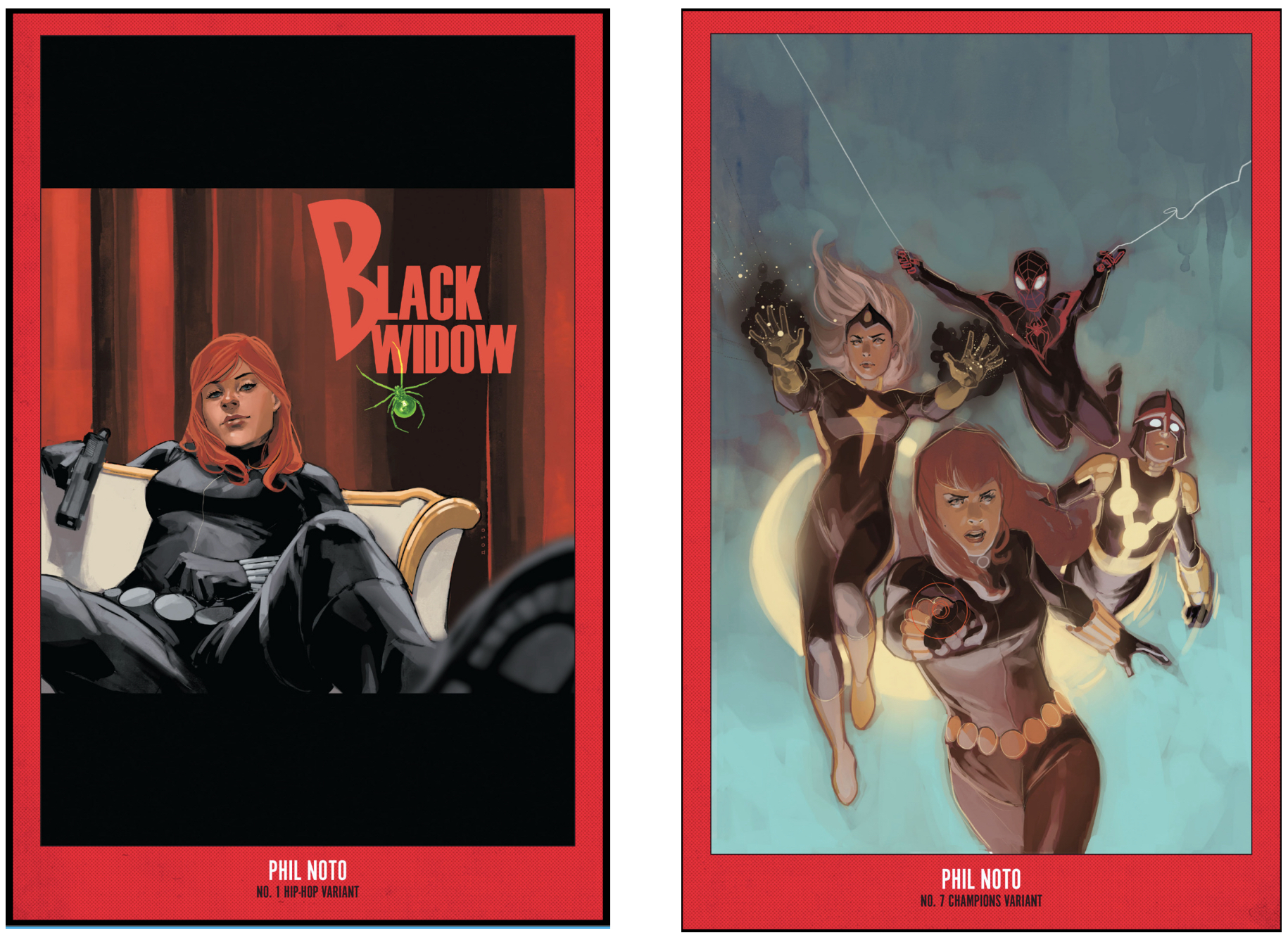
Noto variant covers for v.6.

Wonder Woman Historia: The Amazons (Book Two): Women and Children, Goddesses/Gods and Mortals

Stories matter.

Throughout my childhood, my father told the stories of him growing up, and life before my sister and me, so many times, with so much detail, I can retell them myself today—several years past his death, many decades since I was a child.

Not a literary person, my father returned again and again to telling us about his courtship with my mother. They married in secret during her lunch break from her job working at a Winn-Dixie checkout counter.

We tell stories, often over and over, in an effort to understand better our lives, understand better what it means to be human. But I think, especially for my father, we tell stories of our lives to hold onto those moments and years that slip farther and farther into our past, fading.

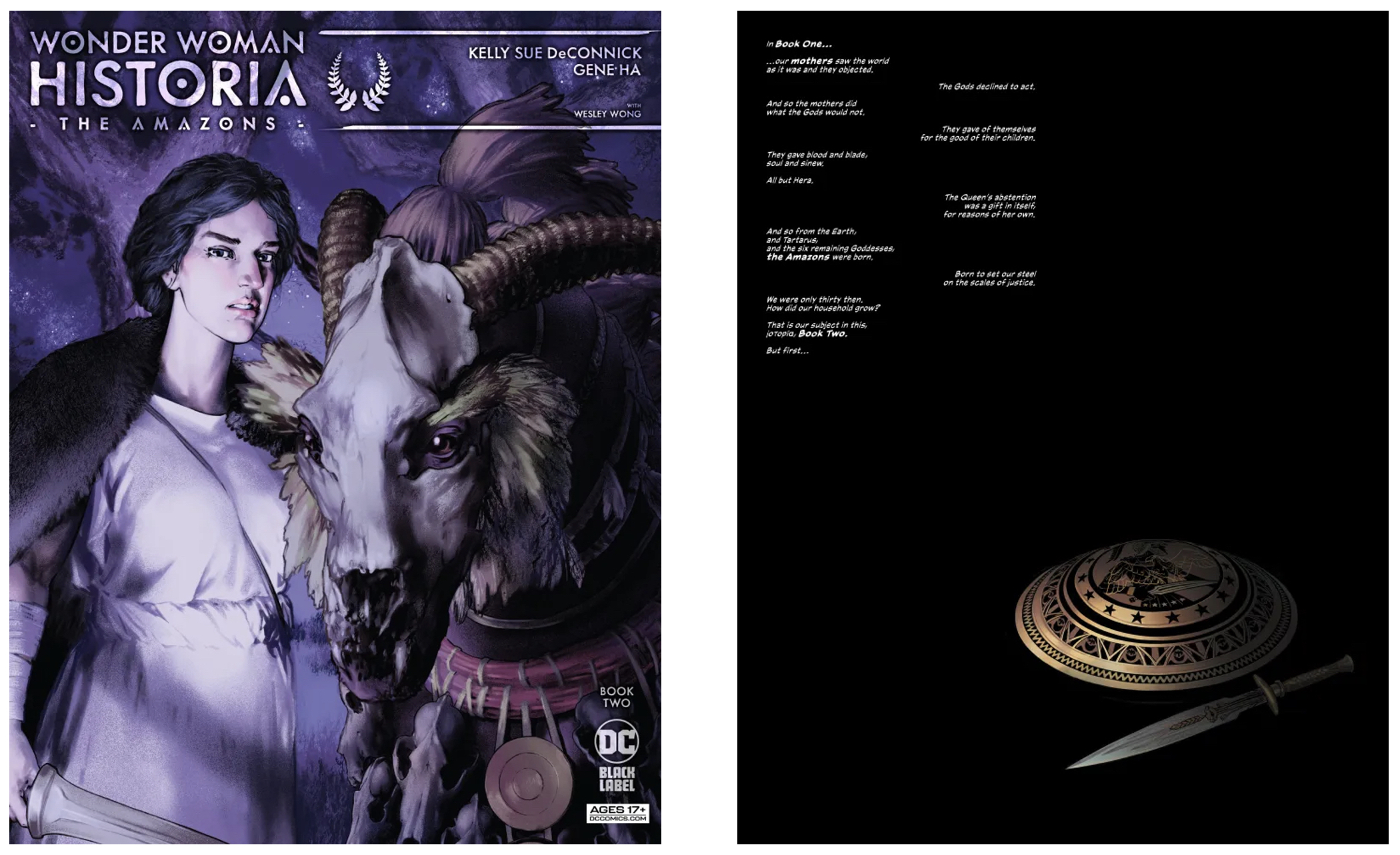
As I read Wonder Woman Historia: The Amazons (Book Two), Kelly Sue DeConnick’s telling and retelling of mythology grounded in the Wonder Woman universe, I thought about my father’s storytelling as well as why we have myths. I explained that Book One, with artist Phil Jimenez, offers not just a beautiful and compelling superhero narrative, but also vivid and urgent messages for our lives today.

DeConnick joins artist Gene Ha in Book Two. Ha’s “Behind the Panels” shares DeConnick’s charge for Ha and her as co-creators of Book Two: “The scripts that follow should be considered more of a roadmap than a set of blueprints.”

Cover: Gene Ha.

DeConnick continues: “I’ve beaten this metaphor into the ground but my point is this: this is a collaborative process.”

This continuing story of Hippolyta and the Amazons, then, begins with the tensions of stories told (lies) and stories not told (truths).

Book Two: DeConnick, writer; Ha, artist; Wesley Wong, colorist; Clayton Cowles, letterer.

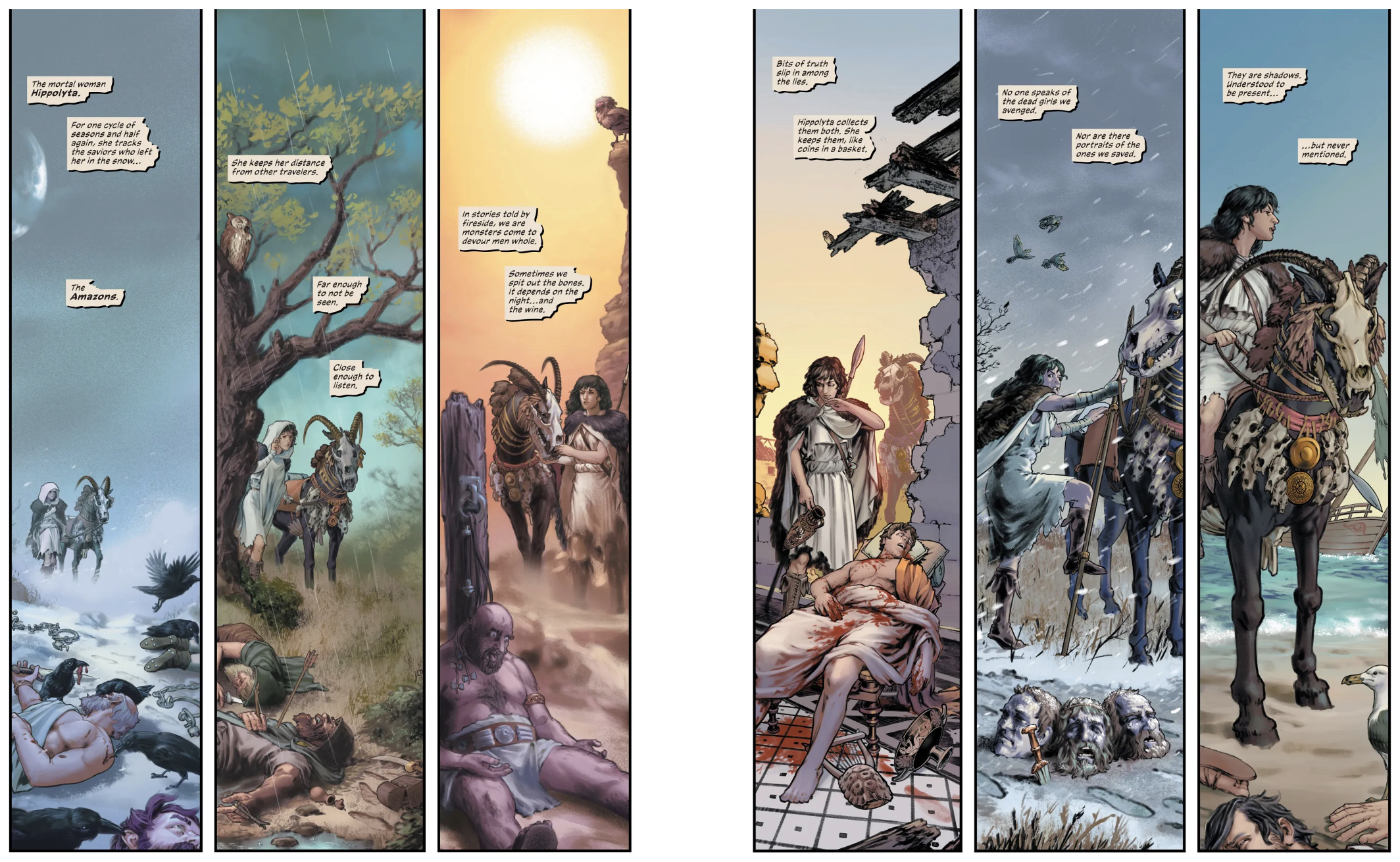
Amazons demonized as monsters overshadows Amazons as savior-warriors: “No one speaks of the dead girls we avenged. Nor are there portraits of the ones we saved.”

Representation matters also.

This narrative tension speaks, of course, to the cultural tensions in the U.S. in 2022—an aggressive political Right running roughshod across the country decrying manufactured threats (Critical Race Theory) and demonizing educators as “groomers” in their Holy War against LGBTQ+ humanity.

Stories matter. But power matters more.

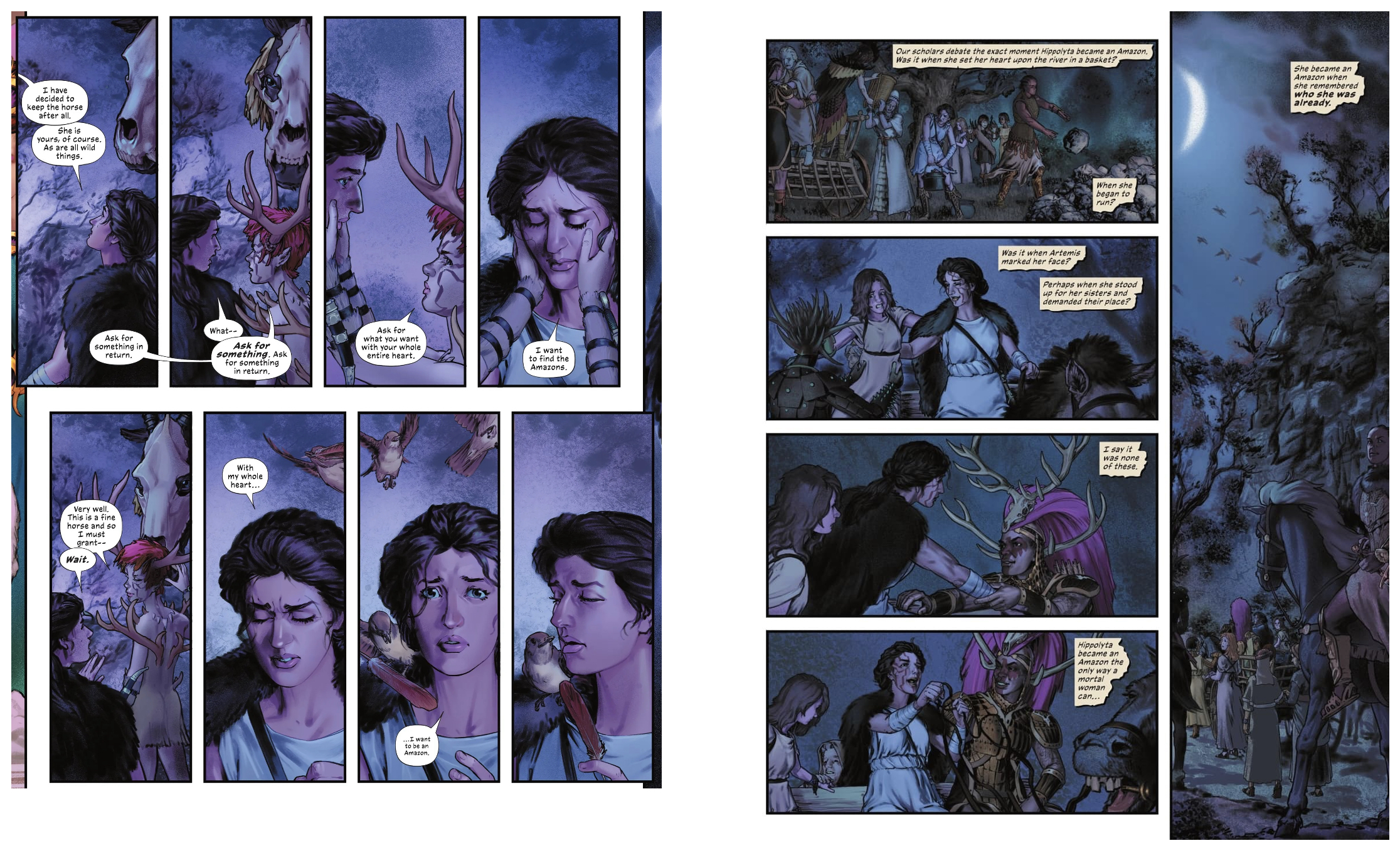
Hippolyta’s story is a story about stories, but it also is a story about another tension between Goddesses/Gods and mortals. When she comes upon Artemis, Hippolyta confesses her ultimate goal: “I need to be an Amazon.”

Book Two: DeConnick, writer; Ha, artist; Wesley Wong, colorist; Clayton Cowles, letterer.

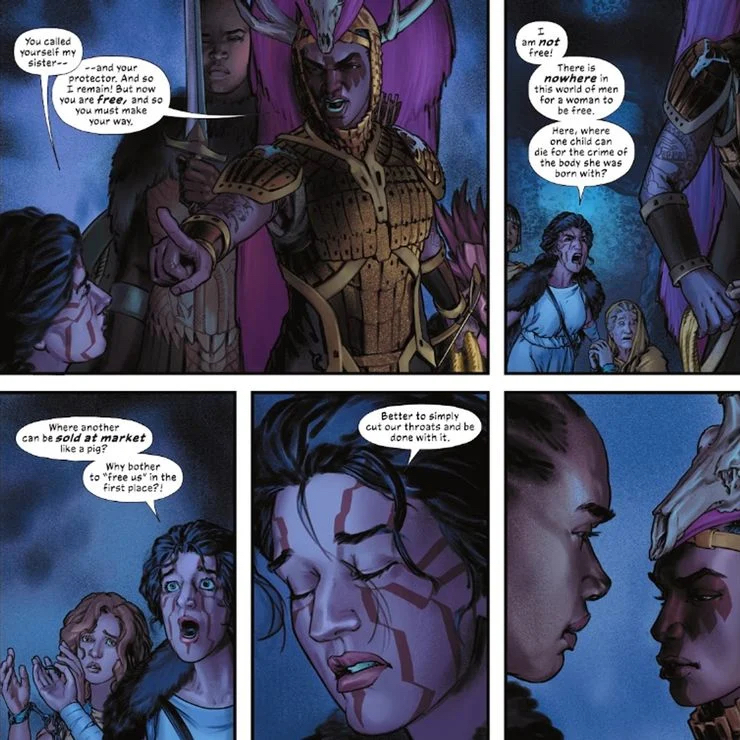
Marked by Artemis, Hippolyta is left to confront enslavers, introducing central themes of Book Two—the conditions of being women and children. Saved by Amazons, the enslaved children and Hippolyta are set free. However, Hippolyta challenges that freedom—not just for this moment, but “There is nowhere in this world of men for a woman to be free.”

Book Two: DeConnick, writer; Ha, artist; Wesley Wong, colorist; Clayton Cowles, letterer.

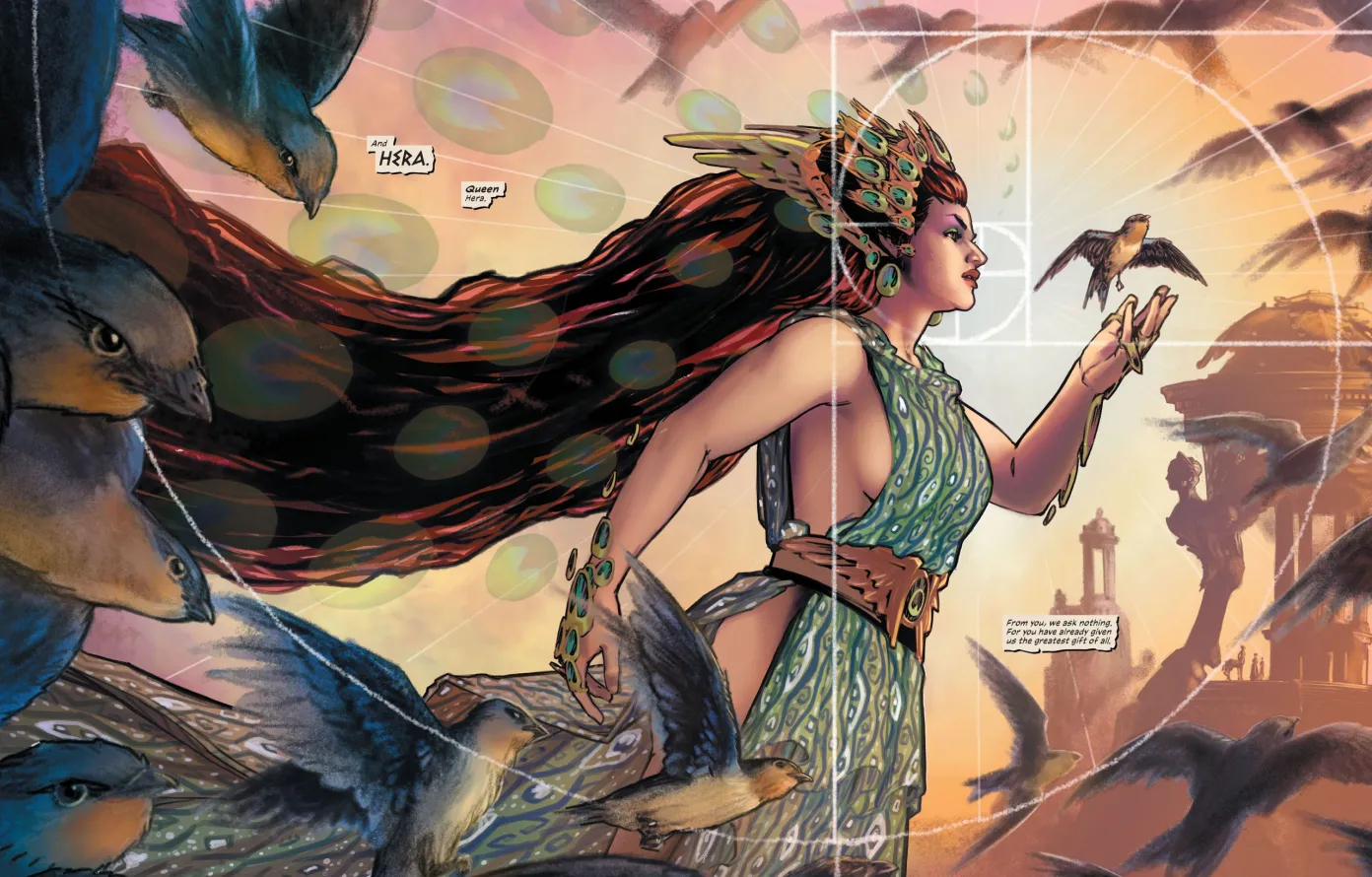
Hippolyta’s outburst echoes Queen Hera’s anger earlier in Book Two: “There will be no justice for women. Not now. Not a hundred years from now. Not a thousand!”

Book Two: DeConnick, writer; Ha, artist; Wesley Wong, colorist; Clayton Cowles, letterer.

Goddesses and mortal women, women and children—for them, Book Two establishes elements of shared existential realities around justice and freedom.

The plot of Book Two builds to a new Seventh Tribe of Amazons with Hippolyta as the leader, chosen by “consensus,” fitting seamlessly into the “collaboration” commitment from DeConnick in Ha’s “Behind the Panels.”

The new tribe, mortals, train and then experience their own mission against enslavers. Those who were freed now free others, but also confront the weight of “great power,” the ability to take life. Tarpeia, however, is restrained from killing a boy. “But he is one of them. He would have killed me!” she argues.

The Amazonian response is powerful and haunting: “He’s just a boy. He shouldn’t die for the sins of his father.”

In terms of contemporary relevance, I find this focus one of the key moments of Book Two.

Book Two: DeConnick, writer; Ha, artist; Wesley Wong, colorist; Clayton Cowles, letterer.

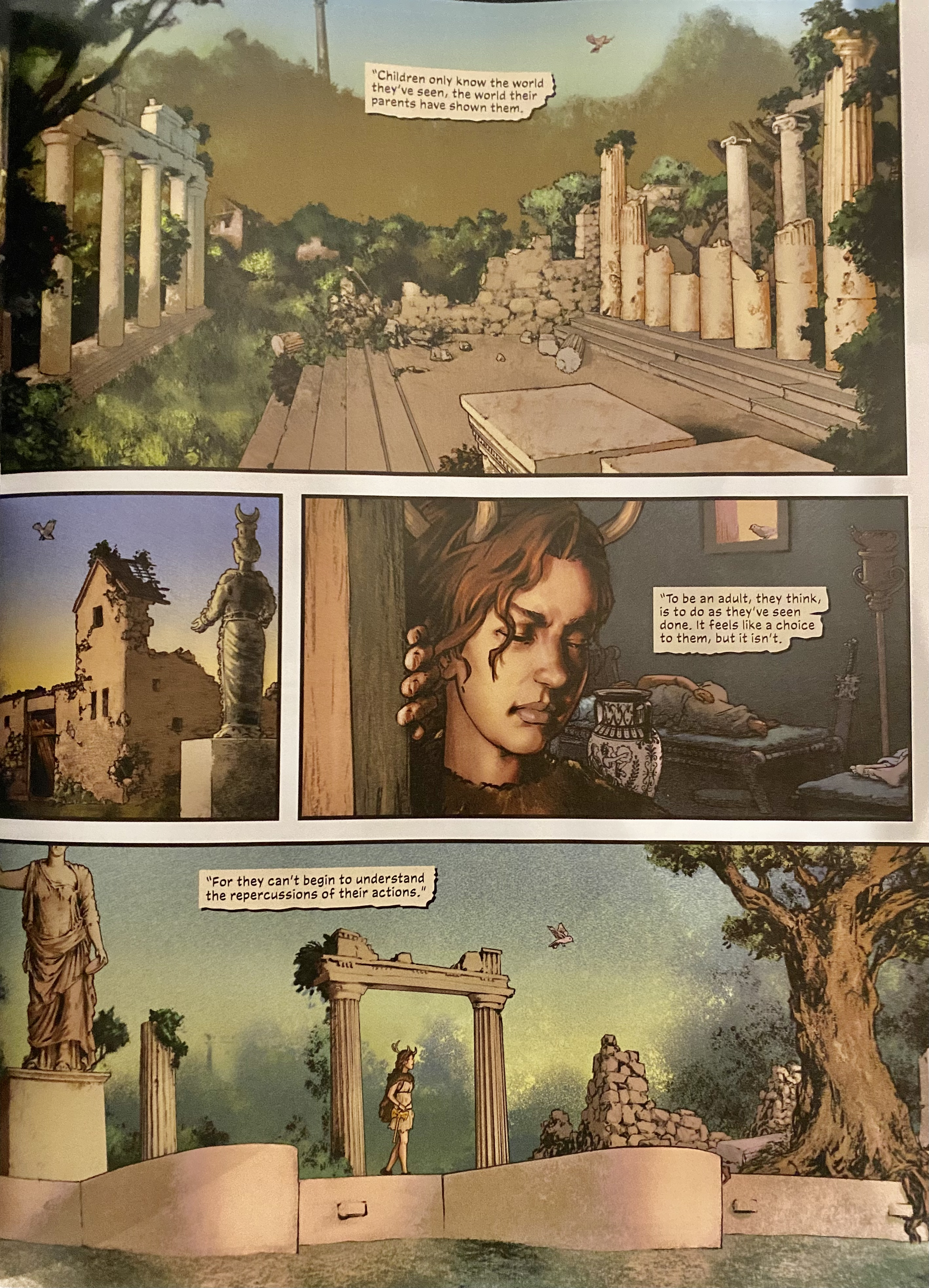
A cultural and political narrative in the U.S. in 2022 involves centering parental rights over their children, an idealized view of parenting paired with denying the autonomy and humanity of children. States are passing legislation directly pronouncing that parents have primary authority over their children’s education.

However, as Book Two dramatizes, “Children only know the world they’ve seen, the world their parents have shown them. To be an adult, they think, is to do as they’ve seen done. It feels like a choice to them, but it isn’t.”

The fate of the boy becomes the ominous final conflict of Book Two, harkening Book Three with “Unleash hell upon them.”

Here, I come back to my father, and mother, and the “world” they showed me. As I have written about often, I was told many wrong stories, corrupting stories, and I could have been trapped in those narratives of racism and ignorance.

Until I learned otherwise—in science fiction and comic books, in comedy albums, and in classrooms where teachers were free to teach.

Again, stories matter.

But who controls them often matters more.

WandaVision: Pastiche, Past, and Present (A Course)

Below I am sharing my MayX (2 credit undergraduate) course I will be offering in about a month.

The course grew out of the following post based on the series WandaVision: Teaching WandaVision: A Textset on Pastiche.

See Also

A Vision of Being Human: “Am I normal?”


EDU 116 – WandaVision: Pastiche, Past, and Present

“The law is meant to be my servant and not my master, still less my torturer and my murderer.” — James Baldwin. The Nation. July 11, 1966.

Equity, Anti-Racism, and Anti-Bias Statement

#BlackLivesMatter

In my teaching, scholarship, public writing, and life, I am fully committed to racial, gender, and all forms of equity not yet realized throughout the U.S. and world. While academic spaces are often intellectually challenging and even uncomfortable, I will not tolerate in any aspect of this course language, ideas, or behavior/symbolism that are hostile to marginalized/oppressed groups (racism, sexism/misogyny, homophobia, transphobia, xenophobia, etc.).

Academic freedom for students and professors is tethered to consequences, and is not license. (See Free Speech and Diversity of Thought?

Students uncertain about what language and ideas are not acceptable because they are hostile or offensive are invited to discuss those questions with me privately and are guaranteed those exchanges will be treated confidentially and respectfully. I am eager to share evidence, research, and reading to help anyone better understand goals of equity, anti-racism, and anti-bias (see materials in Box, Race and Racism).

If you witness or experience any form of bias, please report here:

Bias Incident Report

Title IX syllabus statement

Course Overview

Catalogue Description

This MayX will explore reconsidering the past through the present by viewing the 9-episode series WandaVision (and other texts), which incorporates pastiche as a technique to reflect and challenge the sit-com genre. Students will apply critical media literacy strategies to explore pop culture and apply those strategies to understanding public and popular controversies in K-12 education. An active subscription to Disney+ during MayX is required.

Course Topics

Critical media literacy/ K-12 educational controversies

Pastiche

History/teaching history

Pop culture/Marvel Cinematic Universe/sitcoms

Race/gender

Course Texts

Vision: The Complete Collection (graphic novel)

WandaVision (series)

Pleasantville (film)

Sitcom episodes (TBD)

Brief readings (TBD; see schedule)

The 1619 Project

Course Objectives

  • Understanding and application of the concept of “pastiche” in media and pop culture
  • Understanding and application critical media literacy strategies
  • Awareness of educational controversies (for example, Critical Race Theory, the 1619 Project)
  • Understanding of the field of history (relationship of past and present) and the teaching of history
  • Understanding of the essential aspects of liberal arts education
  • Reconsideration of race and gender in history and pop culture

Assignments

  • Read Vision (before class sessions) and submit reflections* per schedule below
  • View WandaVision episodes (before class sessions) and submit reflections* focusing on pastiche technique in each episode
  • Independent Project – critical analysis of one episode of a classic sit-com referenced in WandaVision after series viewing (PP and class presentation)
  • Group Activity – viewing Pleasantville (film) for in-class critical analysis in groups
  • Final Portfolio Submission (all assignments resubmitted in Box folder)

* Written reflections should be submitted per the daily schedule below. Submit each reflection pasted into email (not attached) and include the reflection number (see schedule) in the “subject” line of the email. Due before each class session by schedule.

Schedule (Meeting 9 am -12 pm)

Week 1

May 11

Course Overview and Assignments

Read Vision (before class sessions) and submit reflections per schedule below

View WandaVision episodes (before class sessions) and submit reflections focusing on pastiche technique in each episode

Independent project – critical analysis of one episode of a classic sit-com referenced in WandaVision after series viewing (PP and class presentation)

Group activity – viewing Pleasantville (film) for in-class critical analysis in groups

May 12

Intro – Marvel Cinematic Universe (MCU); Sitcoms; Pastiche (Postmodern Use of Parody and Pastiche, Nasrullah Mambrol)

Critical Media Literacy – Teachable Moment: Fake News and Critical Media Literacy

Rethinking the past through the present? – Dismantling Monuments: History as a Living Document

May 13

Intro – Wanda and Vision

Teaching WandaVision: A Textset on Pastiche

Week 2

May 16

Vision 1-3 (reading and reflection DUE before class) discussion

May 17

Vision 4-6 (reading and reflection DUE before class) discussion

May 18

Vision 7-9 (reading and reflection DUE before class) discussion

May 19

Vision 10-12 (reading and reflection DUE before class) discussion

May 20

NO CLASS SESSION

Week 3

May 23

WandaVision E1 – Filmed Before a Live Studio Audience

WandaVision E2 – Don’t Touch That Dial

(Viewing and reflection DUE before class)

May 24

WandaVision E3 – Now in Color

WandaVision E4 – We Interrupt This Program

WandaVision E5 – On a Very Special Episode…

(Viewing and reflection DUE before class)

May 25

WandaVision E6 – All-New Halloween Spooktacular!

WandaVision E7 – Breaking the Fourth Wall

WandaVision E8 – Previously On

(Viewing and reflection DUE before class)

May 26

WandaVision E9 – The Series Finale

(Viewing and reflection DUE before class)

May 27

NO CLASS SESSION

Week 4

May 30 Memorial Day Holiday

May 31

Pleasantville (DVD Collection PN1995.9.C55 P63 1999) in-class viewing/discussion

June 1

Last class – final portfolio/exam DUE (submit in Box)

Presentations shared in class

Black Widow Series

[Header image property of Marvel and artist(s)]

Please read and follow my Black Widow series posting at Comics Bookcase (blogs 1-5) and here (6-8).

The series will be updated below as each post is published.

Blog 1: Black Widow Underestimated – An Introduction (24 February 2022)

Blog 2: Black Widow Underestimated – Tortured Beginnings and Solo Black Widow (24 March 2022)

Blog 3: Black Widow Underestimated: A New Start? – ‘He Underestimates Me’ (28 April 2022)

Blog 4: Black Widow Underestimated: ‘It’s Not the Length of Life that Matters…’ (12 May 2022)

Blog 5: Black Widow Underestimated: Black Widow Unbound – Past, Present, Future (26 May 2022)

Blog 6: Black Widow Underestimated: “I Reap What I Sow” (15 August 2022)

Blog 7: Black Widow Underestimated: “I Am What I Am” (4 September 2022)

Blog 8: Black Widow Underestimated: “I Remember Everything” (3 October 2022)


See Also

The Unintended Multiverse of Black Widow’s Origin

Thoughts from Moon Knight and Saga in Days of Darkness

Throughout the last century, education and intellectual freedom have suffered a persistent assault from ideologues on the right—conservatives determined to protect tradition.

In the wake of Trump, the U.S. is currently experiencing one the most intense such moments, very dark days for teachers, students, education, and intellectual freedom.

Recently, I have begun catching up with Saga by reading Compendium One, which collects the first half, 54 issues, of the series that has recently restarted. Just before that, I had added Moon Knight to my collecting and reading commitments.

In the context of our dark days in education, those readings have struck me in powerful ways.

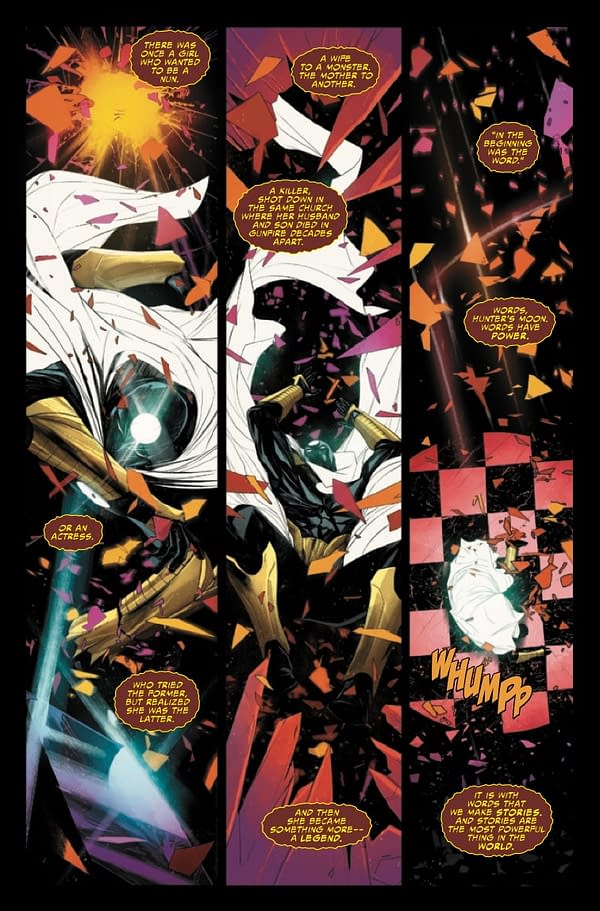
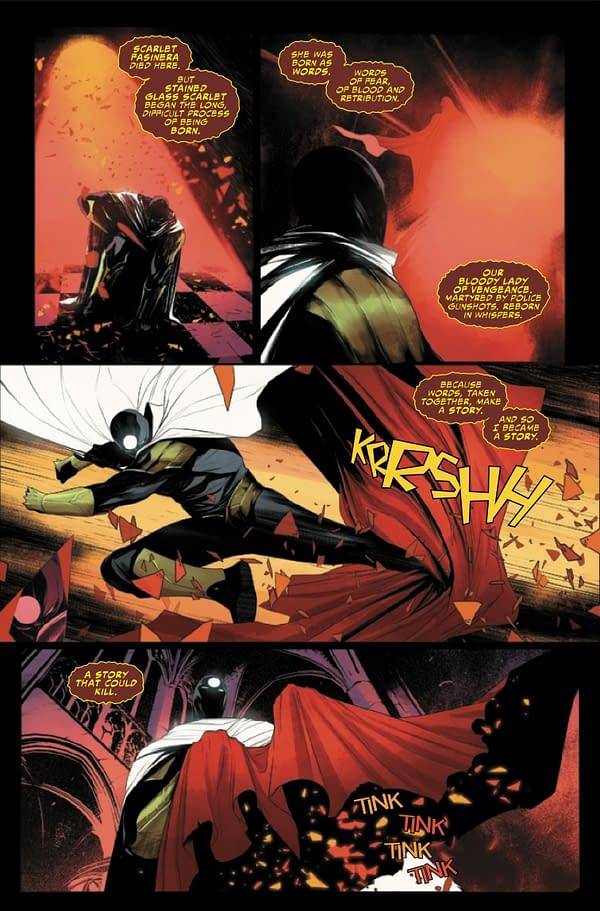
Moon Knight 8 (v.9) presents two dynamic pages that resonate beyond the narrative itself:

Moon Knight 8 (v.9) (Jed MacKay, writer; Alessandro Cappuccio, artist)

“And then she became something more—a legend,” Flint explains about Scarlet, adding:

In the beginning was the word.

Words, Hunter’s Moon, words have power.

It is with words that we make stories. And stories are the most powerful thing in the world….

She was born of words. …

Because words, taken together, make a story. And so I became a story.

A story that could kill.

Moon Knight 8 (v.9)

Beyond the Moon Knight narrative, this scene captures both the importance of story, books/texts, and reading as well as why people in power fear story, books/texts, and reading.

Banning and censoring books/texts and ideas are acts of power, always, and acts of power in a state of fear.

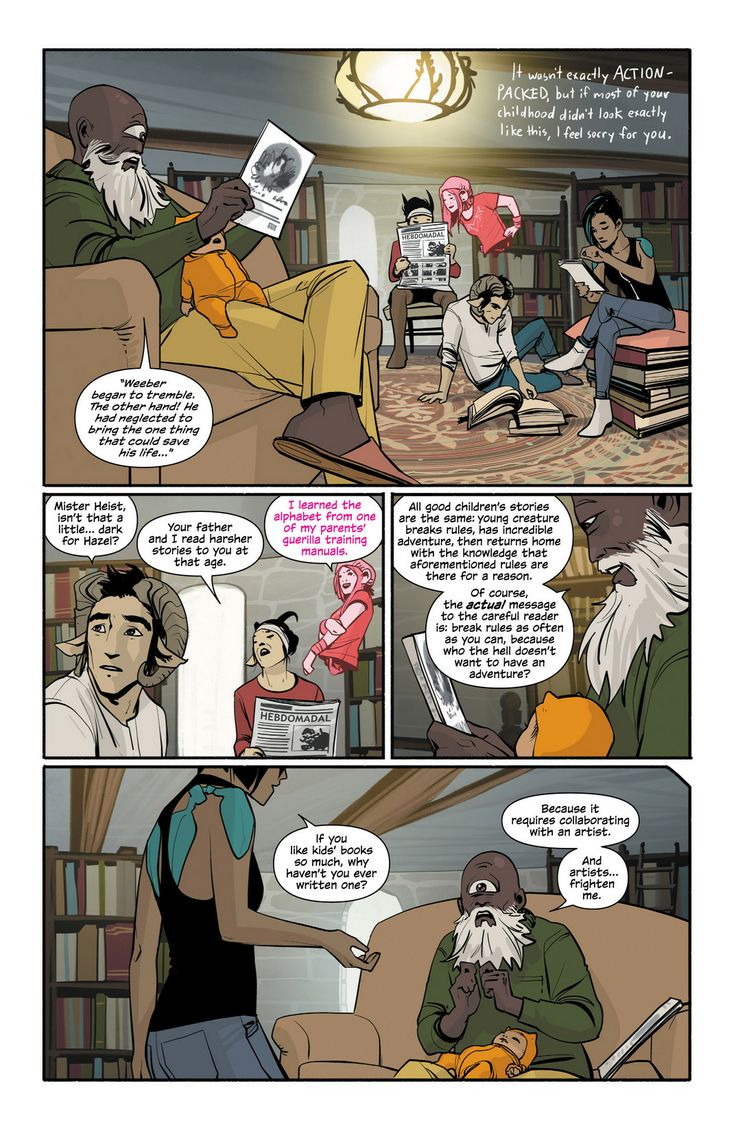
Chapters Sixteen and Seventeen of Saga also interrogate the power of stories. First in Chapter sixteen:

Saga Chapters Sixteen (Brian K. Vaughan, writer; Fiona Staples, artist)

“Mister, Heist, isn’t that a little … dark for Hazel?” Marko asks. And the reply:

All good children’s stories are the same; young creature breaks rules, has incredible adventure, then returns home with the knowledge that aforementioned rules are there for a reason.

Of course, the actual message to the careful reader is: break rules as often as you can, because who the hell doesn’t doesn’t want to have an adventure?

Saga Chapters Sixteen

Along with the pages from Moon Knight, again, we must acknowledge why people in power fear children reading freely.

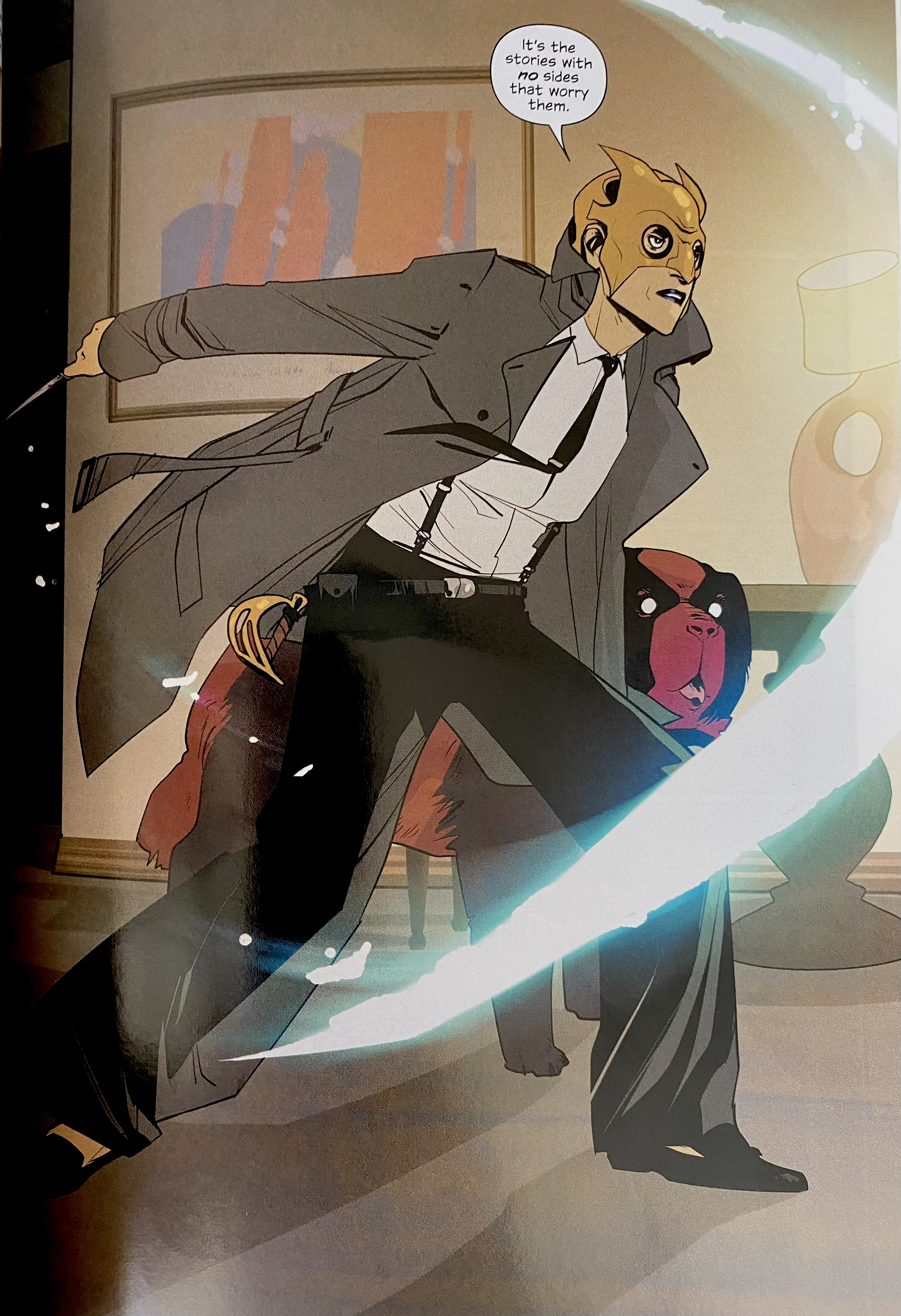
And then in Chapter Seventeen:

Saga Chapters Seventeen (Brian K. Vaughan, writer; Fiona Staples, artist)

This full-page panel, dazzling and concise, fits perfectly into the core of the efforts by conservatives to censor and ban—the fear of confronting racism, a story of the U.S. that has only one Truth, only one side.

People in power fear Truth, and depend on compromise, especially in contexts where there is no room for compromise, to hold power for as long as possible.

Returning to Chapter Sixteen, Izabel reminds us of the accidents inherent in what anyone reads and how reading is what matters, not exclusively what is read: “I learned the alphabet from one of my parents’ [guerrilla] training manuals.”

Bans and censorship are always acts of fear and power; nothing can justify them, especially in the lives of children.

12-22-21: Nerdvana

What does it mean to be a nerd?

Not as vividly as today, slipping toward my last month at the age of 60, but in high school I was aware that I existed in different worlds, worlds that really did not overlap.

Those worlds, in fact, were documented in two films of my youth, Animal House and Revenge of the Nerds. And the worlds, of course, are the tensions between nerds and jocks in formal schooling.

From about 1975 into the early 1980s, I was a compulsive comic book collector, and throughout junior and senior high school, I was on the schools’ basketball teams; I also was a serious golfer and ran track my senior year.

Wearing my father’s number 3, I spent much of my adolescence trying to be the athlete I believed he wanted me to be.

With 7000+ comic books safely ensconced in my comic book room at my home, where I could control who knew about my mostly closeted life, I graduated 8th in my class and more distraught that I had failed to secure a letterman’s jacket than proud of my academic achievements.

My school had arcane rules for lettering, the jacket only awarded to those who lettered in their junior year, the only year I failed to letter in basketball after lettering my sophomore year and in two sports my senior year. I wore my father’s letterman’s jacket occasionally—him a four-sport letterman and co-captain of the school’s first state championship football team.

I clung to the jock life desperately in high school, but the nerd life was who I was, who I am.

Although I became a serious cyclist a few years after high school, and continue today as a fairly accomplished recreational cyclist, I learned quite quickly that the embarrassment of being an outcast that came with being a nerd in school, suddenly flipped throughout college and into adulthood.

Oddly, to be honest, much of my nerd impulses are satisfied by my adult sports obsession, cycling. The two worlds seamlessly merged, and with little conflict—unlike the satirical clashes in the films of my youth.

From the science fiction obsession I adopted from my mother to the comic book collecting and compulsive efforts to be a comic book artist, I slowly throughout college morphed into being a writer and a teacher, followed by graduate school and the life of a scholar, which pulls everything into one neat and stable nerd pile.

In my 40s, I moved to higher education and found the space to merge all of my nerd life into my career, including doing comic book scholarship and blogging. Over the next two decades, with age, I returned to my nerd center, beginning again to collect comics just as the world has embraced all that nerdom in the form of comic books being adapted to film and series on streaming services.

I grew up with campy Batman (a wonderful work around to shift comic books to live-action), The Green Hornet, The Incredible Hulk, and The Amazing Spider-Man, the latter two a hint of the possibility of comic books as TV series that were far ahead of their time in terms of the technology needed to make that work.

Most of that pop culture/comic book/super hero world was simply only stuff that nerds could appreciate, love. While there was some momentum to these as well as popular success, this was still mostly the nerd world.

Young adulthood, career, graduate school, marriage, and fatherhood pushed my nerd life aside while pop culture continued to tip-toe toward today’s nonstop nerdvana seen in Marvel and Disney+.

I sit here writing on 12-22-21, recognizing that the Pop Culture Gods have blessed us with the last episode of season 1 of Hawkeye, the release of The Matrix Resurrections, and new comic book day (including the release of Moon Knight (v9) 6 amidst the buzz around Moon Knight coming to Disney+)—maybe the peak ever nerdvana.

My 15-year-old rendition of Marvel Spotlight on The Moon Knight 28 (1976)

In 2012, despite being a lifelong SF nerd, I came to the original The Matrix trilogy 13 years late; I found all three films on my cable package, and immediately consumed them with nerd-glee, baffled why and how I had allowed life to distract me from them when they were commanding pop culture.

I soon wrote a poem about this experience, alluding the Revenge of the Nerds and beginning then to think seriously about what it means to be a nerd.

The value and consequences for being a nerd shift throughout childhood and adolescence into adulthood because at its core being a nerd is about being fully human, passionately and nakedly fully human. While we are children, and especially teens, to being transparent is terrifying, and the result is many simply hide their passions, who they are, and resort to shaming and bullying those few among us willing to live the nerd life even as we know it costs during those delicate years of growing up.

Of course, we have always found each other, sought refuge in small gatherings, but I grew up before comic book stores and Dungeons and Dragons, well before gaming really took hold.

Nerdom was isolating for me—until it simply was my life, my passions finding their way into my careers.

I will find ways to bask in 12-22-21, this nerdvana. After I complete this blog post, I can head to my local comic book store, opening at 11 am. I will go cycling this afternoon, and we have committed to watching The Matrix Resurrections tonight. I am fretting over how to fit in Hawkeye, as I also fret over how and when Daredevil comes to the MCU (hints and leaks swirling around me).

Being a nerd is an attempt at being fully human, allowing our souls and our minds to care deeply, to love and embrace these other worlds imagined and brought into our real lives.

12-22-21 is also the first day after the Winter Solstice, daylight once again promising to expand and bring us another spring, hope and sunshine and warmth.

Nerdom is the human heart joining with the human mind and pretending we have souls, souls that can and will occasionally join hands, all creatures good and one.

Just in Time: Wonder Woman Historia: The Amazons

[See repost: Wonder Woman Historia: The Amazons…arrives just in time]

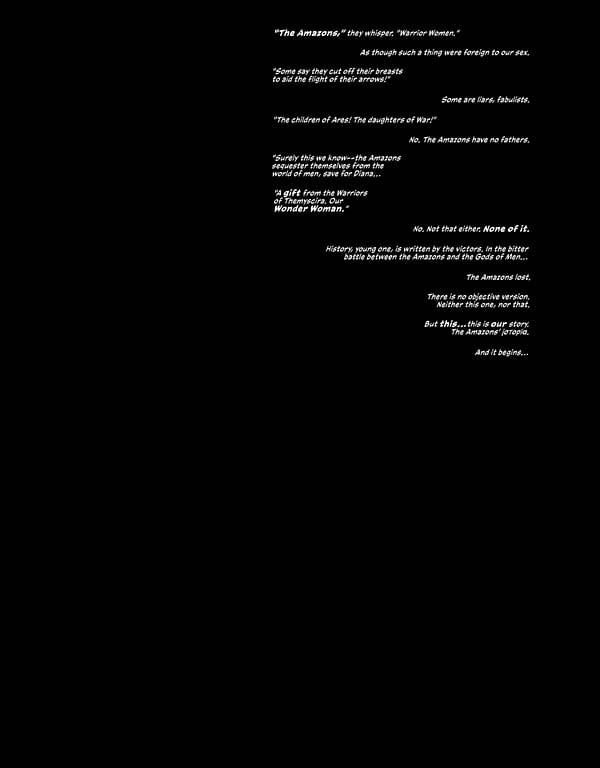
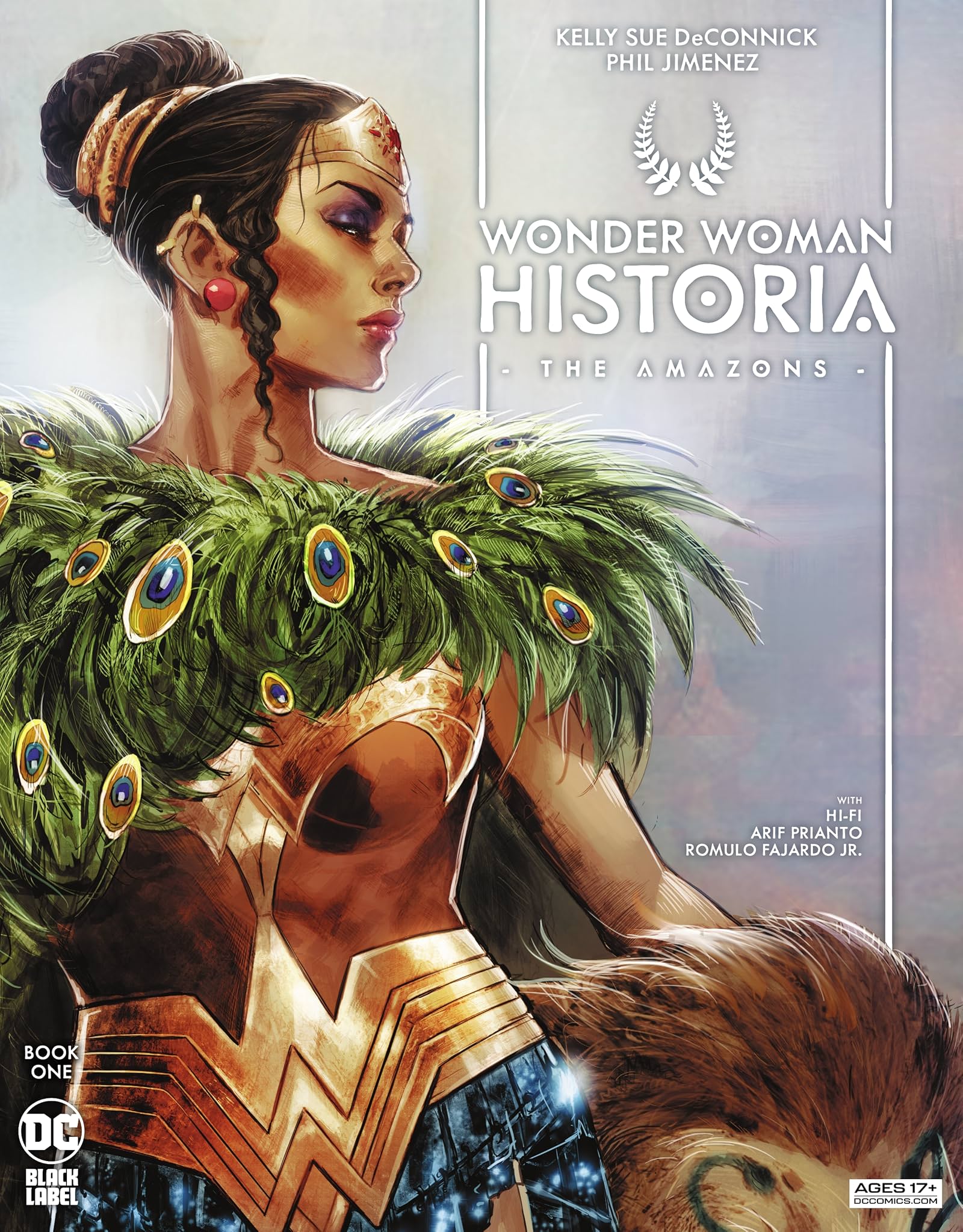
The oversized format and stunning cover by Phil Jimenez and Romulo Fajardo Jr. suggest something special from DC Black Label, but the black text-only first page signals Kelly Sue DeConnick’s Wonder Woman Historia: The Amazons has arrived just in time:

Wonder Woman Historia: The Amazons (2021-) #1 - Comics by comiXology
Interior preview page from WONDER WOMAN HISTORIA THE AMAZONS #1 (OF 3) CVR A PHIL JIMENEZ (MR)

Available December 1, 2021, Historia Book One on its first page speaks into a darkness begun in the waning days of the Trump administration, a ham-fisted attack on the 1619 Project that has escalated into state-level legislation by Republicans across the U.S. banning books and canceling the teaching of history.

The “Some say…” reply of “Some are liars, fabulists” can be read as a critique of the Trump-poisoned Right today. But the most powerful lines speak to the exact source of why conservatives in 2021 are seeking to control what children are taught and how, echoing the essence of Critical Race Theory and vilified historians such as Howard Zinn:

History, young one, is written by the victors. In the bitter battle between the Amazons and the Gods of Men…

The Amazons lost.

There is no objective version. Neither this one, nor that.

But this…this is our story.

Wonder Woman Historia: The Amazons (Book One)

The creative team of DeConnick (writer); Jimenez (artist); Hi-Fi, Arif Prianto, and Fajardo (colorists); and Clayton Cowles (letterer) remind me of J.H. Williams III and Kelly Thompson’s run on Black Widow—although in many ways, Historia proves to be dramatically unique.

Occasionally calling a work a feminist read on a topic can seem reductive, or insubstantial—how many feminist reads [1] has there been of Wonder Woman?—but in a world darkened by censorship and the looming threat of overturning women’s reproductive rights nearly 50 years after Roe v. Wade, a feminist manifesto is not just in time, but essential.

“For the Institutions of Men Care Not for the Weal of Women“: Just in Time?

After a beautifully rendered introduction of Goddesses, the narrator admits, “The subjugations and abuses of not-men by men are too numerous to catalog in a library…let alone a book.”

This powerful refrain not only sets the focus of Historia, but carries an eerie weight in a time of book censorship—books ripped from classrooms and libraries, school board members calling for book burnings—as well as the threat of of the State denying women reproductive rights, “the subjugations and abuses of not-men by men” and the women who do men’s bidding.

Next, an admission more sober: “For the institutions of men care not for the weal of women. You don’t have to be the Queen of Gods to recognize injustice.”

Book One moves from introduction to an exchange between Hera and Zeus, where Hera requests the elimination of not humankind but all men.

“The history of men is a chronicle of crimes against women,” Hera proclaims to protestations that history too includes “tales of love and beauty,” followed by:

“Herodotus 1.93. Every daughter of Lydia will work as a prostitute until she has raised sufficient money for a dowry and can secure a husband.”

Wonder Woman Historia: The Amazons (Book One)

To which, Aphrodite counters:

The indignity lies not in the commerce of love, goat…

…but in the irony of whoring yourself to many to earn the privilege of whoring yourself to one.

Wonder Woman Historia: The Amazons (Book One)

The arguments are an excellent dramatization of concepts such as justice as well as privilege. Hera, indignant, asks, “Do you mean to suggest that women have done something to deserve this station?” Zeus concedes, condescendingly, “You’ve made your point, girls. Women do suffer—historically and undeniably—at the hands of men. But their world is not justice.”

Finally, the main narrative of Book One focuses on childbirth and vividly portrays Hera’s protestations—in short, “Hell is a state of being,” and we can add for women.

An unwanted girl is birthed, an excessively bloody event confirming:

In every birth, there is risk and pain. This is true of creatures, ideas, and tragedies.

Mortal births are particularly gruesome. They enter the world unprotected, screaming, suited for inevitable suffering.

Wonder Woman Historia: The Amazons (Book One)

But the birth itself is not the only “pain”; Hippolyta is tasked with discarding the unwanted baby girl.

DC First Look: Wonder Woman Historia: The Amazons • AIPT

After leaving the baby in the river—”‘The Gods will decide, as they decide the fates of us all. They will choose wisely. Yes.'”—Hippolyta balks on that faith and runs until collapsing in hopes of saving the child.

This tale of the burden of women and the inescapable fate of women as self-sacrificing builds to her being saved by the Amazons, setting up Book Two in a dramatic final page:

Wonder Woman Historia: The Amazons review: Every page of DC's comic is epic  - Polygon

Historia is beautiful and compelling as another contribution to the long history of Wonder Woman, but this is a work that speaks to “not-men” and “men” in the U.S. during the final month of 2021. It is a call to confront the “the institutions of men [that] care not for the weal of women.”

Just in time?


[1] Thomas, P.L. (2018). Wonder Woman: Reading and teaching feminism with an Amazonian princess in an era of Jessica Jones. In S. Eckard (ed.), Comic connections: Reflecting on women in popular culture (pp. 21-37). New York, NY: Rowman and Littlefield.

MCU Director’s Edition Phase [humor]

Spider-Man: Manhattan

Woody Allen

[Filmed in black and white] Peter Parker is bitten by a radioactive spider. Set during Peter’s time in high school, Gwen Stacy leaves Peter for MJ. Depressed, Peter dates a middle-school girl he meets at the museum.

Avengers Limited

Wes Anderson

The Avengers reassemble. On a train. In India.

Black Widow: Barefoot and Pregnant

Quintin Tarantino

After a positive pregnancy test, Natasha Romanoff wakes up, bound and barefoot in a dark basement.

Black Panther: Jungle Fever

Spike Lee

Set in 1968, T’Challa visits the US and faces the challenges of interracial relationships when dating Sue Storm, the Invisible Woman.

Doctor Strange and the Multi-Senses

M Night Shyamalan

Stephen Strange struggles to connect with his family, including a highly perceptive son who sees magic people.

Daredevil: Justice Is Blind

Aaron Sorkin

An intense two-hour court room scene punctuated with quips about justice being blind ends with a hung jury and a frustrated Matt Murdock who has forgotten about a date with Karen Page while being distracted by seeing Elektra in the court room crowd.

The Hulk: MCU Be Damned

Ridley Scott and Martin Scorsese

Bruce Banner’s gamma ray experiment rips a hole in the time/space continuum so intense that all superhero films are erased from existence.

On Disney+

Curb Your Super Powers

Larry David

Larry debates with his wife and friends, including the original cast from Seinfeld, what order to watch MCU on Disney+. Nothing happens.