In 1961, scholar Jacques Barzun declared “we who run businesses, carry on professions, work for the government, or engage in teaching itself are forced to admit that illiteracy is still with us” (xii-xiii).
In 1961, Jacques Barzun in Tomorrow’s Illiterates declared “illiteracy is still with us.” Charles Child Walcutt added: “[N]o further ‘research’ into methods of reading instruction is necessary.” This session examines reading crisis/reform cycles to reconsider the stories told about reading and offer a new approach for reform that serves the needs of students and supports teacher professionalism.
Abstract: The current reading crisis, the “science of reading” (SoR) movement, is a subset of the perpetual education crisis begun under Ronald Reagan with A Nation at Risk. Ultimately, “crisis” education reform is a sort of industry that works as a distraction and erasure. Consequently, marginalized and minoritized students, often significant populations within Urban education, are never directly served in education reform grounded in accountability instead of equity. The SoR movement, through legislation and policy, is working indirectly to drive book censorship, book bans, and the whitewashing of texts in classrooms and libraries.
When I had my OpEd on the manufactured reading crisis and NAEP misinformation published in The Washington Post, I anticipated that SOR advocates would continue their misinformation campaign, including targeted attacks on me that repeat false claims and innuendoes (“hidden agenda”).
I do find it a bit odd that my OpEd claims have ruffled so many feathers because, to be blunt, the OpEd is pretty moderate and factual. For those not interested in reading the piece, here is the TL;DR:
Many SOR advocates and education reformers misrepresent or misunderstand NAEP data and achievement levels, reading “proficiency” and “grade level,” reading programs, and reading theories. I call for accurate and honest discourse and claims.
The wide range of achievement levels between NAEP and state accountability testing should be standardized, and in my informed opinion, that should be a shift to a standard for age-level reading proficiency.
Many states have chosen as reading policy to implement third-grade mandatory retention based on state testing, and current research shows that SOR-based reform is only raising test scores in the short term when states have retention. Grade retention disproportionately impacts Black and brown students, poor students, multilingual learners, and students with special needs; as well, retention is punitive with many negative consequences. I caution states against choosing grade retention since it likely distorts test data and does not contribute to authentic achievement gains.
However, most of the negative responses to this commentary that I have seen focuses on one element—my rejecting crisis rhetoric about reading.
Since I began teaching in 1984, I have worked as an educator entirely in the post-A Nation at Risk era of high-stakes accountability education reform.
I reject crisis rhetoric about reading and education for the following reasons:
The test-score gap by race and socioeconomic status is not unique to reading; all standardized testing exposes that gap regardless of content area. There is no unique gap in reading.
Reading and education crisis have been declared every moment over the past 100 years (at least), and thus, I maintain that the current status of education in the US is the norm that our society has chosen to accept. That norm, by the way, is something I have worked diligently to change for over 40 years as an educator and scholar.
“Crisis” in reading and education is manufactured to feed the reform industry, and not to improve teaching or learning. Two things can be true at once: Education reformers manufacture hyperbolic stories about education and reading crisis to maintain a culture of perpetual reform (for market and political/ideological reasons), and the US public education and social safety net are historically and currently grossly negligent about the serving individual needs of all students (notably those vulnerable populations most negatively impacted by test-based gaps).
“Crisis” reform in the US has created a culture of blame for students, teachers, and public education that distracts from the evidence on the primary sources for low test scores and test-based gaps. Over 60% of those test scores and thus that gap is causally driven by out-of-school factors. Current research suggests that test-based evaluations of schools and students have failed and must be replaced for most effective reform.
There simply is no settled evidence that the US has a “crisis” in reading or that any specific reading program or reading theory has contributed significantly to low student reading proficiency. As well, there simply is no monolithic settled body of science or research on how to teach reading that supports a one-size-fits-all reading program or theory (such as structured literacy); there is a century of robust and complex research on teaching reading that can and should be better implemented in day-to-day classroom instruction; however, the greater causes for ineffective instruction and inadequate student achievement are, again, out-of-school factors and a failure to provide students and teachers the learning/teaching conditions necessary for better outcomes.
Again, to be clear, the US does not currently have the data to make any sort of valid claim about reading proficiency in the US. The only verifiable claim we can or should make is that there is clearly an opportunity gap grounded in race and socioeconomic status as well as ample evidence that multilingual learners and students with special needs are far too often neglected in our schools.
As I argue in the commentary, we need better data, and we need a more honest and nuanced public discourse about reading and education that is not corrupted by market and political/ideological agendas.
Further, journalists, politicians, and even parents should not be controlling the discourse or the reform in reading and education.
Yes, they are and should be stakeholders with a voice in a democracy, but ultimately, education is a profession that has never had autonomy—and I suspect that is because more that 7 out of 10 educators are women (notably even higher in the early grades when students are first taught to read).
I do not—like many in the SOR and education reform movements—have a “hidden agenda.”
I have never and would never sell a reading or education program. I have never and would never endorse any program or theory or ideology. I provide the vast majority of my work for free, open-access publications and my blog.
Over 40+ years, I have presented many dozens of times with well over 90% of that for free or at my own expense.
I am a critical educator and scholar, and I have never been paid to make any claims or to endorse any organization. My published and spoken work is mine and mine only.
I am fortunate to be a university-based scholar, and thus, I have academic freedom and am beholden to no one except me.
My agenda?
I work to support the professional autonomy of teachers so that the individual needs of students can be fully served in our public education system.
And thus, my agenda includes calling out misinformation, identifying the market and political/ideological agendas driving permanent education reform, and providing for all stakeholders counter-evidence to the crisis story being sold.
Since I am an older white man with university tenure in the US, I am not much impacted by the persistent lies and distortions about me and my “hidden agenda”; however, those lies and distortions are in the service of other people maintaining the education reform gravy train that feeds their bank accounts and political/ideological agendas.
Here is another TL;DR version of my WaPo commentary: If you have to misinform or lie to make your argument, you likely do not have a valid argument.
SOR advocates and education reformers are mostly misinforming and outright fanning the flames of crisis to promote their own agendas.
Suggesting I have a “hidden agenda” is a whole lot of projection.
We can and should do better in our rhetoric and our claims.
We can and should create better systems of assessment and thus better data.
We can and should reform reading and education in ways that address the lives of our students as well as the learning and teaching conditions of our schools.
Punishing thousands of Black, brown, and poor students with grade retention because we are addicted to permanent education reform is inexcusable; test-based grade retention is not reading reform.
The accountability era of education reform begun in the early 1980s has never worked, except to perpetuate constant cycles of crisis/reform.
There is no reading or education crisis.
There is a culture of political negligence in the US that has existed for many decades—that culture is grounded in rugged individualism and bootstrapping myths of the US that are contradicted by (ironically) scientific evidence and research.
Students and teachers (mostly women) are not broken beings that need to be fixed.
Students and teachers reflect the negative systemic forces that somehow we as a society refuse to acknowledge or reform.
I should not be surprised that in the Trump/MAGA era there are many people offended by a call for honest and accurate rhetoric about reading, education, students, teachers, and schools.
I think those people being offended says more about them than me.
Some people have recognized that Elon Musk has willfully or ignorantly misread and misrepresented data on social security to create a story to support an ideological agenda—cutting social programs in the US government.
Note this thread on X/Twitter, notably Wolfer’s final post: “When everything they say is designed to mislead, you’re left to wonder why.”
And here's the number of RECIPIENTS of social security in each age bucket with the death field set to false (and recipient set to true). A mere 89,106 are aged 99+, not the tens of millions suggested by @elonmusk. https://t.co/PdCtdCIlsGpic.twitter.com/ljs3wls5Yp
Manufacturing crises to perpetuate stories for ideological agendas is very effective (and nothing new).
Why?
“A lie can travel halfway around the world while the truth is still putting on its shoes” (a quote misattributed to Mark Twain, somewhat ironically).
Certainly, the Trump/Musk era of this strategy is an extreme moment in history; however, this is exactly how education reform has been conducted since the 1980s and how the current “science of reading” (SOR) movement is being orchestrated.
The entire education reform movement was grounded in a data lie manufactured by a political report, A Nation at Risk, to create a story of public school failure in the US in order to perpetuate Reagan’s ideological agendas (school prayer, school choice, etc.).
Now, as a subset of the manufactured education crisis, the SOR movement has misread and misrepresented NAEP data to manufacture a reading crisis in order to perpetuate a story of student literacy and “bad” teachers in order to perpetuate ideological and market agendas for teaching reading.
If evidence is being ignored, then it isn’t really about evidence.
It’s about ideology.
If you see through the manufactured crises of the Trump/Elon answer, you have a template for seeing through the manufactured education and reading crises.
Bracey, G. W., & Jer. (2007). Interview: [Gerald W. Bracey]. The Journal of Educational Research, 100(5), 324–326. http://www.jstor.org/stable/27548196
“The 2022 NAEP results show that the average reading score for fourth graders is lower than it has been in over 20 years. For eighth and twelfth graders, average scores are at about a 30-year low,” states Senator Bill Cassidy (R-LA) in his new literacy report, adding, “The 2022 NAEP LongTerm Trend assessment for nine-year-old students showed average reading scores not seen since 1999.”
Cassidy’s alert about a reading crisis fits into dozens and dozens of media articles announcing crises and failures among students, teachers, and public schools all across the US. Typical of that journalism was Nicholas Kristof in the New York Times about a year ago:
One of the most bearish statistics for the future of the United States is this: Two-thirds of fourth graders in the United States are not proficient in reading.
Reading may be the most important skill we can give children. It’s the pilot light of that fire.
Yet we fail to ignite that pilot light, so today some one in five adults in the United States struggles with basic literacy, and after more than 25 years of campaigns and fads, American children are still struggling to read. Eighth graders today are actually a hair worse at reading than their counterparts were in 1998.
One explanation gaining ground is that, with the best of intentions, we grown-ups have bungled the task of teaching kids to read. There is growing evidence from neuroscience and careful experiments that the United States has adopted reading strategies that just don’t work very well and that we haven’t relied enough on a simple starting point — helping kids learn to sound out words with phonics.
As I have noted, education and reading crises have simply been a fact of US narratives since A Nation at Risk. But as I have also been detailing, these claims are misleading and manufactured.
Based on NAEP data—similar to Cassidy’s report—Shakeel and Peterson offer a much different view of student achievement in the US, notably about reading achievement:
This analysis demonstrates that the current reading crisis is manufactured, exclusively rhetorical and ideological, generating profit for media, politicians, and commercial publishers.
In short, the manufactured crises are distractions from the other contrarian truth about education as highlighted in the analysis from NPE:
This educational grading from NPE is unique because it doesn’t grade students, teachers, or public school, but holds political leadership accountable for supporting universal public education and democracy. The standards for these grades include the following:
Privatization Laws: the guardrails and limits on charter and voucher programs to ensure that taxpayers and students are protected from discrimination, corruption, and fraud.
Homeschooling Laws: laws to ensure that instruction is provided safely and responsibly.
Financial Support for Public Schools: sufficient and equitable funding of public schools.
Freedom to Teach and Learn: whether state laws allow all students to feel safe and thrive at school and receive honest instruction free of political intrusion.
These two examples come from contrasting ideologies, yet they offer contrarian truths about public schools and student achievement that would better serve how we talk about schools and student achievement as well as how we seek ways in which to reform those schools in order to better serve those students and our democracy.
Thomas, P.L. (2022). The Science of Reading movement: The never-ending debate and the need for a different approach to reading instruction. Boulder, CO: National Education Policy Center. http://nepc.colorado.edu/publication/science-of-reading
Accordingly, when policymakers explore new guidelines, they would be wise to do the following:
• Be wary of overstatements and oversimplifications within media and public advocacy, acknowledging concerns raised but remaining skeptical of simplistic claims about causes and solutions.
• Attend to known influences on measurable student reading achievement, including the socioeconomics of communities, schools, and homes; teacher expertise and autonomy; and teaching and learning conditions.
• Recognize student-centered as an important research-supported guiding principle but also acknowledge the reality that translating such research-based principles into classroom practice is always challenging.
• Shift new reading policies away from prescription and mandates (“one-size-fits-all” approaches) and toward support for individual student needs and ongoing teacher-informed reform.
In rethinking past efforts and undertaking new reforms, policymakers should additionally move beyond the ineffective cycles demonstrated during earlier debates and reforms, avoid ing specific mandates and instead providing teachers the flexibility and support necessary to adapt their teaching strategies to specific students’ needs. Therefore, state policymakers should do the following:
• End narrowly prescriptive non-research-based policies and programs such as:
o Grade retention based on reading performance. o High-stakes reading testing at Grade 3. o Mandates and bans that require or prohibit specific instructional practices, such as systematic phonics and the three-cueing approach. o A “one-size-fits-all” approach to dyslexia and struggling readers.
• Form state reading panels, consisting of classroom teachers, researchers, and other literacy experts. Panels would support teachers by serving in an advisory role for teacher education, teacher professional development, and classroom practice. They would develop and maintain resources in best practice and up-to-date reading and literacy research.
On a more local level, school- and district-level policymakers should do the following:
• Develop teacher-informed reading programs based on the population of students served and the expertise of faculty serving those students, avoiding lockstep implementation of commercial reading programs and ensuring that instructional materials support—rather than dictate—teacher practice.
• Provide students struggling to read and other at-risk students with certified, experienced teachers and low student-teacher ratios to support individualized and differentiated instruction.
For many years I have been raising concerns about the use of “crisis” rhetoric around education [1], specifically challenging the default use of “crisis” and “miracle” in mainstream media.
The central role of “crisis” rhetoric in the accountability era of education reform has been characterized as a “manufactured” [2] crisis.
The current subset of education reform, the “science of reading” (SOR) movement, fits into the same patterns of the broader accountability era of education reform, I have argued.
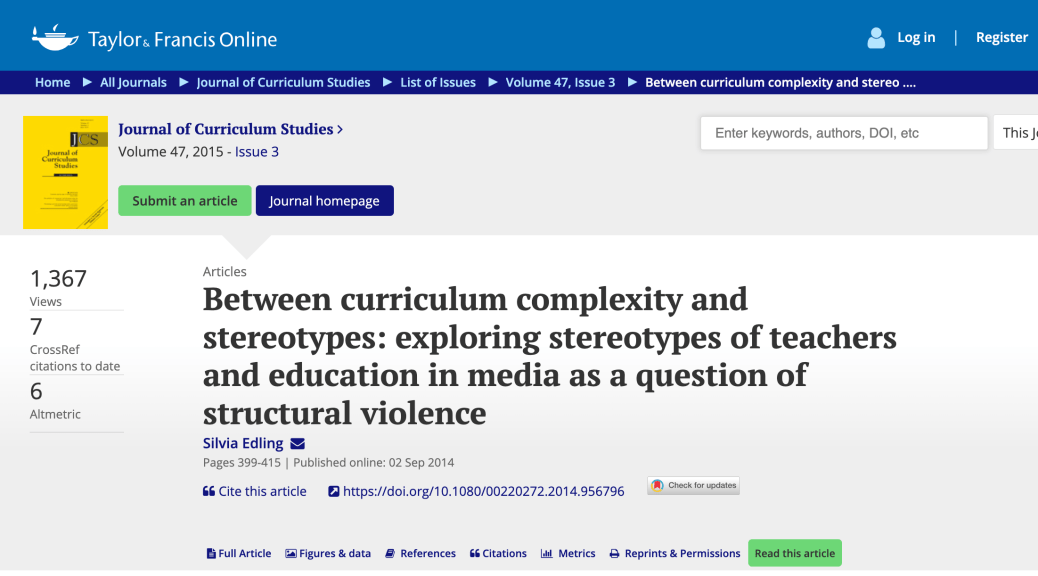
Here, I am using Edling excellent work on the relationship between mainstream media and education to reinforce the claims that SOR as a reform movement is both mainstream accountability reform and essentially conservative.
I want this overview to be accessible, but I also highly recommend reading the piece in it entirety (click title above for access).
Edling’s first sentence establishes: “What is of particular interest in this paper is how professional teachers repeatedly, although not always, seem to be pictured in a de-contextualized and non-relational manner by actors outside education, and especially how the media often fails to take educational complexity and practice into account.”
Media representations of education, then, are often overly simplistic. Note that a key aspect of the SOR movement [3] is the claim that reading science is simple (the simple view of reading) and settled, effectively erasing the complexity of reading science and of reading instruction.
Edling’s explanation about the relationship between media and education also describes well the story of reading found in the SOR movement:
Newspapers do not just write about education, they also represent to their readers what education is ‘about’ (p. 392, see also McLure, 2003; Thomas, 2004). Similarly, Fairclough (1995) stresses that the media has the power: ‘to shape governments and parties … influence knowledge, beliefs, values, social relations, social identities’ (p. 2). From this way of reasoning, the media can be seen as an important power source for the construction of certain ideologies that can either exclude or include (Fairclough, 1995, p. 14), depending on how they are positioned and what sets the agenda for what is to be framed as true or false in society (cf. Johnson-Cartee, 2005).
There is no doubt that critical analyses of education in general are necessary in order to improve quality. Education is here understood as a broad concept that includes institutions such as (pre)schools, teacher education and the ideas behind them (cf. Sa ̈fstro ̈m & Ekerwald, 2012). However, what is highlighted here is not criticism of the media itself, but how the media’s recurring simplifications and often negative images of education and teachers are understood and how they might affect people who are seen or define themselves as teachers. Moreover, teachers in teacher education and teachers at (pre)schools are dialectically interconnected, in that teacher education aims to educate teachers, who are capable of acting as professionals in various educational positions—not the least in (pre) schools. For that reason, the term teacher includes teachers at (pre) schools and teacher education (cf. Hallse ́n, 2013).
In the paper, four interrelated propensities are problematized concerning the media’s portrayals of teachers and education:
Viewing education as being in more or less permanent crisis
Taking the role as a spokesperson for teachers and on behalf of the field of education
Excluding the knowledge and experiences of teacher(s), educators and/or educational researchers in the public press
Simplifying the notion of being a good teacher through stereotypes and dualistic frameworks that overlook task and relational complexity.
The SOR movement is yet another reading crisis in a long line of similar reading crises reaching back to the 1940s. Also the SOR movement is being driven by journalists who are identified as literacy experts, and those journalists have repeatedly characterized teachers as ill-equipped to teach reading because the entire field of teacher education has failed those teachers.
As the fourth bullet point above notes, as well, the SOR movement depends on simplistic characterizations of balanced literacy and reading programs as well as cartoonish caricatures of “three cueing” and “guessing” as pervasive failures of reading instruction across the entire US.
Edling details next “educational crisis discourse”:
Although crisis in the media is generally pictured as having specific causes that can be limited to a certain time in history (Wiklund, 2006), research indicates that the notion of educational crisis has been used as a more or less constant image ever since the 1950s and 1960s, and can be associated with the progressive school vs. conservative school problematic…. [C]risis is something that originates in the clash between different world views. As it is reasonable to assume that different world views will exist as long as there are humans, it is equally reasonable to assume that crises—including educational crises—will too.
The repetition of the word crisis is closely related to ideas that teachers and teacher education are incapable of dealing with education in a proper way. Crisis is used as a blanket to cover the field of education and, as in a situation of social crisis, groups outside education feel the need to step in and take control. The phenomenon can be described as an outside-in vs. an inside-out professionalism (cf. Stanley & Stonach, 2013). It is argued that the way in which people from the outside have assumed the right to define what is good and bad education has created a systematic disbelief in teachers in ways that have reduced their professional autonomy (Ball, 2011; Beach & Bagley, 2012; Krantz, 2009; Lauder, Brown, & Halsey, 2009).
Other researchers point to how the media refers to teacher education and teachers as lacking the necessary qualities and blames them for the crisis in school without taking the purposes and contexts of education into account (cf. Cochran-Smith & Fries, 2008; MacLure, 2003; Thomas, 2004; Warburton & Saunders, 1996).
The SOR movement has manufactured a reading crisis (mostly from misrepresenting NAEP data) and then placing soft or indirect blame on reading teachers and direct blame on teacher educators.
Edling notes that blame for educational crises do vary across countries (Sweden, for example, portrays teachers as victims of the crisis as well as the authorities who can overcome that crisis, contrary to the SOR story of teacher blaming). However, Edling adds that in most crisis discourse about education “teacher educator(s) and educational researchers were degraded and silenced,” similar to the current SOR movement.
Broadly, Edling emphasizes “a tendency to repeatedly fixate the debate on education in a dualistic and simplified image that omits the task and relational complexity,” resulting in “[s]tructural violence”:
Structural violence is generated through social practice and law, and hence becomes closely entwined in a specific culture and the norms that govern it, which implies that people in general, including members of group who suffers from their consequences, risks upholding the norms in their every-day actions since the norms are taken for granted as true. From this sense, people or groups of people, such as teachers, are not neutral or simply passive victims but partakers in the weaving of social structures. Violence is produced as a recurring beat through endorsed ideals, speech, gestures, choice of focus and solutions to world problems. The violence that becomes materialized as a consequence of these structures does not necessarily have to do with ill-will, as in deliberately wanting to do harm. On the contrary, what characterizes these acts is that they appear to be normal, harmless and sometimes have the ambition to do good, whereas in reality, they make life difficult for certain groups of people (cf. Cudd, 2006, p. 127, Epp & Watkinsson, 1997, p. 6).
Here is a key point: Journalists and teachers do not need to be bad actors for the media stories and resulting consequences to be bad actions. Hanford and other journalists as well as elected officials likely see their work as good work even as their messaging and policy endorsements are oversimplified, misguided, and harmful (to teachers and students).
This helps explain why Hanford and other journalists have teacher support:
She argues that our identity is not just shaped by how we see ourselves, but also through the way others see us, and that seeing is often coloured by stereotypes and norms (Young, 1990, p. 46–47). In accordance with the associative model, teachers can choose to see themselves as part of the professional group of teachers, which research describes as complex and multidimensional. At the same time, the group affinity model helps to illuminate how teachers’ identity as a group is shaped from the outside based on stereotyped and simplified images of teachers and educational researchers. Hence, people can identify themselves as members of the group known as ‘teacher professionals’ that is associated with certain practices. At the same time, they may have to face contrasting images of a teacher created by the media.
Parallel to the role of NAEP in the media-manufactured reading crisis, the role of standardized tests is acknowledged by Edling: “In a sense, one could argue that reports such as TIMMS and PISA have presented evidence of the failure of education in many countries, which might suggest that the negative criticism of teachers and education is justified. The results in the reports have been used to motivate several reforms focusing on measurability, accountability and control.”
Ultimately the stories perpetuated by media are stereotypes: “Once people have become accustomed to stereotypical thinking, they may not be able to see individuals or situations for what they are. Accordingly, a problem with stereotypes is that they are used to judge and pigeonhole people, without really taking into account context and unique individuals.”
The crisis story of reading in SOR is a simplistic story of caricature about teachers, teacher educators, balanced literacy, and reading programs. the complexity of the real world of teaching and learning reading are erased. As Edling notes:
Parallel with the recurring waves of crisis that wash over the field of education and the recurring stereotyped images of teachers, the curriculum complexity of the purposes and practices of education generally goes unnoticed in the media debate on education. What is forgotten is that teachers are not free to do as they want, even though their profession often allows them some kind of freedom to judge. Indeed, as the teaching profession is politically defined, it is obliged to pay attention to a multitude of different policies (Ball et al., 2012) and curriculum purposes (Hopmann, 2007). In a sense, it is possible to assert that teaching in many countries have come to be restricted to a standard and accountability movement; and hence, rendered more mechanical and simplified than before—very much following the logic presented in media (cf. Apple, 2011; Berliner, 2013).
Consequently, Edling explains: “Rather than beginning the discussion with the various demands that are embedded in teachers’ professional assignments, there are tendencies within the media to portray the good teacher as someone who is capable of efficiently transferring knowledge to pupils, where the epistemology of knowledge stems from science rendering it equal with truth and fact about a world (Wiklund, 2006, p. 177).”
The weaponizing of “science” in the SOR movement, in fact, has begun to creep broader into the science of learning, the science of writing, and the science of math.
The great paradox of crisis rhetoric in media coverage of education is it insures failure:
The implication is that whatever they do, they will end up as failures in the sense of being unable to embrace the multitude of requirements at the same time. Hence, drawing on the task and relational complexity of teachers’ work, one might ask whether it is possible to be an impeccable teacher in the relational midst of education if a multitude of educational purposes and relational inconsistencies have to be taken into account. If it is not, perhaps there is a point in adhering to more nuanced judgements of teachers’ quality in accordance with curriculum content, purposes and the ways in which relations are played out in educational spaces.
Edling warns: “[T]he power of the media and the damaging consequences of repeatedly judging groups of people through a grid of stereo- types need nevertheless to be taken seriously,” concluding:
Consequently, when the media systematically define teachers as working in a field of crisis and need exterior help to sort things out, it automatically excludes the professional knowledge and experiences of teachers and educational researchers and their task and relational complexity, which are already present in their day-to-day work, from the debate.
In the light of these tendencies, research on structural violence helps to remind us that: (a) teachers are unwillingly forced into a paradoxical (in)visibility (even in Sweden, where it is pointed out that their voices need to be heard), (b) they are squeezed in-between two pressuring external demands, namely the complexities in their professional assignment that are politically steered and stereotypes of the good and bad teacher produced by, in this case, the media, (c) they risk wasting time and energy on addressing prejudices that have nothing to do with the specific work they are expected to do, and d) the logic of binary stereotypes is a power issue that brands teachers into a position of permanent failure.
While Edling is writing about media coverage of education in general, her examination matches exactly how the SOR movement works as well as how that movement is grounded in misinformation to the detriment of teachers, students, and democracy.
[3] See an overview of the story about reading now commonplace in media, grounded in Emily Hanford’s journalism, specifically her article “Hard Words.”
educator, public scholar, poet&writer – academic freedom isn't free










 dr. p.l. (paul) thomas