Category Archives: Democracy

The Market Fails Education

One of the intended consequences of the federal legislation known as No Child Left Behind (NCLB) was to force public schools in the U.S. to disclose and then address differences among demographics of students. Two of the key demographics targeted were race and socioeconomic status.

While the outcome of this part of NCLB was not a surprise—exposing significant and persistent “gaps” correlated strongly with poverty and so-called racial minorities—there were unintended consequences, including the creation of the achievement gap market.

NCLB mandated that districts and schools not only report disaggregated data on race, gender, and socioeconomic categories, but also document how those gaps and demographics of students were being addressed in order to close the gap.

Within just a few years, then, Ruby Payne boosted her own career by monetizing how to address the poverty gap in education, as detailed by Ng and Rury in 2009:

Measures of Payne’s influence are remarkable to consider.  Her aforementioned [self-published] book[, A Framework for Understanding Poverty,] has sold over one million copies and been translated into other languages such as Spanish since its publication in 2005.  Payne has also launched a speaking career by conducting professional development workshops in 38 American states and internationally.  She trains approximately 40,000 educators a year and reports having worked with 70 to 80 percent of the nation’s districts over the last decade with the assistance of her staff and consultants (Shapira, 2007).

However, while Payne provided a product that met the demands of the market created by NCLB, scholars of poverty, race, and education eventually exposed significant problems with Payne’s book and workshops:

While Payne’s popularity cannot be disputed, her work has generated great controversy and criticism.  For example, questions have been raised about the methodological validity of her work and subsequent self­-proclaimed “expertise” (Baker, Ng & Rury, 2006).  Others have criticized the deficiency­-oriented nature of her views on poor people that results not only in blaming the victim for being poor in the first place, but also blaming the victim for not exercising the power to alleviate his/her poor condition (Bohn, 2006; Osei­Kofi, 2005; Gorski, 2006a & 2006b).  Reviews of Payne’s published materials also indicate her inaccurate characterization of existing social science research and reliance upon stereotypes that poor people are disproportionately more immoral, lazy, and promiscuous than middle­-class or wealthy individuals (Ng & Rury, 2006).  And lastly, a careful analysis of the 607 “truth claims” she makes in her text reveals that the majority of her assertions actually contradict the findings of empirical work in fields such as education, anthropology, and sociology (Bomer, Dorin, May & Semingson, 2008). (Ng & Rury, 2009)

While scholarship continued to grow debunking Payne as an authority on poverty and education, Adrienne van der Valk reported on the Payne debate, and enduring career funded by K-12 education, in 2016:

Writer and educator Ruby Payne has been offering strategies for teaching students in poverty for almost 20 years. Since 1996, when she founded her business, aha! Process, to train educators on “the critical role schools can play in helping children and teens exit poverty,” Payne and her affiliates have, according to her website, “trained hundreds of thousands of professionals.” Her self-published book, A Framework for Understanding Poverty, has sold more than 1.5 million copies. Chances are, if you’re a K-12 educator who has received professional development on working with students in poverty, the training was associated with Ruby Payne.

It has now been several years more than a decade since a number of scholars warned that Payne has no credible expertise in poverty, and more disturbingly, that Payne’s central claims perpetuate stereotypes, deficit thinking, and victim-blaming, as van der Valk details:

In our conversations with scholars, educators and other stakeholders, five main criticisms of Payne’s K-12 materials emerged:

  1. They focus on individual interventions and ignore the systems that cause, worsen and perpetuate poverty.
  2. They overgeneralize about people living in poverty and rely upon stereotypes.
  3. They focus on perceived weaknesses (or deficits) of children and families living in poverty.
  4. They are theoretically ungrounded and offer little evidence that they work.
  5. aha! Process workshops—and their price tags—capitalize on the needs of children in poverty.

The ability of Payne to grow her business absent credible expertise or even valid products can also be seen in her newest branding, an Emotional Poverty Workshop offered in February 2020.

Image

Using the belief systems in Payne’s work as well as the belief systems of the education administration and faculty who choose Payne and continue to support her work, it would be easy to blame those school personnel and Payne herself for the Payne phenomenon. But that would be as misguided as Payne’s books and workshops themselves.

The problem here is systemic—reducing a foundational public institution to the whims of the free market. If the system within which Payne is thriving were a different system, we could imagine school personnel and even Payne herself behaving differently.

The systemic problem is distinctly American since it involves the false either/or beliefs in the U.S. concerning socialism (as a reductive and misused term for “publicly funded”) and capitalism. While many in the U.S. claim the country is more devoted to democracy than its economic system, a strong case can be made that the U.S. is capitalism first if not working toward capitalism exclusively.

Public discourse and policy tend to represent anything publicly funded as inefficient, corrupt, and/or failing. Think the narratives around public schools throughout at least the last 170 years.

To understand better how the market necessarily fails education, please consider the road and highway system in the U.S. Roads and highways are primarily publicly funded, and even when roads are funded directly by the users (toll roads), many motorists dislike that version of transportation, and toll roads often fail, then converted into public roads.

Fully publicly funded and well maintained roads and highways are an excellent example of the systemic problem driving the Payne phenomenon. Publicly funded and the market are not antagonistic systems that any public must choose between, but potentially symbiotic forces that allow each system to function better together than in isolation.

Publicly funded roads and highways are essential to the market economy in the U.S., facilitating worker mobility and the near ubiquity of goods and services across the country. As the market thrives, as well, tax dollars are generated at higher and stronger rates, providing even more and better roads and highways.

Symbiotic.

Many in the U.S., notably political leadership, fail to recognize or acknowledge that symbiotic relationship, speaking instead idealistically about the market and demonizing about publicly funded. Public education, then, in some ways like the medical field, is forced into a hybrid system that feeds and depends on the market.

The problem, however, is a bit more complicated than simply blaming the market. In education, the failure of the hybrid nature of education funding (mostly public) and education spending (participating in the market, some of which is created or fueled by public policy) is in part bureaucracy, a failure found in both public institutions and private business.

Payne’s poverty prosperity was made possible by policy in NCLB but also because funds were earmarked and set to a deadline (spend it or lose it) within an accountability system that demanded that districts and schools document that the achievement gap was being addressed. This process occurred far too often (and occurs far too often still) in a purely administrative way.

NCLB also created administrative positions and duties; some people were charged (among dozens of other responsibilities) with complying with NCLB. Those education personnel likely did not have the expertise to evaluate the “who” and “how” of complying with NCLB achievement gap mandates, but was charged with making whatever could fulfill the mandate happen.

While NCLB has been replaced by the Every Student Succeeds Act, the legacy of NCLB remains, a hyper-focus on the achievement gap that sustains the race and poverty market in education consulting and materials.

Public education would better serve students and democracy as well as the economy if it were removed from the market (similar to arguments being made about the health care system now) so that bureaucracy is replaced by professionalism and expertise (education decisions made based on research and experience, not policy mandates driven by accountability) and all education materials and professional development are completely funded by public dollars but also created exclusively within the public education system (not purchased from private vendors).

The Payne phenomenon and mistake would never have occurred and would not be lingering if race and poverty experts were employed throughout education and if all necessary materials and professional development were provided by those experts within the education system. The quality of this process would be much higher and the outcomes would likely be far more substantial.

Education, educators, and students are being mis-served by Payne and others who continue to monetize poverty, racism, and inequity, but this problem is likely a symptom of a much larger disease, the hybrid nature of public education funding and depending on a free market that is too often free of credibility or scholarly oversight.

The U.S. needs and deserves a robust and autonomous public education system free of bureaucracy and outside the market that invariably fails education and our students.
Consent, Policing, and School Safety

A recent controversy at an Arizona Starbucks spurred anger across social media:

Starbucks on Sunday apologized after an employee at one of its stores in Tempe, Arizona, asked six police officers to leave or move out of a customer’s line of sight, triggering social media backlash.

The officers had visited the store on July 4 and had paid for the drinks, before one company employee approached them about a customer not feeling safe because of the police presence, the Tempe Officers Association said on Twitter.

Conservative pro-police voices called for a boycott of Starbucks, and eventually, the company issued an apology.

The outrage toward customers in Starbucks finding the presence of police officers intimidating is a uniquely American response, but not one common to all Americans.

Several months ago, I was having a late dinner at a nearby Mexican restaurant after I finished teaching an evening course at my university. Just as I was eating chips with salsa and drinking the XX I ordered, in walked four officers with the county K-9 unit.

These men were typically outfitted like militia—several visible weapons and fatigues. They were dressed for war—not to serve and protect.

I was deeply uncomfortable when they sat beside me; in fact, I always find armed police officers intimidating because they have guns.

For many years now, U.S. police forces have become more and more militarized, through training and acquiring equipment from the military.

The uncomfortable Starbuck’s customers are, in fact, embodiments of what research shows about heavily armed and antagonistic police forces—especially when compared to London policing, which is grounded in policing by consent from 1829:

  1. To prevent crime and disorder, as an alternative to their repression by military force and severity of legal punishment.
  2. To recognise always that the power of the police to fulfil their functions and duties is dependent on public approval of their existence, actions and behaviour and on their ability to secure and maintain public respect.
  3. To recognise always that to secure and maintain the respect and approval of the public means also the securing of the willing co-operation of the public in the task of securing observance of laws.
  4. To recognise always that the extent to which the co-operation of the public can be secured diminishes proportionately the necessity of the use of physical force and compulsion for achieving police objectives.
  5. To seek and preserve public favour, not by pandering to public opinion; but by constantly demonstrating absolutely impartial service to law, in complete independence of policy, and without regard to the justice or injustice of the substance of individual laws, by ready offering of individual service and friendship to all members of the public without regard to their wealth or social standing, by ready exercise of courtesy and friendly good humour; and by ready offering of individual sacrifice in protecting and preserving life.
  6. To use physical force only when the exercise of persuasion, advice and warning is found to be insufficient to obtain public co-operation to an extent necessary to secure observance of law or to restore order, and to use only the minimum degree of physical force which is necessary on any particular occasion for achieving a police objective.
  7. To maintain at all times a relationship with the public that gives reality to the historic tradition that the police are the public and that the public are the police, the police being only members of the public who are paid to give full time attention to duties which are incumbent on every citizen in the interests of community welfare and existence.
  8. To recognise always the need for strict adherence to police-executive functions, and to refrain from even seeming to usurp the powers of the judiciary of avenging individuals or the State, and of authoritatively judging guilt and punishing the guilty.
  9. To recognise always that the test of police efficiency is the absence of crime and disorder, and not the visible evidence of police action in dealing with them.

Research on “deterrence models,” “based on the idea that offenders and would be offenders are responsive primarily to the risk of punishment,” where “agents of criminal justice need to send out signals of strength, force, detection and justice” and “legitimacy” models where “authority has the right to exercise power [because] it commands consent (a sense of obligation to obey) that is grounded in legality and moral alignment” support the problems with the former and the value in the latter.

That research concludes: “Policing by consent is based upon the idea that the police gain voluntary approval and cooperation from the public not through aggressive control of the population, but through fostering a close social connection between the police and public.”

And thus, citizens in London have a distinctly different experience with police:

[M]ore than 90 percent of the capital’s police officers carry out their daily duties without a gun. Most rely on other tools to keep their city safe: canisters of mace, handcuffs, batons and occasionally stun-guns.

This is no accident.

The Metropolitan Police, which covers most of London, was founded in 1829 on the principle of “policing by consent” rather than by force.

Giving everyday police officers guns sends the wrong message to communities, so this thinking goes, and can actually cause more problems than it solves.

…In the year up to March 2016, police in England and Wales only fired seven bullets….

These officers fatally shot just five people during that period, according to British charity Inquest, which helps families after police-related deaths.

The contrast with the U.S. is stunning:

It’s a world away from the United States, where cops killed 1,092 people in 2016, according to figures compiled by The Guardian.

Of course it’s easier for police to remain unarmed if civilians do the same. Out of every 100 people in Britain, fewer than four of them owns a firearm, according to GunPolicy.org, a project run by Australia’s University of Sydney. In the U.S. there is more than one gun per person.

And for people living in Arizona, “on average, it happens every five days: An Arizona police officer aims a weapon and shoots at someone.”

That armed police officers enter a coffee shop and cause discomfort is not reason to boycott a lucrative chain but a clear signal about the harm being done to democracy and safety in the US. As Jonathan Mummolo’s research details:

The increasingly visible presence of heavily armed police units in American communities has stoked widespread concern over the militarization of local law enforcement. Advocates claim militarized policing protects officers and deters violent crime, while critics allege these tactics are targeted at racial minorities and erode trust in law enforcement. Using a rare geocoded census of SWAT team deployments from Maryland, I show that militarized police units are more often deployed in communities with large shares of African American residents, even after controlling for local crime rates. Further, using nationwide panel data on local police militarization, I demonstrate that militarized policing fails to enhance officer safety or reduce local crime. Finally, using survey experiments—one of which includes a large oversample of African American respondents—I show that seeing militarized police in news reports may diminish police reputation in the mass public. In the case of militarized policing, the results suggest that the often-cited trade-off between public safety and civil liberties is a false choice.

The public and political misguided belief in militarized police units is eerily similar to the public and political calls for turning public schools into prisons through armed guards (and teachers), surveillance cameras, metal detectors, and active shooter drills.

Just as militarized police forces do not deter crime or protect officers, commonly embraced safety features being implemented in schools do not make schools more secure and can often increase unsafe behavior by students.

To protect a democracy and the public schools that in theory feed that democracy, and to foster a society that is both free and safe, the concept of policing by consent is both more effective and better matched to the ideals often claimed for the U.S.

The root problem in the U.S. continues to be guns and seemingly unbridled tendencies toward authoritarianism.

The Starbucks customers had rational reactions not only to the presence of the police officers but to the reality those officers represent—that in the U.S. militarized police forces do not make us safer but often create violence and even death.

The Man in the High Castle and Cat’s Cradle in Trumplandia

At the very naive age of 21, I fell in love with Blade Runner (1982), unaware at the time that it was a film adaptation of Philip K. Dick’s Do Androids Dream of Electric Sheep? My formative years had been spent on science fiction B-movies my mom adored and Marvel comic books, but I remained then still only engaged with genre as a fan.

Many years later, I read Electric Sheep, and was mostly underwhelmed with Dick as a novelist while recognizing his gift for ideas*, much of which was mined by what would become a Ridley Scott modern classic and cult hit.

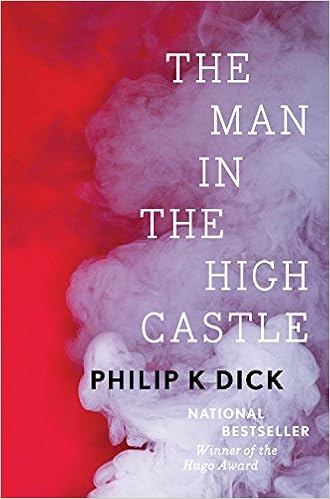
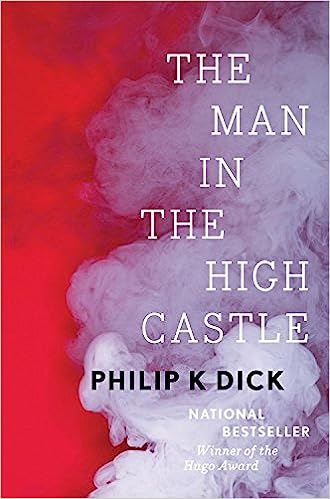
I just finished my second Dick novel, having begun several of them over the years but finding it difficult to stay connected. The Man in the High Castle has gained a new life with the amazon serial adaptation, and I decided to give his work another shot.

Similar to Margaret Atwood’s The Handmaid’s Tale being resurrected through serialization, Castle seems perfect for our time in Trumplandia. Many in the U.S. fear the rise of totalitarianism, but there also is an important new recognition of the fragility of truth and facts.

I must admit that once again I was underwhelmed with Castle as a novel; the central idea—an alternate history in which Germany and Japan win WWII—however, is incredibly compelling as a thought experiment.

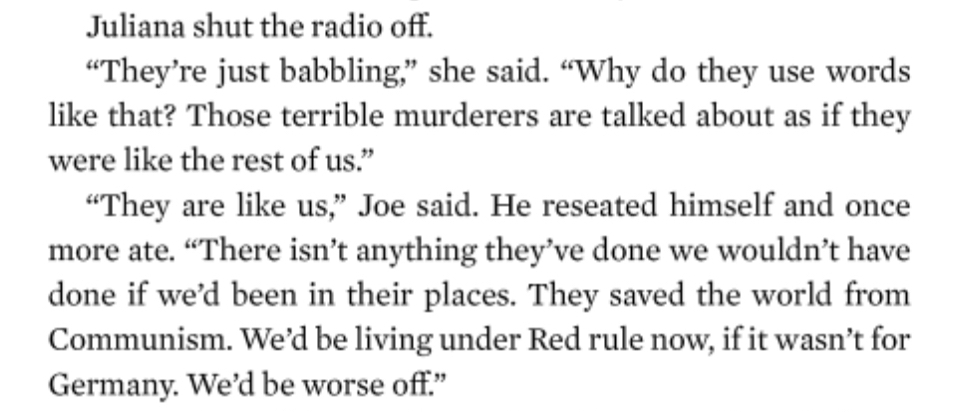
The characters, I feel, aren’t themselves very compelling, and the main woman, Juliana Frick, especially felt superficial, even trite at times. Yet, about a third of the way into the novel when Germany is suffering a crisis of leadership, an exchange between Juliana and her mysterious lover, Joe Cinnadella, essentially solidifies why this novel speaks so powerfully now:

high castle

It is here that I read Castle as a much more political and economic narrative version of Albert Camus’s The Stranger captured in Meursault’s musing in prison:

Afterwards my only thoughts were those of a prisoner….At the time, I often thought that if I had had to live in the trunk of a dead tree, with nothing to do but look up at the sky flowering overhead, little by little I would have gotten used to it. I would have waited for birds to fly by or clouds to mingle, just as here I waited to see my lawyer’s ties, and just as, in another world, I used to wait patiently until Saturday to hold Marie’s body in my arms. Now, as I think back on it, I wasn’t in a hollow tree trunk. There were others worse off than me. Anyway, it was one of Maman’s ideas, and she often repeated it, that after a while you could get used to anything. (p. 77)

Dick forces the reader to see that any of us can easily see our side as always in the right and the other side as always in the wrong; this Nazi/communist duality framed in the novel ultimately is revealed as a false dichotomy in the sense that no option had any real moral superiority.

When is war, or even politics, not a gruesome real-world version of the ends justify the means?

And that thematic element prompted also in my mind Kurt Vonnegut.

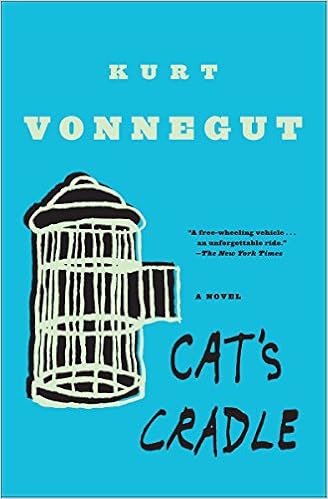
“‘When Bokonon and McCabe took over this miserable country years ago,’ said Julian Castle, ‘they threw out the priests. And then Bokonon, cynically and playfully, invented a new religion’” (p. 172)—opens Chapter 78 of Vonnegut’s Cat’s Cradle.

Bokonon has created a religion “‘to provide the people with better and better lies’” (p. 172), foma, and a central aspect of that strategy involves the orchestrated war between the government of San Lorenzo and the religion, Bokononism:

“But people didn’t have to pay as much attention to the awful truth. As the living legend of the cruel tyrant in the city and the gentle holy man in the jungle grew, so, too, did the happiness of the people grow. They were all employed full time as actors in a play they understood, that any human being anywhere could understand and applaud.” (pp. 174-175)

The false choice between McCabe and Bokonon in this other world created by Vonnegut happens to represent well the delusion of choice that exists in the U.S. McCabe/Bokonon reflect the false choice currently in the U.S. between Republican/Democrat; it’s a fake fight, and a false choice.

However, I must qualify that it has been a fake fight and false choice until the era of Trumplandia.

The policy and ideological differences among Bill Clinton, Hillary Clinton, George W. Bush, and Barack Obama are quite small—even as some of those policies have profound consequences for individuals in the U.S. and abroad.

The partisan political arena, like McCabe and Bokonon, have been compelled for political reasons to make those small differences seem dramatic, often resorting to the sort of hyperbolic language that stretches credulity.

Obama, for example, is no socialist, no communist. Obama is a centerist, a bit moderate and even liberal in his rhetoric, but he is not so far away from George W. Bush that they couldn’t reach out and dap.

This false chasm between Democrats and Republicans has perpetuated a standard cultural and political ideology for decades, a state of perpetual war and an economic system that feeds the wealthy on the backs of workers and the demonized poor.

The norm of hyperbolic partisan rhetoric now has dire consequences as some seek to confront a new norm in Trumplandia, a more insidious assault on truth with even more far reaching negative consequences for much of the U.S. and even many beyond our borders.

Evoking words such as “Nazi” and “fascism” are no longer vapid hyperbole, but those markers fail to resonate among many who have been numbed by partisan hyperbole and hate-mongering along party lines.

George W. Bush was mostly mainstream U.S. politics and ideology, despite the histrionics from the Left. Obama was mostly mainstream U.S. politics and ideology, despite the histrionics from the Right.

There is almost nothing mainstream or normal under Trump, although we are hesitant to admit that this new extreme has most of its roots in mainstream Republican politics that has depended on racism and misogyny for decades.

As a former high school English teacher, I am now deeply concerned that it will not be fake news that sinks this ship, but our inability to distinguish between hyperbole and honest but blunt language.


* I can draw a parallel with a difference here. I love Milan Kundera as a powerful philosophical author, but I find Kundera a much more compelling storyteller.

Free Speech, Free Market, and the Lingering “Rigid Refusal”

In the documentary Corridor of Shame, which explores the historical inequities of school funding in South Carolina along lines of race and social class, Senator (R, SC) Lindsey Graham claims while speaking at MLK Day in 2005: “We have a disparity of funding in a region of our state…. The reason we have disparity in funding is not cause we are prejudiced at the governmental level. It’s because we collect taxes based on property value. And our property value in those counties are pretty low because there’s no industry.”

Graham’s denial of systemic racism represents what Ta-Nehisi Coates called “elegant racism” while confronting the “oafish racism” of Cliven Bundy and former L.A. Clippers owner Donald Sterling:

The problem with Cliven Bundy isn’t that he is a racist but that he is an oafish racist. He invokes the crudest stereotypes, like cotton picking. This makes white people feel bad. The elegant racist knows how to injure non-white people while never summoning the specter of white guilt. Elegant racism requires plausible deniability, as when Reagan just happened to stumble into the Neshoba County fair and mention state’s rights. Oafish racism leaves no escape hatch, as when Trent Lott praised Strom Thurmond’s singularly segregationist candidacy.

Elegant racism is invisible, supple, and enduring. It disguises itself in the national vocabulary, avoids epithets and didacticism. Grace is the singular marker of elegant racism. One should never underestimate the touch needed to, say, injure the voting rights of black people without ever saying their names. Elegant racism lives at the border of white shame. Elegant racism was the poll tax. Elegant racism is voter-ID laws.

Graham acknowledges inequity, but uses “prejudiced” instead of “racist,” and casually rejects systemic racism.

As Coates explains, whites in the U.S. are more apt to acknowledge oafish racism while almost always employing elegant racism, such as denying systemic racism; therefore, Graham’s obfuscation is a powerful and effective political ploy, especially in the South.

In the matter of a few days recently, this distinction has played out in a public way with the NFL instituting a new policy about players protesting during the National Anthem and Roseanne Barr having her ABC sit-com canceled after a racist outburst on social media.

The NFL Anthem policy and Barr’s show cancelation have two important elements in common: what they represent in terms of how the U.S. confronts and understands racism, and how many in the U.S. have a deeply flawed understanding of free speech.

First, when former NFL quarterback Colin Kaepernick initiated protests during the National Anthem, the public and political response has tended to misrepresent the actions. Kaepernick and other players were protesting systemic racism, inequitable policing of blacks often resulting in death, during the Anthem.

Notably, Barr’s oafish racism, comparing a person of color to an ape, has resulted in a similar outcome for Barr and Kaepernick—the loss of work—although the former is a racist and the latter is protesting racism.

While Kapernick and other protesting NFL players have been condemned for being political (disregarding they are taking credible stands against a reprehensible social reality), Barr has a history of being bigoted.

Writer Roxane Gay has examined that history and then the recent cancelation, in fact.

Also significant about these two situations is that the new NFL policy does in fact limit when and how NFL players can express themselves, but Barr was perfectly free to share her comments, with an incredibly wide audience.

That comparison leads to the now common aspect of the public discussion of Barr’s cancelation, claims that they are about free speech: Since the NFL and ABC are not the government, neither of these situations is an issue of free speech.

As Katherine Timpf explains:

First of all, this is in no way a free-speech or First Amendment issue. The First Amendment protects us from facing consequences from the government over our speech, not consequences from our peers or our employers. Yes, what Barr said, although abhorrent, absolutely was constitutionally protected speech, and, of course, it should be. After all, giving the government the power to decide what is and is not “acceptable” speech would be giving the government the power to silence whatever kind of speech it felt like silencing, which would be very dangerous indeed. Anyway, the point is, a free-speech-rights violation would be someone trying to, say, arrest Barr for her comments, not firing her for them. Her rights were in no way violated in this case. ABC simply exercised its own rights as a private company to decide whom it does and does not want to associate with, and it’s my view that no one should blame its executives for making the decision that they made.

Therefore, the NFL policy on the National Anthem and the cancelation of Barr’s sit-com are not about free speech but the free market. Both the NFL and ABC are hedging that their actions preserve their audiences, their bottom line.

And what those concerns about their audiences reinforce is that the public has a much lower tolerance for oafish racism (Barr) than for confronting elegant racism (NFL protests). The NFL believes its audience either denies or cannot see systemic racism, and thus does not support the so-called politics of NFL players who protest while ABC feels that continuing to give an oafish racist a major platform will erode their audience.

Here is where we must confront the problem with trusting the free market since doing the right thing is linked to the moral imperative of the majority, the consumers. Currently in the U.S., that majority remains insensitive to systemic inequity and injustice; therefore, elegant racism survives—even bolstered ironically when oafish racism is shamed and seemingly blunted.

When each oafish racist is given their due, those denying systemic racism have their worldview confirmed since they see individual punishment as justice.

These actions by the NFL and ABC reflect that in the U.S. whites are still in the early adolescent stage of racial consciousness. Being able to confront oafish racism isn’t even fully developed yet.

Many in the media called Barr’s slurs “racially insensitive,” showing the same sort of refusal to call a lie, a lie that now characterizes mainstream media. But a few in that media are calling Barr’s words “racist,” and ABC folded under the weight of that fact—although we should be asking why Barr had this second chance considering her history of bigotry.

As a people, white America is not adult enough, however, to move past finger-wagging at oafish racists and to acknowledge systemic racism because, as Coates recognizes, “to see racism in all its elegance is to implicate not just its active practitioners, but to implicate ourselves.”

James Baldwin’s “Lockridge: ‘The American Myth'” remains a chilling warning then: “This rigid refusal to look at ourselves may well destroy us; particularly now since if we cannot understand ourselves we will not be able to understand anything.”

That anything, as the NFL and ABC have exposed, is racism—the cancer destroying our democracy and our free market.

As consumers, we have a moral obligation to tell the NFL it is wrong; we will not stand for systemic racism. And we must tell ABC that canceling Barr’s sit-com is a start, but it isn’t enough.

As citizens, we have to look at ourselves in the mirror of the voting booth—something we have failed to do yet in the good ol’ U.S. of A.

Recommended

Who Me?

Make America Great, Finally?: The Archeology of White People (Redux)

America has never been great. Including now.

The problem with such a claim is that a blanket statement  leaves too much room to discredit the argument, and of course, we must all agree on the definition of “great.”

Large-scale evidence that America has never been great is obvious: slavery, lynching, the Japanese internment, the Trail of Tears, the Tulsa massacre, and the bloody litany of mass and school shootings that characterize America in a way distinct from all other democracies.

At any moment in the history of the US, what can be called “great” for any group of people, when unpacked, can be exposed as the consequence of some other people’s suffering. It has always benefitted the winners in the US to keep everyone’s eyes on the winning so that we can conveniently ignore the necessary losing.

That is part of the message in Ursula K. Le Guin’s “The Ones Who Walk Away from Omelas.”

That is what I confronted in the last stanza of my poem “the archeology of white people“:

Ignore the body in the road
we whisper in their tiny innocent ears
Isn’t that golden car spectacular?

In F. Scott Fitzgerald’s The Great Gatsby, America is great for Tom and Daisy, but if we refuse to look the other way, that comes at the expense of Myrtle, ripped apart and dead in the road; of George, dead at his own hand; and of Gatsby, perversely shot in his opulent pool.

This is America: “the wreck and not the story of the wreck/the thing itself and not the myth” (“Diving into the Wreck,” Adrienne Rich).

Or as Langston Hughes’s speaker challenges: “(America never was America to me.)”—the too often ignored voice of those who live the fact of America not being great.

To rally around “Make America Great Again” is a perversion of hope; it is delusion.

Delusion is not the result of a lack of knowledge, but a refusal to listen, to see because you are driven deaf and blind by a fear of acknowledging the truths that refute your beliefs.

The delusion of clinging to guns, instruments of death, as a symbol for life, liberty, and the pursuit of happiness.

On social media, I witness this daily—those for whom proof and evidence mean nothing, those who shout the loudest, know the least, and listen not at all.

While there is no credible greatness to recapture in America, I do not deny yet the possibility of greatness. In fact, I can rally myself around “Make America Great, Finally.”

Greatness is certainly a worthy aspiration, although that too requires that we agree on exactly what “great” is.

Let me pose two examples we may want to follow.

Teachers in West Virginia, a right-to-work (non-union) state, have demonstrated a quest for greatness by recognizing and then acting on the power of striking. If citizens would more commonly recognize and then act on the power of mobilized groups with common interests, unresponsive government and political leadership could be eradicated in the name of the greatness we claim to seek.

Students across the US, prompted by Parkland, Florida students, have also demonstrated the potential for the powerless to organize and assert power with the nation-wide walk outs demanding action on gun control. Even before the walk out, student activism had prompted large corporations to change gun sale policies without any policy changes from political leaders.

WV teachers without the legal right to strike along with children and teens with almost no direct political power have demonstrated that power exists where it appears absent and that greatness springs from community and not individual zeal, not necessarily reduced to a zero-sum gain.

The choice in the US does not have to be between Daisy and Myrtle, in fact.

That American dream is only a dream for some because it is a nightmare for many.

There is nothing great about wealth or the wealthy; there is nothing great about coaxing most Americans to develop the grit to overcome adversity.

Great is the absence of poverty, not the presence of wealth.

Great is the absence of adversity, not the presence of grit.

Teachers in WV and students all across the nation have played great first hands.

Your turn.

There Is No Debate

Recently on social media, Ta-Nehisi Coates has been the focus of debate: a collection of mostly black scholars have debated Coates as a credible black public intellectual 9including why he has an eager white audience), and Coates has been challenged to debate the Civil War.

Here, I don’t want to address the content of either situation above, but focus on the response offered by Coates to debating the Civil War:

Two situations come to mind here. First, in the documentary Flock of Dodos, filmmaker and scientist Randy Olson unmasks how Intelligent Design proponents (a warmed-over version of Creationist recants to evolution) have developed a strategy based on maintaining evolution as a topic of debate, and not a foundational scientific theory.

In other words, by placing evolutionary science within an idealized concept of debate—that all issues have multiple credible sides that must be aired equally—the essence of science itself is corrupted.

This normalizing of “both sides” debate characterized, as a second example, my own experience with mainstream media covering corporal punishment during the Adrienne Peterson controversy.

But, as Coates expressed above, sometimes, there is no debate.

There is simple math for demystifying debate and compromise: To debate or compromise between an informed person and an uninformed person necessarily results in misinformation.

To form panels with equal sides for and against adults striking children, for example, mis-informs an audience conditioned to see the world as composed of people having mere opinions. (Concurrently, we tend to be too careless about distinguishing between “opinion” versus an informed stance.)

Especially in Trumplandia, the call for “both sides” to listen to each other is a larger example of the “teach the debate” approach used to derail the teaching of science to students.

When I entered the larger discussion about Peterson spanking his child, I was routinely invited to debate corporal punishment—a context that I have resisted in other issues related to education reform that would have required me to debate people without credibility who simply make opposing claims (such as advocating for school choice).

In 2017, we are faced with an incredible paradox—democracy (and freedom) are tenuous because political leadership now drives an “all voices matter” agenda that appears to be democratic but is in fact a corrupting of what it means to be an informed and compassionate public.

Democracy is mis-served, in fact, if—as we are witnessing—the act of debating itself trumps the content and credibility of the debate. Hints at this problem occurred when Trump was declared the winner of debates with Clinton, even though those declarations of winning were followed with clear analysis that many of Trumps claims were false, lies.

Democracy is also mis-served when we fail to acknowledge that some issues are beyond debate. As I have noted often, while mainstream media and the public seem comfortable debating corporal punishment (despite an abundance of research fully rejecting it), when domestic violence raised its ugly head around another NFL star, Ray Rice, no one formed panels to debate the pros and cons of men physically abusing women.

We don’t debate rape, and when extreme beliefs exist, such as Holocaust deniers, we tend not to give them any platform, except to discredit them.

There is a certain tyranny of the mobilized uninformed that makes simplistic views of democracy dangerous for a free people.

Consider (with caveats about his idealistic libertarian arguments) Henry David Thoreau:

After all, the practical reason why, when the power is once in the hands of the people, a majority are permitted, and for a long period continue, to rule is not because they are most likely to be in the right, nor because this seems fairest to the minority, but because they are physically the strongest. But a government in which the majority rule in all cases cannot be based on justice, even as far as men understand it.

Thoreau was navigating the contradiction between the law and “right” in the context of slavery being legal (determined by the majority) yet immoral. Even in Thoreau’s time, there was no debate about slavery—although debate was allowed.

Slavery, like corporal punishment today, was propped up by the false and manipulated authority of religious doctrine.

Slavery, like arguments against evolution, was propped up by a non-scientific set of beliefs about human beings and race.

If we dig into Thoreau’s plea, and confront his elitist as well as idealistic perspective, we can unpack a qualified understanding of democracy that requires informed voices for them to matter.

Thoreau’s idealizing of the individual is a projection of his own privileges, including his elite education. And thus his opening assertion (sexist language maintained): “‘That government is best which governs not at all’; and when men are prepared for it, that will be the kind of government which they will have.”

So if we return to Coates at the center of debate, we have a powerful and complex example of what faces a free people: informed scholars debating Coates as a credible public intellectual and Coates himself standing firm against a reductive and idealistic view of “all voices matter.”

A free people and their democracy must find ways to embrace not an idealized view of debate but the political will to admit when there is no debate.

Exceptional?: “the right to criticize [America] perpetually”

The U.S. is exceptional.

Exceptionally hypocritical.

Exceptionally delusional.

In a country where patriots are apt to wave fervently the nation’s flag, we are witnessing (mostly passively) in 2017 a professional athlete who took a knee in nonviolent and silent protest become a professional and public pariah.

Yet we in the U.S. routinely express pride for having been birthed out of protest, the Boston Tea Party, and revolution.

It is 2017, and the home of that seminal protest, Boston, remains the most racist fan base in the U.S. and city for a professional football team with owner, coach, and quarterback all supporting Donald Trump—but without any negative consequences for their overt politics.

Free speech in the U.S. is increasingly circumscribed by nationalism as a proxy for race—”Make America Great Again” as code for preserving whiteness.

Adrienne Akins grounds her examination of national and racial identity in the following:

In Notes of a Native Son (1955), James Baldwin poignantly captured the nature of his intense feelings for his nation of birth in stating: “I love America more than any other country in this world, and, exactly for this reason, I insist on the right to criticize her perpetually” (9).

Baldwin, like Muhammad Ali, represents the living ghost haunting Kaepernick’s nightmare—a contemporary resurrection of praise that was contradicted while Baldwin (and Ali) was most prominent and confrontational.

Richard Nixon was elected, many seem to ignore, in the wake of 1960s social unrest, anchored in the Civil Rights movement as well as the counter culture often stereotyped as Hippies.

Nixon’s law-and-order race/class baiting spoke to those most afraid of losing their privileges to the “others”—white America.

Trumplandia is the logical extension of that history—where American exceptionalism, our hypocrisy and delusion, has moved beyond empty political rhetoric (“by gorry/
by jingo by gee by gosh by gum”) to crass nationalism fueled by rhetoric-as-truth (regardless of the evidence otherwise).

The tribalism of crass nationalism denies, as Judith Butler explains, “We are worldless without one another”:

What worries me is that many of us form our sense of obligation toward another on the basis of feelings of identification. If someone else is like us, and that likeness is readily recognizable, then we are more inclined to respond in the way that we would have others respond to us. The harder task is to maintain an obligation to those by whom we feel ourselves to have been injured, to those we fear, or to those whose difference from us seems to be quite severe. This is why I do not think that global obligations can rest on identification, even expanded or expanding identifications; they have to claim us quite regardless of whether or not we feel love or sympathy, for the simple reason that the world is given to us in common and that without each other the world is not given. If the self is the basis of sympathy, our sympathy will be restricted to those who are like us. The real challenge occurs when that extrapolation of the self is thwarted by alterity.

Butler’s insistence for cohabitation feels akin to Baldwin’s refrain about love, a powerful element of his work too often glossed over. Butler argues: “I suppose it is first important to honor the obligation to affirm the life of another even if I am overwhelmed with hostility. This is the basic precept of an ethics of nonviolence, in my view.”

And this bring us full circle to Kaepernick, nonviolent and protesting for equity, ostracized as Baldwin and Ali were in their lifetimes—reduced to “unAmerican” in order to cast him among the Others and to render invalid his refusal to separate his personal and professional ethics (or better yet, his recognition that no one can separate them).

Maybe my opening claims are ill-founded, however. Not that the U.S. is hypocritical and delusional, but that these qualities are somehow exceptional.

Maybe beneath the glitz of consumerism, Americans are merely victims of the worse aspects of being human.

Democracy hasn’t failed, but quite possibly humans are incapable of reaching the high ideals of democracy, equity, and justice.

We have created words for ideas that are just too far beyond our reach as living creatures.

When does one move from “This isn’t working” to “This cannot work”?

Freedom, Choice, and the Death of Us

“they did not stop to think they died instead”

“‘next to of course god america i,'” e.e. cummings

Over the course of a couple hours after my mother was discovered comatose, the ER doctor offered us a choice: airlift my mother to a larger hospital for surgery to remove the clot in her brain that caused her stroke or leave her comatose, each moment destroying more of her brain.

Just twelve days later, in front of my mother then in a rehabilitation facility after responding well to the high-risk surgery,  my father became unresponsive; the EMS team summoned by a 911 call were frantically trying to resuscitate my father, kept alive by his pacemaker/defibrillator. Since my father had resisted switching off the defibrillator and choosing a do-not-resuscitate (DNR) order, the lead EMS responder asked me where I wanted him to be transported.

Because of the proceeding days when we all scrambled against my parents’ health insurance, my first thought was how was I to know where his insurance would cover this event (ultimately the last moments of his life).

While cycling on the local rail trail near my university and where my mother now remains in a single room—the building in which she witnessed my father’s death—a friend and I pedaled up to a road crossing where a father sat on his bicycle with a trailer attached for children to ride along.

This intersection has decorative circles of brickwork on each side of the road. As this man crossed, he steered poorly around the brickwork—the cart left wheel rolling up onto the brick, tipping the cart and his two sons over onto the side of the trail and jerking the bicycle out from under the father.

These are all complicated and difficult stories about choice and freedom in the U.S.

The U.S. is a cruel and calloused culture that values a false narrative about freedom and choice, an idealized version of freedom and choice as concepts that trump all else.

Even human dignity.

Even life.

Especially in healthcare, education, and providing social support for the poor, the guiding principle is giving people choice, believing that individual responsibility is the root cause of poor health, failing students and schools, and finding oneself in poverty.

The meritocracy and rugged individualism myths are so powerful in the U.S. that winners and losers both cling to them even when the game is revealed to be fatally rigged. As Tim Maly explains:

So there are people who can be so wrapped up in a certain worldview that even in the face of serious evidence that they have been taken in, and despite many warnings from the rest of the world, they persist. Indeed, warnings from the rest of the world seem to serve only to entrench them in their position. With some of them, it’s as if they end up making bad choices specifically to spite the people warning them.

The U.S. has instilled a tremendous amount of self-loathing, in fact, among marginalized groups (blacks, English language learners, women) who feel compelled to embrace the bitter American Dream in order to be American—even as each of them could utter as Langston Hughes wrote:

Let America be America again.
Let it be the dream it used to be.
Let it be the pioneer on the plain
Seeking a home where he himself is free.

(America never was America to me.)

The parent cycling with his children in tow was free to choose placing those boys in the trailer, free to choose to pedal along the trail and then to send them tumbling.

And there we must admit, parental choice is not universally a good thing, and we must also confront that anyone’s choice necessarily encroaches on the freedom of others: children routinely suffer the consequences of their parents’ choices.

The children were fine, however, but my mother and father—along with our family—have been navigating a hellscape of healthcare dictated by patient choice and freedom, jumbled with a nightmare of bureaucracy in which mandated and bounded choices are not really choices at all.

In the U.S., we celebrate the choice between a Toyota Camry and Honda Accord (essentially the same car with the free market promise of competitive prices in your local market!), but few people are afforded the freedom of not buying a car at all—and no one is allowed the freedom from sales and property taxes or freedom from insurance and liability for all that driving.

Freedom and choice are in fact a nasty shell game used to keep the masses occupied so that they do not realize only the few have some sort of economic freedom and choice because of the labor of those masses, those people drawn to the myths like moths to a flame but never allowed to survive the allure.

It’s July 4th, a patriotic orgy in the U.S. that is as shallow and materialistic as the country we celebrate.

A people truly committed to equity and our moral obligations as humans would recognize that sometimes, maybe even often, choice and freedom are not as important as insuring that no one needs to choose because essentials are collectively provided for everyone to insure the dignity of simply being a human.

No child left to the lottery draw of their parents, no sick person tossed into the meat grinder of market-based healthcare, no elderly cast into the dark well of individual responsibility.

As we wave tiny plastic flags today, swill (mostly) cheap beer while overeating from our decadent grills, let us roast in the sun and the recognition that we actually have freedom and choice—and this heartless and selfish country is what we have chosen.

For Further Reading

Why poverty is not a personal choice, but a reflection of society, Shervin Assari

‘What to the Slave Is the Fourth of July?’ by Frederick Douglass

The Hollow Nation

Shape without form, shade without colour,
Paralysed force, gesture without motion…

“The Hollow Men,” T.S. Eliot

My name is Kathy H. I’m thirty-one years old, and I’ve been a carer now for eleven years….Carers aren’t machines.

Never Let Me Go, Kazuo Ishiguro

We are the hollow nation. We are the stuffed nation, “Leaning together/Headpiece filled with straw.”

It has been almost seven months since a motorist struck a pack of cyclists I was riding with on Christmas Eve 2016, injuring four of us—two seriously and permanently.

The motorist was deemed at fault on the scene, but received only a $76 ticket, less than the monthly payments I am making on my remaining medical bills since the insurance claim for the accident has yet to be settled.

My own insurance has paid much of the cost, but I am required to repay those payments once I have a settlement. The orthopedist, as well, overcharged me during my fracture treatment, refunding that amount more than six months later.

Nine or ten insurance companies and multiple lawyers have been wrestling with this accident, and the other injured cyclists and I have received a barrage of bills and notices from the ER, the hospital, the ambulance service, and numerous doctors. One cyclist was airlifted from the scene, and since the motorist had minimum coverage, his portion of that insurance likely was erased immediately in that urgent care.

This recent Monday morning, my mother was found unconscious by my youngest nephew, her grandson. She had a stroke, requiring an ambulance to transport her to our local hospital that then had her airlifted to a larger hospital nearby for emergency surgery on the clot discovered in her brain.

She has been in neurological ICU, and now a regular hospital room since Monday—but soon she will be transferred again to a rehabilitation facility for 2-3 weeks.

My father has been quite unwell recently; therefore, we are guiding him around in a wheelchair, circling our own wagons because my mother’s stroke creates a new and terrifying reality: she was his caretaker, and the family now must seek ways to provide both of my parents care.

Working-class children of the 1940s and 1950s, my parents have only Social Security and Medicare to sustain them.

Our next steps are swamped by if and how well their insurance and social services cover the medical care and rehabilitation my mother needs, if and how well my father can receive the daily care she has been providing.

My accident and my mother’s stroke are not nearly as extreme as the terrors of the healthcare system in the U.S. that countless people suffer daily. But these “terrors” are not really about the healthcare.

The treatment my mother has received, the seemingly miraculous surgery, has been the sort of kind and skilled medicine that leaves you mesmerized by the power of humans to make this world work in ways that are good and right and life-affirming.

But that care, I am afraid, is an isolated outlier in a calloused and awful system of administration, bureaucracy, and dehumanization caused by our lack of political courage as a people, as a country.

The power of universal healthcare and a single-payer system to provide humanity and dignity to the amazing medicine and brilliant healthcare providers already in the U.S. is left in the wake of our hollow nation.

A nation that is the wealthiest and most powerful in human history.

A nation that allows more than 1 in 5 children to live in poverty.

A nation of heartless and vicious partisan politics poised to dump an already inadequate system into the laps of caretakers, family members.

My accident exposes the hollowness of calls for individual responsibility; the system is designed to allow serial carelessness that leaves innocent victims responsible.

My mother’s stroke exposes that we as a nation genuinely do not care about a generation of people who may have bought the American Dream myth most sincerely—people such as my parents who were buoyed by white privilege they denied, who preached and practiced  the rigged rugged individualism scarred by racism with the faith it would pay off as they decline into their new reality of being dependent on the kindness of not only family, but the kindness of strangers.

Wealth and security are hoarded by a few, a vicious tribalism of a country that denies community, the power and dignity of everyone caring about everyone—not just the tunnel vision quest of “me getting mine,” the mean-spirited Social Darwinism that lurks beneath our national platitudes about working hard and fair play.

A hollow nation that denies the humanity of all sorts of “others” because of race and religion, but also culls away many at the edges of white privileged—white poor, white working-poor, white working class.

My parents represent that even the wink-wink-nod-nod promise of the American Dream (the white nationalism of “Make America Great Again”) is a lie, a calloused lie within the larger lie to the tired, the poor, the huddled massed—and especially a bald-faced lie about the so-called melting pot, a metaphor more accurate if named a witch’s cauldron.

With these realities before me, it is tempting to call for the removal of the Statue of Liberty, but at least, we must strip it of the poem inscribed at the base and post instead:

We are the hollow nation. We are the stuffed nation, “Leaning together/Headpiece filled with straw.”

Accreditation: “‘relatively superficial, extremely time-consuming and doesn’t lead us to a goal of significant improvement'”

For well over three decades, I have been both a full-time educator (high school English teacher for 18 years and currently a college professor, going on 16 years) and a writer. As a high school teacher, I also taught journalism and was the faculty sponsor for the school newspaper and literary magazine over about 10-11 years.

Therefore, I have a great deal of experience in the fields of education and journalism, experience that has revealed to me a rather damning fact: One can be well trained in educational pedagogy or the craft and conventions of journalism, but without nuanced and deep knowledge of the content of that teaching and writing, the outcome can and often is quite awful.

In journalism, for example, the vaunted New York Times publishes and fails to recognize blindly awful articles about poverty. And Education Week regularly features the worst of edujournalism.

And let me emphasize here, these criticisms are about the very best of the field.

The rise of Trumplandia has also birthed a renewed concern about the media and journalism—much gnashing of teeth about fake news and post-truth—so this announcement from Northwestern University may seem ill-suited in the context of those concerns:

In a nontraditional move, officials at Northwestern University‘s prestigious journalism and communications school have decided not to renew the program’s accreditation, letting the designation lapse.

The dean of the Medill School of Journalism, Media, Integrated Marketing Communications said Monday that school officials chose not to pursue renewed accreditation, which provides outside approval of academic programs, because the process is “flawed” and not useful.

More pointedly, the dean explains:

“Our goal is always to be the best in the world, and this process doesn’t get us there,” Hamm said in an interview Monday afternoon. “We just don’t find that the review provides us with anything beyond what we already know today. It’s relatively superficial, extremely time-consuming and doesn’t lead us to a goal of significant improvement. It’s sort of a low bar.”

The current hyper-focus on media and journalism has been a parallel reality in the field of education over the last three decades-plus; therefore, there is much to unpack about the parallels in the two fields.

As a lifelong educator, I had to seek certification during my formal college education, I worked as a classroom teacher in public schools under standards and testing, and I now must conform to the mandates of teacher certification and program accreditation as a teacher educator.

In all of those contexts, I am a witness to that accreditation (like certification) is, in fact, “’relatively superficial, extremely time-consuming and doesn’t lead us to a goal of significant improvement. It’s sort of a low bar.’”

All types of bureaucratic accountability—such as the thirty years of standards and high stakes testing in public education reform—are ultimately reductive by shifting the focus toward meeting standards and requirements that are secondary and tertiary approximations of authentic goals (holistic goals that have been cannibalized into discrete elements for the sake of efficiency).

Why, we should be asking, do disciplines such as journalism and education feel the need to add the layer(s) of accreditation (and certification) onto their degrees—when other disciplines trust that the degrees themselves are enough?

Two reasons are practitioners in both disciplines suffer from the low self-esteem of the fields and the twin-tyrannies of the market place and bureaucrats.

Since I focused on journalism above, let me shift here to education.

No discipline or profession has suffered more under the weight of political and public marginalizing and de-professionalization than education—in part as a consequence of sexism (teaching long associated with being a woman’s job) and in part due to the burden of K-12 and many college teachers/professors being agents of the state, working in tax-funded public institutions.

Education currently labors under a nearly unmanageable matrix of mandates related to degrees, certification, and accreditation; and these requirements are in constant flux—standards and mandates for proving those standards have been met shifting every 3-5 years.

Over the accountability era, then, many teacher certification programs have dropped educational philosophy courses, foundations courses, and what many people would consider the more academically challenging knowledge base of education degrees (degrees, by the way, that have historically been slandered as “too easy”).

Education programs are in constant flux, changing courses and programs to meet state certification mandates and accreditation mandates—neither of which are being driven by scholars or practitioners but by bureaucrats.

The most perverse of ironies has occurred, then, in education because those who claimed education degrees are flimsy have successfully made them a maze of nothingness through certification and accreditation mandates.

Ultimately, we must face these realities:

  • Increasing an emphasis on the technical aspects of education and journalism distorts the importance of both and has created practitioners who may perform with proficiency while failing miserably at the larger responsibility to what is being taught and what is being expressed as well as who is being taught and who is being informed.
  • No generic teaching or journalism skills exist absent the content of what is being taught or written about, and therefore, reducing teaching or journalism to discrete skills necessarily dilutes holistic professions to simplistic bureaucracy.
  • There is no option for objectivity in education or journalism; both are political acts that require moral and ethical distinctions as well as seeking out the Truth/truth.
  • Accreditation (and certification) is more about power and political grandstanding than about the integrity of any discipline. In fact, accreditation is necessarily counter to the integrity of any discipline.

Reaching back to Franz Kafka and then recurring throughout pop culture (mainly satire such as Dilbert and Office Space), the folly of bureaucracy has been exposed time and again; yet, it remains entrenched in some of the foundational disciplines in our democracy—education and journalism.

Northwestern University has taken a bold but necessary step that should be a beacon for all of journalism and education; we are well past time to end accreditation (certification) as the process that strangles the vibrancy out of any discipline.