Category Archives: Disaster capitalism

“Science of” Movements as Trojan Horse Education Reform

[Header Photo by Tayla Kohler on Unsplash]

The charter school story in New Orleans is almost two-decades long, but most people will not dig past the most recent development: After a 7-year experiment, New Orleans is an all-charter district no more.

In the wake of Katrina in 2005, Louisiana Governor Bobby Jindal (R) leveraged the natural disaster to begin the eventual shift of schools in New Orleans from traditional public schools (TPS) significantly staffed by a Black professional class of teachers to a charter school Recovery School District (RSD) run by Paul Vallas and often staffed by young, white, and affluent Teach for America (TFA) recruits.

This moment was acknowledged by some as disaster capitalism that had far more to do with politics than improving student achievement. The endgame was to entrench school choice schemes and create a cheaper although fluctuating teacher workforce (TFA).

Yet, as many of us warned, an all-charter school system in New Orleans never outperformed the TPS it replaced.

In fact, all across the US, charter schooling, RSD, TFA, and almost every major education reform schemes have never delivered on the academic outcomes promised.

Here, it is important to acknowledge that most education reform in the US over the past 40 years has been grounded in conservative ideology (even though the political support has been bi-partisan) and most of that reform is Trojan Horse reform—using a false veneer of reform to accomplish ideological and political agendas.

School choice schemes are not about student achievement but about publicly funding private education and “white flight” as public schools have become majority-minority populations of students.

TFA and organizations such as National Council on Teacher Quality (NCTQ) are not designed to improve teacher quality or teacher preparation but about creating a cheap workforce and eradicating teacher professionalism to make way for teachers as mere monitors for scripted programs and computer-based instruction.

Although just two examples, the key point is running through Trojan Horse education reform is not just political and conservative ideology but also a commitment to market forces.

Education reform in the US primarily creates churn—new standards, new programs, new materials, new teacher training, etc.—that serves the needs of the market, not parents or their children. That churn is promoted by education reform influencers who only gain if schools, teachers, and students are perpetually viewed as failing—permanent crisis.

Lurking underneath education reforms during George W. Bush’s tenure as governor of Texas and president of the US was the lure of scripted curriculum that shifted authority away from the teacher and to the state and primarily commercial products.

Although Bush’s reform agendas flourished with bi-partisan support, scripted curriculum and de-professionalizing teachers (see also the value-added methods schemes and the “bad teacher” attacks under Michelle Rhee) mostly lost favor and lay dormant post-Obama (even as the Obama administration double-down on most of the conservative elements established by Bush’s administration).

That is, lay dormant until the “bad teacher” myth was resurrected by Emily Hanford and the “science of reading” (SOR) movement.

As Aukerman explains, the story being sold included several elements of failure and incompetence that pits classroom teachers against teacher educators (both of which are primarily women professionals):

Now that SOR has mostly uncritically swept across the US in the form of state-level reading legislation and policy, the evidence suggests that at the core of the so-called success of SOR policies (see Mississippi and Florida) is one of the most conservative and harmful policies possible—grade retention, as Westall and Cummings explain:

Similar to the results for states with comprehensive early literacy policies, states whose policies mandate third-grade retention see significant and persistent increases in high-stakes reading scores in all cohorts. The magnitude of these estimates is similar to that of the “any early literacy policy” estimates described in Section 4.1.1 above, suggesting that states with retention components essentially explain all the average effects of early literacy policies on high-stakes reading scores. By contrast, there is no consistent evidence that high-stakes reading scores increase in states without a retention component.


Grade retention disproportionately impacts poor students, Black students, Multi-lingual learners, and other marginalized population of students. Retention is popular because it represents a type of accountability and punishment for “other people’s children” who need to be “fixed” by those in power.

Concurrent with the SOR movement, a new flurry of “science of” movements have propagated: “science of learning,” “science of writing,” “science of math.”

The mostly uncritical support for SOR by the media, the education market, parents, and politicians have provided fertile ground for a larger “science of” movement to drive our newest round of the same education reform structures we have been implementing without improving student achievement for forty-plus years.

Let’s emphasize here, Trojan Horse education reform doesn’t work to improve teaching and learning, but it does work for media, market, and political interests.

And now, the mask is coming off with the announcement of the Evidence Advocacy Center:

In the EAC’s plan for the transformation of the profession into an evidence-based system, educators will relinquish certain freedoms — notably the leeway to employ ineffective practices — but will gain guidance that empowers them to fulfill their original purpose by profoundly impacting the future of students, families and communities. The alternative is to continue rearranging the deck chairs under the guise of education reform.


“Relinquish certain freedoms” is eerily similar to the explanation handmaid’s received in The Handmaid’s Tale:

There is more than one kind of freedom, said Aunt Lydia. Freedom to and freedom from. in the days of anarchy, it was freedom to. Now you are being given freedom from. Don’t underrate it….

We were a society dying, said Aunt Lydia, of too much choice. (pp. 24, 25)


Under the Brave New World of “science of” education mandates, teachers will have freedom from professional autonomy and freedom to implement scripted programs!

And who benefits?:

Many of these groups are fundamentally conservative, but even a modicum of interrogating the Who and Why behind this agenda reveals some chilling concerns.

NCTQ was founded by the Thomas B. Fordham Institute, a conservative think tank dedicated to school choice/charter schools and market forces. Note that there is a distinct contradiction between advocating for “science” in education practices and citing NCTQ, which has never produced any scientifically valid “reports.”

The leadership of EAC includes several connections to the University of Oregon, home of DIBELS®, a phonics-centric program that was revitalized by the SOR movement.

Other leaders include Louisa Moats, creator of LETRS, which is being mandated across the US to retrain teachers in SOR even though, again, the program is not supported by science.

The Reading League has its own market connections, endorsing practices not supported by the science (decodable texts, notably).

The 95 Percent Group is also based on an aspirational claim not grounded in settled science, as one analysis concludes about the 95% claim: “This all said, it does seem there is some level of support for 96% being a benchmark goal [emphasis added], for reading proficiency rates.”

And two key comments lurking in the background of these “science of” movements must not be ignored.

First, directly from the International Dyslexia Association:

The term “Structured Literacy” is not designed to replace Orton Gillingham, Multi-Sensory, or other terms in common use. It is an umbrella term designed to describe all of the programs that teach reading in essentially the same way. In our marketing, this term will help us simplify our message and connect our successes. “Structured Literacy” will help us sell what we do so well.


And then from the Education Writers Association:

Connect the dots and connect the rhetoric: “Relinquish certain freedoms,” “sell what we do so well,” “watchdogs.”

The “science of” movements are yet another cycle of Trojan Horse education reform. We have already opened the gates and waved this in with blinders on, so now we must do our best to reclaim teaching and learning that serves the needs of our students and not the media, the market, and political/ideological agendas at the expense of those students.

Recommended

What You See Is Not What You Get: Science of Reading Reforms As a Guise for Standardization, Centralization, and Privatization | American Journal of Education, Elena Aydarova

Politics of phonics: How Power, profit and politics guide reading Policies

When Media Misinformation Becomes Conservative Education Legislation Over-Reach: Reading Proficiency Edition

What happens when years of media misinformation become a powerful talking point for extreme conservative advocacy groups and extreme conservative elected officials?

Consider this:

From the misleading and inaccurate work of Emily Hanford in 2018 to the more recent nonsense written by Nicholas Kristof in 2023, the lie that won’t die (2/3 of children are not reading at grade level) has ultimately—see above—driven a wave of conservative education reform that blurs curriculum and book banning legislation with “back-to-basics” reform touting the “science of reading.”

The key problem with the reading proficiency lie is that student reading proficiency is possibly the exact opposite of the lie because NAEP achievement levels are incredibly (purposefully?) confusing:

NAEP student achievement levels are performance standards that describe what students should know and be able to do. Results are reported as percentages of students performing at or above three NAEP achievement levels (NAEP Basic, NAEP Proficient, and NAEP Advanced). Students performing at or above the NAEP Proficient level on NAEP assessments demonstrate solid academic performance and competency over challenging subject matter. It should be noted that the NAEP Proficient achievement level does not represent grade level proficiency as determined by other assessment standards (e.g., state or district assessments). See short descriptions of NAEP achievement levels for each assessment subject.Scale Scores and NAEP Achievement Levels


While still a complicated statistic and claim, the reality is that if we use NAEP data as evidence, about 2/3 of students in the US read at or above grade level.

A better pair of claims, however, is that we do not have a universal definition of reading proficiency and that “grade level” is a far less valuable metric than “age level” for assessing reading proficiency.

This reading proficiency lie that won’t die is helping feed one of the worst waves of conservative assaults on schools even considering the 40-plus years of conservative education reform also based on the Nation at Risk lie.

Here is a reader for both reading proficiency and conservative education reform:

Reading Proficiency

ILEC RESPONSE: MAINSTREAM MEDIA COVERAGE OF READING PROFICIENCY, TEACHERS OF READING, NAEP SCORES, AND TEACHER PREPARATION

WHAT DO WE REALLY KNOW ABOUT READING PROFICIENCY IN THE US?

UNDERSTANDING AND REFORMING THE READING PROFICIENCY TRAP

THE PROFICIENCY TRAP AND THE NEVER-ENDING CRISIS CYCLES IN EDUCATION: A READER

EVEN MORE PROBLEMS WITH GRADE-LEVEL PROFICIENCY

THE POLITICS OF READING PROFICIENCY (AND CHARTER SCHOOLS)

BEWARE GRADE-LEVEL READING AND THE CULT OF PROFICIENCY

Conservative Education Reform

EDUCATION REFORM HAS BEEN BIPARTISAN AND CONSERVATIVE FOR MORE THAN 40 YEARS: WHAT WOULD PROGRESSIVE EDUCATION REFORM LOOK LIKE?

THE INDOCTRINATION PARADOX: THE CHRISTIAN CONSERVATIVE CRUSADE FOR PUBLIC SCHOOLS

SOR MOVEMENT MAINTAINS CONSERVATIVE ASSAULT ON TEACHERS AND PUBLIC SCHOOLS [UPDATED]

TEACHING IN A TIME OF CONSERVATIVE TYRANNY

CONSERVATIVES ARE WRONG ABOUT PARENTAL RIGHTS

DEAR PARENTS, YOUR CHILDREN’S K-12 EDUCATION IS ALREADY VERY CONSERVATIVE

Neoliberal Education Reform: “Science of Reading” Edition

[Header Photo by Mike Erskine on Unsplash]

Cliches become cliches often because they do capture a truth, and “fish don’t know they are in water” may sound trite, but the saying captures well our five decades of education reform in the US.

Since A Nation at Risk under Ronald Reagan and then reinforced and expanded under George W. Bush (with Rod Paige and Margaret Spelling as Secretaries of Education), education reform in the US has been grounded in neoliberal ideology, the foundational beliefs of Republicans and conservatives.

“Neoliberalism” is a challenging term. First, it is hard to define, and second, the use of the word “liberal” has two contrasting meanings in the US—”liberal” as in “classic liberalism” is “conservative” or politically “right,” yet in common usage “liberal” is typically associate with “progressive” or politically “left.”

However, to simplify, in education reform, we can fairly interchange “neoliberal” with “conservative” and “Republican”—even though, as I want to discuss here, it is incredibly important to understand that neoliberal education reform is embraced and perpetuated by both Republicans and Democrats.

Look at the education reform landscape since the 1980s to understand.

A Nation at Risk established the neoliberal education reform playbook: manufacture an education crisis; declare that students, teachers, and public schools are failing; and mandate accountability policies to “fix” students, teachers, and schools (in-school reform only).

Insiders exposed that Reagan gave marching orders to the committee that created A Nation at Risk; Reagan wanted the US to embrace school choice (neoliberalism is a market ideology) and to “put prayer back in schools” (although voluntary prayer has always been allowed in public education, Reagan and Republicans depended on culture wars).

A key component of neoliberal education reform is the buy-in of the media. Until decades later, after numerous scholars discredited the report as a “manufactured crisis,” the media uncritically declared US education—teachers and students—failures.

And thus we set out on several cycles of the same accountability reform grounded in new standards, new tests, and new political mandates.

Governors scrambled to show they took education seriously, and George W. Bush in Texas turned his role as education reform governor into a launching pad for the White House.

Here is another key element.

Although Bush claimed a Texas “miracle,” again as with A Nation at Risk, after the political success and media as well as public buy-in, scholars showed that the “miracle” was a “mirage” (or better yet, a lie).

None the less, Bush took Paige into his administration and No Child Left Behind (NCLB) was modeled in the Texas “miracle”/”mirage”—and just as Democrats rushed to embraced Reagan’s lie, Democrats joyfully made NCLB one of the most prominent federal bi-partisan accomplishments in recent US history.

Few things show how pervasive neoliberal (Republican/conservative) education reform has become the water to the fish (education) than the Barack Obama/Arne Duncan education era.

Instead of ushering in a progressive or critical response to the Bush education policy, Obama/Duncan doubled down—fueling the draconian value-added method era of teacher evaluation, launching the deceptive and austere education career of Michelle Rhee, and supercharging the charter school movement (a “school-choice lite” movement that fulfills the market beliefs of neoliberalism).

At 40 years since A Nation at Risk, all we have to show for the constant reform in education is a series of claims of “crisis” and a smattering of “miracles”—both of which are always manufactured.

But if we reach back further, into the 1940s, we see that neoliberalism also depends on sparking culture wars. For example, the reading wars have always been about attacking progressive/liberal ideologies—Dewey in the early to mid-1900s, whole language in the 1990s, and now, balanced literacy.

So now we come to the “science of reading” (SOR).

SOR has its roots firmly in NCLB and the National Reading Panel (SOR cites the NRP report as much or more than any other evidence)—the peak of neoliberal education reform.

SOR was also fueled throughout the 2000s by the Florida model, which depends heavily on grade retention and laser-focusing on grade 3 reading.

Around 2013, states began to revisit or reimagine reading legislation, but in 2018, the media supercharged the SOR movement, echoing the “manufactured crisis” approach of A Nation at Risk.

Notably, the “manufactured crisis” of the SOR movement is firmly grounded in NAEP testing; first, the media misrepresents NAEP data, and second, NAEP is purposefully designed (the test is a neoliberal tool) to create the veneer of failure by students, teachers, and schools.

NAEP allows media and political leaders to shout that 2/3 of students are not proficient in reading even though that claim isn’t what most people think.

Therefore, at its core, the SOR movement is another neoliberal education reform movement, a tool of Republican/conservative ideology and politics.

SOR has the student/teacher/school failure rhetoric, the “miracle” that is a “mirage,” the eager and uncritical compliance of the media, and the compelling use of standardized tests data (NAEP). But most importantly to understand how SOR is neoliberal education reform, the policies are repackaging Jeb Bush’s Florida model, emphasizing punitive reading policies such as grade retention.

However just like all the other neoliberal education reform since the 1980s, it will not work because it isn’t designed to work.

We are only 20 years since NCLB/NRP which mandated scientifically based reading instruction, yet there is a reading crisis?

Here is the dirty little secret about neoliberal education reform: It is a distraction for political gain.

Neoliberalism keeps the public’s gaze on individuals (students, teachers) and away from systemic forces; SOR wants people to believe that a couple reading programs are to blame for reading failures instead of poverty and inequity.

And the neoliberal attacks in SOR on people are yet another swipe at progressive and critical educators.

Like fish, many educators cannot see they are willing participants in neoliberal education reform; almost all Democrats cannot see they are willing participants in neoliberal education reform.

Fish don’t know they are in water, but with the SOR movement (and whatever crisis comes next), the better analogy may be lobsters in a slowing boiling pot.

Disaster Reform and Shadow Reading Legislation: The Politics of Reading Crisis pt. 2 [UPDATED]

Republican/conservative education reform has been a subset of disaster capitalism for decades now, most prominently after Hurricane Katrina when Republicans used the natural disaster to dismantle public education and erase the existing teacher workforce in New Orleans.

In 2023, Republicans have continued to manufacture educational crises in order to reform education, where “reform” is a veneer for dismantling education.

The twin conservative attacks on schools include the anti-CRT/curriculum gag order movement and the “science of reading” (SOR) movement—both depending on false claims of educational failures by teachers and public schools.

What flies under the radar is that anti-CRT and reading legislation are being promoted by conservative organizations and ideologies in the form of “model legislation” and fact sheets that are devoid of facts.

In the context of the crisis/miracle narratives about education in the media, among the public, and by politicians, disaster reform has evolved into its own powerful and harmful machine.

Not surprising, a key example comes from Florida and Jeb Bush: ExcelinEd.

The disaster education reform organization is Orwellian in its claims but insidious in its carefully packaged information and templates for policy. The key point here is that the SOR movement as a media and parent advocacy event has now fully been folded into the existing Republican education reform machine that is more about dismantling education than supporting student learning or teacher quality.

In short, the materials about reading presented by ExcelinEd are false but very well designed and compelling to the general public and politician looking for ready-made legislation and effective talking points.

As the NCLB/NRP era showed us with Reading First, however, the entire Bush family is driven by market interests, not a pursuit of democratic education for all.

ExcelinEd offers online a series of PDF resources:

The short version of concern here is that nearly all of the information above is misinformation; however, as the SOR movement has shown, most people remain easily targeted by claims of a reading crisis and a set of simplistic blame and solutions.

As I have shown, there simply is no reading crisis in the US, but there is a very long history of political negligence in terms of providing marginalized students and their teachers with the learning and teaching environments as well as social conditions that would support earlier and more developed reading in our students.

Two aspects of the materials above deserve highlighting (again).

First, the Republican commitment to SOR is grounded in doubling-down on punitive policy, grade retention.

The two states identified over and over in the materials above are Florida and Mississippi; however, those states are examples of mirages, not miracles.

ExcelinEd only cites work by Winters [1] to “prove” the effectiveness of grade retention. This strategy is cherry picking “research” by a conservative “scholar” who (surprisingly) only finds positive results for the conservative reform of the day—school choice, charter schools, VAM evaluations of teachers, and now, grade retention.

The research on grade retention is complicated but politically attractive since grade retention (the likely sources of “success” in FL and MS) can raise reading scores in grades 3 or 4, but those “gains” disappear by middle school.

Grade retention distorts the population of students being tested by removing the lowest scoring students and reintroducing older students to grade-level testing. As I have noted before, students achievement can vary significantly by just a month of age difference:

A review of the Florida Model that depends on grade retention has concluded that research does not show whether any short term gains are from retention or additional services. Further, a comprehensive study still notes that grade retention is harmful, especially to marginalized populations of students:

The negative effect of retention was strongest for African American and Hispanic girls. Even though grade retention in the elementary grades does not harm students in terms of their academic achievement or educational motivation at the transition to high school, retention increases the odds that a student will drop out of school before obtaining a high school diploma.

Hughes, J. N., West, S. G., Kim, H., & Bauer, S. S. (2018). Effect of early grade retention on school completion: A prospective study. Journal of Educational Psychology, 110(7), 974–991. https://doi.org/10.1037/edu0000243

A second problematic aspect is the hyper-focus on three-cueing, which fits into the Rufo “caricature” approach to attacking CRT.

Republicans have latched onto the SOR misinformation campaign that perpetuates a cartoon version of three-cueing and fabricates a crisis around claiming that teachers are telling students to guess words instead of using phonics/decoding strategies.

Three-cueing, in fact, is a research-based approach better referred to as “multiple cueing”:

Compton-Lilly, C.F., Mitra, A., Guay, M., & Spence, L.K. (2020). A confluence of complexity: Intersections among reading theory, neuroscience, and observations of young readers. Reading Research Quarterly, 55(S1), S185-S195. https://doi.org/10.1002/rrq.348

ExcelinEd’s prepackaged misinformation campaign and templates for legislation are yet more proof that the SOR movement is another nail in the coffin of public education, an anti-teacher and anti-public school movement that depends on crisis rhetoric and fulfills the goals of disaster reform driven by Republicans and conservatives who serve the needs of the educational marketplace—not students, or teachers.


[1] UPDATE: Another Mississippi “miracle” article in the NYT highlights grade retention positively, again citing only a new study by Kirsten Slungaard Mumma and Marcus A. Winters.

First, this is a working paper supported by Mississippi Department of Education and the acknowledgements add: “This project was made possible by a grant from ExcelinEd.”

Here are some key additional caveats beyond how biased this report likely is in terms of meeting the ideological aims of ExcelinEd:

  • The policy brief concedes: “That said, though the results are distinctly positive for the policy treatment overall, the analysis cannot entirely disentangle the extent to which the observed benefits in ELA are due to the additional year of instruction or to other specific features of the approach Mississippi took to providing literacy-focused supports and interventions to students.”
  • In the full working paper, section “2.1 Within-Age vs Within-Grade Comparisons” details a common failure of analyzing grade retention: “Comparing the later outcomes of students retained at a point in time to students in their cohort who were promoted is complicated by the fact that the two groups are enrolled in different grade levels during later years.” The findings of this working paper must be tempered by this fact of the study: “Unfortunately, within-age comparisons of student test scores are not possible in Mississippi because scores on the state’s standardized tests are comparable within grades over time but not across grades.” In other words, as noted above, higher test scores may be the result of students simply being older in a tested grade level, and not because grade retention or any of the services/instructional practices were effective. Again, these “gains” are likely mirages.

Finally, we must wondering why Kristof chose to highlight a flawed and biased think-tank funded report on grade retention instead of this: Following the Letter of the Law: 2020-21 Retention Outcomes Under Michigan’s Read by Grade Three Law.

Westall, Utter, and Strunk find much more problematic outcomes with retention, findings that fit within decades of research:

Early literacy skills are critical to the educational outcomes of young students. Accordingly, 19 states have early literacy policies that require grade retention for underperforming readers at the end of third grade. However, there is mixed evidence about retention’s effectiveness and concerns that retention may disproportionately impact traditionally disadvantaged student groups. Using regressions and a regression discontinuity design, we examine retention outcomes under Michigan’s early literacy law, the Read by Grade Three Law. We find that Black and economically disadvantaged students are more frequently eligible for retention and retained than their peers. While controlling for students’ test performance, particularly their math scores, eliminates this disparity for Black students, it persists for economically disadvantaged students. We show that differences in average math performance, exemption characteristics, district characteristics, and eligibility-induced student mobility across districts do not explain the disparities in the implementation of retention by economic disadvantage status.

Abstract

The Empty Politics of Teacher Attrition: SC Edition

Former South Carolina Governor Richard Riley, who would go on to be Secretary of Education, remains, for me, the gold standard of education governors.

Riley established education as a central agenda of a governor by launching SC’s commitment to the accountability movement linked to increasing teacher pay. My first year teaching in SC was the fall after Riley helped pass a significant teacher pay raise, in fact.

Over the next several decades, for example, George W. Bush parlayed education reform in Texas (the now discredited “Texas miracle”) into the White House and the historic No Child Left Behind (NCLB) era.

My entire career as a teacher has been in the hyper-accountability era of K-12 education grounded in accountability, standards, and high-stakes testing. I have offered critiques and advocated for finding a different way to do education because the accountability merry-go-round hasn’t served anyone well except politicians and the education market place.

Those good intentions and politically thoughtful strategies used by Riley in the early 1980s have, regretfully, devolved through W. Bush’s failed NCLB, Obama’s doubling down on accountability (focusing harsh accountability and bad science on teacher accountability and reform), and finally to today’s even more hostile environment toward teachers, who are routinely characterized as indoctrinators and groomers by Republican governors and other elected officials.

Only 14 years ago, this was the national antagonism toward teachers and teaching:

How to Fix America’s Schools, Time (8 December 2008)

The Bill Gates/Michelle Rhee era of stack ranking and value-added methods of evaluating teachers not only failed but also it further eroded the value of teaching and being a teacher.

While many of us in education felt that this had to be the low point of teacher bashing and education reform designed to dismantle education, we could not have envisioned the last few years, anchored in the final months of the Trump administration’s attack on the 1619 Project and diversity, equity, and inclusion initiatives in education.

Along with Covid, curriculum bans targeting (falsely) Critical Race Theory (CRT), book bans and attacks on libraries, and charging educators with being indoctrinators and groomers have now resulted in historic teacher shortages and likely one of the national low points for being a teacher in a country founded in part on a commitment to universal public education as a corner stone of being a vibrant democracy.

One of the more virulent anti-teacher and anti-education governors in the nation (likely just behind Gov. Abbott in Texas and the worst, Gov. DeSantis in Florida) is right here in my home state of SC, Governor Henry McMaster.

Yet, Gov. McMaster wants to have his cake and eat it to—but this will prove to be mere rhetoric and a disturbing example of how far the governorship has fallen since Riley:

Calling for a pay raise and a bonus to address the abysmal conditions of being a teacher in 2023 is yet another example of the empty politics of teacher attrition.

Should teachers be paid more?

Of course.

Is pay the root cause or even a major cause of teacher attrition?

No.

For many decades, research has shown that teachers value far above pay how they are treated professionally within the building and by parents and the public, the teaching and learning conditions within which they work, and a whole host of issues that speak to their professional autonomy and authority.

For the sake of the field of education and teaching as a profession, we must stop taking politicians seriously who are unserious about education and teaching.

McMaster followed Abbott’s playbook early on by calling for book bans and suggesting teachers and schools use literature to groom children

McMaster speaks into the ugly and false narrative that teachers are “woke” indoctrinators who have infiltrated K-12 schools with CRT.

Waving a few dollars in one hand while stabbing people in the back with the other isn’t political leadership, and it certainly is not a solution for teacher attrition.

Beleaguered Speaker of the House Kevin McCarthy didn’t take even a few breaths before declaring that his Congress will end woke indoctrination in schools; McMaster and most Republicans have committed entirely to that playbook filled with lies and distortions.

I do hope teachers receive significant pay raises, but that will not save teaching or education.

Political assaults on curriculum, libraries and books, and teacher professionalism must stop immediately.

Political and public narratives accusing falsely teachers of being indoctrinators and groomers must stop immediately.

Teachers deserve first and foremost in 2023 a huge public apology by the Republican Party, and then, teachers deserve a commitment to teacher professionalism and autonomy as well as a different approach not grounded in accountability but in reforming teaching and learning conditions so teachers can teach better and students can learn more.

Political leaders must

  • address poverty and inequity in our children’s lives,
  • fully fund public education,
  • reject school choice and other schemes that divert from public schools,
  • address in-school inequities such as class size and access to courses and programs,
  • and start education reform with teachers, not political fads and boondoggles.

There is a bit more than irony to Republicans who have historically been politically negligent with the refrain “You can’t just throw money at it” but who can’t imagine anything past a meager pay raise and a bonus to address teaching and education—especially when they have been the key architects in their destruction.

We can do better. We should do better. We must do better.

How we treat and support teachers is how we treat and support students; teaching conditions are learning conditions.

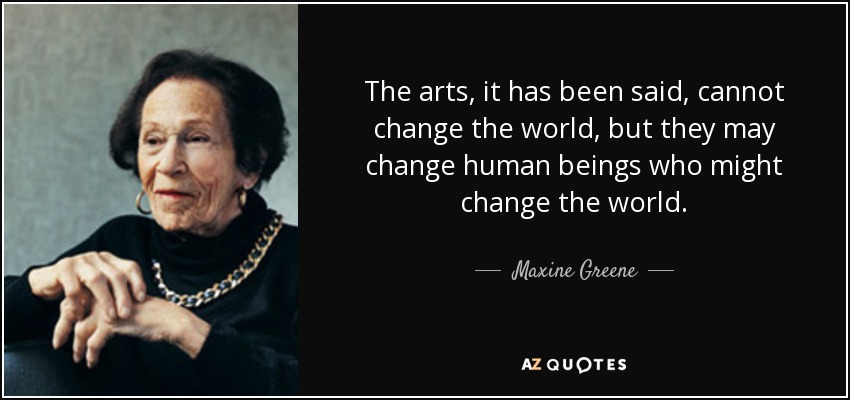
Maxine Greene has implored us in her Releasing the Imagination: “Community cannot be produced simply through rational formulation nor through edict,” Greene recognizes (p. 39), adding:

Community is not a question of which social contracts are the most reasonable for individuals to enter. It is a question of what might contribute to the pursuit of shared goods: what ways of being together, of attaining mutuality, of reaching toward some common world. (p. 39)

Releasing the Imagination

Yes, teachers are the key to public education, which is the key to democracy and freedom. But Greene’s call now stands as the opposite of the education system being created by Republicans

This brings me back to my argument that we teachers must make an intensified effort to break through the frames of custom and to touch the consciousness of those we teach. It is an argument stemming from a concern about noxious invisible clouds and cover-ups and false consciousness and helplessness. It has to do as well with our need to empower the young to deal with the threat and fear of holocaust, to know and understand enough to make significant choices as they grow. Surely, education today must be conceived as a model of opening the world to critical judgments by the young and their imaginative projections and, in time, to their transformative actions. (p. 56)

Releasing the Imagination

Republicans are unserious about teaching, teachers, and education. We cannot afford to continue to take them seriously.

Lehre Ist Tot

This past week an early career teacher, highly regarded in the classroom and very accomplished in the field of education, received a parental request that a student not be required to read The Great Gatsby. That parent, however, had signed a consent agreement with all texts, including that novel, identified as required reading at the beginning of the course.

The parent then reached out to the administration, who confirmed that the teacher had to assign a different work. This, of course, undermines the teacher and the process established, but it also creates more work for teachers already under incredible strain.

While parental oversight of assigned reading has been common in education for decades, this situation comes as states are increasingly passing parental trigger legislation, which moves the parental power from each parent’s own children to parents being able to ban works for all teachers or students to explore in classes.

That same teacher, frustrated and disillusioned, later that day read aloud their resignation letter to me in the context of telling me that much that they had taught in the first three years of teaching could no longer be taught in the last couple years—and increasingly will be directly banned in the coming year (as my home state is poised to pass its own educational gag order this spring).

The teacher cried while reading the letter aloud, and added that the resignation was depressing; this, you see, was a career they had been working toward since high school—and within 6 years, teaching is dead.

The current anti-teacher climate in the U.S. is incredibly harsh and driven by orchestrated false narratives:

Right-wing media are creating parental trigger structures even without the concurrent legislation:

While teacher and school bashing (notably as “liberal indoctrination”) has a long history in the U.S., reaching back to Catholic schools fighting for market space as public schooling increased in the 19th century, the current anti-teacher climate has its roots not in Republican politics but in the Obama administration’s education agenda.

Obama’s appointment of Arne Duncan as Secretary of Education heralded an era of education reform that actually doubled-down on the worst aspects under George W. Bush, and that doubling down feed into a growing media attack on “bad teachers.”

Instead of rejecting the standard approaches to education reform begun under Reagan and federalized under W. Bush, the Obama administration turned their blame to teachers and teacher quality. During the Obama years, the great experiment in value-added methods (VAM) devastated the teaching profession.

The perennial paradox of education has always been that teacher quality matters but it remains a very small part of measurable student achievement (only about 10-15%). Therefore, the Holy Grail of the VAM experiment—identifying “good” and “bad” teachers through standardized test scores of students—was always doomed to fail.

But it did accomplish planting the seeds of today’s multi-pronged attack on teachers—the “science of reading” movement blaming teachers and teacher educators for student reading achievement and the anti-CRT/educational gag order movements being linked to parent trigger laws.

Throughout the education reform era over the past 40 years, many of us in education have argued that education reform initiatives are less about improving education and more about killing public education and the teaching profession—charter schools and voucher schemes, Teach For America, VAM and merit pay, demonizing and dismantling unions and tenure, etc., to name a few.

From Fox News lies to parental trigger laws and education gag orders, the evidence is very clear now that this current wave of teacher bashing is definitely about killing the profession, and not about student discomfort.

Let me return to the opening teacher story.

When the parent was asked for reasons why they wanted their child not to read The Great Gatsby—so the teacher had context for choosing an alternate text—the parent responded that they did not want the child (a high school student) to read about inappropriate relationships and sexual content. So here is a point of fact about the insincerity of these challenges; that student had already read and studied The Crucible, without any complaint, a play grounded in adultery.

I am certain some parents challenging what their children are being taught are sincere, but I am also certain the larger political motivation among conservatives is to completely dismantle public education.

Just as I have explained that there simply is no CRT propaganda agenda in K-12 schools, there is no liberal indoctrination/grooming occurring in K-12 (or K-16) education either.

The Ingraham rants are simply political lies.

And these lies are not improving education.

They have one goal and it seems to have been effective: Teaching is dead.

Brave: No Matter Where You Go, There You Are

If memory serves me well—and it is failing in that regard as I tumble toward 60—this is my fifth summer in a row to take a week-long or so vacation grounded in cycling.

For a couple summers, we went to Colorado, Boulder and Ft. Collins, but now we drive the brief hour just north of where I live to Asheville, NC.

But for all the proximity of geography, I might as well be slipping through a worm hole or walking into some sort of science fiction portal involving much more than time.

This summer of 2017 has come at significant costs to someone with incredible privilege and a life of mostly leisure—a traumatizing car and bicycle accident at the end of 2016 and then June brought my father’s death just days after my mother’s stroke.

More physically and psychologically tired than I can ever remember being, I walk around Asheville now as the U.S. spirals further and further into proving ourselves to be a truly awful people—primarily because of what we refuse to do.

The majority political party, Republicans, maintain a relentless drumbeat toward repealing the Affordable Care Act (ACA), pronounced Obamacare, as political theater and a not-so-thinly veiled next step in the renewed racist energy embodied by President Trump.

While the virulent racists in the U.S. may be few, the “best lack all conviction,” more than willing to remain neutral on this moving train of inequity.

A sizable majority of comfortable people (what we enjoy calling “the middle class”), mostly white but all financially stable enough, may think things are bad here and there, but doing something about pain and suffering for the struggling among us (children, the elderly, carers, the disabled) could disrupt what they have, and they’ll risk none of that.

Just last night a few senators (all of whom are enormously wealthy) stalled (derailed?) yet again the repeal of the ACA—some offering rhetorical flurries about their own medical struggles and eliciting praise for their bravery in the face of political pressure.

Also last night, I had a conversation about the fractures among feminists, specifically involving someone such as Emily Ratajkowski who shares a sort of capitalist feminism once championed by Madonna—the right for a woman to control and market herself as men are free to do even when that crosses a line viewed as objectification or sexualizing.

Not to be too simplistic, but Ratajkowski is the sort of brave witnessed in the senators—brave within a system but unwilling to overthrow a system that benefits them.

And I watch and feel this as I walk around Asheville where a bohemian way of life looks brave to me but is really not that brave at all in Asheville, where this has become normalized by being monetized. Part of the tourist schtick of Asheville is dreadlocks, tattoos, tie-die, and quirky eateries along with lots of breweries.

I mean lots of breweries, including the mega-craft brewery New Belgium, which boasts a powerful ownership model and much-praised corporate values.

NB Asheville
The view from the back deck of New Belgium Asheville is scenic and a picture of revitalization of long-ignored areas of cities. But how often do we ask for whom and why?

So on vacation for daily mountain biking and several rounds of breweries each afternoon, I am mired in thoughts of bravery—or to be honest, the lack of bravery in me and those around me whether I am where I live or here in Asheville.

No matter where you go, there you are, and mostly everyone is cowardly and selfish.

And as I often do, I think about the reduced circumstances of Margaret Atwood’s The Handmaid’s Tale. The rarely discussed consequence of the sacred Invisible Hand is that it keeps us often frantic so that behavior that falls short of any sort of human decency looks brave—senators barely keeping a healthcare system afloat that is criminally inadequate but even so better than the alternatives being promised.

To be brave, then, wherever you live, wherever you are, comes with great personal costs. As Ratik Asokan writes: “Most middle-class Indians hate Arundhati Roy—or, rather, they hate the political activist she has apparently become.”

Roy, it seems, has committed the sin of bravery, a sin most offensive to the so-called middle class—and this is about India, a country of tremendous poverty.

“Fiction is the only thing that can connect all of this together,” Roy explains about returning to the novel as a writer after decades writing essays as a political activist. “Fiction is truth. You turn to fiction when you can’t express reality with footnotes and evidence and reportage.”

Normal, it seems, becomes powerful and evil, ultimately. No matter where you go, there you are with your normal against the normal around you.

I feel both at home and entirely out of place in Asheville, but I am merely visiting and spreading my disposable income around town, often at breweries and restaurants where I am just wasting time and hoping to come out the other side—if not brave at least a bit less of a coward.

See Also

The Low Road, Marge Piercy

The Hollow Nation

Shape without form, shade without colour,
Paralysed force, gesture without motion…

“The Hollow Men,” T.S. Eliot

My name is Kathy H. I’m thirty-one years old, and I’ve been a carer now for eleven years….Carers aren’t machines.

Never Let Me Go, Kazuo Ishiguro

We are the hollow nation. We are the stuffed nation, “Leaning together/Headpiece filled with straw.”

It has been almost seven months since a motorist struck a pack of cyclists I was riding with on Christmas Eve 2016, injuring four of us—two seriously and permanently.

The motorist was deemed at fault on the scene, but received only a $76 ticket, less than the monthly payments I am making on my remaining medical bills since the insurance claim for the accident has yet to be settled.

My own insurance has paid much of the cost, but I am required to repay those payments once I have a settlement. The orthopedist, as well, overcharged me during my fracture treatment, refunding that amount more than six months later.

Nine or ten insurance companies and multiple lawyers have been wrestling with this accident, and the other injured cyclists and I have received a barrage of bills and notices from the ER, the hospital, the ambulance service, and numerous doctors. One cyclist was airlifted from the scene, and since the motorist had minimum coverage, his portion of that insurance likely was erased immediately in that urgent care.

This recent Monday morning, my mother was found unconscious by my youngest nephew, her grandson. She had a stroke, requiring an ambulance to transport her to our local hospital that then had her airlifted to a larger hospital nearby for emergency surgery on the clot discovered in her brain.

She has been in neurological ICU, and now a regular hospital room since Monday—but soon she will be transferred again to a rehabilitation facility for 2-3 weeks.

My father has been quite unwell recently; therefore, we are guiding him around in a wheelchair, circling our own wagons because my mother’s stroke creates a new and terrifying reality: she was his caretaker, and the family now must seek ways to provide both of my parents care.

Working-class children of the 1940s and 1950s, my parents have only Social Security and Medicare to sustain them.

Our next steps are swamped by if and how well their insurance and social services cover the medical care and rehabilitation my mother needs, if and how well my father can receive the daily care she has been providing.

My accident and my mother’s stroke are not nearly as extreme as the terrors of the healthcare system in the U.S. that countless people suffer daily. But these “terrors” are not really about the healthcare.

The treatment my mother has received, the seemingly miraculous surgery, has been the sort of kind and skilled medicine that leaves you mesmerized by the power of humans to make this world work in ways that are good and right and life-affirming.

But that care, I am afraid, is an isolated outlier in a calloused and awful system of administration, bureaucracy, and dehumanization caused by our lack of political courage as a people, as a country.

The power of universal healthcare and a single-payer system to provide humanity and dignity to the amazing medicine and brilliant healthcare providers already in the U.S. is left in the wake of our hollow nation.

A nation that is the wealthiest and most powerful in human history.

A nation that allows more than 1 in 5 children to live in poverty.

A nation of heartless and vicious partisan politics poised to dump an already inadequate system into the laps of caretakers, family members.

My accident exposes the hollowness of calls for individual responsibility; the system is designed to allow serial carelessness that leaves innocent victims responsible.

My mother’s stroke exposes that we as a nation genuinely do not care about a generation of people who may have bought the American Dream myth most sincerely—people such as my parents who were buoyed by white privilege they denied, who preached and practiced  the rigged rugged individualism scarred by racism with the faith it would pay off as they decline into their new reality of being dependent on the kindness of not only family, but the kindness of strangers.

Wealth and security are hoarded by a few, a vicious tribalism of a country that denies community, the power and dignity of everyone caring about everyone—not just the tunnel vision quest of “me getting mine,” the mean-spirited Social Darwinism that lurks beneath our national platitudes about working hard and fair play.

A hollow nation that denies the humanity of all sorts of “others” because of race and religion, but also culls away many at the edges of white privileged—white poor, white working-poor, white working class.

My parents represent that even the wink-wink-nod-nod promise of the American Dream (the white nationalism of “Make America Great Again”) is a lie, a calloused lie within the larger lie to the tired, the poor, the huddled massed—and especially a bald-faced lie about the so-called melting pot, a metaphor more accurate if named a witch’s cauldron.

With these realities before me, it is tempting to call for the removal of the Statue of Liberty, but at least, we must strip it of the poem inscribed at the base and post instead:

We are the hollow nation. We are the stuffed nation, “Leaning together/Headpiece filled with straw.”

The Eternal Narcissism of White Privilege

The nomination of Donald Trump by the Republican Party has spawned a growing body of punditry seeking ways to explain Trump’s rise without directly addressing racism, bigotry, and xenophobia.

The explanation du jour cautions critics of Trump supporters, arguing that Trump is attractive to working-class whites who have legitimate fears.

Works such as Hillbilly Elegy by J.D. Vance have become representative of the serious reconsideration of the angry white voter, as Vance proclaims:

The simple answer is that these people–my people–are really struggling, and there hasn’t been a single political candidate who speaks to those struggles in a long time.  Donald Trump at least tries.

However, as a redneck son of the self-defeating South, I immediately had a different reaction to Vance and the scramble to attend to the eternal narcissism of white privilege:

The four-year-old Joel frets about his mother: “She’s not looking at me. No one ever looks at me.”

The histrionics of working class whites, to me, sound like arrested development, spurred by the long deferred political and social recognition about racism prompted by the #BlackLivesMatter movement.

The consequences of white privilege include that privilege is both ever-present and thus invisible—much as we says that fish don’t understand water.

And thus, while working-class whites have suffered because of disaster capitalism and the vast majority of the policies implemented by the Republican machine they support, the narcissism of privilege among working-class whites in the U.S. blinds them from two powerful and damning facts:

  1. White privilege buoys all whites in comparison to black and brown people in terms of socioeconomic opportunity and wealth as well as shielding whites from the negative consequences of the U.S. judicial system and policing. Just as two examples, whites who dropped out of high school have the same employment opportunities as blacks with some college, and blacks constitute only about 12% of the U.S. population, but mass incarceration impacts 2207/100,000 blacks compared to 380/100,000 whites.
  2. Working-class whites have supported Republicans for ideological reasons linked to religious and racial bigotry—while disregarding how that commitment has been self-defeating to their own interests. As Neil Gross explains: “Union decline [as a subset of many economic factors, I want to add] has left the [white] working class politically and economically vulnerable, and it’s this vulnerability Mr. Trump has been able to exploit.”

This “O, crap!” moment for working-class whites isn’t without merit, but it comes with the same sort of false logic found in the South where whites shout for blacks to “Get over slavery” while clutching and waving the Confederate battle flag and screaming “Tradition!”

Again, as a life-long Southerner, I am compelled despite my own skepticism about organized religion, especially the fundamentalist kind of my home region, to proclaim that working-class whites need to have a Come-to-Jesus moment.

First, while recognizing the power of white privilege regardless of socioeconomic status is essential, working-class whites must forefront the concerns of black and brown people who suffer disproportionately for the mere fact of their race in the U.S.

Next, working-class whites must form a solidarity with all people who share their social and economic needs: working-class status is more significant for equity in the U.S. than religious or racial differences.

And finally, working-class whites must reject the “Make American Great Again” mantra since there is no compelling evidence to support either that the U.S. was once great or that somehow the expansion of freedom and equity beyond whiteness is anti-American.

Again, in a blazing display of illogic, while working-class whites remain committed to mythologies such as “a rising tide lifts all boats,” they have politically resisted expanding* marriage rights to homosexuals, social and economic equity to black and brown Americans, equal pay for women, American citizenship for immigrants, the end to mass incarceration for recreational marijuana use—all of which raising the tide for everyone in the U.S. by growing freedom.

If we concede to the mainstream whitewashing of Trump and his supporters; if we continue not to name bigotry, racism, and xenophobia; if we only attend to anything once it becomes a white problem—we are failing the very thing the Right and conservatives are so quick to shout about: life, liberty, and the pursuit of happiness.

The “yes, but” narcissism of white privilege once again is shouting over #BlackLivesMatter, and their ring-leader is the king of shouting over substance.

Working-class whites need to put on their grown-up pants, sit down, listen patiently, and wait their turn—finally.


* And ideologically refuse even to acknowledge these inequities exist or matter.

Note: Below are Tweets of mine prompting this blog post:

Weekend Quick Takes June 25-26

Read Julian Vasquez Heilig’s What other universities should learn from UT, and note especially this:

Not discussed in the current ruling, but I believe relevant, is that Fisher did not fall below a bright line by which whites were rejected and minorities admitted. As reported in The Nation, UT-Austin offered admission “to some students with lower test scores and grades than Fisher. Five of those students were Black or Latino. Forty-two were white.” Additionally, “168 black and Latino students with grades as good as or better than Fisher’s who were also denied entry into the university that year.”

It is unfortunate that Fisher believed wrongly, in spite of factual evidence and data to the contrary, that she was discriminated against because she was white. In fact, by pursuing a case where the data was very clear on this point, she continued the insecurity and insidiousness of racial prejudice that has unfortunately permeated our society for centuries.

Also see his co-authored Actuating equity?: Historical and contemporary analyses of African American access to selective higher education from Sweatt to the Top 10% Law


There may be many cracks in Maintaining the Charter Mirage: Progressive Racism, including Paul Hewitt’s A modest proposal for charter schools; consider this:

Now that I have established myself as an opponent of charter schools I have a proposal for the Walton family and charter school proponents everywhere. I propose that you go against my friend’s admonition that we need public schools for charters to succeed. If charter schools are so good, let’s make every school in the current school district a charter school. Let’s dissolve the traditional school board and have them become trustees of school facilities. Let’s take all the existing school facilities and have charter school groups nationwide bid through proposals to take over and run that school. State law may need to be altered a little for this grand experiment. For example, no student living in the current school boundaries could transfer to a school in another neighboring school district. This would ensure that the charters serve all students in the community including the special education, English language learners, and at-risk children to ensure that no child could be “pushed out.”

Just imagine, every school would be a charter school and parents could have their choice of schools for their child. The traditional lottery system would be used at each school, and if the parent wasn’t lucky enough to get their first choice they could go to their second or third. Because the population of the entire school district would be involved there could be no discrimination and all students, even the at-risk, would be served. The traditional creaming of top students that is the major criticism of charters would be eliminated. This would be a completely free-market school choice system.

The double irony to this confrontation as (mostly) satire is that transforming all public schools into charter schools has already occurred—in New Orleans; see Endgame: Disaster Capitalism, New Orleans, and the Charter Scam.

And while edureformers continue to mislead political leaders and the public about such turnover/turnarounds, New Orleans is but one example of how these market-based reforms have proven to be utter failures.


In 1949, former NCTE president and English teacher/educator Lou LaBrant argued: “Our language programs have been set up as costume parties and not anything more basic than that” (p. 16).

In 2016, former NCTE president and esteemed educator and activist Joanne Yatvin confronts the same disturbing dynamic in her Too Little and Too Late.

Regretfully, Yatvin’s powerful refuting of the National Reading Panel, at the base of No Child Left Behind, was mostly ignored by political leaders and the public. Yet, she is once again ringing a bell that must be heard:

To the Editor:

As a retired educator, still deeply involved with the teaching of reading and writing, I was dismayed to read that the Portland Public schools are still tied to one-size-fit all commercial materials for teaching reading and considering combining pieces from several of them to make a new program. By this time experienced teachers should have learned that each child learns to read in his own time frame and in his own way, and that real literature and non-fiction are far better tools than anything concocted by commercial publishers.

Learning to read is not all that difficult when children are given interesting and well-written books for group activities and allowed to choose books that appeal to them to read on their own. It also helps when adults read aloud interesting books with illustrations on a regular basis. That is how children learn vocabulary and begin to understand the world outside their own homes and neighborhoods. Reading poetry helps too, because of the repeated word sounds and lines.

Over all, we should remember that reading and writing have been around for many centuries, and that the people who wanted and needed to use those skills found them easy to learn– often without a teacher, and certainly without any breakdown into separate skills, workbook exercises, or tests.

Sincerely yours,
Joanne Yatvin

The entire accountability reform movement driven by ever-new standards and ever-new high-stakes tests benefits mostly the education market—not students, not teachers.

In fact, as my current graduate literacy course has revealed to me, teachers both recognize the negative impact of required reading programs and materials and feel powerless to set those materials aside in order to implement what their children actually need.


I entered the field of education fueled by the belief that traditional schooling needed to be reformed. I am a public school advocate, but I also recognize that traditional public schools have served white middle-class and affluent children well (even though, as I can attest, that population often excels in spite of traditional schooling) while mostly failing vulnerable populations of students, specifically black, brown, and poor children.

My fellow pro-public school friends have been proudly sharing Jack Schneider’s America’s Not-So-Broken Education System.

While both Schneider and those sharing his piece are, I am certain, driven by good intentions, I must caution that such defenses of public schools suffer from whitewashing—a not-so-subtle middle-class lens that fails to adequately emphasize the racist and classist policies entrenched in public schools.

Public education as a social reform mechanism has not happened; public schools more often than not reflect and perpetuate the very worst aspects of our society.

If I may, I believe those of us who are adamant about supporting public education are committed to the potential, the promise that public education could be or should be something better, at the very least a model of equity if not a lever for equity.


Related to the above concern, access to experienced and certified teachers is a key aspect of both how our public schools have failed and how we are currently committed to the very worst aspects of education reform (for example, Teach For America and value-added methods for teacher evaluation).

Derek Black has compiled a powerful and important examination of Taking Teacher Quality Seriously.

See the abstract:

Although access to quality teachers is one of the most important aspects of a quality education, explicit concern with teacher quality has been conspicuously absent from past litigation over the right to education. Instead, past litigation has focused almost exclusively on funding. Though that litigation has narrowed gross funding gaps between schools in many states, it has not changed what matters most: access to quality teachers.

This Article proposes a break from the traditional approach to litigating the constitutional right to education. Rather than constitutionalizing adequate or equal funding, courts should constitutionalize quality teaching. The recent success of the constitutional challenge to tenure offers the first step in this direction. But the focus on teacher tenure alone is misplaced. Eliminating tenure, without addressing more important fundamental challenges for the teaching profession, may just make matters worse. Thus, this Article argues for a broader intervention strategy. When evaluating claims that students have been deprived of their constitutional right to education, courts should first ensure that states equally distribute existing quality teachers, regardless of the supply. Courts should then address state policies that affect the supply of teachers, which include far more than just salaries. When those remedies still prove insufficient to ensure access to quality teachers, courts must ensure that the removal of ineffective teachers is possible.


And a perfect companion for your weekend reading comes from 1969: “Bullshit and the Art of Crap -Detection” by Neil Postman.

Here’s just a taste:

Thus, my main purpose this afternoon is to introduce the subject of bullshit to the NCTE. It is a subject, one might say, that needs no introduction to the NCTE, but I want to do it in a way that would allow bullshit to take its place alongside our literary heritage, grammatical theory, the topic sentence, and correct usage as part of the content of English instruction. For this reason, I will have to use 15 minutes or so of your time to discuss the taxonomy of bullshit. It is important for you to pay close attention to this, since I am going to give a quiz at the conclusion.