Category Archives: Dyslexia

How Media Misinformation Became “Holy Text”: The Anatomy of the SOR Movement

[Header Photo by Nathan Dumlao on Unsplash]

[NOTE: A PDF of this post as a presentation can be accessed HERE. See also a slightly revised presentation HERE. Please do not edit and please acknowledge this is my work if you use for instructional or public purposes.]

On the Social Media Platform Formerly Known as “Twitter,” Mark Weber posed a simple but powerful question:
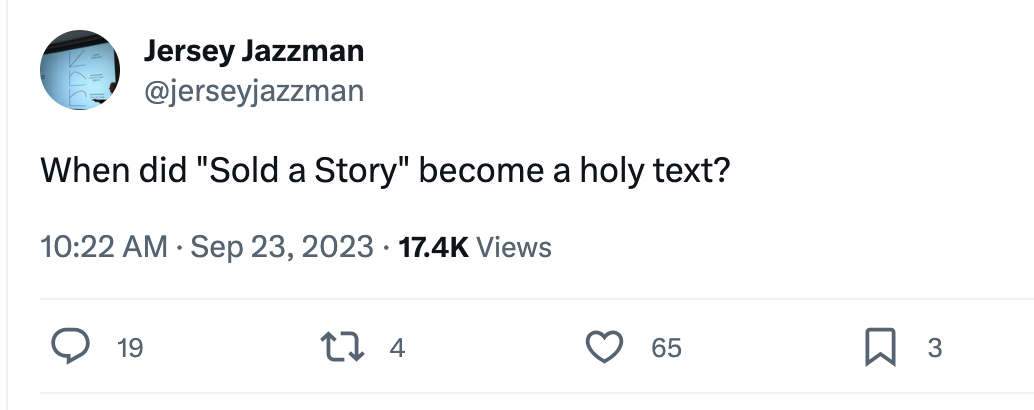
The answer is the anatomy of how media misinformation in 2018 wrapped in sensationalistic anecdotes has been replicated uncritically by dozens and dozens of journalists, resulting in that misinformation becoming “holy text,” or in other words, sacrosanct Truth.

Here, I offer the template that “Hard Words” created, and unlike journalists, I include links to research showing why the claims throughout the piece (and in its cousin, “Sold a Story”) are both false and shoddy journalism.

I.

The article begins with the Big Lie, one of the three biggest lies (along with citing the NRP report and NCTQ reports) in the “science of reading” (SOR) movement:

This is a fundamental misunderstanding of NAEP data. NAEP “proficient” is well above grade level, but “basic” is approximately what most states consider “grade level,” and thus, if anything, about 60-65% of students for several decades have been at or above grade level. That isn’t sensational enough for reporters, however.

The Evidence:

From NAEP:

NAEP student achievement levels are performance standards that describe what students should know and be able to do. Results are reported as percentages of students performing at or above three NAEP achievement levels (NAEP Basic, NAEP Proficient, and NAEP Advanced). Students performing at or above the NAEP Proficient level on NAEP assessments demonstrate solid academic performance and competency over challenging subject matter. It should be noted that the NAEP Proficient achievement level does not represent grade level proficiency as determined by other assessment standards (e.g., state or district assessments). See short descriptions of NAEP achievement levels for each assessment subject.

Scale Scores and NAEP Achievement Levels

Loveless, T. (2016, June 13). The NAEP proficiency myth. Brookings. https://www.brookings.edu/blog/brown-center-chalkboard/2016/06/13/the-naep-proficiency-myth/

Loveless, T. (2023, June 11). Literacy and NAEP proficient (Web log). https://tomloveless.com/posts/literacy-and-naep-proficient/


II.

Next, the SOR movement is squarely grounded in the conservative education reform movement, specifically framing poverty as an “excuse”:

The Evidence:

Read carefully, Coles unpacks “Hard Words” in the context of false claims about poverty: Cryonics Phonics: Inequality’s Little Helper, Gerald Coles
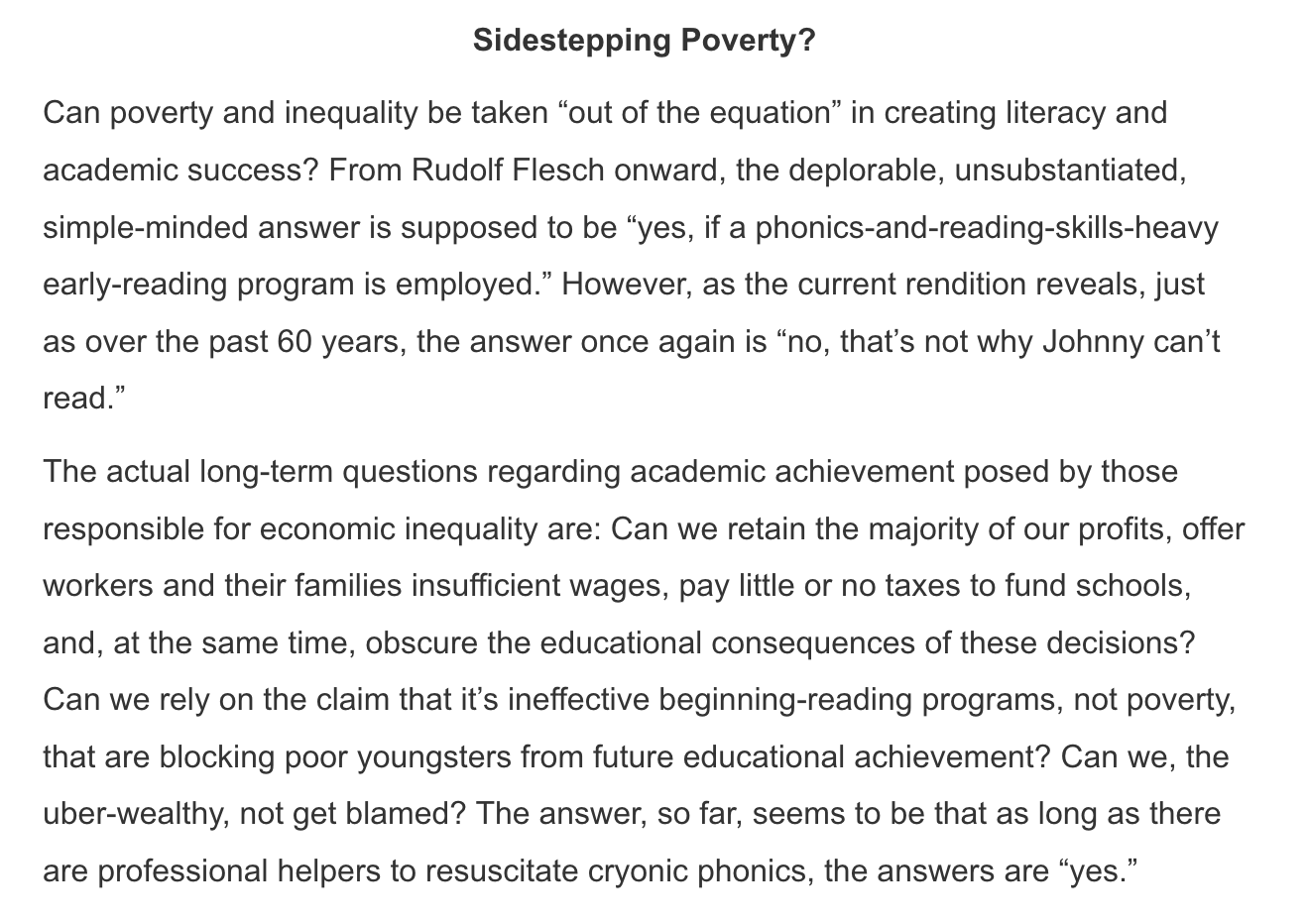
See also: The Crumbling Facade of “No Excuses” and Educational Racism


III.

As I have pointed out about NCTQ (see more below on NCTQ and LETRS/Moats), much of the SOR advocacy has a market interest behind it and the SOR movement is grounded in the myth of the bad teacher, attacking classroom teachers and teacher educators:

The Evidence:

The High Cost of Marketing Educational Crisis [UPDATED]

The Myth of the Bad Teacher: 2023


IV.

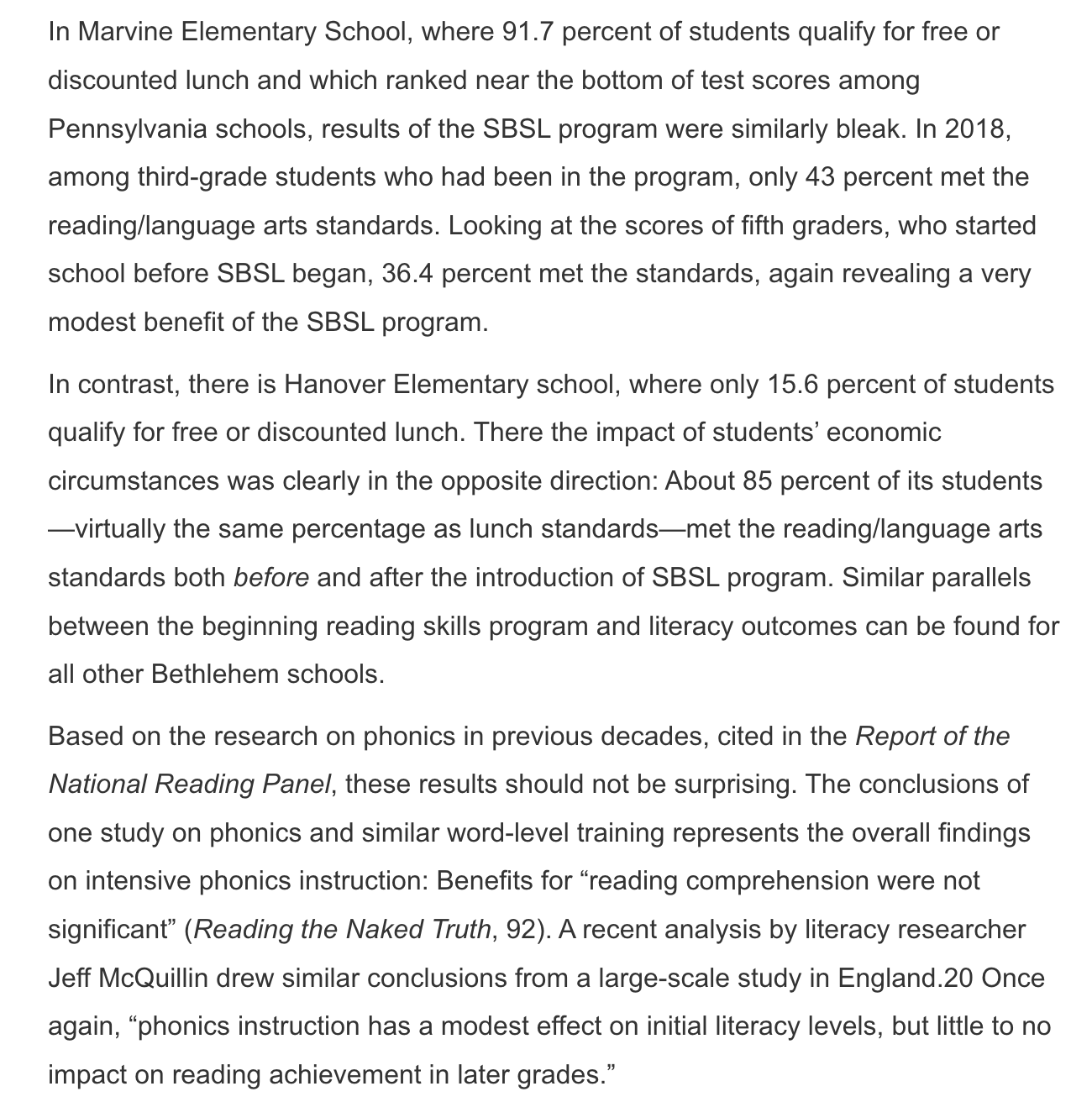
Here and throughout mainstream media, including “Sold a Story,” the SOR movement relies on anecdotes, regardless of how well those stories reflect accurate claims:

The Evidence:

Claims of miracles in Pennsylvania (similar to those made about Mississippi) fall apart once the full picture is examined. Inflated gains at early grades routinely disappear in later grades; this score increases are mirages, not miracle, and ironically, the NRP report showed that reality despite SOR advocates ignoring that fact; see again: Cryonics Phonics: Inequality’s Little Helper, Gerald Coles.

V.

A persistent set of lies in the SOR media campaign concerns misrepresenting “guessing” and three cueing:

The Evidence:

Understanding MSV: The Types of Information Available to Readers

Is Reading a “Guessing Game”?: Reading Theory as a Debate, Not Settled Science

Compton-Lilly, C.F., Mitra, A., Guay, M., & Spence, L.K. (2020). A confluence of complexity: Intersections among reading theory, neuroscience, and observations of young readers. Reading Research Quarterly, 55(S1), S185-S195. https://doi.org/10.1002/rrq.348 [access HERE]

Mora, J.K. (2023, July 3). To cue or not to cue: Is that the question? Language Magazine. https://www.languagemagazine.com/2023/07/03/to-cue-or-not-to-cue-is-that-the-question/


VI.

The SOR misinformation campaign relies on making false claims and definitions about balanced literacy (and whole language, see below):

The Evidence:

Spiegel, D. (1998). Silver bullets, babies, and bath water: Literature response groups in a balanced literacy program. The Reading Teacher, 52(2), 114-124. www.jstor.org/stable/20202025


VII.

The misrepresentation of whole language also has a marketing element; Moats markets SOR-branded materials and thus has a financial interest in discrediting BL and WL:

The Evidence:

Krashen, S. (2002). Defending whole language: The limits of phonics instruction and the efficacy of whole language instruction. Reading Improvement, 39(1), 32-42. http://www.sdkrashen.com/content/articles/2002_defending_whole_language.pdf

Semingson, P. & Kerns, W. (2021). Where is the evidence? Looking back to Jeanne Chall and enduring debates about the science of reading. Reading Research Quarterly, 56(S1), S157-S169. https://doi.org/10.1002/rrq.405.


VIII.

Misrepresenting WL/BL is solidly linked to a complete misreading of the NRP reports (another Big Lie):

The Evidence:

Krashen, S. (2002). Whole language and the great plummet of 1987-92Phi Delta Kappan83(10), 748-753.

McQuillan, J. (1998). The literary crisis: False claims, real solutions. Heinemann.

From Cryonics Phonics: Inequality’s Little Helper, Gerald Coles:
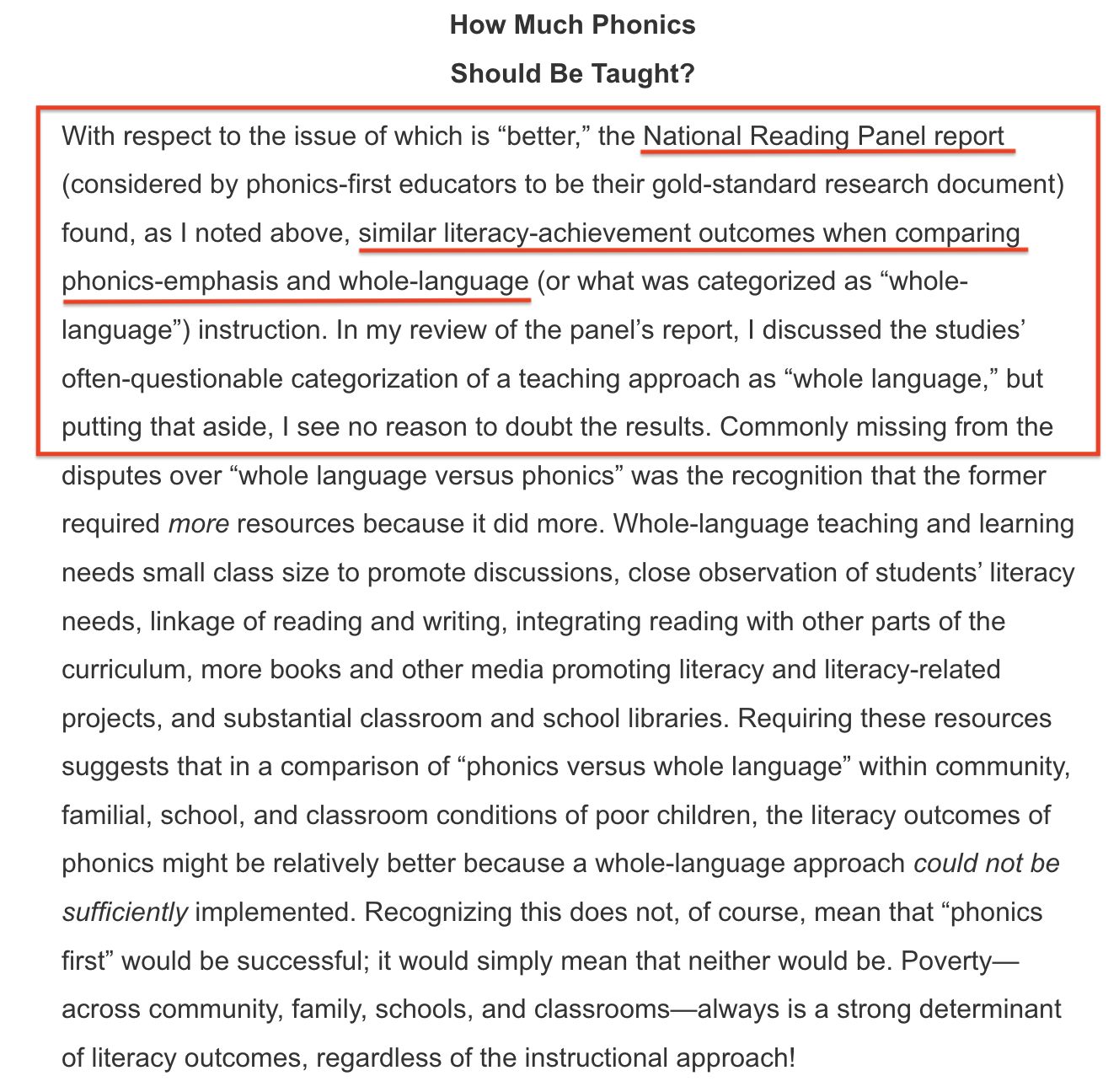
See a wealth of evidence that the NRP is regularly misrepresented by SOR advocacy:


IX.

As many scholars have noted, the SOR movement including “Sold a Story” is driven by sensationalistic anecdotes, stories:

The Evidence:

Hoffman, J.V., Hikida, M., & Sailors, M. (2020). Contesting science that silences: Amplifying equity, agency, and design research in literacy teacher preparation. Reading Research Quarterly, 55(S1), S255–S266. https://doi.org/10.1002/rrq.353


X.

SOR advocacy regularly demands only a narrow use of “scientific” in reading instruction while also endorsing practices and programs not supported by that same rigor, such as LETRS:

The Evidence:

Hoffman, J.V., Hikida, M., & Sailors, M. (2020). Contesting science that silences: Amplifying equity, agency, and design research in literacy teacher preparation. Reading Research Quarterly, 55(S1), S255–S266. https://doi.org/10.1002/rrq.353

Research Roundup: LETRS 


XI.

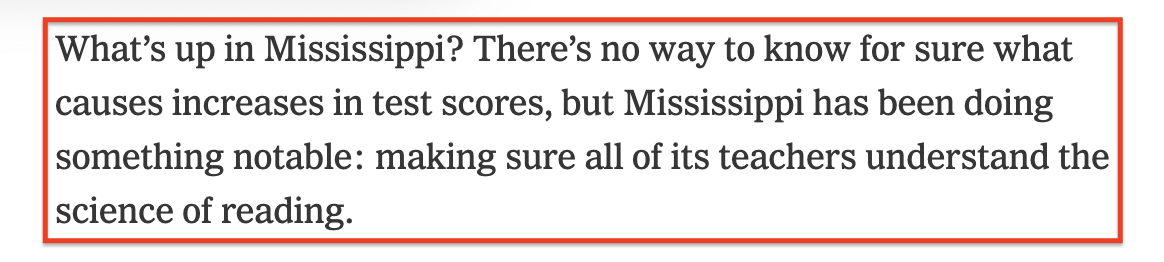
Much of the sensationalistic media coverage is self-contradictory, placing overstated claims of “scientific” beside “impossible to know”:

See also Hanford’s coverage of Mississippi:

XII.

A third Big Lie is using unscientific and discredited reports from the conservative think tank NCTQ to claim that teacher educators are incompetent and/or willfully misleading teacher candidates.

The Evidence:

Thomas, P.L. (2023, September). NEPC review: Teacher prep review: Strengthening elementary reading instruction. Boulder, CO: National Education Policy Center. https://nepc.colorado.edu/review/teacher-prep

Dudley-Marling, C., Stevens, L. P., & Gurn, A. (2007, April). A critical policy analysis and response to the report of the National Council on Teacher Quality (NCTQ). NCTE. https://ncte.org/resources/reports/critical-policy-analysis-response-nctq-report/

Benner, S. M. (2012). Quality in student teaching: Flawed research leads to unsound recommendations. Boulder, CO: National Education Policy Center. https://nepc.colorado.edu/thinktank/review-student-teaching

Fuller, E. J. (2014). Shaky methods, shaky motives: A critique of the National Council of Teacher Quality’s review of teacher preparation programs. Journal of Teacher Education, 65(1), 63-77. https://journals.sagepub.com/doi/10.1177/0022487113503872

Cochran-Smith, M., Stern, R., Sánchez, J.G., Miller, A., Keefe, E.S., Fernández, M.B., Chang, W., Carney, M.C., Burton, S., & Baker, M. (2016). Holding teacher preparation accountable: A review of claims and evidence. Boulder, CO: National Education Policy Center. http://nepc.colorado.edu/publication/teacher-prep

Cochran-Smith, M., Keefe, E.S., Chang, W.C., & Carney, M.C. (2018). NEPC Review: “2018 Teacher Prep Review.” Boulder, CO: National Education Policy Center. http://nepc.colorado.edu/thinktank/review-teacher-prep-2018

Burke, K. J., & DeLeon, A. (2020). Wooden dolls and disarray: Rethinking United States’ teacher education to the side of quantification. Critical Studies in Education, 61(4), 480-495. https://www.tandfonline.com/doi/abs/10.1080/17508487.2018.1506351

Stillman, J., & Schultz, K. (2021). NEPC Review: “2020 Teacher Prep Review: Clinical Practice and Classroom Management.” Boulder, CO: National Education Policy Center. http://nepc.colorado.edu/thinktank/teacher-prep

Thomas, P.L., & Goering, C.Z. (2016). Review of “Learning about Learning: What Every New Teacher Needs to Know.” Boulder, CO: National Education Policy Center. http://nepc.colorado.edu/thinktank/review-teacher-education


XIII.

One of the most damning aspects of the SOR movement has been the embracing of and rise in grade retention policies; grade retention is not supported by research and both creates false test score gains while harming children:

The Evidence:

Mississippi Miracle, Mirage, or Political Lie?: 2019 NAEP Reading Scores Prompt Questions, Not Answers [Update 7 December 2022]

A Critical Examination of Grade Retention as Reading Policy (OEA)

Grade Retention Advocacy Fails by Omission

Gaming the System with Grade Retention: The Politics of Reading Crisis Pt. 3

Beware Grade-Level Reading and the Cult of Proficiency

What Do We Really Know about Reading Proficiency in the US?

Understanding and Reforming the Reading Proficiency Trap


XIV.

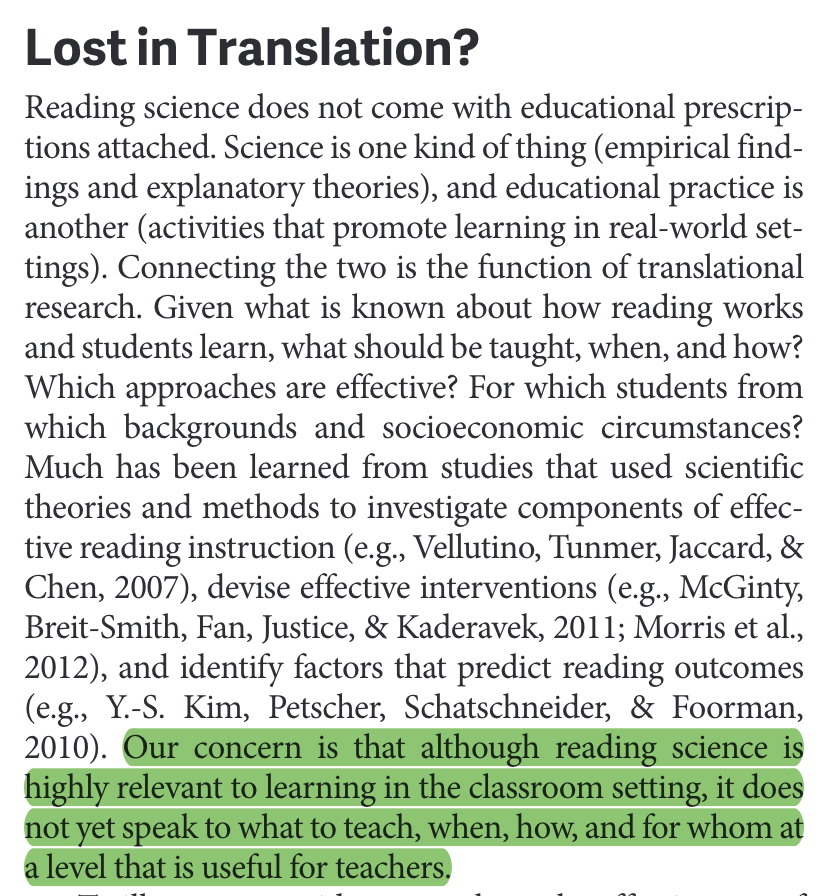
The SOR movement grossly overstates brain science as well as the essential nature of science:

The Evidence:

Seidenberg, M.S., Cooper Borkenhagen, M., & Kearns, D.M. (2020). Lost in translation? Challenges in connecting reading science and educational practice. Reading Research Quarterly55(S1), S119-S130. https://doi.org/10.1002/rrq.341
Yaden, D.B., Reinking, D., & Smagorinsky, P. (2021). The trouble with binaries: A perspective on the science of reading. Reading Research Quarterly, 56(S1), S119-S129. https://doi.org/10.1002/rrq.402


XV.

The SOR movement has hyper-focused on dyslexia, but again, mostly offering misinformation:

The Evidence:

Johnston, P., & Scanlon, D. (2021). An examination of dyslexia research and instruction with policy implications. Literacy Research: Theory, Method, and Practice70(1), 107-128. https://doi.org/10.1177/23813377211024625

International Literacy Association. (2016). Research advisory: Dyslexia. https://www.literacyworldwide.org/docs/default-source/where-we-stand/ila-dyslexia-research-advisory.pdf

Socioeconomic dissociations in the neural and cognitive bases of reading disorders, Rachel R. Romeo, Tyler K. Perrachione, Halie A. Olson, Kelly K. Halverson, John D. E. Gabrieli, and Joanna A. Christodoulou

Stevens, E. A., Austin, C., Moore, C., Scammacca, N., Boucher, A. N., & Vaughn, S. (2021). Current state of the evidence: Examining the effects of Orton-Gillingham reading interventions for students with or at risk for word-level reading disabilities. Exceptional Children87(4), 397–417. https://doi.org/10.1177/0014402921993406

Hall, C., et al. (2022, September 13). Forty years of reading intervention research for elementary students with or at risk for dyslexia: A systematic review and meta-analysis. Reading Research Quarterly. https://doi.org/10.1002/rrq.477

Odegard, T. N., Farris, E. A., Middleton, A. E., Oslund, E., & Rimrodt-Frierson, S. (2020). Characteristics of Students Identified With Dyslexia Within the Context of State Legislation. Journal of Learning Disabilities53(5), 366–379. https://doi.org/10.1177/0022219420914551


“Sold a Story” became a “holy text” because dozens of journalists and politicians repeated the misinformation and lies begun in “Hard Words,” identified above.

This is not good journalism, but it does prove that sensationalistic stories will ultimately trump evidence, even the “science” SOR advocates are so apt to reference.


Recommended

ILEC Response: Mainstream media coverage of reading proficiency, teachers of reading, NAEP scores, and teacher preparation

The Zombie Politics of Marketing Phonics: “There Is a Sucker Born Every Minute”

Consider the following claims about reading proficiency in students and the teaching of reading in the US:

  • No one teaches phonics.
  • There is a phonemic awareness crisis.
  • Direct, systematic, and sequential phonics is the only way to go.
  • Decodable texts are important.

I suspect that most people concerned about education and reading who pay even a modicum of attention to mainstream media will find these claims not only applicable to the current state of reading but also true.

However, there is a problem, which prompted this post from Rachael Gabriel:

As Richard Allington details, these claims are simply not scientific, ironically, even as advocates of the “science of reading” repeat claims that have been standard but misleading arguments for decades.

Since at least the 1940s, these phonics-centered claims have been compelling for the media, the public, and more recently political leaders; yet, “there is no indisputable evidence of a national crisis in reading, and even if there were a crisis, there is no evidence that the amount of phonics in classrooms is necessarily the cause or the solution,” as shown by David Reinking, George G. Hruby, and Victoria J. Risko.

At the core of the phonics frenzy is market, and as Allington noted in the late 1990s, “There is a sucker born every minute.”

I recommend reading Allington’s piece in full and the following reader for context and much more complex and accurate understanding of reading proficiency and the teaching of reading:

ILEC Response: Mainstream media coverage of reading proficiency, teachers of reading, NAEP scores, and teacher preparation

International Literacy Educators Coalition

ILEC Vision: To promote literacy learning practices that enable all children and youth to realize their full potential as literate, thinking human beings.

Download a PDF of the response.


ILEC Response: Mainstream media coverage of reading proficiency, teachers of reading, NAEP scores, and teacher preparation

Mainstream media such as Education Week, the New York Times[1], APM, and Forbes persist in recycling a compelling but misleading story about reading proficiency, teachers of reading, NAEP scores, and teacher preparation that is not supported by the full body of evidence. As Aukerman explains:

From how much of the media tells it, a war rages in the field of early literacy instruction. The story is frequently some version of a conflict narrative relying on the following problematic suppositions:

  • a) science has proved that there is just one way of teaching reading effectively to all kids – using a systematic, highly structured approach to teaching phonics;
  • b) most teachers rely instead on an approach called balanced literacy, spurred on by shoddy teacher education programs;
  • c) therefore, teachers incorporate very little phonics and encourage kids to guess at words;
  • d) balanced literacy and teacher education are thus at fault for large numbers of children not learning to read well.[2]
The Science of Reading and the Media: Is Reporting Biased?, Maren Aukerman

In fact, Reinking, Hruby, and Risko concluded, “there is no indisputable evidence of a national crisis in reading, and even if there were a crisis, there is no evidence that the amount of phonics in classrooms is necessarily the cause or the solution.”

ILEC Concerns:

  1. Hoffman, Hikida, and Sailors note that “the SOR community do[es] not employ the same standards for scientific research that they claimed as the basis for their critiques.” While individual stories of parents and students are compelling, anecdotes are not scientific and do not provide valid evidence for generalizations about reading proficiency or reading instruction.
  2. Longitudinal and recent NAEP scores on reading are misrepresented by mainstream media. “Proficiency” on NAEP is well above grade level, and “basic” is a closer measure of grade level (Loveless, 2023; Loveless, 2016).
  3. Any claim of “crisis” or “miracle” in education is misleading. Specifically, the Mississippi “miracle” does not have scientific evidence to show NAEP increases are caused by instructional reform, but appear linked (as with Florida) to punitive uses of grade retention that disproportionately impact minoritized students.[3]
  4. Mainstream media misrepresents teacher education, reading programs, reading instructional practices, brain research, and the complex body of reading research to promote a compelling story that is melodramatic and anecdotal.
  5. Citing NCTQ, NRP, and surveys fails to meet the level of “scientific” that SOR advocacy requires of teachers.

[1] The NY Times Again Goes After Public Schools, Susan Ohanian

[2] See The Science of Reading and the Media: Is Reporting Biased?, Maren Aukerman; The Science of Reading and the Media: Does the Media Draw on High-Quality Reading Research?, Maren Aukerman; The Science of Reading and the Media: How Do Current Reporting Patterns Cause Damage?, Maren Aukerman

[3] A Critical Examination of Grade Retention as Reading Policy (OEA)

What Do We Really Know about Reading Proficiency in the US?

A data-rich but disappointing report on reading legislation in the US from 2019-2022 has been released by the Shanker Institute.

The report concedes “legislative efforts have at times been criticized widely,” but chooses to applaud the “science of reading” (SOR) movement without considering the considerable scholarly criticism raising cautions about claims of a reading crisis and mandates in that legislation.

Further, the report ignores how the SOR movement fits into decades of political education reform since the 1980s, reforms that have repeatedly failed to produce positive outcomes for students or teachers.

While the report lacks critical grounding, it also offers a couple key points to consider. First:

There are no quick fixes: The path to improvement will require time, consistent investment and a holistic approach to reform. The magnitude of the task should motivate us to persevere and collaborate more effectively. Yet, we are concerned about the polarizing rhetoric surrounding reading and hope that this review can foster a more measured dialogue about the strengths and limitations of state efforts and reading improvement more broadly.

Reading Reform Across America

The emphasis on avoiding one-size-fits all solutions is important and supported by many critics of the SOR movement. And certainly the “polarizing rhetoric” of the SOR debate is harmful; yet, this report’s positive spin on harmful legislation is certain to trigger, not ameliorate that caustic debate.

Valid criticism isn’t any more “polarizing” than idealistic endorsements.

Next, and more importantly for this post:

Whether we see the current state of American students’ reading achievement as a new crisis or as part of a stable trend, the truth remains that more than one-third (37 percent) of the nation’s fourth-graders performed below the National Assessment of Educational Progress (NAEP) “Basic” level in 2022. Because there is no achievement-level description for below “Basic,” it is difficult to make full sense of this statistic.

Reading Reform Across America

Here is the central problem with the SOR movement as well as nine decades of reading wars: The truth is that we know very little empirically about reading proficiency in the US because we have no stable or unified metric or assessment to understand what proficiency is or how well students are developing as readers.

There simply has never been a single day in the US since at least the 1940s that the media, public, and political leaders have declared reading proficiency adequate.

What does it mean to have been in a continual reading crisis in the US for almost a century and yet the country has experienced no major or catastrophic decline?

What does it mean to have been in a continual reading crisis in the US for almost a century because we claim reading is essential for student and societal success and yet the dooms day messaging never materializes?

That leads us to this: What do we really know about reading proficiency in the US?

As the report notes, one aspect of reading proficiency in the US is quite clear and easy to document with multiple data points: Reading proficiency data expose a significant inequity among marginalized groups of students—notably Black and brown students, students in poverty, multi-lingual learners (whom the report advocates for admirably), and special needs students.

Yet this fact about reading is replicated in all other educational measurements, and thus, is not a unique reality about reading proficiency, suggesting something other than reading legislation (or any educational legislation) is needed in the US.

Also, it seems fair and supported by the evidence that we have to note that reading progress by students (how well any students gains reading proficiency in relationship with their peers) is a strong marker for educational progress in general.

While over-emphasizing reading proficiency at grade 3 is problematic, no one suggests that early reading progress should be ignored. Yet, many states persist in adopting harmful grade 3 retention that has been shown to correlate strongly with negative consequences.

The report does concede about grade retention: “Consequently, there are reasons to be cautious about the policy.”

Beyond these two points, however, claims about reading proficiency are at best speculation and at worst ideological assertions without empirical support.

The latter, regretfully, is the crux of most reading wars for decades.

So here is what we don’t have but urgently need in order to address reading in ways that are supportive of students and teachers and avoids the “polarizing rhetoric” with which the report seems deeply concerned:

  • A standardized definition of “proficiency” that is age-based and not grade-based.
  • A comprehensive documentation of reading programs and instructional practices implemented in the US over the last decade.
  • A set of diverse assessments grounded in a standardized definition of “proficiency.”
  • Patience and a willingness to admit that human behaviors occur on a spectrum; not all students learn at the same rates.
  • Reading legislation that neither mandates nor bans practices or policies, but provides a funding framework that supports educators as autonomous professionals.

The polarization in public and political debates about reading is in part driven by all that we do not know and do not have regarding reading proficiency, allowing too many people (some without good intentions) to make melodramatic claims that reinforce political, media, and market interests, not student achievement or teacher/teaching quality.

Ultimately, this current trend in reading legislation is far more dangerous than promising since the decisions being made for teachers and students are not grounded evidence-based claims.

The inequity exposed in data on reading achievement is itself enough to justify that we do something, but continuing to do the same thing over and over while expecting different results is a tremendous political and educational mistake.

We simply do not know what we need to know about reading proficiency, but we do know that reading achievement is not uniquely inequitable; and thus, education reform broadly has failed for decades, and we are far past time to re-evaluate political educational reform.

This report eagerly endorsing more of the same political educational reform; therefore, it fails in its central mission.

Open Letter on Reading Legislation

A recent scholarly commentary by professors Reinking, Hruby, and Risko note: “Since 2015, 47 state legislatures have enacted, or are currently considering, a remarkable total of 145 bills that address reading and reading instruction in public schools.”

Many literacy and policy scholars [1] have also noted that this wave of reading legislation is often grounded in the “science of reading” (SOR) movement that has been characterized as misleading, overly simplistic, and driven by melodramatic anecdotes.

Further, the growing number of states adopting SOR-based reading legislation includes bans of reading practices and programs as well as narrow mandates for different reading practices and programs.

A 2020 policy statement warned about using the SOR movement to inform legislation, however, by:

• Failing to place the current concern for reading in a historical context.
• Overemphasizing recent test scores and outlier data instead of longitudinal data with greater context (for example, NAEP).
• Misrepresenting the “science of reading” as settled science that purportedly prescribes systematic intensive phonics for all students.
• Overstating and misrepresenting the findings of the National Reading Panel report of 2000, without acknowledging credible challenges to those findings.
• Focusing blame on K-12 teachers and teacher education without credible evidence or acknowledgement of challenging teaching and learning conditions and the impact of test-based accountability policies on practice and outcomes.
• Celebrating outlier examples of policy success (in particular, the Mississippi 2019 NAEP data) without context or high-quality research evidence for those claims.

National Education Policy Center & Education Deans for Justice and Equity (2020). Policy Statement on the “Science of Reading.” Boulder, CO: National Education Policy Center.
http://nepc.colorado.edu/publication/fyi-reading-wars

The policy statement remains an important guide for revising reading legislation in order to avoid continuing to under- and mis-serve the individual needs of all students and to de-professionalize teachers.

The recommendations remain urgent and include the following for what legislation should not/should do:

Should not fund or endorse unproven private-vendor comprehensive reading programs or materials.
Should not adopt “ends justify the means” policies aimed at raising reading test scores in the short term that have longer-term harms (for example, third-grade retention policies).
• Should not prescribe a narrow definition of “scientific” or “evidence-based” that elevates one part of the research base while ignoring contradictory high-quality research.
• Should not prescribe a “one-size-fits-all” approach to teaching reading, addressing struggling readers or English language learners (Emergent Bilinguals), or identifying and serving special needs students.
• Should not prescribe such a “one-size-fits-all” approach to preparing teachers for reading instruction, since teachers need a full set of tools to help their students.
• Should not ignore the limited impact on measurable student outcomes (e.g., test scores) of in-school opportunities to learn, as compared to the opportunity gaps that arise outside of school tied to racism, poverty, and concentrated poverty.
• Should not prioritize test scores measuring reading, particularly lower-level reading tasks, over a wide range of types of evidence (e.g., literacy portfolios and teacher assessments), or over other equity-based targets (e.g., access to courses and access to
certified, experienced teachers), always prioritizing the goal of ensuring that all students have access to high-quality reading instruction.
• Should not teacher-proof reading instruction or de-professionalize teachers of reading or teacher educators through narrow prescriptions of how to teach reading and serve struggling readers, Emergent Bilinguals, or students with special needs.
• Should not prioritize advocacy by a small group of non-educators over the expertise and experiences of K-12 educators and scholars of reading and literacy.
• Should not conflate general reading instruction policy with the unique needs of struggling readers, Emergent Bilinguals, and special needs students.

• Should guarantee that all students are served based on their identifiable needs in the highest quality teaching and learning conditions possible across all schools:
o Full funding to support all students’ reading needs;
o Low student/teacher ratios;
o Professionally prepared teachers with expertise in supporting all students with the most beneficial reading instruction, balancing systematic skills instruction with authentic texts and activities;
o Full and supported instructional materials for learning to read, chosen by teachers to fit the needs of their unique group of students;
o Intensive, research-based early interventions for struggling readers; and
o Guaranteed and extensive time to read and learn to read daily.
• Should support the professionalism of K-12 teachers and teacher educators, and should acknowledge the teacher as the reading expert in the care of unique populations of students.
• Should adopt a complex and robust definition of “scientific” and “evidence-based.”
• Should embrace a philosophy of “first, do no harm,” avoiding detrimental policies like grade retention and tracking.
• Should acknowledge that reading needs across the general population, struggling readers, Emergent Bilinguals, and special needs students are varied and complex.
• Should adopt a wide range of types of evidence of student learning.
• Should prioritize, when using standardized test scores, longitudinal data on reading achievement as guiding evidence among a diversity of evidence for supporting instruction and the conditions of teaching and learning.
• Should establish equity (input) standards as a balance to accountability (output) standards, including the need to provide funding and oversight to guarantee all students access to high-quality, certified teachers; to address inequitable access to experienced teachers; and to ensure supported, challenging and engaging reading and literacy experiences regardless of student background or geographical setting.
• Should recognize that there is no settled science of reading and that the research base and evidence base on reading and teaching reading is diverse and always in a state of change.
• Should acknowledge and support that the greatest avenue to reading for all students is access to books and reading in their homes, their schools, and their access to libraries (school and community).

National Education Policy Center & Education Deans for Justice and Equity (2020). Policy Statement on the “Science of Reading.” Boulder, CO: National Education Policy Center.
http://nepc.colorado.edu/publication/fyi-reading-wars

This current cycle of the reading wars is another example of reducing historical and current failures of reading instruction to unwarranted crisis rhetoric and then resorting to the same failed patterns of education reform enacted for nearly five decades.

The individual needs of all students as readers can only be served by autonomous teachers in educational environments that support learning and teaching—not by mandates for scripted programs that enforce a once-size-fits-all approach to learning and teaching.

Reading legislation has the potential to do great harm or great good for the children of the US and our democracy. Once again, political leaders have chosen to do great harm.


Recommended

School Reformers’ Pledge of Good Conduct

[1] See

“Sell What We Do”: The Manufactured Crisis to Hide the Story Being Sold [Updated]

[Header Photo by Kelly Sikkema on Unsplash]

The Origin Story for the “science of reading” movement is popularly associated with a story published by Emily Hanford from 2018. And that movement has gained even more momentum by Hanford’s repackaging that initial (and deeply misleading) story as a podcast, Sold a Story.

The dirty little secret is that this story is not about the ugly underbelly of teaching reading or about creating a new and better way to teach reading. This story is cover for the selling of a different story to feast on the profitable education marketplace.

The single-minded blame-game in Sold a Story that creates reading Super Villains in the form of reading theory (balanced literacy) and reading leaders (Lucy Calkins, Fountas and Pinnell) is a tired and very old media and political strategy.

However the real Monster in the larger story is the marketplace itself, and the conveniently ignored backstory is several years before 2018.

The “science of reading” misleading and oversimplified story [1] about the teaching of reading spoke into a context that was fertile ground for misinformation to not only sprout but thrive—the dyslexia movement, specifically the Decoding Dyslexia structure [2] that was already in place in all 50 states.

Here is an interesting and revealing artifact from 2014:

At its July 1st meeting, the IDA Board of Directors made a landmark decision designed to help market our approach to reading instruction.  The board chose a name that would encompass all approaches to reading instruction that conform to IDA’s Knowledge and Practice Standards. That name is “Structured Literacy.”…

If we want school districts to adopt our approach, we need a name that brings together our successes. We need one name that refers to the many programs that teach reading in the same way. A name is the first and essential step to building a brand….

The term “Structured Literacy” is not designed to replace Orton Gillingham, Multi-Sensory, or other terms in common use. It is an umbrella term designed to describe all of the programs that teach reading in essentially the same way. In our marketing, this term will help us simplify our message and connect our successes. “Structured Literacy” will help us sell what we do so well.

Structured Literacy: A New Term to Unify Us and Sell What We Do

“If we want school districts to adopt our approach,” well, we need to clear space in the reading program marketplace, and that is exactly what the “science of reading” movement is doing with the help of media and complicit parents and political leaders.

Again, the goal announced in 2014: “‘Structured Literacy’ will help us sell what we do so well.”

The many recurring Reading Wars have been driven by people who are sincere and people with ulterior motives—and this “science of reading” movement is no different.

For those with good intentions, that simply is not enough if we are unwilling to confront all the stories being sold as well as the costs of these market wars to effective teaching and the most important outcome of all—students who are eager and critical readers.

Sold a Story [3] is a cover for another story being sold and packaged, literally, and the attacks are designed to clear market space, not support teachers or address individual student needs.

Update

If you want to understand how the education market and education reform machine overlap (or fuel each other), consider the Common Core > Great Minds > Wit & Wisdom (d)evolution as examined in the following:


[1] Media Coverage of SOR [access materials HERE]

Hoffman, J.V., Hikida, M., & Sailors, M. (2020). Contesting science that silences: Amplifying equity, agency, and design research in literacy teacher preparation. Reading Research Quarterly, 55(S1), S255–S266. Retrieved July 26, 2022, from https://doi.org/10.1002/rrq.353

MacPhee, D., Handsfield, L.J., & Paugh, P. (2021). Conflict or conversation? Media portrayals of the science of reading. Reading Research Quarterly, 55(S1), S145-S155. Retrieved July 26, 2022, from https://doi.org/10.1002/rrq.384

Cryonics Phonics: Inequality’s Little Helper – New Politics

The Science of Reading and the Media: Is Reporting Biased?, Maren Aukerman, The University of Calgary

The Science of Reading and the Media: Does the Media Draw on High-Quality Reading Research?, Maren Aukerman

The Science of Reading and the Media: How Do Current Reporting Patterns Cause Damage?, Maren Aukerman

Making sense of reading’s forever wars, Leah Durán and Michiko Hikida

[2] The Hidden Push for Phonics Legislation, Richard L. Allington, University of Tennessee

[3] Recommended: The Broken Logic of “Sold a Story”: A Personal Response to “The Science of Reading,” Tom Newkirk

Recommended

Education Week Finds Corporate Pals to Spread a Message, Susan Ohanian

Connecting Big Business with The Science of Reading: Replacing Teachers and Public Schools with Tech, Nancy Bailey

No Silver Bullet for Dyslexia (Including Orton-Gillingham)

[Header Photo by Rob Hobson on Unsplash]

One element of the “science of reading” movement that has received a great deal of media coverage and policy updates across the U.S. is the perennial concern for dyslexia.

While dyslexia debates have often been included in reading crises and reading wars over the past century (see the overview in this policy brief), the current advocacy around dyslexia often exaggerates the impact of dyslexia and oversimplifies how students identified with dyslexia can best be served in classrooms.

As Jill Barshay reports,

In 2019, a grassroots campaign led by parents succeeded in passing a wave of dyslexia legislation. Many states mandated hallmarks of the Orton-Gillingham method, specifically calling for “multisensory” instruction, to help students with dyslexia read and write better.*  In New York, where I live, the city spends upwards of $300 million a year in taxpayer funds on private school tuition for children with disabilities. Much of it goes to pay for private schools that specialize in Orton-Gillingham instruction and similar approaches, which families insist are necessary to teach their children with dyslexia to read.

PROOF POINTS: Leading dyslexia treatment isn’t a magic bullet, studies find, while other options show promise

While O-G is extremely popular with parents and is now a dominant approach in practice and policy, “[t]he researchers in both the 2021 and 2022 studies all cautioned that the jury is still out on Orton-Gillingham,” Barshay explains because research (the “science”) simply does not show multi-sensory approaches such as O-G are more effective, including:

The larger 2022 analysis of 53 reading interventions had a higher bar for study quality and only one Orton-Gillingham study made the cut. Several of the reading interventions that marketed themselves as “multisensory” also made the cut, but the researchers didn’t detect any extra benefits from them. 

“They weren’t more effective than the ones that didn’t market themselves as multisensory,” said Hall. 

PROOF POINTS: Leading dyslexia treatment isn’t a magic bullet, studies find, while other options show promise

As with all reading science and research on how students learn to read and how best to teach reading, the science on dyslexia is not simple and certainly is not settled.


Recommended on Dyslexia

Allington, R.L. (2019, Fall). The hidden push for phonics legislation. Tennessee Literacy Journal, 1(1), 7-20.

Johnston, P., & Scanlon, D. (2021). An examination of dyslexia research and instruction with policy implications. Literacy Research: Theory, Method, and Practice70(1), 107. Retrieved July 26, 2022, from https://doi.org/10.1177/23813377211024625

International Literacy Association. (2016). Research advisory: Dyslexia. https://www.literacyworldwide.org/docs/default-source/where-we-stand/research-advisory-dyslexia.pdf

Update

Hall, C., et al. (2022, September 13). Forty years of reading intervention research for elementary students with or at risk for dyslexia: A systematic review and meta-analysis. Reading Research Quarterly. Retrieved October 17, 2022, from https://doi.org/10.1002/rrq.477

Stevens, E. A., Austin, C., Moore, C., Scammacca, N., Boucher, A. N., & Vaughn, S. (2021). Current state of the evidence: Examining the effects of Orton-Gillingham reading interventions for students with or at risk for word-level reading disabilities. Exceptional Children87(4), 397–417. https://doi.org/10.1177/0014402921993406

Update

The Science of Reading: A Literature Review