I am teaching now into my fifth decade, and most of that career has been dedicated to teaching students to write.
But for me teaching and assigning writing is not simply about students writing; writing workshop—the foundation of my courses—is how I teach and how my students learn.
In other words, assigning writing and having class sessions grounded in workshop is not a form of evaluation (I am a non-grader), but a more authentic form of instruction and learning experience for students.
However, I recognize daily that having a nontraditional approach to instruction is often misunderstood by students; further, “workshop” is one of the most misrepresented and misunderstood instructional practices among educators and pundits.
Writing workshop, in fact, has been discounted and attacked by right-wing pundits as well as Lisa Delpit, who criticism is grounded in a valid acknowledgement that far too often workshop is implemented poorly or misunderstood by some of its advocates.
I have also discovered that our K-12 use of “workshop” is quite distinct from the creative writing community’s use of the term and their awareness that “workshopping” is often a toxic practice, especially for marginalized people.
Here, then, I want to explain what writing workshop and assigning writing as instructional practice look like in practice while also acknowledging the problems I continue to encounter.
I am currently teaching two new courses that have a major writing assignment. That assignment has several weeks of in-class workshop time dedicated to students doing the following:
gathering and submitting their working references
drafting their initial submission
receiving written and conferencing feedback
and then revising that essay multiple times before a final submission is included in their final portfolio for the course (instead of a final exam).
Students also spend some of their in-class workshop time designing a brief presentation drawn from the major essay.
Here are the assignments, which will provide context for my discussion:
Assignment for a poverty studies introductory course:
Students will conduct an analysis of discourse concerning poverty through an anti-deficit ideology/critical lens. This project includes a cited essay and a final presentation. Students should gather 8-10 artifacts of discourse about poverty (news/magazine articles, documentaries, YouTube/online programming, podcasts, social media posts, etc.). The essay should be a Cited Scholarly Analysis (5-6 pages [not including title page and references], double spaced, 12 pt. font, APA stylesheet). The presentation should include a PowerPoint-type document and reflect the key points of the essay analysis; presentations should be between 8-10 minutes (please comply with the time limits). Minimum expectations for the cited essay include submitting full initial draft, conferencing after receiving feedback, and submitting one revised draft before resubmitting in final portfolio for the exam.
NOTE: You are not writing a “research paper” on a poverty topic. You should answer the following question: Based on the artifacts gathered, what do the discussion and claims about your poverty topic show about attitudes toward poverty, including stereotypes, misunderstandings, and deficit perspectives?
Assignment for an educational philosophy course (that also carries a general education requirement of “textual analysis”):
Students will conduct an analysis of discourse concerning public education through an educational philosophy lens. This project includes a cited essay and a final presentation. Students should gather 8-10 artifacts of discourse about public education (news/magazine articles, documentaries, YouTube/online programming, podcasts, social media posts, etc.). The essay should be a Cited Scholarly Analysis (5-6 pages [not including title page and references], double spaced, 12 pt. font, APA stylesheet). The presentation should include a PowerPoint-type document and reflect the key points of the essay analysis; presentations should be between 8-10 minutes (please comply with the time limits). Minimum expectations for the cited essay include submitting full initial draft, conferencing after receiving feedback, and submitting one revised draft before resubmitting in final portfolio for the exam.
NOTE: You are not writing a “research paper” on an education topic. You are answering the following question: Based on the artifacts gathered, what do the discussion and claims about your education topic show that people believe (educational philosophy) about education, teaching/teachers, and learning/students?
The process outlined above provides structure for direct instruction on the following:
finding and evaluating sources appropriate for an assignment in academic writing
developing genre and essay awareness while planning and writing a cited essay in an academic setting
understanding and using a scholarly citation style sheet (APA)
and applying the content of the course to an original analysis (again, instead of testing students in traditional ways).
Students are simultaneously researching, drafting, and revising while I am providing direct and individual instruction (here is the issue raised by Delpit in that some people may implement workshop with limited or absent direct instruction).
While using essay assignments and writing workshop as instructional practices causes students discomfort (they are trapped in a fear of making mistakes, losing points, and feeling as if their work must be instantly perfect and not a process), the largest hurdle I face is students having only one form of cited essay writing in their mind—the research paper.
As you can see above, I explicitly tell them do not write research papers on your topic and to be sure to write the kind of essay required (in the examples above, discourse analysis in which they use artifacts to discuss patterns of discourse about a relevant topic for the course).
Here are the problems with students being trapped in the reductive and inauthentic research paper paradigm:
They spend a large amount of rhetorical time writing about their sources: “My sources show,” “lots of research confirms,” and similar constructions that are wasted words on something other than the rhetorical purpose of the assignment. They also write a great deal directly about their sources: “Joe Smith conducted research and his essay ‘My Essay on the Topic’ explains.”
Related, then, they have no voice or individual authority about their topic or rhetorically. I call this “writing like a student.” And thus, they are writing the school-only research paper with the teacher/professor as the default audience.
These patterns of writing about the sources also result in students waking readers through one source at a time as a sort of overview of what they found and not a nuanced discussion of the topic supported by credible sources.
To this last point, I guide students to seek patterns in the sources they are using so that they can discuss in their own words the content of that research and cite multiple sources:
From the 1980s (a hot decade for rebooting origins, highlighted by Frank Miller’s Batman) and into the early 2000s, Captain America’s origin continued to be reshaped. Notable for a consideration of race is Truth: Red, White and Black from 2003, which details a remarkable alternate origin as a medical experiment on black men (echoing Tuskegee), resulting in Isaiah Bradley ascension as the actual first Captain America (Connors, 2013; Hack, 2009; McWilliams, 2009; Nama, 2011).
Simple rhetorical shifts can make a huge difference; for example, see the original and then a revised version below:
Research has shown that interscholastic athletes tend to have heightened social performance, as well be less likely to exhibit problem behaviors (Abruzzo et al., 2016; Howie et al., 2021).
Interscholastic athletes tend to have heightened social performance, as well be less likely to exhibit problem behaviors (Abruzzo et al., 2016; Howie et al., 2021).
The power of just writing a research paper is overwhelming for students. Virtually every student for the two assignments above did exactly what I said not to do. They simply used their artifacts to write about their topic, never analyzing the discourse in the artifacts and mostly not connecting to the scholarly requirements of the assignment.
We spent the entire due date having that discussion, and as is part of the process, they are learning both course content material and how to write as informed and authoritative young scholars during the conferencing and revising phase.
The hardest hurdle for them along with breaking free of the research paper template is not seeing their initial draft as failing but as a necessary first step.
Many students, in fact, apologize when they receive my feedback.
Assigning essays and writing workshop can and should be transformative instructional approaches that place students in low-risk and authentic learning environments that support their individual growth.
Ironically, however, since using essay assignments and workshop are non-normative experiences for teaching and learning, students experience some initial and sometimes intense discomfort.
Once they overcome these expected hurdles, the outcomes are impressive because students are much more than students and far more capable that most traditional teaching and assignments require.
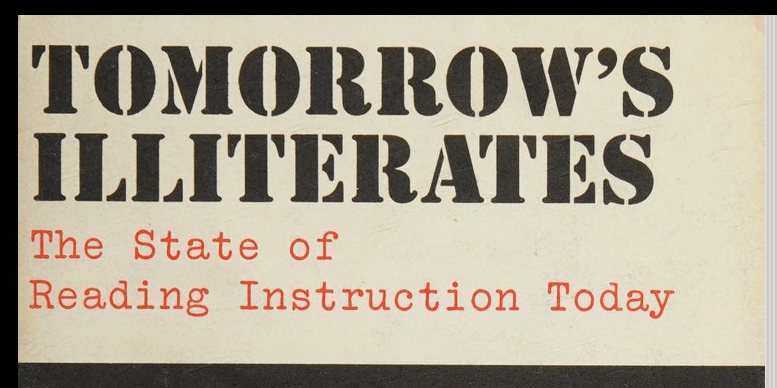
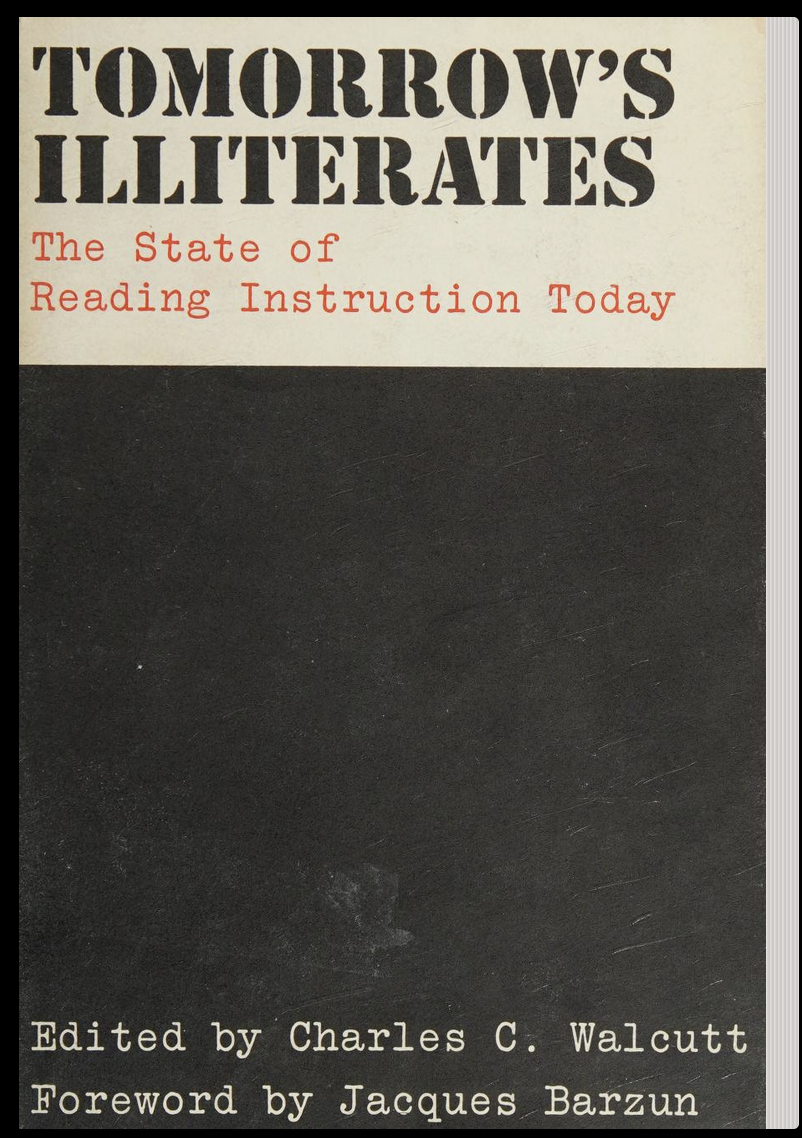
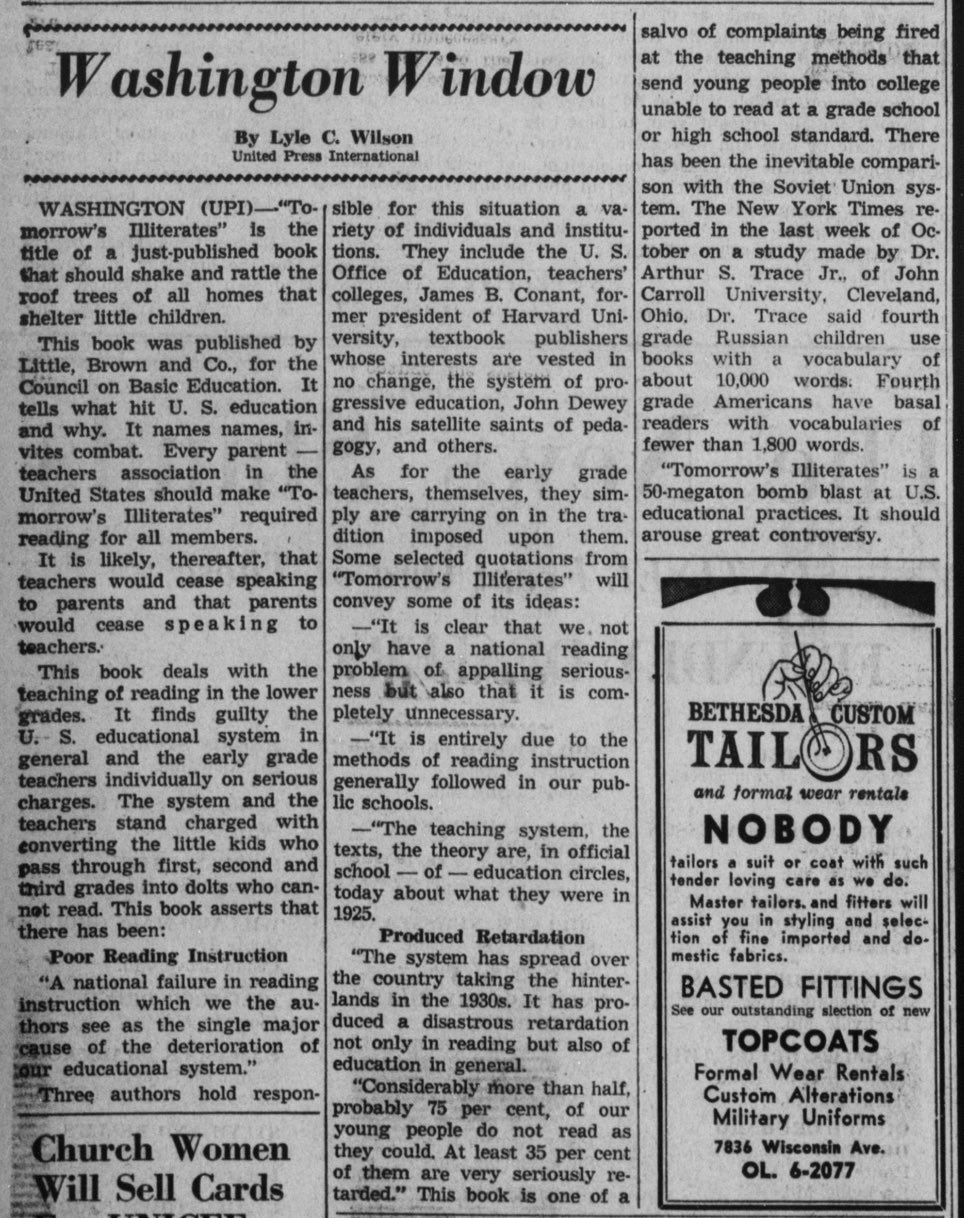
“After half a century of [progressive reform and expanding public education],” wrote Jacques Barzun in Tomorrow’s Illiterates: The State of Reading Instruction Today, “we who run businesses, carry on professions, work for the government, or engage in teaching itself are forced to admit that illiteracy is still with us” (xii-xiii).
This was published in 1961, and the cause of illiteracy Barzun confronts may sound familiar to those of us in the 2020s: “the loss of the proper pedagogy in the lower schools…, the goal of seeing whole words instead of letters” (p. xiii).
Barzun pleads, “the citizen who is interested (and who has managed to learn to read) [may have their] hair [stand] on end at hearing what folly has been condoned as educational theory during the past thirty years” (p. xiv).
Along with Barzuns dismay about how reading was taught and what passed for “reading theory,” he mused at the end of his Introduction: “Shall we need another book like the present one, fifty years hence, about the misdeeds of the new simplifiers?” (p. xvi).
Considering Barzun lived to be 102, dying in 2012, he may have had what little hair remained stand on end to watch the reading crisis return in the 1990s (the national meltdown over whole language) and 2000s (the National Reading Panel era). And if he could have just held on a bit longer, the current “science of reading” (SOR) onslaught that takes its playbook from the very volume that includes Barzun’s hand wringing now some 60-plus years ago.
Despite the authors’ lamentations in this volume (along with others in the 1950s and 1960s that held forth again progressive education and whole word reading instruction), neither the US nor the world collapsed due to misguided reading instruction or theory.
Shouting “reading crisis!” has proven to be more hobby that credible pronouncement, and ironically, if folks would find the time to read a bit (I recommend this book, b the way), it doesn’t take long to see the arguments as mostly nonsense and wild overreactions grounded in ideologies.
Let me show you a few examples beyond Barzun’s smug and sensationalistic Introduction.
Walcutt, editor of the volume and also author of Chapter VII, offers and opening chapter that takes a full swing at announcing a reading crisis as well as casting plenty of blame. Much of the chapter should sound eerie similar to those familiar with Emily Hanford’s journalism and podcast, patterns that pervade the entire volume.
Walcutt starts by showing evidence of claims of a reading crisis (somehow avoiding credible evidence of a reading crisis). This is particularly interesting because of the strong connections made about low literacy, special needs, and what children are suited for higher education and what children should move from high school into the workforce. Of note, Walcutt mentions Samuel Orton (of Orton-Gillingham), but provides no citation, when discussing disability (p. 8)
If nothing else, the certainty exhibited by Walcutt framed against how much of that certainty comes off as deeply misguided, and by today’s standards, offensive and dehumanizing should give all of us pause about our own certainty and blanket claims.
However, note that immediately follow Walcutt’s arguments about low literacy, he immediately shares a single example of a school that excels at teaching reading! Yes, even in the 1960s, there were claims of miracle schools: “In a school of 700 pupils, there are only 20 with reading problems….We cannot stress too positively that fact that in this school every child learns to read independently in the first grade, unless he is mentally retarded [sic] or disabled”—a percentage oddly close to SOR claims that 90, 95, or 96% of students can be proficient readers (pp. 10-11). [Nowhere is terminology such as “independently” defined or linked to how these claims are verified beyond the claims of the school. We also have no demographics on students or how those students compare to a generalized populations of students.]
We should note that these extraordinary claims have no proof, no scientific research—just claims and anecdotes.
Walcutt does launch into a few pages of “facts,” including data mostly grounded in IQ testing. One example is a reference to the 1940s reading crisis based on the draft for WWII; note that this reading crisis was strongly discredited by literacy scholars as a false attack on progressive education.
Walcutt’s facts also criticize popular commercial reading programs (Macmillan) and associate low literacy with delinquency and low IQ.
Then comes the direct blame, which, again, will sound familiar: “One way to describe the reading problem is to say that it is a teacher problem and —even more—that it is a problem of the teaching of teachers” (p. 18).
And of course: “The assertion that the reading experts do not understand the theory of their system can be demonstrated if we point out the false assumptions, the faulty extrapolations from scientific research, and the absolute contradictions that appear in its central propositions and procedures” (pp. 19-20).
Walcutt then discredits the look-and-say method that he claims dominates reading instruction—although we are left simply to trust that the characterization is both fair and as universally applied as he claims.
Walcutt also traces look-and-say back to Horace Mann, although, again, we must trust this analysis is credible.
Embedded here is a big picture characterization-as-criticism:
This says that reading for meaning has supplanted reading for pronunciation, or even word-recognition, and that some teachers teach only reading for meaning (presumably by whole sentences), ignoring phonics completely on the theory that the child who can read for meaning will pick up his phonics incidentally and without special instruction or effort, but he will read for meaning before he can sound out a word” (p. 31).
In the 1990s, this is the same argument leveled against whole language; today, this is the same argument leveled at balanced literacy.
After Walcutt spends a great deal of time metaphorically discrediting the look-and-say method (an extended bird analogy), he ends melodramatically (but not scientifically): “With this rickety equipment the look-and-say bird has flown for more than thirty years, casting a huge shadow over the lives of our children” (p. 43).
Daniels and Diack start with exploring different definitions for reading, using another analogy (driving a car). Much of the discussion focuses on concerns about reading through whole word methods, leading to the authors noting their own research on reading errors.
Again, they criticisms seem mostly grounded in disagreements with Dewey and Gestalt psychology. This leads to a discussion of new reading primers, which they criticize as lacking and boring because of efforts to identify and use a necessarily limited number of sight words.
As an artifact of the recurring patterns of the Reading War, this chapter highlights the problems with reading programs and primers grounded in narrow theories and philosophies of reading, but it also demonstrates the complexity of the debates in their final paragraph: “But having said this, we must add that, though the unit of accomplished reading is the word, the phrase, or even the sentence, the unit of learning to read is the letter. These are not two contradictory, conflicting aspects of reading; the one agrees with the other. However, present anxieties about the teaching of reading stem from failures to distinguish between, and indeed actually confusing, these two aspects of the reading process” (p. 67).
McCracken explains that the New Castle Reading Experiment was published in the book, The Right to Learn, and thus, “Its most important contribution to reading is its proof that the ‘reading readiness’ program is both meaningless and harmful” (p. 71).
This chapter includes a claim that seems common across decades: “Today reading specialists have a long list of reasons why about one third of the public school children can’t read” (p. 80). [Note that despite claims by SOR advocates, NAEP reading scores have been fairly flat with about 30% of students below basic, which is below grade level approximately.]
McCracken represents as well the “poverty is an excuse” faction in the Reading War, arguing: “It is folly to blame poor reading on distracting home influences….Children will learn to read if they are taught to read….If they don’t learn to read it is the fault of the teaching, not the taught” (p. 82).
If fact, McCracken continues, “The reading readiness fad as we have described it here was invented to excuse poor reading instruction by shifting the entire blame to the child….Almost every five-year-old child is ready to learn to read the day he enters school if the reading program is ready for him” (pp. 82, 83).
But, alas, “Reading instructional method in this country is abysmally poor, and blaming the matter on the child is never going to provide any improvement” (p. 84).
Lowe shares an anecdote about a 28-year-old who holds a high school diploma designated with “Honors”; yet, Arthur cannot read.
Of course, such stories have been highlighted throughout the twentieth and into the twenty-first centuries; they are tragic but are none the less anecdotes, proving nothing that can be generalized about how children are taught to read.
Lowe, like the other authors in this volume, has an agenda so as is common in all the eras of the Reading War, their are bait-and-switch tactics, never grounded in valid evidence or claims.
Notable, Lowe recognizes that standardized testing of reading can and was gamed to meet the ways students were taught to read; she accuses reading tests focusing on predicting means that “the best predicters are rated the best readers” (p. 103)
The agenda is to attack, you may be surprised, teaching children to guess at words by using pictures: “How can he learn to read words when he is taught to look and think about pictures?” she ponders (p. 104).
Lowe also mentions Orton (in this volume paired with Gallagher, not Gillingham), again without citation.
Rawson’s chapter demonstrates a few key patterns found in today’s Reading War. First is the tension between teaching reading and how to identify students with special needs such as dyslexia.
Rawson argues that “children with reading disorders are not usually referred to us for examination and treatment until they reach the third grade” because of the look-and-say curriculum.
However, “Children…who have been taught for the first grade…to sound out words—that is, by the phonetic method—approach reading differently. They do not need picture clues” (p. 132).
She calls for phonics-first instruction, and no guessing using pictures, to prevent dyslexia, in fact.
[Ch. VI deals with the claimed link between reading “retardation [sic]” and delinquency.]
Walcutt returns and offers the anchor chapter with the stunning opening line: “We have said that no further ‘research’ into methods of reading instruction is necessary” (p. 141).
The chapter is dedicated to an overview of phonics-based reading programs that, he claims, show that reading research is settled—in 1961.
So here you have essentially the exact same arguments made in 1961 that are being used in the SOR movement.
This is basically a silly book, filled with anecdotes and overstatements. But the SOR movement is no less silly, no less bombastic, and no less futile.
We persist with the same arguments getting us nowhere.
Maybe the problem is the arguments, the silly adult bickering.
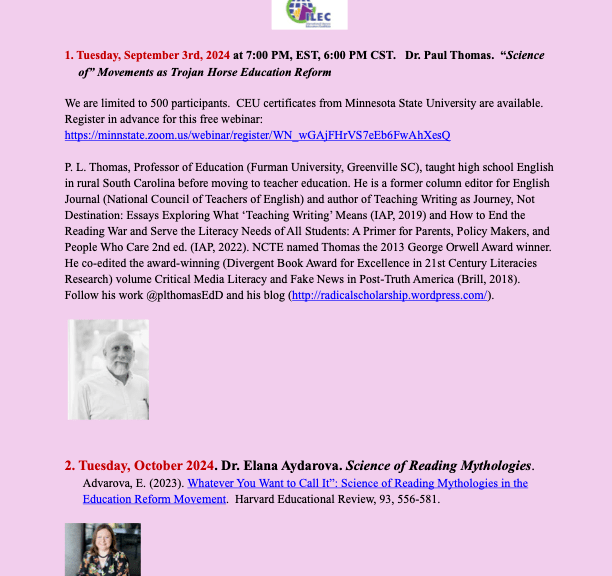
In 1961, Jacques Barzun in Tomorrow’s Illiterates declared “illiteracy is still with us.” Charles Child Walcutt added: “[N]o further ‘research’ into methods of reading instruction is necessary.” This session examines reading crisis/reform cycles to reconsider the stories told about reading and offer a new approach for reform that serves the needs of students and supports teacher professionalism.
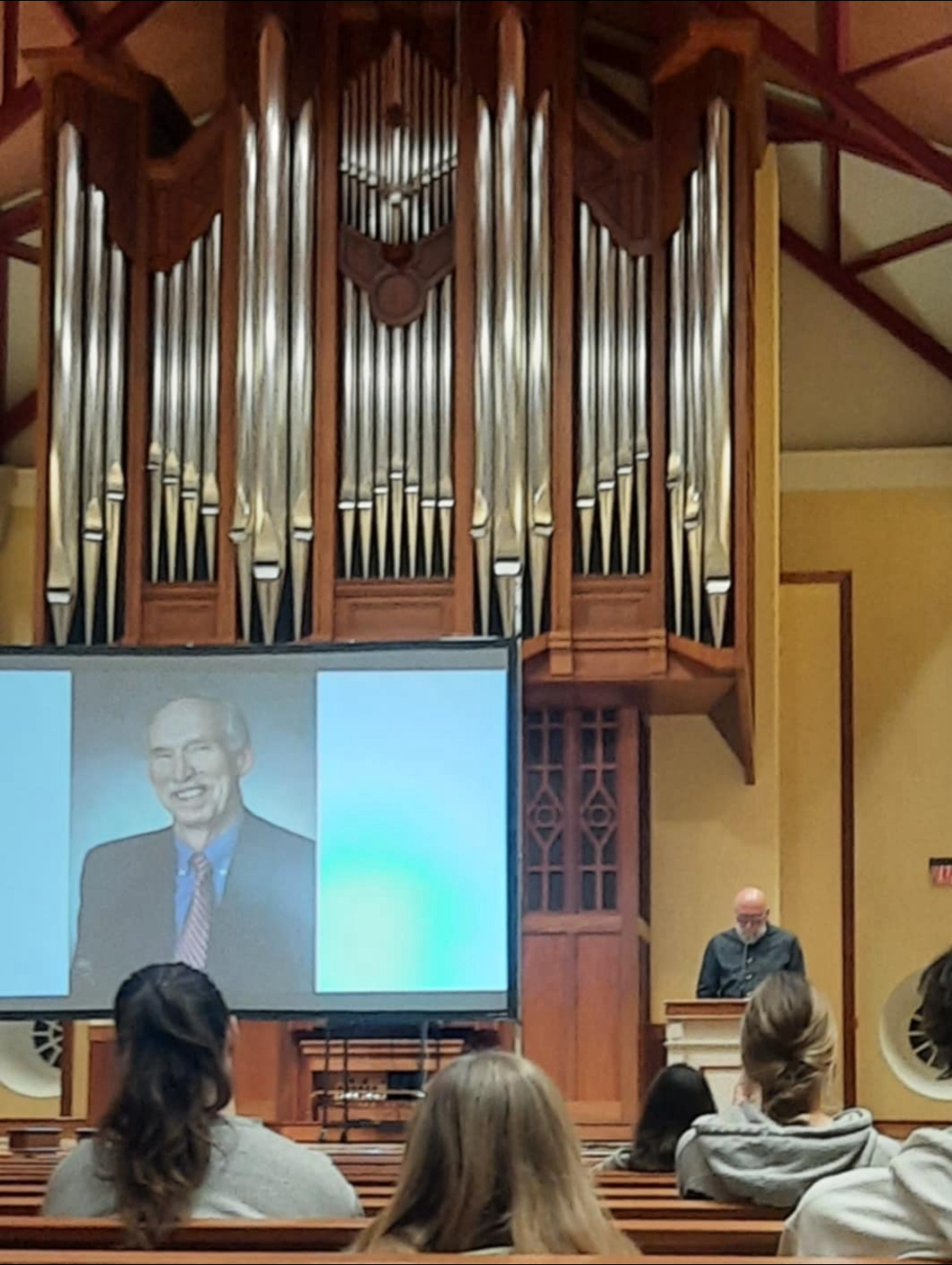
What Really Matters: I Am Thinking about People Tonight
P.L. Thomas, Furman University
Prelude
This is a prelude. This is not what I had originally written for tonight.
Just over a week ago, I woke to learn that Trump had been elected again as the president of the US. Along my immediate despair, I felt that I would not be able to give this talk, to share What Really Matters when so many people had just chosen that so little matters.
I almost immediately thought about a former student who has a trans daughter. I have watched that family choose love and also watched how that choice of love has been met with anger and hate, making their journey more difficult than necessary. Far less humane.
I love my former student and her wonderful family. A family facing an impending doom that is now darkening their frail but blossoming hope.
We are connected on social media, and watching this all unfold in their daily lives is overwhelming, saddening, and even maddening.
Of course, I cannot give in to despair, and so, next is what I had planned, an early draft written in a rush of inspiration when I was so kindly invited to share this with you tonight.
This then is my …
What Really Matters
I am thinking about people tonight.
I am thinking about Jim Edwards.
Jim was a much loved and highly respected professor of philosophy for 41 years at Furman, his alma mater.
If you look up anything about Jim, you see he was born in Columbia, SC, but he always went out of his way to say he was a son of Woodruff, my hometown.
Any time I would see Jim he would smile and say, “Who would have ever imagined two boys from Woodruff, professors at Furman University.” You could hear in that voice a kindness, a reverence for both that town and this university.
I wish Jim could be here because I know what he’d be thinking.
I am thinking about people tonight.
I am thinking about my mom and my dad, Rose and Keith Thomas.
My father and mother both died in 2017. My father in late June. And then my mother in early December, just several days before her birthday.
The end was slow, awful, and premature for my parents. I watched them die while living the reality of the consequences of having little money at the end of your life.
My parents’ death taught me a lesson, in fact: The healthcare system in the US doesn’t care about anyone’s health. It is the bank account that matters.
But I have so much of my parents in my memory, a memory that I am learning is flawed at best.
After tropical storm Helene devastated Western North Carolina and Asheville, I have been trying to recover, trying to recreate as much of my family as I can, specifically my mother’s family who lived for about a decade in Asheville during the 1960s.
After my parents died, my nephews and I cleaned out my parents’ house, the only real capital they left behind and likely the thing they were most proud of. Part of what we held onto was hundreds of pictures that my oldest nephew, Tommy, sifted through and had many scanned.
I have been looking through them all trying to find Asheville pictures. Recently, Tommy dropped by two containers of pictures and other things, most of which have not been scanned.
And there among the pictures, I found letters. A few from my mother to my father in 1960 while they attended Spartanburg Junior College (now Spartanburg Methodist College).
The college was very strict about relationships, including no public displays of affection. However, one day on my mother’s lunch break while working as a cashier at a grocery store, my mom and dad slipped off and were married at the courthouse, although marriage was also not allowed for anyone attending the college.
This led to their coded dialogue. Dad was “Honeybun” and Mom was “Nut,” the only two words on the envelope of one letter. As long as I can remember, my dad would say to my mom, “You tickled me nut,” meaning “I love you.”
My father told stories about that courtship over and over throughout my life. They were happy stories, and they reinforced the happy parents I enjoyed during my childhood and teen years.
I also found a stack of letters my mother wrote from Lumberton, NC just after I turned one year old. My mother, you see, had left my father and moved back in with her parents (who moved constantly, mostly around NC but in SC also).
The letters have the return address at Southern National Bank where Mom was working. We also have her social security card issued while in Lumberton.
These letters are sad and imploring, and often confusing. By spring, my mother began signing letters “Love always, Rosie + Paul + ?” because she was pregnant with my sister.
One letter, as well, is a sweet one from my mother to my father’s dad, Tommy (my namesake since his given name was Paul Lee Thomas).
And then there are letters from my mom to my dad in 1964, three from Asheville and four from Woodruff/Enoree (they lived in a small mill village, Enoree, just south of the slightly larger mill town of Woodruff, SC).
My father was in the National Guard and training in Fort Gordon, GA. Similar to the love letters in college and the letters from Lumberton, these letters are filled with love and missing my father by my mom, my sister, and me.
But in all these letters, the thing missing is my father. No letters back, and several times my mother asking if he has forgotten how to write letters.
I do not know what to do with my parents.
Because I have now begun to recreate a new version of them, a new version captured well I think in many of the pictures that remain.
But I am recreating what I can with what I have, and this new version, I think, will find a new place in my heart that doesn’t have to know everything.
I wish my parents could be here because I do know what this would mean to them.
I am thinking about people tonight.
I am thinking about Pat Lanford. She was my first-grade teacher, and my first surrogate mother.
For those who know me, this will not be a surprise, but I was a momma’s boy. My mom taught me to read and play cards well before school. And instilled in me a love for science fiction. Her favorite movie was The Day the Earth Stood Still, and she introduced me to the sci-fi horror classics like Vincent Price’s The Fly.
So that transition to school was a hard one. I cried, I resisted.
But Mrs. Lanford was always loving and patient.
The story goes I was sitting in the back of class making car revving noises once. Mrs. Lanford said, “Paul, stop it!” So I made a loud tires-screeching-to-a-stop noise.
I think Mrs. Lanford that year adopted a common refrain, “Now, Paul!”
I am thinking about people tonight.
I am thinking of Mrs. Townsend, my second-grade teacher. She was a small woman, and her husband was Mr. Townsend, a highway patrolman. I was terrified of her.
The first day of school, she called the roll, and when she came to my name, she said I was named after my father.
This was Woodruff. Every knew everyone, and everyone knew my father and my grandfather, who ran the Pure Oil and then 76 gas station in the middle of town.
I said, “No, ma’am, I was named after my grandfather.”
First day of second grade I was sent to the hall for talking back.
That gas station I mentioned, it was Tommy’s 76, and everyone in Woodruff knew my grandfather as Tommy. But his name was Paul Lee Thomas, and I was Paul Lee Thomas II.
I had carefully explained that, and that if I were named after my father, Paul Keith Thomas, I would be Jr. and not II.
In the hallway I was terrified of my fate once I got home, but the next day, Mrs. Townsend took me in the hall—not in front of the class—and apologized. That was over 50 years ago, and I remember that as if it were last week.
A couple decades later, I was a teacher at Woodruff High. On the first day of class, I was checking roll, including a student Billy Laughter (spelled L A U G H T E R). Thinking I would be funny, I pronounced his name as “laughter.” Billy was a big guy, redneck in overalls, and I watched as his neck and face began to turn red.
I quickly added, “Billy, I thought I was being funny. I know your family name is Laughter and I also know that wasn’t funny. Sorry.”
The red subsided and Billy stopped contemplating how much trouble he would be in for strangling a teacher.
A lesson Ms. Townsend never knew she taught me. A lesson that both Billy and I appreciate.
I am thinking about people tonight.
I am thinking about people, you may be starting to recognize, who profoundly shaped me to be the person I am standing before you.
That began with my parents, but this list so far and to come, I must emphasize, has mostly been teachers, the profession I too have chosen—or the profession, like being a writer, that I came to recognize is who I am.
I think that recognition of being a teacher is in part out of a debt I feel to all of those people, all of those teachers, in and out of classrooms.
Sometimes I take a few moments and recall all of their names, and I can name nearly every teacher I had from first grade through my doctoral program.
I don’t want to forget.
I am thinking about people tonight.
I am thinking about Mrs. Parks, my first Black teacher, third grade, who taught me the year Woodruff incorporated the previously Black-only schools into its school system.
Integrating came to Upstate SC slowly, into the late 1960s and even into the 1970s.
My mother took a job in the school office that year because my sister and I would be attending that school in the Black neighborhood of Woodruff, Pine Ridge, that literally sat on the other side of the railroad tracks.
Mrs. Parks delivered the first lesson of my life about racism because a student had uttered the N-word. She made us all get out our dictionaries and proceeded to explain to us that the racial slur had its roots in a word that meant “dirty.”
She was calm, stern, and amazingly practical with a room full of third graders, many of us white students living daily in racist homes where that word was commonly used by our parents and nearly every white person we knew.
It was the first time I started to understand there was something profoundly wrong about the words and anger of white culture while I spent my days at school with friends both Black and white.
I am thinking about people tonight.
I am thinking about Mrs. Simpkins.
Mrs. Simpkins was my 6th-grade math teacher. She had two sons, one a year younger and one a year older than me, Clark and Scott. We went through school and played basketball together. A few after she was my teacher, her husband was my high school principal and would also be my first principal when I became a teacher.
They were from Moncks Corner, SC, and once when I was over playing basketball with Scott and Clark, Mrs. Simpkins warned us, “Now, boys, don’t you get in that rud.”
Like most of her students, I loved but was also terrified of Mrs. Simpkins, and I found myself worried about her warning. When I asked her sons what the “rud” was, they laughed and clarified, “The road, the road!”
I am thinking about people tonight.
I am thinking about Harold Scipio.
By high school, Mrs. Simpkins and other teachers had instilled in me a belief that I was a math and science student. Mr. Scipio taught me chemistry and physics, and further convinced me that my future lay in the sciences.
Mr. Scipio was a tall, thin, and even-speaking Black man who printed meticulously on the overhead as he taught. He referred to all his students with “Mr.” and “Miss” and our last names—I was Mr. Thomas—explaining that since we had to address him as Mr. Scipio, he felt he should do the same.
At a banquet near the end of my senior year, as we were cleaning up afterward, he smiled and called me Paul. It was after school hours and I was about to graduate. He was telling me we were both just people, we were equals.
I can still see and hear that moment today.
And the other moments I will never forget were when we took tests. Mr. Scipio would casually walk in and out of the room, often staying out of sight in the back of the lab cleaning lab equipment.
The first time that happened, we all looked around making eye contact, realizing that these tests were about more than chemistry or physics.
He never said a word about this behavior, but I knew even as a teenager that Mr. Scipio was showing us you don’t cheat or lie, especially to those people who treated you with dignity and respect.
Many years after I graduated and had taught high school for almost two decades, I was at dinner being interviewed for this job at Furman. Nelly Hecker, Hazel Harris, and I were talking after a day of interviewing when I saw Mr. Scipio sitting at a table nearby.
I walked over, and when I told him what I was doing, he beamed.
I think at that moment I knew I would take the position if offered.
I am thinking about people tonight.
I am thinking about Lynn Harrill.
Strands of the webs of my life keep breaking.
That is an inevitable consequence of living into your 60s, and hopefully beyond.
I received a text message in July that my high school math teacher and later teaching colleague had informed a group of people that my high school English teacher, Lynn Harrill, passed away.
He had been suffering from Alzheimer’s—something I found out about second hand, explaining several months of fruitless phone calls from him when he never spoke—but the end came quite awfully after Covid prompted a stroke.
I sat on the couch with my partner, and there was nothing I could do except a sudden and deep burst of crying.
This reminded me too much of my mother’s death—a sudden stroke and then dying of cancer a few months later—and my father dying sitting beside my mother right after that stroke.
The end is always too, too awful, and humans, we are too, too frail.
Lynn was a wonderful human and a life-changing teacher who willed me to be a teacher and a reader and a writer.
Lynn taught me two years of high school English, and like Mr. Scipio, profoundly shaped me as a person.
I was that student who wandered into Mr. Harrill’s room any time I was free, talking endlessly, likely consuming time he didn’t have to spare.
Once he said I should consider teaching, and I laughed, thinking it was a ridiculous idea.
About 6 years later, I was sitting in the exact chair Mr. Harrill had been sitting in, teaching in the position he had left for the district office.
And that position here at Furman I interviewed for seeing Mr. Scipio at dinner? Lynn Harrill had just left Furman, and my office is the one he picked out and furnished when Hipp Hall was first opened.
Few days pass without me thinking of Lynn.
No one had a greater impact on who I am than Lynn, and as he would attest, that is what teachers do.
I cannot move on from Lynn with sharing a poem from Emily Dickinson, who Lynn loved:
I am thinking about Steve Brannon and Dean Carter.
I now live in a converted textile mill just a couple miles from my first college, Spartanburg Methodist Junior College. It is there that my life transformed, grounded in Mr. Scipio but fulfilling what Mr. Harrill saw well before I did.
Mr. Brannon introduced me to e.e. cummings in his speech class, and I still recall the day I realized I am a poet and a writer while sitting in the dorm I pass when driving from my apartment to downtown Spartanburg, a poem mimicking cummings.
Dean Carter taught me survey literature courses, and when he wasn’t chastising me for wearing my high-top, leather Converse All-Stars unlaced, he convinced me to begin tutoring for the course, and it was during that experience I discovered my love for teaching.
At SMC, Dean Carter and Mr. Brannon gave me the gifts of being a writer and being a teacher, gifts built on all the gifts of teachers before them.
I am thinking about people tonight.
I am thinking about Richard Predmore and Nancy Moore.
Called USC-Spartanburg at the time, my undergraduate experience became a journey in English and education thanks to Mr. Brannon and Dean Carter.
Dr. Predmore, meticulously writing in pencil on my essays, and Dr. Moore—introducing me to Ralph Ellison, Langston Hughes, and Alice Walker—completed the transformation of my nerdy math and science self into the person who would spend his life with books, literature, and teaching.
Richard was demanding, and Nancy was encouraging and kind. I find myself always trying to emulate those qualities as I teach my college students.
I am thinking about people tonight.
I am thinking about Ann Shelley, John and Mark.
Dr. Ann Shelley taught me at USC-S during my MEd, and after that, she and I did research together in my classroom at Woodruff High. Ann was gracious to have me co-author my first scholarly works years before my doctoral program.
But I also would become colleagues with her son Mark at WHS, where he started a long and stellar career as an educator. And as many of you here know, I would later be a colleague with Dr. John Shelley a cherished faculty member at Furman for decades in the religion department.
I am thinking about people tonight.
I am thinking about Lorin Anderson and Craig Kridel, the chair and anchor of my doctoral committee. [Craig is kindly here with us tonight.]
Once again, Ann’s foundation of me as a scholar was finally fully realized in my doctoral program, one recommended by Lynn Harrill.
I cannot stress the great fortune it was for me to have Lorin Anderson as my committee chair. He was practical, patient, and above all else, like many of the people I have mentioned tonight, incredibly supportive of me as a scholar.
And Craig Kridel introduced me to Joseph Williams’s book Style, and one of the most important people I have yet to mention tonight—Lou LaBrant.
Craig is a giant in the world of educational biography, a field—what I have tried to do here tonight—that centers people to stress what really matters.
Through Craig, I met in person Maxine Greene, and interviewed Louise Rosenblatt.
But most of all, I was entrusted with the legacy of LaBrant, for which I can never repay Craig, himself a person who has always treasured that people above all else, people are what really matter.
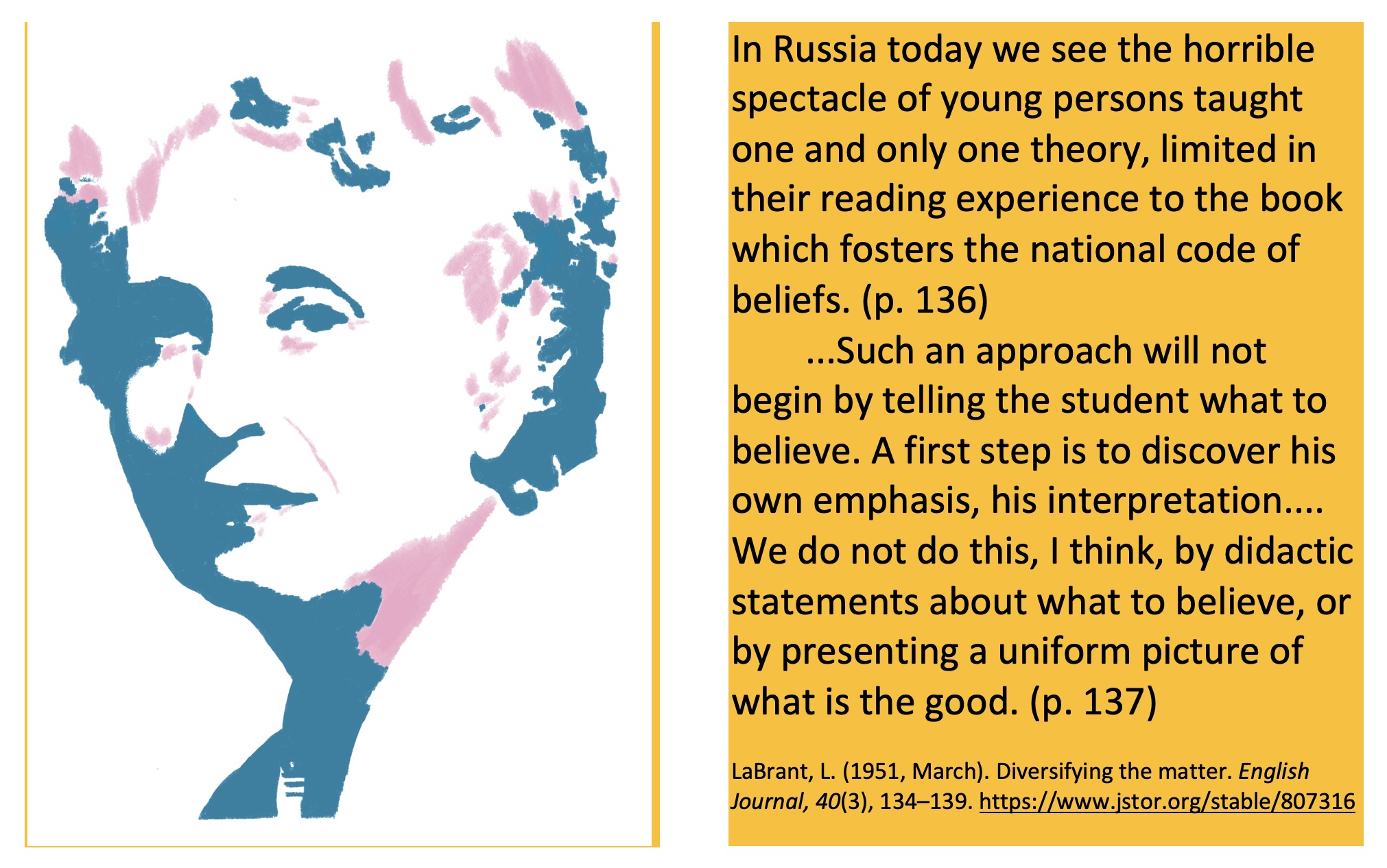
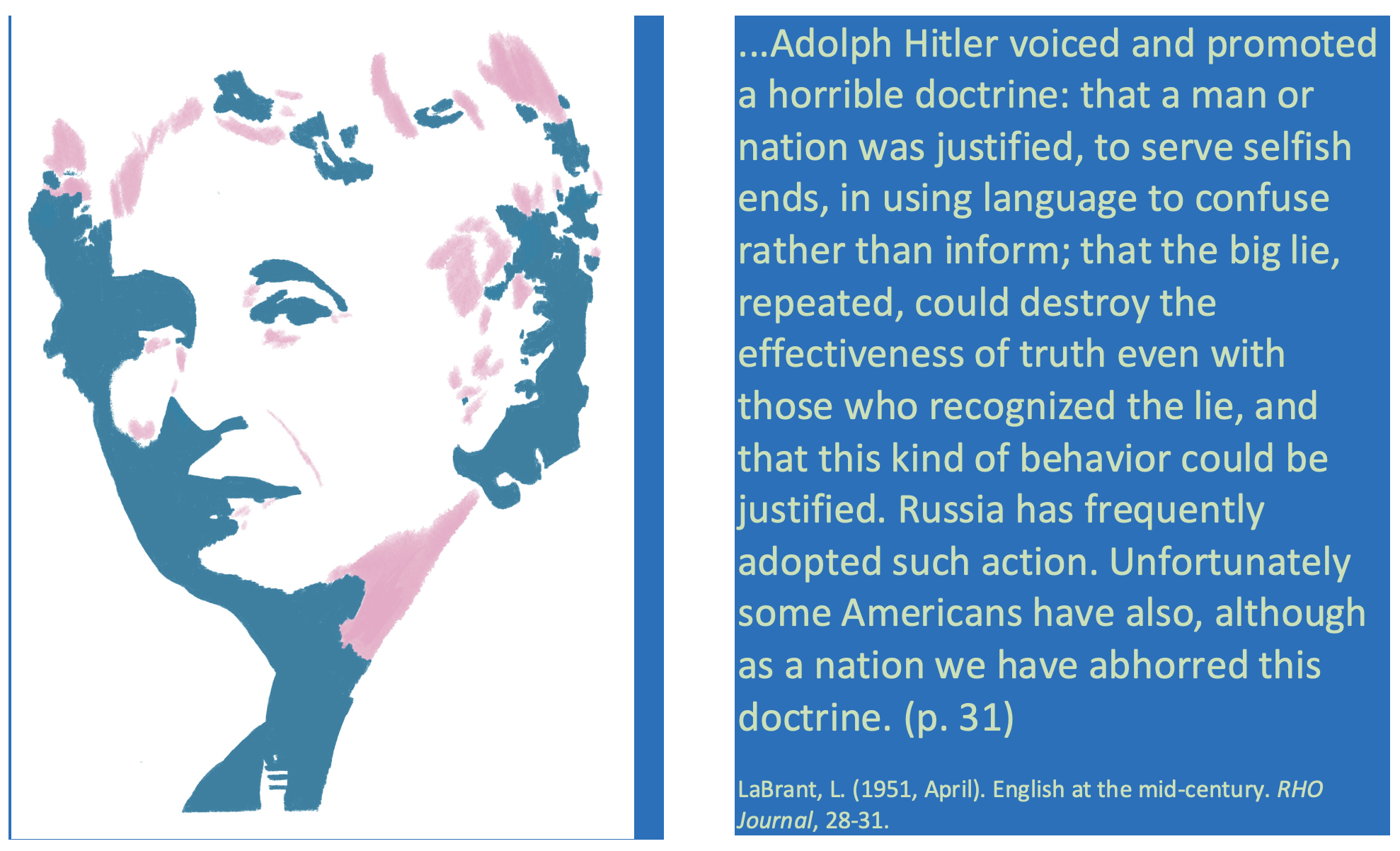
I am too much indebted to Craig to simply thank him, so instead, I want to share a few words from LaBrant, a now constant voice, a sort of sound track for my life who continues to speak into a world too often like hers mid-twentieth century:
LaBrant, L. (1951, April). English at the mid-century. RHO Journal, 28-31.
I am thinking about people tonight.
I am thinking about the people devastated by Hurricane/Tropical Storm Helene. Especially in WNC and Asheville.
Asheville was a central part of my life in the 1960s when my mother’s family lived there.
My mother’s parents can be fairly described as “characters.” Even as a small child, I found them fascinating, fun, and a treat to visit. The thing that is most distinct about them—Harold Sowers and Edith Mize—was that most people called them Slick and Deed.
And then there is their Asheville.
It sweeps over me, more than a memory, more like a flashback, every time we drive into Asheville on Hwy 25 and pass through a tunnel.
The rock tunnels of Asheville and the very distinct area of West Asheville are buried in my child’s brain from trips in the 1960s and 1970s.
As an adult, much of my life included the close mountains of Tryon and Saluda, NC as well as frequent trips to Asheville—for MTB trails, gravel riding, and the explosion of breweries that many people now associate with the bohemian city.
Asheville has become gentrified, and the South Slope introduced the town to tourist beer drinkers. I know locals and long-time Asheville folk (my aunts and uncle included) likely regret these changes, but my life has spanned both Ashevilles in almost completely positive ways.
But with the help of my aunt Lynda (second oldest of five children by Slick and Deed, my mom the oldest by several years), I have reassembled some of what my fractured memory holds.
Slick and Deed moved the remaining family (my mother was married and living in Enoree, SC) from Roanoke Rapids, NC to Asheville in 1963. Moving was normal for the Sowers family; my mother attended 4 high schools, including in Pendleton (SC), Concord (NC), Lumberton (NC) and Union (SC), graduating finally from the latter.
Slick had trouble keeping work, although he mostly moved the family from mill town to mill town.
Asheville proved to be some stability for Lynda, Buddy, Mary, and Patsy—my aunts and uncle. However, they lived in four different houses, and Deed eventually secured the managing job at a motel on 690 Merrimon Avenue, Sunset Court Motel.
My aunts and uncle lived through the often violent integration era for schools in Asheville, attending Asheville High (which was named Lee H. Edwards High School from 1935 to 1969).
Uncle Buddy was eventually expelled from there—he had pictures of the bruises from repeated beatings he received as a high school student—and moved in with my parents in Woodruff where he graduated high school before serving in Vietnam.
Two of the most traumatic events for the Sowers family occurred in Asheville.
Slick fell and broke his leg while drunk, but Deed refused to help him.
I recall my mom talking on the phone and finding out he had a compound fracture and had to drag himself inside to call for help while Deed sat on the porch.
Soon after, Slick, drunk again, threatened Deed with a gun.
These extreme events, it seems, prompted Deed to seek the motel managing work to help provide the family some stability.
Another place that likely has the most consistent memories for me with family is Myrtle Beach, SC.
It was about a four-hour drive from Woodruff in the Upstate of SC, and for most people, Myrtle Beach was a somewhat expensive vacation destination (but, to be fair, this was a working class and middle class beach with the beaches for wealthy people further south near Charleston or North Myrtle Beach).
My working-class parents visited Myrtle Beach in off seasons; I mostly recall the beach in December, in fact. We have many pictures of Myrtle Beach covered in snow; I think we were there for the heaviest snowfall recorded for the area.
Slick and Deed loved Myrtle Beach, but as a family with very meager resources (often as a result of Slick’s alcoholism), they were also resourceful.
Usually in the off season as well, Slick and Deed arranged to help manage the Victory Motel in Myrtle Beach.
In many ways, the Sowers’ world was volatile like the 1960s, but my childhood was more than an hour away, allowing me to hold onto idealistic memories of my family.
And finally.
I am thinking about people tonight.
I am thinking about John Irving, Kurt Vonnegut, Maggie Smith, Eugene V. Debs, Ralph Ellison, and James Baldwin.
I am an old—in more ways than one—English teachers so you’ll have to excuse my ending with literature. Like teachers, authors are the people who made me, the people who saved my life and continue to save my life.
One of my favorite writers is Kurt Vonnegut, who was not only an era defining novelist but also a teacher of writing. And Vonnegut on occasion has noted that one of his best pupils was novelist John Irving, who gained famed for The World According to Garp and The Cider House Rules, both of which were popular novels and films.
In John Irving’sA Prayer for Owen Meany, which builds to being something of a Vietnam War novel, John Wheelwright, narrator and friend of the titular character Owen Meany, offers a key scene in Chapter 1:
We were in Rye, passing the First Church, and the breeze from the ocean was already strong. A man with a great stack of roofing shingles in a wheelbarrow was having difficulty keeping the shingles from blowing away; the ladder, leaning against the vestry roof, was also in danger of being blown over. The man seemed in need of a co-worker—or, at least, of another pair of hands.
“WE SHOULD STOP AND HELP THAT MAN,” Owen observed, but my mother was pursuing a theme, and therefore, she’d noticed nothing unusual out the window….
“WE MISSED DOING A GOOD DEED,” Owen said morosely. “THAT MAN SHINGLING THE CHURCH—HE NEEDED HELP.” (pp. 33-34, 35)
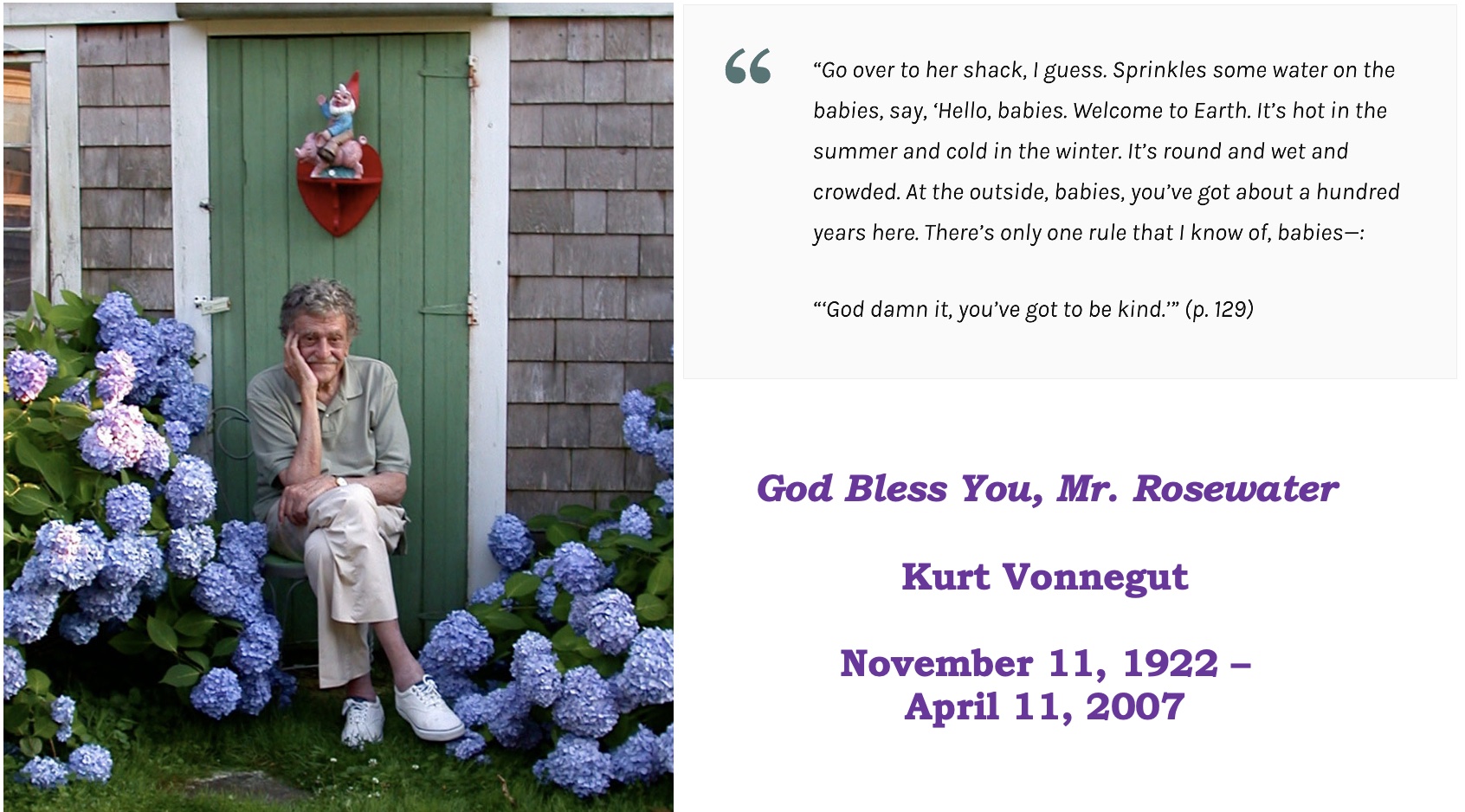
“Go over to her shack, I guess. Sprinkles some water on the babies, say, ‘Hello, babies. Welcome to Earth. It’s hot in the summer and cold in the winter. It’s round and wet and crowded. At the outside, babies, you’ve got about a hundred years here. There’s only one rule that I know of, babies—:
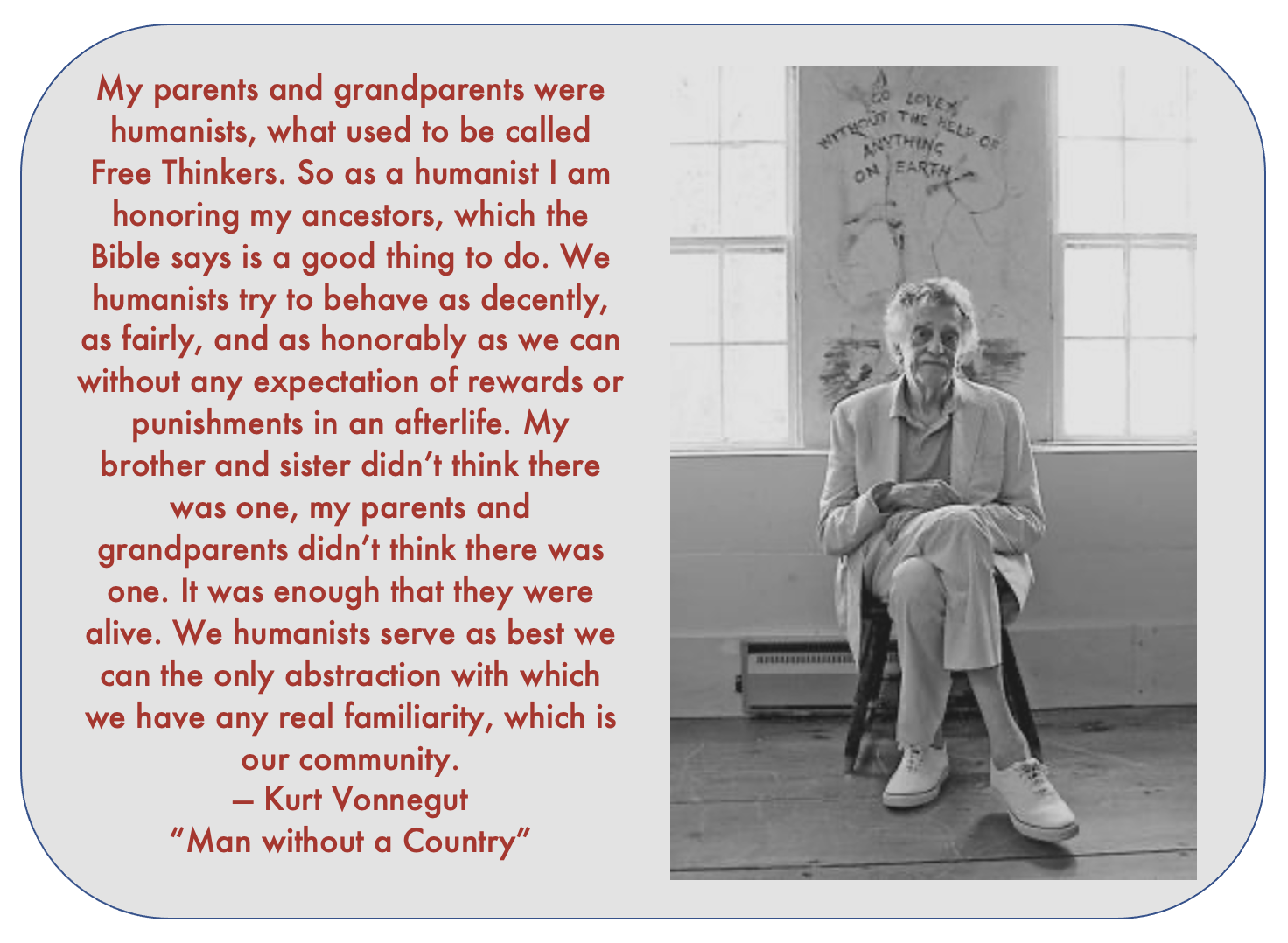
My parents and grandparents were humanists, what used to be called Free Thinkers. So as a humanist I am honoring my ancestors, which the Bible says is a good thing to do. We humanists try to behave as decently, as fairly, and as honorably as we can without any expectation of rewards or punishments in an afterlife. My brother and sister didn’t think there was one, my parents and grandparents didn’t think there was one. It was enough that they were alive. We humanists serve as best we can the only abstraction with which we have any real familiarity, which is our community.
Screenshot
Vonnegut also made a name for himself giving graduation speeches.
This is a long-delayed puberty ceremony. You are at last officially full-grown women—what you were biologically by the age of 15 or so. I am as sorry as I can be that it took so much time and money before you could at last be licensed as grown-ups.
If graduation speeches are meant to punctuate ceremony, then Vonnegut was going to throw cold water on ceremony.
If graduation speeches offer one last moment for sage advice from elders to the young, Vonnegut was going to say something to displease adults and disorient the young.
But always wrapped inside his curmudgeon paper was a recurring gift, one that tied all of his work together: Vonnegut was tragically optimistic and even gleeful about this world.
On cue, then, at Agnes Scott, Vonnegut rejected the Code of Hammurabi, revenge, and admitted he was a humanist, not a Christian, adding:
If Christ hadn’t delivered the Sermon on the Mount, with its message of mercy and pity, I wouldn’t want to be a human being.
I would just as soon be a rattlesnake.
Finally, to those young women, Vonnegut concluded:
I’ll want a show of hands after I ask this question.
How many of you have had a teacher at any level of your education who made you more excited to be alive, prouder to be alive, than you had previously believed possible?
Hold up your hands, please.
Now take down your hands and say the name of that teacher to someone else and tell them what that teacher did for you.
All done?
If this isn’t nice, what is?
I can’t end without more poetry because while my refrain here tonight is designed to argue that people really matter, I also believe that one of the most human of human behaviors is our urge to create and enjoy poetry, the very human urge to produce song with only words, to utter the unutterable.
One of the very best written in recent years, one that resonated when Trump was first elected and has, regretfully, gained renewed power, is “Good Bones” by Maggie Smith.
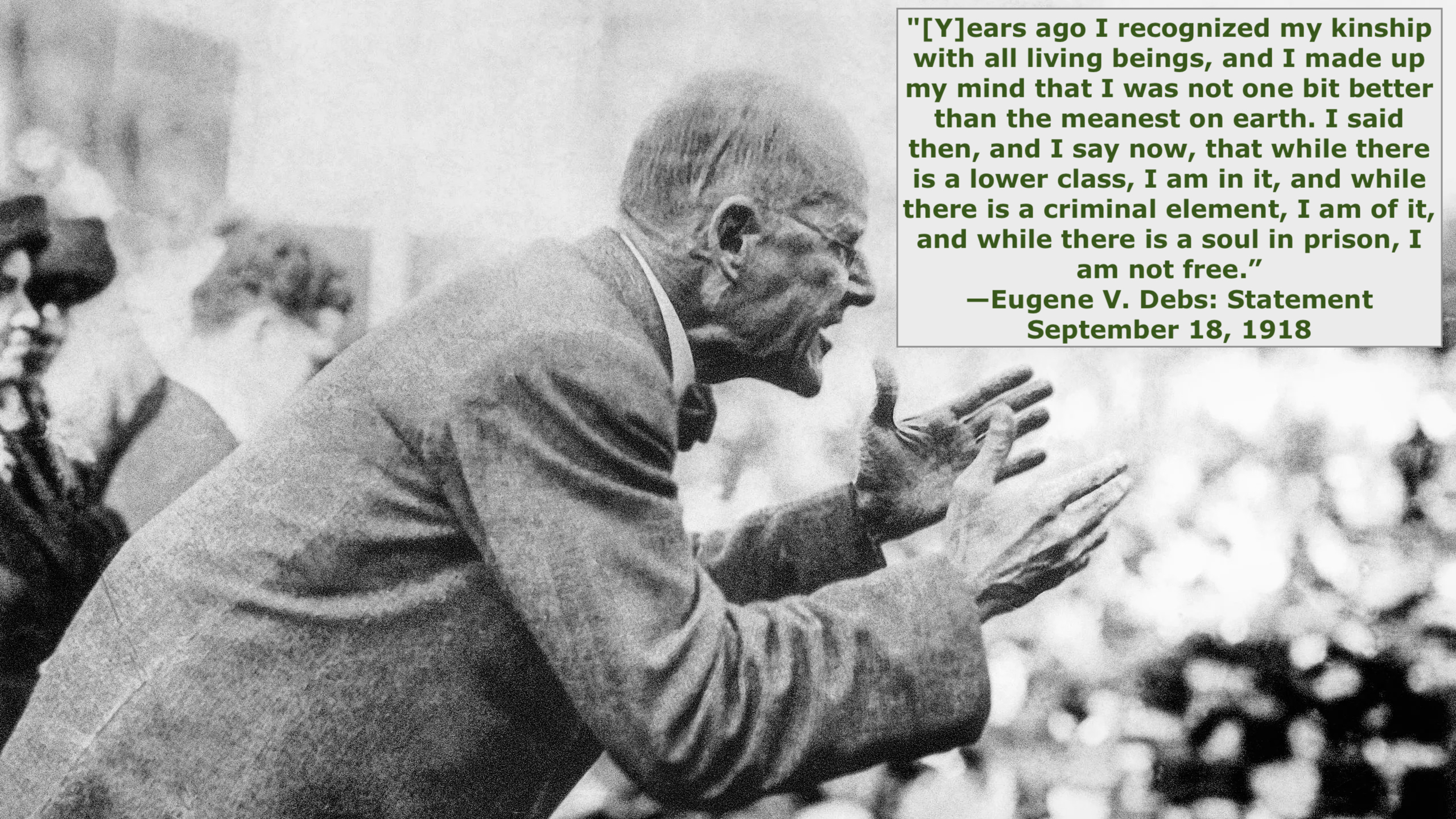
Because of Vonnegut, as well, I am indebted to Eugene V. Debs, a prominent Socialist candidate for president and activist.
I return to his words often:
[Y]ears ago I recognized my kinship with all living beings, and I made up my mind that I was not one bit better than the meanest on earth. I said then, and I say now, that while there is a lower class, I am in it, and while there is a criminal element I am of it, and while there is a soul in prison, I am not free.
In my teaching and writing, I also return often to Ralph Ellison, celebrated author of Invisible Man.
But the work that resonates is his talk to teachers, “What These Children Are Like,” from 1963. Ellison challenges the conventional wisdom about drop-outs and the deficit beliefs about language among rural and Black people. He ends with a wonderful recognition about the place of honoring who people are:
I don’t know what intelligence is. But this I do know, both from life and from literature: whenever you reduce human life to two plus two equals four, the human element within the human animal says, “I don’t give a damn.” You can work on that basis, but the kids cannot. If you can show me how I can cling to that which is real to me, while teaching me a way into the larger society, then I will not only drop my defenses and my hostility, but I will sing your praises and help you to make the desert bear fruit.
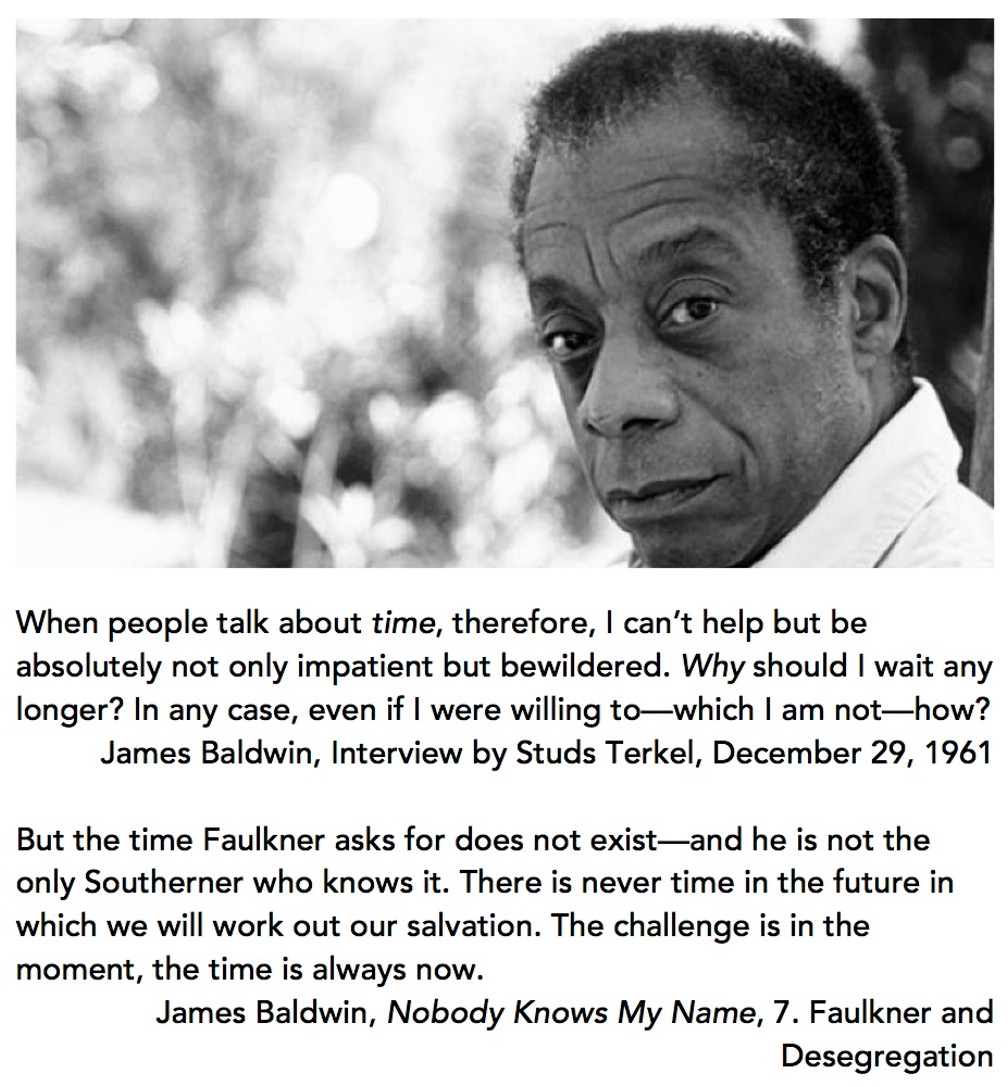
Jame Baldwin also gave a talk to teachers in 1963. Now 60-plus years ago, Baldwin could as easily be speaking to us today:
The purpose of education, finally, is to create in a person the ability to look at the world for himself, to make his own decisions, to say to himself this is black or this is white, to decide for himself whether there is a God in heaven or not. To ask questions of the universe, and then learn to live with those questions, is the way he achieves his own identity. But no society is really anxious to have that kind of person around. What societies really, ideally, want is a citizenry which will simply obey the rules of society. If a society succeeds in this, that society is about to perish. The obligation of anyone who thinks of himself as responsible is to examine society and try to change it and to fight it — at no matter what risk. This is the only hope society has. This is the only way societies change.
In the Prelude, I admitted my despair, and my momentary hesitation about trying to share tonight What Really Matters, but again, I must stand on the shoulders of giants, again Baldwin who argued, “There is never time in the future in which we will work out our salvation. The challenge is in the moment, the time is always now.”
I am thinking about people tonight.
What really matters? It may seem simple, but what really matters is people.
Love them while you have them here. Speak their names when they are gone to keep them in this moment.
We are all standing on the shoulders of giants, the people who were our teachers whether in classrooms of not.
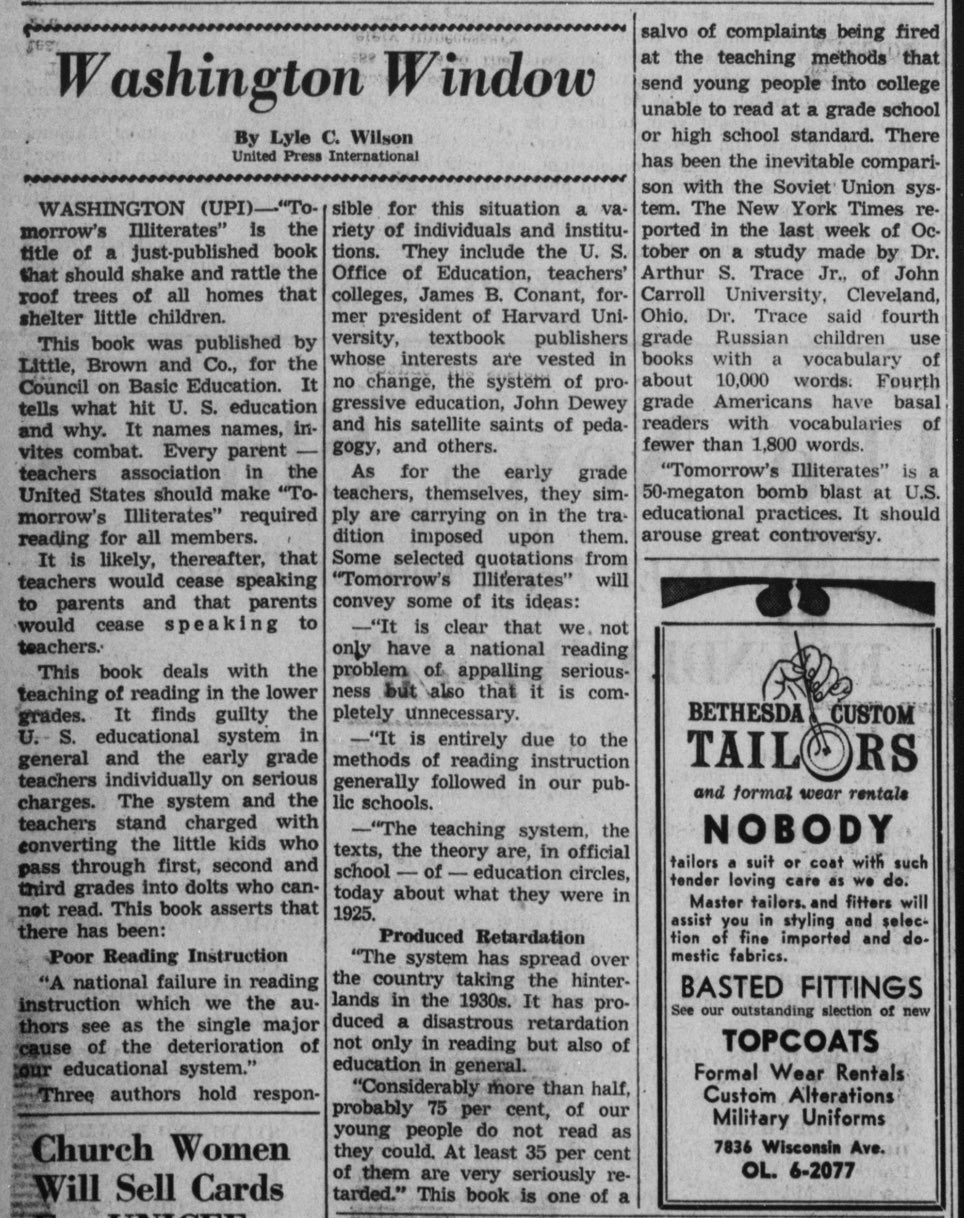
“Considerably more than half, probably 75 per cent, of our young people do not read as they could. At least 35 per cent of them are very seriously [behind].”
Why?
“A national failure in reading instruction which we the authors see as the single major cause of the deterioration of our education system.”
Dr. Elena Aydarova is an Assistant Professor in the Department of Educational Policy Studies at the University of Wisconsin-Madison and a fellow with the National Education Policy Center. Dr. Aydarova’s research examines the interaction between educational policies, education reforms, and policy advocacy. She is an award-winning author of over 40 publications. Dr. Aydarova received postdoctoral fellowships from the National Academy of Education/Spencer Foundation and the American Association of University Women.
Elena Aydarova; “Whatever You Want to Call It”: Science of Reading Mythologies in the Education Reform Movement. Harvard Educational Review 1 December 2023; 93 (4): 556–581. https://doi.org/10.17763/1943-5045-93.4.556
Thomas, P.L. (2024, May). Teaching English in the “science of reading” era: We teach English in times of perpetual crisis: Selling a story of reading. English Journal, 113(5), 16-22. https://publicationsncte.org/content/journals/10.58680/ej2024113516 [Access HERE until open access at EJ]
A couple years before that, I recall vividly looking up and reading about Beelzebub (which led to similar explorations of Mephistopheles) because I was listening to Queen’s “Bohemian Rhapsody” over and over.
However, at school in my English classes, I hated (no, loathed) our vocabulary textbooks, vocabulary homework, and vocabulary tests. Those tests, also, kept me a steady B student instead of my usual A’s in almost all of my classes.
I also hated and often avoided reading the books assigned in my English classes, but at home, I was reading every novel by Arthur C. Clarke and many popular science fiction works such as those by Niven and Pournelle.
And I was collection and reading 1000s of comic books, meticulously and with great joy.
Except for two years with my life-changing sophomore and junior year English teacher, Lynn Harrill (who was an early adopter of the National Writing Project practices), I had stereo-typically harsh and traditional English teachers throughout junior and high school.
Grade 8 was spent dutifully plowing through the grammar book—exercises and chapter tests. Grade 9 was diagramming sentences and then diagramming more sentences.
My senior year of high school, I sat in the room of an English teacher who literally wore a bun of grey hair and most of us found ourselves receiving inspiring grades on our essays (in bold red ink) such as A/F or B/F because the department had a detailed list of errors and point deductions.
A fragment or run-on sentence was an instant F on grammar (the bottom grade) as was 6 misspelled words.
Despite my highly literate (and mostly closeted) life at home, I graduated high school with a great deal of affection for Mr. Harrill but mostly hating English and planning to major in physics (making almost straight As in math and science classes).
Despite all that, five years later, I sat in Mr. Harrill’s room, replacing him as an English teacher. I had also discovered in the mean time I was a writer.
Mr. Harrill planted some important seeds, but even in his much more progressive class where we wrote essays instead of marching through grammar books, he was mostly canon-centric (telling me to stop reading science fiction and read Fitzgerald instead)—and, yes, those damn vocabulary books.
My career as an English teacher started in 1984 with me seeking ways to avoid many of those problematic practices that essentially were barriers to my discovering and embracing my literacy life as a teen.
Let me point out that my journey started with many problems as well; I had only a couple years of some modeling from Mr. Harrill and my teacher prep was mostly grounded in traditional assumptions about teaching and literacy. My student teaching also found me in two very traditional and harsh teachers’ classrooms.
But my heart told me to focus on my students, and my practice gradually centered student choice over imposing what Lou LaBrant aptly called “adult weariness” in 1949:
We must therefore be careful in criticizing the writing of the young, or in talking over poetry they enjoy, not to superimpose our own experience on them. The metaphor which seems stale or worn to us may be apt and new to them, and it is a happy circumstance that this is so. It is therefore not important that the figure which the student uses be new or unique to the adult; but it is of great necessity that the phrase express what the student really sees or believes and that he be made aware of the pitfalls of the too easily accepted phrase. On the other hand, we should not, under the guise of developing literary standards, merely pass along adult weariness. (pp. 275-276)
All of formal schooling is too often driven by that “adult weariness”—but especially literacy instruction, which is often very traditional and conservative.
Take for example a couple articles highlighted in a recent email from ASCD:
Even as a still-evolving critical teacher, I grounded my poetry unit in the songs of R.E.M., and we never banned slang but instead examined how words came to be and why language evolved (taking a descriptive grammar stance).
At the core of why I find the “science of reading” (SOR) movement so problematic is that “adult weariness” is a driving force of the reductive view of reading, literacy, and text characterizing SOR ideology.
As more scholars and teachers are noting, SOR defaults to a singular view of literacy and reading resulting in a scripted approach to literacy instruction.
The consequence of this reductive view of reading and teaching will be even more students having the same negative experience I had as a student.
Yes, in spite of those negative experiences, here I am—voracious reader, professional writer, and 41-year-long teacher of literacy.
Like LaBrant, I think there shouldn’t be an “in spite of” since literacy learning and literacy teaching can and should be things of joy.
Some times I worry that adults impose their weariness on children because adults resent childhood and adolescent joy, because adults have abdicated their own joy.
And because there was joy, in my 63-year-old soul, my 16-year-old self still smiles recalling Martin sing:
Be courteous, kind and forgiving Be gentle and peaceful each day Be warm and human and grateful And have a good thing to say
Be thoughtful and trustful and childlike Be witty and happy and wise Be honest and love all your neighbors Be obsequious, purple, and clairvoyant
In his silliness, there is a joy, an anti-adult weariness that has always inspired me.
This is both a favorite lede in mainstream media and a perfect example of the enduring story we tell about education in the U.S.:
Fewer than half of New York City public school students showed proficiency on reading exams this year, a decline from the previous year that may reflect how hard it is to change teaching approaches as the district embarks on a major reading overhaul. (Troy Closson, New York Times)
If time travel were possible, we could visit virtually any moment in the U.S. over the past 100 years and the story would be the same: Kids today cannot read!
But over the past five decades, the state of schools, teaching, and student achievement has been the focus of perpetual accountability-based education reform grounded in high-stakes testing and standards.
That reform has existed in a repeated cycle of crisis/reform, including periodic elevated concern for student reading achievement. Reading reform almost always sits in what has become know as the Reading War.
Therefore, the lede quoted above is mostly not unlike the public perception of student reading for about a century, although the current Reading War is couched in the high-stake environment of education reform and a media story that is both compelling and misleading as well as often entirely false.
Thus, the reading proficiency decline in NYC sits within a high-profile movement, the “science of reading” (SOR) story driven by mainstream media and resulting in new or revised reading policy across most states.
While the media focus on NYC is outsized and thus misleading, the dynamics at play in NYC do serve as a cautionary tale about policy and legislation reform grounding in a Reading War.
One of those cautions is embedded in the article:
Education officials in New York sought to frame the reading drop as part of the natural pains that come with reform….
“Significant change does not happen overnight,” the New York City schools chancellor, David C. Banks, said in a statement. He called the “slight decline” in reading scores reflective of “a transitional period as our school system adjusts to a new method of instruction.”
Education reform is fraught with identifying problems, posing reforms, and then measuring learning outcomes in valid ways.
Yes, education reform is often followed by measurable learning declines; therefore, the NYC officials are not skirting responsibility.
However, there is a significant problem: Reading in the U.S. (and NYC) is not in crisis, and reading programs themselves have not failed students.
NYC scrapping and banning some reading programs, mandating a few new programs, and then, implementing “a new method of instruction” is the problem with this Reading War and reading reform based on the crisis rhetoric and misinformation about student reading achievement.
Reading Wars, in fact, fuel educational churn, specifically churn in the education market place, but the crisis/reform cycles have never resulted in raising student achievement.
Regardless of Reading Wars or reform cycles, the story remains the same: Students can’t read, teachers do not know how to teach reading, and schools are failing.
The perpetual war that results in constant reform, then, includes collateral damage.
Broadly, that collateral damage reflects a paradox: Education reform simultaneously claims to be in service of teachers and student while also making false and negative claims about those teachers and students.
More narrowly and specifically in the context of the SOR Reading War, one of the key elements of collateral damage is instructional—the erasure of workshop approaches to literacy instruction because of the disproportionate and false attacks on Lucy Calkins’s Units of Study and reading programs by Fountas and Pinnell.
I entered the K-12 classroom as a teacher in 1984. To be blunt, I was solidly prepared by my education program to teach high school literature, but I was nearly lost in terms of teaching writing.
Fortunately, I was already a practicing writer, but I had to build my knowledge of composition instruction while I was teaching high school students.
The foundation upon which I have built a 40-plus-year career as a teacher of writing included two important people and their work—Nancie Atwell and Calkins.
Atwell and Calkins provided for me the workshop structure—time, ownership, and response—that fore-fronted student-centered instruction as well as honoring students experiencing authentic and holistic literacy experiences to grow as readers and writers.
Reading about using reading/writing workshop was a beginning, but the next step was crucial—attending two summer programs by the National Writing Project/Spartanburg Writing Project where we experienced workshop ourselves to guide implementing workshop as teachers.
The current erasure of workshop because of the false SOR story today is not unique. The teaching of reading and writing over the last century has been scarred often by fads as well as misunderstanding and implementing incorrectly what are otherwise credible and effective practices.
For example, Lou LaBrant confronted misusing the project method in 1931, and Lisa Delpit offered a nuanced challenge to how writing workshop implementation often failed marginalized students.
Workshop approaches to teaching literacy should include meeting the individual needs of every student based on demonstrated strengths and needs; that must be in the form of authentic artifacts of learning, student reading authentic texts by choice and writing original texts by choice.
But if workshop structures do not provide direct instruction, for example, students suffer. That failure is not a flaw of workshop but a failure of implementation (what Delpit confronted, for example [1]).
Reading Wars narrowly and education reform broadly have the same essential flaws—misdiagnosed crisis followed by overly simplistic solutions in the form of policy and legislation mandates.
Yes, there is media, market, and political capital in Reading Wars, but (too) similar to actual wars, these repeated Reading Wars have collateral damage.
Once again, the SOR movement is harming teachers and students, and one of the greatest losses is the erasure of workshop, which honors individual student learning and authentic literacy.
Almost 60 years apart, LaBrant and Delpit—both progressive/critical educators and scholars—confronted and rejected what many would consider to be key progressive instructional practices, project-based learning and writing workshop.
Their concerns were valid because they were acknowledge how the implementation of both too often failed progressive/critical standards for all serving students well in the context of intended learning goals.
Too much historically and recently about literacy instruction has also failed progressive/critical standards for serving all students.
But the SOR movement is not making that case and, in fact, is making conditions for learning and teaching worse because it remains grounded in banning and mandating reading programs—not seeking ways to better support teachers serving the needs of all students.
In the wake of this Reading War, students and teachers are once again collateral damage because the war serves something other than learning and teaching.
[1] Delpit:
I do not advocate a simplistic ‘basic skills’ approach for children outside of the culture of power. It would be (and has been) tragic to operate as if these children were incapable of critical and higher-order thinking and reasoning. Rather, I suggest that schools must provide these children the content that other families from a different cultural orientation provide at home. This does not mean separating children according to family background, but instead, ensuring that each classroom incorporate strategies appropriate for all the children in its confines.
educator, public scholar, poet&writer – academic freedom isn't free








 dr. p.l. (paul) thomas