
Category Archives: Education
CRISIS IN EDUCATION!
Cornel West and Carl Dix say: Hoodies Up! on February 26
What Shall We Do About Reading Today? (1942)
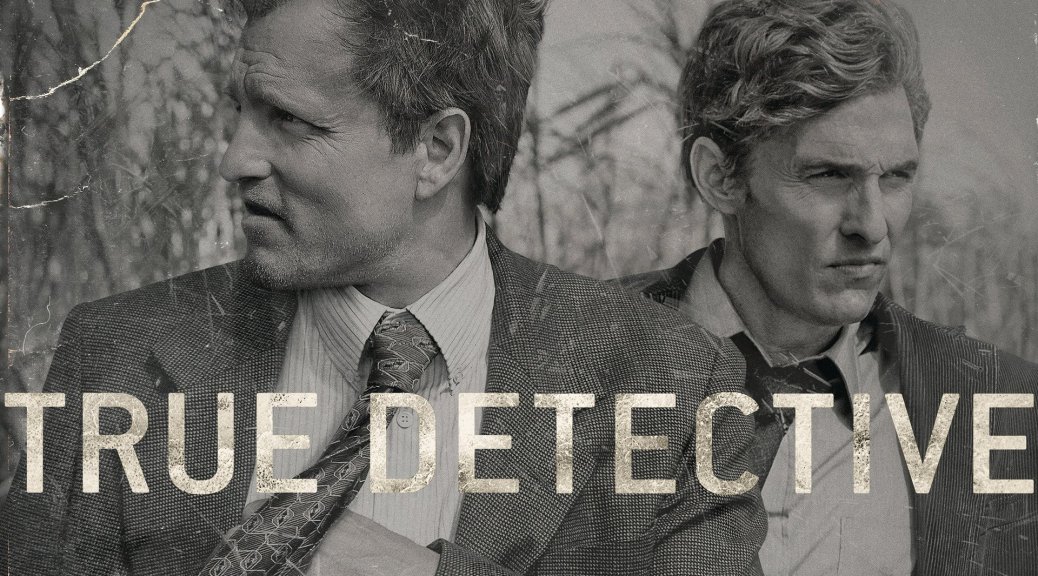
True Detective: It’s Still a Man’s (Hostile) World, pt. 2
I started to say True Detective (HBO original series) is gold ore and then to pursue a metaphor of finding something of value in an impure original form.
But one of the two main characters is named Rust Cohle (Matthew McConaughey) so I will say instead, True Detective is iron ore and we can find something of value—something tarnished, yes—in an impure original form.
I want to start with the tarnished, the rust, that few people have confronted.
Emily Nussbaum sees True Detective through the lens of all that it fails to achieve:
Like many critics, I was initially charmed by the show’s anthology structure (eight episodes and out; next season a fresh story) and its witty chronology, which chops and dices a serial-killer investigation, using two time lines…
On the other hand, you might take a close look at the show’s opening credits, which suggest a simpler tale: one about heroic male outlines and closeups of female asses. The more episodes that go by, the more I’m starting to suspect that those asses tell the real story.
The women in the episodes, Nussbaum explains, are “paper-thin”; they serve as women often do in art made by men—as props, as symbols, as embodiments rendered meaningful only in the context of the men who gain most of the attention when the camera isn’t focused on the bared curves of women titillating and pleasing those men (and the audience, mostly men, we may assume). “Wives and sluts and daughters—none with any interior life,” she recognizes.
I think Nussbaum’s explication is important, not to set True Detective aside, but to mine that rust from the ore. I think there is much here of value—even conceding the entrenched failures of men making art as if women truly and inevitably are “paper-thin,” “a simple prop to occupy [their] time.”
Many people have noted that about 5% of pop culture is brilliant and the remaining 95% is trash. From production value to acting, True Detective aspires to that 5%, and I think it is often successful.
Even (maybe especially) with the mind disengaged in rational ways, each episode is mesmerizing for the senses.
But if we approach the series as a work of collaborative art (director, write, actors) that necessarily involves the viewer as yet another collaborator, we may find that True Detective is a tale possibly subtitled “It’s Still a Man’s (Hostile) World.”
Yes, women are cheated in (and cheated on) this narrative from HBO, but women are cheated in (and cheated on) the real world also. Children too are central in the series, often as the victims they are in real life also.
And if we are to decide whether to applaud True Detective for its often soaring craft or to denounce the series for its cliched and tone deaf paternalism, misogyny, and chauvinism, I think we must also start with genre—not just what the series is about but what form this series is taking to shape that tale.
Taken for its commitment to form, True Detective is noir fiction, a genre itself both illuminating the sexism of the human condition and flawed because of the sexism of the human condition entrenched in the genre.
“Noir fiction has attracted some of the best writers in the United States (mostly) and many of its aficionados are among the most sophisticated readers in the crime genre,” explains Otto Penzler. “Having said that, I am constantly baffled by the fact that a huge number of those readers don’t seem to know what noir fiction is,” adding:
Look, noir is about losers. The characters in these existential, nihilistic tales are doomed. They may not die, but they probably should, as the life that awaits them is certain to be so ugly, so lost and lonely, that they’d be better off just curling up and getting it over with. And, let’s face it, they deserve it.
Pretty much everyone in a noir story (or film) is driven by greed, lust, jealousy or alienation, a path that inevitably sucks them into a downward spiral from which they cannot escape. They couldn’t find the exit from their personal highway to hell if flashing neon lights pointed to a town named Hope. It is their own lack of morality that blindly drives them to ruin.
And there is Rust Cohle and his partner Marty Hart—deeply flawed men blinded by their lusts and trapped between justice and injustice.
Are there better ways to do that story? There was Andy Sipowicz in NYPD Blue, and Bruce Wayne/Batman endures—both of which are examinations of that exact dynamic of justice/injustice and flawed men.
Either these are archetypal characters and narratives or evidence that the paternalism of film and literature have imposed these characters and narratives onto the world by sheer force.
But as I watch the series (as of this writing, the sixth episode), I have been reminded of John Gardner’s The Sunlight Dialogues, a literary and complex novel that searches the human soul as well as the landscape of justice and injustice, as this excerpt shows:
His watchmen are blind: they are all ignorant, they are all dumb dogs, they cannot bark.
-Isaiah 56:10
In late August, 1966, the city jail in Batavia, New York, held four regular prisoners, that is, four prisoners who were being kept on something more than an overnight basis. Three had been bound over for trial; the fourth was being held, by order of the court, until the County could administer a psychiatric examination. The identity of this fourth prisoner was not yet known. He seemed to be about forty. He’d been arrested on August 23rd for painting the word love in large, white, official-looking letters across two lanes of Oak Street, just short of the New York State Thruway. As the police were in the act of arresting him he had managed to burn all the papers in his billfold (dancing up and down, shaking like a leaf), and he refused to say now a halfway sensible word about himself, except that he was “an anarchist, a student.” His face was slightly disfigured by what looked like a phosphor burn — the kind men get in wars. Whether he was actually a student (he was an anarchist, all right) there was no way of telling. He seemed too old for that, and there was no college in Batavia; but the town was not large and they knew he was not from there.
The Sunlight Dialogues is hard; it demands a great deal of the reader in terms of time as well as concentration.
I think the same of True Detective in the sense that we must not take the work on face value only, we must not allow ourselves to be mesmerized, and we must not see the “paper-thin” women as endorsements, but mirrors of the very real ways life remains a man’s (hostile) world.
And I remain committed to mining the rust from the ore in this show because we remain faced with much the same in the real world we fail to excavate and then re-imagine each day.
True Detective is flawed as is the human condition. We can do better in both, but not by giving in to the nihilism of the noir that is both creation and mirror.
It’s still a man’s (hostile) world, but it doesn’t have to be.
Knowledge: Not If, but How (and Who Decides)
As I have posted before, progressivism and whole language have a long history of being blamed for failure when in reality neither has been practiced in any substantial way by teachers. While school policies and classroom practices have remained committed to traditional approaches and behavioral groundings, it is likely more accurate to describe schooling in the U.S. as dominantly bureaucratic—often failing any ideology whether or not, as Harry Webb notes, schools and colleges of education are almost exclusively progressive.
And thus, education remains mired among some in a constant tension between so-called traditional and progressive commitments; as Webb explains, that tension is itself reductive and misleading:
The differences between educational progressives and traditionalists, although often defined in terms of how they go about teaching, are really more fundamental even than that. Progressives and traditionalists actually have different goals. They are trying to achieve different ends. To progressives, traditionalists are trying to fill children’s heads up with rote, disconnected facts. To traditionalists, progressives are trying to ‘facilitate’ the development of nebulous skills; skills that often cannot be defined and certainly not assessed. Of course, there are always those who are quick to cry, ‘False choice! You can have both nebulous skills and rote, disconnected facts.’ Of course there are.
There is a continuum here: on the far right, rote memorization, and on the left, touchy-feely “do your own thing” playtime. While as a critical educator I have serious problems with positivism, behaviorism, and the cultural knowledge concepts promoted by E.D. Hirsch, I agree with Webb, a traditionalist, that both extremes fall well short of what most thoughtful educators are pursuing regardless of their pedagogical commitments or educational philosophies.
So let me enter this debate with a few examples of what critical educators see as the foundational problems with how schools treat the pursuit of knowledge—with the full disclosure here that how the real world of teaching happens is often out of focus when compared to the more complex theories and philosophies identified. In other words, when a school or teacher claims to be implementing essential questions, it is unlikely that is the case. The same can be said of direct instruction, cooperative learning, authentic assessment, and so forth.
If there are educators who say content doesn’t matter, I don’t know any. It is a provocative claim, none the less. Of course content matters, but for critical educators, authoritarian static knowledge is the problem because of the “authoritarian” and “static”—not the knowledge.
Whether directly or indirectly, when a teacher prescribes that all children learn X without consideration for the needs or interests of the students and without any opportunity to examine whether or not that content should be accepted uncritically, education has failed.
Another issue for critical and even progressive educators is the concept of when knowledge is acquired, when (and how) content becomes automatic.
Treating content as value-free, discrete, linear, and sequential is the problem; not the knowledge itself.
Assuming that the human mind is essentially analytic—learning from part to whole—and that most knowledge must be acquired before real thinking, maybe critical thinking, can occur are the problems.
So I want two offer to examples of what I mean.
First, I happen to know a huge amount of content in a fairly wide range of disciplines. Some is very useful on Jeopardy! and a great deal is incredibly useful for my roles as scholar, teacher, and writer.
For example, if I see a panel from a Silver Age Marvel comic book, I am able most of the time to tell you who pencilled and inked the artwork. I also regularly cite research aloud when I am teaching, often identifying the author, year, and even page of the research.
None of this happened by rote memorization that is all too common in traditional schooling. I did not have any of this assigned, I did not study any of this for a multiple choice or true/false exam.
Throughout the 1970s, while wearing a back brace for scoliosis, I retreated into the world of collecting comic books—amassing about 7000 comics that I read, re-read, and carefully catalogued before storing them all in plastic bags.
In the mid- to late 1990s, I wrote a dissertation on Lou LaBrant, meticulously gathering everything she wrote and everything others wrote or said about here before writing a book-length biography of her life and career.
What are notable about these experiences and how I have come to gain and retain so much knowledge?
- Both grew from my choice—one as a teenager and the other as a grown man in my mid-30s. (My point: Let’s not assume that children have no ability to make real and substantial choices, just as, see below, let’s not romanticize childhood as a time when all children’s choices are good for them and that all adult imposition is oppressive.)
- Both were experiences with rich and complex content. Nothing was easy about either experience (despite what people misunderstand about comic books). This is about challenging content (and not the misused and misleading concept of rigor)—in the two sense of the content is complex and thus challenging and that learners should challenge the content in order to learn it.
- Both required that I engaged in a great deal of synthesis, and thus re-creation—resulting in experiencing, re-experiencing, and thus coming to acquire an evolving memorization that has context.
- Both were aided substantially by my having access to authorities on the content I was pursuing.
Yes, knowledge matters, but who decides what knowledge matters is essential to address and how that knowledge is acquired is also central. It fails our goals of acquiring knowledge, then, if we only honor the acquisition of knowledge before any real engagement occurs on a complex level.
Each discipline needs to take a step back from linear, discrete, and analytical assumptions about acquiring knowledge in order to identify when that approach is genuinely essential. (And I suspect it is far less often than is traditionally practiced.)
Next, let me return to the continuum noted about, adding that to the far right we fall into the trap of cynicism (no child knows what is good for her/him) and that to the far left, the trap of romanticism (just leave children alone and allow their natural curiosity to work).
Just as knowledge acquisition may come after deep and rich engagement with experiences (as I detailed above), students may come to “choose” and recognize value in knowledge after being asked to learn it. And so a final example.
Too often traditional approaches to teaching and learning have been (and are) reduced (and more often with students identified as “weak”) to isolated and rote experiences with knowledge. (This can be traced to the failure of the cult of efficiency found in the bureaucracy of schooling [1].)
For example, what has counted (and counts) for “learning about the presidents” in social studies or history class is memorizing the presidents in order to be recited on a test. This is the sort of real-world traditionalism that progressive and critical educators balk at—and recognize as all too common, again, especially for certain students. And there is a cynicism and deficit view of children embedded in that sort of teaching.
However, a romantic view of children may seek to leave whether or not children learn about the presidents up to the students (again, making the mistake of ignoring context), and traditionalists are rightly concerned that many children would find little initial interest in the presidency—despite that core knowledge being quite important for each child as a member of a democracy and to the wider democracy itself.
Instead, then, asking students—either individually or in groups—to choose one president as a research project and to use that example to identify and examine the powers of presidents in the U.S. is the sort of assignment a critical educator would embrace.
Many students are likely to come to appreciate the need to understand the presidency after this experience, and we are failing students by the fault of romanticism if we allow them only to pursue what they initially believe is important.
For critical educators, our concern is with authoritarian education, but not with authoritative teachers. And our goal is a classroom with a teacher/student among students/teachers [2]. Teaching and learning are collaborative, but the ultimate authority is still the teacher.
From his traditional commitments (ones Webb strives to advocate for in real and complex ways), Webb asserts: “By contrast, progressive education is a mirage.”
I would argue that the ways in which both progressive and traditional practices are found in schools are mirages—in the sense that they fail our goals of knowledge acquisition as a vehicle for human and social agency. In fact, those failures, I think, have little to do with progressivism and traditionalism, but much to do with the romanticism and cynicism I have examined above.
[1] Callahan, R. E. (1962). Education and the cult of efficiency: A study of the social forces that have shaped the administration of the public schools. Chicago: The University of Chicago Press.
[2] Freire, P. (2005). Teachers as cultural workers: Letters to those who dare to teach. Trans. D. Macedo, D., Koike, & A., Oliveira. Boulder, CO: Westview Press.
——— . (1998). Pedagogy of freedom: Ethics, democracy, and civic courage. Trans. P. Clarke. Lanham, MD: Rowman and Littlefield Publishers, Inc.
——— . (1993). Pedagogy of the oppressed. New York: Continuum.
 dr. p.l. (paul) thomas