Category Archives: Education

Class Grades

Since I am quick to criticize the media for its role in the failures of the current education reform movement—such as PBS, The Charleston Post and Courier, and Education Week—I must also recognize when a media outlet provides much needed insight into education policy that has clearly run off the tracks, such as the so-called Florida miracle and the enduring practice of assigning letter grades to schools.

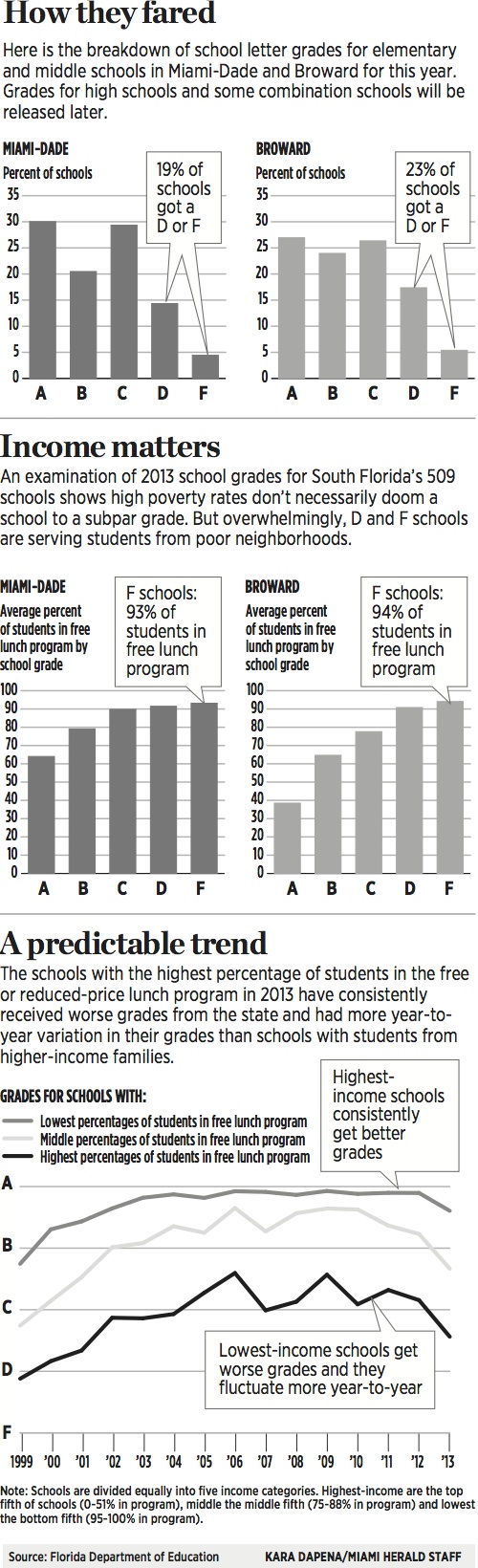
In “Low-income schools struggle under state’s grading system” (Miami Herald, August 10, 2013), Michael Vasquez and David Smiley offer a clear but disturbing picture of accountability in Florida:

With dozens of changes in just the past three years, the formula behind Florida’s A-to-F school grading system has been criticized as a confusing mess. But there’s been at least one constant in Miami-Dade and Broward results: The wealthiest schools never get Fs, and schools with high populations of poor students face an uphill battle to even get a C.

The trend is visible through a decade-plus of school grade results, dating back to the first grades issued in 1999.

Vasquez and Smiley, along with the Miami Herald, represent a needed aspect of journalism addressing education reform: Recognizing large and compelling patterns, and thus the consequences of education policy.

The analysis of assigning letter grades to schools in Florida exposes some important conclusions:

•  Although high poverty rates don’t necessarily doom a school to a subpar grade, D and F schools are overwhelmingly serving students from poor neighborhoods, and the few schools that do overcome poverty to achieve an A are outliers. (There were nine such schools this year, all in Miami-Dade).

•  Of the 209 schools in Miami-Dade and Broward with at least 90 percent of students receiving free or reduced lunch, 78 percent received a grade of C or worse. Roughly 39 percent of these high-poverty schools received a D or F.

•  Of the 43 local schools with much lower poverty rates (30 percent or fewer students receiving free or reduced lunch), 86 percent received an A, and none received a D or F.

Despite efforts to identify educational quality among schools by focusing on growth models, data used in accountability policies remain primarily a reflection of out-of-school factors. Further, the schools that sit outside the typical patterns are rightfully identified by Vasquez and Smiley as “outliers.”

This analytical report on letter grades for schools in Florida is a strong example of quality journalism that seeks out and presents complex and detailed evidence, placing that data in the broader context of the many factors that impact not only the evidence we gather on our schools but also what conclusions we draw as well as how we draw those conclusions.

In the article, Miami-Dade Superintendent Alberto Carvalho explains, “‘Just as much as poverty can’t be an excuse, the exclusion of poverty as a factor is immoral.'”

Rare is the news article that allows a perspective this complex.

No Child Left Behind (NCLB) ushered in several grand promises in 2001, such as closing the achievement gap, but one of the central requirements of the legislation—the use of scientifically based research—is now poised to dismantle the entire accountability movement, including policies such as labeling schools with letter grades based primarily on test scores.

The evidence is clear that thirty years of accountability built on standards and high-stakes testing has failed. The next step is composing and sharing a unified message of that fact, while also building a coalition to reset the reform agenda so that we address poverty, equity, and opportunity in the lives of children and their families as well as in the schools those children attend.

Innocence or Guilt?: Looking Beyond the Individual

The court room presents a powerful narrative focusing on the innocence or guilt of an accused individual. In the U.S. judicial system, the accused is innocent until proven guilty, and this principle is embraced as a foundational commitment to individual freedom.

The George Zimmerman trial, however, prompted for many concerns about the effectiveness and objectivity of that judicial system, including fears that jury trials reflect the biases of the jurors and that the victim, Trayvon Martin, was unfairly put on trial as well. Debates also included a convoluted discussion of the laws themselves surrounding the case, notably the stand your ground laws in Florida. If the laws themselves are flawed or inherently corrupt, how can a trial be just?

The court of public opinion is no less focused on individual innocence or guilt. In the education reform movement, a number of scandals have exposed flawed leaders and dysfunctional systems—Michelle Rhee’s reign as chancellor of DC public schools, Tony Bennett’s role in changing school grades in Indiana, a cheating scandal in Atlanta, and misleading tests scores in New York. Each of these individual people and circumstances lends itself to holding one person or a unique situation accountable, but just as any trial can disproportionately focus blame on an individual, it is careless and ultimately dangerous to ignore the wider accountability era while laying (often justifiable) blame at the feet of Rhee, Bennett, Atlanta public school administrators, or the newest testing process in NY.

Bernhard Schlink’s The Reader confronts readers with the lingering historical horrors of the Holocaust while also weaving an allegory of justice. A central character, Hanna Schmitz, develops a taboo but compelling relationship with a German teen, Michael Berg, many years after she has served as an SS guard at Auschwitz. In the middle section of the novel, Schmitz is on trial for her role at the concentration camp, and the readers of the novel discover that Schmitz’s passion for having Berg read to her grows from her own illiteracy, a key element in how the trial portrays her innocence or guilt.

Readers of Schlink’s novel are likely left torn about Schmitz’s guilt, possibly in ways similar to public opinion about Zimmerman. Schlink, as a lawyer and judge, seems as interested in the larger allegory of justice as he is about the specific horrors of who is culpable for the Holocaust. In fact, the novel suggests that innocence and guilt are not simple, not easily reduced to the acts or decisions of an individual.

Is it possible, the novel asks, that Schmitz is guilty in a nuanced way that is grounded in her illiteracy and the perverse and dehumanizing culture surrounding the Holocaust? Is it then possible that Schmitz is simultaneously guilty but also a victim of forces larger than her?

While I am suggesting no direct comparison between the accountability era and the Holocaust in terms of magnitude, I am compelled to recognize that the allegorical message of The Reader helps inform the potential mistake being layered onto the individual failures represented by Rhee, Bennett, the Atlanta cheating scandal, and the NY test data: Each of these people or circumstances is both an example of individual or situational failures and clear messages about the larger inherently flawed accountability era based on standards, high-stakes testing, and individual accountability (schools, districts, teachers, and students).

Let’s just focus on two recent failures in the accountability era—Bennett and NY test scores. Both, I am convinced, are evidence of specific failures and possibly even unethical behavior by people in power. And I would argue that Bennett and those responsible for testing in NY should all be held accountable for their decisions, actions, and misrepresentations about children, teacher, and schools to the public.

Ultimately, however, that isn’t nearly enough. Assigning grades to schools and all high-stakes testing are the problems; thus, high-stakes testing as a mechanism for labeling, sorting, and ranking schools, teachers, and children is the larger flawed system that Bennett and NY test scores represent.

In the passive voice parlance of avoiding culpability found in the courtroom, it is likely that for Rhee and Bennett “mistakes were made.”

But political, media, and public concern for these individual errors must not end with their individual culpability.

Accountability, standards, and high-stakes testing are dehumanizing, counter to genuine teaching and learning, and corrosive to universal public education, democracy, and individual liberty. With this lesson standing before us, then, it is unconscionable to continue down the road of Common Core and “next generation” national tests.

It is no longer credible to argue about how best to implement Common Core, how best to implement new tests, or how best to analyze that data from those tests. It is time to end an era of misguided accountability.

Even under the weight of forces larger and more powerful than any one of us, we must make a decision to confront and end a failed system, and that system is the accountability era begun thirty years ago, but now has proven itself a failure.

Manifest destiny

Manifest destiny

i did not want you
like inevitable land acquisition
a Manifest destiny of my love
although that isn’t quite accurate
i do not want you
like inevitable land acquisition
a Manifest destiny of my love
sometimes temporal distinctions matter
as i long for small gestures from you
freshly painted toenails offered
an ankle extended toward my hand
the shadowed outline of your ribcage
or the nearly unbearable your hands
nails also polished to match your toes
and you are reaching for me for me
i have never asked to be the only one
although i have always longed for forever
i have never needed or wanted anything
beyond the you that is you and always you
although i do recognize my love for you is
a canyon or a tornado too huge to manage
want you see can become a natural disaster
despite the best intentions or purity of heart
i do not want you
like inevitable land acquisition
a Manifest destiny of my love
but the frailest thing of all remains
i do want you
like the hollow bones of birds
the soft whispers in dreams
and the thin air at 12,000 feet

Made in America: Segregation by Design

“The woman in the gold bracelets tells her friend:,” begins a poem by Barbara Kingsolver from her collection Another America/Otra America. A careful reading notices “gold bracelets,” suggesting more than affluence, opulence. The poem continues:

I had to fire another one.
Can you believe it?
She broke the vase
Jack gave me for Christmas.
It was one of those,
you know? That worked
with everything. All my colors.
I asked him if he’d mind
if I bought one again just like it.
It was the only one that just always worked.

Her friend says:
Find another one that speaks English.
That’s a plus.

The woman in the gold agrees
that is a plus.

The two women speak interchangeably about the fired domestic worker and the vase, both reduced to “one,” and “worked” is repeated about only the broken vase, an object for decoration and a Christmas gift. “It” and “colors” also haunt the conversation. In this brief poetic scene, the callousness of two affluent women about the value of an ornament over a worker (one who apparently is not a native speaker of English, and as suggested by the Spanish/English versions of all the poems and title of the collection, likely Latino/a) is couched in a larger context found in the poem’s title, “What the Janitor Heard in the Elevator.”

This flippant conversation is overheard by another worker, a janitor (who do you see as the “janitor”?), standing essentially unseen, unacknowledged beside these women (who do you see as these women?), trapped momentarily in an elevator.

Kingsolver’s stark and vivid poem captures, as does Kingsolver’s entire collection, the existence of two Americas, a slogan trivialized by politicians and ignored like the janitor by much of the public in the U.S.

The two Americas include the few and affluent, mostly white, who have virtually all the power and, as the poem shows, a voice in the nation and the remaining many, disproportionately middle-class, working-class, working poor, and poor as well as African American and, increasingly, Latino/a.

Let’s consider for a moment what students may be asked to do if presented with this poem in a public high school in the U.S., specifically in this expanding era of accountability and the encroaching specter of Common Core and the concurrent new high-stakes tests.

Based on my having been an educator during the entire past thirty years of the accountability era, I would suggest that this poem would be reduced to mechanistic analysis, in much the same way we have treated F. Scott Fitzgerald’s The Great Gatsby for decades.

While many are rightfully concerned that the Common Core will significantly decrease the focus on fiction and poetry in schools, we have yet to address that even if we maintain great poetry and fiction in the education of our children, we do them or that literature little service to allow those works to be reduced only to their literary parts, mere interchangeable fodder for identifying lination, stanzas, diction, symbolism, narration, characterization, setting, and the endless nuts and bolts deemed worthy of dispassionate analysis in school.

How many generations of students, for example, have examined at length the symbolism of the green light at the end of Daisy’s dock and Gatsby’ yellow car? How many students have been guided through the technical precision of Fitzgerald’s novel while never confronting his vivid challenge to the American Dream?

Have students been asked to look carefully at the corpses of Myrtle and George (the wrong kind of people, George a mere worker and Myrtle left like roadkill in the middle of the road) as well as Gatsby (the wrong kind of rich) floating dead in his pool? Have students been asked why Tom and Daisy (the right kind of rich) go on vacation in the wake of these deaths, seemingly untarnished because of the Teflon coating of their affluence?

Have students been asked to consider carefully why Tom hits Myrtle but bends to Daisy’s taunts?

These are distinctions of analysis—suggesting that Common Core and curriculum are trivial debates if we do not address what happens in the classroom and for whom.

Made in America: Segregation by Design

The technical approach to literature that ignores critical literacy is a subset of the larger technical debate about education and education reform that focuses policy and public attention on the details of schooling (public versus charter and private, Common Core, high-stakes testing, value added methods of evaluating teachers) and ignores the substance of schooling like a janitor trapped in an elevator with two wealthy women.

The substance of schooling today is a stark contrast to the moment of cultural consciousness stretching from the early 1950s into the 1970s when separate but equal was confronted and rejected. As society in the U.S. wrestled with integration of institutions, the cancer of segregation was merely shifted from separate schools to schools-within-schools: White and affluent students tend to sit in Advanced Placement, International Baccalaureate, and honors classes with experienced and qualified teachers and low student-teacher ratios while AA/ Latino/a and impoverished students tend to sit in remedial, test-prep, and tech-prep classes with new and unqualified teachers (in the twenty-first century that means often Teach for America recruits as temporary workers) and high student-teacher ratios.

In-school segregation has been driven by affluent parents, who use their privilege to insure that their children get theirs, and damn the rest. But segregation by design has now been joined by two powerful and corrosive mechanisms—charter schools and segregated higher education access.

Charter schools (see Charter Schools: A Primer and Current Education Reform Perpetuating, Not Curbing, Inequity) have failed to achieve the academic miracles proponents have promised, but charter schools have exposed the most predictable outcome of choice, segregation. As Sarah Carr has shown, New Orleans is a disturbing record of the charter schools flood, the role disaster capitalism plays in destroying equity and opportunity for “the deliberately silenced, or the preferably unheard,” African Americans and people trapped in poverty.

While schools-within-schools and charter schools highlight K-12 segregation by design in the U.S., as troubling is the entrenched privilege of affluence found in higher education, augmenting Matt Bruenig’s conclusion: “you are better off being born rich regardless of whether you go to college than being born poor and getting a college degree.”

Carnevale and Strohl have identified the separate and unequal access to higher education that constitutes the full picture of segregation by design in the U.S.:

The postsecondary system mimics the racial inequality it inherits from the K-12 education system, then magnifies and projects that inequality into the labor market and society at large….

Whites have captured most of the enrollment growth at the 468 most selective and well-funded four-year colleges, while African Americans and Hispanics have captured most of the enrollment growth at the increasingly overcrowded and under-resourced open-access two- and four-year colleges….

These racially polarized enrollment flows have led to an increasing overrepresentation of whites at the 468 most selective four-year colleges….

At the same time, African Americans and Hispanics are increasingly underrepresented at the most selective 468 four-year colleges….

At the same time, African Americans and Hispanics are increasingly underrepresented at the most selective 468 four-year colleges…. (Executive Summary, pp. 3, 6, 10, 12)

The inequitable access to elite higher education mirrors the inequitable access to quality K-12 education and to experienced and qualified teachers. Inequitable access, then, creates inequitable outcomes:

[H]igh-scoring African Americans and Hispanics are far more likely to drop out of college before completing a credential….

Among high-scoring students who attend college, whites are far more likely to complete a BA or higher compared to African Americans or Hispanics….

Each year, there are 111,000 high-scoring African-American and Hispanic students who either do not attend college or don’t graduate.

About 62,000 of these students come from the bottom half of the family income distribution….

Racial inequality in the educational system, paired with low social and economic mobility in the United States, produces enormous differences in educational outcomes: Whites are twice as likely as African Americans and three times as likely as Hispanics to complete a BA or higher…. (Carnevale and Strohl, 2013, Executive Summary, pp. 24, 26, 28, 37)

Despite the meritocracy myth at the heart of the American Dream, then, Carnevale and Strohl conclude: “In the United States, parents’ education determines the educational attainment of their children” (Executive Summary, p. 38).

The cruel irony of education in the U.S. includes that most privileged children will find themselves in classrooms where color imagery (the gold bracelet in Kingsolver’s poem, the green dock light and yellow car in The Great Gatsby) will be the key to the already unlocked door leading to college and secure, high-paying jobs while AA and Latino/a as well as impoverished students are shown quite a different door.

All the while, the colors that matter—black, brown, white, and green—remain invisible and unspoken under the veneer of the American Dream of meritocracy that is less credible than any work of fiction soon to be dropped from the school day.

Humility: A Lesson Most Needed and Least Often Acknowledged

I have been a cyclist for almost 30 years now—longer than many of my cycling friends have been alive.

That hobby grew from a life-long quest to be the sort of athlete (and man) my father would respect. My father was a four-sport letterman in high school, captain of the first state championship football team in my home town. He was a small young man, but fierce and the sort of hard worker that made him a coach’s dream. By the time my father graduated high school in the 1950s, he had lost so many of his teeth that his dentist pulled the rest, and my father has had a full set of false teeth since his late teens.

I was never able to be more than a bench warmer on my school basketball teams, a marginally fair golfer, and briefly a triple jumper my senior year of high school. Mostly, though, I joke that I am a “try” athlete—and it is something I cannot let go, despite knowing without qualification that my father loves and respects me in the exact ways I have always wanted. Any perceptions of failure that exist between the two of us are entirely my insecurities.

My cycling life has had three stages—a beginning decade of learning to ride and race at a high level, a middle decade that was interrupted by my doctoral program and included years of mountain biking and a brief venture into running (a couple marathons and a half marathon), and then the most recent decade of yearly high mileage (7,000-10,000 miles per year) and my best performances as a cyclist despite my advancing age (for an athlete).

For more than half of the years of cycling, I have participated in the Assault on Mt. Mitchell, a 102-mile ride from Spartanburg, SC, to the top of Mt. Mitchell, the highest mountain peak east of the Mississippi. I had my best time, 5:57, at 46 and completed the event in the spring of 2013 as 86th out of 1100 starters.

Typically, in large amateur cycling events I place in the top 15% of entrants—and feel pretty good about these accomplishments.

As I sit writing this, I am on a cycling trip in Colorado, about to leave after a few days in Boulder for Frisco to ride the Copper Triangle ride this coming Saturday. The first half of this trip for me has been a brutal lesson in humility.

Although I have visited Colorado Springs several times in the past, this trip resulted in immediate altitude symptoms—a headache, lethargy, and the classic feeling of having the flu. The day after we arrived, we began riding around Boulder, and the symptoms have been pronounced on each ride.

The first ride was in chilly rain, and when the route turned up hill, I watched my two cycling friends ride away into the mist. The second ride headed to Flagstaff Mountain, resulting in yet another ride in rain and cold; but this time as my friends pedaled away from me I simply couldn’t continue up the climb. At the point when the Flagstaff climb turns to what locals call Super Flagstaff, with grades 15-20%, I shouted to one friend I wasn’t going farther up. I coasted back down to an overlook entrance and waited for them to finish the climb and roll my way.

I was angry, disappointed, exhausted, and most of all, embarrassed.

Yesterday, we headed to Estes Park for a 20-mile mountain climb to the highest point (over 12,000 feet) for a through road in the US. I wasn’t looking forward to yet another day of struggling, and possibly bailing out again.

As we neared the 12,000-feet mark, I was still lagging behind the other three riders, and my head ache returned along with dizziness. None of this boded well for over 2.5 hours of climbing at an altitude I had never experienced before.

It took a great deal of arguing with myself, but I finished the ride yesterday, although still slower than my friends. So far, then, this cycling trip to Colorado has been a series of lessons in humility.

And that has led me to think about the lack of humility found among public and political leadership focusing on schools in the US.

Those self-appointed leaders tend to embody a couple of characteristics: little or no experience or expertise in education and unwavering arrogance, an arrogance that they and the media flaunt.

Ben Folds has captured well the failure of such arrogance in his “Bastard”:

The old bastard left his ties and his suit
A brown box, mothballs and bowling shoes
And his opinion so you’d never have to choose
Pretty soon, you’ll be an old bastard too
You get smaller as the world gets big
The more you know you know you don’t know shit
“The Whiz Man” will never fit you like “The Whiz Kid” did

The refrain to this song speaks potentially to those edu-leaders and their arrogance, and thus failure to exhibit humility:

So why you gotta act like you know when you don’t know?
It’s OK if you don’t know everything

I am well past the 10,000-hour mark needed for expertise as a cyclist (popularized by Malcolm Gladwell). I have a great deal of skill and knowledge as a cyclist, although I also have a pretty low genetic ceiling in terms of how I can perform as a cyclist (a ceiling dropping in on me as I grow older each day).

The Cycling Gods and Altitude Gods have spoken loud and clear to me in the last few days. It is my duty to listen.

The list of what public schools need in the US is long and complex, but a great starting point would be lessons in humility for those who have decided they know best when all the evidence suggests otherwise.

NYT’s Foul Tip on Paul Vallas

In the NYT, Javier C. Hernandez examines embattled Paul Vallas in Connecticut, opening with:

Paul G. Vallas, a leader in the effort to shake up American education, has wrestled with unions in Chicago, taken on hurricane-ravaged schools in New Orleans and confronted a crumbling educational system in Haiti.

Now he faces what may be his most vexing challenge yet: Fending off a small but spirited crowd of advocates working to unseat him as superintendent of one of Connecticut’s lowest-performing and highest-poverty school districts.

“Leader,” “vexing,” “fending,” “spirited”? Not to worry, folks, the NYT doesn’t exactly strike out, but, at best, this column is a foul tip—nowhere near a solid single, or even a bunt.

The media, once again, falls into the trap of buying hook, line, and sinker the “savior reformer” bait cast by Vallas, Michelle Rhee, and Bill Gates.

You see, only a few brave souls dare to stand up against that pesky public education status quo, kept alive by those evil unions and greedy teachers.

And now poor Vallas is next in line to suffer the wrath of that status quo:

Mr. Vallas, who has moved to impose a standardized curriculum and to reorganize central offices in Bridgeport, said he was dismayed by the vitriol. On blogs, which he calls “electronic graffiti,” his critics have called him a racist and compared him to the Chilean dictator Augusto Pinochet. The school district’s student population is 49 percent Hispanic and 39 percent black.

“There are some gigantic egos in this town,” Mr. Vallas said in an interview. “No good deed goes unpunished.”

“Gigantic egos”? [One must wonder is Vallas owns a mirror.] “Electronic graffitti”?

Not to worry, however, appointee Arne Duncan to the rescue!:

Arne Duncan, the federal education secretary, said the opposition to Mr. Vallas was “beyond ludicrous.” He said too many school districts were afraid of innovation, clinging to “archaic ideas.”

“This, to me, is just another painfully obvious, crystal-clear example of people caught in an old paradigm,” Mr. Duncan said in an interview. “This is the tip of the iceberg.”

The Duncan/Vallas allegiance is interesting because the two men have something in common—what they lack:

Mr. Vallas had a vulnerability: despite his decades of experience in schools and a master’s degree in political science, he lacked a degree in education, as required by Connecticut law. The state allowed for an exemption, but Mr. Vallas was required to complete a condensed version of the traditional 13-month certification program over the course of several months. “I didn’t view it cynically and I didn’t complain,” Mr. Vallas said.

Never-been-a-teacher appointee rushes to the aid of never-been-a-teacher appointee. Sounds like a great plot for a Lifetime Movie.

And that movie would have a heart-wrenching message about perseverance in the face of failure:

Mr. Vallas, 60, is a onetime politician who came within two percentage points of defeating Rod R. Blagojevich in a primary for the Illinois governor’s office in 2002. He said he did not know what he would do after Bridgeport, though he ruled out a return to politics. He runs an educational consulting business on the side. His clients have included schools in Illinois and Indiana.

That’s right. If you can’t be a politician, be a political appointee—and be sure to seek out education where the public funds are ripe for the picking (Vallas makes $234,000 a year, but that is small potatoes to the span of his “career” in education).

Kids Count on Public Education, Not Grit or “No Excuses”

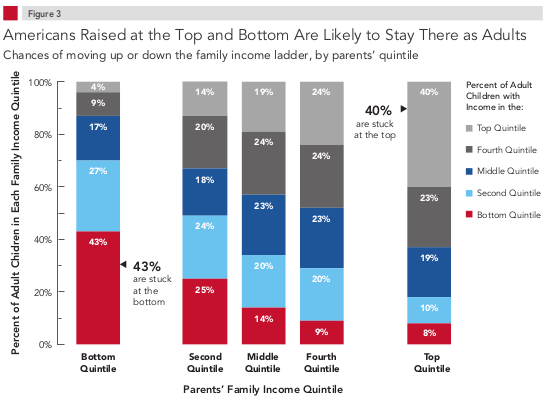
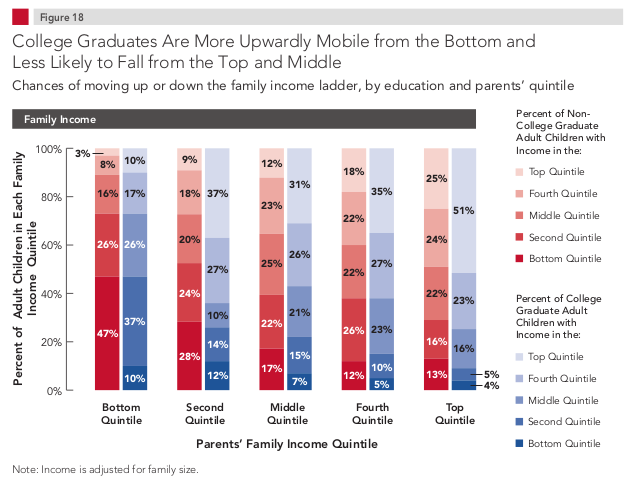
Secretary of Education Arne Duncan has often stated that “education [is] the one true path out of poverty—the great equalizer that overcomes differences in background, culture and privilege. It’s the only way to secure our common future in a competitive global economy.” While this claim appears obvious, when Matt Bruenig asked “What’s more important: a college degree or being born rich?” and examined the data, he concluded:

So, you are 2.5x more likely to be a rich adult if you were born rich and never bothered to go to college than if you were born poor and, against all odds, went to college and graduated. The disparity in the outcomes of rich and poor kids persists, not only when you control for college attainment, but even when you compare non-degreed rich kids to degreed poor kids!

Therefore, the answer to the question in the title is that you are better off being born rich regardless of whether you go to college than being born poor and getting a college degree.

In South Carolina, for example, this sobering reality is made more troubling by the 2013 Kids Count report from the Annie E. Casey Foundation, which examines child well-being in the nation and each state.

Nationally, SC ranks 45th, down from 43rd in the foundation’s previous report. Only Louisiana, Arizona, Nevada, Mississippi, and New Mexico sit lower than SC in child well-being. The ranking consists of four broad categories that reflect significant social and educational challenges for SC:

  • Economic Well-Being (2011 data): SC children in poverty, 28% (worse than 2005, 23%); children whose parents lack secure employment, 35% (worse than 2008, 30%); children living in households with a high housing cost burden, 36% (worse than 2005, 32%); teens not in school and not working, 11% (worse than 2008, 8%).
  • Education: SC children not attending preschool (2009-11), 55% (better than 2005-2007, 59%); 4th graders not proficient in reading (2011), 72% (better than 2005, 74%); 8th graders not proficient in math (2011), 68% (better than 2005, 70%); high school students not graduating on time (2009/2010), 32%.
  • Health: SC low-birthweight babies (2010), 9.9% (better than 2005, 10.2%); children without health insurance (2011), 8% (better than 2008, 13%); child and teen deaths per 100,000 (2010), 32% (better than 2005, 41%); teens who abuse alcohol and drugs (2012-11), 7% (better than 2005-2006, 8%).
  • Family and Community: SC children in single-parent families (2011), 42% (worse than 2005, 38%); children in families where the household head lacks a high school diploma (2011), 13% (better than 2005, 15%); children living in high-poverty areas (2007-2011), 13% (worse than 2000, 6%); teen births per 1000 (2010), 43 (better than 2005, 51).

SC represents states that remain heavily burdened by the negative consequences of poverty and social inequity, complicated factors often reflected in the measurable outcomes of public schools. This report offers SC, the nation, and political leaders an opportunity to change the discourse about school reform and take bold action that addresses the wide range of social and economic challenges facing our state.

While the report data show that social and education reform should remain priorities for SC, that same data also suggest that social reform is far more pressing than expensive and historically ineffective commitments to new standards and tests being promoted for education reform.

Children in SC deserve better schools, and children in poverty remain the exact students most underserved in those schools. No one is suggesting that education reform be set aside or ignored. But many current school reform policies are simply wastes of taxpayers’ money and educators’ time that would be better spent on education reform that addresses the conditions of teaching and learning, and not just more of the same standards-and-testing mandates tried for thirty years now.

More pressing is social reform because without addressing childhood poverty, workforce stability and quality, the costs of living, single-parent homes, and concentrated high-poverty communities, most education reform measures are doomed to be fruitless.

As The Economic Mobility Project reveals, children in SC and across the US are likely to have bright futures if they are born into relative affluence, and those children, even without attending college, are apt to succeed over impoverished children who rise above the challenges of their homes and communities by graduating college. “Grit” and “no excuses” are simply slogans, hollow and cruel in the bright light of the evidence.

If kids count in the US, and I am not sure they do, political leadership will change the course for education reform and begin a commitment to social reform that attends to the needs of the growing numbers of impoverished, working poor, and working class families who populate the country, and thus, depend on public education.

meme

Gaiman’s Mythical Folding of Childhood into Adulthood

I stumbled into the novels (invariably identified with “for adults” by reviewers and critics) of Neil Gaiman in a way that, upon looking back, the intersection now seems inevitable, not stumbling at all.

Browsing as I often do along the center aisle of Barnes and Noble, over several visits I picked up American Gods, a hefty novel labeled by the publisher as the tenth anniversary edition. I have always tended to shun enormous novels, in part as a result of my teacher self recognizing how often students struggled with big books, but I also found myself both avoiding Gaiman’s most celebrated work and always taking it into my hands each time I saw it. In the way that books can, American Gods kept calling out to me (as the author’s preferred text did more recently).

The day I acquiesced to Gaiman the novelist (I had always known him as a comic book/graphic novel creator), I  experienced a second disorientation: The publisher labels American Gods “science fiction.” Not long after slipping with glee into Gaiman’s other worlds, I had a similar experience with Haruki Murakami, whose 1Q84 is also marked “science fiction.”

Before Gaiman and Murakami, I counted myself among those dedicated to science fiction but stubbornly opposed to fantasy. No Hobbits for me! And Harry Potter? No way.

Gaiman represents my crisis of genre that would carry through into Murakami’s universe(s). I could not find a thing in American Gods I would call science fiction, but I also felt “fantasy” failed the work. The best I could ever do was think of Gaiman’s narrative as “contemporary mythology”—not Leda and the swan, but the gods right now in my time of existence.

Regardless, of course, all that mattered for me was that I loved Gaiman’s novels “for adults” and joined millions awaiting his most recent, The Ocean at the End of the Lane.

Gaiman’s Mythical Folding of Childhood into Adulthood

The best works of fiction reach into my chest, grab my heart, and squeeze until I cry because I love the characters in ways that I often fail to satisfy in this real world.

In Sandra Cisneros’s “Eleven,” I experience that feeling every time I read it aloud to my students, and the central moment when I love eleven-year-old Rachel the deepest is also the most harrowing: “Because she’s older and the teacher, she’s right and I’m not.”

“Eleven” is a sad and wonderful narrative of school and childhood crashing into adulthood. And that story, especially that passage, lept to mind as I reached the middle of Gaiman’s Ocean:

Ursula Monkton smiled, and the lightnings wreathed and writhed about her. She was power incarnate, standing in the crackling air. She was the storm, she was the lightning, she was the adult world with all its power and all its secrets and all its foolish casual cruelty….

Ursula Monkton was an adult. It did not matter, at that moment, that she was every monster, every witch, every nightmare made flesh. She was also an adult, and when adults fight children, adults always win. (pp. 86-87)

Gaiman’s slight of hand, his gift of contemporary mythology, achieves the sort of folding over into itself expressed by Kurt Vonnegut’s Tralfamadorian view of time:

The Tralfamadorians can look at all the different moments just the we way we can look at a stretch of the Rocky Mountains, for instance. They can see how permanent all the moments are, and they can look at any moment that interests them. It is just an illusion we have here on Earth that one moment follows another, like beads on a strong, and that once a moment is gone it is gone forever. (p. 34)

Ocean explores many things, but for me, Gaiman folds childhood into adulthood with a craft and care that makes the short novel speak to the collective, and far too often closed, heart of being fully human.

Ursula Monkton as adulthood’s “foolish casual cruelty” chills me to the bone in the way that the insensitivity of the teacher in Cisneros’s story leaves me angry at adults.

The magic of Gaiman’s Ocean is the seamless alchemy of turning adulthood into childhood by creating a narrative in which an adult approaching middle age recalls (and narrates for the reader like an Ancient Mariner or Marlow’s journey into the heart of darkness or Harold Crick listening to his life as narration) his own childhood confrontation with adulthood.

Ocean is often adult as only a seven-year-old can express it: His father’s adultery signalled by his lifting Ursula’s skirt from behind is both essentially innocent and stunningly graphic: “I was not sure what I was looking at….He was hugging her from behind. Her midi skirt was hiked up around her waist” (p. 79).

There are many assorted terrors in this novel, ones that remain with me in a vividness unlike any terrors I have experienced in real life. But the most disturbing message Gaiman offers is about this real world.

Ursula Monkton is a twist on the Evil Stepmother or Wicked Witch archetype, and the Hempstock family—three females like generational Muses or fairies (Russian nesting dolls, of sorts, personified)—offer a triumphant message of the possibilities of kindness and other-world guardian angels.

While Gaiman doesn’t stoop to simplistic idealizing of females, men haunt the world of childhood throughout the novel—although I think more as the embodiment of a belittling human compulsion toward harshness aimed at children than any direct indictment of men (Ursula, the father, and the opal miner share the specter of “adulthood,” not gender).

Why, I am compelled to ask, are adults so angry and unforgiving with children, with childhood?

Like the teacher in “Eleven” and the adult world in Ocean, the assistant principal  in Uncle Buck represents not only adult antagonism for children, for childhood, but how that drives the schooling of children:

While Cisneros’s math teacher’s insensitivity to Rachel, John Hughs’s warted assistant principal, and Gaiman’s Ursula Monkton speak as vivid creations of the imagination, the terrors of childhood remain quite real—and too often those terrors are connected with adults, and far too often those terrors are connected with schools.

When I set down Ocean after finishing this wonderful journey that reached into my chest, grabbed my heart, and squeezed until I cried because I love the characters in ways that I often fail to satisfy in this real world, I found myself thinking of the political, media, and public fascination with a very real-world Evil Stepmother, Wicked Witch, Assistant Principal Anita Hogarth:

No child asks to be brought into this world, and there remains no excuse for adults looming in quick and relentless judgment and anger over children.

Why must a child look to the other world for a hand held in unwavering kindness? Shouldn’t the very real home, parents, and schools where children also never choose to be offer always a hand gesturing comfort and safety?

Gaiman knows the answer and offers Lettie, an eternal eleven-year-old embodying the kindness of strangers:

I said, “I’m sorry I let go of your hand, Lettie.”

“Oh, hush,” she said. “It’s always too late for sorries, but I appreciate the sentiment. And next time, you’ll keep hold of my hand no matter what she throws at us.”

I nodded. The ice chip in my heart seemed to warm then, and melt, and I began to feel whole and safe once more. (p. 103)

Thank you, Neil Gaiman, for bringing Lettie to my world because I now love her as I do eleven-year-old Rachel and Uncle Buck. As I love childhood as the one true thing we must cling to as humans:

children guessed(but only a few/and down they forgot as up they grew

Here’s to never forgetting that we all are children—and, thus, they are all out children.

Charter Schools, the Invisible Hand, and Gutless Political Leadership

Billy Pilgrim becomes unstuck in time in Kurt Vonnegut‘s Slaughterhouse-Five. Billy’s experience introduces readers to Tralfamadorians:

The creatures were friendly, and they could see in four dimensions. They pitied Earthlings for being able to see only three. They had many wonderful things to teach Earthlings, especially about time….

The Tralfamadorians can look at all the different moments just the we way we can look at a stretch of the Rocky Mountains, for instance. They can see how permanent all the moments are, and they can look at any moment that interests them. It is just an illusion we have here on Earth that one moment follows another, like beads on a strong, and that once a moment is gone it is gone forever. (pp. 33, 34)

One of the most memorable moments of Billy becoming unstuck in time is his watching a war movie backward. Viewed in reverse, the film becomes a narrative of renewal, of peace, as fighter planes “sucked bullets and shell fragments from some of the planes and crewmen,” and “[t]he bombers opened their bomb bay doors, exerted a miraculous magnetism which shrunk fires, gathered them into cylindrical steel containers, and lifted the containers into the bellies of the planes” (pp. 93, 94).

In the spirit of folding time back onto itself to give us clarity of sight, let’s become unstuck in time while viewing American Indian Charter Schools.

Spitting in the Eye of Mainstream Education?

Like Billy watching a war film, we start now and move backward.

Jill Tucker reports (June 26, 2013) that American Indian Charter Schools have had their charter revoked by Oakland Unified school district:

The American Indian charter schools, which enroll 1,200 students in grades K-12, are among the highest-scoring in the state on standardized tests.

Yet Oakland district officials said they had a duty to the public to close the schools given the inability of the schools’ management to rein in the misuse of taxpayer money.

A 2012 state audit of the charter organization found several instances of financial impropriety, including $3.8 million in payments to the school’s former director, Ben Chavis, and his wife through real estate deals, consulting agreements and other services, raising ethical questions and conflict-of-interest concerns.

The decision was supported by the state’s leading charter school advocates.

“In this situation, it is clear that academic performance is not enough to either overlook or excuse the mismanagement of public funds and the unwillingness from the board of directors to respond in ways that would satisfactorily address the legitimate concerns raised by OUSD,” said Jed Wallace, president and CEO of the California Charter Schools Association, in a letter to the board in support of the revocation.

Mitchell Landsberg explains—in a provocatively titled “Spitting in the Eye of Mainstream Education” (May 31, 2009)—about American Indian Charter Schools:

Conservatives, including columnist George Will, adore the American Indian schools, which they see as models of a “new paternalism” that could close the gap between the haves and have-nots in American education. Not surprisingly, many Bay Area liberals have a hard time embracing an educational philosophy that proudly proclaims that it “does not preach or subscribe to the demagoguery of tolerance.”

It would be easy to dismiss American Indian as one of the nuttier offshoots of the fast-growing charter school movement, which allows schools to receive public funding but operate outside of day-to-day district oversight. But the schools command attention for one very simple reason: By standard measures, they are among the very best in California….

“What we’re doing is so easy,” said Ben Chavis, the man who created the school’s success and personifies its ethos, especially in its more outrageous manifestations. (One example: He tends to call all nonwhite students, including African Americans, “darkies.”) Although he retired in 2007, Chavis remains a presence at the school.

Focusing on American Indian Charter Schools among five other “no excuses” schools adopting a new paternalism,  David Whitman (2008, Fall) praises the accomplishments and possibilities of these schools:

Yet above all, these schools share a trait that has been largely ignored by education researchers: They arepaternalistic institutions. By paternalistic I mean that each of the six schools is a highly prescriptive institution that teaches students not just how to think, but also how to act according to what are commonly termed traditional, middle-class values. These paternalistic schools go beyond just teaching values as abstractions: the schools tell students exactly how they are expected to behave, and their behavior is closely monitored, with real rewards for compliance and penalties for noncompliance. Unlike the often-forbidding paternalistic institutions of the past, these schools are prescriptive yet warm; teachers and principals, who sometimes serve in loco parentis, are both authoritative and caring figures. Teachers laugh with and cajole students, in addition to frequently directing them to stay on task.

The new breed of paternalistic schools appears to be the single most effective way of closing the achievement gap. No other school model or policy reform in urban secondary schools seems to come close to having such a dramatic impact on the performance of inner-city students. Done right, paternalistic schooling provides a novel way to remake inner-city education in the years ahead….

Still, these entrepreneurial school founders battle on, slowly replicating their institutions across the country. It is too soon to say that all of the copycat schools will succeed. But the early results are extremely encouraging. It is possible that these schools, so radically different from traditional public schools, could one day educate not just several thousand inner-city youngsters but tens or even hundreds of thousands of students in cities across the nation. Done well, paternalistic schooling would constitute a major stride toward reducing the achievement gap and the lingering disgrace of racial inequality in urban America.

The Invisible Hand and Gutless Political Leadership

Backward or forward, this story is ugly. “No excuses” and the new paternalism themselves are classist and racist—ways in which the middle class and affluent allow “other people’s children” to be treated, but not their own—yet the larger faith in the Invisible Hand is the ugliest part of the narrative.

Idealizing parental choice narrowly and choice broadly is the foundation upon which both political parties stand. Why is the Invisible Hand of the Free Market so appealing to political leaders?

The answer is simple: Abdicating political leadership to the market absolves our leaders from making any real (or ethical) decisions, absolves them from doing anything except sitting back and watching the cards fall where they may.

And thus the charter school movement, with its school-choice light that allows progressives to tap into their closeted libertarian. Experimenting with impoverished children, African American children, Latino/a children, English Language Learners, and special needs children—this is the acceptable playground for the Invisible Hand.

Political leaders bask in the glory of Capitalism because the free market requires no moral conviction, no ethical stands, no genuine decision making based on careful consideration of foundational commitments to democracy and human dignity and agency. Capitalism allows Nero to sit and fiddle while Rome burns. If the fire needs putting out, and someone can monetize that, the market will take care of it, right?

Political leadership has ignored and marginalized children in poverty for decades, notably in the schools we provide high-poverty, majority-minority communities. The school-choice light commitment to charter schools is a coward’s way out of facing that reality and doing anything about it.

So it goes.

Kids Count?

The Annie E. Casey Foundation has released their 2013 Kids Count report, cataloging child well-being in the U.S. and individual states.

Let’s place the Kids Count report first in the context of Matt Bruenig’s What’s more important: a college degree or being born rich?, and his conclusion:

So, you are 2.5x more likely to be a rich adult if you were born rich and never bothered to go to college than if you were born poor and, against all odds, went to college and graduated. The disparity in the outcomes of rich and poor kids persists, not only when you control for college attainment, but even when you compare non-degreed rich kids to degreed poor kids!

Therefore, the answer to the question in the title is that you are better off being born rich regardless of whether you go to college than if you are born poor and do go to college.

Next, I want to highlight my home state of SC:

  • 45th (down from 43rd) in national ranking of child well-being
  • From 2007-2011, childhood poverty rose steadily from 21% to 28%
  • Children in homes with parents lacking secure employment, 35%
  • Increases in children in single-parent homes, children living in high-poverty communities

A couple of quick thoughts.

Evidence is undeniable that social equity and opportunity are deeply connected with educational equity and opportunity. This report simply confirms that it is irresponsible to continue to suggest that schools alone are failing impoverished children and their families. Social and educational inequity of opportunity are cancers on a free people who claim to be just and kind.

Second, where are the “no excuses” advocates when it comes to social inequity? Why aren’t they peddling their “no excuses” mantra about childhood poverty, job insecurity, high-poverty neighborhoods, low birth weights, lack of health care, child and teen deaths?

The silence and inaction are inexcusable.