Category Archives: Education

ANNOUNCEMENT: An Education Declaration to Rebuild America

I strongly urge everyone interested in US public education to view and endorse the following:

An Education Declaration to Rebuild America

As the declaration states:

Over the past three decades, however, we have witnessed a betrayal of those ideals. Following the 1983 report, A Nation at Risk, policymakers on all sides have pursued an education agenda that imposes top-down standards and punitive high-stakes testing while ignoring the supports students need to thrive and achieve. This approach – along with years of drastic financial cutbacks — are turning public schools into uncreative, joyless institutions. Educators are being stripped of their dignity and autonomy, leading many to leave the profession. Neighborhood schools are being closed for arbitrary reasons. Parent and community voices are being shut out of the debate. And children, most importantly, are being systemically deprived of opportunities to learn.


Imagine 2013

I am no John Lennon, but I think it is appropriate to imagine an education system and an education reform movement that create teaching and learning experiences for all students based on evidence and the experiences and expertise of educators, scholars, and researchers.

So let’s imagine that system, and consider just a few possibilities.

First, what about gathering student feedback on teachers or attempting to evaluate teachers based on pre- and post- test data within a high-stakes accountability environment? Kornell explains about some recent research:

The authors speculate that the more experienced professors tend to “broaden the curriculum and produce students with a deeper understanding of the material.” (p. 430) That is, because they don’t teach directly to the test, they do worse in the short run but better in the long run.

To summarize the findings: because they didn’t teach to the test, the professors who instilled the deepest learning in their students came out looking the worst in terms of student evaluations and initial exam performance. To me, these results were staggering, and I don’t say that lightly.

Next, let’s imagine a reform movement not built on false claims of standards-driven reform for international competitiveness. As Mathis explains:

Standards advocates argue that common standards are necessary for keeping the nation competitive in a global economy. But this brief points out that research does not support this oft-expressed rationale. No studies support a true causal relationship between national standards and economic competitiveness, and at the most superficial level we know that nations with centralized standards generally tend to perform no better (or worse) on international tests than those without. Further, research shows that national economic competitiveness is influenced far more by economic decisions than by test scores.

Let’s imagine reform that seeks to address equity in the lives and schooling of all children, as Holzman clarifies:

Most people, particularly most African-Americans, are familiar with this situation. The question is, then, what is to be done to end disproportionate black poverty?

The common response to the question is a resort to the American doctrine of individual responsibility. Issues of culture, community and psychology are, no doubt, important contributors to differing levels of achievement in education as well as to the disparities in incarceration rates. We are told that young black men should pull up their socks (and their trousers) and simply do better in school and act better in the community. Examples of “beating the odds” and “resiliency” are featured by the media, foundations, community groups and inspirational speakers. These responses are ways of blaming the victims of racism and each in their own manner is a way of maintaining the system of racism. On the other hand, institutional policy decisions are clearly causal, definable and quantifiable and, possibly, given the public will, amenable to change.

The goal, after all, is not for individuals to beat the odds. The goal is to change the odds, or, rather, to change the game.

And let’s imagine a culture of compassion and opportunity, not a “no excuses” mantra that calls for more and tougher, recognizing the harsh realities discovered by Aguero and Beleche:

Estimating the impact of changing school inputs on student performance is often difficult because these inputs are endogenously determined. We investigate a quasi-experiment that altered the number of instructional days prior to a nationwide test in Mexico. Our exogenous source of variation comes from across states and over time changes in the date when the school year started and the date when the test was administered. We find that having more days of instruction prior to examination slightly improves student performance but exhibits diminishing marginal returns. The effects vary along the distribution of resources as determined by a poverty index, with lower improvements in poorer schools. These findings imply a weaker net benefit of policies expanding the length of the school year as they could widen the achievement gap by socioeconomic status.

Is it too much to imagine a reform strategy that doesn’t trap us in a false dichotomy of doing nothing versus doing the wrong thing—such as the false choice of punitive retention of 3rd graders versus just passing them along?:

SC political leadership must not follow Florida’s lead in reading policy or grade retention policy for several reasons, including the following: the “Florida Miracle” has been thoroughly discredited, grade retention has no support in the research that shows retention has no positive outcomes but many negative consequences for children and tax payers, and initiatives such as Just Read, Florida ignore and replace credible literacy policy desperately needed in high-poverty states such as SC.

And finally let’s imagine a public that comes to respect the experience and expertise of educators, life-long public servants, and recognizes the dishonesty and self-serving motives of Rhee, Kopp, Gates, Duncan, et al., who collectively have neither expertise or experience—but most stunning of all, their claims and reform agendas lack evidence, as Camins carefully details:

There are two pillars of Department of Education policy:  increased numbers of charter schools and consequential use of standards-based assessment for promotion and employment decisions. Rather than citing evidence of causal connections to substantive changes in educational inequity, supporters claim state and local adoption of these reforms as progress and accuse critics of defending the status quo.

Education Secretary Arne Duncan has declared many times that he believes in using data. I do too. Several features of that status quo are unarguable. Evidence suggests two conditions that contribute to lower average levels of achievement of poor and lower-middle class students.  First, on average the conditions of their lives mean that compared to their more well off peers, they enter and continue through school with fewer supports for learning and greater stress that impedes learning.  Parents’ socioeconomic status and educational attainment level — in other words poverty — explain a very substantial portion of the variation in students’ level of achievement and predicts future employment and income. Second, teacher experience and expertise are not equally distributed across schools.

I will argue that the pillars of current education reform are more likely to preserve rather than change the status quo. Further, there are alternative policies that are more likely to mediate educational inequity, creating real rather than illusory movement. None of the pillars of reform will address either of these conditions at scale.  Instead, they merely give some students a competitive advantage.   Even if reforms redistribute these benefits or slightly alter the size of the advantaged group, they are still essentially maintaining the status quo, creating the illusion of movement, without fundamental change.

“You, you may say/ I’m a dreamer, but I’m not the only one…”

Ending Exit Exams a Start, But Not Enough

As the first decade of the twenty-first century drew to an end, Frederick Douglass High School (Maryland) stood as a contradiction of social history, education and racial promise, the claimed failures of public schools, and the essential flaws in high-stakes accountability.

Focusing on Douglass High, documentarians Alan and Susan Raymond detail the realities of both day-to-day schooling in a high-poverty, majority-minority public schools and the unintended consequences of No Child Left Behind (NCLB), enacted in 2001 with 100% proficiency requirements mandated for 2014.

Toward the end of the film, a voice-over explains that the accountability guidelines in place during the filming excluded exit exam data from graduation requirements for students, but those test scores were included in NCLB accountability decisions about the school and its administration and faculty. Panning across the test room and the voice-over reveal many students with their heads down during those tests.

While standardized testing has been a key component of education in the U.S. for a century, the accountability movement and the impact of high-stakes testing entered mainstream education in the early 1980s. One of the first uses of high-stakes testing then was the introduction of the exit exam, designed to prevent students from being passed along through the system and thus graduating without what proponents called basic skills. South Carolina was one of the first states to commit fully to the accountability movement, establishing standards, state tests, and linking graduation to exit exams.

In 2013, SC now sits poised to abandon the exit exam: “But S.C high school students would no longer have to pass an exit exam to graduate if a state House bill becomes law–welcome news for the thousands of students who struggle year after year to pass both the test’s math and English sections.”

However, this bill does not mean SC will stop implementing those tests: “But because the test is used to determine whether S.C schools and school districts meet state and federal accountability standards, students still would be required to take the exam.”

Sponsors and supporters of this bill should receive credit for recognizing the inherent flaw in honoring one data point (the exit exam) over years of multiple data points (course grades, course credits, GPA). In fact, deciding to drop student accountability for exit exam scores is justified by decades of data on the SAT, revealing that SAT scores remain less credible evidence of student readiness for college than GPA.

However, ending high-stakes consequences for students taking exit exams doesn’t go nearly far enough. SC, and states across the U.S., must end high-stakes testing and begin focusing reform and resources on the conditions of learning and teaching before outcomes can be evaluated in any valid way.

The current plan is flawed and incomplete in the following ways:

  • Just as NCLB has proven to have unintended and detrimental consequences, maintaining teacher and school accountability on an exam that students themselves have no investment in can lead only to the exact scene depicted in Hard Times ay Douglass High—disengaged students and invalid test data. At the end of the documentary, viewers learn that the state takes over the school and replaces the administration, again based on testing many students had essentially felt no obligation to attempt.
  • High-stakes testing has now been exposed as an ineffective reform policy in education. Continuing down the new standards and new tests path is no longer reform, but digging a deeper hole in the status quo.
  • Holding teachers and schools accountable for the outcomes of students is a misuse of accountability since, as scholar and The New York Times columnist Stanley Fish explains, teachers cannot be “responsible for the effects of [their] teaching, whereas, in fact, [they] are responsible only for its appropriate performance.” In other words, ending student, teacher, and school accountability based on high-stakes tests must be replaced by policies that address the conditions of learning and teaching provided for all students by schools and teachers.
  • Ultimately, high-stakes testing is an inefficient drain on state tax dollars; the testing machine and the constant creation, field-testing, and implementation of high-stakes tests fails to produce valid data, but lines the pockets of the testing industry at the expense of public funds.

Should states end using exit exams and other high-stakes tests as gatekeepers for graduation and grade promotion? Yes.

But the current plan to continue implementing exit exams as accountability data for schools and teachers fails to recognize that the problems are the tests themselves and how they are used.

The era of high-stakes testing itself must end, and in its place, let’s instead invest our time and tax dollars on the conditions of learning and teaching.

ADDENDUM

See the following:

THE EFFECT OF HIGH SCHOOL EXIT EXAMS ON GRADUATION, EMPLOYMENT, WAGES AND INCARCERATION
Olesya Baker
Kevin Lang
Working Paper 19182

Abstract

We evaluate the effects of high school exit exams on high school graduation, incarceration, employment and wages. We construct a state/graduation-cohort dataset using the Current Population Survey, Census and information on exit exams. We find relatively modest effects of high school exit exams except on incarceration. Exams assessing academic skills below the high school level have little effect. However, more challenging standards-based exams reduce graduation and increase incarceration rates. About half the reduction in graduation rates is offset by increased GED receipt. We find no consistent effects of exit exams on employment or the distribution of wages.

Recommended: Educational Documentaries

I teach a May Experience course, The Reel World: The Depiction of Schools on Film. A colleague of mine in the education department and I designed the course before Waiting for “Superman,” but the course is intended as a way to examine how political and public discourse shapes perceptions about public schools as well as policy. The course was revised to include Poverty Studies credit so many of the films explore how education intersects class and race.

This May X, I added the choice of reading either Police in the Hallways: Discipline in an Urban High School, by Kathleen Nolan, or Hope Against Hope: Three Schools, One City, and the Struggle to Educate America’s Children, by Sarah Carr.

The focus of the discussion, however, remains on the eight documentaries below with some annotations about what aspects of education each film highlights. I do recommend all of these films, although each has some limitations as most documentaries do.

Recommended Documentaries on Education:

Corridor of Shame

This documentary focuses on a court case in South Carolina initiated by high-poverty school districts surrounding primarily the I-95 corridor of the state, paralleling the east coast and stretching from the NE to the SE region. The documentary suffers from melodramatic production values (music, slow-motion panning of sad children’s faces), but the essential claim of the film is important for confronting the social inequity that is reflected in educational inequity, particularly in the South. Issues included in the film are school funding, community-based schools, access to high-quality educational opportunities and facilities, teacher assignments related to student characteristics, and state education accountability mechanisms. Some related resources (SC school report cards, poverty indices, related blog posts) to the documentary can be found HERE.

Heart of Stone

Ron Stone stands at the center of this film about an urban high school in New Jersey. The film is solid and interesting—while also creating a good deal of tension and presenting a surprise ending. Many important issues are raised, notably the controversial stance of Stone as principal toward gangs and gang leaders attending the high school. This is an ideal companion to Police in the Hallways and it confronts several important issues about education and education reform—urban schools, high-poverty/majority-minority schools, zero tolerance policies, deficit views of minorities and impoverished children, gang presence and violence, leadership styles, police in schools.

Flock of Dodos

The controversy, teaching evolution in public schools, that will not die—although it has evolved, ironically—is explored by this film that is engagingly personal and often humorous. The Intelligent Design (ID) movement is the approach of the moment for creating debates about if and how evolution should be taught in schools. While the filmmaker is upfront with his allegiances to science, the documentary is fair, almost to a fault as it allows the scientists to show why their expertise is often lost in their arrogance. The film successfully helps viewers navigate the definitions of science, evolution, ID, and creationism; it also confronts the roles of religion, ideology, and politics (specifically the power of school boards) in the “teach the controversy” assertions found among ID advocates. An interesting connection to this documentary is the news coverage of a creationist test given to students in a SC private school.

Little Rock Central: 50 Years Later

These documentaries often soar because of the people allowed to speak for themselves. This excellent HBO film opens with Minnijean Brown Trickey returning to Little Rock Central High, and then it never fails to deliver throughout. I would rate this a must-see among the selections in this course. The film confronts Brown v. Board, separate and unequal, schools within schools, the return of segregation (especially in the South), and the lingering tensions between the ideal and reality of racial harmony. Related pieces on the rise of the segregated South and education reform in the New Jim Crow Era are recommended. Alexander’s The New Jim Crow is also an excellent connection.

Hard Times at Douglass High

When Waiting for “Superman” was released and disproportionately praised in the media, I wrote a piece on this documentary to suggest it is far superior and to ask viewers what these administration and teachers at Douglass High were supposed to do. The focus of this film is No Child Left Behind (NCLB) in the context of a high-poverty, majority minority urban high school. Some of the most significant moments of the documentary are disturbing scenes of violence in the hallways and one female student recounting a fight with an adult male relative. Teachers struggling with the students, including one TFA recruit, are included, and this is also a strength of the film. The film addresses accountability, administrator/faculty relationships, the roles of teachers (especially young teachers), the influence and struggles of parents, the voices of students, the significance of extracurricular activities, and the limitations of school-only reform and accountability under the weight of poverty and racial inequity.

Clearcut

Who controls the money, controls everything—or at least who controls the money wants to control everything. This documentary examines the clash between a family funding scholarships and the science curriculum in a logging community. This is a powerful pairing with Flock of Dodos since both documentaries dramatize the debate over who should determine the curriculum in public schools serving a free society. Clearcut and Flock of Dodos also highlight the culture war that simmers beneath almost all educational controversies. The issues raised in this documentary can be linked to the influence of entrepreneurs in the current reform movement, such as Bill Gates, and the role of school boards is also a central issue, again as in Flock of Dodos.

Prom Night in Mississippi

Morgan Freeman challenges his childhood hometown to integrate the prom, and he’ll foot the bill; this is the focus of an engaging and powerful documentary on the persistence of segregated proms in the twenty-first century. The voices of students, parents, and administrators drive this film, and the intersection of racism and public education takes center stage through those voices. A potential pairing (non-education related) is the documentary The Loving Story about the 1967 Supreme Court case addressing interracial marriage. The 2013 prom integration in Georgia also is a suitable companion to this film.

Grain of Sand

Neoliberalism driving education reform in Mexico is confronted in this documentary, which provides a strong conclusion to the May experience addressing education. Corporations (Walmart, Coca-Cola, Ford), corrupt unions, and President Fox provide a matrix of influential forces shaping and even dismantling public education in Mexico, paralleling the same neoliberal agenda highlighted under George W. Bush and increased under Obama. A combative and disturbing documentary, Grain of Sand forces viewers to consider the value of the Commons and the dangers of privatization. Like Hard Times at Douglass High, this film suggests that accountability reform based on high-stakes testing poses much greater harm than good for schools and students.

—–

A companion video worth pairing with any of the above films is Tupac Shakur at 17 discussing education.

Limes or Leeches: A Thought Experiment about High-Stakes Accountability

History is a powerful teacher—if we are willing to learn.

Many educators and scholars have triggered the truism “Insanity is doing the same thing over and over while expecting different results,” but that argument seems always to fall on deaf ears among our self-chosen education reformers, the media, and the public.

So let’s venture into history and explore a thought experiment: Would you prefer limes or leeches?

Study the history of identifying and treating scurvy, including how British sailors became known as “limeys.”

Now study the history of blood letting, and the use of leeches.

Solutions, history shows, must be built on a clear identification of the problems and then a careful analysis of what those solutions must be.

Limes and citrus fruits proved credible solutions for preventing scurvy—while “[i]n the overwhelming majority of cases, the historical use of bloodletting was harmful to patients.”

High-stakes accountability built on standards and high-stakes testing is the type of insanity found in bloodletting because the overwhelming majority of educational problems have nothing to do with accountability, standards, or testing—not the lack of accountability, standards, or testing, not the quality of accountability, standards, or testing.

Nothing.

In the education of your child, would you prefer limes or leeches? [And now let’s apply that answer to “other people’s children” because “they’re all our children.”]

Let’s stop the bloodletting.

Adrienne Rich: Artist of the Possible and Life among the Ruins

I. Adrienne Rich: Artist of the Possible*

In late November of 2003, I sat on the floor in a crowded luncheon just a few feet and slightly behind Adrienne Rich, speaking and reading her poetry at the annual convention of the National Council of Teachers of English, held that year in San Francisco.

Appropriately, Rich was reading from her upcoming collection, The School among the Ruins, and talking about teaching, teachers, and education. I was struck by many things that day, and eventually I wrote a poem to capture the moment (see below).

As a poet, teacher, reader, and human, I have been deeply and permanently moved and changed by the poetry and essays of Rich, from the genius of “Diving into the Wreck” and “Aunt Jennifer’s Tigers” to the reconsideration of Emily Dickinson in “Vesuvius at Home: The Power of Emily Dickinson” (see On Lies, Secrets, and Silence) to her remarkable and soaring Arts of the Possible, that includes one of the most cited passages in my scholarly works:

Universal public education has two possible—and contradictory—missions. One is the development of a literate, articulate, and well-informed citizenry so that the democratic process can continue to evolve and the promise of radical equality can be brought closer to realization. The other is the perpetuation of a class system dividing an elite, nominally “gifted” few, tracked from an early age, from a very large underclass essentially to be written off as alienated from language and science, from poetry and politics, from history and hope—toward low-wage temporary jobs. The second is the direction our society has taken. The results are devastating in terms of the betrayal of a generation of youth. The loss to the whole of society is incalculable. (p. 162)

For Rich, the human condition is a fact of what is spoken and unspoken:

The study of silence has long engrossed me. The matrix of a poet’s work consists not only of what is there to be absorbed and worked on, but also of what is missing, desaparecido, rendered unspeakable, thus unthinkable. (p. 150)

When I discovered that Rich had passed, I recognized that while she would no longer speak again to us, she would never be unspoken. With her work, Rich remains the artist of the possible.

Woman as Poet: Possibilities

The life and writing of Rich are testaments to and challenges against the hegemonies of gender, marriage, sexuality, and human agency. She lived many lives in her one life, a fact common for women trapped in the expectations of gender that often create burdens that are nearly impossible to carry.

Her early life included marriage and three sons, and then she lived a much different life after separating from her husband, a life often characterized by a sort of radical feminism that celebrated her lesbianism. Her life as a poet/writer paralleled this personal transformation, with Rich acknowledging that her early success as a poet was built on her embracing modernist traditions, leading to her “Aunt Jennifer’s Tigers” being both, according to her, a rejection (somewhat unconsciously) and model of those traditions. The poet Rich, however, became a radical as well, resulting in canon czars such as Harold Bloom marginalizing Rich as merely political—missing entirely Rich’s powerful argument that political is all that poetry and a poet can be: “I take it that poetry—if it is poetry—is liberatory at its core” (Arts of the Possible, p. 116).

Rich’s poetry and her critical work on Dickinson were central parts of my teaching during my nearly two decades as an ELA high school teacher. In fact, one of the most important and influential units I eventually included in the quarter we explored poetry included Rich’s work paired with the poetry of Sylvia Plath and Anne Sexton. Along with these poets, we viewed the film Pleasantville, framing the lives and poetry of Rich (1929-2012), Plath (1932-1963), and Sexton (1928-1974) against the Betty Parker (Joan Allen) character in the film, the TV mother trapped in the norms of 1950s American.

This unit asked students to consider the suicides of Plath and Sexton against the life and poetic transformations of Rich; we also discussed how the film portrayed Betty Parker, both as a model of the norms of 1950s America and the real person trapped under her make up and the oppressive roles of wife and mother (dramatizing the poetry of Rich’s “Aunt Jennifer’s Tigers”: “The massive weight of Uncle’s wedding band/ Sits heavily upon Aunt Jennifer’s hand”).

And for the words Rich brought to my classroom and my life, I am forever in her debt. She validated things I had dared to think but feared to speak. She reminds me daily of the humility that should be at my core, a paradoxical radical humility, a commitment to human dignity and agency that are both threatened by the mere fact of my being a man in a world and society that allows the norm of manhood to oppress and silence.

It is deeply sad to lose Adrienne Rich, and profoundly uplifting to know all that remains forever from her words and her life:

The possibilities that exist between two people, or among a group of people, are a kind of alchemy. They are the most interesting thing in life. The liar is someone who keeps losing sight of these possibilities….

It isn’t that to have an honorable relationship with you, I have to understand everything, or tell you everything at once, or that I can know, beforehand, everything I need to tell you. It means that most of the time I am eager, longing for the possibility of telling you. That these possibilities may seem frightening, but not destructive, to me. That I feel strong enough to hear your tentative and groping words. That we both know we are trying, all the time, to extend the possibilities of truth between us.

The possibility of life between us. (Arts of the Possible, pp. 39-40)

It cannot be coincidence that just a few days before Rich’s death I sat in my office talking with one of my students; I pulled four books of Rich’s from the shelf and recommended her to the student.

The morning after Rich’s passing that student walked into my office with a New York Times article on Rich.

No, this could not be a coincidence, and yes, it must be the bittersweet symmetry of the universe that reminded me during my moments of sadness of the possibilities.

II. Life among the Ruins

Adrienne Rich’s The School Among the Ruins ** confronts the intersection of school and violence, poems written in the time designated as the turn of a century:

Rich cited another catalyst for ‘The School Among the Ruins’ in an e-mail interview from her Santa Cruz home — the school, in Brooklyn, where her son teaches.

“I knew his love for the school, for those children,” she said.

[The volume is s]et during a nonspecific wartime in which children and their teachers are hostages to horror.

We are now faced again with the incomprehensible intersection of children, teachers, schools, and unspeakable violence. It is ours to honor those taken from us by seeking the rational among the irrational.

Seeking the Rational among the Irrational

Let us commit ourselves to a vigilance, to protecting this moment against the petty, against the call to heap irrational upon irrational, against allowing the needed confrontations and discussions to become too narrow.

We must confront our culture of violence and the fetish with guns within that culture of violence, and not just gun control.

We must confront health care access and mental health care access, and not just mental illness.

We must confront our negative national discourse about teachers and schools—that misrepresents the sacred duties of those teachers and schools that are now memorialized in the names of innocent lives lost in an elementary school.

We must admit that we have been too quick to police children, and too slow to protect, cherish, and serve those children—particularly some children, too often “other people’s children.”

To allow the gaze of blame to be focused too narrowly absolves the larger root causes to remain, to thrive, to perpetuate further the ruins.

Words matter, yes, but actions speak louder than words.

How children matter, whose children matter—our commitments daily send messages.

The world we have created is the world we want, or at least the world we allow; as Kingsolver notes:

In the United States, where people like to think that anyone can grow up to be President, we parents are left very much on our own when it comes to the little Presidents-in-training. Our social programs for children are the hands-down worst in the industrialized world, but apparently that is just what we want.

In a poem of mine, I end with the following: “the world was exactly as they expected/ exactly as they knew it to be/ and mostly not as it could have been/ or should have been.”

To build that world out of the ruins requires action, action built on principles, to build monuments of peace and love against violence and destruction.

“What’s Going On,” Marvin Gaye

“…Don’t punish me with brutality
Talk to me
So you can see
What’s going on…”

Recommended

Adrienne Rich @ Poets.org

Adrienne Rich @ Poetry Foundation

Anne Sexton: A Biography, Diane Wood Middlebrook

Anne Sexton @ Poetry Foundation

Sylvia Plath: A Biography, Linda Wagner-Martin

Sylvia Plath @ Poetry Foundation

—-

“upon hearing adrienne rich speak and read her poetry”

P. L. Thomas, 2003

i cannot shake the rush
of my own grandmother—
hair cropped short—
rush over me whenever
i see adrienne rich—

this time—in person—
i felt the hunger to cry
as i watched her—
cane in hand—shuffle on stage
like but not my grandmother—

my chest and eyes welled
again and again from her words—
speaking about teaching
the frailty of teaching
in America—America—

because she knows—
if “knows” means “tastes in the air”
if “knows” means “feels with her blood”—
because she knows
what no one can teach

this mother of us teachers
who lives that which cannot be taught—
the doubling over in pain
from other people’s suffering
that is surely not of this America—

and if i told her
“adrienne, my lives have split
me into pieces, pieces”
she might cry right there
her eyes welled as mine

because it is that knowing
that makes us cry
at the slightest suffering
of any anyone who hurts
and struggles against this whip

called “living”

* Reposted pieces from 2012—Adrienne Rich: Artist of the Possible (March 29, 2012) and Life among the Ruins (December 16, 2012)

** The title of this blog is intended as an allusion to Rich’s work.

“We Are Entering the Age of Infinite Examination”

In 2011, Jim Taylor entered the poverty and education debate, asking U.S. Secretary of Education Arne Duncan and billionaire/education entrepreneur Bill Gates a direct question*:

I really don’t understand you two, the U.S. Secretary of Education and the world’s second richest man and noted philanthropist. How can you possibly say that public education can be reformed without eliminating poverty?

Taylor’s discussion comes to an important element in the debate when he addresses Gates: “Because without understanding the causes of problems, we can’t find solutions,” explains Taylor, adding. “You’re obviously trying to solve public education’s version of the classic ‘chicken or egg’ conundrum.”

Here, recognizing the education/poverty debate as a chick-or-egg problem is the crux of how this debate is missing the most important questions about poverty—and as a result, insuring that Duncan, Gates, Michelle Rhee, Paul Vallas, and other corporate reformers are winning the argument by perpetuating the argument.

The essential questions about poverty and education should not focus on whether we should address poverty to improve education (where I stand, based on the evidence and the words of Martin Luther King, Jr.) or whether we should reform education as the sole mechanism to alleviate poverty (the tenant of the “no excuses” ideology found at Knowledge Is Power Program [KIPP] charters); the essential question about poverty is: Who creates and allows poverty to exist in the wealthiest and most powerful country in recorded history?

The Conservative Nature of Power

As a basic point of logic, any organized entity—a society, a business, a school—has characteristics that are either created or tolerated by those in power controlling that organization. All entities are by their nature conservative—functioning to maintain the entity itself. In other words, institutions and their norms resist change, particularly radical change that threatens the hierarchy of power.

In the U.S., then, poverty exists in the wider society and performs a corrosive influence in the education system (among all of our social institutions, our Commons) because the ruling elite—political and corporate leaders—need poverty to maintain their elite status at the top of the hierarchy of power.

While the perpetual narratives promoted by the political and corporate elite through the media elite have allowed this point of logic to be masked and ignored in American society, we must face the reality that people with power drive the realities of those without power. Yes, the cultural narratives driven by the elite suggest that people trapped in poverty are somehow in control of that poverty—either creating it themselves due to their own sloth, that they somehow deserve their station in life, or failing to rise above that poverty (and this suggestion allows the source of poverty to be ignored) from their own failure to lift themselves up by their own bootstraps.

But that narrative has no basis in evidence—since those without power have control of that which creates the conditions benefiting the elite. The powerful allow those without power to have some token or artificial autonomy—as parents with children—in order to create the illusion of autonomy to keep revolt at bay; this is why the political and corporate elite use the word “choice” and perpetuate the myth that all classes in America have the same access to choice.

Poverty as Necessary for Current Hierarchies of Power

How does poverty benefit the powerful in the U.S.?

  • U.S. cultural narratives depend on the Utopian elements of democracy, meritocracy, and individual freedom. Those ideals form the basis for most of the cultural narratives expressed by the political and corporate elite in the U.S. Poverty works as the Other in those narratives—that which we must all reject, that which we must strive to avoid. If the Utopian goals, including eliminating poverty, is ever achieved, however, the tension between the working-/middle- class and those in poverty would be eliminated as well, exposing the artificial perch upon which the ruling elite sit. The necessity of poverty works both to keep us from attaining the Utopian goals and to make the Utopian goals attractive.
  • Poverty contributes to the crisis motif that keeps the majority of any society distracted from the minority elite benefiting disproportionately from the labor of the majority. Crises large and small—from Nazis, Communists, and Terrorists to the War on Drugs to teen pregnancy to the achievement gap and the drop-out crisis—create the perception that the average person cannot possibly keep these crises under control (crises that would plunge otherwise decent people into the abyss of poverty) and, thus, needs the leadership and protection of the elite. The majority of average people can only be carried to the promised land of Utopian peace and equality by the sheer force of personality held by only a few; these ruling elite are the only defense against the perpetual crises threatening the ideals we hold sacred (see below for how we identify those elite).
  • Along with Utopian promises and the refrain of crisis, the ruling elite need the pervasive atmosphere of fear—whether real or fabricated—in order to occupy the time and energy of the majority. [1] Poverty becomes not just a condition to be feared, but also those people to be feared. The cultural narratives—in contrast to the evidence—about poverty and people living in poverty connect poverty and crime, poverty and drug abuse, poverty and domestic violence, poverty and unattractiveness, and most of all, poverty and the failure of the individual to grasp the golden gift of personal freedom afforded by the United States.

Just as we rarely consider the sources of poverty—who controls the conditions of our society—we rarely examine the conditions we are conditioned to associate with poverty and people living in poverty. Are the wealthy without crime? Without drug abuse? Without deceptions of all kinds? Of course not, but the consequences for these behaviors by someone living in privilege are dramatically different than the consequences for those trapped in poverty.

The ruling elite have created a culture where we see the consequences of poverty, but mask the realities of privilege.

Winners always believe the rules of the game to be fair, and winners need losers in order to maintain the status of “winner.” The U.S., then, is a democracy only as a masking narrative that maintains the necessary tension among classes—the majority working-/middle-class ever fearful of slipping into poverty, and so consumed by that fear that they are too busy and fearful to consider who controls their lives: “those who are stuck at a machine and supervised for the rest of their lives.” [2]

In the narrow debate about poverty and education, we are being manipulated once again by the ruling elite, within which Duncan and Gates function, to focus on the chicken-and-egg problem of poverty/education so that we fail to examine the ruling elite creating and tolerating poverty for their own benefit. By creating the debate they want, they are winning once again.

And that success derives in large part from their successful propaganda campaign about the value of testing.

The Meritocracy Myth, Science, and the Rise of New Gods

Now that I have argued for shifting the discourse about poverty and education away from the chick-and-egg problem to the role of sustaining and tolerating poverty for the benefit of the ruing elite, let’s look at the central role testing plays in maintaining the status quo of power in the U.S. And let’s build that consideration on a couple pillars of evidence.

First, despite decades committed to the science of objective, valid, and reliable standardized testing, outcomes from standardized tests remain most strongly correlated with the socio-economic status of the students. As well, standardized tests also remain biased instruments.

Next, more recently during the thirty-year accountability era, the overwhelming evidence shows that standards, testing, and accountability do not produce the outcomes that political proponents have claimed.

Thus, just as the poverty/education question should address who creates and allows poverty and why, the current and historical testing obsession should be challenged in terms of who is benefiting from our faith in testing and why.

The history of power, who sits at the top and how power is achieved, is one of creating leverage for the few at the expense of the many. To achieve that, often those at the top have resorted to explicit and wide-scale violence as well as fostering the perception that those at the top have been chosen, often by the gods or God, to lead—power is taken and/or deserved.

“God chose me” and “God told me” remain powerful in many cultures, but in a secular culture with an ambiguous attitude toward violence (keep the streets of certain neighborhoods here crime-free, but war in other countries is freedom fighting) such as the U.S., the ruling elite needed a secular god—thus, the rise of science, objectivity, and testing:

[A] correlative history of the modern soul and of a new power to judge; a genealogy of the present scientifico-legal complex from which the power to punish derives its bases, justifications, and rules; from which it extends it effects and by which it masks its exorbitant singularity. [3]

As I noted above, testing remains a reflection of the inequity gap in society and the high-stakes testing movement has not reformed education or society, so the rising call for even more testing of students, testing based on nationalized standards and used to control teachers, must have a purpose other than the Utopian claims by the political and corporate elite who are most invested in the rising testing-culture in the U.S.

That purpose, as with the necessity of poverty, is to maintain the status quo of a hierarchy of power and to give that hierarchy the appearance of objectivity, of science.

Standards, testing, and accountability are the new gods of the political and corporate elite.

Schools in the U.S. are designed primarily to coerce children to be compliant, to be docile; much of what we say and consider about education is related to discipline—classroom management is often central to teacher preparation and much of what happens during any school day:

The exercise of discipline presupposes a mechanism that coerces by means of observation; an apparatus in which the techniques that make it possible to see induce effects of power in which, conversely, the means of coercion make those on whom they are applied clearly visible. [4]

In education reform, the surveillance of students, and now the surveillance of teachers, is not covert, but in plain view in the form of tests (and even Gates calling for cameras in all classrooms) allowing that surveillance to be disembodied from those students and teachers—and thus appearing to be impersonal—and examined as if objective and a reflection of merit.

Testing as surveillance in order to create compliance is central to maintaining hierarchies of power both within schools (where a premium is placed on docility of students and teachers) and society, where well-trained and compliant voters and workers sustain the positions of those in power:

[T]he art of punishing, in the regime of disciplinary power, is aimed neither at expiation, nor precisely at repression….It differentiates individuals from one another, in terms of the following overall rule: that the rule be made to function as a minimal threshold, as an average to be respected, or as an optimum toward which one must move. It measures in quantitative terms and hierarchizes in terms of value the abilities, the level, the “nature” of individuals….The perpetual penalty that traverses all points and supervises every instant in the disciplinary institution compares, differentiates, hierachizes, homogenizes, excludes. In short, it normalizes. [5]

The political and corporate elite in the U.S. have risen to their status of privilege within the “scientifico-legal complex” that both created that elite and is then perpetuated by that elite. As I noted above, the winners always believe the rules of the game to be fair and will work to maintain the rules that have produced their privilege.

The Expanded Test Culture—“The Age of Infinite Examination”

Foucault has recognized the central place for testing within the power dynamic that produces a hierarchy of authority:

The examination combines the techniques of an observing hierarchy and those of normalizing judgment. It is a normalizing gaze, a surveillance that makes possible to qualify, to classify, and to punish. [6]

Thus, as the rise of corporate paradigms to replace democratic paradigms has occurred in the U.S. over the last century, we can observe a rise in the prominence of testing along with how those tests are used. From the early decades of the twentieth century, testing in the U.S. has gradually increased and expanded in its role for labeling, sorting, and controlling students. In the twenty-first century, testing is now being wedged into a parallel use to control teachers.

Those in power persist in both cases—testing to control students and testing to control teachers—to claim that tests are a mechanism for achieving Utopian goals of democracy, meritocracy, and individual freedom, but in both cases, those claims are masks for implementing tests as the agent of powerful gods (science, objectivity, accountability) to justify the current hierarchy of power—not to change society or education: “[T]he age of the ‘examining’ school marked the beginnings of a pedagogy that functions as science.” [7]

Foucault, in fact, identifies three ways that testing works to reinforce power dynamics, as opposed to providing data for education reform driven by a pursuit of social justice.

First, testing of individual students and using test data to identify individual teacher quality create a focus on the individual that reinforces discipline:

In discipline, it is the subjects who have to be seen. Their visibility assures the hold of the power that is exercised over them. It is the fact of their being constantly seen…that maintains the disciplined individual in his subjection. And the examination is the technique by which power…holds them in a mechanism of objectification. [8]

This use of testing resonated in President Obama’s first term as Secretary Duncan simultaneously criticized the misuse of testing in No Child Left Behind and called for an expansion of testing (more years of a student’s education, more areas of content, and more directly tied to individual teachers), resulting in: “We are entering the age of infinite examination and of compulsory objectification.” [9]

As Giles Deleuze confirms in “Postscript on the Societies of Control”:

We are in a generalized crisis in relation to all the environments of enclosure—prison, hospital, factory, school, family….The administrations in charge never cease announcing supposedly necessary reforms: to reform schools, to reform industries, hospitals, the armed forces, prisons….In disciplinary societies one was always starting again (from school to the barracks, from the barracks to the factory), while in the societies of control one is never finished with anything—the corporation, the educational system, the armed services being metastable states coexisting in one and the same modulation, like a universal system of deformation. (pp. 3-4, 5)

Next, testing has provided a central goal of sustaining the hierarchy of power—“the calculation of gaps between individuals, their distribution in a given ‘population.’” [10] Testing, in effect, does not provide data for addressing the equity/achievement gap, testing has created those gaps, labeled those gaps, and marginalized those below the codified level of standard.

What tends to be ignored in the testing debate is that some people with authority determine what is taught, how that content is taught, what is tested, and how that testing is conducted. In short, all testing is biased and ultimately arbitrary in the context of who has authority.

And finally, once the gaps are created and labeled through the stratifying of students and teachers:

[I]t is the individual as he[/she] may be described, judged, measured, compared with others, in his[/her] very individuality; and it is also the individual who has to be trained or corrected, classified, normalized, excluded, etc. [11]

Poverty and Testing—Tools of the Privileged

Within the perpetual education and education reform debates, the topics of poverty and testing are central themes (poverty is no excuse, and better tests are always being promised), but we too often are missing the key elements that should be addressed in the dynamic that exists between poverty and testing.

Yes, standardized tests remain primarily reflections of social inequity that those tests make possible, labeled as “achievement gaps.”

But the central evidence we should acknowledge is that the increased focus on testing coming from the political and corporate elite is proof that those in privilege are dedicated to maintaining poverty as central to their hierarchy of authority.

Standards, testing, accountability, science, and objectivity are the new gods that the ruling class uses to keep the working-/middle-class in a state of “perpetual anxiety,” fearing the crisis of the moment and the specter of slipping into poverty—realities that insure the momentum of the status quo.

* Reposted and revised/updated from earlier publication at Truthout.

References

[1] Foucault, M. (1984). The Foucault reader. Ed. P. Rabinow. New York: Pantheon Books. See Foucault’s discussion of “perpetual anxiety” (p. 144) in “The Birth of the Asylum” from Madness and Civilization.

[2] Ibid., p. 177.

[3] Ibid., p. 170.

[4] Ibid., p. 189.

[5] Ibid., p. 195.

[6] Ibid., p. 197.

[7] Ibid., p. 198.

[8] Ibid., p. 199.

[9] Ibid., p. 200.

[10] Ibid., p. 202.

[11] Ibid., p. 203.

Seeking Common Ground?

A few years after I joined my university, following 18 years as an English teacher at a rural SC public high school, the faculty ventured into the task of reforming the curriculum and academic calendar. The changes included a revised set of general education requirements, a first year seminar model, and a significant shift in the calendar from three terms and Monday-Friday class sessions to a more traditional fall/spring semester format with an optional May experience and M/W/F or T/Th class sessions.

The university now has experienced several years of the new curriculum and calendar, and is poised to assess how well the changes have been implemented. One concern among faculty and administration rests with the first year seminars. Currently, our students are required to take one first year seminar (FYS) and one first year seminar that is writing intensive (FYW).

Anecdotal and gathered evidence suggests a wide range of how the FYS/W courses are being implemented—some are strong examples of the intended goals of the seminars and how effective they can be, but many miss the goals and appear ineffective. A recent survey also shows that faculty are mixed on the effectiveness of the FYS/W courses for our curriculum and students.

As a writing teacher, I was an early and eager supporter of the move toward first year seminars, especially since that curricular change opened the door for faculty across disciplines to teach FYW classes (I am in the education department, and thus had not been teaching writing for the university since freshman writing had been under the English department). I have taught an FYW each of the academic years of the new curriculum, and have worked as closely as possible with the university to support the effectiveness of writing instruction in those courses.

This current academic year, I have chaired our faculty FYS Oversight Committee, and then was recently asked to take on a small administrative role to guide the assessment and implementation of our first year seminars. One of my first tasks has been to draft and share a common experience document [1] with FYS/W faculty in order to start a conversation about what experiences we believe are essential for FYS/W courses and how to insure all students have these experiences and how to support faculty teaching the courses.

Some of the responses from my colleagues have included strong concerns about attempts to “look over professors’ shoulders” and “dictating” what and how professors teach. When I received those responses, I have been forced to consider a powerful and important tension that now faces me in my roles as an academic at my university and as a public intellectual who spends a great deal of my time engaging in the public sphere about public education policy—a tension that required me to check myself for the very hypocrisy I have claimed about public education reformers.

The question I have asked myself: How can I justify my early and consistent rejecting of Common Core State Standards (CCSS) against my role within my university advocating for common experiences within out FYS/W courses in order to insure all students receive the highest quality education we can offer?

On the surface, the motivation for CCSS in K-12 public schools and common experiences in our FYS/Ws appear to be the same: Identify and implement standard expectations for a commonality of educational experiences by all students.

Setting aside my deep skepticism about the sincerity of those advocating for CCSS, especially at their inception, I can concede only that similarity, and I believe that my experience at the university level with changing and then implementing the curriculum offers the current failed K-12 education reform movement some key lessons about how to reform the reform movement.

Seeking common ground among educational settings must include the following paradigm shifts away from the accountability/corporate model and toward an academic/collegial model:

  • Curriculum change and implementation at the university level are grounded in professor expertise, professor autonomy, and academic freedom. These foundational beliefs provide the central tension necessary for genuine education reform. As Tierney explains, K-12 public school teachers are denied these essentials—and thus current education reform fails:

“In this country, we lurch back and forth between efforts to professionalize and efforts to infantilize public-school teachers, and have been doing so since the beginning of public schools in America. Neither kind of effort accords teachers much respect. Because teachers are chiefly employed by local governments  (unlike doctors or lawyers who are typically employed in private enterprise), there has always been a tendency on the part of some groups of people to try to exert greater central control over teachers, not believing them to be professionals who can be left to do their jobs according to their own judgment. When those skeptics hold sway, the ‘solutions’ they impose favor quantitative/metrics-based ‘accountability,’ top-down management, limitations on teachers’ autonomy, and the substitution of external authority (outside measurers and evaluators) for the expertise of educators themselves.”

  • Thus, curriculum and pedagogical changes as well as on-going evaluation of those changes are prompted and driven by faculty, in collegial (not authoritarian) partnership with administration.
  • Course development and approval are conducted by the faculty. Professors design the courses they teach, propose them to the departments and faculty committees, and then the entire faculty approves those courses.
  • Curriculum change remains “in house,” in that the changes are related to the unique mission of the university and outside political and corporate influences are essentially absent from the process (notably the influence of commercial interests related to textbooks, resources, and testing).
  • Curriculum change and the subsequent evaluation of the implementation are necessarily slow. A great deal of public deliberation (at faculty meetings and committee meetings) went into the initial changes, and that process has continued into the evaluation of the implementation.
  • A constant refrain through the change process has been: Who are our students and how well are we serving them? This is another “in house” element that honors the belief that faculty knows best the students they teach.
  • The pursuit of “common,” “challenging,” “foundational,” and “essential” is not conflated with rote standardization. In other words, faculty are both aware of and honor that a common experience may look different among the faculty teaching the seminars while students still receive high-quality common experiences. For example, our FYWs seek to provide foundational writing instruction for all our students, but the ways in which that can be achieved are varied since each professor must articulate the common experiences for the 12 students in that particular FYW (again “common” is not rote sameness).
  • Absent in the reform and implementation are issues of bureaucratic accountability or concerns about high-stakes testing.

Let me note here, however, that I am not trying to paint the university curriculum change process as some sort of ideal: We now know that despite the deliberateness of the initial process, we likely still moved too quickly, particularly in implementing the first years seminar program, and too often the practical elements of change (for example, having the necessary FYS and FYW courses, all new to the curriculum) overshadowed the issues of insuring faculty were prepared to teach the courses and that courses were being implemented as proposed.

Ultimately, however, I have a great deal of optimism about the curricular change and ongoing efforts to maintain high quality in our courses at my university, but remain deeply skeptical (even cynical) of and nearly hopeless about the failed mechanisms of current K-12 educational changes.

While I am not yet convinced, as Tierney is, that the accountability/corporate reform movement is on its last legs, I am convinced that the model I have noted above is one way that we can and should reform the reform movement.

[1] See a model of common experiences detailed at Cornell University.

Nina Simone: The Ignored, the Silenced Voices of Protest

As a political and public debate, the state of U.S. public education—and all of the Commons—as well as what education reform is needed overlaps and intersects with debates about whose voice matters and what words and tone are acceptable or appropriate.

Powerful and essential discussions about race and racism, about deficit assumptions concerning people in poverty, speak to Arundhati Roy’s “We know of course there’s really no such thing as the ‘voiceless’. There are only the deliberately silenced, or the preferably unheard.”

Nina Simone’s voice demands that we confront debates about language and tone as they contribute to and detract from political and public struggles with democracy, the Commons, liberation, and the often unnamed plights of racism, sexism, and the persistent culture of violence that defines America:

“Mississippi Goddam”

(1963) (c) Nina Simone

The name of this tune is Mississippi Goddam
And I mean every word of it
Alabama’s gotten me so upset
Tennessee made me lose my rest
And everybody knows about Mississippi Goddam
Alabama’s gotten me so upset
Tennessee made me lose my rest
And everybody knows about Mississippi Goddam
Can’t you see it
Can’t you feel it
It’s all in the air
I can’t stand the pressure much longer
Somebody say a prayer
Alabama’s gotten me so upset
Tennessee made me lose my rest
And everybody knows about Mississippi Goddam
This is a show tune
But the show hasn’t been written for it, yet
Hound dogs on my trail
School children sitting in jail
Black cat cross my path
I think every day’s gonna be my last
Lord have mercy on this land of mine
We all gonna get it in due time
I don’t belong here
I don’t belong there
I’ve even stopped believing in prayer
Don’t tell me
I tell you
Me and my people just about due
I’ve been there so I know
They keep on saying “Go slow!”
But that’s just the trouble
“do it slow”
Washing the windows
“do it slow”
Picking the cotton
“do it slow”
You’re just plain rotten
“do it slow”
You’re too damn lazy
“do it slow”
The thinking’s crazy
“do it slow”
Where am I going
What am I doing
I don’t know
I don’t know
Just try to do your very best
Stand up be counted with all the rest
For everybody knows about Mississippi Goddam
I made you thought I was kiddin’ didn’t we
Picket lines
School boycotts
They try to say it’s a communist plot
All I want is equality
for my sister my brother my people and me
Yes you lied to me all these years
You told me to wash and clean my ears
And talk real fine just like a lady
And you’d stop calling me Sister Sadie
Oh but this whole country is full of lies
You’re all gonna die and die like flies
I don’t trust you any more
You keep on saying “Go slow!”
“Go slow!”
But that’s just the trouble
“do it slow”
Desegregation
“do it slow”
Mass participation
“do it slow”
Reunification
“do it slow”
Do things gradually
“do it slow”
But bring more tragedy
“do it slow”
Why don’t you see it
Why don’t you feel it
I don’t know
I don’t know
You don’t have to live next to me
Just give me my equality
Everybody knows about Mississippi
Everybody knows about Alabama
Everybody knows about Mississippi Goddam
That’s it for now! see ya’ later

Consumed by Manufactured Demons: The “-ism’s” that Blind

Science fiction and horror are two genres that often find themselves intersecting where some form of power reduces humans to mere cogs in the machine. Technology, the future, aliens, and the like, it seems, can be terribly frightening.

George Orwell’s Nineteen Eighty-Four stands as one of the most comprehensive and enduring examinations of when that power abuse is in the hands of a totalitarian government. Dystopian SF that explores the dangers of “big government” resonates with the Libertarian thread running through the American public, but SF also aims its detailed satire and allegory at the nuances of just how governments become totalitarian.

Ridley Scotts’ Alien and more recent Prometheus share more than a director and some sort of lineage in their narratives: Both SF films are horrifying tales of oppressive corporations. [Scott’s Blade Runner can be included here are these films also include the dangers of megalomaniacs, especially corporatists and industrialists who use their ill-got billions for something other than the common good.]

While the mid-1950s spawned SF/horror films as thinly disguised propaganda matching the public hysteria about the Red Scare—the immediate and insidious threat of Communism (see Invasion of the Body Snatchers for a tour de force of such)—the Cold War eventually proved that the creeping cancer of Communism wasn’t as powerful as political leadership and pop culture claimed.

What, then, does SF say about more credible fears facing humanity?

In Cat’s Cradle, Kurt Vonnegut (1963) introduces into his fictional world Bokononism, a religion in which its messiah through the sacred text, The Books of Bokonon, confesses: “‘All of the true things I am about to tell you are shameless lies'” (p. 5).

The government of San Lorenzo finds its stability built on a fabricated conflict between General McCabe and the founder of Bokononism, Bokonon:

“‘Well, when it became evident that no governmental or economic reform was going to make the people much less miserable, the religion became the one real instrument of hope. Truth was the enemy of the people, because the truth was so terrible, so Bokonon made it his business to provide the people with better and better lies.'” (p. 172)

The charade driven by McCabe outlawing Bokononism and declaring Bokonon a fugitive continues at the expense of McCabe and Bokonon as men until their manufactured war between the righteous McCabe and renegade holy man Bokonon becomes essential itself:

“‘McCabe was always sane enough to realize that without the holy man to war against, he himself would become meaningless.'” (p. 175)

Cat’s Cradle examines the power of creating a demon for the public in order to keep that public distracted while the privileged remain privileged. Yet, Vonnegut’s often slapstick and always raucous narrative could just as easily be about the U.S. at almost any point in the past century.

What should be feared about the U.S. government and society is better captured, in fact, by Cat’s Cradle, Alien, and Prometheus than Invasion of the Body Snatchers. In other words, Communism and Socialism remain much invoked demons, but the dangers lie somewhere else entirely.

In 2013, two ideologies are intersecting—not unlike SF and horror—the progressive and often liberal education community and the libertarian and populist rightwing commentators and public. The common demon?

Common Core State Standards (CCSS).

While the progressive education community tends to reject CCSS as yet more of the failed accountability, standards, and high-stakes testing paradigm (the insanity of doing the same thing over and over while expecting different results) as well as a distraction from the need to address poverty and inequity, the libertarian/populist rejections of CCSS tend toward a fear of an Orwellian Big Brother or subversive curriculum as pods placed beside the beds of our children; thus, all over Facebook, CCSS are being linked to the Great Evils—Communism and Socialism.

While there is much to be feared about CCSS, that fear need not be grounded on its use to instill communism and/or socialism in America’s youth.

“Communism” and “Socialism” are terms tossed about without much regard for what they mean, but like Bokononism in San Lorenzo, the terms are “ism’s” that blind; they are manufactured demons that allow genuine threats to exist and prosper.

In both Alien and Prometheus, main characters and the audience soon discover that under the guise of science and exploration, the evils of corporate greed—controlling government and its military—are far more horrifying and real than any Red Scare or any form of government, in fact.

Ironically, while I contend we don’t need CCSS, the ability of corporate America to so easily and persistently manipulate the public’s lack of understanding of “-ism’s” seems to beg for a close inspection of just what is being taught in our schools. And if I were going to implement a core curriculum in the U.S., it would include a careful and extensive consideration of some foundational terms:

  • Communism
  • Socialism
  • Capitalism
  • Fascism
  • Oligarchy
  • Indoctrination
  • Consumerism

Condemning CCSS as a government plot to brainwash America’s children with Communism or Socialism ignores some basic points of fact:

  1. Socialists and communists have no power and almost no voice in the U.S.; for at least sixty years, both terms have been used in public discourse to demonize and marginalize (even as both terms are almost always misused in that discourse).
  2. The CCSS were created by and are overwhelming endorsed by the power and corporate elite—who benefit from a consumer culture, not a communist or socialist society.

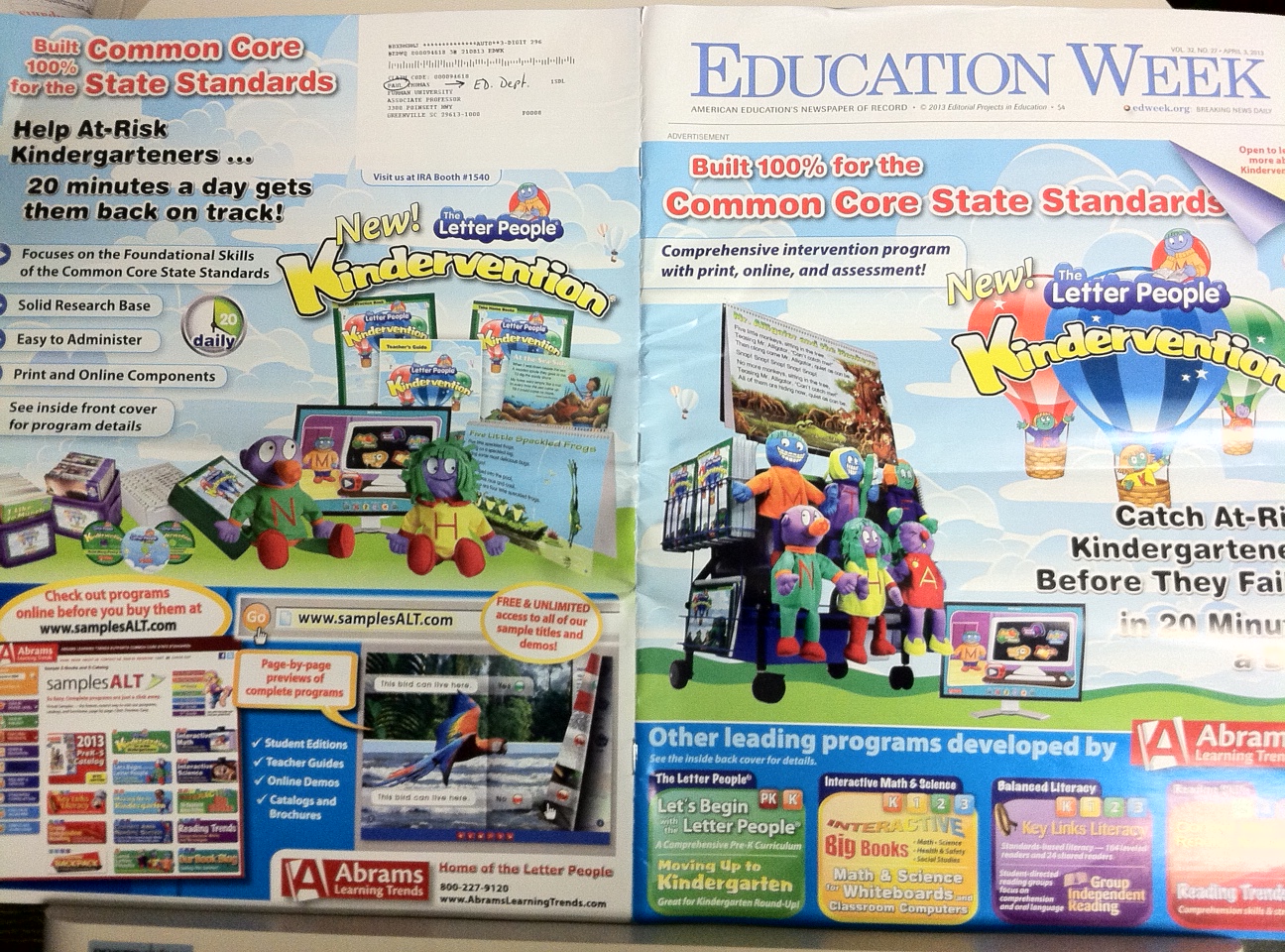
For those who fear the CCSS, I want to remind you once again: Look carefully at this entire cover of Education Week exposing that CCSS is consumerism and commodification—not communism and socialism:

EW.CCSS

The crass commercialism covering a major education publication reads like an infomercial:

“Catch At-Risk Kindergarteners Before They Fail…in 20 Minutes a Day!”

“Help At-Risk Kindergarteners…20 minutes a day gets them back on track!”

But a letter from the company vice president doesn’t inspire much confidence about high standards: “Kindervention is the most unique program in our history…,” it opens.

Most unique? Maybe words that can’t be qualified aren’t in the CCSS.

Ultimately, CCSS are a distraction.

And cries that CCSS are a communist, socialist, or government plot are distractions.

So the odd intersection of progressives and libertarians rejecting the CCSS fails ultimately since the reasons are deeply divided, but there is a reason that we all—every citizen of the U.S. regardless of ideology—should unite against CCSS and most other corporate manipulations of our Commons:

Being consumed by manufactured demons is a self-defeating American tradition that needs to be set aside.

Like the crews in both Alien and Prometheus, Americans are blinded, and often asking the wrong questions (“Why is Common Core not requiring cursive writing instruction?”)—or worse yet, not asking any questions at all about the power of corporate America over the government we fail to see as “we the people.”