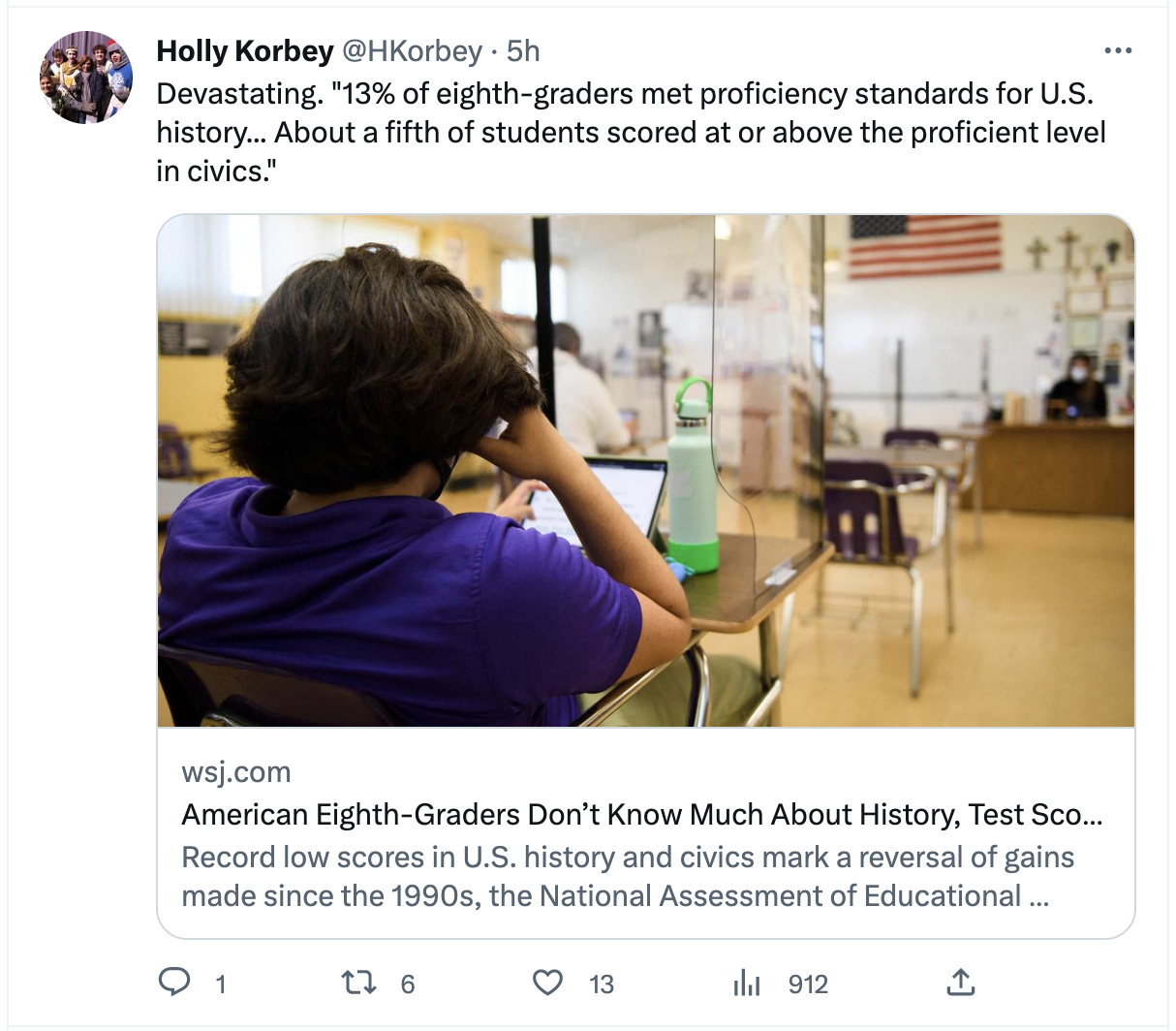
The newest NAEP crisis (until the next one) concerns history and civics NAEP scores post-pandemic.
Similar to the NAEP crisis around reading—grounded in a misunderstanding of “proficiency” and what NAEP shows longitudinally (see Mississippi, for example)—this newest round of crisis rhetoric around NAEP exposes a central problem with media, public, and political responses to test data as well as embedding proficiency mandates in accountability legislation.
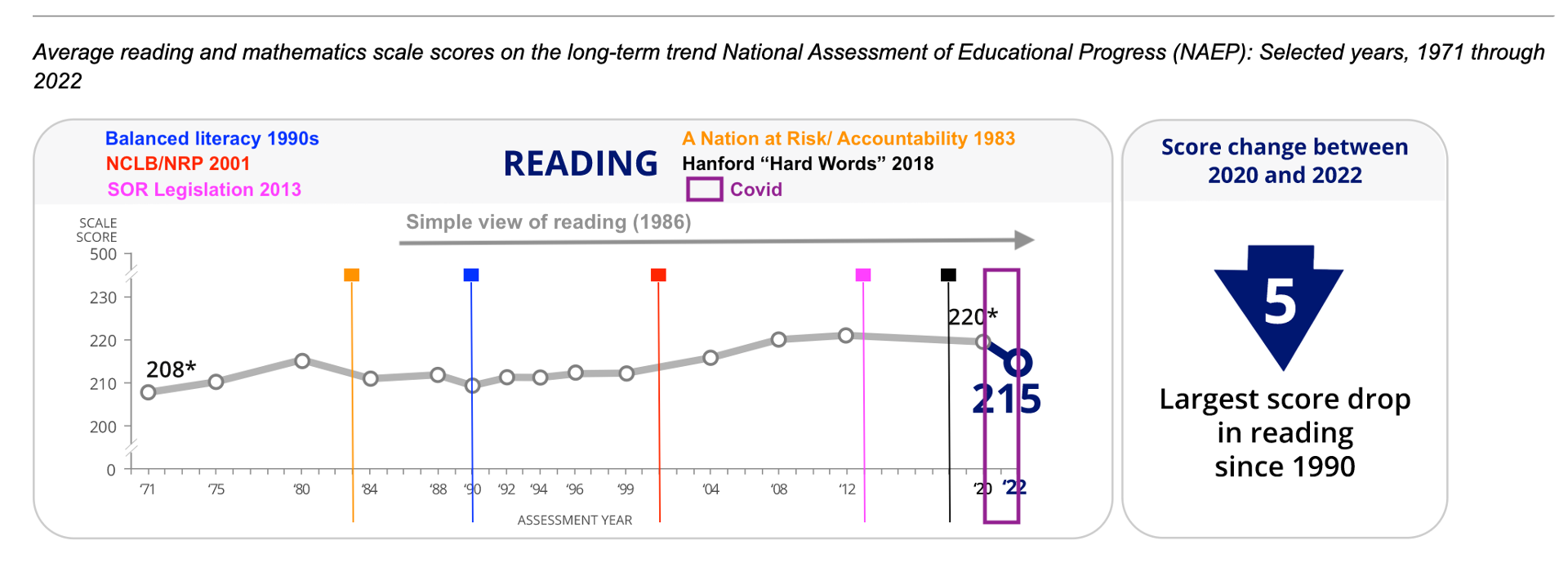
As many have noted, announcing a reading crisis is contradicted by longitudinal NAEP data:
But possibly a more problematic issue with NAEP is confusing NAEP achievement levels with commonly used terms such as “grade level proficiency” (notably as related to reading).
Yet, as is explained clearly on the NAEP web site: “It should be noted that the NAEP Proficient achievement level does not represent grade level proficiency as determined by other assessment standards (e.g., state or district assessments).”
Public, media, and political claims that 2/3 of students are below grade level proficiency, then, is a false claim based on misreading NAEP data and misunderstanding the term “proficiency,” which is determined by each assessment or state (not a fixed metric).
Here is a reader for those genuinely interested in understanding NAEP data, what we mean by “proficiency,” and why expecting all students to be above any level of achievement is counter to understanding human nature (recall the failed effort in NCLB to mandate 100% of student achievement proficiency by 2014):
Way back in the late 1970s, I changed my schedule—either in grade 10 or 11—and found myself in two class periods without my friends; I had been trafficking among the top-ranked students in my class (I graduated number 8 out of about 150 students), but the schedule change put me in a so-called “regular” history class.
The class was taught by a football and track coach. He had a very simple and even elegant instructional strategy.
In the center of the classroom stood an overhead projector. Beside it, daily, he had a designated stack of overheads.
After the first couple classes, he assigned the slowest note taker (or better named, note copier) to sit beside the stack of notes to rotate as that student completed copying.
After one day of this tedium, I rushed to guidance and returned to my original schedule along side my friends.
Something that is rarely discussed in the many public discussions of US education is that history, social studies, civics, and government courses in public schools are disproportionately taught by coaches.
Most coaches are coincidentally teachers—and a few teachers are coincidentally coaches. A significant number of US public school students get begrudging instruction in history, social studies, civics, and government—and that instruction is superficially facts, easy to test (or at least easy to put on tests that are easy to score).
This relatively flat data line for NAEP history scores should remind you of reading NAEP data:
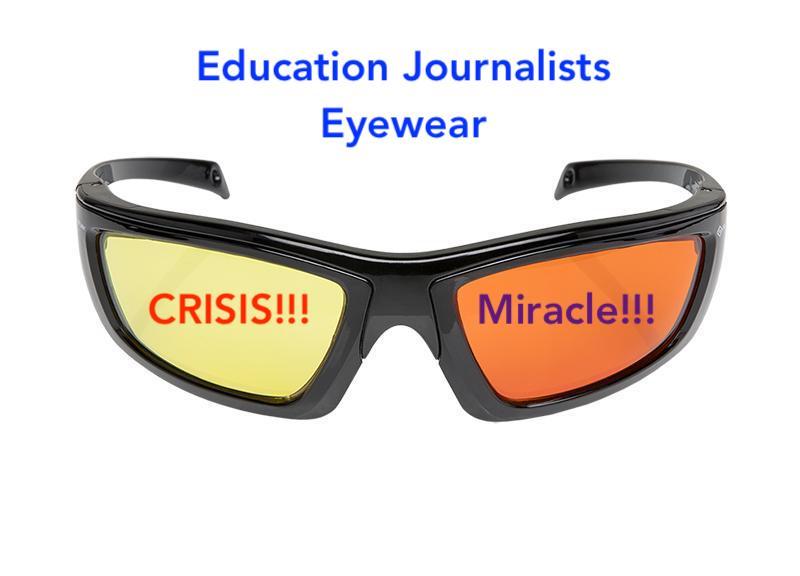
Despite evidence to the contrary, once again, mainstream media, the public, and political leaders have only two ways to react to anything about US public education—crisis or miracle.
We might anticipate that the drop in US history and civics NAEP scores (despite the obvious connection to Covid, as noted above in NAEP reading) will prompt “science of history” and “science of civics” movements.
But, honestly, those will not materialize because politically the US does not care about history or civics—at least not about the quality of teaching and learning in history or civics.
Politically, we only care about anything that allows a public outrage and melodramatic media response to further prove that students suck, teachers suck, and schools, well, suck.
Similar to the false stories around reading, however, the actual problems with history and civics teaching and learning in the US have little to do with a very bad test (that, we should note, is what NAEP is, a very bad test).
History, social studies, civics, and government courses have for decades been part of an open secret—a set of content eagerly sacrificed to the scholastic sports Gods.
And more recently, history, social studies, civics, and government are the political tool of the Republican Party who wants schooling to indoctrinate children in the fairy tales that maintain the status quo of inequitable power, freedom, and humanity that is the good ol’ U.S. of A.
The real purpose of NAEP is to give periodic space to the only way journalists know how to respond to education:
Ironically, that journalists and the public are so easily fooled by this nonsense is the strongest indictment of the failures of US public education.
We all should know better. We all should do better.
But we won’t.
That, by the way, is one predictable lesson of history.
The fall of 2023, I will be walking into my year 40 as a teacher. I started my career journey as a high school English teacher in the high school where I graduated and even the same English classroom I had sat in as a student during my sophomore and junior years.
The somewhat early years teaching high school English at Woodruff High (Woodruff, SC).
Many of the teachers had been my teachers when I was a student, and I was then (seemingly suddenly) a colleague with veteran and well-loved members of the school and my small hometown.
One of those English teachers assigned their seniors only one essay, due at the end of the academic year and never returned or commented on by that teacher. Many of those seniors were destined for college and had essentially no writing instruction their entire senior year—filled instead with weekly vocabulary tests, grammar tests, and textbook tests on British literature.
Just down the hall, I was embarking on 18 years of responding to about 4000 essays per year by my students; I was committed to teaching students to write well by having them write often and in workshop experiences.
I just completed my spring 2023 semester, which had two writing-intensive courses. This spring followed my only sabbatical experience in the fall of 2022, although I had been in higher education for 20 years.
I returned to teaching with a renewed commitment to decreasing stress and high-stakes for my students while trying to foster greater engagement by those students.
For about three-quarters of my teaching career, lowering stress and high-stakes has included de-grading and de-testing my courses, although the de-grading applied to assignments since I still had/have to assign course grades (see here about delaying grades).
However, once again, a number of students offered feedback on student evaluations that deflate significantly my enthusiasm for many of my efforts to support autonomous students.
In courses with required conferencing, some students noted that conferences should be required; this disconnect is linked to students being responsible for requesting and scheduling those conferences.
In a semester where I responded to about 200 essays over three courses and 24 total students, some students complained that I did not provide enough feedback for their work and/or that my feedback was too negative or not specific enough (see here about negative feedback).
At the core of these tensions and disconnects, I feel, is the essential paradox of who is responsible for learning.
For over twenty years now, I am teaching adults, yes, young adults, but college students are adults. My career before higher education was high school, and again, I worked with teens and young adults.
Yet, most students have experiences in formal schooling that teaches them they are passive agents in the teaching/learning dynamic. My students, particularly those who struggle in my course, think the responsibility for their learning is me, the teacher.
My teaching is grounded in critical pedagogy, and I practice an awareness that the role of the teacher is to teach with the role of the student, to learn. More nuanced is Freire’s argument that the teacher is always a teacher/student and the student is always a student/teacher.
Critical pedagogy views teaching and learning as liberatory—to learn is to become fully human, which is a state that requires autonomy.
Broadly, my role as a teacher (and mentor) is to provide the ideal context for students to learn; however, I cannot make someone learn.
As painful as this is to admit, teaching does not guarantee learning, and ultimately, learning is the role of the student (acknowledging that far too many students are in life situations that inhibit that autonomy).
My students are mostly in ideal contexts to learn, yet they often struggle even as I create courses with low stakes (no grades, no tests, no lateness penalties, etc.) and encourage high engagement; that struggle is grounded in the stress that students feel by having the responsibility for learning shifted from me to them.
Traditional and enduring practices around assigning and teaching writing prove to be barriers for student autonomy—essay prompts, rubrics, comprehensive marking of student writing, etc.
Here is another story from my first years of teaching.
A very highly regarded teacher of English moved to the high school when my district reorganized around a middle school concept and shifted ninth grader from our junior high to the high school.
I often taught that teacher’s students, and they explained to me that they would submit their essays, and then the teacher would return the papers with comments before using the overhead to show the students how to rewrite the essays.
Students dutifully followed the essay that teacher rewrote for them and resubmitted essentially identical essays.
My students today often have one of those two experiences—the negligent writing teachers who assign almost no writing or provide no real feedback or the hyper-controlling teacher who uses scripted prompts and rubrics (the enduring five-paragraph essay included) while also commenting exhaustively on submitted essays.
For those students, my classes are disorienting and often difficult to navigate.
While I have worked for decades to reduce high-stakes environments in my courses to reduce stress, students are often stressed when the responsibility for learning is shifted toward them
As I ponder how to revise further my writing-intensive courses, I continue to look for ways to increase student engagement. Currently, here are the structures I use with varying degrees of effectiveness:
Reducing how much I copyedit and comment on student drafts and increasing face-to-face conferencing.
Providing students with resources that support their learning to revise and edit their own writing.
Grounding writing assignments in authentic forms of writing and inviting students to explore examples of published writing to support their own awareness about forms and purposes for writing.
Maintaining a culture of low-stakes that includes not grading student work while in process, establishing workshop environments for students as writers, and providing structure for students without using punitive or coercive procedures.
Establishing minimum requirements for student engagement that include required drafting of essays as well as options for additional drafts and conferences by choice and request.
Regretfully, I am not seeing these materials being as effective as I hoped because at the core of the problem is not my structure or guidance, but that students remain committed to seeing my role not as teaching but as making them learn.
For example, I often mark needed revisions on essays and add a comment to check for the issues throughout the essay, yet most students only revise what I have marked.
That is a habit they bring to my classes, and one I find nearly impossible to break.
What I am addressing as a writing teacher, then, is a subset of how to foster learning autonomy in students.
Traditional schooling and the pervasive consequences of the Covid era are working against students’ abilities to recognize and embrace that autonomy.
And having an outlier class like mine that centers student autonomy, despite my commitment to lowering stress and high-stakes, is ironically highly stressful for my students.
And thus, I have much to ponder before walking into my classrooms for year 40 this coming fall.
[Below is an OpEd submitted to newspapers in SC; no response yet.]
Writing in Teachers College Record, literacy scholars Reinking, Hruby, and Risko explain: “Since 2015, 47 state legislatures have enacted, or are currently considering, a remarkable total of 145 bills that address reading and reading instruction in public schools.”
A few days apart, an article in the New York Times again announced the US has a reading crisis, and in EdSource, a school’s exceptional success with multilingual learners was celebrated.
The problem with new reading legislation, another reading crisis, and highlighting education “miracles” is that they all are factually untrue.
For example, Reinking, Hruby, and Risko demonstrate that reading achievement as measured by NAEP grade 4 reading scores have remained flat for many years in the US:
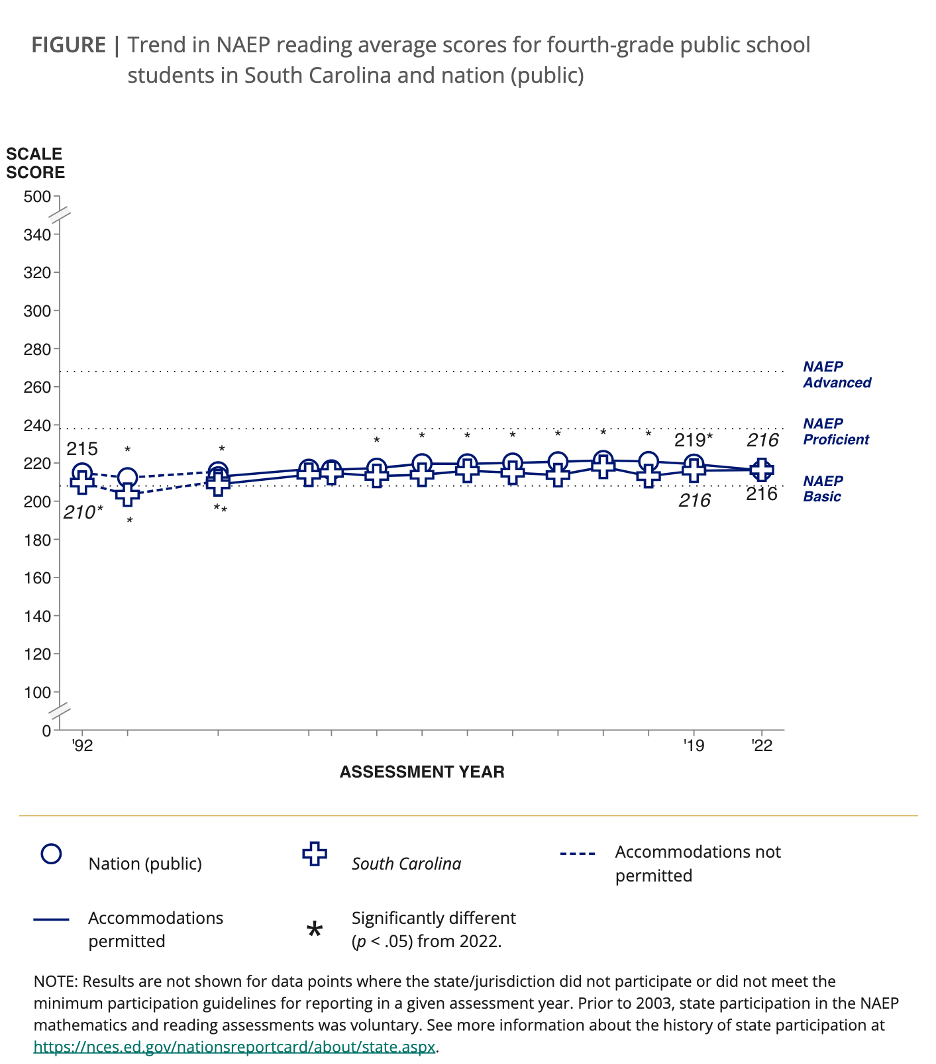
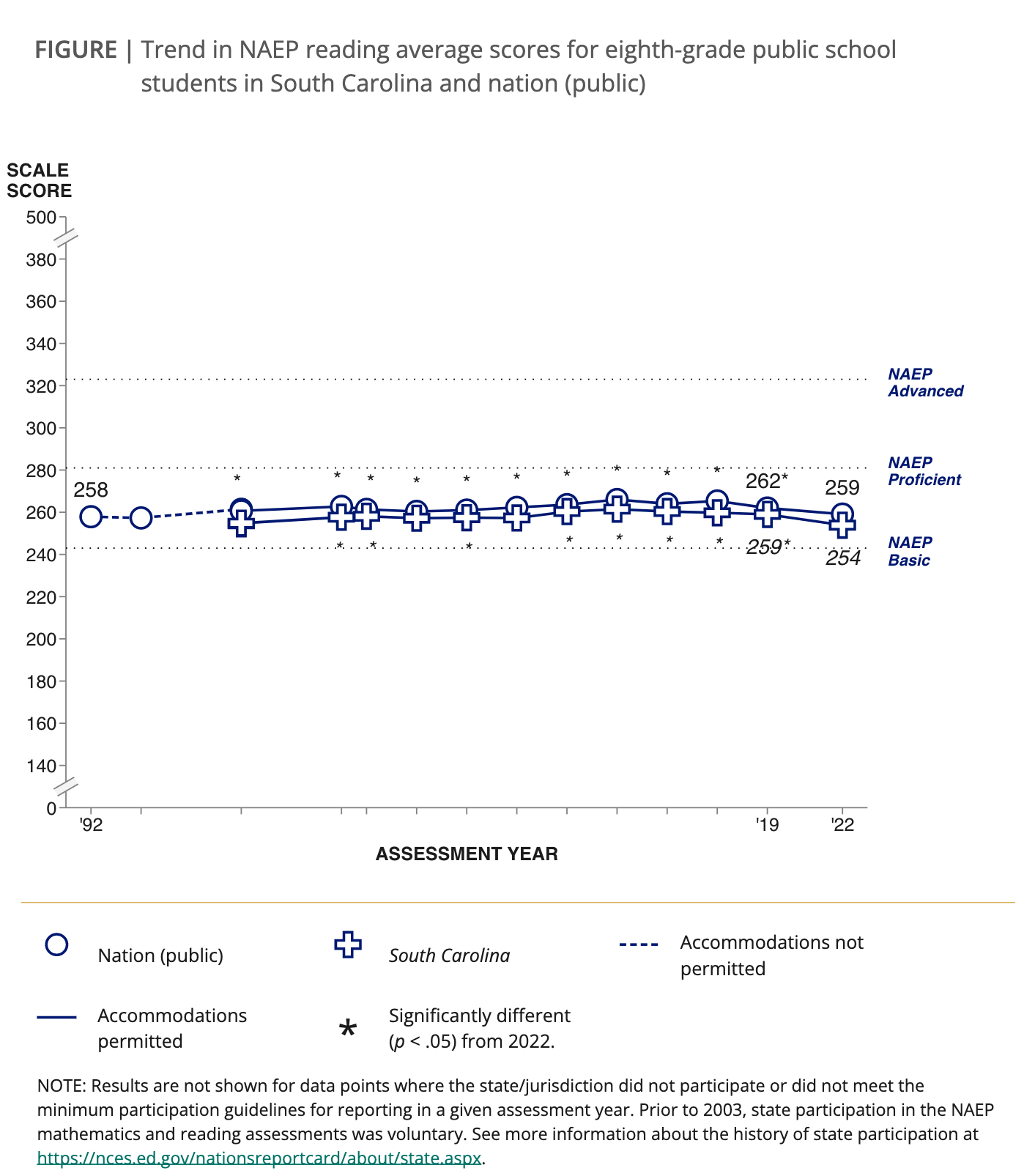
The same is true of South Carolina:
South Carolina has also been an early and eager adopted of standards, high-stakes testing, and embracing the current trend to legislate reading. However, these models of crisis and reform have never produced the sort of reading achievement that the media, the public, or political leaders have promised.
After multiple versions of different standards and tests as well as several rounds of reading wars, South Carolina like the rest of the US continues to lament low reading proficiency in students.
As a lifelong literacy educator in SC over five decades, I recommend that we first stop focusing on crisis and “miracle” stories about our schools, our teachers, and our students. These extreme stories almost always prove to be misleading or false.
Next, and most importantly, we need to do something different—at the school and classroom levels, but also at the political level of legislation, funding, and mandates.
South Carolina has a historical challenge of extreme pockets of poverty, and recent data from the value-added era of education reform under Obama confirmed that about 86 – 99% of measurable student achievement is linked to out-of-school factors, not teacher practice or quality.
The historical negligence of political leadership in SC highlighted in the documentary Corridor of Shame has simply never been addressed.
Further, what do students, teachers, and public schools needed from legislators in SC?
Political leaders must resist the current trend to ban teaching practices and reading programs while also mandating narrow approaches to reading and a new batch of preferred reading programs.
Simply put, there is no silver bullet for teaching reading, and neither the problem nor the solution is a magic reading program.
Students and teachers instead need political leaders to address learning and teaching conditions in our schools concurrent with addressing poverty and inequity in the homes and communities of our children.
Equitable learning and teaching conditions would include repealing grade retention, reducing significantly class sizes in the earliest grades and for the populations of students struggling to read, funding better all aspects of public education (teacher pay, school facilities, learning and teaching materials), and refusing to succumb to the current trends of legislating curriculum through bans and censorship.
The two most powerful commitments that a state can make in terms of supporting education and reading instruction is ensuring that the individual educational needs of all students are supported and that teacher professionalism is directly and fully supported.
For my entire career in SC as a literacy educator, political leaders have failed to address poverty and inequity, ignored the needs of our most vulnerable students, and eroded the profession of teaching in the state.
The stories we have told and the political responses to those stories have failed all of us for decades. We must do better and that means we must do something different.
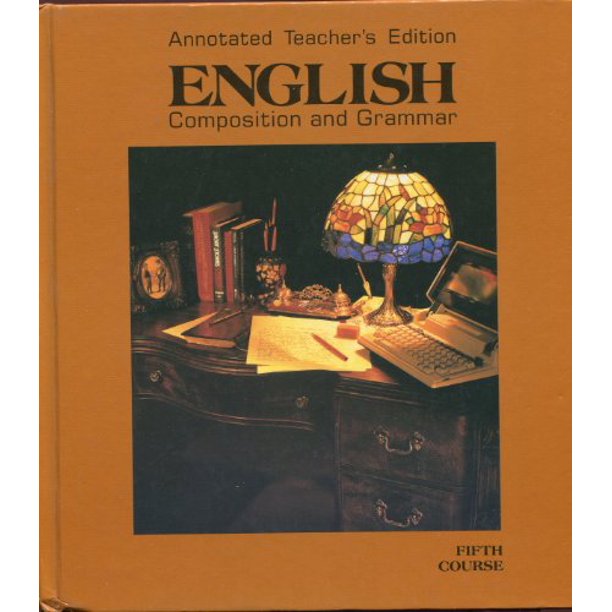
When I entered the classroom as an English teacher in 1984 at the high school where I had graduated just five years earlier, students lugged around two huge textbooks for their English courses, one of which was Warriner’s English grammar text.
Students were conveniently color coded by these texts since the publishers provided different ability and grade levels of the literature and grammar texts. And universally students hated these textbooks, the carrying and their use in the classrooms.
Since I taught different ability levels (we used and A, B, C level system for each grade) and grades, I had about 15 textbooks across my five courses because students in English also were assigned vocabulary books (the publisher we used proudly printed in bright letters that these vocabulary books prepared students for the SAT!).
At least the vocabulary books were small paperbacks.
Two important facts stand out about those first couple years teaching in the traditional expectations for English teachers at that school (mostly the same teachers who taught me as a student): first, Warriner’s regardless of grade or ability level had essentially the exact same chapters for teachers to systematically and comprehensively teach every year, and second, teachers expressed repeatedly that students never learned those grammar lessons, noting that student writing failed to improve in terms of grammar, mechanics, and usage.
Another big picture point to make here is that when I was a student, grammar texts included lessons on “shall” and “will”; that my students had to cover an entire chapter and be tested on “who” and “whom”; and both my students and I had to “learn” about pronoun/antecedent agreement (specifically the use of “they” as plural only).
Today, we must acknowledge that all of these rules and the consequences of students “not learning them” have evaporated since “shall” and “whom” have graciously disappeared and “they” has been (finally) acknowledged as a resourceful pronoun.
As a beginning teacher, I had entered education to teach writing, although, of course, I loved literature also. Yet, the grammar- and skills-centric approach to teaching English, I recognized, was failing students miserably—I mean literally because students were miserable, learning to hate English, writing, and literature.
Of course, my stories here speak to a disturbing reality in education: Lou LaBrant, writing in 1946, noted: “We have some hundreds of studies now which demonstrate that there is little correlation (whatever that may cover) between exercises in punctuation and sentence structure and the tendency to use the principles illustrated in independent writing” (p. 127). And then in 1947: “A brief consideration will indicate reasons for the considerable gap between the research currently available and the utilization of that research in school programs and methods” (p. 87).
Yet, English teachers throughout the decades kept beating their heads against the grammar and skills wall, lamenting “kids today” for not being good writers—regardless of decade, regardless of the grammar programs implemented.
This raises a current issue about “scientific” or “evidence” as the basis for how teachers teach, notably in the current reading war.
Here, I think, is an excellent overview by Jal Mehta (Harvard University) about why calling for “scientific” or “evidence” to mandate teaching literacy is just as misguided as the evidence-free practices I witnessed as a beginning teacher almost 40 years ago:
What may have started out about a decade ago as a sincere plea similar to LaBrant’s—the teaching of reading in practice often failed to be effectively evidence-based (“scientific”)—has turned into the exact sort of one-size-fits-all ideological movement that Jal warns about: scientific as a “weapon.”
The mistake being made is also perfectly identified by Jal: “In my experience, the best educators and leaders see lots of complexity, consider context, and artfully weave together different approaches to solve particular problems.”
Ironically, this is the exact approach grounding both whole language and balanced literacy as philosophies of teaching reading and writing; however, as we have witnessed, both WL and BL also became convenient labels for practices not following those philosophies or simply slurs ideologues use to criticize.
Instead, the SOR movement has become ideological and weaponized to create simplistic and unfounded crisis rhetoric for politicians and skills-driven reading policy and practice.
For example, no one argues that phonics, vocabulary, and knowledge are not key elements in reading. But the SOR movement demands a linear and sequential skills-first approach; teach phonics, vocabulary, and knowledge systematically before students read.
The skills-first approach is essentially authoritarian (what phonics, vocabulary, and knowledge students “need” is determined and outlined for students and teachers) and necessarily erases diversity of language and experiences by students.
The counter approach, the complex approach to reading, acknowledges the importance of elements such as phonics, vocabulary, and knowledge, but also honors that the relationship between so-called skills and reading is reciprocal, not linear or sequential.
In other words, yes, students need some direct and purposeful instruction in phonics, vocabulary, and knowledge building as they become beginning readers; however, most of a person’s acquisition of phonics, vocabulary, and knowledge comes from reading—not direct or systematic instruction.
The problem with systematic and comprehensive teaching of any literacy skills is that the goal and accountability around teaching and learning become the acquisition of the skills (phonics tests, vocabulary tests, knowledge tests) instead of the authentic goal of fostering eager, independent, and critical students who read.
Ultimately, if we genuinely want evidence-based reading instruction for children in the US, we must recognize that the most important sources of evidence are the children themselves and the most valuable person to understand what children need to read are their teachers.
However, beyond shifting to what evidence counts, we must also recognize that students and teachers cannot be successful unless we address learning and teaching conditions (the one move politicians refuse to make).
Regretfully, as Jal recognizes, students and teachers are again simply pawns in another fruitless war won by the SOR advocates “who are loudest about ‘evidence-based practices,’ [and] ironically tend to be more ideologues who have a few preferred solutions that they think can address every problem.”
With a sort of humility rarely found when someone of prominence speaks to or about education in the US, celebrated author Ralph Ellison (Invisible Man) found himself speaking at a teachers conference in 1963 “to discuss ‘these children,’ the difficult thirty percent,” the identified population making up the drop-out crisis of the time [1].
One of the most impressive aspects of Ellison’s talk is his emphasis on systemic influences on children and their language acquisition: “The American scene is a diversified one, and the society which gives it its character is a pluralistic society-or at least it is supposed to be,” explaining:
The education which goes on outside the classroom, which goes on as they walk within the mixed environment of Alabama, teaches children that they should not reach out for certain things. Much of the education that I received at Tuskegee (this isn’t quite true of Oklahoma City) was an education away from the uses of the imagination, away from the attitudes of aggression and courage. This is not an attack. This is descriptive, this is autobiographic. You did not do certain things because you might be destroyed. You didn’t do certain things because you were going to be frustrated. There were things you didn’t do because the world outside was not about to accommodate you….
It does me no good to be told that I’m down on the bottom of the pile and that I have nothing with which to get out. I know better. It does me no good to be told that I have no heroes, that I have no respect for the father principle because my father is a drunk. I would simply say to you that there are good drunks and bad drunks. The Eskimos have sixteen or more words to describe snow because they live with snow. I have about twenty-five different words to describe Negroes because I live principally with Negroes. “Language is equipment for living,” to quote Kenneth ’Burke. One uses the language which helps to preserve one’s life, which helps to make one feel at peace in the world, and which screens out the greatest amount of chaos. All human beings do this.
And then Ellison goes right to the core issue about language in marginalized and minoritized populations:
Some of us look at the Negro community in the South and say that these kids have no capacity to manipulate language. Well, these are not the Negroes I know. Because I know that the wordplay of Negro kids in the South would make the experimental poets, the modern poets, green with envy. I don’t mean that these kids possess broad dictionary knowledge, but within the bounds of their familiar environment and within the bounds of their rich oral culture, they possess a great virtuosity with the music and poetry of words. The question is how can you get this skill into the mainstream of the language, because it is without doubt there. And much of it finds its way into the broader language. Now I know this just as William Faulkner knew it. This does not require a lot of testing; all you have to do is to walk into a Negro church….
Thus we must recognize that the children in question are not so much “culturally deprived” as products of a different cultural complex. I’m talking about how people deal with their environment, about what they make of what is abiding in it, about what helps them to find their way, and about that which helps them to be at home in the world. All this seems to me to constitute a culture. If you can abstract their manners, their codes, their customs and attitudes into forms of expression, if you can convert them into forms of art, if you can stylize them and give them many and subtle ranges of reference, then you are dealing with a culture. People have learned this culture; it has been transferred to them from generation to generation, and in its forms they have projected their most transcendent images of themselves and of the world.
On social media, I had a cognitive scientist SOR-splain to me literacy in my home state of South Carolina, recommending I look at narrow assessments of reading (a popular program) to admit that SC has a reading crisis. Like Ellison, I pointed out I don’t need a test to know the truth about reading and literacy in SC, all across the South, and even in the US.
In my 39th year as a literacy educator in SC, where I was born in 1961 and attended formal education from 1967 through 1998, I have lived and witnessed firsthand a fact that the media narratives never capture, but let me ask you to help me before I explain the real story.
Here are longitudinal data for SC NAEP reading scores in grades 4 and 8 from 1992 to 2022; could you please identify where the “crisis” is?:
I lived, learned, and taught in the three decades before these three decades, and I can only conclude that reading achievement (whatever that is) as measured in formal testing has been about the same forever.
In my home state and across the nation, this is the real story: We have become content with a historical and current negligence about the reading acquisition of some populations (Black and brown students, poor students, special needs students, multi-lingual learners), and we lack the political will to address the systemic forces of inequity in the lives and schooling of these students to do anything about it.
Historical negligence is not a crisis; it simply is how things are, what we have come to accept as “normal.”
As I have examined in my scholarship [2], journalism in the US has only two false stories about education—crisis and miracle.
The problem is that neither narrative is true; they are anecdotal and melodramatic so they are compelling to the public, politically useful, and likely to drive reader/viewership for the media.
The crisis/miracle narrative approach from the Obama era has recently been replicated by the media obsession with SOR; Hanford’s seminal story planted both seeds by falsely claiming the US has a reading crisis and promoting a miracle school that wasn’t.
Again, please point out the crisis here:
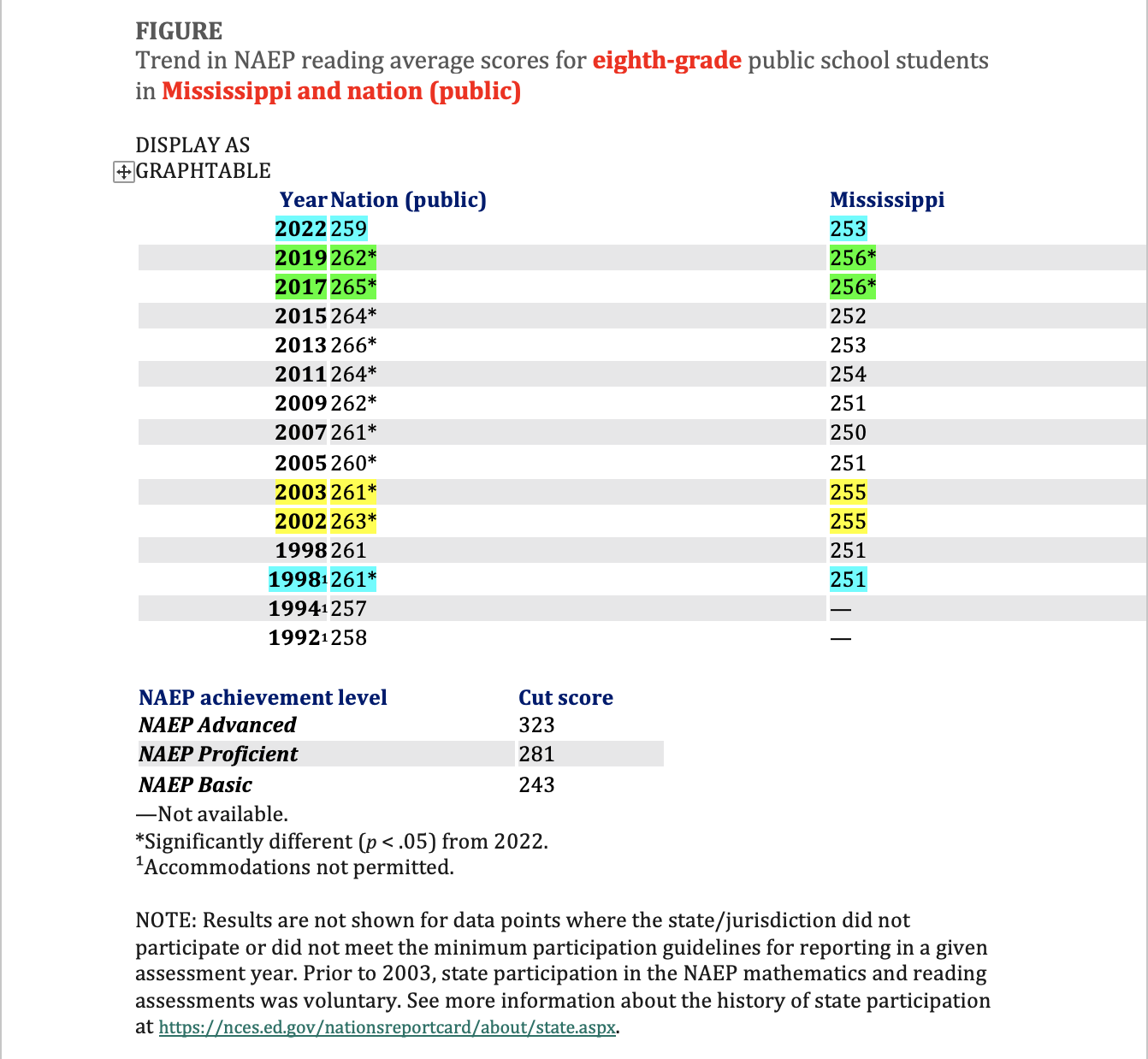
And as I have explained, the miracle of the moment, Mississippi, like all the other educational miracles, simply doesn’t exist; MS has had steady growth and some jumps, often well before any SOR reading legislation:
And MS remains below NAEP proficient and continues to have drops between grade 4 and 8:
For many years, I have had to help my students navigate the media obsession with the melodramatic—crisis! miracle!—often found in films such as Waiting for Superman (false union crisis v. charter miracles) and the compelling documentary about education in SC, Corridor of Shame (an emotionally manipulative film about the powerful connection between poverty and educational negligence in the state).
The media, public, and politicians love and benefit from the crisis/miracle rhetoric about education. But those stories do not serve the needs of children, teachers, or schools.
Ellison ends his talk powerfully:
I don’t know what intelligence is. But this I do know, both from life and from literature: whenever you reduce human life to two plus two equals four, the human element within the human animal says, “I don’t give a damn.” You can work on that basis, but the kids cannot. If you can show me how I can cling to that which is real to me, while teaching me a way into the larger society, then I will not only drop my defenses and my hostility, but I will sing your praises and help you to make the desert bear fruit.
Education journalism has reduced education to crisis or miracle, and like the reductive formula Ellison rejects for children, I must reject this false pair of stories.
There is no reading or education crisis, and there are no miracle schools.
There is historical and current political negligence for addressing inequity in the lives and schooling of “other people’s children” in the US.
But that reality doesn’t sell or garner votes.
[1] Toward end, Ellison is scathing:
The great body of Negro slang–that unorthodox language–exists precisely because Negroes need words which will communicate, which will designate the objects, processes, manners and subtleties of their urban experience with the least amount of distortion from the outside. So the problem is, once again, what do we choose and what do we reject of that which the greater society makes available? These kids with whom we’re concerned, these dropouts, are living critics of their environment, of our society and our educational system, and they are quite savage critics of some of their teachers.
A recent scholarly commentary by professors Reinking, Hruby, and Risko note: “Since 2015, 47 state legislatures have enacted, or are currently considering, a remarkable total of 145 bills that address reading and reading instruction in public schools.”
Many literacy and policy scholars [1] have also noted that this wave of reading legislation is often grounded in the “science of reading” (SOR) movement that has been characterized as misleading, overly simplistic, and driven by melodramatic anecdotes.
Further, the growing number of states adopting SOR-based reading legislation includes bans of reading practices and programs as well as narrow mandates for different reading practices and programs.
A 2020 policy statement warned about using the SOR movement to inform legislation, however, by:
• Failing to place the current concern for reading in a historical context. • Overemphasizing recent test scores and outlier data instead of longitudinal data with greater context (for example, NAEP). • Misrepresenting the “science of reading” as settled science that purportedly prescribes systematic intensive phonics for all students. • Overstating and misrepresenting the findings of the National Reading Panel report of 2000, without acknowledging credible challenges to those findings. • Focusing blame on K-12 teachers and teacher education without credible evidence or acknowledgement of challenging teaching and learning conditions and the impact of test-based accountability policies on practice and outcomes. • Celebrating outlier examples of policy success (in particular, the Mississippi 2019 NAEP data) without context or high-quality research evidence for those claims.
National Education Policy Center & Education Deans for Justice and Equity (2020). Policy Statement on the “Science of Reading.” Boulder, CO: National Education Policy Center. http://nepc.colorado.edu/publication/fyi-reading-wars
The policy statement remains an important guide for revising reading legislation in order to avoid continuing to under- and mis-serve the individual needs of all students and to de-professionalize teachers.
The recommendations remain urgent and include the following for what legislation should not/should do:
• Should not fund or endorse unproven private-vendor comprehensive reading programs or materials. • Should not adopt “ends justify the means” policies aimed at raising reading test scores in the short term that have longer-term harms (for example, third-grade retention policies). • Should not prescribe a narrow definition of “scientific” or “evidence-based” that elevates one part of the research base while ignoring contradictory high-quality research. • Should not prescribe a “one-size-fits-all” approach to teaching reading, addressing struggling readers or English language learners (Emergent Bilinguals), or identifying and serving special needs students. • Should not prescribe such a “one-size-fits-all” approach to preparing teachers for reading instruction, since teachers need a full set of tools to help their students. • Should not ignore the limited impact on measurable student outcomes (e.g., test scores) of in-school opportunities to learn, as compared to the opportunity gaps that arise outside of school tied to racism, poverty, and concentrated poverty. • Should not prioritize test scores measuring reading, particularly lower-level reading tasks, over a wide range of types of evidence (e.g., literacy portfolios and teacher assessments), or over other equity-based targets (e.g., access to courses and access to certified, experienced teachers), always prioritizing the goal of ensuring that all students have access to high-quality reading instruction. • Should not teacher-proof reading instruction or de-professionalize teachers of reading or teacher educators through narrow prescriptions of how to teach reading and serve struggling readers, Emergent Bilinguals, or students with special needs. • Should not prioritize advocacy by a small group of non-educators over the expertise and experiences of K-12 educators and scholars of reading and literacy. • Should not conflate general reading instruction policy with the unique needs of struggling readers, Emergent Bilinguals, and special needs students.
• Should guarantee that all students are served based on their identifiable needs in the highest quality teaching and learning conditions possible across all schools: o Full funding to support all students’ reading needs; o Low student/teacher ratios; o Professionally prepared teachers with expertise in supporting all students with the most beneficial reading instruction, balancing systematic skills instruction with authentic texts and activities; o Full and supported instructional materials for learning to read, chosen by teachers to fit the needs of their unique group of students; o Intensive, research-based early interventions for struggling readers; and o Guaranteed and extensive time to read and learn to read daily. • Should support the professionalism of K-12 teachers and teacher educators, and should acknowledge the teacher as the reading expert in the care of unique populations of students. • Should adopt a complex and robust definition of “scientific” and “evidence-based.” • Should embrace a philosophy of “first, do no harm,” avoiding detrimental policies like grade retention and tracking. • Should acknowledge that reading needs across the general population, struggling readers, Emergent Bilinguals, and special needs students are varied and complex. • Should adopt a wide range of types of evidence of student learning. • Should prioritize, when using standardized test scores, longitudinal data on reading achievement as guiding evidence among a diversity of evidence for supporting instruction and the conditions of teaching and learning. • Should establish equity (input) standards as a balance to accountability (output) standards, including the need to provide funding and oversight to guarantee all students access to high-quality, certified teachers; to address inequitable access to experienced teachers; and to ensure supported, challenging and engaging reading and literacy experiences regardless of student background or geographical setting. • Should recognize that there is no settled science of reading and that the research base and evidence base on reading and teaching reading is diverse and always in a state of change. • Should acknowledge and support that the greatest avenue to reading for all students is access to books and reading in their homes, their schools, and their access to libraries (school and community).
National Education Policy Center & Education Deans for Justice and Equity (2020). Policy Statement on the “Science of Reading.” Boulder, CO: National Education Policy Center. http://nepc.colorado.edu/publication/fyi-reading-wars
This current cycle of the reading wars is another example of reducing historical and current failures of reading instruction to unwarranted crisis rhetoric and then resorting to the same failed patterns of education reform enacted for nearly five decades.
The individual needs of all students as readers can only be served by autonomous teachers in educational environments that support learning and teaching—not by mandates for scripted programs that enforce a once-size-fits-all approach to learning and teaching.
Reading legislation has the potential to do great harm or great good for the children of the US and our democracy. Once again, political leaders have chosen to do great harm.
Thomas, P.L. (2022). The Science of Reading movement: The never-ending debate and the need for a different approach to reading instruction. Boulder, CO: National Education Policy Center. http://nepc.colorado.edu/publication/science-of-reading
Hoffman, J.V., Hikida, M., & Sailors, M. (2020). Contesting science that silences: Amplifying equity, agency, and design research in literacy teacher preparation. Reading Research Quarterly, 55(S1), S255–S266. Retrieved July 26, 2022, from https://doi.org/10.1002/rrq.353
MacPhee, D., Handsfield, L.J., & Paugh, P. (2021). Conflict or conversation? Media portrayals of the science of reading. Reading Research Quarterly, 55(S1), S145-S155. Retrieved July 26, 2022, from https://doi.org/10.1002/rrq.384

















 dr. p.l. (paul) thomas