Category Archives: Education

Where Do We Go from Here?: Learning and Teaching in the SOR Era

One of the most important and too often ignored works by Martin Luther King Jr. is his Where Do We Go from Here: Chaos or Community? (see an excerpts here).

I have relied on this work for many years in the context of my public writing and scholarship addressing equity, poverty, race, and literacy (for example, see pt. 1 and pt. 2). What has always rung true and important is King’s practical call for needed direct action instead of the status quo of political indirect action.

For example, King noted that the political will in the US was to view education as a mechanism for erasing poverty, racism, and inequity (indirect action) instead of directly eradicating the forces that create poverty, racism, and inequity.

I have reached a very sobering moment in my public work addressing the “science of reading” (SOR) movement as that has informed reading legislation across the US:

Since 2015, 47 state legislatures have enacted, or are currently considering, a remarkable total of 145 bills that address reading and reading instruction in public schools.1 Many of these bills are relatively routine appropriations, procedural issues, licensures, and so forth. However, an increasing number define, endorse, and sometimes mandate instructional approaches—a legislative excursion into matters that in other fields of practice, such as medicine or law, are left to certified professionals and the standards set by their professional organizations or accrediting agencies. In that sense, the existence of such laws suggests a perception of a problem with the teaching of reading of such consequence that it demands legislative action. In so doing, it moves professional practice into the political realm, subject to all the forces and vested interests inherent to that domain.

More specifically, it moves the teaching of reading into ideological territory, at least in the narrow pragmatic sense suggested by Fine and Sandstrom (1993; see also Seliger, 1970/2019). They defined ideologies as uniting individuals around shared beliefs and offering “diagnoses of what is and is not problematic in the sociopolitical world” (p. 24). Ideologies, they say, motivate ameliorative action, create affinity by energizing emotional reactions, and set boundaries of acceptable belief, inoculating members against outside influences and helping to recruit new members. Further, ideologies, so conceived, naturally generate a dissimulating rhetoric in which “speech about topics of public controversy, including political and ‘scientific’ speech . . . is subject to slanting and shaping when those treatments seem beneficial to [ideological] groups” (p. 30).

Reinking, D., Hruby, G. G., & Risko, V. J. (2023). Legislating Phonics: Settled Science or Political Polemics? Teachers College Record125(1), 104–131. https://doi.org/10.1177/01614681231155688

In my own work about reading policy, I had cited 32 states less than a year ago, and now, I must admit, SOR reading policy has become the dominant approach to teaching reading in the US despite extensive and credibly scholarly evidence that the reading crisis; blame leveled at reading programs, balanced literacy, and teacher educators; and misrepresentation of reading science are false narratives.

Media stories, political responses, and state-level legislation have resulted in pre-service and in-service training/retraining (often LETRS) and reading programs being banned with short lists of SOR-approved programs being mandated—both of which substantially change the landscape of how children will learn to read and how teachers will be mandated to teach (often in scripted environments).

Therefore, where do we go from here?

First, we must resist fatalism, and thus, we must adopt practices and strategies for advocating for addressing individual student needs as readers and teacher autonomy as reading teachers—even as both students and teachers must adopt ways to navigate this new SOR reality.

Key concerns about SOR legislation and policy include reducing reading instruction to scripted programs (often labeled “structured literacy) that erase individual student needs and teacher professionalism.

Educators, parents, and advocates for reading must acknowledge and reinforce that reading science is not settled, even as we have decades of valuable evidence for what works when teaching children to read.

This advocacy must walk a very difficult path of honoring individual stories of parents, children, and teachers while also raising cautions that anecdotes do not equal science (credible generalizations).

Anecdotes are powerful and compelling, but they often perpetuate overly melodramatic stories that misrepresent reading and teaching reading.

Next, we must hold SOR practices and policies to the highest standards of meeting the equity and diversity needs of our students.

Early evidence suggests that SOR-labeled reading programs and materials often have the same lack of diversity that has plagued reading materials for decades.

One of the historical negative consequences of “science” (which has historically been used to support racism and sexism) is that it promotes authority grounded in claims of being objective, which allows science to often be a veneer for practices that are, in fact, inequitable and biased.

The technocratic focus of the SOR movement and policy is fertile ground for continuing to see reading and students in monolithic ways that erases their humanity. Cultural backgrounds, regional dialects, and individual experiences must all be honored and fostered in our pursuit of teaching reading and the love of literacy that all children deserve.

There simply is not one right way to become a reader, and not one right way to teach children to read.

Finally, we must begin to detail and document what learning to read and teaching reading should look like if we do in fact embrace addressing individual student needs and teacher autonomy.

As a start, that requires that everyone must resist forming reading camps (labels are our enemy) and that we shift away from adopting reading programs to teach reading and call for teaching children to read.

I don’t see what we must do next as a compromise, but as a different way forward.

At its core, the SOR movement and the legislation that has become a national norm are deja vu all over again. We have lived the reading crisis/reading reform merry-go-round for almost a century.

I remain committed to King’s vision of recognizing that status quo approaches to systematic and important problems are doomed to fail again, to feed the entrenched political cycle.

Each child is precious, and unique, and each child deserves the opportunity to love reading, to become an eager and critical reader in order to enjoy the sort of human autonomy we claim to cherish.

Too often adult pettiness stands in the way of that opportunity.

Neanderthal Academia Reanimated!

In 2002, I left my career as a high school English teacher for 18 years and entered higher education full time.

I genuinely loved teaching high school, specifically teaching teenagers. But that part of my career had significant personal costs because I was always an extreme outlier in terms of ideologies among my peers.

Faculty were overwhelmingly religious and most of my colleagues voted Republican (this was South Carolina in the 1980s and 1990s).

As I entered higher education, I must admit now, I had an idealistic view of academia that was shaped by the standard view that colleges and professors are liberal.

However, once in the halls of academia, I recognized that once again I was an outlier.

Higher education is populated by performative progressivism; yes, many if not most professors are moderate to progressive on social issues.

But in their professional roles, college professors are overwhelmingly conservative and traditional. The normative culture of higher education is firmly conservative.

Also, despite what the public thinks, many professors are ideologically conservative about teaching and knowledge and conduct their classes and research in highly conservative ways because those traditional norms are expected and rewarded.

How should a professor teach? With an objective pose that simply exposes students to a wide range of (normative) perspectives.

How should a professor conduct research? Experimental/quasi-experimental studies are by far the most rewarded, quantitative and objective.

Should a professor conduct public work or activism? Not no, but hell no.

Professors that conform to and perpetuate the most conservative views on disciplinary content (seminal works, classic thinkers, essential knowledge), the most conservative research (scientific), and the most conservative teaching practices (objective, not political) have the easiest paths to full professor and also have the highest prestige in the university, holding key chair positions on the committees that drive the university—Faculty Status, Curriculum, etc.

“Conservative” is grounded in having normal established and endorsed; the entire basis of scientific research is normative, finding generalizable conclusions from randomized data.

The implication is always that normal is right, and being outside that norm, abnormal, is wrong.

Of course, the key problem with generalizable research is that it excludes outliers, perpetuating the idea that everyone, even those outliers, should conform to that norm.

The marginalized (lesser status) approach to research is descriptive, qualitative, and allows there to be value is simply exploring one event or person. The non-normative approach to research is open to possibilities that what has been scientifically determined to be “normal” may in fact not be right (or even true beyond a scientific truth), at least for some.

Research and science helped create the norm, for example, that humans are sexually straight and that gender is binary. That sexuality and gender may be fluid, and that we are considering that because of the life stories of individual people, challenges not only our norms about sex and gender, but our scientific norms.

Science has proven the superiority of races, the frailty of women, and even designated homosexuality as a mental illness.

To think that the scientific norm of higher education isn’t conservative takes a great deal of mental gymnastics.

We are currently witnessing how any challenge to what has been determined as normal, especially under the guise of science, is viewed in melodramatic ways.

As a cultural example, despite the US overwhelmingly being Christian, Christians often claim to be oppressed, notably each season fighting a manufactured War on Christmas.

Somehow uttering “happy holidays” threatens the very fabric of the largest cultural holiday in the US celebrated by the overwhelming majority, Christians, while non-Christians are compelled to join in with the ubiquitous acknowledgement of Christmas from Halloween through the New Year.

The much protesting we are seeing from conservative academics is exactly like the performative crisis espoused by Christians each Christmas holiday season.

Academia is extremely conservative—scientific research, objective teaching, authorized disciplinary knowledge—and that conservative norm has allowed for many decades mediocre people (mostly white, mostly men) to thrive and even excel.

And yet, Neanderthal academia has been reanimated (not revived, because it never died).

Conservative academics are shouting that they have been canceled.

Conservative academics bemoan their university’s “woke” curriculum.

Conservative academics cry that they are being threatened by “woke mobs” of students.

This, you see, is all theater, melodrama, by people who are not really relevant and are fighting desperately to be relevant in a world continuing to question what is normal

In fact, the fight against woke agendas is clearly a manufactured drama in which these Neanderthal academics have cast themselves in leading roles with predictable lines:

“Marketplace of ideas!”

“Scientific!”

“Objectivity!”

“Classic!”

“Seminal texts!”

It is genuinely embarrassing when people with the most power shed so many tears into the chilling effect of their histrionics that the result is a blizzard that will soon leaves us all snow blind.

I have spent 39 years as an extreme ideological minority within my profession, and frankly, most situations of my life. Yet, you will not see me crying “cancel culture!” or “woke mob!” because I can see clearly from the margins.

Neanderthal academia is not just alive and well, but it is reanimated in ways it hasn’t seen since the glory days at mid-twentieth century when minoritized people “knew their place,” being contentedly white-man adjacent if not subservient.

Revisiting the Research Paper Problem for College Students as Writers

[Header Photo by Thought Catalog on Unsplash]

About 15 years ago, my university overhauled the curriculum and academic calendar, including dropping the traditional English 101/102 approach to composition for a first-year seminar structure.

That moved the responsibility for teaching composition out of the English Department solely and across the entire university (a problem of writing pedagogy that the university didn’t acknowledge until several years later). Initially students were required to take two first-year seminars, one writing intensive and another that allowed students and professors to explore their passions.

The non-writing seminar was popular, but ultimately not sustainable so when the curriculum was updated a few years ago, we dropped the non-writing FYS and added an upper-level writing and research course requirement to better support teaching writing at the college level.

I have been teaching writing formally for 39 years, 18 years as a high school ELA teacher and currently 21 years and counting at the college level. Therefore, I have a great deal of experience and knowledge about teaching writing as part of a transition from high school to college (see recommended posts below).

As a high school ELA teacher, I focused on teaching writing, and for my advanced students, I worked diligently to prepare them for college. I am proud that many students returned during college and confirmed that they were better prepared as writers than many of their peers.

Embedded in that, of course, is that many students then—and now— enter college not well prepared to write at the college level. In fact, much of my work in my first-year writing seminar is helping students unlearn beliefs and practices about writing that helped them be very successful in high school—but that were guaranteed to be far less effective in college.

A significant part of that needed transition is the misguided “research paper” approach to writing cited essay and an overemphasis of the singular importance of MLA as a style and citation guide.

Elements of the inauthentic “research paper” model of writing cited essays include the following:

  • Students following templates and prescribed steps to gathering sources and producing a paper in MLA format.
  • Students writing with a stilted style that focuses on their “research” and “sources” instead of incorporating sources as authoritative evidence in an original essay and purpose.
  • Students using a “one source at a time” organization and discussion pattern that focuses on covering the sources instead of writing an original essay.

I address these issues directly in my FYW, scaffolding the course from a first essay that is personal narrative, to an essay citing entirely with hyperlinks, and then to a formally cited scholarly essay in which they use APA style and citation.

That FYW experience in my course is transitional and foundational, and I would say moderately effective. But I also recognize that teaching composition at the college level is not a mere inoculation; one course over 3-4 months cannot a scholarly writer make.

So I am always eager to work with my upper-level writing/research course—where every class I am confronted with how powerful the “research paper” model of writing remains in students two or three years into college.

Just yesterday, my students in the upper-level writing/research course turned in their major cited essay grounded in their course project—analyzing and evaluating how media covers a key education topic.

The course is heavily structured and scaffolded to help students write a very advanced and difficult cited essay. Part of that structure is that I almost daily remind them that the focus of their work is media analysis, which I punctuate with “You are not writing a research paper on your education topic.”

As has become expected in this course, however, students mostly submitted research papers on their education topics and tended to write using the strategies I identified above that they learned in high school—mostly writing about their sources (even calling them “sources) and simply covering all their sources one at a time.

Many students almost entirely failed to even mention media, and they all continue to struggle with the complex expectations for writing an original analysis and evaluating media coverage—especially the stylistic differences they need to practice in different sections of the essay.

Here is the full assignment and guiding support for the assignment (which I revised and refine every time I teach the course):

Assignment

Students will conduct a research project in which they critically analyze how the above chosen issue is presented in the mainstream media, and write in a workshop format (multiple drafts, conferencing) an 8-10 page essay using APA format (see link above and student resources provided) detailing how well or not the media has presented the research. See Sample APA 7e with comments. NOTE: This cited essays is primarily a critical analysis of media coverage, and not simply an essay on your chosen education topic. The essay should include the following major sections: opening, literature review, media coverage, relationship between research and media, and closing/conclusion.

For 8-10 pages, a proposed structure:

Opening – about 1 page (2-4 paragraphs); be sure to include essay focus on media

literature review – 2 pages; focus on *patterns* in the sources (write about your topics, not the sources); must be fully cited (prefer synthesis and avoid presenting one source at a time) and address all scholarly sources included in references

media analysis – 2 pages; focus on *patterns* in the media and include several examples; directly identify media outlets and journalists

media evaluation (relationship between research and media) – 2 pages; this is the most important goal of the essay so evaluate the media coverage by implementing your knowledge of the scholarship (do not refer to “research” or “sources”); must be fully cited

closing/conclusion – about 1 page (2-4 paragraphs); must emphasize essay focus, media analysis

You MUST follow APA guidelines; please refer to this SAMPLE.

And please review this CHECKLIST.

Assignment Submission Guidelines

Research project essay: Submit research project cited essay in both the initial and final submissions (all drafts should be complete and in proper format, even when submitting “rough” or initial drafts) as Word files and attach to email with “research project essay” in the subject line. See APA 7e guidelines here and Sample APA 7e with commentsSubmit essay as a Word file, and format in Times New Roman font, 12 pt., double space, with 1″ margins. Each file should be named “lastname essay.docx” (as you revise and resubmit, add RW, RW2, RW3, etc., to the file name to designate multiple drafts).

Peer conferencing cited essay in class; have a copy of your cited essay (hard copy or on your device) to peer review with classmates.

Checklist for peer-review:

[ ] Formatted with 2 page breaks (after title page and after last page, before references)

[ ] Opening: narrative and focus/thesis identifying media coverage of educational topic

[ ] Four level two subheads: lit review, media analysis, relationship of media and research (key section of the essay), and closing

[ ] Fully use *all* sources and fully cite throughout the essay

[ ] APA formatting


I am very clear and address directly that the assignment is challenging, in many ways preparing students for graduate school. But I also believe this is an important entry point to writing well as an undergradute.

Students spend the first half of the course exploring writing (we examine scholarly personal narrative) and study educational research; they also carefully research both scholarly evidence on their education topic while gathering recent examples of media coverage.

Their first major assignment is to produce an annotated bibliography of those sources, and I stress that this is a process scholars use to support writing their essays (noting that creating an annotated bibliography is for them as writer and scholars, not just an assignment to follow).

The sections—literature review, media analysis, media evaluation—force them to write with different styles within one essay.

Some students struggle with focusing rhetorically on the patterns found in their scholarly sources for the literature review; they tend still to write about the sources and walk through them one at a time.

The media analysis requires that they do close textual analysis (a much different style than the literature review). We ground that in critical discourse analysis [Theory and Practice in Critical Discourse Analysis (PowerPoint)], but they also tend here simply to summarize the media examples one at a time, not focusing on patterns or how media covers the topic.

Along with not being adept with analysis, they do not understand that using sources is a way to lend authority to their own evaluation. Some of this is rhetorical since they want to say “research shows” instead of allowing the parenthetical citation to support their wording.

As I have noted before, students would be much better served if high school set aside the reductive research paper method and instead established some concepts for students about how and why academic and scholarly writing incorporates sources into writing:

  • Explain to students that citation formats are a subset of style guidelines that are discipline specific. MLA, for example, is often required in high school English classes because it is the style guide favored in some of the humanities. I forefront for students the stylistic expectations of style guides in the context of disciplinary expectations (APA uses dates in parenthetical citations because when a study is conducted is important in the social sciences, for example) and stress that many of the formatting quirks of a style guide are tedious and thus not to be memorized. In short, students need to learn to use style guides as a reference, not “learn MLA,” etc.
  • Focus on centering academic and scholarly writing around questions that the essay will explore and answer instead of declarative thesis sentences. Students as young scholars benefit from a humble and nuanced pose versus asserting a level of certainty that they simply do not yet have.
  • Foster an understanding of a wide range of ways to offer evidence and support in academic writing. Since many students write cited essays as literary/textual analysis in their English classes, they “learn” that the only or most important evidence is quoting—yet quoting from social science sources is not recommended in APA or even relevant. In fact, writing expectations in many disciplines prefer students synthesizing multiple sources into they own words to show a body of evidence. Paraphrasing and citing multiple sources shows sophistication and understanding that simply summarizing one source at a time cannot.
  • Stress that citation in original writing is a tool, not the goal of writing. As writers they need to start with clear content purposes that then lead to searching for sources that help them gain the knowledge and authority to write a compelling essay. They should move away from “my sources say” to “I know this” and include citations to stand on the shoulder of giants.

My university’s shift from English Department-based composition to first-year seminars has had many stumbles and falls, but the core principle of moving writing instruction across all the disciplines is essentially far more authentic.

As my assignment above demonstrates, academic and scholarly writing often is a blend of modes and purposes that demand a great deal from a purposeful and effective writer.

This sort of writing is very challenging, and students would benefit from being introduced early to these concepts so that so much of college instruction need no longer be spent helping them unlearn the “research paper” method.


Recommended

What Do College Professors Want from Incoming High School Graduates?

Transitioning from High School to College: (Re)considering Citation Edition

Making the Transition from Writing in High School to Writing in College

Fostering the Transition from Student to Writer

The Science of Scarcity and Sleep that Education Reformers (Want to) Ignore

[Header Photo by Richard Stachmann on Unsplash]

In the middle of the Obama years of education reform, I discovered and cited often Sendhil Mullainathan and Eldar Shafir’s Scarcity: Why Having Too Little Means So Much.

Mullainathan and Shafir use the term “scarcity” for the conditions associated with living in poverty and “slack” for what most people would call “privilege.”

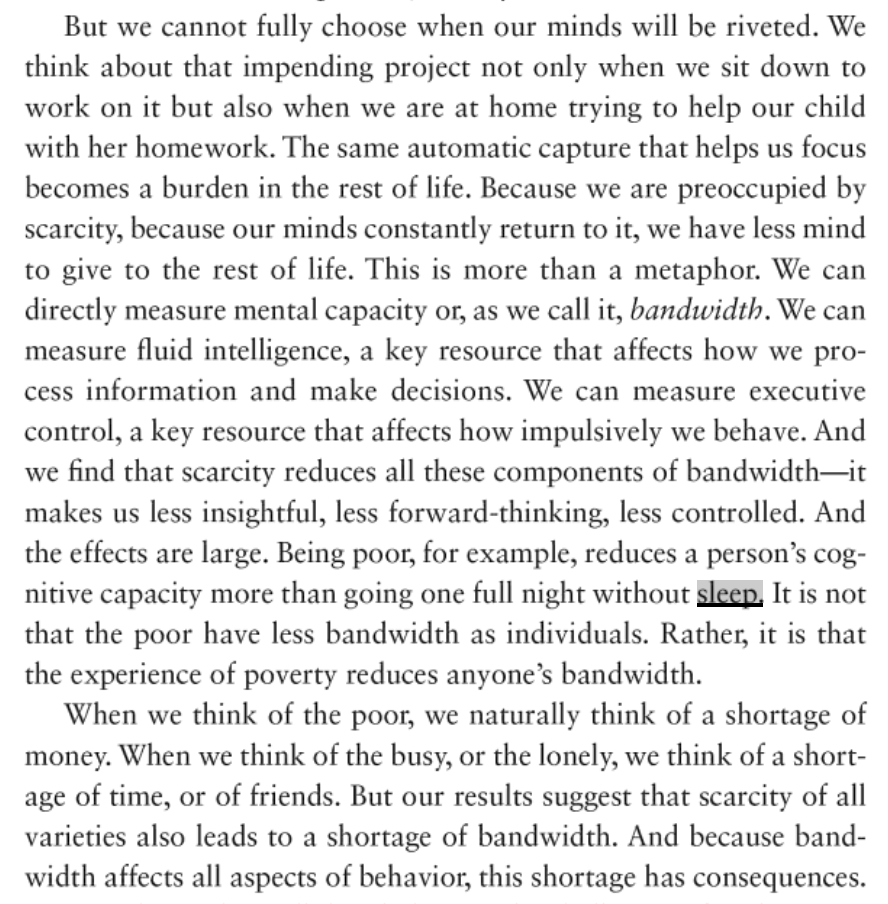
This book is an overview of the scientific research base around the consequence of being poor. This point has always struck me as incredibly important:

And to focus on the kernel point related to bandwidth: “Being poor…reduces a person’s cognitive capacity more than going one full night without sleep.”

Imagine, if you will, that this is likely magnified for children—and when they are younger, even more so.

Now let’s place that science on scarcity into a recent student on sleep and students:

Although numerous survey studies have reported connections between sleep and cognitive function, there remains a lack of quantitative data using objective measures to directly assess the association between sleep and academic performance. In this study, wearable activity trackers were distributed to 100 students in an introductory college chemistry class (88 of whom completed the study), allowing for multiple sleep measures to be correlated with in-class performance on quizzes and midterm examinations. Overall, better quality, longer duration, and greater consistency of sleep correlated with better grades. However, there was no relation between sleep measures on the single night before a test and test performance; instead, sleep duration and quality for the month and the week before a test correlated with better grades. Sleep measures accounted for nearly 25% of the variance in academic performance. These findings provide quantitative, objective evidence that better quality, longer duration, and greater consistency of sleep are strongly associated with better academic performance in college. Gender differences are discussed.

[abstract] Okano, K., Kaczmarzyk, J.R., Dave, N. et al. Sleep quality, duration, and consistency are associated with better academic performance in college students. npj Sci. Learn. 4, 16 (2019). https://doi.org/10.1038/s41539-019-0055-z

Also focus on this: “Sleep measures accounted for nearly 25% of the variance in academic performance.”

Next imagine that children living in poverty are likely to be under the weight of poverty (similar to sleep deprivation) and to experience actual sleep deprivation.

And if we add some other recent data, that children accidentally born in a month earlier than their peers also contributes to variances in test scores (the most common proxy for learning), and data created under the value-added methods era (teaching impact on measurable student learning is about 1% to 14%), then we are being confronted again with the problems associated with test-based accountability and in-school-only education reform.

Poor children don’t need to be “fixed” (just give them growth mindset and grit) and their teachers don’t need to have higher expectations, or higher quality, or the “science of reading”; poor children need their living conditions changed so that the negative consequences of scarcity (such as indirect and direct sleep deprivation) allow them the opportunities to learn and excel.

Almost all traditional education reform remains laser focused on blaming children, teachers, and schools in order to justify yet another round of in-school education reform.

We must not ignore the full and complicated science of learning just because it is inconvenient and fails to support the false stories we have almost always embraced.

Recommended

Poverty and Education are Inextricably Linked

Even More Problems with Grade-Level Proficiency

I have explained often about the essential flaw with grade-level proficiency, notably the third-grade reading myth.

Grade level in reading is a calculation that serves textbook companies and testing, but fulfills almost no genuine purpose in the real world; it is a technocratic cog in the efficiency machine.

Now that we are squarely in the newest reading war, the “science of reading,” two other aspects of grade-level proficiency have been central to that movement—the hyper-focus on third-grade reading proficiency that includes high-stakes elements such as grade retention and the misinformation rhetoric that claims 65% of students are not reading at grade-level (the NAEP proficiency myth).

These alone are enough to set aside or at least be skeptical about rhetoric, practice, and policy grounded in grade-level proficiency, but there is even more to consider.

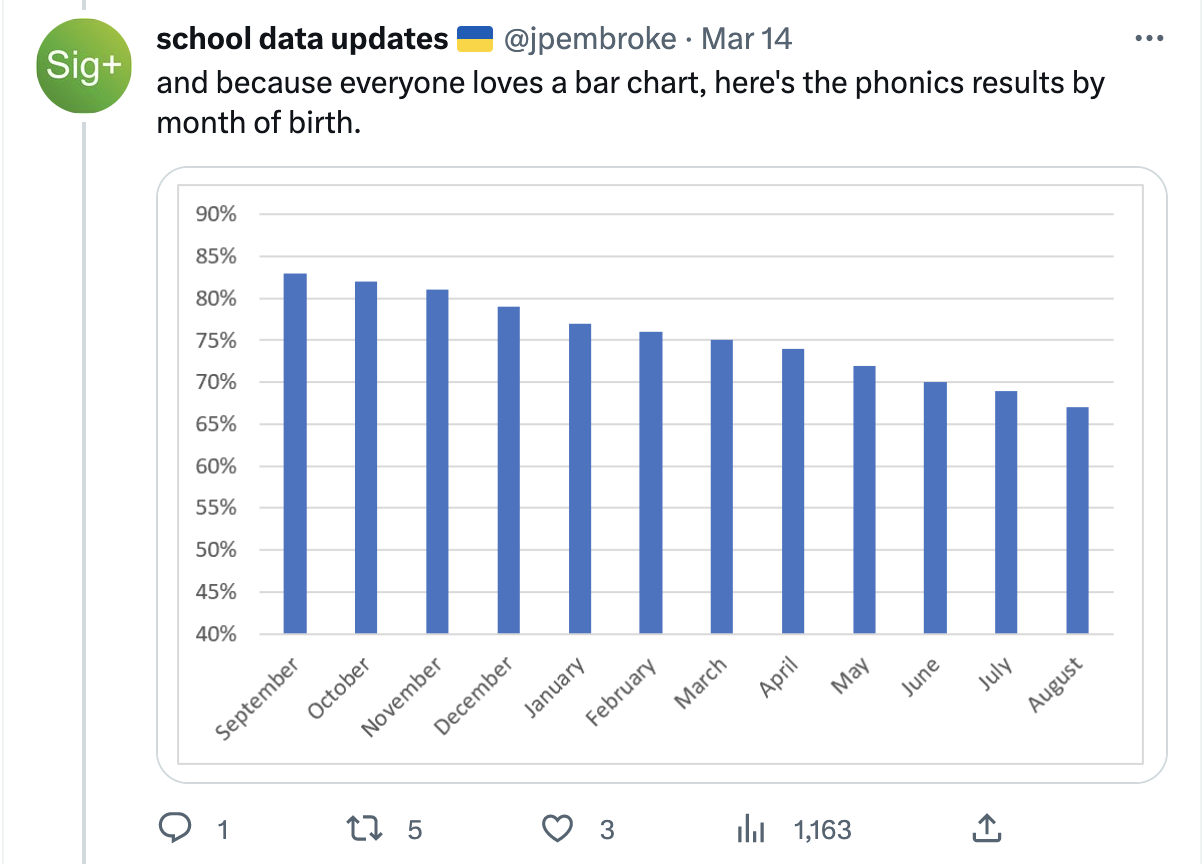
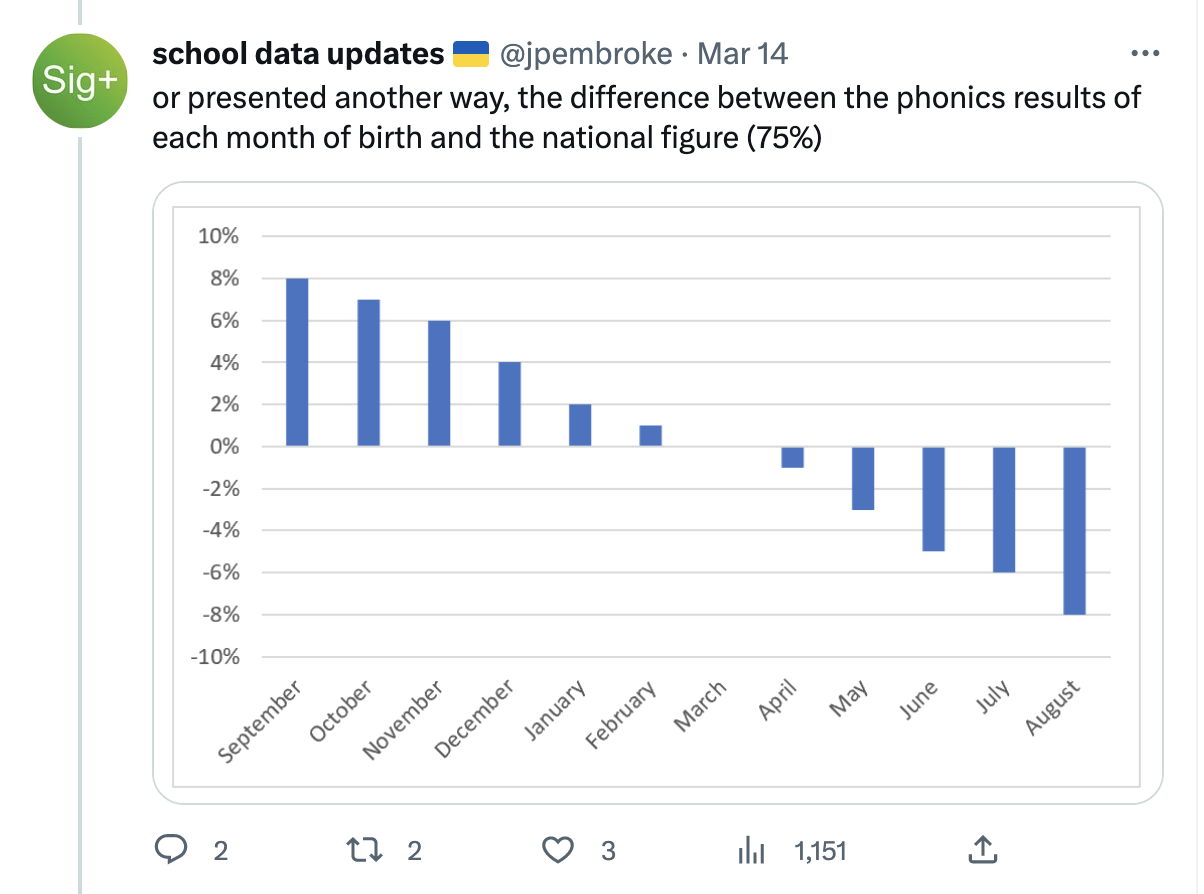
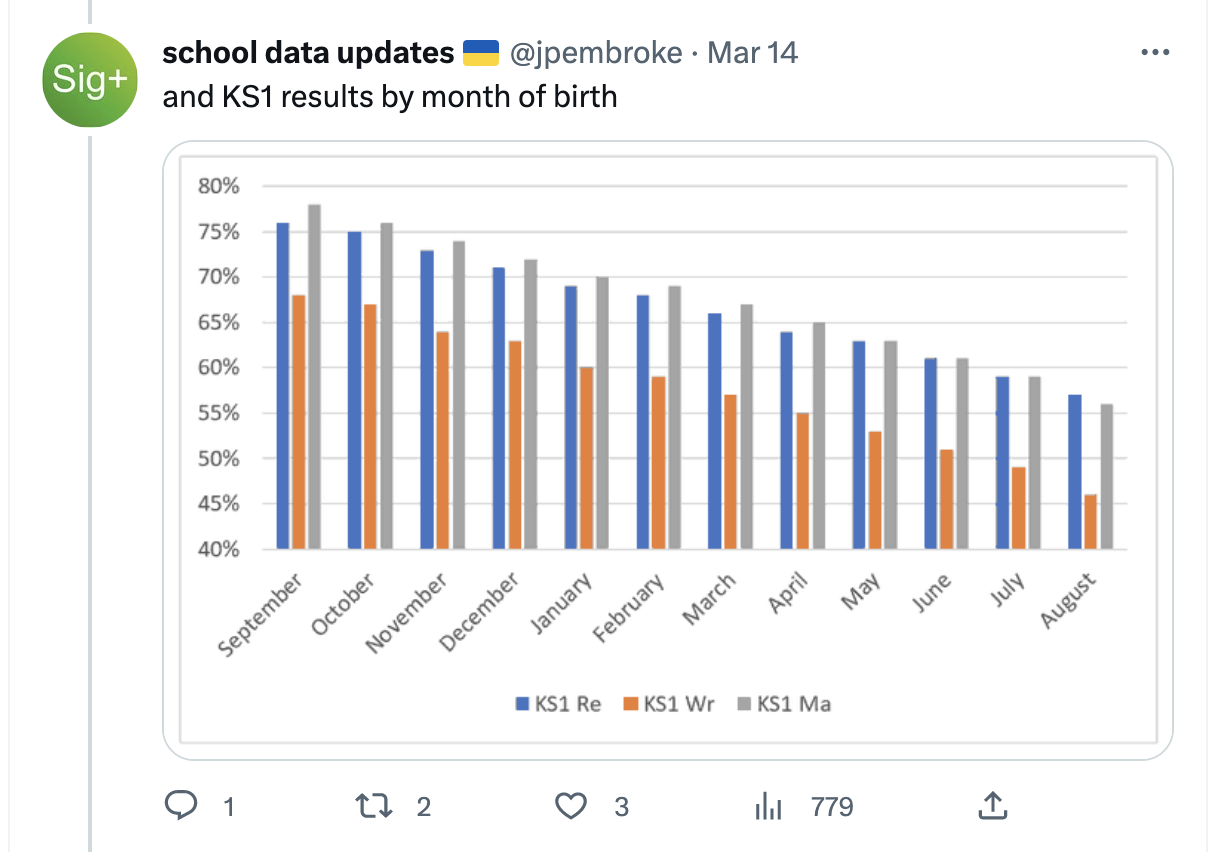
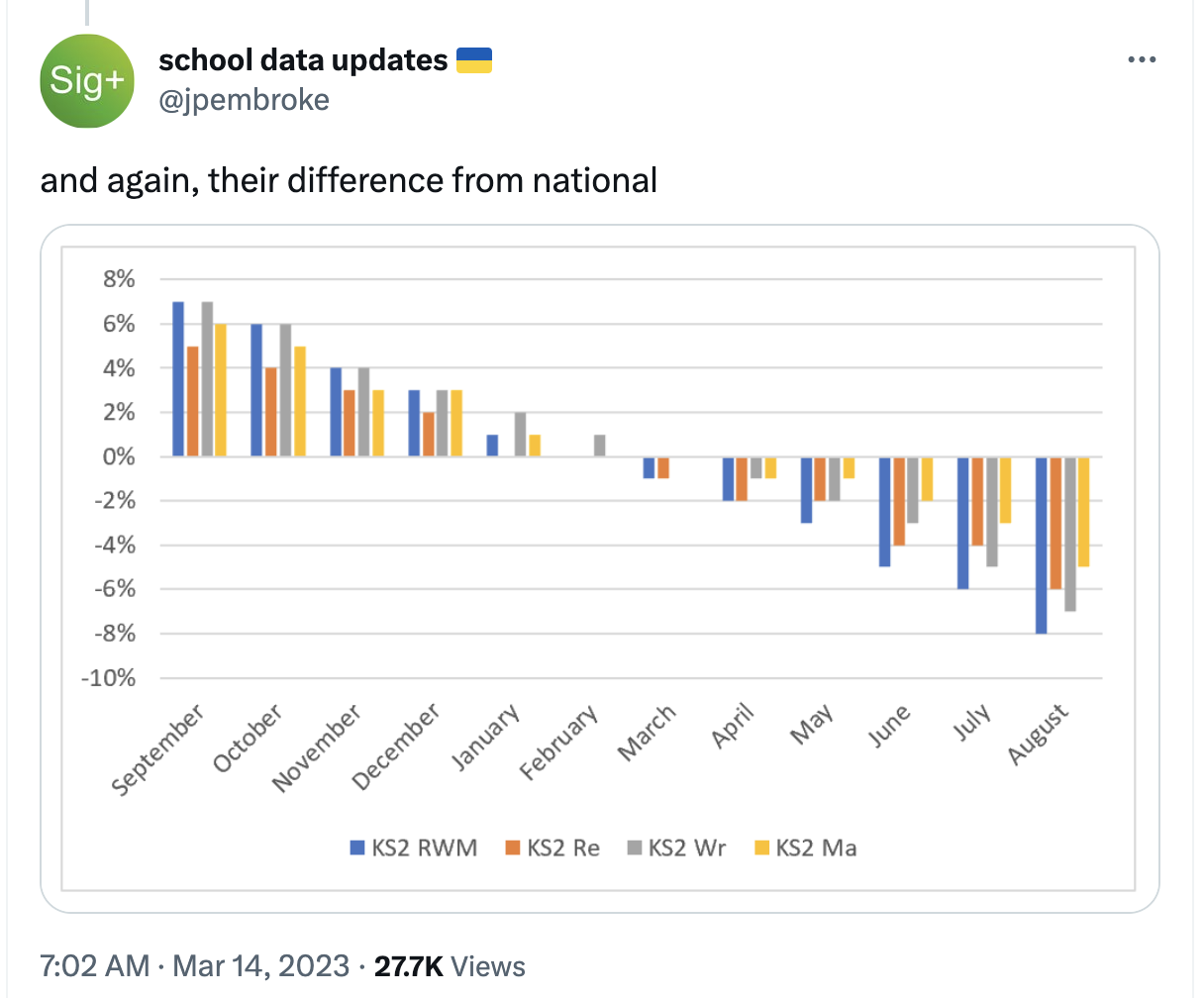
A Twitter thread examines grade-level achievement aggregated by month of birth:

The thread builds off a blog post: Age-Related Expectations? by James Pembroke.

The most fascinating aspect of this analysis thread is the series of charts provided:

As the analysis shows, student achievement is strongly correlated with birth month, which calls into question how well standardized testing serves high-stakes practices and how often standardized testing reflects something other than actual learning.

Being older in your assigned grade level is not an aspect of merit, and being older in your assigned grade seems to have measured achievement benefits that aren’t essentially unfair to younger members of a grade.

Further, this sort of analysis helps contribute to concerns raised about grade retention, which necessarily removes students most likely to score low on testing and reintroduces those students as older than their peers in the assigned grade, which would seem to insure their test data corrupts both sets of measurements.

This data above are from the UK, but a similar analysis by month/year of birth applied to retained students and their younger peers would be a powerful contribution to understanding how grade retention likely inflates test data while continuing to be harmful to the students retained (and not actually raising achievement).

There appears to be even more problems with grade-level proficiency than noted previously, and now, even more reason not to continue to use the rhetoric or the metric.

Republicans Seek IndoctriNation

[Header Photo by Markus Spiske on Unsplash]

Books, ideas, and knowledge are not inherently dangerous.

Political control of education, books, ideas, and knowledge, however, is likely the end of individual freedom as we know it, and which we claim to embrace.

Republicans have now fully committed to banning books, censorship, and mandating what can and cannot be taught in all levels of formal education.

Ironically, there are some dangerous books for Republicans: George Orwell’s 1984, Ray Bradbury’s Fahrenheit 451, and Margaret Atwood’s The Handmaid’s Tale.

These are cautionary tales about totalitarian governments, book banning and censorship, and theocracies. Yet, Republicans have apparently misread them as how-to manuals.

It is also important to recognize that Republicans have sought to control the teaching of history since banning novels is merely attacking imagined worlds.

Again, Republicans appear to have completely misunderstood what history is, why history is taught, and something that has now become nearly cliche to express: Those who ignore history are doomed to repeat it.

Consider the language and justification for book bans and burnings here:

At the meeting places, students threw the pillaged and “unwanted” books onto bonfires with great ceremony, band-playing, and so-called “fire oaths.” In Berlin, some 40,000 persons gathered in the Opernplatz to hear Joseph Goebbels deliver a fiery address: “No to decadence and moral corruption!” Goebbels enjoined the crowd. “Yes to decency and morality in family and state! I consign to the flames the writings of Heinrich Mann, Ernst Gläser, Erich Kästner.”

Holocaust Encyclopedia

If we sanitize the past—as Republicans demand in the name of objectivity—we find ourselves banning books and ideas in the name of protecting children and “morality.”

If we pay attention to Orwell, for example, we recognize that the Nazi’s were using “decency and morality” as a cover for totalitarian aims.

And then, when Republicans claim to be against politicizing education and indoctrination, we must recognize they are actually politicizing education and seeking indoctrination:

Most of us, especially on the left, completely agree with a sincere charge that “a university should not involve political indoctrination,” and therefore, we would be forced to point out that Florida and other Republican-led states are rushing to create exactly that—universities that are nationalistic and Christian-based political indoctrination.

It would behoove Republicans (most of whom have university degrees and ironically disprove their own claims that colleges brainwash students into being “woke” zombies) to sit in on any of my courses.

Republicans have a really hard time with words and concepts, especially the ones they are most angry about; they routinely cannot define the concepts they seek to control and ban—”CRT,” “woke,” and even “free.”

You see, education is not indoctrination because education is mostly about how to navigate knowledge, discourse, and the world—not about endorsing or embracing any predetermined set of ideas or ideologies.

For example, consider if a student expresses the two following brief claims:

“I do not believe in evolution because I do not think humans came from monkeys.”

“I believe God created humans because of my Christian faith.”

In an education setting (putting aside concerns for what the course may be), what would be appropriate responses to these claims by the teacher?

The first should be challenged—not because the student rejects evolution but because the claim is sloppy (scientific theory is not something to “believe” or not) and it makes an implication that incorrectly defines evolution (evolution is a theory, thus proven with evidence, that never claims humans “came from monkeys”).

Therefore, that first claim fails to fully and correctly define terms in order to make evidence-based claims, which has nothing to do with whether or not the student personally accepts evolution as a concept.

The second claim, of course depending on whether or not it is relevant to the course objectives, is completely solid, making no false implications and drawing a reasonable conclusion. Again, the credibility of that second claim has nothing to do with what the teacher believes (or not) and certainly isn’t in any way related to wanting a student to believe or not in any supreme being.

Rhetorically and logically the second statement is far more valid in an education setting than the first. The ideologies of the student and teacher are, therefore, irrelevant to how these fit into the student being educated (and not indoctrinated).

More complicated is whether these claims are relevant in specific fields of knowledge such as biology and religion; students well educated learn that field-based claims are not necessarily in conflict but based on different ways of thinking and knowing.

The first may be better suited for biology, and the second, for religion, but as the liberal arts embraces, these both may be better examined in a full range of disciplines and ideologies that understand science and religion as complimentary, not adversarial.

Faith-based people can understand evolution, of course, but those different ways of knowing may create tension in a person’s journey to understanding the world as a free person.

Education often involves and even requires discomfort, something Republicans seek to eliminate as part of their indoctrination package.

The problem facing the US, of course, is that Republicans cannot fathom a place where the human mind is trusted, where education is the goal and indoctrination is genuinely rejected.

Republicans can only envision people with power indoctrinating those over whom they have power so they are seeking complete control of education-as-indoctrination.

As I have noted often, those of us on the left were likely compelled to that ideological viewpoint because critical pedagogy (grounded in Marxism) is antithetical to indoctrination. As my all-too-brief mentor Joe Kincheloe explains, “Critical pedagogy wants to know who’s indoctrinating whom.”

I have been teaching across five decades, and I have never demanded that a student accept or endorse any ideologies or concepts. I have repeatedly offered challenges to students’ assumptions and worldviews in order for them to fully understand and live with whatever they choose to believe and accept.

Can students fully and accurately define the concepts and words they use? Can students make claims and draw conclusions baed on credible evidence or logic?

That’s it.

Nothing more nefarious or sinister than that.

Like Emerson and Thoreau, I believe in and trust the human mind when it is free of indoctrination, fear, and coercion.

I believe in the possibility of humans who have critically challenged themselves and the assumptions of their families, their communities, and their countries.

I believe in the beauty and power of the human imagination—often found in books, art, and all sorts of creations that bring us to tears, laughter, doubt, wonder, and a whole host of emotions that make us fully human.

And I know deep into my bones that “only cowards ban books” and ideas because cowards are seeking ways to hold onto their power or control over any and everyone else.

There can be no human dignity or freedom without a free mind, and a free mind deserves an education that is grounded in academic freedom and open access to all the possibilities found in books and lessons that cannot be mandated by or restricted by mere government (political) mandate.

Small-minded Republicans are the sort of cowards Orwell, Bradbury, and Atwell—among millions of others—have warned us about.

Cowards and bully politics are seeking an IndoctriNation that a free people must not allow.


Update

Rightwing ‘PragerU’ content is now available through SC education department portal

Lessons Never Learned: From VAM to SOR

The US is in its fifth decade of high-stakes accountability education reform.

A cycle of education crisis has repeated itself within those decades, exposing a very clear message: We are never satisfied with the quality of our public schools regardless of the standards, tests, or policies in place.

The sixteen years of the George W. Bush and Barack Obama administrations were a peak era of education reform, culminating with a shift from holding students (grade-level testing and exit exams) and schools (school report cards) accountable to holding teachers accountable (value-added methods [VAM] of evaluation).

The Obama years increased education reform based on choice and so-called innovation (charter schools) and doubled-down on Michelle Rhee’s attack on “bad” teachers and Bill Gates’s jumbled reform-of-the-moment approaches (in part driven by stack ranking to eliminate the “bad” teachers and make room for paying great teachers extra to teach higher class sizes). [1]

Like Rhee and Gates, crony appointee Secretary of Education Arne “Game Changer” Duncan built a sort of celebrity status (including playing in the NBA All-Star celebrity games) on the backs of the myth of the bad teacher, charter schools, and arguing that education reform would transform society.

None the less, by the 2010s, the US was right back in the cycle of shouting education crisis, pointing fingers at bad teachers, and calling for science-based reform, specifically the “science of reading” movement.

Reading legislation reform began around 2013 and then the media stoked the reading crisis fire starting in 2018. However, this new education crisis is now paralleled by the recent culture war fought in schools with curriculum gag orders and book bans stretching from K-12 into higher education.

Education crisis, teacher bashing, public school criticism, and school-based culture wars have a very long and tired history, but this version is certainly one of the most intense, likely because of the power of social media.

The SOR movement, however, exposes once again that narratives and myths have far more influence in the US than data and evidence.

Let’s look at a lesson we have failed to learn for nearly a century.

Secretary Duncan was noted (often with more than a dose of satire) for using “game changer” repeatedly in his talks and comments, but Duncan also perpetuated a myth that the teacher is the most important element in a child’s learning.

As a teacher for almost 40 years, I have to confirm that this sounds compelling and I certainly believe that teachers are incredibly important.

Yet decades of research reveal a counter-intuitive fact that is also complicated:

But in the big picture, roughly 60 percent of achievement outcomes is explained by student and family background characteristics (most are unobserved, but likely pertain to income/poverty). Observable and unobservable schooling factors explain roughly 20 percent, most of this (10-15 percent) being teacher effects. The rest of the variation (about 20 percent) is unexplained (error). In other words, though precise estimates vary, the preponderance of evidence shows that achievement differences between students are overwhelmingly attributable to factors outside of schools and classrooms (see Hanushek et al. 1998Rockoff 2003Goldhaber et al. 1999Rowan et al. 2002Nye et al. 2004).

Teachers Matter, But So Do Words

Measurable student achievement is by far more a reflection of out-of-school factors (OOS) such as poverty, parental education, etc., than of teacher quality, school quality, or even authentic achievement by students. Historically, for example, SAT data confirm this evidence:

Test-score disparities have grown significantly in the past 25 years.  Together, family income, education, and race now account for over 40% of the variance in SAT/ACT scores among UC applicants, up from 25% in 1994.  (By comparison, family background accounted for less than 10% of the variance in high school grades during this entire time) The growing effect of family background on SAT/ACT scores makes it difficult to rationalize treating scores purely as a measure of individual merit or ability, without regard to differences in socioeconomic circumstance.

Family Background Accounts for 40% of SAT/ACT Scores Among UC Applicants

Let’s come back to this, but I want to frame this body of scientific research (what SOR advocates demand) with the SOR movement claims [2] that teachers do not teach the SOR (because teacher educators failed to teach that) and student reading achievement is directly linked to poor teacher knowledge and instruction (specifically the reliance on reading programs grounded in balanced literacy).

This media and politically driven SOR narrative is often grounded in a misrepresentation of test-based data, NAEP:

First, the SOR claims do not match grade 4 data on NAEP in terms of claiming we have a reading crisis (NAEP scores immediately preceding the 2013 shift in reading legislation were improving), that SOR reading policies and practices are essential (NAEP data have been flat since 2013 with a Covid drop in recent scores), and that 65% of students aren’t proficient at reading.

On that last point, the misinformation and misunderstanding of NAEP are important to emphasize:

1.  Proficient on NAEP does not mean grade level performance.  It’s significantly above that.
2.  Using NAEP’s proficient level as a basis for education policy is a bad idea.

The NAEP proficiency myth

Now if we connect the SOR narrative with NAEP data and the research noted above about what standardized test scores are causally linked to, we are faced with very jumbled and false story.

Teacher prep, instructional practices, and reading programs would all fit into that very small impact of teachers (10-15%), and there simply is no scientific research that shows a causal relationship between balanced literacy and low student reading proficiency. Added to the problem is that balanced literacy and the “simple view” of reading (SVR) have been central to how reading is taught for the exact same era (yet SOR only blames balanced literacy and aggressively embraces SVR as “settled science,” which it isn’t).

One of the worst aspects of the SOR movement has been policy shifts in states that allocate massive amount of public funds to retraining teachers, usually linked to one professional development model, LETRS (which isn’t a scientifically proven model [3]).

Once again, we are mired in a myth of the bad teacher movement that perpetuates the compelling counter myth that the teacher is the most important element in a child’s education.

However, the VAM era flamed out, leaving in its ashes a lesson that we are determined to ignore:

VAMs should be viewed within the context of quality improvement, which distinguishes aspects of quality that can be attributed to the system from those that can be attributed to individual teachers, teacher preparation programs, or schools. Most VAM studies find that teachers account for about 1% to 14% of the variability in test scores, and that the majority of opportunities for quality improvement are found in the system-level conditions. Ranking teachers by their VAM scores can have unintended consequences that reduce quality.

ASA Statement on Using Value-Added Models for Educational Assessment (2014)

Let me emphasize: “the majority of opportunities for quality improvement are found in the system-level conditions,” and not through blaming and retraining teachers.

The counterintuitive part in all this is that teachers are incredibly important at the practical level, but isolating teaching impact at the single-teacher or single-moment level through standardized testing proves nearly impossible.

The VAM movement failed to transform teacher quality and student achievement because, as the evidence form that era proves, in-school only education reform is failing to address the much larger forces at the systemic level that impact measurable student achievement.

Spurred by the misguided rhetoric and policies under Obama, I began advocating for social context reform as an alternative to accountability reform.

The failure of accountability, the evidence proves, is that in-school only reform never achieves the promises of the reformers or the reforms.

Social context reform calls for proportionally appropriate and equity-based reforms that partner systemic reform (healthcare, well paying work, access to quality and abundant food, housing, etc.) with a new approach to in-school reform that is driven by equity metrics (teacher assignment, elimination of tracking, eliminating punitive policies such as grade retention, fully funded meals for all students, class size reduction, etc.).

The SOR movement is repeating the same narrative and myth-based approach to blaming teachers and schools, demanding more (and earlier) from students, and once again neglecting to learn the lessons right in front of us because the data do not conform to our beliefs.

I have repeated this from Martin Luther King Jr. so often I worry that there is no space for most of the US to listen, but simply put: “We are likely to find that the problems of housing and education, instead of preceding the elimination of poverty, will themselves be affected if poverty is first abolished.”

While it is false or at least hyperbolic messaging to state that 65% of US students are not proficient readers, if we are genuinely concerned about the reading achievement of our students, we must first recognize that reading test scores are by far a greater reflection of societal failures—not school failures, not teacher failures, not teacher education failures.

And while we certainly need some significant reform in all those areas, we will never see the sort of outcomes we claim to want if we continue to ignore the central lesson of the VAM movement; again: “the majority of opportunities for quality improvement are found in the system-level conditions.”

The SOR movement is yet another harmful example of the failures of in-school only education reform that blames teachers and makes unrealistic and hurtful demands of children and students.

The science from the VAM era contradicts, again, the narratives and myths we seem fatally attracted to; if we care about students and reading, we’ll set aside false stories, learn our evidence-based lessons, and do something different.


[1] TAKING TEACHER EVALUATION TO SCALE: THE EFFECT OF STATE REFORMS ON ACHIEVEMENT AND ATTAINMENT

Joshua Bleiberg
Eric Brunner
Erica Harbatkin
Matthew A. Kraft
Matthew G. Springer
Working Paper 30995
http://www.nber.org/papers/w30995

ABSTRACT

Federal incentives and requirements under the Obama administration spurred states to adopt major reforms to their teacher evaluation systems. We examine the effects of these reforms on student achievement and attainment at a national scale by exploiting the staggered timing of implementation across states. We find precisely estimated null effects, on average, that rule out impacts as small as 0.015 standard deviation for achievement and 1 percentage point for high school graduation and college enrollment. We also find little evidence that the effect of teacher evaluation reforms varied by system design rigor, specific design features or student and district characteristics. We highlight five factors that may have undercut the efficacy of teacher evaluation reforms at scale: political opposition, the decentralized structure of U.S. public education, capacity constraints, limited generalizability, and the lack of increased teacher compensation to offset the non-pecuniary costs of lower job satisfaction and security.

[2] I recommend the following research-based analysis of the SOR movement claims:

The Science of Reading and the Media: Is Reporting Biased?, Maren Aukerman

The Science of Reading and the Media: Does the Media Draw on High-Quality Reading Research?, Maren Aukerman

The Science of Reading and the Media: How Do Current Reporting Patterns Cause Damage?, Maren Aukerman

[3] See:

Hoffman, J.V., Hikida, M., & Sailors, M. (2020). Contesting science that silences: Amplifying equity, agency, and design research in literacy teacher preparation. Reading Research Quarterly, 55(S1), S255–S266. Retrieved July 26, 2022, from https://doi.org/10.1002/rrq.353

Research Roundup: LETRS (PDF in link above also)

Recommended

Part of the problem in debates about schools and education is the relentless use of “teacher quality” as a proxy for understanding “teaching quality”. This focuses on the person rather than the practice.

This discourse sees teachers blamed for student performance on NAPLAN and PISA tests, rather than taking into account the systems and conditions in which they work.

While teaching quality might be the greatest in school factor affecting student outcomes, it’s hardly the greatest factor overall. As Education Minister Jason Clare said last month:

“I don’t want us to be a country where your chances in life depend on who your parents are or where you live or the colour of your skin.”

We know disadvantage plays a significant role in educational outcomes. University education departments are an easy target for both governments and media.

Blaming them means governments do not have to try and rectify the larger societal and systemic problems at play.

Our study found new teachers perform just as well in the classroom as their more experienced colleagues

The Rise and Fall of the Teacher Evaluation Reform Empire

Podcast: What You Can Do: How ‘Sold a Story’ sold us a story ft Dr. Paul Thomas

How ‘Sold a Story’ sold us a story ft Dr. Paul Thomas


See Also

Which Is Valid, SOR Story or Scholarly Criticism?: Checking for the “Science” in the “Science of Reading”

The Science of Reading and the Media: Is Reporting Biased?, Maren Aukerman

The Science of Reading and the Media: Does the Media Draw on High-Quality Reading Research?, Maren Aukerman

The Science of Reading and the Media: How Do Current Reporting Patterns Cause Damage?, Maren Aukerman

ChatGPT and a New Battle in the Citation Gauntlet for Students and Teachers

The responses to AI writing in the form of ChatGPT have run the gamut from thoughtful to frantic (see both in my own consideration), but the International Baccalaureate response has added a new battle in the citation gauntlet for students and teachers:

Schoolchildren are allowed to quote from content created by ChatGPT in their essays, the International Baccalaureate has said.

The IB, which offers an alternative qualification to A-levels and Highers, said students could use the chatbot but must be clear when they were quoting its responses.

ChatGPT has become a sensation since its public release in November, with its ability to produce plausible responses to text prompts, including requests to write essays.

While the prospect of ChatGPT-based cheating has alarmed teachers and the academic profession, Matt Glanville, the IB’s head of assessment principles and practice, said the chatbot should be embraced as “an extraordinary opportunity”.

ChatGPT allowed in International Baccalaureate essays

This hamfisted move by IB has prompted another layer to the debate:

IB’s “exactly wrong” response to ChatGPT and McCormick’s criticism come on the heels of my first-year writing students submitting their second essay of the semester, an assignment that introduces them to academic citation at the college level through using hyperlinks to support their claims and discussions.

This assignment is grounded in two concerns.

First, students often come to college having learned “to do MLA” and “to write research papers,” which inculcates in them writing like students instead of writing in authentic ways or as scholars/academics.

Second, first-year students are often buried under the weight of formatting citation and less engaged with why and how citation works in authentic texts.

Therefore, hyperlinking as citation and incorporating online sources into original writing allow students to navigate that why and how of citation and using sources while primarily focusing on original ideas and claims in the context of finding and using credible sources to establish their authority as writers.

The next essay assignment requires students to do scholarly citation using APA; therefore, essay 2 is a type of scaffolding to address student misconceptions learned before college.

My teaching style is grounded in workshop structures—students doing holistic behaviors and producing authentic artifacts of learning—as well as providing less upfront direct instruction, models of products being created by students, and then individualized instruction grounded in the artifacts students submit. Of course, much of the learning comes from, in writing-intensive courses, conferencing and revising.

One student, for example, who seems sincerely engaged in the course submitted their essay 2 with the first hyperlink being to Wikipedia.

I had given the class the standard Wikipedia talk I offer: Academia frowns on Wikipedia so you should never cite it, but Wikipedia may be a good place to start thinking and brainstorming, although it certainly isn’t a solid source to end your research.

I reminded them of that in my comment, and once again, reminded the class of this aspect of finding and using credible sources in academic writing.

Essay 2 is once again proving to be a valuable instructional tool about seeking out sources to understand topics and claims better, incorporating citation into writing to support claims and give writing (and the writer) authority, and the seemingly arbitrary standards for citation that vary among different fields (journalism has a much different standards for citation than academia, for example).

Now that IB has christened ChatGPT as citable, students and teachers have yet another layer of problems in the tensions between plagiarism and citation.

Despite IB’s stance, as McCormick rightfully notes, ChatGPT is not citable, not a credible source.

Part of the reason reminds me of the SAT writing debacle that also included computers—machine grading of the writing portion of the test.

As Thomas Newkirk mused in 2005, machine graded writing on the SAT allowed students to “invent evidence” because the computer rubric rewarded the appearance of evidence, not the credibility or even accuracy of evidence; simply putting words in quote marks and ascribing that to someone could fulfill the rubric for proof.

This, as some have noted, is what ChatGPT will do, along with other forms of fabrication.

Citation and incorporating sources in original writing are about the conversation of deep and critical thinking as well as about the ethics of attribution of ideas; in academia, we often call that standing on the shoulders of giants.

It doesn’t have to be that grand, but scholarship and thoughtful thinking and writing should acknowledge that knowing and knowledge are communal, not the product of the solitary mind.

I have come to recognize citation as an unnecessary gauntlet for students, something like academic hazing.

As I tell students, I hope someday we all simply hyperlink as citation to eradicate the mindless formatting nonsense from an otherwise noble behavior: Simply acknowledging that I am not alone in this thinking and many smart and careful people have wrestled with this also in diverse and engaging ways.

Until then, sigh, we teachers and our students are now confronted with another battle tossed in the heap of traps for the emerging students-as-writers.

Added to our lessons on choosing sources, warnings about Wikipedia, and fervent fist-waving about plagiarism, the Brave New World of ChatGPT—and the likelihood that students will arrive in higher ed not only trapped in “doing MLA” and “writing research papers,” but citing AI because their IB program told them it is ok.


See my many posts on citation.

Plantation Ghosts Past and Present

I was pretending to stay awake or fighting to wake up, but when I slightly opened my eyes, I realized I was in my bedroom from my teen years.

I was my age now, in my sixties, and my father was standing over me. The room was brightly lit; my father was in his late 30s—although he died about six years ago.

This was a very vivid dream the last night I was in Hilton Head recently. Although I was born in and lived my entire life in South Carolina, this was only my second trip to Hilton Head, the first time just a couple years before.

We were a Myrtle Beach family when I was growing up, and those vacations were usually off-season, in winter. For a while my maternal grandparents managed a hotel in Myrtle Beach (after doing so in Asheville); both places provided us cheaper ways to vacation like we could afford it.

You see, my parents were solidly working class in my childhood during the sixties—but decidedly middle-class aspirant.

My teens were spent in the 1970s at the house my parents built on the golf course just north of my home town. By then, they were middle-class adjacent, having bought the first lot as the course was being developed.

It took everything my parents had to buy the lot and then build the house. The house payment was less than $100 per month, and Mom always paid extra so they eventually paid off the house early, their way of proving they belonged in the middle class.

When I graduated high school, my father had just turned forty so I have a very powerful set of naive memories of him in his 20s and 30s, just before I was able to confront the realities of my parents as deeply flawed people.

That golf course—being members and living there—was incredibly important for my parents, materially and symbolically. But the private course was segregated, and I lived in a sort of hazy awareness that institutional racism was both an entrenched fact and really disturbing.

One club member had a wife who was Native American (we said “Indian” then); that was a whispered scandal every time he came to play a round alone with her simply walking the course beside him.

She had incredibly black straight hair, and members would stand in the club house pointing and mumbling among themselves as he and his wife walked along the fairway.

The larger scandal was the very dark Indian family who joined the club, a doctor who had come from India to earn his medical degree in the US and then settled in our small town to practice.

Those children were at the course pool where I worked one day. The board president drove by and went directly to the club pro to complain that Black people were at the pool (I feel certain he did not say “Black”).

By college and my early adulthood, I recognized the racism I had been raised in, both in my home and community. My parents were mostly passively matter-of-fact in their racism, but my father could spew pretty vile racist rhetoric when upset.

That dream while in Hilton Head was clinging to my naive memories of my young, fit, and smiling father—who I loved and who was mostly incredibly loving and supportive of me, although in his hard-ass 1950s sort of toxic male way that included being whipped with a belt as a child and wrestled to the ground or tossed across the room as a teen.

But that naive memory of him I still love—that smiled at me in the dream—wasn’t my father really or fully; that was only a ghost.

And a fitting dream in Hilton Head where plantation ghosts past and present haunt everything.

As I said, we were Myrtle Beach people, working-class rednecks who fully embraced the tackiness and crass commercialism of Myrtle Beach as the black eye of the SC Grand Strand that stood in stark contrast to the golf courses and coastal islands that run all down the coast and attract mostly very wealthy people not from the South.

During my family trips, we met dozens of people from Ohio and Canada, and my father—as was his way—spoke at length to everyone of them as if they had been friends forever. He did this with everyone, everywhere, regardless of who those people were or the color of their skin.

Eventually, my father’s gregariousness weighed on me against the man I knew at home.

At least Myrtle Beach was open about the shitty thing it has always been, I tend to feel, but Hilton Head, like Kiawah, takes on a disturbing pose of nature preservation to cloak the crass commercialism and obscene wealth.

Signage and lighting laws and dozens of notices asserting preserved land reinforce the narrative that Hilton Head, and other coastal islands, are very concerned about the sea turtles, the moss, and the trees.

Except for where they have carved out golf courses and the McDonald’s and Starbucks you can barely see through the moss in those trees allowed to stand between the highways and parking lots.

Although just before sunrise or at night, you can’t see a damn thing.

Because of the sea turtles, Hilton Head is very dark. But there is more than a little symbolism in that darkness since many of the areas and several of the establishments still carry the monicker “plantation.”

Governor DeSantis ain’t got nothing on the ability of the rich in SC to act as if nothing really happened here and to cling to our past like Emily clutching her dead lover’ corpse each night.

“Plantation” down here is somewhere between a “Bless your heart” and “Fuck you,” depending.

The drive from and to the Upstate takes about four hours, a grueling trek along I-95 and I-26, with some of the most stark poverty lining the pot-holed I-95.

At least the tourists can drive 70-80 miles an hour and keep their eyes focused on the crumbling roads, lest they catch a glimpse of the squalor between their luxurious homes and the vacation plantation of their dreams.

During the drive home, I could not shake the dream of my father, and once back home, the shower didn’t ease the feeling that I was very dirty having visited for a few days that island punctuated repeatedly with “plantation,” indelibly so.

Plantation ghosts invade the skin, burrow into your bones, seer into your eyes.

Well, if you allow yourself to feel the weight of that past—and the present.

Not feeling, not thinking, and not giving a good goddamn are special talents among many in the South.

That’s one way to get filthy rich.

That’s one way to get elected.

I do not hold any sort of false pride about living in the Upstate and not among those island ghosts because we have plantations up here also, places marketing for tourists as well.

But I was very happy to return to the soil of my working-class roots, where we have garish signs and so much lighting you can see everything—except what you choose to ignore.