Category Archives: Education

The Politics of Teaching: #BlackLivesMatter Edition

On a social media group for educators, a teacher asked for clarification about the legal grounds for an administrator requesting that the teacher remove #BlackLivesMatter and LGBTQ+ support posters from their room.

The responses were illuminating since they tended to drift toward larger and different concerns about ideology and of course the standard claim that teachers should “not be political.”

This was a discussion among teachers in South Carolina, where I taught public high school English throughout the 1980s and 1990s; I also attended SC public schools from 1967 until 1979.

Not to be simplistic, but my experience teaching in SC, and my subsequent two decades working with public schools and teachers, has shown that what is technically legal isn’t as important and how administration—supported by community standards—views what is “allowed” or “banned.”

Therefore, at the root of this teacher’s dilemma is the fundamental problem with the term “political” and how teaching and education are framed as “not political” (or more clearly, how teaching and education should not be “political”).

Public schools tend to reflect and perpetuate community, state, and national norms, what we often call “culture.” Rarely, in fact, are public schools mechanisms for confronting, rejecting, or reforming traditional assumptions and behaviors.

As I noted above, during my public school teaching career from 1984 until 2002, my principals allowed prayer over the intercom each morning despite coerced and organized prayer being prohibited in the 1960s (NOTE: Prayer by individual choice has always been and remains allowed and protected in public schools; forced or coerced prayer was prohibited, not individual prayer by choice).

Because of state law and community standards as well, students were required to stand during the morning Pledge of Allegiance (and some teachers required students to participate, speaking the words with hand over the heart).

In that situation, teachers monitoring students in order to make them comply with the Pledge was never seen as “political,” even though not monitoring by teachers and students not participating often were seen as political acts.

Recall the controversy in the NFL over Colin Kaepernick kneeling during the National Anthem; Kaepernick was always framed as injecting politics into sports, but the NFL playing the Anthem was never confronted as what it most certainly is—a political statement.

If we return to the teacher’s dilemma about having #BLM and LGBTQ+ posters in their room, we must confront two important aspects.

First, we must begin to educate everyone about the term “political,” especially as that contrasts with the term “partisan.”

In situations with a hierarchy of authority—such as teachers interacting with students—those with authority (teachers) must remain neutral in terms of “partisan” advocacy. In other words, teachers must refrain from making partisan endorsements in the classroom, never advocating for a specific political party or candidate.

However, every act a teacher does or does not do is a political act since “politics” is the negotiation of power in any human interaction. Teachers are sending political messages when they are agents of any rules or laws.

Complying with rules, laws, or social norms are often seen as “not political” when in fact they are just as political (endorsement) as when people reject or break with rules, laws, or social norms.

Again, while a teacher is being compelled not to display support for #BLM and LGBTQ+, those teachers who have no social justice messaging in their classrooms are equally political; silence and taking a so-call neutral pose are the politics of compliance, rendered “not political” or invisible because of the support of authority (not because they are in fact “not political”).

As I have examined before, demanding that anyone conform to not being political is a political demand. Administrators in public schools requiring teachers to monitor student participation in the Pledge is political; administrators requesting teachers remove social justice messaging from the classroom is political.

Let’s be clear that all of these circumstances are political, and therefore, the reason that teacher is being asked to remove the social justice messaging is clearly not to render the classroom and school “not political,” but to insure that the teacher, students, and classroom conform to the politics supported by the administration, community, and state.

To teach is to be political, and instead of pretending there are options (preferred options) for being “not political” in classrooms and schools, teachers and administrators must be more intentional and open about the moral and ethical implications of education—that schooling is continually sending political messages, some endorsed by authority and some discouraged or silenced by authority.

Howard Zinn’s dictum that we cannot be neutral on a moving train is apt for being a teacher; silence, absence, and compliance send messages of support for the conditions that currently exist.

Removing #BLM and LGBTQ+ messaging as well as not having that messaging in class suggests that the current state of the country is equitable or that the inequity is acceptable (to those with power at least).

We teachers and all educators are political agents in everything we do; our task is not to be “not political” but to be intentional and ethical/moral in the politics of our roles as educators and our stewardship of authority over children and young adults.

I regret the dilemma faced by the teacher being asked to remove social justice messaging from their room; I recognize that solving that tension by determining what the legal basis is for removing or keeping those messages is tenuous, likely to fall on either side based on who is making the interpretation.

But I also must stress that, as Martin Luther King Jr. emphasized in “Letter from Birmingham City Jail,” laws or rules can be unjust, and thus, breaking the law or rule can often be the moral/ethical way to behave:

[T]here are two types of laws: just and unjust. I would be the first to advocate obeying just laws. One has not only a legal but a moral responsibility to obey just laws. Conversely, one has a moral responsibility to disobey unjust laws. I would agree with St. Augustine that “an unjust law is no law at all.”

Regardless of what the teacher is required to do with the social justice messages in the classroom, we cannot pretend that having those messages visible is political but removing them is not political.

All teaching is political and that means our work as educators is moral and ethical work each time we chose to do or not do something in the context of rules, laws, and expectations.

Pandemic Pedagogy: The New Normal?

The evening before the first day of school for students, a high school teacher opened their district email to discover that the schedule for International Baccalaureate (IB) students had changed.

Again.

That new schedule is also layered onto the tentative district-wide pandemic schedule that has four color-coded waves of students, divided by last names, who attend one day a week Monday through Thursday with all students remote on Fridays.

This teacher was distraught. To tears and hopelessness.

This teacher has already expressed what I am hearing and reading across the U.S.: Teaching has become unmanageable, and the current teacher shortage is about to take an even greater hit with even more teachers leaving the profession.

To demonstrate that the last-minute changes and the complex system mixing face-to-face (F2F) with remote teaching are, in fact, nearly impossible, this teacher created a mind-numbingly elaborate chart and shared it with the principal.

This is the new normal for K-12 teachers in the U.S. An already nearly impossible profession has been made even more bureaucratic and dehumanizing by the sheer weight of managing all the moving parts.

As a college professor—a teaching profession dramatically less stressful and complex than K-12 teaching (which I did for 18 years)—I have also resorted to color-coding my rosters in an effort to manage that I now have first-year students and seniors on campus and in class (except for those choosing remote learning all semester) as well as sophomores and juniors who are remote until September 14.

On any day, also, students may be remote due to health concerns or quarantine.

My class sessions are a mix of F2F students (no more than 12) and students joining class remotely by zoom, their tiny images in blocks on the computer screen and projected on the drop-down screen at the front of the class.

I am trying to teach and make some sort of contact with both groups; the masked F2F students are disorienting, and the tiny images of students on the screen give a whole new meaning to “remote.”

After the first few days of class, I am also realizing that discussion-based and student-centered teaching are essentially impossible. Our masks make talking and hearing a struggle as we are remaining 6 feet apart, and in order to maintain the social distancing requirements, I cannot ask students to form small groups and interact.

Like many K-12 teachers as school resumes this fall, I must admit that for the first time in 37 years of teaching, I find my work as a teacher something I dread.

And I mean the actual classroom teaching, not just all the other aspects of being a teacher that have always, frankly, been mind-numbing (grading, standards and testing, meetings, etc.).

For K-12 and higher education teachers and professors, we must survive the current pandemic pedagogy (many of the conditions are the only options we have even as they are not good options for teaching and learning), but we must also begin to imagine what the new normal will be on the other side of all this.

When I moved to higher education 19 years ago, one of the first things I witnessed was my university debating a change to the academic calendar, the weekly course schedule, and the curriculum (the general education requirements). This university had a long history of a three-session academic year (students taking three 4-credit courses in fall and spring along with two 4-credit courses in the middle winter session), and students attended all classes five days a week (similar to high school).

This debate took months, but one of the most hotly contested issues was moving from five days a week to the traditional MWF and TTh scheduling found at most colleges.

Many faculty seemed very committed to seat time, acknowledging a belief that learning was essentially grounded in face-to-face instruction. I found that reasoning flawed then, and supported the change.

However, the debate did highlight that the structures we choose for schooling profoundly impacts how we teach and how (and if) students learn.

The pandemic, on the other hand, has foisted upon educators at all levels changes that have not been debated and are often unwanted.

I had to teach my graduate summer course online (with no input on the decision) and have been forced to put all my courses on the university’s course management program that I have always avoided for ideological and pedagogical reasons.

Most educators have essentially no choice except to participate in remote programs (such as zoom) that raise significant questions about personal data and instructional practices.

As I have discussed about moving to remote teaching last spring, there are elements of pandemic pedagogy that match well my practices in so-called normal circumstances, notably individualized instruction grounded in feedback on student artifacts of learning (such as essays).

Ending a well-established course with pandemic pedagogy is quite different than beginning one that way.

I cannot accept that the Covid-19 pandemic will be on balance a positive moment for education—or humanity. The pandemic’s cost to human life and health far outweigh the value of education.

But that ship has sailed; we cannot undo the shift that the pandemic has forced on teaching as a profession, on learning, and on being a human.

It seems certain that what comes next will not be a return to that former normal. It seems certain that we should not want to return to that normal.

However, we should begin the transition to the new normal, and we must do that intentionally.

To accomplish a bit of alchemy, then, we must embrace the pause the pandemic has afforded us in order to reimagine the following:

  • The role of F2F instruction (seat time) and whole-group class sessions.
  • The consequences of inequity grounded in race, socioeconomic status, gender, etc., for teaching and learning.
  • The roles of teacher and student in the teaching/learning dynamic.
  • The purposes and forms of assessment and grades.
  • The spaces (real and virtual) for teaching and learning.
  • The funding for and costs of schooling.
  • The professional autonomy of teachers and professors.
  • The academic calendar.
  • The value and problems associated with technology.
  • The significance of privacy and personal agency for teachers/professors and students.

With almost four decades of experience teaching and a doctorate in curriculum and instruction, I must emphasize that these have always been the issues we should have been critically unpacking and reimagining.

The universe has given us a terrible pause in normal, but the pandemic has not taken away our possibilities to create a new normal that will be a better realization of the ideals we often express about the importance of education.

As I have often argued, education in the U.S. is not a failure; however, we have mostly failed the promise of education.

Ideally, I want to sit in the same room with my students and see their uncovered faces. I want to watch and listen as they construct their own meaning and knowledge for themselves.

I do very much miss some of the pre-pandemic world of teaching and learning that was only five or six months ago.

But I am also waiting on a sense of hope for what comes next, a new normal post-pandemic; as Maggie Smith imagines, “This place could be beautiful,/right? You could make this place beautiful.”

Critical Literacy, Not Nonsense Literacy

At 59 with almost 40 years experience as an educator (focusing on literacy) and writer, I remain someone who struggles with spelling.

And when I come across an unfamiliar word, I ask around until I find someone who can pronounce it aloud for me; I have never really tried to “sound it out”—even though I have intuited a huge amount of letter/sound patterns in the English language.

Also, as a Southerner, my common pronunciation of many words doesn’t quite align with the so-called “proper” pronunciation of many words; I can make one-syllable words two syllables, and choke two-syllable words into one.

“Hell” is one of my better versions of the former.

More like “hey-uhl.”

None the less, I am a highly literate person with a reading and writing background that outpaces most people in sheer volume significantly. I also love language and the history of the English language.

After fumbling my way earnestly through a decade or more of teaching high school English and honing my craft as a writer, I discovered critical pedagogy and critical literacy in my 30s during my doctoral program. That “discovery” was simply a recognition of an ideology and practice I had already been attempting to grasp daily as a teacher, but finding this philosophy already existed was deeply liberating—and crucial for my own practice as an educator of literacy.

I have a very firm appreciation for and understanding of the holistic nature of literacy, but I also am an ardent advocate for critical literacy as the ultimate goal of reading and writing instruction.

My commitments to holistic and critical literacy have resulted in a career-long battle with advocates of isolated and intensive grammar and phonics instruction (what I frame as grammar/phonics as the goal of instruction, not as authentic components of broader literacy goals such as critical literacy).

For a couple years now, I have been confronting the most recent Reading War, often labeled as the “science of reading,” which is another veneer for advocates of systematic intensive phonics for all students.

The general public, likely, isn’t aware that “phonics” isn’t a monolithic instructional practice or concept; within the field of phonics, there is debate (such as synthetic approach versus analytic phonics).

The systematic intensive phonics being advocated for all students by proponents of the “science of reading” includes a focus on teaching students to decode nonsense words (such as the assessment DIBELS).

The embracing of teaching and assessing nonsense words is a central concern for me as a holistic and critical literacy teacher.

Consider this from Nicola Yelland:

Advocates of the phonics screening tests claim that they are fun. In fact, for fluent readers, it can destroy their recognition as competent readers. In one school example, a boy who came to school reading, and who continued to flourish as a fluent reader, scored 2/40! Since the test includes nonsense words in the quest to focus on decoding (he read “elt” as “let,” “sarps” as “rasp,” and “chab” as “cab,” to foreground a few). What he seemed to be doing was re-arranging the letters or sounds and reconstructing them into recognizable words that he knew made sense. Meanwhile, another child whom the teacher regarded as not being a fluent reader was able to sound out the nonsense words as well as regular words and achieve a score of 16/40, all without knowing their meaning. Thus, the raw scores from the test of each child give us no information about them as readers and how they can make meaning from text; they simply show how they decode words out of context.

Adoniou (2018) has pointed out that while the phonics screening test scores are increasing in the United Kingdom where it was introduced in 2011, with children improving in their ability to read words like “kigh” and “queep,” reading comprehension scores have not improved. So, the claims of success of teaching with the phonics approach would seem to be premature. She also notes that the assertion that the test has given teachers more data with which to support children struggling with reading is false. There is no evidence that test results data was any better than the teachers’ professional judgements. Some of the synthetic phonics “kits” include 80 hours of lessons for 20 weeks in small groups of no more than four children. This requires high-level resourcing for systems, and while research revealed improved skills in phonemic awareness and letter sound knowledge, as that is what the 80 hours was designed for, there were “no better outcomes on reading whole passages of text” (Quach et al., 2019, p. 8).

Here is the crux of the ultimate failure of the “science of reading” movement; it embraces nonsense literacy, claiming it is a necessary step on the journey toward comprehension for all students.

That is, at best, a tenuous claim, but it does expose the anaemic view of literacy and incomplete goals of the “science of reading” movement, which fails to reach for (or even acknowledge) critical literacy for all students and seeks to justify spending precious time on nonsense with children—time that could and should be better spent in rich and authentic literacy experiences.

As Yelland’s example above shows, nonsense is a distraction from sense-making in reading; however, nonsense makes for very manageable (and profitable) “phonics instruction.”

It shouldn’t have to be stated, but let me be clear, for children learning to read, we must choose critical literacy over nonsense literacy.

GUEST POST: We Must Maintain a Suitable System of Free Public Schools, Chris Goering

NOTE: This open letter confronts the opening of public schools in Arkansas, but this message can and should resonate throughout the U.S. All public schools in Arkansas are being forced to open physically on August 24th by the governor, despite some of the worst infection rates in the country thus far. — PLT

We Must Maintain a Suitable System of Free Public Schools

Dear Governor Hutchinson,

I have enjoyed hearing you speak about how your teachers impacted your choice to take leadership in our state and how your own education has been an important emphasis in your governorship. I would like to ask that you revisit memories of teachers who impacted you. Think of the attributes of amazing teachers you’ve known. Are they selfless, encouraging, motivational, tough? Now, remember the very best teacher you ever had and think of the qualities that made them stand out. Imagine that very teacher called you, like Martha Sandven called me on Wednesday, bawling, angry, frustrated, and scared, and told you, ashamedly, that she was leaving the classroom. You see, I prepare teachers in Arkansas, and Martha is one of the best anywhere.

If your ideal teacher called you to say she was leaving the students she loved, the toughest kids, the neediest kids—the ones who desperately need her undying passion for their learning—she was walking away from a department leadership position and her colleagues who thrive under her mentorship, and turning in the keys to her legendary classroom because of something her Governor said about required face-to-face instruction beginning August 24th, what would you do? Ms. Martha actually apologized as she told me she could not mentor a pre-service teacher or teach junior high or lead her Governor’s Arts Award-winning after school program this year because her mother and niece, who both rely heavily on her, are high risk. If she teaches in person, she couldn’t help them. She was crying. I was crying. Here I am. Here we are.

What the Ms. Marthas of Arkansas need from you right now is the true grit of leadership in trying times. The Ms. Marthas need you to follow the science and keep schools closed on Monday. Ms. Martha and her students should not be subjected to an experiment where we group people together in the middle of a pandemic by opening our schools face-to-face. Look at Georgia, Mississippi, and Texas to see how reopening is going, and note the rising cases forcing quarantines and closures. Teachers, staff, students, and the people at home who love them are going to get sick and die; it’s unfortunately that simple. What is most unforgivable is that the way the pandemic impacts certain communities–including those here in Arkansas–translates to an increased death toll among teachers, staff, and students from minority populations. Please sir, this cannot be allowed to happen on your watch. Given your directives that school must be open five days/week, I wonder who will bear the brunt of the responsibility for those deaths this move most certainly will cause?

Let’s also look to the time beyond where we are; we’ll celebrate when we can return safely to school in person by working to get infection rates in the state below 5%, ensuring each school has adequate PPE, providing equitable, rapid testing, and streamlining effective contact tracing capabilities. That is the real work we must do. We need to focus every conversation we have on equity and allocating large swaths of the education budget on the most vulnerable students in our state who will endure the most suffering at the hands of this pandemic, economically, physically, educationally, and emotionally. We need to imagine smaller class sizes for all students and increase the number of counselors and paraprofessionals available in our public schools. We will have to free our teachers and schools from the constraints and loss of instructional times caused by standardized testing and re-allocate the millions spent on those tests to making schools safer and more responsive. We must give the teachers the authority and support to do what is best for each individual child. This is what school needs to look like, and we have a chance right now to reinvent it. Redesigned schools will require an investment that is truly focused on equity and how to create the best public education system in the country. Arkansans have it within us to do exactly that, especially when we listen to educators.

It’s my honor to get to work with another outstanding class of future teachers this summer and fall. This year’s group is exceptional, investing their funds, minds, and hearts in the teaching profession despite the uncertainty in what the immediate future holds. I’ve challenged this group to be the future Ms. Marthas of the world. We will need the best teachers this state has seen because our students and our communities will look to our educators as we reinvent how to best prepare children for a successful future while we fight and claw our way back from COVID.

Part of what makes our state great is Article 14 of the Arkansas Constitution: “Intelligence and virtue being the safeguards of liberty and the bulwark of a free and good government, the State shall ever maintain a general, suitable and efficient system of free public schools and shall adopt all suitable means to secure to the people the advantages and opportunities of education.”

If we send our children, staff, or teachers off to die in the schools this fall, I don’t believe anyone could make the argument that what we’ve done meets the definition of “suitable.” If the best teachers leave the classrooms or state in droves or caskets, suitable will become impossible. There are no easy answers and no answers where people won’t be hurt by your decisions. While I appreciate that, I as a public school parent, advocate for teachers, and lifelong educator urge you to act on behalf of the safety of our state in these unprecedented times. Please, before needless deaths and long term illnesses, move the state’s school to start fully online.

Chris Goering

Fayetteville, AR

The Problems with “Show Me the Research” in Teaching Reading

I was born in 1961 and entered first grade in 1967, already able to read independently and play sophisticated card and board games.

My mother had taped index cards with words identifying objects all around our house. She had attended one year of junior college, but had no training in how to teach.

None the less, from the first day of school, I excelled in literacy, scoring in the 99th percentile on standardized tests. My learning to read has two important elements; I was of the generation taught by the Dick and Jane basal readers (whole-word focus over discrete phonics), and my learning to read overlapped with one of the most aggressive reading crisis moments in the U.S., spurred by Rudolf Flesch’s Why Johnny Can’t Read, first published in 1955.

To whom and what should we attribute my high-achieving literacy skills? How could research tease out any causal inferences about my reading achievement? I was certainly not a Johnny who couldn’t read even as I had almost no direct phonics instruction, and I am sure the basal readers and my teachers’ instructional methods had only minimal impact on my literacy development (other than that I loved Ms. Landford, my first grade teacher, and wanted desperately to please her).

Many years later, I was a high school English teacher in the rural high school I had attended. One year, a wonderful student whose mother was also an English teacher in the school scored a perfect 800 on the verbal section of the SAT.

People throughout the school and town often congratulated me and praised my role in her perfect score. For many, that student’s success was proof I was an outstanding teacher of English.

Frankly, I had almost nothing to do with that score; but her excellent literacy development—like my own—had hundreds if not thousands of causal elements leading to her scoring that 800.

Both of these examples, I think, help highlight the problem of proximity and time in making causal claims about who and what contribute to student learning and growth.

Real world teaching and learning are incredibly messy and always cumulative; any student’s measurable achievement has a mind-numbingly complex history behind that achievement that is not fairly attributed to any singular cause.

Now let me offer another complication.

Many years ago, I began confronting the poverty workbook and claims of Ruby Payne. When scholars on poverty and race began to challenge Payne (much of that in Teachers College Record), those challenges often exposed that Payne’s claims about poverty were almost entirely stereotypes and not supported by the research base on social class and race.

In other words, scholars were essentially saying that Payne needed to “show the research.” So she did—and exposed her own misunderstanding about that request.

Payne’s workshops and program became popular when No Child Left Behind injected federal money into schools in order to close the achievement gap. Payne, then, was being hired not necessarily to provide schools with credible expertise on social class and race (which Payne lacks in her training), but to raise test scores.

Payne’s rebuttal to the criticism was providing data suggesting that her workshops did raise test scores for the vulnerable populations associated with the achievement gap (although I am not suggesting that the data she provided did prove such).

This wrinkle to “show me the research” is incredibly important since it draws attention to exactly what we are looking for in that research; Payne’s critics were raising one issue about evidence, and Payne countered with evidence of a completely different kind.

More than six decades after the Why Johnny Can’t Read crisis (which is indistinguishable from the reading crisis in the 1940s before and the whole language “plummet” in the 1990s after), the U.S. is mired in another round of the Reading War, driven by advocacy for the “science of reading.”

The “science of reading” movement rehashes the stale Flesch argument that student reading is in crisis because of a failure to teach systematic intensive phonics to all students.

This round, however, emphasizes “science” and has embraced both a simple view of reading and a narrow view of “science” (evidence).

Advocates for the “science of reading” beat the “science” drum and often demand that anyone challenging their advocacy “show me the research”—while disregarding the problems I have detailed above.

“Show me the research” in this case is limited to the so-called gold standard of research, quantitative empirical research with controls and findings that are generalizable.

In virtually all fields, especially medicine, that gold standard is sacred for good reason.

However, this view of “science” and research is deeply flawed in education, for the problems I outline above.

Direct phonics instruction is easy to isolate and research in order to fulfill the mandate that only some research counts in reading research; this is also the way the National Reading Panel greatly skewed the work of the panel, excluding decades of research that did not meet the threshold of “gold standard.”

“Show me the research” seems on the surface to be a reasonable and even essential starting point when debating how to teach students to read. Yet, it isn’t.

First, demanding research on whole language or balanced literacy effectiveness misunderstands what these two terms represent. Whole language (WL) and balanced literacy (BL) are philosophies of literacy; they are not programs or even instructional practices.

To suggest we can separate in some blunt and clear way phonics from WL or BL is as misguided as Payne’s response to her critics. WL and BL as guides for instructional practices would include a wide variety of phonics instruction (including direct phonics instruction).

When researchers do try to make that distinction, we find that there is often little or no differences in outcomes (see Bowers, 2020), or as with Payne, the “better” approach isn’t proving what we really are seeking or any difference dissipates over time (See Krashen, 2006; Krashen, 2004).

Ultimately, the “show me the research” demand about the teaching of reading is a problem because the “science of reading” movement has embraced not just simple views of reading and research, but simplistic views.

Reading comprehension and critical literacy are not a simple formula, and learning to read is a complex and even haphazard process that occurs over many years (if not our entire lives) and depends on a wide assortment of interworking elements such as decoding, content and life knowledge, comprehension, and critical awareness.

While gold standard research seeks to isolate instructional methods, that sort of data has limited use in the real-world, where students are not static beings (and may be outliers) and are not able to control for poverty, racism, and sexism in their lives (all factors that likely have far more influence on their achievement than reading instruction, reading programs, or reading philosophies).

The work of Lou LaBrant reveals that we have had for a century a wealth of research and evidence on what can work to teach students to read.

The problem with “show me the research” about teaching reading is not a lack of research, but a fundamental failure to understand human behavior, especially how one comes to be an eager and independent reader.

Reading is not simple; just because you can reduce it to an algebra equation doesn’t mean you should.

The balanced literacy movement sought to give some philosophical structure to the recognition that learning to read is complex and haphazard. Additionally, balanced literacy was an effort to forefront the professional autonomy of the teacher.

To be blunt, balance literacy (like whole language) has never been implemented with those goals intact. The accountability movement has dominated the teaching of reading with a formula that is somehow absent in the current debate: standards + high-stakes testing = reading programs – teacher autonomy.

To be blunt again, more teachers are being compelled to teach reading in ways that seek to raise test scores (recall the Payne problem from above) and not to foster eager and independent critical readers.

The “science of reading” movement is making and perpetuating the Payne mistake in education.

“Show me the research” in this case is a misdirection and further evidence that many people are not willing to acknowledge the complexity of reading, the complexity of human behavior, or the professional autonomy of teachers.

I became a highly literate person with no direct phonics instruction. That’s a neat little story about my life, but it doesn’t prove a damn thing about anyone else.

This round of the Reading War is weaponizing the term “science” in ways that are guaranteed to distract us yet again from the complicated and politically unpopular work of addressing inequity in the lives and schooling of children.

That evidence is clear and disappointing.


Recommended

Phoney Phonics: How Decoding Came to Rule and Reading Lost Meaning

Fact Checking the “Science of Reading”: A Quick Guide for Teachers

Fact Checking the “Science of Reading”: A Quick Guide for Teachers

Download a PDF here

Thomas, P.L. (2020). How to end the Reading War and serve the literacy needs of all students: A primer for parents, policy makers, and people who careCharlotte, NC: Information Age Publishing.


Recent Research Refuting “Science of Reading” Claims

Dyslexia

Johnston, P., & Scanlon, D. (2021). An examination of dyslexia research and instruction with policy implications. Literacy Research: Theory, Method, and Practice70(1), 107–128. https://doi.org/10.1177/23813377211024625

Science

Yaden, D.B., Reinking, D., & Smagorinsky, P. (2021). The trouble with binaries: A perspective on the science of reading. Reading Research Quarterly, 56(S1), S119– S129. https://doi.org/10.1002/rrq.402

Balanced Literacy and Whole Language

Semingson, P., & Kerns, W. (2021). Where is the evidence? Looking back to Jeanne Chall and enduring debates about the science of reading. Reading Research Quarterly, 56(S1), S157– S169. https://doi.org/10.1002/rrq.405

 “Simple” View of Reading

Duke, N.K., & Cartwright, K.B. (2021). The science of reading progresses: Communicating advances beyond the simple view of reading. Reading Research Quarterly, 56(S1), S25– S44. https://doi.org/10.1002/rrq.411

Filderman, M. J., Austin, C. R., Boucher, A. N., O’Donnell, K., & Swanson, E. A. (2022). A meta-analysis of the effects of reading comprehension interventions on the reading comprehension outcomes of struggling readers in third through 12th grades. Exceptional Children88(2), 163–184. https://doi.org/10.1177/00144029211050860

State-Level Reading Policy

Cummings, A. (2021). Making early literacy policy work in Kentucky: Three considerations for policymakers on the “Read to Succeed” act. Boulder, CO: National Education Policy Center. https://nepc.colorado.edu/publication/literacy

Collet, V.S., Penaflorida, J., French, S., Allred, J., Greiner, A., & Chen, J. (2021). Red flags, red herrings, and common ground: An expert study in response to state reading policy. Educational Considerations, 47(1). https://doi.org/10.4148/0146-9282.2241

National Education Policy Center & Education Deans for Justice and Equity (2020). Policy statement on the “science of reading.” Boulder, CO: National Education Policy Center. http://nepc.colorado.edu/publication/fyi-reading-wars

Intensive Systematic Phonics

Wyse, D., & Bradbury, A. (2022). Reading wars or reading reconciliation? A critical examination of robust research evidence, curriculum policy and teachers’ practices for teaching phonics and reading. Review of Education, 10, e3314. https://doi.org/10.1002/rev3.3314

Bowers, J.S. (2020).Reconsidering the evidence that systematic phonics is more effective than alternative methods of reading instruction. Educational Psychology Review, 32(2020), 681–705. https://link.springer.com/article/10.1007%2Fs10648-019-09515-y

Why Dorothy Counts?

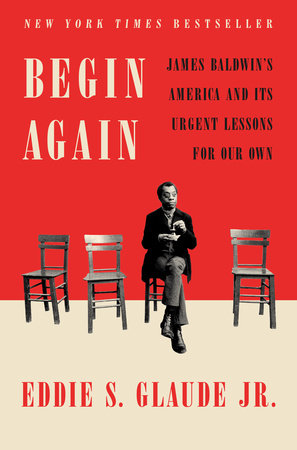
“I must admit this is a strange book,” Eddie S. Glaude Jr. explains in the “Introduction” to Begin Again, explaining:

It isn’t biography, although there are moments when it feels biographical; it is not literary criticism, although I read Baldwin’s nonfiction writings closely; and it is not straightforward history, even though the book, like Baldwin, is obsessed with history. Instead, Begin Again is some combination of all three in an effort to say something meaningful about our current times. (p. xviii)

One such “something meaningful” is quite large: “A moral reckoning is upon us, and we have to decide, once and for all, whether or not we will truly be a multiracial democracy” (p. xix).

Begin Again by Eddie S. Glaude Jr.
Begin Again, Eddie S. Glaude Jr.

Addressing that large scope for the book, Glaude navigates James Baldwin witnessing and confronting “the lie“:

The lie is more properly several sets of lies with a single purpose. If what I have called the “value gap” is the idea that in America white lives have always mattered more than the lives of others, then the lie is a broad and powerful architecture of false assumptions by which the value gap is maintained. These are the narrative assumptions that support the everyday order of American life, which means we breathe them like air. We count them as truths. We absorb them into our character. (p. 7; see Chapter One excerpt for a full explication of “the lie”)

But as Glaude notes about his own transition form Ralph Ellison to Baldwin—”Baldwin was too personal. In contrast, Ellison remained hidden behind his elegant words and powerful insight” (p. xxiv)—another “something meaningful” is as small as an individual person, a jumbled intersection with Baldwin, Dorothy Counts:

This picture signaled an end to segregation. Why has so little ...
Photograph: Douglas Martin/AP

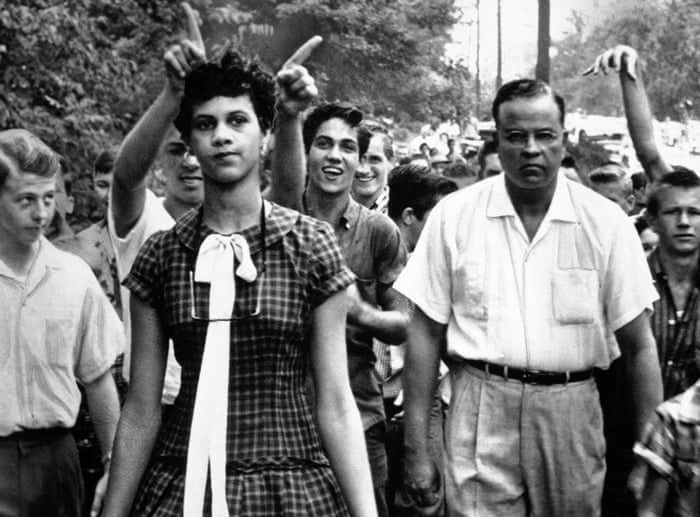
Chapter Two, “Witness,” opens with the harrowing story or Dorothy “Dot” Counts, a Black teenager carrying the weight of integrating Harding High School in Charlotte, NC, in 1957.

“Dot walked a racist gauntlet to enter Harding High School,” Glaude details. “She made the walk for just three more days before deciding never to return” (p. 30).

The racist anger launched repeatedly at a fifteen-year-old young woman personifies the lie, but that indelible image of Dot Counts became a twisted mythology for Baldwin (even as he fumbled details and the facts of history):

[I]n No Name in the Street, [Baldwin] would start at the beginning, with the image of her amid the hatred on her first day, and use the famous photo [above] of Dorothy to justify his own decision to join the fray….

Looking back, after the deaths of Medgar Evers, Malcolm X, and Martin Luther King, Jr., the photo with all of its pathos, anguish, and pride represented for Baldwin in 1972 the demand to bear witness to what was happening in 1957 and to what had transpired since, which led to his [mistaken] recollection of it in No Name in the Street. Dot’s eyes captured the trauma of that journey. Baldwin sought to narrate what happened on the eve of a social movement that would attempt to transform the country, and to testify to that odd combination of trauma and grit, which he now knew so well, seen in a fifteen-year-old black girl’s courage that spurred him, so he believed, to leap into the fire. (p. 43)

So, why Dorothy Counts?

Glaude weaves a motif of trauma through this work, and certainly there is trauma linking Baldwin and Counts, the latter more often than not ignored by white America: “It has never been America’s way to confront the trauma directly, largely because the lie does not allow for it” (p. 46). The result, Glaude notes, is “historical gaslighting.”

That did not happen, or That did not happen that way, or That is only the past, not who we [Americans] are today—so it goes.

While Baldwin’s mythology of Counts and his charge to bear witness are a narrative of the South, it certainly has become a prescient story about all of America, especially those supporting Trump:

The white southerner had to lie continuously to himself in order to justify his world. Lie that the black people around hum were inferior. Lie about what he was doing under the cover of night. Lie that he was Christian. For Baldwin, the accumulation of lies suffocated the white southerner. (p. 49)

That was then; this is now:

We are told every day not to believe what we see happening all around us or what we feel in the marrow of our bones. We are told, for example, that Trumpism is exceptional, a unique threat to our democracy. thus view that Trump, and Trump alone, stresses the fabric of the country lets us off the hook. It feeds into the lie that Baldwin spent the majority of his life trying to convince us to confront. It attempts to explain away as isolated events what today’s cellphone footage exposes as part of our everyday experience. Exceptionalizing Trump deforms our attention…. Trump represents a reassertion of the belief that America is, and always will be, a white nation. (p. 54)

Read Glaude’s exceptional work grounded in Baldwin and you will soon learn that there is no question why Dorothy Counts.


Dorothy Counts-Scoggins Still Fighting

This picture signaled an end to segregation. Why has so little changed?

From Observer archives (2007): Dorothy Counts at Harding High, a story of pride, prejudice

Where Are They Now?: Dorothy Counts

Big Time Football: “angry white man society”

While Trevor Lawrence—probably the highest profile white Division I college football player in 2020—has become the face for the #WeWantToPlay campaign calling for a start to college football amidst a pandemic, the Colorado State University football program has been forced to reckon with a racially toxic culture, implicating their former coach and current assistant coach at the University of South Carolina (Mike Bobo).

The #WeWantToPlay campaign appears to be garnering greater media and public coverage, but the CSU controversy should not be ignored, and should not be examined as a culture problem somehow centered only at CSU or in the individual coaches named in that coverage.

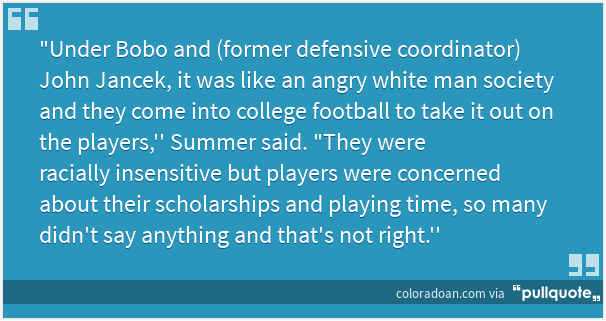
Charges by Black players at CSU are powerful and damning:

Image

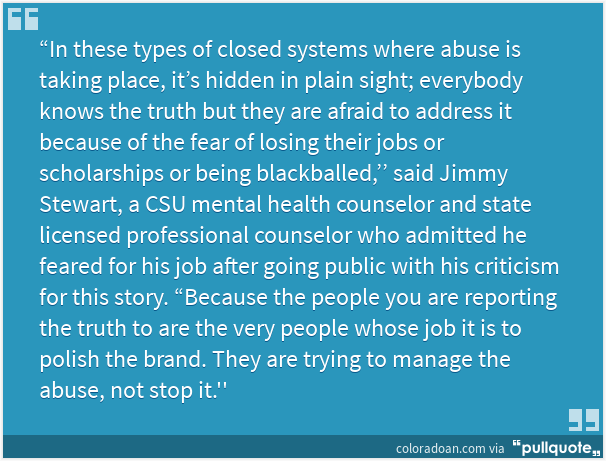
However, again, this is not about CSU solely or a few high-profile coaches; this is about “closed systems” and a normalized culture of abuse “hidden in plain sight”:

Image

Black athletes describing the culture of their football program as “an angry white man society” can and should be amplified to describe the entire system of big time football in the U.S. Start by considering the numbers:

Div I head coach race football
NCAA Demographics Database

The power-base of college football is significantly skewed toward white men, disproportionate to percentage of white men in general U.S. society as well as disproportionate to the demographics of men who play the sport:

In mass media and popular culture, sport is often presented as a level playing field where the most skilled and committed athletes rise to the top. The racial composition of American football is often presented as evidence of the supposed meritocracy of sport. While 13.2 percent of the U.S. population is black, 47.1 percent of NCAA Division I football players and 68.7 percent of National Football League (NFL) players are black.

White Americans hold the vast majority of power and wealth in the U.S., skewed significantly toward white men. Yet, white Americans tend to struggle with concepts of systemic inequity (racism, sexism, etc.) that depend on understanding the invisibility of white privilege for white people and the key statistical concept exposed above, “disproportion.”

Even as the killing of George Floyd by a police officer has reignited awareness and public protests about police violence being racist, this movement has not silenced or erased the “but police shoot and kill more white people” response, echoed by the current white nationalist POTUS.

For people with power, then, grasping data about disproportion is often a paradoxical experience (Simpson’s Paradox) because of white denial and white fragility:

The people making this argument don’t dispute the fact that police kill Black people at disproportionate rates. A Black person in America is roughly three times more likely than a white person to be killed by police. But according to this argument, the disparity is rooted in crime rates and more frequent encounters with police, not racism. In 2018, the rate of arrests for violent crime was 3.6 times higher for Black people than white people. So actually, the argument goes, Black people are underrepresented as victims of police killings, after controlling for the number of encounters.

Big time college football is both a reflection and perpetuation of the larger systemic inequities (such as racism and sexism) throughout the U.S.

But the current charges against coaches and the program (culture) at CSU are not merely a condemnation of CSU or the former and current head coaches. These charges are historical and current features of sports across the U.S., starting when athletes are children and running through the very small percentage who make sports their livelihoods.

The mythology that coaches (overwhelmingly white men) are building character in their athletes and are nearly universally “God-fearing, good family men” is one of the ugliest lies in American culture.

Sports in the U.S. is never about building character and certainly isn’t in the service of God (despite the veneer of Christianity that is layered onto every aspect of scholastic sports in the U.S.), but about winning and the wealth and aggrandizement of coaches and the institutions associated with those teams at the expense of the athletes (often disproportionately Black bodies):

“After watching George Floyd being humiliated before he died, it triggered in me the times I saw or heard about certain coaches humiliate student-athletes and the fact that not going public made me complicit and compromised my integrity,” said the 65-year-old Stewart, who is white. “I also became conscious that racism is about being a bully. In that encounter with the Black student-athlete, Coach Addazio had this attitude that he’s bigger and more powerful than the student-athlete. The student was enslaved.”

The day-to-day normalized behavior of coaches—yelling, berating, swearing, threatening—would be viewed as bullying and abuse in virtually all other situations where there is the sort of power, age, and racial imbalance as there exists in sports.

The abrupt and sustained pauses created by the Covid-19 pandemic have the potential for not only the needed reckonings echoing around many of the foundational aspects of American culture but also long-overdue revolutions in those institutions, including how we educate young people as well as how young people are invited into and coached through sports (since in the U.S. formal education and sports are nearly inextricably intertwined).

White men coaches are reinforced at every turn that they are “good men” despite their behaving as bullies, despite their racist and sexist ideologies mostly veiled or closeted behind the secrecy of male bonding and locker rooms:

A member of CSU’s football staff said Addazio has downplayed the COVID-19 health threat and Black Lives Matter movement, which have dominated public discussion in recent months, calling both a “distraction from football” to be managed.

“He’s smart enough not to come right out in public and say it, but he thinks BLM (Black Lives Matter) is a crock of s—, and that has come out in meetings,” said the football staff member who wished to remain anonymous. “When we had the incident with the player (a Black CSU football player was held at gunpoint by a white man while working in Loveland), the players wanted to march with shirts that had BLM on it, make posters and say chants. He told them if you are going to do that we aren’t marching.”

CSU and the University of South Carolina likely have some hard decisions to make, and probably are hoping to sweep all this under the rug while people struggle against the avalanches of crises surrounding them—from the Covid-19 pandemic to the rumbles of a 5.1 magnitude earthquake at the North Carolina/Virginia border.

I suspect these universities will issue a few more statements, probably conduct some investigations and also create reports months down the line; there may be some very mild consequences for the coaches named (but their already earned millions will not be touched, of course).

The white coaching shuffle, in which mediocre white men fail upward while stepping on those Black bodies for leverage, will continue, however.

The messages coming from Black football players at CSU are not just about CSU, or big time college football, or the most disturbing aspects of coaching; the messages coming from Black football players at CSU are about systemic inequities pervading all aspects of the U.S.

Big time college football is an important subset of American culture, a point being fumbled by Lawrence calling for #WeWantToPlay.

The U.S does not need major college football to return to normal and resume as soon as possible in the coming weeks, the fall of 2020.

A full and complete unmasking of big time college football would be welcomed, and should precede any efforts to return to our contemporary and slightly sanitized gladiator event that was always about sacrificing some Other bodies.

UPDATE

ACC players speak out against Trevor Lawrence 

See Also

Dabo Swinney and the White-Man No-Apology Apology

The Christian Veneer: On Dabo Swinney and Donald Trump

Confronting Aaron Hernandez, Big Time Football, and Toxic Masculinity

The United States of Hypocrisy: Scholastic Sports

College Athletes’ Academic Cheating a Harbinger of a Failed System

Coach K, Sports Fandom, and More on My Redneck Past

I Swear: On “Grit,” Adult Hypocrisy, and Privilege


Academic Freedom, Pedagogy, White Privilege, and Racism in Higher Education

“Reckoning” is an imposing word for those with power and privilege; for white people in the U.S. the threat or possibility of a reckoning is often terrifying, triggering what has now been identified as white fragility.

For those abused, assaulted, or marginalized by racism, sexism/misogyny, homophobia, transphobia, xenophobia, etc., the possibility of a reckoning is exhilarating—although tinted with at least skepticism if not cynicism about any reckoning coming to fruition.

Amidst a pandemic, however, the murder of George Floyd at the knee of a police officer seems to have reignited with a renewed stamina the #BlackLivesMatter movement.

Professional sports, including even the ultra-conservative NFL, have blinked finally against the call for police reform and racial reform across all aspect of the U.S.

Like the symbolism now being allowed and celebrated in the NBA and WNBA, the diversity and inclusion initiatives in U.S. higher education remain mostly rhetoric (and seemingly endless committee work).

While higher education is often characterized (and demonized) as some sort of insular liberal and progressive playground for college professors, the truth is that colleges and universities—like K-12 schools—are deeply conservative and mostly a reflection of society and the populations they serve.

Yes, a good portion of college faculty talk the talk of moderates and progressives, but almost all institutions are conservative by nature in order to exist; revolutionary behavior fits poorly with the economics of running a college or university.

Public universities are governed by politicians (mostly conservative and right-leaning moderate across the U.S.), and college and university boards tend to be populated by wealthy and conservative advocates for sustaining the institution (not brainwashing students with Marxism).

We of a genuine leftist persuasion, Marxists or critical scholars, are small outliers on college and university campuses; we are at best begrudgingly tolerated, often with significant consequences to our professional and personal lives.

Here’s the ugly truth—colleges and universities are systemically inequitable places. The campus, dorm, and classroom cultures are more often than not hostile to marginalized groups.

Black students, for example, are under-represented on college campuses (except at HBCUs), and even though women are the majority of students at those colleges and universities, they still must navigate sexual assault and harassment cultures with weak university support as well as significant inequities in access to majors as well as extracurricular activities such as athletics.

At my university, there have been a number of diversity and inclusion movements over the years, and we have fairly recently hired a Chief Diversity Officer.

The university has also been relatively proactive in confronting the racism in the founding of the institution, creating a report, Seeking Abraham, and establishing a series of action steps to address the racism built into the institution.

Yet, a new reckoning appears to be upon the university, best represented by an Instagram account, Black at Furman.

Alumni have been posting anonymously, detailing that the campus, dorms, and classrooms have been and remain hostile environments for students who have been marginalized by race, gender, nationality, sexuality, etc.

To their credit, administration at the university has responded positively so far to a petition by those running the IG account. Faculty seem also more motivated than in the past to acknowledge and address campus-wide inequities, especially those impacting Black students.

Along with other faculty, I have created a Equity, Anti-Racism, and Anti-Bias Statement, fore-fronting it on all course materials across my fall load:

#BlackLivesMatter

In my teaching, scholarship, public writing, and life, I am fully committed to racial, gender, and all forms of equity not yet realized throughout the U.S. and world. While academic spaces are often intellectually challenging and even uncomfortable, I will not tolerate in any aspect of this course language, ideas, or behavior/symbolism that are hostile to marginalized/oppressed groups (racism, sexism/misogyny, homophobia, transphobia, xenophobia, etc.).

Academic freedom for students and professors is tethered to consequences, and is not license. (See Free Speech and Diversity of Thought?)

Students uncertain about what language and ideas are not acceptable because they are hostile or offensive are invited to discuss those questions with me privately and are guaranteed those exchanges will be treated confidentially and respectfully. I am eager to share evidence, research, and reading to help anyone better understand goals of equity, anti-racism, and anti-bias (see materials in Box, Race and Racism).

If you witness or experience any form of bias, please report here:

Bias Incident Report

Anti-racism and anti-bias practice has been central to my teaching career for almost four decades; students are well aware of where I stand against the -isms that deform us, and my public work (such as my blogs) and my scholarship are firmly grounded in critical pedagogy, critical race theory, and critical discourse analysis.

I have also been a vocal critic of the ways in which my university falls short of critical practice and ant-racism/anti-bias commitments.

Yet, the IG account has highlighted in vivid and disturbing ways that far too often—and like many colleges and universities—inexcusable behavior is tolerated in dorms, across campus, and in classrooms because of tradition, fear of upsetting students and parents as customers, and more insidious ideologies such as academic freedom and narrow (traditional) expectations for research, scholarship, and teaching.

Central to my statement above, I think, is a confrontation of academic freedom and how it has been weaponized in the name of white privilege and racism.

Again, read the experiences of Black students in courses at my university, class sessions where language and comments that have no credibility have been allowed and have created hostile learning environments for Black students.

As I note in the statement, academic freedom is not license; it is not about “anyone can says anything in a class setting.”

For example, biology professors might acknowledge creationists and their rejecting Darwinism/evolution, but many do not, and certainly none suggest that “counter opinion” is credible in the field fo science.

How much time is spent in courses on World War II allowing Holocaust deniers equal time? Do we allow students to hold forth about the credibility of exterminating Jews?

In other words, academic freedom is about the boundaries of a discipline, and who determines the boundaries. Biology professors determine the boundaries for teaching evolution (not the university’s board of directors), and that is academic freedom.

Academia is not about knowledge bereft of moral or ethical parameters.

I will not sit in a classroom and allow students to create the sort of hostile environment former students lived and learned through because of the negligence of their professors and the university’s administration.

In the U.S., our government failure is a lack of political will, allowing and perpetuating what is ethically wrong because doing so gains political capital.

This, I fear, is an equally valid commentary on higher education.

College and university administrators and faculty too often lack the political and ethical will to simply do the right thing.

Academic freedom, how we teach (pedagogy), and what we teach are sacred and even potentially beautiful things, enormously valuable to the students who walk the grounds and sit in our classrooms.

But we have failed too, too many of those students; we have hidden behind a tarnished vision of academic freedom and proper pedagogy.

Let’s hope this reckoning is the real thing. It is long past due.

Recommended

This Ain’t Another Statement! This is a DEMAND for Black Linguistic Justice!