Category Archives: Education

The Right Remains Wrong about Teaching, Learning, and Critical Thinking

Everything about Williamson M. Evers is politically conservative, right-wing. Evers is a research fellow for the conservative Hoover Institution, explicitly dedicated to market economics and antagonistic to “government intrusion into the lives of individuals” (a libertarian strain of conservatism in the U.S.).

Evers has also been an appointee in a number of Republican state and federal administrations, often connected with education despite his academic background being entirely in the field of political science.

So let’s explore for a moment the great irony in Evers’ opinion/commentary piece for the Wall Street JournalCalifornia Wants to Teach Your Kids That Capitalism Is Racist. Two elements of this screed are worth highlighting, in fact.

Over the course of about 770 inflammatory words that repeatedly misrepresent concepts and terminology in order to rush to his central arguments, Evers builds to these sweeping conclusions: “The curriculum is entirely wrongheaded when it comes to critical thinking” and “Teaching objective history clearly isn’t the goal.”

These claims are nested in the larger argument that the California curriculum Evers is criticizing is somehow a veiled left-wing agenda (while Evers carefully avoids making a case about the possibility of “objective” teaching and learning and is entirely uncritical himself in terms of his own conservative agenda).

Ultimately, Evers is resisting, ironically, a critical examination of capitalism and endorsing the free market ideology of his think tank and political party as if those are what counts as “objective.”

The ideological spectrum of the right in the U.S. (which is by far the dominant ideology, especially when compared to Europe) is conservative in the sense of tradition—meaning that an institution such as public education would be dedicated to transmitting a fixed set of knowledge (this, in fact, is what Evers frames as “objective” even though this approach to teaching and learning is also biased since some agent in power must decide what knowledge counts and what knowledge doesn’t).

Public education in the U.S. has always been mostly conservative and used primarily to perpetuate traditional values associated with the country’s foundational ideals; as such, public education has mostly avoided critical thinking.

And therein lies the great irony of Evers opinion piece.

Critical education and critical thinking do come out of a leftist position, broadly a Marxist tradition. As an academic or scholarly lens, however, “left” in this context is far less about narrow partisan politics and more about how anyone navigates knowledge and human behavior.

For example, a traditional (thus conservative) approach to the Founding Fathers would offer students the ideals and actions taken by the men typically framed as founders in order to establish what makes the United States a free country. In many ways, this traditional approach to teaching is not factually incorrect, but it is misleading by omission.

If we pull back from this narrow history lesson, we must also acknowledge that the teaching of history in U.S. public schools is almost exclusively the promoting of positive and thus uncritical views of U.S. policies, wars, and political leaders.

In other words, the biased and incomplete approach to history that Evers idealizes as “objective” has not only dominated the teaching and learning of history in U.S. public education for more than a century, it remains the norm of how most history courses are taught—except in outlier situations where teachers inject critical history such as Howard Zinn’s history-as-activism or a marginally popular text, Lies My Teacher Told Me by James Loewen.

While Evers and many on the right enjoy demonizing government and government institutions as leftist, the reality is that all formal organizations are inherently conservative in that for any cohesive body to exist, it must maintain its structure. To be critical is to dismantle, re-imagine, and rebuild.

This is the essential partisan political tension between conservative (keeping things as they are) and progressive (seeking change, idealistically for the better).

Many on the right struggle with genuine criticism because to be critical is viewed as always negative (as in “to criticize) and criticism of X is almost always assumed to be an endorsement of Y.

Here is the great flaw of thinking perpetuated by partisan politics in the U.S., a system that is almost entirely divorced of an ideological spectrum and any real range of choice. Republican and Democrats in the U.S. are mostly well right of center ideologically and barely indistinguishable from each other beyond party affiliation.

Academic settings in the U.S.—at both the K-12 and high education levels—are rarely about endorsing either Republicans and Democrats (because the traditional nature of teaching and learning is not critical and thus is endorsing the system that perpetuates both). And any left-leaning elements in formal education, by being critical, are pulling back from that simplistic binary and from the incomplete knowledge base taught in traditional curriculum in order to ask critical questions.

Thomas Jefferson is not simply a great thinker and leader, but a man deeply stained by slavery during the inception of the country. Slavery as well is not simply a scar on the history of the nation, but a key element in how capitalism gained momentum and so-called economic progress flourished in the early years of the country.

And thus, the lazy and misguided approach to critical thinking on the right would be having students investigate which car is the better choice, a Honda Civic or a Toyota Camry.

Authentic critical thinking would be having students investigate who benefits from the U.S. being so invested in car ownership while considering the option of not owning a car at all (seeking better public transportation, for example).

Evers as a conservative ideologue, then, is incapable of recognizing that he is endorsing a curriculum that is biased propaganda (pro-capitalism) and a way of teaching that lacks critical thinking.

In fact, Evers is the one wrongheaded about critical thinking: “Critical thinking is described not as reasoning through logic and consideration of evidence but rather a vague deconstruction of power relationships so that one can ‘speak out on social issues.'”

Critical education and critical thinking in that tradition are entirely about equipping students to interrogate knowledge, to ask “In whose interest is this?” and “Who is in power and why?”

The right in the U.S. is the power class, and Evers is among that power elite.

Those of us on the left, never among the power elites, are not threatened by critical thinking that seeks to dismantle, re-imagine, and rebuild.

Those of us who are critically progressive are capable of seeing that the U.S. historically and currently is good for some while failing many. To be critical and progressive, then, is to seek better for all, not just maintaining the good for some.

As a critical educator and scholar, I have always wondered about the failed logic on the right. If the traditional values the right so eagerly endorses and protects are in fact as wonderful as they claim, why can they not stand against criticism and interrogation?

The authoritarian tendencies of the right suggest a fear of individual thinking and autonomy; the right is deeply invested in power, but the left remains deeply skeptical of all power and authority.

Formal education dedicated to human liberation must be grounded in critical thinking, the ways of calling all knowledge into question and seeking the full story—not simply the aspects of the story endorsed by the ruling elites.

The final irony is that commentaries such as Evers is unintended proof of the ultimate dangers of incomplete knowledge and a failure to think critically.

See Also

CQ Researcher: Does Common Core help students learn critical thinking? No.

More on Critical Pedagogy, Critical Thinking, and the Other: “Critical pedagogy wants to know who’s indoctrinating whom”

Verboden!: Autonomy and Critical Thinking in Education

Teacher Preparation and the Kafkan Nightmare of Accreditation

Over three-plus decades of teaching, I have found that students are far less likely to laugh while reading Franz Kafka than, say, while reading Kurt Vonnegut. But Kafka and Vonnegut are essentially satirists, though both traffic mainly in dark humor.

Black-and-white photograph of Kafka as a young man with dark hair in a formal suit
Franz Kafka 1923 (public domain)

The Metamorphosis is the work most people associate with Kafka, but it isn’t readily recognized, I have found, that the work is filled with slapstick humor—the scene when Gregor is revealed as a bug to his family—while also making a damning commentary on the consequences of the bureaucratic life.

You see, Gregor Samsa’s metamorphosis into a bug is merely a physical manifestation of his life as a salesman, which, Kafka illustrates, is nothing more than a bug’s life.

This, of course, was Kafka’s impression of early twentieth century Prussia as well as the corrosive nature of materialism. As I enter my eighteenth year as as a teacher educator, after eighteen years as a public school English teacher, I can attest that Kafka has pretty much nailed my career on the head as well.

So when I saw Teacher-Preparation Programs Again Have a Choice of Accreditors. But Should They? in Education Week, I immediately recognized that this was the wrong question—or at least incomplete.

Accountability, standards, and assessment have been pervasive my entire career in education, which began in 1984. Over that career, I have heard a consistent refrain about the failures of both K-12 education and teacher education.

As I have recently detailed, teacher education is, in fact, the new scapegoat for all that ails education.

I have worked through about ten combined iterations of standards and assessment expectations, include two different rounds of submitting the teacher preparation program I am solely responsible for now, the first being for NCATE and the for CAEP (mentioned prominently in the article linked above).

Through these experiences, I have witnessed that the same complaints of failure remain while each new round of standards and assessment promise to reform the system and bring great success (often for all students), only to be replaced in a few years under the blanket of the same crisis rhetoric and the same promises that never materialize.

This Kafkan nightmare is perfectly described by Gilles Deleuze, who also turns to Kafka:

In the disciplinary societies one was always starting again (from school to the barracks, from the barracks to the factory), while in the societies of control one is never finished with anything—the corporation, the educational system, the armed services being metastable states coexisting in one and the same modulation, like a universal system of deformation. In The Trial, Kafka, who had already placed himself at the pivotal point between two types of social formation, described the most fearsome of judicial forms. The apparent acquittal of the disciplinary societies (between two incarcerations); and the limitless postponements of the societies of control (in continuous variation) are two very different modes of juridicial life, and if our law is hesitant, itself in crisis, it’s because we are leaving one in order to enter the other.

In my home state of South Carolina, for example, the state adopted Common Core standards, planned to implement the assessment designed for those standards, purchased textbooks and materials aligned with the standards, trained teachers in the standards, and then dropped the standards for new SC versions of standards before Common Core could ever be fully implemented.

My first experience with accreditation of teacher education programs was early in my tenure in higher education. I was baffled both by the process (again, I am solely responsible for an entire program and all the data as well as the report submitted for that accreditation) and my colleagues’ almost complete uncritical obsession with the requirements. In short, the vast majority of my department’s time and attention was devoted to fulfilling the obligations of accreditation—not teaching, not scholarship, but standards, rubrics, and data tables mandated by the accreditation entity.

Just six or seven short years later, the process came back around again—nearly the same, but different. NCATE had been replaced by CAEP and standards were different along with the report itself and the broad expectations being both eerily different and the same.

Accreditation, I suspect, is a process that is perceived as a necessary layer of bureaucracy to insure some sort of consistency and fidelity among all teacher education programs across the U.S. This appears to be the same initial urge driving Common Core, for example.

Political leaders have used accountability, standards, and high-stakes testing for nearly four decades as a way to claim a commitment to higher expectations and better outcomes from the public education system. The public appears incapable over that time to examine closely the argument that schools are failing (the mainstream argument is both false and misleading) or the assertion that accountability, standards, and high-stakes testing will somehow address those problems.

Accreditation of teacher education is essentially a thinly veiled admission that there is no political or public trust of teacher educators, the field of education, or teachers.

Beneath that lack of trust, the accountability era for public education and the allure of accreditation are evidence that political leaders and the public fundamentally misunderstand teaching and learning.

Here is the sobering truth about teaching and learning: To teach is about offering the opportunity to learn; however, there is no way to guarantee that teaching will result in learning regardless of the quality of the teacher or the motivation of the student.

Accountability and accreditation are designed with the assumption that teaching and learning can be prescribed and clearly defined (standards) and then made visible with assessments that are valid and authentic.

Those assumptions are mostly hokum.

The standards and testing movement in K-12 education and the accreditation process for teacher education have proven to be what Oscar Wilde argued about how government addresses poverty: ““But their remedies do not cure the disease: they merely prolong it. Indeed, their remedies are part of the disease.”

Trying to meet the requirements of accreditation has made teacher educators less effective, has reduced the quality of courses and experiences for pre-service teachers, and has consumed an incredible amount of time and financial resources for teacher educators.

It is much ado about nothing.

The EdWeek question, then, is overly simplistic; the rise of AAQEP as an alternative to CAEP is the “illusion of choice” that masks the truly important choice—teacher education and education as a field need to abandon accreditation and seek instead to build a discipline.

Meeting the demands of accreditation is a waste of time and resources that should be dedicated to the things associated with disciplines such as history, psychology, sociology, etc.—reading and thinking deeply about the ideas and practices at the core of the field, conducting a wide range of research on those topics and problems, producing scholarship that informs an ongoing dialogue about teaching and learning, and engaging students in those topics in ways that allow them to become the educators they seek to be.

To reject accreditation is to embrace higher expectations for teacher education, teacher educators, and teachers.

At the end of The Metamorphosis, Gregor’s macabre demise is a distraction for many readers who miss that this is a story about such rejections and not necessarily a tale about Gregor, but his family. After Gregor dies, “Then all three [Gregor’s family] left the apartment together, something they had not done for months now, and took the electric tram into the open air outside the city. The car in which they were sitting by themselves was totally engulfed by the warm sun.”

Careful reading of the final paragraph reveals that the family’s obsession with Gregor, who himself had embraced a toxic bug life dedicated to erasing the family’s debt, has to be abandoned for their eventual happiness: “The greatest improvement in their situation at this moment, of course, had to come from a change of dwelling. Now they wanted to rent an apartment smaller and cheaper but better situated and generally more practical than the present one, which Gregor had found.”

Gregor’s sister becomes the symbol of a new, and better, possibility, a fully human life unfettered by the bug life swept into the dust bin.

See Also

The Metamorphosis at 100, Alexander Billet

Once Racist: More on My Redneck Past

There is so much about the U.S. in the story of Kyle Kashuv.

Kashuv as a teenager has had thrust upon him a complex and accidental fame. First, he gained recognition by being among the high school student survivors of the Parkland, Florida school shooing.

Next, Kashuv filled a partisan political niche by being the face of conservative activist students after that school shooting—an event that spawned a rise in what has been characterized in the U.S. as left-wing political activism by a number of his classmates.

And now, Kashuv is the face of consequences: He was first accepted in Harvard and then that acceptance was rescinded.

Conservatives across the country have rushed to express outrage, focusing on arguments that his actions (documented and repeated racist language) occurred while he was still young; these defenses of Kashuv have often been absent the fact that colleges, and Harvard, have rescinded acceptances for similar reasons in the past (with little media fanfare) and that the nature of all college admission is judging applicants for their behavior while only in their teens.

By the logic of apologists for Kashuv, Harvard—and all colleges—are irresponsible for admitting or rejecting students for the grades they earned and the accomplishments they achieved while teenagers.

But the larger problem with how conservatives have rushed to defend Kashuv is that it is grounded in a plea for license, not freedom.

Kashuv has not been denied his freedom to express racist language and bigoted ideology; Kashuv has not been denied the opportunity to rise above these deplorable displays of calloused youthful indiscretion (if that is what it was); and Kashuv has not been denied access to a college education.

While it may seem harsh due to his age and his notoriety, Kashuv is simply experiencing consequences. To be free to speak and believe in the U.S. is not, ideally, also freedom from consequences.

As I watched this debate play out on social media, I noticed several people share that when they were teens, they knew racist language and slurs were wrong, and they refused to use them.

For me, however, I have quite a different confession—one that the following Tweeted video well documents in a context far different than my upbringing in the 1960s and 1970s in South Carolina:

These children above both knew the terror of their language and their actions, and they seem almost gleeful in the boldness of their hatred. This video in many ways feels like the evidence of Kashuv’s behavior, which he frames as “private” and “immature.”

In my home and community of Upstate South Carolina, everyone knew racial slurs and racist behavior were dehumanizing and, essentially, wrong. But whites of all social classes and statuses persisted in using the language (casually and often in whites-only situations) and held the N-word in their pockets when the moment arrived to wield it against a black person.

Except in rare circumstances, you see, there were virtually no negative consequences for our casual and aggressive racism; in fact, among whites, racial slurs and behavior gained a person status.

Whites pridefully told stories of putting black people in their places—retelling in vivid detail the exchange so that racial slurs were fore-fronted in the retelling.

When I was in my late teens, I worked as an assistant in a golf pro shop at the country club where my parents built their dream home; this was the urge of proximity my working-class parents aspired to as an unconscious rejection of being just working-class in the good ol’ U.S. of A.

The private golf club was all-white, as detailed in the by-laws, but the people living on the course and the members were mostly just the rednecks of my hometown no matter how hard they pretended to be otherwise.

One morning while I was in the pro shop, one of the grounds crew workers was milling around and decided to teach me something: “Want to know where [racial slur] come from?”

We were alone, and he was an adult. But I was pretty sure I didn’t want to hear what was coming, but his question was just a formality.

He explained in detail that when Cain killed Able, and Cain was banished from the Garden, Cain mated with apes. And the result was the black race. And he had learned this himself in church. Sunday school.

He quoted scripture.

The problem with this moment in my life is that my only real response—all remaining private in my thoughts—was that I knew I wasn’t that ignorant. But thinking myself better than this man did nothing to dissuade me from my casual racism couched in my family and my community (among many whites who actually did not reject this man’s outlandish Garden of Eden version of races).

So here is my story of privilege, of the grand comfort I was allowed because I was a white young man and a good student, smart.

I attended junior college, and then I was a commuter at a satellite campus of the state university—never even considering a selective college in my home state much less something a rarified as Harvard or Duke. I was first-generation and my parents, despite their aspirations, could not have afforded more than what I did (college never cost my family more than hundreds of dollars a semester).

Here is the white male privilege part, and why I am not an apologist for Kashuv having his acceptance revoked—even as I freely admit my own behavior probably trumped his in many ways.

At junior college on a lesser level and then during my last two-and-a-half years as an undergrad, I was allowed the space to realize that an entire world and set of ideologies existed unlike my home and community—specifically that many well-educated people were actively not racist, sexist, or homophobic.

These new contexts and my journey with professors and literature (Ralph Ellison, Alice Walker, Richard Wright, Langston Hughes) allowed me to choose to be a better person, to face my bigotry spawned by my home and community in order to be a more humane, to be fully human.

Four decades later I am deeply embarrassed by who I was for those first couple of decades of my life. In fact, I spend a good deal of my work as a teacher and writer seeking ways to confront that past by advocating for equity for all humans.

But there really is nothing I can do that pays the debt, that changes my history.

As I watch the sound and fury surrounding Kashuv, however, I can say without hesitation that he is being afforded a privilege I was not; Kashuv is being held accountable and this is happening early enough that he can right his ship if he so wishes.

He will suffer very little loss from this, but he can benefit—as white men often do—on the other side of being a truly calloused young man who is blind to his advantages.

There is far too little difference between my truly unforgivable youth and Kashuv’s more recent “private” and “immature” racism.

Neither, however, is the least bit funny, and neither is a case of how the U.S. should honor freedom.

Language and behaviors must have consequences in order to protect everyone’s humanity against the privileging of some people’s humanity.


The Problem with Balanced Literacy

My summer graduate course, Foundations and Current Trends in Literacy Research and Practice, never fails at being an invigorating course for me and my students because it combines foundational topics in literacy with a never-ending series of current debates and controversies surrounding those enduring elements of teaching and learning literacy.

For several years recently, my home state of South Carolina has provided ample content because of the current reading legislation, Read to Succeed, heavily drawn from Florida’s reading policy and commitment to grade retention as a punitive key element in teaching reading.

This summer, however, even with Read to Succeed firmly entrenched and resulting in grade retention for students, a new wave of controversy has invigorated this course’s topics—the media focus on the “science of reading” driven by advocates for students with dyslexia and the (tired) resurgence of calls for systematic phonics for all students.

The scapegoats in this “science of reading” frenzy are teacher education and balanced literacy (the younger cousin of the similarly maligned whole language).

At the end of class preceding the next day’s focus on balanced literacy, a graduate student asked for a quick definition because since she was new to education and had recently experienced many interviews that asked her to define balanced literacy, she felt quite disoriented and uninformed about what it means.

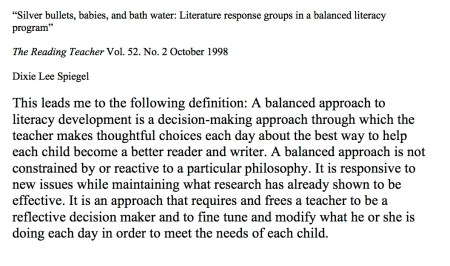
I pulled up my standard paragraph from Dixie Lee Spiegel and immediately heard several other students note this isn’t how they have had the term defined in their schools.

As I read the daily reflections on the readings for balanced literacy, this response, I think, is an important way to address the problem with balanced literacy (edited for some minor formatting):

My school places a huge emphasis on balanced literacy. However, it is presented more in terms of how much time and in what context various components of literacy should be implemented in class daily (we even have it in a pie chart) [emphasis added]. We used to have a great deal of autonomy in the curriculum we chose in reading and writing, but our district recently adopted Lucy Calkins’ Units of Study. Although Calkins desires for teachers to use her units as a framework, it has become a way to make sure all teachers are doing the same thing [emphasis added]. In practice we have a balanced literacy program in terms of we give students choice (although in the early grades very restricted choices), allow time for free reading, a lot of experience with literacy, small, guided reading group instruction, and explicit phonics instruction; we are doing all of this in a systematic, controlled way. I read the article about effective balanced literacy instruction and felt it did a great job in summarizing the qualities that make a teacher highly effective in the implementation of balanced literacy. But the point is…it takes a highly effective teacher, period.

Having only been consistently teaching for five years, I also understand how incredibly challenging it is to be a masterful teacher. I feel I could have seemed that I was implementing balanced literacy proficiently in a class I had two years ago. Most of my class came from literacy rich environments and could discuss books in meaningful ways. The ones that did struggle, were inspired by their peers to take risks in reading (they made me look good). This past year, I did not have a class as a whole that loved reading. For a lot of them, it was a challenge to get them to listen to stories much less engage in meaningful conversations. The majority of them would say they hated to read. Calkins (and my reading coach) would have me go to a first grade unit of study and implement more basic literacy skills to scaffold, but there was no way I would be able to do this alone. The lessons are very in depth and it would have cost me more time than I had available. Also, those mini-lessons would not have appealed to the 6 or 8 students who were ready to have more comprehensive, richer discussions. Reading and literacy implementation was a struggle all year.

I also realize that it is easier within systems to quantify and package things, but you simply cannot do this with teachers and students [emphasis added]. It is easy to show learning in a quantitative way. Although my students achieved higher reading levels this year, which looks great on an SLO [Student Learning Objectives], as a teacher I know that I missed it with them. I also realize that I can say I am doing balanced literacy, but I know it isn’t truly what balanced literacy is intended to be [emphasis added].

To open the discussion, after reading this an other reflections with similar descriptions, I explained to the class that both whole language and balanced literacy are philosophies of teaching and acquiring literacy; they provide evidence-based broad concepts to guide practice, but neither was originally intended to be programs or templates for how teachers teacher or how students learn.

As the response above demonstrates, however, education in practice is often over-reliant on programs and less diligent about addressing philosophy or theory. In short, the problem with balanced literacy is not that teacher education teaches balanced literacy and not the science of reading (note because balanced literacy as a philosophy of literacy embraces that full and complex science of reading) and not that teachers do not know the science of reading but are teaching balanced literacy, but that almost all schools have adopted programs, many of which claim the label of “balanced literacy” while also breaking the foundational elements of that philosophy (see the last sentence of the response above).

And just as the media, dyslexia advocates, and phonics proponents have endorsed, these reading programs (labeled “balanced literacy” or not) are primarily about addressing standards, preparing students for high-stakes tests, and imposing a one-size-fits-all approach to teaching and learning reading; and therein is the essential flaw.

All teachers and all students doing the same things at the same time and being held accountable for doing the mandated program—this is literacy instruction in the U.S., and this is the grand failure no one in the media or in political leadership is willing to address.

All the bluster around calling out “balanced literacy” is nothing more than distraction because it doesn’t really matter what label we assign to how teachers teach reading or how students learn reading; what matters are the expertise of teachers, the needs of students, and the teaching/learning conditions that support or inhibit (see complying with reading programs) effective teaching and learning.

The real problem with balanced literacy is too few people know what it is and as a result are failing it along with the students and teachers caught in that misguided vortex.

Educational Accountability and the Science of Scapegoating the Powerless

Several years ago when I submitted an Op-Ed to the largest newspaper in my home state of South Carolina, the editor rejected the historical timeline I was using for state standards and testing, specifically arguing that accountability had begun in the late 1990s and not in the early 1980s as I noted.

Here’s the interesting part.

I began teaching in South Carolina in the fall of 1984, the first year of major education reform under then-governor Richard Riley. That reform included a significant teacher pay raise, extended days of working for teachers, and the standards-testing regime that would become normal for all public education across the U.S.

In fact, SC’s accountability legislation dates back to the late 1970s (I sent her links to all this).

As a beginning teacher, the only public schooling I ever knew was teaching to standards and high-stakes tests by identifying standards on my lesson plans and implementing benchmark assessments throughout the academic year to document I was teaching what was mandated as a bulwark against low student tests scores. State testing, including punitive exit exams, pervaded everything about being an English teacher.

Yet, an editor, herself a career journalist, was quick to assume my expertise as a classroom practitioner and then college professor of education was mistaken.

This is a snapshot of how mainstream media interact with education as a topic and educators as professionals.

I am reminded of that experience over and over in fact as I read media coverage of education. Take for example this from Education Week, Want Teachers to Motivate Their Students? Teach Them How, which has the thesis:

Most teachers intrinsically understand the need to motivate their students, experts say, but teaching on intuition alone can lead to missteps in student engagement.

A study released in May by the Mindset Scholars Network, a collaborative of researchers who study student motivation, found most teacher education programs nationwide do not include explicit training for teachers on the science of how to motivate students.

Want Teachers to Motivate Their Students? Teach Them How

Two key elements of this article stand out: The new scapegoat in proclaiming education a failure is teacher education and the go-to failure is always about a lack of “science” in teacher education.

This article on motivation is following a media template well worn recently about students in the U.S. can’t read because teachers are not taught the “science of reading,” you guessed it, in their teacher education programs.

As I detailed in a Twitter thread, scapegoating teacher education has many flaws, and my experience and expertise as a teacher educator for almost two decades, following almost two decades as a classroom teacher, inform my understanding of how finding scapegoats for educational failure during the accountability era is fool’s gold.

How has the accountability era gone in terms of where the accountability and locus of power lie, then?

In the 1980s and 1990s, the accountability mechanisms focused on holding students accountable (think exit exams) and schools accountable (student test scores often translated into school rankings or grades, designating schools as “failing,” for example).

Keep in mind that students had no power in that process, and that schools were merely agents of the standards being implemented, again outside the power dynamics of those mandates being determined.

With No Child Left Behind spawned by the false claims of the Texas Miracle, the accountability era was greatly accelerated, including a creeping sense that the process wasn’t improving education but it was punishing students (lower graduation rates due to exit exams) and demonizing schools (most high-poverty and high-racial minority schools were labeled as “failing”).

By the administration of Barak Obama, with education policy under another false narrative (the Chicago Miracle) and false ambassador with no background in education other than appointments (Arne Duncan), the scapegoating took a turn—the problem, went the new message, was “bad” teachers and the solution was not holding students or schools accountable for test scores but those teachers (the era of value-added methods [VAM]).

As some have noted and documented, teacher bashing increased and then prompted a backlash (see magazine covers from Time for a great series of artifacts on this); it seems that VAM proved to be a false metric for accountability and that maybe teachers were not the problem after all.

With the scapegoat role now vacant, the media have discovered a new candidate, teacher education.

Let’s here recognize that once again the power context is way off in who is determining the accountability and who is being held accountable. For the most part, teachers and teacher educators are relatively powerless agents who are mandated to implement standards and assessments that they do not create and often do not endorse as valid.

Now consider another really important reason accountability in education is deeply flawed: The constant misguided scapegoating of powerless agents in formal teaching and learning is a distraction from the actual causal sources for educational challenges.

Fun fact: Decades of research from educators and education scholars have detailed that out-of-school factors overwhelmingly determine measurable student outcomes, some estimates as high as 80+% and most scholars agreeing on 60%. Teacher quality’s impact on measurable student achievement has been identified repeatedly as only about 10-15%.

Yet, the entire accountability era since the early 1980s has focused on in-school reforms only (scapegoating along the way), while tossing up hands and embracing harsh ideologies such as “no excuses” practices that argue teachers fail students with the “soft bigotry of low expectations” and students fail because they lack “grit” or a growth mindset.

Many of us have doggedly argued for social context reform, addressing socio-economic reform first and then reforming education along equity (not accountability) lines next, or concurrently. Many of us have also demonstrated that “grit” and growth mindset have racist and classist groundings that are harmful.

For those positions, we have been demonized and marginalized for decades.

So imagine my surprise when, first, the tide shifted on teacher bashing (I have 34 posts on my blog discrediting VAM and dozens on misunderstanding teacher quality) and then these articles: Better Schools Won’t Fix America (The Atlantic), The Harsh Discipline of No-Excuses Charter Schools: Is It Worth the Promise? (Education Week), and Unchartered territory: 2020 Democrats back away from charter schools (MSN).

My blog posts, however, on social context reform and poverty (157), “no excuses” reform (70), and the mirage of charter schools (80) have either mostly been ignored or are harshly (even angrily) rejected. Like my interaction with the editor discussed in the opening, my experience and expertise as an educator and education scholar have held almost no weight with those in power pr the media.

The media and journalists as generalists seem deeply resistant to learning a lesson they create over and over.

Take for a current example Karin Wulf’s examination of Naomi Wolff and Cokie Roberts; Wulf herself is a historian:

It’s been a tough few weeks for amateur history. First, journalist Naomi Wolf discovered on live radio that she had misinterpreted key historical terms in her new book, “Outrage,” leading her to draw the wrong conclusions. A week later, journalist Cokie Roberts, too, got a quick smackdown when she claimed on NPR that she couldn’t find any incidence of abortion advertised in 19th century newspapers, a claim quickly disproved by historians.

Wolf and Roberts fell victim to a myth widely shared with the American public: that anyone can do history. Whether it’s diving into genealogy or digging thorough the vast troves of digital archives now online, the public has an easy way into the world of the past. And why would they imagine it takes any special training? After all, the best-selling history books are almost always written by non-historians, from conservative commentators like Bill O’Reilly to journalists like Wolf and Roberts.

What Naomi Wolf and Cokie Roberts teach us about the need for historians

Wulf’s confronting “that anyone can do history” immediately prompted in me my experience when I first moved from teaching high school English (and adjuncting at several colleges, including being a lead instructor in a university-based summer institute of the National Writing Project) to higher education. My university was debating a curriculum change that included dropping traditional composition courses (popularly known as English 101 and English 102) for first-year seminars.

One of those first-year seminars was to be writing-intensive, and the argument being posed was that any professor could teach writing.

This change passed, and the English department and professors were relieved of sole responsibility for teaching writing.

Over the next eight years or so, the university learned a really disturbing lesson (one I could have shared in the beginning): “Any professor can teach writing” is false.

As Wulf argues about history, with writing and education, experience and expertise matter.

So here I sit again, writing over and over that the media are getting reading wrong, that scapegoating teacher education is missing the real problem.

How many years will it take until I see articles “discovering” these facts as if no one with experience and expertise ever raised the issue?

Checklist: Media Coverage of the “Science of Reading”

Several years ago while preparing the first edition (2013) of De-testing and De-grading Schools: Authentic Alternatives to Accountability and Standardization, I came to know Peter DeWitt as a highly praised principal who wrote in that volume about no testing week at his school.

His work and career have shifted since then, but I have remained in contact through his public writing. Coinciding with a mostly fruitless Twitter debate about how the media continues to misrepresent the challenges and realities of teaching reading, then, I was strongly drawn to DeWitt’s 3 Reasons I Do Not Engage In Twitter Debates.

Much of his examination of the paradox that is social media is extremely compelling to me; his three reasons, in fact, resonate powerfully: They’re rarely about common understanding, they make you look really crazy to onlookers, and he’s not good at them.

When I find myself crossing (foolishly) DeWitt’s pointed line, I try to justify the effort by this (mostly idealistic and probably misguided) justification: Making a nuanced and detailed case, even through the limitations of Twitter, will likely not persuade the Twitter thread members, but can provide a platform for learning to those observing the discussion.

However, I find DeWitt’s conclusions hold fast, and thus, offering here the details and the nuance has a better, although also limited, potential for changing the dialogue and reaching more understanding.

Instead of providing yet another discrediting of yet another media misrepresentation of the “science of reading” (see some of that work listed below), I want to offer here a checklist for those who want to navigate the media coverage in an informed and critical way.

Mainstream media education journalism is routinely bad because of some broad problems inherent in journalism: journalists tend to be generalists and media assume a journalist can and should cover specialized fields, journalism remains bound to a “both sides” coverage of topics that misrepresents the actual balance of evidence in those specialized fields, and as I outline below, mainstream media tend to be trapped in a sort of presentism that lacks historical context.

Below with additional sources to support and illuminate the problems is a checklist for navigating mainstream media’s coverage of the “science of reading”:

Mainstream media’s errors in science of reading include the following:

[ ] Misrepresenting balanced literacy (BL), whole language (WL) to discredit them. To evaluate media coverage of reading instruction, know that reading ideologies such as balanced literacy and whole language suffer very complex realities. First, as links below detail, even when teachers or schools claim to be implementing BL or WL, there is ample evidence that traditional and more isolated practices are actually in place. Second, and extremely important to the current and historical versions of the reading wars, both BL and WL recognize and endorse a significant place for phonics instruction in early literacy; as Stephen Krashen explains pointedly: “Zero Phonics. This view claims that direct teaching is not necessary or even helpful. I am unaware of any professional who holds this position.”

Resources:

Defending Whole Language: The Limits of Phonics Instruction and the Efficacy of Whole Language Instruction, Stephen Krashen

Whole Language and the Great Plummet of 1987-92, Stephen Krashen

Literacy at the Crossroads: Crucial Talk About Reading, Writing, and Other Teaching Dilemmas, Regie Routman

Facts: On the nature of whole language education

Attack on “Balanced Literacy” Is Attack on Professional Teachers, Research

Silver Bullets, Babies, and Bath Water: Literature Response Groups in a Balanced Literacy Program, Dixie Lee Spiegel

[ ] Misrepresenting the complex role of phonics in reading in order to advocate for phonics programs. Related to the first point above, phonics advocacy tends to suggest falsely that some literacy experts support no phonics instruction and that all children must receive systematic intensive phonics instruction; these extreme polarities distort, ironically, what the broad and complex research base does show about how children learn to read as well as the role of phonics in that process.

Resources:

To read or not to read: decoding Synthetic Phonics, Andrew Davis

Stephen Krashen: Literacy: Phonemic Awareness and Phonics

The Literacy Crisis False Claims Real Solutions, Jeff McQuillan

[ ] Lacking historical context about the recurring “reading wars” and the false narratives of failing to teach children to read. The media, the public, and political leaders have chosen a crisis narrative for teaching reading throughout the twentieth and into the twenty-first century. That framing as crisis has mostly obscured both the problems that do stunt effective reading instruction and the complex nature of teaching reading as well as the current research base on teaching and literacy development.

Resources:

What Shall We Do About Reading Today?: Looking Back to See Now More Clearly

What Shall We Do About Reading Today?: A Symposium

Research in Language (1947), Lou LaBrant

Hooked on Phonics Redux

[ ] Overemphasizing/ misrepresenting National Reading Panel (NRP) value, ignoring it as a narrow and politically skewed report. A central component of No Child Behind was the NRP; however, as a key member of the panel has detailed, that report was neither a comprehensive and valid overview of the then-current state of research on teaching reading nor a foundational tool for guiding reading practices or policy. Yet, media coverage routinely references the NRP as gold-standard research and laments its lack of impact (although the NRP report did spawn a disturbing scandal concerning federal funding and textbook adoptions).

Resources:

Babes in the Woods: The Wanderings of the National Reading Panel, Joanne Yatvin

Did Reading First Work?, Stephen Krashen

My Experiences in Teaching Reading and Being a Member of the National Reading Panel, Joanne Yatvin

I Told You So! The Misinterpretation and Misuse of The National Reading Panel Report, Joanne Yatvin

The Enduring Influence of the National Reading Panel (and the “D” Word)

[ ] Citing bogus reports from discredited think tanks such as NCTQ. Well over a decade ago, Gerald Bracey warned about the growing influence of agenda-driven think tanks aggressively promoting reports before they are peer reviewed; since the mainstream media and most journalists are under-funded and overworked, press-release journalism has become more and more common, especially regarding education and often in terms of how so-called research is framed for the public. With the recent focus on the “science of reading,” the scapegoat of the day is teacher education; the narrative goes that teachers today do not know the science of reading because teacher education programs do not teach the science of reading. Often as proof, the mainstream media resorts to anecdote (they talk to a teacher or two who claims not to have been taught the science of reading) and citing bogus reports masquerading as research—notably the work of NCTQ, a think-tank that has aggressively and falsely attacked teacher education in report after report using slip-shod methods and devious processes to gather the data claim to analyze.

Resources:

NEPC Review: 2018 Teacher Prep Review (National Council on Teacher Quality, April 2018)

Review of Learning about Learning: What Every New Teacher Needs to Know

GUEST POST by Peter Smagorinsky: Response to the new NCTQ Teacher Prep Review

[ ] Scapegoating teacher education while ignoring two greatest influences on reading: poverty and reading programs adopted to comply with standards and high-stakes testing. There is ample room to criticize teacher education, particularly focusing on the problems with credentialing and the flaws inherent in the accreditation process, but the current media urge to blame teacher education for either how reading is taught or the errors in how reading is taught distracts from some hard facts about measurable reading achievement: first, standardized testing of all kinds are more strongly correlated with socio-economic and out-of-school factors than either teacher, teaching, or school quality; and this blame-teacher-education narrative glosses over that almost all reading instruction in U.S. public schools is mandated by standards, high-stakes testing, and adopted reading programs regardless of what teachers learned in their certification program.

Resources:

In Schools, Teacher Quality Matters Most

Teachers Matter, But So Do Words | Shanker Institute

Teaching Reading and Children: Reading Programs as “Costume Parties”

Masquerading (1931), Lou LaBrant

[ ] Conflating needs of students with special needs and needs of general population of students. The genesis of the most recent version of the reading wars that focuses on the “science of reading” appears to be grounded in a growing advocacy for children either not diagnosed or misdiagnosed for issues related to dyslexia. Parents of those children have been very politically active, and while their concerns for children with special needs are valid, the media and politicians have overreacted to that narrow issue and over-generalized the needs of those students to all students. This advocacy has also run roughshod over the actual and more nuanced research base on dyslexia itself. In short, parents advocating for their children should be honored and heard, but parents should not be driving reading instruction or reading policy.

Resource:

Parent Advocacy and the New (But Still Misguided) Phonics Assault on Reading

[ ] Emphasizing voices of cognitive scientists over literacy professionals. Two common patterns in media coverage of education and specifically reading are that journalists perpetuate both a gender and a discipline bias in whose voices are highlighted; notably, mostly men who are cognitive scientists are used to drive the agenda while women who are literacy practitioners and scholars are either ignored, marginalized as “critics,” or scapegoated as misguided advocates of BL or WL.

Resources:

NPR Fails Journalism and Education (Again)

What’s Wrong with Education as a Discipline?: Unpacking the Reading Wars (Again)

[ ] Trusting silver-bullet, one-size-fits-all claims about teaching and learning. Fundamentally, the historical and current flaw in the reading wars, even one framed as the “science of reading,” is that phonics advocacy reaches for “all students must have systematic intensive phonics programs,” buoyed recently by “but intensive phonics programs won’t hurt any students.” However, all teaching and learning proves to be far more complex that these claims. If we return to BL as a reading philosophy, we can emphasize that each child (not all children) should receive the type and amount of direct phonics instruction they need to begin and then grow as readers; that type and amount is difficult to prescribe, and often children are mis-served when systematic phonics programs are adopted because fidelity to the program typically trumps the actual goal of reading instruction, eager and autonomous readers. When a child is mandated to complete a phonics program, regardless of that child’s needs, that time would have been much better spent with the child reading by choice; therefore, systematic phonics do in fact harm students when they are implemented as “all students must.”

Resources:

Navigating the Scylla and Charybdis of Research in Education

Teaching Students, Not Standards or Programs

[ ] Feeding a false narrative blaming teachers and teacher educators both of whom are deprofessionalized /powerless in accountability structures. There are some dirty little secrets about education that discredit much of how media cover teaching and learning: as noted above, measurable teacher impact on student learning is quite small; teachers are mostly complying with mandates, and not making instructional or assessment decisions; and teacher educators have very little impact on how teachers implement teaching once they are in the classroom and required to conform to the mandates linked to standards and high-stakes testing.

Resources:

Pre-Service Teacher Education vs. the World

Verboden!: Autonomy and Critical Thinking in Education

Autonomy Must Precede Accountability

See Also


The Government

A common and valid criticism of Marxism is that the ideology is idealistic. A similar charge is leveled against communism, but often far more hostile and along the lines that in practice it has never worked or in practice it has been horribly dehumanizing, a totalitarian nightmare.

Left mostly unexamined, however, in the U.S. is the shallow and equally idealistic, and illogical, libertarian dream, expressed well in Henry David Thoreau’s “Civil Disobedience,” which begins:

I heartily accept the motto, “That government is best which governs least”; and I should like to see it acted up to more rapidly and systematically. Carried out, it finally amounts to this, which also I believe—”That government is best which governs not at all”; and when men are prepared for it, that will be the kind of government which they will have. Government is at best but an expedient; but most governments are usually, and all governments are sometimes, inexpedient.

Ah, the narcotic allure of no government!

Yet, once Thoreau triggers those no-government endorphins, he backtracks:

But, to speak practically and as a citizen, unlike those who call themselves no-government men, I ask for, not at once no government, but at once a better government. Let every man make known what kind of government would command his respect, and that will be one step toward obtaining it.

Well, damn, just better government? Yes, because, you know, practicality:

After all, the practical reason why, when the power is once in the hands of the people, a majority are permitted, and for a long period continue, to rule is not because they are most likely to be in the right, nor because this seems fairest to the minority, but because they are physically the strongest. But a government in which the majority rule in all cases cannot be based on justice, even as far as men understand it. Can there not be a government in which majorities do not virtually decide right and wrong, but conscience?—in which majorities decide only those questions to which the rule of expediency is applicable? Must the citizen ever for a moment, or in the least degree, resign his conscience to the legislation? Why has every man a conscience, then? I think that we should be men first, and subjects afterward. It is not desirable to cultivate a respect for the law, so much as for the right. The only obligation which I have a right to assume is to do at any time what I think right. It is truly enough said that a corporation has no conscience; but a corporation of conscientious men is a corporation with a conscience.

Thoreau speaks to not only the no-government streak in the American Myth but also our foundational rugged individualism mythos; to hell with laws and government, Thoreau argues, because “[m]oreover, any man more right than his neighbors constitutes a majority of one already.”

Lazy contemporary libertarian urges in the U.S. still sing many of these idealistic and internally illogical refrains, but most now diverge from Thoreau about material possessions since Thoreau at least claimed to be not about things and possessions (more idealism and one of his many blind spots about the privileges he enjoyed to be able to wax eloquently while living off other people’s kindness).

Today’s no-government folk love to shout many of the ideologies found in “Civil Disobedience” while simultaneously screaming about private property and keeping government out of their business, which includes, often, the right to bear arms.

Here then is a real conundrum: If one wishes to be a no-government ideologue and worship private property, one must admit that a society’s system of laws and policing (government) allows everyone the freedom of life, liberty, and the pursuit of happiness—as opposed to spending much of anyone’s day watching that private property and defending it.

Today’s libertarians are as idealistic and unaware as dear old Thoreau.

While the libertarian types enjoy spouting their nonsense on social media, that ideology does work powerfully among many across the U.S. because the narratives are compelling when left unexamined, but also because there is a serious mistake made with word associations concerning “government” as well as “communism” and “socialism.”

While I have little to no compassion for the lazy libertarian lie, especially at the level of manipulative conservative politicians, I do think the misunderstandings can and should be unpacked to advocate for a much healthier and effective national narrative.

Image result for the metamorphosis franz kafka book covers

First, no-government arguments seem to be mostly about the tyranny and inefficiency of bureaucracy, a scourge found in government and business. The work of Franz Kafka, in fact, warned humanity that bureaucracy reduces all humans to insects:

One morning, as Gregor Samsa was waking up from anxious dreams, he discovered that in bed he had been changed into a monstrous verminous bug. He lay on his armour-hard back and saw, as he lifted his head up a little, his brown, arched abdomen divided up into rigid bow-like sections. From this height the blanket, just about ready to slide off completely, could hardly stay in place. His numerous legs, pitifully thin in comparison to the rest of his circumference, flickered helplessly before his eyes.

‘What’s happened to me,’ he thought. It was no dream. His room, a proper room for a human being, only somewhat too small, lay quietly between the four well-known walls. Above the table, on which an unpacked collection of sample cloth goods was spread out (Samsa was a traveling salesman) hung the picture which he had cut out of an illustrated magazine a little while ago and set in a pretty gilt frame. It was a picture of a woman with a fur hat and a fur boa. She sat erect there, lifting up in the direction of the viewer a solid fur muff into which her entire forearm disappeared.

Kafka’s work is darkly comic and more complex than many people recognize; the truth is that Gregor Samsa has not been turned into a bug, but that this sudden manifestation is a reflection of his already living the life of a bug because of the dehumanizing nature of his work as a salesman to serve the needs of his family:

‘O God,’ he thought, ‘what a demanding job I’ve chosen! Day in, day out on the road. The stresses of trade are much greater than the work going on at head office, and, in addition to that, I have to deal with the problems of traveling, the worries about train connections, irregular bad food, temporary and constantly changing human relationships which never come from the heart. To hell with it all!’

Bureaucracy, then, is not a unique or even necessary feature of government, but certainly a curse on being fully human regardless of the context.

If we consider the ignored value of laws and policing as they allow the libertarian dream of worshipping private property, it takes little critical unpacking to recognize that laws and policing, in practice, often also mis-serve humanity—resulting in the U.S. in a racial divide in attitudes about policing.

In short, policing as public service (an ideal) is a dramatic difference when compared to a police state, a militarized police force (a reality).

The no-government refrain as a rejection of bureaucracy is often buoyed by a similar misinterpretation of “socialism” and “communism” as inherently totalitarian. Again, this is a conflict between the ideal and reality (as most point to communist regimes throughout history that functioned as totalitarian states).

There is a valid reason to feel compassion for those fearing a totalitarian state:

Ultimately, the garbled and illogical libertarian lie, the no-government ploy, prevents the sort of imagination necessary in the U.S. to understand that publicly funded institutions are foundational to ideological commitments to personal property and the so-called free market.

The lazy shouting also detracts from evidence that government—as publicly funded services—can work to support our humanity, not erase it as in Kafka. Consider, for example, a Twitter thread from Mary Robinette Kowal about her experiences with publicly funded healthcare in Iceland—a more humane, affordable, and efficient experience than anything available in the U.S.

This is not idealism, but a possible reality, an alternative reality.

Just as publicly funded roads and highways make robust commerce possible, many basic needs of a free people can and should be fully publicly funded so that our free market not only works better but more humanely—universal public education (K-16) and healthcare, for example.

Setting aside Thoreau’s idealism and hyperbole, and shifting away from his essential libertarian lie, we too should be asking for “not at once no government, but at once a better government.”

Hooked on Phonics Redux

The commercial reading program Hooked on Phonics, with iconic over-the-top commercials for those of us of a certain generation, had to abandon those ads in 1994:

Under an agreement disclosed this week between the makers of the reading program Hooked on Phonics and the Federal Trade Commission, the manufacturer must abandon its advertising campaign or conduct far more research into the program’s effectiveness–and disclose any evidence of failure.

Anyone paying even slight attention to current media fascination with the “science of reading” and dyslexia may benefit from revisiting the problem with Hooked on Phonics and their outlandish claims:

Orange County-based Gateway Educational Products, maker of Hooked on Phonics, agreed to a settlement that bars the parent company from making unsubstantiated claims about the program’s ability to teach people to read. The settlement, which was signed Aug. 29, was made public Wednesday by the commission.

The FTC had charged that Gateway was making sweeping, unproven promises that the program could teach anyone to read, regardless of their limitations. Gateway admitted no wrongdoing in the settlement, and will pay no penalty, said Christian S. White, acting director of the commission’s bureau of consumer protection.

“They offered a one-size-fits-all solution–you have reading problems, this is the product,” White said. “Gateway’s evidence just doesn’t back up these broad, sweeping claims.”

The claims, according to the commission, included statements that Hooked on Phonics can teach even those with reading problems, such as dyslexia; that the product improves users’ reading levels and classroom grades significantly; that it can teach reading at home, without a tutor; that it teaches comprehension of the meaning of words, and that it has helped almost 1 million people learn to read at home.

The commission also said that testimonials by people who have taken the program are used misleadingly in commercials and do not prove that their experiences were typical of the average user, which is a violation of federal law.

Although this happened 25 years ago, currently driven by overzealous dyslexia advocacy, the mainstream media is promoting essentially the same misguided and overstated arguments about teaching reading.

For the full and complicated story about teaching reading that the mainstream media refuses to acknowledge, see this reader below:

Found in Translation

Charlotte: I just don’t know what I’m supposed to be.

Lost in Translation (2003)

Trans 2
Recent reading heavily skewed by translation as well as works by women.

So what do Charlotte (Scarlett Johansson) and Bob Harris (Bill Murray) have in common as the central characters in Sophia Coppola’s Lost in Translation (2003)?

Quite a great deal despite the significant age difference—disillusionment about marriage (Charlotte young and newly married while Bob is much older and married 25 years), being American as well as white and privileged, and possibly most importantly, feeling deeply out of kilter with their own separate lives.

Viewers watch as these two develop both an occasionally predictable and often unpredictable relationship while visiting Japan—and thus, the title’s play on the location and these two being lost and also possibly finding themselves while visiting a land foreign to them.

As a many-decades voracious reader, I can attest to the power of literature for offering the same sort of different context that being in Japan provides Charlotte and Bob. In fact, I have experienced deep and powerful affection for authors from countries outside the U.S.—from Milan Kundera to Haruki Murakami—and am drawn to the literary qualities but also their distinctly different world views and cultural experiences from my own.

Kundera and Murakami, for example, have forced me often to step away from my assumptions and re-see the world and many of the ideals I hold precious. From Kundera’s philosophical musings on sex and relationships along with his narrative unpacking of history and geography in the shaping of society and individuals to Murakami’s confrontations of reality and the awkwardness that is self-awareness as human sexuality—these works I have experienced in translation with an affection beyond most other writers I also love and cherish.

By comparison, I love the work of Margaret Atwood and value the Canadian and gendered elements of her writing, but she composes in my shared language of English.

While I have long been fascinated by writing in translation—reaching back to my high school English teaching days when we wrestled with literary analysis of non-English language authors such as Franz Kafka, Albert Camus, and Henrik Ibsen—I have recently slipped into a trend of reading several new non-English language authors (see recent reading below).

The love of fiction often includes both an affection for the narrative (characters, plot, tension, etc.) as well as how that narrative is told, the weaving together of words and sentences. It is about both the what and how.

With traditional works in the canon of English-language fiction, and the dominance of New Criticism’s emphasis on textual analysis (echoed in the Common Core’s arguments about the four corners of the page), readers have been conditioned to consider rhetorical devices and literary technique as purposeful and singular tools of the author.

Here is where translation poses a problem of language—especially in translations of works by Murakami, Kim, and Kang, for example—and who makes those choices of language.

Zero K by Don DeLillo represents the most traditional sort of white male writing among the works I have read recently; this work overtly makes a case for language and words, represented by the narrator’s obsession with language:

Once, when they were still married, my father called by mother a fishwife. This may have been a joke but it sent me to the dictionary to look up the word. Coarse woman, a shrew. I had to look up shrew. A scold, a nag, from Old English for shrewmouse. The book sent me back to shrew, sense 1. A small insectivorous mammal. I had to look up insectivorous. The book said it meant feeding on insects, from Latin insectus, for insect, plus Latin vora, for vorous. I had to look up vorous. (p. 25)

With works in translation, however, the translator becomes another factor in the meaning as well as the compelling nature of the narrative. In Signs Preceding the End of the World by Yuri Herrera, the Translator’s Note offers a window into that process.

Lisa Dillman, translator, explains that “Herrera’s prose…exhibits…non-standard language,” for example, posing challenges for her work. Dillman adds “[t]o prepare for the project, as many translators do, I first read widely. I read for theme; I read for tone; I read for style” (pp. 109, 110).

Interestingly, Dillman focused on the prose of Cormac McCarthy as a guide for this novel’s translation. Also compelling is her decisions with word choice, notably “the novel’s most talked-about neologism: jachar” (p. 112). Dillman eventually chose “to verse” as the translation, capturing the word’s meaning (“essentially, ‘to leave'”) and carrying an odd, quirky sense found in the original.

Herrera’s fiction offers beyond concerns about language, and translation, insight into how culture and even geography impact genre, as investigated by Marcelo Rioseco:

Two subjects seem inescapable for a Mexican author who works with the space of the border: immigration, drug trafficking, and, consequently, the violence associated with these two phenomena. Nonetheless, this swift and simplifying identification can be deceiving in the effort to create a taxonomy of border literature, especially in the case of a writer like Yuri Herrera, born in Actopan in the Mexican state of Hidalgo.

Herrera’s case appears more problematic, precisely because, since his first novel, Kingdom Cons (2005), Herrera has been seen by critics as a border writer and, indirectly, as a natural representative of a subgenre of border literature: the narconovela.

Reading the three novels listed below by Hererra were genre bending and genre expanding; these works in translation, then, are about narrative and language but in ways for me as someone with a different first language than the author that I cannot experience with DeLillo—or Kurt Vonnegut and Atwood.

Just as Charlotte and Bob find something between them while out of context, for them, in Japan, I have found myself anew in these translations often because of disorientation and lack of context that forces me to think and rethink the world.


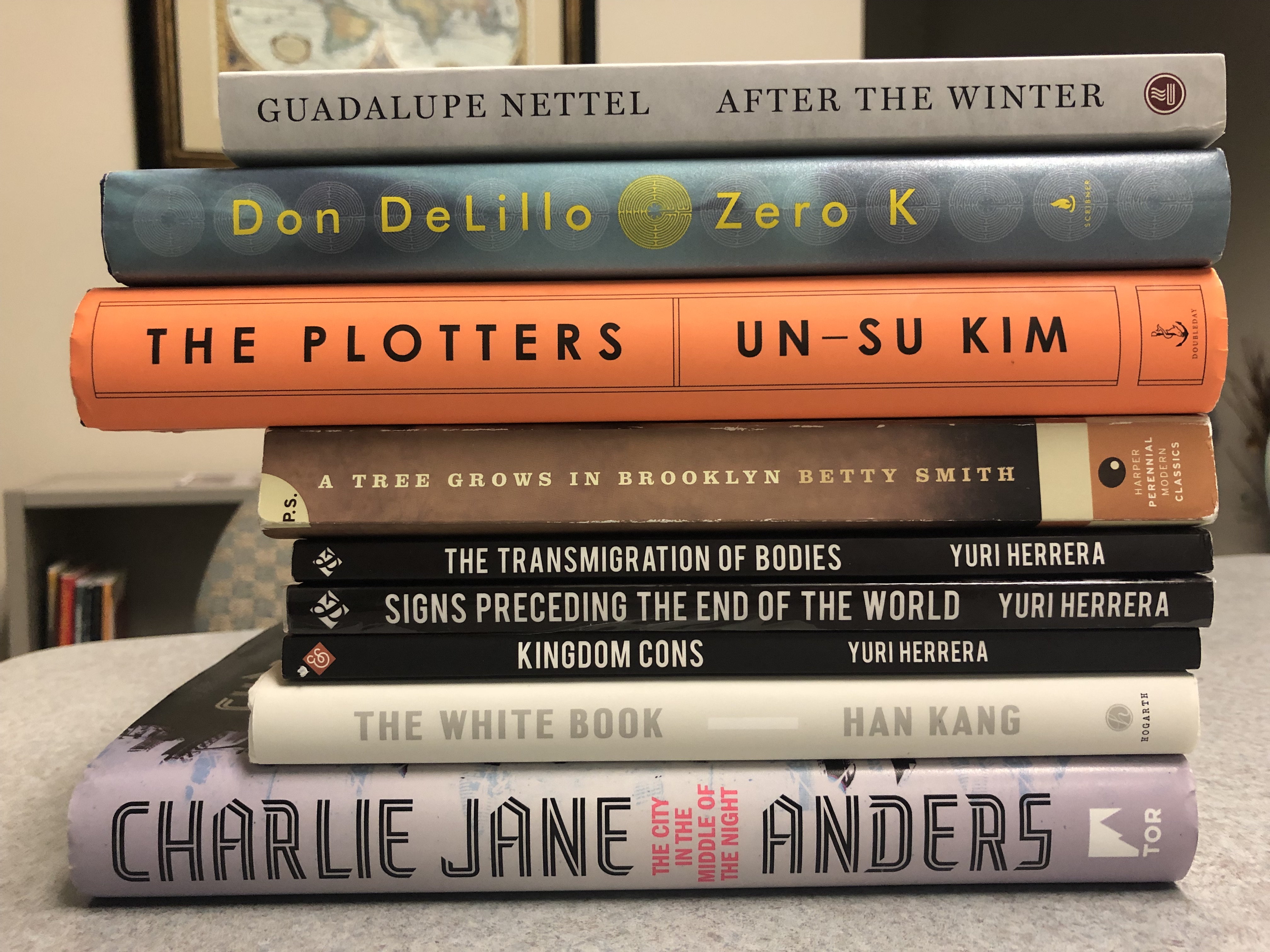
Recent Reading

After the Winter, Guadalupe Nettel*

Zero K, Don DeLillo

The Plotters, Un-su Kim*

A Tree Grows in Brooklyn, Betty Smith

The Transmigration of Bodies, Yuri Herrera*

Signs Preceding the End of the World, Yuri Herrera*

Kingdom Cons, Yuri Herrera*

The White Book, Han Kang*

The City in the Middle of the Night, Charlie Jane Anders

* In translation

URGENT: Media Misreading the Reading Crisis Yet Again

Media Misreading the Reading Crisis Yet Again

By Katie Kelly and P.L. Thomas

Photo by Nathaniel Shuman on Unsplash

Several news articlesvideosreports on new state legislation, and commentaries across mainstream media have built a false narrative about a Reading Crisis. That story includes several key elements: Teachers do not know, and thus do not practice, the science of reading because teacher education has failed them.

Not only have the mainstream media offered only one narrative, but also, for example, the Education Writers Association chose one of the most prominent misleading articles for a Public Service, small staff award: Emily Hanford’s “Hard Words.”

In 2019, the Reading Wars have begun anew but with different language: Phonics advocates have simplified “the science of reading” to “all students need systematic phonics,” for example. And this round has resulted in dramatic changes in state reading policies.

As literacy educators and scholars, however, we contend that these messages are misrepresenting the Reading Crisis and the science of reading — both of which are far more complicated than being presented by much of the media, dyslexia advocates, and political leaders.

Those Who Ignore History: A Look Back at Reading Crises

The newest misdiagnosed Reading Crisis begs for a truism: “Those who cannot remember the past are condemned to repeat it” (George Santayana).

For example, the November 1942 issue of The Elementary English Review(National Council of Teachers of English) included a provocative piece, What Shall We Do About Reading Today?: A Symposium, prompted by the high rate of illiteracy among men drafted into WWII.

This symposium offers answers to the titular question from leading literacy experts of the time, including Lou LaBrant (former president of NCTE). Represented by assembled experts on literacy, this Reading Crisis foreshadows these debates are misguided and driven by ideology instead of evidence.

While we recommend reading the symposium responses in full, let’s focus on LaBrant: “Nevertheless, we hear many persons saying that the present group of near-illiterates are results of ‘new methods,’ ‘progressive schools,’ or any deviation from the old mechanical procedures. They say we must return to drill and formal reciting from a text book” (p. 240).

However, LaBrant discredits that blame because the recruits identified as illiterate or semi-literate “…are drop-outs, who have not completed elementary school, come from poorly taught and poorly equipped schools, and actually represent the most conservative and backward teaching in the United States [emphasis in original]” (pp. 240–241).

Next, in the 1980s/1990s, the media announced a Reading Crisis in California blamed on whole language. Literacy scholar Stephen Krashen, and others, debunked that claim, noting although whole language was the official reading approach of the state, teachers almost never implemented whole language. Further, the reading score plummet correlated with whole language being the official policy, but the causes of those lower scores were a large influx of non-native speakers of English and reduced educational funding.

Throughout much of the 20th century, reading instruction in practice remained skills-based, perpetuating a simple view of reading. That criticism of whole language, however, prompted a call for more scientific approaches to teaching reading, which meant mandated scripted instruction with an emphasis on phonics instruction. This was also driven by the high stakes accountability era of No Child Left Behind.

Contrasting thoughtful literacy, scripted reading programs narrow curriculum focusing on skills instruction and test preparation through teacher-directed learning (Kozol, 2005; Lipman, 2004). In this context, students serve as vessels with teachers depositing knowledge. This back-to-basics model of instruction encourages replication and regurgitation of information with little emphasis on comprehension instruction, critical thinking, and rich discussion of text (Comber & Nichols, 2004Durkin, 1981Leland, Harste, & Huber, 2005Shannon, 2007Taberski, 2011).

Being a good word caller does not equate to being a good reader, but can produce a false-positive on narrow types of reading tests. This unbalanced approach to teaching literacy is not only problematic, but also dangerous.

Misreading the Reading Crisis Yet Again

Despite the value of a more student-centered curriculum that fosters critical thinking, some advocate for a return to skills-based systematic phonics instruction, framed as the “science of reading,” and claim another Reading Crisis. With a new push for phonics as a single pathway to literacy, the role of the meaning making process in reading will again be neglected.

In her seminal study, Delores Durkin found an overemphasis on testing comprehension rather than teaching comprehension. Reading is a complex cognitive process mediated by social and cultural practices requiring instruction and interaction with text and others to construct meaning. Therefore, we must shift our view of literacy beyond decoding to include constructing meaning and reading texts critically by expanding instructional practices and the ways we assess reading.

The so-called science of reading is, in fact, balanced literacy, which includes a focus on multiple components of literacy including phonics, comprehension, and writing: “A balanced approach will privilege authentic texts and tasks, a heavy emphasis on writing, literature, response, and comprehension, but it will also call for an ambitious program of explicit instruction for phonics, word identification, comprehension, spelling, and writing” (Pearson, 2004, p. 243).

While phonics is an essential component of reading instruction in the primary grades, “it should be noted that phonics is one element of a comprehensive literacy program that must also include practice in comprehension, fluency, vocabulary, writing, and thinking” (ILA, 2018).

No Crisis, But We Are Failing Our Students

Crisis rhetoric misreads not only how we currently teach and historically have taught reading, but also misrepresents the causes of low student achievement in reading while perpetuating some of the worst possible policies and legislation such as grade retention based on high-stakes testing.

This Reading Crisis ignores that focusing on narrow standards and high-stakes testing combined with the de-professionalization of teaching and under-funding education has resulted in overcrowded classrooms where teachers and students conform to mechanical reading programs privileging the wealthy and overemphasize test scores.

As teacher educators, we can attest that regardless of what we teach about reading and literacy, most teachers feel pressured to implement programs and raise test scores.

Rather than blaming students and teachers for the opportunity gap entrenched in formal schooling, consider the achievement debt due to inequitable funding, poor healthcare, and a lack of political courage. With increasingly diverse student populations, we have a responsibility to address this debt by serving all students through culturally relevant teaching practices.

We must, then, disrupt the misguided narrative of crisis that disguises the sociocultural historical and political factors that influence reading instruction as a disease that simply needs a vaccination in the form of systematic phonics.

Katie Kelly is an Associate Professor of Education at Furman University. A former elementary teacher and literacy coach, Katie teaches courses in literacy methods and assessment at the undergraduate and graduate levels. She is the coauthor of Reading to Make a Difference: Using Literature to Help Students Speak Freely, Think Deeply, and Take Action (Heinemann). Follow her work at bookbuzz.blog and @ktkelly14.

P. L. Thomas, Professor of Education (Furman University), taught high school English for 18 years in South Carolina before moving to teacher education and teaching first-year writing. He is author of Teaching Writing as Journey, Not Destination: Essays Exploring What “Teaching Writing” Means (IAP). Follow his work at https://radicalscholarship.wordpress.com/ and @plthomasEdD.