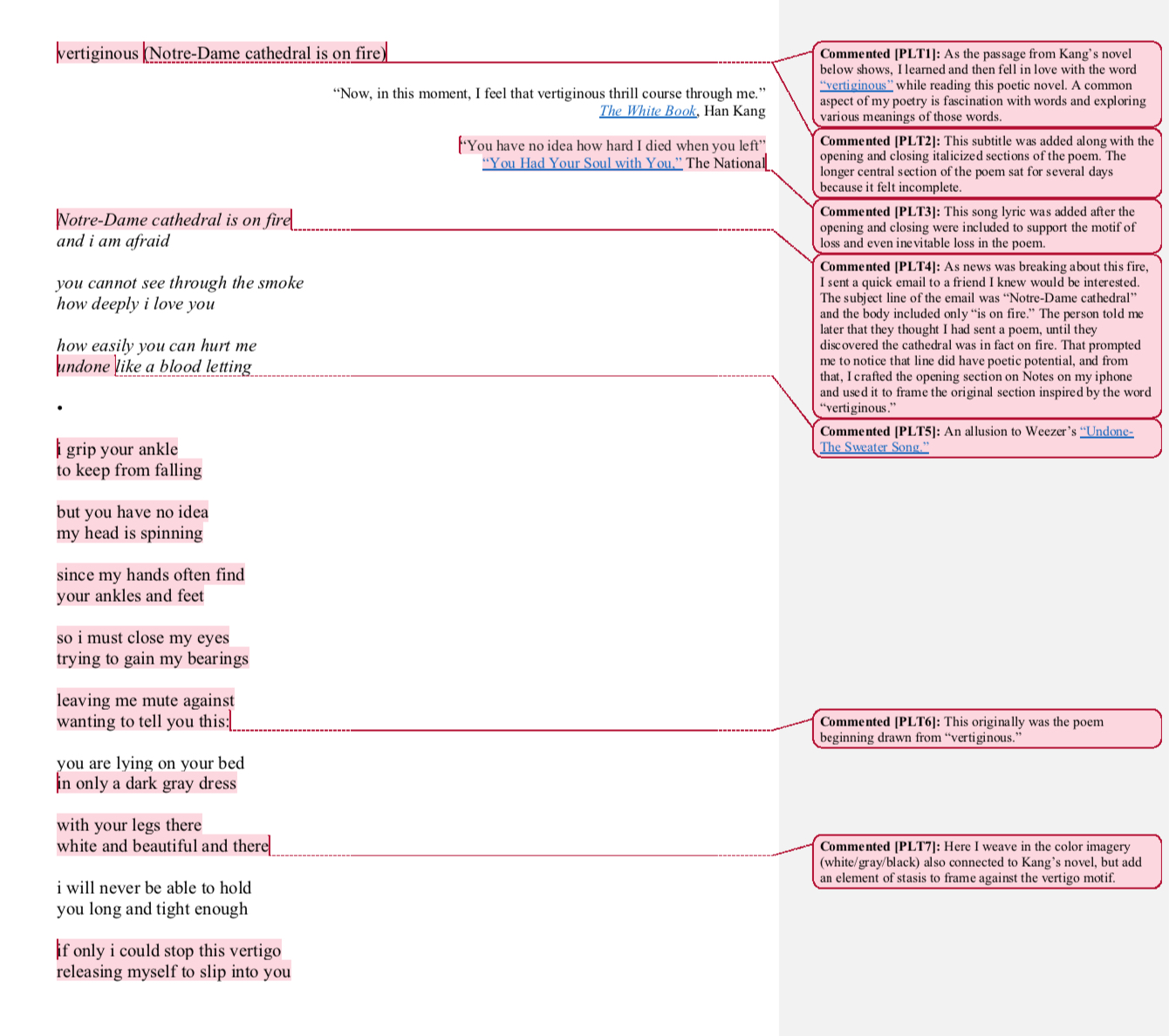
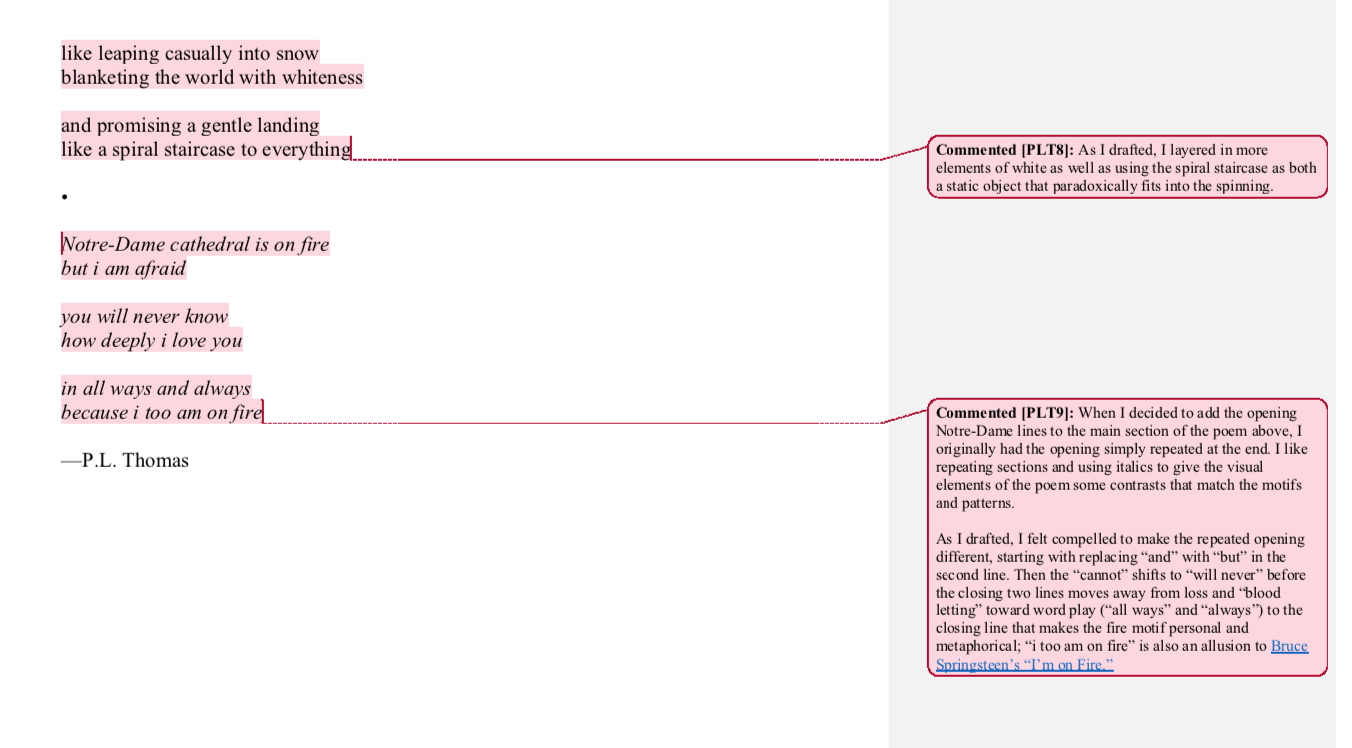
vertiginous (Notre-Dame cathedral is on fire)

Since I feel skepticism on the verge of antagonism toward tradition, I have struggled with the responses to the fire consuming Notre-Dame.
I certainly find the lost unfortunate, but I wonder how the opulence of the structure and the tremendous social inequity that spawned it remain mostly unacknowledged as the vast majority of people see this as a tragedy and hundreds of millions of dollars have already been donated to rebuild the cathedral.
Grand tragedy moves us, I realize, while gradual and persistent suffering seems to numb us; those hundreds of millions could better serve the destitute and hungry, human beings and not mere material monuments.
Like Shelley’s Ozymandias, many humans remain too often disturbingly un-self-aware: “‘Look on my Works, ye Mighty, and despair!'”
But there is more to consider since this grand fire has occurred in the context of three church fires in Louisiana, arson rooted in racist hatred. The attention and responses are of much different scales because the contexts of each are of much different scales driven by tremendous historical inequities that linger, especially in the U.S.
I am drawn to my conflicted feelings about Notre-Dame as I consider the online responses to Rebecca A. Reid and Todd A. Curry’s The White Man Template and Academic Bias. Reid and Curry build on some of my work:
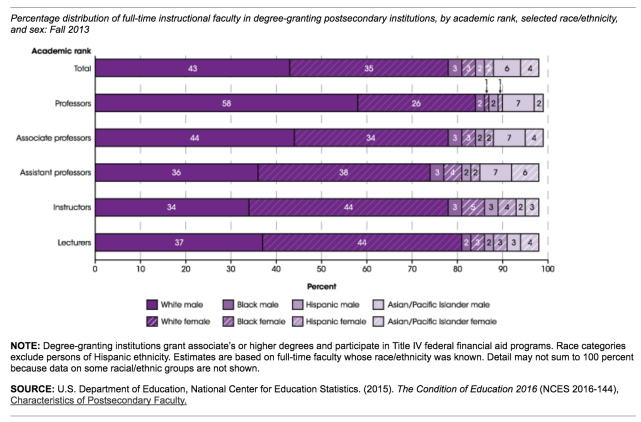
Higher education’s white male template, as P. L. Thomas, professor of education at Furman University, calls it, insidiously produces barriers for scholars throughout their entire careers, disproportionately affecting women and people of color. This template dictates certain research agendas, epistemologies, and methods as legitimate while discarding or marginalizing those that do not fit neatly within this framework. In essence, Thomas says, it “frames a white male subjectivity as the norm (thus ‘objective’), rendering racialized (nonwhite) and genderized (nonmale) subjectivity as the ‘other,’ as lacking credibility.”
And their central argument concludes: “Scholars who focus on critical theory, race, gender, ethnicity, sexuality and identities, qualitative methods and the like are marginalized because their work is supposedly not ‘objective’ science. Rather, it is political advocacy masquerading as scholarship — attractive only to specialized audiences and self-serving.”
This is ultimately a challenge to the Old Academy [1] and a call for the New Academy, suggesting, I think, that the only way to raise the New Academy is in the ashes of razing the Old Academy—something metaphorical against the very real burning of Notre-Dame.
The comments, as well, are parallel reactions to the hundreds of millions of dollars pouring in the from the cultural elite to rebuild Notre-Dame; many of those responses are vigorous and shallow defenses of the Old Academy, masked as arguments for rigor and high scientific ideals.
One of my responses prompted more ire:
Many of the comments prove the points posed by Reid and Curry even as the anonymous posters believing they are disputing them. This is the exact dynamic this article addresses. A total lack of self-awareness by the white/male elites who want to pretend they are the ones being objective and they are the ones meeting high standards. From educated people, these responses are sadly embarrassing.
I do in fact find these comments embarrassing in the same way Ozymandias’s words echo inside the hollowness of his defunct glory:
“…Round the decay
Of that colossal Wreck, boundless and bare
The lone and level sands stretch far away.”
Academics posting on Inside Higher Ed should know better, but one thing I have learned over the past 17 years is that the so-called Ivory Tower is just as petty and flawed as the general population; we are just people after all—although one would hope many years of learning could spark a soul in a few more people.
Some of the comments make errors in logic and argument that many of us who teach first-year writing wouldn’t allow: misrepresenting Reid and Curry in order to attack the misrepresentation among the worst.
So I have tried to offer a couple clarifying comments of my own:
…The article above calls for both a critical reconsideration of the imbalance of power and authority allowed for so-called objective research and a more equitable understanding and greater space for so-called subjective research BECAUSE the objective is in fact not any less subjective than the so-called subjective; the imbalances of power in the academy are gendered and racial and the current dynamic of what research counts is both a result of those imbalances and a cause of perpetuating them. The rebukes posted here are often myopic, self-serving, and petty, mostly very shallow defenses of the current power imbalance under a thin veneer of defending rigor and scientific standards.
And:
For example, claims of objectivity and being scientific created and perpetuates scientific racism; the introduction of critical race theory, then, provides the platform for unmasking scientific racism and thus racism. This is an argument for allowing a larger space of what counts so that all types of research have greater fidelity and validity. See The Lingering, and Powerful, Legacy of “Scientific Racism” in America.
I function in two contexts that represent the conflict exposed in Reid and Curry’s article. I am the embodiment of the “white male template” and a critical scholar/activist.
As a result, I recognize that I both worked incredibly hard to achieve my academic success, my degrees and ultimately my tenured position as a full professor along with my publishing record, and benefitted from even greater privilege along all of those paths to accomplishment. As well, left mostly invisible, many of my accomplishments necessarily mean that I inhabited spaces denied to people being marginalized—women, people of color among many others.
I didn’t ask for anyone to be denied or erased, but I mostly failed to recognize those denials and erasures in my zeal for personal accomplishment. And I can attest that very few people have the moral fortitude to tumble the structures that benefit them—myself included.
Winners always think the rules of the game are fair and believe they earned their trophies by being better than the vanquished while never even considering those not allowed in the contest.
There is a great irony in the resistance to the New Academy, the clinging to the Old Academy like Emily sleeping each night with the corpse of a murdered lover who betrayed her: The New Academy will be far more demanding because of the influx of diversity and the expansion of what counts as credible research along with whose voice counts.
The Old Academy and lazy narrow conceptions of objective and scientific are ultimately simplistic and inadequate for the human experience and the pursuit of knowledge.
The Old Academy is primarily valuable to those already there; it is a security blanket of confirmation bias for the privileged who think they hit a triple when they were in fact born on third base.
Change is frightening for those made comfortable by the status quo. What Reid and Curry are calling for, the New Academy, deserves not the resistance of the white male template but the wonder and excitement of Miranda:
O, wonder!
How many goodly creatures are there here!
How beauteous mankind is! O brave new world,
That has such people in’t!
[1] The Old Academy, of course, is the current academy:

A dog whistle is designed so that to unintended audiences (humans), the whistle is silent, but to the intended audience (dogs), the whistle is a sharp alert.
Now here comes the metaphorical portion of this post.
Over only a couple years of the Donald Trump era of Republican politics, we have become gradually accustomed—like a live lobster dropped in a pot of water soon boiled—to the gross and bluntly self-unaware language of his leadership of the Republican party—he of “grab them by the pussy,” no less.
But Trump’s race-baiting and race-appeasing of white nationalism/racism is no less ham-fisted.
In the U.S., we are pretty solid examples of Meursault’s dictum that people can get used to anything, but we also represent how short human memory is. I fear we have forgotten something most of us never even recognized: The good ol’ traditional political lie, often wrapped conveniently in dog whistle language.
Do not fret, though, because here’s a little nudge from former South Carolina Representative and Senator Jim DeMint, who did what many good ol’ Republicans have done, parlay the “damned-government” mantra into, ironically, a political career that leads to a cushy position in the so-called private sector, in DeMint’s case that was becoming president of the [White] Heritage Foundation forming his own conservative think tank.
It’s good work—if you are a white man with the sort of wealth and clout that you can negotiate into being among the rich-boys’ club we call the U.S. Senate.
DeMint’s political lie du jour is, hold your breath, an endorsement of school choice, the perennial go-to of conservatives:
Former U.S. Sen. Jim DeMint is urging state lawmakers to create education scholarship accounts to foster an expansion of school choice in South Carolina.
The proposal that DeMint outlined during a speech Monday night to the Greenville County Republican Party would allow parents of special needs and impoverished students to spend state-allocated education money to attend private schools. Foster children and military families also would be eligible to take part in the program.
“The only way we are going to save our culture and our society is if we can create an education system that the parents can customize,” DeMint said.
Wow, it really takes your breath away, doesn’t it, when someone of DeMint’s stature speaks for special needs children and children trapped in poverty?
And, he wants them to go to private school. Private. School.
As the dog whistle goes, however, if you aren’t a white nationalist/racist (and chances that you are and reading my blog are really pretty low), your eyes may have become all blurry with empathy tears by the time you got to “our culture and our society.”
If you did miss that, maybe track down a friend or family member who voted for Trump, or is a card-carrying Republican, and ask them who the “our” is all about, or maybe to define the whole “culture” thing.
I have a few ideas, as well, because I am really close to having lived 60 years in the very state DeMint represented—a state that clutches the Confederate flag and believes the Civil War wasn’t waged over slavery. You see, SC is a “Heritage Not Hate” state.
There’s some world-class Orwellian language for you, by the way, because, if you have the time and patience, I suspect it would be illustrative to ask anyone in SC who says “Heritage Not Hate” to explain what that heritage entails. Mind you, the explanation will defy reality, and history, but it will be an experience, and unlike a dog whistle, you will hear every word, but may doubt you are hearing the words you hear.
DeMint has provided for those who see and hear past the veneers the ugly relationship between school choice advocacy and the Republican party’s investment in white nationalism/racism.
First, the political lie of school choice:
In his speech Monday night, DeMint said education scholarship accounts can result in a “win-win” scenario for parents and public schools. He said parents can choose the best educational opportunities for their children while public schools can benefit from a reduction in class sizes.
“It creates a dynamic in every situation that we’ve studied where public schools get better,” DeMint said.
School choice, in fact, and including charter schools, has not improved anything, but has been strongly associated with re-segregating education and proving public funds for more affluent families to flee public schools.
Parents, you see, do not chose schools for academic reason mostly, but for ideological ones, such as making sure their children attend school with people who look like them and sit in classes that provide the sorts of indoctrination the parents desire.
School choice schemes never provide the sort of full support low-income parents need, such as transportation or time that is taken for granted by the affluent.
And what DeMint will not discuss is that the free market, the sacred Invisible Hand, has no incentive toward equity or quality. Market forces are guided by the lever of the customers and their capital.
Private schools are no better than public or charter schools—all of which are mostly reflections of the populations they serve.
And private schools represent a broad range of schooling, from narrow religious-based instruction to almost anything a group of parents may be willing to fund.
So we are left with a really jumbled message to the white nationalists/racists who are anti-government: School choice will provide you public funds to isolate your white children with other white children to receive the indoctrination you want to preserve the sacred white race.
That is the dog whistle that is “‘our culture and our society.'”
This sounds harsh, I know, but that is what a dog whistle is designed to do, mute the ugly for “the best” in order to rouse “the worst…full of passionate intensity.”
I won’t need any help to be lonely when you leave me
It’ll be easy to cover, gather my skeletons far inside
“Slipped,” The National
The week leading up to April 1 and the start of National Poetry Month afforded me one of my most cherished elements of my Being: My Poet-Self was invited to speak to two local high school classes and a poem of mine, “the philosophy of gerunds (my mother is dying),” was published in the March 2019 issue of English Journal.
My drive into work is almost an hour, so today I began thinking about this blog post, and as part of my driving/prewriting, I listened to a few songs by The National—crying during both “Pink Rabbits” and “You Had Your Soul With You.”
There are song lyrics that break my heart no matter how often I hear them, and then, there are simply moments when my heart overfills and the results slip from my eyes.
As I was talking with high school students about how I came to realize I am a poet and how I write poetry, I once again heard myself tell a story I have told often, an explanation I have teased out for other people many, many time.
One day in the spring of my first year of college, I wrote a poem, mostly inspired by a speech class where the professor introduced us to e.e. cummings’s poetry. This act of mine was a sudden compulsion, not so much a choice.
And it was then I knew I was a poet, and despite working hard to be a writer throughout my 20s, completing one full novel draft and dozens of short stories and poems, I published very little—never finding any publisher interested in the novel—and eventually resigned myself to never being that kind of writer.
Moving to higher education in my early 40s, however, opened a different door to being a writer. I have had a very rich and full life publishing since then, mostly academic writing along with becoming a dedicated blogger. For this, I am very thankful.
Throughout this journey as a writer, the one constant has been writing poetry—regardless of the possibility for publishing.
My scholarly writing and blogging have very distinct differences from that poetry, however.
Poetry, you see, simply comes to me; I cannot beckon it, and I cannot write poetry on demand. Often poems come when there are new music albums to listen to or novels to read. My word lives cross-pollinate.
Whether I am drawn to a popular band, such as The National or R.E.M., or a novelist, such as Haruki Murakami or Han Kang, and when those poems come to me, I am deeply aware of another powerful presence—grief and depression.
As a writer, I suffer what I have found to be a common feeling among writers; once a piece is finished, I fear I will never write another, that the well has gone suddenly dry.
As a music lover and reader, I often feel deeply depressed after a new album finally is released and when I come to the end of a novel; what if this beautiful experience never comes my way again?
The poem published recently by English Journal linked above was originally scheduled for the January issue, but when that journal was released, my heart sank when my poem was not included. The editors were quick to note that the poem had been moved, and I had just not been notified.
It seems fitting, then, for the poem to come to me at the beginning of National Poetry Month because poetry remains something of my heart and my intellect. When I shared the poem with my department, several of my colleagues replied kindly, a couple even moved to tears.
When I reread this piece, I too feel the urge of my tears returning.
It was the summer of 2017 when my mother was discovered in the floor unconscious, having suffered, we learned later that day, a stroke. Just two weeks later, my father died having been moved to share a room with my mother in a high-care facility.
After his death, I spent some of most every day visiting my mother, who moved to another facility and suffered a series of problems with her health. The worst being diagnosed with stage 4 kung cancer, which took her life by early December of that year.
Over those six months and after, I have written poems and blogs trying to understand the grief and depression of watching my parents die, in many ways quite badly. I may as well be seeking as the British Romantic poets argued a way to render my parents immutable through art.
As I contemplate poetry, and try always to explain to others or understand myself the sources of my urge to create poetry, I wonder about the place of grief and depression in art more broadly.
My life is often rich with joy and happiness, but I am not sure that compels me to art as the moments of grief and depression. I am certain that sadness in other people’s art, like the darkness that runs through songs by The National, do not make me sad but offer comfort, even as I drive down the highway sobbing.
Moments of grief, I think, are small celebrations and recognitions of the joy that is life, an awareness that life and its joys are fleeting so we better pay attention.
We can reach out and touch it, even hold on, but we cannot stop it from moving toward the inevitable.
Watching my mother die, sitting beside her while knowing I could do nothing really to change the trajectory of her dying, was just as much about me or anyone living—I realized.
And was driven to words.
To me, living and dying are the very human of being human, but so are words. We have less control of our living and dying than we would like, I think, but some times we have such great control of our words, of language.
Few things are more marvelous than a human creating words in a way that drives other people’s heart to full. And it wells up inside of us pushing free through our eyes.
I reread my poem in print and see through the blurring of tears that I am a truly inadequate son. I am fully human.
In her The Answer Sheet, Valerie Strauss offers yet another post about the current Reading War/Crisis: A case for why both sides in the ‘reading wars’ debate are wrong — and a proposed solution.
Strauss explains before offering the long post:
This is an unusual post about the “reading wars,” that seemingly never-ending battle about how to best teach reading to students — systematic phonics or whole language. This argues that both sides have it wrong, and the authors, two brothers who are literacy experts, suggest a new way.
While this is a provocative, often nuanced, and compelling, it makes a fatal flaw common in the seemingly never-ending false war between phonics and whole language by misdefining whole language and then failing to take care when citing research that seems to show neither systematic phonics nor whole language are more effective than the other.
First, let me offer an example of this type of failure in a slightly different context, the powerful and complicated work of Lisa Delpit.
Delpit has made for many years a strong case about the inequity of educational opportunities that cheat black students (as well as many other vulnerable populations). At times, Delpit’s work has been co-opted by traditional advocates for education—notably those calling for intensive phonics and isolated grammar instruction.
Here, Delpit make a very direct refuting of that sort of co-opting:
I do not advocate a simplistic ‘basic skills’ approach for children outside of the culture of power. It would be (and has been) tragic to operate as if these children were incapable of critical and higher-order thinking and reasoning. Rather, I suggest that schools must provide these children the content that other families from a different cultural orientation provide at home. This does not mean separating children according to family background, but instead, ensuring that each classroom incorporate strategies appropriate for all the children in its confines.
However, the sources of why Delpit came to confront how formal education often cheats black students is an important window into why many continue to misrepresent the Reading War/Crisis by defining incorrectly whole language (or balanced literacy).
As Delpit explains:
A doctoral student of my acquaintance was assigned to a writing class to hone his writing skills. The student was placed in the section led by a white professor who utilized a process approach, consisting primarily of having the students write essays and then assemble into groups to edit each other’s papers. That procedure infuriated this particular student. He had many angry encounters with the teacher about what she was doing. …
When I told this gentleman that what the teacher was doing was called a process method of teaching writing, his response was, ‘Well, at least now I know that she thought she was doing something. I thought she was just a fool who couldn’t teach and didn’t want to try.’ This sense of being cheated can be so strong that the student may be completely turned off to the educational system.
Yes, this teacher and experience had clearly failed that doctoral student, but if we are careful to note the details of that failure, what we discover is that the teacher had also failed process (or workshop) writing instruction.
Process or workshop writing instruction is far more that peer conferencing; it entails drafting and student choice of topics and text form, conferences with peers and the instructor, explicit instruction of all aspects of composing (including grammar, mechanics, and usage) based on the needs of the students revealed in their original essay drafts (typically called mini-lessons), careful and varied reading-like-a-writer experiences with rich texts, and producing final authentic artifacts or writing.
To be brief here, Delpit is correct that “other people’s children” are disproportionately cheated by reduced curriculum and inadequate instruction, but it is misleading to lay that blame at the feet of process/workshop methods since the student example shows this is not what was implemented.
Now, let’s circle back to the “both sides are wrong” claim by Jeffrey S. Bowers and Peter N. Bowers.
Bowers and Bowers discredit systematic phonics fairly carefully and fairly, I think. But when they turn to the research on whole language, they make no effort to verify if the research cited in fact confirmed that whole language was being implemented with any level of fidelity.
As I have noted often in the 1980s/1990s, the media announced a Reading Crisis in California blamed on whole language. Literacy scholar Stephen Krashen, and others, debunked that claim [1], noting although whole language was the official reading approach of the state, teachers almost never implemented whole language.
As well, Bowers and Bowers make an odd choice about defining what whole language is by citing and defining as follows:
According to foundational theory for whole language, learning to read is just like learning to speak (Goodman, 1967). Given that virtually everyone from every culture learns to speak without any formal instruction in a context of being exposed to meaningful speech, it is concluded that children should learn to read in the same way, naturally, by reading meaningful text. The fact that not all verbal children learn to read with whole language should be a first clue that something is wrong with this theory.
This dramatically over-simplifies Goodman’s work, but also ignores decades of refinement of what whole language became, and then how many have embraced balanced literacy.
When we are referring to whole language, however, the fundamental problem with discounting whole language often rests with not understanding what it is: “Whole language is not a program, package, set of materials, method, practice, or technique; rather, it is a perspective on language and learning that leads to the acceptance of certain strategies, methods, materials, and techniques.—Dorothy Watson, 1989.”
And a failure to acknowledge that “… [w]hole language…builds on the view that readers and writers integrate all available information in authentic literacy events as they make sense of print. Whole language teachers don’t reject phonics; they put it in its proper place [emphasis added]” (K. Goodman, Phonics Phacts, p. 108).
Let me put this directly: Whole language does reject the need for systematic phonics for all children, but the language philosophy endorses entirely that some phonics is needed, that each child should receive the amount and type of phonics instruction needed to read independently—not to comply with a reading program, to cover a set of universal standards, or to raise test scores.
The argument posed by Bowers and Bowers is correct only if we misdefine whole language and fail to critically examine research that claims to be measuring whole language effectiveness or if whole language was even implemented with any sort of fidelity.
As it sits now, the Bowers and Bowers’s argument is 50% wrong.
[1] Note that the reading test score decreases (the reason for the claim of a reading crisis) were caused mostly by a large influx of non-native English speaking students and drastic budget cuts for education. The ways in which students were being taught to read are correlations at best with those scores.
For Further Reading
Defending Whole Language: The Limits of Phonics Instruction and the Efficacy of Whole Language Instruction, Stephen Krashen, Reading Improvement 39 (1): 32-42, 2002.
Facts: On the nature of whole language education (Heinemann)
To read or not to read: decoding Synthetic Phonics, Andrew Davis
A few days ago, I had an Allen Iverson moment on Twitter:
1. Take any normal worksheet with review questions.
2. Cut the sheet into slips.
3. Hide those slips in plastic eggs.
4. Toss the eggs in a trash can.
5. Stop wasting your time and your students’ time with worksheets. https://t.co/B5CeDNAT9A
— Paul Thomas (@plthomasEdD) March 22, 2019
Iverson, among many other athletic and pop culture accomplishments, is notorious for this rant:
“We sitting in here — I’m supposed to be the franchise player, and we in here talking about practice. I mean, listen: We talking about practice. Not a game. Not a game. Not a game. We talking about practice. Not a game. Not the game that I go out there and die for and play every game like it’s my last. Not the game. We talking about practice, man.”
What resonates with me, after I posted the retweet above, is that Iverson was almost entirely misunderstood, and received a fair among of negative feedback and is often still misrepresented by his outburst.
Once I realized that my critical list had gained a momentum of its own—many people responding positively to my intent, but a few creeping into viewing my Tweet as a burn—I noticed that some people found the Tweet to be unprofessional in tone and misread my point as somehow being against students having fun or oversimplifying the problem with worksheets.
To attempt to set the record straight, and try to calm the piling on that I did not intend, I posted a thread navigating the misunderstandings and concerns about my tone and points.
For the record, I am firmly against worksheets (although what that label means needs some interrogation, I admit), and for authentic (even fun) engagement by students with whole and real learning and artifacts of learning. But that is really complicated.
A former student and then early-career teacher, who has now left teaching, had a disturbing experience with why this position of mine is complicated. She taught in a school grounded in project-based learning (PBL). Her course was also team-taught.
As an English teacher, however, she was frustrated that she was required to prepare lessons and activities for students that were a series of different projects; notable in that requirement is that reading and writing were excluded from being the only sorts of projects students could complete.
She found herself in the sort of dilemma Lou LaBrant rejected in 1931, in one of the earliest rounds of PBL mis-attributed to John Dewey:
The cause for my wrath is not new or single. It is of slow growth and has many characteristics. It is known to many as a variation of the project method; to me, as the soap performance. With the project, neatly defined by theorizing educators as “a purposeful activity carried to a successful conclusion,” I know better than to be at war. With what passes for purposeful activity and is unfortunately carried to a conclusion because it will kill time, I have much to complain. To be, for a moment, coherent: I am disturbed by the practice, much more common than our publications would indicate, of using the carving of little toy boats and castles, the dressing of quaint dolls, the pasting of advertising pictures, and the manipulation of clay and soap as the teaching of English literature. (p. 245)
LaBrant’s anger lead her to this conclusion:
That the making of concrete models will keep interested many pupils who would otherwise find much of the English course dull may be granted. The remedy would seem to be in changing the reading material rather than in turning the literature course into a class in handcraft. (p. 246)
When I saw the original Tweet about hiding worksheets cut into strips inside Easter eggs, I immediately thought of my former student and LaBrant.
I am certain that I could create a Jeopardy!-style game to engage students in, for example, grammar activities. I think the game itself and student engagement could likely be exciting, and anyone observing that lesson would be fairly impressed with the energy.
I may even concede that students could learn grammar during the activity—although I am skeptical of the likelihood that a one-shot activity would produce genuine and deep understanding.
Here, however, let me return to LaBrant, who wrote in 1947: “We have some hundreds of studies now which demonstrate that there is little correlation (whatever that may cover) between exercises in punctuation and sentence structure and the tendency to use the principles illustrated in independent writing” (p. 127).
While the Jeopardy!-style game may be successful in being fun and engaging students, I am certain that whatever grammar students may learn, we remain faced with the same reality LaBrant confronted 80-plus years ago: Isolated grammar instruction does not transfer into student practice as writers.
Therefore, we must evaluate the Jeopardy!-style grammar game based on our instructional purposes. If we are teaching grammar-for-grammar’s sake, the game may be a valid instructional strategy (compared to completing grammar worksheets, for example).
But if our goal is writing instruction, even though the game is fun and engaging, it is a waste of instructional time better spent by students drafting, conferencing, and engaging in explicit instruction covering grammar, usage, and mechanics in the context of their original writing.
For those who see the teaching of English as more than writing and reading, we may be compelled to find engaging and fun ways to bring students to literature as well.
What if I designed a Thoreau-like nature walk for students to commune with nature and come to a better understanding of American transcendentalism espoused by Ralph Waldo Emerson and Henry David Thoreau?
Again, this nature walk to an outside observer may appear to be very engaging and even fun for the students. But hiking in nature is not the domain of literature study; mining text for meaning, however, is what literature study entails.
Crouching in the woods or wading into a pond, like Thoreau, may help students with appreciating nature, but it is time better spent reading, discussing, and critically unpacking the essays written by Emerson and Thoreau, while also contrasting those texts with others written by their contemporaries, such as Nathaniel Hawthorne and Edgar Allan Poe.
Once again, as LaBrant argued throughout her career, writing is learned by writing, and reading is learned by reading.
Let me circle back, now, briefly, to the worksheet.
The decade’s long appeal of PBL comes, I think, from a realization that worksheets, workbooks, and static, silent students are elements of traditional schooling most of us want to avoid.
When I think “worksheet,” I am reminded of my early days of teaching high school English and being compelled to teach context clues because our students scored low on that subset of reading skills during state testing.
As part of our mandated test-prep, we were issued workbooks with worksheets dedicated to isolated reading skills. The context clues worksheet identified four or five types of context clues and then tested students with dozens of sample sentences requiring students to identify the type of context clue strategy needed to define the unknown vocabulary.
To be honest, this approach could likely raise student test scores since the worksheets were designed to prepare students for test-reading; the worksheets and tests involve the same sort of mechanical and inauthentic process and test a manufactured set of content designated as “context clues.”
Here’s the problem: Writers don’t write implementing context clues; writers just use words to form sentences and paragraphs. Context clues strategies work on worksheets and tests, but not so much in real-world reading.
Vocabulary acquisition is incredibly important for literacy development, but most people have the how of that acquisition backward: Students don’t need words (or context clues strategies) crammed into them so they can read better; reading more and more makes them better readers, in part, because that is how we acquire more words.
My concern and caution, then, are much broader than the worksheet since both worksheets and PBL (seemingly antithetical to each other) can be flawed practice if we are not careful to match our instructional strategies to our intended learning outcomes and artifacts of learning.
At first blush, this may seem tedious, even dull, but teaching English is mostly about reading and writing. These are often engaging and fun, but some times they are also challenging and rewarding even as they are tedious.
None the less, let’s not lose sight of what we are doing in the name of fun when that pursuit, in fact, avoids the real work that we should attend to and seeks as well to insure that students are engaged and, yes, often having fun.
Education reform is deja vu all over again
[with hyperlinks below]
I have taught in South Carolina since 1983, 18 years as an English teacher and coach followed by 17 years as a teacher educator and first-year writing professor. Over that career, I have felt exasperated by education reform that has proven to be déjà vu all over again.
A few years ago, I advocated against the misguided Read to Succeed Act, policy as flawed as I predicted since it failed to identify the evidence-based problems with reading in SC and then promoted new policy that does not address those problems while creating new and even worse consequences.
Read to Succeed also foreshadowed this newest round of wholesale education reform facing the state.
Since the 1980s, politicians in SC have insisted that our public schools are failing. Their responses, however, have meant that the only consistency in our schools is we are in a constant state of education reform repackaged over and over again.
State standards, state high-stakes testing, school choice, charter schools—these policies have been reframed repeatedly, and all we have to show for that is the same complaints about failing schools and decades of research revealing it’s policies that have failed.
Instead of misguided education reform beneath misleading political rhetoric, SC should take a different path, one shifting not only policies but also ideologies.
First, SC must clearly identify what problems exist in our schools and then carefully distinguish between which of those problems are caused by out-of-school factors and which are the consequences of in-school practices and policies.
For example, SC’s struggles with literacy are driven by generational inequities such as poverty and racism magnified by decades of misguided commitments to ever-changing standards, tests, and reading programs. Literacy outcomes in our state reflect how children suffer when families have low-paying work, endure transient lives, and are denied affordable insurance and healthcare.
Literacy outcomes also represent that once children enter schools, they receive distinctly different educations: Poor students, black and brown children, English language learners, and special needs students experience tracks and conditions unlike those of white and affluent students who are far more likely to have access to low class sizes in advanced courses and experienced certified teachers.
Next, SC must recognize that policies and practices based on accountability and market forces have failed our students and our schools. Instead, we need educational policy grounded in equity. Policies and practices grounded in equity and not accountability would insure that all children have access to experienced and certified teachers, low class sizes, and challenging classes.
Further, SC must acknowledge that teaching conditions are learning conditions. Teacher pay, teacher professionalism, teacher autonomy, facilities and materials funding and quality, student/teacher ratios—all of these are conditions that indirectly and directly impact whether or not teaching and learning can thrive in our schools. Yet, SC politicians remain determined not to make these choices while remaining committed to expensive and ineffective approaches such as standards, testing, and choice options, notably charter schools.
As a broad guide, then, SC must set aside inspirational rhetoric and partisan commitments and seek instead a wealth of educational expertise on both the need for social policy addressing inequity and reforming schools in ways that serve both teachers’ ability to teach and students’ equitable access to learning.
The problem in SC schools has never been about the presence or quality of our standards, what tests students have to navigate in order to survive schooling, or parental choice.
The harsh reality of our state includes poverty, racism, and disadvantages such as the scarcity of high-quality and stable work as well as affordable healthcare and housing. The harsh reality of our schools is that teaching and learning conditions are hostile to some students having equitable access to learning.
SC political leaders refuse to address those realities because they are too enamored with partisan politics as usual in a state tragically embracing the worst aspects of conservative ideology; once again as those myopic political leaders claim bold education reform, it’s déjà vu all over again.
Imagine for a moment that in the 1970s when Philip John Landrigan, an epidemiologist and pediatrician, conducted research on the negative consequences of lead in paint, political leaders chose to ignore the source of the problem, lead in paint, and had initiated policies aimed at children instead.
Now imagine that children continued to suffer from lead paint poisoning every decade since that decision, and every few years, political leaders offered passionate rhetoric confronting the tragedy of lead poisoning in children, followed by yet new policies once again aimed at children, while ignoring entirely the presence of lead in paint.
If this sounds ridiculous, please consider that beginning in the early 1980s, this exact scenario is how South Carolina political leaders have handled public education.
I have a unique perspective on SC education since I have taught here over four decades since 1983, 18 years as a public high school English teacher and coach followed by an on-going 17 years in higher education as a teacher educator and first-year writing professor. I also bring to this conversation a doctoral program grounded significantly in the history of public education in the U.S. as I wrote an educational biography of Lou LaBrant, who taught from 1906 until 1971.
Over my career in education, I have felt a great deal of compassion for LaBrant as she lamented in her memoir having lived and worked through three back-to-basics movements. As I have, she found herself exasperated by political education reform that proved to be déjà vu all over again.
A few years ago, I advocated strongly against yet more misguided education reform in SC—the Read to Succeed Act which has proven to be as flawed as I predicted since it, as my hypothetical scenario above highlights, failed to identify the evidence-based problems with literacy and reading in SC and then promoted new policy and solutions that not only do not address the problems, but create new and even worse problems.
Read to Succeed represents how SC education policy and reform is almost entirely partisan politics, but it also foreshadowed this newest round of wholesale education reform facing the state now.
Since the early 1980s, political leaders in SC have beaten a steady drum that our public schools are failing, resulting in that the only consistency in our schools has been the same solutions repackaged over and over again.
State standards, state high-stakes testing, school choice proposals, and charter schools—these templates for policies have been reframed over and over, and all we have to show for that today is the same political complaints—failing schools—and decades of research that all of these approaches have failed.
Instead of yet another misguided series of education reform policies beneath misleading political rhetoric, SC could take a different path, one that shifts not only policies and practices but ideologies.
First, again returning to the opening hypothetical response to lead paint, SC must start with clearly identifying what problems exist in our schools and then carefully distinguish between which of those problems are a reflection of social forces and which are the consequences of actual school and teaching practices.
For example, SC’s problems with literacy are a reflection of generational inequities such as poverty and racism magnified by decades of misguided commitments to ever-different standards, tests, and reading programs.
Literacy in our state is a harbinger of how children suffer when parents have low-paying work, face transient lives, and are shut out of robust healthcare and adequate insurance.
Literacy also reflects in our state that once all children enter schools, they receive distinctly different access to education—poor, black, and brown children along with English language learners and students with special needs are significantly cheated by schooling while white and affluent students have access to low class sizes, advanced courses, and the most experienced certified teachers.
Next, SC must recognize that policies and practices based on accountability and market forces have failed our students and our schools. Instead, we need educational policy grounded in equity.
For example, all children should have access to experienced and certified teachers, low class sizes, and challenging classes. Historically and currently, those assurances are for privileged children only.
Further, SC must acknowledge that teaching conditions are learning conditions. Teacher pay, teacher professionalism, teacher autonomy, facilities and materials funding and quality, student/teacher ratios—all of these are policies that indirectly and directly impact whether or not teaching and learning can thrive in our schools. Yet, SC politicians remain determined not to make these choices while remaining committed to expensive and ineffective policies such as standards, testing, and choice models such as charter schools.
As a broad guide, then, SC must set aside political rhetoric and partisan commitments in order to turn instead to a wealth of educational research on both the need for social policy addressing inequity and reforming schools in ways that serve both teachers’ ability to teach and students’ equitable access to learning.
The problem in SC schools has never been about the presence or quality of our standards or what tests students have to navigate in order to survive schooling.
The lead in the paint of our state includes poverty, racism, and a whole host of disadvantages such as the scarcity of high-quality and stable work, healthcare, and affordable housing.
The lead in the paint of our schools is that teaching and learning conditions are hostile to students having equitable access to learning.
SC political leaders refuse none the less to address those problems because they are too enamored with partisan politics as usual in a state tragically embracing the worst aspects of conservative ideology; once again as those myopic political leaders claim bold education reform, it’s déjà vu all over again.
See Also
UPDATED: Beware the “Miracle” School Claim: “Why not tell the whole story?”
Conservative Politics Fails Public Education Redux
Many years ago while I was a high school English teacher, I began to advocate strongly against the influence of the SAT, and all standardized testing. One of the few sources for that criticism was work by Alfie Kohn, whose publications received pretty harsh resistance from the testing industry.
One of my best friends and colleagues while teaching high school left for higher education before I did, and as I would several years later, found himself teaching at a selective liberal arts college. He taught education foundations, where he included some of my work and Kohn’s confronting the failures of testing and the SAT specifically.
What my friend and former colleague discovered is that students at a selective liberal arts college did not receive well his message or the evidence about the inequity in high-stakes standardized testing and college admission exams.
As the recent college admissions scandal, Operation Varsity Blues, is gradually unmasking, people with privilege are powerfully invested in proving their merit—even if that veneer has to be manufactured at great expense.
I have been very successful at every level of formal education, attaining what is ominously called a “terminal degree.” Along that journey, I worked very hard, and simultaneously, the journey was nearly effortless because it required skills that I have mostly been quite adept at completing.
As well, I have been a professional educator for 35-plus years, at both the K-12 and higher education levels, including public and private schools.
In those experiences, I have been afforded incredible privilege because I am white and male. But I also have been often at arm’s length from that privilege in some ways because of my working-class background and my ideological alienation from my personal and professional communities.
Most difficult has been that despite my educational accomplishments and career as an educator, I have witnessed and then argued that while formal education is often framed as powerful in terms of how it shapes society and people (the “great equalizer” and “game changer” mantras), the reality of K-12 and higher education in the U.S. is that they mostly reflect and reinforce our inequities along racial, economic, and gender lines.
With the so-called college admissions scandal before us, I hope we can have larger discussions of what the purpose of education is and how access to education must be as sacred as what happens once students enter school.
The scandal exposes that education is not a game changer, but a marker for privilege. The wealthy are always branding, always seeking ways to be associated with the aura of quality.
Wealthy celebrities needed a daughter to attend USC for the prestige that attending Arizona State did not offer. This is no outlier, but an extreme example of how the wealthy perpetuate and are drawn to “elite” institutions, whether it be selective pre-schools, private K-12 academies, or the Ivey League.
Some experiences I have noticed throughout my teaching career include a misunderstanding of teaching and learning compounded at selective (mislabeled as “elite”) colleges by a wish among faculty to take credit for the existing so-called excellence in students admitted.
Let me explain with some historical context first.
The concept of universal public education in the U.S. is expressed very well as an ideal by the deeply flawed elitist Thomas Jefferson in the following passages:
The object [of my education bill was] to bring into action that mass of talents which lies buried in poverty in every country for want of the means of development, and thus give activity to a mass of mind which in proportion to our population shall be the double or treble of what it is in most countries. ([1817], pp. 275-276)
The less wealthy people, . .by the bill for a general education, would be qualified to understand their rights, to maintain them, and to exercise with intelligence their parts in self-government; and all this would be effected without the violation of a single natural right of any one individual citizen. (p. 50)
I… [proposed] three distinct grades of education, reaching all classes. 1. Elementary schools for all children generally, rich and poor. 2. Colleges for a middle degree of instruction, calculated for the common purposes of life and such as should be desirable for all who were in easy circumstances. And 3d. an ultimate grade for teaching the sciences generally and in their highest degree… The expenses of [the elementary] schools should be borne by the inhabitants of the county, every one in proportion to his general tax-rate. This would throw on wealth the education of the poor. (p. 791)
To all of which is added a selection from the elementary schools of subjects of the most promising genius, whose parents are too poor to give them further education, to be carried at the public expense through the colleges and university. (p. 275)
By that part of our plan which prescribes the selection of the youths of genius from among the classes of the Door, we hope to avail the State of those talents which nature has sown as liberally among the poor as the rich, but which perish without use, if not sought for and cultivated. But of all the views of this law none is more important none more legitimate, than that of rendering the people the safe, as they are the ultimate, guardians of their own liberty. (p. 276)
The tax which will be paid for this purpose is not more than the thousandth part of what will be paid to kings, priests and nobles who will rise up among us if we leave the people in ignorance. (p. 278)
The recent college admissions scandal is but the tip of the iceberg of privilege that has already sunk the Titanic plan detailed above by Jefferson, himself an original elitist unable to make his ideal real.
So, since these lofty claims established formal education in the U.S., we have instead embraced a deficit ideology—framing students needing to learn as a flaw of the student and a burden on the teacher (misunderstanding teaching and learning)—and creating formal education as a mechanism of enculturation (institutions that either label and shame those deemed deficient or label and praise those deemed elite).
If we pull back from the scandal and how this is the tip of the iceberg in terms of the wealthy gaming everything along a spectrum from inequitable and unethical to outright criminal, we must also interrogate that we have failed the ideals of not only universal public education (K-16), but also the potential of education to revolutionize society and individuals.
Many students who need that ideal education the most are disenfranchised from or disillusioned by formal schooling while many privileged students are deeply invested in the game of formal schooling even as the education itself mostly washing over and by them.
In both cases, education is a scam and a rigged game.
While we are hand wringing over the college admissions scam, my home state of South Carolina has rejected provisions in a new education bill calling to lower some student/teacher ratios, claiming such mandates are too expensive.
However, in public schools across the state, mostly white and affluent students sit daily in Advanced Placement and International Baccalaureate classes with incredibly low student/teacher ratios, classes often next door to so-called regular classes at and above state maximums for student/teacher loads.
Inequity serving the wealthy and white and mis-serving everyone else—this is a feature of our systems and institutions, including schools, not a glitch—as some seem to suggest about the admissions scandal.
Today, in 2019, formal education in the U.S. is mostly a disturbing snapshot of how we are a people mostly using rhetoric to hide the power and momentum of privilege.
There is really nothing shocking about the admissions scandal, unless you want to pretend it is something other than the tip of a very old and very large iceberg of privilege that defines the good ol’ U.S. of A.

 dr. p.l. (paul) thomas