Category Archives: Education

Dismantling Monuments: History as a Living Document

Disturbance at the Heron House
A stampede at the monument
To liberty and honor under the honor roll

“Disturbance At The Heron House,” R.E.M.

“And on the pedestal, these words appear:
My name is Ozymandias, King of Kings;
Look on my Works, ye Mighty, and despair!”

“Ozymandias,” Percy Bysshe Shelley

Possibly one of the greatest failures of formal K-12 schooling has been not only what students are taught in history and social studies, but how history as a discipline has been misrepresented (paralleled, I think, by a similar message about science) as fixed and objective.

History is never fixed or objective, but always a living document—one written by those who have power, access to the telling.

A powerful and vivid example of this fact is how Howard Zinn has been marginalized as more an activist than a historian because his work was committed to changing the perspective of history from the power elites to the people. Zinn was both heralded and demonized, for example, when his work asked everyone to rethink Christopher Columbus and the concept of “discovering” lands already occupied.

Traditionalists remain trapped in the belief that history has been and can be objective, can avoid being political, and once anyone seeks to better understand a person or the narratives of the past, those traditionalists shout “revisionism,” as if that new understanding is something to be shunned.

That any human expression can be objective, apolitical, is a naive position. In response to those arguing Ivanka Trump’s new book is not a political work, Ani Kokobobo reveals:

She claims she wrote it before her father’s election, “from the perspective of an executive and an entrepreneur.” And though they criticize her for being trite, derivative, out of touch and racially tone-deaf, most readers have accepted the premise that this is a largely apolitical book.

Yet as every scholar of literature knows, each book contains what theorist Fredric Jameson has dubbed a “political unconscious.” In other words, through the sheer act of narrating, a book reinforces one particular point of view while policing others.

This last point perfectly captures the reality of all history. And thus, the great irony of slurring history with “revisionism” is that history as a living document should be a constant act of revisionism as a retelling history in an effort to make the story clearer, more accurate—not an erasing of history.

Teaching that Washington never told a lie or that Columbus discovered America was in the moment an act of revisionism since they both are distortions in the name of some agenda. To seek ways that better portray Washington and how Europe reaching the West began what is now the U.S. and other countries is the great promise history and historical thought can offer a free people.

In a time now characterized by the rise of Trump (as a marker for nationalism masking racism) against the #BlackLivesMatter movement (as a confrontation of the racial inequities in policing and the justice system), we become witnesses to the power of monuments to maintain racism: calls for renaming Tillman Hall at Clemson University, New Orleans removing Civil War statues, and near my university, black students petitioning to rename a high school.

These efforts to revise history, bending it toward a greater clarity, a more credible Truth, cannot be divorced from how political, media, and public responses frame calls for dismantling monuments to the flawed and often awful past.

As a recent example, local coverage of students’ petitioning to rename a high school has a revealing title, Petition calls for dropping ‘racist’ name of Wade Hampton, and lede paragraph:

Wade Hampton III was a Confederate lieutenant general, one of the largest slaveholders in the Southeast and, by today’s standards, a blatant “racist,” according to historians.

When I raised concern about the word racist being placed in quote marks in the article, the journalist noted that it was to identify “charged language” and to avoid bias.

Couched within the lingering racism driven by denying and tip-toeing about confronting racism is the pervasive failure of both-sides journalism that refuses to acknowledge that some perspectives are credible while others are not.

The article itself quotes a historian acknowledging the fact of racism that the article treats as “charged language,” and thus, possibly lacking credibility.

A revised view of history allows us to acknowledge what is not debatable—many with power in the past, mostly white men, were racists—and is essential for helping us resolve what is debatable—whether or not we rename buildings/institutions and dismantle monuments.

If we believe in an optimistic view of human history, associated with Martin Luther King Jr. (“How long? Not long, because the arc of the moral universe is long, but it bends toward justice”), that we can somehow shape the world for the good of all, there is much to dismantle—the monuments grounded in human actions devoid of a more refined moral view as well as a tentative discourse that refuses to name and steps around the very facts that allow us to engage in robust debate.

It is an anemic approach to wait for monuments to crumble under their own baselessness, and thus, it is our duty to hasten the process on the path to justice, even when that duty is hard and seemingly unpopular.

We make history with each step we take, and we reshape history necessarily in that procession.

See Also

Opinion: Leave Wade Hampton in the history books, Asha Marie

The Young Black Activists Targeting New Orleans’s Confederate Monuments, Clint Smith

Elite or Selective?: Reconsidering Who We Educate and How

Sharde Miller’s California teen describes his road from Compton to Harvard University offers a powerful subtext about the American Dream as well as the enduring belief in education as the “great equalizer,” embodied by Elijah Devaughn Jr.:

Devaughn grew up in a single-parent household in Compton, California, a city that has been plagued by gun violence and gang activity for decades….

“Getting accepted into a prestigious university like Harvard, I think it means the world,” Devaughn said. “It means God is able. It means that hard work pays off. It means that, you know, struggles end.”

What if we unpack the label of “prestigious” by making an important caveat: Is Harvard University elite or selective?

As a point of reference, over the past three decades of high-stakes accountability in public education, schools have been annually labeled as excelling and failing; however, once we look beneath the A-F rankings, a strong and consistent correlation persists between schools identified as excelling or failing and the socio-economic status of the students [1] (as well as the racial and language demographics).

Consider also that for every year of the SAT being administered, average scores have fallen perfectly in correlation with parental income and parental years of education [2].

My university has begun gathering data to analyze our impact on students. The university is selective, having high standards for the academic backgrounds and achievements of students.

Some initial data are telling. When students with high preparation are compared to students with low preparation, extrapolating over four years of college, high preparation students are more successful and the gap with low preparation students widens during years 2 and 3 and then never closes by year 4 (year 1 and year 4 gaps are about the same).

If we persist in suggesting that education is the great equalizer (despite ample evidence education does not, in fact, equalize) and a foundational mechanism of the American Dream, we must reconsider how and why we identify any schools as “prestigious.”

Alexander W. Astin’s Are You Smart Enough? seeks to examine if our prestigious and excelling schools are elite or merely selective. Astin exposes part of the problem with labeling colleges, for example, as “prestigious”:

The “quality” or “excellence” of a college or university is thus judged on the basis of the average test score of its entering students, rather than on how well it educates them once they enroll.

What is lost in the rush to ascribe success and failure to schools is, as Astin argues, the essential charge of any formal schooling:

On the contrary, the quality of our national talent pool depends heavily on how well colleges and university develops the students’ capacities during the college years. And this mean all students.

And thus, Astin asserts: “More parents need to be asking, ‘Why should an educational system invest the least in the students who may need the most in higher education?'”

Here, then, is the dirty little secret: “Prestigious school” (K-12 as well as colleges/universities) is a veneer for “selective,” not “elite” in terms of the educational impact but in terms of the conditions at those schools.

Public universities are less selective than private liberal arts colleges, and the former experience is distinct from the latter in, for example, faculty/student ratios, class size.

In other words, more academically successful students tend to be from more affluent and well educated parents, and then are afforded higher education experiences that are identifiably superior to relatively less successful students from lower levels of affluence and education.

Reconsidering how we label schools, the “selective” versus “elite” divide, is a first step in seeking ways to turn a tarnished myth (“education is the great equalizer”) into a reality.

Too often “prestigious” and “elite” are code for “selective,” praising a college/university for gatekeeping, and not educating; too often “excellent” and “failing” are code for student demographics, ranking K-12 schools for proximity, and not educating.

Testing, ranking, and accountability in the U.S. have entrenched social and educational inequity because, as Astin confronts, “there are two very different uses for educational assessment: (a) to rank, rate, compare, and judge the performance of different learners and (b) to enhance the learning process.”

We have chosen the former, pretending as well that those metrics reflect mostly merit although they are overwhelming markers of privilege.

Let’s return to Devaughn as a rags-to-riches story.

Late in the article we learn Devaughn attended private school before his acceptance to Harvard—again bringing us back to the issue of opportunity and what we are learning at my university about well prepared students versus less prepared students.

Devaughn’s story should not be trivialized, but carefully unpacked, it does not prove what I think it intended to show. The American Dream and claims education is the great equalizer are, in fact, deforming myths.

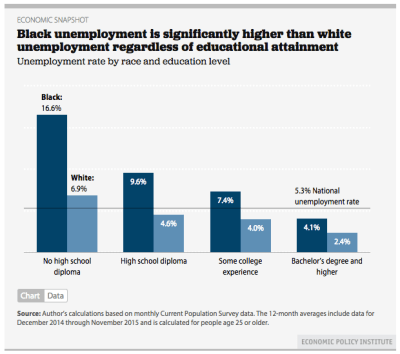
Race, gender, and the socioeconomic factors of homes and communities remain resilient causal factors in any person’s opportunities and success:

Access to good jobs
Black unemployment is significantly higher than white unemployment regardless of educational attainment | Economic Policy Institute

All schools at any level must re-evaluate who has access to the institution, and why, and then focus on what impact the educational experience has on those students. Therein must be the evidence for determining excellence and prestige.


[1] See here and here for examples in South Carolina.

[2] See The Conversation: Tests don’t improve learning. And PARCC will be no different.

Teaching Literacy in Pursuit of “a Wholesome Use of Language”

Because, in the final analysis, the language we speak constitutes who we are as a people.

“Yesterday,” Men without Women, Haruki Murakami

“Let us look at this English tongue with which, as English teachers, we profess to deal,” proposes Lou LaBrant in her “The Place of English in General Education,” published in English Journal in 1940.

As LaBrant’s biographer, I immediately pause at “profess” and recognize that a scolding is about to commence—one that is blunt, smart, and unlikely to achieve her goals because of her scathing tone and style as well as the recalcitrance of far too many who teach literacy at all levels of formal education.

During my interviews with people who had known LaBrant, one spoke directly to her essence: “She never suffered fools gladly,” he said.

And about language and their uses, we have always been and remain surrounded by foolishness about language—in William Butler Yeats’s trap: “The best lack all conviction, while the worst/Are full of passionate intensity.”

Among her many points addressing how educators teach literature/reading and writing, LaBrant makes a foundational demand:

Mental hygiene calls for a wholesome use of language. Schools do much to set up the opposite attitude. By the very nature of the school, its experiences become a standard of sort. Language used in school is characterized as “good” in contrast to language which cannot be used in school. By our taboo on sex words, on literature which deals frankly with life-experiences, and on discussion of love and romance, we set up inhibitions and false values. Only by discussing frankly and unemotionally vital matters can we develop individuals who use language adequately and without embarrassment….Our people use [language] timidly, haltingly. They fear to speak directly, call frankness vulgarity, fear to discuss love, beauty, the poetry of life. They ban honest words and prefer circumlocutions. The language teacher, the teacher of English, carries a goodly share of responsibility for the mental hygiene of young people. (p. 362)

Formal schooling, LaBrant confronts, creates an unhealthy attitude about language in young people—and thus, corrupting what young people believe, how they think, and ultimately how they navigate the world. These failures of formal schooling have roots, she notes, in misguided practice:

As training for independent thinking and clear self-expression, how appropriate is it to ask children to punctuate bad sentences some textbook-maker has written, or to write endless papers on topics chosen by a teacher or committee? (pp. 363-364)

And thus, LaBrant concludes: “Language is a most important factor in general education because it is a vital, intimate way of behaving. It is not a textbook, a set of rules, or a list of books” (p. 364).

Teaching Literacy in Pursuit of “a Wholesome Use of Language”

For about a decade now, my university has been offering faculty seminars focusing on teaching writing/composition to first-year students. The university switched from a traditional English 101/102 model (though we never used those labels) to a pair of first-year seminars with one being writing-intensive.

That shift included a commitment to inviting and allowing faculty across the disciplines to teach writing/composition—despite virtually none of them (included some in the English Department) having formal training in teaching composition or being writers.

More recently, we have created a year-long seminar, Faculty Writing Fellows (FWF), and appointed a Director of Writing who leads these seminars and all aspects of the writing program, which now includes the writing-intensive first-year seminar (the second one has been dropped) and an upper-level writing/research requirement.

This past week, the opening session of the upcoming cohort of FWF began their journey, and during one presentation, I sat listening to a colleague explore with the participants how to decide if and how to engage with students whose writing includes so-called problems with grammar, mechanics, and usage (a set of distinctions that most professors lump as “grammar”).

This colleague teaches history of the English language and upper-level grammar courses; she was very patiently and kindly—unlike LaBrant—making a case for descriptive grammar and stepping back from focusing in an unhealthy way on correctness in order to begin with student expression, while also carefully unpacking what students do and don’t know about conventional uses of language (instead of rules).

I could listen to this colleague all day; she is a measured and gifted scholar of language who embodies how linguists talk about and think about language (it is more about marveling at and wondering about than preserving some arcane and misguided rule).

Then the inevitable happened.

A participant asked about a rule, concerned that we professors have an obligation to maintain the rules of the language but also worried that she may be addressing a rule that no longer applies.

My colleague was steadfast. Instead of making a declaration on the said rule, she walked the point back to our overarching obligation to address the ideas of students as expressed in their writing.

Despite her kindness, patience, and authoritative reply,  I fear that she had no more success than LaBrant did with her abrupt mannerisms.

Far too many teachers charged with teaching literacy as their main obligation and teachers who necessarily engage with literacy anchored to what they would call teaching about disciplinary knowledge/content remain trapped in thinking that correctness trumps all else in teaching writing/composition and speaking in formal settings.

In the session about responding to student writing, then, we were derailed into chatter about splitting infinitives, ending sentences with prepositions, and the use of “they” as a gender-neutral singular pronoun.

My colleague’s message, I regret, was lost in the feeding frenzy, the language itself left bleeding and battered in the wake of the grammar police circling and attacking like sharks.

And here is what was lost.

First, our obligations with teaching literacy must begin with two primary goals: fostering an accurate and healthy attitude about language (descriptive grammar grounded in the history of language development) concurrent with initially addressing the ideas expressed by students (accuracy, originality, complexity) through coherent, clear, and concise language use (diction, style, organization).

Next, nested in that first dual obligation, we must raise student awareness that conventional uses of language, although always shifting, carry status marking in many circumstances. Language use, then, impacts directly and indirectly a person’s credibility as well as the effectiveness of the ideas being expressed.

Here, let me emphasize that this obligation allows any of us to teach directly to students that people continue to function under the rule mentality, but along with that, we should make them aware of several important caveats:

  • Prescriptive grammar often fails in the context of historical patterns of language, and many so-called rules are illogical in that historical context: not splitting infinitives and not ending sentences with prepositions both sprung from imposing Latin grammar onto English in order to raise its status as a language; rejecting double negatives the result of garbling mathematical and linguistic concepts; and constructions such as “Aren’t I?” highlighting the often foolish pursuit of rules over naturally occurring usage (the latter being how “they” has become a singular pronoun).
  • Teaching students about a rules approach to language must include pulling back the curtain, sharing with students that many so-called rules are in fact the topic of heated debate among experts on language (again, the “they” debate).
  • Language use cannot be divorced from discussions of power; the standard dialect versus non-standard dialect dichotomy is about who has power and how those in power manipulate language correctness to marginalize and silence some groups (LaBrant addresses this in her 1940 essay quoted above). Despite many who call for no politics in teaching, to teach standard English in a rules-based way is a blunt political act itself. Instead taking a false objective stance about rules, invite students to read, for example, James Baldwin on black English, or Silas House’s “In My Country.”

Finally, and I am making a sequential case here, once a student has presented an artifact of a quality that deserves it (after purposeful drafting and conferencing), we must wade into editing, where we do have an obligation to address conventional grammar, mechanics, and usage. But even as we confront conventional language use, we must know the status of the language ourselves, and we must also continue to focus on issues that are status marking for the student’s attention in editing.

Dangling and misplaced modifiers are likely to garble meaning while split infinitives, not so much.

Subject/verb agreement (common when students are ambitious, writing longer sentences with subordinations that separate the subject and verb) can scar credibility while pronoun/antecedent agreement or a comma failure, not so much.

Ultimately, no teacher can do everything in any one course. We are all forced, then, to make priorities.

In terms of literacy and language, we must first do no harm—foster and honor “a wholesome use of language” that cannot be separated from the autonomy and agency of our students as purposeful, ethical, and informed people.


LaBrant, L. (1940, May). The place of English in general education. The English Journal, 29(5), 356-365.

Becoming and Being a Writer

She’s suddenly beautiful
We all want something beautiful
Man I wish I was beautiful

“Mr Jones,” Counting Crows

For two summers overlapping with my last two years as a high school English teacher before moving to higher education, I was a lead instructor for the summer institute of the Spartanburg Writing Project.

Hindsight can be a powerful thing, and through that lens, I am not being hyperbolic or nostalgic when declaring that was a powerful transition in my life as a writer: Teaching as a writer while mentoring and fostering teachers as writers.

That first summer, I can still recall vividly working with a beginning teacher (now a dear friend and amazing educator/writer) who was eagerly seeking how to become and be a writer. She shared with me a redneck past (our birth-homes relatively close in the rural upstate of South Carolina) and a deep love of books, reading, and language.

Her prose was beautiful and compelling, and narrative seemed to flow almost effortlessly from her. The writer problem she faced, however, was how to write poetry.

I set out to help her develop a foundational writer move—the form our writing takes is, in part, driven by the conventions we associate with the form. Prose (whether fiction or nonfiction) rests inside a sense that expression is bound by forming sentences and paragraphs.

The poet steps away from paragraphs, remains bound to sentences, and then begins to shape something within poetic constructions—lines and stanzas, how language sounds aloud, how words look on the page.

We set out, then, that summer investigating lination, how a writer begins to think as a poet nested within thinking like a writer.

#

Becoming a writer, I think, tends to come about in two way. One is by necessity, which is the path for many academics and scholars, and another, by recognition, something in the bones that you either embrace or try to ignore like that same place that itches in the middle of your back.

I am not convinced, however, that the becoming and being a writer is any different for those in either category.

The difference seems to be mostly internal. For most moments of my life since I was in my late teens or early 20s, I have existed and still exist in a continual state of words that want to be formed into something else I will write.

This is an auto-state, not a conscious or even welcomed state. It is a sort of running monologue in my mind that I somewhat meta-think about as recognition that I am writing something.

As a writer and a teacher, I am often asked about how anyone knows they are writers, and this is one of the ways in which I try to explain the recognition, and that this is distinct from those of us who must write as part of a separate calling (again, academics and scholars).

Here is what it is like for me in 2017.

Words and phrases just come to me, often in the hazy transition from sleep to waking. A couple days ago “i bought boxes of sequins and glitter” came to me. It seemed silly and likely just my brain working overtime after a very fertile day of writing a new poem.

I began playing with the idea of “filled to bursting” and that resulting in someone exploding into a shower of sequins and glitter. To be honest, this isn’t the sort of poetry I write, or type of ideas that tends to compel me so I just pecked out a stanza that I believed was no more than a little word game, an insignificant aftershock of more substantial writing:

i bought boxes of sequins and glitter
because you fill me near to bursting
and if i explode
when i explode
it might as well be a party

However, that next morning, a related image came to me as I was waking up—a stanza I quickly typed into the Notes App on my phone and emailed to myself (this, my friends, is how I write, frantically typing into Notes and sending to myself):

covering my mouth
i cough
and then wipe glitter from my palm
across the thigh of my pants
as i hum “happy birthday”

Still, this seemed less like a serious piece and more like my writer-brain in overdrive (The National released a new song, I had just received Haruki Murakami’s new volume of short stories), but the monologue continued as I drove to work, my brain slipping into dialogue about driving toward a full moon at dusk with the sun rising and reflected in the rearview mirror.

I began to recognize patterns of size and color, but more importantly, this initial patchwork of seemingly silly words and images had demanded that it was a poem, something rich and filled to bursting itself:

party.png

To become and be a writer, then, is about giving into the writerly moment or creating the writerly moment.

Neither is necessarily easy or pleasurable. Being a writer is always a luxury of sorts, and there is little about the realities of life that defer to something as removed from those realities as writing.

#

Although I suspect this isn’t unique to writing, I can attest to a fact: writing is a terrible combination of arrogance and crippling insecurity.

My foundational moment of knowing I am a writer is that I am a poet; poems simply come to me, demand they be written, and then I am compelled to follow through. But along with the compulsion to write (as opposed to the practical necessity to publish ones scholarship) is the compulsion to have readers, to publish.

Tremendous amounts of time and energy were spent in my 20s and 30s submitting work for publication—mostly short fiction and poetry, but one novel manuscript as well. This Sisyphean adventure wore thinner and thinner, eventually soothed when I moved to higher education in my early 40s and found I was much more adept at academic publishing.

I think I can make this claim while also not sounding arrogant, so I believe I can safely say I am well-published; I also have little trouble finding places for much of my work.

Despite this great fortune (one spurred by the late and wonderful Joe Kincheloe), I routinely find myself deeply despondent, work rejected. I try to move my public work (on my blog) into more formal publications, and despite my resolve to avoid this painful process, I occasionally submit poems to journals.

Silence. Rejection.

Writing is a terrible combination of arrogance and crippling insecurity.

#

With regularity, I hear these words: How do I become a writer?

It begins with confessing why you ask that in the first place. Have you found yourself a writer by necessity or have you finally recognized in yourself the compulsion to write?

Here a fork in the road appears.

If you write out of necessity, my answer is as practical as the writing before you: Create and meet a process and schedule. This is the becoming and being a writer of necessity that really is about meeting an external obligation.

If you write out of compulsion, my answer is much more esoteric.

Give into and create the writerly moments; cultivate them as often and for as long as you can.

Becoming and being a writer is a concurrent condition without a final destination.

It is reading, listening, watching, and thinking as a writer. Eating dinner as a writer. Drinking a pint as a writer. Sitting on the floor playing with a child as a writer. Kissing an intimate’s lips as a writer.

This is the disembodied tyranny of being a writer, inescapable.

It is writing, and writing, and writing—with both the hope of readers and publication as well as doing so without any hope of readers or publication.

Regardless of the reason for the question, this is a solitary adventure in most ways, especially the act itself. And there isn’t a single fun thing about it—although it can be fleetingly satisfying.

Until the crippling insecurity swoops back in, snatches the satisfaction in its claws, and screeches off into the distance.

Teaching Grounded in Compassion

For almost five months now, I have been mourning the premature demise of my road cycling life, brought about by the negligence of a motorist.

Cycling has been a tremendous part of my recreation and social life for over three decades; for more than the last decade, in fact, I have been cycling about 8,000-10,000+ miles per year.

The cycling community is a wonderful and diverse group of people, but we are often bonded by a not-so subtle type-A predisposition to obsessive and extreme physical efforts, especially among those who compete and those drawn to endurance sport.

Cyclists in our group range from their teens and 20s through many in our 50s and 60s, and while in organized groups, we often ride at high speeds and intensive intervals as well as extremely long days in the saddle, notably an annual 220-240+-mile ride over about 11-12 hours of cycling in a 14-15-hour days.

To understand cycling culture, you should peruse The Rules, part brutal Truth about cycling and cyclists, and part parody of that Truth.

The essence of cycling culture is Rule #5: Harden The Fuck Up, which we soften to “HTFU” for public consumption.

When new people have joined our cycling group, especially when they ask to be a part of the weekly zone rides that include attack sections in which stronger riders leave slower ones behind (before we regroup), we offer something similar to The Rules’ mixture of Truth and satire: “When you feel like you are getting dropped,” we say with straight faces, “pedal faster.”

This is mostly bluster, however, since most of the elite and veteran riders are more than eager to mentor new and developing cyclists. “Mostly bluster” is key here because in its essence cycling is a very demanding and harsh sport at elite levels of competition and endurance events.

You simply cannot be an cyclist and avoid the need to have a high pain threshold while also maintaining a strict level of focus on yourself and the pack along with prioritizing many simultaneous cycling-specific skills (holding your line, braking, shifting gears, communicating with other cyclists).

Over the more than three decades of my life as a road cyclist, I aspired to and then was a vocal embodiment of HTFU. Suffering, I discovered, was the one athletic skill I was fairly good at doing in my lifelong quest to be a good athlete.

While I find the Social Darwinism and HTFU-culture of cycling endearing, something I genuinely believe has enhanced me as a person, I am routinely mortified that this same dynamic often drives how most adults interact with children and how many teachers deal with students.

I must fully and clearly reject that contemporary child rearing and formal education must function in a way that tempers children and students for surviving in a harsh and calloused world.

To be blunt, the world, life, simply doesn’t have to be that way.

Since I often interact with teachers and professors working on their teaching and assessment practices, I witness far too much anger, far too many attitudes about “teaching students a lesson” in the most pejorative way that can be expressed—punishment as preparation for a life of punishment.

As an existentialist, I have always suffered under the complete mainstream misunderstanding of what I do believe; yes, life itself is hell, and, yes, hell is other people, and, yes, our passions are our sufferings.

Existential philosophy, however, is about acknowledging these facts of the human condition as a salve, not as a fatalistic excuse to perpetuate human pain and suffering. Think about the Bergens in Trolls:

So I have taken a long route here to make a plea that teaching (and child rearing) must always be grounded in compassion—that we must resist the urge to temper children for the cold cruel world.

As adults, we can and should be working to lessen and then eradicate the coldness and cruelty of the world; concurrently, we can and should be nurturing children, offering them the sort of ideal modeling of how the world can be in our teaching and parenting.

The tension between the Trolls and the Bergens (and within the Trolls, in fact) is the possibility of the good life against the fatalism of life without happiness. This is a child’s film with many of the Trolls embodiments of the most wonderful qualities associated with childhood (poo-pooed as “childish” by those embittered with the Bergen angst).

Teaching (and parenting) is about the possibility of the good life, an enduring faith in the light in the human spirit that is often brilliant in children and young people if we are willing to see and celebrate it instead of being the sacrificial messenger of doom.

If we are not teaching always grounded by compassion, we should not be teaching.

Let me emphasize here that this is not about not challenging students (we must challenge), about not being demanding (we must be demanding).

But, as LaBrant admonished, “we should not, under the guise of developing literary standards [or high expectations], merely pass along adult weariness.”

The HTFU approach to teaching is exposed by its commitment to rigor, a word rooted to rigor mortis (that which is stiffened by death).

I must admit that the cupcakes-and-rainbows approach to life by the Trolls is simply not my thing; this is not about breaking into song and dance, decorating the world in glitter, or being idealistic to the point of being naive.

This about teaching grounded in compassion and patience, teaching committed to the possibility of a good life.

Life, I regret, is far too often cruel and horrible for far too many people, disproportionately children and young people. I have no interest in ignoring that fact, or lying to children about the inequity of privilege and poverty.

But acknowledging the harshness and inequity of the human condition must not be the boulder that traps us in fatalism about now, preventing us from teaching committed to the possibility of the good life, for everyone.

Analogies Like Land Mines: Treading Carefully When We Discuss Teaching Writing

Metaphor is a powerful element in the craft of language. Writers and speakers seek metaphors, similes, and analogies to produce rich expression, but the analogy is a part of everyday discourse and all types of public expression and debate.

One of the staples of my years teaching high school English was Flannery O’Connor’s “A Good Man Is Hard to Find,” a dark satire and enduring example of the brilliance found in Southern literature.

My students and I always paused early in that story, the second paragraph, that begins:

Bailey didn’t look up from his reading so she wheeled around then and faced the children’s mother, a young woman in slacks, whose face was as broad and innocent as a cabbage and was tied around with a green head-kerchief that had two points on the top like a rabbit’s ears.

As a cabbage? we would always ponder. The early descriptions establish O’Connor’s use of contrast to cause tension between some of the cartoonish elements with the grim reality of the story’s plot.

But I also feel in the cabbage simile that O’Connor was poking a bit at metaphorical language itself—something like a meta-metaphor.

Less as craft and more as a strategy for argument, however, Donald Trump, apparently, has posed that he avoids exercise because, he claims, humans are like batteries, having a finite amount of energy. He believes we waste that energy store when exercising.

Both of these example highlight, I think, that we must always investigate the use of analogy for the essential validity of the relationship being presented.

At different times in the past, the mind, for example, has been characterized as a blank slate and a muscle—and then, evidence and careful consideration of these analogies have been discredited.

Where analogy fails, it seems, is when we take a position and then reach for a comparison that confirms the position. Trump, in his baseless battery analogy, simply clamored for something to justify his position—one that falls apart if we interrogate the comparison.

Yet, the analogy is a powerful tool, and often compelling because analogy brings the concrete and the understood into complex and often abstract settings: the mind as a blank slate or muscle is far more manageable for the average person than how the mind actually functions, a domain for specialists.

As a writer and a teacher, my world is often deeply entrenched not only in language, but also in investigating how language works (and doesn’t) to create warranted meaning.

Both as a writer and reader, I have come to live by a guideline that helps remind me of the need to resist the uncritical allure of the analogy: Just because someone can make a comparison doesn’t mean that the comparison is valid.

Writing Is Like?

Recently, I have had several experiences with people making analogies in order to understand writing (composing) and teaching writing: writing like learning to ride a bicycle (starting with training wheels to justify teaching the five-paragraph essay), writing like playing a piano (moving from scales to playing a full piece).

Both of those are recurring analogies, and thus, they must be compelling. However, here I am asking us all to think more carefully about these analogies.

Writing (composing) is nothing like riding a bicycle, and is also nothing like playing the piano, because writing (composing) is creating something from nothing, an act of synthesis.

“Writing” as a term can cause some of the problem, in fact, so let’s first consider writing (as handwriting) versus writing (as composing).

Even in behaviors that depend on something like rote actions (such as handwriting, riding a bicycle, and playing a piano) [1], the repetition of behaviors must be “correct” (or you are learning to do something “wrong”) while also incrementally moving from something like novice to proficient to expert.

Let me risk next an analogy between coaching a scholastic sport and teaching.

As a soccer coach, I worked hard to maintain some level of quality in drills during practice (isolated and rote), for the fact above, to prepare players for playing an actual soccer match (holistic and autonomous, although conforming to a body of rules); but my work as a coach would have been much different if I were helping the team create a whole new game instead of teaching them how to conform to an existing system.

Now we have come against the inherent flaw in the analogies about writing like riding a bicycle or playing a piano because writing (composing) is not of the same kind of behavior. Instead, writing is more validly analogous to visual art such as painting or drawing.

While writing (composing) and visual art do in fact have discrete skill sets that can and should be honed in isolated and somewhat artificial ways, practice, composing a written piece and visual art come from trying the whole thing inexpertly at first and then continuing to do the whole thing in incrementally more proficient ways until some level of expertise is achieved.

Writing (composing) and visual art begin by facing blank paper, acts of synthesizing and creating from nothing to something.

And thus, in pursuit of a more valid analogy, just as we do not teach painting by first asking students to paint-by-number, we should avoid at least an overuse of templates (five-paragraph essay, etc.) when teaching composition.

Further, the field of composition has ample evidence (as do those of us who teach writing/composition) that once students have been prompted to conform to a template, they are dogged in never letting go; the template, sigh, is not a set of training wheels easily removed.

Metaphor, simile, and analogy are powerful tools, but the pursuit of analogy is like navigating a field littered with land mines; we should tread more carefully when making our comparisons, avoiding the Trump error above (selecting the analogy to confirm a belief without investigating if the comparison is accurate, without starting with a credible claim itself).

Just as we scramble to understand better how the brain/mind works, often resorting to analogy, we who write and teach writing (composing) are confronted with something equally complex, and are rightfully looking for how to better navigate that understanding.

In that pursuit, I believe the bicycle and piano analogies to writing mis-serve us and our students. Let us seek instead analogies grounded in capturing the holistic and chaotic nature of rendering meaning from nothing and presenting comparisons that are of the same kind.


[1] I urge you to look into how the 10,000-hour rule was misrepresented in the media by Gladwell and others.

Accreditation: “‘relatively superficial, extremely time-consuming and doesn’t lead us to a goal of significant improvement'”

For well over three decades, I have been both a full-time educator (high school English teacher for 18 years and currently a college professor, going on 16 years) and a writer. As a high school teacher, I also taught journalism and was the faculty sponsor for the school newspaper and literary magazine over about 10-11 years.

Therefore, I have a great deal of experience in the fields of education and journalism, experience that has revealed to me a rather damning fact: One can be well trained in educational pedagogy or the craft and conventions of journalism, but without nuanced and deep knowledge of the content of that teaching and writing, the outcome can and often is quite awful.

In journalism, for example, the vaunted New York Times publishes and fails to recognize blindly awful articles about poverty. And Education Week regularly features the worst of edujournalism.

And let me emphasize here, these criticisms are about the very best of the field.

The rise of Trumplandia has also birthed a renewed concern about the media and journalism—much gnashing of teeth about fake news and post-truth—so this announcement from Northwestern University may seem ill-suited in the context of those concerns:

In a nontraditional move, officials at Northwestern University‘s prestigious journalism and communications school have decided not to renew the program’s accreditation, letting the designation lapse.

The dean of the Medill School of Journalism, Media, Integrated Marketing Communications said Monday that school officials chose not to pursue renewed accreditation, which provides outside approval of academic programs, because the process is “flawed” and not useful.

More pointedly, the dean explains:

“Our goal is always to be the best in the world, and this process doesn’t get us there,” Hamm said in an interview Monday afternoon. “We just don’t find that the review provides us with anything beyond what we already know today. It’s relatively superficial, extremely time-consuming and doesn’t lead us to a goal of significant improvement. It’s sort of a low bar.”

The current hyper-focus on media and journalism has been a parallel reality in the field of education over the last three decades-plus; therefore, there is much to unpack about the parallels in the two fields.

As a lifelong educator, I had to seek certification during my formal college education, I worked as a classroom teacher in public schools under standards and testing, and I now must conform to the mandates of teacher certification and program accreditation as a teacher educator.

In all of those contexts, I am a witness to that accreditation (like certification) is, in fact, “’relatively superficial, extremely time-consuming and doesn’t lead us to a goal of significant improvement. It’s sort of a low bar.’”

All types of bureaucratic accountability—such as the thirty years of standards and high stakes testing in public education reform—are ultimately reductive by shifting the focus toward meeting standards and requirements that are secondary and tertiary approximations of authentic goals (holistic goals that have been cannibalized into discrete elements for the sake of efficiency).

Why, we should be asking, do disciplines such as journalism and education feel the need to add the layer(s) of accreditation (and certification) onto their degrees—when other disciplines trust that the degrees themselves are enough?

Two reasons are practitioners in both disciplines suffer from the low self-esteem of the fields and the twin-tyrannies of the market place and bureaucrats.

Since I focused on journalism above, let me shift here to education.

No discipline or profession has suffered more under the weight of political and public marginalizing and de-professionalization than education—in part as a consequence of sexism (teaching long associated with being a woman’s job) and in part due to the burden of K-12 and many college teachers/professors being agents of the state, working in tax-funded public institutions.

Education currently labors under a nearly unmanageable matrix of mandates related to degrees, certification, and accreditation; and these requirements are in constant flux—standards and mandates for proving those standards have been met shifting every 3-5 years.

Over the accountability era, then, many teacher certification programs have dropped educational philosophy courses, foundations courses, and what many people would consider the more academically challenging knowledge base of education degrees (degrees, by the way, that have historically been slandered as “too easy”).

Education programs are in constant flux, changing courses and programs to meet state certification mandates and accreditation mandates—neither of which are being driven by scholars or practitioners but by bureaucrats.

The most perverse of ironies has occurred, then, in education because those who claimed education degrees are flimsy have successfully made them a maze of nothingness through certification and accreditation mandates.

Ultimately, we must face these realities:

  • Increasing an emphasis on the technical aspects of education and journalism distorts the importance of both and has created practitioners who may perform with proficiency while failing miserably at the larger responsibility to what is being taught and what is being expressed as well as who is being taught and who is being informed.
  • No generic teaching or journalism skills exist absent the content of what is being taught or written about, and therefore, reducing teaching or journalism to discrete skills necessarily dilutes holistic professions to simplistic bureaucracy.
  • There is no option for objectivity in education or journalism; both are political acts that require moral and ethical distinctions as well as seeking out the Truth/truth.
  • Accreditation (and certification) is more about power and political grandstanding than about the integrity of any discipline. In fact, accreditation is necessarily counter to the integrity of any discipline.

Reaching back to Franz Kafka and then recurring throughout pop culture (mainly satire such as Dilbert and Office Space), the folly of bureaucracy has been exposed time and again; yet, it remains entrenched in some of the foundational disciplines in our democracy—education and journalism.

Northwestern University has taken a bold but necessary step that should be a beacon for all of journalism and education; we are well past time to end accreditation (certification) as the process that strangles the vibrancy out of any discipline.

Intimacy, Privacy, and Consent

Tom. Look—I’ve got no thing, no single thing—

Amanda. Lower your voice!

Tom. In my life here that I can call my own!

The Glass Menagerie, Tennessee Williams

I am in high school, junior or senior year, I think, playing pick-up basketball on the concrete court in my yard with several friends and my father.

At some point, I say something wrong to my father as the game heats up, and he slaps me hard across the face—bringing the game to a sudden stop and silence.

I had—as I did more and more often as a late teen—breached the respect line due all adults engrained in me by my father. I had been slapped before walking down the street when I failed to say “yes, sir” to someone we had spoken with in our hometown.

To this day, as reflex, I say “yes, sir” and “yes, ma’am” to almost everyone, from my students to my peers and always those older than me. To most people, it seems quaint, I am sure, and yet another marker of my very Southern Self.

On balance, however, my father was unflinchingly wonderful to me; my childhood, nearly idyllic—although I have had to cast aside many of the beliefs and practices my father passed onto me.

The iron-fisted authoritarianism of my childhood and teen years harvested the opposite effect intended. To this day, I bristle at all authority, mostly because I recognize in it such crass hypocrisy that I can barely hold my tongue—just as I often could not hold my tongue with my father triggering him to throw me across my bedroom and into the wall even though I was an inch taller then he, triggering him to wrestle me to the ground, pinning me down and demanding that I just not say one more word.

Straining against his weight and strength, I would add: “Word.”

In the wake of the four decades between then and now, I often think about that day I was slapped in front of all my friends. I do not recall it, and cannot make some dramatic claim that the slap still burns on my cheek.

I think about it, often.

During just under thirty years as a father, more than thirty as a teacher, and almost three as a grandfather, I think about that slap as I work moment by moment to be a kinder and more patient human, especially to children, young people, and anyone in my care.

“All we gotta do is be brave/And be kind,” guides me along with “I’m so sorry for everything.”

I urge my teacher candidates to say “please” and “thank you” to their students; I beg them to have higher standards for themselves than for the students in their care—always to walk the walk instead of or before talking the talk.

It is ours to be that which we expect in others, to earn and deserve the respect that my father demanded by default.

And without fail, my teacher candidates report to me that teachers in the field tell them to stop the “please,” stop the “thank you” because children don’t work that way, and often this is code for “those children”—black, brown, poor unlike the teachers embodying the same sort of stoic harshness of my father.

I was well on my way in this journey before the birth of my granddaughter almost three years ago, but that tiny human has accelerated my efforts, and sharpened my resolve.

I have helped with daycare with my granddaughter, Skylar, and now also my grandson, at least once a week throughout her life.

As a toddler, Skylar on those days when we were alone would often take my finger and guide me to the floor. I sat cross-legged, and she would use me as a chair; she would also just as often pull me next to her just to be touching as she played.

She still climbs onto the couch just to be close, taking my hand and guiding it to hold her foot or leaning into my hand as I scratch her tiny head beneath that wild flourish we call her hair.

I am now very conscious that she needs but is also learning about what healthy and promised intimacy means, how it looks and feels.

My granddaughter is also learning about this in the context of how men and women interact. It will be an ongoing journey for her—one about which I am terrified because the world remains a horrible and violent place for children and women.

Skylar, approaching three, also seeks from time to time her privacy, becoming aware that some of human behavior is ours alone, and not the loneliness alone, but the privacy alone.

We know when she hides around the corner or goes to another room, we need to change her diaper, which has also become a delicate matter between her and the people who love her, care for her.

I ask her gently for permission to change her diaper because she hates this necessary act; she is aware of its encroachment on her privacy, her emerging awareness of her physical privacy, her physical spaces that are hers to share or not.

I seek her consent, her understanding that I am a caregiver and simply fulfilling a duty she will be able to do on her own someday.

As I change her, especially as I wipe her, I say over and over, “I’m sorry. I’m sorry.”

Skylar has embraced this as well; her sweet refrain, “I’m sorry,” lacing any time she feels she has somehow breached expectations—prompting my always: “It’s ok.”

We talk softly to each other in these exchanges.

Because making mistakes is being a child, being fully human. Who among us is above that?

My dear Skylar, unlike me, has never been and will never be hit by me as a caretaker because this is something unlike my upbringing I have brought to my family, to my daughter’s family.

And so, this becoming fully human child, Skylar, rudders me, will not allow me to ignore the sanctity of intimacy, privacy, and consent.

These, I am resolute, shall not be breached; these remain inviolate.

Because “I’m so sorry for everything.”

School Choice Advocacy Exposes Political Cowardice

It has become fashionable for pundits to argue that fake news has created a post-truth America; however, mainstream media, in fact, carry the brunt of the responsibility because too often journalists are trapped in press-release journalism and traditional expectations of objectivity.

Evidence of this can be found in how the media routinely cover education and education reform—even when good journalists with good intentions seek to be objective and fair by covering a topic.

Paul Hyde’s Advocates tout the benefits of school choice (25 January 2017) represents the ultimate failure of covering what advocates claim instead of confronting whether or not those claims are credible.

Regularly, the public is bombarded with school choice advocacy and proposals that school choice can somehow address the historical and persistent problems we rightfully recognize in South Carolina’s public schools. These arguments are compelling for a public in the U.S. that believes in choice and idealizes parental choice.

But here is the problem: The evidence rejects that market forces (through vouchers, tuition tax credits, charter schools, and even public school choice, which is in place in South Carolina’s Greenville county) are effective but indirect methods for education reform.

School choice is an ideological argument that exposes political cowardice (let the Invisible Hand do what political leaders refuse to do), and it ignores that public institutions should make choice unnecessary (think about why we do not privatize the judicial system, the police force, roads and highways).

First, the problems with our public schools are primarily strongly connected to large gaps in outcomes among identifiable groups of students by race, social class, special needs, and home languages.

All across South Carolina, for example, and notably along its Corridor of Shame, schools serving low-poverty populations have strong outcomes while schools burdened with high poverty and high percentages of students with special needs and English language learners have weak outcomes.

What we must acknowledge is first that struggling schools and students are not struggling because of a lack of choice, and then, all choice models for reform are indirect ways to make the changes that should be accomplished by public policy directly.

Here is the fact that political leaders are avoiding by abdicating their responsibilities to address inequity: Between 60-80% of measurable student outcomes are connected to students’ lives outside of school—home income, access to medical care, food and living security, and stable and well-paying jobs for the parents.

If public policy were to address these social inequities directly, student outcomes would improve with no in-school reform at all.

But our current schools also require direct reform, some of which could correct the negative consequences of choice—increasing segregation, creating unnecessary shuffling of student populations, diverting funds from public schools for charter and private schools that do not have better outcomes.

Too often, public school practices reflect and perpetuate the exact inequities in society that are overburdening our schools.

Instead of hoping that market forces create equity (and they will not), new direct policy should confront the following: vulnerable populations of students are assigned disproportionately new and un-/under-certified teachers, tracking and selective programs (Advanced Placement, International Baccalaureate) benefit advantaged students while vulnerable students are often barred, discipline practices and consequences perpetuate inequity, and too often school facilities and materials reflect the socioeconomic status of the community.

Ultimately, mainstream media failing to provide a critical response to school choice advocates allows yet more political cowardice.

School choice—from vouchers to charter schools to public school choice—over the past 20-30 years has never produced the miracles advocates promise. Despite public perception, charter schools and public schools do not have higher outcomes than public schools when adjusted for the characteristics of students served.

Types of schooling simply do not make a difference, but practices do—although no in-school practices have yet to overcome the influence of out-of-school influences beyond the scope of teachers and schools to control.

Allowing powerful people with vested interests to advocate for failed policy without any media, political, or public challenges is cheating our schools, our students, and our democracy.

The weight of evidence does not validate school choice advocacy, but more important than that, we know what needs to be reformed to insure better opportunities for all students.

We need politicians themselves to embrace choice, choosing direct action instead of continuing to hide behind the political cowardice of hoping parents-as-customers can force schools to accomplish the impossible.

Think Tank Advocacy Reports Not Credible for Education Policy: SC Edition

The Palmetto Promise Institute‘s report authored by Adam CrainMoney doesn’t translate into student results, is a follow-up to their 2013 report also comparing South Carolina education to Florida education reform.

Although this report offers several charts detailing an analysis of SC and FL National Assessment of Educational Progress (NAEP) tests data (some of which is aggregated by race, disabilities, and poverty, but focusing on 4th grade reading), the report proves to be overly simplistic and an incomplete picture of student achievement in both states—with the ham-fisted data analysis serving as a thin veneer for advocacy unsupported by valid research and a more nuanced analysis of data.

In short, this report proves to be significantly inadequate evidence to support the ideologically-driven recommendations offered at the end—recommendations this conservative think tank would make regardless of the evidence (mostly a mishmash of school choice policy). There simply is no credible link between the shallow analysis of SC/FL NAEP scores and the call for policy as solutions to the manufactured problems.

Let me outline here both the flaws of the data analysis and then the folly of the recommendations.

The foundational flaw of both reports is suggesting some sort of value in comparing SC to FL and the persistent but discredited claim that FL has successful education reform. In fact, the so-called Florida “miracle” has been strongly refuted, notably its grade-retention policy based on high-stakes test scores.

By comparison, SC is slightly more impoverished than FL, and SC (27%) has a higher percentage than FL (16%) of blacks (both metrics used in the report analysis). However, this report from PPI makes no effort to show how their raw comparisons are actually apples-to-apples, or valid.

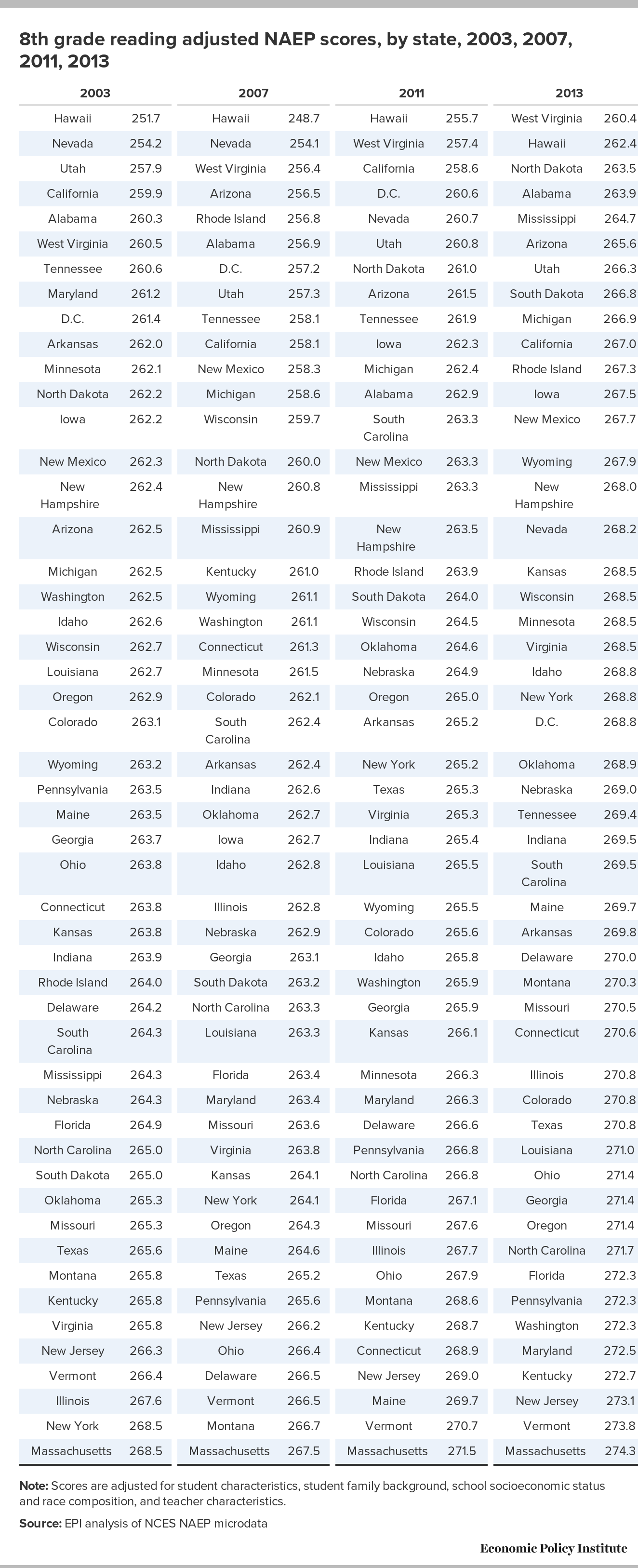
Another analysis of NAEP data that adjusts for factors impacting test scores reveals a much more nuanced and important picture, one that exposes a huge flaw with the FL model of reform [1] and depending on test data.

While adjusted trend data on NAEP continues to show 4th grade FL reading scores better than SC scores, by 8th grade (see Table 6B1, 2013 data) SC (269.5) and FL (272.3) have nearly identical adjusted scores.

Here is a key point about FL’s retention policy: Retaining students can inflate short-term test data, but those gains erode over time. Further, grade retention [2] maintains a strong correlation with students dropping out of school and an inverse correlation with students receiving a diploma (see Jasper, 2016 [3]).

Ultimately, the data analysis and charts in this report are overly simplistic on purpose because PPI has an agenda: argue against increased school funding and promote school choice.

The report uses bold face, lazy math, and insufficient statistical methods to dramatize a baseless claim: “Simple funding comparisons indicate quite the opposite. Over the twelve year period between 1999 and 2011, South Carolina spent a total of $6,920 more per student, or an average of $692 per year.

Without proper statistical analysis, using controls and making causal claims, this raw data approach, like the NAEP analysis, means almost nothing.

The body of educational research, in fact, shows that funding does matter (see Baker, 2016) [4].

Both, then, the NAEP analysis and the related argument that SC school funding is somehow excessive/wasteful are statistically inadequate and useless for making the recommendations at the end of the report.

Those recommendations fall into two broad categories: accountability and school choice.

SC and FL jumped on the accountability bandwagon early, about three decades ago, and remain completely unsatisfied with their educational outcomes, despite huge amounts of tax dollars and immeasurable time spent on ever-new standards and ever-new high-stakes tests.

Calling for accountability ignores the research base that shows accountability based on standards and testing has failed, will continue to fail:

There is, for example, no evidence that states within the U.S. score higher or lower on the NAEP based on the rigor of their state standards. Similarly, international test data show no pronounced tests core advantage on the basis of the presence or absence of national standards. Further, the wave of high-stakes testing associated with No Child Left Behind (NCLB) has resulted in the “dumbing down” and narrowing of the curriculum….

As the absence or presence of rigorous or national standards says nothing about equity, educational quality, or the provision of adequate educational services, there is no reason to expect CCSS or any other standards initiative to be an effective educational reform by itself. (Mathis, 2012)

The evidence on school choice also contradicts the report because choice fails to increase student achievement, but it is strongly associated with increasing segregation and inequity (see here and here).

Let’s summarize the major points of the report:

  • The report claims SC lags FL in academic achievement and education reform while spending more per pupil. However, the analysis offered here is an incomplete picture and statistically flawed. None of the claims made in the report are proven, and more nuanced and longitudinal analyses of NAEP greatly erode the premise of PPI’s report (grounded also in the debunked Florida “miracle” claim).
  • The report’s major recommendations about school funding, accountability, and school choice are all strongly contradicted by the research base, which the report fails to acknowledge.

Ultimately, as a colleague responded when I shared this report, PPI has published “a five page Op-Ed with bar graphs,” and I would add, not a very good one at that.

SC should in no way be influenced by this report when making education policy.

However, SC should heed a kernel the report’s conclusion: “The disparity between the stewardship of resources in Florida and our struggling education system in South Carolina is apparent.”

As I have detailed, while most educational rankings and comparisons prove to be hokum, what evidence from our schools and reform policies shows is that SC ranks first in political negligence.

Ironically, this report is calling for more negligence in the pursuit of market ideology.


[1] See evidence discrediting Florida “miracle” and FL’s reading policyhow SC could benefit from looking at Oklahoma, not FL; and why FL reform is harmful for students and literacy.

[2] See the National Council of Teachers of English’s Resolution on Mandatory Grade Retention and High-Stakes Testing:

Grade retention, the practice of holding students back to repeat a grade, does more harm than good:

  • retaining students who have not met proficiency levels with the intent of repeating instruction is punitive, socially inappropriate, and educationally ineffective;
  • basing retention on high-stakes tests will disproportionately and negatively impact children of color, impoverished children, English Language Learners, and special needs students; and
  • retaining students is strongly correlated with behavior problems and increased drop-out rates.

[3] Jasper’s abstract captures the ultimate failure of FL’s reform:

In 2003-2004 approximately 23,000 third graders were retained in Florida under the third grade retention mandate outlined in the A+ Plan. Researchers in previous studies found students who were retained faced difficulty in catching up to their peers, achieving academically, and obtaining a high school diploma (Anderson, Jimerson, & Whipple, 2005; Andrew, 2014; Fine & Davis, 2003; Jimerson, 1999; Moser, West & Hughes, 2012; Nagaoka, 2005; and Ou & Reynolds, 2010). In this study I examined educational outcomes of students retained in a large southwest Florida school district under the A+ Plan in 2003-2004. I used a match control group, consisting of similarly nonretained students, who scored at level one on the Grade 3 Reading FCAT. I then compared the control group to the retained group. I also compared achievement levels on the Grade 10 Reading FCAT of the retained and non-retained group. I evaluated longitudinal data, for both the retained and non-retained students, and found 93% of the retained students continued to score below proficiency (below a level 3) seven years after retention on the Grade 10 Reading FCAT as compared with the 85.8% of the non-retained students. I also compared standard diploma acquisition of the retained and non-retained group. The non-retained group was 14.7% more likely to obtain a standard high school diploma than the retained group. Finally, I used data from previous studies to extrapolate economic outcomes.

[4] Baker’s analysis has key points detailed in the Executive Summary (p. i):

baker funding 2016.png