Third grade retention (required by 22 states) significantly contributes to increases in early grade high-stakes assessment scores as part of comprehensive early literacy policy.
Retention does not appear to drive similar increases in low-stakes assessments.
No direct causal claim is made about the impact of retention since other policy and practices linked to retention may drive the increases.
However, their analysis concludes about grade retention as reading reform :
Similar to the results for states with comprehensive early literacy policies, states whose policies mandate third-grade retention see significant and persistent increases in high-stakes reading scores in all cohorts. The magnitude of these estimates is similar to that of the “any early literacy policy” estimates described in Section 4.1.1 above, suggesting that states with retention components essentially explain all the average effects of early literacy policies on high-stakes reading scores. By contrast, there is no consistent evidence that high-stakes reading scores increase in states without a retention component.
Therefore, one Big Lie about grade retention is that it allows misinformation and false advocacy for the recent “science of reading” reform across most states in the US.
Since grade retention in the early grades removes the lowest scoring students from populations being tested and reintroduces them biologically older when tested, the increased scores may likely be from these population manipulations and not from more effective instruction or increased student learning.
Evidence from the UK, for example, suggests that skills-based reading testing (phonics checks) that count as “reading” assessment strongly correlate with biological age (again suggesting that test scores may be about age and not instruction or learning):
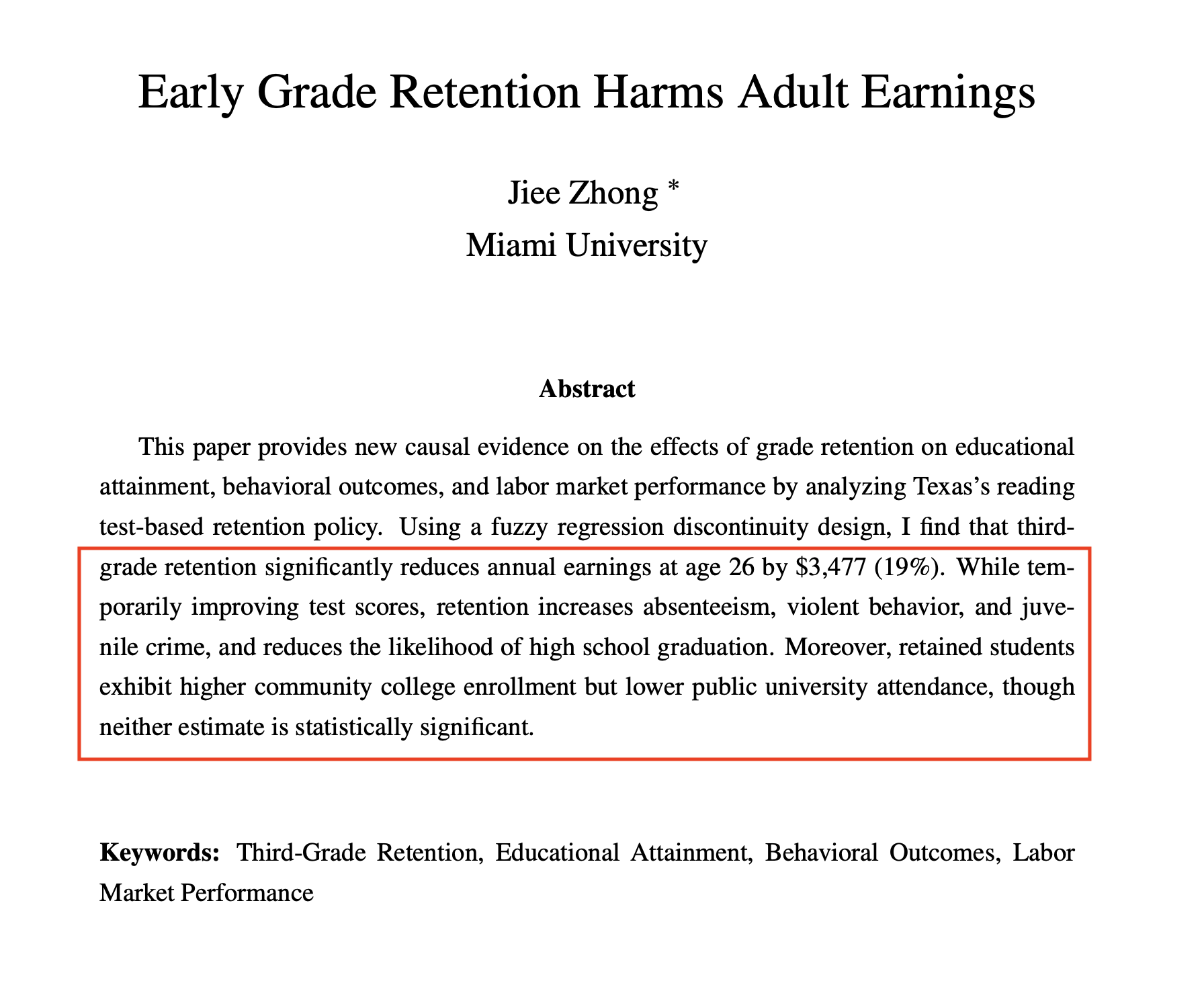
Another Big Lie about grade retention is that reading reform advocates fail to acknowledge decades of evidence that grade retention mostly drives students dropping out of school and numerous negative emotional consequences for those students retained.
Resolved, that the National Council of Teachers of English strongly oppose legislation mandating that children, in any grade level, who do not meet criteria in reading be retained.
And be it further resolved that NCTE strongly oppose the use of high-stakes test performance in reading as the criterion for student retention.
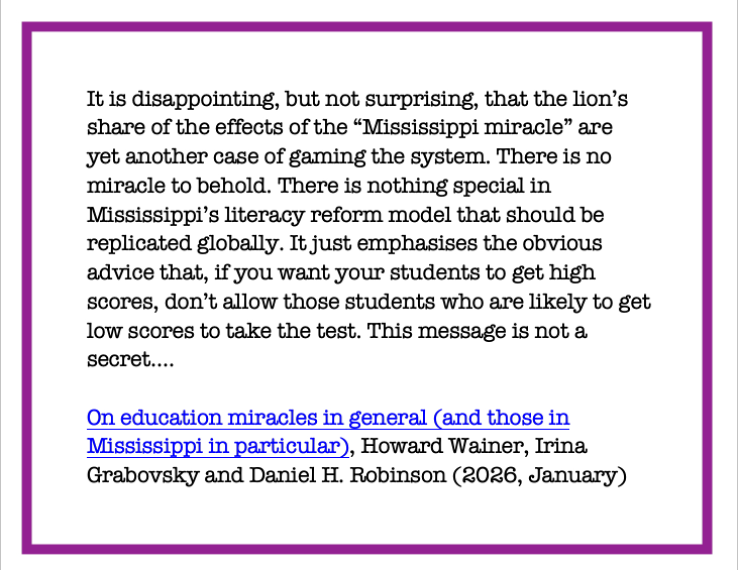
Grade retention, then, is an effective Big Lie of Education because it allows misinformation based in test-score increases to promote policy and practices that fail to increase test scores in sustained ways (see the dramatic drop in “success” for “high-flying” states such as Mississippi and Florida, both of which taut strong grade 4 reading scores, inflated by grade retention, but do not sustain those mirage gains by grade 8).
Grade retention is a Big Lie of education reform that punishes minoritized and marginalized students, inflates test scores, and fuels politicized education reform.
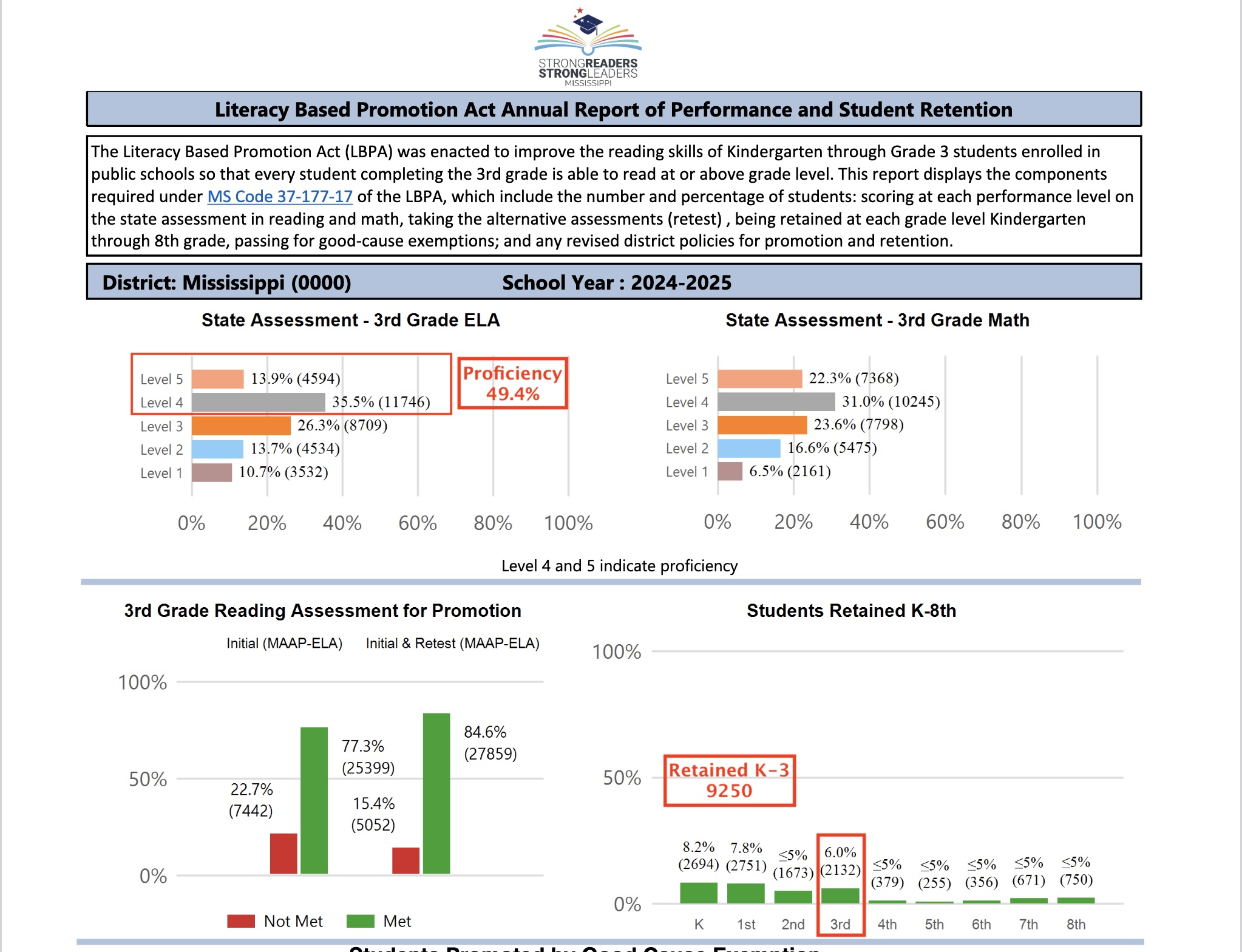
[1] Consider that states retaining thousands of students each year, such as Mississippi, have not seen those retention numbers drop, suggesting that the “science of reading” reforms are simply not working but the retention continues to inflate scores.
The following data from Mississippi on reading proficiency and grade retention exposes that these claims are misleading or possibly false:
“The available research does not ratify the case for school cellphone bans,” writes Chris Ferguson, professor of psychology at Stetson University, adding, “no matter what you may have heard or seen or been [told].”
What Ferguson then offers is incredibly important, but also, it exposes a serious lack of awareness by Kappan considering their coverage of education:
And the media treatment has played a part in amplifying what can only be described as a moral panic about phones in schools.
News media often cater to panics, neglecting inconvenient science and stoking unreasonable fears. And this is what I see happening with the issue of cellphones in schools.
First, Ferguson’s characterizations of media coverage of education—”News media often cater to panics”—is not only accurate but matches a warning many scholars and educators have been offering for decades, especially during five decades of high-stakes accountability education reform uncritically endorsed by media.
The only story education journalists seem to know how to write is shouting crisis and stoking panic.
Just a couple days ago in The Hechinger Report, this headline, “6 observations from a devastating international math test,” is followed by this lede: “An abysmal showing by U.S. students on a recent international math test flabbergasted typically restrained education researchers. ‘It looks like student achievement just fell off a cliff,’ said Dan Goldhaber, an economist at the American Institutes for Research.”
And for a century, in fact, education journalism has been persistently fostering a “moral panic” about reading proficiency by students.
Here is Nicholas Kristof in the New York Times: “One of the most bearish statistics for the future of the United States is this: Two-thirds of fourth graders in the United States are not proficient in reading.”
Kristof is but one among dozens in the media repeating what constitutes at best an inexcusable mischaracterization and at worst a lie about what exactly NAEP testing data show about reading achievement in the US.
Nearly every media story about reading in the US since Emily Hanford launched in 2018 (and then repackaged as a podcast) the popular mischaracterization/lie has dutifully “amplif[ied] what can only be described as a moral panic” about reading achievement and instruction:
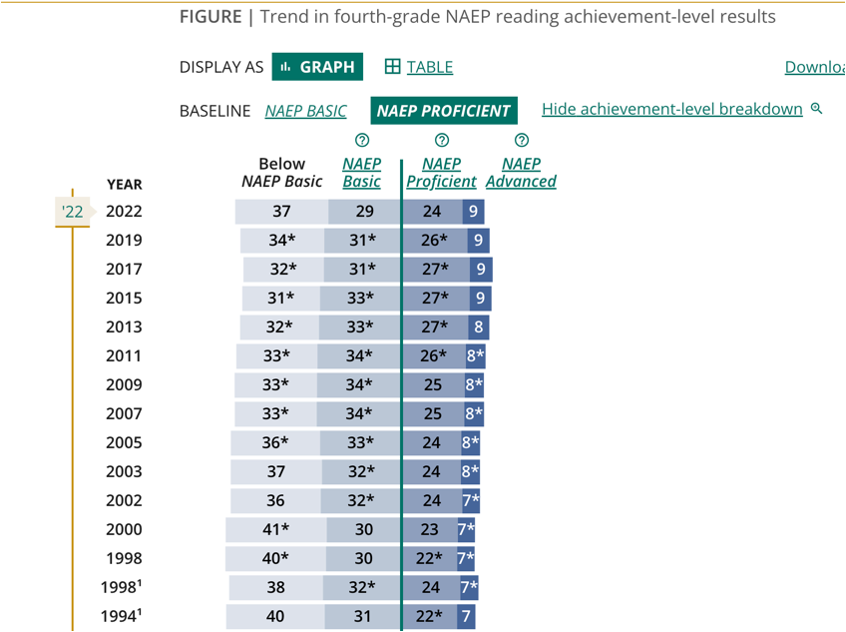
The stakes were high. Research shows that children who don’t learn to read by the end of third grade are likely to remain poor readers for the rest of their lives, and they’re likely to fall behind in other academic areas, too. People who struggle with reading are more likely to drop out of high school, to end up in the criminal justice system, and to live in poverty. But as a nation, we’ve come to accept a high percentage of kids not reading well. More than 60 percent of American fourth-graders are not proficient readers, according to the National Assessment of Educational Progress, and it’s been that way since testing began in the 1990s.
Ferguson’s warning about the misguided panic over cell phones in schools and the resulting rush to legislate based on that misguided panic is but a microcosm of the much larger and much more dangerous media misinformation about reading and the rise of “science of reading” (SOR) legislation.
We should heed Ferguson’s message not just about cell phones in schools but about the vast majority of media coverage of education and then how the public and political leaders overreact to the constant but baseless moral panics.
Yes, I am glad Kappan included Ferguson’s article, but I wish Kappan‘s The Grade and all education journalists would pause, take a look in the mirror, and recognize that his concern about media coverage of cell phones easily applies to virtually every media story on education.
In fact, I encourage The Grade and other education journalists to implement Ferguson’s “Red Flags” when considering education research, specifically the SOR story being sold:
RED FLAG 1: Claims that all the evidence is on one side of a controversial issue….
RED FLAG 2: Reversed burden of proof. “Can you prove it’s not the smartphones?”…
RED FLAG 3: Failing to inform readers that effect sizes from studies are tiny, or near zero, only mentioning they are “statistically significant.”…
RED FLAG 4: Comparisons to other well-known causal effects.
As I and others have repeatedly shown, the SOR stories fails all of these Red Flags.
There is no debate at this point among scientists that reading is a skill that needs to be explicitly taught by showing children the ways that sounds and letters correspond.
“It’s so accepted in the scientific world that if you just write another paper about these fundamental facts and submit it to a journal they won’t accept it because it’s considered settled science,” Moats said.
And this refrain is at the center of SOR advocacy, media coverage, and the work of education journalists: “Hanford pushed reporters to understand the research on how students learn to read is settled.”
Ultimately, the moral panics around education have far more to do with media begging for readers/viewers, education vendors creating market churn for profit, and politicians grandstanding for votes.
In the wake of education journalists repeatedly choosing to “cater to panics,” students, teachers, and education all, once again, are the losers.
At the end of fall semester of year 41 as an educator, I can admit two things: (1) I may have learned more than my students (taught two new courses and continue to experiment with course grade contracts), and (2) I am excited about spring courses where I can implement what I learned (both about grade contracts and teaching students to write).
Since I entered the classroom in 1984, I am in my fifth decade as a teacher, much of that work dedicated to teaching writing to students but also using writing assignments as teaching and learning, not assessment.
Gradually and then at some point in the 1990s, I successfully eliminated traditional tests and assignment grades in my high school English courses. As a note of clarification, although I do not use tests or grades, I have always been required to assign grading period and course grades.
Thus, I have been seeking ways to better navigate a test/grade culture of traditional schooling (one my students have been conditioned to trust and even embrace) while practicing my critical philosophy that rejects both.
A few semesters ago, as part of that journey, I returned to the course grade contract, something I had tried in some fashion during my high school teaching years.
The problem I continued to have was that students were mostly unable to set aside their test/grade mentality, and thus, the absence of tests and assignment grades often negatively impacted student engagement and learning.
Initially, I envisioned course grade contracts would improve student engagement and lower stress and anxiety, thus improving learning.
Some non-traditional practices worked. I have students prepare for and participate in a class discussion for their midterm, for example. No memorization, no “cover your work,” and no exam stress.
This collaborative approach students both embraced and recognized as not assessment, but as learning experiences themselves.
However, particularly in courses that are not designated as writing courses (I do teach first-year writing and an upper-level writing/research courses), students tend to struggle significantly with the course structure and the use of a major writing assignments as an extended teaching and learning experiences (and not a way to grade them).
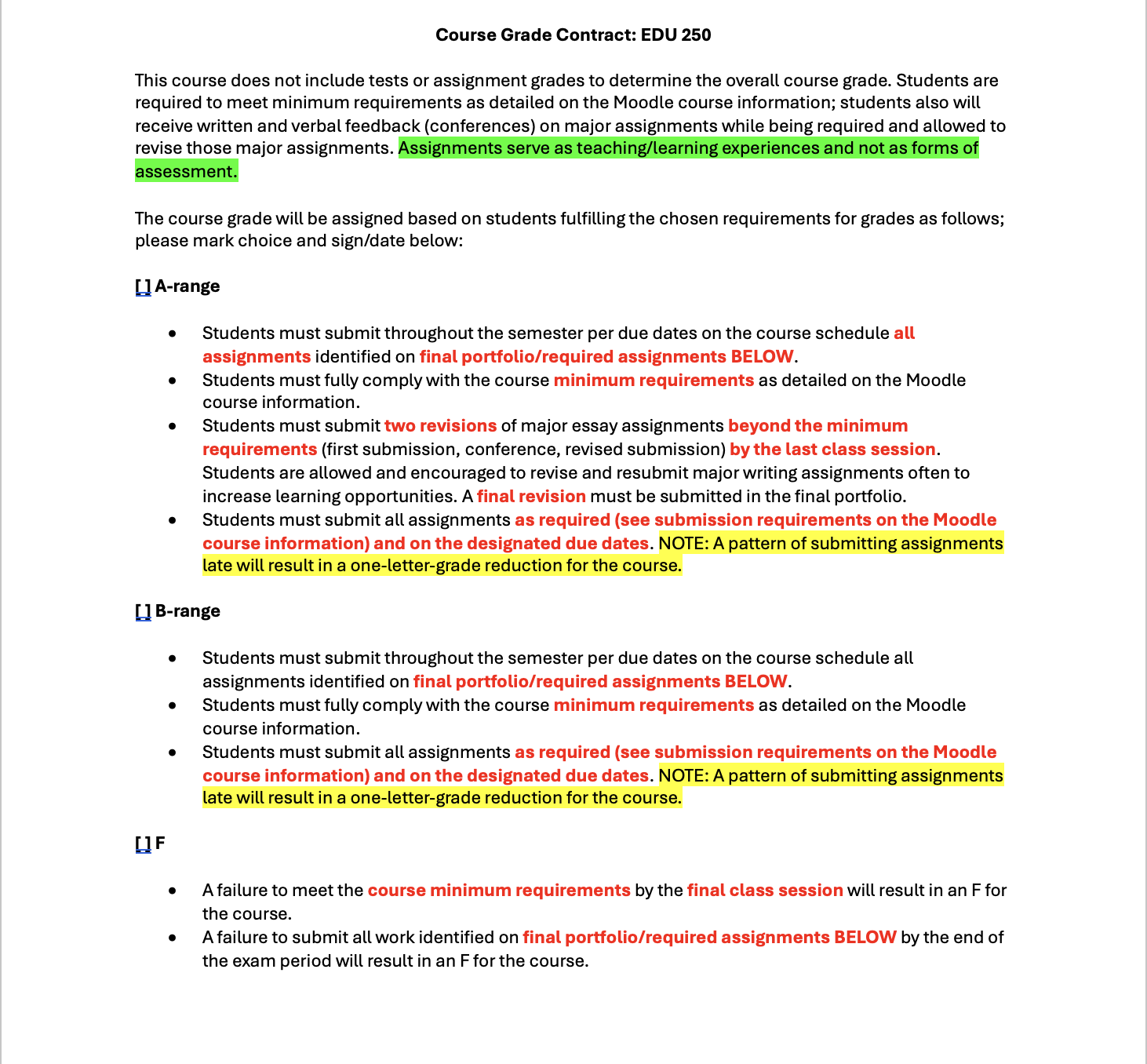
The first iteration of the course grade contract, then, focused on requiring students to submit, conference, and revise essays; I structured A and B course grades around minimum standards for the B-range (submit an acceptable essay, conference after receiving my feedback, and submit one acceptable revision that addresses the feedback) and additional revisions after more feedback for the A-range.
Despite the course grade being explicitly linked to minimum expectations for the process, students continue to see my feedback as negative and harsh, but also remain trapped in the possibility of submitting a perfect essay and never having to complete revisions.
In short, they see the essay assignment as a form of assessment and cannot fully engage in the submitting/revising process as individualized teaching and learning experiences.
Oddly, students continue to email me apologizing for their first submissions because they see the revision-oriented feedback, again, as negative or harsh—evaluative—and not a necessary part of essay assignment as teaching and learning.
The semester ending now, in fact, proved to me that using the course grade contract to shift assignments from forms of assessment to teaching/learning experiences (like the midterm exam period as a class discussion) needed another round of revision by me.
The problems I am still encountering include students struggling in content-focused courses (where they expect traditional tests and are not expecting to be challenged as thinkers and writers) because of the absence of tests/grades as well as the course structure that forefronts course content in the first half of the semester and mostly implements workshop the second half.
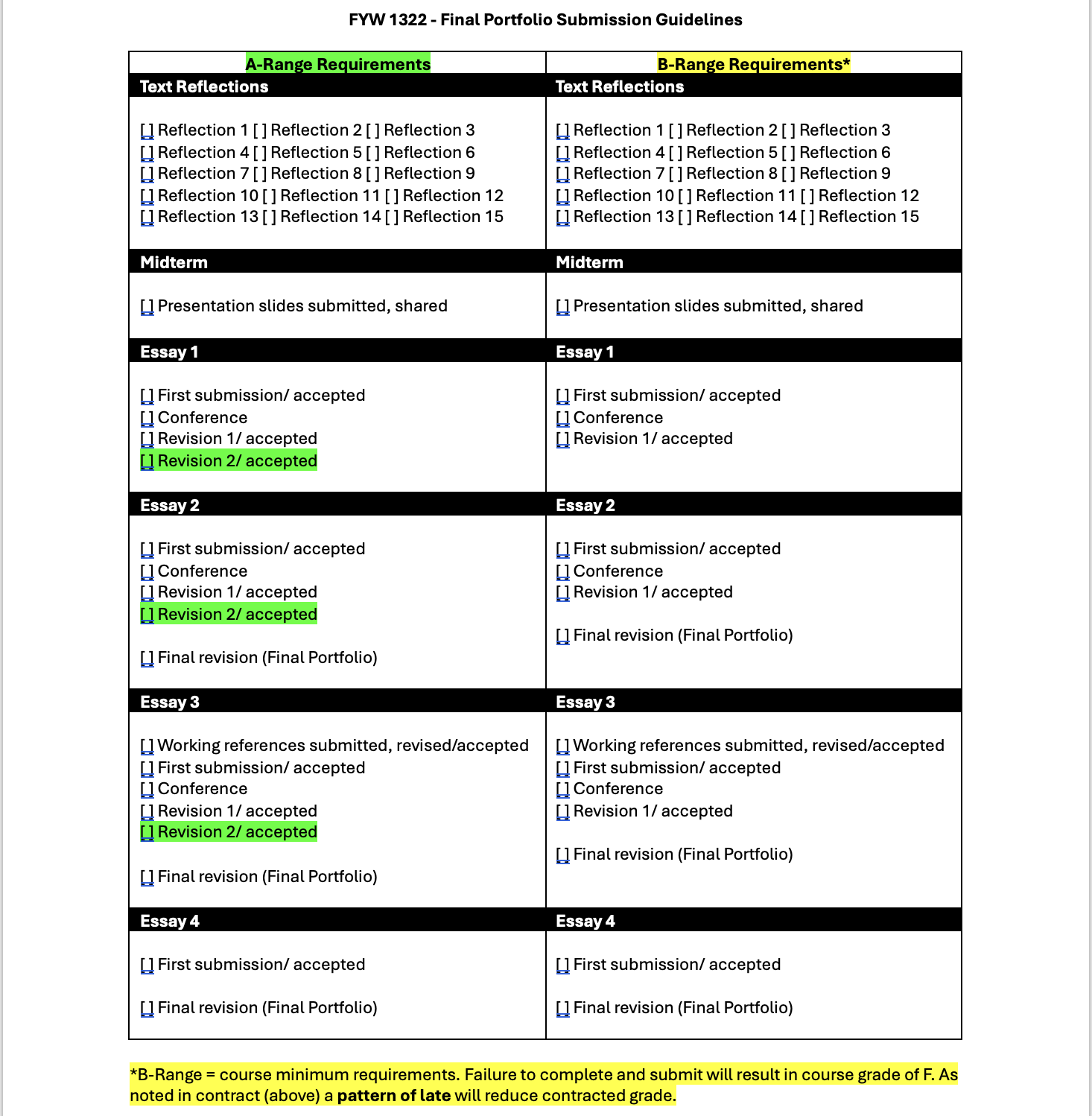
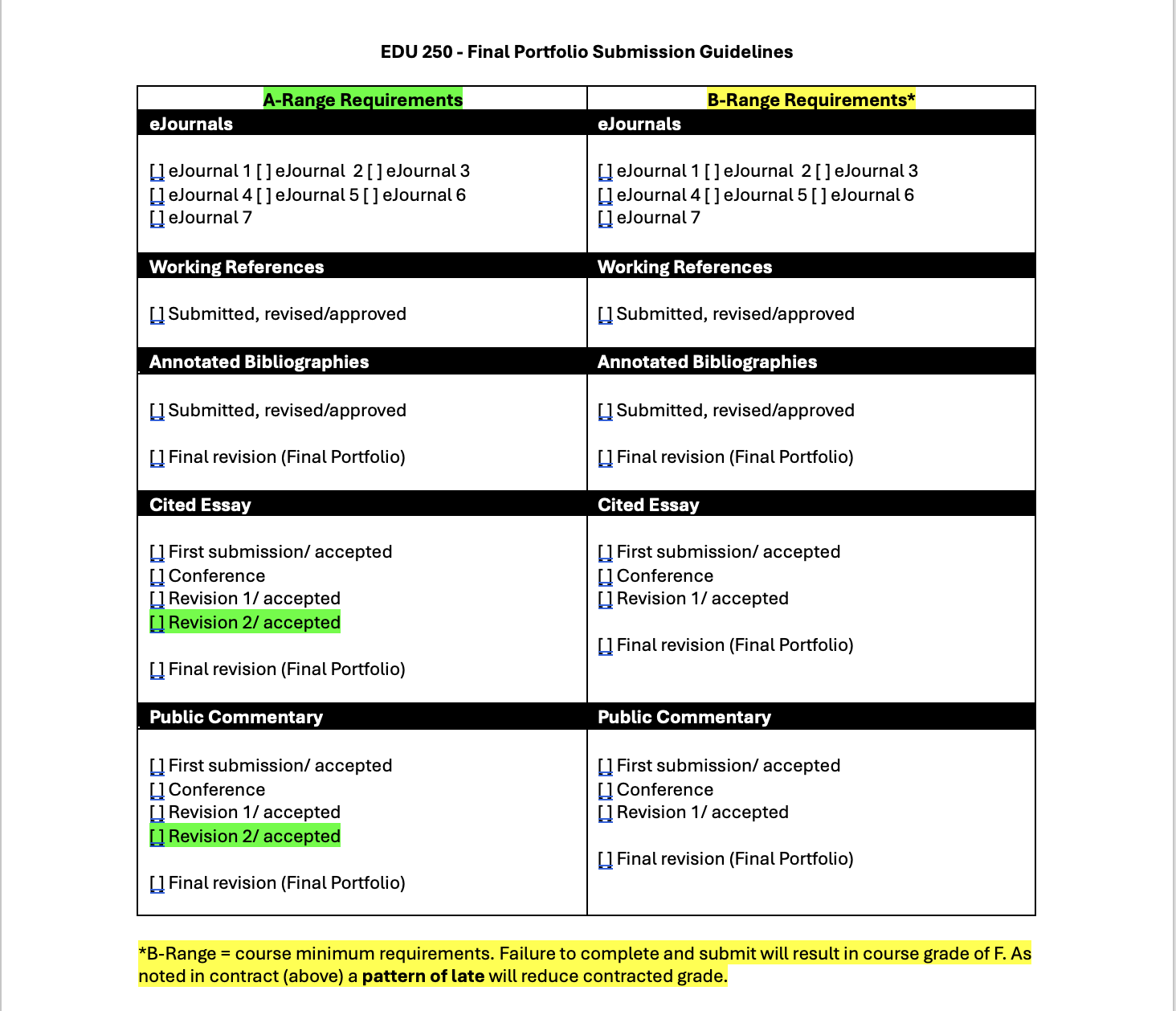
Here, then I want to share the new versions of those contracts to be implemented in spring. I have more explicitly included language about the purpose of the contract and added the final portfolio expectations in a format that also is more explicit about assignment expectations as well as fulfilling the contracted grade.
The problem will remain, however, that I teach students conditioned for more than 2/3 of their lives in a culture of tests and grades, a culture that has taught them that assignments as by the teacher for evaluation and not for the student as teaching and learning.
I am seeking ways to shift the culture of teaching and learning as well as my students’ expectations for what it means to be a student and a teacher.
These are big asks for those students, but I am convinced they can make those shifts and benefit greatly from doing so.
“Misinformation has received much public and scholarly attention in recent years,” write Ecker et al. in Why Misinformation Must Not Be Ignored, adding, “The fundamental question of how big a concern misinformation should be, however, has become a hotly debated topic.”
They argue and conclude, as noted in the abstract:
Here, we rebut the two main claims, namely that misinformation is not of substantive concern (a) due to its low incidence and (b) because it has no causal influence on notable political or behavioral outcomes. Through a critical review of the current literature, we demonstrate that (a) the prevalence of misinformation is nonnegligible if reasonably inclusive definitions are applied and that (b) misinformation has causal impacts on important beliefs and behaviors. Both scholars and policymakers should therefore continue to take misinformation seriously.
While this compelling examination of misinformation focuses broadly, their focus and conclusion are applicable to the current “science of reading” (SOR) movement that is grounded in misinformation, yet has proved to be highly compelling for the public and then has driven new and revised reading legislation across nearly every state in the US.
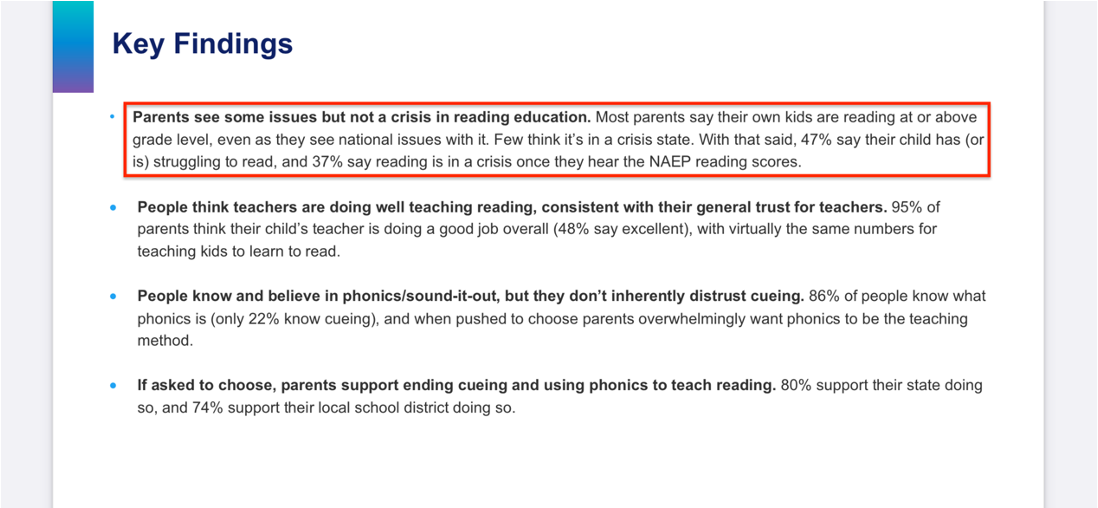
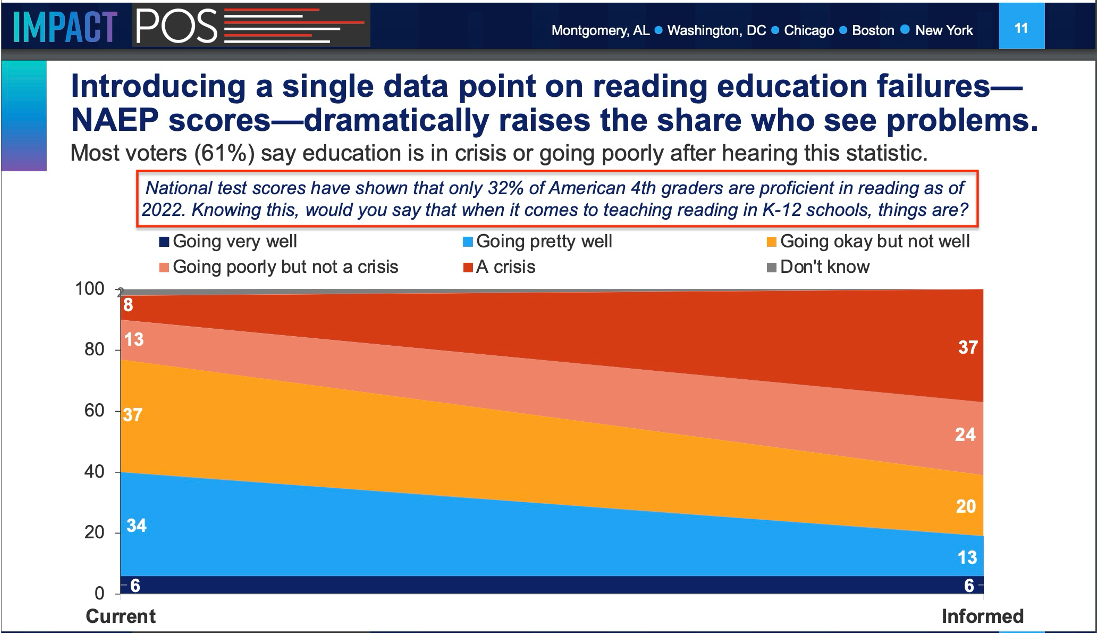
The misleading media claim about reading proficiency (because of the confusing categories in NAEP testing) actually changes parental opinion about reading achievement from positive to negative.
Although the SOR story about reading has become “holy text,” the foundational claims of a reading crisis and the causes of that supposed crisis are both false and mischaracterizations.
This influx of misinformation about reading proficiency and reading instruction has created a false story about reading teachers and teacher educators as “bad” teachers and imposed on students a one-size-fits-all and whitewashed set of reading reading
Further, this misinformation campaign about reading proficiency, reading instruction, and reading science is also a serious distraction from the real challenges facing learning and teaching reading.
The US is, as the authors propose, increasingly a misinformation nation, and that dynamic has reignited the corrosive “crisis” and reform cycles in US education, specifically in terms of reading and math.
The US is in a state of perpetual and manufactured crisis/reform in education that serves the interests of the media, political leaders, and the education market place, but harms teachers and students.
Here, then, is a reader that addresses that misinformation by offering a more nuanced and evidence-based examination of the outsized impact of out-of-school factors on student learning, the complicated facts about “reading proficiency” and NAEP testing, and the false stories driving the SOR movement:
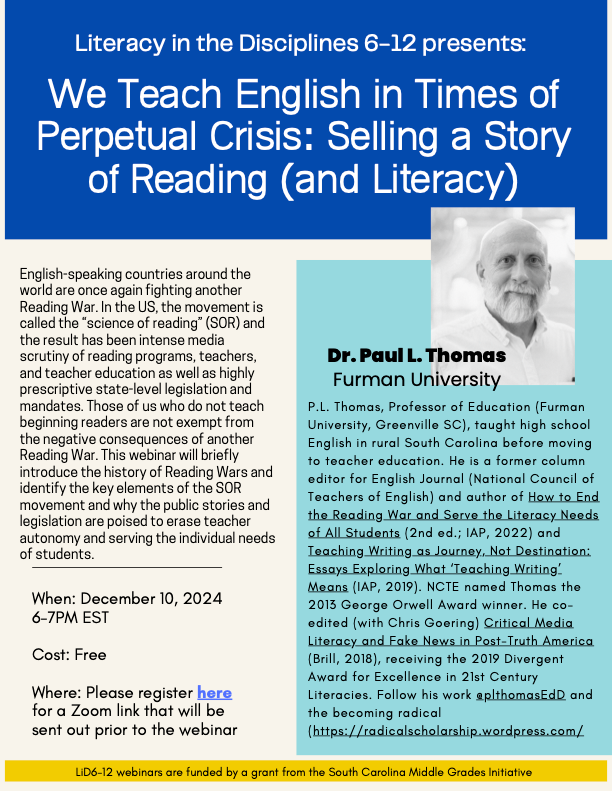
Thomas, P.L. (2024, May). Teaching English in the “science of reading” era: We teach English in times of perpetual crisis: Selling a story of reading. English Journal, 113(5), 16-22. https://publicationsncte.org/content/journals/10.58680/ej2024113516 [Access HERE until open access at EJ]
Thomas, P.L. (2024, November). We teach English in times of perpetual crisis: For all ELA teachers, “the time is always now.” English Journal, 114(2), 21-26. TBD
Note
Ecker, U. K. H., Tay, L. Q., Roozenbeek, J., van der Linden, S., Cook, J., Oreskes, N., & Lewandowsky, S. (2024). Why misinformation must not be ignored. American Psychologist. Advance online publication. https://dx.doi.org/10.1037/amp0001448
The more things change, the more things stay the same.
Especially in America.
F. Scott Fitzgerald’s The Great Gatsby, set in the 1920s, centers the story on a few rich characters—Tom and Daisy Buchanan, who have “old” money, as well as Jay Gatsby, representing the nouveau riche.
At the cusp of 2024 and 2025, a century later, one page from the novel seems disturbingly relevant:
In this scene, Fitzgerald uses Buchanan to portray the rise of scientific racism in the US. The scientific racism era in the early 20th century is but one of many examples of how “science” can be used by bad faith actors to promote an ideological agenda.
It isn’t his fault, Buchanan seems to suggest, that he is among the superior white Western civilization: “‘It’s all scientific stuff; it’s been proved.'”
In recent years in the US, navigating science, proof, and science skepticism has reach a level of complexity that defies postmodern thought. Simultaneously, we may be living in the most advanced era of scientific knowledge along side a rising and powerful science-skepticism era.
Vaccination deniers, flat Earthers, and Covid conspiracy theorists have increasingly prominent voices and policy influence due to social media, and the Trump era certainly has eroded how most people understand and what counts as “proven” science.
“Science” as Bad Faith Bullying: Education Edition
Concurrent to the larger political and cultural problems with “science” and science-denial, the education reform movement grounded in the early 1980s accountability movement has adopted “science” as a bad faith bullying approach to reform.
The “science of reading” (SOR) movement [1], essentially driven by conservative ideology, exploded around 2018 under the first Trump administration, and now, SOR has spawned a series of “science of” companion movements—the “science of math,” “the science of learning,” etc.
We may have reached peak “science” as bad faith bullying, however, with a law suit against Heinemann and a few reading programs [2] disproportionately attacked and scapegoated by Emily Hanford and much of mainstream media: “The suit alleges ‘deceptive and fraudulent marketing and sale of products and services which are undermining a fundamental social good: literacy.'”
If this weren’t yet another personal attack on a few literacy leaders and potentially significant waste of time and money to navigate the nonsense of this legal move, it would be funny since the SOR movement itself is practicing exactly what the suit accuses Heinemann of doing, “fraudulent marketing and sale of products.”
Let’s start with the foundational argument among SOR advocates that teaching practices must be grounded only in practices supported by experimental/quasi-experimental research published in peer review publications, as argued by The Reading League:
While I think these standards are too narrow for real-world practice, this is in fact the basis upon which SOR advocates (and the substance of the law suit) rest sweeping and misleading claims about a range of discounted practices labeled as either whole language or balanced literacy (SOR advocates both interchange and mischaracterize these terms repeatedly along with misrepresenting other terminology such as “three cueing”).
Further, the SOR movement has adopted an old and inaccurate assertion about “science,” echoing Tom’s “‘it’s been proved.'”
Similar to the reading crisis rhetoric from 1961—when Walcutt announces: “We have said that no further ‘research’ into methods of reading instruction is necessary” (p. 141)—Hanford and Moates proclaimed SOR “settled science” in 2018 (and we must note Moates has a huge market interest in these claims as author of LETRS, see below):
However, the “science” in reading research is not settled, and the SOR movement, as I stated above, is committed to a “deceptive and fraudulent marketing and sale of products and services”; as I have shown repeatedly, the SOR movement is itself grounded in a plan from 2014 to brand “structure literacy” to “help us sell what we do so well.”
That plan has included exaggerated attacks on some reading programs, some literacy leaders, and some literacy practices while simultaneously endorsing different programs and some practices that are also not supported by SOR’s mandate for a narrow type of “science.”
For example, in a literature review of the current status of SOR from 2022, note that practices either ineffective or lacking scientific support include those rejected by SOR and those embraced by SOR; while this lit review identified “three cueing” as not supported by science as SOR advocates claims, it also lists decodable texts and multisensory approaches (such as Orton-Gillingham), practices and programs aggressively supported by SOR advocates and legislation:
That pattern is standard practice in the SOR movement, including the false attack on teacher education and teacher knowledge being used as “science” as bad faith bullying to sell LETRS.
LETRS falls into the “ineffective and currently unsupported” category as well since only a few studies exist, showing no improvement in student reading.
The SOR movement has also adopted slogans not supported by science (95% of students can be proficient readers) and practices that inflate test scores, target and harm marginalized groups of students, but are not supported by research (grade retention, which seems to be the sole SOR policy impacting test scores).
The “science of” era of education reform is not about improving instruction or student learning. The movement uses “science” as a Trojan horse for de-professionalizing teaching and teachers (selling scripted curriculum) while clearing market space for a new round of “fraudulent marketing and sale of products.”
The law suit is another example showing this “science of” education reform movement is more bad faith bullying than a credible avenue to better supporting teachers and better serving students as readers and learners.
[2] I reject adopting any reading programs and maintain that the reading-program-merry-go-round is the problem, not the solution to reading achievement.
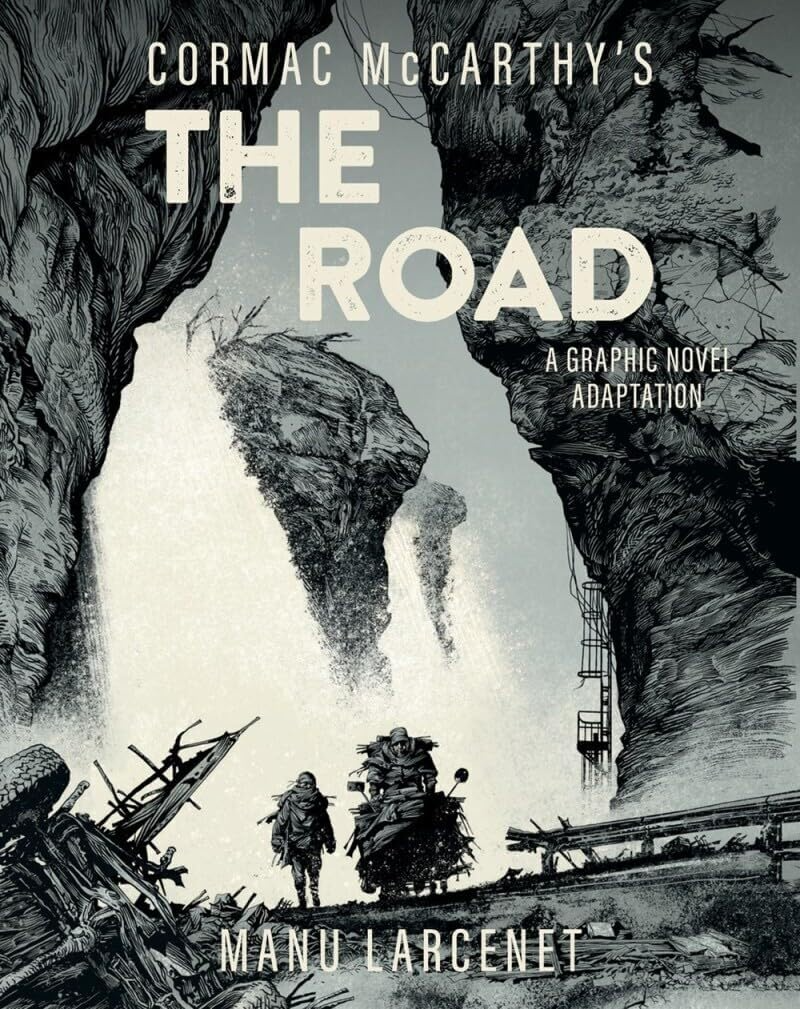
Although a Vanity Fair article has framed Augusta Britt as Cormac McCarthy’s “muse,” Moira Donegan argues in The Guardian that McCarthy, in fact, groomed and took advantage of Britt.
Below, while I discuss positively McCarthy’s work and adaptations of that work, I want to acknowledge the serious concerns being raised about McCarthy as a person. He represents yet another problem with confronting deeply flawed and even abusive people against the context of what many believe are praiseworthy accomplishments.
Larcenet’s Graphic Adaptation of McCarthy’s The Road
Cormac McCarthy’s novel The Road won the Pulitzer Prize in 2007. Then in 2009, it was adapted into a major film starring Viggo Mortensen and Charlize Theron.
Larcenet made a personal appeal to McCarthy to allow him to adapt “The Road.” Praising its atmosphere, Larcenet wrote, “I enjoy drawing the snow, the chilling winds, the dark clouds, the sizzling rain, tangles and snags, rust, and the damp and the humidity. I draw violence and kindness, wild animals, dirty skin, pits and stagnant water.”
McCarthy’s novel is a stark post-apocalyptic narrative that seemed perfect for both film and now a graphic adaptation. It isn’t that McCarthy’s text isn’t enough; it is that the humanity and inhumanity of this cold barren world become even more painful for the viewer and reader through the different visual media.
Roe adds about the connection between text and graphic depiction:
“I have no other ambitions but to draw your words,” Larcenet wrote. “The magical part of being an illustrator is to find a silent line to draw with every word. These lines could support yours without distorting them. At least, that’s the goal if this project should come to fruition.”
Since The Road has already been made into a film, some may wonder why this graphic novel version is needed:
“On top of that, I’ve been racking my brain to avoid any reference to the movie adaptation,” Larcenet wrote to McCarthy. “I usually write my own comics, one of which (‘Blast’) shares common themes with your book. But I didn’t write ‘The Road’; I really wish I had! I sincerely thank you for allowing me to put my pencil down where your pen went.”
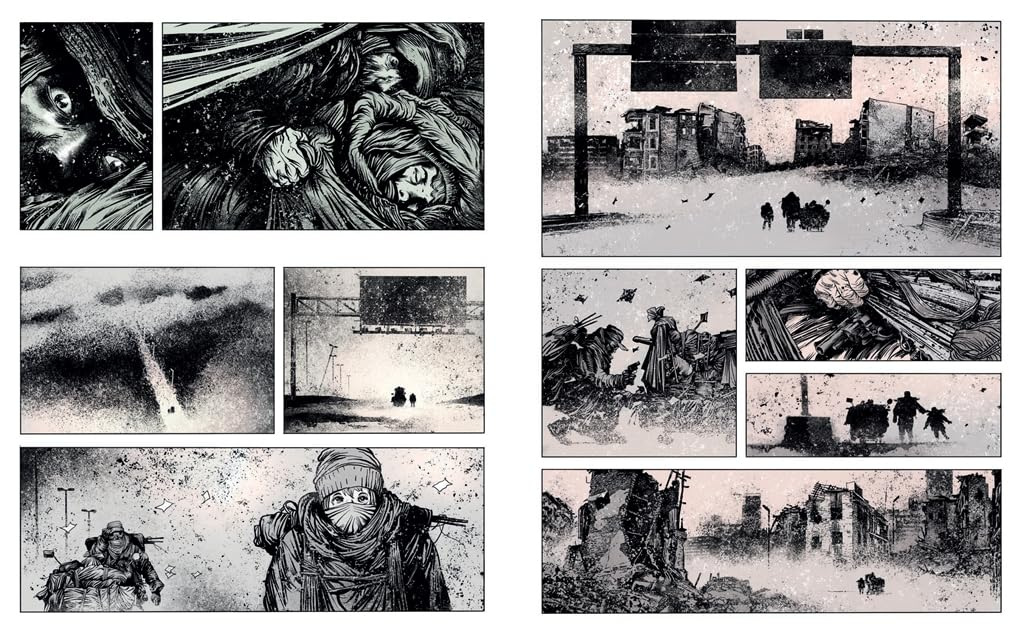
Appropriately, then, Larcenet’s adaptation is sparse in wording (many panels and pages are wordless), yet highly detailed in the mostly black-and-white artwork, augmented with subtle washes of coloring. The result is page after page that is mesmerizing and horrifying:
So why do we need yet another version of The Road?
I have read the novel and seen the film, but as a life-long comic book collector, I of course ordered Larcenet’s adaptation. But, frankly, I did so as a collector, thinking I would glance through the book because I do love sequential art.
Then, I found myself reading, lingering on pages and panels. Over a couple sittings, yes, I read the entire adaptation.
I cried. I paused because the story is often overwhelming.
This is the same and a different experience than the novel and the film.
I can’t say we need another version of McCarthy’s novel, but I do say we have been gifted by this beautiful and haunting graphic adaptation.
And since the narrative itself examines the good guys/bad guys dynamic through a child who has had his innocence ripped from him by a calloused world, we too must confront this duality in reality as we try to navigate the flawed artist and the art we love.
In 1947, writing in NCTE’s Elementary English (which became Language Arts), Lou LaBrant announced, “This is not the time for the teacher of any language to follow the line of least resistance, to teach without the fullest possible knowledge of the implications of his medium” (p. 94).
The 2020s have made this call even more important for teachers of language K-12 in the US because of the rise of censorship and curriculum gag orders along with legislative mandates including scripted curriculum as part of the “science of reading” (SOR) movement.
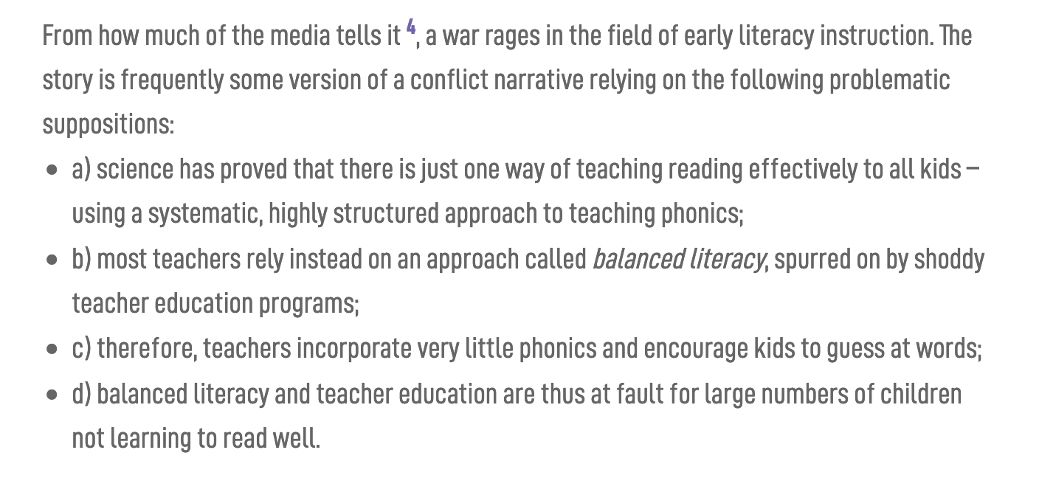
Here, I want to focus on the SOR movement as another cycle of the Reading War, one that threatens the professionalism and autonomy of all teachers at every level.
2018: The SOR movement driven by media (traditional journalism and podcasts) and political mandates
Teachers must recognize that Reading War cycles tend to be about ideology, market concerns (reading programs), and political agendas, but not grounded in credible evidence or well focused on the needs of students or the professionalism of teachers.
Also when I address the SOR movement, I am not contesting reading science or valid concerns about reading instruction or reading proficiency by students. I am challenging the media story being sold:
Further, teachers at all levels must be familiar with the key issues for misleading and even inaccurate claims within the SOR movement (again distinct from reading science and a broad base of research over a century):
The media claim about reading proficiency (which is false because of the confusing categories in NAEP testing) actually changes parental opinion from positive to negative.
More broadly, the phonics agenda in the Reading War is driven by the same conservative ideology as book bans.
One example is the advocacy of the Gablers in the 1980s, featured in a article in Texas Monthly:
But the Gablers also feel that even those students who learn to read through intensive phonics, memorize their ‘times tables,’ diagram sentences perfectly, and win spelling bees and math contests must still cope with an educational system that is geared to undermining their morals, their individuality, their pride in America, and their faith in God and the free enterprise system. Much of this corrosive work is accomplished through textbooks in history, social sciences, health, and homemaking.
The Gablers also targeted textbooks in their crusade similar to the book bans and misguided attacks on some reading programs:
Norma and Mel Gabler entered the field of textbook reform twenty years ago, after their son Jim came home from school disturbed at discrepancies between the 1954 American history text his eleventh-grade class was using and what his parents had taught him. The Gablers compared his text to history books printed in 1885 and 1921 and discovered differences. “Where can you go to get the truth?” Jim asked.
Since states have been moving toward reading legislation and programs labeled as SOR since around 2012, the evidence is mounting that these misleading and ideological claims of a reading crisis have not (and cannot) deliver on their promises. [1]
But possibly more troubling than the failure to improve student reading proficiency is that these legislative commitments are wasting taxpayers’ money on another baseless Reading War that serves the interests of the education marketplace: “In the first year of implementation, $100 million was allocated for the reform, with $60 million coming from CO VID-19 relief funds. Most of these resources, however, went toward covering the products and services provided by nonprofit and private-sector organizations” (Aydarova, 2023, p. 570).
At its July 1st meeting, the IDA Board of Directors made a landmark decision designed to help market our approach to reading instruction. The board chose a name that would encompass all approaches to reading instruction that conform to IDA’s Knowledge and Practice Standards. That name is ‘Structured Literacy.’…
If we want school districts to adopt our approach, we need a name that brings together our successes. We need one name that refers to the many programs that teach reading in the same way. A name is the first and essential step to building a brand….
The term “Structured Literacy” is not designed to replace Orton Gillingham, Multi-Sensory, or other terms in common use. It is an umbrella term designed to describe all of the programs that teach reading in essentially the same way. In our marketing, this term will help us simplify our message and connect our successes. “Structured Literacy” will help us sell what we do so well.
Structured literacy is more a marketing term than a proven way to address the manufactured reading crisis; further, structured literacy accomplishes two outcomes that are counter-educational—de-professionalizing teachers and whitewashing the reading curriculum. [2]
In the EAC’s plan for the transformation of the profession into an evidence-based system, educators will relinquish certain freedoms — notably the leeway to employ ineffective practices — but will gain guidance that empowers them to fulfill their original purpose by profoundly impacting the future of students, families and communities. The alternative is to continue rearranging the deck chairs under the guise of education reform.
Since over 75% of public school teachers are women (Report on the Condition of Education 2024), all educators, regardless of content area or grade level, must recognize the threat of “relinquish certain freedoms,” eeriely similar to arguments posed to Handmaid’s in Atwood’s The Handmaid’s Tale:
There is more than one kind of freedom, said Aunt Lydia. Freedom to and freedom from. in the days of anarchy, it was freedom to. Now you are being given freedom from. Don’t underrate it….
We were a society dying, said Aunt Lydia, of too much choice. (pp. 24, 25)
While these efforts are about power and control, the SOR movement includes a harmful pattern of journalists taking on the role of “watchdogs,” as Hanford claims for the Education Writers Association.
Finally, then, the SOR movement is not just another Reading War, and the SOR movement is far more than an immediate concern for beginning reading teachers and teacher educators.
This movement is another threat to teaching as a profession, an organized agenda that seeks ways to de-professionalize teachers while serving market and political goals at the expense of teaching and learning.
Recommended
Betts, E. A., Dolch, E. W., Gates, A. I., Gray, W. S., Horn, E., LaBrant, L., Roberts, H., Smith, D. V., Smith, N. B., & Witty, P. (1942). What shall we do about reading today? A symposium. The Elementary English Review, 19(7), 225– 256. https://www.jstor.org/stable/41382636
Thomas, P.L. (2024, May). Teaching English in the “science of reading” era: We teach English in times of perpetual crisis: Selling a story of reading. English Journal, 113(5), 16-22. https://publicationsncte.org/content/journals/10.58680/ej2024113516 [Access HERE until open access at EJ]
Thomas, P.L. (2024, November). We teach English in times of perpetual crisis: For all ELA teachers, “the time is always now.” English Journal, 114(2), 21-26. TBD
Thomas, P.L. (2022). The Science of Reading movement: The never-ending debate and the need for a different approach to reading instruction. Boulder, CO: National Education Policy Center. Retrieved [date] from http://nepc.colorado.edu/publication/science-of-reading
Aydarova, E. (2023). ‘Whatever you want to call it”: Science of reading mythologies in the education reform movement. Harvard Educational Review, 93(4), 556–581, https://doi.org10.17763/1943-5045-93.4.556
Chaffin, M., Riesco, H.S., Hacket-Hill, K., Collet, V., Grizzle, M.Y., Y Warren, J. (2023). “Phonics monkeys” and “real life reading”: Heteroglossic views of a state reading initiative. Literacy Research and Instruction, 1–22. https://doi.org10.1080/19388071.2023.2271085
Reinking, D., Hruby, G.G., & Risko, V.J. (2023). Legislating phonics: Settle science of political polemic? Teachers College Record. https://doi.org/10.1177/01614681231155688
Thomas, P.L. (2022). The Science of Reading movement: The never-ending debate and the need for a different approach to reading instruction. Boulder, CO: National Education Policy Center. http://nepc.colorado.edu/publication/science-of-reading
[2] See for example:
Chaffin, M., Riesco, H.S., Hacket-Hill, K., Collet, V., Grizzle, M.Y., Y Warren, J. (2023). “Phonics monkeys” and “real life reading”: Heteroglossic views of a state reading initiative. Literacy Research and Instruction, 1–22. https://doi.org10.1080/19388071.2023.2271085
Rigell, A., Banack, A., Maples, A., Laughter, J., Broemmel, A., Vines, N., & Jordan, J. (2022, November). Overwhelming whiteness: A critical analysis of race in a scripted reading curriculum. Journal of Curriculum Studies, 54(6), 852–870, https://doi.org10.1080/00220272.2022.2030803.
Hoffman, J.V., Hikida, M., & Sailors, M. (2020). Contesting science that silences: Amplifying equity, agency, and design research in literacy teacher preparation. Reading Research Quarterly, 55(S1), S255–S266. Retrieved July 26, 2022, from https://doi.org/10.1002/rrq.353
educator, public scholar, poet&writer – academic freedom isn't free















 dr. p.l. (paul) thomas