For people not in the field of education, A Nation at Risk is either a hazy (or nonexistent) footnote of history or a pedestrian (and obvious) claim that didn’t need a government committee to announce—US public education is a failure.
However, for all its fanfare and eager media coverage, the real significance of the politically driven report is that it set in motion a pattern still vibrant in 2023; mainstream media is constantly fanning the flames of “manufactured crisis.”
A Nation at Risk was a media, public, and political hit, but scholars were quick to note that the claims in the report were overstated, oversimplified, and lacking any credible evidence [1].
In short, manufactured.
From the early 1980s and into the 2020s, mainstream education journalism has hopped feverishly from crisis to crisis and endorsed boondoggle after boondoggle—never once stopping to say “My bad!” or to pause, step back, and reconsider their template.
When the state takes the quantified depiction of schooling that educational researchers provide and uses it to devise a plan for school reform, the best we can hope for is that the reform effort will fail. As the history of school reform makes clear, this is indeed most often the outcome. One reform after another has bounced off the classroom door without having much effect in shaping what goes on inside, simply because the understanding of schooling that is embodied in the reform is so inaccurate that the reform effort cannot survive in the classroom ecology. At worst, however, the reform actually succeeds in imposing change on the process of teaching and learning in classrooms. Scott provides a series of horror stories about the results of such an imposition in noneducational contexts, from the devastating impact of the collectivization of agriculture in the Soviet Union to the parallel effect of imposing monoculture on German forests. The problem in all these cases is that the effort to impose an abstract technical ideal ends up destroying a complex distinctive ecology that depends on local practical knowledge. The current efforts by states across the globe to impose abstract technical standards on the educational village bear the signs of another ecological disaster.
As a result, a stunningly harmful pattern has emerged:
Amanda Ripley was wrong about Michelle Rhee.
Jay Matthews and Paul Tough were wrong about “no excuses” charter schools and Teach For America.
David Brooks was wrong about “miracle” charter schools (and everything else).
[Insert journalist] was wrong about Common Core and VAM.
And now, rest assured it will come to pass, Emily Hanford and Natalie Wexler are wrong about the “science of reading.”
Remember Waiting for Superman?
Sold a Story and The Truth about Reading are the same melodramatic misinformation campaign depending on an uninformed public to sell yet another educational crisis.
There will be no reckoning; there never is.
But some day (soon?) the “science of reading” histrionics will be a faint memory while everyone scrambles to the next education manufactured crisis.
The only things not to be addressed, of course, are the actual needs of students, teachers, and universal public education.
From late November of 2022 through late February 2023, I have (or will have) presented at 6 major literacy conferences, both national and state level.
Two dominant literary issues have been curriculum/book bans and the “science of reading” (SOR) movement. A few important patterns occurred with the latter.
Many teachers are overwhelmed and discouraged about the heavily negative messaging around SOR, but I also interacted with teachers not fully aware of the magnitude of this movement and remain puzzled about the controversy.
Further, the media, public, and political story around reading and teaching reading is the primary message reaching both educators and the public. The robust scholarly criticism of SOR [1] is often welcomed by teachers and administrators, but unless they are attending conferences, these critique goes unnoticed.
Scholars and educators have been backed into a corner since the SOR story is grounded in a great deal of blame, hyperbole, misinformation, and melodrama.
The media SOR story is simple to the point of being false, but simple in a way that is very compelling for people outside the field of literacy.
Here, I want to put some pieces together, and offer a place to hold the SOR movement/story to the same standards demanded by advocates of SOR (specifically The Reading League).
First, let’s start with the core of the scholarly critiques of mainstream media’s story:
Hoffman, J.V., Hikida, M., & Sailors, M. (2020). Contesting science that silences: Amplifying equity, agency, and design research in literacy teacher preparation. Reading Research Quarterly, 55(S1), S255–S266. Retrieved July 26, 2022, from https://doi.org/10.1002/rrq.353
While scholarly critiques (see note 1) are far more nuanced and substantive that this central point, this is a manageable way to interrogate whether or not the SOR story is valid based on the standards the movement itself established.
The debate, then, is well represented by conflicting evaluations of SOR and SOR criticism on social media: a literacy scholar and co-author of an SOR reading program called the scholarly criticism “stupid,” and a policy scholar not in literacy noted that the media story is “facile.”
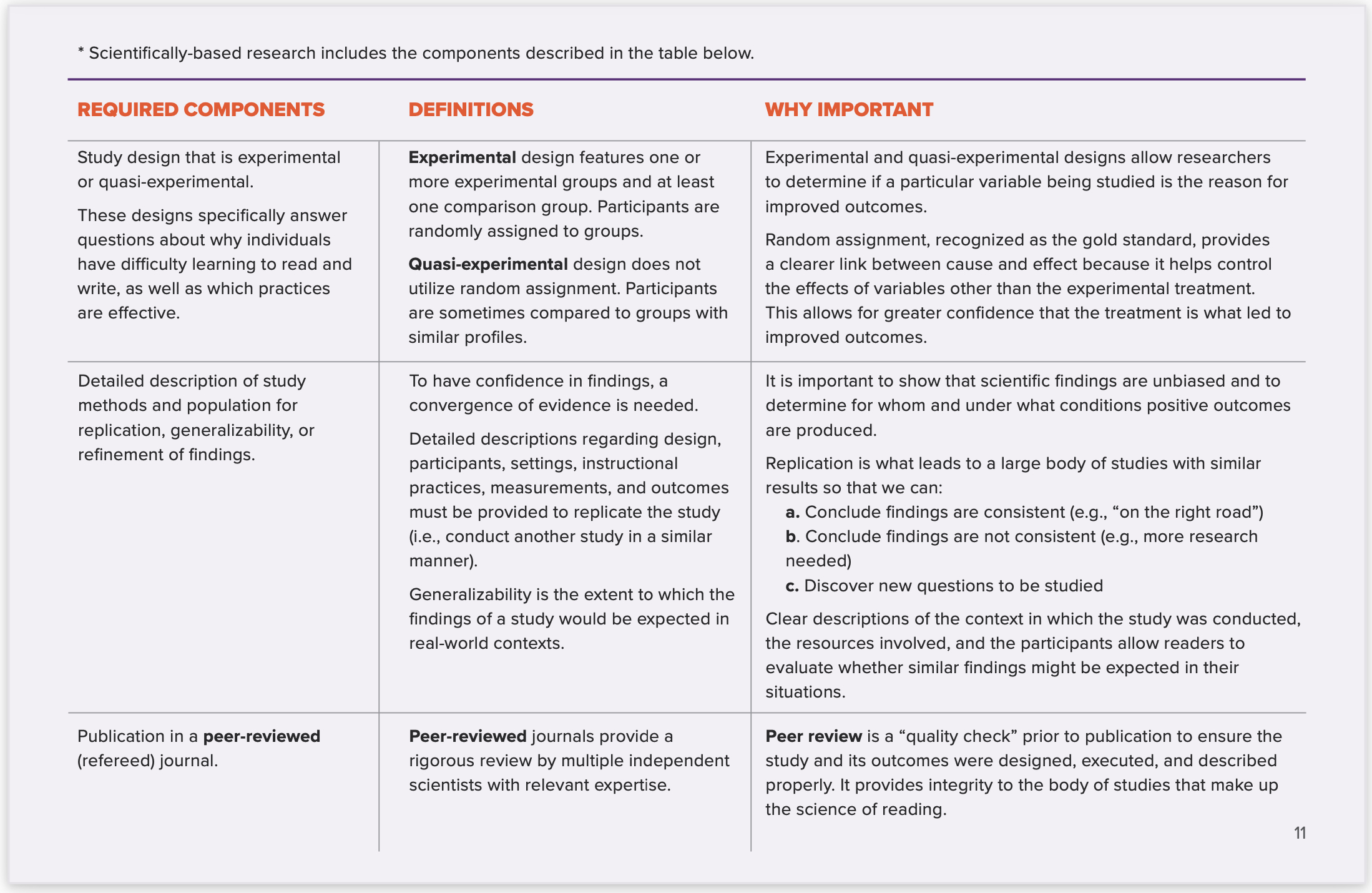
To determine which is valid—the SOR story or the scholarly criticism—that story must be checked against the standards for science established by the movement itself, here from The Reading League:
Finally, the components of the SOR story must be identified in order to check the science behind the claims and the anecdotes; consider Aukerman’s overview:
Below, I outline the SOR story and identify current scientific research, or lack thereof, limiting the evidence to TRL’s guidelines (experimental/ quasi-experimental, published in peer-reviewed journals).
1
First, for the rest of the SOR story to hold up to scientific scrutiny, we must establish whether or not there is a unique reading crisis in the last 10-20 years in which students are failing to learn to read at acceptable rates; this must be true for the blame aspects of the SOR movement to be true.
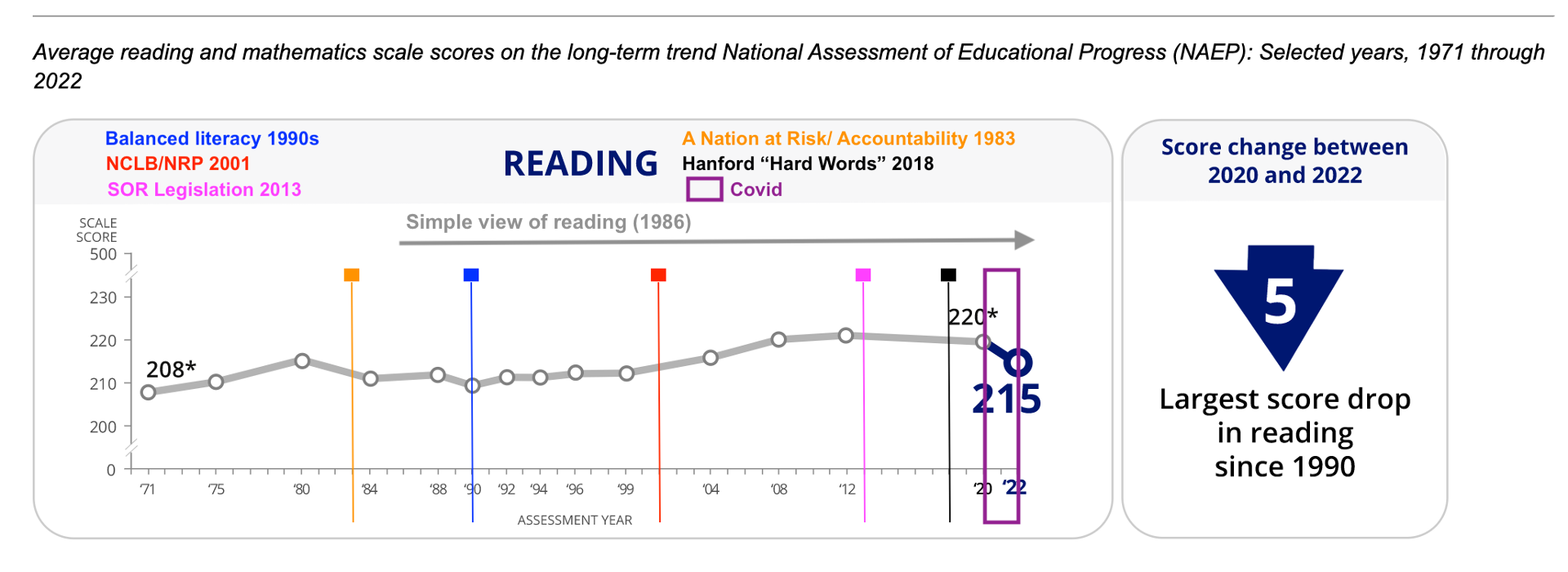
What is the status of scientific research supporting this claim? There is no current scientific research to support this claim; most scholars have identified that NAEP [2] (and other measures of reading achievement) have remained flat and achievement gaps have remained steady as well for many decades predating the key elements blamed for reading failures.
Note that the age 9 longitudinal data including actual scores appears mostly flat with some fluctuation. (Source)NAEP age 9 reading appears mostly flat after A Nation at Risk, mostly flat with some trending upward during the 1990s BL era, increasing after the federal pressure of NCLB in 2001, and then flat since the rise of SOR legislation around 2013.
Notably the long-term NAEP data during the recent SOR era for 9 and 13 year olds is relatively flat or unchanged except for lowest performing students:
2
Next, the SOR story claims teachers are not well prepared to teach reading and teacher educators either fail to teach evidence-based methods or willfully ignore the science.
What is the status of scientific research supporting this claim? There is no current scientific research to support this claim [3] although scholars have demonstrated that credible research is available on teacher knowledge of reading and teacher education:
Hoffman, J.V., Hikida, M., & Sailors, M. (2020). Contesting science that silences: Amplifying equity, agency, and design research in literacy teacher preparation. Reading Research Quarterly, 55(S1), S255–S266. Retrieved July 26, 2022, from https://doi.org/10.1002/rrq.353
3
The media story claims the current settled reading science is the “simple view” of reading.
What is the status of scientific research supporting this claim? Scientific research refutes this claim:
Duke, N.K. & Cartwright, K.B. (2021). The science of reading progresses: Communicating advances beyond the simple view of reading. Reading Research Quarterly, 56(S1), S25-S44. https://doi.org/10.1002/rrq.411
[UPDATE]
Burns, M. K., Duke, N. K., & Cartwright, K. B. (2023). Evaluating components of the active view of reading as intervention targets: Implications for social justice. School Psychology, 38(1), 30–41. https://doi.org/10.1037/spq0000519
4
The SOR story centers a claim that systematic phonics instruction is superior to all other approaches to teaching beginning readers and thus necessary for all students.
What is the status of scientific research supporting this claim? Current scientific research refutes this claims, showing that systematic phonics is no more effective than other approaches (balanced literacy, whole language) and confirming that systematic phonics can increase early pronunciation advantages but without any gains in comprehension and with that advantage disappearing over time:
Bowers, J.S. (2020). Reconsidering the evidence that systematic phonics is more effective than alternative methods of reading instruction. Educational Psychology Review, 32(2020), 681-705. https://link.springer.com/article/10.1007%2Fs10648-019-09515-y
Wyse, D., & Bradbury, A. (2022). Reading wars or reading reconciliation? A critical examination of robust research evidence, curriculum policy and teachers’ practices for teaching phonics and reading. Review of Education, 10(1), e3314. https://doi.org/10.1002/rev3.3314
Bowers, J.S. Yes Children Need to Learn Their GPCs but There Really Is Little or No Evidence that Systematic or Explicit Phonics Is Effective: a response to Fletcher, Savage, and Sharon (2020). Educ Psychol Rev33, 1965–1979 (2021). https://doi.org/10.1007/s10648-021-09602-z
Mississippi has been heralded in the SOR story as a key example of the success of SOR reading policy, based on MS 2019 grade 4 reading scores.
What is the status of scientific research supporting this claim? There is no current scientific research to support this claim, and the SOR story omits that MS has had steady grade 4 reading improvement since the early 1990s (well before SOR) and that MS grade 8 have remained low, suggesting the grade 4 gains are inflated (see also other states with the grade 4 to 8 drop).
6
The source of low reading proficiency, the SOR story claims, is the dominance of balanced literacy and a core of popular reading programs.
What is the status of scientific research supporting this claim? There is no current scientific research to support this claim. In fact, some of the most criticized programs are only adopted in about 1 in 4 schools suggesting that the variety of programs and practices make these claims overly simplistic at best. Journalists also often misidentify reading programs as balanced literacy that explicitly do not claim that label.
7
Often the SOR story includes a focus on dyslexia, claiming that multi-sensory approaches (such as Orton Gillingham) are necessary for all students identified as dyslexic (and often that all students would benefit from that approach).
What is the status of scientific research supporting this claim? Current scientific research refutes this claims:
Johnston, P., & Scanlon, D. (2021). An examination of dyslexia research and instruction with policy implications. Literacy Research: Theory, Method, and Practice, 70(1), 107. Retrieved July 26, 2022, from https://doi.org/10.1177/23813377211024625
Stevens, E. A., Austin, C., Moore, C., Scammacca, N., Boucher, A. N., & Vaughn, S. (2021). Current state of the evidence: Examining the effects of Orton-Gillingham reading interventions for students with or at risk for word-level reading disabilities. Exceptional Children, 87(4), 397–417. https://doi.org/10.1177/0014402921993406
Hall, C., et al. (2022, September 13). Forty years of reading intervention research for elementary students with or at risk for dyslexia: A systematic review and meta-analysis. Reading Research Quarterly. Retrieved October 17, 2022, from https://doi.org/10.1002/rrq.477
As of this post, the claims made in the SOR story are not supported by scientific research, and the criticisms offered by scholars appear valid.
The media story is overstated and oversimplified even though nearly all literacy educators and scholars agree that too many marginalized students (minoritized students, special needs students, impoverished students, MLLs) are being underserved (which is a regrettably historical fact of US education).
The SOR movement has created a predicament for the media story in that the standards being required for teachers and reading policy is an incredibly high and narrow threshold that (as I have shown above) the movement itself has not reached.
Again, scholarly criticism of the SOR story is nuanced and substantive, but at its core, that criticism is best represented by demonstrating that SOR advocates, especially the media, cannot meet the standard they propose for the field of teaching reading.
Simply put, US reading achievement is not uniquely worse now than at nearly any point in the last 80 years, and therefore, blaming balanced literacy as well as popular reading programs proves to be a straw man fallacy.
Reading instruction and achievement, of course, can and should be better. But the current SOR story is mostly anecdote, oversimplified and unsupported claims, and fodder for the education marketplace.
Media is failing students far more so than educators by perpetuating a simplistic blame-game that fuels the education market place.
Hoffman, J.V., Hikida, M., & Sailors, M. (2020). Contesting science that silences: Amplifying equity, agency, and design research in literacy teacher preparation. Reading Research Quarterly, 55(S1), S255–S266. Retrieved July 26, 2022, from https://doi.org/10.1002/rrq.353
MacPhee, D., Handsfield, L.J., & Paugh, P. (2021). Conflict or conversation? Media portrayals of the science of reading. Reading Research Quarterly, 55(S1), S145-S155. Retrieved July 26, 2022, from https://doi.org/10.1002/rrq.384
NAEP does not report the percentage of students performing at grade level. NAEP reports the percentage of students reaching a “proficient” level of performance. Here’s the problem. That’s not grade level.
In this post, I hope to convince readers of two things:
1. Proficient on NAEP does not mean grade level performance. It’s significantly above that. 2. Using NAEP’s proficient level as a basis for education policy is a bad idea
While the Editorial Staff of the Post and Courier rightfully raises cautions about newly elected Superintendent of Education Ellen Weaver, who has a history of extremely conservative positions on public education, that caution should also extend to Weaver’s plans for merit pay to address teacher needs in South Carolina.
I am in my fifth decade as an educator in SC, beginning as a high school English teacher in Upstate SC in 1984. Over that career I have witnessed one frustrating pattern: A constant state of education reform that recycles the exact same crisis rhetoric followed by the same education reforms.
Over and over again.
In fact, in very recent history, SC and the nation have experienced a high intensity focus on teacher quality, teacher evaluation, and teacher merit pay models under the Obama administration.
And just like in the so-called real world of business, merit pay models for teachers have failed.
Under Obama and then-Secretary of Education Arne Duncan, federal and state policy helped implement teacher evaluation and pay schemes modeled on Bill Gates’s use of stack ranking. Notably this value-added model of teacher evaluation and pay was famously heralded by the media when Michelle Rhee was chancellor of DC schools.
However, over time, Rhee’s tenure was unmasked as mostly a fraud but also as extremely harmful for teachers and students.
While merit pay remains a popular approach to recruiting and maintaining workers across many fields, research has consistently shown that merit pay does not work, and often has negative consequences, especially in education.
Research by Dan Pink and Alfie Kohn, for example, highlight the disconnect between what merit pay promises and how that plays out in the real world.
Gary Clabaugh challenged Obama’s merit pay polices, offering evidence that remains valid today and suggests not only caution about Weaver’s merit pay plan but also solid reasons not to try the same thing again.
Merit pay fails education, teachers, and students in the following ways:
Merit pay assumes workers need motivation to work harder; teachers are often overworked and their ability to be effective is not a result of how hard they are working, but the conditions under which they work.
Merit pay is often linked to standardized testing in education. As a result, merit pay incentivizes teaching to the tests and corrupts evaluation systems intended to measure learning.
Merit pay creates a culture of competition, instead of cooperation. Research also shows that competition is more harmful than cooperation, especially in the field of education where all educators should be invested in the success of all students.
Measurable student achievement, mostly through standardized testing, is more heavily linked to out-of-school factors (60-80%) than to in-school factors or teacher quality (10-15%). Therefore, merit pay overemphasizes direct and measurable teacher impact and often holds teachers and students accountable for factors beyond their control.
Policy makers in SC are faced with two facts: (1) Teacher pay is important to address and long overdue in the state; however, (2) merit pay is an ineffective and even harmful approach to addressing pay and teacher shortages.
Since SC has tried to use pay incentive to address teacher shortages in struggling districts already, we will better serve the needs of our students if we commit to new and different reforms.
The greatest need in SC is that elected officials directly address poverty across the state—access to healthcare, stable jobs with strong pay, and access to affordable housing.
But we can also do better with in-school reform.
If we want to bolster the teaching profession among our high-poverty districts, we must address teaching and learning conditions, which include the following:
Parent, community, and administrative support for teachers.
School facilities in good repair.
Fully funding teaching and learning technologies and materials.
Guaranteeing students who are struggling have access to experienced and certified teachers.
Recognizing that student success is linked to teacher quality, but that teacher quality is only one element in a complex network of forces that help children learn.
SC remains faced with a very old problem—high-poverty students struggle to achieve well enough or fast enough compared to their more affluent peers.
Those children deserve new solutions, and merit pay is a tired gimmick that has never worked and will fail children and teachers once again.
Intensive phonics (often called systematic phonics) is serving porridge that is too hot. Zero phonics is serving porridge that is too cold. But basic phonics is serving porridge that is just right.
The current reading war, the “science of reading” (SOR) movement, is little different than any of the proceeding reading wars; once again, the war is being framed as one between intensive/systemic phonics and zero phonics.
And once again, the “just right” option, basic phonics, is being left out of the rhetorical equation.
Let me be very clear. What I am doing is not a call for compromise or for a middle approach. I find the pendulum analogy to be one of the problems with the recurring reading war, in fact.
My proposal is more akin to the conclusions draw in England that showed systematic phonics has not achieved what was promised and that students would be better served with “balance.”
Of course, the word “balance” often triggers the caricature of “balanced literacy” (BL) offered in the SOR movement, a misrepresentation that erases the philosophical and theoretical framing intended in BL (teacher autonomy grounded in serving the individual needs of students).
Where people get lost, I think, and what I am proposing is that the balance isn’t about reading theories (such as balancing phonics and comprehension in instruction), but about how any teacher serves the individual needs of any student.
The balance is about balancing student needs with instructional goals, and then, making sure the teacher and student are provided the appropriate teaching and learning conditions for students to learn to read.
This sort of balance de-centers reading programs and standards, and centers students. As a result most any program or set of standards can be effective or not depending on the teacher’s ability to serve the student’s needs.
Another aspect of this dilemma, I think, is that intensive/systematic phonics will always prove to be too hot because it over-emphasizes the role of the letter-sound system. Nonsense words and decodable texts mislead students about the complexity of decoding and making meaning from text.
Students may be compelled to see phonics as a simple plug-and-play until they encounter “wind” or “dove,” two words that have differing pronunciations in different contexts.
Also consider the maze of problems when exploring the letter “C”:
Cease
Crease
Cause
Cello
Checker
Climb
Slime
Coach
Cat
Space
Cough
Coffee
“C” shares sounds with “S” and “K,” but this series of words presents some satisfying patterns as well as some baffling exceptions that students could better navigate with some background in etymology and with greater experience reading (and thus building their toolbox for making meaning).
The question (which still hasn’t been fully answered by research) has never been if students need phonics, but how much, when, and how that is acquired (upfront v. by extensive reading).
Intensive/systematic phonics is too hot and misleading, I think, for the same reason that worksheet approaches to context clues are ultimately harmful. The “rules” for using context clues tend to work only in sentences designed to prove context clues strategies work.
The SOR reading war is fundamentally no different than any other reading war; see McQuillan’s debunking of the whole language reading war from the 1990s and note the similar patterns found in the current SOR movement.
Currently, the media misinformation and the misguided political response have made yet another claim that reading instruction has failed to provide systematic phonics (porridge too cold), and now state reading policy and reading program adoption are scrambling to implement structured literacy (scripted curriculum, porridge too hot).
In the US, we have never stepped back from the same old reading war rhetoric that centers all the adults and their (often petty) ideological biases.
Too often, everyone is caught up in selling their thing by demonizing other people’s things.
It is a tremendous failure of logic to shout that current popular reading programs have failed students because publishers and program creators are grabbing the cash, and therefore, we need to change to a different set of programs (with publishers and program creators who are also grabbing cash).
Again, we must stop centering adult ideologies and market interests, and start centering the students themselves and also providing teachers the resources and conditions to serve student needs.
What I propose is purposeful literacy, which has the following framing:
The teaching of reading begins with individual student artifacts of reading (strengths, needs, etc.)—not programs, standards, or mandates.
Centering the individual needs of students requires that we address the equity in their lives outside of school as well as in school.
The effective teaching of reading requires teacher autonomy and teaching and learning conditions that allow teachers to serve individual student needs.
Reading materials, programs, and standards must be tools that serve teacher instruction and not goals and frameworks for teacher accountability. The current “problem” with reading programs is not the quality of any program but that programs become the goal of teaching (fidelity, “is the teacher implementing the program” v. “is the student being served”).
Purposeful literacy places reading skills (such as phonics) in both the context of comprehension and critical literacy (moving beyond mere understanding to interrogating text).
The goal of purposeful literacy is students who are eager, independent, and critical readers.
The reading war approach to education reform is not a fairy tale; it is a horror story, and almost no one survives.
We must set aside the quest for THE program and the THE theory of reading.
Instead of centering all the adults and the concurrent pettiness, we must center the individual needs of students, which includes honoring the autonomy of teachers and providing both teachers and students the teaching and learning conditions that make a “just right” approach possible.
The Origin Story for the “science of reading” movement is popularly associated with a story published by Emily Hanford from 2018. And that movement has gained even more momentum by Hanford’s repackaging that initial (and deeply misleading) story as a podcast, Sold a Story.
The dirty little secret is that this story is not about the ugly underbelly of teaching reading or about creating a new and better way to teach reading. This story is cover for the selling of a different story to feast on the profitable education marketplace.
The single-minded blame-game in Sold a Story that creates reading Super Villains in the form of reading theory (balanced literacy) and reading leaders (Lucy Calkins, Fountas and Pinnell) is a tired and very old media and political strategy.
However the real Monster in the larger story is the marketplace itself, and the conveniently ignored backstory is several years before 2018.
The “science of reading” misleading and oversimplified story [1] about the teaching of reading spoke into a context that was fertile ground for misinformation to not only sprout but thrive—the dyslexia movement, specifically the Decoding Dyslexia structure [2] that was already in place in all 50 states.
Here is an interesting and revealing artifact from 2014:
At its July 1st meeting, the IDA Board of Directors made a landmark decision designed to help market our approach to reading instruction. The board chose a name that would encompass all approaches to reading instruction that conform to IDA’s Knowledge and Practice Standards. That name is “Structured Literacy.”…
If we want school districts to adopt our approach, we need a name that brings together our successes. We need one name that refers to the many programs that teach reading in the same way. A name is the first and essential step to building a brand….
The term “Structured Literacy” is not designed to replace Orton Gillingham, Multi-Sensory, or other terms in common use. It is an umbrella term designed to describe all of the programs that teach reading in essentially the same way. In our marketing, this term will help us simplify our message and connect our successes. “Structured Literacy” will help us sell what we do so well.
“If we want school districts to adopt our approach,” well, we need to clear space in the reading program marketplace, and that is exactly what the “science of reading” movement is doing with the help of media and complicit parents and political leaders.
Again, the goal announced in 2014: “‘Structured Literacy’ will help us sell what we do so well.”
The many recurring Reading Wars have been driven by people who are sincere and people with ulterior motives—and this “science of reading” movement is no different.
For those with good intentions, that simply is not enough if we are unwilling to confront all the stories being sold as well as the costs of these market wars to effective teaching and the most important outcome of all—students who are eager and critical readers.
Sold a Story [3] is a cover for another story being sold and packaged, literally, and the attacks are designed to clear market space, not support teachers or address individual student needs.
Update
If you want to understand how the education market and education reform machine overlap (or fuel each other), consider the Common Core > Great Minds > Wit & Wisdom (d)evolution as examined in the following:
Hoffman, J.V., Hikida, M., & Sailors, M. (2020). Contesting science that silences: Amplifying equity, agency, and design research in literacy teacher preparation. Reading Research Quarterly, 55(S1), S255–S266. Retrieved July 26, 2022, from https://doi.org/10.1002/rrq.353
MacPhee, D., Handsfield, L.J., & Paugh, P. (2021). Conflict or conversation? Media portrayals of the science of reading. Reading Research Quarterly, 55(S1), S145-S155. Retrieved July 26, 2022, from https://doi.org/10.1002/rrq.384
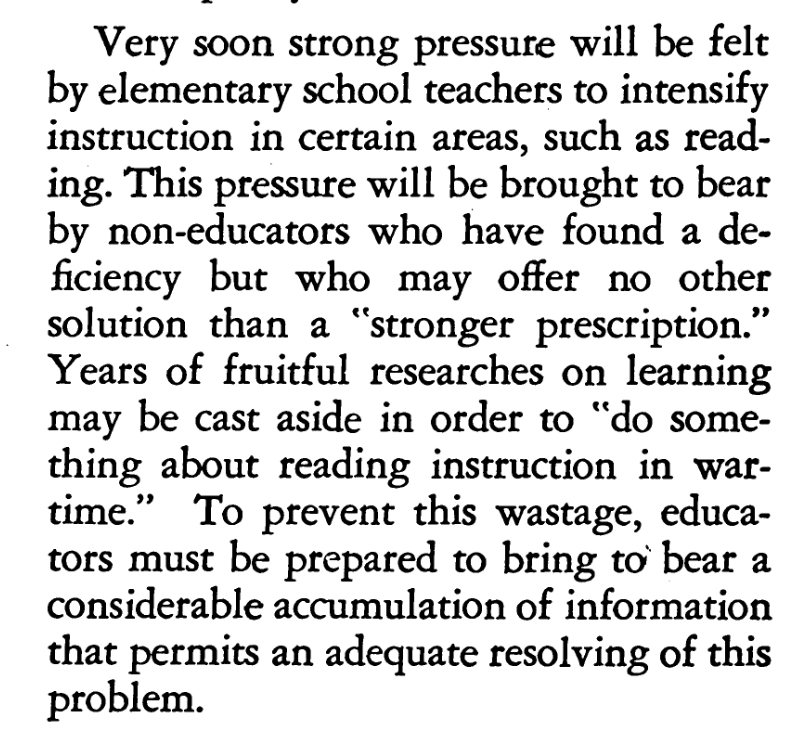
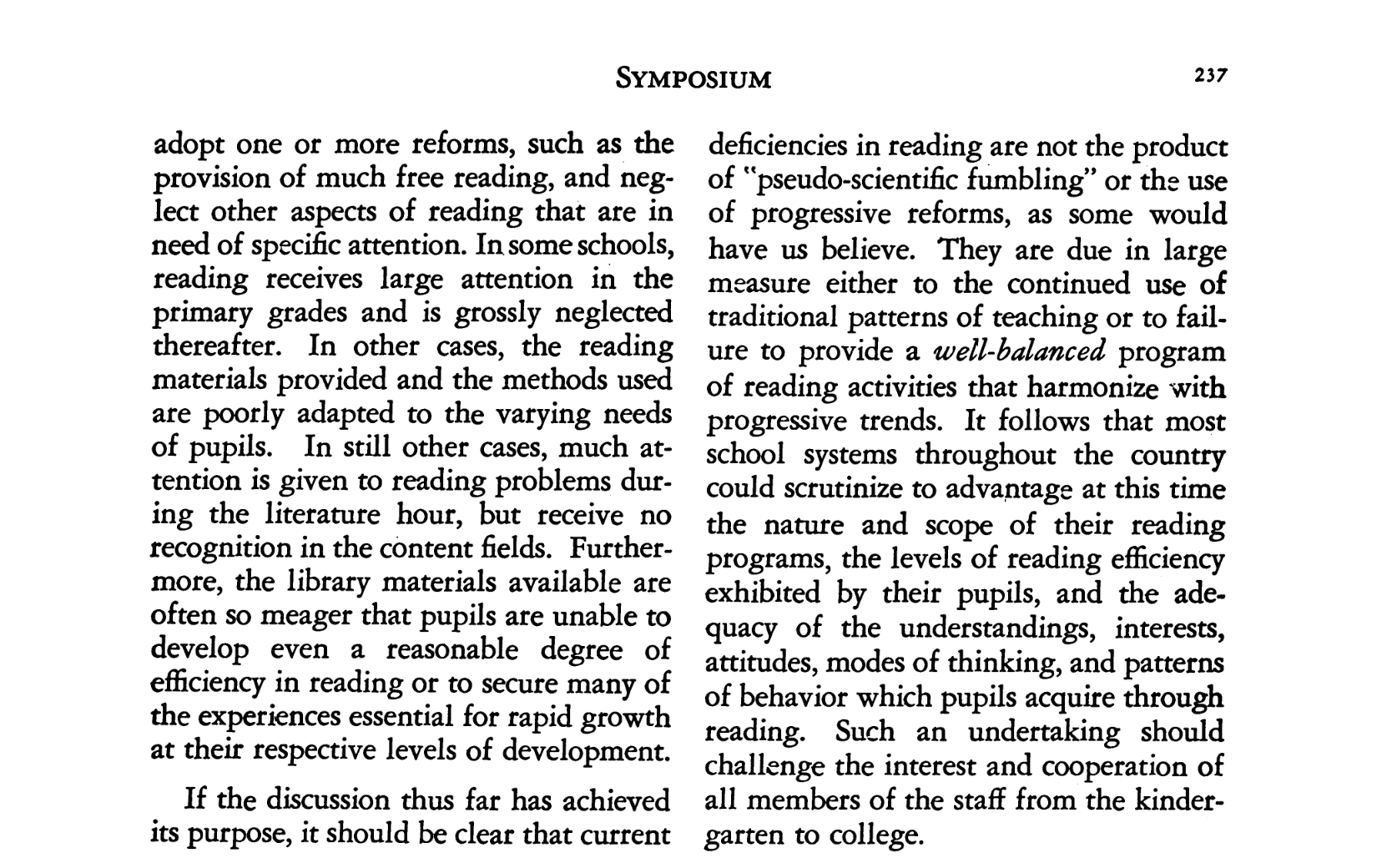
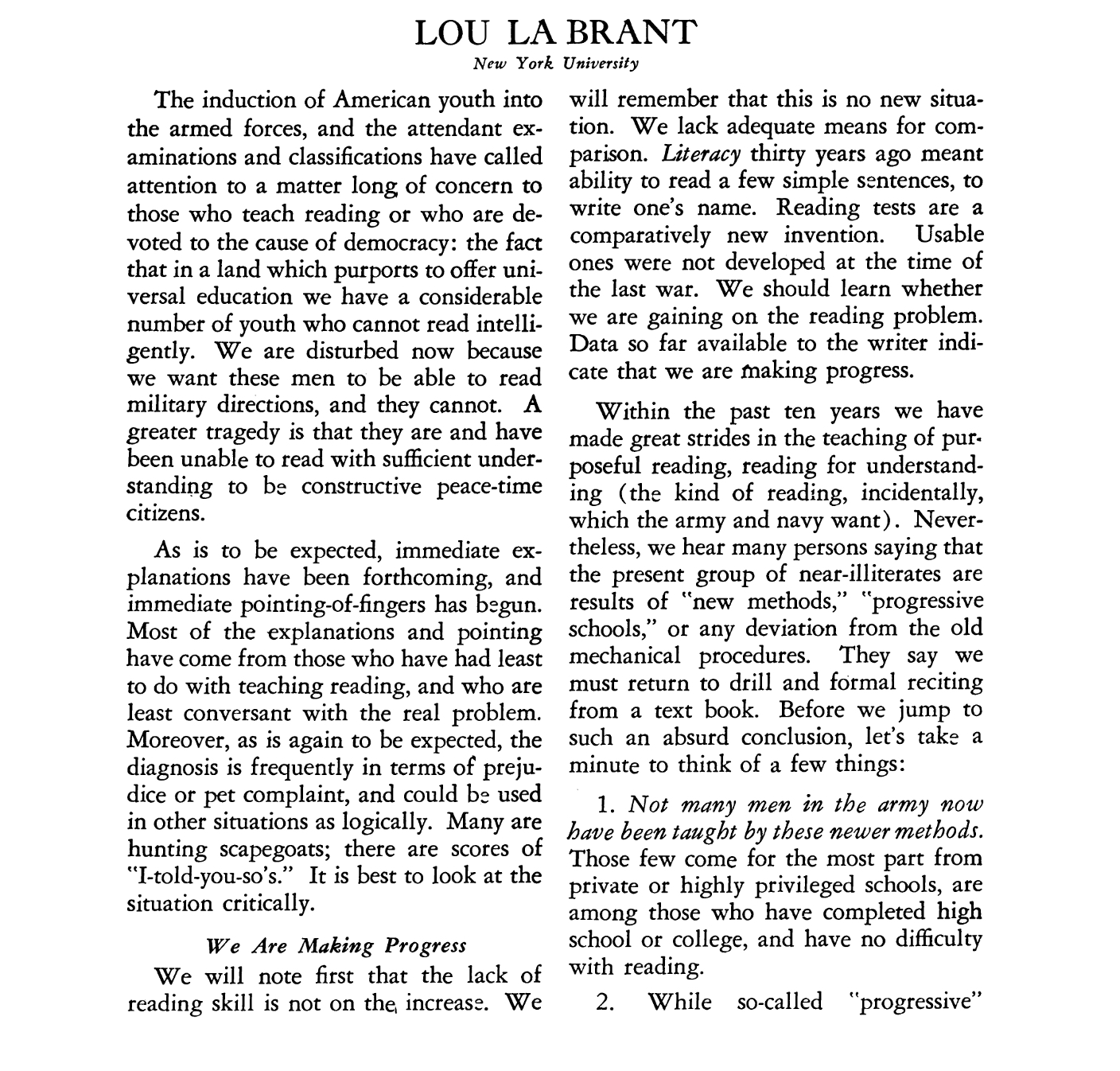
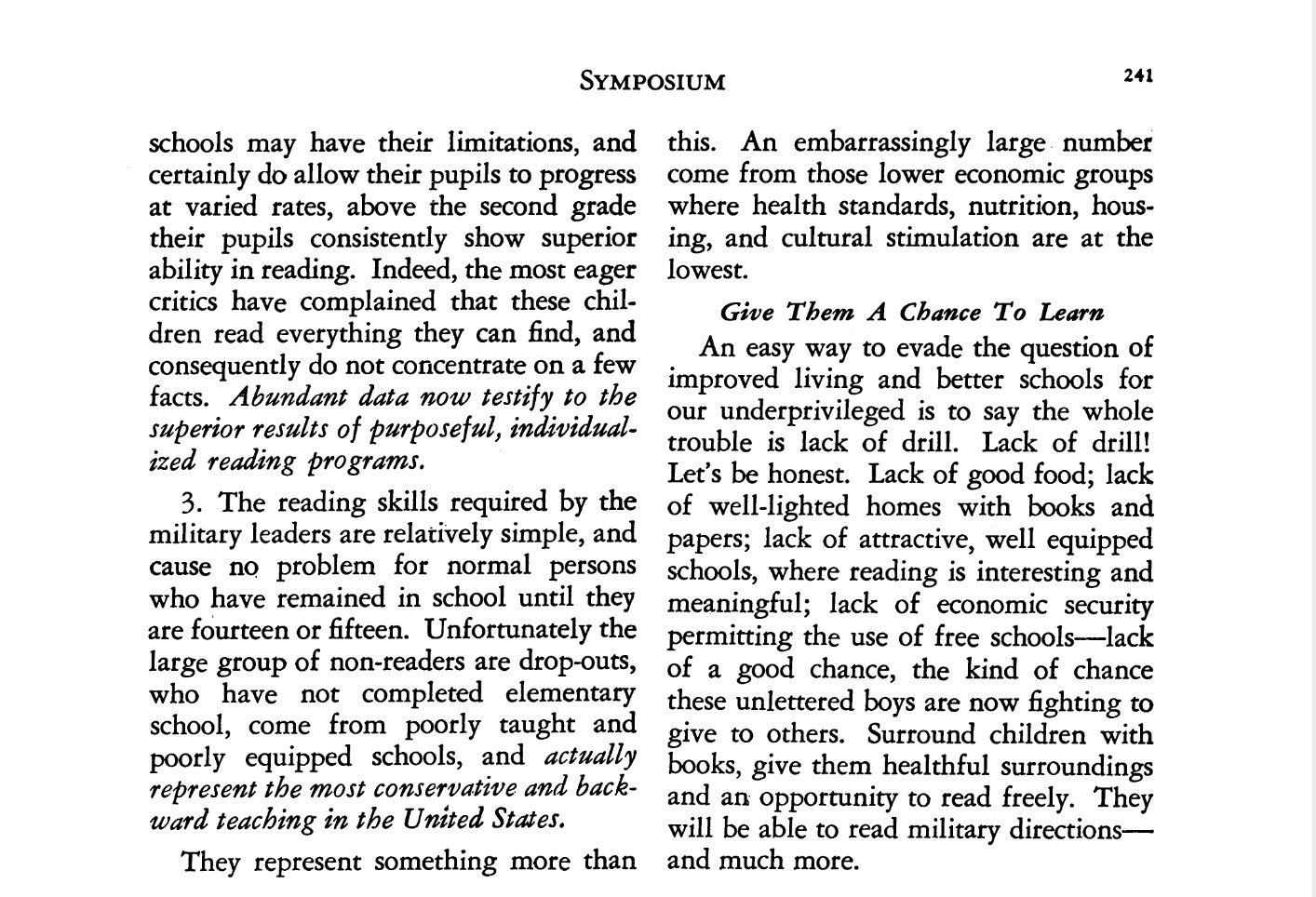
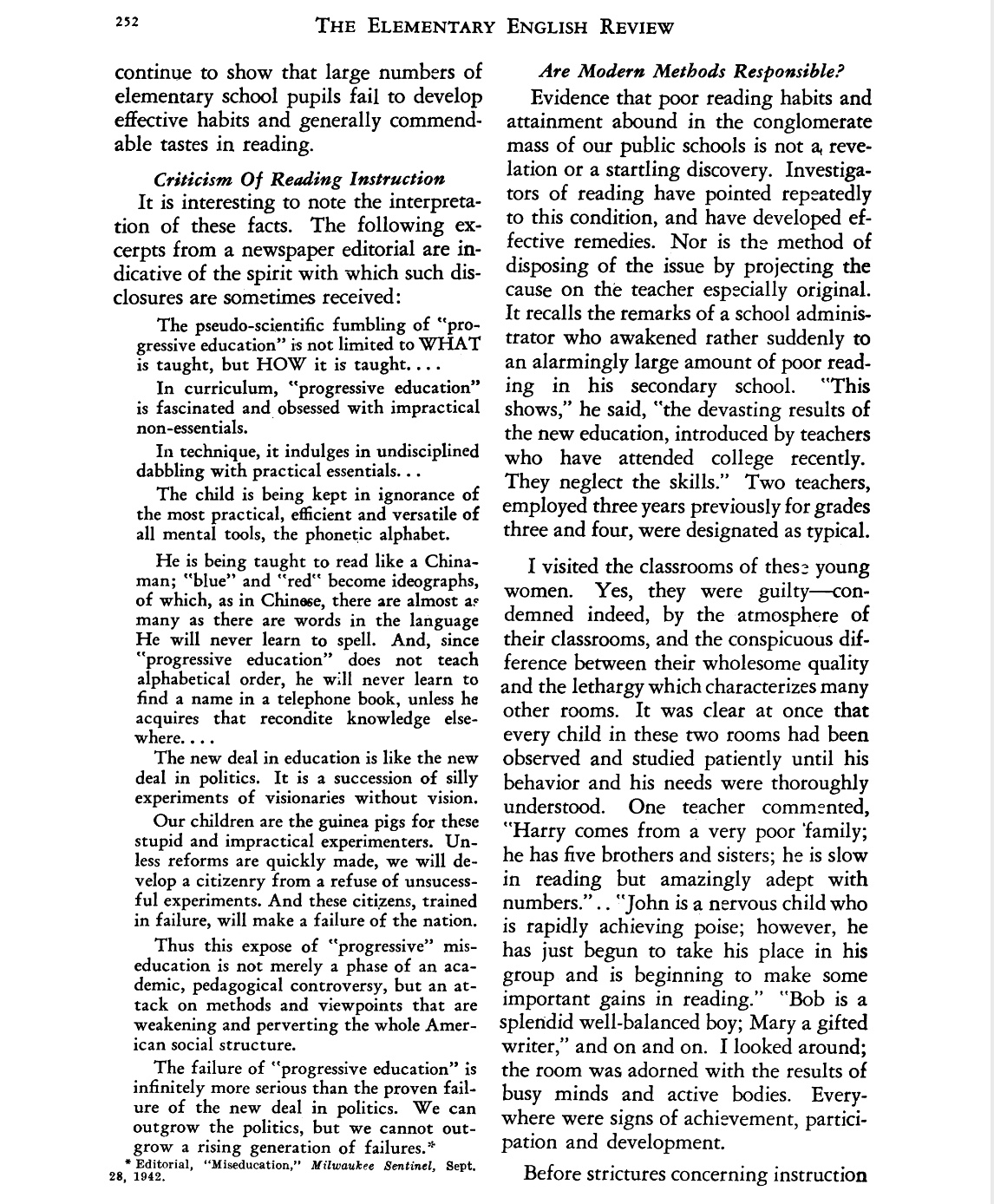
Consider the following excerpts from a scholarly journal of literacy. The articles included are responses from literary scholars to a political and media claim of a reading crisis.
These patterns may seem familiar in 2023 to anyone following the “science of reading” movement:
Public schools are failing to teach adequately children to read.
Reading teachers are ill-equipped to teach reading.
Reading and teaching strategies are not scientific.
Political leaders and the media drive the criticism.
And literacy scholars carefully debunk the entire narrative, to no avail.
These excerpts are from 1942 and collected in The Elementary English Review (The National Council of Teachers of English), which would become Language Arts [1].
The reading crisis was spurred by high illiteracy rates in WWII draftees and Eleanor Roosevelt’s call to action and media coverage of the reading crisis.
The blame game, like now, is misguided and ill informed. Progressive education was the scapegoat, but LaBrant and others noted these soldiers had attended mostly traditional schooling.
Scholar after scholar also note that high illiteracy rates were caused by high poverty levels.
In 2023, as we are trying to stay afloat during the “science of reading” tidal wave of misinformation, we must acknowledge that this current reading war does not differ in any significant way from several since the 1940s.
We must also acknowledge that at no point has the US found reading achievement adequate regardless of teacher training, reading theories, or reading programs and instructional practices.
Reading Wars, then, are reductive, misleading, and ultimately ineffective—over and over.
The “science of reading” movement is another round of misguided blame, misinformation, and yet more hollow calls for “reform” that isn’t anything new or valid.
The “science of reading” is tired and lazy journalism, politics, and ultimately education.
[1] Betts, E., Dolch, E., Gates, A., Gray, W., Horn, E., LaBrant, L., . . . Witty, P. (1942). What shall we do about reading today?: A symposium. The Elementary English Review, 19(7), 225-256. http://www.jstor.org/stable/41382636 [access HERE]
Increasingly, I am contacted by email or spoken to in person by teachers with a similar and disturbing series of experiences.
These teachers ask to remain anonymous out of fear of retaliation because they have already been reprimanded or dismissed for simply asking questions about their school/district’s implementing the “science of reading.”
One recent communication I received represents well that pattern (I am paraphrasing and reducing specifics to protect anyone trying to identify the specific teacher, and this is representative of dozens and dozens of similar communications).
The teacher has been a literacy educator well over a decade and also has earned a doctorate. A few years ago, this teacher had a first experience with LETRS training being required for university faculty where they were on one-year contracts.
After asking about why LETRS was being required and noting that the research base doesn’t support that training as effective, the teacher was shunned by their administrator and then their contract wasn’t renewed.
Before leaving that school, they noticed some faculty had simply stopped attending the training, but the administrator sought other faculty to log in to complete that training. The teacher grew concerned that there seemed to be some incentive for simply having many faculty trained.
At a new school, that teacher was immediately required to go through LETRS training. They described the training as a “cult” experience in which professional educators were handed pipe cleaners and asked to make models of the “simple view” of reading (Scarborough’s rope).
While I have repeatedly documented (along with several other scholars; access materials HERE) that the “science of reading” movement is primarily over-simplified narratives and misinformation, I want here to address that the central flaw in the movement is one we have seen in recent history regarding education reform: missionary zeal.
It is important to emphasize that I am aware of no one who rejects that a body of reading science/research exists and that should be a significant part of what drives classroom practice.
However, the media-driven SOR movement and the political consequences of that advocacy that has resulted in SOR-labeled policy are oversimplified and misguided versions of that research base.
And that new policy is often unscientific and harmful such as the pervasive implementation of grade retention.
Further the SOR movement fails to ground the narrative in the history of the field of reading and education reform.
For example, during the “miracle” school/teacher era spanning from George W. Bush through Barack Obama, missionary zeal drove Teach For America, charter schools, “miracle” school claims, and value-added methods for evaluating teachers.
At the core of these connected elements of education reform is a missionary zeal that ultimately failed to produce what was guaranteed, primarily because the reformers misidentified the problems and offered misguided solutions. In the case of the SOR movement, the same mistake is being made by claiming that reading science is simple and settled.
Currently, the “science of reading” movement has fallen into the missionary zeal trap as represented by The Reading League:
The similarities in these two recent movements are important and damning:
The criticisms I have raised are directly targeting the missionary zeal and misinformation found in the media story [1] and the political reaction [2] to that false narrative.
Reading proficiency in the US is about the same now as well before anyone implemented balanced literacy or current popular (and demonized) reading programs. And persistently over the last 80 years, scholars have lamented the “considerable gap” between research and practice in all aspects of K-12 education.
Throughout those 80-plus years, no one has ever been satisfied with student reading achievement regardless of the reading theory being implemented or the reading programs being adopted.
And teacher preparation has been significantly hampered for the past 40 years by top-down accountability mandates that have reduced most teacher certification to more bureaucracy than preparation. A dirty little secret that SOR advocates ignore is that how teachers are prepared to teach reading matters little because most teachers are bound to reading programs and reading standards once they enter the classroom. A huge gap exists between how teachers are prepared and how they are allowed to teach.
But manufacturing a crisis, perpetuating melodramatic stories, and casting simplistic blame are doing the same things we have done in education reform for decades without ever truly supporting teachers or better serving all students.
Just like the TFA and charter/”miracle” school era immediately behind us, the SOR movement is anti-teacher and anti-schools. The public and political leaders have been well primed since the 1980s to believe that schools are horrible and that teachers are incompetent. Regardless of what SOR advocates intend, that is what most people hear.
SOR advocates have falsely attacked teacher expertise, both that of K-12 teachers and that of teacher educators (many of whom had long careers as K-12 teachers); these attacks are often grounded in agendas and reports that are not themselves scientific (such as reports from NCTQ), and solutions offered (LETRS) lack scientific grounding as well.
Just as there is a robust and deep body of reading science, there are sincere educators who are engaged with that research base but also recognize that the SOR movement and SOR policy are not aligned with the complex and still developing reading science.
The SOR movement and much of SOR implementation are corrupted by missionary zeal that creates a veneer for the essentially anti-teacher elements—scripted curriculum (structured literacy), mandated retraining (LETRS), and caricatures of teacher educators, teacher education, balanced literacy, three cueing, and reading programs
An authentic embracing of reading science would acknowledge that current research is complex and evolving, that the causes of students struggling to read are also complex and include influences beyond and in the classroom (not just teacher practice but teaching/learning conditions such as class size and funding), that professionals engaging with research should raise questions and challenge conventional wisdom and traditional assumptions in order to serve the individual needs of students, that one-size-fits-all solutions for students and teachers don’t exist, and that educational practices should be grounded in teacher expertise—not journalists, parents, and politicians.
Missionary zeal is problematic in the same way as people who claim to know the mind of god (I unpack that in the newest arc of Daredevil), creating tunnel vision and arrogance while casting blame and judgment toward anyone or anything that dare raise a valid question or concern.
Just as TFA lured thousands into the program and thousands more to champion the idealistic (and unrealistic) blame-game as well as promises of miracles only to collapse under the weight of its own propaganda, SOR is following the same guaranteed-to-fail strategy.
And, yes, many good people jump on bandwagons with good intentions (I have several people I greatly admire who came through TFA), but eventually, we must all come to terms with the deeply flawed elements of this SOR movement. We must remain committed to individual student needs and teacher autonomy—not movements, slogans, and market boondoggles.
The reasons students have struggled for decades to acquire reading as well or as soon as we’d like are multi-faceted and mostly grounded outside of schools; therefore, the solutions are also complex and quite large.
From the TFA/”miracle” school era to today’s SOR movement, these false narratives are compelling because they are simple (simplistic), but they are destined to cause far more harm than good to students, teachers, and schools.
Beware missionary zeal—especially when dealing with why our schools and students struggle and what solutions advocates offer with passionate certainty.
Hoffman, J.V., Hikida, M., & Sailors, M. (2020). Contesting science that silences: Amplifying equity, agency, and design research in literacy teacher preparation. Reading Research Quarterly, 55(S1), S255–S266. Retrieved July 26, 2022, from https://doi.org/10.1002/rrq.353
MacPhee, D., Handsfield, L.J., & Paugh, P. (2021). Conflict or conversation? Media portrayals of the science of reading. Reading Research Quarterly, 55(S1), S145-S155. Retrieved July 26, 2022, from https://doi.org/10.1002/rrq.384
[2] Thomas, P.L. (2022). The Science of Reading movement: The never-ending debate and the need for a different approach to reading instruction. Boulder, CO: National Education Policy Center. http://nepc.colorado.edu/publication/science-of-reading
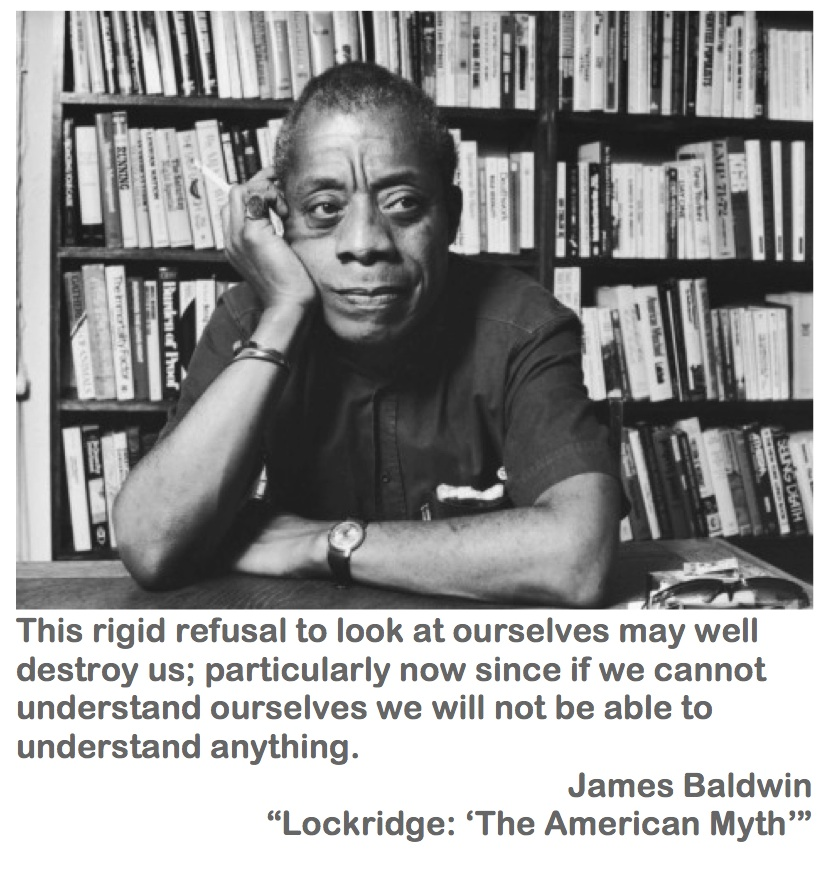
What better represents America is this from James Baldwin:
Included in that “rigid refusal to look at ourselves” is an insidious pattern of creating mythologies that conform to our foundational myths even when those manufactured myths prove to be distortions, or even lies.
That is the legacy of Martin Luther King Jr. who Americans begrudgingly allowed into the pantheon of Great Americans but only as a reductive caricature as a passive radical.
The Right and conservatives in the US have repeatedly shaped MLK into a soundbite endorsing color blindness, a false representation of MLK and the ideal in terms of how race should matter among humans.
MLK was clear that racism was the plague on the US, but he didn’t call for not seeing race; he urged humans to see race and not impose hatred and bigotry onto race, not allow privilege/oppression for some based on race.
But one of the single most important aspects of MLK’s ignored legacy is his call for direct action, which conservatives refuse to see and even cloak by stressing “passive” action (again, an important misrepresentation of “non-violent” since MLK himself stated he never urged people to be passive about anything).
Up to recently we have proceeded from a premise that poverty is a consequence of multiple evils:
• lack of education restricting job opportunities;
• poor housing which stultified home life and suppressed initiatives;
• fragile relationships which distorted personality development.
The logic of this approach suggested that each of these causes be attacked one by one. Hence a housing program to transform living conditions, improved educational facilities to furnish tools for better job opportunities, and family counseling to create better personal adjustments were designed. In combination these measure were intended to remove the causes of poverty.
“In addition to the absence of coordination and sufficiency, the programs of the past all have another common failing — they are indirect. Each seeks to solve poverty by first solving something else,” King noted, adding: “I am now convinced that the simplest approach will prove to be the most effective — the solution to poverty is to abolish it directly by a now widely discussed measure: the guaranteed income.”
Not only did King call for a guaranteed income, he asserted the essential need to be direct:
We are likely to find that the problems of housing and education, instead of preceding the elimination of poverty, will themselves be affected if poverty is first abolished. The poor transformed into purchasers will do a great deal on their own to alter housing decay. Negroes, who have a double disability, will have a greater effect on discrimination when they have the additional weapon of cash to use in their struggle.
It is here that I have grounded my work in education addressing education policy, practice, and reform.
The reason political leaders focus on education is that it is the perfect mechanism for keeping the public focused on indirect action.
The US is committed to capitalism, not democracy, and capitalism depends on poverty and therefore will never eradicate it.
To perpetually address the consequences of inequity projects the veneer of action without actually committing to action, direct action, that would eradicate what causes the harm to begin with.
The history of education reform in the US since the 1980s has been on in-school only reform. Many key reformers and often cited scholars (such as John Hattie) beat an incessant drum that there is nothing we can do about systemic inequity—poverty, racism, etc.—so we must target school reform and then over time that will somehow eradicate inequity.
There are numerous problems with this, including that it fits into our rugged individualism myth by claiming that we must “fix” students and “fix” teachers.
But the essential problem with indirect action is well dramatized in the parable of the river:
Many Americans and most education reformers have decided that addressing directly root causes is too hard, or impossible, a fatalistic view of the world that Paulo Freire cautions against: “I have always rejected fatalism. I prefer rebelliousness because it affirms my status as a person who has never given in to the manipulations and strategies designed to reduce the human person to nothing.”
Targeted in-school reform only, addressing inequity indirectly—these approaches “reduce the human person to nothing.”
Education reform is constantly scrambling to pull babies form the river but will not dedicate any resources to stop those babies form being thrown in that river.
For two decades now, every time I call for addressing inequity directly, I am characterized as calling for doing nothing about the consequences; those who have embraced fatalism project that onto me and my work.
This is a false dichotomy.
The in-school only reformers have made their decision to focus only on indirect action.
It is no accident that the students we pretend to be reforming education to serve are the vulnerable and marginalized children and teens who are the victims of the very inequity we refuse to address, and increasingly refuse to even acknowledge.
Black students, poor students, special needs students, and multi-language learners are all viewed through deficit lenses that emphasize all that they lack while arguing that students who excel are hard working, gifted, and bright.
Disadvantage and privilege are ignored, and again, increasingly discounted.
The rich and complex MLK, his commitment to eradicating inequity by direct action, is both the answer America needs and the solution America refuses to see.
Occasionally we are acknowledging that we have broken people in our society and our schools; yet, we continue to dishonor MLK by refusing to see what forces are breaking these people and children in the first place.
First, simply stating something (or posting on Twitter) doesn’t make it true.
And, second, good intentions are not enough—especially in education.
Before considering whether or not the “science of reading” movement is fulfilling social justice and equity goals in education, let’s acknowledge how two relatively recent movements in education help inform a credible answer to that question.
For many years now, educators have been embracing both grit and growth mindset uncritically, promoting these concepts and practices as both scientific and especially necessary for marginalized and vulnerable populations of student (Black students, poor students, multi-language learners, and special needs students). [See HERE and HERE for research and examinations of grit and growth mindset.]
However, two important aspects of these movements must be considered: the science and research base is increasingly challenging the initial claims of both grit and growth mindset, and the appeal of both are grounded in deficit ideologies that are essentially racist and classist.
Grit and growth mindset prove to be cautionary tales, in fact, because education is often victim of faddism that spreads before the full science is understood and that is embraced without critical analysis of how well the concepts and practices actually accomplish what advocates claim.
Grit and growth mindset speak to a cultural belief that struggling students (disproportionately minoritized racial groups, speakers of languages other than English, impoverished students, and special needs students) lacks experiences and qualities existing in students who excel (disproportionately students who are white and affluent).
These beliefs are a subset of the rugged individualism mythology of the U.S. that needs success and failure to be centered in who people are and whether or not people work hard, even in the face of substantial challenges not of their making (and even when we are dealing with children).
This is why faddism in education is often driven by sloganism also—“no excuses” charter schools thrived even as they harmed the vulnerable and marginalized populations that they were disproportionately marketed to.
That belief system either carelessly ignores or brazenly rejects the power of systemic forces such as racism and classism.
Over the past few years, the “science of reading” movement has ridden a similar wave of claiming “scientific” paired with advocates associating the movement with social justice and equity goals. As a result, the “science of reading” movement is still in the uncritical phase of fadism.
What complicates this dynamic is that we have a century of evidence that the students who struggle the most as learners and as readers are the very vulnerable and marginalized groups that these fads’ advocates target, and justifiably so.
This brings us to the opening points: Saying the “science of reading” movement is a social justice and equity movement doesn’t make it true, and those very real and justifiable good intentions simply are not enough to ignore that the “science of reading” movement, in fact, is harming the students who need reading reform the most (see, for example, HERE).
Over the course of a 65-year career, educator Lou LaBrant lived and worked through multiple back-to-basic movements, lamenting those cycles in her memoir.
In the U.S., we seem fatally attracted to viewing children and students in the most harsh and deficit perspectives, determined to prove that those who succeed and those who fail somehow deserve those outcomes.
The “no excuses” movement has been one of the worst examples of demanding that children/students and their teachers somehow ignore the realities of their lives when they enter schools and just suck it up and learn.
Like grit and growth mindset, the “science of reading” is a reductive and deficit belief system that diagnoses students struggling to read as lacking structure and basics (the exact same claim that has been made without success for a century, LaBrant lived and documented).
The result is reading policy that promotes scripted curriculum that erases teacher autonomy and student individual needs and then reduces reading in the early grades to pronouncing nonsense words.
The social justice and equity reckoning hasn’t quite taken hold yet with the “science of reading” [1], as it has with grit and growth mindset, and the “science of reading” movement has successfully deflected that the practices and policies actually are not supported by science (see HERE).
But the evidence is starting to build as critics have warned.
First, the education miracle machine is being unmasked. Florida, for example, represents how political marketing can use early test-based achievement mirages to mask that the entire system still fails to meet the needs of all students (see also Mississippi where celebrating 2019 NAEP grade 4 reading scores masked their persistent achievement gap and struggling students at later grades).
And, reading programs marketed as meeting the “science of reading” mandate are being exposed as failing to meet social justice and equity goals.
Consider for example two reading programs heavily marketed as “science of reading” endorsed: Wonders and HMH Into Reading [1].
An analysis from NYU of three programs, including these two, found the following:
1. All three curricula were Culturally Destructive or Culturally Insufficient.
2. All three curricula used superficial visual representations to signify diversity, especially skin tone and bodily presentation, without including meaningful cultural context, practices or traditions.
3. All three curricula were dominated by one-sided storytelling that provided a single, ahistorical narrative.
4. All three curricula used language, tone and syntax that demeaned and dehumanized Black, Indigenous and characters of color, while encouraging empathy and connection with White characters.
5. All three curricula provided little to no guidance for teachers on engaging students’ prior knowledge, backgrounds and cultures; or reflecting on their own bias, beliefs and experiences.
We found that these three curricula, which collectively reach millions of students across the country, have deficits that are mostly not being raised in the current public debate about curriculum. Their texts, language, tone and guidance communicate harmful messages to students of all backgrounds, especially Black, Indigenous, students of color, LGBTQIA+ students, and students with disabilities.
The “science of reading” movement is often championed for legitimate concerns about learning and students and by people with good intentions. But that movement is also another example of faddism and marketing boondoggles at the expense of the vulnerable and marginalized students who need and deserve a reckoning for reductive mythologies and deficit ideologies.
Ultimately, the “science of reading” movement is not fulfilling social justice and equity goals in education, and like grit and growth mindset, the reckoning is one the horizon, but our students and teachers deserve better and now.
Burns, M. K., Duke, N. K., & Cartwright, K. B. (2023). Evaluating components of the active view of reading as intervention targets: Implications for social justice. School Psychology, 38(1), 30–41. https://doi.org/10.1037/spq0000519
One of the key flaws of education reform since the 1980s is that education policy tends to be more about political and popular fads resulting in copy-cat state education policy than about addressing provable educational need.
For example, as Cummings, Stunk, and De Voto show about state reading policy:
Florida, which passed it’s Just Read, Florida! retention-based third-grade literacy policy in 2002, is largely considered the trailblazer of such policies (CCSSO, 2019). Florida’s policy includes several provisions designed to improve students’ literacy in grades K-3, including early identification of students who need additional supports, ongoing monitoring and communication with families, a range of literacy interventions, and third-grade retention for students who do not meet a certain score on the state assessment. By 2021, 19 states had adopted retention-based third-grade literacy policies that contained several elements of Florida’s policy.
However, with the release of the 2019 NAEP reading scores, Mississippi supplanted Florida as the miracle-du-jour.
These copy-cat urges have been grounded in almost exclusively grade 4 standardized test scores.
As I have documented about the over-reaction to Mississippi, the 2019 grade 4 scores were in line with decades of steady progress (thus no miracle), but most people failed to put the grade 4 scores in broader contexts that showed Mississippi grade 8 scores remained low and the racial gap remained steady even as Mississippi improved average scores.
Mississippi, in fact, was benefitting from the Florida model, mostly driven by grade retention.
New for 2023 is a moment of reckoning for Florida: “a Stanford University study of state-level standardized tests showed that Florida’s ‘learning rate’ was the worst in the country — by a wide margin.”
This analysis is taking into account longitudinal test scores instead of focusing only on early grades:
· Florida kids regress dramatically as they age in the system. Since 2003, Florida’s eighth grade rank as a state has never come close to its fourth grade rank on any NAEP test in any subject.
· The size of Florida’s regression is dramatic and growing, especially in math. Florida’s overall average NAEP state rank regression between fourth and eighth grade since 2003 is 17 spots (math) and 18 spots (reading). But since 2015, the averages are 27 spots (math) and 19 spots (reading).
Therefore, political leaders have tried to keep the focus on grade 4: “Tellingly, DeSantis ignored the eighth grade results, which came out far worse than fourth grade — just as they have in every NAEP cycle since 2003.”
So here is the dirty little secret about education reform and education policy.
First, test data are weak reflections of learning, and how we measure learning significantly impacts those scores.
Next, at the earlier grades, testing tends to reflect reductive versions of skills. For example, many states test pronunciation of nonsense words (thus, there is no meaning or comprehension) and call that “reading.”
Research for decades has shown that systematic phonics instruction can raise those scores, especially for young students, but that increase in pronunciation is not correlated with comprehension and that advantage disappears by middle school.
There is a similar pattern to how grade retention can raise test scores in the short term but those retained students fall behind again in a few years and are more likely to drop out.
In short, increased test scores in the early grades are often test-based achievement mirages, not increased learning.
As students and assessments become more sophisticated, these early increases are much harder to maintain for a number of reasons—some related to brain and overall development, and some related to teaching and learning conditions as well as instructional challenges.
This reckoning for Florida is a clarion call for all education reform across the U.S.
We must stop playing partisan politics with our schools, and we must resist copy-cat fadism when it comes to education reform.
Thomas, P.L. (2022). The Science of Reading movement: The never-ending debate and the need for a different approach to reading instruction. Boulder, CO: National Education Policy Center. http://nepc.colorado.edu/publication/science-of-reading
educator, public scholar, poet&writer – academic freedom isn't free





















 dr. p.l. (paul) thomas