The article below appears in Rethinking Schools and brings together several problems with and connections between the “science of reading” and book banning/censorship movements that I have been address since 2018.
Although the “culture war” and “reading war” have been described as separate causes promoted by disparate organizations, their stories are more connected than they appear. Both book banning and SoR dogmatism limit what teachers can teach and what students can read, narrowing the ability of public schools to address children’s diverse needs. We see this most explicitly in conservative parent groups, including Moms for Liberty, who have made it clear they endorse both. This should be a wake-up call to critically examine the potential impact of phonics-based policies on public school students and teachers.
Thomas, P.L. (2024, May). Teaching English in the “science of reading” era: We teach English in times of perpetual crisis: Selling a story of reading. English Journal, 113(5), 16-22. https://publicationsncte.org/content/journals/10.58680/ej2024113516 [Access HERE until open access at EJ]
Thomas, P.L. (2023). The “science of reading,” education faddism, and the failure to honor the intellectual lives of all children: On deficit lenses and ignoring class and race stereotyping. Voices in the Middle, 30(3), 17-21. https://publicationsncte.org/content/journals/10.58680/vm202332439
Education reform, however, was never about improving learning or teaching, but about ideological agendas, conservative agendas.
The crisis/miracle cycles started with that Texas “miracle,” but included the Chicago “miracle” (to bolster Arne Duncan), the DC “miracle” (to promote Michelle Rhee’s grift), and the Harlem “miracle” (that solidly merged education reform as bi-partisan under Obama with the help of grifter Duncan).
What may prove to be the most successful (and harmful) “miracle,” however, is the media manufactured Mississippi “miracle,” grounded in 2019 NAEP scores.
Six years later, the real end game of these manufactured and false “miracles” are merging with an initial effort by W. Bush—de-professionalizing teachers with scripted curriculum. Note the connection in a recent misleading but recurring endorsement by Patrinos (from the Department of Education Reform, funded by Walton money in Arkansas) of that Mississippi “miracle”:
After taking a swipe at NCTE, Korbey makes the same but false connection as Patrinos above:
Nearly all the states that have seen reading scores improve recently – including Mississippi, Louisiana, Tennessee and Alabama – have changed state law to encourage districts to choose from approved lists of HQIM.
Conveniently omitted in public advocacy and endorsements of scripted curriculum, is that this is a correlation; however, research has shown that curriculum, instruction, and teacher training are not the keys to increased test scores. Grade retention is:
[S]tates whose policies mandate third-grade retention see significant and persistent increases in high-stakes reading scores in all cohorts…. [T]here is no consistent evidence that high-stakes reading scores increase in states without a retention component.
And another omission is that research has shown scripted reading programs de-professionalize teachers, fail to serve the individual needs of students, and have “whitewashed” the curriculum, alienating the most under-served students in our schools [see Recommended below].
And thus, the end game:
Musk: If you have a classroom of 25 or 30 kids, it is literally impossible to spend time with every kid individually or you can spend to little time.. But what you can do is set them up with ai.. pic.twitter.com/tAcySW2zTE
Education reform is dedicated to perpetual education crisis for market and political goal.
Scripted curriculum, then, is not designed to improve reading proficiency, but to create one more step toward AI replacing teachers the same way self-checkout replaced cashiers in our grocery stores.
Mainstream media loves a compelling story. And, regretfully, media tends to care very little how accurate or complete that story is.
Media coverage of education is almost entirely a series of misleading stories grounded in either crisis or miracle rhetoric.
One of the darlings of the media is the charter school, the one aspect of the school choice movement that has garnered bipartisan support.
However, as a type of school choice, charter schools must market themselves and recruit. So when media and school marketing combine, I urge “Buyer Beware”:
Here, The State (Columbia, SC) has platformed the principal of a charter school, who makes a couple important (but misleading) claims: the charter school is exceptional and that is because the school practices separating boys and girls for instruction.
“Exemplary High Performing School” is causally connected by Wooten to the boy/girl instructional segregation; however, rarely can a school conduct the sort of scientific research in-house to determine causation, and more importantly, student achievement (test scores) remain overwhelmingly a reflection of the students’ socioeconomic status (60+%), not the school, instruction, or teacher quality.
Here is the missing parts to this story:
Note that Langston Charter Middle has the third lowest poverty index (PI) in the state (12.9), and for comparison, in the same district, the Washington Center has one of the highest PI (96) in the state. [Note that Greenville has a incredibly wide range of low and high poverty schools because the district is large and covers an area of the state with significant pockets of poverty and affluence; and thus, neighborhood schools tend to reflect that socioeconomic reality.]
Further, if we look at Langston Charter Middle’s state report card, the “exceptional” seems to be missing:
Yes, the academic achievement is “excellent,” but again, this data point reflects mostly the very low PI for the students being served.
Note that when Langston Charter Middle is compared to schools with similar student demographics (Daniel Island School, 8.2PI, and Gold Hill Middle, 11.5 PI), the “exceptional” appears to be typical among similar schools:
Media and marketing do more harm than good for public education. When the media is fixated on incomplete and misleading stories and schools feel compelled to market themselves for customers, we all lose.
The OpEd run by The State is not about an exceptional school or the success of separating girls and boys for instruction (although that does speak into a current political ideology that wants this to be true).
The story, as usual, is incomplete, and the marketing is at best misleading.
Once again, many in the US do not want to hear or see the full story: Our schools and student achievement mostly reflect the socioeconomic status of the students’ parents, homes, and communities.
When it comes to media coverage of our schools, I must emphasize: Don’t buy the story being sold.
I almost feel sorry for Louisiana. (See Update 2 below)
When the 2024 reading scores for NAEP were released, LA seemed poised to be the education “miracle” of the moment for the media and political leaders.
Since mainstream media seems to know only a few stories when covering education—outliers, crises, and miracles—the outlier gains by LA compared to the rest of the nation, reportedly still trapped in the post-Covid “learning loss,” was ripe for yet another round of manufacturing educational “miracles.”
To maintain the MS “miracle” message, journalists must work incredibly hard to report selectively, and badly.
For example, Aldeman celebrates, again, MS as a outlier for for the achievement of the bottom 10% of students (carelessly disregarding that outlier data is statistically meaningless when making broad general claims):
But one state is bucking this trend: Mississippi. Indeed, there’s been a fair amount of coverage of Mississippi’s reading progress in recent years, but its gains are so impressive that they merit another look.
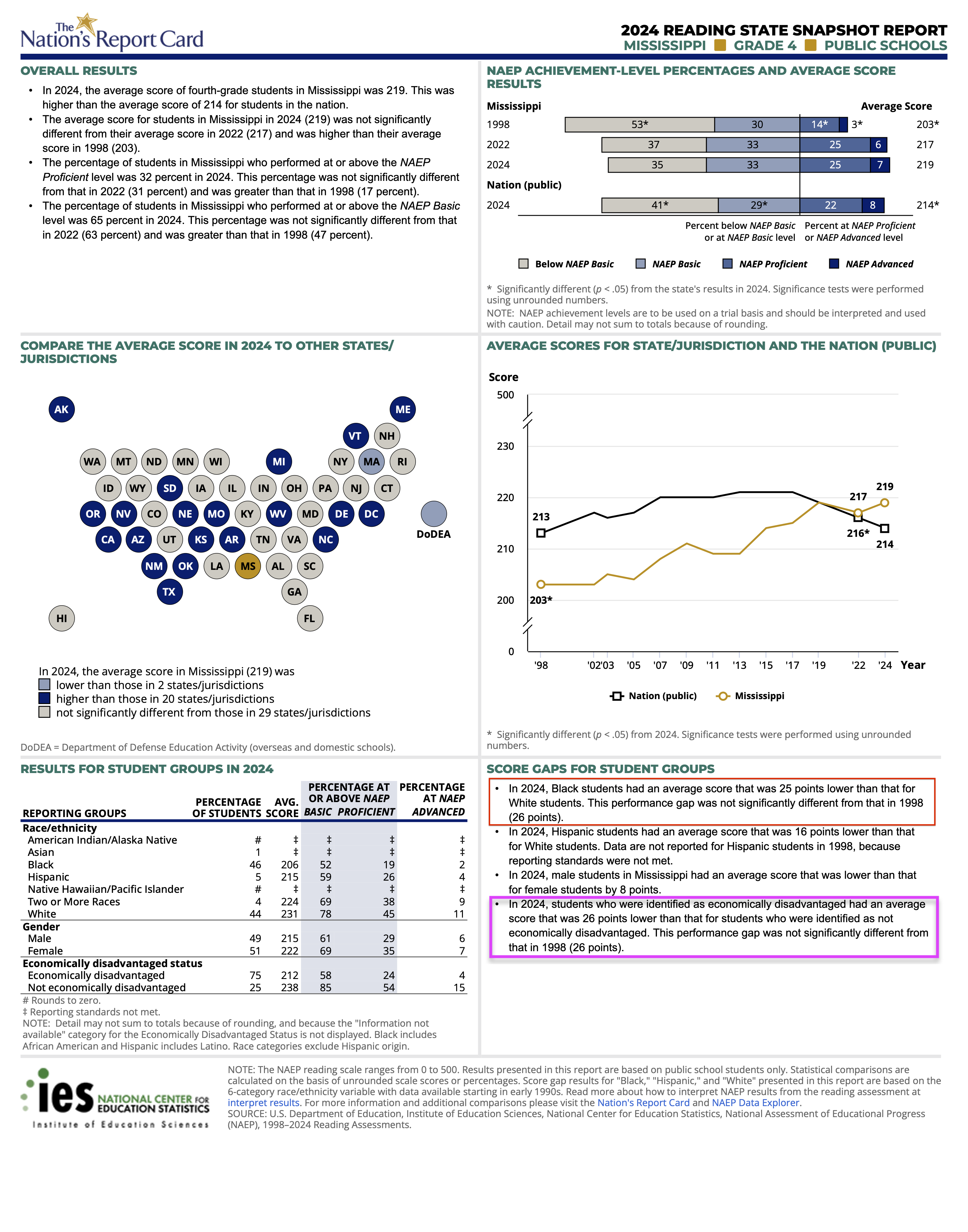
Next, Aldeman highlights reading gains by Black students in MS, omitting a damning fact about the achievement of Black (and poor) students in MS (which mirrors the entire nation):
That’s right, MS has the same racial and socio-economic achievement gaps since 1998, discrediting anything like a “miracle.”
But the likely most egregious misrepresentation of MS as a reading “miracle” is Aldeman “debunking” claims that MS gains are primarily grounded in grade retention, not the “science of reading.”
Notably, Aldeman seems to think linking to the Fordham Institute constitutes credible evidence; it isn’t.
So let’s look at the full picture about grade retention and MS’s reading scores on NAEP.
First, the research on increased reading achievement has found that only states with retention have seen score increases. Westall and Cummings concluded in a report on reading policy: “[S]tates whose policies mandate third-grade retention see significant and persistent increases in high-stakes reading scores in all cohorts…. [T]here is no consistent evidence that high-stakes reading scores increase in states without a retention component [emphasis added].” [Note that Aldeman selective refers to this study late in the article, but omits this conclusion.]
The positive impact of retention on test scores has not been debunked, but confirmed. What hasn’t been confirmed is that test score gains are actual achievement gains in reading acquisition.
Next, MS (like FL and SC, for example) has risen into the top 25% of states in grade 4 reading on NAEP, but then plummets into the bottom 25% of states by grade 8 (despite their reading reform having been implemented for over a decade), suggesting those grade 4 scores are a mirage and not a miracle:
A final point is that media always omits the most important story, what research has shown for decades about student achievement:
Almost 63% of the variance in test performance was explained by social capital family income variables…. The influence of family social capital variables manifests itself in standardized test results. Policy makers and education leaders should rethink the current reliance on standardized test results as the deciding factor to make decisions about student achievement, teacher quality, school effectiveness, and school leader quality. In effect, policies that use standardized test results to evaluate, reward, and sanction students and school personnel are doing nothing more than rewarding schools that serve advantaged students and punishing schools that serve disadvantaged students.
High-poverty states and states with high percentages of so-called racial minorities are not, in fact, beating the odds—again, note that states have not closed the racial achievement gap or the socio-economic achievement gap.
Yes, too often our schools are failing our most vulnerable students. But the greater failures are the lack of political will to address the inequity in the lives of children and the lazy and misleading journalism of the mainstream media covering education.
The goal is de-professionalizing teachers and teaching, not improving student reading proficiency.
Updated 2
The political, market, and media hype over both MS and LA are harmful because that misrepresentation and exaggeration drive the fruitless crisis/reform cycles in education and distracts reform from the larger and more impactful causes of student achievement.
Funded and maintained by the National Center for Youth Law (NCYL) and The Schott Foundation for Public Education, the Opportunity to Learn Dashboard tracks 18 indicators across 16 states. The project seeks to provide information about factors impacting the degree to which children of different ethnicities and races are exposed to environments conducive to learning.
However, indicators directly related to schools explain only a minority of the variation in achievement-related outcomes. Therefore, the dashboard includes out-of-school factors such as access to health insurance and affordable housing, as well as within-school factors such as exposure to challenging curricula and special education spending.
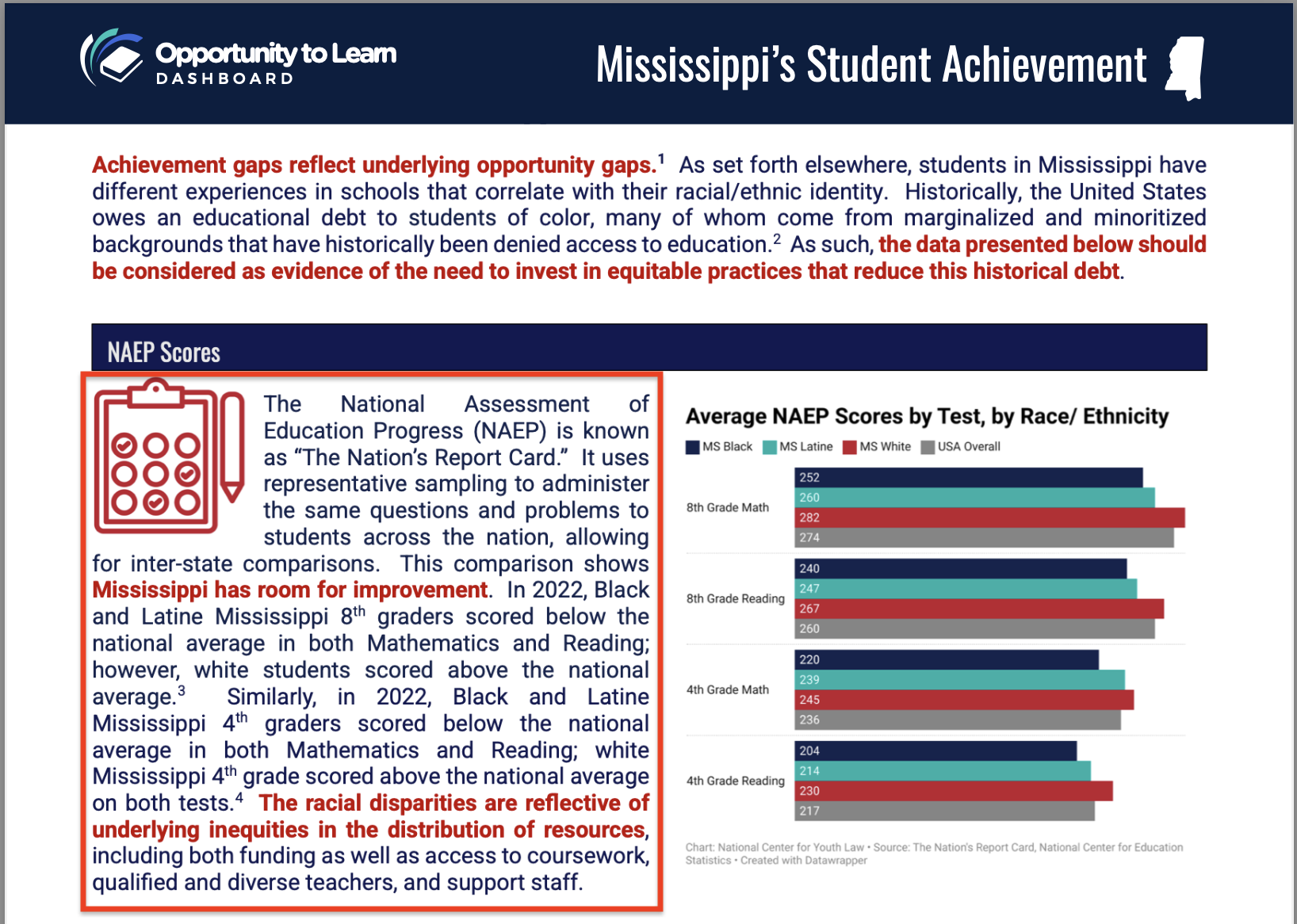
For both MS and LA, we must acknowledge the significant and robust systemic (out-of-school) disadvantages minoritized and impoverished students continue to face in both states:
Note here my points raised about lingering opportunity/achievement gaps exposed by NAEP scores in both states:
To emphasize again, NAEP scores do not reveal education “miracles” in either MS or LA. In fact, NAEP scores continue to show that education reform as usual is a failure.
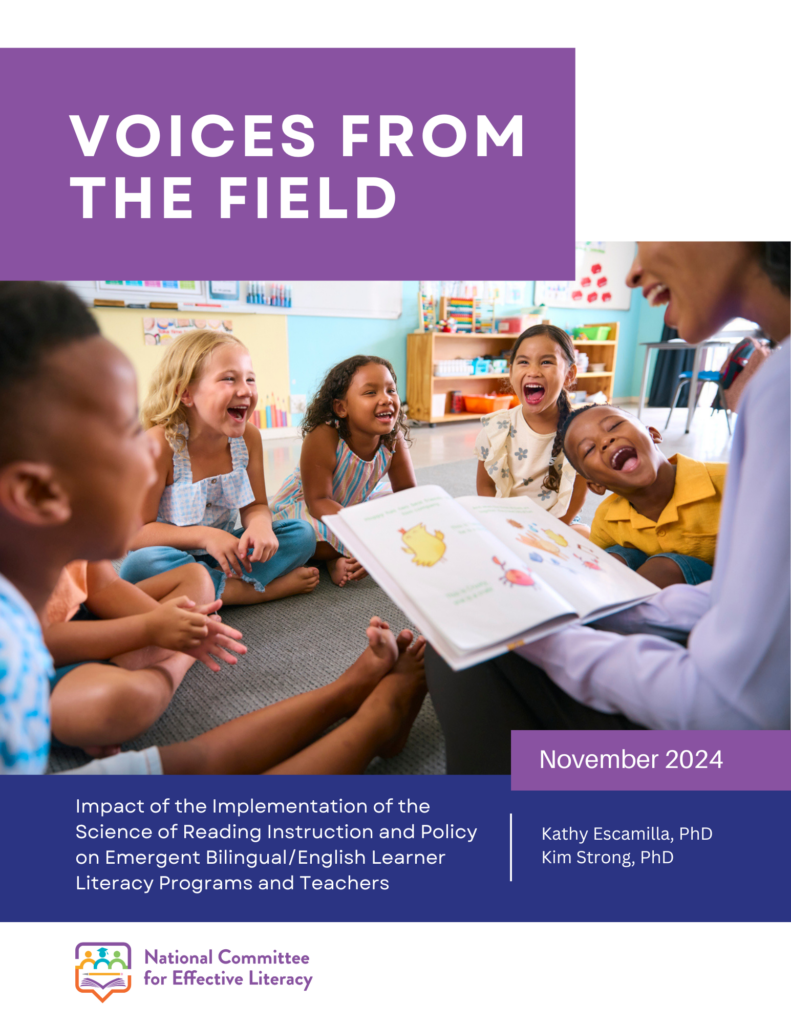
This new groundbreaking report from the National Committee for Effective Literacy (NCEL), Voices from the Field: The Impact of the Implementation of Science of Reading Instruction and Policy on Emergent Bilingual/English Learner Literacy Programs and Teachers, dives deep into the real-world implementation of Science of Reading (SoR) policies. Through interviews with nearly 80 educators who work directly with emergent bilinguals and English learners (EB/EL) in schools implementing state and district SoR policies, we uncover critical insights into the challenges and opportunities for supporting EB/ELs. This study points to the need for more comprehensive understanding of the SoR and for implementation supports that directly address the needs of EB/EL students and the contexts in which they are taught.
Some people have recognized that Elon Musk has willfully or ignorantly misread and misrepresented data on social security to create a story to support an ideological agenda—cutting social programs in the US government.
Note this thread on X/Twitter, notably Wolfer’s final post: “When everything they say is designed to mislead, you’re left to wonder why.”
And here's the number of RECIPIENTS of social security in each age bucket with the death field set to false (and recipient set to true). A mere 89,106 are aged 99+, not the tens of millions suggested by @elonmusk. https://t.co/PdCtdCIlsGpic.twitter.com/ljs3wls5Yp
Manufacturing crises to perpetuate stories for ideological agendas is very effective (and nothing new).
Why?
“A lie can travel halfway around the world while the truth is still putting on its shoes” (a quote misattributed to Mark Twain, somewhat ironically).
Certainly, the Trump/Musk era of this strategy is an extreme moment in history; however, this is exactly how education reform has been conducted since the 1980s and how the current “science of reading” (SOR) movement is being orchestrated.
The entire education reform movement was grounded in a data lie manufactured by a political report, A Nation at Risk, to create a story of public school failure in the US in order to perpetuate Reagan’s ideological agendas (school prayer, school choice, etc.).
Now, as a subset of the manufactured education crisis, the SOR movement has misread and misrepresented NAEP data to manufacture a reading crisis in order to perpetuate a story of student literacy and “bad” teachers in order to perpetuate ideological and market agendas for teaching reading.
If evidence is being ignored, then it isn’t really about evidence.
It’s about ideology.
If you see through the manufactured crises of the Trump/Elon answer, you have a template for seeing through the manufactured education and reading crises.
Returning Pencil Buster Dr. Paul Thomas joins us to help us break down the “science of reading.” This is a topic we’ve covered frequently, most recently with Dr. Nancy Carlsson-Paige this week. But Dr. Paul brings a uniquely nuanced and deep knowledge of the marketing scheme/regressive conservative political tool masquerading as a curriculum set to the show. Because Dr. Paul’s dug deep, and with his 40+ year career as a literacy educator, writer, and speaker he is one educated educator on the topic. Don’t be fooled by their talk of “science”, Dr. Paul urges us. It is a method for censorship and limiting of educators. We can do so much better. And our students deserve so much better. Yet conservative lawamakers have written laws literally banning the teaching of anything except the so-called “science of reading.” Come on, let’s not remove tools from our educators’ literacy teaching kits. That’s just foolish.
BustED Pencils: Fully Leaded Education Talk is part of Civic Media. Subscribe to the podcast to be sure not to miss out on a single episode! To learn more about the show and all of the programming across the Civic Media network, head over to https://civicmedia.us/shows. Join the conversation by calling or texting us at 608-557-8577 to leave a message!
#1 South Carolina Governor’s School for Science & Mathematics – [Poverty Index] 21.7
#2 Academic Magnet High School – 15.1
#3 Spring Hill High School – 32.7
#4 Mayo High School for Math, Science & Technology – 47.6
#5 SC Governor’s School for Arts & Humanities – 22.5
#6 HCS Early College High School – 80.2
#7 Catawba Ridge High School – 18.2
#8 Greenville Technical Charter High School – 29.5
#9 Berkeley County Middle College High School – 27.4
#10 River Bluff High School – 31.7
Now compare that list (I have added PI data) with this ranking by PI:
Eight of the ten ranked are in the least impoverished high schools in the state. I have included in orange several charter schools (12 of the least impoverished high schools out of the lowest 40 are charter schools) because charter advocates often enjoy comparing apples to oranges to promote charter schools. [Note that several of the so-called top 10 are schools allowed to select their students.]
These rankings reinforce a misconception that out-of-school factors are just an excuse when trying to educate students; however, historically and currently, reading test scores and achievement reflect a fact that has been replicated for decades:
Almost 63% of the variance in test performance was explained by social capital family income variables….The influence of family social capital variables manifests itself in standardized test results. Policy makers and education leaders should rethink the current reliance on standardized test results as the deciding factor to make decisions about student achievement, teacher quality, school effectiveness, and school leader quality. In effect, policies that use standardized test results to evaluate, reward, and sanction students and school personnel are doing nothing more than rewarding schools that serve advantaged students and punishing schools that serve disadvantaged students.
Rankings are harmful to education and perpetuate another false story about schools in the US.
The first two decades of my career as a literacy educator were spent as a high school English teacher in rural Upstate South Carolina, the high school I had graduated from and my home town.
This began in 1984 when SC had passed sweeping education legislation that would become the standard legislative approach across the US—accountability policy grounded in state standards, high-stakes testing (grades 3 and 8 with exit exams in high school starting in grade 10), and school report cards.
SC was an early and eager adopter of the “crisis” rhetoric fueled by A Nation at Risk report released under the Reagan administration.
That high school and town were populated mostly by working-class and poor people; the town and smaller towns served by the high school were dead or dying mill towns.
Schools had far more poverty than the data showed because rural Southerners often refused to accept free and reduced meals (the primary data point for measuring poverty in schools).
However, for many years the high school ranked number 1 in the entire state for student exit exam scores in math, reading, and writing. Because of our student demographics (and notably because these students had relatively low or typical scores in grade 8 testing), we were what many people would refer to as a “high flying” or “miracle” school.
In more accurate statistical terms, we were an “outlier” data point in the state.
I have been in SC education for an ongoing five decades, and the overwhelming body of data related to student achievement in the state has matched what all data show across the US—measurable student learning is most strongly causally related to the socioeconomic status and educational levels of those students’ parents.
Further, the full story about how we achieved outlier status includes two aspects.
One is that from grade 8 to grade 10 testing, the population of students changed because of students dropping out of school (and these were among the lowest scoring students in grade 8). In fact, students were often encouraged to drop out and enroll in adult education (a two-fer win for the school because they would not be tested and enrolling in adult ed removed them from the drop-out data).
A second part of the story is that students scoring low in grade 8 were enrolled in two math and two ELA courses in grade 10. The “extra” courses were specifically designed as test-prep for state testing. We rigorously adopted a teach-to-the-test culture.
For the state writing exam, for example, we discovered that the minimum text a student could produce was an “essay” with a three-sentence introduction, a five-sentence body, and a three-sentence conclusion. Students in the “extra” ELA course wrote dozens of 3-5-3 essays in grade 10 with the teacher focusing on helping students avoid the “errors” that would flag the text as a below standard.
Many of us found the 3-5-3 approach to writing became a huge problem when students were required to write in other courses; even as students “passed” the state writing exam, they were not performing well as writers in other courses, and even refusing at times to write more than 3-5-3 essays.
For the high-stakes accountability era, we did do a great deal of good because many students across the US passed all their courses but could not receive a diploma because of exam exams. Most of our students graduated, and not because we did anything underhanded.
Yet, I must stress that how we accomplished our outlier status was likely not scalable, but more importantly, our approach should not be replicated by other schools.
Fast-forward 40 years, and education journalism has written hundreds and hundreds of stories not only in pursuit of “outlier” schools, but carelessly framing them as both proof of the on-going (permanent) education crisis and that “status quo” education refuses to implement what we know “works.”
The newest iteration of this misleading story in education is the “science of” movement grounded in the “science of reading” story first popularized by Emily Hanford, who wrote about a “miracle” school in Pennsylvania. This compelling but false story has been parlayed into an even more successful podcast as well as spawning dozens of copy-cat articles by education journalists across the country.
Media, however, never covered Gerald Coles’s careful debunking of the “miracle” school Hanford featured. Similar to my story above about the beginning of my teaching career, the full story of that school was quite different than what was covered in the media.
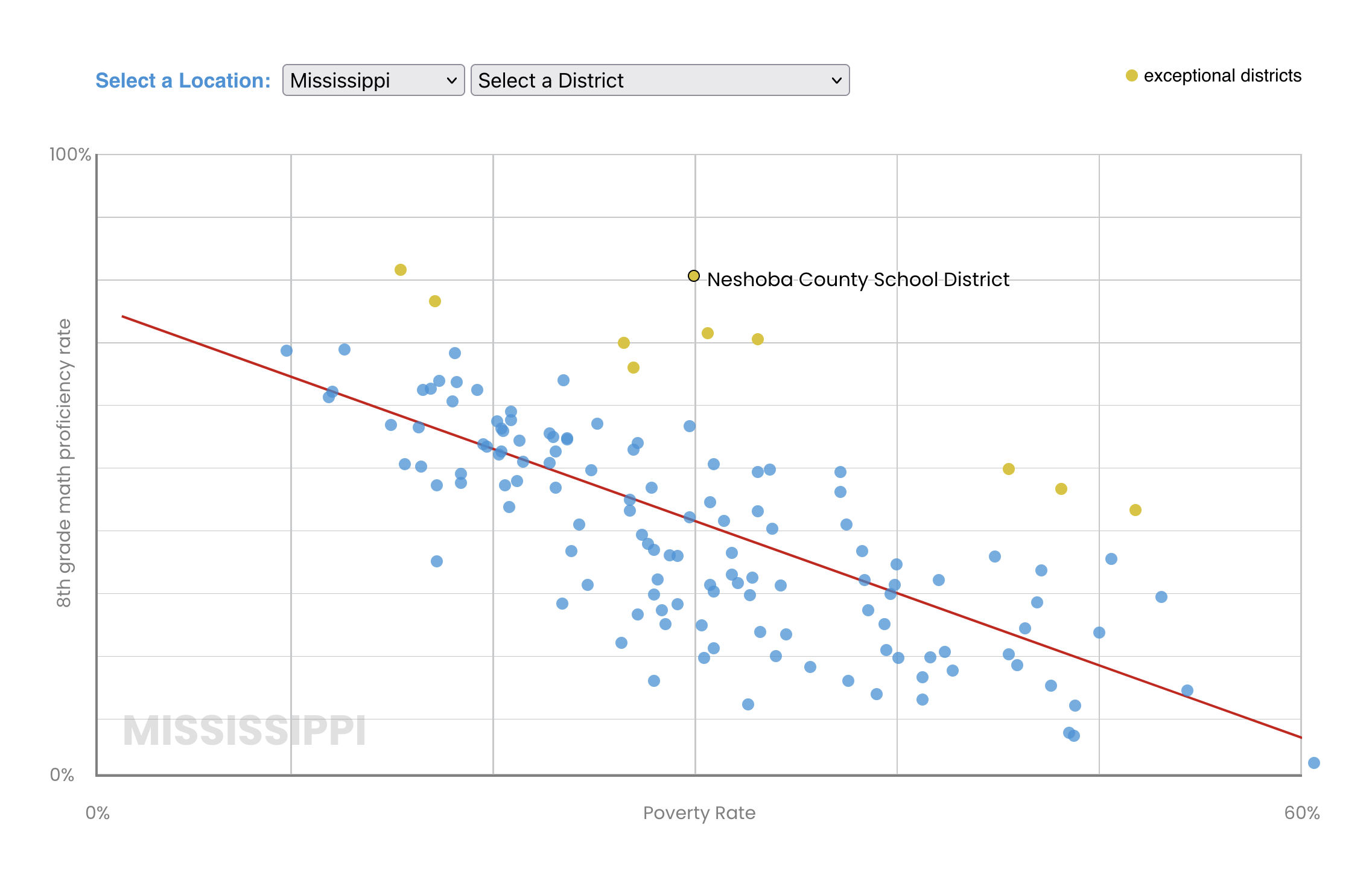
To be blunt, education journalists are mistakenly compelled to focus on the “exceptional” districts (outliers) while ignoring the more compelling red line that, again, shows what, in fact, is normal and what can and should be addressed in terms of educational reform—the negative impact of poverty on educational attainment.
So here is a story you likely will not read: Education journalism is failing public education, and has been doing so for decades.
Education journalists are blindly committed to the “crisis” and “outlier” stories because they know people will read and listen to them.
The “outlier” story makes for a kind of “good” journalism, I suppose, but the problem is that these stories become popular beliefs and then actual legislation and policy.
The current”science of” movement is riding a high wave because of the “science of reading” tsunami. But like all the misguided reforms since the original false education story, A Nation at Risk, this too will crash and reveal itself as a great harm to students, teachers, and our public school system.
This is boring, I know, but most outlier stories are ultimately false or they simply are not replicable or scalable, as I explained in my opening story.
If we genuinely care about student learning, teaching, and the power of public education, we need education journalists more dedicated to the full story and the not the outliers that help drive their viewing numbers.
The more things change, the more things stay the same.
Especially in America.
F. Scott Fitzgerald’s The Great Gatsby, set in the 1920s, centers the story on a few rich characters—Tom and Daisy Buchanan, who have “old” money, as well as Jay Gatsby, representing the nouveau riche.
At the cusp of 2024 and 2025, a century later, one page from the novel seems disturbingly relevant:
In this scene, Fitzgerald uses Buchanan to portray the rise of scientific racism in the US. The scientific racism era in the early 20th century is but one of many examples of how “science” can be used by bad faith actors to promote an ideological agenda.
It isn’t his fault, Buchanan seems to suggest, that he is among the superior white Western civilization: “‘It’s all scientific stuff; it’s been proved.'”
In recent years in the US, navigating science, proof, and science skepticism has reach a level of complexity that defies postmodern thought. Simultaneously, we may be living in the most advanced era of scientific knowledge along side a rising and powerful science-skepticism era.
Vaccination deniers, flat Earthers, and Covid conspiracy theorists have increasingly prominent voices and policy influence due to social media, and the Trump era certainly has eroded how most people understand and what counts as “proven” science.
“Science” as Bad Faith Bullying: Education Edition
Concurrent to the larger political and cultural problems with “science” and science-denial, the education reform movement grounded in the early 1980s accountability movement has adopted “science” as a bad faith bullying approach to reform.
The “science of reading” (SOR) movement [1], essentially driven by conservative ideology, exploded around 2018 under the first Trump administration, and now, SOR has spawned a series of “science of” companion movements—the “science of math,” “the science of learning,” etc.
We may have reached peak “science” as bad faith bullying, however, with a law suit against Heinemann and a few reading programs [2] disproportionately attacked and scapegoated by Emily Hanford and much of mainstream media: “The suit alleges ‘deceptive and fraudulent marketing and sale of products and services which are undermining a fundamental social good: literacy.'”
If this weren’t yet another personal attack on a few literacy leaders and potentially significant waste of time and money to navigate the nonsense of this legal move, it would be funny since the SOR movement itself is practicing exactly what the suit accuses Heinemann of doing, “fraudulent marketing and sale of products.”
Let’s start with the foundational argument among SOR advocates that teaching practices must be grounded only in practices supported by experimental/quasi-experimental research published in peer review publications, as argued by The Reading League:
While I think these standards are too narrow for real-world practice, this is in fact the basis upon which SOR advocates (and the substance of the law suit) rest sweeping and misleading claims about a range of discounted practices labeled as either whole language or balanced literacy (SOR advocates both interchange and mischaracterize these terms repeatedly along with misrepresenting other terminology such as “three cueing”).
Further, the SOR movement has adopted an old and inaccurate assertion about “science,” echoing Tom’s “‘it’s been proved.'”
Similar to the reading crisis rhetoric from 1961—when Walcutt announces: “We have said that no further ‘research’ into methods of reading instruction is necessary” (p. 141)—Hanford and Moates proclaimed SOR “settled science” in 2018 (and we must note Moates has a huge market interest in these claims as author of LETRS, see below):
However, the “science” in reading research is not settled, and the SOR movement, as I stated above, is committed to a “deceptive and fraudulent marketing and sale of products and services”; as I have shown repeatedly, the SOR movement is itself grounded in a plan from 2014 to brand “structure literacy” to “help us sell what we do so well.”
That plan has included exaggerated attacks on some reading programs, some literacy leaders, and some literacy practices while simultaneously endorsing different programs and some practices that are also not supported by SOR’s mandate for a narrow type of “science.”
For example, in a literature review of the current status of SOR from 2022, note that practices either ineffective or lacking scientific support include those rejected by SOR and those embraced by SOR; while this lit review identified “three cueing” as not supported by science as SOR advocates claims, it also lists decodable texts and multisensory approaches (such as Orton-Gillingham), practices and programs aggressively supported by SOR advocates and legislation:
That pattern is standard practice in the SOR movement, including the false attack on teacher education and teacher knowledge being used as “science” as bad faith bullying to sell LETRS.
LETRS falls into the “ineffective and currently unsupported” category as well since only a few studies exist, showing no improvement in student reading.
The SOR movement has also adopted slogans not supported by science (95% of students can be proficient readers) and practices that inflate test scores, target and harm marginalized groups of students, but are not supported by research (grade retention, which seems to be the sole SOR policy impacting test scores).
The “science of” era of education reform is not about improving instruction or student learning. The movement uses “science” as a Trojan horse for de-professionalizing teaching and teachers (selling scripted curriculum) while clearing market space for a new round of “fraudulent marketing and sale of products.”
The law suit is another example showing this “science of” education reform movement is more bad faith bullying than a credible avenue to better supporting teachers and better serving students as readers and learners.
[2] I reject adopting any reading programs and maintain that the reading-program-merry-go-round is the problem, not the solution to reading achievement.




















 dr. p.l. (paul) thomas