Category Archives: education reform

George Saunders’s Allegory of Scarcity and Slack

The stories themselves, literally, are powerful and engaging or George Orwell’s 1984 and Arthur Miller’s The Crucible would not have endured as they have as literature people read again and again—and possibly should read again and again.

However, ultimately, 1984 is not about the future (especially since we have long since passed the future Orwell may have envisioned), and The Crucible is not about the past (although Miller built his play on the very real and troubling history of Puritan witchcraft hysteria). These works are about the complicated present of both authors’ worlds as that speaks to the enduring realities of the human condition.

All of that may seem weighty stuff to step into a look at what appears to be a children’s book, but the paragraphs above should be more than a hint that looks can be deceiving—and enlightening.

The Very Persistent Gappers of Frip, written by George Saunders and wonderfully illustrated by Lane Smith (whose It’s a Book I cannot recommend highly enough), is a fanciful and satirical tale that proves in the end to be an allegory of scarcity and slack—a perfect companion read to Ursula K. Le Guin’s allegory of privilege, “The One’s Who Walk Away from Omelas.”

The Very Persistent Gappers of Frip

Realizing that the Human Heart Is Capable

“Ever had a burr in your sock?” sets the story in motion—one sentence centered on the page over a giant question mark. It is an opening worthy of a child and all of us who cling to the wonder of childhood.

While Le Guin is often described as a science fiction writer, in her work I recognize the blurring of genres that joins science fiction, speculative fiction, and fantasy; it is that “other world” about which Le Guin and Margaret Atwood appear to argue, and it a stark but rich other world Saunders conjures and Lane pictures.

The story of Frip involves three houses for three families, all with children at the center. The houses are distinguished with primary colors—child-like blue, green, and red—but Lane’s artwork adds the ominous to Saunders’ seemingly simple narrative tinged with more than a bite of satire. The illustrations echo the haunting works about and for children found in Neil Gaiman and Tim Burton.

“Frip was three leaning shacks by the sea.” (p. 6) Artwork by Lane Smith

A child standing precariously close to the end of a slanted cliff over an angry ocean catches the eye on page 7 and then the crux of the story pulls you back to the text on page 6:

Frip was three leaning shacks by the sea. Frip was three tiny goat-yards into which eight times a day the children of the shacks would trudge with gapper-brushes and cloth gapper-sacks that tied at the top. After brushing the gappers off the goats, the children would walk to the cliff at the edge of town and empty their gapper-sacks into the sea. (p. 6)

Gappers, orange burr-like creatures with many eyes and the size of a baseball, come to represent throughout the story the power of the systemic inevitable: The presence of the gappers determines the lot of the families (and their goats), but most of the people in the tale remain unable to see beyond their own fixed and mostly misguided worldviews.

“A gapper’s like that, only bigger, about the size of a baseball, bright orange, with multiple eyes like the eyes of a potato.” (p. 2) Artwork by Lane Smith

When the gappers cling to the goats of all three families, there is an ironic appearance of equality among them. But when the fortune of one family shifts, the gappers fulfill their name by creating the gap:

So that night, instead of splitting into three groups, the gappers moved into one very large and impressive shrieking group directly into Capable’s yard. (p. 12)

Before this shift in how the gappers behave, of course, the three families are not equal because Capable is an only child living with her father and who has lost her mother. Capable works as all the children are expected to work (removing gappers in a daily Sisyphean nightmare of chores) and seeks to serve the needs of her grieving father, who along with his grief is a prisoner of nostalgia:

“I myself was once an exhausted child brushing off gappers. It was lovely! The best years of my life. The way they fell to the sea from our bags! And anyway, what would you do with your time if there were no gappers?” (p. 11)

This nostalgia masking an unnecessarily burdensome childhood, however, is but one ideology weighing on Capable because as soon as the other two families are relieved of gappers on their goats, those families reveal themselves to be very much like the people of Le Guin’s Omelas:

“It’s a miracle!” Mrs. Romo shouted next morning, when she came out and discovered that her yard was free of gappers. “This is wonderful! Capable, dear, you poor thing. The miracle didn’t happen to you, did it? I feel so sorry for you. God has been good to us, by taking our gappers away. Why? I can’t say. God knows what God is doing, I guess! I suppose we must somehow deserve it!” (p. 17)

Capable becomes the sacrificed child, and despite her misfortune, the relieved families read the events as their merit (and of course the ugly implication that Capable and her father deserve the burden of the gappers).

What follows from this shift in fate is the central story of Frip with Capable as our main character. The message becomes clear, and Saunders and Lane make the ride one you’ll want to visit again and again. If you are lucky, the book could become one of those read alouds requested by son or daughter, or by a classroom of children.

And while I will leave the rest of the story to you, I think it is necessary to note here that this allegory is both a cautionary tale about how we view children and childhood as well as a brilliant call to reconsider how we view education and education reform.

George Saunders’s Allegory of Scarcity and Slack

The U.S., like the characters (except for Capable) in Saunders’s story, is tragically blinded by a belief in cultural myths that have little basis in evidence: That we live and work in a meritocracy, that competition creates equity, that children need to be “taught a lesson” about the cold cruel world lest they become soft, and such.

As a result of these beliefs, schools often reflect and perpetuate rather harsh environments for children—or to be more accurate, schools often reflect and perpetuate rather harsh environments for other people’s children, as Capable personifies.

Here, then, I want to make the case that The Very Persistent Gappers of Frip is a powerful allegory of scarcity and slack as examined by Sendhil Mullainathan and Eldar Shafir in their Scarcity: Why Having Too Little Means So Much.

Mullainathan and Shafir detail that the conditions of poverty, scarcity, so overburden people psychologically, mentally, and physically that their behavior is often misread (poor people are lazy, poor people make bad decisions, etc.). In Saunders’s story, scarcity and its burden are portrayed by the gappers, and readers witness how the coincidence of the onslaught of the gappers changes the families involved. In other words, the behavior of people is determined by the environment, and not by the inherent goodness or deficiencies of any individual.

The Very Persistent Gappers of Frip goes further, however, by showing that one person’s scarcity (Capable) allows other person slack: privilege is built on the back of others, and those conditions are mostly arbitrary. While Mullainathan and Shafir argue that the slack enjoyed by those living in relative privilege provides the sort of cognitive space needed to excel, Saunders speaks to more than the slack enjoyed by the two families relieved of gappers and the compounding scarcity suffered by Capable (her lot in life and the addition of the gappers):

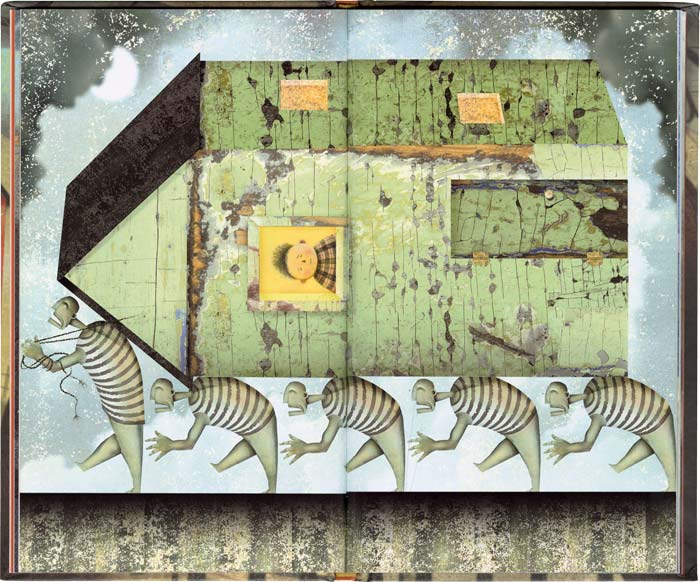
“And the men succeeded in lifting the house and moving it very very close to the third and final house in Frip, which belonged to Sid and Carol Ronsen, who stood in their yard with looks of dismay on their nearly identical frowning faces.” (p. 23) Artwork by Lane Smith
  • Capable represents a counter-narrative to claims that impoverished children lack “grit.” As her name suggests, this child is more than capable, but the world appears determined to defeat her.
  • Capable also embodies Lisa Delpit’s confrontation of “other people’s children”—that those with privilege (slack) are willing to allow one set of standards for other people’s children (often living and learning in scarcity), standards they will not tolerate for their own.

As I stated in the opening, allegory seeks to open our eyes by diversion, creating an other world that helps us see both the flaws with our now and the enduring failures of humans to embrace our basic humanity, a failure Capable teeters on the edge of making herself but cannot:

And [Capable] soon found that it was not all that much fun being the sort of person who eats a big dinner in a warm house while others shiver on their roofs in the dark.

That is, it was fun at first, but then got gradually less fun, until it was really no fun at all. (p. 70).

In the end, it is this sort of charity, this sort of recognition of the community of humanity, a call for the kindness found in Kurt Vonnegut’s similar mix of dark humor that Saunders appears to suggest we are all capable.

Companion Reads for The Very Persistent Gappers of Frip

Scarcity: Why Having Too Little Means So Much, Sendhil Mullainathan and Eldar Shafir

“The Ones Who Walk Away From Omelas,” Ursula K. Le Guin

“The Soul of Man under Socialism,” Oscar Wilde (1891)

“The Silenced Dialogue: Power and Pedagogy in Educating Other People’s Children,” Lisa Delpit

Other People’s Children: Cultural Conflict in the Classroom, Lisa Delpit

“NPR Whitewashes ‘Grit’ Narrative” 

Competition: A Multidisciplinary Analysis, Wade B. Worthen, A. Scott Henderson, Paul R. Rasmussen and T. Lloyd Benson, Eds.

This Week in “Please Shut Up”: Arne Duncan

This Week in “Please Shut Up” should have been aimed at George Will and that he really needs to shut up about rape.

But, instead, let’s look at Secretary of Education Arne Duncan who has held forth on the Vergaras ruling in California:

The ruling was hailed by the nation’s top education chief as bringing to California — and possibly the nation — an opportunity to build “a new framework for the teaching profession.” The decision represented “a mandate” to fix a broken teaching system, U.S. Education Secretary Arne Duncan said….

Duncan, a former schools chief in Chicago, said he hoped the ruling will spark a national dialogue on a teacher tenure process “that is fair, thoughtful, practical and swift.”

At a minimum, Duncan said the court decision, if upheld, will bring to California “a new framework for the teaching profession that protects students’ rights to equal educational opportunities while providing teachers the support, respect and rewarding careers they deserve.”

“The students who brought this lawsuit are, unfortunately, just nine out of millions of young people in America who are disadvantaged by laws, practices and systems that fail to identify and support our best teachers and match them with our neediest students. Today’s court decision is a mandate to fix these problems,” Duncan said. (as reported by Michael Martinez)

Now, let’s consider the context. First, Arne Duncan has no education or experience in teaching as a profession. But, Duncan has a long list of political appointments:

In 1992, childhood friend and investment banker John W. Rogers, Jr., appointed Duncan director of the Ariel Education Initiative, a program mentoring children at one of the city’s worst-performing elementary schools and then assisting them as they proceeded further in the education system. After the school closed in 1996, Duncan and Rogers were instrumental in re-opening it as a charter school, Ariel Community Academy. In 1999, Duncan was appointed Deputy Chief of Staff for former Chicago Public Schools CEO Paul Vallas.

CEO of Chicago Public Schools Mayor Richard M. Daley appointed Duncan to serve as Chief Executive Officer of the Chicago Public Schools on June 26, 2001….

Duncan was appointed U.S. Secretary of Education by President Barack Obama and confirmed by the Senate on January 20, 2009. [all emphasis added]

For the record, having no background as a teacher and then having spent his entire professional career as a political appointee depending on his privileged connections, Duncan has no appreciation for teaching or for workers’ rights.

And thus, this week, we must implore: Arne Duncan, please shut up.

Twitter Truth (and The Onion Gets It Again)

As I have catalogued on this blog and elsewhere, when it comes to education policy, my home state of South Carolina is A Heaping Stumbling-Bumbling Mess of Ineptitude.

And while we have garnered a sort of unwanted but fully warranted 15 minutes of fame by being the repeated source of ridicule for The Daily Show, SC has now achieved what I am calling Twitter Truth through the actions of Governor Nikki Haley, as reported at The Huffington Post:

South Carolina Gov. Nikki Haley (R) wanted to tout her state’s education reform plan Monday — but it all went horribly wrong.

Here’s what Haley tweeted about the plan:

nikki haley tweet

Haley, or whichever member of her staff posted the tweet, was the victim of Twitter’s 140 character limit. An Instagram photo caption longer than 140 characters in length is cut off mid-sentence, followed by a link to the original post. The full caption makes much more sense than the above tweet:

nikki haley instagram post

The tweet was deleted a few hours after it was posted.

If we put Tweet 1 (clipped by Twitter Truth) together with Tweet 2, we find that Tweet 1 actually makes an accurate commentary on how SC continues to plow the wrong road in our claimed quest for educating the children of SC, a large percentage of whom are living in poverty and suffering the burdens of their racial and language minority statuses.

For the record, “reading coaches” masks that SC has adopted 3rd-grade retention policy based on high-stakes testing, “technology investments” ignores SC’s high poverty rate and that the state needs to invest in hundreds of areas other than making technology vendors wealthy, and “charter schools” fails to note that SC charter schools, as is the case across the U.S., perform about the same and worse than public schools while contributing to the rise in re-segregation.

And with charter schools in mind, let’s be sure to give The Onion its due, once again; this time for New Charter School Lottery System Gives Each Applicant White Pill, Enrolls Whoever Left Standing:

NEW YORK—Introducing key changes to the lottery system that governs the admissions process, the New York City Charter School Center notified potential students this week that openings will now be filled by randomly distributing white pills to applicants and enrolling those left standing.

In place of the existing electronic lottery system conducted in the spring, education officials explained that applicants would receive identical white pills, among them a small number of innocuous placebos corresponding to the amount of open spots, and then wait approximately 30 minutes to determine the survivors and new charter school enrollees.

“With so many deserving students competing for so few spots in the city’s network of high-performing, tuition-free charter schools, our new lottery system ensures that each student is provided with an equal opportunity,” said Eva Moskowitz, the head of the Success Academy chain of 22 charter schools, while mixing up a tub of 118 sugar pills and 2,376 pentobarbital capsules to be blindly administered in an upcoming lottery. “Between small class sizes, longer school days, individualized instruction, and superior college admission rates, charters provide amazing opportunities for students who don’t enter a convulsive state, fall into a coma, stop breathing, and cease all bodily functions during the admissions process.” (emphasis added)

“Of course it’s heartbreaking for the families of children who aren’t accepted,” Moskowitz continued, “But seeing the look on parents’ faces when their child is still standing in a room littered with rejected applicants is priceless. They know their child is going to get the best possible education.” [1]

Administrators told reporters that the new quick and relatively painless lottery system is a welcome alternative to the notoriously long and emotional computerized drawings of past years, where all applicants received a random number and were subjected to waiting for many hours before learning whether they would attend a charter school or return to an inferior public school.

Officials confirmed that the innovative selection process has already proved a success, though not without its minor setbacks, in areas of the country where it has already been implemented.

“This year we’re making the pills a little stronger because not all the candidates were weeded out right away,” said Tim Bernard of Thrive Academy in Washington, D.C., a public charter that had 200 elementary school students apply for eight open spots last year. “Some kids would seem fine, we’d extend them an official offer of admission, and then a few days later they’d start hallucinating or slurring their speech. Meanwhile parents are scared sick we’re going to rescind their kids’ offers because too many applicants survived.”

“Luckily, we worked out all the kinks for this year,” Bernard added. “The body removal crews are already assembled outside the auditoriums and ready to go.”

Though charter school officials maintained that the new admissions process is designed fairly, critics claimed many affluent parents have already found ways to exploit the system. For example, after a lottery in Los Angeles ended with a high number of living students, officials discovered that parents had been building up their children’s immunity to the pills by giving them small doses of poison each day, or had hired tutors to help them train their bodies to overcome the effects of the pills. (emphasis added) [2]

Despite these flaws, many parents said they have no doubts about trying to get their child into a charter.

“I went through charter school admissions with my oldest son last year, but after he died I wondered whether it was even worth it to try again with my other kids,” Hoboken, NJ mother Jane Schaal told reporters. “But then my younger daughter got into Achievement First and I knew we made the right decision. There was no way she was going to succeed in public school.”

“Next year we’ll try to get my youngest son into a good elementary school,” Schaal added. “He’s not in kindergarten yet, but even if he’s not accepted to a top-notch charter, it’s a relief knowing that his future will be set.”

This should be really funny, but as with many of their other satires, this piece comes disturbingly close to everything that is wrong with charter schools driven by market forces—a commitment done to children and their families, a process that sacrifices children in very real ways.

[1] Why Sending Your Child to a Charter School Hurts Other Children

[2] Endgame: Disaster Capitalism, New Orleans, and the Charter Scam:

And even in Layton’s own article, we discover the dark truth beneath the polished sheen of charter school advocacy:

“White students disproportionately attend the best charter schools, while the worst are almost exclusively populated by African American students. Activists in New Orleans joined with others in Detroit and Newark last month to file a federal civil rights complaint, alleging that the city’s best-performing schools have admissions policies that exclude African American children. Those schools are overseen by the separate Orleans Parish School Board, and they don’t participate in OneApp, the city’s centralized school enrollment lottery.”

Maxine Greene and the “Frozen Sea Inside of Us”

The image of Franz Kafka that captures most clearly Kafkan for me is the one of Kafka himself coming to consciousness in the morning, numbed from the waist down after sitting in one spot writing all night. He, of course, was lost in his text in a way that is something like dreaming—a hybrid of consciousness and unconsciousness.

The text of Kafka that speaks most directly about Kafka for me is his January 1904 letter to Oskar Pollack:

I think we ought to read only the kind of books that wound and stab us. If the book we’re reading doesn’t wake us up with a blow on the head, what are we reading it for? So that it will make us happy, as you write? Good Lord, we would be happy precisely if we had no books, and the kind of books that make us happy are the kind we could write ourselves if we had to. But we need the books that affect us like a disaster, that grieve us deeply, like the death of someone we loved more than ourselves, like being banished into forests far from everyone, like a suicide. A book must be the axe for the frozen sea inside us. That is my belief.

And although Kafka is writing here specifically about fiction, I think the core sentiment (“A book must be the axe for the frozen sea inside us”) is the perfect entry point into why Maxine Greene’s works remain more important than ever, her voice the axe against the frozen sea of relentless but misguided education reform.

Greene’s Releasing the Imagination, a collection of essays, is one such book.

Releasing the Imagination: “Breaking with Old Quantitative Models”

Published in 1995, Releasing the Imagination speaks from the middle of the current 30-year cycle of accountability-based education reform driven by standards and high-stakes testing. But the volume also speaks to the resilient nature of the fundamental source for why education reform remains mired in the same failed policy paradigm that is repackaged over and over:

In many ways, school restructure does, indeed, mean breaking with old quantitative models; but countering this break is an anxiety that is driving people into what John Dewey called “the quest for certainty” (1929). Present-day economic uncertainty has much to do with this anxiety as does the current challenge to traditional authorities. In response to school changes, many parents yearn not merely for the predictable but also for the assurances that used to accompany children’s mastery of the basics. (p. 18)

Threads running though Greene’s work are powerfully weaved into this important recognition of the Siren’s song of “certainty” that appears to be captured in quantitative data (think test scores as evidence of student learning and teacher quality): Greene’s existential philosophical lens, her rich progressive commitment, and ability to frame education within larger societal and cultural realities.

Greene continues her examination of breakthroughs by referring to the poetry of Wallace Stevens, Emily Dickinson, and Denise Leverton (again, the style that distinguishes Greene), which she incorporates seamlessly with the framing of Dewey and then Paulo Freire. By example and then explicitly, Greene is making a case for setting aside the veneer of certainty presented by measurement and numbers for the ambiguity and unexpected of art:

In contradicting the established, or the given, art reaches beyond what is established and leads those who are willing to risk transformations to the shaping of social vision.

Of course, this does not happen automatically or even naturally. Dewey, in Art as Experience, talks about how important it is for people to plunge into subject matter in order to steep themselves in it, and this is probably more true of works of art than other subject matters….In our engagements with historical texts, too, with mathematical problems, scientific inquiries, and (not incidentally) the political and social realities we have constructed along with those around us, it is never enough simply to label, categorize, or recognize certain phenomena or events. There has to be a live, aware, reflective transaction if what presents itself to consciousness is to be realized.

Dewey asked for an abandonment of “conformity to norms of conventional admiration” in approaching art; he asked that we try to avoid “confused, even if genuine emotional excitation” (1934, p. 54). The beholder, the percipient, the learner must approach from the vantage point of her or his lived situation, that is, in accord with a distinctive point of view and interest….Imagination may be a new way of decentering ourselves, of breaking out of the confinements of privatism and self-regard into a space where we can come face to face with others and call out, “Here we are.” (pp. 30-31)

From A Nation at Risk and then No Child Left Behind as that morphed into the Common Core movement, education reform has remained focused on the exact measurement (“label, categorize, or recognize”) Greene warns against while that reform has also concurrently erased the arts from the lives and education of children (more often than not, from the lives and education of the most marginalized children).

Along with the allure of quantifying as the pursuit of certainty, of control, bureaucracy is also exposed as a recurring flaw of education reform: “Community cannot be produced simply through rational formulation nor through edict,” Greene recognizes (p. 39), adding:

Community is not a question of which social contracts are the most reasonable for individuals to enter. It is a question of what might contribute to the pursuit of shared goods: what ways of being together, of attaining mutuality, of reaching toward some common world. (p. 39)

The bureaucracy of education reform built on recycling the accountability paradigm also fails because we remain committed as well, not to community and democracy, but competition and market forces (charter schools and dismantling teachers unions and tenure, for examples). Education reform is, in fact, not reform at all; education reform insures that public institutions, such as schools, maintain the status quo of society. As a result, students are being indoctrinated, not educated—as Greene confronts about the trap teachers face:

This brings me back to my argument that we teachers must make an intensified effort to break through the frames of custom and to touch the consciousness of those we teach. It is an argument stemming from a concern about noxious invisible clouds and cover-ups and false consciousness and helplessness. It has to do as well with our need to empower the young to deal with the threat and fear of holocaust, to know and understand enough to make significant choices as they grow. Surely, education today must be conceived as a model of opening the world to critical judgments by the young and their imaginative projections and, in time, to their transformative actions. (p. 56)

Education today, in this time of high-stakes accountability, may at best be preparing students to make choices between buying a Honda Accord or a Toyota Camry (which is no real choice at all), but education today, in this time of high-stakes accountability, is not empowering students to choose not to own or drive a car at all, not empowering them to imagine another world, a better world.

Greene recognized that we are tragically paralyzed by the pursuit of certainty and the need to complete our tasks; as a result, we remain trapped like bugs in the amber of capitalism, never freeing ourselves to pursue democracy:

Dewey found that democracy is an ideal in the sense that it is always reaching toward some end that can finally never be achieved. Like community itself, it has to always be in the making. (p. 66)

And so we stand in 2014, in the wake of Greene’s death, and before us is the frozen sea of education reform. Greene’s Releasing the Imagination is one of the axes waiting for us to take it in hand, to break us free.

These essays now about two decades old serve as foundational explorations of all that is wrong with how we fail to re-imagine our schools in our commitments under the misnomer “reform.” In “Teaching for Openings” (Chapter Nine), Greene presents a tour de force for those of us who embrace the label “teacher,” and it is here that I argue for the enduring importance of finally listening to Greene:

Still, caught in the turmoils of interrogation, in what Buber called the pain, I am likely to feel the pull of my old search for certainty. I find myself now and then yearning after the laws and norms and formulations, even though I know how many of them were constructed in the interests of those in power [emphasis added]. Their appeal to me was not only due to the ways in which they provide barriers against relativism. It was also due to my marginality: I wanted so much to be accepted in the great world of wood-panelled libraries, authoritative intellectuals, sophisticated urban cafes….

That means that what Elizabeth Fox-Genovese has called the elite culture must be transformed. This is the culture white male scholars tend to create, one that has “functioned in relation to women, the lower classes, and some white races analogously to the way in which imperialism functioned for colonized people. At worst, it denied the values of all others and imposed itself as an absolute standard….As a set of techniques, literacy has often silenced persons and disempowered them. Our obligation today is to find ways of enabling the young to find their voices, to open their spaces, to reclaim their histories in all their variety and discontinuity. Attention has to be paid to those on the margins [emphasis added]…. (pp. 114, 120)

As I wrote to implore us all to beware the roadbuilders, as I drafted that piece while skimming through Alice Walker’s The Color Purple to find the truth I felt compelled to offer, I stood on Greene’s shoulders, as I often do, trying in my very small way to pay attention to those on the margins because with the axe Greene provided me, I was able to begin breaking the frozen sea of my privilege.

In her death, then, we must return not only to Greene’s words, but to the alternative she points to with those words:

Art offers life; it offers hope; it offers the prospect of discovery; it offers light. Resisting, we may make the teaching of the aesthetic experience our pedagogic creed. (p. 133)

Education in Black and White: Beware the Roadbuilders

Nettie sees the world in a stark black and white once she faces and confronts the missionary zeal being done to the people who are native to Africa. The letters exchanged between Nettie and Celie, which constitute The Color Purple, are literally the lived stories of oppression and the oppressed right there in black and white for readers:

The first thing I should tell you about is the road. The road finally reached the cassava fields about nine months ago and the Olinka, who love nothing better than a celebration, outdid themselves preparing a feast for the roadbuilders who talked and laughed and cut their eyes at the Olinka women the whole day. In the evening many were invited into the village itself and there was merrymaking far into the night. I think Africans are very much like white people back home, in that they think they are the center of the universe and that everything that is done is done for them. The Olinka definitely hold this view. And so they naturally thought the road being built was for them [emphasis added]. And, in fact, the roadbuilders talked much of how quickly the Olinka will now be able to get to the coast. With a tarmac road it is only a three-day journey. By bicycle it will be even less. Of course no one in Olinka owns a bicycle, but one of the roadbuilders has one, and all the Olinka men covet it and talk of someday soon purchasing their own.

Well, the morning after the road was “finished” as far as the Olinka were concerned (after all, it had reached their village), what should we discover but that the roadbuilders were back at work. They have instructions to continue the road for another thirty miles! And to continue it on its present course right through the village of Olinka. By the time we were out of bed, the road was already being dug through Catherine’s newly planted yam field. Of course the Olinka were up in arms. But the roadbuilders were literally up in arms. They had guns, Celie, with orders to shoot!

It was pitiful, Celie. The people felt so betrayed! They stood by helplessly—they really don’t know how to fight, and rarely think of it since the old days of tribal wars—as their crops and then their very homes were destroyed. Yes. The roadbuilders didn’t deviate an inch from the plan the headman was following. Every hut that lay in the proposed roadpath was leveled. And, Celie, our church, our school, my hut, all went down in a matter of hours. Fortunately, we were able to save all of our things, but with a tarmac road running straight through the middle of it, the village itself seems gutted.

Immediately after understanding the roadbuilders’ intentions, the chief set off toward the coast, seeking explanations and reparations. Two weeks later he returned with even more disturbing news. The whole territory, including the Olinkas’ village, now belongs to a rubber manufacturer in England. As he neared the coast, he was stunned to see hundreds and hundreds of villagers much like the Olinka clearing the forests on each side of the road, and planting rubber trees. The ancient, giant mahogany trees, all the trees, the game, everything of the forest was being destroyed, and the land was forced to lie flat, he said, and bare as the palm of his hand.

And there is a scene in the problematic film Gandhi (itself both an unmasking of imperialism and the embodiment of paternalism and privilege) when Gandhi expresses his idealism about the potential for non-violent resistance to overcome oppression:

Brigadier: You don’t think we’re just going to walk out of India!

Gandhi: Yes. In the end, you will walk out. Because 100,000 Englishmen simply cannot control 350 million Indians, if those Indians refuse to cooperate.

As a work of art (The Color People) and a film recreation (and appropriation) of history (Gandhi), these scenes speak to the current state of education and education reform, especially as those contexts are being viewed through the lens of the 60th anniversary of Brown v. Board.

Unlike Gandhi, I am not optimistic that oppressive privilege will simply walk away. Like Nettie, I watch as the roadbuilders court the people they plan to bulldoze.

In New Orleans, the roadbuilders are charter school advocates and Teach For America are the missionaries filled with zeal.

And 60 years after Brown v. Board, New Orleans has replaced its public schools in the wake of firing all of the public school teachers with charter schools—a 21st century separate but equal, as Lyndsey Layton reports:

White students disproportionately attend the best charter schools, while the worst are almost exclusively populated by African American students. Activists in New Orleans joined with others in Detroit and Newark last month to file a federal civil rights complaint, alleging that the city’s best-performing schools have admissions policies that exclude African American children. Those schools are overseen by the separate Orleans Parish School Board, and they don’t participate in OneApp, the city’s centralized school enrollment lottery.

Privilege remains white and inequity remains black.

I invite you, then, to read.

Andre Perry in The education-reform movement is too white to do any good:

But let’s also stipulate that overwhelmingly white movements pursuing change for black and brown communities are inherently paternalistic. The great educator Benjamin E. Mays famously said, “I would rather go to hell by choice than to stumble into heaven.” Reform is being done to communities of color. That’s why saying you’re a black education reformer effectually elicits charges of “acting white” from black communities….

Diversity removes doubt of racial bias, explicit or implicit. So when black and brown people are largely absent from positions of power, the entire reform movement loses credibility and accrues suspicion. Black education reformers struggle to connect with the very communities we’re members of. The overarching sentiment among attendees at the aforementioned meeting was that black leadership is missing from education reform. Consequently, “reform” has become a dirty word in some communities….

We need less “reform” and more social justice.

Tressie McMillan Cottom (and Ta-Nehisi Coates) in No, college isn’t the answer. Reparations are:

For some, reparations to African Americans for enslavement and state-sanctioned apartheid (more benignly known as “Jim Crow”) is a shocking case to make. I am a sociologist whose training has been, in part, with economists like Sandy Darity at Duke University and Darrick Hamilton at The New School. For Darity, Hamilton, and many other serious scholars of race, history, and inequality, the matter of reparations is anything but novel or shocking. Neither is it hyperbolic. There are real programs, with feasibility studies and implementation suggestions, and they move far beyond Coates’ call for a spiritual reckoning of the body politic. If you have never heard of them, that is likely by design [emphasis added]. Few powerful persons or institutions have ever been willing to seriously put a reparations program before the American people.

But I wager that you have heard a lot about how education and opportunity can be, through hard work and moral fortitude, the path to greater equality for African Americans. In many ways, when the formerly enslaved asked first for a national program to redress the forced, free labor that made the United States the nation we know it to be, they were given schooling instead of redress; opportunity instead of compensation. It is an attitude that persists in our policy and our cultural lexicon. When the demand is for justice, we are most likely to respond with an appeal, instead, to fairness. And in no institution is that more clearly evident than education. There’s just one problem: It’s not good enough.

Mia McKenzie in The White Teachers I Wish I Never Had:

Black children need teachers who can reflect the history of our people to them in an honest and empowering way. They also need teachers who see them, who don’t think of them as deficient, as problems to solve, or as thugs-in-training, when they are really just children, innocent and eager and as capable of learning as anyone else. They need teachers who can love them. In a world that tells them they are less, having authority figures, from an early age, who believe in their humanity, in their goodness, in their extraordinariness, is everything.

Ms. Reisman was the first terrible white teacher I had, but after her there were others. Mr. Fleischman, my seventh-grade homeroom and math teacher, was one. He disliked me and he showed it. He punished me for things more popular kids got away with daily. He seemed to like only the Black kids who were hip and cool but not smart, and then only if they were also boys. My awkward girl presence bugged him, particularly because I wasn’t silent or invisible. I was still confident, in spite of not being cool, or a boy, and he seemed to loathe it, his misogynoir showing quite clearly. I battled him, too.

Margaret Kimberley in Police Target Black Children:

Americans should take a long look in the mirror before criticizing other nations for human rights abuses. The law enforcement system in the United States ranks among the worst in the world in the cruel treatment meted out to its citizens. Even children in this country are not safe if they are black and unlucky enough to interact with the police. Of all the various ethnic and national groups in the United States, only black people have to worry that their child may be pushed through a glass window by officers of the law.

A recent study published in the Journal of Personality and Social Psychology demonstrated what black people have always known. Black children are dehumanized to such an extent that they aren’t perceived as children at all. They are assumed to be older, less innocent and inherently guilty of some wrong doing. Study co-author Matthew Jackson said, “With the average age overestimation for black boys exceeding four-and-a-half years, in some cases, black children may be viewed as adults when they are just 13 years old.” Two recent cases involving the New York City police department show the truth of these words and the perils black people face even in childhood.

Beware the roadbuilders. They are not here to serve you, they are on their way to bulldoze right over you.

See Also

Education Reform in the New Jim Crow Era

Endgame: Disaster Capitalism, New Orleans, and the Charter Scam

From Baldwin to Coates: Denying Racism, Ignoring Evidence

Invoking “Oliver Rule (Expanded)” for Education Reform Debate

While it is becoming increasingly common and frustrating that the most perceptive views of political and public claims and policies come from satirical programs and their figure-heads (as I have noted recently), John Oliver’s skit about the current ways the mainstream media present the climate change debate can serve well how we proceed with the education reform debate.

Oliver’s climate change debate skit highlights that by always having one FOR and one AGAINST, popular media debates distort the current state of the field; for example, Oliver notes that 97% of climate scientists support that humans impact climate change, thus he sets up a debate between 97 FOR and 3 AGAINST. The journalistic quest for “fair and balanced” (one FOR and one AGAINST), ironically, creates a distorted view of fields of knowledge.

Guideline 1 for the “Oliver Rule,” then, is that all public debates must accurately represent the current ratio of perspectives within the field.

Embedded in Oliver’s skit, however, is another recognition of the tension between democracy (everyone deserves a voice) and expertise.

Guideline 2 for the “Oliver Rule” must be a slight expansion of Oliver’s initial premise: All who wish to contribute to the debate must be allowed to contribute, but each voice must also establish his/her context for contributing, his/her expertise and experience with the topic, and his/her investment in or potential for benefitting from the stated position.

If we apply, for example, the “Oliver Rule (Expanded)” to the on-going debate about value-added methods (VAM) for evaluating and retaining teachers, the debate would look quite different.

For anyone making a public claim (such as Op-Eds or blogs) or advocating new policy (such as by political leaders or think tanks) endorsing VAM, those advocates should have to establish the following:

  • Formal study and/or experience in education.
  • Investments in research or policy related to VAM.
  • Potential for profiting from VAM policy.
  • Whether or not he/she will be professionally or personally impacted by the policy.

But, more importantly, as with the Oliver skit on climate change, the VAM debate must accurately represent the current knowledge-base on VAM. And that would have to reveal the following:

  • The research base still identifies VAM-based teacher evaluation as experimental—not ready for wide-scale or high-stakes implementation.
  • The research base also recommends when ready for implementation, VAM should be only a small part (often endorsed at only about 10-15%) of a larger range of evidence for evaluating teachers.
  • Commitments to VAM must be revealed as a large investment in a greatly increased testing program that will pre- and post-test every student for every teacher; otherwise, the process can never be equitable. (This huge investment must be framed in the context of “return on investment” for, now, an experimental process.)

If we begin to demand the “Oliver Rule (Expanded)” for the wide range of education reform policies currently being endorsed—VAM, charter schools, Common Core, high-stakes testing, etc.—the debates themselves would look  much different, and as a result, public understanding and support for those policies would likely change dramatically as well.

Just as the overwhelming majority of climate science supports human-made climate change, the overwhelming majority of educational research reveals that charter schools are nearly indistinguishable from public schools (both in student outcomes and in the trend toward re-segregation), that VAM is inconsistent and not ready for high-stakes implementation, that standards reform has not and likely will not address our greatest educational needs, and that high-stakes testing causes more harm than good. But the public and political debate—again as with the climate change debate—greatly misrepresents those bodies of research.

Also, as Oliver detailed brilliantly, climate science has actually been dealt a disservice by Bill Nye because his expertise and relentless commitment to his field (all of which must be commended) have been distorted in the simplistic FOR and AGAINST format in the mainstream media.

In the education reform debate, Diane Ravitch has become our Nye. We need Ravitch to continue, of course, and she has made huge strides in our message.

But we must now make sure that when Ravitch (or any single representative of evidence-based education policy) speaks, the public knows what ratio of the evidence-base she represents.

As Oliver has highlighted, yes, everyone voice counts, but not every voice counts the same.

Endgame: Disaster Capitalism, New Orleans, and the Charter Scam

The horror of 9/11 in 2001 and the devastation of Hurricane Katrina in 2005 captured both the 24/7 media attention and cultural consciousness in the U.S.

In the wake of both, however, the impact of disaster capitalism has remained mostly ignored and unchallenged.

This is the U.S. response to 9/11.

How to monetize and what will the market bear are the guiding ethics of disaster capitalism, which exists seamlessly within the larger ethic of the U.S., capitalism.

Disaster capitalism came to New Orleans in full force in the wake of Katrina, possibly more powerful than a hurricane, in the person of Paul Vallas and his education policy, the Recovery School District.

Career teachers (a significant percentage of the African American middle-class in the city) were fired and public schools were systematically replaced by charter schools and the new pseudo-teacher workforce (mostly young and privileged Teach For America recruits who were transplanted to New Orleans).

Now, less than a decade after Katrina, Lyndsey Layton reports:

With the start of the next school year, the Recovery School District will be the first in the country made up completely of public charter schools, a milestone for New Orleans and a grand experiment in urban education for the nation.

Layton mostly paints this transformation in a positive light, focusing on an idealized view of market forces:

Advocates say the all-charter model empowers parents.

“We’ve reinvented how schools run,” said Neerav Kingsland of New Schools for New Orleans, which promotes and supports charter schools. He is leaving the organization to try to export the model to other cities. “If I am unhappy with service I’m getting in a school, I can pull my kid out and go to another school tomorrow. I don’t have to wait four years for an election cycle so I can vote for one member of a seven-member board that historically has been corrupt.”

By most indicators, school quality and academic progress have improved in Katrina’s aftermath, although it’s difficult to make direct comparisons because the student population changed drastically after the hurricane, with thousands of students not returning.

But this typically rosy but misleading picture of charter schools presents a different kind of evidence than intended, as Mercedes Schneider exposes:

Layton offers no substantial basis for her opinion of “improvement” other than that the schools were “seized” by the state following Katrina.

Certainly school performance scores do not support Layton’s idea of “improvement.” Even with the inflation of the 2013 school performance scores, RSD has no A schools and very few B schools. In fact, almost the entire RSD– which was already approximately 90 percent charters– qualifies as a district of “failing” schools according to Louisiana Governor Bobby Jindal’s definition of “failing schools” as C, D, F schools and whose students are eligible for vouchers.

And even in Layton’s own article, we discover the dark truth beneath the polished sheen of charter school advocacy:

White students disproportionately attend the best charter schools, while the worst are almost exclusively populated by African American students. Activists in New Orleans joined with others in Detroit and Newark last month to file a federal civil rights complaint, alleging that the city’s best-performing schools have admissions policies that exclude African American children. Those schools are overseen by the separate Orleans Parish School Board, and they don’t participate in OneApp, the city’s centralized school enrollment lottery.

Yes, you see, a rising tide does lift all boats, but we forget to point out that a rising tide has no impact on who sits in what boats after that tide rises (just as we never note that a rising tide drowns those without boats, even those without boats through no fault of their own, because market forces are amoral).

Once again, behind the curtain of charter school propaganda we find that there is nothing about “charterness” that will reform the most corrosive aspects of inequity in U.S. schools, corrosive aspects that are a reflection of inequity in society.

The relabeling of schools as “charter,” in fact, is yet another euphemistic tactic to avoid the racism and classism that dare not be mentioned, much less addressed.

As Andre Perry uncovers about “community engagement” in New Orleans:

What does community engagement mean? In particular, how does community engagement work for a “takeover district?” It doesn’t really.

Community engagement is a euphemism for “how to deal with black folk.”

I never use certain metaphors. Immediately after Katrina and the breeches in the levees, I added “hurricane” to a list that includes “slavery,” “rape” and sometimes “war.” I’ve also become very alert to people who use euphemisms to conveniently rob words of their history and meaning.

Standards of decency should rise above poetic license.

Nevertheless, education reformers look to post-Katrina New Orleans as a model to increase the percentage of charter schools, remove attendance zones, take over failing schools, close schools, dissolve teachers unions and decentralize bureaucratically thick school districts.

I’m constantly asked, “In lieu of a hurricane, what can be done to radically reform school districts?” Hurricane has become the unspoken metaphor or referent that reform strategists muse upon to build apparatuses that can initiate the aforementioned strategies. The turnaround/takeover/portfolio district has evolved to become the hurricane of reformers’ desire. As a result, community engagement has become euphemism for “how to deal with black folk in the aftermath.”

As well, Deborah Meier challenges the same euphemistic use of “urban”:

Even the “urban” has switched its meaning. When the 1955 film appeared, it was a word for low-income city kids. It’s now a euphemism for the “African American,” “Latino” poor. The book The Power of Their Ideas starts with me asking kids what it meant to refer to as “inner city” in preparation for a visit to a largely white college. They got it when I added that Dalton (a rich white school 20 blocks further “into” the city) was not considered inner city. It was a euphemism for another euphemism—ghetto.

In other words, “charter school,” “Recovery School District,” “community engagement,” and “parental empowerment” are euphemisms designed to mask the consequences of disaster capitalism.

Charter schools as a rebranding of public schools into a free market model driven by competition and choice teach us some ignored but urgent lessons:

  • When parents choose segregation, that choice should not be on the public dime.
  • No impoverished children should have to depend on their parents’ choices in order to have equitable opportunities to learn

However, it seems unlikely these lessons will be heeded because in the U.S., the entire public is a distracted Nero as our Rome burns in the form of souvenirs for sell at the 9/11 museum and the eradication of public schools.

It is no longer enough to call the charter school movement a “scam” because the consequences are much higher than that, as Layton also reports:

John White, the state’s superintendent of education, agreed that access to the best schools is not equal in New Orleans, but he said the state is prevented by law from interfering with the Orleans Parish School Board’s operations.

“The claim that there’s an imbalance is right on the money,” White said. “The idea that it’s associated with privilege and high outcomes is right on the money.”

And here, we have idiom that speaks to the truth euphemisms avoid, possibly with the simple change of a preposition, about the money.

SC, Choose OK, Not FL: Failing Students with Failed Policy

What do third-grade retention policies based on reading tests, charter schools, tracking, and parental choice have in common?

First, across the U.S., they all have a great deal of public and political support.

Second, the research base on all of these policies (among many other popular policies) has shown repeatedly that they do more to fail students than to achieve any of the lofty goals advocates claim.

My home state of South Carolina is a typical example of how education policy not grounded in the evidence continues to fail students again and again. For example, charter schools advocacy remains robust and deeply misleading:

We know that choice in education changes lives. We must work together to develop a culture in South Carolina that values education — from our families to funding at the State House. All students deserve access to a high-quality education regardless of their ZIP code, and excellent public charter schools are part of the solution in transforming South Carolina’s future.

This sort of incomplete and distorted advocacy is commonplace in SC, regretfully, but charter schools in SC have reinforced several patterns found across the U.S. but contradictory to the advocacy:

  • Charter schools contribute significantly to the re-segregation of schools, and thus to the exact inequity that plagues schools in high-poverty states such as SC.
  • Students in charter schools have measurable outcomes that are about the same or worse than comparable public schools. I have documented this in SC, but national studies of charter schools have shown that nothing about “charterness” offers advantage to students.
  • Charter schools are the newest version of the school choice movement that depends on emotional appeals to sloganism, “Parents deserve more choices,” and anecdote. Ultimately, however, parental choice has been idealized (many parents can and do make poor choices for children), and school choice remains mostly a neutral to negative influence on educational quality. Charter schools as a mechanism for competition are a distraction from the public good and harm all students, even those who claim they are thriving in selected charter schools. [1]

Charter schools and parental choice—like grade retention and tracking—are politically compelling, but neither effective nor appropriate for the essential problems facing public education.

As well, SC is also seeking to follow Florida’s third-grade retention and reading policies—which have been discredited when reviewed. However, a possible pinpoint of light may be at the end of this accountability-based education reform movement tunnel, as John Thompson details:

Oklahoma’s Republican Legislature overrode the veto of Republican Governor Mary Fallin, and overwhelmingly rejected another cornerstone of Jeb Bush’s corporate reform agenda. The overall vote was 124 to 21….

Oklahoma’s victory over the test and punish approach to 3rd grade reading is a win-win team effort of national importance. The override was due to an unexpected, grassroots uprising started by parents, joined by superintendents and teachers, organized on social media, and assisted by anti- corporate reform educators and our opposite, Stand for Children, as well as Tea Party supporters, and social service providers who are increasingly coming to the rescue of the state’s grossly underfunded schools.

The rise of grade-retention policy shares with the rise of charter schools the powerful and flawed combination of popularity and a solid research base discrediting those policies. Deborah Stipek and Michael Lombardo pose some key points about the need to reject grade-retention policy, points that should guide similar movements against charter schools, tracking, and parental choice:

  • Before policy is implemented, the problem needs to be clearly defined and then the research base on the appropriate policies for that problem must be identified by experts in the field (and not political leaders or policy advocates). If, for example, reading achievement is an identified problem in a state, what do we know about grade retention as a policy solution?

A majority of peer-reviewed studies over the past 30 years have demonstrated that holding students back yields little or no long-term academic benefits and can actually be harmful to students. When improvements in achievement are linked to retention, they are not usually sustained beyond a few years, and there is some evidence for negative effects on self-esteem and emotional well-being.

Moreover, there is compelling evidence that retention can reduce the probability of high school graduation. According to a 2005 review of decades of studies by Nailing Xia and Elizabeth Glennie: “Research has consistently found that retained students are at a higher risk of leaving school earlier, even after controlling for academic performance and other factors such as race and ethnicity, gender, socioeconomic status, family background, etc.”

  • Once we establish the problem and the evidence base on the reform, what concept should guide adopting new policy? Again, about retention, Stipek and Lombardo explain: “Instead of giving children the same treatment that failed them the first time, alternative strategies provide different kinds of learning opportunities.” In other words, policies that reinforce or replicate the identified problems must be ended, and then something different needs to be implemented.

If reading achievement is a problem, grade retention guarantees to cause more harm than good.

If public school segregation and student achievement are problems, charter schools actually fuel segregation and offer about the same student achievement (and even worse) as public schools.

If equity of opportunity is a public school problem, tracking creates inequity in schools.

In the current public and political environment that rails against failing schools and failing students, the ugly truth is that public and political support for misguided policy is failing students. Again and again.

Education policy must no longer be a popularity contest driven by sloganism and anecdotes.

If we insist on continuing a commitment to choice, we need to choose the sorts of public school policies that will insure that no child and no parent needs to choose the school best for any child.

In SC and across the U.S., we need to choose Oklahoma, not Florida.

[1] Now that New Orleans has completely replaced the public school system with charter schools, the full picture of the futility of charter schools is being revealed, as Layton explains about the results of the turnover:

White students disproportionately attend the best charter schools, while the worst are almost exclusively populated by African American students. Activists in New Orleans joined with others in Detroit and Newark last month to file a federal civil rights complaint, alleging that the city’s best-performing schools have admissions policies that exclude African American children. Those schools are overseen by the separate Orleans Parish School Board, and they don’t participate in OneApp, the city’s centralized school enrollment lottery.

John White, the state’s superintendent of education, agreed that access to the best schools is not equal in New Orleans, but he said the state is prevented by law from interfering with the Orleans Parish School Board’s operations.

“The claim that there’s an imbalance is right on the money,” White said. “The idea that it’s associated with privilege and high outcomes is right on the money.”

Misreading the Never-Ending Drop-Out “Crisis”

Prompted by Peter Greene’s Why Students Drop Out, further evidence that evidence doesn’t matter for the Obama administration of Secretary Duncan, I post below an entry for the Daily Kos from 4 February 2012.

The political and public concern about high school graduation rates must be placed in two contexts: the historical reality of drop-out rates in the U.S. and the misleading use of “crisis” discourse surrounding drop-out rates.

I also strongly recommend Ralph Ellison’s speech from 1963, What These Children Are Like, which confronts the high drop-out rate among African American students:

I assume you all know that I really have no business attending this sort of conference. I have no technical terminology and no knowledge of an academic discipline. This isn’t boasting, nor is it an apology; it is just a means of reminding myself of what my reality has been and of what I am. At this point it might be useful for us to ask ourselves a few questions: what is this act, what is this scene in which the action is taking place, what is this agency and what is its purpose? The act is to discuss “these children,” the difficult thirty percent. We know this very well; it has been hammered out again and again. But the matter of scene seems to get us into trouble.

Daring to Look Behind the Curtain: The Drop-Out Crisis Redux

“‘Only four out of ten U.S. children finish high school, only one out of five who finish high school goes to college’”—does this sound familiar? Possibly at least echoed in the 2012 State of the Union Address by President Obama, who made this charge regarding U.S. public education?:

We also know that when students don’t walk away from their education, more of them walk the stage to get their diploma. When students are not allowed to drop out, they do better. So tonight, I am proposing that every state — every state — requires that all students stay in high school until they graduate or turn 18.

The opening quote is from a 1947 Time magazine article focusing on John Ward Studebaker, a former school superintendent who served as U.S. Commissioner of Education in the mid-1940s. The drop-out crisis has been one of many refrains in U.S. politics and education for nearly a century.

Fifty years later, in 1997, The America’s Promise Alliance formed, chaired by General Colin Powell, with the express purpose of confronting the drop-out crisis.

Yet, despite decades of some essential facts—many students persisting in dropping out of school, drop-out rates disproportionately occurring in at-risk sub-groups (high poverty, racial minorities, English language learners), federal and state policies and codes mandating school attendance—we find ourselves in 2012 with President Obama declaring yet another mandate, which was met with applause.

Daring to Look Behind the Curtain

Power, authority, privilege, and winning are certain narcotics—numbing the mind and soul, limiting vision, and removing the possibility of pulling aside the curtain of assumptions to see the reality behind the pageantry.

I have always had an affinity for The Wizard of Oz, similar to my life-long affection for children’s books like Hop on Pop and Go, Dog, Go! of my childhood. The Wizard of Oz, now, offers an important reading about the nature of critical pedagogy as it confronts the enormity of authority.

A critical reading of the classic film of Dorothy and Toto focuses on the dangers of norms—that those caught up in the given are trapped like bugs in amber, never even considering there is a curtain, much less the possibility of looking behind it—and the need for the brave outsider, that person or those people who both consider the possibility of the curtain and act on pulling it aside.

Americans are tragically bound to our ideals—such as our faith in free markets, rugged individualism, and our contemporary tandem of royalty, wealth and fame—and we fear pulling aside those curtains because we don’t want to confront that those ideals may be wrong.

Thus, our leaders are allowed and even encouraged to do the same thing over and over, while lamenting that things never change (or worse, while never even acknowledging that our so-called “crises” are not unique to our time but persistent realities we in fact maintain by the very cures we prescribe). And such is the case with the drop-out crisis redux (Obama’s 2012 incarnation).

Mandating that students remain in school until 18 or upon graduating is maintaining the status quo while decrying the status quo. Like No Child Left Behind (NCLB) and the endless accountability spawns of that legislation, creating a national mandate for attending school fails for the same reasons a national curriculum and national testing will fail, for the same reasons that student accountability morphing into school and teacher accountability have and will fail: These are all acts of those who cannot imagine the curtain, and are, in effect, desperately keeping anyone from looking behind the curtain.

So here are just some of the things we should pull aside the curtain to consider:

The prekindergarten expulsion rate was 6.7 per 1,000 prekindergarteners enrolled. Based on current enrollment rates, an estimated 5,117 prekindergarten students across the nation are expelled each year. This rate is 3.2 times higher than the national rate of expulsion for K-12 students, which is 2.1 per 1,000 enrolled.

Four-year-olds were expelled at a rate about 50 percent greater than three-year-olds. Boys were expelled at a rate over 4.5 times that of girls. African-Americans attending state-funded prekindergarten were about twice as likely to be expelled as Latino and Caucasian children, and over five times as likely to be expelled as Asian-American children.

And Gilliam (2005) details further that gender and race are distinct elements in how pre-kindergarteners experience school:

African-American preschoolers were about twice as likely to be expelled as European-American (both Latino and non-Latino) preschoolers and over five times as likely as Asian-American preschoolers. Boys were expelled at a rate over 4½ times that of girls. The increased likelihood of boys to be expelled over girls was similar across all ethnicities, except for African-Americans (?2 = 25.93, p < .01), where boys accounted for 91.4% of the expulsions.

Students from some racial- and ethnic-minority groups, and those from disadvantaged families, continued to turn in lower SAT scores on average than those of their white, Asian, and more-affluent peers, patterns that have held their shape for the past decade.

In reading, for instance, white students’ average score was 528, and Asian students’ was 519, compared with 454 for Latino students and 429 for African-Americans. In math, white students outscored blacks by 108 points and Latinos by 69 or more points. Asians’ average math score was 55 points higher than that of white students….

Students’ scores continued to reflect their family income and parents’ education. Those in the lowest-income brackets, and whose parents had the least education, scored 125 points or more below their peers at the top of the family-income or parental education grid.”

South Africa under Apartheid was internationally condemned as a racist society. What does it mean that the leader of the “free world” locks up its Black men at a rate 5.8 times higher than the most openly racist country in the world?

While white males outnumber African American males 5 to 1 in the U.S., the prison population (which exceeds a ratio of 10 to 1 of men to women) is 6 to 1 African American males to white males.

“You Matter. Your Culture Matters. You Belong Here.”

When Diane Ravitch pulled back the curtain and asked “Does President Obama Know What Race to the Top Is?” some responses to her blog clamored to support the ideals we allow to thrive behind “Pay no attention to the man behind the curtain”—looking always at the student or the teacher and abdicating supreme authority to tests.

But if we dare to pull aside the curtain we must ask: Why is prekindergarten so much like prison? How do males and specifically African American males find their lives so often trapped in exclusion and punishment?

Yes, if we pull back the curtain of the drop-out crisis, and set aside the notion that compulsion is the answer, we can stop to ask: Why are so many students dropping out?

This question is vital since there is no compelling evidence that dropping out of school has ever been a fruitful path for most people to take.

Linda Christensen offers a rare look behind the curtain, an alternative to Obama’s myopic policy:

The school-to-prison pipeline doesn’t just begin with cops in the hallways and zero tolerance discipline policies. It begins when we fail to create a curriculum and a pedagogy that connects with students, that takes them seriously as intellectuals, that lets students know we care about them, that gives them the chance to channel their pain and defiance in productive ways. Making sure that we opt out of the classroom-to-prison pipeline will look and feel different in every subject and with every group of students[emphasis added]. But the classroom will share certain features: It will take the time to build relationships, and it will say, “You matter. Your culture matters. You belong here.”

Standardizing students is dehumanizing, and likely driving children into our streets. Compulsion doesn’t address that fatal flaw.

Compelling children and young adults to remain in our scripted, test-based classrooms where we can predict how children will be labeled and ranked simply by the accident of their zip codes, the color of their skin, and the language of their homes is inexcusable; it is the act of those who are deaf and blind and numb to the humanity of us all.

Testing, labeling, sorting, and ranking are both the creation and tool of the historical realities of the U.S., a culture committed to the ideals of equity but mired in the realities of racism, classism, and sexism. Testing perpetuates these plagues on our possibilities; testing will never address them.

In hundreds of ways, the Obama administration’s education policies are being orchestrated from behind a curtain where no questions can be asked, not even the wrong ones.

Those with power, authority, and privilege (often built on the pillars of the circumstances of their birth and the fortunes afforded them by test scores) must face the mirror now and ask, “Why are children dropping out?” while making sure they keep their gaze steady into their own eyes where the answers lie.

References

Get adjusted. (1947, December 15). Time.

Gilliam, W. S. (2005, May 4). Prekindergarteners left behind: Expulsion rates in state prekindergarten systems. Yale University Child Study Center.

Autonomy Must Precede Accountability

Nearly 2.5 years ago, I wrote directly about the essential flaw with the thirty-plus-years accountability movement in K-12 U.S. public education. That essential flaw is that accountability built on standards and high-stakes testing is a corruption of the concept of accountability—which may be better understood as “responsibility.”

The corrupted “accountability” imposed on students, teachers, and schools in this model fails to establish first some key conditions in which accountability proper can be valid, ethical, and effective:

  • Identify clearly and openly the conditions that are in need of reform as well as the causational roots of those conditions.
  • Insure and then honor the autonomy of those being held accountable.
  • Insure accountability does not include conditions over which those being held accountable have no real control.

As a teacher, and if I am allowed my professional autonomy, I cannot control the outcomes of my students since those outcomes are impacted significantly by many different cause agents outside my control, but I can (or should be able to) control the opportunities to learn that I provide students each day.

And thus, as we dig deeper the corrupted accountability hole with the shiny new Common Core shovel, it is with great sadness that I must assert that the reposting below remains the ugly reality of today as we near mid-2014 (in handy-dandy bumper sticker format):

UntitledAccountability without Autonomy Is Tyranny

When educational research reaches the public through the corporate media, the consequences are often dire. Chetty, Friedman, and Rockoff released “The Long-Term Impacts of Teachers: Teacher Value-Added and Student Outcomes in Adulthood” and immediately The New York Times pronounced in “Big Study Links Good Teachers to Lasting Gains”:

Elementary- and middle-school teachers who help raise their students’ standardized-test scores seem to have a wide-ranging, lasting positive effect on those students’ lives beyond academics, including lower teenage-pregnancy rates and greater college matriculation and adult earnings, according to a new study that tracked 2.5 million students over 20 years.

The simplistic and idealistic headline reflects the central failure of the media in the education reform debate, highlighted by careless reporting such as including this quote from one of the study’s researchers:

“The message is to fire people sooner rather than later,” Professor Friedman said.

This newest attempt to justify value-added methods for identifying, rewarding, and retaining high-quality teachers (as well as firing so-called weak teachers) was yet to be peer-reviewed, but two close initial examinations of the study—by Matthew Di Carlo and Bruce Baker—have praised the data but urged caution about conclusions drawn by the researchers and in media responses:

This appropriately cautious conclusion stands in stark contrast with the fact that most states have already decided to do so. It also indicates that those using the results of this paper to argue forcefully for specific policies are drawing unsupported conclusions from otherwise very important empirical findings. (Di Carlo)

These are interesting findings. It’s a really cool academic study. It’s a freakin’ amazing data set! But these findings cannot be immediately translated into what the headlines have suggested – that immediate use of value-added metrics to reshape the teacher workforce can lift the economy, and increase wages across the board! The headlines and media spin have been dreadfully overstated and deceptive. Other headlines and editorial commentary has been simply ignorant and irresponsible. (No Mr. Moran, this one study did not, does not, cannot negate  the vast array of concerns that have been raised about using value-added estimates as blunt, heavily weighted instruments in personnel policy in school systems.) (Baker)

Despite these strong and careful cautions, Dana Goldstein followed up with a praising piece in The Nation that links to Di Carlo’s work, but on balance accepts Chetty, Friedman, and Rockoff’s claims and suggests:

Given the widespread, non-ideological worries about the reliability of standardized test scores when they are used in high-stakes ways, it makes good sense for reform-minded teachers’ unions to embrace value-added as one measure of teacher effectiveness, while simultaneously pushing for teachers’ rights to a fair-minded appeals process. What’s more, just because we know that teachers with high value-added ratings are better for children, it doesn’t necessarily follow that we should pay such teachers more for good evaluation scores alone. Why not use value-added to help identify the most effective teachers, but then require these professionals to mentor their peers in order to earn higher pay?

Journalists, politicians, bureaucrats, and researchers are nearly uniform in failing to identify the central flaw in pursuing data as the holy grail of identifying and rewarding high-quality teachers, and the persistent positive response to Chetty, Friedman, and Rockoff’s study doesn’t prove VAM works but does reveal that there is little hope we’ll make any good decisions about teachers and schools any time soon.

Teaching in a Time of Tyranny

Ten-plus years into the federalized accountability era designated as No Child Left Behind, one fact of education is rarely mentioned (except by people who do spend and have spent their lives actually teaching children day in and day out): Since 1983’s A Nation at Risk, and intensified under NCLB, teachers have systematically been de-professionalized, forced by the weight of policy and bureaucracy to implement standards they did not create, to prepare students for tests they did not create (and cannot see, and likely do not support), and to be held accountable for policies and outcomes that are not within their control.

And this is the fact of the accountability era that has evolved from holding students accountable for test scores in the beginning to the more recent call to hold teachers accountable because, as media pundits claim, teachers and their protective unions are all that is wrong with the U.S.—at least according to Mort Zuckerman on CNN:

I think there are huge problems in this country and a lot of it, in my judgment, stems not from capitalism [emphasis added] but from the government….

Because the education is a government function. If there ever was a public function in this country from the days it started, it’s public education and we’ve done a lousy job. Part of it is frankly because we have lousy teachers.

Part of the reason we have lousy teachers is we have teachers union that say won’t deal with those issues. So there are lots of reasons why education is not being properly handled in this country.

If U.S. public education is failing (and that is at least complicated, if not mostly misleading) and if teachers are the source of that failure (and that is demonstrably untrue since out-of-school factors represent at least two-thirds of the influence on measurable student outcomes), let’s consider where the accountability should lie.

For the past ten years, teachers have been reduced to mere conduits of policy, curriculum, and tests that have nothing in common with what educators and researchers know to be best practice. Teacher have had little or no autonomy in these decisions and practices. To hold people accountable for implementing behaviors they do not control or support is, simply put, tyranny—not accountability.

The teacher quality debate is failing among political leaders, corporate elites, and the media because none of them are teachers, and as a consequence, they are controlling a debate about reform that they do not allow to start where it should—not at how to measure teacher quality, but at creating teaching and learning environments that honor the autonomy of children and teachers as professionals.

The ugly truth is that the leading elite do not truly respect children (especially children of color, children living in poverty, and children speaking home languages other than English), and they genuinely do not want professional teachers.

If children were treated with dignity in our schools and provided the environment they deserve to look critically at the world and if teachers were allowed their professional autonomy and held accountable for only that over which they have control, those children and teachers would likely notice and confront the tremendous inequity being controlled and perpetuated by the corporate leaders, corporate politicians, and corporate media—threatening the privilege that is being protected by calls for more testing, more data, and more accountability.

Hasty and misleading reactions to research that confirms the corporate narrative and even moderate pleas for compromise, such as Goldstein’s, are equally inexcusable because they all fail to confront that accountability without autonomy is tyranny.

We are a people tragically enamored with data to the exclusion of humanity, dignity, and the very ideals we claim to be at center of our country—individual autonomy.

And we have sold our souls to capitalism, blind to the reality that the only thing free about the market is that our consumer culture is free of any ethics, free of any commitment to social justice.

Of course teacher quality matters, of course every child deserves a quality teacher. But neither is something we can measure and force to happen as if students and teachers are cogs in a machine.

So ultimately every second spent crunching data about VAM is wasted time; every moment and penny spent on more standards and testing, also wasted time.

Teaching, learning, and human autonomy are complicated and beyond metrics, but they must become the ideals we put into practice. All else is tyranny