Category Archives: education reform

Faith-Based Education Reform: Common Core as Standards-and-Testing Redux

Let’s start with irony:

Compelling research suggests that the public in the U.S. is unique in its commitment to belief, often at the expense of evidence—leading me to identify the U.S. as a belief culture.

Additionally, while I remain convinced that the U.S. is a belief culture, I also argue that, below, the political cartoon posted at Truthout captures another important dynamic: Many committed to their own beliefs both do not recognize that they are committed to belief and belittle others for being committed to their beliefs:

By Clay Bennett, Washington Post Writers Group | Political Cartoon

And this brings me to advocacy for Common Core standards, with one additional point: Along with embracing belief over evidence, the public (along with political leadership) in the U.S. tends to lack historical context.

Placed in the century-plus commitment to pursuing new and supposedly higher standards for public schools, then, Common Core advocacy falls into only two possible characterizations:

  1. Common Core is a response to the historical failure of all the many standards movements that have come before, and thus, the success of CC depends on CC being somehow a different and better implementation of an accountability/standards/testing paradigm.
  2. CC advocacy is yet another example of finding oneself in a hole and persisting with digging despite evidence to the contrary. In other words, CC may well be yet another commitment to a reform paradigm that isn’t appropriate regardless of how it is implemented, as John Thompson details in his review of The Allure of Order:

Jal Mehta’s masterpiece, The Allure of Order, answers the question, “Why have American [school] reformers repeatedly invested such high hopes in these instruments of control despite their track record of mixed results?” He starts with the review of how the bloom fell off the NCLB rose, explaining why its results in the toughest schools have been “miserable.” In the highest poverty schools the predictable result has been “rampant teaching to the test” which has robbed children of the opportunity to be taught in an engaging manner.

Mehta explains that this “outcome might have been surprising if it were the first time policymakers tried to use standards, tests, and accountability to remake schooling from above.” The contemporary test-driven reform movement is the third time that reformers have used the “alluring but ultimately failing brew” of top down accountability to “rationalize” schools and, again, they failed [emphasis added].

These two claims are themselves evidence-based (and it will be interesting to watch as others respond, as they have to my previous work on CC, by either ignoring evidence or garbling evidence to support what proves to be faith-based commitments to CC), and thus should provide a foundation upon which to continue the debate about CC.

CC advocacy and criticism are often based on false narratives and baseless claims (see Anthony Cody for one example of this problem and Ken Libby‘s [@kenmlibby] cataloguing on Twitter #corespiracy)—again reinforcing the pervasive and corrosive consequences of faith-based, but not evidence-based debates.

Instead, we should start with an evidence-based recognition about standards-driven education reform.

For example, the existence and/or quality of standards are not positively correlated with NAEP or international benchmark test data—leading Mathis (2012) to conclude about CC: “As the absence or presence of rigorous or national standards says nothing about equity, educational quality, or the provision of adequate educational services, there is no reason to expect CCSS or any other standards initiative to be an effective educational reform by itself [emphasis in original]” (p. 2 of 5).

Therefore, CC advocacy has some principles within which it should continue if that advocacy is to be credible and thus effective:

  • Claims that CC advocacy is separate (and can be separated) from high-stakes testing must show evidence of when standards have been implemented without high-stakes tests (and how that was effective) or evidence of some state implementing CC without high-stakes tests connected. Otherwise, this is a faith-based claim.
  • Claims that accountability built on standards and high-stakes testing is an effective education reform strategy must show evidence of how that has worked in the previous state-based accountability era and then explain why those examples of success must now be replaced by the new CC set of standards. Otherwise, this is a faith-based claim.
  • CC advocacy has been endorsed as a logical next step built on the call in NCLB for scientifically based education reform; thus, CC advocates must either comply with the two points above or concede that the CC era is a break from evidence-based reform.

I am no advocate for remaining only within rational, evidence-based, and quantifiable norms for decision making, by the way, but I am convinced we must make clear distinctions between evidence and belief—and I am equally convinced that many education reformers enjoy a flawed freedom to call for evidence from their detractors while practicing faith-based reform themselves.

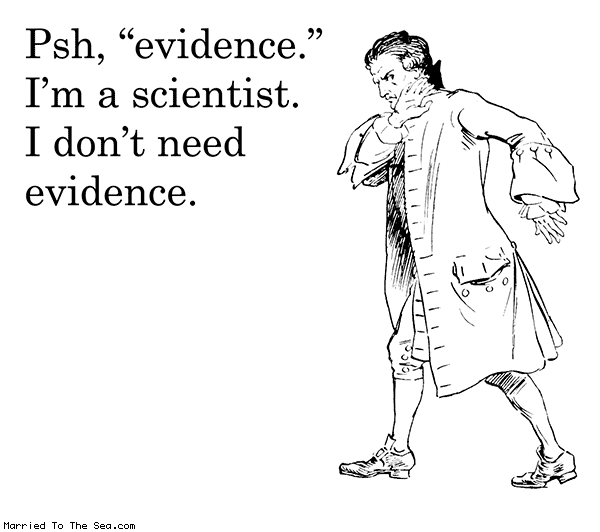
It is the hypocrisy that bothers me, the hypocrisy of power:

scientist evidence – Married to the Sea

Let’s acknowledge that teachers currently work under the demand of measurable evidence of their impact on students while CC advocates impose faith-based policies such as CC, new generation high-stakes testing, merit pay, charter schools, value-added methods of teacher evaluation, and a growing list of commitments to education reform at least challenged if not refuted by evidence.

CC advocates now bear the burden of either offering the evidence identified above or admitting they are practicing faith-based education reform.

CALL FOR PROPOSALS: Pedagogies of Kindness and Respect: On the Lives and Education of Children

CALL FOR PROPOSALS

Pedagogies of Kindness and Respect: On the Lives and Education of Children

Edited by P. L. Thomas, Paul R. Carr, Julie Gorlewski, and Brad Porfilio

Peter Lang USA

Rethinking Childhood Series, Gaile Cannella, series editor

Call and Submission Requirements

Submit a proposal of about 300 words by February 28, 2014, to paul.thomas@furman.edu.

Chapter initial drafts due July 15, 2014, should be in APA citation/style format (see citation proofing guidelines below) and 5,500-6,500 words. Authors are urged to submit clean and carefully edited drafts to enhance the editing process. Please take great care with block quotes (do not set off with returns and tabs) and hanging indents in the references list (do not create hanging indents with return/tab, but use the ruler or Menu>Format>Paragraph>Special>Hanging Indent). (Please read carefully below the background underpinning informing this volume.) Also, it is important to have complete bibliographic information with up-to-date references. (See the end of this document for more information on APA).

Topics, problems, and practices addressing the following will be included:

  • How are “no excuses” ideologies dominant in child rearing and schooling in the U.S. and elsewhere? How are these practices harmful to children?
  • Why are the Commons essential to a thriving democracy, and how does a cultural attitude toward children impact that culture’s commitment to the Commons (notably public schools)?
  • What constitutes pedagogies of kindness and respect?
  • What practices in child rearing and schooling reflect pedagogies of kindness and respect?
  • How are attitudes and practices related to children connected to democratic values?
  • How are current educational structures reflecting and perpetuating stratified opportunities for children, and what education reform alternatives address those structures?
  • How does kindness play into the conceptualization of educational curricula, pedagogy, policy and evaluation?

Submission of Chapter Proposals

To be included in the 300 words are:

  1. Name(s) and affiliation(s) of author(s)
  2. Proposed title
  3. A detailed abstract on the focus of the proposed chapter, including conceptual, theoretical and methodological frameworks as well as the central research question.
  4. A list of 8 keywords.
  5. Also attach the CV(s) for the proposed author(s).

Points of Emphasis

Because we are living in times of historical amnesia, the chapters themselves should be critical, illustrate multiplicity and nuance, and demonstrate an awareness of historical and critical constructions of childhood (and the past work done related to these areas).  The following are examples of expectations for the work:

  1. The fields of education, and especially early childhood education, have included some histories and perspectives that view/treat those who are younger with kindness and respect.  Examples include the works of Nel Noddings (1992), The Challenge to Care in Schools, and Lisa Goldstein (1998), Teaching with Love (in Peter Lang’s Rethinking Series) as well as various scholarly and educational models practiced or put forward by multiple educators and scholars.  Chapters in the work should demonstrate an informed awareness of this history and the ways that both old and new ideas can counter current conditions that are harmful to both those who are younger and older.
  2. The chapters should avoid reconstitution of the romantic, innocent child to be saved by more advanced adults; this has been addressed by many.  The issue is the context in which we are all being placed (not that we should protect the “innocent” child) that is harmful to those who are younger, as well as everyone else.
  3. The notion of two interpretations of childhood: (a) those who are poor who are also often labeled as not knowing how to raise their children so needing help, and (b) those who are privileged and know how to raise their children, has been discussed and problematized over the past 30 years.  Rather than treating this circumstance as a new revelation, the issue is “why has this circumstance continued and even worsened?”  The gap between the rich and poor has certainly increased (why?); testing and standards based education has been critiqued as problematic, but the practices are more accepted than ever (why?); why has past work been ignored and what can be done to change our current circumstances?

Timeline

  • Call, proposals due: February 28, 2014
  • Accepted chapters: March 15, 2014
  • Chapters due: July 15, 2014
  • Revised/final chapters due: September 30, 2014
  • Manuscript delivered: October 15, 2014

Background

Eliot Rosewater in Kurt Vonnegut’s God Bless You, Mr. Rosewater implores:

“Go over to her shack, I guess. Sprinkles some water on the babies, say, ‘Hello, babies. Welcome to Earth. It’s hot in the summer and cold in the winter. It’s round and wet and crowded. At the outside, babies, you’ve got about a hundred years here. There’s only one rule that I know of, babies—:

“‘God damn it, you’ve got to be kind.’” (p. 129)

In Sandra Cisneros’s short story “Eleven,” Rachel sits in class on her eleventh birthday, a day in which she is confronted by her teacher about a found red sweater that the teacher is certain belongs to Rachel:

“Of course it’s yours,” Mrs. Price says. “I remember you wearing it once.” Because she’s older and the teacher, she’s right and I’m not. (Cisneros, 2004, p. 42)

While these are fictional representations, children live in a state of powerlessness, silenced by the hierarchy of authority. The sweater in Cisneros’s story is, in fact, not Rachel’s, but as the narration reveals, facts are secondary to hierarchy.

In the U.S. and throughout the world, children tend to experience not only silencing but also a level of harshness not found in other cultures.

The twenty-first century remains a harsh place for children in their lives and their schools, even in the U.S. where childhood poverty is over 20% and the new majority of public schools involve children in poverty (A new majority, 2013).

But more than the conditions of children’s lives and schools in 2013 is worth addressing. As Barbara Kingsolver (1995) details in “Somebody’s Baby”:

What I discovered in Spain was a culture that held children to be meringues and éclairs. My own culture, it seemed to me in retrospect, tended to regard children as a sort of toxic-waste product: a necessary evil, maybe, but if it’s not our own we don’t want to see it or hear it or, God help us, smell it. (p. 100)

A sort of cultural antagonism and authoritarian control of children pervades the U.S., and during the current thirty-year cycle of accountability, children tend to face this formula[i]:

If children in the U.S. can survive the gauntlet that is the national formula for children, as young adults they can look forward to crushing debt to attend college so that they can enter a nearly non-existent workforce.

But there is a caveat to this formula: The U.S. formula for children above is for “other people’s children,” that new majority in U.S. public schools and those children living in homes of the working poor, the working class, and the dwindling middle class.

Children of the privileged are exempt.

This volume will collect a wide variety of accessible chapters from scholars and practitioners to explore pedagogies of kindness, an alternative to the “no excuses” ideology now dominating how children are raised and educated in the U.S. The genesis of this volume cane be linked to two poems by P.L. Thomas: “the archeology of white people” and “the kindness school (beyond the archeology of white people, pt. 2),” the second of which reads in full:

it simply happened one day
when the teachers decided
enough was enough

all the boys with OCD
spent the day playing drums
or riding their bicycles

and the introverts sat quietly
smiling periodically in the corners
while the extroverts laughed and laughed

and soon the pleasures became many
as varied as the children themselves
until one day a child stood to proclaim

after reading Hamlet all on her own
“I say, we will have no more tests”
to which there was thunderous cheering

yes it seemed simple and obvious enough
the founding of the kindness school
with open doors and children singing

References

Cisneros, S. (2004). Vintage Cisneros. New York, NY: Vintage Books.

Kingsolver, B. (1995). High tide in Tucson: Essays from now and never. New York, NY: Perennial.

A new majority: Low income students in the South and nation. (2013, October). Atlanta, GA: Southern Education Foundation. Retrieved from http://www.southerneducation.org/getattachment/0bc70ce1-d375-4ff6-8340-f9b3452ee088/A-New-Majority-Low-Income-Students-in-the-South-an.aspx

Vonnegut, K. (1965). God bless you, Mr. Rosewater or pearls before swine. New York, NY: Delta.

See also:

https://radicalscholarship.wordpress.com/2013/10/26/on-children-and-kindness-a-principled-rejection-of-no-excuses/

https://radicalscholarship.wordpress.com/2013/10/22/medicating-adhd-in-the-brave-new-world-of-high-stakes-accountability/

http://www.alternet.org/education/why-sending-your-child-charter-school-hurts-other-children

http://www.alternet.org/education/theyre-all-our-children

Citation Proofreading Guidelines

APA — Please copyedit submissions carefully to be sure you have cited following the APA style sheet; below are key points of emphasis that still need addressing in many chapters (also see for guidance https://owl.english.purdue.edu/owl/resource/560/01/):

Copyedit carefully references, noting APA format for titles of books and article (CAP first letter of title, first letter of subtitle and proper nouns ONLY [for example The handmaid’s tale]; journal titles use standard CAP conventions [for example: English Journal]). Essay and chapter titles do NOT require QMs, but book and journal titles remain in ITAL. Also be careful to ensure that each reference conforms to the type of work you are citing; the OWL link has a wide range of samples on the left menus, and it is crucial that you match the type of work being cited to the format. The initial information in each reference bibliography MUST match your in-text citations. For example:

in-text example

James Baldwin (1998), in “A Report from Occupied Territory” (originally published in The Nation, July 11, 1966), confronted an “arrogant autonomy, which is guaranteed the police, not only in New York, by the most powerful forces in American life” (p. 737) and the corrosive deficit view of race it is built upon.

reference

Baldwin, J. (1998). James Baldwin: Collected essays. New York, NY: The Library of America.

In-text guidelines include the following key elements:

First paraphrased reference to a source in EACH new paragraph must include either Author (year) or (Author, year). PLEASE keep Author (year) or (Author, year) in conjunction; do NOT place the year isolated from the author name. All subsequent uses in that paragraph require only either Author or (Author). Please note that parenthetical cites in the flow of your sentences require that the period come AFTER the ( ). ; for block quotes, the period comes BEFORE .( )

example

America the Beautiful created a minority class out of a race of people who are as rich, vibrant, and beautiful as any race of people. America the Beautiful has also created a criminal class out of African American men, building a new Jim Crow system (Alexander, 2012) with mass incarceration masked as a war on drugs. America the Beautiful created a dropout class and future criminal class out of African American young men, as Alexander details, building school-to-prison pipelines and schools-as-prisons as zero-tolerance schools imprisoning urban communities (Nolan, 2011).

In-text citing of print sources, required page numbers:

First quoted reference to a print source in EACH new paragraph must include either Author (year, p. #) or (Author, year, p. #). All subsequent uses require only either Author (p. #) or (Author, p. #). Note that a comma must separate Author, year, p. # and that a SPACE must be placed after the p. preceding the page number. For a quote from a single page use “p.” and for a quote spanning multiple pages, use “pp.” Please note that parenthetical cites in the flow of your sentences require that the period come AFTER the ( ). ; for block quotes, the period comes BEFORE .( )

example

In 1963, Ellison (2003) spoke to teachers:

At this point it might be useful for us to ask ourselves a few questions: what is this act, what is this scene in which the action is taking place, what is this agency and what is its purpose? The act is to discuss “these children,” the difficult thirty percent. We know this very well; it has been hammered out again and again. But the matter of scene seems to get us into trouble. (p. 546)

Ellison recognized the stigma placed on African American students, a deficit view of both an entire race and their potential intelligence (marginalized because of non-standard language skills). But Ellison rejected this deficit perspective: “Thus we must recognize that the children in question are not so much ‘culturally deprived’ as products of a different cultural complex” (p. 549). Ultimately, Ellison demanded that the human dignity of all children be honored.

Citing literary sources with APA:

APA is somewhat cumbersome for citing extended literary analysis, but you must first create an accurate bibliography of the cited works (such as novels) you will cite, and then maintain the above formatting principles when citing from and offering an extended analysis of that work. APA uses Author (year) or (Author, year) and not abbreviations of titles. If you are citing multiple works from an author published in the same year, you must alphabetize them in your bibliography by the titles, and then add sequential alphabet denotes that then MUST be used in the in-text citations.

example 

Typical of contemporary education reform, CCSS began as a political process driven by business interests—not as an educational process designed by classroom teachers or educational researchers (Ohanian, 2012a, 2012b, 2012c, 2011a, 2011b, n.d). In the 1980s during the first wave of accountability, state governors became the primary voice for educational reform. Those governors often used their educational bully pulpit to pursue economic and business goals—improving the workforce or attracting new companies.

[note that proper hanging indent does not show in blog format]

Ohanian, S. (2012a, November 19). Common Core reality check: Here’s how Common Core assessments plan to certify workers for the global economy (with pix)…Let’s make sure the children read ALL of Ovid while we’re at it! Substance News. Retrieved from http://www.substancenews.net/articles.php?page=3778

Ohanian, S. (2012b, October 28). Snookered by Bill Gates and the U.S. Department of Education. The Daily Censored. Retrieved from http://www.dailycensored.com/snookered-by-bill-gates-and-the-u-s-department-of-education/

Ohanian, S. (2012c, February 4). NCTE allegiance to the Common Core is burying us. SusanOhanian.org. Retrieved from http://susanohanian.org/outrage_fetch.php?id=1183

Ohanian, S. (2011a, December 7). We’re being steamrolled into one-size-fits-all. Learning Matters. Retrieved from http://learningmatters.tv/blog/web-series/discuss-are-common-core-standards-good-or-bad-for-education/8280/

Ohanian, S. (2011b, October 19). The crocodile in the Common Core Standards. Substance News. Retrieved from http://www.substancenews.net/articles.php?page=2716

Why Are We (Still) Failing Writing Instruction?

We have two recent commentaries that detail how schools and teachers fail students in the teaching of writing—one comes from a college student and the other, from a former teacher. While both reach the same conclusion about the teaching of writing, the reasons for those failures are in conflict, suggesting that we must consider whether schools and teachers are fumbling the teaching of writing, and then why.

Posted at Anthony Cody’s Living in Dialogue, a former Massachusetts student and current college student, Joan Brunetta, confronts the negative consequences of high-stakes accountability driven by standards and testing:

I am currently a student at Williams College, but I grew up in the public school system in Cambridge, MA and was among the first cohort of kids to have every single MCAS test administered, 3rd grade through 10th. Over the course of my years in the Cambridge public school system, I saw the scope of my education narrowed with increased testing, from a curriculum that valued student growth, experiences, and emotions, to one that was often cold and hard and moved on whether or not we were ready.

Brunetta’s experience should not be discounted as anecdotal since an analysis of twenty years of reform in her home state tends to reinforce her claim. As well, her message about how writing instruction distorted by standards and testing failed her is equally compelling:

In the years I attended high school, in which more focus was centered on testing, much more of our learning was directed toward tests. I wrote hardly anything but five-paragraph essays in high school English and history classes before 11th grade….

Some students said that they actually remember more of what they learned in elementary school than of the material they had learned just the last semester in high school, because those pieces of history or literature were taught in a context and were talked about, not glossed over and memorized quickly. Others noted that they had actually read and written more in elementary school than high school….

Here’s a rubric that my 7th and 8th grade teachers used for evaluating our essays. This is what real rigor looks like to me. Our papers were looked at as true pieces of writing, with respect to our ideas, our structure, and our use of language. If you compare this to the rubric for an MCAS essay or an AP essay (both of which apparently test for a “higher” level of critical thinking), the juxtaposition is truly laughable. I would particularly like to point out the 7/8th grade criteria for good organization: “The paper has a thoughtful structure that surfaces from the ideas, more than the ideas feeling constrained by the structure. Paragraphs and examples connect with fluid transitions when necessary to make the relationships between ideas clear. The organization is not predictable but artful and interesting in the way it supports the ideas.” (emphasis my own)

To do this in writing is hard. It is a challenge. It is what real writers do when they write engaging essays, books, and articles. In MCAS essays and all the essays we wrote to prepare for MCAS essays, using an unpredictable structure was wrong. To do anything but constrain your ideas by the structure was very wrong. When we learned essay writing in high school, we were often handed a worksheet, already set up in five paragraphs, telling you exactly where to put the thesis, the topic sentences, and the “hook.” In my freshman history class, I was told that each paragraph should have 5-9 sentences, regardless of the ideas presented in the paragraph. The ideas didn’t matter–structure reigned supreme. There is nothing wrong with learning how to write in a structured and clear way–for many students, having certain structures to rely on or start with is very helpful. But when testing was involved, all of our writing was reduced to a single, simple, and restrictive structure–simply because that structure is simpler (and therefore cheaper) to grade. It is important to note here that I have heard multiple college professors specifically tell all their well-trained, test-ready students never to use this structure in their writing.

Furthermore, in elementary school, we were taught to edit our writing (a skill totally missing from any MCAS standards and tests and generally lacking from high school); we wrote at least 2 or 3 drafts each time. At the end of the year, we created a portfolio presentation, which we gave to parents, teachers, and community members about how we had grown over the year, what we still needed to work on, and what our goals were for next year. Almost all of my writing practices and skills that I use each day in college –and even more so, the ability to evaluate my own work and see what I need to do in the next draft or on the next paper–come from my middle school years in a school that was not following the guidelines and was refusing to prep us for tests.

Again, Brunetta’s experience is one student’s story that is typical of how high school instruction in the U.S. has been decimated by accountability, standards, and testing. Applebee and Langer, in fact, have compiled a powerful examination of the exact experiences Brunetta details: Despite teachers being aware of a growing body of research on how best to teach writing (in ways Brunetta experienced in elementary and middle school), there remains a “considerable gap between the research currently available and the utilization of that research in school programs and methods” (LaBrant, 1947, p. 87), notably in writing instruction in schools today.

However compelling Brunetta’s story is, Robert Pondiscio shares Brunetta’s conclusion while offering a much different source of failing students in the teaching of writing:

Like so many of our earnest and most deeply humane ideas about educating children in general, and poor, urban children in particular, this impulse toward authenticity is profoundly idealistic, seductive, and wrong. I should know. I used to damage children for a living with that idealism.

I taught 5th grade at PS 277 in the South Bronx from several years. It was the lowest-performing school in New York City’s lowest-performing school district. We didn’t believe in the kind of literacy instruction practiced by New Dorp High School, as described by Peg Tyre in her piece, “The Writing Revolution.” It is not an overstatement to say that our failure to help students become good readers and writers is why I became a curriculum reform advocate.

Pondiscio has continued to blame authentic writing instruction as a failure, linking it to the same narrowing effect as accountability:

More recently the muscular brand of test-driven education reform that has come to dominate schooling has ill-served those purposes by hollowing out the curriculum further still.  If a child reads on grade level and graduates by age 18 our schools will eagerly pronounce him or her educated and send them off into the world, with diminished agency, fewer options, and less opportunity than their affluent and better-educated brethren.  We have conspired—all of us—to make them less than fully free.

This fundamental injustice upset me and upsets me still.  I sometimes note that my progressive credentials were in good order until I became a teacher.  The education I was trained to give to my students left them less than prepared for self-sufficiency and upward mobility.  My complicity in allowing the scope of their education to be narrowed, whether by progressive ideals or test-driven accountability, robbed them of some measure of their liberty.  Not just economic liberty, but freedom of thought and expression.

What, then, should we conclude from Brunetta and Pondiscio in the context of what we know about best practice in teaching writing and how writing is being taught in K-12 schools?

First, we are clearly failing the teaching of writing, and as Hillocks warned (see Hillocks, 2003, and Hillocks, 2002), that failure is primarily driven by high-stakes accountability’s influence on the classroom.

As well, the increased high-stakes testing of writing, notably the SAT and ACT along with high-stakes state assessments linked to standards, has eroded effective writing instruction, as NCTE cautioned. A similar warning about machine-scored writing is a harbinger for even more damage to be done to the teaching of writing.

The tension between Brunetta and Pondiscio about authentic writing instruction remains both troubling and important. In order to understand how Brunetta and Pondiscio could reach the same conclusion with such contradictions, we must examine Brunetta’s and Pondiscio’s characterizations of authentic writing instruction, specifically workshop approaches to teaching writing. Brunetta’s description quoted above should be measured against this from Pondiscio:

Every day, for two hours a day, I led my young students through Reader’s and Writer’s Workshop. I was trained not to address my kids as “students” or “class” but as “authors” and “readers.” We gathered “seed ideas” in our Writer’s Notebooks. We crafted “small moment” stories, personal narratives, and memoirs. We peer edited. We “shared out.” Gathered with them on the rug, I explained to my 10-year-olds that “good writers find ideas from things that happened in their lives.” That stories have “big ideas.” That good writers “add detail,” “stretch their words,” and “spell the best they can.”

Teach grammar, sentence structure, and mechanics? I barely even taught. I “modeled” the habits of good readers and “coached” my students. What I called “teaching,” my staff developer from Teacher’s College dismissed as merely “giving directions.” My job was to demonstrate what good readers and writers do and encourage my students to imitate and adopt those behaviors.

Two brief points from Brunetta and Pondiscio offer a window into clarifying why Brunetta’s characterization of writing workshop is more accurate than Pondiscio’s: Brunetta notes, “in elementary school, we were taught to edit our writing…; we wrote at least 2 or 3 drafts each time,” while Poniscio laments, “Teach grammar, sentence structure, and mechanics? I barely even taught.”

Pondiscio has fallen victim to a common mischaracterization of authentic writing instruction, one that suggests no direct instruction occurs, particularly direct instruction addressing grammar, mechanics, and usage.

If Pondiscio was doing no direct instruction, then, in fact, he did fail his students. But that failure cannot be laid at the feet of workshop or authentic writing instruction.

Workshop approaches to teaching writing authentically include direct and purposeful instruction addressing all aspects of writing, including grammar, mechanics, and usage; the issue has never been if we teach grammar, for example, but when and how.

Pondiscio’s characterization of writing workshop is cartoonish, a simplistic distortion of a vibrant field that portrays the teaching of writing as complex and multi-faceted.

For example, Writing Next (2007) highlights “Eleven Elements of Effective Adolescent Writing Instruction”:

1. Writing Strategies, which involves teaching students strategies for planning, revising, and editing their compositions

2. Summarization, which involves explicitly and systematically teaching students how to summarize texts

3. Collaborative Writing, which uses instructional arrangements in which adolescents work together to plan, draft, revise, and edit their compositions

4. Specific Product Goals, which assigns students specific, reachable goals for the writing they are to complete

5. Word Processing, which uses computers and word processors as instructional supports for writing assignments

6. Sentence Combining, which involves teaching students to construct more complex, sophisticated sentences

7. Prewriting, which engages students in activities designed to help them generate or organize ideas for their composition

8. Inquiry Activities, which engages students in analyzing immediate, concrete data to help them develop ideas and content for a particular writing task

9. Process Writing Approach, which interweaves a number of writing instructional activities in a workshop environment that stresses extended writing opportunities, writing for authentic audiences, personalized instruction, and cycles of writing

10. Study of Models, which provides students with opportunities to read, analyze, and emulate models of good writing

11. Writing for Content Learning, which uses writing as a tool for learning content material (pp. 4-5)

These eleven elements in no way discredit direct instruction or addressing grammar, mechanics, and usage; again, teaching writing is about couching direct instruction within students being provided structured, authentic and whole experiences with multi-draft, original writing.

Pondiscio’s misrepresentation of workshop isn’t unusual among educators who embrace teacher-centered and knowledge-based approaches to learning. Part of Pondiscio’s position lies within his embracing grammar, for example, as a body of knowledge worth acquiring as an end to learning, not as a means to better writing.

In writing instruction, grammar and other surface features (mechanics and usage) are important elements of a larger writing context, and research has shown (see Weaver, 1996, and Hillocks, 1995) that isolated direct grammar instruction neither helps students acquire grammatical knowledge nor improves students as writers. In fact, isolated direct grammar instruction tends to impact negatively student writing:

chart

(click to enlarge)

Pondiscio’s knowledge-based view of acquiring grammar and his mischaracterization of writing workshop are powerfully refuted by what we know is best practice in writing instruction:

BP writing

(click to enlarge)

As the chart above shows, best practice in writing instruction is not a template, but a range of practices that must be navigated by teachers and students dedicated to students becoming writers. If Pondiscio failed his students when teaching writing, he can point to many things I am sure, but writing workshop properly implemented is not one of them.

Ultimately, we must admit that Brunetta and Pondiscio are right about the lingering failure of teaching students to write. To answer why, both Brunetta and Pondiscio offer valuable insight, but for different reasons.

Over the past thirty years, high-stakes accountability and testing have ruined the promise of best practice begun in the first days of the National Writing Project in the late 1970s and early 1980s. Standards-and-test mania have supplanted a rich field of teaching writing, one that is still evolving and one that remains characterized by tensions.

But a second reason we continue to fail the teaching of writing is that English teaching has a long history, as I quoted LaBrant above, of allowing a “considerable gap between the research currently available and the utilization of that research in school programs and methods.” This professional failure has occurred even when the stakes were not high or linked to standardized tests.

Writing remains a powerful and important tool for learning, thinking, and expression. The teaching of writing, although often marginalized and ignored, should be foundational to all education—although it remains a distant cousin to reading and math.

Continuing to seek new standards and better tests will only erode further the failure to teach writing Brunetta and Poniscio identify. Instead of trying to close the achievement gap measured by test scores we have manufactured during the accountability era, we are way past time in our need to address the gap between what we know about teaching writing and what we do with students in our classrooms.

For Further Reading

Writing Instruction That Works: Proven Methods for Middle and High School Classrooms, Arthur N. Applebee and Judith A. Langer

The Testing Trap: How State Writing Assessments Control Learning, George Hillocks

Teaching Grammar in Context, Constance Weaver

Teaching Writing As Reflective Practice: Integrating Theories, George Hillocks

Best Practice (4th ed.), Zemelman, Daniels, and Hyde

Research on Composition: Multiple Perspectives on Two Decades of Change, Peter Smagorinsky, Editor

End Zero-Tolerance Policies: A Reader

What do zero-tolerance policies, “no excuses” practices, and grade retention have in common?

They all negatively and disproportionately impact children from poverty, minority children, English language learners, and boys; and nearly as disturbing, all are discredited by large bodies of research.

Is the tide turning against at least zero-tolerance policies? Lizette Alvarez reports:

Faced with mounting evidence that get-tough policies in schools are leading to arrest records, low academic achievement and high dropout rates that especially affect minority students, cities and school districts around the country are rethinking their approach to minor offenses.

Zero-tolerance policies, “no excuses” practices, and grade retention have something else in common: they should all be eradicated from our schools. And thus, here is a reader to help support calls for ending these practices and policies:

Police in the Hallways: Discipline in an Urban High School, Kathleen Nolan

Review: Police in the Hallways: Confronting the “Culture of Control,” P. L. Thomas

The School-to-Prison Pipeline, Journal of Educational Controversy (vol. 7, issue 1, Fall/2012-Winter 2013)

Hope Against Hope: Three Schools, One City, and the Struggle to Educate America’s Children, Sarah Carr

New Schools, Old Problems [Review: Hope Against Hope], P. L. Thomas

Education Reform in the New Jim Crow Era

Truthout TV Interviews P.L. Thomas About the New “Jim Crow” Era of Education Reform

Just Say No to Just Read, Florida, South Carolina [includes retention research]

Implementing Policies to Reduce the Likelihood of Preschool Expulsion, Walter S. Gilliam, PhD

Prekindergarteners Left Behind: Expulsion Rates  in State  Prekindergarten Programs, Walter S. Gilliam, PhD

Henry Giroux on the “School to Prison Pipeline”

The Mis-education of the Negro, Carter Godwin Woodson

Arresting Development • Zero Tolerance and the Criminalization of Children, Annette Fuentes

Education Reform as Collaboration, Not Competition

At This Week in Poverty, Greg Kaufmann offers Anti-Poverty Leaders Discuss the Need for a Shared Agenda. Taking a similar pose, Diane Ravitch offers her reasoned “dissent” to my post, Secretary Duncan and the Politics of White Outrage, explaining at the end:

My advice to Paul Thomas, whose sense of outrage I share, is to embrace coalition politics. When the white moms and dads realize they are in the same situation as the black and Hispanic moms and dads, they become a force to be reckoned with. The coalition of diverse groups is a source of political power that will benefit children and families of all colors and conditions.

Both pieces raise an important element in the education reform debates, especially as that overlaps with efforts to address and eradicate poverty and inequity: Failure in education and equity reform has be driven by commitments to competition models instead of embracing collaboration and coalitions. To that, I offer the following:

Education Reform as Collaboration, Not Competition

Since the mid- to late-1800s, and especially over the past thirty years, public education has experienced a constant state of reform that can be characterized by one disturbing conclusion—none of that reform appears to work (or, at least, political leaders and the media stay committed, often in conjunction, to that claim).

Despite massive political, public, and financial commitments to creating better schools in the U.S., most people remain concerned that education is not achieving its promise. While debates often focus on issues related to state-to-state or international comparisons of test scores, we have also struggled with issues of equity, such as high drop-out rates and achievement gaps (see HERE and HERE).

Ultimately, the failure of decades of education reform is likely that we have committed to in-school-only reform. “No excuses” and “poverty is not destiny” represent educational policy such as Knowledge Is Power Program (KIPP) charter schools and calls for tougher standards (Common Core) and next-generation tests. Education consultant Grant Wiggins defends this in-school-only focus: “Teachers and schools make a difference, a significant one. And we are better off improving teaching, learning, and schooling than anything else as educators because that’s what is in our control.”

Since three decades of standards-based and test-driven accountability have resulted in the current call for different standards and tests, we are poised at a moment when in-school-only reform and competition models such as school choice and Race to the Top must be examined as part of the problem. Instead, education reform must be an act of collaboration that addresses directly both social and educational reform. That collaboration model should begin by acknowledging that we are failing both the historical promise of public education and the call in No Child Left Behind to create scientifically-based education reform. For example, consider just two powerful research-based reasons to change course.

The Joseph Rowntree Foundation highlights the importance of social reform as a powerful mechanism for educational reform: “The impact of increases in income on cognitive development appears roughly comparable with that of spending similar amounts on school [emphasis added] or early education programmes. Increasing household income could substantially reduce differences in schooling outcomes, while also improving wider aspects of children’s well-being.”

And Sendhil Mullainathan and Eldar Shafir in Scarcity: Why Having Too Little Means So Much show that—despite the in-school reform argument for students needing “grit”—people in abundance succeed because of slack, not grit, and those same people would struggle in scarcity.

Education reform, then, needs to shift away from in-school-only commitments and competition, thus seeking ways in which the lives and schools of children can create the slack all children deserve so that their grit can matter.

Misreading “Grit”: On Treating Children Better than Salmon or Sea Turtles

Rob McEntarffer (@rmcenta) Tweeted a question to me about my blog post, The Poverty Trap: Slack, Not Grit, Creates Achievement, asking: “can Grit research (Duckworth, etc) be used as a humanizing/empowering tool, rather than a weapon against schools/kids?”

Rob’s question is both a good one and representative of the numerous challenges I received for rejecting “grit”—some of the push-back has been for my associating “grit” and “no excuses,” but many of the arguments (some heated) I have read simply rest on a solid trust that “grit” matters and thus should be central to what educators demand from their students, regardless of their students’ backgrounds (and possibly because many students have impoverished backgrounds).

I remain adamant that demanding “grit” is deeply misguided and harmful to children, especially children living in poverty. But I also acknowledge that a large percentage of educators who embrace “grit” are genuinely seeking ways in which we can help children in poverty succeed. In other words, many “grit” advocates share my educational goals.

So I think Rob’s question needs to be answered, and done so carefully. Let me start with a nostalgic story.

A Facebook post from a former high school friend and basketball teammate is the basis of this story—my junior year high school basketball team:

WHS basketball jr year

I am number 5, and other than wondering why I was looking away and seemingly disengaged, I am struck by my socks.

Throughout junior high and high school, I suffered the delusion I was an athlete, spending most of my free time either playing basketball or golf. My heart and soul longed for being a basketball player, and on my bedroom wall (along with the required poster of Farrah Fawcett) hung a poster of Pete Maravich who wore the same socks superstitiously every game, two pairs pushed down and tattered.

I wanted few things more than being Pistol Pete. Maravich was smart, skilled, and hard-working. Even after his career on the court, Maravich remained the personification of practice and drills: If you work hard enough, Maravich seemed to represent, you too can be a magician on the basketball court.

Soon after Maravich, I added Larry Bird to my list of role models, again latching on to his working-class ethic as an athlete. Bird prompted mythological tales—Larry Legend—about his breaking into Boston Garden to shoot in the dark when the facility was closed.

That’s right, I was a child and teenager smitten by “grit.”

After being diagnosed with scoliosis the summer before my ninth grade, I became an exercise fanatic, possibly as a response to the genetic failure of my body. I created a year-long daily calendar on poster-board each year from ninth through twelfth grades to list and monitor my workouts. For those four years, I wore ankle weights most days and jumped rope at least 300 times each night with those weights on. Every day. Four years.

My Holy Grail was dunking the basketball*—despite my being about 5’10” and around 130 pounds.

My fanaticism about practice carried over onto the driving range in good weather also. I often hit 300 range balls on the golf course practice range before setting out to play 18-27 holes.

And what did all that get me?

Look back to that junior-year photograph above. In my high school during the late 1970s, letterman jackets were the greatest treasure for want-to-be athletes like me (I often wore my father’s jacket from the 1950s to school, a jacket he earned as captain of the first state championship football team at that same high school). But the rules of receiving a letterman’s jacket revolved around lettering your junior year—no other year of lettering resulted in a jacket.

I lettered every year of high school except junior year—a year I spent almost totally on the bench. I never earned a letterman’s jacket in high school, despite lettering in two sports my senior year.

And all that golf practice resulted in a huge amount of callouses and a year on the golf team at junior college.

But I was never Pistol Pete or Larry Legend, and certainly never close to Arnold Palmer (yes, my golf fantasies had working-class heroes also).

So what is my point? I am not trying to suggest that my anecdotes of my life prove my point, but they certainly make an important case for answering Rob’s question.

You see, throughout junior high, high school, and college, I never really tried at school—I was too busy trying to be Pistol Pete and then Larry Legend. And if anyone looked at the outcomes of these two different spheres—my grades in my classes and my scrawny, blond self riding the bench of countless high school basketball games—which do you think appears to be the result of “grit,” effort?

Despite my growing up in a working class family, I thrived when I did because of a number of privileges—being white, male, and prone to math and verbal skills cherished by the school system.

And the evidence is powerful that privilege trumps effort and that human behaviors are greater reflections of the conditions of their lives (abundance or scarcity) than the content of their character.

When my junior year ended without my having earned that letterman’s jacket, I began carrying with me until this day a deep and genuine sense of failure because I wanted few things more than to hand my father back his jacket and to stand before him in the one I earned, to show him I was the man I wanted to be, which was the man he was. That was a boy’s dream, of course, because my father could not have loved me more then or now than he does.

I trust, as well, that my experiences with trying very hard at things I could never excel in and then excelling in things that required very little effort on my part do inform what I argue is a misguided commitment to “grit” in calls for education reform and in school and classroom practices, even among educators with the best of intentions. So I want to end by answering Rob with a few observations and questions I think should help us at least reconsider commitments to “grit”:

  • How do we know when one child is trying and another isn’t? And how do we know why one child works hard and another seems not to make the same effort? I recently arrived at my first year seminar class upset that so many students had failed to submit their essays on time for that class session. My assumptions were all focused on them, but once I arrived in class, I discovered they had all been having technical trouble—the campus email system wasn’t allowing attachments. The focus on “grit,” then, often maintains a singular and accusatory eye on the child, and thus ignores the context, which may be the source of the behavior.
  • How often do we misread “privilege” as “grit”? My argument is—almost always. Even when privileged people excel because of their “grit,” the distinguishing aspect of that success remains the privilege. As well, when impoverished people overcome their hurdles due to hard work and “grit,” they remain outliers, and while they should be applauded, their outlier success isn’t a credible template for everyone else struggling under the weight of poverty.
  • As I note below, “grit” may be a distorted quality among leaders because our culture is competition-based, and our leaders both feel like winners and are praised as winners. Winning is linked to effort in our society even when the effort is not the key to that success. Leaders as winners, then, tend to project their “grit” onto others—not unlike the messages found in Maravich’s basketball training videos—”Just work hard, like I did, and you can do anything!” While such messages may be inspiring, they are at least incomplete, if not mostly untrue; my efforts in high school were not failures due to my lack of effort, but due to my genetic ceiling.
  • And finally, Rob’s question directly: Can “grit” research and ideology be used as a humanizing and empowering tool, rather than a weapon against schools and children? To which I say: If we dedicate ourselves to creating the slack necessary for that “grit” to matter and for such demands to be equitable, then yes. In other words, “grit” fails when it becomes the initial and primary demand of children, superseding commitments to creating the equitable conditions that all children need in their lives and schools. My conclusion about “grit,” then, is that the ultimate concern of mine may be where we prioritize and emphasize it—and how it is used as a spotlight on children in poverty almost exclusively.

On this last point, I think, I can make my best case about why emphasizing “grit” is both misguided and harmful.

From the authoritarian extremes of “no excuses” schools such as KIPP to the more progressive embracing of “grit” that many may call “tough love,” when we honor “grit” we reduce our children to salmon and sea turtles, we create schools that perpetuate a Social Darwinism that is human-made. School, like life, for these children becomes something to survive, a mechanism for sorting.

I think we can and should do better than treating our children like salmon and sea turtles—even when we do so with love in our hearts.

* By the way, yes, I could occasionally dunk in my late teens and early twenties.

Pete Maravich: A Tribute

The New York Times in an Era of Kool-Aid Journalism

With Advertisements for the Common Core, the Editorial Board at The New York Times has offered its special brand of Kool-Aid journalism to the careless claim that 2013 NAEP data somehow prove education reform is a success:

The country is engaged in a fierce debate about two educational reforms that bear directly on the future of its schoolchildren: first, teacher evaluation systems that are taking hold just about everywhere, and, second, the Common Core learning standards that have been adopted by all but a few states and are supposed to move the schools toward a more challenging, writing-intensive curriculum.

Both reforms — or at least the principles behind them — got a welcome boost from reading and math scores released recently by the federal government. …

Two examples are the District of Columbia and Tennessee, among the first to install more ambitious standards and teacher evaluations. Tennessee jumped from 46th in the country in fourth-grade math two years ago to 37th, and from 41st in the nation to 34th in eighth-grade reading. The District of Columbia, though still performing below the national average, has also shown progress. The scores of its students improved significantly in both math and English.

Moreover, according to Education Secretary Arne Duncan, the eight states that managed to get the Common Core standards in place in time for the latest National Assessment of Educational Progress exams this year showed improvement from 2009 scores in either reading or math.

Kool-Aid journalism occurs when journalists relinquish their work as researchers and reporters to political appointees—in this case the Editorial Board of the NYT decides to turn Secretary Duncan’s baseless claims into statements of fact that support an editorial position. The Board concludes:

But the progress seen elsewhere — like Tennessee and the District of Columbia — shows that improvement is possible if the states strengthen their resolve and apply solutions that have been shown to work.

However, if the Editorial Board at the NYT had made even a basic effort at confirming Duncan’s claims, the Board could have discovered that NAEP data are complicated and cannot prove in any way that recent reforms are a success.

As I have detailed, and despite my not having any training as a journalist or as an investigative reporter, the Editorial Board could have benefitted from the following clarifications about NAEP that I found easily—all of which discredit Duncan’s claims and the Board’s position:

When I point out that raw changes in state proficiency rates or NAEP scores are not valid evidence that a policy or set of policies is “working,” I often get the following response: “Oh Matt, we can’t have a randomized trial or peer-reviewed article for everything. We have to make decisions and conclusions based on imperfect information sometimes.”

This statement is obviously true. In this case, however, it’s also a straw man. There’s a huge middle ground between the highest-quality research and the kind of speculation that often drives our education debate. I’m not saying we always need experiments or highly complex analyses to guide policy decisions (though, in general, these are always preferred and sometimes required). The point, rather, is that we shouldn’t draw conclusions based on evidence that doesn’t support those conclusions.

This shows that the places with the greatest gains were D.C., Tennessee, and Indiana, three places that have embraced the corporate reform strategy of testing, closing down schools, and opening charters.  If this was the only data we had access to, it would seem to prove that “the ends justify the means” when it comes to education reform….

There are many other things to analyze, and I’m looking forward to reading how others analyze the data.  For example, it is curious that Louisiana had ‘gains’ that were smaller than the national average despite that state having, certainly, the most aggressive reforms occurring.  For ‘reformers’ who are so obsessed with test scores and test score gains, this is certainly something that shouldn’t be ignored.  Also, Washington and Hawaii were pretty high up on the ‘growth’ numbers even though Washington does not have charter schools and Hawaii has been very slow to adopt Race To The Top reforms so their ‘gains’ can’t be attributed to those.

I’m still pretty confident that in the long run education reform based primarily on putting pressure on teachers and shutting down schools for failing to live up to the PR of charter schools will not be good for kids or for the country, in general.  I hope politicians won’t accept the first ‘gains’ chart without putting it into context with the rest of the data.

  • Latest NAEP Results, by G.F. Brandenburg exposes that DC gains pre-date the reforms championed by Duncan and the NYT:

First of all, the increases in some of the scores in DC (my home town) are a continuation of a trend that has been going on since about 2000. As a result of those increases, DC’s fourth grade math students, while still dead last in the nation, have nearly caught up with MISSISSIPPI, the lowest-scoring state in the US.

You will have to strain your imagination to see any huge differences between the trends pre-Rhee and post-Rhee. (She was installed after testing was over in 2007.)…

So, the Educational DEforms instituted by Rhee, Henderson, and their corporate masters have not produced the promised miracles.

Yesterday gave us the release of the 2013 NAEP results, which of course brings with it a bunch of ridiculous attempts to cast those results as supporting the reform-du-jour. Most specifically yesterday, the big media buzz was around the gains from 2011 to 2013 which were argued to show that Tennessee and Washington DC are huge outliers – modern miracles – and that because these two settings have placed significant emphasis on teacher evaluation policy – that current trends in teacher evaluation policy are working – that tougher evaluations are the answer to improving student outcomes – not money… not class size… none of that other stuff.

I won’t even get into all of the different things that might be picked up in a supposed swing of test scores at the state level over a 2 year period. Whether 2 year swings are substantive and important or not can certainly be debated (not really), but whether policy implementation can yield a shift in state average test scores in a two  year period is perhaps even more suspect….

Is Tennessee’s 2-year growth an anomaly? we’ll have to wait at least another two years to figure that out. Was it caused by teacher evaluation policies? That’s really unlikely, given that those states that are equally and even further above their expectations have approached teacher evaluation in very mixed ways and other states that had taken the reformy lead on teacher policies – Louisiana and Colorado – fall well below expectations.

As it stands, the position taken by the NYT Editorial Board lacks even the barest qualities of credibility, but it does expose the utter failure of Kool-Aid journalism.

The Duncan Debacle: It’s Not (Just) about Duncan

If Secretary of Education Arne Duncan has prompted outrage from a wide range of people, as Rebecca Klein reports, by invoking “white suburban moms,” as I have noted, the controversy is much more complex than “clumsy phrasing.”

I remain adamant about my concluding point concerning the racial components of Duncan’s comment and the responses to it: If white outrage is the only outrage that counts in the U.S., any victory won from that outrage is no victory at all.

But there is another component of the response that deserves the “conversation” Duncan claims he would like to see us embrace: Duncan is simultaneously the embodiment and the victim of a toxic combination of privilege, bureaucracy, and arrogance.

First, Duncan’s incompetence is no different than the incompetence exhibited by previous Secretaries, such as Margaret Spellings. Where has the outrage been about the national leaders of education having essentially no grasp of data or statistics? Or the likelihood that they feel compelled to protect their partisan politics regardless of the truth?

Next, Duncan’s most recent embarrassment must be placed in the larger context of the entire education agenda under Obama—an agenda characterized by Civil Rights discourse used with Orwellian aims of masking classist and racist policies impacting negatively and disproportionately black, brown, and  poor children (“other people’s children”) as well as English language learners. Where has the outrage been about maintaining and expanding two separate education systems—one for the privileged children of our leaders and another for the impoverished and marginalized?

Duncan, then, is not an isolated failure as Secretary of Education, and his recent “clumsy phrasing” isn’t an aberration in his public discourse.

No, Duncan sits in a long line of failed bureaucratic education reformers, ripe for satire that borders on possibility.

Since Duncan has called for a return to a conversation, I want to repost here a simple request I made during the summer of 2013: A request that Duncan confront the wealth of evidence that refutes his Common Core advocacy.

Evidence? Secretary Duncan, You Can’t Handle the Evidence [1]

Secretary of Education Arne Duncan appears now to be assuming the mantle of self-righteous indignation—a tenuous perch for someone who is leading a field in which he has no experience or expertise.

As Valerie Strauss has reported, Duncan this summer lambasted news editors, berating them for failing to demand evidence for claims against Common Core.

Duncan, first, is striking an insincere pose that manufactures a false universe in which only evidence-based support for CC and Tea Party railings against CC exist. This conveniently ignores the growing legions of educators, academics, and scholars who reject CC, and actually have the evidence.

Since Duncan is demanding evidence, it is high time he practices what he preaches (let’s all pause here because that strikes me as a bit of lunacy, in fact, to expect a political appointee to live by the rules he imposes on others).

Secretary Duncan, please either confirm or discredit the following body of evidence that refutes any credibility for needing CC or that CC will work as education reform:

  • Hout and Elliott (2011), Incentives and Test-Based Accountability in Education: Most recent decades of high-stakes accountability reform hasn’t work.
  • French, Guisbond, and Jehlen (2013), Twenty Years after Education Reform: High-stakes accountability in Massachusetts has not worked.
  • Loveless (2012), How Well Are American Students Learning?: “Despite all the money and effort devoted to developing the Common Core State Standards—not to mention the simmering controversy over their adoption in several states—the study foresees little to no impact on student learning” (p. 3).
  • Mathis (2012): Existence and/or quality of standards not positively correlated with NAEP or international benchmark test data; “Further, the wave of high-stakes testing associated with No Child Left Behind (NCLB) has resulted in the ‘dumbing down’ and narrowing of the curriculum” (2 of 5).
  • Whitehurst (2009), Don’t Forget Curriculum: “The lack of evidence that better content standards enhance student achievement is remarkable given the level of investment in this policy and high hopes attached to it. There is a rational argument to be made for good content standards being a precondition for other desirable reforms, but it is currently just that – an argument.”
  • Kohn (2010), Debunking the Case for National Standards: CC nothing new, and has never worked before.
  • Victor Bandeira de Mello, Charles Blankenship, Don McLaughlin (2009), Mapping State Proficiency Standards Onto NAEP Scales: 2005-2007: Why does research from the USDOE not show high-quality standards result in higher NAEP scores?
  • Horn (2013): “The 2012 NAEP Long-Term Trends are out, and there is a good deal that we may learn from forty years of choking children and teachers with more tests with higher stakes: IT DOESN’T WORK!”

Evidence? Secretary Duncan, you can’t handle the evidence.

For Further Reading, Secretary Duncan:

Baker, B.D. & Welner, K.G. (2011). Productivity Research, the U.S. Department of Education, and High-Quality Evidence. Boulder, CO: National Education Policy Center. Retrieved [date] from http://nepc.colorado.edu/publication/productivity-research.

—–

Bruce Baker and Kevin G. Welner

Evidence and Rigor: Scrutinizing the Rhetorical Embrace of Evidence-Based Decision Making Educational Researcher April 2012 41: 98-101, doi:10.3102/0013189X12440306
—–
—–
[1] The original blog posting has been identified by the National Council of Teachers of English in recognizing my work for the 2013 George Orwell Award.

Secretary Duncan and the Politics of White Outrage

Social media and even mainstream media appear poised to leap on Secretary Arne Duncan with both feet due to his swipe at white suburban moms.

The nearly universal sweeping outrage—some with a level of glee that must not be ignored—calls for close consideration itself.

First, rejecting Duncan’s comments about white suburban moms and Common Core critics is completely valid. I join hands with the education community in rejecting Duncan’s claims, his discourse, and his efforts to discredit a significant, credible, and growing resistance to CC that should not be trivialized and marginalized as Duncan does.

However, I find the magnitude and swiftness of the responses to this “white suburban moms” incident disappointing in the larger context of Duncan’s entire tenure as Secretary of Education.

In the first moments of Obama’s administration, Duncan has personified and voiced an education agenda that disproportionately impacts black, brown, and poor children in powerfully negative ways. And the entire agenda has been consistently cloaked in discourse characterizing these policies as the Civil Rights issue of the day.

As well, Duncan has perpetuated and embraced “no excuses” narratives while directly and indirectly endorsing education reform and policies that target and mis-serve high-poverty students, African American and Latina/o students, and English Language learners—charter schools, Teach for America, accountability based on standards and high-stakes testing.

Public commentary that highlights that education reform under Obama and Duncan fails the pursuit of equity in the context of race and class in the U.S. tends to fall on deaf ears. The same urgency witnessed in the responses to Duncan’s “white suburban moms” contrasts significantly from the silence surrounding challenges to Duncan’s discourse and policies that are classist and racist, policy designed for “other people’s children.”

The problem is not that educators and scholars have failed to identify that education reform under Obama and Duncan have continued and increased federal and state education policy creating two inequitable education systems—one for the white and affluent, another for minorities and the impoverished—because these important messages have been raised.

The problem is that rejecting education reform discourse and policy based on race and class concerns doesn’t resonate in the U.S.

As I have asked numerous times, what would the political and public support for TFA be if the organization was providing recent college graduates with no degrees in education and only five weeks of training to teach Advanced Placement or International Baccalaureate classes filled with affluent white students? (A similar question about KIPP raises the same issue.)

Indirectly, from the response to Duncan’s “white suburban moms” comments, now we know.

The measure of a people must not come from how we flinch when the privileged suffer; the measure of a people must come from how we tolerate (or ignore) the conditions that impact the impoverished and the powerless.

If white outrage is the only outrage that counts in the U.S., any victory won from that outrage is no victory at all.

For Further Reading

First They Came For Urban Black and Latino Moms (For Arne Duncan), Jose Vilson

“the archeology of white people”