Category Archives: education reform

Beyond “Doubly Disadvantaged”: Race, Class, and Gender in U.S. Schools and Society

The U.S. Department of Housing and Urban Development (HUD) established the Moving to Opportunity (MTO) for Fair Housing program in the mid-1990:

MTO recruited more than 4,600 families with children living in severely distressed public housing projects in five cities (Baltimore, Boston, Chicago, Los Angeles, and New York City). HUD offered some MTO families the opportunity to use a housing voucher to move into private-market housing in lower poverty neighborhoods and did not make the same offer to others.

“The Long-Term Effects of Moving to Opportunity on Youth Outcomes” (2012) reveals the following from that program:

These patterns [school dropout, low test scores, and delinquency] have led to a longstanding concern that neighborhood environments may exert an independent causal effect on the life chances of young people. Because low-income individuals comprise nearly one-half of the 8.7 million people living in census tracts with poverty levels of 40 percent or higher (Kneebone, Nadeau, and Berube, 2011), poor children growing up in neighborhoods of concentrated poverty may be “doubly disadvantaged”—they face potential risks from growing up in a low-income household and in an economically poor neighborhood. (See a full discussion HERE)

The disadvantages of being born poor and then attending public schools in impoverished neighborhoods are far greater than doubled, however. The disadvantages are exponential and involve race, class, and gender.

NPR has presented two brief looks at new analyses from MTO—one directly about Study: Boys Report PTSD When Moved Out Of Poverty, and the other a related story, ‘Prep School Negro’ Shows Struggle Between Poverty And Plenty.

David Green reports on the MTO research:

Now a new study in the Journal of the American Medical Association finds that boys from these families did not thrive. They found that the move took a toll on their emotional well being, a toll not experienced by girls….

Professor at Harvard Medical School, Ronald Kessler explains about the research findings:

Well, the hope was originally that the educational opportunities for the kids would increase because of better schools, that the opportunities for the parents finding jobs would increase because they moved to places where there were higher employment rates so that in the long run the kids, as they moved out, would have better socioeconomic achievement than they would have otherwise….

Well, we found something that we hadn’t expected, which was the effect of the intervention was quite positive for girls, but boys had the opposite effect. Boys were more depressed. They were more likely to have post traumatic stress disorder. They were more likely to have conduct problems if they were in families that were offered vouchers than in the control group that wasn’t involved in any kind of move.

Although not part of the WTO experimental group, Andre Robert Lee represents that alienation felt by African American and poor males and identified by Kessler and his team:

I kind of feel like when you’re black, sometimes you have to be twice as good. I was kind of, you know, sad by it, you know. I’m a people person and to go to a school where you can’t be yourself – I was being myself, but people not to embrace you is just – it kind of sucked.

This research and personal experience must be placed in several social and educational contexts.

First, the unique and negative experiences of impoverished males, including impoverished African American males, are complicated by the research on how people view African American children:

Asked to identify the age of a young boy that committed a felony, participants in a study routinely overestimated the age of black children far more than they did white kids. Worse: Cops did it, too.

The study, published in the Journal of Personality and Social Psychology, aimed at figuring out the extent to which black children were likely to be treated differently than their white peers solely based on race. More specifically, the authors wanted to figure out the extent to which black kids were dehumanized. “Children in most societies are considered to be in a distinct group with characteristics such as innocence and the need for protection,” author Phillip Atiba Goff of UCLA told the American Psychological Association. “Our research found that black boys can be seen as responsible for their actions at an age when white boys still benefit from the assumption that children are essentially innocent.”

Second, the more specific context of how society sees and treats African American young men is captured in the controversies surrounding the shootings of Trayvon Martin and Jordan Davis as well as the controversies surrounding Richard Sherman (and the coded use of “thug”) and Marcus Smart.

Third, the Office for Civil Rights (USDOE) has detailed that in-school discipline policies and retention are disproportional by gender and race, and that access to high-quality courses and experienced teachers is also inequitable. “No excuses” practices and zero tolerance policies tend to target high-poverty and racial minority students as well:

There is abundant evidence that zero tolerance policies disproportionately affect youth of color. Nationally, black and Latino students are suspended and expelled at much higher rates than white students. Among middle school students, black youth are suspended nearly four times more often than white youth, and Latino youth are roughly twice as likely to be suspended or expelled than white youth. And because boys are twice as likely as girls to receive these punishments, the proportion of black and Latino boys who are suspended or expelled is especially large.  Nationally, nearly a third (31 percent) of black boys in middle school were suspended at least once during the 2009–10 school year. Part of this dynamic is that under-resourced urban schools with higher populations of black and Latino students are generally more likely to respond harshly to misbehavior. (p. 3)

Fourth, the race, class, and gender inequity found in school discipline is replicated and intensified in the mass incarceration of African American males in the U.S.

Finally, and possibly most importantly, the historical context must be addressed. Consider first James Baldwin speaking in 1963, Take This Hammer:

And also, consider Baldwin writing in 1966, A Report from Occupied Territory:

Here is the boy, Daniel Hamm, speaking—speaking of his country, which has sworn to bung peace and freedom to so many millions. “They don’t want us here. They don’t want us—period! All they want us to do is work on these penny-ante jobs for them—and that’s it. And beat our heads in whenever they feel like it. They don’t want us on the street ’cause the World’s Fair is coming. And they figure that all black people are hoodlums anyway, or bums, with no character of our own. So they put us off the streets, so their friends from Europe, Paris or Vietnam—wherever they come from—can come and see this supposed-to-be great city.”

There is a very bitter prescience in what this boy—this “bad nigger”—is saying, and he was not born knowing it. We taught it to him in seventeen years. He is draft age now, and if he were not in jail, would very probably be on his way to Southeast Asia. Many of his contemporaries are there, and the American Government and the American press are extremely proud of them. They are dying there like flies; they are dying in the streets of all our Harlems far more hideously than flies.

How much different, then, is our world when we listen carefully to Lee:

Yeah, it’s hard. And when a kid walks in and they’re immediately seen as a delinquent, that perception and notion is thrust upon a person immediately. Despite the fact that I’m quote-unquote successful and have a career and have a graduate degree, you know, I still have a darn hard time getting a cab, and this is even if I’m in a suit or not.

If you’re not a really strong person, it can destroy you ’cause it’s constant chipping away at your psyche, you know, and I realized this in 9th grade. I thought there’s inequity in the world and it’s not going to change. What am I going to do?

The conclusions about impoverished males drawn from the WTO experiment and Lee’s personal story suggest that Baldwin’s warnings remain disturbingly true:

This rigid refusal to look at ourselves may well destroy us; particularly now since if we cannot understand ourselves we will not be able to understand anything. (“Lockridge: ‘The American Myth’”; Baldwin, 1998, p. 593)

The truth is that the country does not know what to do with its black population now that the blacks are no longer a source of wealth, are no longer to be bought and sold and bred, like cattle; and they especially do not know what to do with young black men, who pose as devastating a threat to the economy as they do to the morals of young white cheerleaders. It is not at all accidental that the jails and the army and the needle claim so many, but there are still too many prancing around for the public comfort. Americans, of course, will deny, with horror, that they are dreaming of anything like “the final solution”—those Americans, that is, who are likely to be asked: what goes on in the vast, private hinterland of the American heart can only be guessed at, by observing the way the country goes these days. (No Name in the Street; Baldwin, 1998, pp. 432-433)

The disadvantage of being impoverished, African American, and male remains powerfully staggering, far beyond “doubly” and something we seem unable to confront much less address.

American Hustle: Ignoring Poverty in U.S. Needs More than 50-Year Anniversary

It is 2014, and publications such as Education Week are offering 50th-year anniversary looks at the War on Poverty.

It is 2014, and race and racism remain words that shall not be spoken, lingering scars on the American character [1] that are routinely concealed beneath a heavy foundation (something in a Caucasian, please) and a bold but not too flashy shade of red lipstick.

It is 2014, and almost everyone will say poverty, but the great irony is that this American Hustle is achieved through constantly mentioning poverty in order to ignore it.

The trick is to keep the public gaze in the U.S. transfixed on people trapped in poverty, to reinforce the myth that poverty is the result of individual weaknesses (a lack of “grit,” for example), and to perpetuate the idea that the wealthy and privileged have earned that wealth and privilege.

This American Hustle allows politicians, the media, and the public to wash their collective hands of actually doing anything except demanding that the lazy poor step up to the American Dream home plate and take their swings like everyone else.

And our literature, for example, has ample evidence that being poor in the U.S. is above all other things embarrassing—see works from The Great Gatsby to eleanor & park.

Finger pointing, ignoring systemic inequity, and embarrassment—these are the crucibles in which inequity and privilege thrive, and these are the crucibles that must be confronted in ways that rise above 50th anniversaries.

Since education, privilege, poverty, and race are inextricably interrelated, we must confront some real lessons gained during the 50 years we now associate with a War on Poverty [2]:

  • Poverty/affluence and race remain nearly indistinguishable factors at a system level driving the opportunity gaps for people in the U.S. However, poverty and race can and must be addressed both as related markers for inequity/privilege as well as separately. Gender adds another axis of complexity, and thus must be viewed in conjunction with socioeconomic status and race as well as separately.
  • Affluence is the U.S. is gained primarily through privilege and slack—not through the superior personal characteristics of those experiencing wealth. Poverty is the result primarily of scarcity [3].
  • The two evidence-based failures of K-12 public schools in the U.S. include (1) that schools often reflect the inequities found in the communities those schools serve and (2) that schools often perpetuate the inequities found in the communities those schools serve [4].
  • Calls for in-school-only education reform as the sole mechanism for overcoming social inequity have never worked and cannot work. The evidence is clear that the accountability paradigm built on standards and high-stakes testing hasn’t address inequity (closing the so-called and misleading “achievement gap”) and cannot address inequity [5].

As each of us considers this American Hustle, let me recommend a series of readings that I think help reframe how we view poverty and how we view the role education plays against poverty:

But there is another step beyond dialogue, reading, thinking, and writing about the War on Poverty as the American Hustle.

We must act, we must do something directly about inequity while naming poverty, racism, and sexism as very real and not merely as token political discourse in order to mask those realities.

As Haberman implores: “Before we can make workers, we must first make people. But people are not made—they are conserved and grown” (p. 294).

[1] Please see Denying Racism Has an Evidence Problem and The Mistrial of Jordan Davis: More Evidence Problems for Denying Racism.

[2] Please see Ending Poverty Requires Community, Not War.

[3] Please see Learning and Teaching in Scarcity: How High-Stakes ‘Accountability’ Cultivates Failure.

[4] Please see Studies Suggest Economic Inequity Is Built Into, and Worsened by, School SystemsSchools Can’t Do It Alone: Why ‘Doubly Disadvantaged’ Kids Continue to Struggle Academically, and Education Reform in the New Jim Crow Era.

[5] Please see What We Know (and Ignore) about Standards, Achievement, and Equity.

South Carolina and Common Core: A Next Step?

Oran P. Smith, a senior fellow at Palmetto Policy Forum, introduces in The State a new report on Common Core from the conservative think tank:

After the hearing, I concluded that John Hill of the Alabama Policy Institute had it right when he wrote: “Although both sides of the Common Core debate make arguments worth consideration, both the potential benefits and pitfalls related to Common Core have been the subject of exaggeration and error.”

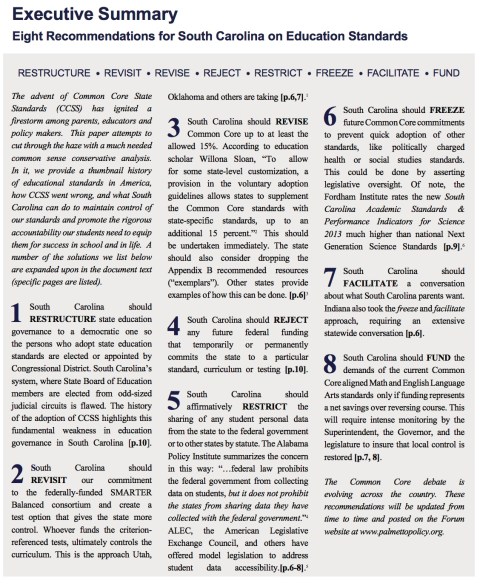
This is why Palmetto Policy Forum recently released a paper we believe cuts through the Common Core fog, outlining an eight-point plan to return unquestioned control of education standards to S.C. parents.

Several points can be taken from the release of this report on CC.

First, the report fails as many ideological think tank reports do because it speaks uncritically to its ideological base (this report has glowing images and commentary on Ronald Reagan and Jeb Bush, for example).

Second, the report also fails by offering an incomplete consideration of the extensive research base on CC and the entire standards movement.

And third, despite these weaknesses, it seems only fair to highlight that the eight recommendations have much to applaud:

8 recs SC copy

[click to see full report; 8 recommendations on page 1]

These recommendations hold some promise but with caveats.

The report must be viewed through the lens of a detailed history of how CC developed as well as the entire standards movement begun under Reagan; see for example:

Whatever Happened to Scientifically Based Research in Education Policy?

Corporations Are Behind The Common Core State Standards — And That’s Why They’ll Never Work

The research base on CC must be examined, noting that CC is unlikely to create outcomes any different than the standards movements preceding the new standards (notably about three different waves in SC); see for example:

What We Know (and Ignore) about Standards, Achievement, and Equity

On Public Schools and Common Core: Graff’s Critique of Ravitch

Should SC Ditch Common Core?

Please note the research base:

  • Hout and Elliott (2011), Incentives and Test-Based Accountability in Education: Most recent decades of high-stakes accountability reform hasn’t work.
  • French, Guisbond, and Jehlen (2013), Twenty Years after Education Reform: High-stakes accountability in Massachusetts has not worked.
  • Loveless (2012), How Well Are American Students Learning?: “Despite all the money and effort devoted to developing the Common Core State Standards—not to mention the simmering controversy over their adoption in several states—the study foresees little to no impact on student learning” (p. 3).
  • Mathis (2012): Existence and/or quality of standards not positively correlated with NAEP or international benchmark test data; “Further, the wave of high-stakes testing associated with No Child Left Behind (NCLB) has resulted in the ‘dumbing down’ and narrowing of the curriculum” (2 of 5).
  • Whitehurst (2009), Don’t Forget Curriculum: “The lack of evidence that better content standards enhance student achievement is remarkable given the level of investment in this policy and high hopes attached to it. There is a rational argument to be made for good content standards being a precondition for other desirable reforms, but it is currently just that – an argument.”
  • Kohn (2010), Debunking the Case for National Standards: CC nothing new, and has never worked before.
  • Victor Bandeira de Mello, Charles Blankenship, Don McLaughlin (2009), Mapping State Proficiency Standards Onto NAEP Scales: 2005-2007: Why does research from the USDOE not show high-quality standards result in higher NAEP scores?
  • Horn (2013): “The 2012 NAEP Long-Term Trends are out, and there is a good deal that we may learn from forty years of choking children and teachers with more tests with higher stakes: IT DOESN’T WORK!”

Smith argues at the end of his Op-Ed, “This is not a time for mutual destruction,” and I agree.

I remain skeptical, but I wonder if this report suggests the possibility that SC is moving toward a reasonable reaction to CC.

I hope so because SC remains a high-poverty state stratified by wealth and poverty; no one in the state, especially the children in our schools, can afford more partisan political grandstanding over education policy.

I am willing to set aside the misleading nods to Reagan and Jeb Bush (both key causes of this problem) in order to enact the 8 recommendations above because at least then we will have a space within which to confront the issues left unaddressed—notably the inordinate cost of yet more commitments to new standards and tests that will, I guarantee, fail our children in SC.

Retain to Impede: When Reading Legislation Fails (Again)

I remember vividly during one of Bill Clinton’s State of the Union addresses watching the president state that he was seeking education policy that would ensure that all third graders would be able to read; he did the emphatic fist with thumb slightly extended to prove he was serious.

I also remember thinking—and possibly saying aloud to the TV—”No, they won’t.”

It is a silly political thing to pretend that the teaching of reading is somehow determined by political policy. It is a ridiculous thing to think that naming that political policy something clever matters as well.

But it also a silly and ridiculous thing that seemingly will never end.

In South Carolina, the state senate is considering Read to Succeed, a reading policy built in part on the Florida formula (Just Read, Florida!) that has a great deal of political support but has been unmasked as yet another misleading education “miracle” that wasn’t.

The most flawed aspect of Read to Succeed is that it mimics Florida’s third-grade retention policy that will retain third graders based on standardized test scores.

The Education Oversight Committee (EOC) has examined the Read to Succeed act, and offers an At a Glance on retention and lessons learned from Florida.

While the At a Glance appears research-based and comprehensive, the Read to Succeed act and the EOC support actually represent what Matthew DiCarlo has identified as a central problem with policy built on a misuse of data:

The recent release of the National Assessment of Educational Progress (NAEP) and the companion Trial Urban District Assessment (TUDA) was predictably exploited by advocates to argue for their policy preferences. This is a blatant misuse of the data for many reasons that I have discussed here many times before, and I will not repeat them….

But they are not policy evidence. Period….

But, as I’ve said before, there’s a very large group of us out here who are willing to applaud any high-level leader who refuses to misuse evidence, whether or not we happen to agree with their substantive policy positions. I’m sure there are leaders like that out there, and I wish they were more visible.

In the exact same way as DiCarlo details above about misusing NAEP data for political gain, the EOC is failing in its support of Read to Succeed directly and third-grade retention inclusive.

The EOC’s At a Glance cites only four sources, one of which, Greene and Winters, has been reviewed, concluding:

The report reviewed here concludes that Florida’s recently instituted policy of test-based retention has helped academically struggling elementary school students improve their reading. According to the review, the report overstates the effect of retention on student achievement.

Further, the At a Glance fails to identify a strong body of research that refutes the claims made about the Florida formula and a four-decades body of research that rejects grade retention (See Sources below).

Reading problems are not primarily in our schools. Reading and all literacy problems are overwhelmingly reflections of larger social problems related to inequity and poverty.

Reading and literacy solutions, then, are not to be found in legislation and clever program names—especially when those policies are built on partial and politically manipulated evidence, and especially when those name serve to mislead.

SC is considering using partial evidence a reading policy better named Retain to Impede.

Recommended

Commentary: When our students are living in a book desert:

But Xavier wanted a different life; he wanted to be a doctor. He wanted to write about his experiences. What should he read?

I compiled a list of my favorite books, making sure to include teen favorites, books about the medical profession and topics that might speak to a kid growing up in a high-poverty neighborhood. When I gave him the list, he contemplated it with his usual care, made a small check mark next to the books that looked interesting, and looked up. “Where can I get them?” he asked.

And that’s where our story stalls out. Because that’s when I realized that Xavier was living in a book desert.

SOURCES

“Florida Miracle” 

Review of Closing the Racial Achievement Gap, Madhabi Chatterji

Water into Wine?, Julian Vasquez Heilig

Lurking in the Bushes, Julian Vasquez Heilig

Parsing the Florida “Miracle,” Diane Ravitch

The Test-Based Evidence on the “Florida Formula,” Matthew Di Carlo

Editorial: Florida needs no advice from Jeb Bush on education policy, Jac Versteeg

Review of Getting Farther Ahead by Staying Behind, Derek C. Briggs

Grade Retention

Hold Back to Move Forward? Early Grade Retention and Student Misbehavior, Umut Özek

Test-based accountability has become the new norm in public education over the last decade. In many states and school districts nation-wide, student performance in standardized tests plays an important role in high-stakes decisions such as grade retention. This study examines the effects of grade retention on student misbehavior in Florida, which requires students with reading skills below grade level to be retained in the 3rd grade. The regression discontinuity estimates suggest that grade retention increases the likelihood of disciplinary incidents and suspensions in the years that follow. The findings also suggest that these adverse effects are concentrated among economically disadvantaged students

Retaining Students in Grade A Literature Review of the Effects of Retention on Students’ Academic and Nonacademic Outcomes, Nailing Xia, Sheila Nataraj Kirby (2009)

Our review of these 91 studies indicates that grade retention is associated with gender, race, SES, age for grade, student mobility, family and parental characteristics, prior academic achievement, prior behavioral and socioemotional development, and student health. Converging evidence suggests that grade retention alone is not an effective intervention strategy for improving academic and longer-term life outcomes. In general, retention does not appear to benefit students academically. Although some studies have found academic improvement in the immediate years after retention, these gains are usually short-lived and tend to fade over time. Past research has consistently shown that retained students are at significantly increased risk of dropping out of school. Although only a few studies have examined the effects of retention on postsecondary outcomes, the available evidence suggests negative effects on enrollment in postsecondary education and on employment outcomes in adulthood. Overall, the literature indicates mixed findings on attitudinal, socioemotional, and behavioral outcomes among the retained students….Our review found fruitful avenues of research, most notably the impact of supportive interventions (such as early identification of at-risk students, academic instructional services provided in and out of school, and different types of intervention strategies) on proximal and future student outcomes.

The Spillover Effects of Grade-Retained Classmates: Evidence from Urban Elementary Schools, Michael A. Gottfired, American Journal of Education 119 (May 2013)

Retention, Social Promotion, and Academic Redshirting: What Do We Know and Need to Know?, Nancy Frey, Remedial and Special Education, volume 26, number 6, November/December 2005, pages 332-346

The evidence gathered in the last 30 years on the practice of retention suggests that it is academically ineffective and is potentially detrimental to children’s social and emotional health. The seeds of failure may be sown early for students who are retained, as they are significantly more likely to drop out of high school. Furthermore, the trajectory of adverse outcomes appears to continue into young adulthood, when wages and postsecondary educational opportunities are depressed.

Dropout Rates after High-Stakes Testing in Elementary School: A Study of the Contradictory Effects of Chicago’s Efforts to End Social Promotion, Elaine M. Allensworth, Educational Evaluation and Policy Analysis, Vol. 27, No. 4 (Winter, 2005), pp. 341-364

Alternative to Grade Retention, Jimerson, Pletcher, and Kerr (2005)

Given the accumulating evidence that grade retention is an ineffective and possibly harmful intervention, it is imperative that school administrators advocate for “promotion plus” policies that depend on effective, evidence-based interventions. The issue for secondary school educators is twofold. Not only must educators determine whether retention is appropriate for a given student, they also need to address the negative academic, social, and emotional consequences for students who were retained in earlier grades. Very often the student’s original difficulties persist, or more likely worsen, as their school career progresses.

Winning the Battle and Losing the War, Jimerson, Anderson, and Whipple (Psychology in the Schools, Vol. 39(4), 2002)

Considering the results of this review of research examining the association between grade retention and high school dropout and other reviews of research addressing the efficacy of grade retention (Holmes, 1989; Jimerson, 2001a, 2001b; Smith & Shepard, 1987, 1988), we must move beyond the use of grade retention as an intervention strategy and attempt to implement those strategies research has demonstrated to be effective (Jimerson, 2001a). Educational professionals, researchers, parents, and policymakers would be remiss to overlook the implications of research that demonstrate the association between grade retention and school dropout. Furthermore, a new imperative has emerged, where the onus is on programs training future educational professionals to disseminate the results of the recent research presented in this review. It is crucial that we transcend limited solutions and begin to consider student developmental and achievement trajectories in order to reinforce and strengthen pathways that promote social and cognitive competence and lead to academic success.

Does Retention (Repeating a Grade) Help Struggling Learners?

Some stakeholders in Florida believe that the “hard line in the sand” created by mandatory, test-based retention created a motivational difference in teachers and parents…, since it is thought that many of the same learning supports were being provided to struggling students prior to the policy. This may be the case for test score gains close to the retention year, but given the well-known longer-term negative effect of retention on drop-out rates (e.g., Allensworth, 2005) as well as the assured delayed entry into the workforce, Florida’s evidence falls far short of even suggesting that retention is the only or best way to motivate a real positive difference for struggling students, nor has it contradicted the overwhelming evidence against retention prior and since.

What Doesn’t Work, Smith and Shepard (Phi Delta Kappan, October 1987)

The Lesson of the Cupcakes: Fixing Schools by Resisting Gimmicks and Heeding Evidence, Kevin Welner

Exploring the Association Between Grade Retention and Dropout, Jimerson, et al. (The California School Psychologist, Vol. 7, pp. 51-62, 2002)

Ultimately, the research is unequivocal in identifying that grade retention does not appear to address the needs of these students at risk of academic failure. Findings from this study should not be misinterpreted as an indication that retention was an effective intervention strategy for the retained students who did not drop out of high school. There is a need for further research comparing the retained students who completed high school with matched comparison groups of similarly low achieving but socially promoted students. This study highlights the association of early socio-emotional and behavioral adjustment and high school dropout among a group of retained students. These findings have direct implications for school psychologists and other educational professionals. In particular, rather than focusing on the unsupported academic intervention of grade retention, it is time to implement prevention and intervention programs that have been empirically demonstrated to meet the needs of these students in facilitating both positive academic success and socio-emotional adjustment.

Grade Retention: A Flawed Education Strategy, Xia and Glennia (part 1)

Decades of research suggest that grade retention does not work as a panacea for poor student performance. The majority of research fails to find compelling evidence that retention improves long-term student achievement. An overwhelmingly large body of studies have consistently demonstrated negative academic effects of retention. Contrary to popular belief, researchers have almost unanimously found that early retention during kindergarten to grade three is harmful, both academically and emotionally. [1] Many studies find that retention does not necessarily lead to increased work effort among students as predicted.

Cost-Benefit Analysis of Grade Retention, Xia and Glennia (part 2)

Grade Retention: The Gap Between Research and Practice, Xia and Glennia (part 3)

The majority of published studies and decades of research indicate that there is usually little to be gained, and much harm that may be done through retaining students in grade. Yet, many educators continue to use retention as a way to improve student achievement and claim that it produces positive results. The consequence is while a growing body of studies show that retention does not improve academic performance and has a number of negative side effects, more and more states and school districts have adopted retention policy in an effort to enhance the educational accountability.

Synthesis of Research on Grade Retention, Shepard and Smith (Educational Leadership, May 1990)

Grade Retention [a synthesis]

Social Promotion – In Comparison to Grade Retention, Advantages and Disadvantages, Different Perspectives, Jere Brophy

Meta-analysis of Grade Retention Research: Implications for Practice in the 21st Century, Shane R. Jimerson (School Psychology Review, 2001, Volume 30, No. 3, pp. 420-437)

A Synthesis of Grade Retention Research: Looking Backward and Moving Forward, Shane R. Jimerson (The California School Psychologist, Vol. 6, pp. 47-59, 2001)

In looking backwards at the retention research and previous reviews and meta-analyses, a consistent theme emerges—grade retention is not an empirically supported intervention. As reflected in the results of the three meta-analyses described above, the confluence of results from research during the past century fails to demonstrate achievement, socioemotional, or behavioral advantages of retaining students. Moreover, the research consistently demonstrates that students who are retained are more likely to drop out of high school.

Evaluating Kindergarten Retention Policy, Hong and Raudenbush (September 2006)

First, Do No Harm, Jay P. Heubert (Educational Leadership, December 2002/January 2003)

The Facts on Education: Should Students Be Allowed to Fail Grades?

[1] See Krashen, S. (2013, May). Need Children Read ‘Proficiently’ by Grade Three? Language Magazine; Deborah A. Byrnes, and Kaoru Yamamoto, 1985, “Academic Retention of Elementary Pupils: An Inside Look,” Education, 106(2), 208-14; Peg Dawson, 1998, “A Primer on Student Grade Retention: What the Research Says,” NASP Communique, 26(8); Shane R. Jimerson et al., 1997, “A Prospective, Longitudinal Study of the Correlates and Consequences of Early Grade Retention,” Journal of School Psychology, 35(1), 3-25; Panayota Y. Mantzicopoulos, 1997, “Do Certain Groups of Children Profit from Early Retention? A Follow-Up Study of Kindergartners with Attention Problems,” Psychology in the Schools, 34(2), 115-27; Samuel J. Meisels and Fong-Ruey Liaw, 1993, “Failure in Grade: Do Retained Students Catch Up?” Journal of Educational Research, 87(2), 69-77; Judy Temple, Arthur Reynolds and Suh-Ruu Ou, 2001, “Grade Retention and School Dropout: Another Look at the Evidence,” The CEIC Review, 10(5), 5-6 & 21; Charles L. Thompson and Elizabeth K. Cunningham, 2000, “Retention and Social Promotion: Research and Implications for Policy,” Eric Clearinghouse on Urban Education Digest, 161, 1-5; Deneen M. Walters and Sherry B. Borgers, 1995, “Student Retention: Is It Effective?” School Counselor, 42(4).

The Analogy, Hyperbole Problem: “With explanation kind” (Tone, pt. 5)

Prologue

I am a child of literature, more specifically of science fiction.

As a result, I am also a child of allegory, metaphor, and the richness of layered language.

Smitten as a reader, I eventually—and predictably—looked in the mirror and saw a writer. For almost four decades now, I have been chasing that image in the mirror, that writer I hope to be.

So when I write—mostly non-fiction, mostly essays addressing issues related to education, poverty, race, and class—I am channeling the science fiction novelist I long(ed) to be. Some Vonnegut, some Atwood, some Bradbury—laced with Ellison and cummings and Dickinson as well as Salinger and a relentless pursuit of Baldwin’s passion, bravery, and incisiveness.

So in my blogging and scholarship, I am apt to confront the conditions of teachers as worker in the context of Cloud Atlas‘s thematic exploration of slavery, calling the current state of workers in the U.S. “wage-slavery.”

I write as I live—with anger and passion.

But I also write as I live—in a constant state of critical reflection. My anxieties are many, but one constant is the anxiety that I have failed the ultimate goal in some small or even significant way.

The road to hell is paved with good intentions. [1]

Nancy Flanagan has recently blogged about Monstrous Labels (see Part I and Part II), raising hard questions about the sorts of analogies and hyperbole that exist in the education reform debate. Flanagan is confronting another aspect of the tone debate I have been wrestling with for some time [2]:

Clearly, everyone who writes about the existence and meaning of cultural holocausts–including The Holocaust–must bow to the experience of the ones who lived it. Our only possible ethical response, however, is to try to take the sacrifices made in humanity’s historical tragedies and make them sacred, through remembrance and honor.

That’s an enormously difficult thing to do, fraught with false equivalencies and cultural misappropriation. But is it wrong? When you’re faced with what Jeff Bryant–correctly, in my opinion–labels an “existential threat” to an essential cornerstone of democratic equality, public education, is it immoral to call up the spirit of other existential threats to democracy, other weapons of human destruction?

On Twitter, Flanagan engaged Jose Vilson about the problems with misappropriations, further emphasizing how efforts to stress the importance of education reform issues to a lay public is fraught with substantive dangers and unintended consequences—ones that often serve to work against the good intentions of those making their cases.

If I have learned anything from committing to my own blog space and actively participating on Twitter and in the public sphere, my resistance to bowing to tone complaints and my effort to engage the public effectively are often now at odds because of the rising and stringent misinformed voices that too often are indistinguishable from informed voices (and I am pointing a finger here at me).

To put it briefly, if I can be mistaken by the public as little different in substance and tone for Glenn Beck or Michelle Malkin, I have failed miserably. That failure rests on my belief that expertise and experience are often lacking in deciding education policy, and therefore, I want to offer a voice of expertise and experience clearly distinguishable from the Beck/Malkin populism and libertarian fear-mongering.

So Flanagan’s question and Vilson’s warnings about misappropriations are important and powerful—and ultimately troubling.

All along the ideological spectrum, education reform commentary includes direct and indirect references to the Holocaust (and even Hitler), U.S. slavery, child abuse, and prisons—just to name a few analogies and uses of hyperbole.

In my 30+ years of teaching, I have heard numerous students call school prison; that may be one of the most common analogies uttered by students (even those not in schools with armed police and metal detectors).

In light of Flanagan’s question and Vilson’s warning, then, when I confront my own work—in blogs and scholarly publications—I must begin to examine more closely the very thin line between illuminating analogy and misappropriation. Here, then, are some guiding ideas and questions for keeping the discourse from failing our goals despite our good intentions:

  • Invoking or comparing a contemporary situation to a historical scar of the magnitude of the Holocaust or U.S. slavery (just to note two) likely fails both that magnitude and the importance of the contemporary situation.
  • When tone complaints come from people of privilege, I will not allow the conversation to start with tone. When tone and misappropriation concerns are raised by marginalized and oppressed groups, the concern must be addressed.
  • That said, it is not the responsibility of marginalized and oppressed groups to police inappropriate tone or misappropriations. That is the responsibility of everyone making public claims and commentary. For me, this is my responsibility—one I have stumbled over, I am sure, but one that I can make amends for from this moment forward.
  • Hindsight is 20/20 so the power of analogy and hyperbole is to force people to take off contemporary blinders in order to see (this is the power of Atwood’s The Handmaid’s Tale and George Orwell’s 1984—and Arthur Miller’s The Crucible). But we must always ask: At what cost this analogy, this hyperbole? In short, if the contemporary situation is as dire as we recognize, we must seek ways in which to demand attention for that in its own right.
  • The road to hell is paved with good intentions.

Epilogue

Is the use of high-stakes testing in kindergarten child abuse?

Are zero tolerance policies, police in the hallways, and metal detectors creating schools as prisons?

Is mass incarceration the New Jim Crow?

Have U.S. workers been reduced to wage-slaves?

I think we must all ask ourselves at what cost are we making these claims, and we must be able to see and hear these claims through the eyes and ears of those who may not immediately see the difference between what we hope to accomplish and those who hold up posters of George W. Bush or Barack Obama as Hitler.

When people see no difference, we have lost something very important, and something precious.

When we offend the marginalized and oppressed as if they do not exist, we certainly have little room to criticize anyone about anything.

The privilege of having a voice must be tempered with humility, by honoring the dignity of everyone and by having the empathy to walk in someone else’s shoes, to live in someone else’s skin, to honor someone else’s past.

It may be best when we seek the truth that we also include “With explanation kind.”

Tell all the truth but tell it slant — (1263)

by Emily Dickinson

Tell all the truth but tell it slant —
Success in Circuit lies
Too bright for our infirm Delight
The Truth’s superb surprise
As Lightning to the Children eased
With explanation kind
The Truth must dazzle gradually
Or every man be blind —

[1] Possibly one of the best passages from a novel is “‘Road to hell paved with unbought stuffed dogs'” from Ernest Hemingway’s The Sun Also Rises.

[2] See for example:

Tone, pt. 1: Does Tone Matter in the Education Reform Debate?

Tone, pt. 2: On “Hostile Rhetoric,” Laziness, and the Education Debate

Tone, pt. 3: Mirror, Mirror

Tone, pt. 4: Dystopian Fiction, Passion, and the Education Reform Debate

Teflon, Fatalism, and Accountability

One legacy of Ronald Reagan’s presidency is his being tagged the Teflon president, as Patricia Schroeder explained:

As a young congresswoman, I got the idea of calling President Reagan the “Teflon president” while fixing eggs for my kids. He had a Teflon coat like the pan.

Why was Reagan so blame-free? The answer can be found in the label that did stick to him — “The Great Communicator.”

Reagan’s ability to connect with Americans was coveted by every politician. He could deliver a speech with such sincerity. And his staff was brilliant in playing up his strengths. They made sure the setting for any speech perfectly captured, re-emphasized and embraced the theme of that speech. And, let’s be honest, Reagan told people what they wanted to hear.

Teflon is, I believe, an apt metaphor for the protective veneer of privilege and power. As Mullainathan  and Shafir detail, individual behavior tends to reflect powerful contexts such as abundance and slack or scarcity, and thus, those living in abundance and experiencing slack live much as Reagan lead since nothing sticks to the Teflon of privilege and power.

Let me offer a brief example.

Since I hold a salaried position as a tenure professor (all of which have been attained from effort built on statuses of privilege), if I drive down the highway to work one morning and hit something in the road, resulting in a ruined tire, I simply call in, cancel class, buy a new tire with my credit card, and then go on with my day. As well, my next paycheck will not reflect that morning in any way.

If I were an hourly employee driving a car on its last leg and having no credit card (or more likely, one that is maxed out with little hope of paying more than the minimum next month), that same morning would be quite different, and once I missed work, my paycheck would be reduced as well—as my ability to get to work for days may be in jeopardy if I cannot somehow acquire a new tire.

The slack that comes with privilege and power (whether or not the person earns or deserves either) is a Teflon coating that allows many conditions that constitute the burdens of poverty to slip right off the privileged and powerful.

I want to transpose the Teflon metaphor onto another context, as well, related to the key figures leading the education reform movement built on an accountability/standards/testing model.

Arne Duncan, Bill Gates, Michelle Rhee, and a wide assortment of political leaders (notably governors and superintendents of education) have some important characteristics in common: most have no background in education, many grew up and were educated in privileged lives and settings (such as private schools with conditions unlike the reforms they promote), many with children send those children to schools unlike the reforms they promote, and few, if any, suffer any real consequences for their misguided claims or policies. This crop of education reformers are Teflon reformers.

When Gates poured money and his influence into small school projects and then pulled the plug (a project that proves more about misunderstanding research than education reform), all the schools and stakeholders were left holding the bag, but Gates just shifted into “blame the teachers” mode and is investing his money and influence with the same gusto as before [1]. Education is his hobby, and nothing sticks to Gates while he is playing the game because of the Teflon coating provided by his enormous wealth (built on his privileged background).

The narratives around Duncan and Rhee are little different; they thrive on serial political appointments (often irrespective of the quality of their performance at any position [2]) and that their “leadership” skills (which they argue trumps experience and expertise in the filed that are leading [3]) are transportable from venture to new venture. But neither suffers any real career consequences as Teflon reformers.

Who does suffer the consequences of narratives, claims, and policies coming from Teflon reformers?

Students and teachers—who also represent two levels of relative powerlessness, sharing, however, a state of scarcity created by the high-stakes elements of the reform movement built on accountability.

Students and teachers also share a similar response to that scarcity combined with their powerlessness, fatalism [4].

For teachers, the self-defeating characteristics of that fatalism are captured in the current implementation of Common Core, which, as with all the preceding waves of new standards and tests, are imposed on teachers, not called for, designed by, or directed by teachers.

SC represents how caustic Teflon reform and teacher fatalism are for effective implementation of policy and practices. As is typical across the U.S., administrators, teachers, professional organizations, and unions nearly universally and without criticism accepted CC as a matter of course (an example of professional fatalism).

The standard line was that no one in any of those groups could stop or change CC from happening, thus they all felt compelled to implement CC as best as possible—including professional organizations explicitly saying they could not challenge CC as they had a duty to help teachers implement CC, again because no one could stop the implementation.

Now that many teachers have been given a great deal of training and a tremendous amount of CC-related materials have been purchased, SC is taking a predictable Tea Party turn against CC. Governor Nikki Haley has identified dumping CC as part of her re-election campaign and Tea Party motivated parents have begun to challenge directly schools for implementing CC.

While some states are also seeking to drop CC, others are simply renaming the standards. But in SC, the consequences of this churn created by Teflon reform policies and partisan backlashes against CC impact primarily teachers—trapped within demands for them to implement CC—and students who are bridging the years between their being taught and tested under one set of standards and soon to be taught (although some may have to mask that the lessons are CC-based) and tested under yet another.

For teachers, their own fatalism against the power of Teflon reform has resulted in low morale and scattered CC implementation (directly contradicting a central call for CC as a way to standardize what is taught across the U.S.).

Both Teflon reform and teacher fatalism doom any reform efforts in our schools. Teflon reformers continue to prosper despite the credibility of their claims or the outcomes of their policies.

And at the bottom of this power chain are students, themselves fatalistic.

Rick VanDeWeghe, expanding on the work of Rick Wormeli, in 2007 confronted how the flawed accountability paradigm remains uncontested, but at the center of Teflon reform’s greatest failure:

This research is based on a basic and controversial assumption about accountability. Quoting from Wikipedia, Wormeli states that accountability “implies a concern for the welfare of those with whom one works” (“Accountability” 16 [5]). This definition carries the message that “I’m here to help you along, to help you grow.” It implies that teachers are learner advocates and have a responsibility to help students grow as learners, just as students have a responsibility to demonstrate their growth as learners: It’s mutual accountability. This form of mutual accountability focuses on achievement—that is, we practice accountability when we focus on actual achievement and not on nonacademic factors, and we teach accountability when we demand that students show their real learning and growth. It sounds simple, but it gets complicated.

In contrast to mutual accountability, Wormeli notes, an alternative and more familiar definition of accountability values threat over concern (i.e., advocacy) for others….This is the ‘caughtya’ and ‘gotcha’ mentality,” and grading “is one of the default tools teachers use to play the ‘gotcha’ game.” When we play the gotcha game, according to Wormeli, “There is no growth in accountability within the student that will carry over to the next situation” (“Accountability” 16). Students learn to do whatever it takes to get the grade. (pp. 74-75)

Teflon reform along with with teacher and student fatalism have combined to create the exact failed accountability exposed by VanDeWeghe and Wormeli.

The current accountability paradigm embraced and perpetuated by Teflon reformers ignores the importance of mutual accountability as well as investment by all stakeholders in both the policies and the consequences of those policies.

When Teflon reformers are neither mutually accountable nor personally invested, their policies create fatalistic, and thus, ineffective teachers—in the same way that students become fatalistic (and learn less or simply check out of the learning opportunities) when teachers are above the accountability and thus not mutually invested in learning with students.

For education reform to work, we need to reject Teflon reformers for the sort of leadership accountability highlighted by Wormeli:

There is an old story about ancient Roman engineers and accountability. It says that whenever they were constructing an arch, the engineer who designed it stood directly underneath the center of the arch as the capstone was hoisted into position. He had worked hard, took responsibility, and knew his competence was true. It was the ultimate accountability if his design failed. (p. 25)

And thus, Wormeli concludes:

Accountability by its nature requires the interaction of others in our work. Individually, we are not, but together we are, accountable. (p. 26)

Together must include those leaders who rise above the Teflon veneer of authority and stand beside us, investing and risking in collaboration.

[1] For those unfamiliar with the history of Gates’s small schools focus and then shift to teacher quality (and if you jump to the assumption that my comments above are mere ad hominem), I offer the following reader (and suggest this exact pattern will occur again after teacher quality and Common Core fall as flat as small schools appeared to do to Gates):

[2] Rhee has suffered little if any career fail-out from “eraser-gate,” and Duncan attained in part his appointment as Secretary of Education on a mirage, the Chicago “miracle” (replicating the same misleading rise of Rod Paige to Secretary based on the debunked Texas “miracle”).

[3] This is the inherent problem with Teach for America, which is primarily a leadership organization, not an education organization.

[4] See Freire.

[5] See Rick Wormeli’s Accountability: Teaching through Assessment and Feedback, Not Grading

From Failing to Killing Writing: Computer-Based Grading

[Header Photo by Clément Hélardot on Unsplash]

In Ernest Hemingway’s The Sun Also Rises, Bill and Mike discuss Mike’s bankruptcy:

“How did you go bankrupt?” Bill asked.

“Two ways,” Mike said. “Gradually and then suddenly.”

Someday soon, two teachers of writing will be sitting and discussing the death of teaching writing, and the conversation will sound much the same.

Teaching writing came into its own in the 1970s and 1980s with great promise that the discipline of teaching composition would find its way into K-12 classrooms; this potential rested in the arms of the National Writing Project and its state affiliates across the U.S., often connected with universities.

However, we have sat silently and watched the accountability era dismantle that hope, and as a result, we have failed the teaching of writing [1].

Standards and high-stakes testing have slowly bled that promise dry, and then the addition of the writing section of the SAT kicked writing instruction while it was down. But the final nail in the coffin?

Calls for computer-based grading of writing:

Here is where leadership is needed from teachers and administrators.  Before some company comes up with a way to grade essays and boards of education become enamored with the idea, and legislators find new ways to require their use…let’s lead.  The technology is here….

We must lead the conversation by knowing and understanding how the technology can improve the educational process, which is based on the most important relationship between teacher and student. In educating our communities, it is essential to begin with the intention of improving teacher and student contact time, not replacing it.  We need to design the solution, not be given it.  First steps are opening our minds to the possibilities.

If you take the time, this is the same self-defeating fatalism that accompanies advocacy for Common Core: Let’s shoot ourselves in the foot before someone else does it!

The piece quoted above asks Will We Ever Allow Computers To Grade Students’ Writing?—to which I say, probably because we tend to do whatever is least credible in our education policy.

A better question is Should We Ever Allow Computers To Grade Students’ Writing?—to which the answer is an unequivocal No! 

And thus I offer a reader of resources for speaking that truth to such calls:

Apologies to Sandra Cisneros, Maja Wilson

NCTE Position Statement on Machine Scoring

Thomas, P.L. (2005, May). Grading student writing: High-stakes testing, computers, and the human touch. English Journal, 94 (5), 28-30:

As a writer, I cannot imagine composing without my trusted iMac and iBook. And as a writing teacher, I watched the value computers and word processors had for my students—particularly as the technology contributed to students’ ability to write more and to revise more efficiently. While computers and computer programs do offer a huge benefit for the teaching of writing, they must remain merely a tool; we cannot allow anyone to suggest that computers can substitute for humans in the ultimate evaluation of a composition.

Our students’ writing has “something the tests and machines will never be able to measure,” and it is now the duty of all writing teachers to make known the art of human assessment of writing. (pp. 29-30)

[1] Please see the following:

Why Are We (Still) Failing Writing Instruction?

More on Failing Writing, and Students

New Criticism, Close Reading, and Failing Critical Literacy Again

RECOMMENDED: Writing Instruction that Works, Applebee and Langer

For Additional Reading

Computer Writer Vs. Computer Grader

Critique of Mark D. Shermis & Ben Hammer, “Contrasting State-of-the-Art Automated Scoring of Essays: Analysis,” Les C. Perelman

Writing Instructor, Skeptical of Automated Grading, Pits Machine vs. Machine

Computerized Grading: Purloining the Analysis, the Most Fundamental Exposition of Humanity

Flunk the robo-graders

On Public Schools and Common Core: Graff’s Critique of Ravitch

Are U.S. public schools failing, and if so, will implementing Common Core and next-generation tests as part of school accountability correct those failures?

At Valerie Strauss’s The Answer Sheet, Gerald Graff, an English professor at the University of Illinois at Chicago, has challenged Diane Ravitch’s stance on the both public schools and Common Core, which he characterizes as follows:

“Public education is not broken,” says Diane Ravitch in her new book, “Reign of Error: The Hoax of the Privatization Movement and the Danger to America’s Public Schools.”  The “diagnosis” of the corporate reformers “is wrong,” Ravitch writes, and their solutions are also wrong.  “Our urban schools are in trouble because of concentrated poverty and racial segregation.  But public education as such is not ‘broken,’” and “the solutions proposed by the self-proclaimed reformers have not worked as promised.”

Ravitch’s argument — that the real problem is not public education but its would-be reformers — has become a familiar one for opponents of current attempts to reform the American educational system.  Like most such opponents, Ravitch concedes that the system is far from perfect, but she argues that the causes lie in social conditions outside education, in “concentrated poverty and racial segregation,” as she puts it, and in the false story of a broken system that reformers disseminate in order to justify privatizing education and enriching themselves.  So goes this argument.

Graff concludes: “I don’t buy it.”

While he concedes that Ravitch is correct about the negative impact of poverty and inequity on schools as well as the failure of many aspects of the reform movement (“more charters, more standardized tests and fetishized test data, all of it used punitively, more privatization”), Graff argues that, based on his experiences as a professor, public schools are failing and poverty cannot be the sole cause: “Few of the college students I teach are poor and many are white, middle class, and relatively privileged, yet their command of basic skills of reading, writing, and critical thinking falls far short of their potential.”

And thus, Graff aligns himself with the promise of Common Core standards, “which focus on precisely these ‘college readiness’ skills that my students not only struggle with but don’t seem to have been told are important” (See Mercedes Schneider’s response to Graff’s endorsing Common Core).

First, Graff’s characterization of Ravitch, I think, distorts how public school effectiveness should be described (and likely Ravitch’s position).

Public education is not failing the ways that reformers claim, typically based on raw test score comparisons (year-to-year in the U.S., international, state-to-state) and sweeping charges about “bad” teachers, public school monopolies (and lack of choices), and the negative influences of the status quo (often code for “unions”).

However, public schools are failing as they are overburdened by out-of-school influences (as long as we focus on standardized test scores, that influence remains the dominate problem facing education reform) and in the ways in which they perpetuate those social inequities (for example, tracking, inequitable discipline practices such as zero tolerance policies, rising segregation in public and charter schools, and inequitable teacher assignment including commitments to Teach for America for high-poverty minority students).

But the larger public school failure (the one I believe at the root of Ravitch’s “Public education is not broken”), however, is not that public education is failing the U.S., but that so far, we have failed public education. In other words, Ravitch’s argument is a call to reconsider our commitment to public education as part of the essential Commons and the need to reject market-based critiques and reform for that institution.

Here, Graff ignores that much of Ravitch’s Reign is, in fact, a call for reforms—which would be an odd thing to do if she in fact held as Graff claims that public schools are fine as they are.

Next, Graff’s reasons for endorsing the Common Core are ironically the reasons Common Core standards will never address the failures of public schools.

Since Graff and Ravitch highlight that public education struggles under the weight of poverty and inequity, we must acknowledge that there is nothing about Common Core (or any aspect of the accountability movement based on standards and testing) that addresses those inequities; in fact, a great deal of evidence suggests that high-stakes accountability simply labels inequity and often increases inequity—along with failing to achieve the goals often associated with accountability-based reform.

For example, there is nothing in Common Core that will change African American males being disproportionally suspended and expelled, nothing that will change African American and impoverished students attending majority-minority schools that are underfunded and staffed by inexperienced and un-/under-certified teachers, nothing that will insure that minority and high-poverty students will have access to high-quality courses (such as Advanced Placement and International Baccalaureate), and nothing that will end the disproportionate retention of minority and male students (in fact, a growing trend of the accountability movement is retaining third grade students based on high-stakes test scores).

Finally, and directly drawn from Graff’s concerns about college students not burdened by poverty, is the claim that those students are not well prepared by public education.

Setting aside that every generation has bemoaned the failure of the children coming after them (including Aristotle), we must ask why those students appear not prepared for the demands of college work.

The answer, for example, lies in Graff’s experience with students analyzing text and writing original essays.

Applebee and Langer have explored what students are asked to do as student writers in middle and high schools. Their research reveals a powerful, but damning dynamic: English teachers of middle and high school know more than ever about best practices in the teaching of writing, but students do little extended writing and much of that best practice is never implemented in U.S. classrooms.

Applebee and Langer’s research appears to expose why Graff finds his students ill prepared for college demands related to text analysis and writing, but the most important pattern found by Applebee and Langer is the reasons students are not be challenged are the inordinate high-stakes demands of the standards and testing era under which U.S. public schools function.

College-bound students, currently and over the past thirty years, have disproportionately spent their time in English classes learning to write to prompts for AP exams, high-stakes state tests, and, since 2005, the one-draft, 25-minute essay on the SAT.

As a writing teacher of freshman at a selective liberal arts university, I can attest that Graff’s characterization of students’ ability to write autonomously and with authority is lacking, but unlike Graff, I recognize that the problem is grounded in high-stakes accountability.

I also recognize that the historical record of standards and testing reveal that Common Core and next-generation tests will not change the entrenched failures of the accountability era, and Common Core has no mechanism to shift traditional failures of public schools (the inequities I have identified above).

In the end, Common Core is continuing to dig even after we have found ourselves in a pointless hole.

As Deborah Meier explains, even if Common Core standards do align better with college readiness (and that claim falls short), we are still asking too little of students with that goals.

And that is the problem, ultimately, with standards-based education and education reform.

If schools are failing to meet the needs of children living in a free society—and they are—that failure can be traced to the narrowing of teacher and student expectations—the one guaranteed consequence of standards-based education about which we have ample evidence.

In ten years, political leaders and the public will be decrying the failures of public education, professors such as Graff will still bemoan the inadequacies of their students, and we will again hear demands for yet another round of new standards and new tests—standards and tests that must be world-class and address college readiness. And Common Core will be placed on the shelf with all the other disappointing trophies to how we continue to fail universal public education.

Muscle Cramps, Evidence, and the Public Education Reform Debate

For almost thirty years, I have been a serious recreational and competitive cyclist. Despite my goals as a cyclist focusing primarily on endurance events—such as English centuries (100 miles) over mountain courses (elevation gains of 10,000 feet and more) and single-day rides of 220+ miles—I have also been that entire time prone to muscle cramps.

Since cramping has often ruined my targeted events, and since when cramps occur (and don’t) has been impossible to predict or even explain, I have spent a great deal of my cycling career studying and experimenting with how to avoid muscle cramps during endurance events—especially in the summer months of my home in the South.

When I raise my cramping issue among the cycling community, I am always flooded with “I do X and so should you!” The X includes claims about hydration (plain water for some, this or that brand sports drink for another), electrolyte tablets and gels, mustard, pickle juice, and Tums.

What is profoundly interesting about these anecdotal responses are two really important facts: (1) As Joe Friel states, “Contrary to what we’ve been led to believe, no one knows what causes muscle cramps. [1] The common lore is that the culprit is electrolytes, but this is highly doubtful. Much of the sports nutrition industry, however, is based on this myth,” and (2) research calls into question the value of sports drinks.

A common pattern, in fact, is when I send out emails or post blogs stating that we do not know what causes muscle cramps, warning not to use any product for something different than its stated purpose (i.e. Tums), and emphasizing that muscle cramps appear unrelated to electrolyte levels, I am still flooded with emails about hydration (plain water for some, this or that brand sports drink for another), electrolyte tablets and gels, mustard, pickle juice, and Tums—followed with “It works for me!”

The example above about muscle cramps and endurance athletes is no different than the current public debate about education reform.

The general public is often compelled by claims that they already believe at the intuitive or personal experience level—a personal experience level that is quick to assign causation (in fact, humans are genetically predisposed to being cause/effect machines as a matter of survival).

As a result, “That’s how I learned in school” is far more influential to the public than carefully explained bodies of research.

Amanda Ripley, Paul Tough, Arne Duncan, Bill Gates, Michelle Rhee, Malcolm Gladwell, David Brooks, and a wide array of public voices (not restricted to only one political ideology) find their common sense and normalized claims ring true with the general public. In fact, that is how they make their living.

Thus, while it isn’t surprising to me, it is frustrating that when I make an evidence-based case against Common Core, for example, almost all of the responses replicate my efforts to inform my cycling community about muscle cramps—the responses remain mired in the initial assumptions and claims with almost no regard for the evidence. [2]

In these days between Martin Luther King Jr.’s birth day and MLK Day 2014, I am considering that King offers a hard but successful example of how to present a complex and unpopular case that is both based in evidence and ultimately compelling despite conflicting with the common sense beliefs of the time.

King exemplifies that any case requires more than being right in order to be heard, in order to lead to action. King did not have just evidence on his side—evidence of racism, classism, and widespread inequities—he also had moral imperative on his side. Yet, he was rejected and contested by many different stakeholders in the American Dream.

This is daunting for those who believe public education is in fact a powerful foundation for continuing King’s dream for the U.S.; this is daunting for those who recognize that we are failing education reform even as leaders call it the civil rights issue of our time.

I am not willing to concede yet, but I am more and more convinced that evidence alone is a weak part of any public debate addressing large and thus cumbersome movements.

As we seek ways in which we can support public education, public school teachers, and the children of the U.S., we must first be right—in other words, be on the side of evidence—but we must also recognize that being on the side of evidence is likely never enough.

And any fight worth fighting will take time and patience—like training all year for one more chance to ride that century to the top of a mountain in a personal best time, only to find yourself unable to push through when your body fails you once again.

You do the best you can that day, and then you start training for the next year, no less determined.

[1] For a solid base of what we know (or rightfully, don’t know) about cramping see the following:

Muscle Cramps and Mythology

Muscle Cramp Theory

Sports drinks, sweat and electrolytes – part 1

Sports drinks, sweat and electrolytes – part 2

Muscle Cramps: Part I  //  Theories and Fallacies of muscle cramps

Muscle Cramps: Part II  //  The electrolyte depletion model of muscle cramps

Muscle Cramps: Part III  //  A novel theory for Exercise-associated muscle cramps

Muscle Cramps: Part IV  //  An explanation of the evolution of science

Muscle Cramps: Part V  //  What all this means for you

Does Gatorade Actually Work?

[2] Consider the evidence against Common Core as any different from the failed standards/testing paradigm preceding them:

  • Hout and Elliott (2011), Incentives and Test-Based Accountability in Education: Most recent decades of high-stakes accountability reform hasn’t work.
  • French, Guisbond, and Jehlen (2013), Twenty Years after Education Reform: High-stakes accountability in Massachusetts has not worked.
  • Loveless (2012), How Well Are American Students Learning?: “Despite all the money and effort devoted to developing the Common Core State Standards—not to mention the simmering controversy over their adoption in several states—the study foresees little to no impact on student learning” (p. 3).
  • Mathis (2012): Existence and/or quality of standards not positively correlated with NAEP or international benchmark test data; “Further, the wave of high-stakes testing associated with No Child Left Behind (NCLB) has resulted in the ‘dumbing down’ and narrowing of the curriculum” (2 of 5).
  • Whitehurst (2009), Don’t Forget Curriculum: “The lack of evidence that better content standards enhance student achievement is remarkable given the level of investment in this policy and high hopes attached to it. There is a rational argument to be made for good content standards being a precondition for other desirable reforms, but it is currently just that – an argument.”
  • Kohn (2010), Debunking the Case for National Standards: CC nothing new, and has never worked before.
  • Victor Bandeira de Mello, Charles Blankenship, Don McLaughlin (2009), Mapping State Proficiency Standards Onto NAEP Scales: 2005-2007: Why does research from the USDOE not show high-quality standards result in higher NAEP scores?
  • Horn (2013): “The 2012 NAEP Long-Term Trends are out, and there is a good deal that we may learn from forty years of choking children and teachers with more tests with higher stakes: IT DOESN’T WORK!”

On Leaders and Teacher Responsibility

Political leaders and candidates are rightfully concerned about asserting their credibility as leaders; however, when political leaders and candidates emphasize their leadership skills in the education reform debate, the implication appears to be that leadership replaces the value of expertise and experience in education. Let me offer two examples.

Rep. Andy Patrick, R-Hilton Head Island, SC, addressed the upcoming race for state superintendent as that intersects with plans to change teacher evaluation in SC:

“You don’t hire a surgeon to run a hospital,” he said. “What I believe we need are leaders in education not beholden to a system that’s not shown the results we need to see.”

Sen. Vincent Sheheen, D-Kershaw, SC, candidate for governor, responded to concerns about his focus on raising teacher pay as central to his education platform:

Informed of this criticism, Sheheen countered: “I think teaching environment is critical, but the biggest message we need to send for our support of public education is that we value our teachers. Sometimes academics and researchers omit the important emotional content that goes into a successful system. That’s what leaders are for.”

A key aspect of Sheheen’s response is that the criticism came from me (cited in the article)—and by taking this swipe at me, and apparently the lack of credibility found among academics and researchers, Sheheen belittles the importance of my 18 years in the public school classroom.

While I concede that leadership is important and that we can identify and foster leadership skills, I reject the implication of these comments because they suggest that leadership skills replace the need for expertise and experience. I contend that leadership grows from expertise and experience (Patrick’s background includes the military and politics; Sheheen’s background includes law and politics as well as his parents working in education).

Political leadership, historically and currently, then, has contributed directly to the marginalization of teacher professionalism, voice, and autonomy.

In fact, the conditions surrounding becoming and being a teacher in 2014 are reflected in Lou LaBrant’s “The Rights and Responsibilities of the Teacher of English” from 1961*.

LaBrant begins by identifying the conditions of teaching then that are replicated today in attacks on teachers unions and the increased accountability measures such as Common Core, new high-stakes testing, value-added methods of teacher evaluation, and merit pay:

Every teacher of English exercises some rights, no matter how dictatorial the system under which he works; and every teacher carries out some responsibilities. But today we have a considerable movement in this country to curtail certain freedom—rights—of the classroom teacher, and those rights are the matter of this discussion. (p. 379)

Reducing teaching to its mechanical parts, according to LaBrant, strips teachers of their professional “freedom,” autonomy:

Teaching, unlike the making of a car, is primarily a thought process. A man may work on an assembly line, turning a special kind of bolt day after day, and succeed as a bolt-turner. (For the moment we will forget the man and what happens to his personal life.) Having the bolts tightly turned may be all the car-in-the-making needs. But the teacher is something quite different from the man who turns a bolt, because the student is not like a car. Teaching is a matter of changing the mind of the student, of using that magic by which the thinking of one so bears on the thinking of another that new understanding and new mental activity begin. Obviously, the degree to which this is reduced to a mechanical procedure affects the results….

What I am trying to say here is that the teacher who is not thinking, testing, experimenting, and exploring the world of thought with which he deals and the very materials with which he works, that teacher is a robot himself. But we cannot expect a teacher to continue the attempt to find better means or to invent new approaches unless he knows he will have freedom to use his results. Without this freedom we must expect either a static teacher or a frustrated one. I have seen both: the dull, hopeless, discouraged teacher, and the angry, blocked, unhappy individual. (p. 380)

Predating Adam Bessie’s refuting the “bad teacher” myth, LaBrant connects the “dictatorial” educational system with the implication that since some teachers are often “bad,” all teachers need control:

Repeatedly when capable teachers ask for freedom, someone points out that we have many lazy teachers, stupid teachers unable to think and choose, ignorant teachers; in short, bad teachers who need control. We do have some, but we encourage others to be bad. Even the weak teacher does better when he has to face his own decisions, and when he supports that decision. The best way to induce teachers to think and act is to put them into situations where some thinking is essential. This less competent teacher will put more effort into the work he has himself undertaken than he will into something handed out to him. Moreover, he can, if he proves helpless, be given direction. The right to select does not force everyone to use all of his freedom, but it encourages him to use his mind. The nature of human beings precludes for either teacher or class a totally static course. The exercise of freedom is itself one means by which we become good teachers. (p. 383)

A powerful point presented by LaBrant, one too often unspoken today by teacher advocates, is the need for teachers to “earn” that freedom as they also call for their autonomy; it is in effect an argument for teacher professionalism grounded in the evidence of the field:

One reason so many of us do not have our rights is that we have not earned them. The teacher who is free to decide when and how to teach language structure has an obligation to master his grammar, to analyze the problems of writing, and to study their relations to structure….But his right to choose comes only when he has read and considered methods other than his own. He has no right to choose methods or materials which research has proved ineffective….There is little point in asking for a right without preparation for its use. (p. 390)

Finally, LaBrant challenges the pursuit of “uniformity,” today’s standardization, and ends with her strong support for teacher autonomy:

Throughout our country today we have great pressure to improve our schools. By far too much of that pressure tends toward a uniformity, a conformity, a lock-step which precludes the very excellence we claim to desire. Many are talking as though teachers with sufficient training would become good teachers. There is little consideration of the teacher as a catalyst, a changing, growing personality. Only a teacher who thinks about his work can think in class; only a thinking teacher can stimulate as they should be stimulated the minds with which he works. Freedom of any sort is a precious thing; but freedom to be our best, in the sense of our highest, is not only our right but our moral responsibility. “They”—the public, the administrators, the critics—have no right to take freedom from us, the teachers; but freedom is not some-thing one wins and then possesses; freedom is something we rewin every day, as much a quality of ourselves as it is a concession from others. Speaking and writing and exploring the books of the world are prime fields for freedom. (pp. 390-391)

In the five-plus decades since LaBrant wrote this piece, little has changed, including the lack of expertise and experience in education among political leaders.

To continue championing leadership that replaces that expertise and experience is to continue to strip teachers of the very professionalism that those leaders often give lip service to with token calls for higher pay and misleading claims that teachers are the most important element in the education of students.

Leadership grows from expertise and experience; our true leaders in education walk the halls of our schools, teach every day, and yet, remain essentially ignored by those who wish to prove that their leadership skills trump all.

* For more work by LaBrant see Lou LaBrant: An Annotated Bibliography.