Category Archives: education reform

Open Letter to the Media, Politicians, Reformers, B/Millionaires, and Celebrities

First, some context for the problem with education reform and how we discuss the topic.

Cindy Scoppe, associate editor at The State, addresses grading schools, drawing several conclusions:

What we need is a single grading system, which wasn’t possible before the Obama administration decided to let states apply for waivers from No Child Left Behind….

We’re never going to make the progress we need unless we demand an increasingly higher level of performance, but we need to make sure everyone understands that, rather than mistakenly believing that lower school scores mean schools are doing worse….

Actually requiring that each subgroup meet expectations is important, because without that, schools can ignore the difficult-to-teach students, knowing that their low scores will be masked by the high scores of easier-to-teach students….

South Carolina Superintendent Mick Zais continues to push his version of accountability:

South Carolina has two systems for education accountability. One was developed in 2011 by the S.C. Department of Education and was approved by the U.S. Department of Education as meeting federal requirements. The other was developed in 2001 by the state’s Education Oversight Committee. These dual systems are redundant, confusing and expensive….

Finally, in any situation, timely information is necessary to make informed decisions. The letter grade system tells parents, educators and the public how each school and district performed the previous year. This information is publicized in early August so educators can use the data to make adjustments prior to the beginning of a new school year and so parents can make decisions about where their children are educated.

And while the media and political leadership wrangle with education reform and accountability, yet another wealthy celebrity enters the reform arena, M. Night Shyamalanhas:

Until recently, he says, moviemaking was his real passion. “I’m not a do-gooder,” he says. Still, after the commercial success of his early movies, he wanted to get involved in philanthropy. At first, he gave scholarships to inner-city children in Philadelphia, but he found the results disheartening. When he met the students he had supported over dinner, he could see that the system left them socially and academically unprepared for college. “They’d been taught they were powerless,” he says.

He wanted to do more. He decided to approach education like he did his films: thematically….

Much of his initial research was contradictory. When he asked experts which improvements would close the gap, some said smaller classes, others said school vouchers and still others said school spirit. He discovered that none of these reforms had worked across the board, but this finding, paradoxically, encouraged him. He knew he had to think more broadly.

An idea came to him over dinner with his wife and another couple who were both physicians. One of them, then the chief resident at a Pennsylvania hospital, said that the first thing he told his residents was to give their patients several pieces of advice that would drastically increase their health spans, from sleeping eight hours a day to living in a low-stress environment. The doctor emphasized that the key thing was doing all these things at the same time—not a la carte.

“That was the click,” says Mr. Shyamalan. It struck him that the reason the educational research was so inconsistent was that few school districts were trying to use the best, most proven reform ideas at once. He ultimately concluded that five reforms, done together, stand a good chance of dramatically improving American education. The agenda described in his book is: Eliminate the worst teachers, pivot the principal’s job from operations to improving teaching and school culture, give teachers and principals feedback, build smaller schools, and keep children in class for more hours.

The problem highlighted and represented in these three examples involves several key flaws inherent in education reform being analyzed and driven by people without expertise and experience as educators themselves. The media, politicians, reformers, b/millionaires, and celebrities dominate the debate, formation, and implementation of education policy—all of which focuses on how best to design (and redesign) accountability plans and thus ignores the possibility that accountability based on standards and high-stakes testing is the problem.

Scoppe, Zais, and Shyamalanhas offer common sense claims that ring true with the public, building compelling narratives of what is wrong with education and what, then, would serve as credible solutions.

Common sense claims, however, are often misleading and misguided, especially in the education reform debate. Let’s consider just a couple concerns I have about the dominant arguments found in these three pieces but typical of the wider reform debate during the past thirty years.

I taught high school English in a public school in SC for eighteen years before entering teacher education at the university level for the past twelve years, thus, when I read commentaries and media reports related to education, I feel compelled to ask the following:

“We’re never going to make the progress we need unless we demand an increasingly higher level of performance.”* Really? Does this mean that a student scoring an average score on a test in 8th grade should score above average on the 9th grade test? Or does that mean that eighth graders in 2012 should score higher than different 8th graders in 2011? In other words, the claim of constantly increasing achievement is much more rhetoric than a credible expectation. It ignores that different populations of students are incredibly difficult to compare fairly (and possibly that making such comparisons is of little value); that much that we call academic achievement may be a reflection of brain development, effort, or circumstances beyond anyone’s control and not learning; and that in an environment of ever-changing standards and tests, making valid comparisons of data grows nearly impossible as well. For just one complicating example, consider two populations of students tested in 8th and 11th grades:

2009 8th grade math score — 87

2010 8th grade math score — 72

2012 11th grade math score — 85

2013 11th grade math score — 83

It appears, if we focus on simple increases from one year to the next, that the 2013 scores dropped 2 points from 2012. But a close inspection shows that the 2009/2012 scores (same population of students plus/minus drop-outs and other population shifts) remained about the same (a small drop), but that the 2013 score of 83 may easily be a really impressive increase of the 2010 score, from 72 to 83 by the same population of students. However, what if the 2010-2013 increase was the result of an unusual loss of low scoring students due to drop outs, expulsions, and a shifting population of non-native language learners?

In short, ever-increasing outcomes is neither something we should seek, nor something we can make simple claims about. The hypothetical data above could reveal dozens of conclusions, with few having anything to do with achievement, teaching quality, or school quality.

“Over the course of his research, Mr. Shyamalan found data debunking many long-held educational theories. For example, he found no evidence that teachers who had gone through masters programs improved students’ performance; nor did he find any confirmation that class size really mattered. What he did discover is plenty of evidence that, in the absence of all-star teachers, schools were most effective when they put in place strict, repetitive classroom regimens.” Again, really? If fact, the many claims in this passage are a series of powerful public narratives (ones found,  and debunked, in the propagandistic Waiting for “Superman”) that themselves are not reflected in educational research (for example, class size, or better described as student/teacher ratio, does matter—as revealed in rigorous research and as a market mechanism represented by the small class sizes found in elite K-12 schools and universities).

The piece on Shyamalan having an epiphany about education while talking with friends who are doctors is strikingly similar to the Bill Gates phenomenon, both revealing a message that is being ignored: Wealth, celebrity, and success in one field does not guarantee expertise in other fields.

As an educator myself, one who has studied the history of educational thought from the late 1900s until today very closely, I am compelled to ask Shyamalan and Gates why they believe they have discovered ideas that no one else spending her/his whole life and career on education has considered before Shyamalan or Gates. How credible does it seem that a movie director and two medical doctors chatting could suddenly imagine ways to do schools that no one else in the field has imagined?

I’m not saying there is no chance, but it takes a great deal of arrogance and an absence of awareness to make the claims Shyamalan and Gates have made—notably since many of those claims are in fact not supported by research although Shyamalan and Gates claim they are.

There’s more, of course, because despite the simplistic claims surrounding education and education reform (“poverty is not destiny,” “no excuses”), education is a complex process that is rarely predictable and essentially never completed.

However, I remain compelled to ask the media, politicians, reformers, b/millionaires, and celebrities to set aside their assumptions and reset the education reform debate by beginning again but this time begin with the expertise and experience that already exist among educators and within the field of education.

And let me suggest that we step back from how best to create an accountability system, recognizing that accountability, new standards, and new tests have not succeeded for thirty years and thus are unlikely to work now because the key challenges of education have nothing to do with a lack of or the quality of accountability, standards, and testing.

That new beginning, then, must stop focusing on outcomes and start focusing on input and the conditions of teaching and learning. Ironically, that change is likely to bear fruit, the types of outcomes we have asked for all along.

* Zais’s argument builds on a similar argument: “This new system has many advantages over the old federal and the current state accountability systems. The new system has three important elements we are committed to maintaining: yearly progress, transparency and timeliness.”

Innocence or Guilt?: Looking Beyond the Individual

The court room presents a powerful narrative focusing on the innocence or guilt of an accused individual. In the U.S. judicial system, the accused is innocent until proven guilty, and this principle is embraced as a foundational commitment to individual freedom.

The George Zimmerman trial, however, prompted for many concerns about the effectiveness and objectivity of that judicial system, including fears that jury trials reflect the biases of the jurors and that the victim, Trayvon Martin, was unfairly put on trial as well. Debates also included a convoluted discussion of the laws themselves surrounding the case, notably the stand your ground laws in Florida. If the laws themselves are flawed or inherently corrupt, how can a trial be just?

The court of public opinion is no less focused on individual innocence or guilt. In the education reform movement, a number of scandals have exposed flawed leaders and dysfunctional systems—Michelle Rhee’s reign as chancellor of DC public schools, Tony Bennett’s role in changing school grades in Indiana, a cheating scandal in Atlanta, and misleading tests scores in New York. Each of these individual people and circumstances lends itself to holding one person or a unique situation accountable, but just as any trial can disproportionately focus blame on an individual, it is careless and ultimately dangerous to ignore the wider accountability era while laying (often justifiable) blame at the feet of Rhee, Bennett, Atlanta public school administrators, or the newest testing process in NY.

Bernhard Schlink’s The Reader confronts readers with the lingering historical horrors of the Holocaust while also weaving an allegory of justice. A central character, Hanna Schmitz, develops a taboo but compelling relationship with a German teen, Michael Berg, many years after she has served as an SS guard at Auschwitz. In the middle section of the novel, Schmitz is on trial for her role at the concentration camp, and the readers of the novel discover that Schmitz’s passion for having Berg read to her grows from her own illiteracy, a key element in how the trial portrays her innocence or guilt.

Readers of Schlink’s novel are likely left torn about Schmitz’s guilt, possibly in ways similar to public opinion about Zimmerman. Schlink, as a lawyer and judge, seems as interested in the larger allegory of justice as he is about the specific horrors of who is culpable for the Holocaust. In fact, the novel suggests that innocence and guilt are not simple, not easily reduced to the acts or decisions of an individual.

Is it possible, the novel asks, that Schmitz is guilty in a nuanced way that is grounded in her illiteracy and the perverse and dehumanizing culture surrounding the Holocaust? Is it then possible that Schmitz is simultaneously guilty but also a victim of forces larger than her?

While I am suggesting no direct comparison between the accountability era and the Holocaust in terms of magnitude, I am compelled to recognize that the allegorical message of The Reader helps inform the potential mistake being layered onto the individual failures represented by Rhee, Bennett, the Atlanta cheating scandal, and the NY test data: Each of these people or circumstances is both an example of individual or situational failures and clear messages about the larger inherently flawed accountability era based on standards, high-stakes testing, and individual accountability (schools, districts, teachers, and students).

Let’s just focus on two recent failures in the accountability era—Bennett and NY test scores. Both, I am convinced, are evidence of specific failures and possibly even unethical behavior by people in power. And I would argue that Bennett and those responsible for testing in NY should all be held accountable for their decisions, actions, and misrepresentations about children, teacher, and schools to the public.

Ultimately, however, that isn’t nearly enough. Assigning grades to schools and all high-stakes testing are the problems; thus, high-stakes testing as a mechanism for labeling, sorting, and ranking schools, teachers, and children is the larger flawed system that Bennett and NY test scores represent.

In the passive voice parlance of avoiding culpability found in the courtroom, it is likely that for Rhee and Bennett “mistakes were made.”

But political, media, and public concern for these individual errors must not end with their individual culpability.

Accountability, standards, and high-stakes testing are dehumanizing, counter to genuine teaching and learning, and corrosive to universal public education, democracy, and individual liberty. With this lesson standing before us, then, it is unconscionable to continue down the road of Common Core and “next generation” national tests.

It is no longer credible to argue about how best to implement Common Core, how best to implement new tests, or how best to analyze that data from those tests. It is time to end an era of misguided accountability.

Even under the weight of forces larger and more powerful than any one of us, we must make a decision to confront and end a failed system, and that system is the accountability era begun thirty years ago, but now has proven itself a failure.

Made in America: Segregation by Design

“The woman in the gold bracelets tells her friend:,” begins a poem by Barbara Kingsolver from her collection Another America/Otra America. A careful reading notices “gold bracelets,” suggesting more than affluence, opulence. The poem continues:

I had to fire another one.
Can you believe it?
She broke the vase
Jack gave me for Christmas.
It was one of those,
you know? That worked
with everything. All my colors.
I asked him if he’d mind
if I bought one again just like it.
It was the only one that just always worked.

Her friend says:
Find another one that speaks English.
That’s a plus.

The woman in the gold agrees
that is a plus.

The two women speak interchangeably about the fired domestic worker and the vase, both reduced to “one,” and “worked” is repeated about only the broken vase, an object for decoration and a Christmas gift. “It” and “colors” also haunt the conversation. In this brief poetic scene, the callousness of two affluent women about the value of an ornament over a worker (one who apparently is not a native speaker of English, and as suggested by the Spanish/English versions of all the poems and title of the collection, likely Latino/a) is couched in a larger context found in the poem’s title, “What the Janitor Heard in the Elevator.”

This flippant conversation is overheard by another worker, a janitor (who do you see as the “janitor”?), standing essentially unseen, unacknowledged beside these women (who do you see as these women?), trapped momentarily in an elevator.

Kingsolver’s stark and vivid poem captures, as does Kingsolver’s entire collection, the existence of two Americas, a slogan trivialized by politicians and ignored like the janitor by much of the public in the U.S.

The two Americas include the few and affluent, mostly white, who have virtually all the power and, as the poem shows, a voice in the nation and the remaining many, disproportionately middle-class, working-class, working poor, and poor as well as African American and, increasingly, Latino/a.

Let’s consider for a moment what students may be asked to do if presented with this poem in a public high school in the U.S., specifically in this expanding era of accountability and the encroaching specter of Common Core and the concurrent new high-stakes tests.

Based on my having been an educator during the entire past thirty years of the accountability era, I would suggest that this poem would be reduced to mechanistic analysis, in much the same way we have treated F. Scott Fitzgerald’s The Great Gatsby for decades.

While many are rightfully concerned that the Common Core will significantly decrease the focus on fiction and poetry in schools, we have yet to address that even if we maintain great poetry and fiction in the education of our children, we do them or that literature little service to allow those works to be reduced only to their literary parts, mere interchangeable fodder for identifying lination, stanzas, diction, symbolism, narration, characterization, setting, and the endless nuts and bolts deemed worthy of dispassionate analysis in school.

How many generations of students, for example, have examined at length the symbolism of the green light at the end of Daisy’s dock and Gatsby’ yellow car? How many students have been guided through the technical precision of Fitzgerald’s novel while never confronting his vivid challenge to the American Dream?

Have students been asked to look carefully at the corpses of Myrtle and George (the wrong kind of people, George a mere worker and Myrtle left like roadkill in the middle of the road) as well as Gatsby (the wrong kind of rich) floating dead in his pool? Have students been asked why Tom and Daisy (the right kind of rich) go on vacation in the wake of these deaths, seemingly untarnished because of the Teflon coating of their affluence?

Have students been asked to consider carefully why Tom hits Myrtle but bends to Daisy’s taunts?

These are distinctions of analysis—suggesting that Common Core and curriculum are trivial debates if we do not address what happens in the classroom and for whom.

Made in America: Segregation by Design

The technical approach to literature that ignores critical literacy is a subset of the larger technical debate about education and education reform that focuses policy and public attention on the details of schooling (public versus charter and private, Common Core, high-stakes testing, value added methods of evaluating teachers) and ignores the substance of schooling like a janitor trapped in an elevator with two wealthy women.

The substance of schooling today is a stark contrast to the moment of cultural consciousness stretching from the early 1950s into the 1970s when separate but equal was confronted and rejected. As society in the U.S. wrestled with integration of institutions, the cancer of segregation was merely shifted from separate schools to schools-within-schools: White and affluent students tend to sit in Advanced Placement, International Baccalaureate, and honors classes with experienced and qualified teachers and low student-teacher ratios while AA/ Latino/a and impoverished students tend to sit in remedial, test-prep, and tech-prep classes with new and unqualified teachers (in the twenty-first century that means often Teach for America recruits as temporary workers) and high student-teacher ratios.

In-school segregation has been driven by affluent parents, who use their privilege to insure that their children get theirs, and damn the rest. But segregation by design has now been joined by two powerful and corrosive mechanisms—charter schools and segregated higher education access.

Charter schools (see Charter Schools: A Primer and Current Education Reform Perpetuating, Not Curbing, Inequity) have failed to achieve the academic miracles proponents have promised, but charter schools have exposed the most predictable outcome of choice, segregation. As Sarah Carr has shown, New Orleans is a disturbing record of the charter schools flood, the role disaster capitalism plays in destroying equity and opportunity for “the deliberately silenced, or the preferably unheard,” African Americans and people trapped in poverty.

While schools-within-schools and charter schools highlight K-12 segregation by design in the U.S., as troubling is the entrenched privilege of affluence found in higher education, augmenting Matt Bruenig’s conclusion: “you are better off being born rich regardless of whether you go to college than being born poor and getting a college degree.”

Carnevale and Strohl have identified the separate and unequal access to higher education that constitutes the full picture of segregation by design in the U.S.:

The postsecondary system mimics the racial inequality it inherits from the K-12 education system, then magnifies and projects that inequality into the labor market and society at large….

Whites have captured most of the enrollment growth at the 468 most selective and well-funded four-year colleges, while African Americans and Hispanics have captured most of the enrollment growth at the increasingly overcrowded and under-resourced open-access two- and four-year colleges….

These racially polarized enrollment flows have led to an increasing overrepresentation of whites at the 468 most selective four-year colleges….

At the same time, African Americans and Hispanics are increasingly underrepresented at the most selective 468 four-year colleges….

At the same time, African Americans and Hispanics are increasingly underrepresented at the most selective 468 four-year colleges…. (Executive Summary, pp. 3, 6, 10, 12)

The inequitable access to elite higher education mirrors the inequitable access to quality K-12 education and to experienced and qualified teachers. Inequitable access, then, creates inequitable outcomes:

[H]igh-scoring African Americans and Hispanics are far more likely to drop out of college before completing a credential….

Among high-scoring students who attend college, whites are far more likely to complete a BA or higher compared to African Americans or Hispanics….

Each year, there are 111,000 high-scoring African-American and Hispanic students who either do not attend college or don’t graduate.

About 62,000 of these students come from the bottom half of the family income distribution….

Racial inequality in the educational system, paired with low social and economic mobility in the United States, produces enormous differences in educational outcomes: Whites are twice as likely as African Americans and three times as likely as Hispanics to complete a BA or higher…. (Carnevale and Strohl, 2013, Executive Summary, pp. 24, 26, 28, 37)

Despite the meritocracy myth at the heart of the American Dream, then, Carnevale and Strohl conclude: “In the United States, parents’ education determines the educational attainment of their children” (Executive Summary, p. 38).

The cruel irony of education in the U.S. includes that most privileged children will find themselves in classrooms where color imagery (the gold bracelet in Kingsolver’s poem, the green dock light and yellow car in The Great Gatsby) will be the key to the already unlocked door leading to college and secure, high-paying jobs while AA and Latino/a as well as impoverished students are shown quite a different door.

All the while, the colors that matter—black, brown, white, and green—remain invisible and unspoken under the veneer of the American Dream of meritocracy that is less credible than any work of fiction soon to be dropped from the school day.

Humility: A Lesson Most Needed and Least Often Acknowledged

I have been a cyclist for almost 30 years now—longer than many of my cycling friends have been alive.

That hobby grew from a life-long quest to be the sort of athlete (and man) my father would respect. My father was a four-sport letterman in high school, captain of the first state championship football team in my home town. He was a small young man, but fierce and the sort of hard worker that made him a coach’s dream. By the time my father graduated high school in the 1950s, he had lost so many of his teeth that his dentist pulled the rest, and my father has had a full set of false teeth since his late teens.

I was never able to be more than a bench warmer on my school basketball teams, a marginally fair golfer, and briefly a triple jumper my senior year of high school. Mostly, though, I joke that I am a “try” athlete—and it is something I cannot let go, despite knowing without qualification that my father loves and respects me in the exact ways I have always wanted. Any perceptions of failure that exist between the two of us are entirely my insecurities.

My cycling life has had three stages—a beginning decade of learning to ride and race at a high level, a middle decade that was interrupted by my doctoral program and included years of mountain biking and a brief venture into running (a couple marathons and a half marathon), and then the most recent decade of yearly high mileage (7,000-10,000 miles per year) and my best performances as a cyclist despite my advancing age (for an athlete).

For more than half of the years of cycling, I have participated in the Assault on Mt. Mitchell, a 102-mile ride from Spartanburg, SC, to the top of Mt. Mitchell, the highest mountain peak east of the Mississippi. I had my best time, 5:57, at 46 and completed the event in the spring of 2013 as 86th out of 1100 starters.

Typically, in large amateur cycling events I place in the top 15% of entrants—and feel pretty good about these accomplishments.

As I sit writing this, I am on a cycling trip in Colorado, about to leave after a few days in Boulder for Frisco to ride the Copper Triangle ride this coming Saturday. The first half of this trip for me has been a brutal lesson in humility.

Although I have visited Colorado Springs several times in the past, this trip resulted in immediate altitude symptoms—a headache, lethargy, and the classic feeling of having the flu. The day after we arrived, we began riding around Boulder, and the symptoms have been pronounced on each ride.

The first ride was in chilly rain, and when the route turned up hill, I watched my two cycling friends ride away into the mist. The second ride headed to Flagstaff Mountain, resulting in yet another ride in rain and cold; but this time as my friends pedaled away from me I simply couldn’t continue up the climb. At the point when the Flagstaff climb turns to what locals call Super Flagstaff, with grades 15-20%, I shouted to one friend I wasn’t going farther up. I coasted back down to an overlook entrance and waited for them to finish the climb and roll my way.

I was angry, disappointed, exhausted, and most of all, embarrassed.

Yesterday, we headed to Estes Park for a 20-mile mountain climb to the highest point (over 12,000 feet) for a through road in the US. I wasn’t looking forward to yet another day of struggling, and possibly bailing out again.

As we neared the 12,000-feet mark, I was still lagging behind the other three riders, and my head ache returned along with dizziness. None of this boded well for over 2.5 hours of climbing at an altitude I had never experienced before.

It took a great deal of arguing with myself, but I finished the ride yesterday, although still slower than my friends. So far, then, this cycling trip to Colorado has been a series of lessons in humility.

And that has led me to think about the lack of humility found among public and political leadership focusing on schools in the US.

Those self-appointed leaders tend to embody a couple of characteristics: little or no experience or expertise in education and unwavering arrogance, an arrogance that they and the media flaunt.

Ben Folds has captured well the failure of such arrogance in his “Bastard”:

The old bastard left his ties and his suit
A brown box, mothballs and bowling shoes
And his opinion so you’d never have to choose
Pretty soon, you’ll be an old bastard too
You get smaller as the world gets big
The more you know you know you don’t know shit
“The Whiz Man” will never fit you like “The Whiz Kid” did

The refrain to this song speaks potentially to those edu-leaders and their arrogance, and thus failure to exhibit humility:

So why you gotta act like you know when you don’t know?
It’s OK if you don’t know everything

I am well past the 10,000-hour mark needed for expertise as a cyclist (popularized by Malcolm Gladwell). I have a great deal of skill and knowledge as a cyclist, although I also have a pretty low genetic ceiling in terms of how I can perform as a cyclist (a ceiling dropping in on me as I grow older each day).

The Cycling Gods and Altitude Gods have spoken loud and clear to me in the last few days. It is my duty to listen.

The list of what public schools need in the US is long and complex, but a great starting point would be lessons in humility for those who have decided they know best when all the evidence suggests otherwise.

NYT’s Foul Tip on Paul Vallas

In the NYT, Javier C. Hernandez examines embattled Paul Vallas in Connecticut, opening with:

Paul G. Vallas, a leader in the effort to shake up American education, has wrestled with unions in Chicago, taken on hurricane-ravaged schools in New Orleans and confronted a crumbling educational system in Haiti.

Now he faces what may be his most vexing challenge yet: Fending off a small but spirited crowd of advocates working to unseat him as superintendent of one of Connecticut’s lowest-performing and highest-poverty school districts.

“Leader,” “vexing,” “fending,” “spirited”? Not to worry, folks, the NYT doesn’t exactly strike out, but, at best, this column is a foul tip—nowhere near a solid single, or even a bunt.

The media, once again, falls into the trap of buying hook, line, and sinker the “savior reformer” bait cast by Vallas, Michelle Rhee, and Bill Gates.

You see, only a few brave souls dare to stand up against that pesky public education status quo, kept alive by those evil unions and greedy teachers.

And now poor Vallas is next in line to suffer the wrath of that status quo:

Mr. Vallas, who has moved to impose a standardized curriculum and to reorganize central offices in Bridgeport, said he was dismayed by the vitriol. On blogs, which he calls “electronic graffiti,” his critics have called him a racist and compared him to the Chilean dictator Augusto Pinochet. The school district’s student population is 49 percent Hispanic and 39 percent black.

“There are some gigantic egos in this town,” Mr. Vallas said in an interview. “No good deed goes unpunished.”

“Gigantic egos”? [One must wonder is Vallas owns a mirror.] “Electronic graffitti”?

Not to worry, however, appointee Arne Duncan to the rescue!:

Arne Duncan, the federal education secretary, said the opposition to Mr. Vallas was “beyond ludicrous.” He said too many school districts were afraid of innovation, clinging to “archaic ideas.”

“This, to me, is just another painfully obvious, crystal-clear example of people caught in an old paradigm,” Mr. Duncan said in an interview. “This is the tip of the iceberg.”

The Duncan/Vallas allegiance is interesting because the two men have something in common—what they lack:

Mr. Vallas had a vulnerability: despite his decades of experience in schools and a master’s degree in political science, he lacked a degree in education, as required by Connecticut law. The state allowed for an exemption, but Mr. Vallas was required to complete a condensed version of the traditional 13-month certification program over the course of several months. “I didn’t view it cynically and I didn’t complain,” Mr. Vallas said.

Never-been-a-teacher appointee rushes to the aid of never-been-a-teacher appointee. Sounds like a great plot for a Lifetime Movie.

And that movie would have a heart-wrenching message about perseverance in the face of failure:

Mr. Vallas, 60, is a onetime politician who came within two percentage points of defeating Rod R. Blagojevich in a primary for the Illinois governor’s office in 2002. He said he did not know what he would do after Bridgeport, though he ruled out a return to politics. He runs an educational consulting business on the side. His clients have included schools in Illinois and Indiana.

That’s right. If you can’t be a politician, be a political appointee—and be sure to seek out education where the public funds are ripe for the picking (Vallas makes $234,000 a year, but that is small potatoes to the span of his “career” in education).

Kids Count on Public Education, Not Grit or “No Excuses”

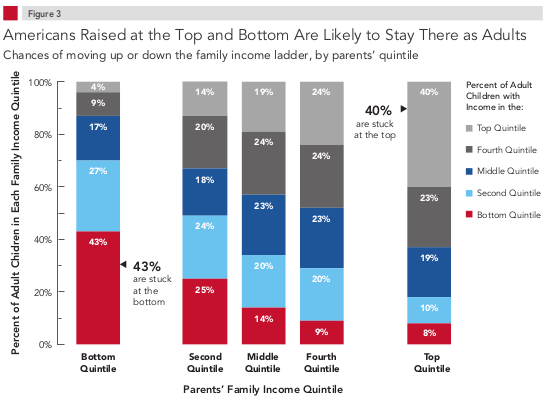
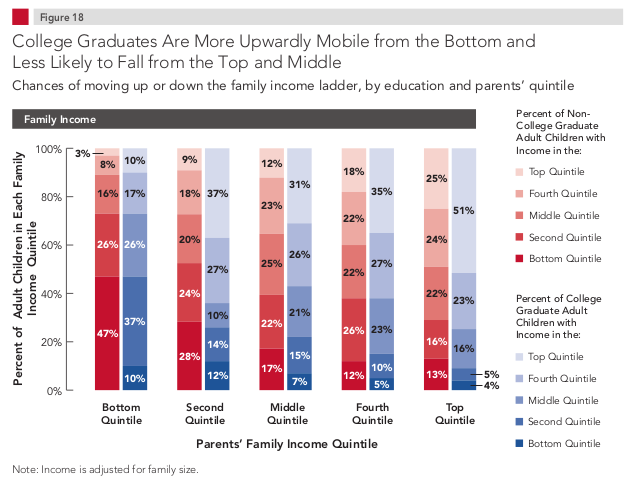
Secretary of Education Arne Duncan has often stated that “education [is] the one true path out of poverty—the great equalizer that overcomes differences in background, culture and privilege. It’s the only way to secure our common future in a competitive global economy.” While this claim appears obvious, when Matt Bruenig asked “What’s more important: a college degree or being born rich?” and examined the data, he concluded:

So, you are 2.5x more likely to be a rich adult if you were born rich and never bothered to go to college than if you were born poor and, against all odds, went to college and graduated. The disparity in the outcomes of rich and poor kids persists, not only when you control for college attainment, but even when you compare non-degreed rich kids to degreed poor kids!

Therefore, the answer to the question in the title is that you are better off being born rich regardless of whether you go to college than being born poor and getting a college degree.

In South Carolina, for example, this sobering reality is made more troubling by the 2013 Kids Count report from the Annie E. Casey Foundation, which examines child well-being in the nation and each state.

Nationally, SC ranks 45th, down from 43rd in the foundation’s previous report. Only Louisiana, Arizona, Nevada, Mississippi, and New Mexico sit lower than SC in child well-being. The ranking consists of four broad categories that reflect significant social and educational challenges for SC:

  • Economic Well-Being (2011 data): SC children in poverty, 28% (worse than 2005, 23%); children whose parents lack secure employment, 35% (worse than 2008, 30%); children living in households with a high housing cost burden, 36% (worse than 2005, 32%); teens not in school and not working, 11% (worse than 2008, 8%).
  • Education: SC children not attending preschool (2009-11), 55% (better than 2005-2007, 59%); 4th graders not proficient in reading (2011), 72% (better than 2005, 74%); 8th graders not proficient in math (2011), 68% (better than 2005, 70%); high school students not graduating on time (2009/2010), 32%.
  • Health: SC low-birthweight babies (2010), 9.9% (better than 2005, 10.2%); children without health insurance (2011), 8% (better than 2008, 13%); child and teen deaths per 100,000 (2010), 32% (better than 2005, 41%); teens who abuse alcohol and drugs (2012-11), 7% (better than 2005-2006, 8%).
  • Family and Community: SC children in single-parent families (2011), 42% (worse than 2005, 38%); children in families where the household head lacks a high school diploma (2011), 13% (better than 2005, 15%); children living in high-poverty areas (2007-2011), 13% (worse than 2000, 6%); teen births per 1000 (2010), 43 (better than 2005, 51).

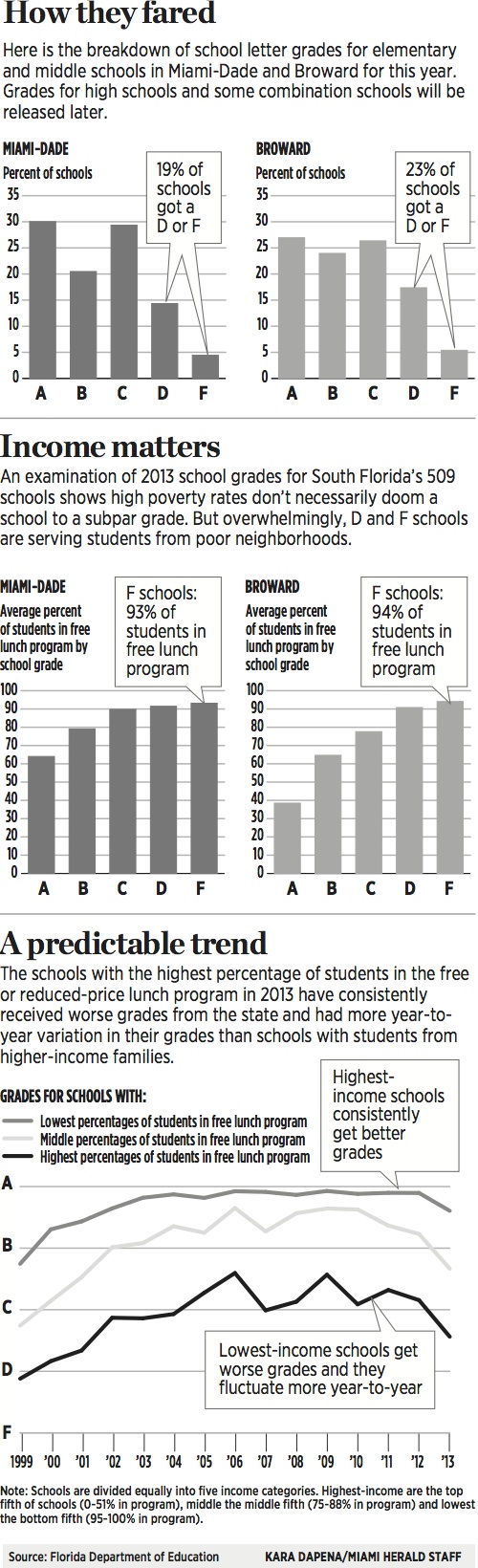
SC represents states that remain heavily burdened by the negative consequences of poverty and social inequity, complicated factors often reflected in the measurable outcomes of public schools. This report offers SC, the nation, and political leaders an opportunity to change the discourse about school reform and take bold action that addresses the wide range of social and economic challenges facing our state.

While the report data show that social and education reform should remain priorities for SC, that same data also suggest that social reform is far more pressing than expensive and historically ineffective commitments to new standards and tests being promoted for education reform.

Children in SC deserve better schools, and children in poverty remain the exact students most underserved in those schools. No one is suggesting that education reform be set aside or ignored. But many current school reform policies are simply wastes of taxpayers’ money and educators’ time that would be better spent on education reform that addresses the conditions of teaching and learning, and not just more of the same standards-and-testing mandates tried for thirty years now.

More pressing is social reform because without addressing childhood poverty, workforce stability and quality, the costs of living, single-parent homes, and concentrated high-poverty communities, most education reform measures are doomed to be fruitless.

As The Economic Mobility Project reveals, children in SC and across the US are likely to have bright futures if they are born into relative affluence, and those children, even without attending college, are apt to succeed over impoverished children who rise above the challenges of their homes and communities by graduating college. “Grit” and “no excuses” are simply slogans, hollow and cruel in the bright light of the evidence.

If kids count in the US, and I am not sure they do, political leadership will change the course for education reform and begin a commitment to social reform that attends to the needs of the growing numbers of impoverished, working poor, and working class families who populate the country, and thus, depend on public education.

meme

Charter Schools, the Invisible Hand, and Gutless Political Leadership

Billy Pilgrim becomes unstuck in time in Kurt Vonnegut‘s Slaughterhouse-Five. Billy’s experience introduces readers to Tralfamadorians:

The creatures were friendly, and they could see in four dimensions. They pitied Earthlings for being able to see only three. They had many wonderful things to teach Earthlings, especially about time….

The Tralfamadorians can look at all the different moments just the we way we can look at a stretch of the Rocky Mountains, for instance. They can see how permanent all the moments are, and they can look at any moment that interests them. It is just an illusion we have here on Earth that one moment follows another, like beads on a strong, and that once a moment is gone it is gone forever. (pp. 33, 34)

One of the most memorable moments of Billy becoming unstuck in time is his watching a war movie backward. Viewed in reverse, the film becomes a narrative of renewal, of peace, as fighter planes “sucked bullets and shell fragments from some of the planes and crewmen,” and “[t]he bombers opened their bomb bay doors, exerted a miraculous magnetism which shrunk fires, gathered them into cylindrical steel containers, and lifted the containers into the bellies of the planes” (pp. 93, 94).

In the spirit of folding time back onto itself to give us clarity of sight, let’s become unstuck in time while viewing American Indian Charter Schools.

Spitting in the Eye of Mainstream Education?

Like Billy watching a war film, we start now and move backward.

Jill Tucker reports (June 26, 2013) that American Indian Charter Schools have had their charter revoked by Oakland Unified school district:

The American Indian charter schools, which enroll 1,200 students in grades K-12, are among the highest-scoring in the state on standardized tests.

Yet Oakland district officials said they had a duty to the public to close the schools given the inability of the schools’ management to rein in the misuse of taxpayer money.

A 2012 state audit of the charter organization found several instances of financial impropriety, including $3.8 million in payments to the school’s former director, Ben Chavis, and his wife through real estate deals, consulting agreements and other services, raising ethical questions and conflict-of-interest concerns.

The decision was supported by the state’s leading charter school advocates.

“In this situation, it is clear that academic performance is not enough to either overlook or excuse the mismanagement of public funds and the unwillingness from the board of directors to respond in ways that would satisfactorily address the legitimate concerns raised by OUSD,” said Jed Wallace, president and CEO of the California Charter Schools Association, in a letter to the board in support of the revocation.

Mitchell Landsberg explains—in a provocatively titled “Spitting in the Eye of Mainstream Education” (May 31, 2009)—about American Indian Charter Schools:

Conservatives, including columnist George Will, adore the American Indian schools, which they see as models of a “new paternalism” that could close the gap between the haves and have-nots in American education. Not surprisingly, many Bay Area liberals have a hard time embracing an educational philosophy that proudly proclaims that it “does not preach or subscribe to the demagoguery of tolerance.”

It would be easy to dismiss American Indian as one of the nuttier offshoots of the fast-growing charter school movement, which allows schools to receive public funding but operate outside of day-to-day district oversight. But the schools command attention for one very simple reason: By standard measures, they are among the very best in California….

“What we’re doing is so easy,” said Ben Chavis, the man who created the school’s success and personifies its ethos, especially in its more outrageous manifestations. (One example: He tends to call all nonwhite students, including African Americans, “darkies.”) Although he retired in 2007, Chavis remains a presence at the school.

Focusing on American Indian Charter Schools among five other “no excuses” schools adopting a new paternalism,  David Whitman (2008, Fall) praises the accomplishments and possibilities of these schools:

Yet above all, these schools share a trait that has been largely ignored by education researchers: They arepaternalistic institutions. By paternalistic I mean that each of the six schools is a highly prescriptive institution that teaches students not just how to think, but also how to act according to what are commonly termed traditional, middle-class values. These paternalistic schools go beyond just teaching values as abstractions: the schools tell students exactly how they are expected to behave, and their behavior is closely monitored, with real rewards for compliance and penalties for noncompliance. Unlike the often-forbidding paternalistic institutions of the past, these schools are prescriptive yet warm; teachers and principals, who sometimes serve in loco parentis, are both authoritative and caring figures. Teachers laugh with and cajole students, in addition to frequently directing them to stay on task.

The new breed of paternalistic schools appears to be the single most effective way of closing the achievement gap. No other school model or policy reform in urban secondary schools seems to come close to having such a dramatic impact on the performance of inner-city students. Done right, paternalistic schooling provides a novel way to remake inner-city education in the years ahead….

Still, these entrepreneurial school founders battle on, slowly replicating their institutions across the country. It is too soon to say that all of the copycat schools will succeed. But the early results are extremely encouraging. It is possible that these schools, so radically different from traditional public schools, could one day educate not just several thousand inner-city youngsters but tens or even hundreds of thousands of students in cities across the nation. Done well, paternalistic schooling would constitute a major stride toward reducing the achievement gap and the lingering disgrace of racial inequality in urban America.

The Invisible Hand and Gutless Political Leadership

Backward or forward, this story is ugly. “No excuses” and the new paternalism themselves are classist and racist—ways in which the middle class and affluent allow “other people’s children” to be treated, but not their own—yet the larger faith in the Invisible Hand is the ugliest part of the narrative.

Idealizing parental choice narrowly and choice broadly is the foundation upon which both political parties stand. Why is the Invisible Hand of the Free Market so appealing to political leaders?

The answer is simple: Abdicating political leadership to the market absolves our leaders from making any real (or ethical) decisions, absolves them from doing anything except sitting back and watching the cards fall where they may.

And thus the charter school movement, with its school-choice light that allows progressives to tap into their closeted libertarian. Experimenting with impoverished children, African American children, Latino/a children, English Language Learners, and special needs children—this is the acceptable playground for the Invisible Hand.

Political leaders bask in the glory of Capitalism because the free market requires no moral conviction, no ethical stands, no genuine decision making based on careful consideration of foundational commitments to democracy and human dignity and agency. Capitalism allows Nero to sit and fiddle while Rome burns. If the fire needs putting out, and someone can monetize that, the market will take care of it, right?

Political leadership has ignored and marginalized children in poverty for decades, notably in the schools we provide high-poverty, majority-minority communities. The school-choice light commitment to charter schools is a coward’s way out of facing that reality and doing anything about it.

So it goes.

Post-Katrina New Orleans: Disatser Capitalism Feeds on Poverty and Racism

Drawing from her Hope Against Hope, Sarah Carr asks, Can school reform hurt communities?—focusing on New Orleans:

New Orleans may be the extreme test case, but reforms like these are reshaping public education across the country. The movement is rooted in the notion that “fixing” schools is the strongest lever for lifting communities out of poverty. The criminal justice and health care systems may be broken, living-wage jobs in short supply, and families forced to live in unstable or unsafe conditions. But the buck supposedly stops in the classroom. Thus teachers can find themselves charged with remedying an impossibly broad set of challenges that go far beyond reading at grade level.

Post-Katrina New Orleans represents a crucible for both disaster capitalism and the neoliberal (privatization) agenda driving education reform. After the hurricane devastated New Orleans, the city was swept clean of its teacher workforce (overwhelmingly African Americans constituting a significant percentage of the black middle class), its public schools, and its teachers union so that Paul Vallas could rebuild the school system with charter schools and Teach for American recruits, inexperienced and uncertified teachers who are often white, affluent, and transplants to New Orleans from all across the US. Carr highlights the tensions in this human-made flood of the city:

But most explanations have focused on the radical overhaul of the city’s education system: the expansion of independent charter schools (which more than 80 percent of New Orleans public school children now attend); a greater reliance on alternative teacher training programs like Teach for America; and the increased use of test scores to determine whether educators should keep their jobs and schools should stay open….

This mentality has attracted ambitious, talented young teachers from across the country. But it has also risked turning teaching into a missionary pursuit. At a few of the charter schools I have reported on over the last six years, less than 10 percent of the teachers came from New Orleans or were older than 35. “I think a lot of people who come to New Orleans want to change New Orleanians,” said Mary Laurie, a veteran school administrator and principal of O. Perry Walker High School….

This disconnect can manifest itself in ways both small (as when a teacher fails to recognize a popular New Orleans term, like “beaucoup” for “a lot”) and large (as when a teacher can’t grasp what students are going through at home).

Yet, while New Orleans has become a feast for disaster capitalism (see Archer and Bessie’s graphic journalism here, here, and here), political and public concern for the city and for the greater assault on public education, children and families living in poverty, and teachers remains essentially absent.

In her critical analysis of education reform in New Orleans, Kristen Buras concludes: “Critical research and ongoing activism in multiple spaces are crucial. What is currently happening in New Orleans is not socially conscious capitalism. It is simply unconscionable” (p. 324).

That New Orleans, public schools across the US, teachers, teachers unions, and families in poverty remain under assault while political leadership, advocacy representatives, and the public remain focused on baseless calls for Common Core and next generation testing as well as equally baseless attacks of teacher education exposes some harsh realities about the US: profit and the privilege of wealth matter, but workers, children, and the impoverished do not.

There is simply no other lesson one can draw from New Orleans today.

Detesting and Degrading or De-Testing and De-Grading?

It began with an idea, a play on words: Children (and increasingly, teachers) detest school because the current test-and-grade paradigm is degrading so why not de-test and de-grade the schools?

With that idea in mind, I contacted Joe Bower, whose stance against grades and tests I followed on Twitter, and we began discussing an idea of an edited volume addressing de-testing and de-grading our schools, a direct confrontation of the current high-stakes accountability movement. We were fortunate to invite Alfie Kohn on board for the introduction and a chapter. From there the book was developed—although we struggled through a few hiccups with publishers, landing at Peter Lang USA.

Since the volume doesn’t preview each chapter, I want to offer below some snippets from each chapter, and invite you to join the authors of this volume in our tribute to the teachers at Garfield High (Seattle, WA) for their courageous stance against MAP testing (to whom the volume is dedicated):

De-Testing and De-Grading Schools: Authentic Alternatives to Accountability and Standardization

Joe Bower and P. L. Thomas, editors

Table of Contents

Introduction: The Roots of Grades-and-Tests, Alfie Kohn:

Most of the contributions to this book focus on problems with either grades or tests. In an article about college admissions published more than a decade ago, however, I suggested that we might as well talk about “grades-and-tests” (G&T) as a single hyphenated entity (Kohn, 2001). There are certainly differences between the two components, but the most striking research finding on the subject is that students’ G&T primarily predicts their future G&T — and little else. It doesn’t tell us much at all about their future creativity, curiosity, happiness, career success, or anything else of consequence.

In fact, the case for the fundamental similarity of grades and tests runs deeper than their limited predictive power. Both are “by their nature reductive,” as P. L. Thomas, co-editor of this volume, observes in his chapter. I would add that both emerge from — and, in turn, contribute to — our predilection for three things: quantifying, controlling, and competing. All of these are defining characteristics of our educational system but also permeate our culture more generally.

Part I: Degrading Learning, Detesting Education: The Failure of High-Stake Accountability in Education

Chapter One: NCLB’s Lost Decade for Educational Progress: What Can We Learn from this Policy Failure?, Lisa Guisbond, Monty Neill, and Bob Schaeffer (FairTest.org):

It is not too late to revisit the lessons of the past ten years and construct a federal law that provides support for equity and progress in all public schools. With that goal in mind, this report first provides an overview of the evidence on NCLB’s track record. Second, it looks at recent efforts at NCLB “reform” and what past evidence says about their likely outcomes. Finally, it points to alternative strategies that could form the basis for a reauthorized federal law that would improve all schools, particularly those serving our most needy students.

Chapter Two: High-stakes Testing Assessment: The Deus Ex Machina of Quality in Education, Fernando F. Padró:

From here on forward the discussion reflects how assessment and quality are used as proxies for each other. The discussion comes more from a higher education viewpoint than a P-12 one, but one reason for this is that higher education is facing many of the same issues and pressures; therefore, the concerns at the macro level are more similar than dissimilar. In other words, it is another way at looking at those external influences impacting education and all aspects of educational activity from early childhood until the brink of formally entering the workforce. While the focus is not always on testing and assessment, the discussion is always about testing and assessment because that is the stock in trade within the quality model that is strongly impacting education.

Chapter Three: Technocratic Groupthink Inflates the Testing Bubble, Anthony Cody:

The sooner this groupthink bubble bursts, the better off we will be. In our classrooms, we must do our best to give our students meaningful opportunities to learn, in spite of the intense pressure to raise test scores. In the public arena, we can help burst the bubble by focusing on the big picture data that shows that in spite of a decade of obsessing over data, there is no evidence that better learning results (Hout & Elliott, 2011). We can help burst the bubble by calling out the self-appointed umpires like NCTQ, the Media Bullpen, and dozens of other test-obsessed advocacy groups that are attempting to overwhelm critical discussion of these issues. And we can support efforts to give voice to other points of view, through organizations that allow parents, teachers and students to raise their voices, without the filtering effect of foundation funding.

Chapter Four: Mean Scores in a Mean World, Lawrence Baines and Rhonda Goolsby:

Today, personnel from state departments of education are about as welcome in public schools as vultures. A wake of vultures seldom attacks healthy animals, but prey upon the wounded or sick. So, when student achievement levels wane, the state sees its role not as helper, but as disciplinarian—to punish a school for allowing its students to post achievement scores below the mean. If a school is contacted by the state, the news inevitably is bad— at best, a public humiliation and at worst, a tumult of teacher and administrator firings in a takeover. Firing people, while enjoyable for select politicians, is a tactic that helps neither student nor teacher.

Chapter Five: Degrading Literacy: How New York State Tests Knowledge, Culture, and Critical Thinking, Julie Gorlewski and David Gorlewski:

In June 1999, New York State anticipated the political and pedagogical movement that has engulfed public schools through the federal legislation entitled No Child Left Behind (USDE, 2003). The state’s education department implemented learning standards meant to drive local district curricula. In addition, the state unveiled a plan to attach the standards to mandatory assessments for students in grades 4, 8, and 11, beginning in the area of English language arts (ELA). Consequences for students and educators were significant and comprehensive. In addition to gauging individual student performance, tests at all levels were designed to measure schools’ progress towards meeting the learning standards and to rank schools according to student achievement. Scores and rankings were to be published and distributed by districts, the state education department, and media outlets; and schools with consistently inadequate scores and unacceptable levels of improvement were threatened with the designation “School Under Regents Review (SURR).” So-called SURR schools would be required to show rapid, significant improvement on standardized assessments or face state takeover (NYSED, 1999). Tests were equally high-stakes for students. In June 1999, passing the commencement level ELA examination (intended for students in grade 11) became a graduation requirement for the high school graduating class of 2000.

Chapter Six: The Aesthetics of Social Engineering: How High Stakes Testing Dehumanizes/Desensitizes Education, Morna McDermott:

Schools in America, at least since the industrial age, have been vehicles of social control. Factory model schools, designed during the industrial era, and guided by the industrial paradigm served that framework through economic, ideological, and political means. Now, just as decades ago, high-stakes testing (HST) is the weapon of choice used by education reformers to manipulate the educational system in ways that benefit their agenda to privatize public; pushing a standardized and highly regulated curriculum (to match with the required tests), increased social engineering (using and tracking student data via the HST for other purposes), and corporate profit (through the development, implementation and evaluation of the HST). One cannot deeply understand the origins or purposes of today’s high stakes tests without examining the social, political, and economic climate in which they exist. High stakes testing is the thread that ties together a larger picture of reform that includes: privatization of public education, replacing public schools with charter schools, enforcing a curriculum which “force feeds” meaningless data to already disempowered and disenfranchised communities, and uses “accountability” to turn data into big profits. Each of these issues, as they interface with testing policies and effects, will be explored in this chapter.

Chapter Seven: Standardized Testing and Boredom at an Urban Middle School, Richard Mora:

While conducting a multi-year, gender study at an urban K-8 school, I witnessed and documented the ground-level impact the push toward greater accountability in public education had on the group of 33 working-class, Latina/o students that I followed. At Romero, as I call the school, standardized test scores served as the ultimate measure of the school’s performance. As a result, entire class periods, hours at time, were dedicated to both district and statewide assessments, with teachers teaching to the test, to the practice tests, and to pre-practice tests. During these tests and the various quizzes and exams their teachers administered, the students had to sit quietly at their desks for long stretches of time, an expectation that proven difficult for most.

Additionally, during the sixth grade, the majority of students I observed had a double math period meant to prepare them for the upcoming state exam. Students found these experiences excruciatingly frustrating and repeatedly summed up their feelings with some variant of the statement, “School is so boring.”

Chapter Eight: Reconciling Student Outcomes and Community Self-Reliance in Modern School Reform Contexts, Brian Beabout and Andre Perry:

Education for African-Americans has historically been linked to the broad movement to improve their lot in life. Ceaselessly, from slavery and Jim Crow, towards full membership in American society, schooling was as much about academic learning as it was for ensuring the sustainability of the community in which the school was situated. Due to both de jure and de facto racial segregation of their communities and public schools, there have historically been high levels of self-determination in schooling for African-Americans (Anderson, 1988). The boundaries of the racial community were often undistinguishable from the geographic communities in which African-Americans lived. Racial uplift became the raison d’être in all sectors of Black society, but education offered a pragmatic focus for community development, political empowerment, and economic enfranchisement. This has meant black teachers, the visible presence of the African-American experience in the curriculum, and significant local decision-making power….

This current pervasiveness of market approaches is reflected in the reform language of state takeover, school turnaround, and reconstitution. As a consequence, since 2001, administrative control of many schools serving students of color has shifted from local educators and elected school boards to the states and the federal government who set the accountability policies and determine student and school accountability rules based on test scores. The following chapter interrogates this facially benign policy of raising student achievement with respect to the potential impact on the legacy self-determination of African-American schooling.

Chapter Nine: The Role of Assessment in Empowering/ Disempowering Students in the Critical Pedagogy Classroom, David Bolton and John Elmore:

Since the focus of teacher education at West Chester University has shifted toward teacher training, Democracy and Education, the one foundations course that students take is often where they learn critical perspectives on education. In this class, students define and examine their own philosophies and beliefs about the purpose of education in democratic society and compare, contrast, reject, and borrow from the philosophies of others. Since one of the stated goals of education at West Chester University is to create public intellectuals, it is critical that that foundations course be as empowering as possible.

Learning to think critically about assessment should be a vital part of this foundations course. If students are critically examining the purpose and content of education, i.e., instruction, then students also must learn to become critical assessors of their students. They must be given the intellectual tools to refocus the debate about assessment, so that assessment is not their master, but is a tool that will empower them as they teach their own students.

Part II: De-Grading and De-Testing in a Time of High-Stakes Education Reform

Chapter TenThe Case Against Grades, Alfie Kohn

Chapter Eleven: Reduced to Numbers: From Concealing to Revealing Learning, Joe Bower:

Since 2006, I have worked to identify and remove things like grading that traditional school has done for so long. And when I share this with others, I receive mixed responses. Some listen intently, nodding their heads in agreement, as if deep down they have always sensed something wrong with what Seymour Papert (1988) described as School with a capital ‘S’ — which is a place that he explains as having a bureaucracy that has its own interests and is not open to what is in the best interest of the children. Unfortunately, when most people close their eyes and think of their Schooling, many have experienced no other kind of School than the one with a capital “S.” Some listen in shock and awe at how school could even function without such things as grading. The people who have a hard time comprehending how children could learn without extrinsic manipulators concern me the most. They are so invested into traditional schooling that they have never questioned its foundation. Unfortunately, some have a distrustful view of the nature of children. Meaning that they believe that without grading there would be nothing to stop children from running amok.

Chapter Twelve: Assessment Technologies as Wounding Machines: Abjection, the Imagination and Grading, John Hoben:

For me the questions surrounding grading are incessant: Do I subtract marks for improper citation style in a paper where a young teacher talks about the death of her father with remarkable insight, wisdom and grace? What grade do I give a teacher who has the courage to write and share her struggles with breast cancer and her fears about leaving her young daughter? Or to a young man who writes about his mother’s struggles with the late stages of multiple sclerosis? Conventional grading gives no consideration to the marks these students should receive for having taught me about grace under fire, about humility and a quiet kind of perseverance instead of “sorting students like so many potatoes” (Kohn, 1994, p. 38). As a quantifying technology which presents teachers with a set of bureaucratic practices for the management of human subjects, grading is a machinery of abjection: a set of technical and administrative practices which works by “casting out” since schooling needs the threat of the wound to maintain its own internal boundaries and hierarchies. More than a simple means of disciplining students and teachers (Foucault, 1995), grading is a mode of schooling the imagination rather than allowing the imagination to radically transform schools. It does this by excluding those who do not fit prescribed models of excellence and teaching us to revile those who do not conform to dominant ways of thinking and being.

Chapter Thirteen: No Testing Week: Focusing on Creativity in the Classroom, Peter DeWitt:

When I entered college, a friend’s parents, who were both teachers, tried to persuade me from entering the field of education, which I found very sad. They were both excellent teachers but they said the profession was changing, and not for the better. I politely smiled and listened to their concerns but I continued down the same path despite their warnings. After working in an after-school program, I knew that I wanted to be an educator. I never forgot the disappointment I felt when those two retired teachers tried to talk me out of entering the profession that they spent so much time in. After seventeen years in education, first as a teacher and then a principal, I understand why they felt the way they did so long ago. However, I still maintain hope that things will get better and strongly believe it is my job as the school leader to help teachers find that love again.

I have come to a crossroads in my career. According to the movie Under the Tuscan Sun, that sounds very Oprah of me. When I began teaching I remember more seasoned teachers stating that if you stay in education long enough you will see the pendulum swing from one side to the other. It is my hope that the pendulum has swung to one very dysfunctional side long enough and will make its way to a side that is based in common sense and sound educational practices before many of us end our careers.

It seems as though policymakers in education want educators to pay attention to research, data and accountability, but they feel that they do not have to play by the same rules. Apparently research, data and accountability only matter when it tells policymakers what they want to hear. Unfortunately, the direction they have been leading education is not good for kids. It is bordering on educational malpractice. Just like the present economic issues in the U.S., education will continue to benefit only the top percentage of kids who can afford it.

Chapter Fourteen: Creating an Ungraded Classroom, Hadley Ferguson:

It is often easy to identify the beginning of an adventure; but where that journey will take you is usually a mystery. That was certainly the case with my adventure into ungrading and using portfolios for assessment. There have been many unexpected twists and turns in the road, unanticipated challenges as well as significant and rewarding successes. When I asked my administration if I could teach an ungraded class, I knew that I was stepping away from the security of my established practice and into a place where all of my skills and knowledge would have to be applied in fresh ways. A new adventure was truly starting. I asked for and was given permission to teach the only ungraded class in an otherwise school with grades. The school was in a time of transition, and teachers had been challenged to experiment with the best strategies for meeting the changing needs of 21st century students. My class, 7th grade history, became a place where learning took place within a new set of standards and expectations. While there were a wide variety of assignments and assessments, none of them was going to end in a grade.

Chapter Fifteen: “Parents Just Want to Know the Grade”: Or Do They?, Jim Webber and Maja Wilson:

Occasionally, someone has the nerve to suggest that grades are overrated, that a focus on them is detrimental, and that everyone might be happier and learn more if we de-emphasized or got rid of them completely. A widely discussed article on Inside Higher Education (Jaschik, 2010) described Cathy Davidson’s efforts to “get out of the grading business.” In her English classes at Duke University, students held regular meetings to decide if their work was acceptable or needed revision. Davidson gave no grades—only descriptive feedback. At the end of the experiment, Davidson declared, “It was spectacular….It would take a lot to get me back to a conventional form of grading ever again.” …

Still, the research accumulates: a study (Pulfrey, Buchs, & Butera, 2011) demonstrated that when students anticipate grades on papers (with or without comments), they become more likely to avoid difficult work than when they anticipate teacher comments without grades. This finding complements Ruth Butler’s (1987) study showing that grades (with or without comments) lead to lower levels of intrinsic motivation and creativity. But suggest that we act on this research—by de-emphasizing or replacing grades in the classroom—and even sympathetic teachers conjure up parent protests: “I’d be the first to get rid of grades and just do writing conferences and narrative feedback! But parents just want to see the grade!”

Chapter Sixteen: De-grading Writing Instruction in a Time of High-stakes Testing: The Power of Feedback in Workshop, P. L. Thomas:

It is now 2012, and I am at the end of my first decade as a college professor of education. After 18 years teaching high school English, a career that was deep in my heart and bones as a teacher of writing, I moved to the university in part as an act of professional and scholarly autonomy. Teaching in education courses, however, has proven to be far less fulfilling and off-kilter to my central concerns with directly addressing human literacy—fostering writers.

After being allowed to teach one section of the university’s introductory English course, I was fortunate that my university re-imagined its curriculum, replacing the two required freshman English courses with two freshman seminars designed to inspire and fuel student engagement in learning. One of the freshman seminars must be writing intensive, and the seminars are taught by professors across departments—not just the English faculty.

This curriculum change has afforded me a unique opportunity to teach a writing-intensive freshman seminar each fall at the university level, where I have the autonomy to implement writing workshop and, most significantly, to de-grade the feedback process of my students crafting their essays. In that context, this chapter opens with a brief discussion of how the writing curriculum has suffered a failed history in K-12 education—almost completely disconnected from the research and craft of composition as a field. Then, I detail my own evolution as a teacher of writing from my high school years as a teacher and into my recent experiences with de-grading the writing classroom for freshmen. I also examine how K-12 teachers of writing are both inhibited in best practices for composition because of the accountability era as well as how those teacher should and can reclaim the teaching of writing for all children.

Chapter Seventeen: One Week, Many Thoughts, Brian Rhode:

Have you ever had the pleasure of watching a school bloom? I have. I watched the walls around me burst into color, like flower petals extending themselves to the great warmth of the spring sun. Splashes of primary shades crawled throughout the school thoroughfares in which I spend my days as a professional. The entrances to classrooms became bustling hives of activity and the productivity was evidenced in the variety of posters, pictures and projects that emerged. Suddenly my small elementary school in upstate NY resembled a field of flowers in the full throws of its spring awakening!

I am certain many of you are asking what possibly ignited such a school-wide explosion of creativity. Quite simply, it was the result of a week without testing. My principal, Dr. Peter DeWitt, had the idea back in the fall of 2011 to give us, as a staff, a much-needed break from the relentless drive of standardized assessment based instruction. As a veteran of the classroom himself, he recognized a way to re-invigorate his teachers by endorsing a respite from the type of instruction that seems to stand in a starkly antagonistic position to the attitudes and beliefs that typically bring people into teaching.

Conclusion: Striving Towards Authentic Teaching for Social Justice, Lisa William-White:

What does it mean to prepare emergent teachers in an era where we bear witness to anti-immigrant discourses and policies; where we see (or even know) scores of people who live in poverty (Measuring Child Poverty, 2012); or where there is widespread bullying of children and youth in schools and communities (From Teasing to Torment, 2005)? What does preparation mean in a country where we have championed education reform since the 1950s; where we extol the importance of literacy and critical thinking; and yet, we further prescribe what constitutes appropriate knowledge, including what content teachers must teach (Common Core State Standards Initiative n.d.)? And, what does this all mean in an era of education deform (Pinar, 2012) – a time of shrinking state budgets, eroding of educational enrichment opportunities for children and youth, rising tuition costs in universities, and where democratic learning spaces in higher education are further undermined by business models for educational decision making?

ANNOUNCEMENT: An Education Declaration to Rebuild America

I strongly urge everyone interested in US public education to view and endorse the following:

An Education Declaration to Rebuild America

As the declaration states:

Over the past three decades, however, we have witnessed a betrayal of those ideals. Following the 1983 report, A Nation at Risk, policymakers on all sides have pursued an education agenda that imposes top-down standards and punitive high-stakes testing while ignoring the supports students need to thrive and achieve. This approach – along with years of drastic financial cutbacks — are turning public schools into uncreative, joyless institutions. Educators are being stripped of their dignity and autonomy, leading many to leave the profession. Neighborhood schools are being closed for arbitrary reasons. Parent and community voices are being shut out of the debate. And children, most importantly, are being systemically deprived of opportunities to learn.