Category Archives: Education Week

Open Letter: Education Week’s Coverage of the Life, Career, and Death of Ken Goodman

The May 21, 2020 article in Education Week by Stephen Sawchuk fails to honor the remarkable life and career of Ken Goodman on the occasion of his death. Instead, the publication has used this significant loss to the field of literacy as well as the Goodman family and friends for yet another opportunity to perpetuate the misleading narrative about the “science of reading.”

While Ken Goodman spent his life and career dedicated to reading and literacy, leaving behind a legacy of wide-reaching influence through his scholarship and embodying an ethic of kindness and inquiry, the selective use of interviews and incomplete references to research in the EdWeek article construct a distorted and tarnished image of a powerful voice in the field of education.

There is ample room for scholarly debate and disagreement in the complex and still evolving understanding of how children learn to read; however, EdWeek has chosen a solemn moment to continue a single-minded and misguided refrain about the “science of reading”—at the expense of the dignity and respect many know Ken and his family deserve.

Those signed below find the EdWeek coverage both insensitive to Ken and his family, and harmful to the field of literacy and reading.

This is a new low in EdWeek’s role as a high-profile voice in education. By mis-serving Ken and the field of literacy and reading, EdWeek has further eroded the publication’s credibility.

Signed,

Shira Adler
MFA, Founder & CEO Synergy

Richard Allington
Professor Emeritus
University of Tennessee

Marcia Baxter
Literacy Coach Columbia, SC

Laurey Brevig Almirall, EdD
Third grade teacher, Port Washington School District

Delisa Alsup Ed.S
Reading and Literacy Leadership
Instructional Coach

Bess Altwerger
Professor Emerita
Towson University
Former School Board Member, Howard County, MD

Nancy Bailey, Ph.D.
Education Blogger

Kylene Beers, Ed.D.
Literacy specialist and educational consultant
Past-president National Council of Teachers of English;
Recipient of the CEL Leadership Award

Carrie Birmingham
Associate Professor of Education
Pepperdine University

Susi Bostock, Ed.D.
Elementary Education
Half Hollow Hills School District, NY

Dorey Brandt-Finell, Family Advocate and Educational Specialist
David Finell, Principal (retired)

Lois Bridges Ph.D.
VP/Publisher

C. Garth Brooks,
British Columbia Literacy Council of the ILA
Executive Director, LEADER Special Interest Group of the ILA

Sally Brown, Ph.D.
Professor of Literacy Education
Reading Program Director
Department of Curriculum, Foundations, and Reading
Georgia Southern University

Charlotte A. Butler, MAELT
P-20 Literacy Coordinator (retired)

Lucy Calkins
Richard Robinson Professor of Children’s Literature at Teachers College, Columbia University
Founding Director of the Teachers College Reading and Writing Project

Professor Brian Cambourne, B.A. Litt.B (Hons), Ph.D A.M
Principal Fellow University of Wollongong, NSW, Australia

Cecilia Candreva, Ed.D.
Retired Elementary Principal
Franklin Square School District, NY

Rose Anne Casement
Professor Emerita
University of Michigan-Flint

Erika Strauss Chavarria
Spanish Teacher, Howard County MD

Linda Christensen
Director, Oregon Writing Project
Lewis & Clark College
Editor, Rethinking Schools
Editor Rethinking School

Ruby Clayton, Teacher
Indianapolis Public Schools

Gerald Coles,
Education Researcher
Reading the Naked Truth: Literacy Legislation & Lies (Heinemann)

Nancy Creech, Ed.D.
Elementary Teacher & Reading Specialist, Retired

Caryl Crowell, M.Ed, Ed.S.
Retired, Tucson Unified School District

Paul Crowley, PhD
Professor Emeritus
Sonoma State University
Rohnert Park, CA

Joan Czapalay,
Teacher, Educator (Nova Scotia, MSVU)
Parent and Grandparent

Diane DeFord
Professor Emerita and Endowed Professor
University of South Carolina

Benjamin Doxtdator
English Teacher, Education Writer

Corydon Doyle, Ph.D.
English Teacher Mount Sinai UFSD
Adjunct Professor Long Island University

Amy J. Dray
Program Officer
Spencer Foundation

Katie Dredger
Associate Professor
James Madison University

Peter Duckett, PhD
Bahrain Bayan
Kingdom of Bahrain

Carole Edelsky, Ph.D.
Professor Emerita
Arizona State University

Eric W. Eye, M.A.
HS ELA teacher

Amy Seely Flint
Professor
University of Louisville

Barbara Flores, Ph.D.
Professor Emerita
CSU, San Bernardino

Jennifer Flores
Tucson TAWL

Susan Florio-Ruane Ed.D.
Professor Emerita
College of Education
Michigan State University

Alan Flurkey
Professor, Literacy Studies
Department Chair, Specialized Programs in Education
Hofstra University

Salli Forbes, Ph.D.
Professor Emerita and Reading Recovery Trainer
The University of Northern Iowa

David E. Freeman, Ph.D.
Professor Emeritus
The University of Texas Río Grande Valley

Yvonne S. Freeman, Ph.D.
Professor Emerita
The University of Texas Río Grande Valley

Peter H. Fries
Professor emeritus
Central Michigan University

Stefanie Fuhr, MEd

Janet S. Gaffney
Professor, University of Auckland
Professor Emerita, University of Illinois

Andrea Garcia, Ph.D.
Literacy Educator, Mexico

Suzanne Gespass

Carol Gilles, Associate Professor of Reading/Language Arts, Emerita
University of Missouri, Columbia

Debra Goodman
Professor, Hofstra University
President, Center for Expansion of Language and Thinking

Wendy J Trachtman Goodman, MA ED
36 year veteran classroom teacher

Vera Goodman
Teacher and Reading Expert
Creator of The Making Sense Approach to Reading
Calgary, Alberta

Yetta Goodman, Regents Professor Emerita
University of Arizona, College of Education

Helmuth Leal Guatemalan
professional in tourism and activist in improving the techniques of teaching in Guatemala

Kris Gutierrez, University of California, Berkeley

Xenia Hadjioannou, Ph.D.
Associate Professor of Language and Literacy Education
Penn State Harrisburg

Sue Haynes, M.S. ed, M.ed, Literacy Specialist
Author of Creative Mavericks: Beacons of Authentic Learning

Dr. Roxanne Henkin
Professor Emeritus
The University of Texas at San Antonio
Past President
Literacies & Languages for All
Director Emeritus
San Antonio Writing Project

Kathleen A. Hinchman, Professor
School of Education
Syracuse University

Jim Horn, PhD
Professor, Cambridge College

Dr. Mary Howard
Literacy Consultant and Author

Liz Hynes-Musnisky, Ph.D.,
Associate Professor, Department of Critical Reading
Nassau Community College

Ana Christina da Silva Iddings
Professor, Vanderbilt University

Lori Jackson,
Reading Interventionist and Coach

Debra Jacobson

Rosemarie A. Jensen, M.Ed.
UF ProTeach Grad

Bobbi Jentes-Mason, Ph.D.
Professor Emerita
Teacher Education

Nancy J. Johnson, Ph.D.
Professor Emeritus
Western Washington University
Bellingham, WA

Katie Kelly, Ph.D.
Associate Professor of Education
Coordinator of Literacy Graduate Program Furman University

Gary Kilarr
Center for the Expansion of Language and Thinking

Dorothy F. King

Brian Kissel, Ph.D.

Dr. Dick Koblitz
Adjunct Professor at Webster University in St. Louis, Missouri and Saint Louis University
Literacy Consultant

Alfie Kohn
author and lecturer / Belmont, MA

Stephen Krashen
Professor Emeritus
University of Southern California

Lorraine Krause
Retired teacher
Peter Krause
Retired Superintendent of Schools

Tasha Laman

Lester Laminack
Children’s Author
Professor Emeritus Western Carolina University

Christine Leland​
Professor Emerita, Indiana University, Indianapolis

Mitzi Lewison
School of Education
Indiana University

Georgia Leyden, MA in Education, Reading and Language
Retired first grade teacher
Retired lecturer, School of Education, Sonoma State University

Calvin A. Luker
Respect ABILITY Law Center
Co-founder, Our Children Left Behind

Elizabeth Lynch, Ed.D.,
retired elementary school teacher, Brentwood UFSD, NY,
former Adjunct Associate Professor, Dowling College, NY,
Adjunct Assistant Professor, Hofstra University

Gina Margiotta, NBCT
LAUSD

Prisca Martens
Ray Martens

Carmen M. Martínez-Roldán
Associate Professor & Program Director Bilingual Bicultural Education,
Teachers College, Columbia University

Stephanie L. McAndrews

Becky McCraw
Goucher Elementary
Cherokee County Schools

J. Cynthia McDermott

Dr. Theresa McGinnis
Associate Professor, Literacy Studies
Hofstra University

Jeff McQuillan
Independent Researcher

Rick Meyer
Regents’ Professor Emeritus
University of New Mexico

Alexandra Miletta
Ed Blogger

Heidi Mills
Distinguished Professor Emerita
University of South Carolina

Kathryn Mitchell Pierce
Saint Louis University

Luis Moll
Emeritus Professor, University of Arizona
Reading Hall of Fame

Maureen Arnold Morrissey, M.ED.
37 year veteran teacher

Liz Murray, Ed D.

Michele Myers
Clinical Associate Professor
University of South Carolina

Jennifer Ochoa
8th grade English Teacher

Susan Ohanian
Fellow, National Education Policy Center

Mike Oliver, principal
Zaharis Elementary, Mesa Public Schools
“Zaharis Elementary School is standing on the shoulders of Ken Goodman.”

Richard C. Owen, Publisher
Richard C. Owen Publishers, Inc.

Celia Oyler
Professor, Teachers College, Columbia University

Glennellen Pace, PhD, Associate Professor Emerita
Lewis & Clark College Graduate School of Professional Studies
Portland, OR

Karen V. Packard, Ed.D
Retired teacher educator, Title 1 director, reading/language arts specialist and classroom teacher

Johnna Paraiso, EdD
Rutherford County Schools, ESL/ Adult Literacy Educator
Education Professor, Tennessee State University

Nancy Paterson, PhD
Associate Professor (Retired) Literacy Studies
College of Education, Grand Valley State University
Former Chair Middle Section, NCTE

Patricia Paugh
Associate Professor
University of Massachusetts Boston

P. David Pearson
Evelyn Lois Corey Emeritus Professor of Instructional Science
Graduate School of Education
University of California, Berkeley

Erica Ann Pecorale

Ann Peluso
Assistant Superintendent of Curriculum & Instruction (Retired)
West Hempstead School District, NY

Kathleen O’Brien Ramirez, PhD
Universal Multilingual Literacy

Patricia Reed-Meehan, Ed.D.
Literacy Teacher, NYC Department of Education
Adjunct Professor, EECE Queens College

Louann Reid, PhD
Professor of English Education
Chair Department of English
Colorado State University

Lynne Hebert Remson, PhD, CCC-SLP, BCS-F
Speech-Language Pathologist
Small Talk Speech and Language Specialists

Victoria J. Risko
Professor Emerita
Vanderbilt University

Laura Roop, Director
Western Pennsylvania Writing Project
University of Pittsburgh

Elisabeth Costa Saliani, Ph.D.
William Floyd UFSD
20 year teacher of Elementary ENL

Lenny Sánchez
Faculty, Language and Literacy Education
co-Director, Bilingualism Matters @ UofSC
co-Editor, Literacy Research: Theory, Method, and Practice

Sherry Sanden, Ph.D., NBCT alum
Interim Associate Director
Associate Professor, Early Childhood Literacy

Ronda Schlumbohm, M.Ed Reading
Grade 2, Salcha Elementary

Renita Schmidt
Associate Professor Emeritus
University of Iowa

Jean Schroeder

David Schultz, EdD, Retired
Long Island University Riverhead
Mattituck-Cutchogue School District

Sara H. Somerall

Louise Sweeney Shaw, Ed.D.
Associate Professor, Curriculum and Learning
Southern Connecticut State University

Nancy Rankie Shelton, PhD
Professor, UMBC, Literacy Education

Ira Shor
Professor Emeritus
City University of NY Graduate Center

Marjorie Siegel,
Professor, Teachers College, Columbia University

Flory Simon U of A Retired
Co-Director Southern Arizona Writing Project

Yvonne Siu-Runyan, Ph.D.
Professor Emerita, The University of Northern Colorado
Past President, National Council Teachers of English
Boulder, CO

Tracy L. Smiles, Ph.D.
Professor Emerita, Western Oregon University

Melinda Smith, MAEd
Elementary Teacher
Manhasset UFSD, NY

Patricia G Smith Ph.D.,retired
Federation University
Victoria, Australia

Ellen Spitler, PhD
Associate Professor
Metropolitan State University of Denver

Diane Stephens
Professor Emerita
University of South Carolina

Charlotte H. Stocek, Ph.D.

Steven L. Strauss, MD, PhD
Neurologist
Baltimore, Md

Denny Taylor
Distinguished Alumni, Columbia University
Distinguished Scholar, NCRLL
Inducted (2004) Reading Hall of Fame
Founder of Garn Press

Monica Taylor, PhD
Professor, Department of Educational Foundations
Montclair State University

P.L. Thomas, EdD
Professor of Education
Furman University
NCTE’s 2013 George Orwell Award winner

Serena Troiani Ph.D.
Elementary school teacher Port Washington UFSD, NY
Adjunct Assistant Professor Queens College, NY

Dr Jan Turbill FACE
University of Wollongong
Australia

Dr. Jesse P. Turner
Central Connecticut State University

Ruth J. Sáez Vega
Universidad de Puerto Rico
San Juan, Puerto Rico

Meghan Valerio, M.Ed.
Doctoral Student & Graduate Assistant
Curriculum and Instruction, Emphasis in Literacy
Kent State University

Elisa Waingort
Classroom Teacher
Calgary, Alberta
Canada

Judy M. Wallis, Ed.D.
Literacy Author and Consultant
Former Director of Language Arts

Russ Walsh
Adjunct Instructor, Graduate Education
Rider University

Yang Wang
Assistant Professor in Language and Literacy
University of South Carolina

Lois Weiner, Ed.D.
Professor Emerita, NJCU

Steve Wellinski
Associate Professor of Reading Education
Eastern Michigan University

Darlene Westfall, M.ED.
Special Education Teacher

Kathryn F Whitmore, PhD
Professor and Department Chair
Metropolitan State University of Denver
And PROUD student of Dr Kenneth S Goodman

Carolynn E. Wilcox, English Teacher,
Early College of Arvada and Affiliate Professor,
Department of English,
Metropolitan State University of Denver

Jeffery L Williams
Past-President of Reading Recovery Council of North America
K-12 Literacy Coach and Teacher Leader

Joan Wink, Professor Emerita
California State University, Stanislaus

Thomas DeVere Wolsey, EdD
Graduate School of Education
The American University in Cairo

Recommended

Policy Statement on the “Science of Reading”

What Every Parent Should Know about Kenneth S. Goodman

Reading Programs Put Reading Last

girl reading book
Photo by Jerry Wang on Unsplash

While rewatching Zombieland recently, I noticed that this version of the zombie genre was not only a blend of horror and comedy but also a slightly different take on the zombie mythology; a central character, Columbus (played by Jesse Eisenberg), embodies a motif focusing not on the zombies but on the survivors, and their survival techniques often grounded in anxiety and other compulsions that are often a burden in the so-called normal world.

Zombie narratives are enduring in popular culture throughout history because reanimation of life and the near impossibility of killing the reanimated are truly horrifying elements. But zombie narratives are also highly adaptable to many cultural perspectives.

Currently the Reading War has been reanimated around the branding of the “science of reading,” and this version seems even harder to kill than previous iterations; the effectiveness of the double tap perfected by Columbus in the film would be deeply appreciated in this circumstance.

As we wander into 2020, the “science of reading” movement has developed a few new approaches grounded in the foundational arguments that have made “science of reading” as compelling as a zombie story: discrediting popular reading programs as not scientific and reanimating Reading First (the program built on the National Reading Panel).

Central to these developments in the “science of reading” onslaught on reading are two key names: Timothy Shanahan and Lucy Calkins.

In many ways, Shanahan (a member of NRP) has emerged as a key voice in rewriting the history of both the NRP and Reading First. Calkins, as the name on a widely adopted reading program, now represents the so-called failed balanced literacy movement.

Here we have names and people superimposed onto the false war between phonics (Shanahan) and balanced literacy/whole language (Calkins).

Calkins has posted a defense of her programs, and Shanahan has recently posted a somewhat garbled defense of Reading First.

However, there is no value in mainstream media pointing fingers at Calkins, charging her with a self-serving agenda, while supporting Shanahan, who is conducting his own PR campaign for his role in the NRP. Let them without agendas cast the first stone. (Hint: There are plenty of agendas to go around on this.)

Yet, it is a negative review of Calkins’s program that has found a home in the mainstream media:

A new player has moved into the curriculum review market: Nonprofit consulting group Student Achievement Partners announced this week that it is going to start evaluating literacy curricula against reading research.

The group released its first report on Thursday: an evaluation of the Units of Study for Teaching Reading in grades K-5, a workshop style program designed by Lucy Calkins and published through the Teachers College Reading and Writing Project.

The seven literacy researchers who reviewed the program gave it a negative evaluation, writing that it was “unlikely to lead to literacy success for all of America’s public schoolchildren.”

This last point quoted from the review is incredibly important to unpack, as is the urgency with which the mainstream media reports this review mostly uncritically.

First, there is a serious contradiction and hypocrisy when the mainstream media commit to a term such as the “science of reading,” demanding that reading instruction is always grounded in a narrow concept of “scientific” (the so-called gold standard of cognitive psychology, specifically), but participate in press release journalism.

We must ask about the review endorsed by EdWeek: Is it scientific? Has it been blind peer-reviewed? Do the authors have any agendas that would skew the findings?

And then we must argue: If mainstream journalists are now demanding that educators implement only practices supported by high-quality scientific studies, those journalists should not report on any reviews or studies that themselves are not also high-quality scientific studies.

This contradiction in which the media have lower standards for their reporting than for the agenda they are promoting is a window, however, into what is really going on, bringing us back to the conclusion about Calkins’s reading program.

All reading programs can and should be viewed through that conclusion: “unlikely to lead to literacy success for all of America’s public schoolchildren.”

In fact, like the Orwellian named Reading First, reading programs always put reading last because reading programs are inevitably linked over the past 40 years to the accountability movement; teachers and students have been disproportionately held accountable for implementing and following the programs and not for authentic reading.

Reading First did in fact fail, despite arguments to the contrary, because the bureaucracy allowed the natural corruption inherent in the market; funding for reading became inappropriately tied to specific reading programs and textbook companies using the label of “scientifically based” (a central element of No Child Left Behind and the NRP almost twenty years ago).

Reading was last in the Reading First scandal because the focus became adopting and implementing Open Court.

The real irony here is that the market/accountability dynamic is at the heart of why it makes perfect sense to conclude that Calkins’s program is “unlikely to lead to literacy success for all of America’s public schoolchildren.”

And the bigger irony is that whole language and balanced literacy were attempts to pull back from scripted and prescriptive program approaches to teaching reading and to provide philosophical and theoretical frameworks within which teachers could use their professional autonomy to shape reading instruction to the needs of “all of America’s public schoolchildren.”

This is a much ignored truism found in John Dewey: In education, we must resist reducing philosophical and theoretical truths to fixed templates that then become not guiding principles but simplistic mandates to be fulfilled.

Children reading eagerly and critically—this is the real goal of teaching reading in our public schools; that is putting reading first, not any commercial program whether it be systematic intensive phonics or one promoted as balanced literacy.

Reanimating NRP and Reading First is, I concede, on its second round so I can hold out hope that a vigilant double tap may put these zombies back in the ground permanently.

None the less, I will remain anxious like Columbus, skeptical that we are safe.

See Also

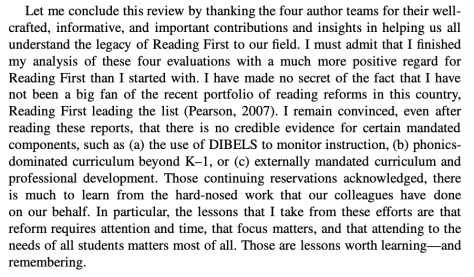
Reading First: Hard to Live With—or Without, P. David Pearson

Pearson Reading First

Teacher Preparation and the Kafkan Nightmare of Accreditation

Over three-plus decades of teaching, I have found that students are far less likely to laugh while reading Franz Kafka than, say, while reading Kurt Vonnegut. But Kafka and Vonnegut are essentially satirists, though both traffic mainly in dark humor.

Black-and-white photograph of Kafka as a young man with dark hair in a formal suit
Franz Kafka 1923 (public domain)

The Metamorphosis is the work most people associate with Kafka, but it isn’t readily recognized, I have found, that the work is filled with slapstick humor—the scene when Gregor is revealed as a bug to his family—while also making a damning commentary on the consequences of the bureaucratic life.

You see, Gregor Samsa’s metamorphosis into a bug is merely a physical manifestation of his life as a salesman, which, Kafka illustrates, is nothing more than a bug’s life.

This, of course, was Kafka’s impression of early twentieth century Prussia as well as the corrosive nature of materialism. As I enter my eighteenth year as as a teacher educator, after eighteen years as a public school English teacher, I can attest that Kafka has pretty much nailed my career on the head as well.

So when I saw Teacher-Preparation Programs Again Have a Choice of Accreditors. But Should They? in Education Week, I immediately recognized that this was the wrong question—or at least incomplete.

Accountability, standards, and assessment have been pervasive my entire career in education, which began in 1984. Over that career, I have heard a consistent refrain about the failures of both K-12 education and teacher education.

As I have recently detailed, teacher education is, in fact, the new scapegoat for all that ails education.

I have worked through about ten combined iterations of standards and assessment expectations, include two different rounds of submitting the teacher preparation program I am solely responsible for now, the first being for NCATE and the for CAEP (mentioned prominently in the article linked above).

Through these experiences, I have witnessed that the same complaints of failure remain while each new round of standards and assessment promise to reform the system and bring great success (often for all students), only to be replaced in a few years under the blanket of the same crisis rhetoric and the same promises that never materialize.

This Kafkan nightmare is perfectly described by Gilles Deleuze, who also turns to Kafka:

In the disciplinary societies one was always starting again (from school to the barracks, from the barracks to the factory), while in the societies of control one is never finished with anything—the corporation, the educational system, the armed services being metastable states coexisting in one and the same modulation, like a universal system of deformation. In The Trial, Kafka, who had already placed himself at the pivotal point between two types of social formation, described the most fearsome of judicial forms. The apparent acquittal of the disciplinary societies (between two incarcerations); and the limitless postponements of the societies of control (in continuous variation) are two very different modes of juridicial life, and if our law is hesitant, itself in crisis, it’s because we are leaving one in order to enter the other.

In my home state of South Carolina, for example, the state adopted Common Core standards, planned to implement the assessment designed for those standards, purchased textbooks and materials aligned with the standards, trained teachers in the standards, and then dropped the standards for new SC versions of standards before Common Core could ever be fully implemented.

My first experience with accreditation of teacher education programs was early in my tenure in higher education. I was baffled both by the process (again, I am solely responsible for an entire program and all the data as well as the report submitted for that accreditation) and my colleagues’ almost complete uncritical obsession with the requirements. In short, the vast majority of my department’s time and attention was devoted to fulfilling the obligations of accreditation—not teaching, not scholarship, but standards, rubrics, and data tables mandated by the accreditation entity.

Just six or seven short years later, the process came back around again—nearly the same, but different. NCATE had been replaced by CAEP and standards were different along with the report itself and the broad expectations being both eerily different and the same.

Accreditation, I suspect, is a process that is perceived as a necessary layer of bureaucracy to insure some sort of consistency and fidelity among all teacher education programs across the U.S. This appears to be the same initial urge driving Common Core, for example.

Political leaders have used accountability, standards, and high-stakes testing for nearly four decades as a way to claim a commitment to higher expectations and better outcomes from the public education system. The public appears incapable over that time to examine closely the argument that schools are failing (the mainstream argument is both false and misleading) or the assertion that accountability, standards, and high-stakes testing will somehow address those problems.

Accreditation of teacher education is essentially a thinly veiled admission that there is no political or public trust of teacher educators, the field of education, or teachers.

Beneath that lack of trust, the accountability era for public education and the allure of accreditation are evidence that political leaders and the public fundamentally misunderstand teaching and learning.

Here is the sobering truth about teaching and learning: To teach is about offering the opportunity to learn; however, there is no way to guarantee that teaching will result in learning regardless of the quality of the teacher or the motivation of the student.

Accountability and accreditation are designed with the assumption that teaching and learning can be prescribed and clearly defined (standards) and then made visible with assessments that are valid and authentic.

Those assumptions are mostly hokum.

The standards and testing movement in K-12 education and the accreditation process for teacher education have proven to be what Oscar Wilde argued about how government addresses poverty: ““But their remedies do not cure the disease: they merely prolong it. Indeed, their remedies are part of the disease.”

Trying to meet the requirements of accreditation has made teacher educators less effective, has reduced the quality of courses and experiences for pre-service teachers, and has consumed an incredible amount of time and financial resources for teacher educators.

It is much ado about nothing.

The EdWeek question, then, is overly simplistic; the rise of AAQEP as an alternative to CAEP is the “illusion of choice” that masks the truly important choice—teacher education and education as a field need to abandon accreditation and seek instead to build a discipline.

Meeting the demands of accreditation is a waste of time and resources that should be dedicated to the things associated with disciplines such as history, psychology, sociology, etc.—reading and thinking deeply about the ideas and practices at the core of the field, conducting a wide range of research on those topics and problems, producing scholarship that informs an ongoing dialogue about teaching and learning, and engaging students in those topics in ways that allow them to become the educators they seek to be.

To reject accreditation is to embrace higher expectations for teacher education, teacher educators, and teachers.

At the end of The Metamorphosis, Gregor’s macabre demise is a distraction for many readers who miss that this is a story about such rejections and not necessarily a tale about Gregor, but his family. After Gregor dies, “Then all three [Gregor’s family] left the apartment together, something they had not done for months now, and took the electric tram into the open air outside the city. The car in which they were sitting by themselves was totally engulfed by the warm sun.”

Careful reading of the final paragraph reveals that the family’s obsession with Gregor, who himself had embraced a toxic bug life dedicated to erasing the family’s debt, has to be abandoned for their eventual happiness: “The greatest improvement in their situation at this moment, of course, had to come from a change of dwelling. Now they wanted to rent an apartment smaller and cheaper but better situated and generally more practical than the present one, which Gregor had found.”

Gregor’s sister becomes the symbol of a new, and better, possibility, a fully human life unfettered by the bug life swept into the dust bin.

See Also

The Metamorphosis at 100, Alexander Billet

Educational Accountability and the Science of Scapegoating the Powerless

Several years ago when I submitted an Op-Ed to the largest newspaper in my home state of South Carolina, the editor rejected the historical timeline I was using for state standards and testing, specifically arguing that accountability had begun in the late 1990s and not in the early 1980s as I noted.

Here’s the interesting part.

I began teaching in South Carolina in the fall of 1984, the first year of major education reform under then-governor Richard Riley. That reform included a significant teacher pay raise, extended days of working for teachers, and the standards-testing regime that would become normal for all public education across the U.S.

In fact, SC’s accountability legislation dates back to the late 1970s (I sent her links to all this).

As a beginning teacher, the only public schooling I ever knew was teaching to standards and high-stakes tests by identifying standards on my lesson plans and implementing benchmark assessments throughout the academic year to document I was teaching what was mandated as a bulwark against low student tests scores. State testing, including punitive exit exams, pervaded everything about being an English teacher.

Yet, an editor, herself a career journalist, was quick to assume my expertise as a classroom practitioner and then college professor of education was mistaken.

This is a snapshot of how mainstream media interact with education as a topic and educators as professionals.

I am reminded of that experience over and over in fact as I read media coverage of education. Take for example this from Education Week, Want Teachers to Motivate Their Students? Teach Them How, which has the thesis:

Most teachers intrinsically understand the need to motivate their students, experts say, but teaching on intuition alone can lead to missteps in student engagement.

A study released in May by the Mindset Scholars Network, a collaborative of researchers who study student motivation, found most teacher education programs nationwide do not include explicit training for teachers on the science of how to motivate students.

Want Teachers to Motivate Their Students? Teach Them How

Two key elements of this article stand out: The new scapegoat in proclaiming education a failure is teacher education and the go-to failure is always about a lack of “science” in teacher education.

This article on motivation is following a media template well worn recently about students in the U.S. can’t read because teachers are not taught the “science of reading,” you guessed it, in their teacher education programs.

As I detailed in a Twitter thread, scapegoating teacher education has many flaws, and my experience and expertise as a teacher educator for almost two decades, following almost two decades as a classroom teacher, inform my understanding of how finding scapegoats for educational failure during the accountability era is fool’s gold.

How has the accountability era gone in terms of where the accountability and locus of power lie, then?

In the 1980s and 1990s, the accountability mechanisms focused on holding students accountable (think exit exams) and schools accountable (student test scores often translated into school rankings or grades, designating schools as “failing,” for example).

Keep in mind that students had no power in that process, and that schools were merely agents of the standards being implemented, again outside the power dynamics of those mandates being determined.

With No Child Left Behind spawned by the false claims of the Texas Miracle, the accountability era was greatly accelerated, including a creeping sense that the process wasn’t improving education but it was punishing students (lower graduation rates due to exit exams) and demonizing schools (most high-poverty and high-racial minority schools were labeled as “failing”).

By the administration of Barak Obama, with education policy under another false narrative (the Chicago Miracle) and false ambassador with no background in education other than appointments (Arne Duncan), the scapegoating took a turn—the problem, went the new message, was “bad” teachers and the solution was not holding students or schools accountable for test scores but those teachers (the era of value-added methods [VAM]).

As some have noted and documented, teacher bashing increased and then prompted a backlash (see magazine covers from Time for a great series of artifacts on this); it seems that VAM proved to be a false metric for accountability and that maybe teachers were not the problem after all.

With the scapegoat role now vacant, the media have discovered a new candidate, teacher education.

Let’s here recognize that once again the power context is way off in who is determining the accountability and who is being held accountable. For the most part, teachers and teacher educators are relatively powerless agents who are mandated to implement standards and assessments that they do not create and often do not endorse as valid.

Now consider another really important reason accountability in education is deeply flawed: The constant misguided scapegoating of powerless agents in formal teaching and learning is a distraction from the actual causal sources for educational challenges.

Fun fact: Decades of research from educators and education scholars have detailed that out-of-school factors overwhelmingly determine measurable student outcomes, some estimates as high as 80+% and most scholars agreeing on 60%. Teacher quality’s impact on measurable student achievement has been identified repeatedly as only about 10-15%.

Yet, the entire accountability era since the early 1980s has focused on in-school reforms only (scapegoating along the way), while tossing up hands and embracing harsh ideologies such as “no excuses” practices that argue teachers fail students with the “soft bigotry of low expectations” and students fail because they lack “grit” or a growth mindset.

Many of us have doggedly argued for social context reform, addressing socio-economic reform first and then reforming education along equity (not accountability) lines next, or concurrently. Many of us have also demonstrated that “grit” and growth mindset have racist and classist groundings that are harmful.

For those positions, we have been demonized and marginalized for decades.

So imagine my surprise when, first, the tide shifted on teacher bashing (I have 34 posts on my blog discrediting VAM and dozens on misunderstanding teacher quality) and then these articles: Better Schools Won’t Fix America (The Atlantic), The Harsh Discipline of No-Excuses Charter Schools: Is It Worth the Promise? (Education Week), and Unchartered territory: 2020 Democrats back away from charter schools (MSN).

My blog posts, however, on social context reform and poverty (157), “no excuses” reform (70), and the mirage of charter schools (80) have either mostly been ignored or are harshly (even angrily) rejected. Like my interaction with the editor discussed in the opening, my experience and expertise as an educator and education scholar have held almost no weight with those in power pr the media.

The media and journalists as generalists seem deeply resistant to learning a lesson they create over and over.

Take for a current example Karin Wulf’s examination of Naomi Wolff and Cokie Roberts; Wulf herself is a historian:

It’s been a tough few weeks for amateur history. First, journalist Naomi Wolf discovered on live radio that she had misinterpreted key historical terms in her new book, “Outrage,” leading her to draw the wrong conclusions. A week later, journalist Cokie Roberts, too, got a quick smackdown when she claimed on NPR that she couldn’t find any incidence of abortion advertised in 19th century newspapers, a claim quickly disproved by historians.

Wolf and Roberts fell victim to a myth widely shared with the American public: that anyone can do history. Whether it’s diving into genealogy or digging thorough the vast troves of digital archives now online, the public has an easy way into the world of the past. And why would they imagine it takes any special training? After all, the best-selling history books are almost always written by non-historians, from conservative commentators like Bill O’Reilly to journalists like Wolf and Roberts.

What Naomi Wolf and Cokie Roberts teach us about the need for historians

Wulf’s confronting “that anyone can do history” immediately prompted in me my experience when I first moved from teaching high school English (and adjuncting at several colleges, including being a lead instructor in a university-based summer institute of the National Writing Project) to higher education. My university was debating a curriculum change that included dropping traditional composition courses (popularly known as English 101 and English 102) for first-year seminars.

One of those first-year seminars was to be writing-intensive, and the argument being posed was that any professor could teach writing.

This change passed, and the English department and professors were relieved of sole responsibility for teaching writing.

Over the next eight years or so, the university learned a really disturbing lesson (one I could have shared in the beginning): “Any professor can teach writing” is false.

As Wulf argues about history, with writing and education, experience and expertise matter.

So here I sit again, writing over and over that the media are getting reading wrong, that scapegoating teacher education is missing the real problem.

How many years will it take until I see articles “discovering” these facts as if no one with experience and expertise ever raised the issue?

URGENT: Media Misreading the Reading Crisis Yet Again

Media Misreading the Reading Crisis Yet Again

By Katie Kelly and P.L. Thomas

Photo by Nathaniel Shuman on Unsplash

Several news articlesvideosreports on new state legislation, and commentaries across mainstream media have built a false narrative about a Reading Crisis. That story includes several key elements: Teachers do not know, and thus do not practice, the science of reading because teacher education has failed them.

Not only have the mainstream media offered only one narrative, but also, for example, the Education Writers Association chose one of the most prominent misleading articles for a Public Service, small staff award: Emily Hanford’s “Hard Words.”

In 2019, the Reading Wars have begun anew but with different language: Phonics advocates have simplified “the science of reading” to “all students need systematic phonics,” for example. And this round has resulted in dramatic changes in state reading policies.

As literacy educators and scholars, however, we contend that these messages are misrepresenting the Reading Crisis and the science of reading — both of which are far more complicated than being presented by much of the media, dyslexia advocates, and political leaders.

Those Who Ignore History: A Look Back at Reading Crises

The newest misdiagnosed Reading Crisis begs for a truism: “Those who cannot remember the past are condemned to repeat it” (George Santayana).

For example, the November 1942 issue of The Elementary English Review(National Council of Teachers of English) included a provocative piece, What Shall We Do About Reading Today?: A Symposium, prompted by the high rate of illiteracy among men drafted into WWII.

This symposium offers answers to the titular question from leading literacy experts of the time, including Lou LaBrant (former president of NCTE). Represented by assembled experts on literacy, this Reading Crisis foreshadows these debates are misguided and driven by ideology instead of evidence.

While we recommend reading the symposium responses in full, let’s focus on LaBrant: “Nevertheless, we hear many persons saying that the present group of near-illiterates are results of ‘new methods,’ ‘progressive schools,’ or any deviation from the old mechanical procedures. They say we must return to drill and formal reciting from a text book” (p. 240).

However, LaBrant discredits that blame because the recruits identified as illiterate or semi-literate “…are drop-outs, who have not completed elementary school, come from poorly taught and poorly equipped schools, and actually represent the most conservative and backward teaching in the United States [emphasis in original]” (pp. 240–241).

Next, in the 1980s/1990s, the media announced a Reading Crisis in California blamed on whole language. Literacy scholar Stephen Krashen, and others, debunked that claim, noting although whole language was the official reading approach of the state, teachers almost never implemented whole language. Further, the reading score plummet correlated with whole language being the official policy, but the causes of those lower scores were a large influx of non-native speakers of English and reduced educational funding.

Throughout much of the 20th century, reading instruction in practice remained skills-based, perpetuating a simple view of reading. That criticism of whole language, however, prompted a call for more scientific approaches to teaching reading, which meant mandated scripted instruction with an emphasis on phonics instruction. This was also driven by the high stakes accountability era of No Child Left Behind.

Contrasting thoughtful literacy, scripted reading programs narrow curriculum focusing on skills instruction and test preparation through teacher-directed learning (Kozol, 2005; Lipman, 2004). In this context, students serve as vessels with teachers depositing knowledge. This back-to-basics model of instruction encourages replication and regurgitation of information with little emphasis on comprehension instruction, critical thinking, and rich discussion of text (Comber & Nichols, 2004Durkin, 1981Leland, Harste, & Huber, 2005Shannon, 2007Taberski, 2011).

Being a good word caller does not equate to being a good reader, but can produce a false-positive on narrow types of reading tests. This unbalanced approach to teaching literacy is not only problematic, but also dangerous.

Misreading the Reading Crisis Yet Again

Despite the value of a more student-centered curriculum that fosters critical thinking, some advocate for a return to skills-based systematic phonics instruction, framed as the “science of reading,” and claim another Reading Crisis. With a new push for phonics as a single pathway to literacy, the role of the meaning making process in reading will again be neglected.

In her seminal study, Delores Durkin found an overemphasis on testing comprehension rather than teaching comprehension. Reading is a complex cognitive process mediated by social and cultural practices requiring instruction and interaction with text and others to construct meaning. Therefore, we must shift our view of literacy beyond decoding to include constructing meaning and reading texts critically by expanding instructional practices and the ways we assess reading.

The so-called science of reading is, in fact, balanced literacy, which includes a focus on multiple components of literacy including phonics, comprehension, and writing: “A balanced approach will privilege authentic texts and tasks, a heavy emphasis on writing, literature, response, and comprehension, but it will also call for an ambitious program of explicit instruction for phonics, word identification, comprehension, spelling, and writing” (Pearson, 2004, p. 243).

While phonics is an essential component of reading instruction in the primary grades, “it should be noted that phonics is one element of a comprehensive literacy program that must also include practice in comprehension, fluency, vocabulary, writing, and thinking” (ILA, 2018).

No Crisis, But We Are Failing Our Students

Crisis rhetoric misreads not only how we currently teach and historically have taught reading, but also misrepresents the causes of low student achievement in reading while perpetuating some of the worst possible policies and legislation such as grade retention based on high-stakes testing.

This Reading Crisis ignores that focusing on narrow standards and high-stakes testing combined with the de-professionalization of teaching and under-funding education has resulted in overcrowded classrooms where teachers and students conform to mechanical reading programs privileging the wealthy and overemphasize test scores.

As teacher educators, we can attest that regardless of what we teach about reading and literacy, most teachers feel pressured to implement programs and raise test scores.

Rather than blaming students and teachers for the opportunity gap entrenched in formal schooling, consider the achievement debt due to inequitable funding, poor healthcare, and a lack of political courage. With increasingly diverse student populations, we have a responsibility to address this debt by serving all students through culturally relevant teaching practices.

We must, then, disrupt the misguided narrative of crisis that disguises the sociocultural historical and political factors that influence reading instruction as a disease that simply needs a vaccination in the form of systematic phonics.

Katie Kelly is an Associate Professor of Education at Furman University. A former elementary teacher and literacy coach, Katie teaches courses in literacy methods and assessment at the undergraduate and graduate levels. She is the coauthor of Reading to Make a Difference: Using Literature to Help Students Speak Freely, Think Deeply, and Take Action (Heinemann). Follow her work at bookbuzz.blog and @ktkelly14.

P. L. Thomas, Professor of Education (Furman University), taught high school English for 18 years in South Carolina before moving to teacher education and teaching first-year writing. He is author of Teaching Writing as Journey, Not Destination: Essays Exploring What “Teaching Writing” Means (IAP). Follow his work at https://radicalscholarship.wordpress.com/ and @plthomasEdD.

Post & Courier: Education reform is deja vu all over again

Education reform is deja vu all over again

[with hyperlinks below]

I have taught in South Carolina since 1983, 18 years as an English teacher and coach followed by 17 years as a teacher educator and first-year writing professor. Over that career, I have felt exasperated by education reform that has proven to be déjà vu all over again.

A few years ago, I advocated against the misguided Read to Succeed Act, policy as flawed as I predicted since it failed to identify the evidence-based problems with reading in SC and then promoted new policy that does not address those problems while creating new and even worse consequences.

Read to Succeed also foreshadowed this newest round of wholesale education reform facing the state.

Since the 1980s, politicians in SC have insisted that our public schools are failing. Their responses, however, have meant that the only consistency in our schools is we are in a constant state of education reform repackaged over and over again.

State standards, state high-stakes testing, school choice, charter schools—these policies have been reframed repeatedly, and all we have to show for that is the same complaints about failing schools and decades of research revealing it’s policies that have failed.

Instead of misguided education reform beneath misleading political rhetoric, SC should take a different path, one shifting not only policies but also ideologies.

First, SC must clearly identify what problems exist in our schools and then carefully distinguish between which of those problems are caused by out-of-school factors and which are the consequences of in-school practices and policies.

For example, SC’s struggles with literacy are driven by generational inequities such as poverty and racism magnified by decades of misguided commitments to ever-changing standards, tests, and reading programs. Literacy outcomes in our state reflect how children suffer when families have low-paying work, endure transient lives, and are denied affordable insurance and healthcare.

Literacy outcomes also represent that once children enter schools, they receive distinctly different educations: Poor students, black and brown children, English language learners, and special needs students experience tracks and conditions unlike those of white and affluent students who are far more likely to have access to low class sizes in advanced courses and experienced certified teachers.

Next, SC must recognize that policies and practices based on accountability and market forces have failed our students and our schools. Instead, we need educational policy grounded in equity. Policies and practices grounded in equity and not accountability would insure that all children have access to experienced and certified teachers, low class sizes, and challenging classes.

Further, SC must acknowledge that teaching conditions are learning conditions. Teacher pay, teacher professionalism, teacher autonomy, facilities and materials funding and quality, student/teacher ratios—all of these are conditions that indirectly and directly impact whether or not teaching and learning can thrive in our schools. Yet, SC politicians remain determined not to make these choices while remaining committed to expensive and ineffective approaches such as standards, testing, and choice options, notably charter schools.

As a broad guide, then, SC must set aside inspirational rhetoric and partisan commitments and seek instead a wealth of educational expertise on both the need for social policy addressing inequity and reforming schools in ways that serve both teachers’ ability to teach and students’ equitable access to learning.

The problem in SC schools has never been about the presence or quality of our standards, what tests students have to navigate in order to survive schooling, or parental choice.

The harsh reality of our state includes poverty, racism, and disadvantages such as the scarcity of high-quality and stable work as well as affordable healthcare and housing. The harsh reality of our schools is that teaching and learning conditions are hostile to some students having equitable access to learning.

SC political leaders refuse to address those realities because they are too enamored with partisan politics as usual in a state tragically embracing the worst aspects of conservative ideology; once again as those myopic political leaders claim bold education reform, it’s déjà vu all over again.

Dear Media, Stop Misrepresenting Reading Instruction, Please

From Education Week to the Hechinger Report to The Answer Sheet (the latter two typically good sources for education journalism), the media simply cannot resist publishing misguided takes on how we do and should teach reading.

Citing the National Reading Panel as credible (it isn’t), misrepresenting whole language and balanced literacy (as somehow anti-phonics), hand-wringing about third-grade reading ability, and taking broad uneven swipes at teacher education—these are the hallmarks of bad journalism and garbled takes (usually with ulterior motives) on the reading wars.

Since I simply cannot continue to make the same points over and over, I suggest below a bit of actual reading to clarify why the media continually misrepresents the reading wars:

Here is a final note worth emphasizing: Phonics-intense and phonics-only reading instruction is a gold mine for textbook publishers, reading program shills, and the testing industry.

Consider carefully the who and why of public commentaries screeching about reading instruction, especially when the arguments are full of easily identifiable holes in their credibility and logic.

Misreading the Reading Wars Again (and Again)

Here is some incredibly bad edujournalism: Hard Words: Why aren’t kids being taught to read?

And the summary blurb beneath the title takes that to truly awful:

Scientific research has shown how children learn to read and how they should be taught. But many educators don’t know the science and, in some cases, actively resist it. As a result, millions of kids are being set up to fail.

Now, let me offer a brief rebuttal.

First, the claim that we are not teaching reading as we should is well into its twelfth decade of crisis rhetoric. But the classic example rests at mid-twentieth century: Why Johnny Can’t Read.

That blather was a lie then and it remains a lie today.

I invite you to peruse the work of a literacy educator who taught from the 1920s into the 1970s and left behind decades of scholarship: Lou LaBrant. But the short version is the reading war claim that we are failing reading instruction is a long history of false claims grounded in selling reading programs.

Now let’s be more direct about the bad journalism.

This article cites thoroughly debunked sources—the National Reading Panel (NRP) and a report from NCTQ.

The NRP was a political sham, but it also was not an endorsement of heavy phonics. Please read this unmasking by an actual literacy expert and member of the NRP, Joanne Yatvin: I Told You So! The Misinterpretation and Misuse of The National Reading Panel Report.

NCTQ is a partisan think tank exclusively committed to discrediting teacher education. Their reports, when reviewed, are deeply flawed in methodology and typically misread or misrepresent research in order to reach the only conclusion they ever reach—teacher education is a failure! (Like reading instruction, apparently, has always been.)

I offer here one example of why no NCTQ report should be cited as credible: Review of Learning about Learning: What Every New Teacher Needs to Know. (See also GUEST POST by Peter Smagorinsky: Response to the new NCTQ Teacher Prep Review.)

NCTQ lacks credibility, but the organization has learned how to manipulate the current state of press-release journalism that simply publishes whatever aggressive organizations are willing to feed journalists desperate for click bait.

As well, the article plays the usual game of misrepresenting whole language and balanced literacy. A more accurate explanation of whole language and balanced literacy exposes a really ugly reason some are so eager to trash both and endorse phonics: the former are not tied to (lucrative) reading programs, but phonics is a veritable cash cow for textbook companies and the testing industry. (Note the NRP and NCLB directly led to a textbook scandal under the Bush administration.)

Although I tire making this point, no one in literacy recommends skipping direct phonics instruction. WL and BL both stress the need for the right amount and right time for direct phonics instruction (depending on student needs) and recognize that most students eventually need rich and authentic whole reading experiences to grow as readers (not phonics rules, not phonics worksheets, not phonics tests).

Finally, however, is the real paradox.

Formal schooling has likely never taught reading well. Little of that has to do with teacher education or teacher buy in. Again, see LaBrant’s work from the 1920s into the 1960s and 1970s; she laments the gap between good research and practice over and over.

Of course, the key point is why are we failing our students and everything we know about teaching reading?

One powerful reason is the accountability movement grounded in standards and high-stakes tests. Reading instruction (like writing instruction) has been corrupted by the all-mighty tests.

Test reading is reductive (and lends itself to direct phonics instruction, hint-hint), but it is a pale measure of deep and authentic reading, much less any student’s eagerness to read.

Because of the accountability movement, then, and because of high-pressure textbook reading programs, we have for decades ignored a simple fact of research: the strongest indicator of reading growth in students is access to books in the home (not phonics programs).

I want to end by addressing the real scapegoat in all this—teacher education.

Full disclosure: I have been working in teacher education for 17 years, after 18 years teaching high school English in public school.

But, I am the first to admit teacher education is quite bad, technocratic, bureaucratic, and mostly mind-numbing.

Teacher education, however, is not the problem because whether or not we are teaching reading research and practices correctly is irrelevant; teacher candidates overwhelmingly report that once they are in the classroom, they are told what to do and how—what they know from teacher education is tossed out the window.

The article is not a powerful call, then, for teaching students to read. It is a standard example of really bad edujournalism.

Ironically, a bit of Googling and reading could have alleviated much of that, but I guess we are asking for too much and may want to blame teacher education and teachers for those journalists’ inability to read.

Recommended

Whatever Happened to Scientifically Based Research in Education Policy?

Corporations Are Behind The Common Core State Standards — And That’s Why They’ll Never Work

What’s Wrong with Education as a Discipline?: Unpacking the Reading Wars (Again)

In one of the last class sessions of my education foundations course, a student I had taught in a first-year writing seminar the semester before posed a question while being nearly exasperated: To paraphrase, she wondered allowed why education had such a problem with how classroom practices often contradict what the research base shows is (for lack of a better term) best practice.

Since I have repeatedly addressed in my public and scholarly work Lou LaBrant’s masterful charge about the historical (and current) “considerable gap” between practice and research, I chose to help walk students through unpacking her question by asking them first who controlled the fields of medicine and law.

We tended to agree that doctors and lawyers mostly (although certainly not exclusively) had the greatest authority and autonomy in their fields.

By contrast, education in the U.S. is primarily public institutions at the K-12 and higher education levels, and thus, education as a discipline is significantly barricaded from education as a practice by legislation, bureaucracy, and a public discourse dominated by disciplines other than education—economics, psychology, and political science.

Embedded in that bureaucracy, we must also note, is the authority of administrators, a subset of eduction as a field that is in many ways disconnected from pedagogy, if not antagonistic to teacher autonomy.

Education as a discipline, then, suffers under the weight of being routinely declared a failure as well as an inadequate field while simultaneously being denied authority and autonomy in its practice, the very thing being used as evidence of its failure.

So, in 2018, we have yet another example of the on-going problem in the so-called publication of record on the field of education, Education WeekWhen It Comes to Public Education, the Nation Is Still at Risk.

Thomas Toch grounds his commentary is a praising and uncritical embracing of A Nation as Risk—although that report has been thoroughly discredited as a partisan hatchet job masquerading as research (see Gerald Holton here and here as well as Gerald Bracey).

Few things better represent all that is wrong with education as a discipline and profession than how A Nation at Risk (as a partisan political sham) came to drive policy by claiming “research” and “scientific” while being any but.

But the relentless bashing of education and then teacher education certainly did not stop with the rise of standards and high-stakes testing in the form of the accountability movement after Reagan; it was reinvigorated under W. Bush, and then Obama doubled down even further.

No Child Left Behind took its cue from A Nation at Risk, in fact.

This brings me to a recent Twitter discussion representing the reading wars debate that will just not die.

Let’s join that sort of in media res with Daniel Willingham refuting some claims made by Carol Black quoting from my blog post:

This Twitter exchange holds almost all of the elements I am confronting in this post: the disciplinary arrogance of economics, psychology, and political science (disciplines that routinely impose themselves in education as if the field dose not exist); the veneer provided by claiming “research” and “scientific” among hard-core phonics advocates; and the irony of the “research” crowd embracing partisan reports that fail as credible research.

First, let me clarify that I have taken a very clear stand against how the media embrace scholars from outside the fields of education and literacy when they arrogantly impose on those fields—for example, Willingham and Mark Seidenberg.

Next, it is illustrative that Willingham’s rebuttal of my criticism, in fact, provides proof of my point: His NYT’s op-ed is both a sweeping discrediting of teachers (since teacher educators are teachers) and, as Toch does, Willingham offers an uncritical embracing of the National Reading Panel (NRP), a partisan hack job powerfully refuted by Joanne Yatvin.

The NRP report serves a different purpose than it intended since it represents how partisan politics combined with unchallenged claims of “research” and “scientific” provide cover for everything that is wrong with the discipline of education being blocked from having authority and autonomy in the practice of education, specifically how reading is taught in US public schools.

If you skim through the discussion after I responded to Willingham, you also witness the problems with the cult of phonics, how advocates for phonics simultaneously beat the drum for “research” and “scientific” while refusing to engage with the field of literacy and reading in an honest way.

For example, whole language and balanced literacy are misrepresented and then those misrepresentations are attacked. Both whole language and balanced literacy are evidence-based approaches to teaching reading that include phonics instruction (just as writing pedagogy includes grammar instruction); however, phonics advocates typically frame them as hostile to phonics as well as not supported by “research” (something dishonestly posed by the NRP).

In other words, this Twitter debate exposes that far too often educational research and practice are highjacked for partisan political and ideological concerns as well as bureaucratic and market ones (phonics advocacy is significantly driven by the textbook and testing industries, for example).

If we return to my student’s question that is echoes in this Twitter debate grounded in Willingham’s sweeping dismissal of teacher education, we are faced with a real dilemma.

LaBrant’s charge that a “considerable gap” exists between evidence and practice exists today, but not in the way or for the reasons stated and implied by Willingham.

Literacy as a sub-discipline of education is not bereft of research, and it is not populated by incompetent professionals who do not know or teach that research base.

Education and literacy scholars are often women, and at its core, the fields suffer from some of the lingering sexism that hovers just beneath why economists, psychologists, and political scientists feel compelled to speak over education as a discipline.

Concurrent with that uncomfortable fact, however, is a damning dynamic captured in Applebee and Langer’s analysis of writing instruction in formal schooling; they concluded something that also explains virtually every problem found in why so many are compelled to declare education a failure: Applebee and Langer discovered that although teachers today know more than ever about best practice in teaching writing (and despite the field of composition being more robust than ever), teachers overwhelmingly disclosed that they are not able to implement that knowledge because of the mandates anchored in standards and high-stakes testing.

As I argued in the Twitter debate, whether or not teacher educators of literacy are teaching as Willingham wants, it doesn’t matter because when teachers enter the field they are being mandated to teach to the tests that measure standards. Teachers in the US have very little to no professional autonomy.

So I want to circle back to the more narrow issue of balanced literacy, a concept rejected by phonics advocates.

At its core, balanced literacy is about having highly expert teachers of literacy who then have the professional autonomy to individualize instruction for all students so that every student excels in literacy.

Intensive phonics programs and textbooks as well as isolated phonics testing (such as DIBELS) are the antithesis of that expertise and professional autonomy—just as the standards and high-stakes testing machine is.

I am not at all dissuaded from my not-so-modest proposal that all disciplines deserve their own autonomy and professionalism, that education has been denied that autonomy and professionalism because of sexism and the corrosive influence of bureaucracy and partisan politics.

This recent Twitter debate captures all that in a way that is relatively concise with many players inadvertently proving my points.

But, alas, I am not hopeful of having made any progress because, you know, I am but a lowly education scholar and practitioner, one mired even lower in the field of literacy.

Sigh.


For Further Consideration

Please note that, like economics, psychology has much to do to keep its own house in order; maybe slamming other disciplines serves as distraction:

Attack on “Balanced Literacy” Is Attack on Professional Teachers, Research

Progressivism and Whole Language: A Reader

My Next Book Project: The Psychology of Fixing the Economy through Better Public Policy


The Lingering, and Powerful, Legacy of “Scientific Racism” in America

Writing about the class of 2017’s performance on the newly redesigned SAT, Catherine Gewertz notes, “The number of students taking the SAT has hit an all-time high,” and adds cautiously:

What appear to be big scoring increases should be understood not as sudden jumps in achievement, but as reflections of the differences in the test and the score scale, psychometricians said.

More test takers and higher scores, albeit misleading ones, are the opening discussion about one of the most enduring fixtures of U.S. education—standardized testing as gatekeeping for college entrance, scholarships, and scholastic eligibility.

However, buried about in the middle of Gewertz’s article, we discover another enduring reality:

The 2017 SAT scores show inequities similar to those of earlier years. Asian (1181), white (1118), and multiracial (1103) students score far above the average composite score of 1060, while Hispanic (990) and African-American (941) students score significantly below it.

Throughout its long history, the SAT, like all standardized testing, has reflected tremendous gaps along race, social class, and gender lines; notable, for example, is the powerful correlation between SAT scores and takers’ parental income and level of education as well as the fact that males have had higher average scores than females for the math and verbal sections every year of SAT testing (the only glitch in that being the years the SAT included a writing section).

The SAT is but one example of the lingering and powerful legacy of “scientific racism” in the U.S. Tom Buchanan, in F. Scott Fitzgerald’s The Great Gatsby, punctuates his racist outbursts with “‘It’s all scientific stuff; it’s been proved.'”

Buchanan represents the ugly and rarely confronted relationship between “scientific” and “objective” with race, social class, and gender bigotry. In short, science has often been and continues to be tainted by bias that serves the dominant white and wealthy patriarchy.

Experimental and quasi-experimental research along with so-called standardized testing tends to avoid being implicated in not only identifying racism, classism, and sexism, but also perpetuating social inequity.

As I noted recently, since Carol Dweck and Angela Duckworth have produced mainstream scientific studies and published in reputable peer-reviewed journals, their inherently biased work has been nearly universally embraced—among the exact elites who tend to ignore or outright reject the realities of inequity and injustice.

As just one example, Duckworth grounded her work in and continues to cite a Eugenicist, Francis Galton, with little or no consequences.

Racism, classism, and sexism are themselves built on identifying deficits within identifiable populations. Science allows these corrupt ideologies to appear factual, instead of simple bigotry.

“Scientific” and “objective” are convenient Teflon for bias and bigotry; they provide cover for elites who want evidence they have earned their success, despite incredible evidence that success and failure are more strongly correlated with the coincidences of birth—race, social class, gender.

It takes little effort to imagine a contemporary Tom pointing to the 2017 SAT data and arguing, “‘It’s all scientific stuff; it’s been proved.'”

Such ham-fisted scientism, however, mutes the deeper message that SAT data is a marker for all sorts of inequity in the U.S. And then when that data have the power to determine college entrance and scholarships, the SAT also perpetuates the exact inequities it measures.

The SAT sits in a long tradition including IQ testing that speaks to a jumbled faith in the U.S. for certain kinds of numbers and so-called science; when the data and the science reinforce our basest beliefs, we embrace, but when data and science go against out sacred gods, we refute (think climate change and evolution).

Science that is skeptical and critical, questioning and interrogating, has much to offer humanity. But science continues to be plagued by human frailties such as bias.

Science, like history, is too often written by the winners, the oppressors. As a result, Foucault details, “[I]t is the individual as he[/she] may be described, judged, measured, compared with others, in his[/her] very individuality; and it is also the individual who has to be trained or corrected, classified, normalized, excluded, etc.” [1]

“Scientific racism,” as a subset of science that normalizes bigotry, allows the accusatory white gaze to remain on groups that are proclaimed inherently flawed, deficient, in need of correction. “Scientific racism” distracts us from realizing that the tests and science themselves are the problem.

And thus, we must abandon seeking ever-new tests, such as revising the SAT, and begin the hard work of addressing why the gaps reflected in the tests exist—a “why” that is not nested in any group but our society and its powerful elite.


[1] Foucault, M. (1984). The Foucault reader. Ed. P. Rabinow. New York: Pantheon Books, p. 203.

See this thread: