Category Archives: education

School Library Month 2015

While April is receiving attention as National Poetry Month, many of us may have missed April is also School Library Month.

I must admit that I am a book person more than a library person, and by that I mean I am compelled to own books instead of borrow them.

But I vividly recall my junior high library, where I found a book with Mark Twain’s signature reproduced and decided at that young age a person’s signature matters—creating then what has endured as my own swirling signature that is a very important icon of my Self (especially as a writer).

As a literacy educator, I also know that access to books at school and home is a foundational part of any child’s literacy—one we have ignored for reading programs and punitive legislation masked as reading policy (see Stephen Krashen).

As a public school teacher, I also witnessed—and resisted—book banning attempts from parents as well as the school’s librarian.

My doctoral work, writing a biography of educator and former NCTE president Lou LaBrant, helped solidify my appreciation for the key role of librarians as scholars and teachers; LaBrant co-authored several scholarly works with a librarian, Frieda M. Heller.

So here for School Library Month 2015, let me repost my presentation from NCTE 2014.

Teaching Reading and Children: Reading Programs as “Costume Parties”*

“It is 1956, and I am thirteen years old,” begins Louise DeSalvo’s memoir Vertigo.  The opening scene reveals DeSalvo’s teenage angst and her desire to flee:

I have begun my adolescence with a vengeance. I am not shaping up to be the young woman I am supposed to be. I am not docile. I am not sweet. I am certainly not quiet. And, as my father tells me dozens of times, I am not agreeable. If he says something is true, I am sure to respond that it is most certainly not true, and that I have the evidence to prove it. I look up at the ceiling and tap my foot when my father and I argue, and this makes him furious.

In the middle of one of our fights, the tears hot on my cheeks, I run out of the house, feeling that I am choking, feeling that if I don’t escape, I will pass out. It is nighttime. It is winter. I have no place to go. But I keep running.

There are welcoming lights a few blocks away. It is the local library. I run up the stairs. I run up to the reading room, sink into one of its comforting, engulfing brown leather chairs, pull an encyclopedia down from the shelf, hold it in front of my face so that no one can see me, so that no one will bother me, and pretend to read so that I won’t be kicked out. It is warm and it is quiet. My shuddering cries stop. My rage subsides. (Prologue, p. xiii)

Libraries, librarians, and teachers return often throughout DeSalvo’s life story that reads as a slightly revised version of Tennessee Williams’s fictional “kindness of strangers”—this a retelling of the kindness of teachers, and of the library as sanctuary.

“There is more than one way to burn a book” (p. 209), Ray Bradbury warns in the “Coda” included in the 60th anniversary edition of Fahrenheit 451—a comment that motivated a poem of mine, “The 451 App (22 August 2022),” a speculative poem about how the move to electronic books could lead to the dystopian end to books and reading.

Bradbury’s novel, of course, emphasizes the importance of books, and of reading, but Bradbury’s writing of the novel and life also present powerful messages about libraries.

Jonathan R. Eller explains, “Bradbury virtually lived in the public libraries of his time” (p. 168). Further, Bradbury drafted early versions and then Fahrenheit 451 itself in the UCLA Library, working at a dime-per-half-hour typewriter.

Bradbury explains as well in the audio introduction to Fahrenheit 451:

I’m a library-educated person; I’ve never made it to college. When I left high school, I began to go to the library every day of my life for five, ten, fifteen years. So the library was my nesting place, it was my birthing place, it was my growing place. And my books are full of libraries and librarians, and book people, and booksellers. (p. 196)

It makes a great deal of sense and offers some literary symmetry, then, that Neil Gaiman wrote the Introduction to Bradbury’s 60th anniversary edition—Gaiman who is the source of a mostly satiric piece I wrote calling for Gaiman to replace Arne Duncan as the U.S. Secretary of Education.

Gaiman, like, Bradbury is an advocate of books, of reading, of libraries, and then of children choosing what they read:

It is obviously in my interest for people to read, for them to read fiction, for libraries and librarians to exist and help foster a love of reading and places in which reading can occur….

The simplest way to make sure that we raise literate children is to teach them to read, and to show them that reading is a pleasurable activity. And that means, at its simplest, finding books that they enjoy, giving them access to those books, and letting them read them….

Well-meaning adults can easily destroy a child’s love of reading: stop them reading what they enjoy, or give them worthy-but-dull books that you like, the 21st-century equivalents of Victorian “improving” literature. You’ll wind up with a generation convinced that reading is uncool and worse, unpleasant….

Another way to destroy a child’s love of reading, of course, is to make sure there are no books of any kind around. And to give them nowhere to read those books. I was lucky….

They were good librarians. They liked books and they liked the books being read. They taught me how to order books from other libraries on inter-library loans. They had no snobbery about anything I read. They just seemed to like that there was this wide-eyed little boy who loved to read, and would talk to me about the books I was reading, they would find me other books in a series, they would help. They treated me as another reader – nothing less or more – which meant they treated me with respect. I was not used to being treated with respect as an eight-year-old.

But libraries are about freedom. Freedom to read, freedom of ideas, freedom of communication. They are about education (which is not a process that finishes the day we leave school or university), about entertainment, about making safe spaces, and about access to information.

While writing this, it was late in the year 2014. No dystopia like Bradbury envisioned had happened, and at least potentially, books now are more abundant than ever—both in print and electronically.

But a much more insidious dystopia does exist, one that is little different than decades before us and one that comes in the form of policy and what former NCTE president Lou LaBrant called “adult weariness” (p. 276).

Reading and books—and children—have long been the victims of prescribed reading lists, reading programs, and reading legislation. By mid-twentieth century, LaBrant (1949) had identified the central failure of teaching reading: “Our language programs have been set up as costume parties and not anything more basic than that” (p. 16).

Nearly 65 years later, Common Core, the related high-stakes tests, and rebranded concepts such as “close reading” are poised to have the same chilling effect Bradbury dramatized in Fahrenheit 451, and directly warned about, again: “There is more than one way to burn a book.”

From LaBrant to Stephen Krashen, literacy teachers and scholars have called repeatedly for access to books in the home, well-funded public libraries, and children having choice in what they read.

Instead, we close libraries (and public schools), we defund and underfund what libraries (and schools) remain, and we invest in reading programs and reading tests. That is a very real and painful dystopia.

Like DeSalvo, Gaiman recalls the library as a safe haven:

Nobody is giving you a safe space. I used to love libraries at school. Because school libraries had an enforced quiet policy, which meant they tended to be bully-free zones. They were places where you could do your homework, you could do stuff, whether it was reading books, or getting on with things that you wanted to get on with, and know that you were safe there. And people responded to your enthusiasms. If you like a certain writer, or a certain genre, librarians love that. They love pointing you at things that you’ll also like. And that gets magical.

Here, Gaiman answers his question from his Introduction to Bradbury’s Fahrenheit 451: “Why do we need the things in books?” (p. xv).

Books as magic, libraries as sanctuaries—we must cast spells, then, to erase the dystopia before us in the form of yet more standards and test, yet more libraries closed, and then yet more children taught to hate the very things and the very places that have made life worth living for so many.

Books and libraries created Gaiman, spawned his belief: “The world doesn’t have to be like this. Things can be different.”

Let’s hope so.

References

LaBrant, L. (1949, May). Analysis of clichés and abstractions. English Journal, 38(5), 275-278.

LaBrant, L. (1949). A genetic approach to language. Unpublished manuscript, Institute of General Semantics, Lakeville, CT.

LaBrant, L. (1947). Um-brel-la has syllables three. The Packet, 2(1), 20-25.

*Portions adapted from the following blog posts:

Teaching Reading and Children: Reading Programs as “Costume Parties”

Common Core in the Real World: Destroying Literacy through Standardization (Again)

“Fahrenheit 451″ 60 Years Later: “Why do we need the things in books?”

Neil Gaiman Should Be U.S. Secretary of Education: “Things can be different”

See Also

Neil Gaiman: Libraries are cultural ‘seed corn’

It’s a Book, Lane Smith

Magical Murakami Nightmares

From “Bad” Teachers to Teachers as Cheaters: The Burden of the Impossible

The guilty verdict in the Atlanta cheating scandal seems to be a logical conclusion to the “bad” teacher myth confronted nearly five years ago by Adam Bessie.

As a 30-plus-years educator, I have daily witnessed a not-so-subtle disdain for teachers, directly as people and broadly as a profession.

One situation that captures that, I think, is the many times among my cycling group years ago when people would discover I was then an English teacher. Each time, the person would say, “I better watch what I say then”—not so jokingly.

The stereotype of the authoritarian and humorless English teacher—gray hair in a bun, red pen at the ready—is likely the image many people conjure when they think about teachers.

Not all, but many.

School for too many children is something to endure, a place that seems impossible to navigate without getting into trouble, and especially for children of color, the first confrontation with discipline and punishment that are inequitable and inevitable.

So I regret to admit that a significant reason the “bad” teacher myth works politically and there seems a great deal of glee about teachers/educators being busted for cheating is our faultour fault each time we have created or perpetuated authoritarian schooling.

That said, I must then stress here it isn’t that simple.

I have, then, a few questions.

The first, Why are 11 educators being convicted in Atlanta, but Michelle Rhee continues to skip along scot-free?

Another, Why did professional educators commit these crimes?

And finally, What does the popular glee over these convictions reveal about justice in the U.S. as well as lingering racism and sexism?

I have some ideas about how all of these are connected.

Let me start with Rachel Aviv’s headline about the Atlanta scandal, by focusing on the subhead: Wrong Answer: In an era of high-stakes testing, a struggling school made a shocking choice.

My first idea is that there is nothing “shocking” about the cheating scandal, but that it is entirely predictable, if not reasonable.

I recommend Margaret Atwood’s The Handmaid’s Tale which dramatizes the consequences of “reduced circumstances.”

Adults, children, and animals backed into a corner will behave in ways that are unlike their normal behavior.

Offred/June fantasizes about murder with a knitting needle; she had been a “normal” wife and mother before the events creating the dystopia that reduces her.

Teachers/educators and students who find themselves in high-stakes situations and almost no power, then, have often and will often seek any means necessary to avoid the injustice of punishment over which that have no control.

As a high school teacher, I witnessed time and again that students who faced impossible expectations either quit or cheated, often. The problem was not the student, but the expectations and the burden of the impossible.

But here is the problem: In the U.S., we have a cultural belief that human goodness/badness is almost entirely a consequence of the individual—despite that cultural belief being mostly refuted by what research shows about the power of social forces to shape individual behavior.

I recommend in that context the research-based Scarcity: Why Having Too Little Means So Much by Sendhil Mullainathan and Eldar Shafir and the literary (as well as beautiful) The Very Persistent Gappers of Frip, written by George Saunders and wonderfully illustrated by Lane Smith (I have examined how these two works complement each other).

Let me end this by stressing that I am not calling for excusing any and all behavior because of social forces; nor am I necessarily saying that the educators convicted in the Atlanta scandal are somehow above punishment.

I do argue what the punishment should be for those educators needs careful deliberation.

I also think the greater issue is that we must confront the reasons these cheating scandals are occurring under the high-stakes accountability mandates, which is the lesson from the Atlanta cheating scandal:

ATL cheatingI think a great illustration of what must be done is how the tide is turning about the legalization of marijuana.

For those who think right/wrong is simple, consider that one day possessing marijuana was illegal in Colorado, for example, but the next day it wasn’t.

The solution to ending cheating among educators under the impossible weight of high-stakes accountability (just as the solution to stop student cheating in school) is to end the conditions creating it.

The Atlanta cheating scandal is not a major lesson about “bad” teachers, but it is yet another lesson about the bankrupt education reform movement, the one that made Michelle Rhee rich and famous and thus above the law (a situation that oddly seems to draw little fire from those dancing about teachers getting busted).

Particularly in high-poverty, majority-minority schools, students and teachers are living a dystopia not of fiction, but a daily experience.

“No excuses,” zero tolerance, high-stakes testing—these are the conditions that reduce good children and adults to behaviors that are unlike who they are.

High-stakes accountability must be put on trial, convicted, and sent away for life without parole.

See Also

Taking the Fall in Atlanta, Richard Rothstein

National Poetry Month 2015: “A poem should not mean/But be”

Spring semester 1980, I was a first-year student at Spartanburg Methodist College and the class was Public Speaking 101, taught by Steve Brannon.

At that point in my redneck life, I was mostly focused on golf (I was on the college golf team), playing pick up basketball (I carried a basketball to class often), and recreational drinking (buying shopping carts filled with beer on sale to smuggle back onto our dry campus).

But one class session changed a great deal of that, or at least pointed me in a different direction—the day Mr. Brannon introduced me and the class to e.e. cummings with “[in Just-].”

I suppose that moment and the days to follow are what many people call a religious experience, but for me, it was an awakening to the glory that is language, that is poetry.

Soon after the cummings epiphany, I was sitting in my third-floor dorm room, looking out the window. It must have been an early spring day, warm and sunny. Then, I wrote what I consider my first “real” poem—since no one had assigned it, and the poem had—as would be the case since that day until this moment—demanded I write it:

essence

The years to follow, my life as a poet, would include many, many efforts to become other poets—always, always cummings, James Dickey, Emily Dickinson.

Poetry for me is the inextricable blurring of reading and writing poetry. Poetry is the verbal gymnastics of standing on the shoulders of giants.

#

It is no small thing, I think, to be a reader (a lover of books), a teacher, and a writer. I make no claim that this combination is better than other combinations, but I do argue the combination matters (in the same way being a teacher and a parent inform each other).

My teacher-who-is-a-writer/poet Self, then, existed in a constant state of anxiety over the formal schooling demand to dissect literature (at the bidding of the New Criticism gods) as that contradicted my love of literature and my poet-Self who wanted readers simply to enjoy having read a poem.

One of my soul cleansing moments was to share with students Archibald MacLeish’s “Ars Poetica” to linger at those last lines: “A poem should not mean/But be.”

#

It is National Poetry Month 2015, may I invite you to read?

Tarame Chronicles

Yen To Dollar (notes on a gifted child as an adult)

wonderland (Yen To Dollar pt. 2)

remnant 3: it started with a cup of coffee

remnant 8: what makes poetry, poetry?

remnant 9: Thoreau on poetry

remnant 11: poetry of social consciousness, personal experience

remnant 12: “my fingers touch your blood,” Frida Kahlo

remnant 20: “your absence will sadden other afternoons”

remnant 56: “thus I, for example, in the midst of my unhappiness”

remnant 73: “It’s not a place of measurement”

In Defense of Poetry: “Oh My Heart”

Writing versus Being a Writer

“There’s time to teach”: Entering the world of literature through the music of R.E.M.

There’s Time to Teach: Making Poetry Sing with R.E.M.

Poems published in English Journal

Adrienne Rich: Artist of the Possible and Life among the Ruins

REVIEW: Jimmy’s Blues and Other Poems, James Baldwin

Teaching Essay Writing through Poetry

National Poetry Month: “What is the message when some children are not represented in those books?”

Made in America: Segregation by Design

“He knows, or thinks he knows”: It’s Still a Man’s (Hostile) World

My Next Book Project: The Psychology of Fixing the Economy through Better Public Policy

As many have highlighted, the media turns to almost anyone except educators when dealing with education topics such as evaluating and paying teachers (ask an economist), teaching reading (ask a psychologist), expanding charter schools (ask a political scientist), or creating national standards (which apparently requires a degree in philosophy).

Therefore based on my experiences as a student (nobody asks a student about anything), as a public school classroom teacher (nobody asks a teacher anything), and as an “ivory tower” academic (really? ask a professor?) who graduated from state schools with an undergraduate and two graduate degrees in education, I have now begun work on my next book:

New Book2

I am eager to speak with publishers, and any media outlet interested in a guest Op-Ed or an interview!

[insert cricket noise]

Finally, (a Little) More Room for Teachers’ Voices in the Debate

Since I have taken the NYT and its Room for Debate to task for the near absence of teachers’ voices in mainstream media examinations of education, I think I must highlight this Room for Debate: Is Improving Schools All About Money?

Two classroom ELA teachers, Nicole Amato and Yvonne Mason, offer excellent perspectives, and Lisa Delpit provides a powerful argument as well:

I remain baffled at the obsession in the media with economist Eric Hanushek, who continues to push misleading and discredited claims about teacher quality and educational funding.

But the media also sees no problem with Daniel Willingham, psychologist, posing as a reading expert.

So I want to acknowledge that the NYT has given some space, but there is still much ground left to cover.

See Also

Classroom Teaching Experience and Whose Voice Matters

Education Activism for Equity: On Common Core, Pearson, and Race

Likely as a consequence of being a critical educator and my own proclivities as a non-joiner skeptic, I remain mostly an outsider in the education reform debates—although I am a 30+-year educator and an established blogger/public voice on education.

Not addressing only specific, recent debates but prompted by my own witnessing of the evolving (and muddled) Pearson monitoring controversy and how that seems as problematic as the much longer (and equally muddled) Common Core debate, I posted the following Tweets earlier today:

On Common Core (see here, here, and here) and Pearson monitoring (see here and here), I cannot be placed neatly into any major camp of the ongoing debates.

And throughout my blogging and public work on education reform, I forefront race and racism as well as poverty—noting that addressing race in the U.S. immediately prompts both harsh reactions and stunning silence.

As more context, I am regularly confronted as a union shill and union basher, depending on the detractor; although I am not now and have never been a member of a union, living and working my entire life in a right-to-work state, but simultaneously support unionism while acknowledging that organized unions (NEA and AFT) have mostly failed education.

That same pattern occurs within politics since many assume I am a Democrat (I am not) and both partisan sides bristle at my equal-opportunity criticism of mainstream politicians’ failures related to education.

None of this is intended as a pity party or a pat on my own back, but to note I am living, and thus witnessing from a privileged white/male vantage point, what I am concerned about in this post: Even—or notably among—good people with whom I consider myself in allegiance on educational goals, education activism for equity too often fails by slipping into the wrong allegiances (people and organizations) and not the ultimate goal, equity.

To understand this, I think we must return to race and other aspects of marginalized people and voices. Three powerful situations must be acknowledged:

  • Civil rights organizations with black leadership speaking out in favor of high-stakes testing and accountability.
  • Blacks identified as supporting Common Core.
  • Blacks associated with strong support for charter schools.

As well, Andre Perry has offered two important examinations of the white/black dynamic in education reform:

To understand the racial divide in the education reform debate (why do blacks support many of the policies strongly rejected by a mostly white education reform counter-movement?) requires the same considerations necessary to unpack the often misguided Common Core and Pearson monitoring debates: Simplistic analysis of white and black support fails to confront the inherent problems with white privilege and fully expand the important contributions of minority voices.

As I have examined about black support of charter schools in the context of mass incarceration, I want to flesh out the three bullet points above by arguing that all three must include “as mechanisms for educational equity.”

In other words, it is misleading to say that civil rights or minority populations embrace policy A or practice B as if those policies and practices have no goals attached to them. The support must be read as “We support X in order to accomplish Y”—and it is that Y which is vital to emphasize, educational and social equity for minorities and the impoverished.

And not to belabor a specific topic, I have continued to reject Common Core as a mechanism of educational equity because the evidence suggests:

As the absence or presence of rigorous or national standards says nothing about equity, educational quality, or the provision of adequate educational services, there is no reason to expect CCSS or any other standards initiative to be an effective educational reform by itself.

And that brings me back to my morning Twitter flurry.

Education activism for equity must not succumb to mere missionary zeal, and certainly fails when people and organizations trump the goal of equity or when winning the debate destroys the actual reason for the debate.

As I noted above, education activism for equity has failed in those ways—just as have the NEA, AFT, and Democrat Party (all of which I highlight since they are associated with being “liberal” and supposedly for both public education and economic/educational equity).

And all of this is very disappointing and disheartening—just as being alienated and ignored among those with whom I have strong allegiances is very disappointing and disheartening.

But again, this isn’t about me, although I do feel an obligation to bear witness to the failures among those I personally respect and publicly share ideologies—even when I disagree with them.

And I have failed along the way to this post, often—and will likely fail again.

But I stand by the Twitter flurry above, I stand by the unpopular positions I hold about Common Core and Pearson monitoring—despite the tensions those stands cause specific people and organizations, many of whom also pursue educational equity.

Teaching and activism are compelling pursuits for me because they both demand that we rise above personal and organizational commitments, that we rise to our individual commitment to humanity: They are all our children.

Teaching and activism require our humility, and a capacity for listening and learning, for admitting when we are wrong and moving forward.

And in both roles, we risk ourselves in order to find ourselves and the world we imagine can and should be.

See Also

Avoiding Patricia Arquette Moments in Education Reform

Responsibilities of Privilege: Bearing Witness, pt. 2

Education Reform as the New Misogyny: A Reader

If You Don’t Think, Why Should I listen?

Often, my high school students would draft a sentence that began “I don’t think,” and I would highlight or circle the construction and then comment: “If you don’t think, why should I listen?”

This was a typical ploy of my feedback on student writing—one designed to develop in my students a purposefulness and care for not only the words they chose, but also the assembling of those words.

For “I don’t think the movie was good,” we would discuss the placement of “not,” recasting as “I think the movie was not good” or simply “bad,” and then “I think the movie was cliche and condescending to the viewers.”

But I was relentless (and still am) about what word choices and sentence formations actually stated (“I could care less”) versus what was meant (“I couldn’t care less”): “I want to kiss you badly” isn’t a very good invitation to romance, I’d explain.

We argued about “not” and “only” placements, but also I emphasized the lazy openings of sentences: “Flying low over the fields, the cows were startled by the plane.” So we could examine dangling and misplaced modifiers as well as the inherent dangers of passive voice; eventually, hitting on the real danger of passive voice—the absent agent: “Documents were shredded.”

Mostly, for my students, class time was about playing with language as readers and writers. It endeared my students to Margaret Atwood and Kurt Vonnegut—Atwood’s wordplay and Vonnegut’s sparse snark.

Words are how humans define the world, and how we are equipped to re-define the world.

And that is why I am so persistent about the importance of careful, purposeful language—especially for young people.

“I Don’t Think” v. “I Don’t Believe”

During my first 18 years as a high school English teacher in my rural Upstate South Carolina home town, I was committed to confronting the provincialism that had plagued me—and the realization that education had changed my life by changing my mind (or more accurately, education had realigned my mind with my soul).

My wonderful parents gave me life, but writers—many black writers, notably Alice Walker, Ralph Ellison, Langston Hughes, Toni Morrison, and James Baldwin—saved my life.

Currently, I am easing into my second decade teaching at a selective liberal arts college, also in the rural Upstate of SC, and the provincialism is different, but not absent.

While I had to confront “I don’t think” with my high schoolers, I am more often challenging “I don’t believe” with undergraduates.

In my education foundations course, I engage the students in the lingering controversy over teaching evolution in public schools. The students at my university are high-achieving students who tend to be religiously and politically conservative and from economically and racially privileged backgrounds.

I must note here, that for 30+ years, I have taught overwhelmingly wonderful young people, and I must stress that all young people have histories, misconceptions, and home-based baggage to overcome.

This is what it means to go from childhood to adulthood. But for some of us, that journey and the baggage are uglier than for others.

During the teaching of evolution discussion I witness each semester some patterns:

  • Students often make this statement: “I don’t believe in evolution.”
  • When I note evolution is a credible theory, students rarely can define accurately the term “theory” (confusing it with “hypothesis,” and even “guessing”).
  • And when I ask what evolution means (and thus what they don’t believe), students typically misrepresent evolution (something akin to “I don’t believe humans came from monkeys”).

And then, I must admit, that I am fairly certain that despite the care taken (and the time, including viewing and discussing the documentary Flock of Dodos) to examine terminology (“hypothesis,” “theory,” “law”) and the students’ misconceptions, many if not most of those students claiming “I don’t believe in evolution” hold that same view afterward—as well as their belief that “both sides” of the evolution debate should be taught in biology, despite the problem with that stance being discredited in our discussions.

Yes, “I don’t think” is both a sloppy construction and a real problem behind what many people embrace—because in many instances people cling to “I believe” without having challenged those beliefs, and with little regard for evidence that contradicts those beliefs.

For those of us in academia, claims and evidence are a way of discourse and the foundations of knowing the world.

However, in the so-called real world, unsupported and unsupportable claims have a great deal of power.

And as I am often overwhelmed with my recalcitrant but very academically bright students, I am equally discouraged by the impact of my public work, most of which addresses education, poverty, and racism—phenomena awash in “I believe.”

Is teacher quality the greatest factor in student achievement? Well, no.

Is education the great equalizer? Well, no.

Is the U.S. a post-racial country? Well, no.

This could go on for quite a while— pairing the entrenched commitments to charter schools, merit pay, school choice, etc., against the substantial body of evidence showing those commitments are ill founded.

There is great irony in all this.

Education could be the key to overcoming this problem, but when many people start their comments with “I don’t think” they are unwittingly admitting exactly what is wrong with the claim that follows.

Teacher Motivation: Context and Culture

Catherine Joynson and Ottoline Leyser’s The culture of scientific research identifies the motivation of scientists, which:

provide[s] additional insights into how they view research, and the majority of the survey respondents clearly chose a career in science in order to find out more about the world around them. When respondents were asked to rank phrases to describe what they believe motivates them in their work, the top three were:

  1. Improving my knowledge and understanding
  2. Making scientific discoveries for the benefit of society
  3. Satisfying my curiosity

And then, they confront the impact of competition:

High levels of competition in scientific research emerged as a strong theme running through all the project activities. Applying for funding is thought to be very competitive by the majority of the survey respondents (94 per cent), as is applying for jobs and promotions (77 per cent). Around nine in ten think making discoveries and gaining peer recognition is quite or very competitive.

High levels of competition for jobs and funding in scientific research are believed by survey respondents both to bring out the best in people and to create incentives for poor quality research practices, less collaboration, and headline chasing [emphasis added]. For example, behaviours such as rushing to finish and publish research, employing less rigorous research methods and increased corner-cutting in research were raised by 29 per cent of survey respondents who commented on the effects of competition on scientists.

Immediately this analysis reminded me of the increasing political calls for weeding out “bad” teachers and concurrently rewarding good teachers, notably from the right but also from the left, including support for value-added methods (VAM) for teacher evaluation and retention as well as merit pay.

While simplistic calls for rewarding good teachers are politically popular, they fail to confront the inherent negative consequences and to acknowledge the research base on what exactly motivates teachers.

Teaching and learning are highly sensitive to the same problems noted above about science: VAM and merit pay create competitive cultures in schools, discouraging collaboration and incentivizing teachers to view their students as tools of success (and thus, creating winners and loser when we claim a goal of everyone winning).

Research shows that merit pay for teachers is harmful:

Some researchers have warned, however, that merit pay may change the relationships between teachers and students: poor students may pose threats to the teacher’s rating and rewards [emphasis added] (Johnson 1986). Another concern is that merit pay plans may encourage teachers to adjust their teaching down to the program goals, setting their sights no higher than the standards (Coltham 1972).

Odden and Kelley reviewed recent research and experience and concluded that individual merit and incentive pay programs do not work and, in fact, are often detrimental (1997). A number of studies have suggested that merit pay plans often divide faculties, set teachers against their administrators, are plagued by inadequate evaluation methods, and may be inappropriate for organizations such as schools that require cooperative, collaborative work [emphasis added] (Lawler 1983).

Evidence on VAM reveals similar warnings:

High-stakes uses of teacher VAM scores could easily have additional negative consequences for children’s education. These include increased pressure to teach to the test, more competition and less cooperation among the teachers within a school, and resentment or avoidance of students who do not score well. In the most successful schools, teachers work together effectively (Atteberry & Bryk, 2010). If teachers are placed in competition with one another for bonuses or even future employment, their collaborative arrangements for the benefit of individual students as well as the supportive peer and mentoring relationships that help beginning teachers learn to teach better may suffer. (p. 24)

So what does motivate teachers?:

Frase identified two sets of factors that affect teachers’ ability to perform effectively: work context factors (the teaching environment, and work content factors (teaching)….

Work context factors are those that meet baseline needs. They include working conditions such as class size, discipline conditions, and availability of teaching materials; the quality of the principal’s supervision; and basic psychological needs such as money, status, and security.

In general, context factors clear the road of the debris that block effective teaching. In adequate supply, these factors prevent dissatisfaction. Even the most intrinsically motivated teacher will become discouraged if the salary doesn’t pay the mortgage….

Work content factors are intrinsic to the work itself. They include opportunities for professional development, recognition, challenging and varied work, increased responsibility, achievement, empowerment, and authority. Some researchers argue that teachers who do not feel supported in these states are less motivated to do their best work in the classroom (NCES 1997).

Data from the National Center for Education Statistics (1997) confirm that staff recognition, parental support, teacher participation in school decision making, influence over school policy, and control in the classroom are the factors most strongly associated with teacher satisfaction [emphasis added]. Other research concurs that most teachers need to have a sense of accomplishment in these sectors if they are to persevere and excel in the difficult work of teaching.

VAM, merit pay, accountability built on standards and high-stakes testing, “no excuses” ideologies, zero tolerance policies—these remain essential elements of education reform although they are likely to creates the worst possible contexts and cultures necessary for teaching and learning.

Top-down and technocratic approaches to school policy, which de-professionalize teaching and teachers, are creating harmful cultures in public schools, proving further that the partisan political control of education remains tone-deaf to evidence and educators.

Teachers, like scientists above, are already quite likely to have chosen the profession in order to serve others. VAM and merit pay destroy those initial reasons for teaching.

Political commitments to harmful policies suggest the real problem in education is the motivation of those political leaders, not teachers.

From Crenshaw to Hartsville: Race, Poverty, and Education Reform

In order to avoid the existential hell known as I-85 where morning commuters creep along bug-like in a daily Kafkan nightmare, I take winding backroads through the Upstate of South Carolina to my university.

Recently, I noticed a real estate sign advertising a new neighborhood with an added bright yellow sign above signaling, “RIVERSIDE SCHOOLS.”

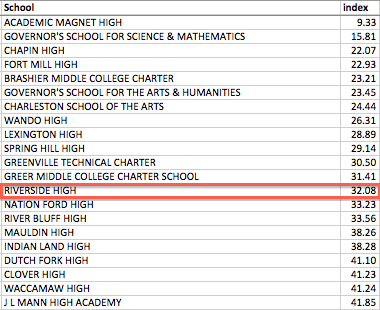
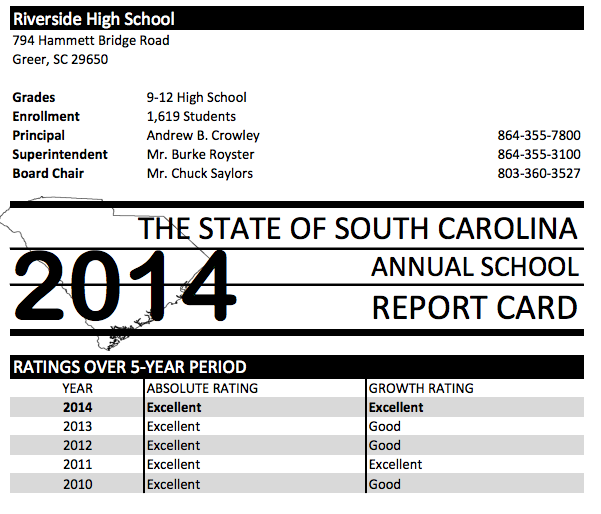
Children in this housing development will attend, eventually, Riverside High, which is ranked 13th lowest of 237 SC high schools in the 2014 Poverty Index, has Excellent/Excellent ratings on the 2014 SC report card, and tests only 51/341 students on subsidized meals and 25/341 with limited English proficiency:

Riverside HS PI 2014

Riverside HS 2014 report card 1Among four other comparable high schools in the state, they all are rated Excellent:

Riverside HS schools like ours 2014Having placed student teachers at Riverside High, and knowing faculty there, I can attest that this is a wonderful school, and students are both supported and challenged.

The real estate sign struck me especially since I had viewed two new educational documentaries: Crenshaw, a film by activist Lena Jackson on the Los Angeles school, and 180 Days: Hartsville, focusing on two schools—Thornwell School for the Arts and West Hartsville Elementary School—along the infamous I-95 Corridor of Shame in my home state of SC.

While nearly 2500 miles apart and politically/culturally worlds apart, Los Angeles and Hartsville reflect powerful narratives about the intersections of race, poverty, and education reform. As well, they offer nuance to those intersections since Creshaw High is high-poverty, majority-minority in an urban setting while Hartsville’s elementary schools are high-poverty, majority-minorty in the rural South.

Before discussing each documentary separately, let me highlight what they share as entry points into reconsidering race, poverty, and education reform:

  • Public schools both serve and reflect the communities within which they sit.
  • Race and poverty significantly impact academic achievement, and thus, when schools, teachers, and students are labeled, ranked, and judged by test scores, high-poverty and majority-minority schools are disproportionately identified as “failing.”
  • Political leadership often expresses support for education and public schools, but implements policies that appear tone deaf to the communities they represent.
  • Education reform advocates ignore the failure of popular policies.
  • Demands of effort and not embracing excuses dominate political and educational rhetoric (despite ample evidence that effort is trumped by racism/classism).
  • Parents, students, and teachers are often passionate about education, regardless of economic status or race.

Crenshaw: Disenfranchising through Take Over Strategies

Crenshaw is, as David B. Cohen explains, a “cautionary tale” about school take overs narrowly and education reform built on accountability broadly.

Jackson does a wonderful job in 20 minutes introducing viewers to the students, parents, and teachers whose lives and learning/teaching are dramatically disrupted by converting Crenshaw High into a magnet school as part of a take over plan.

This film is an excellent introduction to how so-called good intentions of political education reform is not only insufficient, but also harmful.

The take over of Crenshaw disenfranchises the students, parents, and teachers highlighted in the documentary and exposes that political leadership (school board and Superintendent John Deasy) often fails to be culturally sensitive or appropriately responsive to the needs of the people they serve.

Ultimately, as in New Orleans, Crenshaw and the take over represent a failure to identify the sources of entrenched problems, to listen to the people whose lives are being impacted by policy, and to be open to alternative views of both problems and solutions.

Crenshaw High is now and has been for decades a reflection of deep and serious social inequity fueled by racism, classism, and an unresponsive political establishment.

Changing a school’s name, firing the adults who have dedicated their lives to students, and ignoring the parents of those students—these appear to be the worst possible actions available, and regretfully, what more and more political leaders seem determined to do.

Hartsville: It’s All about the Tests (I Mean, Children)

As a life-long resident of and career-long educator in SC, I have lived and witnessed the historical and lingering racism and poverty that scar our state and our schools.

In my education foundations and educational documentary courses, I show Corridor of Shame, and we examine issues related to pockets of poverty across SC and school funding.

I also highlight how problematic Corridor is as a documentary since it depends on maudlin music and slow-motion shots of children looking forlorn. The inequity along I-95 in SC needs no emotional appeal; the conditions are inexcusable, and any reasonable person can see that.

In that context, I was nervous about 180 Days: Hartsville—although I do trust and respect co-producer Sam Chaltain and feel that the documentary does offer a much more complex portrayal of education reform, race, and poverty in SC than Corridor.

Broadly, depending on how audiences interpret the narratives of the film, 180 Days: Hartsville challenges the effectiveness of accountability-based reform that focuses on in-school policies only.

That “depending,” however, is huge.

Yes, the two schools and the central family highlighted are wonderful and accurate representations of the huge challenges of public schools in a high-poverty community.

I find the educators, parents, and students extremely compelling and genuine—a tribute to the care taken with the film.

There are also moments that need to be paused, digested carefully: the burdens of working minimum-wage jobs, the pressures of being a child living in poverty and trying to succeed in school, the passion and compassion of educators, and the determination of a parent working two jobs and raising two children alone.

Statistics flashed on the screen and audio/video snippets of political rhetoric against cuts to education funding—these also demand greater critical consideration.

But I am left deeply concerned that too many viewers will not respond as I did to the relentless influence of testing the film captures throughout—because the film is also punctuated with adults expressing a “no excuses” mentality, again with the best intentions.

These educators are supportive and positive, but those qualities cannot temper the weight of testing that has become the end-all, be-all of public schooling—especially for our high-poverty, majority-minority schools.

Viewers watch a highly dedicated principal at Thornwell School for the Arts giving pep talks to entire grade levels of students as well as students preparing to take MAP tests, computerized commercial programs that give detailed and nearly immediate feedback and claim to be strongly correlated with high-stakes state testing.

Viewers also watch as students’ names are moved on a board in front of those students so that each child is listed under her/his status according to the tests.

The money and time spent on MAP and the public labeling of students—not to mention, Where are the arts?—should prompt us all to end the madness that is high-stakes accountability. But, again, I fear many viewers found the story compelling because the educators and students were working so hard, and are characterized as being uniquely successful.

And it is at that last point we must pause.

First, schools that are outliers are not evidence of any need for policy, or for any standard by which to judge all schools. Outliers are outliers for a reason.

But, as well, consider Thornwell School for the Arts 2014 school report card:

Thornwell 2014 report card

And how does Thornwell School for the Arts look against comparable schools across SC?:

Thornwell schools like ours 2014

While the film suggests nearly “miracle” outcomes, the school, in fact, continues to struggle under the burdens of poverty and race; as the classifications above show, the school is typical of schools with similar students.

The film highlights only one of the two ways in which SC evaluates schools—the annual state report card that has been in use for most of SC’s decades of accountability and the federal accountability report (in 2014, Thornwell School for the Arts received a B/86.7 and West Hartsville Elementary, a B/81.1).

Without context, and careful analysis of what data are being portrayed along with why and how (former Superintendent Mick Zais [R] manipulated the federal accountability reports in order to criss-cross the state to “prove” poverty doesn’t matter, for example), viewers are apt to fall under the impression that schools struggling against poverty just need to demand more from educators and children.

However, for me, the key scene is when the principal at West Hartsville Elementary must confront the tremendously complex issues surrounding Rashon, ones that are often outside the ability of the school or even his mother to control.

180 Days: Hartsville is a story of place. It is, like Crenshaw, a cautionary tale, but I suspect one easily misinterpreted.

I think the intent behind this film is to offer Hartsville as a model for education reform addressing race and poverty because the efforts of the educators and students are remarkable and community business has committed to addressing the complex elements of poverty in the area and schools.

However, the film actually reveals that accountability has failed SC and the entire U.S.

How?

The relentless and dehumanizing focus on data—as if people are somehow not involved.

Ultimately what connects Crenshaw in Los Angeles to two elementary schools in SC is this mostly ignored fact: political rhetoric and tone-deaf education policy are not curative but part of the disease.

Once again, there are no miracles—but there are very real and very harmful consequences to demanding the impossible from schools, educators, parents, and children who are ultimately the victims of the racism and poverty political leaders refuse to acknowledge or erase.

For Additional Reading

What If Education Reform Got It All Wrong in the First Place?, Bill Raden

If there is a lesson in evidence-based research for California policymakers, say Orfield and Gandara, it is that there are limitations to what even the most inspired teachers alone can achieve in a society plagued with inequities.

“I studied a really rich district in Massachusetts,” Orfield noted, “and the kids from the housing projects in the city were just hugely behind when they arrived at school. The schools actually made as much progress each year as the [wealthier] kids did, but the gap never closed at all. So the schools were doing their job, but society wasn’t.”

“I always say, if money doesn’t matter, then why is it that people who have money send their kids to schools that have many, many more resources?” Gandara adds. “I think fundamentally the problem is that other developed nations have social systems that support families and children in a variety of ways: with childcare, with good health care, with recreational opportunities—with lots of things that support healthy development. We have dumped it all on the schools and said, ‘We’re really not going to provide any of these services. You deal with it, schools.’”

No Child Left Behind fails to work ‘miracles,’ spurs cheating

Conservative Talking Points Wrong for SC Education

South Carolina and Education Reform: A Reader

2014 NCUEA Fall Conference: Thirty Years of Accountability Deserves an F

Unpacking Education and Teacher Impact

Disaster Capitalism and Charter Schools: Revisiting New Orleans Post-Katrina

Endgame: Disaster Capitalism, New Orleans, and the Charter Scam

NPR Whitewashes Charter Schools and Disaster Capitalism in New Orleans

The State (Columbia, SC): Hartsville documentary reminds us of failures of SC education ‘reform’ efforts