Category Archives: education

Unpacking Education and Teacher Impact

Among media, political, and public claims driving calls for education reform, two beliefs are dominant: (i) education is the single most important lever for lifting anyone above the circumstances of her/his birth, and (ii) teacher quality is the single greatest factor in whether that educational experience accomplishes the first belief.

As I have increased my contribution to public debates about education reform, I have witnessed that media, political, and public comments are often knee-jerk and simplistic either/or responses to complex research.

For example, when I note that 40 years of research reject grade retention, responses tend to discount that research with “So you want us just to pass them on?”—suggesting that social promotion is the only alternative to grade retention (which, of course, it isn’t). Similarly, when I share that 60 years of research on corporal punishment also refute spanking—that, in fact, there is no debate on its use—responses immediately include, “So we are just supposed to let children do whatever they want?”

But I have also discovered that in my education courses, students challenge many research-based conclusions, although the students are more thoughtful—particularly when I share the evidence on the impact of education and teachers [1].

Consider the follow body of evidence below; and then, in the context of this evidence, I want to unpack what education and teacher impact actually entails.

Is teacher quality actually the single greatest factor in student achievement? Di Carlo details what research shows:

But in the big picture, roughly 60 percent of achievement outcomes is explained by student and family background characteristics (most are unobserved, but likely pertain to income/poverty). Observable and unobservable schooling factors explain roughly 20 percent, most of this (10-15 percent) being teacher effects. The rest of the variation (about 20 percent) is unexplained (error). In other words, though precise estimates vary, the preponderance of evidence shows that achievement differences between students are overwhelmingly attributable to factors outside of schools and classrooms (see Hanushek et al. 1998; Rockoff 2003; Goldhaber et al. 1999; Rowan et al. 2002; Nye et al. 2004).

Also consider Donald Hirsch’s research on the UK for the Joseph Rowntree Foundation: “Just 14 per cent of variation in individuals’ performance is accounted for by school quality [emphasis added]. Most variation is explained by other factors, underlining the need to look at the range of children’s experiences, inside and outside school, when seeking to raise achievement.”

We see here two important points: (i) out-of-school factors dwarf measurable influences of teacher quality, and (ii) teacher quality is a subset of school quality. Thus, school and teacher quality is not even close to the most important measurable factor in student achievement.

Now, what is the evidence on social mobility in the U.S., notably in terms of how educational attainment influences the relationship between social class or race and that mobility?

Social mobility appears fairly sticky in the bottom and top quintiles:
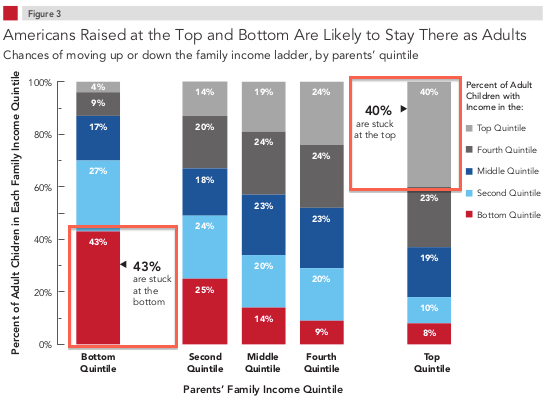
mobility
From Pew’s Economic Mobility Project data; analysis by Bruenig, 2013, June 13: “As far as income mobility goes, you are 10x more likely to wind up in the richest fifth as an adult if you were born there than if you were born in the poorest fifth.”
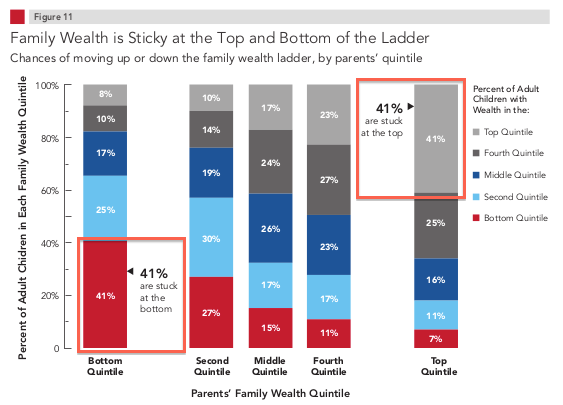
Fig 11
From Pew’s Economic Mobility Project data; analysis by Bruenig, 2013, June 13: “As far as wealth mobility goes, you are more than 5x more likely to wind up in the wealthiest fifth as an adult if you were born there than if you were born in the least wealthiest fifth.”

Next, Bruenig (2013, June 13) concludes:

One convenient way to describe what’s going on is that rich kids are more likely to get a better education, which translates into being richer and wealthier as adults. It is certainly the case that richer kids are more likely to get a college degree, and it is certainly the case that getting a college degree leaves you much better off on average than not getting one. But this does not explain the full picture of social immobility [emphasis added].

And thus, social mobility appears more strongly connected to the social class of a person’s family than to education (a function of combined school and teacher quality):

educationandmobility
From Pew’s Economic Mobility Project data; analysis by Bruenig, 2013, June 13: “[Y]ou are 2.5x more likely to be a rich adult if you were born rich and never bothered to go to college than if you were born poor and, against all odds, went to college and graduated.”
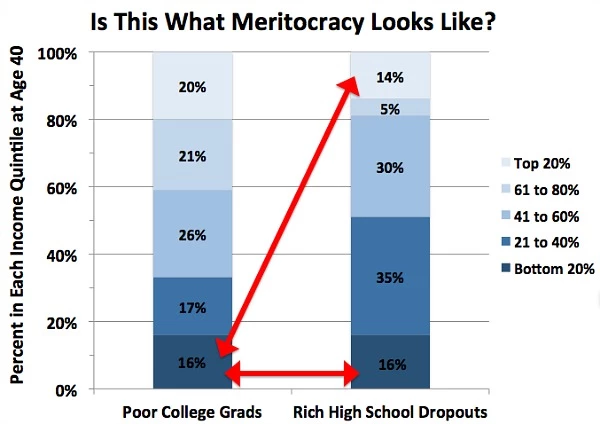
The consequences of the dynamic between social class and education are, as Matt O’Brien explains, as follows:

meritocracy
Data from Richard Reeves and Isabel Sawhill. O’Brien concludes: “Even poor kids who do everything right don’t do much better than rich kids who do everything wrong.”

Now, consider the relationship between educational attainment and race. First, in Closing the Race Gap, O’Sullivan, Mugglestone, and Allison (2014) detail that blacks with some college earn about the same as whites with no high school diploma:
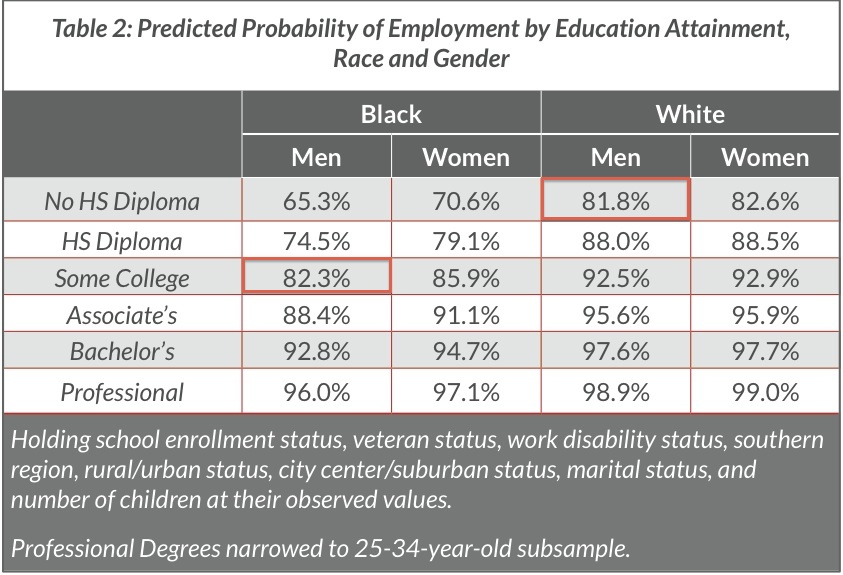
Table 2 copy
O’Sullivan, Mugglestone, and Allison (2014)

From this report as well, Susan Adams explains: “African-American college students are about as likely to get hired as whites who have dropped out of high school.”

Significant income disparities exist along racial lines despite educational attainment, as Bruenig (2014, October 24) shows:

fig_2
Bruenig (2014, October 24): “First, understand that blacks and Hispanics have lower incomes than whites up and down the educational spectrum. On average, black families at a given level of educational attainment receive incomes that are just 66% of what white families at the same level of educational attainment receive. For Hispanic families, that figure is 79%. Naturally, when education-controlled income disparities like this exist, education-controlled wealth disparities will exist.”

The impact of education (school and teacher quality), then, when placed in the context of both social class and race refutes the opening claims: (i) education is the single most important lever for lifting anyone above the circumstances of her/his birth, and (ii) teacher quality is the single greatest factor in whether that educational experience accomplishes the first belief.

When I offer these measurable facts to either the public or my students, often I hear: “So you are saying that education and teachers do not matter?”

Here is the hard part.

First, making claims that measurable education and teacher impact exists is problematic. Thus, I absolutely support that both education and teachers matter, but I also caution that this impact is not singular, direct, or easily quantified.

Part of that problem is that the impact of any person’s education or the influence of any teacher or teachers tends to occur over long periods of time, and we are hard pressed to tease out and measure specific teachers or practices since that impact is cumulative, interrelated, and multi-faceted (consider that a student can learn a valuable lesson from a flawed lesson or a weak teacher).

Our first conclusion, then, is that making claims about education being the single or sole factor in success or that the teacher is the single most important factor in achievement is misleading, overly simplistic.

But, there are fair and accurate claims we can make about the importance of education, leading to our second conclusion.

Our second conclusion is that within social class and race, educational attainment has significant influence, but that education alone appears less effective in overcoming large social inequities such as classism and racism.

From this, I think we have several important lessons:

  • Media, public, and political hyperbole about education and teacher impact does a disservice to public education, teachers, students, and the public. Overstating the impact of education and teachers assures that we will continue to fail our students and the promise of universal public education.
  • In our endless quest for education reform, we would be better served if we moved away from mostly measurable data points for making claims about and policies in education. Education is messy and complicated; quantified data are in fact simplistic and misleading.
  • Until we confront the corrosive influence of class and race in the U.S. and until we admit that education alone is not enough to overcome classism and racism, we are perpetuating social inequity.

Let’s be clear: Education and teachers matter. But, regretfully, they simply do not matter in the ways most people claim or believe, and certainly not in ways that are easy to identify.

The good news, however, is that there is much we can do to change this, if we have the resolve to confront the evidence, accept the ugly truths, and then to do something different.

See Related: If social mobility is the problem, grammar schools are not the solution, Gaby Hinsliff


[1] This post is in debt to my current, fall 2014 EDU 111 course at Furman University, a group of students fully committed to engaging with the topics, challenging claims, and seeking to understand the complexity of education. They are proof that teaching is an act of learning, if the teacher is there to listen as well as talk.


Karma, Tested by the Universe, or The Day I Did Not Kill My Dog

This past summer we had to put down both our dear chocolate lab Hershey and one month later our black lab Scout (named by her breeder after the To Kill A Mockingbird character).

I wanted a new lab immediately after Hershey, but my wife did not, unable to rise out of the pain from that loss (in most ways, they were very much her dogs). After the loss of Scout, however, we did buy a new pup, dear Zoe, a yellow lab.

Zoe 2
Sweet Zoe, with her wonderful green eyes, groggy in my floorboard after her adventure in spaying. (Note: Zoe is very smart, but, no, she isn’t reading Margaret Atwood’s new collection of stories.)

Yesterday as I was working on a blog post, I glanced outside to see Zoe chewing on the broom. A classic lab, Zoe chews everything; in fact, I believe she is Olympic or Guinness Book level in her chewing, and destruction.

So I went out, retrieved the broom, and then as I walked through the garage, I considered the possibility that my special edition Ridley Excalibur Flandrien bicycle was a target for Zoe. And much to my dismay, that feeling was confirmed:

Zoe 1
SRAM Force 22 carbon fiber cranks, bottle cages, and rear derailleur cable housing (not pictured) destroyed by dear Zoe. (Hint: Very expensive cycling parts.)

Let me pause here and back up.

This was Tuesday, and on Monday, I had participated in an online debate about corporal punishment for The Stream. That invitation was the result of recent pieces of mine arguing against corporal punishment, ironically for the show, stating that there is no debate about spanking.

During the discussion, I did not have the chance, but at one point, I wanted to say that I now own a new lab pup, and I wouldn’t dare hit a puppy—I certainly wouldn’t hit a child.

I have never been one for spirituality, or mysticism. But someone very dear to me, after years of my resistance, did bring me around to accepting karma, or at least that some universal consciousness exists—one seeking balance and possibly justice.

And thus, I stood in the garage with Zoe leaping against my leg; she is deep into the jumping and snipping phase, ruining our clothes, leaving bloody nicks on our hands and arms. I stood there looking at my precious bicycle, and I didn’t yell at, hit, or kill Zoe.

The damage done to the bicycle, of course, was my fault.

With my chest heavy, I took the bicycle inside—a bit angry I would have to spend the morning touching up the crank, replacing the cages and the cable housing, and thus eating into writing time—and then I took apart Zoe’s cage we had used when she was smaller but left in the garage because she was attached to the confines even though we now leave its gate open.

With some zip ties, I carefully created a barrier between Zoe and the side of the garage where my bicycle racks are.

Zoe is a beautiful and loving creature, but she is a dog. I am the human in this relationship.

In the same way, children are children, and any time a child is put in our care, we must observe the very real fact that we are the adults in those relationships.

As I carefully applied black and clear touch-up paint to the crank of my bicycle, I hoped I had been convinced correctly. I hoped for karma, for a universe seeking balance. But I also knew one thing for sure, a lesson from the universe: You better be ready to put up or you better shut up.

At least that appeared to be just behind Zoe’s amazing green eyes as she wanted nothing more than my attention while I wrestled against my anger spurred by her teeth marks etched in carbon.

Media Fail, 10,000 hours, and Grit: The Great Media-Disciplines Divide, pt. 2

In his The Danger of Delegating Education to Journalists: Why the APS Observer Needs Peer Review When Summarizing New Scientific Developments [1], K. Anders Ericsson makes several key points about how the mainstream media present disciplinary knowledge to the public, focusing on Malcolm Gladwell’s misleading but popular 10,000 hour rule.

Ericsson’s key point includes:

Although I accept that the process of writing an engaging popular article requires considerable simplification, I think it is essential that the article does not contain incorrect statements and misinformation. My primary goal with this review is to describe several claims in Jaffe’s article that were simply false or clearly misleading and then discuss how APS might successfully develop successful methods for providing research summaries for non-specialists that are informative and accurately presents the major views of APS members and Fellows. At the very least they should not contain factually incorrect statements and avoid reinforcing existing misconceptions in the popular media.

Through the Gladwell/10,000 hour rule example, Ericsson provides an important argument relevant to the current (and historical) public debate about school quality, teaching and learning, and education reform.

Much in the same way Gladwell has misrepresented research (which is typical within the media), and how that has been uncritically embraced by the media and public (as well as many if not most practitioners), a wide array of issues have received the same fate: learning styles, “grit,” collaborative learning, progressive education, charter schools, school choice, language gap, and so on.

Even when a claim or practice has a kernel of research at its source, popular oversimplification (often by journalists, but practitioners as well) and then commercialization/politicizing (creating programs and policies through publishers, “star” advocates, and legislation) significantly distort that research.

Education Has Failed Research, Historically

John Dewey represents an odd paradox in that he is possibly the most mentioned educator in the U.S. (either as the source of all that is wrong in education or idealistically cited as all that is right about how school could be), despite the reality that Dewey is mostly misunderstood and misrepresented; and thus his philosophy, progressivism, remains mostly absent in U.S. public schools.

Dewey can be blamed, in part, for this reality because he refused on principle to allow his experiments in education to be carefully catalogued because he believed no educational practice should be come a template for others.

Throughout much of the twentieth century, Lou LaBrant, a vigilant progressive educator, spent much of her career practicing and advocating for progressive literacy instruction, but LaBrant also confronted the many instances of how progressivism was misrepresented.

Broadly, and early, LaBrant recognized the public confusion about progressivism:

Two adults speak of “progressive education.” One means a school where responsibility, critical thinking, and honest expression are emphasized; the other thinks of license, lack of plans, irresponsibility. They argue fruitlessly about being “for” or “against” progressive education. (LaBrant, 1944, pp. 477-478)

But she also confronted how progressivism was mostly distorted in its application. LaBrant’s criticisms still reflect why education has failed research, and why research has not failed education.

Credible educational research-based philosophy, theory, and pedagogy are often corrupted by oversimplification.

In 1931, LaBrant published a scathing criticism of the popularity of the project method, an oversimplification of Dewey that resulted in students doing crafts in English class instead of reading or writing:

The cause for my wrath is not new or single. It is of slow growth and has many characteristics. It is known to many as a variation of the project method; to me, as the soap performance. With the project, neatly defined by theorizing educators as “a purposeful activity carried to a successful conclusion,” I know better than to be at war. With what passes for purposeful activity and is unfortunately carried to a conclusion because it will kill time, I have much to complain. To be, for a moment, coherent: I am disturbed by the practice, much more common than our publications would indicate, of using the carving of little toy boats and castles, the dressing of quaint dolls, the pasting of advertising pictures, and the manipulation of clay and soap as the teaching of English literature. (p. 245)

Credible educational research is often corrupted by commercialization/politicizing, reducing that research to misguided programs/legislation.

“[L]anguage behavior can not be reduced to formula,” LaBrant (1947) argued (p. 20)—emphasizing that literacy growth was complicated but flourished when it was child-centered and practical (for example, in the ways many privileged children experience in their homes because one or more of the parents are afforded the conditions within which to foster their children’s literacy).

By mid-twentieth century, LaBrant (1949) had identified the central failure of teaching reading: “Our language programs have been set up as costume parties and not anything more basic than that” (p. 16).

For at least 80-plus years since LaBrant fought this fight, the same patterns of media, political, public, and practitioners failing educational research have continued

Oversimplification, Commercialization/Politicizing: Recovering the Evidence

The list is incredibly long, too long to be exhaustive here, but consider the following: sloganism (“Work hard. Be nice.”), silver-bullet ideologies (“grit,” 10,000-hour rule), miracle schools (KIPP), evidence-based programs (Dibbles, 4-block, 6-traits), common sense claims and policy absent evidence (Common Core), and trendy legislation (3rd-grade retention policies as reading policy, merit pay) as well as politicized government reports (National Reading Panel).

Each of these can be traced to some kernel of research (sometimes robust bodies of research, and sometimes cherry-picked research), but all of these represent a current and historical fact: Education has failed research, but research has not failed education.

When educational research is reduced to scripts or programs/legislation, that knowledge base is invariably distorted, corrupted—as Ericsson details well above.

Journalists, politicians, and commercial education entities have all played a fundamental and crippling role in this reality; thus, as Ericsson argues, educators, scholars and researchers must not allow the fate of educational research to remain primarily in the wrong hands.

We have a public and professional obligation to confront these oversimplifications as well as the commercialization/politicizing of educational research. And we must do this through our public work that speaks to those failures and the public simultaneously.

As LaBrant and Ericsson reveal, unless we take that call seriously, we too are part of the reason education continues to fail research.

References

LaBrant, L. (1949). A genetic approach to language. Unpublished manuscript, Institute of General Semantics, Lakeville, CT.

LaBrant, L. (1947). Um-brel-la has syllables three. The Packet, 2(1), 20-25.

LaBrant, L. (1944, November). The words they know. The English Journal, 33(9), 475-480.

LaBrant, L. (1931, March). MasqueradingThe English Journal, 20(3), pp. 244-246.

For Further Reading

U.S. and Education Reform Need a Critical Free Press

My Open Letter to Journalists: A Critical Free Press, pt. 2

NPR Whitewashes “Grit” Narrative

Shiny Happy People: NPR, “Grit,” and “Myths that Deform” pt. 2

How I Learned to Distrust the Media (about Education)

My (Often Painful) Online Education

[1] See original and downloadable link to the paper here.

GUEST POST: The Danger of Delegating Education to Journalists, K. Anders Ericsson

The Danger of Delegating Education to Journalists: Why the APS Observer Needs Peer Review When Summarizing New Scientific Developments

K. Anders Ericsson, Department of Psychology, Florida State University

Tallahassee, Florida, October 28th, 2012

I have always viewed the APS Observer as a source for up-to-date summaries of advances in the wide research domains of the Association for Psychological Science (APS). Receiving summarized information about research outside my domain of expertise is only helpful if it accurately represents the consensus views of the active APS members and Fellows. The cover article by Eric Jaffe on “Piecing together performance” in the September 2012 issue of the APS Observer focused on my own area of expertise, namely expert performance and deliberate practice, so I feel that I am able to assess the accuracy of its presentation [1].

Although I accept that the process of writing an engaging popular article requires considerable simplification, I think it is essential that the article does not contain incorrect statements and misinformation. My primary goal with this review is to describe several claims in Jaffe’s article that were simply false or clearly misleading and then discuss how APS might successfully develop successful methods for providing research summaries for non-specialists that are informative and accurately presents the major views of APS members and Fellows.  At the very least they should not contain factually incorrect statements and avoid reinforcing existing misconceptions in the popular media.

Jaffe’s  (2012, p. 13) article discusses recent research on one of the longstanding issues in Psychology, namely  “the roles of natural endowment and hard work in human performance”(Jaffe, 2012, p. 13). It goes on to state that “Ericsson and his colleagues found in a 1993 study that professional musicians had accumulated about 10,000 hours of deliberate practice over the course of a decade. The results became the basis of Ericsson’s deliberate practice theory of elite performance, also called the 10,000 hour rule” (Jaffe, 2012, p. 13). With these two sentences Jaffe reinforces misconceptions in some popularized books and internet blogs that incorrectly infer a close connection between deliberate practice and the “10,000 hour rule”.  In fact, the 10,000 hour rule was invented by Malcolm Gladwell (2008, p. 40) who stated that “researchers have settled on what they believe is the magic number for true expertise: ten thousand hours.” Gladwell cited our research on expert musicians as a stimulus for his provocative generalization to a magical number. Our research found that the best violinists reported having spent a remarkably large number of hours engaged in solitary practice when, in fact, 10,000 hours was the average of the best group; indeed most of the best musicians had accumulated substantially fewer  hours of practice at age 20. Our paper found that the attained level of expert music performance of students at an international level music academy showed a positive correlation with the number of solitary practice hours accumulated in their careers and the gradual improvement due to goal-directed deliberate practice. In contrast, Gladwell (2008) does not even mention the concept of deliberate practice.

The focus of Jaffe’s (2012) paper is to report on empirical evidence to reject a straw man primarily advocated by bloggers on the internet. The Jaffe strawman argues that individuals would only display clearly superior performance after 10,000 hours or ten years of practice. This strawman is even rejected by our research on deliberate practice in music and other domains. The music performance of our violinists developed gradually by engaging in solitary practice under the guidance of teachers and coaches. In our study, the best violinists had practiced significantly more than the two less skilled groups of violinists (Ericsson, Krampe, & Tesch-Römer, 1993). After only a few thousands of hours of solitary practice, the music performance of our musicians was clearly superior to other groups of amateur musicians at the time they were accepted to the music academy.

Jaffe’s most surprising and potentially most damaging criticism of deliberate practice was made in the section with the interview with Joanne Ruthsatz, where she is described as having “reanalyzed Ericsson’s data from the 1993 study and found that the top violinists had begun to distance themselves well before they’d put in 10,000 hours“ (Jaffe, 2012, p. 13) [2]. Most remarkably, Jaffe’s APS article goes on to quote Ruthsatz as saying that, “when they [the top violinists] were eight years old, for instance, they won two-thirds of their competitions. Compare that to the “good” students, who only won about half at that age, and the lowest group, who won about a fifth of the time.” (p. 13). This statement is puzzling in light of our 1993 paper, which says that “The biographic histories of the four groups of subjects with respect to violin playing are remarkably similar and show no systematic differences between groups. The age when they began practice was 7.9 years old and essentially coincided with the age of starting systematic lessons, which was 8.0-years-old” (Ericsson et al., 1993, p. 374). Taken together, these two statements would imply thatthe violinists in all groups won competitions even before they started playing the violin or took systematic lessons—if confirmed, it would be the most compelling evidence for innate talent reported to date in a journal of scientific organization! However, it should be noted that in their only peer-reviewed published report Ruthsatz, Detterman,  Griscom, and Cirullo (2008) make a different claim than that reported by Jaffe (2012).  Namely, that “the group of elite violinists won more open competitions from the time they were 8 years” (p. 331). In contrast, this published claim is consistent with our 1993 paper, which reported that the top violinists had won significantly more open competitions (competitions without any age constraints) by the time that the top violinists were 23 years old on the average (their age at the time of our study). In our original 1993 paper we interpreted this finding as confirmation that the top violinists were exhibiting a higher level of performance at the time of the study as a result of their gradually gained improvements from more extensive training (e.g., a larger number of hours of solitary practice).

Jaffe (2012, p. 13) focuses his article around a statement made by APS Fellow Hambrick, who is reported to say that “it seems clear to me that there’s something else [than deliberate practice]”, as if these other factors were not already considered in the 1993 Psychological Review paper. The 1993 paper reviewed evidence for a wide range of immutable genetic factors, such as height and body size, and heritable individual differences in motivation: “We believe that a more careful analysis of the lives of future elite performers will tell us how motivation is promoted and sustained. It is also entirely plausible that such a detailed analysis will reveal environmental conditions as well as heritable individual differences that predispose individuals to engage in deliberate practice during extended periods and facilitate motivating them.” (Ericsson et al., 1993, p. 400).  More generally, our 1993 paper offered accounts of cognitive abilities, innate abilities, and personality differences in terms of their development from sustained practice activities. Ericsson, Roring, Nandagopal (2007a, 2007b) has a more comprehensive proposal for the account of giftedness. For example, mathematically gifted students would have had years of activities related to mathematics even before they attained a high score on the mathematical part of the SAT test at age 13; scientists would have decades of focused scientific study before they produced Nobel-prize winning research, and so on. Only future research will uncover the role of deliberate practice activities and associated motivational factors in accounting for their reproducibly superior achievement.

The most objectionable omission of a deliberate practice account in the evidence reviewed by Jaffe (2012) is presented under the heading “personality influences performance.” In this section, Jaffe (2012) describes the work of Angela Duckworth on grit and how “elite performers also tend to have a lot of endurance when it comes to achieving their goals” (p. 15). To argue that deliberate practice needs to be augmented, he explicitly cites an article, which includes deliberate practice in its title, “Deliberate practice spells success.” In that study we (as I was also one of the co-authors) collected data on “deliberate practice.” We found that “Grittier spellers engaged in deliberate practice more so than their less gritty counterparts, and hours of deliberate practice fully mediated the prospective association between grit and spelling performance”, (Duckworth,  Kirby, Tsukayama, Berstein, & Ericsson, 2011, p. 178).  In direct contrast to Jaffe’s (2012) suggestion that personality characteristics (grit) have a relation to performance completely independent of deliberate practice, the cited article shows that this relation is fully explained by the differential engagement in deliberate practice.

The more generalizable issues concern  how factually incorrect statements and misrepresentations were not captured prior to publication of this article in the APS Observer. Unlike regular newspapers, such as the New York Times, Jaffe could not have engaged in fact checking or even interviewed researchers with different theoretical orientations. From contacts with a number of researchers active in the study of expert performance Jaffe (2012) did not interview them—including researchers explicitly named in the article, such as Angela Duckworth and myself . Even Dean Simonton, who was interviewed felt that his arguments were not accurately described.

In response to the problems with Jaffe’s (2012) article, I hope that the APS Observer will not continue to hire professional writers to publish articles independently. I think that the APS Observer should have procedures to ensure that its articles are examples of engaging, yet accurate, summaries of research development.  If the professional writers are invited in the future to write on controversial topics, I recommend that the APS Observer rely on an APS member as an invited action editor that evaluates accuracy of the article by sending it out for peer review. It should be possible to develop procedures and standards for popularized articles that incorporate the checks and balances of the traditional journal procedure. In an interview the popular author MalcolmGladwell said the following: “There is an important distinction to be made between popular works and academic works. My book is intended to be a popular work based on academic research, but it is not the same as an academic work. It is a different kind of literary enterprise. And it has to be judged by different criteria.” (Gladwell cited in Gruber, 2006, p. 398). The procedures for assuring that popularized articles meet reasonable standards of scientific rigor will be different from the ones from those used with scientific journal articles, and should focus on avoiding factual mistakes and biased simplified accounts that misinform its readers. Hopefully the problems with the Jaffe (2012) article might lead to a discussion about how summary articles on research developments pertaining to controversial topics can be produced so that they exemplify how popularized articles on psychological topics can be made appropriate for the APS Observer, one of the flagship journals representing the Association for Psychological Science.

References

Duckworth, A. L., Kirby, T., Tsukayama, E., Berstein, K., & Ericsson, K. A. (2011). Deliberate practice spells success: Why grittier competitors triumph at the National Spelling Bee. Social Psychological and Personality Science, 2, 174-181.

Ericsson, K. A. (in press). Training history, deliberate practice and elite sports performance: An analysis in response to Tucker and Collins Review – What makes champions? British Journal of Sport Medicine.

Ericsson, K. A., Krampe, R. T., & Tesch-Römer, C. (1993).  The role of deliberate practice in the acquisition of expert performance.  Psychological Review, 100(3), 363-406.

Ericsson, K. A. Roring, R. W., & Nandagopal, K. (2007a). Giftedness and evidence for reproducibly superior performance: An account based on the expert-performance framework. High Ability Studies, 18, 3-56.

Ericsson, K. A. Roring, R. W., & Nandagopal, K. (2007b). Misunderstandings, agreements, and disagreements: Toward a cumulative science of reproducibly superior aspects of giftedness. High Ability Studies, 18, 97-115.

Gladwell, M. (2008). Outliers: The story of success. New York: Little, Brown and Company.

Gruber, D. A. (2006). The craft of translation: An interview with Malcolm Gladwell. Journal  of Management Inquiry, 15, 397-403

Jaffe, E. (2012). Piecing together performance. APS Observer, 25(7), 13-16.

Ruthsatz, J., Detterman, D., Griscom, W.S., & Cirullo, B.A. (2008). Becoming an expert in the musical domain: It takes more than just practice. Intelligence, 36, 330–338.

Footnote

  1. In the last month I (Ericsson, in press) responded to a similar misrepresentation of my collaborators’ and my work in British Journal of Sports Medicine.
  2. I have never given Dr. Ruthsatz access to our original data.

The Delusion of Choice

“What you need is a gramme of soma.”

“All of the benefits of Christianity and alcohol without their defects.”

Brave New World, Aldous Huxley

Narcotics cannot still the Tooth
That nibbles at the soul—

[This World is not Conclusion], Emily Dickinson

“‘When Bokonon and McCabe took over this miserable country years ago,’ said Julian Castle, ‘they threw out the priests. And then Bokonon, cynically and playfully, invented a new religion'” (p.172)—opens Chapter 78 of Kurt Vonnegut’s Cat’s Cradle.

Readers soon learn that Bokonon creates a religion “‘to provide the people with better and better lies'” (p. 172), foma, and a central aspect of that strategy involves the fabricated war between the government of San Lorenzo and the religion, Bokononism. Readers discover that this plan fails:

“But people didn’t have to pay as much attention to the awful truth. As the living legend of the cruel tyrant in the city and the gentle holy man in the jungle grew, so, too, did the happiness of the people grow. They were all employed full time as actors in a play they understood, that any human being anywhere could understand and applaud.” (pp. 174-175)

The false choice between McCabe and Bokonon in the other world created by Vonnegut happens to represent well the delusion of choice that exists in the U.S. (not to be examined here, but McCabe/Bokonon reflect the false choice currently in the U.S. between Republican/Democrat; it’s a fake fight, and a false choice).

This delusion, in fact, doesn’t even require the existence of choice—the word itself is nearly magical. But the choice that is the soma of American Myth tends to be binary and constrained, actually no real choice at all.

Should I buy an Accord or a Camry (no real difference, by the way)? But never, Should I even own a car?

And that constraint tends to lie within making sure Americans have no choice other than to work, work, work and thus participate fully in the great Free Market. This choice isn’t really about choice, but about keeping everyone busy and focused on choosing so that no one will consider the alternatives.

This dynamic plays out in the education reform debate through the emphasis on parental choice: that parents must have choice and that parents must know how to choose what education is best for their child.

Just as choosing between car models fails the larger freedom to choose, the school choice truism fails to acknowledge the possibilities of creating conditions that are beyond choice—conditions that make parents choosing what school is best unnecessary.

Many people living in poverty in the U.S. must choose between eating low-quality but cheap food or spending limited funds on more expensive but healthy food (and thus sacrificing other expenses). When do we ever discuss creating a world in which that choice isn’t needed, a world in which only healthy food is available and all food is affordable regardless of social class?

Is that really beyond the scope of a free people and the richest country in the history of humanity?

Probably not.

A a simple example, the South (mostly) has chosen not to play the toll road game, one in which people must choose between spending more money or more time. Many areas of the South have a large number of publicly funded roads (as a cyclist I ride for miles and never see a car, never see a house, but there is a road, usually well maintained).

That attitude toward roads rises above choice; open and available roads render choices between spending time or money irrelevant. But also, that was a choice, a culturally and regionally bound choice.

Idealizing choice and failing to unmask false choice are, ironically, failures of choice, the myopia created by the belief that choice is sacred, that choice is the only key to human freedom.

Although focusing on the UK, a recent study reveals a disturbing conclusion:

But in our new research we found that three and a half years after finishing university, graduates who attended private schools earn an average of 7% more per year than graduates who went to state school.

This could easily be interpreted as the need for choice so the superior private option could motivate the inferior public model to do better—if the consumers choose and create such pressure.

But, as the researchers explain about the complexities of these findings, we often fail to acknowledge that education (including how much achieved and what type of school attended) is often a marker for privilege, and that privilege or race is a stronger predictor of success (such as income) than any equal achievement (such as graduating college); see for example (from HERE, Fig. 1, and HERE, Fig. 2), the influence of class and race against educational attainment:

Figure 1. “Even poor kids who do everything right don’t do much better than rich kids who do everything wrong. Advantages and disadvantages, in other words, tend to perpetuate themselves. You can see that in the above chart, based on a new paper from Richard Reeves and Isabel Sawhill, presented at the Federal Reserve Bank of Boston’s annual conference, which is underway.” Matt O’Brien

Figure 2. “On average, black families at a given level of educational attainment receive incomes that are just 66% of what white families at the same level of educational attainment receive. For Hispanic families, that figure is 79%. Naturally, when education-controlled income disparities like this exist, education-controlled wealth disparities will exist.” Matt Bruenig

Thus, if we remain committed to choice—that parents and students must have choice in order to spur higher quality education, that in turn will overcome social inequity (classism, racism)—we are not directly addressing class and race inequities, and thus allowing them to continue: Within class and race, education makes a difference, but education does not erase class and race inequities.

Again, we are committed to a false and misleading choice, and not creating a world where that choice isn’t needed once we have eradicated (mostly) classism and racism.

The soma of choice in the U.S. keeps us addicted to competing so that some may win—while excluding the possibility of collaborating so that all may thrive.

As we seek ways to create better education, we should stop demanding that parents and students have choice, and start demanding that no parents or children should have to choose. This is the sort of real choice a free people can and should make.

NOTE: See report by Richard Reeves and Isabel Sawhill identified in Figure 1.

See Also From Bruenig 2013:

educationandmobility
Fig. 18. Bruenig: “Look at the red bar furthest to the right. That is the bar describing where kids born into the richest fifth who do not get a college degree wind up. Notice that 25% of those kids still wind up in the richest fifth. Now look at the blue bar furthest to the left. That is the bar describing where kids born into the poorest fifth who do get a college degree wind up. Notice that only 10% of those kids wind up in the richest fifth.”

mobility
Fig 3. Matt Bruenig concludes, based on data from the Pew’s Economic Mobility Project: “So, you are 2.5x more likely to be a rich adult if you were born rich and never bothered to go to college than if you were born poor and, against all odds, went to college and graduated….Therefore, the answer to the question in the title is that you are better off being born rich regardless of whether you go to college than being born poor and getting a college degree.”

My (Often Painful) Online Education

No, I have not been taking part in a MOOC or signed up for an online degree because an NFL player has been hired to promote it.

I am here to discuss my online education over the past couple years since I have committed fully to Twitter and now maintain my own blog, both of which have over 3000 followers each (thank you, thank you, thank you, kind followers). That modest presence I have built in the New Media has taught me some valuable and often painful lessons I believe deserve some consideration as I approach the end of two years blogging original pieces at this site.

Let me offer first that I entered education over 30 years ago to change the way children are taught. In that context, one of the most painful lessons I have learned is that the educational reformers with power have cavalierly discounted me as “anti-reform.” Both factually untrue and, yes, painful.

Also, I have titled my blog “the becoming radical” because I spend a great deal of time and energy blogging and creating public work (instead of traditional scholarly work, which I still do) as both my activism and part of that becoming toward radicalism that speaks against what I view as the utter failure of traditional/conservative and progressive ideologies [1].

So, what have I learned?

Tone shouldn’t matter, but tone matters—at least tone matters when those in power want it to. Calling someone out for tone is both a common ploy by those without credibility, and an effective one. The cousin of this lesson is that a handy and often misused tactic is to cry ad hominem even when the person isn’t being attacked. That too is effective. Trying to steer any public discussion to how credible are the claims and how credible is the person making the claims is nearly impossible because in the education reform debate, power and influence trump all types of credibility.

Political leaders, the media, and the public have little regard for evidence. This is likely the most painful lesson of all. Many scholars work within the range of evidence-based claims, and as such, the public reaction to evidence is incredibly frustrating because a typical response is like this one: “I myself have little respect for the ‘studies’ that might be quoted by the self-appointed ‘authorities’ in these matters.” Let me, then, dwell on this lesson a moment.

The great obstacle to evidence-based public discussions is the media. Journalists and a wide range of media forms exist within an environment that requires the appearance of balance, almost always a for-and-against simplicity that both distorts complex issues and misrepresents the weight of evidence. Members of the media are also trapped within a culture of reporting that suggests journalists do not need any sort of discipline-specific expertise to examine a topic; and thus, I am constantly amazed that when I interact with journalists, they find positions relatively typical in a field to be incredible—things they have never heard and thus claims they find hard to believe.

They say things like “Your opinion is really unusual” or “I’ve never heard that before”—even and especially when I am not expressing my opinion, but simply relaying the current research conclusions on the issue (see this and this, for example). This problem with the media and the public has been most distinct over the past few months while I have addressed grade retention and corporal punishment—two heavily researched areas (40 years of research on retention and 60 years of research on corporal punishment) that have very clear positions (both on balance are harmful to children and should be avoided) among the leading professionals in disciplines spanning medical doctors, psychologists, sociologists, and educators. [Read the comments on the corporal punishment piece, for example.]

Those in power win, no matter what. Power associated with status, wealth, or celebrity brings both volume and frequency to anyone’s voice, regardless (see above) of credibility. And thus, in public discussions of education and education reform, power goes first, the powerless respond, and then power always wins. Two very ugly examples of this have occurred recently, in fact.

A mainstream publication and a national alternative teacher (actually, leadership) organization have both demonstrated how their toxic and misleading claims and agendas speak to and perpetuate their power even and especially when they are publicly refuted. Every time credible points are raised against the publication or the organization, both gain even more public exposure—thus, winning.

People rarely listen, and almost never change their minds. Make a public claim, and many who refute you will demonstrate that they haven’t actually understood or considered your point (state that grade retention hurts children, and have people rant about social promotion). Make a public claim against what people believe, and expect everything from the nasty to the condescending.

And with this—since I see my public work as an extension of my work as a teacher—I am deeply discouraged. It is a bitter lesson, but my recent life in the virtual world and in public discourse has revealed that commentary attracts those who already agree with you and simply inflames those who do not.

*sigh*

And finally, silence by those with whom you believed yourself to be in solidarity is worse than all the hateful responses combined. This is the hardest lesson, but the fate of all writers, who above all else seek an audience. Those days when one feels as if she/he has been shouting down an empty well …

So what now?—you may be asking, especially since the lessons above are quite negative, and my refrain has been “discouragement.”

Discouragement does not equal defeated, I must state here quite clearly: discouragement does not equal defeated.

Because the greatest lesson of all has been that my online education has confirmed my initial urge toward radicalism: We must have radical change of the larger social structures in order to achieve the individual opportunities toward equity, I believe, many of us are seeking.

I remain committed to my support for universal public education and a critical free press.

Currently, neither is being achieved by the existing versions of both, regretfully—a reality that builds a monumental wall against our efforts to achieve either.

And thus, even when discouraged, we must continue to tear down that wall in order to build anew. And words that lead to action can be powerful sledgehammers if we are patient and true.

[1] Howard Zinn (1994), You Can’t Be Neutral on a Moving Train: “From that moment on, I was no longer a liberal, a believer in the self-correcting character of American democracy. I was a radical….The situation required not just a new president or new laws, but an uprooting of the old order, the introduction of a new kind of society—cooperative, peaceful, egalitarian.”

How I Learned to Distrust the Media (about Education)

“It’s easier to fool people than to convince them they have been fooled”—this quotable is now common on memes across the Internet, always attributed to Mark Twain:

Why we cannot trust meme-truth.

The problem, however, is no one can find any evidence Twain ever uttered or wrote these words.

But the premise of the saying against the momentum of online of misattribution [1] prompts me to offer a line from Airplane II: The Sequel, by Buck Murdock (William Shatner): “Irony can be pretty ironic sometimes.”

That Twain didn’t write that doesn’t discount the credibility of the claim, and thus, that leads to my never-ending (it seems) disappointment about how the mainstream media addresses education.

Part of the problem is that journalists and others in the media are simply uninformed about disciplinary fields, such as education, that have rich research bases and histories. Another large component of the problem is that journalists and the media have little to check them since the public often shares the same misconceptions journalists and the media promote and work within.

David Dunning highlights that many people are “confident idiots”:

In 1999, in the Journal of Personality and Social Psychology, my then graduate student Justin Kruger and I published a paper that documented how, in many areas of life, incompetent people do not recognize—scratch that, cannot recognize—just how incompetent they are, a phenomenon that has come to be known as the Dunning-Kruger effect. Logic itself almost demands this lack of self-insight: For poor performers to recognize their ineptitude would require them to possess the very expertise they lack. To know how skilled or unskilled you are at using the rules of grammar, for instance, you must have a good working knowledge of those rules, an impossibility among the incompetent. Poor performers—and we are all poor performers at some things—fail to see the flaws in their thinking or the answers they lack.

Dunning adds that being uninformed has an odd effect, one confirmed by research:

What’s curious is that, in many cases, incompetence does not leave people disoriented, perplexed, or cautious. Instead, the incompetent are often blessed with an inappropriate confidence, buoyed by something that feels to them like knowledge.

And thus, as Alamy Alberto Nardelli and George Arnett report: Today’s key fact: you are probably wrong about almost everything:

People from the UK also think immigrants make up twice the proportion of the population as is really the case – and that many more people are unemployed than actually are.

Such misconceptions are typical around the world, but they can have a significant impact as politicians aim to focus on voter perceptions, not on the actual data….

It is one thing for public opinion to be shaped by the perception of issues and another when politicians choose to make promises and write policies to feed and satisfy misconceptions.

While not unique to media coverage of education, we must face that both the media and the general public feed a tremendous amount of misinformation about education policy and research, school effectiveness, student achievement, and teacher quality.

How I Learned to Distrust the Media (about Education)

Public education has been battered for over 150 years in the U.S., but the most recent thirty years of accountability based on standards and high-stakes testing have increased that negative scrutiny; as well, the media now uses its flawed formula of showing both sides to give a fair-and-balanced view of how education is failing (no space for any other view than failure, by the way).

But just as the objective pose of journalism fails how education is covered in the mainstream press, a wide variety of equally misinformed assumptions about teaching, learning, and schooling tend to tarnish nearly all coverage of education.

I want here to examine an Op-Ed in the Wall Street Journal to highlight that pattern and examine how to anticipate and navigate those patterns: How I Learned Not to Hate School: Florida’s tax-credit scholarship program saved me. So why are teachers trying to kill it?

First, common in media coverage of education is an assumptive negative claim; in this title and subtitle we see “hate school” and “kill,” associated with public school and teachers. The positives are by implication and then directly related to market forces; being able to choose another school and the tax-credit scholarship “save” the writer.

Immediately, the piece embraces and speaks to a cultural distrust of government (publicly funded) and faith in the market throughout the U.S.—all of which is sparked in Denisha Merriweather’s opening paragraph:

By the time I was in the fourth grade, I had been held back twice, disliked school, and honestly believed I’d end up a high-school dropout. Instead, three months ago, I earned a bachelor’s degree from the University of West Florida in interdisciplinary social science with a minor in juvenile justice. I am the first member of my family to go to college, let alone graduate. But this didn’t happen by chance, or by hard work alone. It happened because I was given an opportunity.

Merriweather’s story proves to be compelling, and I believe anyone would support that her single experience is something to support. But that this is a personal story raises several issues.

First, an anecdote, one that may well be an outlier example, cannot prove or disprove a generalization; thus, if the generalization is that Florida’s tax-credit scholarship is flawed education policy, Merriweather’s story simply offers no evidence to reject that premise—one that may well be based on research of the entire program against the good of all people in Florida and the health of the education system in the state.

The only power that Merriweather’s anecdote has is that prompts an emotional response and triggers assumptions that may (or may not) be grounded in credible claims.

Next, Merriweather immediately identifies the tax-credit as the “difference maker” in her turn-around, implying that the scholarship and subsequent choice caused her transformation.

This claim is deeply flawed since causation is an incredibly hard thing to prove in formal research, much less in an individual’s anecdote. This leads us to two key points about the foundational claim by Merriweather that access to school choice caused her changed path in life.

As she details, her failed experiences in public schools were marked by a transient life, and then her success in private school was marked by stability. One possibility is that her transformation was linked to the shift from transience to stability—not a function of choice, and not a function of school type. In other words, if her life had stabilized in her years of public schools, she may have succeeded just as she did in a private school.

The implication by Merriweather includes both that choice was key in her success and that private schools trump public. This last point perfectly reflects the opening framing that market/private is inherently superior to government/public—concepts embraced by most people in the U.S. but strongly refuted by evidence.

In fact, among public, private, and charter schools [2], the type of schooling has little or no impact on the outcomes; all three types have the same range of outcomes, when student characteristics are controlled.

Another series of assumptions involve claims about effort and expectations, as Merriweather explains:

At Esprit de Corps, making honor roll is expected and academic success is celebrated. This environment was very different for me. But something clicked. My grades and self-confidence rose. I believed I could succeed and people there believed the same. Learning was no longer a nightmare, but a gift I greatly appreciated. I worked hard. In the end, I graduated with honors.

Private schools are better than public schools, in part because private schools expect more—that is the message. As I have noted above, private schools are not superior because they are private (most raw claims they are superior are based on more affluent student populations when compared to public), but we must also admit that expectations and effort are not the keys our cultural myths suggest. Despite our belief in demanding more and working hard, effort is often trumped by privilege and race.

And I think this leads to the greatest irony of Merrieweather’s piece since toward the end she highlights the power of opportunity, the one solid claim she makes. What is left unexamined, however, is that Merriweather argues for choice (and thus, chance) as the needed mechanism for opportunity instead of public policy that can insure equitable opportunity for everyone (consider civil rights legislation or women’s rights legislation); all of which again reveals how media representations of education are heavily couched in foundational beliefs, ones that are often refuted by credible evidence.

Yes, the Merriweather piece is an Op-Ed, not traditional news by a journalist, but I have detailed often that mainstream news articles follow the exact flawed patterns I have highlighted above: holding up anecdote and outliers as proof of generalizations, conflating causation and correlation, making sweeping but unsupported claims, couching all claims in market ideology, suggesting expectations and effort are more important than social forces, and only examining education in the U.S. through the lens of assumed failure.

When it comes to education coverage in the media—just as we should understand about memes on the Internet—reader beware:

Related Posts

Belief Culture: “We Don’t Need No Education”

Faith-Based Education Reform: Common Core as Standards-and-Testing Redux

[1] The Internet itself makes posting and spreading the misattribution quite easy, but also verifying equally as easy, although verifying such appears not to be nearly as compelling as spreading.

[2] See Di Carlo’s explanation about “charterness.”

Sense: Teaching towards Democracy with Postmodern and Popular Culture Texts

Teaching towards Democracy with Postmodern and Popular Culture Texts

Sense Publishers

(Eds.)

Patricia Paugh The University of Massachusetts Boston, USA

Tricia Kress The University of Massachusetts Boston, USA

and

Robert Lake Georgia Southern University, USA

This edited volume supports implementation of a critical literacy of popular culture for new times. It explores popular and media texts that are meaningful to youth and their lives. It questions how these texts position youth as literate social practitioners. Based on theories of Critical and New Literacies that encourage questioning of social norms, the chapters challenge an audience of teachers, teacher educators, and literacy focused scholars in higher education to creatively integrate popular and media texts into their curriculum. Focal texts include science fiction, dystopian and other youth central novels, picture books that disrupt traditional narratives, graphic novels, video-games, other arts-based texts (film/novel hybrids) and even the lives of youth readers themselves as texts that offer rich possibilities for transformative literacy. Syllabi and concrete examples of classroom practices have been included by each chapter author.

Teaching toward Democracy 1

Teaching toward Democracy 2