
Category Archives: education

“Students Today…”: On Writing, Plagiarism, and Teaching

Posted at Maureen Downey’s Get Schooled, college instructor Rick Diguette offers a grim picture of first year college writing:

Once upon a time I taught college English at a local community college, but not any more.  Don’t get me wrong, I’m still on faculty and scheduled to cover three sections of freshman composition this fall.  But it has become obvious to me that I am no longer teaching “college” English.

Every semester many students in my freshman English classes submit work that is inadequate in almost every respect. Their sentences are thickets of misplaced modifiers, vague pronoun references, conflicting tenses, and subjects and verbs that don’t agree―when they remember, that is, that sentences need subjects.  If that were not bad enough, the only mark of punctuation they seem capable of using with any consistency is the period.

I read this just after I had been mulling Jessica Lahey’s What a 12 Year Old Has in Common With a Plagiarizing U.S. Senator, and I recognize in both pieces several overlapping concerns that deserve greater consideration as well as some warranted push back.

“Students Today…”

Let me first frame my response by noting that I taught high school English for 18 years in rural upstate South Carolina—where I focused heavily on student writing—and now have been in teacher education for an additional 13 years. My primary role is to prepare future English teachers, but I also serve as the university Faculty Director for First Year Seminars, and thus support the teaching of writing at my university.

In both Diguette’s and Lahey’s pieces, we must confront a problematic although enduring sense that “students today” are somehow fundamentally different than students in the past, and that difference is always that “students today” are worse. Students today can’t even write a complete sentence (Diguette), and students today are cheating like there is no tomorrow (Lahey).

This sort of “students today” crisis discourse fails us, I believe, because it is fundamentally skewed by our tendency to be nostalgic about the past as well as by shifting far too much focus on lamenting conditions instead of addressing them.

I offer, then, a broad response to both Diguette’s and Lahey’s central points: Let’s not address student writing and plagiarism/cheating as if these are unique or fundamentally worse concerns for teachers and education in 2014 than at any other point in modern U.S. education.

And for context, especially regarding students as writers, I offer the work of Lou LaBrant on teaching writing (see sources below) and my own examination of teaching writing built on LaBrant’s work; in short:

In “Writing Is More than Structure,” LaBrant (1957) says that “an inherent quality in writing is responsibility for what is said. There is therefore a moral quality in the composition of any piece” (p. 256). For LaBrant, the integrity of the content of a student’s writing outweighs considerably any surface features. In that same article, she offers a metaphor that captures precisely her view of the debate surrounding the teaching of writing—a debate that has persisted in the English field throughout this century: “Knowing about writing and its parts does not bring it about, just as owning a blueprint does not give you a house” (p. 256)….

…LaBrant sought ultimately through writing instruction the self-actualized literate adult, the sophisticated thinker. She never wavered in her demand that writing instruction was primarily concerned with making sincere and valuable meaning—not as a means to inculcate a set of arbitrary and misleading rules, rules that were static yet being imposed on a language in flux.

Lou LaBrant remained paradoxically rigid in her stance: The writing curriculum had to be open-ended and child-centered; the content of writing came first, followed by conforming to the conventions; and English teachers had to be master writers, master descriptive grammarians, and historians of the language. It all seemed quite obvious to her, since she personified those qualities that she demanded. LaBrant was one of many who embodied the debates that surround the field of teaching English, and she left writing teachers with one lingering question: Do we want our students drawing blueprints or building houses? The answer is obvious. (pp. 85, 89)

Instead of framing student writing and plagiarism, then, within crisis discourse, we must view the teaching of writing and the need to instill scholarly ethics in our students as fundamental and enduring aspects of teaching at every level of formal schooling. In other words, the problems in student work we encounter as teachers—such as garbled claims; shoddy grammar, mechanics, and usage; improperly cited sources; plagiarism—are simply the foundations upon which we teach.

Along with the essential flaw of viewing “students today” as inferior to students of the past, the urge to lament that students come to any of us poorly prepared by those who taught them before is also misleading and more distraction.

We certainly could and should do a better job moving students along through formal education (see my discussion of common experiences versus standards), but the simple fact is that each teacher must take every student where she/he is and then move that student forward as well as possible. Formal standards and implied expectations about where all students should be mean little in the real world where our job as teachers is bound to each student’s background, proclivities, and all the contexts that support or impede that student’s ability to grow and learn.

Now, before moving on, let me introduce another point about our perceptions of how and when students “learn” literacy. Consider the common view of children learning to read by third grade, for example. As reported at NPR, this widespread assumption that students acquire reading by third (or any) grade is flawed because children and adults continue to evolve as readers (and writers) in ways that defy neat linear categories.

As educator professor and scholar Peter Smagorinsky notes in his response to Diguette, “Education is very complex, and it’s rare that one problem has a single cause.”

On Writing, Plagiarism, and Teaching

None of what I have offered so far relieves teachers of this truth: All students need (deserve) writing instruction and that must include serious considerations of proper citations as well as focusing on the ethical implications of being a scholar and a writer (and citizen, of course).

And while I disagree with claims that “students today” are fundamentally worse writers or more prone to plagiarism than students in the past, I do recognize that we can expose why students perform as they do as writers and why students plagiarize and settle for shoddy citation.

Whether we are concerned about the claims or organization in a student writing sample, the surface features (grammar, mechanics, and usage), faulty attribution of citations, or outright plagiarism, a central root cause of those issues can be traced to the current thirty-years cycle of public school accountability built on standards and high-stakes testing.

As Smagorinsky does, I want to urge anyone concerned about student writing to consider the conclusions drawn by Applebee and Langer regarding the teaching of writing in middle and high school (see my review at Teachers College Record).

Applebee and Langer present a truly disheartening examination of the consequences related to the accountability era as they impact student writing: Although teachers are more aware than ever of best practices in the teaching of writing (due in no small part to the rise of the National Writing Project in the 1970s and 1980s), throughout middle and high school, students are not writing in ways that foster their abilities to generate original ideas; establish, support, and elaborate on credible claims; and polish writing that conforms to traditional conventions for language.

The primary reasons behind this failure are not “bad” teachers or lazy/stupid students, but the demands linked to high-stakes accountability. Just as one example, please consider Thomas Newkirk’s challenge to the unintended and corrosive consequences of writing being added to the SAT in 2005.

The writing section of the SAT has negatively impacted the teaching of writing in the following ways, all of which can be found in contexts related to preparing students for other high-stakes testing situations related to state-based accountability (although NCTE warned about these consequences from the beginning):

  • Writing (composition) is reduced to what can be tested in multiple-choice format. In other words, students are being taught and assessed for writing in ways that are not composing. Here we have the central failure of allowing testing formats to correlate with holistic performances, and thus, students are not invited or allowed to spend the needed time for developing those holistic performances (composing). See LaBrant (1953) “Writing Is Learned by Writing.”
  • Students write primarily or exclusively from detailed prompts and rubrics assigned by teachers or formulated by test designers. Ultimately, by college, few students have extended experiences with confronting the wide range of decisions that writers make in order to form credible and coherent ideas into a final written form. If many college students cannot write as well as professors would like, the reason is likely that many of those students have never had the opportunity to write in ways that we expect for college students. Students have been drilled in writing for the Advanced Placement tests, the SAT, and state accountability tests, but those are not the types of thinking and writing needed by young scholars.
  • Students have not experienced extended opportunities to draft original essays over a long period of time while receiving feedback from their teachers and peers; in other words, students have rarely experienced workshop opportunities because teachers do not have the time for such practices in a high-stakes environment that is complicated by budget cut-backs resulting in enormous class sizes that are not conducive to effective writing instruction.

The more productive and credible approach to considering why students write poorly or drift into plagiarism, then, is to confront the commitments we have made to education broadly. The accountability era put a halt to best practice in writing for our teachers and students so we should not be shocked about what college professors see when first year students enter their classes.

But another source of shoddy student writing must not be ignored.

Within that larger context of accountability, student writing that is prompted tends to have much weaker characteristics (content as well as surface features including proper citation) than writing for which students have genuine engagement (see the work of George Hillocks, for example). In other words, while students are not composing nearly enough in their K-12 experiences (and not receiving adequate direct instruction of writing at any formal level), when students do write, the assignments tend to foster the worst sorts of weaknesses highlighted by Diguette and Lahey.

Shoddy ideas and careless editing as well as plagiarism are often the consequences of assigned writing about which students do not care and often do not understand. (Higher quality writing and reducing plagiarism [Thomas, 2007] can be accomplished by student choice and drafting original essays over extended time with close monitoring by the teacher, by the way.)

And this leads back to my main argument about how to respond to both Diguette and Lahey: As teachers in K-12 and higher education, we have a moral obligation to teach students to be writers and to be ethical. Period.

To be blunt, it doesn’t matter why students struggle with writing or plagiarism at any level of formal education because we must address those issues when students enter our rooms, and we must set aside the expectation that students come to us “fixed.”

In other words, like most of education, learning to write and polishing ones sense of proper citation as well as the ethical demands of expression are life-long journeys, not goals anyone ever finishes.

However, in the current high-stakes accountability era of K-12 education—and the likelihood this is spreading to higher education—I must concur with Smagorinsky:

If you want kids to learn how to write, then put your money to work to provide teachers the kinds of conditions that enable the time to plan effective instruction, guide students through the process, and assess their work thoughtfully and considerately.

Otherwise, you may as well add yourself to the list of reasons that kids these days can’t write.

And I will add that if college professors want students who write well and ethically, they (we) must commit to continuing to teach writing throughout any students formal education—instead of lamenting when those students don’t come to us already “fixed.”

Writing and ethical expression have never been addressed in formal schooling in the ways they deserve; both have been mostly about technical details and domains of punishment. The current accountability era has reinforced those traditional failures.

I find Diguette’s and Lahey’s pieces both very important and seriously dangerous because they are likely to result in more misguided “blaming the victims” in that too many of the conclusions drawn about why students write poorly and often plagiarize remain focused on labeling teachers and students as flawed.

That students write poorly and often plagiarize is evidence of systemic failures, first and foremost. In order for the outcomes—effective and ethical student writers—to occur, then, we all must change the conditions and expectations of formal education, including understanding that all teachers are obligated to identify our students strengths and needs in order to start there and see how far we can go.

Final Thoughts: Adult Hypocrisy

Many of you may want to stop now. The above is my sanitized response, but it isn’t what I really want to say so here goes.

If you wonder why students write poorly and too often plagiarize, I suggest you stroll into whatever room has the biggest mirror and look for a moment.

As someone who is a writer and editor, I work daily with scholars and other writers who submit work far more shoddy than my students submit.

And as an increasingly old man, I witness the adult world that is nothing like the idealized and ridiculous expectations we level moment by moment on children.

Plagiarism? You too can become vice president of the U.S.!

Lazy student? You can become president of the U.S.!

Now, I absolutely believe we must have high expectations for our students, including a nuanced and powerful expectation for ethical behavior, but many of the reasons that children fail at their pursuit of ethical lives must be placed at our feet. The adults in the U.S. (especially if you are white, if you are wealthy, if you are a man) play a much different ethical game than what we tell children.

Children see through such bunkum and that teaches a much different lesson that doesn’t do any of us any good.

For Further Reading

The New Writing Assessments: Where Are They Leading Us?, Thomas Newkirk

On Children and Childhood

Advice to Students and Authors: Submitting Your Work

High and Reasonable Expectations for Student Writing

What do College Professors Want from Incoming High School Graduates?

References

LaBrant, L. (1949, May). Analysis of clichés and abstractions. English Journal, 38(5), 275-278.

LaBrant, L.L. (1934, March). The changing sentence structure of children. The Elementary English Review, 11(3),  59-65, 86

LaBrant, L. (1945, November). [Comment]. Our Readers Think: About IntegrationThe English Journal, 34(9), 497-502.

LaBrant, L. (1950, April). The individual and his writingElementary English27(4), 261-265.

LaBrant, L. (1955). Inducing students to write. English Journal, 44(2), 70-74, 116.

LaBrant, L. (1943). Language teaching in a changing world. The Elementary English Review, 20(3), 93–97.

LaBrant, L. (1936, April). The psychological basis for creative writingThe English Journal, 25(4), 292-301.

LaBrant, L. (1946). Teaching high-school students to write. English Journal, 35(3), 123–128.

LaBrant, L. (1953). Writing is learned by writing. Elementary English, 30(7), 417-420.

LaBrant, L. (1957). Writing is more than structure. English Journal, 46(5), 252–256, 293.

Thomas, P. L. (2000, January). Blueprints or houses?—Looking back at Lou LaBrant and the writing debate. English Journal, 89(3), pp. 85-89.

Thomas, P. L. (2007, May). Of flattery and thievery: Reconsidering plagiarism in a time of virtual information. English Journal, 96(5), 81-84.
Evidence Must Trump Idealism: A Reader

Many of us are compelled by idealism, and I certainly entered education as a career over 30 years ago because of my faith in the power of learning (specifically literacy), especially as it has enriched my own life.

But evidence must trump idealism, or we are destined to remain trapped in the corrosive patterns of inequity that keep us from achieving the American Dream.

As disheartening as the facts are, poverty is destiny, education is not the great equalizer, and the U.S. is not a post-racial society.

I’m sorry, but these are the realities as we have them in the U.S. as of 2014.

Before you shoot the messenger, however, let me encourage you to spend some time with the following:

Once we face what the evidence shows, then we become equipped with the foundation upon which we can work to build toward those ideals that must matter among a free people.

teleportation, time travel, & dreams (the empiricists have no clothes)

teleportation, time travel, & dreams (the empiricists have no clothes)
only two weeks on this planet
my granddaughter appears again in a dream
me now 1500 miles away from her
in my absence she laughs for the first time
in my dream i am holding her and she laughs
teleportation and time travel are not whimsy
resigned to our science fictions and fantasies
but the devices of our dreams reaching always
i drop into sleep and then into REM
where time and distance disappear
because the heart is a powerful engine
there i return to you again and again
to relive in order to live and breath awake
discovering in those unconscious recreations
the empiricists have no clothes

The Real “Low Expectations” Problem

I have asked this about the U.S. Secretary of Education: Why Is Arne Duncan Still Pushing the Dangerous Myth of Low Expectations?

And a large part of the answer may be because the uncritical mainstream media not only buy that message, but actively perpetuate it. For example, David Leonhardt beats that drum in Principals in U.S. Are More Likely to Consider Their Students Poor:

The phrase “soft bigotry of low expectations” is inevitably associated with George W. Bush, who used it frequently. But whatever your politics, the idea has undeniable merit: If schools don’t expect much from their students, the students are not likely to accomplish much.

A new international study, set to be released Tuesday, argues that the United States has an expectation problem.

The U.S. does, in fact, have a low expectations problem, but it isn’t where Duncan and the media claim. Political leaders and journalists need to heed the old adage about pointing a finger (three are aiming back at you).

Just as another example, see Colleen Flaherty’s Dropping the Ball?—a call for higher education to jump on the Common Core bandwagon:

The Common Core State Standards Initiative is supposed to prepare K-12 students for higher education — but college and university faculty members and administrators remain largely removed from planning and rolling out these new assessments and standards. So argues a new paper from the New American Foundation, which urges colleges and universities to get involved in the Common Core to ensure the program ends up doing what it was supposed to do.

Both of these pieces suffer from the press release approach to journalism that insures presenting both sides as a mask for endorsing a solid status quo (and thus, not evidence-based) position: the “low expectations” myth and the standards-driven reform paradigm, both of which fail against significant bodies of research and scholarship.

So here are my responses sent to Leonhardt and Flaherty, as my commitment to speaking against the low expectations for U.S. media:

To Leonhardt (slightly edited):

This is evidence of the problem: Principals in U.S. Are More Likely to Consider Their Students Poor

But our only low expectations in the US are for political leadership (especially in education) and the media:

Why Is Arne Duncan Still Pushing the Dangerous Myth of Low Expectations?

U.S. and Education Reform Need a Critical Free Press

My Open Letter to Journalists: A Critical Free Press, pt. 2

I have been an educator for 31 years, 18 of which as a high school teacher in rural SC. I know poverty, lived among it all my life. The claims in this study and in your piece are more of the blame the victim attitude that is corrosive in the US. We must do better.

To Flaherty*:

Higher ed, in fact, needs to lead the evidence-based resistance to Common Core and the entire accountability movement built on standards and high-stakes testing.

As Mathis (2012) shows from an analysis of the standards movement, there is no correlation between the existence or quality of standards and student achievement; as well, standards in no way address equity, but have increased inequity.

See:

William Mathis (2012), NEPC

Standards May Achieve Equality, But Not Equity

The problem is more than CC as well: Paul Thomas: The Problem Isn’t Just Common Core, but the Entire Reform Agenda

The corrosive impact of accountability/standards/testing has already negatively impacted student learning, as Applebee and Langer have shown in relation to writing (see TCR: REVIEW: Writing Instruction That Works), but higher ed must recognize that this movement is also aimed at higher ed.

We should have been leading the resistance all along, but now we have even more vested interests in joining those who have unmasked the standards movement for what it is: not about teaching or learning, but testing in order to rank and sort (see Common Core Movement Never about Teaching and Learning, Always about Testing).

Yes, the U.S. as a society and through our public institutions—notably public education—must do a better job; we have too often failed.

But our low expectations problem rests solidly with what we are settling for in our political leaders and our mainstream media.

* I want to add that Colleen Flaherty responded to my email and plans to follow up. This is a rare positive response to my concerns, and I believe she should be commended for it.

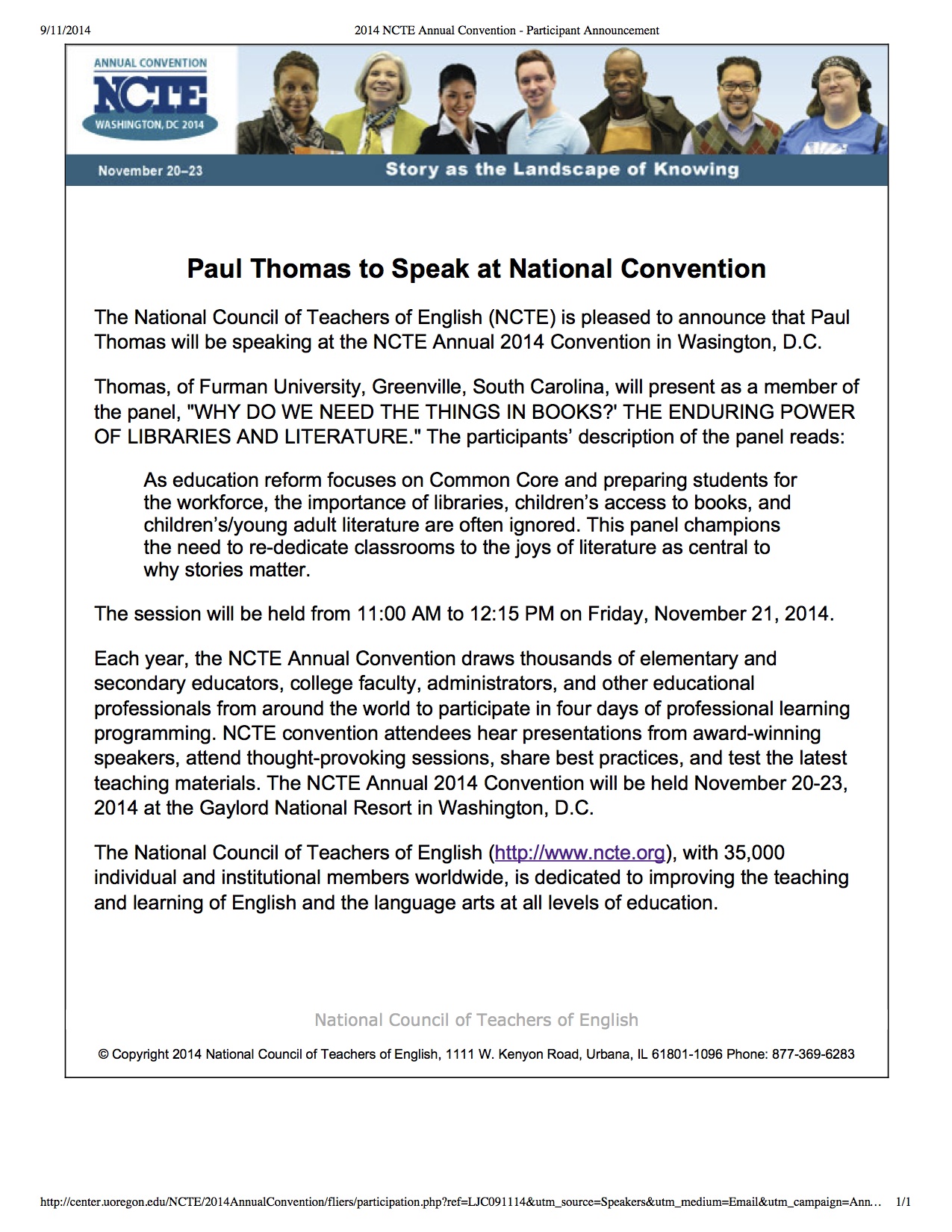
NCTE 2014: “Why do we need the things in books?”: The Enduring Power of Libraries and Literature

[At the 2014 National Council of Teachers of English Annual convention—themed Story As the Landscape of Knowing and held November 20-23, 2014, in Washington DC—Renita Schmidt (University of Iowa), Sean Connors (University of Arkansas), and I will be presenting as detailed below; I offer our proposal as a preview and hope you can join us as we need to raise our voices for both libraries and literature.]

“Why do we need the things in books?”: The Enduring Power of Libraries and Literature

Panel presentation, 75 mins

2014 NCTE Annual Convention - Participant Announcement copy

Teaching Reading and Children: Reading Programs as “Costume Parties”*

P. L. Thomas, Furman University

“[L]anguage behavior can not be reduced to formula,” Lou LaBrant (1947) argued (p. 20)—emphasizing that literacy growth was complicated but flourished when it was child-centered and practical (for example, in the ways many privileged children experience in their homes because one or more of the parents are afforded the conditions within which to foster their children’s literacy). Also, LaBrant (1949) identified the central failure of teaching reading: “Our language programs have been set up as costume parties and not anything more basic than that” (p. 16). This opening talk of the panel will focus on the importance of access to books and libraries as an antidote to “costume parties”—highlighting the work of LaBrant and Stephen Krashen as well as the speeches and writings of Neil Gaiman and Ray Bradbury as life-long proponents of libraries.

The More Books the Better!: Library Books as Boundary Objects To Build Strong Girls

Nita Schmidt, University of Iowa

Libraries provide stories for helping us understand who we are and who we might become. Sometimes, those stories take us to places we cannot imagine and we need more stories to resolve the tension. Libraries provide the books that become boundary objects or, as Akkerman and Baker (2011) describe, artifacts that work as mediators during times of discontinuity. Drawing on sociocultural theories of learning (Gee, 1996; Wenger, 1998; Vygotsky, 1978), this paper will discuss the ways an after school book club works with 4th – 6th grade girls to consider new perspectives. Book club members visit the library every month, read books with strong female protagonists, discuss topics in the books that relate to the real lives of the girls, and help the girls start their own personal libraries to encourage girls to begin to see themselves as successful young women in a complex global world. A bibliography will be provided.

Speaking Back to Power: Teaching YA Literature in an Age of CCSS

Sean Connors, University of Arkansas

If, as the narrator of John Green’s (2009) Paper Towns suggests, imagination is the machine that kills fascists, then literature, as English teachers and librarians know, is the engine that drives it. Despite the current education reform movement’s insistence on reducing the study of literature to a set of narrowly defined, measurable skills, and arguments which associate “close reading” and “textual complexity” with canonical literature, educators who value Young Adult fiction know that, like literature for adults, it is capable of creating a space for readers to examine complex issues related to race, class, gender, etc. This presentation calls on educators to recast arguments for teaching YA fiction in an age of CCSS by foregrounding its ability to encourage critical thinking. The presenter will share examples of (and guidelines for producing) student created digital book trailers that, rather than promoting books, instead “speak back” to oppressive ideologies featured in them.

*Portions adapted from the following blog posts:

Teaching Reading and Children: Reading Programs as “Costume Parties”

Common Core in the Real World: Destroying Literacy through Standardization (Again)

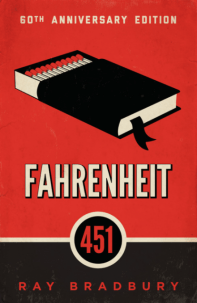
“Fahrenheit 451” 60 Years Later: “Why do we need the things in books?”

Neil Gaiman Should Be U.S. Secretary of Education: “Things can be different”

References

Akkerman, S.F. & Baker, A. (2011). Boundary crossing and boundary objects. Review of Educational Research, 81(2), 132-169.

Bradbury, R.  Fahrenheit 451, 60th anniversary edition.

Fahrenheit 451: 60th Anniversary Edition

Neil Gaiman lecture in full: Reading and obligation — http://readingagency.org.uk/news/blog/neil-gaiman-lecture-in-full.html

Gee, J.P. (1996). Social linguistics and literacies: Ideology in discourse. New York: Routledge.

Green, J. (2009). Paper towns. New York: Speak.

Krashen, S. (2014, January 4). The Spectacular Role of Libraries in Protecting Students from the Effects of Poverty. http://skrashen.blogspot.com/2014/01/the-spectacular-role-of-libraries-in.html?m=1

LaBrant, L. (1949). A genetic approach to language. Unpublished manuscript, Institute of General Semantics, Lakeville, CT.

LaBrant, L. (1947). Um-brel-la has syllables three. The Packet, 2(1), 20-25.

LaBrant, L. (1944, November). The words they know. The English Journal, 33(9), 475-480.

LaBrant, L. (1940, February). Library teacher or classroom teacher? The Phi Delta Kappan, 22(6), pp. 289-291.

LaBrant, L. (1931, March). Masquerading. The English Journal, 20(3), pp. 244-246.

Wenger, E. (1998). Communities of practice, learning, meaning and identity. Cambridge: Cambridge University Press.

Vygotsky, L. (1978). Mind and Society: The development of higher psychological processes. Cambridge, MA: President and Fellows of Harvard College.

Papa

As Steve Paul explains, July is an important month for Ernest Hemingway:

The month of July brings the anniversary of three defining Hemingway moments: He was born on July 21, 1899, in Oak Park, Illinois; he took his own life on July 2, 1961, in Ketchum, Idaho. And on July 8, 1918, while he was serving in the Red Cross ambulance service attached to the Italian army, he was wounded by the explosion of an Austro-Hungarian trench mortar shell. The blast sliced 227 pieces of metal fragments into his body, gave him what felt like a near-death experience and ultimately shaped one persistent subtext of Hemingway’s literary career.

For me, 21 July 2014 sits just a few weeks after the birth of my first granddaughter by my only daughter—and with that event the never-ending question posed to me: What is she going to call you?

My first urge has always been “Whatever she calls me,” to leave this to this wonderful new child who will have an inordinate amount of her life decided for her as we are wont to do with children, sadly.

I named by maternal grandfather Tu-daddy, and so there is some nostalgia in that desire to leave this to my granddaughter.

But if I must choose a name, it will be Papa for Papa Hemingway. Hemingway’s first wife Hadley explains in an audio clip how Hemingway became Papa:

In this clip, Alice Sokoloff asks Hadley if she remembers how the name “Papa” began, which was sometime during their years in Paris. As we know, Hemingway was wonderful at assigning nicknames to almost everyone he knew. Throughout the tapes, Hadley enjoys remembering affectionate names between them such as “Bumby” and “Bumili”, “Hemingstein”, “Tattie”, “Hash”, “Feather Kitty”, “Wax Puppy”, and “Tiny”.

“You did a lot of playing with words,” Alice observes, later in the tape. “We both loved words”, Hadley agrees, “I loved words as much as he did but I wasn’t a magician.”

As a writer, one who loves wordplay, and someone who nicknames (I am also a name clipper: Sky for Skylar, Jess for Jessica), I have much in common with Hemingway, who poses a tremendous problem for me.

Yes, I know there is much wrong with and in Hemingway’s writing and life. And I struggle with my technical attraction to his economy of language—his craft—against those issues of misogyny and complicated glorification of the very violent man’s world.

The world is complicated—as I grow to understand better every day—so I have a special, although conflicted, place in my writer’s heart for Hemingway, and if my granddaughter takes to Papa, well, so much the better for this world, a world I want to be kinder and more gracious because she is now here as another part of the lineage begun with my daughter.

As Hadley notes above, there is a magic to words, and magic rises above this world we fumble all too often. Words, then, are hope, the sort of hope we embrace when we conjure yet more of us on this planet.

Yes, Papa is fine by me.

Blogs Using Hemingway

Gates Moratorium Another Scam: Beware the Roadbuilders pt. 2

The Analogy, Hyperbole Problem: “With explanation kind” (Tone, pt. 5)

From Failing to Killing Writing: Computer-Based Grading

Our Dystopia Is Now: The Circle (Eggers) and Feed (Anderson)

Common Core in the Real World: Destroying Literacy through Standardization (Again)

Poetry

the archeology of white people

“No new federal spending” Equals “This really doesn’t matter”

New York Times columnist Mykoto Rich‘s lede sounds promising in her Obama to Report Widening of Initiative for Black and Latino Boys:

President Obama will announce on Monday that 60 of the nation’s largest school districts are joining his initiative to improve the educational futures of young African-American and Hispanic boys, beginning in preschool and extending through high school graduation.

But the most important point comes in the fourth paragraph:

No new federal spending is attached to the initiative. The new efforts, which will also seek support from the nonprofit and private sectors, are being coordinated by the Council of the Great City Schools, which represents large urban school districts.

In the U.S., “No new federal spending” equals “This really doesn’t matter.”

Can you imagine no new federal spending being attached to any military initiative?

What about no new federal spending to bail out the banks?

Of course not. But the U.S. has made a clear choice: Fund the interests of the rich and powerful (for them, the dirty money of government isn’t so dirty) and leave the fortunes of the impoverished and victims of inequity to the Invisible Hand of the free market.

We may want to note that at least the Obama administration has made a somewhat bold move to acknowledge the crippling disadvantages faced by African American and Latino boys in the U.S.—and here we should pause and make sure we acknowledge that as the civil rights issue of our time. And because of that acknowledgement, the NYT makes a rare concession to these facts, as Rich explains late in her piece:

Black and Latino students have long experienced a pattern of inequality along racial lines in American schools. According to data from the Department of Education’s Office of Civil Rights, black and Latino students are suspended and expelled at much higher rates than white students and attend schools with less-experienced teachers. Many also attend schools that do not offer advanced math and science courses.

Boys in particular are at a disadvantage. Black and Latino boys are less likely to graduate from high school than white boys, but also less likely than African-American or Latino girls. And in elementary school, they already fall far behind their white counterparts in reading skills: According to the National Assessment of Educational Progress, a series of standardized tests administered to a random sampling of American children, only 14 percent of black boys and 18 percent of Hispanic boys scored proficient or above on the fourth-grade reading tests in 2013, compared with 42 percent of white boys and 21 percent of both black and Hispanic girls.

But without government spending, initiatives are nothing more than rhetoric and distraction—further evidence of our commitment to capitalism first and possibly to the exclusion of democracy and equity, as I have examined before:

More difficult to confront than either mendacity or foma, it appears, is the hard truth that the human pursuit of equity must come before merit can matter and that in order to achieve that possibility, the human condition must commit to a spirit of community and collaboration, not competition.

Regretfully, most in power are apt to continue to not let that cat out of the bag.

Capitalism and the free market, however, are not the domains of ethical and moral social action. The human experience in the U.S. has shown us time and again that left unfettered, that market feeds itself on the workers in order to fatten the owners.

The lives and faces of African American and Latino boys in the U.S. are the regrettable portraits of our failures as a people. We are now confronted with an option to embrace our collective power and shared humanity—that which is government, the public sphere, the Commons.

There is often a reason a cliche becomes a cliche—the wisdom of all that is True becomes repeated until we have cliche. In the U.S., our new motto should be: Put your money where your mouth is.

Until then, we remain malnourished by the empty calories of rhetoric.

NOTE: For an alternative view, please read Oscar Wilde’s The Soul of Man under Socialism.

A Brief Meditation on What Has Failed

What has failed in the U.S.?

Democracy? No. We have failed democracy.

Public education ? No. We have failed public education.

The free press? No. We have failed the free press.

Capitalism? No. This is exactly how capitalism works–consuming all and laying waste to democracy, human dignity, and equity.

Of all that is the U.S., capitalism is working as it is designed to work.

And that is our greatest failure.

O, Free Press, Where Art Thou?

As I have noted, a common thread running through my blogs is the carelessness among the media covering education.

Case in point, yet another tone-deaf and completely unsupportable piece has appeared in the The Post and Courier (Charleston, SC): Duncan deserves high marks.

With just a modicum of effort, almost every claim made in this piece is easily refuted by something the mainstream press seems determined to ignore, evidence.

I have called for the “Oliver Ruler” and  a critical free press as well as posting an open letter to journalists, but many journalists remain committed to “balance” and thus are unwilling to evaluate the quality of claims or the credibility of people or positions.

But there appears to be some hope across the pond (it seems Oliver’s land can see what we cannot):

Stop giving airtime to crackpots, Phil Plait

BBC staff told to stop inviting cranks on to science programmes

So once again, not all issues have “both sides” and thus do not require seeking out balance for the sake of balance. As well, not all people or claims are credible; therefore, that those people or claims exist does not justify their being acknowledged. It is essentially malpractice to treat unequal claims as equal.

While the BBC is directly addressing science, in the U.S. the education reform agenda is currently being crippled by inexpert and incompetent leadership that is being reinforced by a media blinded by their pursuit of balance at the expense of credibility and evidence.

Leaving me still pining, O, free press, where art thou?

GUEST POST: Denny Taylor, Garn Press

GUEST POST: Denny Taylor, Garn Press

 Dear Friends and Colleagues,

I am writing to urgently request your help. If you find the political circumstance and the research base for the four propositions that I have outlined in this letter are compelling, and you support the course of action suggested here please send this letter to friends and colleagues. Use your websites, Facebook, and any other means to get the message out. Given that I rarely enter the public sphere my friends will know that the situation of which I write is pressing. Time is of the essence, I fear.

Some of you will have read books I have written based on forty years of longitudinal research in family, community, and schools settings with children, families, and teachers who live and work in challenging social and physical environments. Except for my doctoral dissertation, all my research has taken place in sites of urban and rural poverty.

About fifteen years ago I became more focused on catastrophic events, including extreme weather events, industrial disasters, war and armed conflict, and acts of mass violence that occur with little warning and in a matter of a few seconds change the lives of children, teachers, and their families forever.

I haven’t published during this fifteen year time period, but I have been working as a researcher and writing on a daily basis. Much of the time I have spent studying the research on trauma and mass trauma with a mentor in the field. Still more time has been spent studying Earth system science, and eventually writing qualitative research papers that were peer reviewed by researchers in the physical sciences. Based on the reviews, I have participated in research conferences and meetings with Earth system scientists whose research focuses on quantitative studies on the anthropogenic changes that are taking place to the planet.

My own research has evolved, and I have found my place between scientists, policy makers, and the public. The mix of social and physical sciences is making it possible for me to share the findings of these fifteen years of daily study, which are firmly grounded in scientific evidence, and in the lived knowledge that has come from living and working in places where catastrophic events have taken place.

There are eight book length manuscripts on my bookshelf and the first three books based on them are being published this summer. These books are very different from each other, but they all focus on the interconnections between two of the greatest threats to our children’s future:

  1. The dismantling of the US public education system; and
  2. The acceleration of anthropogenic change to the planet.

The Earth system scientists from the global scientific community who participated in the IPCC 5th Assessment Report categorized climate change as “unequivocal”, and 195 countries signed documents in agreement with these scientists. In addition, the US Government Accountability Office (GAO) has produced 40 reports, the first in 2005, raising concerns about climate change and in the 2014 report the GAO has elevated the impacts of climate change to “high risk” status. The Department of Defense (DOD) has issued similar reports and warnings and is preparing for catastrophic events that might occur because of climate change.

But the US Congress still refuses to act. Many members of Congress are still denying that climate change is unequivocal, and they refuse to acknowledge that both the people of the United States and the entire global community are at “high risk”.

Even more inexplicable is the fact that there is now one political party in the US Congress that is not only denying climate change, but has powerful members on Congressional sub-committees convened to focus on climate change who are also outspoken in denying basic science.

The three books connect the dots between the dismantling of the US public education system and the denial of climate change, and they present four propositions:

First Proposition: By defunding public education the federal government is selling the future of children in the US to private corporations, creating huge revenues for companies and a bonanza for shareholders, while at the same time undermining and destabilizing the neighborhoods and communities in which schools are privatized.

Second Proposition: By profligating denial of climate change, defunding and limiting expenditures on mitigating climate and environmental problems, the US Congress is actively engaged in protecting the corporate interests that have supported their political campaigns, while willfully ignoring the very real and very grave threat that exists to the American people, especially children, and to all human life on the planet.

Third proposition: By defunding public education and selling the children in the US to private corporations that are in large part responsible for climate change and the destruction of the environment, the federal government is ensuring the indoctrination of America’s children into the State-Corporate Complex that is threatening their future, while at the same time actively interfering with their capacity to develop the problem-solving capabilities they will need to tackle the potentially life-threatening anthropogenic changes to the planet that they will experience in their lifetime.

Fourth proposition:If we are serious about preparing our children for an uncertain future, in which they will be confronted by many perils, then we must stop the corporate education revolution immediately and recreate the public school system based on democratic principles, ensuring equality and opportunity for all children to participate in projects and activities that will ensure their active engagement in re-visioning and re-imagining human life on Earth.

For our children and the planet, the third and fourth propositions are far reaching in their implications. The three books unpackage the political propaganda, and focus on the scientific research that is being obfuscated for political power, and corporate revenues and profits. Each book explores the relationships that exist between what Noam Chomsky calls “the State-Corporate Complex” and the acceleration of climate change, and the defunding and corporatization of public education. Together they provide compelling evidence why the Common Core should be abandoned and Pearson’s “global education revolution” immediately ended.

Here are the titles of the three books:

Nineteen Clues: Great Transformation Can Be Achieved Through Collective (just published in paper and also available in electronic formats for Amazon, B&N, Kobo, and iBooks).

Save Our Children, Save Our School, Pearson Broke the Golden Rule (proof copies of this political satire have arrived and the actual book should be available in two weeks with eBooks to follow).

Keys to the Future: A Parent-Teacher Guide to Saving the Planet (is in the final edit stage and will be available in paper by September, again with eBooks to follow).

Together, based on the evidence, these books make the case that there are three things we know for sure:

  1. What happens to the future lives of our children and grandchildren depends on us;
  2. We should not expect the powerbrokers of the State-Corporate Complex to come to our aid or rescue our children;
  3. Extreme inequality is not only bad for people it is bad for the planet – the poor are at greater peril than the rich.

Many teachers and parents are already leading the way in the struggle for equality and more humane learning environments for children. Their courageous activism is the struggle not only for the re-establishment of the public education system, but also for the future of humanity.

The dangers to our children are real, and at Garn we volunteering our time to work for the Press, because we regard ourselves as first responders in an emergency situation. Our mission is to publish books with actionable knowledge that can be of use to educators and the public. We are hopeful for the future and we put our trust in the people, especially parents and teachers, who are working to make the planet a child safe zone.

Please consider supporting Garn Press by sharing this letter with everyone in your social networks and encouraging your friends and colleagues to read the books. Reviews are welcome!

Our hope at Garn is that when our children and grandchildren ask us what we did to respond to climate change we will be able to tell them that:

  1. We saved their schools and made them sites of equity and justice;
  2. We made their schools places where every child developed the capacity to be resourceful and resilient;
  3. We insisted that they had the opportunity to participate in great projects about the Earth and about the Universe;
  4. We made sure their education included both the scientific and the literary so they could see the deep connections between these ways of thinking and ways of being;
  5. We were adamant that they learned together in classrooms that valued the ways in which they could support one another;
  6. We insisted that their classes included the arts, dance, music, drama, painting and drawing in seamless lessons that encouraged joyfulness and a sense of belonging to a community.

We will be able to tell them that because of the ways in which we insisted they were educated the ethos of the nation changed. Because of their children the public began to regard the Earth differently. People began to reassess what was important to them. They acted on what they already knew, that liberty cannot exist without justice, and that the price of great wealth for a few was too high for the public to pay and would no longer be tolerated.

We will tell them we stood strong, and we used these newfound beliefs in our re-Imagining of the ways we live on the planet. We will tell them because we love our children so much the world changed.

We must do whatever we can to make this happen, so we can tell our children, “We worked together and we made the Earth a child-safe zone.”

Denny Taylor

New York

July 15, 2014