Category Archives: education

Will Free-Pass Mainstream Media Clean Up Their Chetty Mess?

The New York Times couldn’t hold back: Big Study Links Good Teachers to Lasting Gain.

And for two years now, the so-called Chetty study that claims teacher quality directly causes higher lifetime earnings for their students has been re-released by Chetty and colleagues as well as rehashed by the free-pass mainstream media with a fervor that seems at least over-the-top.

When the Chetty numbers (has anyone noticed that the lifetime earning numbers appear to change?) are put into perspective, all the air should deflate from that misleading balloon: $50,000 gained over a lifetime (40 years) is only about 1.5-2 tanks of gas a month. But inflating that balloon to $1.4 million for a class of 28! Now you have something … (Hint: An overinflated balloon, possibly filled with poop.)

Initial scholarly responses to the Chetty balloon were cautious and critical (see notably Bruce Baker and Matthew Di Carlo here), but the free-pass mainstream press kept on keeping on.

Thus, since I have made a case for our needing a critical free press (in other words, “free press” and not “free pass” found among press-release journalists), we are at a key moment with the release of a thorough review of the Chetty study, a review that discredits the claims, Review of Measuring the Impacts of Teachers by Moshe Adler:

Can the quality of teachers be measured the way that a person’s weight or height is measured? Some economists have tried, but the “value-added” they have attempted to measure has proven elusive. The results have not been consistent over tests or over time. Nevertheless, a two-part report by Raj Chetty and his colleagues claims that higher value-added scores for teachers lead to greater economic success for their students later in life. This review of the methods of Chetty et al. focuses on their most important result: that teacher value-added affects income in adulthood. Five key problems with the research emerge. First, their own results show that the calculation of teacher value-added is unreliable. Second, their own research also generated a result that contradicts their main claim—but the report pushed that inconvenient result aside. Third, the trumpeted result is based on an erroneous calculation. Fourth, the report incorrectly assumes that the (miscalculated) result holds across students’ lifetimes despite the authors’ own research indicating otherwise. Fifth, the report cites studies as support for the authors’ methodology, even though they don’t provide that support. [emphasis added] Despite widespread references to this study in policy circles, the shortcomings and shaky extrapolations make this report misleading and unreliable for determining educational policy.

So my question now is: Will the free-pass mainstream media clean up their Chetty mess?

I suspect we will not have a NYT scorching headline, we will not even have a NYT article, we probably will not see interviews on NPR with Adler, and I am skeptical about Education Week‘s coverage (beyond some bloggers).

The fair and balanced mainstream media, alas, (those journalists who cannot judge the credibility of the research they cover) will not fall all over themselves to cover and then repeat for two years to come the popping of the Chetty balloon because that would mean admitting their own incompetence, which is the sweet allure of fairness that leaves us all misinformed.

Education Reform as the New Misogyny: A Reader

While watching The Wolverine (2013) starring Hugh Jackman, I noticed that along with Wolverine’s adamantium claws, Jackman’s nipples were featured prominently, leading me to search for the film’s promotional poster. And my suspicions were confirmed

Apparently Eva Green’s thinly-veiled nipples are not only more dangerous than the gun she is holding in the new Sin City sequel, Sin City: A Dame to Kill For, poster, but also more offensive than Jackman’s nipples (despite the violence and extended sequences of a topless Jackman, the film is rated PG-13 “for sequences of intense sci-fi action and violence, some sexuality and language”).

This contradiction highlights Hollywood’s perverse double-standard that includes tabooing female nudity while also disproportionately objectifying women in gratuitous sex and nudity in films, and then speaks to the remaining systemic and institutional misogyny throughout the U.S.

Along with Hollywood and the complicit media, the central elements of education reform in the U.S. share one important thread among the repeated blaming of “bad” teachers, “bad” teachers unions, and the urgent need to fire those teachers by dismantling those unions.

That thread? Teaching remains a field dominated by women, and one we can assume the public identifies with women. As Nancy Flanagan explains:

But–as Solnit deftly points out–a great deal of bias goes unrecognized and unacknowledged in ordinary life in a male-dominated culture. Folks in education–male and female–just don’t see it, or feel it. Or the huge imbalance in power and influence is obscured by a handful of women who serve as highly visible role models.

Do the math, however–about 84% of K-12 teachers in the United States are female, a rapidly increasing disproportion.  Combined with the fact that the modal level of teacher experience is currently one year, it’s easy to see how major shifts in curriculum, instruction, assessment and hiring have been accomplished. Nobody’s pushing back.

I am struck that of all the professions in the U.S., why is there no urgent call for no “bad” doctors, no “bad” lawyers, no “bad” CEOs, or no “bad” politicians? And I must note that each of these remains male-dominated—both in numbers and in social perception.

As well, teaching as the work of women has been traditionally monitored by a demand that teachers remain politically quiet, passive, and now in 2014, education reform is the new misogyny.

The surface elements of education reform that currently target teacher quality and teachers unions are as thin veils as Green’s nightgown, but socially, the U.S. appears offended only by the exposed breast on a film poster.

But once we remove that veil, it seems irrefutable that education reform is driven by a 21st-century misogyny that must be confronted. I offer, then, this reader:

In Acts of Resistance, Pierre Bourdieu nearly 20 years ago recognized:

In the United States, the state is splitting into two, with on the one hand a state which provides social guarantees, but only for the privileged, who are sufficiently well-off to provide themselves with insurance, with guarantees, and a repressive, policing state, for the populace. (p. 32)

Only a decade later, New Orleans was ground-zero for disaster capitalism’s end game: The entire public school teacher workforce was fired, a workforce dominated by African Americans and women, a representation of the so-called middle class that U.S. political leaders claim to cherish.

Bourdieu adds:

In all countries, the proportion of workers with temporary status is growing relative to those with permanent jobs. Increased insecurity and “flexibility” lead to the loss of modest advantages…which might compensate for low wages, such as long-lasting employment, health insurance and pension right. (p. 37)

While teaching as a profession has remained relatively low-pay, teachers have often been pacified by the mirage of “fringe benefits,” but now it seems, that as the circumstances of all workers are reduced (the Walmartification of the U.S. workforce as part-time with no benefits), the next phase of that reduction is the lowest rungs of the professional ladder—those professions held mainly by women.

As Bourdieu explains by way of Max Weber, “dominant groups [read: white males in the U.S.] always need…a theoretical justification of the fact that they are privileged. Competence is nowadays at the heart of that” justification, which for teachers is the rise of proving teacher quality through measurement—something that those in power do not need to do since they maintain the public’s gaze on the demand for others to prove their worth (p. 43).

Systemic and institutional racism, classism, and misogyny are protected by repeating pacifying and distracting narratives, as confronted by Bourdieu:

I’m thinking of what has been called the “return of individualism,” a kind of self-fulfilling prophecy which tends to destroy the philosophical foundations of the welfare state and in particular the notion of collective responsibility….The return to the individual is also what makes it possible to “blame the victim,” who is entirely responsible for his or her own misfortune, and to preach the gospel of self-help, all of this being justified by the endlessly repeated need to reduce costs for companies. (p. 7)

Racial minorities, women, and children remain disproportionately disadvantaged in the U.S., the wealthiest and most power nation in human history. But that wealth and advantage also remain disproportionately hoarded by a white and male leadership that demands everyone proves her/his worth.

Education reform is the new misogyny as well as the new racism and classism.

The commonality we are failing to recognize and mobilize is that most of us are and always will be workers. To protect and honor the field of teaching is to protect and honor all workers—just as to protect and honor the field of teaching is to call for an end to misogyny.

Debating the Gates Moratorium, Or Life among the Roadbuilders

As a lifelong fan of science fiction (SF), I want to start by invoking a SF convention that never gets old: time travel (but I’ll spare you the whirlwind prestidigitation mastered by Kurt Vonnegut, who married time travel and non-linear narrative in Slaughterhouse-Five).

Once upon a time (well, I must confess, I enjoy a bit of genre-splicing also), Bill Gates, billionaire and burgeoning education hobbyist, began tossing his considerable expertise (read: money) at small schools projects. Low and behold, Gates eventually looked at the research his own foundation gathered, declared the project a failure, and scuttled away—only to decide that the greatest scourge on the planet was the enormous number of “bad” teachers failing our children everyday!

Since we are now back in time (and you may notice a pattern here about history repeating itself, and such), let’s look at that Gates/small school dynamic as I blogged about this in April and May 2011:

And, Gates’s small schools experiment? While Gates himself declared the experiment a failure, Marshak explains that Gates’ small school experiment actually exposes Gates’ own inability to understand the education dynamics he claims to reform. But ample evidence reveals both that Gates is inexpert and remains unsuccessful as an education reformer. See here, here and here — including his failure to understand statistics and the charts he enjoys using to make his points here. (Accountability? Start at the Top, OpEdNews 11 April 2011)

Let’s do some truly basic math.

First, consider that Bill Gates, a billionaire whose wealth and success have been built on computer innovation and entrepreneurship, has been an education reformer for many years now–stretching back to a small schools focus:

“Bill Gates used to believe that one of the solutions to failing schools was to create smaller ones with 500 students or fewer. His foundation spent $1 billion toward this; seeing the opportunity to bring in private dollars, districts started shifting to smaller schools. Small schools became the big new trend. But then the foundation conducted a study that found that, by itself, school size had little if any effect on achievement. The foundation dropped the project and moved on to teacher reform, but by then some urban districts throughout the nation had changed to small–and more expensive to operate–schools.”

So the first formula is:

Gates initiative + Gates funding = abandoned schools in the wake of failure (with no consequences for Gates)

As the Los Angeles Times reports above, Gates is now focusing on teacher quality–including calls for teacher evaluations tied to test scores measuring student achievement against the common core standards.

This suggests a new formula:

Gates money + common core standards + testing industry = profit for Gates and testing industry at the expense of students, learning, and public education. (If There Remains Any Question, Daily Kos 1 May 2011)

Let’s return now to the present where the Gates machine has called for a moratorium on all that Common Core and VAM stuff because his own people’s research appears to refute what Gates has been pontificating about in the compliant media gaze that only Gates seems worthy of receiving (I hate to beat this to death, but do any of you see a pattern here?).

I want to offer now that this call for a moratorium is another teachable moment—those who fail to learn from history are doomed to repeat it, and all that—and therein we have at least two important lessons:

First, Gates/small schools, Gates/VAM, and Gates/Common Core are all the same flawed dynamic in which political leaders, the media, and the public confuse wealth with expertise. Remove Gates’s billions and he would have zero credibility in any of these ventures—and I still maintain that the small school debacle is the most telling part of this story [1] because Gates misread his own research, declared erroneously the commitment a failure, and simply walked away leaving others to hold the bag (roadbuilder he has always been, roadbuilder he will always be).

And this leads to the debate and discussion that has blossomed from the Gates moratorium announcement.

So our second lesson is somewhat positive: If we could ever set aside confusing wealth with expertise, we may come to recognize that among educators, scholars, and researchers we already have a wealth of expertise that could better serve our goals of education reform.

And thus, I maintain my stance that the Gates moratorium is a sham, but I want to highlight here that within the credible responses to that moratorium call, we see how education reform should be debated by those who know the field:

And while I enjoy coming back to and finding new SF again and again, in education reform I am eager to step off the “Déjà vu all over again” merry-go-round.

Bill Gates, about that moratorium? No thanks. And while we are at it, no thanks to all the rest either.

If you’d stopped building your roads we never asked for right through the middle of our villages, we would have time to take care of business here, instead of constantly staying one step behind underneath the rubble of the disasters you create.

[1] Please read carefully Good Doubt and Bad Doubt from 2007 and Why Did the Gates Small-High-Schools Program Fail?: Well, Actually It Didn’t from 2010 for some really powerful time travel. And this is just must-read: Bill Gates should hire a statistical advisor.

My Open Letter to Journalists: A Critical Free Press, pt. 2

Dear Journalists (especially those who write about education):

After posting my U.S. and Education Reform Need a Critical Free Press, which represents a recurring effort in my public work to address the problems with journalism about education and education research/reports, I continued to interact with Juana Summers (NPR) and Stephen Sawchuk (Education Week) on Twitter. Those exchanges have suggested to me that I need to examine more fully what my concerns raised specifically about mainstream coverage of NCTQ’s reports mean to my wider call for a critical free press.

First, I think I need to establish the foundational context of my complaints about journalism/education journalism.

I believe journalists and teachers should be (must be) comrades in arms because a free press and universal public education are essential foundational institutions for a free people.

I am not, however, suggesting that this camaraderie is some sort of wink-wink, nod-nod collusion between the two professions in which we “cover” for each other, but that we are comrades joined by the same mission to build the free society that many claim the U.S. seeks. In fact, as comrades I expect we should be each other’s most vigilant and accurate critics to insure that we both stay the course.

And that builds on my second larger context for my concerns about journalism and my call for a critical free press. My use of the term “critical” is the source of my calls for reform of both education and journalism—two fields that reach their potential when critical, but fail when they are bound by traditional expectations of impartiality, calls that teachers and journalists avoid being “political.” Critical teachers and critical journalists are activists; they use their professions as mechanisms for change. Apolitical teachers and journalists are essentially defenders of the status quo (thus, the calls for impartiality are always loudest from those with power and wealth).

So I want to return briefly to my criticisms of mainstream media coverage of NCTQ’s latest report.

While Summers, Sawchuk, and I exchanged Tweets related to my post, Adam Bessie, whose important public work refuting the “bad” teacher meme is central to my points here, offered a Tweet that simply identified a fact about Gates funding among NPR, Education Week, and NCTQ:

@jmsummers @plthomasEdD @Stephen_Sawchuk Gates Funds NPR: http://t.co/L2YMLobtRn NCTQ: http://t.co/HCb8OrQ6ps EdWeek: http://t.co/INKq8Kp39s

— Adam Bessie (@AdamBessie) June 19, 2014

This Tweet represents the central issue to my concerns: Among the New Media (blogs, Twitter, Facebook, etc.), many critical educators have been confronting the disproportionate and inappropriate (because Gates has no credibility in the field of education, but nearly endless funds) influence of Gates on education reform—an influence that I have confronted often with a question: If Bill Gates had no money, who would listen to him about education reform? No one.

Also, Bessie’s Tweet about the ubiquity of Gates funding has finally begun to gain some traction in the mainstream press. But bloggers still carry the greatest weight for being critical about the influence of Gates on education reform. (The most common places now to find critical journalism is in the New Media, such as blogs at Education Week [see Anthony Cody and Nancy Flanagan] and The Washington Post [see Valerie Strauss] or alternative press such as Truthout and AlterNet.)

Despite Bessie’s Tweet only stating facts, Sawchuk immediately responded with this:

@AdamBessie @jmsummers @plthomasEdD As someone who works to be scrupulously fair I find that pretty offensive.

— Stephen Sawchuk (@Stephen_Sawchuk) June 19, 2014

It is at “offensive” that I think we should all pause and consider carefully.

I do not in any way think Sawchuk is a careless, “bought,” or shoddy journalist. In fact, as I stated to him, I have interacted with Sawchuk because I respect him, his work, and his profession (I do not interact with others about whom I cannot say the same).

I must add that my concern with Sawchuk’s coverage of NCTQ (as well as the other coverage I identified) is that the work fails because it conforms to the flawed traditional convention of fairness that Sawchuk mentions directly.

The traditional view of fairness in journalism has been brilliantly skewered recently by John Oliver on his HBO show: Oliver exposes that being “fair” in the climate change debate—having one person for “both sides” debate the issue—actually greatly misrepresents the current understanding within the field of science for the lay public. Mainstream journalists committed to this sort of “fair and balanced” are doomed to fail the much more important goal of accuracy. As Oliver demonstrated, the ratio of for and against climate change within the sciences is not 1 to 1 as a “fair” debate implies, but about 97 for and 3 against (and while Oliver didn’t explore this, a careful look at the against shows that even those 3% are less credible within the field).

If we extrapolate the Oliver Rule, then, to education reform, we do not find an equal 1 to 1 ratio of research on using value-added methods (VAM) to evaluate and dismiss teachers because the field overwhelmingly refutes using VAM in highs-stakes situations (even pro-VAM researchers call for “modest” uses of VAM) and mostly ideological advocates and political leaders (without expertise) endorse VAM for high-stakes education policy. However, VAM advocacy garners primary coverage in the mainstream press with little attention paid to the more credible research refuting its high-stakes and disproportionate use.

So let me be very clear here about both Sawchuk being offended and the difference between critical journalists and fair journalists.

I’m sorry, but journalists and journalism will always look bad when money speaks louder than expertise (see again Gates).

Now, imagine, journalists, if every day your field was repeatedly and inaccurately trashed for all the public: U.S. public education is a failure because our tests scores rank poorly internationally (misleading), schools with impoverished students have low test scores because of low expectations by the teachers (untrue), U.S. public education is failing because of corrupt teachers’ unions (untrue and basically opposite of the evidence), to improve public schools we need to identify “bad” teachers and fire them (untrue), public school teachers are “bad” mostly because they have tenure (untrue) [1], and the list goes on.

I genuinely regret Sawchuk being offended because he doesn’t deserve it, but I must emphasize that Sawchuk is among the media who are complicit in offending teachers, teaching, and schools everyday because journalists are quick to assume the misguided pose of “fair” and unwilling to assume the needed position of critical.

Many issues simply do not have “sides” (rape, genocide), and to be honest, most issues do not have equally credibly sides.

Does teacher education/certification need to be reformed (full disclosure: I am a teacher educator)? Absolutely.

But NCTQ has no credibility and garners its influence through the impact of money and media endorsement, and not validity (just as Gates has done).

Louann Reid, Chair of NCTE’s Conference on English Education, has identified this problem perfectly in her rebuttal of NCTQ’s recent report:

The recommendations are, however, backed by considerable funding, which helps extend NCTQ’s reach. CEE doesn’t have that kind of funding, but we do have reliable researchers and educators who can mobilize to tell the true stories of effective English teacher education. And I believe we must do so.

And herein lies the problem. While I also spurred some offense by my use of “press-release journalism,” the inordinate and uncritical coverage of NCTQ by the mainstream press proves my point that mainstream journalists respond to press releases (funding) while the experts (NCTE/CEE) remain mostly ignored.

And that’s the problem with “fairness” as the journalist’s guide instead of “critical.”

As researcher and scholar Bruce Baker added to the Twitter discussion, critical journalism would have responded to NCTQ quite differently:

@Stephen_Sawchuk @plthomasEdD To be really blunt, my point is that NCTQ report is so obviously junk, it shldn’t be covered by media at all

— Bruce Baker (@SchlFinance101) June 19, 2014

It may appear “fair” to respond to NCTQ as one perspective in the education reform debate, but it isn’t beneficial to afford an organization and a report without merit more credence (or even the same) as the contributions of those who have credibility.

And choosing to cover a topic is a political choice; coverage is never unbiased. And framing a topic is also a political choice (what perspective to present first, how to frame in the headline and lede, etc.). In truth, assuming a dispassionate pose is always dishonest since as humans we are always being political. I suggest we are all better off being openly and purposefully political instead of conforming to misleading norms of “neutrality.”

Yet, this is how the mainstream media carry on day after day—especially in the misguided assault on teachers, public schools, and now higher education.

Legions of hardworking and dedicated classroom teachers are offended daily by the mainstream media being complicit in a false story being told by those with money and an agenda—while that same mainstream media either offer secondary equal time [2] or ignore a powerful group of educators, researchers, and scholars who have the experience and expertise to reform education as it needs to be reformed.

Journalists, if you are ever offended, I would add that coincidentally you are now educators’ comrades for another reason.

As a lifelong teachers (31 years with 13 years teaching journalism to wonderful high school students), I am asking that you join us in the fight instead of taking your impartial stance that allows the well-funded but misguided reformers to keep on keeping on.

Any takers?

[1] How many mainstream journalists covering the Vergara ruling in California addressed that the judge issuing the ruling has job security himself?

[2] As “fair,” we are occasionally allowed to rebut the “reformers” somewhere in the middle or bottom third of the coverage, but even then we are framed as “critics.”

U.S. and Education Reform Need a Critical Free Press

Few things are worse than mainstream media coverage of education.

Except for that sentence above, which stretches hyperbole beyond credibility.

But that is exactly where the mainstream media finds itself when covering education. Journalists, in their quest to maintain the traditional commitment to “fair and balanced” journalism [1], consistently endorse and perpetuate organizations without credibility (such as NCTQ) and baseless claims (such as cries of “bad” teacher, “bad” teacher certification, and “bad” unions).

With yet another report released by NCTQ, that failure of the mainstream media has been highlighted once again—notably at NPR [2] and Education Week: Study Delivers Failing Grades For Many Programs Training Teachers, Claudio Sanchez and Juana Summers; Alternative Certification Deemed Weak by NCTQ in New Teacher-Prep Report, Stephen Sawchuk; Most Teacher Preparation Falls Short on Strategies for ELLs, NCTQ Finds, Lesli A. Maxwell.

First, the mainstream coverage of NCTQ’s reports remains trapped inside assumed crises that have no basis in fact; NCTQ’s reports and then the media begin with the givens that education suffers under the burden of “bad” teachers, “bad” teacher certification, and “bad” unions. However, at the very least, these claims are disproportional, if not outright erroneous:

  • If we maintain the current context that student achievement is accurately reflected in test scores (and it isn’t), then we must acknowledge that teacher quality (10-15%) and school quality account for only about 20% of that measurement, but “60 percent of achievement outcomes is explained by student and family background characteristics (most are unobserved, but likely pertain to income/poverty),” as Di Carlo details.
  • If we accept that value-added methods (VAM) can accurately and consistently identify “good” and “bad” teachers (and the evidence is that it cannot) and if we accept the much repeated claim by Chetty et al. that teacher quality can add $50,000 to the lifetime earning potential of a student (and that also is a significantly contested claim, as well as another example of advocacy and media hyperbole since that lifetime earning figure equates to about 1.5-2 tanks of gas per month), the enormity of the claims about “bad” teachers and the urgency expressed about creating and implementing huge and expensive test-based systems to address teacher quality are at best overstated. No rational person would endorse the cost-benefit analysis of such schemes.
  • Finally, claims that teachers unions are primary or significant negative influences on educational quality are powerfully refuted by the historical and current fact that the states in the U.S. with the lowest standardized test scores tend to be those that are right-to-work (non-union) states. Unionization correlates positively with measurable student achievement, in fact, while poverty is the greatest correlation with low measurable student outcomes (for the record, union bashing is a straw man because U.S. public education has a poverty problem, not a union problem).

Next, NCTQ has established a sort of immediate appearance of credibility through three strategies: partnering itself with U.S. News & World Report, garnering significant and influential sources of funding, and bombarding the mainstream media with a series of reports without vetting those reports as is common in traditional scholarship (which slows down and greatly harnesses higher-quality research from reaching the public [3]. But scholars don’t issue press releases, and apparently, journalists respond primarily to press releases instead of conducting investigative journalism [4].)

Finally, once I engaged Sawchuck (EdWeek) and then Summers (NPR) on Twitter, several key aspects of this phenomenon were highlighted. Both journalists argued that their pieces on NCTQ were fair, and even critical—which I will examine below—but even more significant is a comment on Twitter from Summers:

@plthomasEdD I’m not sure it’s my place to say whether the study is credible, but we both note the significant criticism of the methods.

— Juana Summers (@jmsummers) June 18, 2014

My two reactions to Summers deferring from examining the credibility of NCTQ are, first, to strongly disagree, and second, note that no journalists need to do any real investigative journalism to uncover that NCTQ has no credibility because all of that work has been done already by a number of scholars (see those critiques catalogued here and here).

As disturbing, however, as that stance is, examining carefully the coverage of NCTQ reveals that the mainstream media does in fact endorse NCTQ implicitly (despite claims of impartiality) and also marginalizes the credible critiques of NCTQ.

All three articles (see above) have headlines that establish immediately for any reader that NCTQ’s report is worthy of major media coverage. Next, all three articles have ledes that also present NCTQ positively:

The nation’s teacher-preparation programs have plenty of room for improvement, according to a new report. (Sanchez and Summers)

Alternative-certification programs for preparing teachers suffer from many of the same problems that the National Council on Teacher Quality has identified in traditional, university-based programs, the Washington-based group concludes in a new pilot study. (Sawchuk)

More than 75 percent of elementary teacher-preparation programs are failing when it comes to readying future teachers to work effectively with English-language learners, a new report from the National Council on Teacher Quality contends. (Maxwell)

Sanchez and Summers (again, note that Summers argues it isn’t her job to assign credibility to the study) certainly imply that the study is credible by using this language: “The study is a dismal read, given that the U.S. spends more than $6 billion each year to prepare teachers for the classroom.”

The NCTQ study is only a “dismal read” if it is accurate (and it isn’t). NCTQ has been carefully discredited in scholarship (for example, see Fuller here and here) for serious conflicts of interest (Teach For America and KIPP leaders sit on the Advisory Board, for example), for a flawed study design, and for shoddy methodology [5].

So how are credible academic critiques of NCTQ characterized in the journalism that claims not to take evaluative positions?:

When NCTQ released a version of this report last year, it was met with some skepticism among educators and those responsible for preparing teachers. Critics said the advocacy group should have visited individual teacher-prep programs and talked to graduates and students, rather than relying on syllabi. (Sanchez and Summers)

Last year’s inaugural teacher-prep review was immediately rejected by most teacher colleges and, especially, by their main membership body, the American Association of Colleges for Teacher Education.

Criticism focused on the NCTQ’s tack of reviewing syllabi and other course materials rather than visiting institutions; its use of open-records requests and current students to obtain documents; the complaint that its standards weren’t agreed to by the profession; and the fact that its research products aren’t peer reviewed. Additionally, critics have claimed that the project is ideologically driven, given NCTQ’s role as incubator of an alternative-certification group, the American Board for Certification of Teacher Excellence (ABCTE), which received federal funding from the George W. Bush administration.

The latter complaint seems less viable now that the NCTQ has turned its green eyeshade toward alternative-certification programs. (Sawchuk)

“Some skepticism” and “critics” clearly position credible scholarship negatively while maintaining the implied endorsement of NCTQ as an organization and NCTQ’s reports. And while Sawchuk appears to address more directly NCTQ’s lack of credibility, he still marginalizes scholars as “critics” and then in the last paragraph above, simply discounts the criticism [6].

Further in Sawchuk’s piece, the contrast between lacking credibility (NCTQ) and credibility (scholarship discrediting NCTQ) is reduced to a simple misunderstanding and a matter of tone (not substance):

Notably, the report’s introduction this year contains a number of mea culpas regarding the bad blood between the NCTQ and teacher colleges. And Walsh agreed that her group bore some of the blame.

“At times we were a bit arrogant about what it is we think teacher education should be doing,” she said. “Even if we agree to disagree, we can be more respectful.”

Again, this trivializes criticism of NCTQ and further equates NCTQ (an advocacy think tank) with scholarship—while also painting NCTQ as apologetic (despite the organization maintaining its threat of ranking programs whether they cooperate or not; a powerful tool afforded NCTQ because of its media partnership with U.S. News & World Report).

One of my strongest criticisms of teachers is that we far too often allow ourselves to be trapped within traditional calls that we take neutral stances; however, the U.S. needs critical teachers (political teachers) if our public schools are to be a foundation for our democracy.

What I have detailed above is that journalists in the U.S. have bowed to the same call for neutrality, one that cannot be accomplished but can serve as a shield for maintaining the status quo.

The U.S. needs critical journalists, ones who see their job as maintaining a commitment to seeking out and identifying the credibility of things they report. Only those in power benefit when the free press is mostly free of taking to task those in power.

Nowhere is that more apparent than in how the mainstream media fails the education reform debate.

[1] Journalists and teachers share the burden of traditional expectations that they should never be “political,” but taking a neutral stance is, in fact, taking a passive stance endorsing the status quo. In other words, taking a dispassionate pose is a political stance (see The Politics of Calling for No Politics).

[2] See a similar example with NPR’s coverage of “grit.”

[3] See the following in terms of how the mainstream media disproportionately reports on think tank (non-peer reviewed) reports as compared to peer-reviewed and university-based research:

Molnar, A. (2001, April 11). The media and educational research: What we know vs. what the public hears. Milwaukee, WI: Center for Education Research, Analysis, and Innovation. Retrieved from http://epsl.asu.edu/epru/documents/cerai-01-14.htm

Yettick, H. (2009). The research that reaches the public: Who produces the educational research mentioned in the news media? Boulder, CO and Tempe, AZ: Education and the Public Interest Center & Education Policy Research Unit. Retrieved from http://epicpolicy.org/publication/research-that-reaches

[4] I make this claim not as a direct attack on any journalists, but teachers and journalists now experience very similar and negative influences on their ability to conduct their professions. While education reform tends to impeded good teaching, the contracting media market has tended to overburden journalists. As a result of newspapers and magazines disappearing and contracting their staffs, many journalists resort to press-release journalism as a survival technique, similar to teachers teaching to the tests. The conditions of both professions, teaching and journalism, are stark reasons why both teachers and journalists must exert their political selves in their professional work.

[5] As a brief glimpse into NCTQ’s accidental admission of their methodology, in an effort to twist criticism of their practices, this post adds at the end “As one teacher candidate who is working on our office this summer said,” highlighting that anecdote is enough for NCTQ, as long as it matches their advocacy.

[6] Sawchuk fails to recognize that NCTQ is working within a scorched-earth policy as part of the large disaster capitalism driving education reform in the U.S. For a vivid example of how this works, and why NCTQ, TFA, and KIPP benefit once the traditional education system is dismantled, see the events that have occurred since Katrina in New Orleans where the public school system has been replaced by charters schools, many KIPP and many staffed by TFA recruits.

UPDATED: NCTQ: “their remedies are part of the disease”

Accordingly, with admirable, though misdirected intentions, they very seriously and very sentimentally set themselves to the task of remedying the evils that they see. But their remedies do not cure the disease: they merely prolong it. Indeed, their remedies are part of the disease.

Oscar Wilde (1891), The Soul of Man under Socialism

And so: NCTQ releases yet another think tank faux-report that will spur yet more press-release journalism.

In the wake of the Vergara ruling in California, which is one intended consequence of maintaining the distracting drum beat about “bad teachers,” I am convinced that NCTQ is implementing a strategy dramatized in the (regretfully) ignored film In Time: Keep everyone so frantic and thus distracted that no one can confront, as Oscar Wilde so wonderfully states, that NCTQ’s “remedies are part of the disease.”

I cannot and see no need to speak directly to new reports from NCTQ because, as I have stated before:

NCTQ offers no credible agenda or scholarship worthy of reforming teacher education. But this ideological think tank is a disturbing example of all that is wrong with the current education reform movement that has allowed people without experience or expertise as educators to perpetuate an education reform agenda through the weight of money, political influence, and media compliance.

Here, however, I will gather my previous posts on NCTQ as well as the expected responses to come—keeping in mind that we can feel safe even before looking at the report that NCTQ remains a think tank without credibility.

Responses to NCTQ

[new]

NCTQ (Finally) Gets Formally Rated– And It Isn’t Pretty.

UNC Study Examines NCTQ’s Ratings of Teacher Preparation Programs and Measures of NC Teacher Performance

Measuring Up: The National Council on Teacher Quality’s Ratings of Teacher Preparation Programs and Measures of Teacher Performance

Why NCTQ Is Wrong, NCTE

A Plethora of Recommendations Based on a Paucity of Evidence, Louann Reid

NCTQ’s Gradual Unmasking [UPDATED] (See compiled list of earlier responses to NCTQ at the end.)

UPDATED: NCTQ’s Free Pass in an Era of Press-Release Journalism

Those Nonsense Annual NCTQ Ratings Are Coming on June 17, Mercedes Schneider

Peter Smagorinsky: Response to the new NCTQ Teacher Prep Review

A “Fuller” Look at Education Issues, Ed Fuller

Shaky Methods, Shaky Motives: A Critique of the National Council of Teacher Quality’s Review of Teacher Preparation Programs, Ed Fuller

Knowledge Ventriloquism, EduShyster

Bunkum on teacher quality from the corporate reformers, Fred Klonsky

Professor: How NCTQ Restricts My Reading List, Katherine Crawford-Garrett

Reading Professor Responds to NCTQ Blast at Her Post, Katherine Crawford-Garrett

Statement on NCTQ Teacher Prep Review from Sharon P. Robinson, Ed.D., AACTE President and CEO

NCTQ/USNWR Review, AACTE

Resisting the National Council on Teacher Quality’s Propaganda, Jack Hassard

Also from Schneider

The Very Disappointing Teacher Impact Numbers from Chetty

It appears that Raj Chetty, of the very famous and mostly hypothetical Chetty et al. study addressing teacher quality’s impact on students’ lifetime earning potential, had a big influence on the Vergara case in California:

But one has to wonder how much impact that testimony would have had if the judge had considered that most reviews of the study find it to be poppy-cock (see Baker on the Chetty et al. molehill and Di Carlo) or if we simply displayed the numbers differently.

A 40-year “lifetime earnings” of $50,000 is only about $1250 a year, or about, after taxes, $75-80 per month, or about 1.5 to 2 tanks of gas a month.

Hmmmm. Compared to the $50,000 of hypothetical life-time earning or that insane $1.4 million for a class of 28, 1.5-2 tanks of gas a month appears to be much ado about nothing.

Chetty also fails to make a very important point about the economics of investing in measuring teacher quality: It will cost billions of dollars in public funding to create and implement a significant increase in high-stakes testing in order to hypothetically raise the monthly earning income of students enough for them to buy 1.5-2 tanks a gas each month.

A much more effective strategy would be to take those billions of dollars needed to create and implement VAM and give every worker in the U.S. $75 per month tax free. Simple, direct, and guaranteed.

Setting aside that this is all hypothetical, seems a ridiculously inefficient cost/benefit analysis of addressing a teacher quality issue that already is only about 10-15% of measurable student learning.

“Click, Clack, Moo”: Why the 1% Always Wins

[Originally posted at Daily Kos and Truthout, “Click, Clack, Moo”: Why the 1% Always Wins is a powerful companion to George Saunders’s Allegory of Scarcity and Slack.]

As a high school English teacher for nearly two decades, I came to embrace a need to offer students a wide range of lenses for interacting with and learning from many different texts, but I also learned that coming to read and re-read, to write and re-write the world is both a powerful and disorienting experience for young people. So a strategy I now use and encourage other teachers to implement is reading and discussing children’s literature, picture books, while expanding the critical lenses readers have in their toolbox.

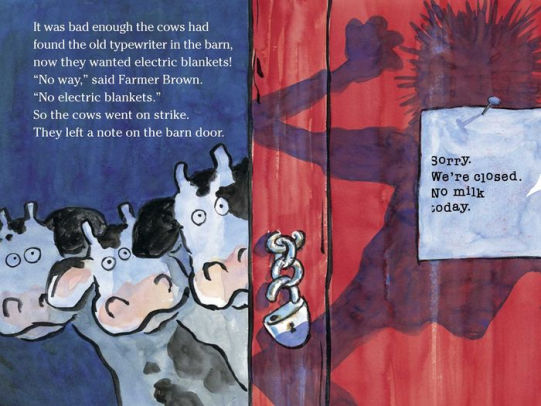
My favorite book for this activity is Click, Clack, Moo: Cows that Type. This work by Doreen Cronin with art by Betsy Lewin (view a read-aloud here) presents a clever and humorous narrative about Farmer Brown and his suddenly recalcitrant cows who, having acquired a rickety typewriter, establish a strike that inspires the chickens to join and ends with the neutral ducks aiding the revolt.

Click, Clack, Moo: Cows that Type

This story is ideal for asking teachers to consider the traditional approach to text in schools, New Criticism (a focus on text in isolation and on the craft in any story, such as characterization, plot, and theme), against Feminist and Marxist criticism, for example.

One fall, while doing the activity with a young adult literature class, I came against yet a new reading of Cronin and Lewin’s work: Why the 1% always wins.

The U.S. Public Likes Farmer Brown

As we explored Click, Clack, Moo recently, the adult members of the class told me they like Farmer Brown, with one student characterizing the striking farm animals as “mean.” And here is where I felt the need to consider how this children’s book helps us all confront the Occupy Wall Street movement or the rise in antagonism toward teachers, tenure, and unions as well as why the 1% continues to own the 99%.

One important element of the story is that the cows and chickens are female workers under the authority of the male Farmer Brown. These female workers produce for the farmer and remain compliant until the cows acquire the typewriter—both a powerful tool of literacy (the cows and chickens cannot effectively strike until they gain access to language) and a representation of access to technology (readers should note that the cows and chickens produce typewritten notes that show they find an old manual typewriter unlike the cleaner type produced by Farmer Brown on an electric typewriter, a representation of the inequity of access to technology among classes).

The cows and chickens, in effect, unionize and strike. Here, members of my classes often fail to notice the unionization, but tend to side with the farmer even when we acknowledge the protest as unionizing—particularly bristling at the duck, as a neutral party, using its access to the negotiation to acquire a diving board for the duck pond.

Like the 1%, Farmer Brown is incensed that the cows and chickens demand basic necessities for comfort, electric blankets, but he eventually secures a compromise, agreeing to give the barn animals the requested electric blankets for the return of the typewriter (the story ends with the obvious next step that the duck uses the typewriter to trade for the diving board).

What tends to be missed in this story is that Farmer Brown ultimately wins; in fact, the barn animals appear to be eager to abandon their one access to power, the typewriter, for mere material items—the electric blankets as comfort many would see as a basic right and the diving board as frivolous entertainment.

The 1% have the 99% right where Farmer Brown has the barn animals—mesmerized by the pursuit of materialism and entertainment. Consider the eager hordes of consumers lined up to buy the then-new iPhone 4S, released on the cusp of the passing of Steve Jobs, heralded as a genius for his contribution to our consumer culture.

Just give us our iPhones and we’ll be quiet, we’ll work longer and harder for the opportunity to buy what the 1% tells us we want.

And when the 1% and their compliant media inform us that the top 20% pays 64% of taxes, we slip back to our barns with our tails between our legs, shamed.

Instead, we should be noting that, yes, the top 20% income earners pay 64% of taxes because they make 59% of income.

We, the 99% who tend to remain silent and compliant, wait patiently for the next generation of technology to occupy our time, our lives reduced to work and amassing the ever-changing and out-dated things that become passe as the next-thing lures us further and further into our sheep lives.

Yes, if we remain eager to trade our voices for things, the 1% will always be the winners.

When we learn to treasure voice over things, however, the chickens may come home to roost.

George Saunders’s Allegory of Scarcity and Slack

The stories themselves, literally, are powerful and engaging or George Orwell’s 1984 and Arthur Miller’s The Crucible would not have endured as they have as literature people read again and again—and possibly should read again and again.

However, ultimately, 1984 is not about the future (especially since we have long since passed the future Orwell may have envisioned), and The Crucible is not about the past (although Miller built his play on the very real and troubling history of Puritan witchcraft hysteria). These works are about the complicated present of both authors’ worlds as that speaks to the enduring realities of the human condition.

All of that may seem weighty stuff to step into a look at what appears to be a children’s book, but the paragraphs above should be more than a hint that looks can be deceiving—and enlightening.

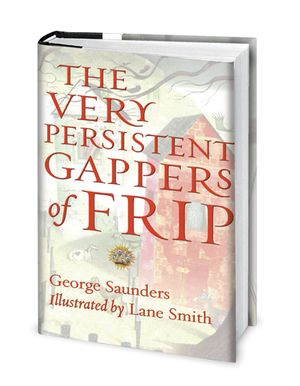
The Very Persistent Gappers of Frip, written by George Saunders and wonderfully illustrated by Lane Smith (whose It’s a Book I cannot recommend highly enough), is a fanciful and satirical tale that proves in the end to be an allegory of scarcity and slack—a perfect companion read to Ursula K. Le Guin’s allegory of privilege, “The One’s Who Walk Away from Omelas.”

The Very Persistent Gappers of Frip

Realizing that the Human Heart Is Capable

“Ever had a burr in your sock?” sets the story in motion—one sentence centered on the page over a giant question mark. It is an opening worthy of a child and all of us who cling to the wonder of childhood.

While Le Guin is often described as a science fiction writer, in her work I recognize the blurring of genres that joins science fiction, speculative fiction, and fantasy; it is that “other world” about which Le Guin and Margaret Atwood appear to argue, and it a stark but rich other world Saunders conjures and Lane pictures.

The story of Frip involves three houses for three families, all with children at the center. The houses are distinguished with primary colors—child-like blue, green, and red—but Lane’s artwork adds the ominous to Saunders’ seemingly simple narrative tinged with more than a bite of satire. The illustrations echo the haunting works about and for children found in Neil Gaiman and Tim Burton.

“Frip was three leaning shacks by the sea.” (p. 6) Artwork by Lane Smith

A child standing precariously close to the end of a slanted cliff over an angry ocean catches the eye on page 7 and then the crux of the story pulls you back to the text on page 6:

Frip was three leaning shacks by the sea. Frip was three tiny goat-yards into which eight times a day the children of the shacks would trudge with gapper-brushes and cloth gapper-sacks that tied at the top. After brushing the gappers off the goats, the children would walk to the cliff at the edge of town and empty their gapper-sacks into the sea. (p. 6)

Gappers, orange burr-like creatures with many eyes and the size of a baseball, come to represent throughout the story the power of the systemic inevitable: The presence of the gappers determines the lot of the families (and their goats), but most of the people in the tale remain unable to see beyond their own fixed and mostly misguided worldviews.

“A gapper’s like that, only bigger, about the size of a baseball, bright orange, with multiple eyes like the eyes of a potato.” (p. 2) Artwork by Lane Smith

When the gappers cling to the goats of all three families, there is an ironic appearance of equality among them. But when the fortune of one family shifts, the gappers fulfill their name by creating the gap:

So that night, instead of splitting into three groups, the gappers moved into one very large and impressive shrieking group directly into Capable’s yard. (p. 12)

Before this shift in how the gappers behave, of course, the three families are not equal because Capable is an only child living with her father and who has lost her mother. Capable works as all the children are expected to work (removing gappers in a daily Sisyphean nightmare of chores) and seeks to serve the needs of her grieving father, who along with his grief is a prisoner of nostalgia:

“I myself was once an exhausted child brushing off gappers. It was lovely! The best years of my life. The way they fell to the sea from our bags! And anyway, what would you do with your time if there were no gappers?” (p. 11)

This nostalgia masking an unnecessarily burdensome childhood, however, is but one ideology weighing on Capable because as soon as the other two families are relieved of gappers on their goats, those families reveal themselves to be very much like the people of Le Guin’s Omelas:

“It’s a miracle!” Mrs. Romo shouted next morning, when she came out and discovered that her yard was free of gappers. “This is wonderful! Capable, dear, you poor thing. The miracle didn’t happen to you, did it? I feel so sorry for you. God has been good to us, by taking our gappers away. Why? I can’t say. God knows what God is doing, I guess! I suppose we must somehow deserve it!” (p. 17)

Capable becomes the sacrificed child, and despite her misfortune, the relieved families read the events as their merit (and of course the ugly implication that Capable and her father deserve the burden of the gappers).

What follows from this shift in fate is the central story of Frip with Capable as our main character. The message becomes clear, and Saunders and Lane make the ride one you’ll want to visit again and again. If you are lucky, the book could become one of those read alouds requested by son or daughter, or by a classroom of children.

And while I will leave the rest of the story to you, I think it is necessary to note here that this allegory is both a cautionary tale about how we view children and childhood as well as a brilliant call to reconsider how we view education and education reform.

George Saunders’s Allegory of Scarcity and Slack

The U.S., like the characters (except for Capable) in Saunders’s story, is tragically blinded by a belief in cultural myths that have little basis in evidence: That we live and work in a meritocracy, that competition creates equity, that children need to be “taught a lesson” about the cold cruel world lest they become soft, and such.

As a result of these beliefs, schools often reflect and perpetuate rather harsh environments for children—or to be more accurate, schools often reflect and perpetuate rather harsh environments for other people’s children, as Capable personifies.

Here, then, I want to make the case that The Very Persistent Gappers of Frip is a powerful allegory of scarcity and slack as examined by Sendhil Mullainathan and Eldar Shafir in their Scarcity: Why Having Too Little Means So Much.

Mullainathan and Shafir detail that the conditions of poverty, scarcity, so overburden people psychologically, mentally, and physically that their behavior is often misread (poor people are lazy, poor people make bad decisions, etc.). In Saunders’s story, scarcity and its burden are portrayed by the gappers, and readers witness how the coincidence of the onslaught of the gappers changes the families involved. In other words, the behavior of people is determined by the environment, and not by the inherent goodness or deficiencies of any individual.

The Very Persistent Gappers of Frip goes further, however, by showing that one person’s scarcity (Capable) allows other person slack: privilege is built on the back of others, and those conditions are mostly arbitrary. While Mullainathan and Shafir argue that the slack enjoyed by those living in relative privilege provides the sort of cognitive space needed to excel, Saunders speaks to more than the slack enjoyed by the two families relieved of gappers and the compounding scarcity suffered by Capable (her lot in life and the addition of the gappers):

“And the men succeeded in lifting the house and moving it very very close to the third and final house in Frip, which belonged to Sid and Carol Ronsen, who stood in their yard with looks of dismay on their nearly identical frowning faces.” (p. 23) Artwork by Lane Smith
  • Capable represents a counter-narrative to claims that impoverished children lack “grit.” As her name suggests, this child is more than capable, but the world appears determined to defeat her.
  • Capable also embodies Lisa Delpit’s confrontation of “other people’s children”—that those with privilege (slack) are willing to allow one set of standards for other people’s children (often living and learning in scarcity), standards they will not tolerate for their own.

As I stated in the opening, allegory seeks to open our eyes by diversion, creating an other world that helps us see both the flaws with our now and the enduring failures of humans to embrace our basic humanity, a failure Capable teeters on the edge of making herself but cannot:

And [Capable] soon found that it was not all that much fun being the sort of person who eats a big dinner in a warm house while others shiver on their roofs in the dark.

That is, it was fun at first, but then got gradually less fun, until it was really no fun at all. (p. 70).

In the end, it is this sort of charity, this sort of recognition of the community of humanity, a call for the kindness found in Kurt Vonnegut’s similar mix of dark humor that Saunders appears to suggest we are all capable.

Companion Reads for The Very Persistent Gappers of Frip

Scarcity: Why Having Too Little Means So Much, Sendhil Mullainathan and Eldar Shafir

“The Ones Who Walk Away From Omelas,” Ursula K. Le Guin

“The Soul of Man under Socialism,” Oscar Wilde (1891)

“The Silenced Dialogue: Power and Pedagogy in Educating Other People’s Children,” Lisa Delpit

Other People’s Children: Cultural Conflict in the Classroom, Lisa Delpit

“NPR Whitewashes ‘Grit’ Narrative” 

Competition: A Multidisciplinary Analysis, Wade B. Worthen, A. Scott Henderson, Paul R. Rasmussen and T. Lloyd Benson, Eds.