Category Archives: education

Paternalism, Old or New, Blinds

22 Wives, be subject to your own husbands, as to the Lord. 23 For the husband is the head of the wife, as Christ also is the head of the church, He Himself being the Savior of the body. 24 But as the church is subject to Christ, so also the wives ought to be to their husbands in everything.

Ephesians 5:22-24

Wives, submit yourselves to your husbands, as is fitting in the Lord.

Colossians 3:18

The Olinka do not believe that girls should be educated. When I asked a mother why  she thought this, she said: A girl is nothing to herself; only to her husband can she become something.

Nettie to Celie, The Color Purple, Alice Walker

Slaves, obey your earthly masters with respect and fear, and with sincerity of heart, just as you would obey Christ.

Ephesians 6:5

Slaves, obey your earthly masters in everything; and do it, not only when their eye is on you and to curry their favor, but with sincerity of heart and reverence for the Lord.

Colossians 3:22

The road to hell is paved with good intentions.

No one is more dangerous than he who imagines himself pure in heart: for his purity, by definition, is unassailable.
― James Baldwin, Nobody Knows My Name

I spent the last third of my career as a high school English teacher also serving as the soccer coach for the school’s boys and girls soccer programs. The reasons I took the coaching position included my own concerns about how public school coaches often behaved in ways that no one would have tolerated by teachers in the classroom—although most of those coaches were also classroom teachers.

Coaches routinely berated players, including the use of profanity, and in the South, the line between church and state simply did not exist since coaches always led players in prayer, especially just before a game or match started in full view of the fans.

For most of my life and career in my small hometown, the head football coach—who worked as athletic director and assistant principal—blared profanity over the stadium intercom during practices and even swore at students while issuing them demerits for profanity.

That coach won football games, state championships, and thus, essentially not a soul ever uttered a concern—even in those moments when the profanity was joined with racial slurs.

I did complain so when I became a coach, I set out to change the culture of my teams both in my behavior and in the messages I sent.

When I notified my team that I would not lead them in prayer—explaining why—and that before games teammates who wanted to pray needed to organize that and then join the team for a pre-game huddle, that change did prompt complaints. But that change also brought players to me in private who thanked me—players who had never spoken a word about coach-led prayers making them uncomfortable before.

So when I heard about the controversy surrounding Clemson University and whether or not head coach Dabo Swinney is coercing his players with his religious beliefs, I was certain of two things: (1) local public opinion would overwhelming support Swinney, and (2) despite Swinney’s good intentions (I do trust he has only good intentions), the situation is, in fact, inappropriate in the context of Swinney’s power as head coach and Clemson being a state university.

But the Clemson football/religion controversy is much more than the narrow situation because at its source, the controversy is about a recurring human flaw: the allure and failure of paternalism, both on grand and small scales.

Nettie and Celie are sisters who exchange letters in Alice Walker’s The Color Purple. Nettie reveals to Celie throughout the correspondence Nettie’s own awakening to the dangers of missionary zeal during her experience in Africa. Celie, who remains home in the Deep South, confronts her own awakening about the traditional view of women in the South—the subservience of women and wives occurring, however, in both sisters’ worlds.

As a work about racism and sexism, The Color Purple ultimately is a confrontation of paternalism. And paternalism is the driving force behind the justifications for misogyny and slavery: Women were to be protected because of their inherent frailties and slaves were to be taken care of by their owners because of Blacks’ inherent inadequacies.

Subjugating women to the control of men and Blacks to the control of Whites was repeatedly framed as acts of good intentions and then linked to the ultimate paternalism—the Word of God.

When the U.S. came against the bombing of Pearl Harbor, the political response was something that—looking back—seems nearly impossible to believe. Japanese-Americans were subjected to internment:

In 1942, still reeling from the attack on Pearl Harbor, the U.S. government ordered thousands of Japanese Americans to leave their homes behind and take up residence in remote detainment camps. About two thirds of them were U.S. citizens.

The most famous of the camps, located in California’s Owens Valley, was called the Manzanar War Relocation Center.

History reveals this pattern at a stunning rate: At the time, the unjustifiable appears justifiable and the acts are with good intentions, designed to protect everyone involved.

Treating women as second-class humans, U.S. slavery, the Japanese Internment—grand human errors all—are daily matched on smaller scales, however, in the pervasive paternalism that drives people in power to control those within their authority.

To suggest that Swinney and Clemson is a unique or isolated failure of paternalism, or that this crossing of the line between church and state is a lingering failure of the South is to miss the real message of the controversy.

And the controversy isn’t just about sports—although an easy scapegoat.

Consider education broadly. As Whitman notes: “In the narrowest sense, all American schools are paternalistic.” This comment, however, rests in a larger piece serving to endorse “no excuses” schools—a central justification being Whitman’s argument that a new paternalism deserves to be embraced:

Paternalistic programs survive only because they typically enforce values that “clients already believe,” Mead notes. But many paternalistic programs remain controversial because they seek to change the lifestyles of the poor, immigrants, and minorities, rather than the lifestyles of middle-class and upper-class families. The paternalistic presumption implicit in the schools is that the poor lack the family and community support, cultural capital, and personal follow-through to live according to the middle-class values that they, too, espouse.

Women must be subservient to men and wives to husbands because women lack certain qualities (that men have). The same with slaves. The same with the poor (who tend to be people of color).

And therein is the problem—a problem not unrelated to the Clemson/Swinney controversy: beware justifications of paternalism on grand and small scales, especially when the person in authority is above reproach.

Parents, teachers, and coaches all face a tremendous paradox: Those roles are by their nature prone to paternalism (and maternalism) by necessity because (unlike stereotypes of females, African Americans, and people in poverty) children in fact lack some qualities that adults (literally as parents or in locos parentis) are obligated to monitor and even control.

The paradox grows from when anyone in authority confronts her/his paternalism, the fact of that authority and the possibility of coercion must check that paternalism against some moral imperatives: (1) Is the paternalistic drive based in a deficit view of those subjected to the authority? (2) Is the paternalistic drive grounded in a moment of crisis? and (3) Is that crisis genuine or fabricated as a circular argument for justifying the acts?

Public education embracing “no excuses” ideologies and Dabo Swinney infusing his football program with Christianity (small scale paternalism) are in no way the Japanese Internment, U.S. slavery, or the historical weight of misogyny (grand scale paternalism), but they fail young people in ways that are just as hard to justify as much larger social scars facing humanity.

Our ability to see in hindsight historically grand failures of paternalism should help sharpen our ability to recognize the failure of paternalism on smaller scales.

People in authority—such as coaches—often get passes they don’t deserve, and acts grounded in assumed positive contexts—such as religion—are often above reproach.

Authority, religion, paternalism, and missionary zeal, combined, are dangerous and likely to fail us all, regardless of anyone’s good intentions. (Allow me to point back to Nettie’s experience in The Color Purple.)

Authority and its necessary paternalistic impulses must always be tempered with humility and the ability to see the world with other people’s eyes—particularly when those other people are likely intimidated and coerced by that authority.

I think it is not ours to cast stones at Swinney because he is us. Every time anyone thinks “what is right for me is right for you,” she/he is falling into the same trap of paternalism that we must recognize and avoid. And although I cannot guarantee a line has been crossed at Clemson, I am deeply suspicious it has because the responses from all involved remain righteous, and I know we all are prone to being trapped in the amber of the moment, the amber of our assumptions.

Let’s not cast stones, but let’s ask some important questions:

  1. Do we want our athletic coaches to also serve as our athletes’ spiritual leaders?
  2. How do we justify Christianity (or any religion) in the context of competitive and violent sport?
  3. If the exact same situation were occurring but Swinney was as devout about being Hindu, not Christian, would public reaction be the same?
  4. And how do we treat as sacred the wall between church and state in our public institutions so that both church and state remain honored?

And let’s be sure to answer these recognizing that paternalism on scales grand and small tends to blind us from the answers we seek.

“There’s a Muslim in America Named Muhammad Ali”

There’s a Muslim in America named Muhammad Ali.

Louis Farrakhan, The Trials of Muhammad Ali

The Trials of Muhammad Ali opens with contrasting responses to Muhammad Ali, highlighted by the awkward ceremony in which George W. Bush awarded Ali the Presidential Medal of Freedom.

The Trials of Muhammad Ali

The documentary follows footage of that ceremony with Louis Farrakan struggling with Ali’s pronouncement that Ali was “still a nigger.”

David Zirin calls The Trials of Muhammad Ali “the best documentary ever made about the most famous draft-resister in human history,” situating the documentary against the Will Smith bio-pic and other documentaries. I felt the same tension between trying to recreate Ali and the historical Ali when I watched HBO’s Muhammad Ali’s Greatest Fight (see my earlier post, Ali: “You must listen to me”).

To me, that historical and complicated Ali remains out of reach for many in the U.S.:

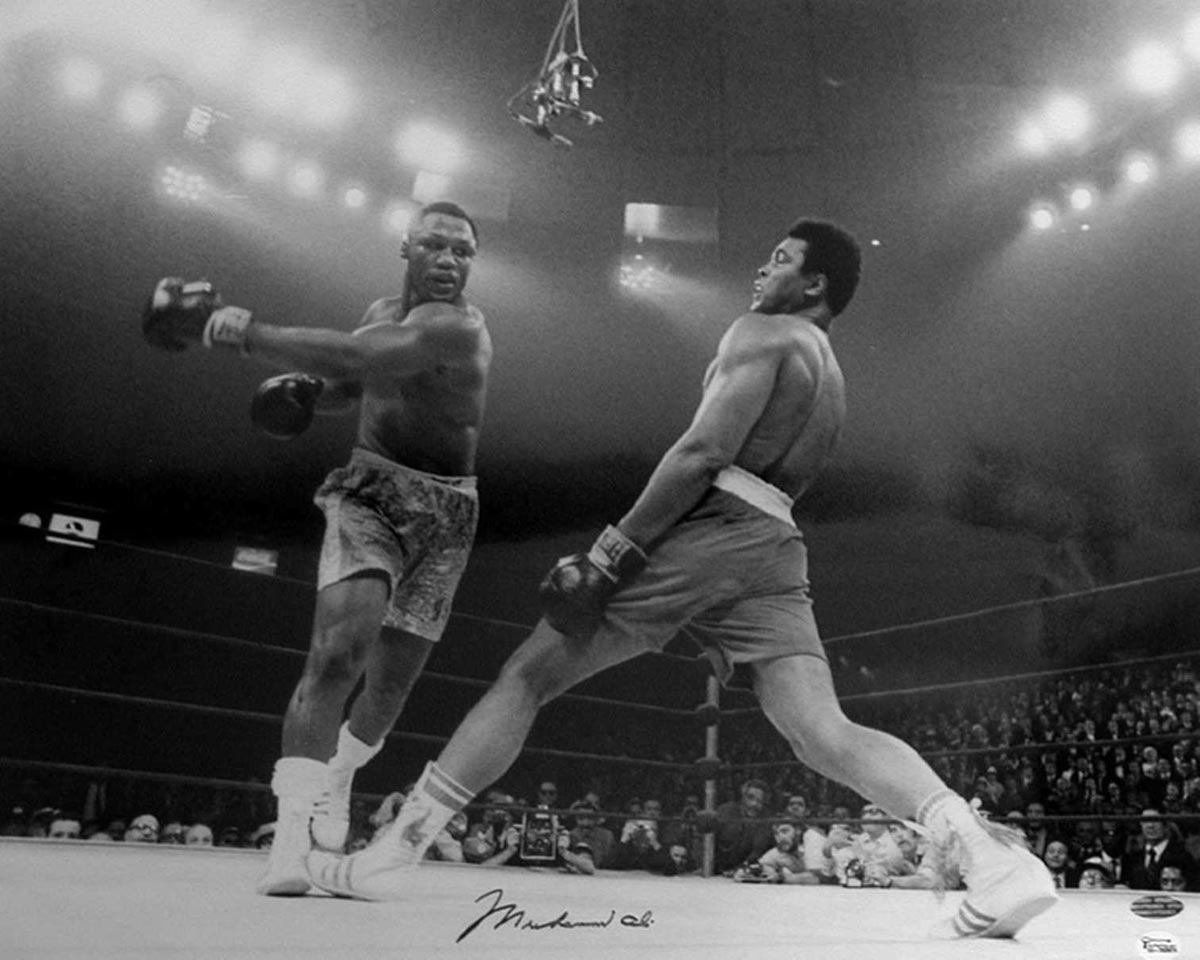
Muhammad Ali vs. Joe Frazier in Fight of the Century, Madison Square Garden in New York City, New York, 1971

The documentary ran on PBS and can be viewed streaming online, but I remain uncertain—despite the power of the documentary—about the American character in 2014 and whether or not we can fully connect with a black man who floated like a butterfly and stung like a bee in a white world.

My reservations, however, do not deter me from recommending that everyone tries by starting with this documentary that forces viewers to confront the uncomfortable.

David Susskind calls Ali a “simplistic fool,” and Jerry Lewis adds that Ali is a “big bag of wind”—just two of numerous scenes in which white men berate and demean Ali.

Ali smiles. Ali jabs with his wit and even with a cool detachment.

Black Nationalism and the Nation of Islam are characters in this documentary, as are Farrakhan, Elijah Muhammad, Malcolm X, Martin Luther King Jr., John Carlos, and Tommy Smith (just to highlight a few)—with Ali always at the center of the tensions this part of U.S. history entails.

The literal trial of Ali was his refusal to serve in Vietnam, but the film also dramatizes in detailed fashion how Ali as a converted Muslim was a trial for Ali and the U.S.

A key scene, for me, is sports writer Robert Lipsyte discussing how the New York Times refused to print Muhammad Ali’s Muslim name, maintaining Cassius Clay, to which Lipsyte states: “Nobody asked John Wayne or Rock Hudson what their names were.”

The history of Ali during the volatile 1960s and into the 1970s, the focus of the documentary, is the history of the U.S. Both are complicated, and both are filled with contradictions.

If you want to come closer to understanding both Ali and the often ignored aspects of U.S. history—the Civil Rights Era that dare not be uttered—then you should view The Trials of Muhammad Ali.

Since viewing the documentary twice, I am left wrestling with Farrakhan smiling as he speaks about Ali battering opponents and taunting them with “What’s my name?”

And now that refrain haunts me as does Ali’s “You must listen to me.”

I am not sure that we must, but I know we should.

For Further Consideration

The Eleven Men Behind Cassius Clay

Malcolm X: A Life of Reinvention, Manning Marable

Middlesex, Jeffrey Eugenides

Seeking Equity: Not “If,” But “How” and “Why”

Pat Tillman (11/6/76 – 4/22/04): A Decade of Forgetting

On the first anniversary of the Boston Marathon bombing, David Zirin highlights a nearly concurrent anniversary:

Two wrenching anniversaries loom in the world of sports. Both are in many respects conjoined by the dominant narratives of the twenty-first century. Both show how the military adventures of the last decade have even breeched the escapist sanctity of the sports page. Both contain elements of tragedy, honor and courage. But you can be sure that one of these anniversaries will get a whole hell of a lot more attention than the other….

April 22 marks ten years since the death of NFL player turned Army Ranger Pat Tillman. Expect the media to take cursory notice and expect a press release from the NFL, but don’t expect much else. That’s because the Pat Tillman narrative doesn’t exactly lend itself to swelling music and sonorous sound bites.

Pat Tillman, if his death is acknowledged at all, will likely be portrayed as a man in uniform—but not as the man he was:

And despite his tragic death being the result of “friendly fire,” despite the now exposed political manipulation of Tillman’s service and death, despite the lies—Tillman, if his death is acknowledged at all, will be misrepresented once again—waved like a flag to keep the public’s gaze distracted:

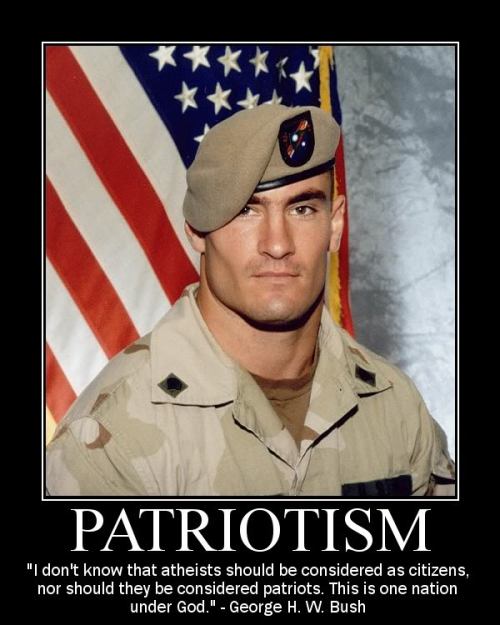
Patriotism?

The truth, however ugly, is available in The Tillman Story (2010), and ESPN offers an Outside the Lines special, Pat Tillman: 10 Years Later an Enduring Tragedy.

The Tillman story, ultimately, is a story about us, about the U.S., about the myths that deform. On the tenth anniversary of Tillman’s death, I invite you to read below a post (revised) from 2012.

“Don’t Ask, Don’t Tell”: There’s a Reason Captain America Wears a Mask

With the release of The Tillman Story (2010), Pat Tillman’s brother, Richard, appeared on Bill Maher’s Real Time and offered yet another narrative of Pat’s life and death, one the Tillman family is willing to tell, but one the American public and political leaders are unwilling to ask about or retell.

Richard was frank and struggling on Maher’s HBO show, which included a clip from Pat’s memorial where Richard made a blunt and impassioned effort to tell the truth about his brother in the face of the political need to maintain American Mythology—even when those myths are deceptive, even when those myths are at the expense of people.

Pat Tillman was a stellar athlete who succeeded in college and rose to unique status in the NFL, where he did a very un-American thing, stepped away from a multi-million dollar contract, to do a very American thing, enlist in the military after 9/11 in order to serve his country. The news and political stories of Tillman’s decision played down the apparent rejection of materialism in Tillman’s volunteering to serve in the military, but the official stories began to craft a narrative starring Pat Tillman as Captain America.

Apparently, we could mask a not-so-subtle challenge to our materialistic existence and consumer culture as long as that masked hero would justify our wars.

Then Tillman died in the line of duty.

Then the U.S. government was exposed for building a story around Tillman’s death that was untrue: Pat was killed by “friendly fire” (a disarming term for an incomprehensible and gruesome fact of wars) and not at the hands of the enemy as officials initially claimed—to Pat’s brother who was also serving and nearby, to Pat’s family, and to the entire country.

Then Richard Tillman, still boiling with anger, said on Maher’s show that Pat should have retaliated in order to save himself against the “friendly fire.”

Beyond the continuing chasm between the real life and death of Pat Tillman and the narratives created around him, the release of the Tillman documentary presents the American public with a story that isn’t very flattering. The Tillman Story depends on the ambiguous meaning of “story,” as a synonym for “narrative” and “lie,” to offer another layer to the growing truths and distortions connected with why Pat Tillman joined the military, how he died, and the complex human being who he was.

Captain America and the Mask of Patriotism

Now, if we place the Tillman stories against the debate in the military over “don’t ask, don’t tell,” we notice that in this culture we endorse masking reality as a good and even honorable thing. We confront the Great American Myth that never allows us to ask, much less tell.

This military policy based on deception is ironically our central cultural narrative, one political leaders perpetuate since their political success depends upon speaking to our cultural myths instead of to reality. We are a country committed to don’t ask, don’t tell.

Pat Tillman’s life story and the corrupted narrative invented by politicians and the military to hide the truth and propagandize at the expense of a man and his life are tragic and personal myths that we are ignoring still. If political leaders will fabricate preferred stories at the expense of a single person, we can expect the same about the institutions central to our democracy, such as our public education system and teachers.

Such is a disturbing confirmation of the “myths that deform” that Paulo Freire cautioned about in his examination of the failures of “banking” concepts of education.

In this new era of hope and change, the Obama administration, we must be diligent to ask and tell, especially when it comes to our public schools. The false dichotomy of Republican and Democrat, conservative and liberal, is a distraction from the reality of political leaders expressing corporate narratives to ensure the balance of power favoring the status quo. Leaders are often compelled to maintain cultural myths because black-and-white messages are politically effective.

President Obama and Secretary of Education Duncan are now leading a renewed assault on public education, and directly teachers, under the banner of civil rights—just as Pat Tillman’s life and death were buried beneath claims of patriotism raised like Captain America’s shield so no one could see behind it.

The reality that Obama and Duncan cannot ask or tell about is poverty—and its impact on the lives and learning of children. Acknowledging poverty is an affront to the American Dream; confronting poverty is political dynamite. Blaming teachers and schools instead without offering the evidence works because this is a message we are willing to acknowledge and hear.

For example, a group from the ruling elite of schools, self-described as “educators, superintendents, chief executives and chancellors responsible for educating nearly 2 1/2 million students in America,” placed themselves squarely in the context of President Obama’s and Secretary Duncan’s charge against teachers and the status quo; their manifesto states: “As President Obama has emphasized, the single most important factor determining whether students succeed in school is not the color of their skin or their ZIP code or even their parents’ income—it is the quality of their teacher.” [1]

The names of the leaders—Klein, Rhee, Vallas—appear impressive, and their sweeping claims are compelling—except that the substance of their message is false.

Narratives are powerful, and telling those narratives requires diligence, a willingness to say something often enough to make the created story sound more credible than reality—until the truth is masked beneath a web of narratives that makes truth harder to accept than the lies that seem to conform to all the myths that deform us (rugged individualism, pulling oneself up by the bootstrap, a rising tide lifts all boats).

“Let’s stop ignoring basic economic principles of supply and demand” speaks to an American faith in the market. “[U]ntil we fix our schools, we will never fix the nation’s broader economic problems” triggers Americans’ blind willingness to compete and an enduring faith in schools as tools of social reform. They are compelling because Americans have been saying them for a century.

Just as the fabricated story of Pat Tillman and his sacrifice justified war.

“I don’t believe that even the best teachers can completely overcome the huge deficits in socialization, motivation and intellectual development that poor students bring to class through no fault of their own” (Walt Gardner) sounds weak, fatalistic, in the face of our myths, the words of soft people eager to shift the blame. It is something we dare not tell.

Just as the smoldering facts of Pat Tillman’s death remain too hard to ask about and too hard to tell.

But only the latter are supported by evidence. But only the latter contradict the Great American Myths about which we dare not ask, we dare not tell.

Captain America wears a mask for a reason: The myth is easier to look at, easier to tell about than the truth hidden underneath—whether we are asking about and looking hard at the death of a complex man, Pat Tillman, or the complex influences of poverty on the lives and learning of children across our country.

[1] See recent evidence to the contrary regarding the claim about zip codes: A Rotting Apple: Education Redlining in New York City, a report from the Schott Foundation for Public Education; and Housing Costs, Zoning, and Access to High-Scoring Schools, a report from Brookings.

Devaluing Teachers in the Age of Value-Added

“We teach the children of the middle class, the wealthy and the poor,” explains Anthony Cody, continuing:

We teach the damaged and disabled, the whole and the gifted. We teach the immigrants and the dispossessed natives, the transients and even the incarcerated.

In years past we formed unions and professional organizations to get fair pay, so women would get the same pay as men. We got due process so we could not be fired at an administrator’s whim. We got pensions so we could retire after many years of service.

But career teachers are not convenient or necessary any more. We cost too much. We expect our hard-won expertise to be recognized with respect and autonomy. We talk back at staff meetings, and object when we are told we must follow mindless scripts, and prepare for tests that have little value to our students.

During the 1980s and 1990s, U.S. public schools and the students they serve felt the weight of standards- and test-based accountability—a bureaucratic process that has wasted huge amounts of tax-payers’ money and incalculable time and energy assigning labels, rankings, and blame. The Reagan-era launching of accountability has lulled the U.S. into a sort of complacency that rests on maintaining a gaze on schools, students, and test data so that no one must look at the true source of educational failure: poverty and social inequity, including the lingering corrosive influences of racism, classism, and sexism.

The George W. Bush and Barack Obama eras—resting on intensified commitments to accountability such as No Child Left Behind (NCLB) and Race to the Top (RTTT)—have continued that misguided gaze and battering, but during the past decade-plus, teachers have been added to the agenda.

As Cody notes above, however, simultaneously political leaders, the media, and the public claim that teachers are the most valuable part of any student’s learning (a factually untrue claim), but that high-poverty and minority students can be taught by those without any degree or experience in education (Teach for America) and that career teachers no longer deserve their profession—no tenure, no professional wages, no autonomy, no voice in what or how they teach.

And while the media and political leaders maintain these contradictory narratives and support these contradictory policies, value-added methods (VAM) of evaluating and compensating U.S. public teachers are being adopted, again simultaneously, as the research base repeatedly reveals that VAM is yet another flawed use of high-stake accountability and testing.

When Raj Chetty, John N. Friedman, and Jonah E. Rockoff released (and re-released) reports claiming that teacher quality equates to significant earning power for students, the media and political leaders tripped over themselves to cite (and cite) those reports.

What do we know about the Chetty, et al., assertions?

From 2012:

[T]hose using the results of this paper to argue forcefully for specific policies are drawing unsupported conclusions from otherwise very important empirical findings. (Di Carlo)

These are interesting findings. It’s a really cool academic study. It’s a freakin’ amazing data set! But these findings cannot be immediately translated into what the headlines have suggested – that immediate use of value-added metrics to reshape the teacher workforce can lift the economy, and increase wages across the board! The headlines and media spin have been dreadfully overstated and deceptive. Other headlines and editorial commentary has been simply ignorant and irresponsible. (No Mr. Moran, this one study did not, does not, cannot negate  the vast array of concerns that have been raised about using value-added estimates as blunt, heavily weighted instruments in personnel policy in school systems.) (Baker)

And now, a thorough review concludes:

Can the quality of teachers be measured the way that a person’s weight or height is measured? Some economists have tried, but the “value-added” they have attempted to measure has proven elusive. The results have not been consistent over tests or over time. Nevertheless, a two-part report by Raj Chetty and his colleagues claims that higher value-added scores for teachers lead to greater economic success for their students later in life. This review of the methods of Chetty et al. focuses on their most important result: that teacher value-added affects income in adulthood. Five key problems with the research emerge. First, their own results show that the calculation of teacher value-added is unreliable. Second, their own research also generated a result that contradicts their main claim—but the report pushed that inconvenient result aside. Third, the trumpeted result is based on an erroneous calculation. Fourth, the report incorrectly assumes that the (miscalculated) result holds across students’ lifetimes despite the authors’ own research indicating otherwise. Fifth, the report cites studies as support for the authors’ methodology, even though they don’t provide that support. Despite widespread references to this study in policy circles, the shortcomings and shaky extrapolations make this report misleading and unreliable for determining educational policy.

Similar to the findings in Edward H. Haertel’s analysis of VAM, Reliability and validity of inferences about teachers based on student test scores (ETS, 2013), the American Statistical Association has issued ASA Statement on Using Value-Added Models for Educational Assessment, emphasizing:

Research on VAMs has been fairly consistent that aspects of educational effectiveness that are measurable and within teacher control represent a small part of the total variation in student test scores or growth; most estimates in the literature attribute between 1% and 14% of the total variability to teachers. This is not saying that teachers have little effect on students, but that variation among teachers accounts for a small part of the variation in scores. The majority of the variation in test scores is attributable to factors outside of the teacher’s control such as student and family background, poverty, curriculum, and unmeasured influences.

The VAM scores themselves have large standard errors, even when calculated using several years of data. These large standard errors make rankings unstable, even under the best scenarios for modeling. Combining VAMs across multiple years decreases the standard error of VAM scores. Multiple years of data, however, do not help problems caused when a model systematically undervalues teachers who work in specific contexts or with specific types of students, since that systematic undervaluation would be present in every year of data.

Among DiCarlo, Baker, Haertel and the ASA, several key patterns emerge regarding VAM: (1) VAM remains an experimental statistical model, (2) VAM is unstable and significantly impacted by factors beyond a teacher’s control and beyond the scope of that statistical model to control, and (3) implementing VAM in high-stakes policies exaggerates the flaws of VAM.

The rhetoric about valuing teachers rings hollow more and more as teaching continues to be dismantled and teachers continue to be devalued by misguided commitments to VAM and other efforts to reduce teaching to a service industry.

VAM as reform policy, like NCLB, is sham-science being used to serve a corporate need for cheap and interchangeable labor. VAM, ironically, proves that evidence does not matter in education policy.

Like all workers in the U.S., we simply do not value teachers.

Political leaders, the media, and the public call for more tests for schools, teachers, and students, but they continue to fail themselves to acknowledge the mounting evidence against test-based accountability.

And thus, we don’t need numbers to prove what Cody states directly: “But career teachers are not convenient or necessary any more.”

National Poetry Month: “What is the message when some children are not represented in those books?”

National Poetry Month 2014 comes not on “little cat feet,” like Carl Sandberg’s “Fog,” but in the wake of Walter Dean Myers and his son, Christopher, responding to reports of the whitewashing of books for children. Walter Dean Myers explains:

But there was something missing. I needed more than the characters in the Bible to identify with, or even the characters in Arthur Miller’s plays or my beloved Balzac. As I discovered who I was, a black teenager in a white-dominated world, I saw that these characters, these lives, were not mine. I didn’t want to become the “black” representative, or some shining example of diversity. What I wanted, needed really, was to become an integral and valued part of the mosaic that I saw around me.

Myers identifies James Baldwin as the moment he discovered what was missing, and then Myers asks:

Books transmit values. They explore our common humanity. What is the message when some children are not represented in those books? Where are the future white personnel managers going to get their ideas of people of color? Where are the future white loan officers and future white politicians going to get their knowledge of people of color? Where are black children going to get a sense of who they are and what they can be?

National Poetry Month 2014 also comes just as we have Baldwin’s Jimmy’s Blues and Other Poems, which includes a beautiful and inspired Introduction by Nikky Finney:

Jimmy’s Blues and Other Poems, James Baldwin

As we search for ways in which to insure that students, as Myers did, find what is missing in the texts students are often required to read, I recommend the poetry of Baldwin and Finney. Along with Finney’s full Introduction above, students can access Finney’s Playing by Ear, Praying for Rain: The Poetry of James Baldwin, and then their poetry (see Nikky Fnney at Poetry Foundation).

These entry points to poetry can then lead to multi-genre/mode/form considerations, such as The Most Powerful Piece of Film Criticism Ever Written—about Baldwin’s The Devil Finds Work. Noah Berlatsky’s essay includes two important links as well to another African American writer, Ta-Nehisi Coates, inspired by Baldwin (see Jose Vilson on Baldwin as well):

Along with seeking texts that have people who look like all our students, we must also consider language. A wonderful bi-lingual poetry unit can be developed from two beautiful and powerful books: Barbara Kingsolver’s Another America and Jorge Luis Borges’s Borges: Selected Poems (see Borges at Poetry Foundation), Kingsolver’s translated from English to Spanish and Borges’s translated from Spanish to English:

Another American
Borges: Selected Poems

Myers ends his essay by confronting how texts represent African Americans and how African American males, specifically, are impacted:

And what are the books that are being published about blacks? Joe Morton, the actor who starred in “The Brother From Another Planet,” has said that all but a few motion pictures being made about blacks are about blacks as victims. In them, we are always struggling to overcome either slavery or racism. Book publishing is little better. Black history is usually depicted as folklore about slavery, and then a fast-forward to the civil rights movement. Then I’m told that black children, and boys in particular, don’t read. Small wonder.

“There is work to be done,” Myers concludes, and National Poetry Month is an ideal time to start, or continue that work.

Additional Reading

Reading Out of Context: “But there was something missing,” Walter Dean Myers

From Baldwin to Coates: Denying Racism, Ignoring Evidence

remnant 20: “your absence will sadden other afternoons”

Assorted thoughts on poetry

James Baldwin: Challenging Authors

Reading, Learning, Teaching Barbara Kingsolver

Photoshop® (the shortest novel imaginable)

Photoshop® (the shortest novel imaginable)
I die fast in this city, outside I die slow
Everywhere I am is just another thing without you in it
“Fashion Coat,” The National
Prologue
i tried to Photoshop® myself
back into the picture
from which you cut me
the process was tedious and slow
because i work from dream and memory
haunting me like welcomed ghosts
Chapter 1
i have been hit twice by cars while cycling
and i cannot remember anything about them
Chapter 2
i remember every moment
from the first time we made love
every detail of your apartment
the position of your bed in the room
the Salvador Dali rose poster i gave you
hanging on your wall near the door
the flush along your neck and face
and every word shared between us
Chapter 3
i remember The National concert in Asheville
and that you were not there beside me swaying
Chapter 4
i remember reading At Night We Walk in Circles
wanting to highlight in blue this sentence:
“Nothing is more deserving of one’s respect,
he told Monica that night, as they lay in bed,
than two young people who’ve found each other.”
i remember i could find only an orange highlighter
and that i could not share about any of that with you
Epilogue
i have discovered that Photoshop®
cannot fabricate the things that matter
especially when the things that matter
are no longer possible and no longer there

College Athletes’ Academic Cheating a Harbinger of a Failed System

Margaret Atwood’s narrator, June/Offred, characterizes her situation in the dystopian speculative world of The Handmaid’s Tale:

Apart from the details, this could be a college guest room, for the less distinguished visitors; or a room in a rooming house, of former times, for ladies in reduced circumstances. This is what we are now. The circumstances have been reduced; for those of us who still have circumstances….

In reduced circumstances you have to believe all kinds of things. I believe in thought transference now, vibrations in the ether, that sort of junk. I never used to….

In reduced circumstances the desire to live attaches itself to strange objects. I would like a pet: a bird, say, or a cat. A familiar. Anything at all familiar. A rat would do, in a pinch, but there’s no chance of that. (pp. 8, 105, 111)

In her reduced circumstances as a handmaid—her entire existence focusing on becoming pregnant by a Commander to whom she is assigned, potentially a series of three before she is cast aside as infertile, thus useless—June/Offred’s fantasies about her Commander turn murderous:

I think about how I could take the back of the toilet apart, the toilet in my own bathroom, on a bath night, quickly and quietly, so Cora outside on the chair would not hear me. I could get the sharp lever out and hide it in my sleeve, and smuggle it into the Commander’s study, the next time, because after a request like that there’s always a next time, whether you say yes or no. I think about how I could approach the Commander, to kiss him, here alone, and take off his jacket, as if to allow or invite something further, some approach to true love, and put my arms around him and slip the lever out from the sleeve and drive the sharp end into him suddenly, between his ribs. I think about the blood coming out of him, hot as soup, sexual, over my hand. (pp. 139-140)

The novel reveals no evidence that June in her life in “former times” has been anything other than a relatively typical young woman with a family and a normal life. Atwood asks readers to consider her reduced circumstances (ones she does not create, ones she has no power to change alone) and how they shape the individuals in this disturbing Brave New World.

Atwood’s “reduced circumstances” are a narrative and fictional examination through a novelist’s perspective—a thought experiment replicated in the graphic novels and TV series The Walking Dead, as the comic book creator Robert Kirkman explains: “I want to explore how people deal with the extreme situations and how these events change [emphasis in original] them. I’m in this for the long haul.”

Research on human behavior has revealed, as well, that the same human behaves differently as the situations around change, what Sendhil Mullainathan and Eldar Shafir in Scarcity: Why Having Too Little Means So Much define as “scarcity” and “slack.” The “reduced circumstances” of The Handmaid’s Tale, then, is a state of “scarcity,” and poverty is one of the most common types of scarcity:

One cannot take a vacation from poverty [emphasis added]. Simply deciding not to be poor—even for a bit—is never an option….

Still, one prevailing view explains the strong correlation between poverty and failure by saying failure causes poverty.

Our data suggest causality runs at least as strongly in the other direction [emphasis added]: that poverty—the scarcity mindset—causes failure.(pp. 148, 155)

Given that we hold highly negative stereotypes about the poor, essentially defined by a failure (they are poor!), it is natural to attribute personal failure to them….Accidents of birth—such as what continent you are born on—have a large effect on your chance of being poor….The failures of the poor are part and parcel of the misfortune of being poor in the first place. Under these conditions, we all would have (and have!) failed. (pp. 154, 155, 161)

We are faced with a perplexing problem that sets up a clash between a powerful cultural ideal (the rugged individual and the allure of individual accountability) against a compelling research base that, as Mullainathan and Shafir offer, suggests individual behavior is at least as likely to represent systemic conditions, and not individual qualities (either those that are fixed or those can be learned, such as “grit”).

Although they may seem unrelated narrowly, two academic cheating phenomena are ideal examples of this perplexing problem—attempting to tease out individual culpability from systemic forces.

One consequence of the high-stakes era of accountability in public education has been the seemingly endless accounts of cheating on high-stakes testing; the most notorious being the DC eraser-gate under the reign of Michelle Rhee but also scandals such as the one in Georgia.

Academic cheating by college athletes has also been exposed recently, notably associated with the University of North Carolina. But college athletes cheating to remain eligible is not anything new; for example, Florida State University has received similar criticism for ignoring or covering up the academic deficiencies of athletes in the past.

It is at this point—the academic cheating and dodging of college athletes—that I want to focus on the concept of “reduced circumstances” and “scarcity” in order to consider where the source of these outcomes lie.

A few additional points inform this consideration.

First, college athletes at Northwestern University are seeking to form a union so that they can gain some degree of autonomy over their circumstances as college athletes—circumstances dictated by the NCAA. This move by athletes themselves appears to match a call by Andre Perry, his being specifically about graduation rates:

Black athletes have no choice but to play a major role in their own success. They must take full advantage of the scholarships afforded to them in spite of the climate. But some athletes have to pay a political price to force institutions to cater to black males’ academic talents. Graduation is a team effort, but black athletes must flex their political muscle to pave a way from the stadiums in January to the graduation stages in May.

Perry’s argument is one that focuses on individual agency and the athletes’ ability to rise above “the climate.”

However, David Zirin, discussing a Meet the Press examination of the NCAA and the circumstances of college athletes, seeks a systemic focus:

Yet far more glaring than the content of the discussion was what the discussion was missing. This is not surprising given the parties sitting around the table, but there was zero discussion about how institutionalized racism animates the amassed wealth of the NCAA, the top college coaches and the power conferences. It does not take Cornel West to point out that the revenue producing sports of basketball and football are overwhelmingly populated by African-American athletes. The population of the United States that is most desperate for an escape out of poverty is the population that has gotten the rawest possible deal from an NCAA, which is actively benefiting from this state of affairs….

The issue of the NCAA is a racial justice issue.

The public and the media, I believe, have already sided with blaming the athletes as well as blaming a failure of leadership and accountability among coaches and university administration, including presidents.

For example, the media has rushed to identify a student paper (a bare paragraph) as an example of the cheating at UNC, a claim now refuted by the whistleblower in the scandal, Mary Willingham. That rush and misrepresentation highlight, however, where the accusatory gaze is likely to remain—on the student athlete as culpable, on the coaches, professors, and universities.

As Zirin asks, what will be missing?

Few will consider that the academic scandal among student athletes at UNC—like the cheating scandals on high-stakes tests in public schools—is powerful evidence of a flawed system, one that places young people in “reduced circumstances” and then their behavior is changed.

As I have argued before [*see the entire post included below] (from a position of my own experiences as a teacher and scholastic coach and as someone who advocates for student athletes), school-based athletics in the U.S. corrupts both sport and academics. The entire scholastic sports dynamic is the essential problem.

There simply is no natural relationship between athletics and academics, and by creating a context in which young people are coerced into academics by linking their participation in athletics to their classroom achievement, we are devaluing both athletics and academics.

So I see a solution to the tension between Perry’s call for athlete agency and Zirin’s call for confronting systemic racism: We must address the conditions first so that we can clearly see to what extent individuals can and should be held accountable.

It seems simple enough, but if student athletes were not required to achieve certain academic outcomes (attendance, grades, graduation), then there would be no need to cheat. Hold athletes accountable for that which is athletic, and then hold students accountable for that which is academic. But don’t continue to conflate the two artificially because we want to create the appearance that we believe academics matter more than athletics (we don’t and they aren’t).

In conditions of scarcity—demanding of anyone outcomes over which that person has no control or no hope of accomplishing without a change in systemic conditions (such as academic outcomes an athlete is not prepared or able to accomplish or closing an achievement gap between populations of students)—the same person behaves differently than if that person were in a condition of abundance or privilege, “slack” as Mullainathan and Shafir call it.

Let’s turn to The Walking Dead, a world created by Kirkman, as he explains, in which “extreme situations…change” people.

In season 4 episode 14, “Look at the Flowers,” Carol, who has already demonstrated her ability to take extreme measures in “reduced circumstances” (season 4 episode 2, “Under My Skin”), offers another example paralleling June/Offred, as Dalton Ross explains:

If you thought Carol had a zero-tolerance attitude when she killed and burned two bodies back at the prison to stop the spread of a deadly virus, tonight she went truly sub-zero. The insanity began when little Lizzie stabbed and killed her sister Mika to prove that she would come back to life, leaving Carol to knife Mika’s brain to stop her from coming back as a zombie. She and Tyreese then had to decide what to do with Lizzie, with Carol saying that, “We can’t sleep with her and Judith under the same roof. She can’t be around other people.” And with that, Carol walked Lizzie outside, told her to “look at the flowers,” and then put a bullet in her brain.

Two children die, one at the hands of Carol, and that scene reminded me immediately of John Steinbeck’s Of Mice and Men, when George shoots his best friend Lenny.

After Lenny has killed Curley’s wife and run away to the hiding spot he and George have already designated, George finds Lenny:

George had been listening to the distant sounds. For a moment he was business-like. “Look acrost the river, Lennie, an’ I’ll tell you so you can almost see it.” (p. 103)

George and Lenny are hired hands, workers, pursuing their own American Dream. That pursuit has been difficult, including George trying to overcome Lenny having the mind of a child guiding the powerful and large body of a man. And it is in this final scene that George, like Carol, finds himself in “reduced circumstances.” While Lenny gazes across the river, George tells the same story he’s told hundreds of times, about the farm they will buy and the rabbits Lenny will tend as his own, and then:

And George raised the gun and steadied it, and he brought the muzzle of it close to the back of Lennie’s head. The hand shook violently, but his face set and his hand steadied. He pulled the trigger. The crash of the shot rolled up the hills and rolled down again. Lennie jarred, and then settled slowly forward to the sand, and he lay without quivering. (p. 105)

Cultural assumptions are powerful lenses for judging outcomes.

If we assume the “dumb jock” stereotype to be true, we point our fingers at the student athletes as cheaters and allow our gaze never to consider that the entire system is failing those student athletes.

If we assume people in poverty are lazy (and use that as a mask for lingering racist stereotypes of African American and Latino/a students and people), we point our fingers and say they simply aren’t trying hard enough; they need “grit.” And we fail to recognize and confront the pervasive racism, classism, and sexism that constitute the “reduced circumstances” of their lives.

Of course, college athletes should not be cheating to maintain their access to participating in sports, but it may be important to consider who is responsible for putting them in that situation to begin with—and who benefits most from maintaining that system.

***

*An Honest Proposal: End Scholastic Sport in the U.S. (originally posted at Daily Kos 14 August 2011)

While teaching the introductory education course at my university, I have taught many of our athletes, and they often immediately make an extra effort to engage with me once I explain to them that I was a high school English teacher for 18 years, including many years as the head soccer coach for the boys and girls teams. I also tell them that my wife is a P.E. teacher as well as a varsity/junior varsity volleyball coach and varsity assistant/junior varsity head soccer coach.

My daughter was an elite high school and club soccer player throughout her academic life as well.

One semester, a young man from England sat in my class as a member of the university’s soccer team. He was a popular and thoughtful young man whose British accent garnered him a good deal of attention, but I was most struck by his willingness to discuss how the U.S. and his native England approached education and sport differently.

Soccer is an interesting sport through which to view those differences since, as this young man personified, many soccer athletes come to the U.S. for their education after they have come to terms with their not attaining the professional career they had been striving to achieve.

Yes, this young man was older than his peers and viewed sport in the U.S. as a ticket to education, but he was quick to note that he thought the direct connection between education and sport in the U.S. is ridiculous; no such connection exists in many countries outside the U.S. where sport is a club, not scholastic, activity.

And when I saw a recent story at Education Week titled “NCAA Approves Higher Academic Standards for Athletes,” I immediately thought about my soccer student from England, and I have been mulling this for some time: It is time we stop not only the charade that is “higher standards for student-athletes,” but also the corrosive connection between education and team sport.

The education reform we should address and never even mention is ending scholastic sports entirely in the U.S.

First, at the philosophical level, by creating an artificial relationship between academics and athletics (consider the unique leverage we use athletics for to coerce children to engage in their academics), we are devaluing both.

If academics truly matter, then why are we spending so much energy bribing and manipulating students to take their studies seriously?

And if athletics are truly less important than academics (along with band, chorus, art, drama, etc.), then why are so many professional lives spent in fields connected to athletics?

The truth is that academics and athletics are valuable in and of themselves, and that no real relationship exists between the two. Children and adults should be allowed and encouraged to engage in either without being held hostage to artificial guidelines—such as grade and graduation requirements for student-athletes in K-12 or college athletics.

In my life and career as an educator, I have witnessed hundreds of young people with gifts and passions that are daily trivialized and dampened because the adult world has fabricated coercive and dishonest mechanisms to shape children in ways that conform to false cultural narratives (high school algebra matters more than basketball, for example).

I have taught students gifted in art, who suffered in real ways taking required math courses; I have taught gifted athletes who were banished from sport teams due to grades, withering in classes and filled with resentment instead of being inspired to turn to their books because their sport was taken away; and I could make a list like this that goes on for pages.

It is both dehumanizing and dishonest to use sport to coerce children and young adults to suffer through the academics that we have deemed essential for them.

Now, on a practical level, athletic teams associated with schools and colleges are at the heart of the culture in the U.S.—parallel to the love and affection for local soccer clubs in England, for example.

I think that cultural aspect of scholastic sport matters and can and should be preserved, but that this is also corrupted by the dishonest and manipulative political game of claiming to have high standards for student-athletes when we know that at all levels these claims are little more than wink-wink, nod-nod.

My solution, then, is to end all scholastic sport in education throughout the U.S. and replace that with a club system that includes schools and colleges fielding club teams.

At the K-12 levels, club teams could be sponsored by any school that wishes to sponsor a team, and these teams would be delineated by age groups—common in club sport—but the schools would not be required to monitor their athletes’ grades or anything related to their schooling (just as we do not require any businesses to monitor their teen employees). In fact, the club associated with the schools would not have to include only students from that school.

K-12 schools would likely focus on community athletes, many of which will be in their schools, but the removal of the false connection between any student’s ability and desire for either schooling or sport would eliminate huge and tedious bureaucracy; corrosive tension among students, coaches, and educators; and superficial and erroneous cultural messages about “what matters.”

Here is also another important and practical matter related to scholastic sport—the inordinate amount of funding and time spent on managing athletics and athletic facilities at the school level. When we alleviate schools of scholastic sport, we also shift facilities to the club level, where public and private entities who wish to preserve sport can step in and assume these responsibilities.

At the college levels, colleges and universities would also field club teams—which could continue to be monitored by the NCAA—but their players would be drawn into those clubs for athletic purposes only, likely as a stepping stone to professional teams. Colleges and universities would be free to offer scholarships to those athletes wishing to attend college, but this would be purely within the purview of the colleges/universities and the athletes who wish to gain an education.

The end of scholastic sport is an end to hypocrisy, it is an acknowledgement that sport and academics both matter, and it is an education reform we never mention but could implement immediately with positive outcomes for everyone involved.

So-called high academic standards for student-athletes are not about students, athletes, or any sort of respect for the academic life. So-called high academic standards for student-athletes are more political pontificating and, worst of all, more of the tremendous coercion practices at the heart of a misguided American culture that claims one thing—the pursuit of individual freedom and democracy—while instituting another—the codifying of indoctrinating and manipulating the country’s children through our foundational institutions.

Ending scholastic sport is the first step toward honoring sport, academics, and the humanity of the youth of our free society.

educator, public scholar, poet&writer – academic freedom isn't free