
Relaxing zero tolerance in schools could be Obama’s boldest civil rights reform
Category Archives: education
Reclaiming “No Excuses”: A Reader
With Waiting for excuses for the inexcusable, Leonard Pitts Jr. offers us all a watershed moment—one that involves reclaiming the language and the narratives in order to take direct action against the one thing we refuse to acknowledge or change in the U.S., racism.
“What excuses will they make this time?” Pitts begins, emphasizing:
Meaning that cadre of letters-to-the-editor writers and conservative pundits who so reliably say such stupid things whenever the subject is race. Indeed, race is the third rail of American conscience; to touch it is to be zapped by rationalizations, justifications and lies that defy reason, but that some must embrace to preserve for themselves the fiction of liberty and justice for all. Otherwise, they’d have to face the fact that advantage and disadvantage, health and sickness, wealth and poverty, life and death, are still parceled out according to melanin content of skin.
And then Pitts makes a case that must stand as a model for any and all who seek the sort of equity and dignity that political leaders pay lip service to while ensuring nothing of the kind: Pitts presents evidence in the face of ideological claims with no basis in evidence:
One waits, then, with morbid fascination to see what excuse those folks will make as federal data released last week reveal that African-American children are significantly more likely to be suspended – from preschool. Repeating for emphasis: public preschool, that phase of education where the curriculum encompasses colors, shapes, finger painting and counting to 10. Apparently, our capacity for bias extends even there. According to the Department of Education, while black kids make up about 18 percent of those attending preschool, they account for 42 percent of those who are suspended once – and nearly half of those suspended more than once.
Let us then all confront The Undeniables:
- Ideological narratives and policies built on those narratives—”grit,” “no excuses,” and “zero tolerance”—are almost exclusively driven by the privileged.
- Those same policies and narratives are almost exclusively imposed on marginalized groups of students—African American, Latino/a, impoverished (see for example, the KIPP model, its primary focus, and its mantra: Work hard. Be nice.).
- The consequences of those narratives and policies serve to maintain the interests of the privileged at the expense of the marginalized.
As I have been arguing repeatedly because the evidence is overwhelming: Anyone denying racism in the U.S. has an evidence problem (See Denying Racism Has an Evidence Problem, The Mistrial of Jordan Davis: More Evidence Problems for Denying Racism, From Baldwin to Coates: Denying Racism, Ignoring Evidence).
Yes, it is time for “grit” (often defined as “perseverance and passion for long-term goals”). We must not waver from demanding an end to inequity in the form of racism, classism, and sexism.
Yes, it is time for “no excuses.” As Pitts explains, there are no excuses for the “made up facts,” the dodges, and the fabricated fairy tales designed to maintain the current imbalance of opportunity in the U.S. (see the Gritty White Hope lesson on Steve Jobs presented by NPR without any criticism).
Yes, it is time for “zero tolerance.” We must have zero tolerance for the false narratives (see the roots of seeking ideological narratives to prop up capitalistic goals) perpetuated by the privileged to keep most everyone else in a state of the compliant worker.
And thus, a reader:
Waiting for excuses for the inexcusable, Leonard Pitts Jr.
The Secret Lives of Inner-City Black Males, Ta-Nehisi Coates
Black Pathology and the Closing of the Progressive Mind, Ta-Nehisi Coates
The New Jim Crow, Michelle Alexander
Prekindergarteners Left Behind: Expulsion Rates in State Prekindergarten Programs, Walter S. Gilliam (2005)
Implementing Policies to Reduce the Likelihood of Preschool Expulsion, Walter S. Gilliam (2008)
Police in the Hallways: Discipline in an Urban High School, Kathleen Nolan
Denying Racism Has an Evidence Problem
The Mistrial of Jordan Davis: More Evidence Problems for Denying Racism
End Zero-Tolerance Policies: A Reader
Civil Rights Issue of Our Time?
Beyond “Doubly Disadvantaged”: Race, Class, and Gender in U.S. Schools and Society
Snow Blind: “Trapped in the Amber of This Moment”
What is wrong with the following claims?
- The rich and successful are rich and successful because of their work ethic.
- The poor are poor because they fail to take advantage of the American Dream.
- Women are paid less than men because they choose fields/careers that pay less and choose family over career.
- Prisons are overwhelmingly populated by African Americans because they are trapped in the cycle of poverty.
- Work hard and be nice.
- Education, especially college, is the main path for rising above the conditions of any person’s home or community.
Before I examine the answer, consider this enduring claim:
- In 1492, Columbus sailed the ocean blue, and thus, Columbus discovered America. [The original poem ends “The first American? No, not quite./ But Columbus was brave, and he was bright.”]
And how about this blast from the past:

Gallup brought science to that process. Richard Smith tells how, by the time Landon challenged Roosevelt, the prestigious Literary Digestmagazine was America’s leading pollster. The Digest featured a regular poll called “America Speaks.” It drew samples from phone books and auto registrations. Gallup knew that such samples were biased toward people with means….
Then, in 1948, Gallup blew the Truman-Dewey prediction. How? His mistake was to quit polling two weeks before the election with fourteen percent of the electorate still undecided. After that humiliation, Gallup went back to analyze his error. He emerged with the maxim, “Undecided voters side with the incumbent.”
By 2012, then, you’d think polling would have reached some higher and clearer process for predicting presidential outcomes, but instead, we had the Nate Silver element, yet another case about how the science of polling has flaws, human flaws.
Even, it seems, as science inspects itself—acknowledging and addressing confirmation bias, for example—we are always “trapped in the amber of this moment,” since the human condition is itself necessarily a subjective experience.
And now, in order to answer my initial question, I want to turn to history; while history as a discipline is distinct from the hard sciences, both are dependent on evidence and then the conclusions drawn from that evidence—conclusions I call narratives (more on that below). Consider Howard Zinn on Christopher Columbus:
My viewpoint, in telling the history of the United States, is different: that we must not accept the memory of states as our own. Nations are not communities and never have been, The history of any country, presented as the history of a family, conceals fierce conflicts of interest (sometimes exploding, most often repressed) between conquerors and conquered, masters and slaves, capitalists and workers, dominators and dominated in race and sex. And in such a world of conflict, a world of victims and executioners, it is the job of thinking people, as Albert Camus suggested, not to be on the side of the executioners.
Thus, in that inevitable taking of sides which comes from selection and emphasis in history, I prefer to try to tell the story of the discovery of America from the viewpoint of the Arawaks, of the Constitution from the standpoint of the slaves, of Andrew Jackson as seen by the Cherokees, of the Civil War as seen by the New York Irish, of the Mexican war as seen by the deserting soldiers of Scott’s army, of the rise of industrialism as seen by the young women in the Lowell textile mills, of the Spanish-American war as seen by the Cubans, the conquest of the Philippines as seen by black soldiers on Luzon, the Gilded Age as seen by southern farmers, the First World War as seen by socialists, the Second World War as seen by pacifists, the New Deal as seen by blacks in Harlem, the postwar American empire as seen by peons in Latin America. And so on, to the limited extent that any one person, however he or she strains, can “see” history from the standpoint of others.
In other words, shaping narratives bound by evidence does not insure that those narratives are pure and certainly does not insure that those narratives are above bias or absent the urge to mold them in order to secure someone’s agenda (likely someone in power). [1]
Snow Blind
Misleading narratives around Columbus or “I cannot tell a lie” George Washington—and the whitewashing of Steve Jobs to promote the “grit” narrative (compare the Jobs lesson to the original 1492 poem about Columbus)—are not problematic because of the evidence, but because of the lens through which the narratives are shaped and by whom those narratives are created and in whose interest.
Consider Billy Pilgrim in a telepathic conversation with a Tralfamadorian in Kurt Vonnegut’s Slaughterhouse Five:
“Welcome aboard, Mr. Pilgrim,” said the loudspeaker. “Any questions?”
Billy licked his lips, thought a while, inquired at last: “Why me?”
“That is a very Earthling question to ask, Mr. Pilgrim. Why you? Why us for that matter? Why anything? Because this moment simply is. Have you ever seen bugs trapped in amber?”
“Yes.” Billy, in fact, had a paperweight in his office which was a blob of polished amber with three ladybugs embedded in it.
“Well, here we are, Mr. Pilgrim, trapped in the amber of this moment. There is no why.”
And that brings me to the “grit” debate, one in which advocates point to scientific research and prestigious grants. From that evidence, we have three contexts of narratives: disciplinary narratives (Angela Duckworth, Carolyn Dweck), popular narratives (Paul Tough, Jay Mathews), political narratives (Arne Duncan, Michelle Rhee)—all of which are trapped like bugs in amber, or as I prefer to suggest, that “grit” narrative advocacy is snow blind.
If evidence and the narratives surrounding the evidence appear to support a privileged agenda, and since the privileged have a larger megaphone in a culture, then that evidence and narrative are disproportionately likely to gain momentum—regardless of how accurate they are in the context of the oppressed or marginalized (consider again history and the Zinn points above).
And that inability by the privileged to see beyond their privilege is, I think, a state of being snow blind.
Thus, my answer to the initial question at the beginning is that those claims as narratives built on evidence are ideological distortions of the evidence. The “grit” narrative is similar to the education = income argument that falls apart when analyzed: Education is a marker for privilege (since privilege leads to advanced education) just as “grit” qualities are markers for privilege.
Systemic Inequity v. Rugged Individualism
In Slaughterhouse Five, the work of Howard W. Campbell (previously the main character in Vonnegut’s Mother Night) is quoted:
America is the wealthiest nation on Earth, but its people are mainly poor, and poor Americans are urged to hate themselves….
Americans, like human beings everywhere, believe many things that are obviously untrue….The most destructive untruth is that it is very easy for any American to make money. They will not acknowledge how in fact hard money is to come by, and, therefore, those who have no money blame an blame and blame themselves. This inward blame has been a treasure for the rich and powerful, who have had to do less for their poor, publicly and privately, than any other ruling class since, say, Napoleonic times. (pp. 164, 165)
Snow blind and bugs trapped in amber, the privileged by their privilege and the impoverished by the blinding but misleading promise of the American Dream—the narratives become the product of those who shape them and for whose benefit, regardless of the evidence, the artifacts, the data.
Let me end, then, with a couple of points to consider, one from the 1973 satire Sleeper [2] and the other from Vonnegut’s Cat’s Cradle.
First, a scene from the film:
And then, John and Mona in Cat’s Cradle discuss Boko-maru (a sacred foot ceremony) and their culturally-bound and conflicting perceptions of love:
“Mona?”
“Yes?”
“Is—is there anyone else in your life?”
She was puzzled. “Many,” she said at last.
“That you love?”
“I love everyone.”
“As—as much as me?”
“Yes.” She seemed to have no idea that this might bother me….
“I suppose you—you perform—you do what we just did—with other people?’
“Boko-maru?”
“Boko-maru.”
“Of course.”
“I don’t want you to do it with anybody but me from now on,” I declared.
Tears filled her eyes. She adored her promiscuity; was angered that I should try to make her feel shame. “I make people happy. Love is good, not bad.”
“As your husband, I’ll want all your love for myself.”
She stared at me with widening eyes. “A sin-wat!”
“What was that?
“A sin-wat!” she cried. “A man who wants all of somebody’s love. That’s very bad.” (pp. 207-208)
John is trapped in the amber of the moment, his patriarchal and possessive love leaves him snow blind to Mona’s perspective. He either cannot see, or refuses to see.
So I have made a decision—one shared by Zinn, expressed by Eugene V. Debbs, and reflected in the research of Sendhil Mullainathan and Eldar Shafir—that the perspectives of the marginalized must be honored in the context of systemic inequities.
This is a position of humility and a recognition that any human arrogance—whether it be scientific or not—is likely to lead to the sort of pettiness captured in the Sleeper clip: both the satire aimed at the foolish dietary beliefs of the past and the incredulity of the scientists in the film’s present (“You mean there was no deep fat…?” exposes that despite the scientists recognizing the misguided stances of the past, they remain trapped in their own certainty).
Both the “grit” narrative and the “grit” research fail that litmus test. They both speak from and to a cultural norm that privileges individual characteristics (rugged individualism) as if they are indistinguishable from the systemic context of privilege (again, a claim refuted by Mullainathan and Shafir, but that narrative doesn’t serve the privileged, and thus, isn’t embraced as the “grit” narrative is).
“Many novelties have come from America,” the cited monograph from Campbell notes, adding:
The most startling of these, a thing without precedent, is a mass of undignified poor. They do not love one another because they do not love themselves. (p. 165)
The human intellect is a wonderful thing, and thus, we must pursue our efforts to understand the world and the human condition—a thing we call science. But as humans, it is not ours to somehow remove our basic humanity from that process (the folly of objectivity), but to choose carefully just how we shape the narratives from the evidence we gather.
I am then compelled to manipulate Einstein once again. His “Science without religion is lame, religion without science is blind,” I think, is a call for the necessity of human kindness, decency, and compassion in the shaping of our narratives. The “grit” narrative does no such thing. It is a snow blind story that is also deaf to the basic human dignity shared among all people.
Your Honor, years ago I recognized my kinship with all living beings, and I made up my mind that I was not one bit better than the meanest on earth. I said then, and I say now, that while there is a lower class, I am in it, and while there is a criminal element I am of it, and while there is a soul in prison, I am not free.
Eugene V. Debs: Statement September 18, 1918
[1] See Robert Pondiscio’s citing of Kurt Vonnegut’s “Harrison Bergeron,” a misleading use of Vonnegut in the name of choice that is well outside Vonnegut’s ideological leanings; see my posted comment.
[2] While citing a Woody Allen work is problematic, I am in no way endorsing Allen or any efforts to absolve him of guilt or responsibility in the ongoing controversy surrounding him.
Conditions v. Outcomes: More on What’s Wrong with Teacher Education (and Accountability)? pt. 2
After posting What’s Wrong with Teacher Education?, I received comments and responses that are fairly represented in the comments at the original post from Peter Smyth and psmagorinsky (Peter Smagorinsky). For full disclosure, these two Peters are acquaintances that I respect a great deal, and thus, take their comments quite seriously.
To Peter Smyth’s concern (voiced by a few others offering feedback), I can clarify that my original post is a rejection of certification and a call for the need for rich and deep education degrees; thus, my argument in no way endorses Teach for America or other alternative certification programs that inherently avoid and marginalize education degrees (which are in fact the antithesis of my argument).
Peter Smagorinsky’s comment—notably “At the same time, I think that if we are constructed as being against being accountable for our teaching, we not only lose the PR battle, we are dodging responsibility for the end result of our teacher education”—requires a bit more explanation so I ask that you allow me to offer a series of personal anecdotes to make my case.
•
The summer of 1975 was traumatic for me and my family since I was diagnosed with scoliosis, requiring my parents to pay for and me to wear an elaborate and expensive back brace. This ordeal lasted from my 9th through my 12th grades.
Setting aside the personal angst from wearing a large back brace during my gangly and painfully self-conscious teen years, I have detailed that this experience with scoliosis became the breeding ground for my extensive comic book collection as well as many hours and years spent teaching myself to draw.
Since the brace made sitting nearly impossible, I began to stand at the end of the long bar that separated my family’s kitchen and living room. There I at first traced my favorite comic book superheroes from my collection; soon I began drawing freehand. Eventually, I was drawing large portraits of entire comic book panels and dramatic scenes—first carefully creating the artwork in pencil and then inking the works reflecting the comic book process (I even did some coloring over the years, again mimicking the comic book industry).
Over about 5 or 6 years, I became a fairly accomplished artist, branching our beyond comic book artwork to realistic pencil drawings (often from photography). For the purposes of this blog post, I want to emphasize that at no point did I ever have any formal courses, no teacher of any kind related to being a visual artist.
I read and studied comic books, I researched how comic book art was created, and I bought a few art books, mostly large books of sketches to use as practice.
•
Overlapping my teenage years spent collecting comic books, teaching myself to draw, and contemplating a career as a comic book artist, I grew up on a golf course, where I worked (both in the club house as an assistant and at the pool as a lifeguard). I also spent many hours of my life hitting range balls (often 300 at a time) and playing 18-27 holes of golf many days each week.
Yes, I also contemplated the life of the professional golfer.
While in college, I secured an assistant pro job at a different golf course, where I spent a good deal of time talking with two professional golf instructors. These men gave golf lessons on the course driving range and sometimes on the course itself.
One golf pro had never had a career as a touring pro, and I was able to shoot scores similar to his. The other had briefly played on the tour in the Ben Hogan era, but his promise of a tour career was cut short by a car accident.
From talking with these two golf instructors and watching their work and their students, I recognized something incredibly important: Most of the people taking the lessons essentially stayed about the same in their ability to score on the golf course. The older golf instructor often said directly to me that he could teach anyone the proper grip and motions in a golf swing, but that beyond that, the outcomes of how any person played golf was really not something he could teach or control.
With learning to play golf, technique, physical aptitude, practice, and such were all intricately intertwined. Few people practiced or played as much golf as I did in those years, and I was never going to be a touring professional. Never. (Likely too, I was never going to be a professional comic book artist.)
•
About twenty years after those teen and early 20s years, I had become a public school English teacher; my life was steeped in reading and writing (now traceable to those comic books I was also reading voraciously along with science fiction).
A few years after receiving my EdD, I was fortunate to be the lead instructor for the Spartanburg Writing Project in their summer institutes for teachers. In that first summer, a beginning teacher, Dawn Mitchell (who would go on to teach and work for SWP as well as adjunct where I now work in teacher education), and I began working on her efforts to write poetry. Dawn was a wonderful teacher, a gifted writer of prose, and an eager as well as frequent reader.
When I read her poem drafts, however, I felt she had not attained the same genre/form awareness about poetry that she displayed about prose.
I had been writing poetry since my freshman year of college, had published a fair number of poems (see “horea,” “Mary (sea of bitterness),” and “quilting”), and had been teaching high school students to write poetry for almost twenty years. Four of my high school students’ poems were included in one of my earliest articles in English Journal, in fact (see Ashley Mason and Leigh Hix here; Lauren Caldwell and Kris Harrill here).
The summer institute workshop format allowed Dawn and me an ideal opportunity for examining how to develop poetic sensibilities. And Dawn’s work as a poet soon rose to the fine level of her prose.
While Dawn was growing as a writer and poet, I too was learning to hone my craft not as a poet, but as a teacher of writing poetry—developing the ability to mine craft from reading poetry and helping writers transfer those craft lessons into their original work.
Of the many things I teach, I remain convinced teaching someone to write poetry is possibly my most refined skill.
That said, I cannot claim ever that I can produce a poet from that teaching as acts themselves that must be viewed as their own evidence of quality.
•
What does all this have to do with what’s wrong with teacher education, broadly, and Smagorinsky’s concern, narrowly?
First, teachers and formal teaching are important, but not necessary or easily defined, aspects of learning, especially as that learning manifests itself in some observable outcomes—as my learning to draw is but one example.
Thus, seeking to identify direct, isolated, and causational relationships among teachers, teaching, learning, and observable learning outcomes is simplistic and a fundamental misrepresentation of each of these.
No teacher can be involved when a learner produces outstanding outcomes. A poor teacher can be involved when a learner produces outstanding outcomes. And a brilliant teacher can be involved when a learner produces weak outcomes.
Why?
Because a teacher of anything has control only over the conditions of the learning experience—as my second and third example are offered as evidence.
Golf instructors and teachers of writing poetry can never promise skilled golfers or brilliant poets. Many other elements besides the teachers or the teaching are involved—and such is the case with all teaching and learning.
And therein lies my essential disagreement with continuing to focus on learner outcomes when seeking accountability for teachers and teaching.
How did I teach myself to draw? All of the conditions necessary were provided or occurred—incredibly supportive parents who bought the comic books and art supplies, my own unfortunate situation with scoliosis, my fortuitous discovery of a proclivity for visual art, and my own intrinsic motivation that fueled my hours and hours of practice. (By the way, I think I would have benefited greatly from a professional teacher, but the conditions in which I taught myself are evidence of how important conditions are in contrast to a teacher.)
In the larger picture, however, elite golfers, visual artists, and poets cannot be taught to be elite. A substantial number of unpredictable elements are involved, and direct teaching and teachers are important but not even necessary.
Learner outcomes are simply not credible artifacts for teacher or teaching quality.
Teacher education (and teaching accountability) must set aside that paradigm of accountability, and begin to focus on the conditions of teaching instead.
Admitting that teacher education cannot guarantee teacher quality from their programs is not a cop-out. It is the same as the golf instructor who despite his best efforts cannot guarantee golfer quality, the teacher of poetry who cannot guarantee a poet.
By continuing to pretend that teacher quality is the most important element in student learning, we are in fact devaluing and misrepresenting the importance of teachers and teaching.
The Politics of Misinformation in Education Reform
Appointed and elected officials related to education have some important characteristics in common. Consider U.S. Secretary of Education Arne Duncan and South Carolina Superintendent of Education Mick Zais.
Neither have experience or education in the field of K-12 education, despite their primary responsibilities being related to K-12 education.
And because of their appointed (Duncan) or elected (Zais) position, they have a primary and nearly unchallenged voice in both the narratives about education and the policies implemented in public schools.
As well, since they have that access, Duncan and Zais often conduct tours and speeches promoted as informational or celebratory, but always use those masks to achieve something quite different: driving a set of ideologies and narratives that are mostly misinformation.
Superintendent Zais has been touring SC under the guise of celebrating successful schools in the state, but at each stop, he, instead, offers passive-aggressive and unsubstantiated claims directed less at the schools he appears to be praising than at other schools, teachers, and students.
Zais presents this pattern of misinformation in a commentary for The Greenville News (21 March 2014), which begins:
I am writing to set the record straight about public education in South Carolina.
The opening points made by Zais focus on his claim that funding and poverty levels are not the key determining factors in how successful schools are. To make that case he identifies two schools directly:
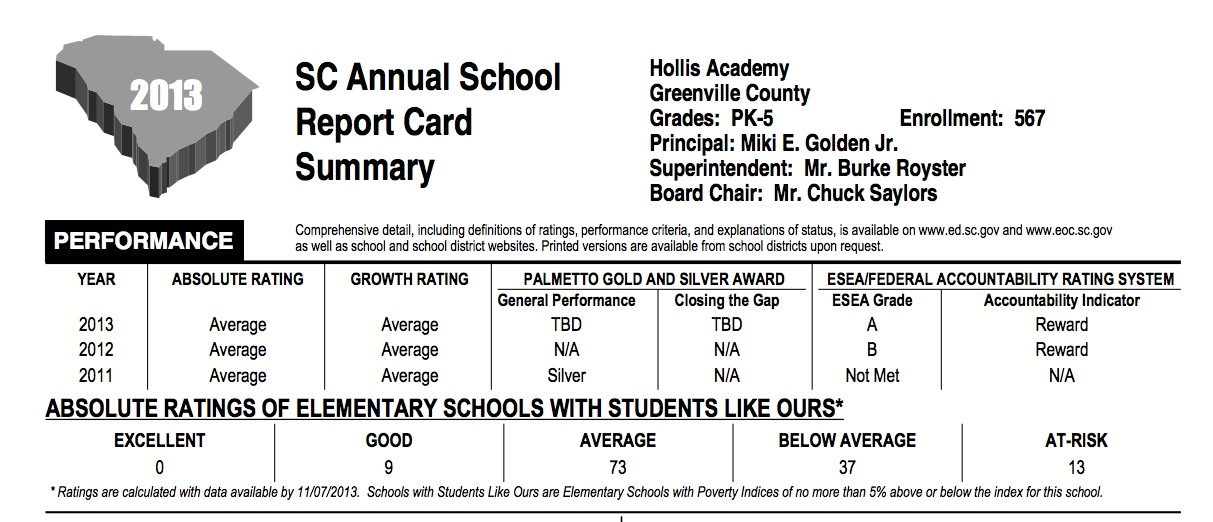
In Greenville County School District, Hollis Academy Elementary School has a poverty rating of 99 percent and received a grade of 97 percent, an A, on their federal report card. It’s one of the highest performing elementary schools in South Carolina. Welcome Elementary School is also in Greenville County. It has virtually identical demographics and received a grade of 47 percent, an F, on their report card.
Hollis Academy Elementary School (99.48 PI) and Welcome Elementary School (98.32) as high-poverty schools in the same school district (Greenville County) do appear to make Zais’s case, except he fails to identify the SC school report card data—ones that provide an important metric, “schools like us.”
On the 2013 school report cards (issued by the SC Department of Eduction which Zais heads), Hollis Academy Elementary School receives an absolute rating of “Average,” which is essentially typical of “schools like us” (Excellent, 0; Good, 9; Average, 73; Below Average, 37; At-Risk, 13):
On the same report card, Welcome Elementary School receives an absolute rating of “Average,” which is essentially typical of “schools like us” (Excellent, 0; Good, 10; Average, 85; Below Average, 43; At-Risk, 15):

Two points must be highlighted, if we seek to set the record straight: Hollis and Welcome are relatively similar in their composition and their outcomes; however, as the data above suggests (the numbers are different, note, in the range of “schools like us”), Hollis and Welcome are not identical in populations served.
Thus, the only way Zais can make his case is to cherry-pick data, conveniently omit data, and then make a really mean-spirited claim for which he offers no data:
The difference between high poverty schools that are excelling and those that are failing is neither funding, the education level of the parents, nor demographics. It’s the competence of the adults in the system. Where schools have capable principals and effective teachers, poor kids will learn.
The sweeping claims made by Zais, however, are not supported by the research base—and not once does Zais offer any evidence from research showing that “competence of the adults in the system” is a determining factor in student outcomes. Not once (notably because such evidence doesn’t exist).
Teacher quality (and VAM advocacy), “more with less,” funding doesn’t matter, and X practices and/or teacher quality can add “days of learning” or “years of learning”—all of these claims have been debunked:
- Estimated Versus Actual Days Of Learning In Charter School Studies
- Does Money Matter in Education?
- Do Top Teachers Produce “A Year And A Half Of Learning?”
- More with Less or More with More & Why it Matters!
- Review [UPDATED]: “How to Evaluate and Retain Effective Teachers” (League of Women Voters of SC)
Just as Duncan has continued a legacy among recent USDOE Secretaries of Education (Paige, Spellings), Zais represents the politics of misinformation in education reform that exposes our appointed and elected education officials as either incompetent or dishonest—neither quality suggesting that they should be driving our education narratives or policies.
Talk about the Passion
The best lack all conviction, while the worstAre full of passionate intensity.
All across the upstate of South Carolina recently, yard signs have been appearing: Stop Common Core (see the one held in the photo below):

For those of us who have rejected the Common Core movement from the beginning, however, these signs are more a message about the “passionate intensity” of the worst and that “the best lack all conviction”:

The most fervent and vocal Common Core challengers, as the organization and signs above represent, are people making baseless claims: Common Core standards were written by Bill Ayers (they weren’t), Common Core standards are a communist plot by Obama (they are the product of the National Governors Association), and the list goes on—just search Michelle Malkin or Glenn Beck on Common Core.
While the misinformed are galvanized and passionate in their efforts to stop Common Core, the vast majority of educators have committed themselves to doing as they are told—scrambling as best they can to implement Common Core.
The reasons to reject Common Core are important and relatively clear—reasons based in the research base that shows no correlation between the presence or quality of standards and student outcomes, that shows no correlation between standards and achieving equity, and that shows the enormous costs of implementing new standards and new high-stakes tests are unlikely to produce returns to justify those costs.
And the irony is that the uninformed and misinformed movement against Common Core—a rabid group that appears to see Common Core as a harbinger of the Apocalypse, worthy of Yeats’s “The Second Coming” or Robert Frost’s “Fire and Ice”—is evidence itself that “passionate intensity” trumps reason, research, expertise, and experience—notably when those armed with reason, research, expertise, and experience “lack all conviction.”
To paraphrase Einstein, the Common Core debate shows us that knowledge without passion is lame, passion without knowledge is blind.
For teachers, it is well past time to talk about the passion.
Combien de temps?
—
R.E.M., Murmur
Empty prayer, empty mouths, combien reaction
Empty prayer, empty mouths, talk about the passion
Not everyone can carry the weight of the world
Not everyone can carry the weight of the world
Talk about the passion
Talk about the passion
Empty prayer, empty mouths, combien reaction
Empty prayer, empty mouths, talk about the passion
Combien, combien, combien de temps?
Not everyone can carry the weight of the world
Not everyone can carry the weight of the world
Combien, combien, combien de temps?
Talk about the passion
Talk about the passion
(repeat)
What’s Wrong with Teacher Education?
I belong to two communities that are central to my life—educators and cyclists.
So when a cyclist and friend sent me an article on the importance of how cyclists conduct themselves as groups on the roads, I was struck by the opening quote included by the writer, Richard Fries:
“We have met the enemy and he is us.” —Walt Kelly, Pogo
Immediately, the spirit of the article—many times motorist antagonism toward cyclists can be traced to cyclist behavior—resonated with me as someone who has been cycling seriously for about 30 years, including a great deal of time and effort spent posting and leading group rides. But the sentiment of this piece on group cycling also spoke to me as a teacher and teacher educator because when I ponder what is wrong with teacher education, I notice that the enemy is often us—teachers and teacher educators.
Gerardo M. Gonzalez, dean of the school of education at Indiana University Bloomington, examines the current state as well as the political and public perception of teacher education in Defining Teacher-Prep Accountability:
Much has been written and discussed of late about the debate over the best method of assessing teacher-preparation programs. As the dean of the school of education at Indiana University Bloomington, I understand that meaningful assessment of teacher preparation requires a multifaceted approach based on a robust research methodology and focused on program outcomes. A sound study, as researchers know, begins with a viable research question. The design and method of data collection then flow from that question. Moreover, the scientific validity of conclusions reached on the basis of the data depends on the ethical application of research principles and, where appropriate, validation of results through peer review and replication.
Two important aspects of Gonzalez’s commentary occur in the opening: He acknowledges the impact and influence of National Council on Teacher Quality (NCTQ) and then takes a firm stand against NCTQ’s reports and methodologies.
NCTQ’s reports have received essentially free passes by the mainstream press, but have been discredited in detail among researchers, educators, and bloggers. That dynamic is a powerful picture of the larger context of what is wrong with teacher education.
First, teacher education (like public schools and public school teachers) is not failing in the ways claimed by NCTQ—or other think tanks, political leaders and appointees, and the mainstream media.
Second, the noise created by NCTQ and others promoting misinformation masks the very real ways in which teacher education is failing (and, again, this parallels a similar pattern found in education reform more broadly; see An Alternative to Accountability-Based Education Reform).
While I applaud Gonzalez and Indiana University for taking a politically unpopular but credible and evidence-based stance against NCTQ (too few in teacher education did take that stand), the last part of Gonzalez’s commentary reveals just what is wrong with teacher education.
In the outline offered by Gonzalez, accountability based on standards and outcomes is, once again, reinforced:
If I were to design a study to hold preparation programs accountable for their graduates’ performance, as the group Teach Plus Indianapolis has challenged me to do, I would start with the question of whether a given teacher-preparation program produces graduates who can work effectively in school classrooms to increase student learning and achieve other valued educational outcomes. Then, I would select or create appropriate measures of student learning and related educational outcomes, as well as ways to assess teacher effectiveness on the impact of those measures.
And therein lies the problem.
What’s wrong with teacher education? In brief, the problem with teacher education is the maze of bureaucracy that constitutes certification and accreditation.
And that maze of standards (and the perpetual changing of those standards) feeds a misguided overarching paradigm: accountability linked to outcomes.
In both education reform and teacher education, accountability is misguided and it causes more harm than good—notably because the traditional accountability paradigm seeks to hold one agent accountable for the outcomes of other agents, whether that be teachers accountable for student test scores or colleges/departments of education accountable for the student test scores of their candidates.
That accountability fails because the focus is on outcomes, and those outcomes are outside the control of the agent being held accountable.
Additionally, since that accountability is flawed, those agents being held accountable are reduced to documenting meticulously that they have served the standards as a defense against their inability to control the outcomes.
The result is dysfunctional because too much of both teacher educator’s and educator’s time is spent correlating their lessons and assessments with standards (and not enough time preparing by studying the content of their field and the needs of their students), and then wasting a tremendous amount of time completing the external mandates related to certification and accreditation.
Gonzalez mentions the Council for the Accreditation of Educator Preparation (CAEP)—which ironically represents the fundamental flaw with the entire accreditation process since this organization is a new version of two earlier accreditation organizations. Accreditation (like certification) is a minefield of every-moving targets, a bureaucratic process for the sake of being bureaucratic. In fact, the only constant in the worlds of certification and accreditation is that both perpetually change—always in pursuit of the right (or next) standards.
CAEP will no better serve teacher education than Common Core will save K-12 public education. We have decades of evidence that these processes have never worked, and we have no evidence that anything different will happen this time around (except the new elements, such as VAM, are guaranteed to increase the harm).
Again, the failure of teacher education is in the bureaucracy of accountability, standards, and focusing on outcomes. The solution, then, would be for teacher education to embrace the foundational aspects of the disciplines.
I have stated this before, but it is worth repeating: Every moment I have spent achieving certification has been a waste of my time; every moment spent in rich and engaging education courses and programs has been infinitely valuable. For example, the road to certification as an undergraduate was disappointing (except for some excellent professors), and that contrasts strongly with my doctoral program (including no certification requirements), which was the single most important element in my path to being an educator.
As an undergraduate, I learn to be a bureaucrat; as a graduate student, I learned to be a scholar.
I think even the best among us in the field of education remain trapped in a low self-esteem mindset: we are afraid, because we know this is what other disciplines say about education, that we are in fact not a real field of study; therefore, we manufacture the most complex systems imaginable to make our field seem valuable, “rigorous,” professional. And thus:
“We have met the enemy and he is us.” —Walt Kelly, Pogo
Certification and accreditation are mind-numbingly complicated, I fear, as a sort of low-self-esteem theater. The maze of standards, rubrics, data charts, and reports surely proves that we are a complex field, that we are working hard?
Two things about that are nonsense: (1) all the bureaucracy of certification and accreditation confirms the worst slurs against education as a field, and (2) the field of education is a rich and credible discipline, if only we’d trust that and embrace it.
So allow me to end with an anecdote.
As an 18-year teacher of high school English, I entered higher education and teacher education. Soon afterward, I asked if I could be spared to teach an occasional freshman composition course (my first love). Although the politics of an education professor (with an EdD, no less) teaching in the English department were more treacherous than I anticipated, I was finally allowed one section.
When I met with the English department chair to discuss the course, I asked to see a sample syllabus. The chair, at first, seemed puzzled, but he did shuffle through his desk and around his office until he found a couple.
One syllabus was the front of one page, and the other, the front and part of the back of one page.
My syllabus for the introductory education course I taught was 17 pages.
The field of education—including teacher education—I fear, is mired in bureaucracy because we do not trust ourselves; we do not trust ourselves in the way that the disciplines do in chemistry and English and history right on our campuses all across higher education.
We are our own worst enemies when we persist down the accountability road, demanding standards, rubrics, data charts, and the external review of bureaucratic agencies to whom we abdicate the responsibility of bestowing certification on candidates and accreditation on departments and colleges because we do not trust our field or ourselves.
Recommended
“We Brought It Upon Ourselves”: University-Based Teacher Education and the Emergence of Boot-Camp-Style Routes to Teacher Certification, Daniel Friedrich
Reading Out of Context: “But there was something missing,” Walter Dean Myers
ac·a·dem·ic: adjective \a-kə-ˈde-mik\ having no practical importance; not involving or relating to anything real or practical.
###
Currently, I have three seniors on track to certify as secondary English teachers doing extended field experiences in local schools—one is placed in an eighth-grade ELA class and another is teaching college-bound students in a high school.
While observing at the middle school, I arrived early one day while the full-time teacher was finishing a discussion of Walter Dean Myers’s Monster. The teacher had to cut the read aloud short, and one student begged for him to continue reading. The teacher asked for the books to be passed forward, prompting that same student to ask to hold on to his copy so he could keep reading (the teacher arranged for the student to retrieve a copy later, by the way).
In the high school class, the teacher-to-be has been teaching poetry by Adrienne Rich and Sylvia Plath—I observed a wonderful discussion of Plath’s “Metaphors”—but the full-time teacher has stressed that students not be offered biographical background information so students could focus on reading the texts cold—in part, as preparation for Advanced Placement Literature testing.
###
An essential element in the ELA Common Core standards is “close reading,” endorsed by David Coleman (now president of the College Board, home of AP and SAT testing):
Close reading, as it appears in the Common Core, requires readers to emphasize “what lies within the four corners of the text” and de-emphasize their own perspective, background, and biases in order to uncover the author’s meaning in the text.
Although “close reading” is a relatively new term, I have noted that its foundational elements are essentially perpetuating the dominant literary analysis focus of public education throughout the 20th and into the 21st centuries, New Criticism.
As Ferguson explains, “close reading” is only part of the literacy approach needed by students:
Critical reading, in contrast, concerns itself with those very differences between what does and does not appear in the text. Critical reading includes close reading; critical reading is close reading of both what lies within and outside of the text. For Paulo Freire, critical reading means that “reading the world always precedes reading the word, and reading the word implies continually reading the world.”…
Critical literacy argues that students’ sense of their own realities should never be treated as outside the meaning of a text. To do so is to infringe on their rights to literacy. In other words, literacy is a civil and human right; having your own experiences, knowledge, and opinions valued is a right as well. Despite praise for King’s rhetoric, Coleman promotes a system that creates outsiders of students in their own classrooms.
“Close reading,” then, is reading out of context—and ultimately, it isn’t reading at all because the reader and the world are rendered irrelevant.
###
Prompted by an analysis of people of color in children’s books (what Christopher Myers calls “[t]his apartheid of literature”), Walter Dean Myers examines his own journey as a reader and then a writer in Where Are the People of Color in Children’s Books?
Myers recalls finding books and reading in his mother’s lap, which led to comic books and eventually what many would consider classic literature:
But by then I was beginning the quest for my own identity. To an extent I found who I was in the books I read. I was a person who felt the drama of great pain and greater joys, whose emotions could soar within the five-act structure of a Shakespearean play, or find quiet comfort in the poems of Gabriela Mistral. Every book was a landscape upon which I was free to wander.
The first part of Myers’s story appears nearly idyllic, and could have served as an argument for requiring all students to read the canon, the Great Books argument. But when Myers’s family experienced “dark times,” he concludes:
But there was something missing. I needed more than the characters in the Bible to identify with, or even the characters in Arthur Miller’s plays or my beloved Balzac. As I discovered who I was, a black teenager in a white-dominated world, I saw that these characters, these lives, were not mine. I didn’t want to become the “black” representative, or some shining example of diversity. What I wanted, needed really, was to become an integral and valued part of the mosaic that I saw around me.
And although Myers struggled against his own personal “dark times”—”My post-Army days became dreadful, a drunken stumble through life, with me holding on just enough to survive”—he did discover James Baldwin:
Then I read a story by James Baldwin: “Sonny’s Blues.” I didn’t love the story, but I was lifted by it, for it took place in Harlem, and it was a story concerned with black people like those I knew. By humanizing the people who were like me, Baldwin’s story also humanized me. The story gave me a permission that I didn’t know I needed, the permission to write about my own landscape, my own map.
Ultimately, Myers’s journey is a story itself, a story about the context of reading, the humanity of reading, the inescapable web of reader, writer, text, and world:
Books transmit values. They explore our common humanity. What is the message when some children are not represented in those books? Where are the future white personnel managers going to get their ideas of people of color? Where are the future white loan officers and future white politicians going to get their knowledge of people of color? Where are black children going to get a sense of who they are and what they can be?
###
Late to the party, I finally read 1Q84 a few years ago, setting off a passionate love affair with the writing of Haruki Murakami.
I have read all of his books and am now awaiting the English translation of Colorless Tsukuru Tazaki and His Years of Pilgrimage. As I typically do, Murakami has a bit of a shrine on my office book shelf:

Until I began reading What I Talk About When I Talk About Running, however, I was missing a very important element in my love of Murakami’s work. Unlike Myers’s recognition of himself in his discovery of James Baldwin, I did not think about my Self in Murakami, who is Japanese and a generation removed from me about halfway between my father and me.
Since Running is part memoir, I began to see comments by Murakami about his essential nature—claims of his true Self that speak very much to me as well as about me. Murakami, despite the details of our races and our histories, share many traits that I am convinced are at the root of my love for his fiction.
###
I was also late to the Breaking Bad party, and coincidentally, I was reading Murakami’s Running while I was just getting to Season 3 of Breaking Bad. So I was taken aback when the character Gale Boetticher shared with the main character, Walter White, how he came to cook meth—a journey of rejecting the merely academic world of science for the magic of the lab.
To fully explain his reasons, and despite his embarrassment about his being a self-proclaimed nerd, Boetticher quotes Walt Whitman:
When I Heard the Learn’d Astronomer
Walt Whitman
When I heard the learn’d astronomer,When the proofs, the figures, were ranged in columns before me,When I was shown the charts and diagrams, to add, divide, and measure them,When I sitting heard the astronomer where he lectured with much applause in the lecture-room,How soon unaccountable I became tired and sick,Till rising and gliding out I wander’d off by myself,In the mystical moist night-air, and from time to time,Look’d up in perfect silence at the stars.
###
I am reading Murakami’s Running and pausing again and again as his confessions of his true Self are ones I too could make—confessions about solitude, about assuming others will not like him.
But I am also struck by Murakami’s comments about formal education:
I never disliked long-distance running. When I was at school I never much cared for gym class, and always hated Sports Day. This was because these were forced on me from above. I never could stand being forced to do something I didn’t want to do at a time I didn’t want to do it. Whenever I was able to do something I liked to do, though, when I wanted to do it, and the way I wanted to do it, I’d give it everything I had….
If you’ll allow me to take a slight detour from running, I think I can say the same thing about me and studying. From elementary school up to college I was never interested in things I was forced to study….I only began to enjoy studying after I got through the educational system and became a so-called member of society….
I always want to advise teachers not to force all junior and senior high school students to run the same course, but I doubt anybody’s going to listen to me. That’s what schools are like. The most important thing we ever learn at school is the fact that the most important things can’t be learned at school. (pp. 34-35, 45)
###
It is 1943, and English educator Lou LaBrant is deeply concerned about the teaching of language in a world combating Hitler:
Today in a world of hyperbole, it is easy to make sweeping statements and to have them accepted. We must therefore be cautious when thinking of our work. Teachers are, by the nature of their work, largely outside immediate war activities. They spend their days with children, whose greatest contribution will be made after the war….
Far too often as a people we are led astray by orators or writers whose words sound fine and smooth, but whose meanings are false, shallow, or misleading. We make their path easy when we approve essays, stories, or poems which are imitations or are full of words used for the sake of sound. (pp. 93, 95)
It is 2014, and I am deeply concerned that LaBrant’s warnings are as significant today as teachers of English face the “sweeping statements” of “orators or writers whose words sound fine and smooth” in regards to Common Core and “close reading.”
And I am certain her criticism of how books are assigned rings true today:
Too frequently we give children books which have enough value that we call them “good,” forgetting that there are other, perhaps more important values which we are thereby missing. It is actually possible that reading will narrow rather than broaden understanding. Some children’s books, moreover, are directed toward encouraging a naive, simple acceptance of externals which we seem at times to hold as desirable for children. (p. 95)
###
Close reading of books assigned to children, books in which children cannot find themselves, is reading out of context, it is merely academic, and without the magic—”I was lifted by it,” Walter Dean Myers says about Baldwin—our students will likely “bec[o]me tired and sick,/Till rising and gliding out [they will wander] off by [themselves],” concluding that teachers, schools, and books have no meaning for them.
Close reading and de-contextualizing books will, I fear, contribute to more of Christopher Myers’s denounced “apartheid of literature”; instead, he asserts:
The children I know, the ones I meet in school visits, in juvenile detention facilities like the Cheltenham Youth Facility in Maryland, in ritzy private schools in Connecticut, in cobbled-together learning centers like the Red Rose School in Kibera, Nairobi — these children are much more outward looking. They see books less as mirrors and more as maps. They are indeed searching for their place in the world, but they are also deciding where they want to go. They create, through the stories they’re given, an atlas of their world, of their relationships to others, of their possible destinations.
We adults — parents, authors, illustrators and publishers — give them in each book a world of supposedly boundless imagination that can delineate the most ornate geographies, and yet too often today’s books remain blind to the everyday reality of thousands of children. Children of color remain outside the boundaries of imagination. The cartography we create with this literature is flawed….
So now to do my part — because I can draw a map as well as anybody. I’m talking with a girl. She’s at that age where the edges of the woman she will become are just starting to press against her baby-round face, and I will make a fantastic world, a cartography of all the places a girl like her can go, and put it in a book. The rest of the work lies in the imagination of everyone else along the way, the publishers, librarians, teachers, parents, and all of us, to put that book in her hands.
remnant 57: “forced on me from above”
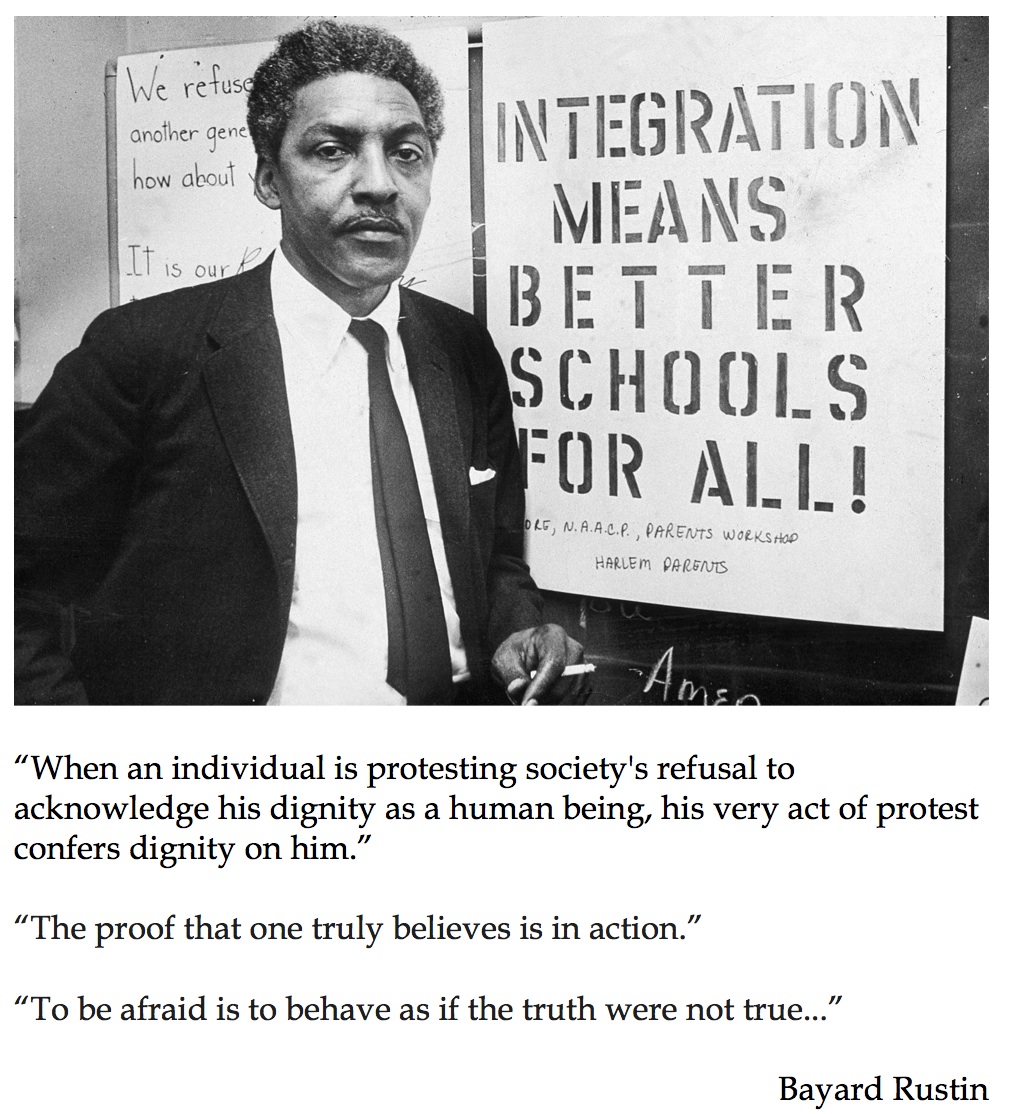
“To be afraid is to behave as if the truth were not true…” Bayard Rustin
 dr. p.l. (paul) thomas