William Butler Yeats

The U.S. Department of Housing and Urban Development (HUD) established the Moving to Opportunity (MTO) for Fair Housing program in the mid-1990:
MTO recruited more than 4,600 families with children living in severely distressed public housing projects in five cities (Baltimore, Boston, Chicago, Los Angeles, and New York City). HUD offered some MTO families the opportunity to use a housing voucher to move into private-market housing in lower poverty neighborhoods and did not make the same offer to others.
“The Long-Term Effects of Moving to Opportunity on Youth Outcomes” (2012) reveals the following from that program:
These patterns [school dropout, low test scores, and delinquency] have led to a longstanding concern that neighborhood environments may exert an independent causal effect on the life chances of young people. Because low-income individuals comprise nearly one-half of the 8.7 million people living in census tracts with poverty levels of 40 percent or higher (Kneebone, Nadeau, and Berube, 2011), poor children growing up in neighborhoods of concentrated poverty may be “doubly disadvantaged”—they face potential risks from growing up in a low-income household and in an economically poor neighborhood. (See a full discussion HERE)
The disadvantages of being born poor and then attending public schools in impoverished neighborhoods are far greater than doubled, however. The disadvantages are exponential and involve race, class, and gender.
NPR has presented two brief looks at new analyses from MTO—one directly about Study: Boys Report PTSD When Moved Out Of Poverty, and the other a related story, ‘Prep School Negro’ Shows Struggle Between Poverty And Plenty.
David Green reports on the MTO research:
Now a new study in the Journal of the American Medical Association finds that boys from these families did not thrive. They found that the move took a toll on their emotional well being, a toll not experienced by girls….
Professor at Harvard Medical School, Ronald Kessler explains about the research findings:
Well, the hope was originally that the educational opportunities for the kids would increase because of better schools, that the opportunities for the parents finding jobs would increase because they moved to places where there were higher employment rates so that in the long run the kids, as they moved out, would have better socioeconomic achievement than they would have otherwise….
Well, we found something that we hadn’t expected, which was the effect of the intervention was quite positive for girls, but boys had the opposite effect. Boys were more depressed. They were more likely to have post traumatic stress disorder. They were more likely to have conduct problems if they were in families that were offered vouchers than in the control group that wasn’t involved in any kind of move.
Although not part of the WTO experimental group, Andre Robert Lee represents that alienation felt by African American and poor males and identified by Kessler and his team:
I kind of feel like when you’re black, sometimes you have to be twice as good. I was kind of, you know, sad by it, you know. I’m a people person and to go to a school where you can’t be yourself – I was being myself, but people not to embrace you is just – it kind of sucked.
This research and personal experience must be placed in several social and educational contexts.
First, the unique and negative experiences of impoverished males, including impoverished African American males, are complicated by the research on how people view African American children:
Asked to identify the age of a young boy that committed a felony, participants in a study routinely overestimated the age of black children far more than they did white kids. Worse: Cops did it, too.
The study, published in the Journal of Personality and Social Psychology, aimed at figuring out the extent to which black children were likely to be treated differently than their white peers solely based on race. More specifically, the authors wanted to figure out the extent to which black kids were dehumanized. “Children in most societies are considered to be in a distinct group with characteristics such as innocence and the need for protection,” author Phillip Atiba Goff of UCLA told the American Psychological Association. “Our research found that black boys can be seen as responsible for their actions at an age when white boys still benefit from the assumption that children are essentially innocent.”
Second, the more specific context of how society sees and treats African American young men is captured in the controversies surrounding the shootings of Trayvon Martin and Jordan Davis as well as the controversies surrounding Richard Sherman (and the coded use of “thug”) and Marcus Smart.
Third, the Office for Civil Rights (USDOE) has detailed that in-school discipline policies and retention are disproportional by gender and race, and that access to high-quality courses and experienced teachers is also inequitable. “No excuses” practices and zero tolerance policies tend to target high-poverty and racial minority students as well:
There is abundant evidence that zero tolerance policies disproportionately affect youth of color. Nationally, black and Latino students are suspended and expelled at much higher rates than white students. Among middle school students, black youth are suspended nearly four times more often than white youth, and Latino youth are roughly twice as likely to be suspended or expelled than white youth. And because boys are twice as likely as girls to receive these punishments, the proportion of black and Latino boys who are suspended or expelled is especially large. Nationally, nearly a third (31 percent) of black boys in middle school were suspended at least once during the 2009–10 school year. Part of this dynamic is that under-resourced urban schools with higher populations of black and Latino students are generally more likely to respond harshly to misbehavior. (p. 3)
Fourth, the race, class, and gender inequity found in school discipline is replicated and intensified in the mass incarceration of African American males in the U.S.
Finally, and possibly most importantly, the historical context must be addressed. Consider first James Baldwin speaking in 1963, Take This Hammer:
And also, consider Baldwin writing in 1966, A Report from Occupied Territory:
Here is the boy, Daniel Hamm, speaking—speaking of his country, which has sworn to bung peace and freedom to so many millions. “They don’t want us here. They don’t want us—period! All they want us to do is work on these penny-ante jobs for them—and that’s it. And beat our heads in whenever they feel like it. They don’t want us on the street ’cause the World’s Fair is coming. And they figure that all black people are hoodlums anyway, or bums, with no character of our own. So they put us off the streets, so their friends from Europe, Paris or Vietnam—wherever they come from—can come and see this supposed-to-be great city.”
There is a very bitter prescience in what this boy—this “bad nigger”—is saying, and he was not born knowing it. We taught it to him in seventeen years. He is draft age now, and if he were not in jail, would very probably be on his way to Southeast Asia. Many of his contemporaries are there, and the American Government and the American press are extremely proud of them. They are dying there like flies; they are dying in the streets of all our Harlems far more hideously than flies.
How much different, then, is our world when we listen carefully to Lee:
Yeah, it’s hard. And when a kid walks in and they’re immediately seen as a delinquent, that perception and notion is thrust upon a person immediately. Despite the fact that I’m quote-unquote successful and have a career and have a graduate degree, you know, I still have a darn hard time getting a cab, and this is even if I’m in a suit or not.
If you’re not a really strong person, it can destroy you ’cause it’s constant chipping away at your psyche, you know, and I realized this in 9th grade. I thought there’s inequity in the world and it’s not going to change. What am I going to do?
The conclusions about impoverished males drawn from the WTO experiment and Lee’s personal story suggest that Baldwin’s warnings remain disturbingly true:
This rigid refusal to look at ourselves may well destroy us; particularly now since if we cannot understand ourselves we will not be able to understand anything. (“Lockridge: ‘The American Myth’”; Baldwin, 1998, p. 593)
The truth is that the country does not know what to do with its black population now that the blacks are no longer a source of wealth, are no longer to be bought and sold and bred, like cattle; and they especially do not know what to do with young black men, who pose as devastating a threat to the economy as they do to the morals of young white cheerleaders. It is not at all accidental that the jails and the army and the needle claim so many, but there are still too many prancing around for the public comfort. Americans, of course, will deny, with horror, that they are dreaming of anything like “the final solution”—those Americans, that is, who are likely to be asked: what goes on in the vast, private hinterland of the American heart can only be guessed at, by observing the way the country goes these days. (No Name in the Street; Baldwin, 1998, pp. 432-433)
The disadvantage of being impoverished, African American, and male remains powerfully staggering, far beyond “doubly” and something we seem unable to confront much less address.
children guessed(but only a few
and down they forgot as up they grew
“[anyone lived in a pretty how town],” e. e. cummings
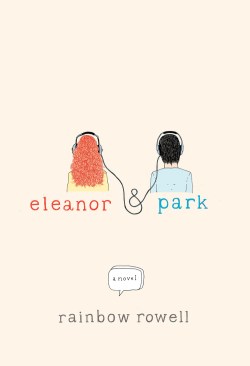
I cried on the first page of eleanor & park by Rainbow Rowell.
But to be perfectly honest, I am a crier, and that may not be my most compelling argument for this disturbingly beautiful novel. I agree, however, with John Green:
But I have never seen anything quite like “Eleanor & Park.”…
“Eleanor & Park” reminded me not just what it’s like to be young and in love with a girl, but also what it’s like to be young and in love with a book.
Before discussing the novel more directly, I want to offer a few points of context.
First, I am a strong advocate of young adult literature, but must confess, I also tend to be disappointed by young adult literature. Too often, I believe, young adult novels ask too little of readers, slip into simplistic language and ideas, and drift into condescension. I must stress strongly here that eleanor & park is not one of those novels.
Second, quite by accident, I read eleanor & park immediately after reading Jeffrey Eugenides’s The Virgin Suicides. I will examine this further below, but both novels are powerful works that ask the reader to consider the fragility of adolescence and the often dangerous conditions in which adolescents and children live—both physically and psychologically dangerous.
And third, I knew I had fallen in love with eleanor & park when it immediately reminded me of Notting Hill (which oddly began running on cable just as I started reading Rowell’s novel; karma, I suppose). Eleanor and Park are fearful, hesitant to wade into love, similar to William and Anna in the film. And the first page of the novel describes a broken Park, confirming William’s fear:
William: The thing is, with you I’m in real danger. It seems like a perfect situation, apart from that foul temper of yours, but my relatively inexperienced heart would I fear not recover if I was, once again, cast aside as I would absolutely expect to be. There’s just too many pictures of you, too many films. You know, you’d go and I’d be… uh, well buggered basically.
I cannot say more emphatically or directly that I believe everyone should read eleanor & park; it is equally a novel for adolescents and adults. And for that reason I cannot separate my reasons why so I’ll simply offer here my arguments for dedicating some of your reading life, your heart, and your tears to this novel.
Rowell beautifully and elegantly frames scene by scene the budding and doomed love between Eleanor and Park, two adolescents joined by qualities that Rowell examines without romanticizing, without condescending. Eleanor and Park represent and share both gender-based and universal characteristics: low self-esteem and self-consciousness related to body image; nerdom linked to comic books, music, social awkwardness and anxieties, and fashion; and navigating the painful transition from childhood to adulthood that includes hurdles related to peer groups, family dynamics, and social institutions such as school.
And while I anticipate everyone crying while reading this novel, I can assure you that spontaneous laughter comes about in an equal amount. Rowell is perceptive and empathetic as a writer, but she is also damned funny: “It was the nicest thing she could imagine. It made her want to have his babies and give him both her kidneys” (p. 93).
Again, I think anyone who loves to read, who loves novels will love eleanor & park, but I also have some more targeted suggestions.
If you are a parent (or expect to be some day) or a teacher (or expect to be some day), Rowell reminds us about the power—both positive and negative—of the adults in the lives of children and adolescents. As I noted above, The Virgin Suicides is a disturbing portrait of the tragic consequences of the misguided home, the overbearing parents.
While Eugenides’s novel is focused, Rowell invites the reader into two homes that serve as complex and nuanced narratives about how difficult parenting is—especially for Eleanor’s family because of the weight of poverty and the frailties of her mother joined with the inexcusable terror of her mother’s second husband. Park’s family is also complex, but there are moments of real kindness, change, and just-plain-real-life in Park’s home that serve to put Eleanor’s challenges in stark relief.
Rarely are things or people all evil or all angel (think about Tina in the novel when you read), but the impact of parents on their children is central to why parents and teachers must read this novel.
And while the school is somewhat less defined or fully developed in the novel, school and teachers share another burden along with the parents. Yes, there is terror and cruelty in school for Eleanor, but there are moments of real tenderness and kindness (DeNice and Beebi are wonderful friends for Eleanor) that serve to avoid the typical portrayal of schools in young adult works (think Ferris Bueller’s Day Off).
•
“Damn, damn, damn,” [Eleanor] said. “I never said why I like you, and now I have to go.”
“That’s okay,” [Park] said.
“It’s because you’re kind,” she said. “And because you get all my jokes…” (p. 113)
My second targeted suggestion is nearly impossible to express so I am likely to wander.
When my daughter was a child, sleeping each night upstairs in a child’s daybed, I would often tip-toe up the stairs and into her room to stand next to her sleeping like a stone.
Like me, she radiates heat while sleeping, but my nighttime ventures were to take her tiny warm foot in my hand, squeezing it slightly, feeling the softest skin and the curve of her arch.
That is the only other experience for me that compares to holding the hand of the one you love. And that is the only way I can come close to my broad second recommendation.
If you love holding hands, you should read this book.
If you have the sort of anxiety that creeps into self-loathing and the fear that you are unlovable, you should read this book.
If you believe in or want to believe in soul-mates, you should read this book.
If your heart breaks at the sign of human kindness, you should read this book.
If you love adolescents and realize that some of being an adolescent is always with us (and should be) and that some of being a child is always with us (and should be)—if you regret that for most people “down they forgot as up they grew,” you should read this book.
She would never belong in Park’s living room. She never felt like she belonged anywhere, except for when she was lying on her bed, pretending to be somewhere else. (p. 127)
I suppose in the end what I want to say is that if you are fully aware of what it means to be a human and you are determined to cling to the dignity of being fully human for yourself and everyone else, you should read this book because it is a beautiful reminder, a powerful confirmation that creeps into you bone-deep like the love you have for that one person who also resides there in your bones forever.
See Also
Review: Eleanor & Park by Rainbow Rowell
—
Thomas: Don’t link teacher pay to student test scores
Linking teacher evaluations to student standardized test scores is a bad idea that will not die.
The S.C. League of Women Voters issued a report in 2013 endorsing a plan to include what are called value-added methods in teacher evaluations, despite the overwhelming evidence that they are unreliable in high-stakes policies.
H.4419, sponsored by Rep. Andy Patrick, requires that half of teacher evaluations must be based on “evidence of growth in student achievement using a student growth model as determined by the department for grade levels and subjects for which student standardized assessment data is available.”
These teacher evaluation methods join grade retention, charter schools and Common Core as bad policies that are refuted by the research base — resulting in a tremendous waste of time and funding that could be better spent for our students and our state.
For example, Edward H. Haertel’s Reliability and validity of inferences about teachers based on student test scores (ETS, 2013) offers yet another analysis that details how value-added methods fail as a credible policy initiative.
Haertel refutes the popular and misguided perception that teacher quality is a primary influence on student test scores. As many researchers have detailed, teachers account for about 10 percent to 15 percent of student test scores. While teacher quality matters, access to experienced and certified teachers as well as addressing out-of-school factors dwarf narrow measurements of teacher quality.
He also concludes that standardized tests create a “bias against those teachers working with the lowest performing or the highest performing classes,” which makes it hard to justify using student test scores as anything more than a modest factor in teacher-evaluation systems.
Instead, Haertel calls for teacher evaluations grounded in three evidence-based “common features”:
“First, they attend to what teachers actually do — someone with training looks directly at classroom practice or at records of classroom practice such as teaching portfolios. Second, they are grounded in the substantial research literature, refined over decades of research, that specifies effective teaching practices…. Third, because sound teacher evaluation systems examine what teachers actually do in the light of best practices, they provide constructive feedback to enable improvement.”
Haertel concedes that value-added methods may have a “modest” place in teacher evaluation. That’s no ringing endorsement, and it certainly refutes the primary — and expensive — role that they play in proposals to reform teacher evaluation in South Carolina and across the country.
Would South Carolina benefit from focusing on teacher quality — as well as ensuring that all children have equitable access to experienced and certified teachers? Absolutely. Teacher effectiveness is strongly connected to the conditions of teaching, however, and value-added-method evaluations promise to erode, not enhance, those conditions.
Linking teacher evaluation in any way to test scores will force teachers to teach to the tests (and thus ask less of all students), expand an already expensive testing regime and discourage teachers from working in the most challenging schools and communities.
The calls to implement policy that is contradicted by a growing body of research are not only misguided but also likely to cause far more harm than good — and drain valuable time and resources from our schools.
Our students, teachers and schools cannot afford doubling down on a failed test-based education culture.
Dr. Thomas is an associate professor at Furman University and a former high school English teacher; contact him at Paul.Thomas@furman.edu or follow him on Twitter @plthomasEdD.
Oran P. Smith, a senior fellow at Palmetto Policy Forum, introduces in The State a new report on Common Core from the conservative think tank:
After the hearing, I concluded that John Hill of the Alabama Policy Institute had it right when he wrote: “Although both sides of the Common Core debate make arguments worth consideration, both the potential benefits and pitfalls related to Common Core have been the subject of exaggeration and error.”
This is why Palmetto Policy Forum recently released a paper we believe cuts through the Common Core fog, outlining an eight-point plan to return unquestioned control of education standards to S.C. parents.
Several points can be taken from the release of this report on CC.
First, the report fails as many ideological think tank reports do because it speaks uncritically to its ideological base (this report has glowing images and commentary on Ronald Reagan and Jeb Bush, for example).
Second, the report also fails by offering an incomplete consideration of the extensive research base on CC and the entire standards movement.
And third, despite these weaknesses, it seems only fair to highlight that the eight recommendations have much to applaud:
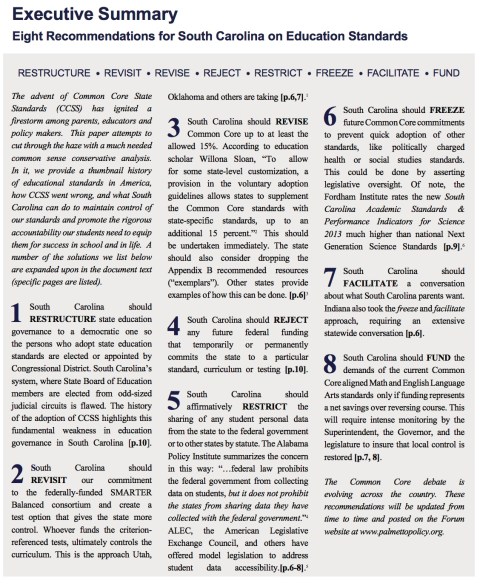
[click to see full report; 8 recommendations on page 1]
These recommendations hold some promise but with caveats.
The report must be viewed through the lens of a detailed history of how CC developed as well as the entire standards movement begun under Reagan; see for example:
Whatever Happened to Scientifically Based Research in Education Policy?
Corporations Are Behind The Common Core State Standards — And That’s Why They’ll Never Work
The research base on CC must be examined, noting that CC is unlikely to create outcomes any different than the standards movements preceding the new standards (notably about three different waves in SC); see for example:
What We Know (and Ignore) about Standards, Achievement, and Equity
On Public Schools and Common Core: Graff’s Critique of Ravitch
Please note the research base:
Smith argues at the end of his Op-Ed, “This is not a time for mutual destruction,” and I agree.
I remain skeptical, but I wonder if this report suggests the possibility that SC is moving toward a reasonable reaction to CC.
I hope so because SC remains a high-poverty state stratified by wealth and poverty; no one in the state, especially the children in our schools, can afford more partisan political grandstanding over education policy.
I am willing to set aside the misleading nods to Reagan and Jeb Bush (both key causes of this problem) in order to enact the 8 recommendations above because at least then we will have a space within which to confront the issues left unaddressed—notably the inordinate cost of yet more commitments to new standards and tests that will, I guarantee, fail our children in SC.
 dr. p.l. (paul) thomas