
remnant 39: “Lou Reed was massively important to ‘Island of Misfit Toys’ kids”.
Category Archives: education
The Poverty Trap: Slack, Not Grit, Creates Achievement
Poverty is a trap children are born into:

No child has ever chosen to be poor. Children have never caused the poverty that defines their lives, and their education.
Yet, the adults with political, corporate, and educational wealth and power—who demand “no excuses” from schools and teachers serving the new majority of impoverished children in public schools and “grit” from children living in poverty and attending increasingly segregated schools that offer primarily test-prep—embrace a very odd stance themselves: Their “no excuses” and “grit” mottos stand on an excuse that there is nothing they can do about out-of-school factors such as poverty.
Living in poverty is a bear trap (and it is), and education is a race, a 100-meter dash.
“No excuses” advocates calling for grit, then, are facing this fact:
Children in poverty line up at the starting line with a bear trap on one leg; middle-class children start at the 20-, 30-, and 40-meter marks; and the affluent stand at the 70-, 80-, and 90-meter marks.
And while gazing at education as a stratified sprint, “no excuses” reformers shout to the children in poverty: “Run twice as fast! Ignore the bear trap! And if you have real grit, gnaw off your foot, and run twice as fast with one leg!”
These “no excuses” advocates turn to the public and shrug, “There’s nothing we can do about the trap, sorry.”
What is also revealed in this staggered 100-meter race is that all the children living and learning in relative affluence are afforded slack by the accidents of their birth: “Slack” is the term identified by Mullainathan and Shafir as the space created by abundance that allows any person access to more of her/his cognitive and emotional resources.
In the race to the top that public education has become, affluent children starting at the 90-meter line can jog, walk, lie down, and even quit before the finish line. They have the slack necessary to fail, to quit, and to try again—the sort of slack all children deserve.
Children in relative affluence do not have to wrestle with hunger, worry about where they’ll sleep, feel shame for needing medical treatment when they know their family has no insurance and a tight budget, or watch their families live every moment of their lives in the grip of poverty’s trap.
As Mullainathan and Shafir explain: “Scarcity captures the mind.” And thus, children in poverty do not have such slack, and as a result, their cognitive and emotional resources are drained, preoccupied.
The ugly little secret behind calls for “no excuses” and “grit” is that achievement is the result of slack, not grit.
Children living and learning in abundance are not inherently smarter and they do not work harder than children living and learning in poverty. Again, abundance and slack actually allow children to work slower, to make more mistakes, to quit, and to start again (and again).
Quite possibly, an even uglier secret behind the “no excuses” claim that there is nothing the rich and powerful can do about poverty is that this excuse is also a lie.
David Berliner (2013) carefully details, “To those who say that poverty will always exist, it is important to remember that many Northern European countries such as Norway and Finland have virtually wiped out childhood poverty” (p. 208).
More children are being born into the trap of poverty in the U.S., and as a result, public schools are now serving impoverished students as the typical student.
The “no excuses” and “grit” mantras driving the accountability era have been exposed as ineffective, but have yet to be acknowledged as dehumanizing.
Instead of allowing some children to remain in lives they didn’t choose or create and then condemning them also to schools unlike the schools affluent children enjoy, our first obligation as free people must be to remove the trap of poverty from every leg of every child.
Reference
David C. Berliner (2013) Inequality, Poverty, and the Socialization of America’s Youth for the Responsibilities of Citizenship, Theory Into Practice, 52:3, 203-209, DOI: 10.1080/00405841.2013.804314
UPDATE
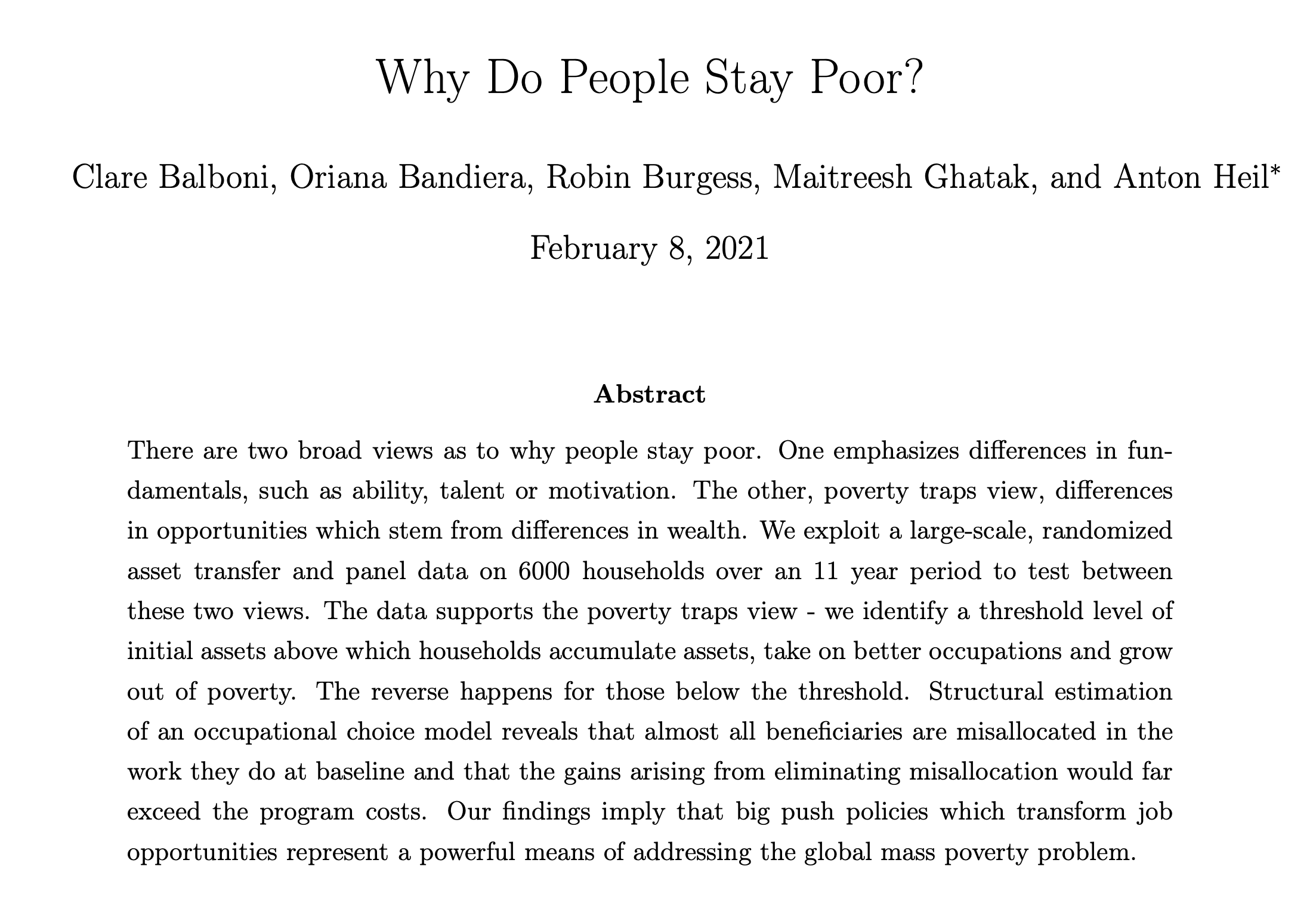
Why Do People Stay Poor? Clare Balboni, Oriana Bandiera, Robin Burgess, Maitreesh Ghatak, and Anton Heil
Learning and Teaching in Scarcity: How High-Stakes ‘Accountability’ Cultivates Failure | Alternet
remnant 38: “I still owe money to the money to the money I owe”
CAUTION: Technology!
In the myriad debates surrounding implementation of Common Core and the concurrent tests, the sheer costs of this process tends to be ignored. Another issue related to both CC and the related costs is yet another series of commitments to technology as a part of the perpetual education reform process. Here is a reposting of a presentation [see Note below] I gave offering a stern caution about our repeated rush to embrace technology:
Author Kurt Vonnegut quipped, “Novels that leave out technology misrepresent life as badly as Victorians misrepresented life by leaving out sex.” As with novels, so with schools, I believe, but we must take one step beyond “whether schools should address technology” to “how.”
In Walden, Henry David Thoreau offered two warnings that should guide how we approach technology: “We are in great haste to construct a magnetic telegraph from Maine to Texas; but Maine and Texas, it may be, have nothing important to communicate,” and, “We do not ride on the railroad; it rides upon us.”
It’s a Book, Lane Smith [VIDEO]
Shifting from seeking technology for technology’s sake to critical technological awareness
- Caution: Inflated costs (market forces) in state-of-the-art technology
- Caution: Pursuing state-of-the-art technology is self-defeating since “state-of-the-art” is a moving target; teaching students to use state-of-the-art technology fails to recognize that it will be “old” technology once students leave school. Also, state-of-the-art technology has a high risk/reward factor since many “new” gadgets fail and many “new” upgrades fizzle. Consider the storage facilities at schools filled with cables, software, out-dated hardware, and the LaserDisk players that never caught on.
- Caution: New technology has inflated costs AND embedded costs related to repair and upgrades.
- Caution: Adding new technology or upgrading existing technology requires added time spent for teachers (in-service) and students to learn the technology itself, draining time better served on teaching and learning themselves.
- Caution: Research base, although sparse, does not support a positive role for technology in improving teaching/learning, and evidence we have shows teachers rarely use technology provided (EdWeek synthesis of research on technology):
That study found that most of the schools that have integrated laptops and other digital tools into learning are not maximizing the use of those devices in ways that best make use of their potential.
From “Who really benefits from putting high-tech gadgets in classrooms?” (Los Angeles Times, February 4, 2012):
Almost every generation has been subjected in its formative years to some “groundbreaking” pedagogical technology. In the ’60s and ’70s, “instructional TV was going to revolutionize everything,” recalls Thomas C. Reeves, an instructional technology expert at the University of Georgia. “But the notion that a good teacher would be just as effective on videotape is not the case.”
Many would-be educational innovators treat technology as an end-all and be-all, making no effort to figure out how to integrate it into the classroom. “Computers, in and of themselves, do very little to aid learning,” Gavriel Salomon of the University of Haifa and David Perkins of Harvard observed in 1996. Placing them in the classroom “does not automatically inspire teachers to rethink their teaching or students to adopt new modes of learning.”
…In 2009, the Education Department released a study of whether math and reading software helped student achievement in first, fourth, and sixth grades, based on testing in hundreds of classrooms. The study found that the difference in test scores between the software-using classes and the control group was “not statistically different from zero.“In sixth-grade math, students who used software got lower test scores — and the effect got significantly worse in the second year of use.
- Caution: Seeking to close GAPS (equity, achievement, technology) found in the lives of children (children in poverty, disadvantaged; children in affluence, privileged) through education presents a paradox: As Walt Gardner has succinctly explained: “Don’t forget that advantaged children are not standing still in the interim. They continue to benefit from travel and other enriching learning experiences. As a result, the gap will persist.”
- Caution: Begin with educational (teaching/learning) NEEDS, not the allure of new technology.
References
Thomas, P. L. (2012, January 3). A misguided use of money. Room for Debate. The New York Times.
—–. (2011, December 2). No. At Issue in CQ Researcher, p. 1017.
http://library.cqpress.com/cqresearcher/ and http://wrestlingwithwriting.blogspot.com/2011/12/cq-researcher-online.html
NOTE: This originally was a presentation, as below:
March 8-9, 2012
9:30-10:15
CAUTION!: Technology
P. L. Thomas, EdD
Associate Professor of Education
Furman University
UPDATE:
Larry Cuban, Answering the Big Question on New Technology in Schools: Does It Work? (Part 1)
See related: Technology In Education: An Answer In Search Of A Problem?
Schools Matter: Union Leadership as Political Sleight of Hand
Are Common Core and Testing Debates “Two Different Matters”?
A comment posted on my blog about union support for Common Core (CC)—which parallels my blog post about Secretary Duncan and the Obama administration’s support for CC—represents a typical response coming from standards advocates in the CC debate: “You can’t combine the issue of high stakes testing with the common core [sic] they are two different matters.”
Alfie Kohn in January 2010 argued against national standards in Education Week; I then offered a direct rejection of CC in the same publication in August of 2010. A few others took early stances against CC, such as Susan Ohanian (whose work is impressive and certainly well before most people raised any concerns) and Stephen Krashen.
Diane Ravitch and Carol Burris have taken stances opposing CC more recently, and they represent thoughtful and patient considerations of the exact issue raised by the comment quoted above. At first, Ravitch and Burris appeared willing to consider that CC could prove to be an effective reform mechanism. But both of their explanations for deciding to oppose CC are windows into my initial and continuing stance against the expensive and unnecessary venture into what for most states will be the third or fourth set of standards and high-stakes tests in about thirty years.
I have been a teacher for those thirty years, in fact—the first 18 years spent as a public school teacher in the rural South and the last 13 years as a teacher educator in the same region.
My work as a classroom teacher in the 1980s and 1990s was characterized by quarterly multiple-choice benchmark tests of reading and quarterly writing samples from my students that asked them to write one of four types of writing: description, narration, persuasion, or exposition (types that do not exist as stand-alone forms in the real world, by the way, but exist only in a world where standards and testing rule).
During those years also, state standards changed three times, and concurrent with those changes, we adopted new textbooks and sat through hours and hours of in-service, handed over more and more class time to test-prep, and implemented SAT courses during the school day (ones for which students received credit toward graduation) that required huge investments in hardware and software, which mostly never worked (my home state of SC has a history of so-called low SAT scores so our 1990s approach to addressing that was to encourage more students to take the SAT).
Eventually, the entire state of SC became invested in MAP testing while students at the high school where I taught were assigned two ELA and two math courses as sophomores if they had 8th-grade test data suggesting they would struggle with the state high-stakes tests. Our administration assigned as many as half our sophomores in double ELA and math courses, in fact.
One legacy of this test-mania was that many sophomores in our school wrote only 3-5-3 essays (3-sentence introduction, 5-sentence body paragraph, 3-sentence conclusion) because that was how they were trained to answer on the state writing test—a strategy that did increase how many passed but also ignored good writing pedagogy and mis-educated those students severely.
In the 1980s and 1990s, my high school became a master of doing the wrong thing the right way as we were regularly the top-scoring school in the state on the state’s high-stakes tests.
Once at higher education, I watched my teacher candidates and teachers in the surrounding public schools suffer under yet more revisions to the standards and two different versions of high-stakes tests (since the mid-1980s, SC has implemented BSAP and then PACT and then PASS); now the entire state is implementing CC and poised for the CC-based and once again new set of high-stakes test.
All of this is to say: If you have ever taught in public schools during the past three decades you know that the comment quoted at the beginning is patently false. In fact, if you have taught in public schools during the past three decades you know that CC cannot be separated from highs-stakes testing.
In 2013, with almost all states in the U.S. committed to CC, with the U.S. Department of Education supporting CC, with teachers’ unions supporting CC, with textbook and testing companies supporting CC, and with professional teacher organizations supporting CC, there is a deafening silence about a few facts that must be confronted if anyone or any organization wishes to make this claim: “You can’t combine the issue of high stakes testing with the common core [sic] they are two different matters”:
- Name a state in the U.S. that implemented state standards since 1980 without also implementing high-stakes tests.
- Name a state in the U.S. that has adopted CC and has not adopted some form of high-stakes testing related to CC.
- Name a state that does not have high-stakes accountability mechanisms in place—as a legacy of state legislation and/or as a result of complying with federal mandates within policy such as Race to the Top or opting out of NCLB.
- Name a school (especially a high-poverty school) where “what is tested is what is taught” does not drive most of what occurs in that school.
- Name a state that is not spending tax payer money (totaling in the 10s if not 100s of millions of dollars nationally) on CC resources and technology, CC-aligned text books, CC testing, and CC teacher in-service.
- Name a strong CC advocate who isn’t making money and/or gaining political advantage by endorsing CC.
My doctorate is in curriculum and instruction. A foundational part of my doctoral study and dissertation research, then, explored the century-old debate about what content matters, what should be taught in public schools. Any standards movement is a direct descendent of the larger curriculum debate.
While John Dewey and even Joseph Schwab provide engaging and powerful places upon which Eliot Eisner and others have the luxury of thinking deeply about esoteric things (issues that I too find fascinating), in the real world of day-to-day K-12 teaching, it is pure delusion and myopic idealism to make claims that CC and high-stakes testing debates are “two different matters.”
Around 2000 when my daughter was 11 and attending a public middle school, she came out to the car one day leaning against the weight of her giant backpack, slid into my car, and then said: “All they care about is the PACT test [SC’s high-stakes test at the time]; they don’t care if we learn anything.” [1] She never once as a student mentioned the standards. And in many ways as a child of the accountability era, I think she learned to hate school. She loved her friends and loved many of her teachers, but she hated what school had become throughout the 1990s—which pales to what school has become in the twenty-first century.
Thus, address the bullet points above if you don’t believe me, or better yet, ask a classroom teacher—not a union leader, not a politician, not a representative of Pearson, not a consultant.
[1] See “Standards, Standards Everywhere, and Not a Spot to Think,” English Journal (2001, September).
Zombies, “Scarcity,” and Understanding Poverty
Fight poverty to fix S.C. schools – The Post and Courier
Evidence? Randi Weingarten Ignores the Evidence
Evidence? Randi Weingarten Ignores the Evidence
 dr. p.l. (paul) thomas