

i am not the one
to be singing this
i don’t have the voice
i don’t have the music
i can type it all
here on this computer
or write it by hand
on this yellow legal pad
but i am not the one
to be singing this
—P.L. Thomas
Category Archives: education

[Submitted]: South Carolina Needs a New Story and Different Political Responses to Reading
[Below is an OpEd submitted to newspapers in SC; no response yet.]
Writing in Teachers College Record, literacy scholars Reinking, Hruby, and Risko explain: “Since 2015, 47 state legislatures have enacted, or are currently considering, a remarkable total of 145 bills that address reading and reading instruction in public schools.”
A few days apart, an article in the New York Times again announced the US has a reading crisis, and in EdSource, a school’s exceptional success with multilingual learners was celebrated.
The problem with new reading legislation, another reading crisis, and highlighting education “miracles” is that they all are factually untrue.
For example, Reinking, Hruby, and Risko demonstrate that reading achievement as measured by NAEP grade 4 reading scores have remained flat for many years in the US:

The same is true of South Carolina:
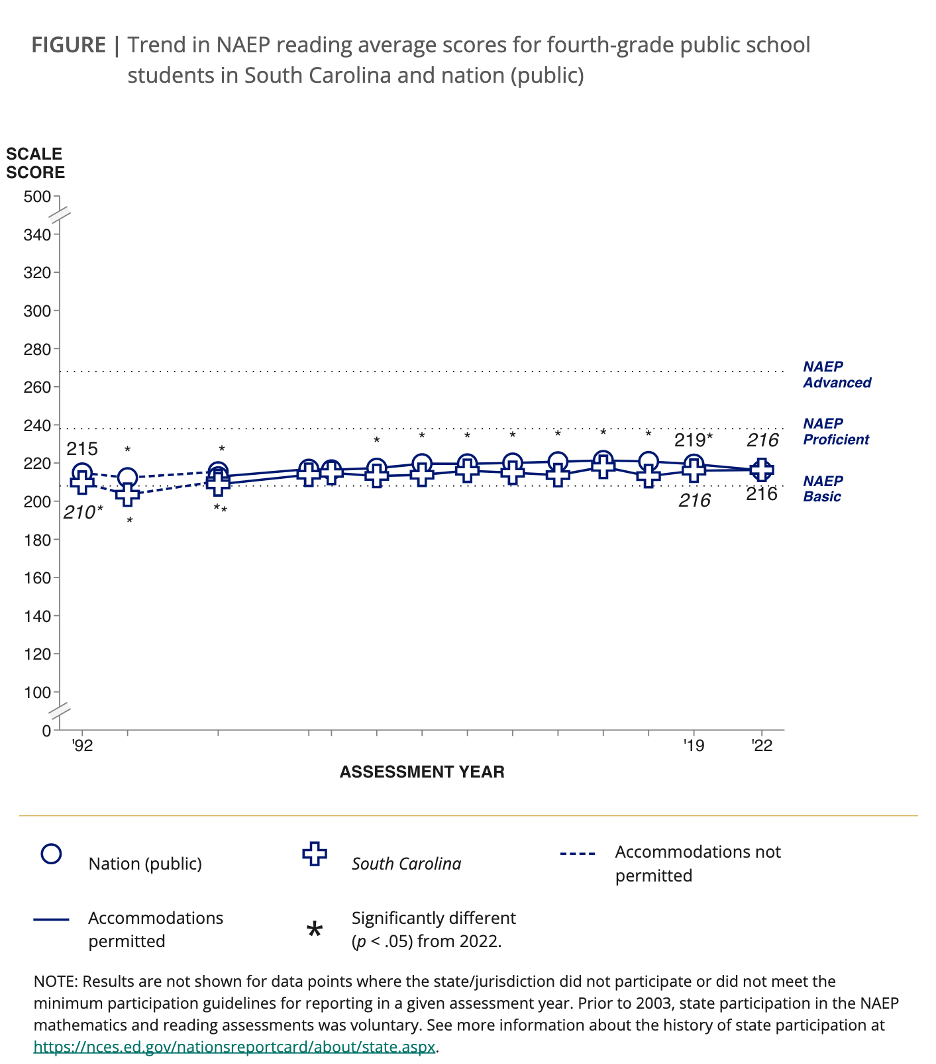
South Carolina has also been an early and eager adopted of standards, high-stakes testing, and embracing the current trend to legislate reading. However, these models of crisis and reform have never produced the sort of reading achievement that the media, the public, or political leaders have promised.
After multiple versions of different standards and tests as well as several rounds of reading wars, South Carolina like the rest of the US continues to lament low reading proficiency in students.
As a lifelong literacy educator in SC over five decades, I recommend that we first stop focusing on crisis and “miracle” stories about our schools, our teachers, and our students. These extreme stories almost always prove to be misleading or false.
Next, and most importantly, we need to do something different—at the school and classroom levels, but also at the political level of legislation, funding, and mandates.
South Carolina has a historical challenge of extreme pockets of poverty, and recent data from the value-added era of education reform under Obama confirmed that about 86 – 99% of measurable student achievement is linked to out-of-school factors, not teacher practice or quality.
The historical negligence of political leadership in SC highlighted in the documentary Corridor of Shame has simply never been addressed.
Further, what do students, teachers, and public schools needed from legislators in SC?
Political leaders must resist the current trend to ban teaching practices and reading programs while also mandating narrow approaches to reading and a new batch of preferred reading programs.
Simply put, there is no silver bullet for teaching reading, and neither the problem nor the solution is a magic reading program.
Students and teachers instead need political leaders to address learning and teaching conditions in our schools concurrent with addressing poverty and inequity in the homes and communities of our children.
Equitable learning and teaching conditions would include repealing grade retention, reducing significantly class sizes in the earliest grades and for the populations of students struggling to read, funding better all aspects of public education (teacher pay, school facilities, learning and teaching materials), and refusing to succumb to the current trends of legislating curriculum through bans and censorship.
The two most powerful commitments that a state can make in terms of supporting education and reading instruction is ensuring that the individual educational needs of all students are supported and that teacher professionalism is directly and fully supported.
For my entire career in SC as a literacy educator, political leaders have failed to address poverty and inequity, ignored the needs of our most vulnerable students, and eroded the profession of teaching in the state.
The stories we have told and the political responses to those stories have failed all of us for decades. We must do better and that means we must do something different.
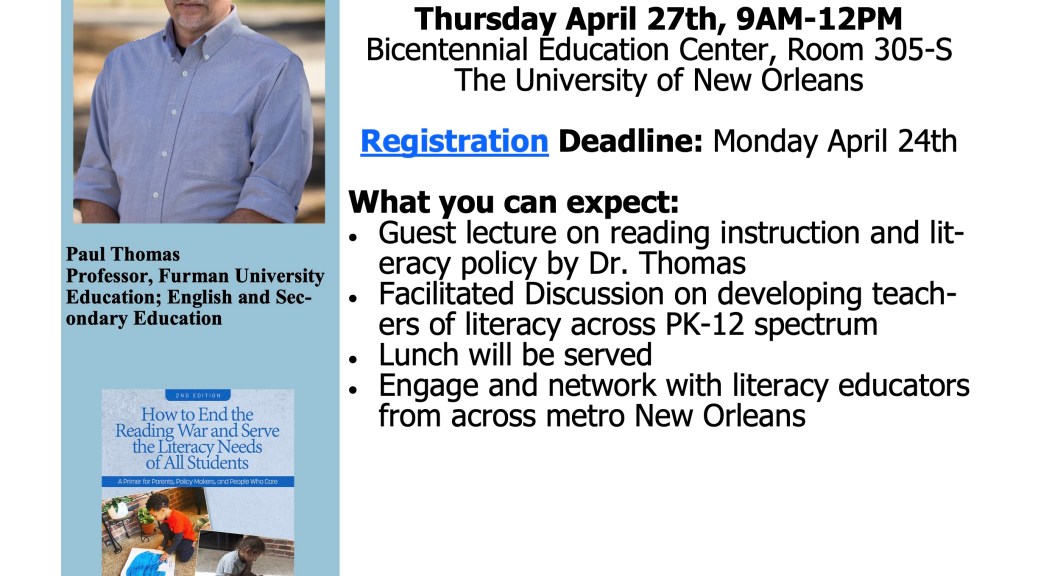
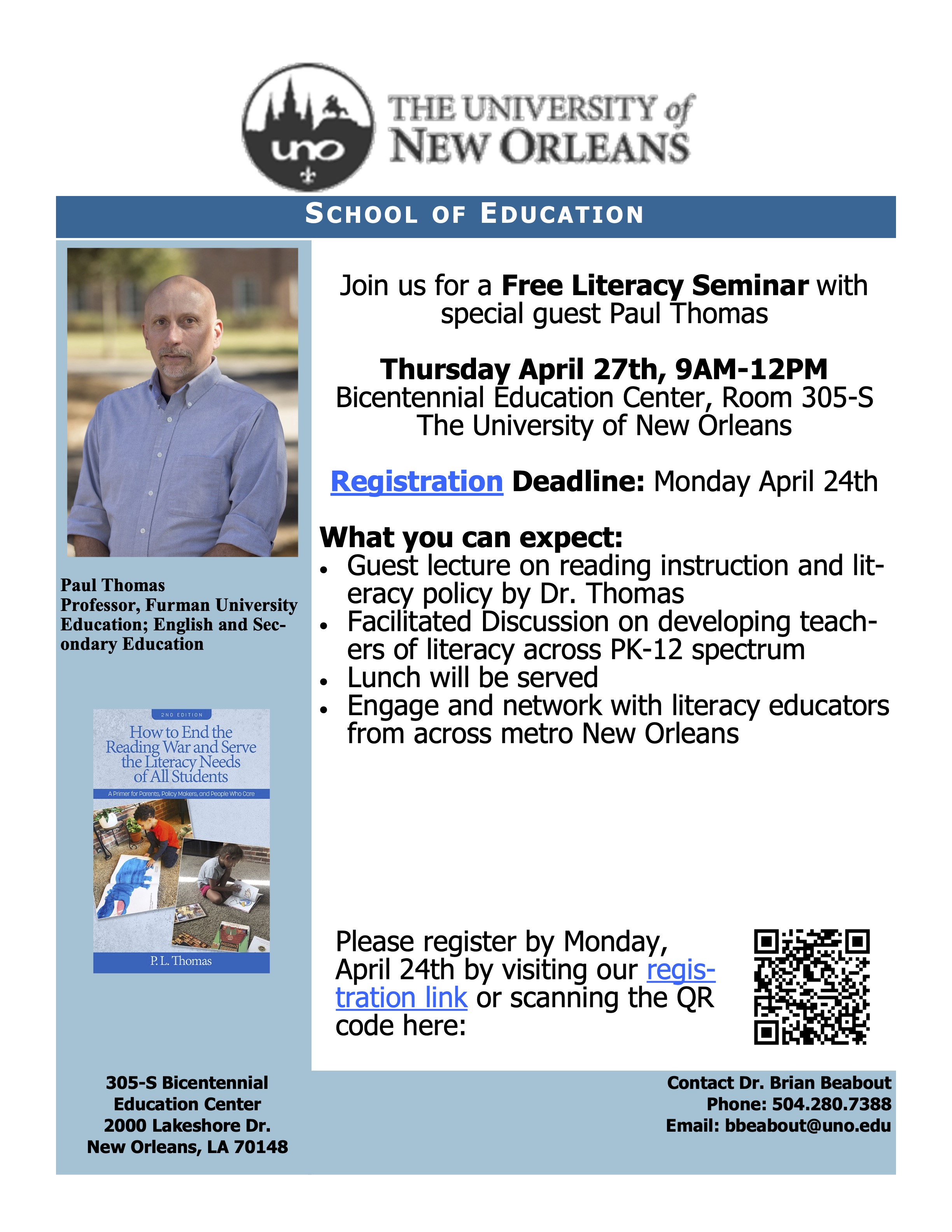
UPCOMING: Free Literacy Seminar (University of New Orleans)
Beyond Reading Skills: Phonics, Vocabulary, and Knowledge
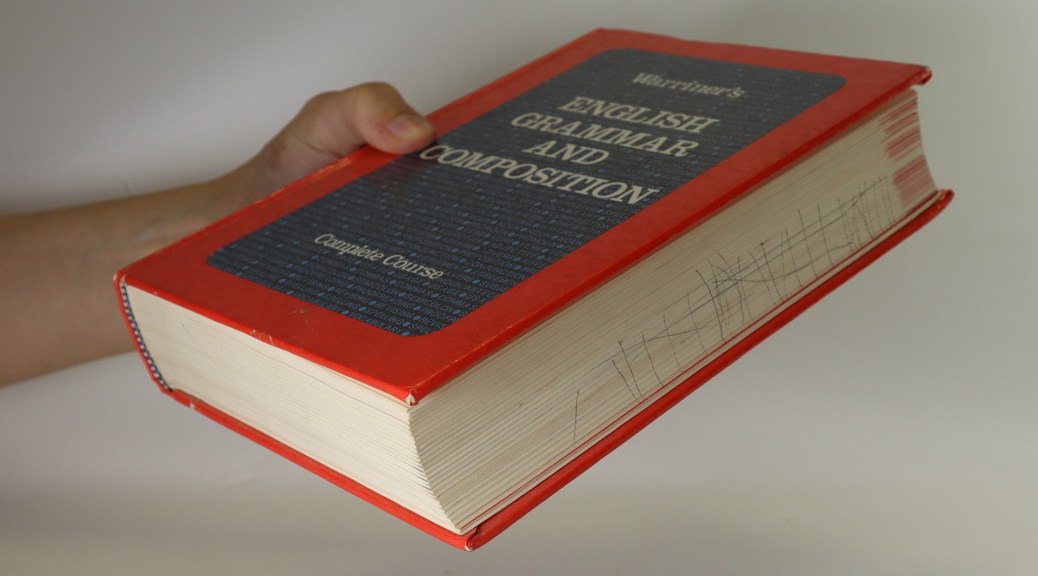
When I entered the classroom as an English teacher in 1984 at the high school where I had graduated just five years earlier, students lugged around two huge textbooks for their English courses, one of which was Warriner’s English grammar text.
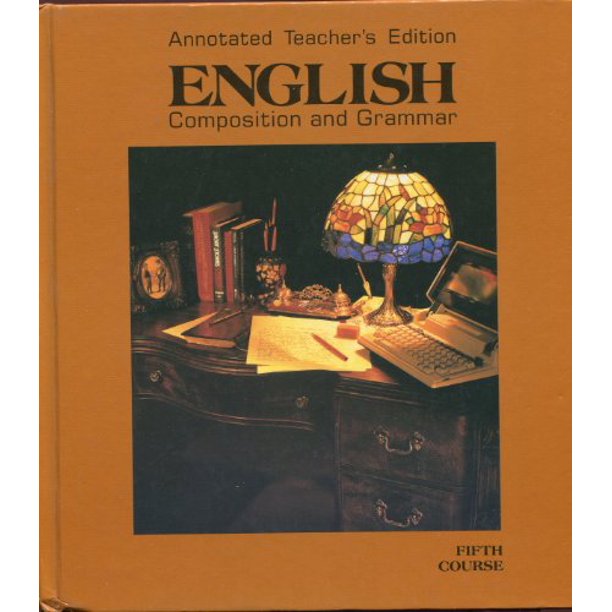
Students were conveniently color coded by these texts since the publishers provided different ability and grade levels of the literature and grammar texts. And universally students hated these textbooks, the carrying and their use in the classrooms.
Since I taught different ability levels (we used and A, B, C level system for each grade) and grades, I had about 15 textbooks across my five courses because students in English also were assigned vocabulary books (the publisher we used proudly printed in bright letters that these vocabulary books prepared students for the SAT!).
At least the vocabulary books were small paperbacks.
Two important facts stand out about those first couple years teaching in the traditional expectations for English teachers at that school (mostly the same teachers who taught me as a student): first, Warriner’s regardless of grade or ability level had essentially the exact same chapters for teachers to systematically and comprehensively teach every year, and second, teachers expressed repeatedly that students never learned those grammar lessons, noting that student writing failed to improve in terms of grammar, mechanics, and usage.
Another big picture point to make here is that when I was a student, grammar texts included lessons on “shall” and “will”; that my students had to cover an entire chapter and be tested on “who” and “whom”; and both my students and I had to “learn” about pronoun/antecedent agreement (specifically the use of “they” as plural only).
Today, we must acknowledge that all of these rules and the consequences of students “not learning them” have evaporated since “shall” and “whom” have graciously disappeared and “they” has been (finally) acknowledged as a resourceful pronoun.
As a beginning teacher, I had entered education to teach writing, although, of course, I loved literature also. Yet, the grammar- and skills-centric approach to teaching English, I recognized, was failing students miserably—I mean literally because students were miserable, learning to hate English, writing, and literature.
Of course, my stories here speak to a disturbing reality in education: Lou LaBrant, writing in 1946, noted: “We have some hundreds of studies now which demonstrate that there is little correlation (whatever that may cover) between exercises in punctuation and sentence structure and the tendency to use the principles illustrated in independent writing” (p. 127). And then in 1947: “A brief consideration will indicate reasons for the considerable gap between the research currently available and the utilization of that research in school programs and methods” (p. 87).
Yet, English teachers throughout the decades kept beating their heads against the grammar and skills wall, lamenting “kids today” for not being good writers—regardless of decade, regardless of the grammar programs implemented.
This raises a current issue about “scientific” or “evidence” as the basis for how teachers teach, notably in the current reading war.
Here, I think, is an excellent overview by Jal Mehta (Harvard University) about why calling for “scientific” or “evidence” to mandate teaching literacy is just as misguided as the evidence-free practices I witnessed as a beginning teacher almost 40 years ago:


What may have started out about a decade ago as a sincere plea similar to LaBrant’s—the teaching of reading in practice often failed to be effectively evidence-based (“scientific”)—has turned into the exact sort of one-size-fits-all ideological movement that Jal warns about: scientific as a “weapon.”
The SOR movement has refueled the myth of the bad teacher, continued to perpetuate false narratives of crisis and miracle schools, profited the education marketplace, and driven deeply problematic reading legislation and policy, including inequitable grade retention.
The mistake being made is also perfectly identified by Jal: “In my experience, the best educators and leaders see lots of complexity, consider context, and artfully weave together different approaches to solve particular problems.”
Ironically, this is the exact approach grounding both whole language and balanced literacy as philosophies of teaching reading and writing; however, as we have witnessed, both WL and BL also became convenient labels for practices not following those philosophies or simply slurs ideologues use to criticize.
Instead, the SOR movement has become ideological and weaponized to create simplistic and unfounded crisis rhetoric for politicians and skills-driven reading policy and practice.
For example, no one argues that phonics, vocabulary, and knowledge are not key elements in reading. But the SOR movement demands a linear and sequential skills-first approach; teach phonics, vocabulary, and knowledge systematically before students read.
The skills-first approach is essentially authoritarian (what phonics, vocabulary, and knowledge students “need” is determined and outlined for students and teachers) and necessarily erases diversity of language and experiences by students.
The counter approach, the complex approach to reading, acknowledges the importance of elements such as phonics, vocabulary, and knowledge, but also honors that the relationship between so-called skills and reading is reciprocal, not linear or sequential.
In other words, yes, students need some direct and purposeful instruction in phonics, vocabulary, and knowledge building as they become beginning readers; however, most of a person’s acquisition of phonics, vocabulary, and knowledge comes from reading—not direct or systematic instruction.
The problem with systematic and comprehensive teaching of any literacy skills is that the goal and accountability around teaching and learning become the acquisition of the skills (phonics tests, vocabulary tests, knowledge tests) instead of the authentic goal of fostering eager, independent, and critical students who read.
Ultimately, if we genuinely want evidence-based reading instruction for children in the US, we must recognize that the most important sources of evidence are the children themselves and the most valuable person to understand what children need to read are their teachers.
However, beyond shifting to what evidence counts, we must also recognize that students and teachers cannot be successful unless we address learning and teaching conditions (the one move politicians refuse to make).
Regretfully, as Jal recognizes, students and teachers are again simply pawns in another fruitless war won by the SOR advocates “who are loudest about ‘evidence-based practices,’ [and] ironically tend to be more ideologues who have a few preferred solutions that they think can address every problem.”

COE Spring Forum: Are We in the Midst of “Reading Wars” – Again?
COE Spring Forum: Are We in the Midst of “Reading Wars” – Again?
Access this PowerPoint for my part of the forum. Access expanded PowerPoint also.
YouTube RECORDING
Rachael Gabriel SLIDES
See RESEARCH supporting my presentation:
Reading Science Resources for Educators (and Journalists): Science of Reading Edition [UPDATED]


No Crisis, No Miracles: The False Narratives of Education Journalism
With a sort of humility rarely found when someone of prominence speaks to or about education in the US, celebrated author Ralph Ellison (Invisible Man) found himself speaking at a teachers conference in 1963 “to discuss ‘these children,’ the difficult thirty percent,” the identified population making up the drop-out crisis of the time [1].
One of the most impressive aspects of Ellison’s talk is his emphasis on systemic influences on children and their language acquisition: “The American scene is a diversified one, and the society which gives it its character is a pluralistic society-or at least it is supposed to be,” explaining:
The education which goes on outside the classroom, which goes on as they walk within the mixed environment of Alabama, teaches children that they should not reach out for certain things. Much of the education that I received at Tuskegee (this isn’t quite true of Oklahoma City) was an education away from the uses of the imagination, away from the attitudes of aggression and courage. This is not an attack. This is descriptive, this is autobiographic. You did not do certain things because you might be destroyed. You didn’t do certain things because you were going to be frustrated. There were things you didn’t do because the world outside was not about to accommodate you….
It does me no good to be told that I’m down on the bottom of the pile and that I have nothing with which to get out. I know better. It does me no good to be told that I have no heroes, that I have no respect for the father principle because my father is a drunk. I would simply say to you that there are good drunks and bad drunks. The Eskimos have sixteen or more words to describe snow because they live with snow. I have about twenty-five different words to describe Negroes because I live principally with Negroes. “Language is equipment for living,” to quote Kenneth ’Burke. One uses the language which helps to preserve one’s life, which helps to make one feel at peace in the world, and which screens out the greatest amount of chaos. All human beings do this.
What These Children Are Like
And then Ellison goes right to the core issue about language in marginalized and minoritized populations:
Some of us look at the Negro community in the South and say that these kids have no capacity to manipulate language. Well, these are not the Negroes I know. Because I know that the wordplay of Negro kids in the South would make the experimental poets, the modern poets, green with envy. I don’t mean that these kids possess broad dictionary knowledge, but within the bounds of their familiar environment and within the bounds of their rich oral culture, they possess a great virtuosity with the music and poetry of words. The question is how can you get this skill into the mainstream of the language, because it is without doubt there. And much of it finds its way into the broader language. Now I know this just as William Faulkner knew it. This does not require a lot of testing; all you have to do is to walk into a Negro church….
Thus we must recognize that the children in question are not so much “culturally deprived” as products of a different cultural complex. I’m talking about how people deal with their environment, about what they make of what is abiding in it, about what helps them to find their way, and about that which helps them to be at home in the world. All this seems to me to constitute a culture. If you can abstract their manners, their codes, their customs and attitudes into forms of expression, if you can convert them into forms of art, if you can stylize them and give them many and subtle ranges of reference, then you are dealing with a culture. People have learned this culture; it has been transferred to them from generation to generation, and in its forms they have projected their most transcendent images of themselves and of the world.
What These Children Are Like
On social media, I had a cognitive scientist SOR-splain to me literacy in my home state of South Carolina, recommending I look at narrow assessments of reading (a popular program) to admit that SC has a reading crisis. Like Ellison, I pointed out I don’t need a test to know the truth about reading and literacy in SC, all across the South, and even in the US.
In my 39th year as a literacy educator in SC, where I was born in 1961 and attended formal education from 1967 through 1998, I have lived and witnessed firsthand a fact that the media narratives never capture, but let me ask you to help me before I explain the real story.
Here are longitudinal data for SC NAEP reading scores in grades 4 and 8 from 1992 to 2022; could you please identify where the “crisis” is?:

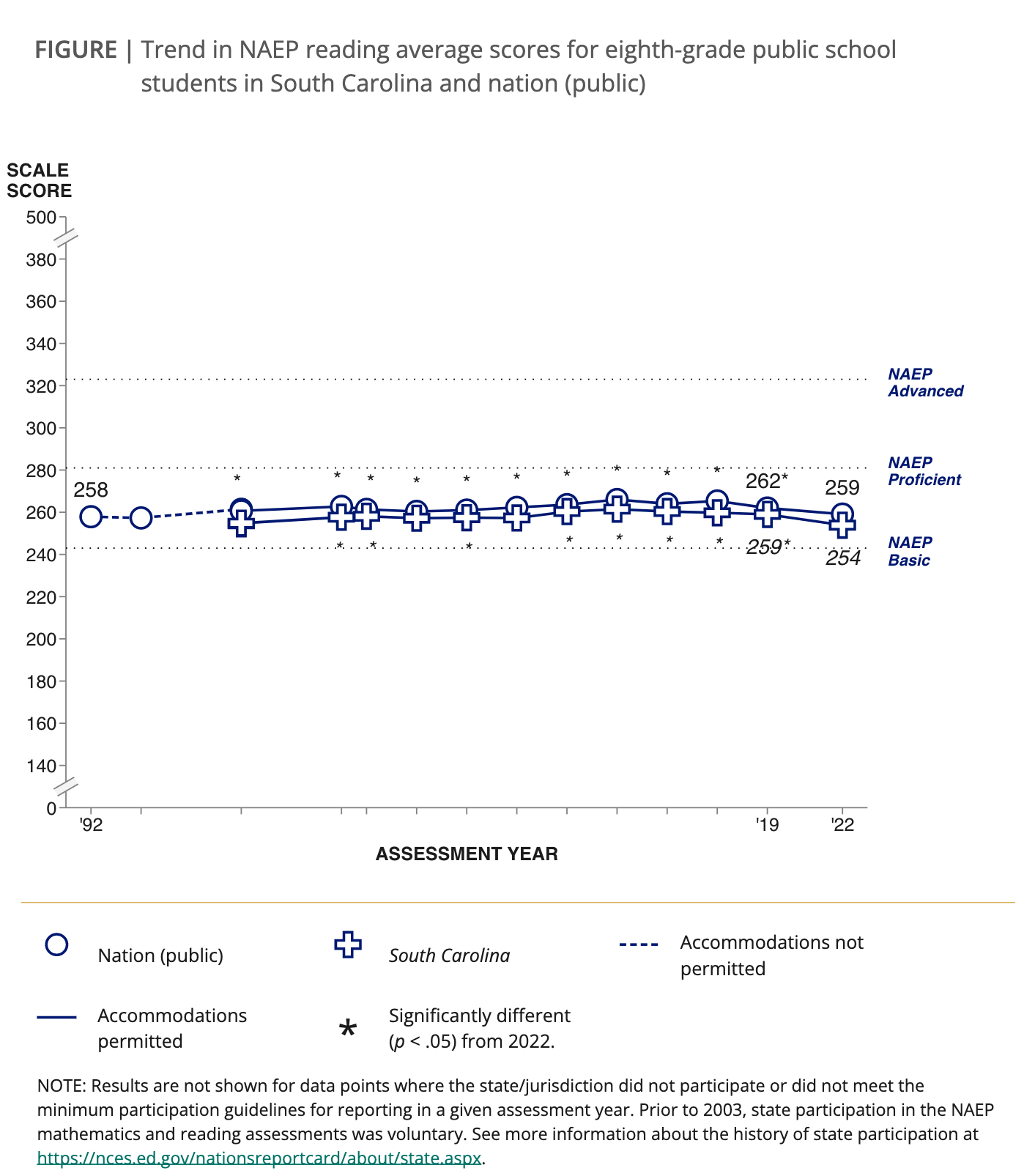
I lived, learned, and taught in the three decades before these three decades, and I can only conclude that reading achievement (whatever that is) as measured in formal testing has been about the same forever.
In my home state and across the nation, this is the real story: We have become content with a historical and current negligence about the reading acquisition of some populations (Black and brown students, poor students, special needs students, multi-lingual learners), and we lack the political will to address the systemic forces of inequity in the lives and schooling of these students to do anything about it.
Historical negligence is not a crisis; it simply is how things are, what we have come to accept as “normal.”
As I have examined in my scholarship [2], journalism in the US has only two false stories about education—crisis and miracle.
The problem is that neither narrative is true; they are anecdotal and melodramatic so they are compelling to the public, politically useful, and likely to drive reader/viewership for the media.
The US remains in a false crisis cycle begun by A Nation at Risk, and then powerfully expanded under the Obama/Duncan era of shouting education crisis while propping up the false charter school miracle machine (for example, the Harlem “miracle” celebrated by David Brooks citing the Obamas).
The crisis/miracle narrative approach from the Obama era has recently been replicated by the media obsession with SOR; Hanford’s seminal story planted both seeds by falsely claiming the US has a reading crisis and promoting a miracle school that wasn’t.
Again, please point out the crisis here:


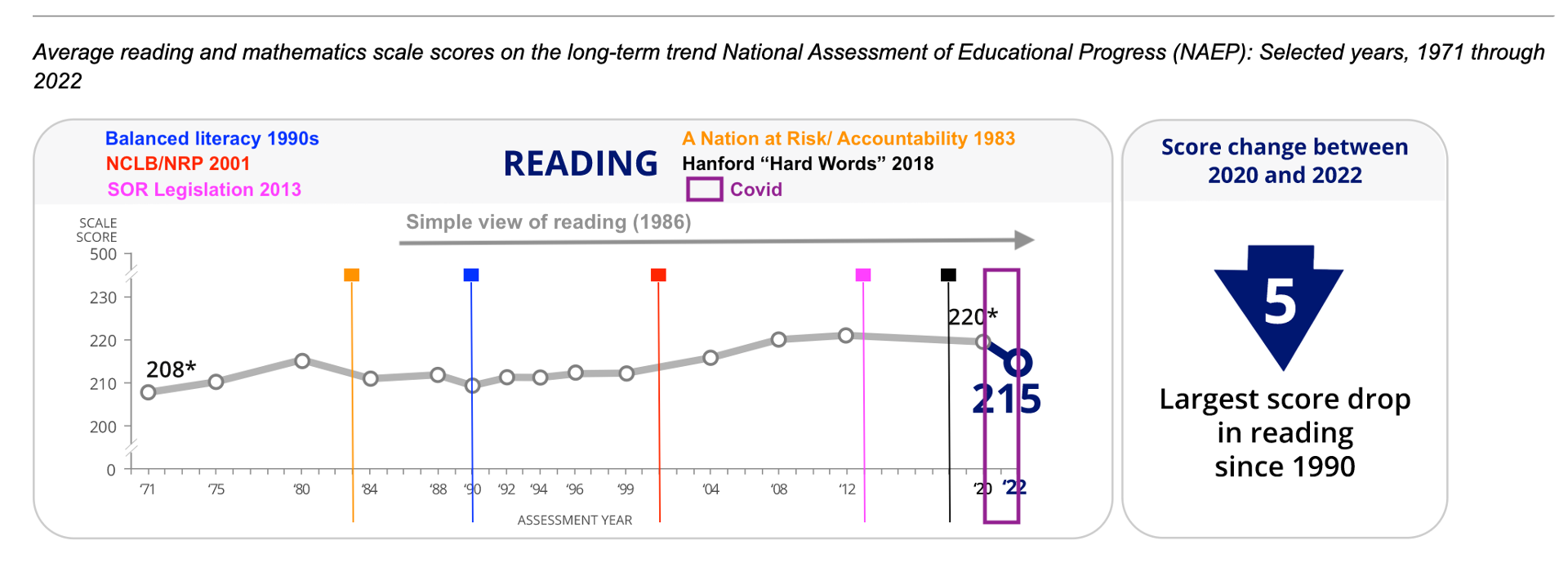
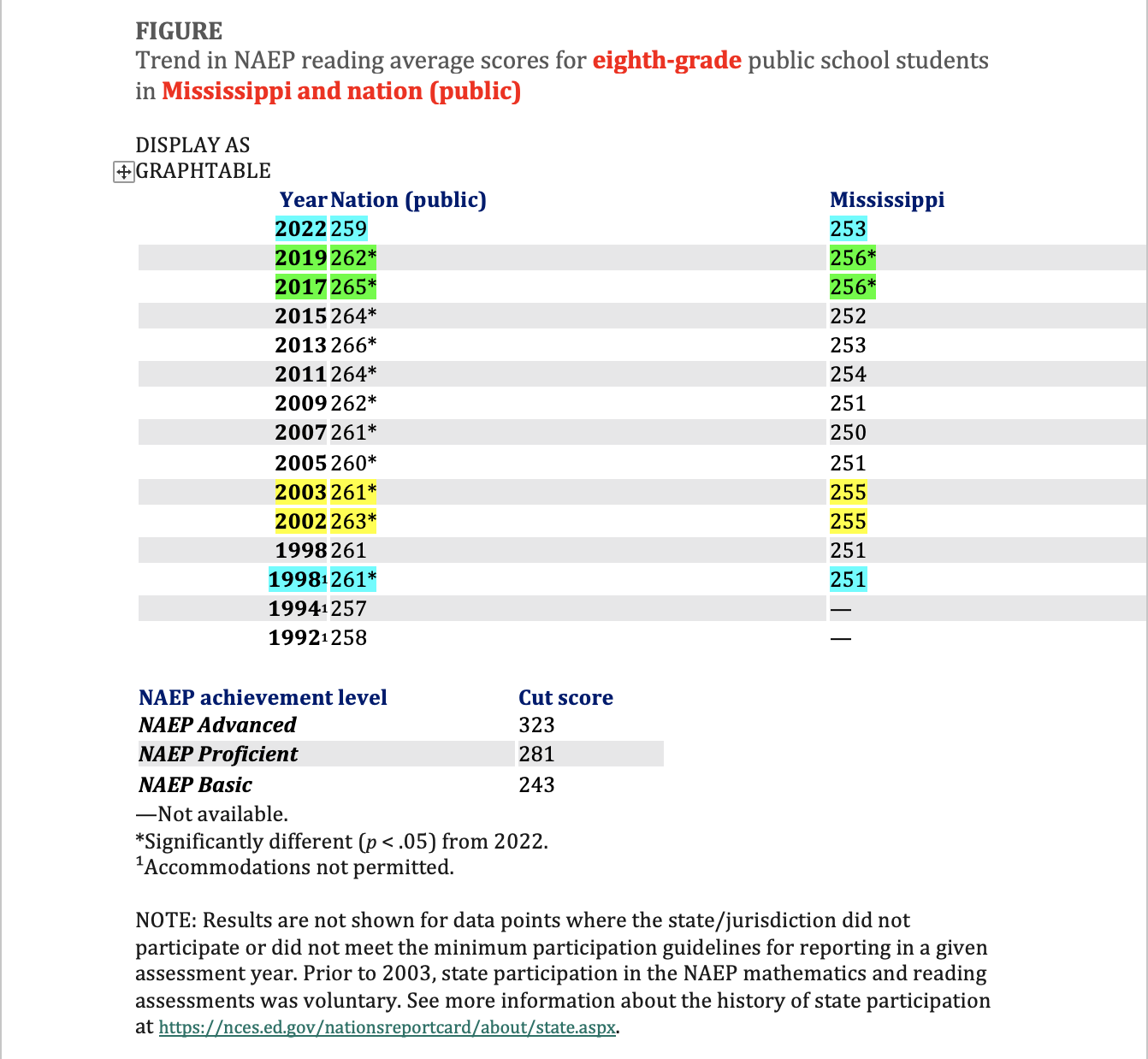
And as I have explained, the miracle of the moment, Mississippi, like all the other educational miracles, simply doesn’t exist; MS has had steady growth and some jumps, often well before any SOR reading legislation:

And MS remains below NAEP proficient and continues to have drops between grade 4 and 8:

For many years, I have had to help my students navigate the media obsession with the melodramatic—crisis! miracle!—often found in films such as Waiting for Superman (false union crisis v. charter miracles) and the compelling documentary about education in SC, Corridor of Shame (an emotionally manipulative film about the powerful connection between poverty and educational negligence in the state).
The media, public, and politicians love and benefit from the crisis/miracle rhetoric about education. But those stories do not serve the needs of children, teachers, or schools.
Ellison ends his talk powerfully:
I don’t know what intelligence is. But this I do know, both from life and from literature: whenever you reduce human life to two plus two equals four, the human element within the human animal says, “I don’t give a damn.” You can work on that basis, but the kids cannot. If you can show me how I can cling to that which is real to me, while teaching me a way into the larger society, then I will not only drop my defenses and my hostility, but I will sing your praises and help you to make the desert bear fruit.
What These Children Are Like
Education journalism has reduced education to crisis or miracle, and like the reductive formula Ellison rejects for children, I must reject this false pair of stories.
There is no reading or education crisis, and there are no miracle schools.
There is historical and current political negligence for addressing inequity in the lives and schooling of “other people’s children” in the US.
But that reality doesn’t sell or garner votes.
[1] Toward end, Ellison is scathing:
The great body of Negro slang–that unorthodox language–exists precisely because Negroes need words which will communicate, which will designate the objects, processes, manners and subtleties of their urban experience with the least amount of distortion from the outside. So the problem is, once again, what do we choose and what do we reject of that which the greater society makes available? These kids with whom we’re concerned, these dropouts, are living critics of their environment, of our society and our educational system, and they are quite savage critics of some of their teachers.
What These Children Are Like
[2] Thomas, P.L. (2016). Miracle school myth. In W.J. Mathis & T.M. Trujillo, Learning from the Federal Market-Based Reforms: Lessons for ESSA. Charlotte, NC: IAP.
Thomas, P.L. (2015). Ignored under Obama: Word magic, crisis discourse, and utopian expectations. In P. R. Carr & B. J. Porfilio (Eds.), The phenomenon of Obama and the agenda for education: Can hope (still) audaciously trump neoliberalism? (pp. 45-68). Charlotte, NC: Information Age Publishing.

Open Letter on Reading Legislation
A recent scholarly commentary by professors Reinking, Hruby, and Risko note: “Since 2015, 47 state legislatures have enacted, or are currently considering, a remarkable total of 145 bills that address reading and reading instruction in public schools.”
Many literacy and policy scholars [1] have also noted that this wave of reading legislation is often grounded in the “science of reading” (SOR) movement that has been characterized as misleading, overly simplistic, and driven by melodramatic anecdotes.
Further, the growing number of states adopting SOR-based reading legislation includes bans of reading practices and programs as well as narrow mandates for different reading practices and programs.
A 2020 policy statement warned about using the SOR movement to inform legislation, however, by:
• Failing to place the current concern for reading in a historical context.
National Education Policy Center & Education Deans for Justice and Equity (2020). Policy Statement on the “Science of Reading.” Boulder, CO: National Education Policy Center.
• Overemphasizing recent test scores and outlier data instead of longitudinal data with greater context (for example, NAEP).
• Misrepresenting the “science of reading” as settled science that purportedly prescribes systematic intensive phonics for all students.
• Overstating and misrepresenting the findings of the National Reading Panel report of 2000, without acknowledging credible challenges to those findings.
• Focusing blame on K-12 teachers and teacher education without credible evidence or acknowledgement of challenging teaching and learning conditions and the impact of test-based accountability policies on practice and outcomes.
• Celebrating outlier examples of policy success (in particular, the Mississippi 2019 NAEP data) without context or high-quality research evidence for those claims.
http://nepc.colorado.edu/publication/fyi-reading-wars
The policy statement remains an important guide for revising reading legislation in order to avoid continuing to under- and mis-serve the individual needs of all students and to de-professionalize teachers.
The recommendations remain urgent and include the following for what legislation should not/should do:
• Should not fund or endorse unproven private-vendor comprehensive reading programs or materials.
• Should not adopt “ends justify the means” policies aimed at raising reading test scores in the short term that have longer-term harms (for example, third-grade retention policies).
• Should not prescribe a narrow definition of “scientific” or “evidence-based” that elevates one part of the research base while ignoring contradictory high-quality research.
• Should not prescribe a “one-size-fits-all” approach to teaching reading, addressing struggling readers or English language learners (Emergent Bilinguals), or identifying and serving special needs students.
• Should not prescribe such a “one-size-fits-all” approach to preparing teachers for reading instruction, since teachers need a full set of tools to help their students.
• Should not ignore the limited impact on measurable student outcomes (e.g., test scores) of in-school opportunities to learn, as compared to the opportunity gaps that arise outside of school tied to racism, poverty, and concentrated poverty.
• Should not prioritize test scores measuring reading, particularly lower-level reading tasks, over a wide range of types of evidence (e.g., literacy portfolios and teacher assessments), or over other equity-based targets (e.g., access to courses and access to
certified, experienced teachers), always prioritizing the goal of ensuring that all students have access to high-quality reading instruction.
• Should not teacher-proof reading instruction or de-professionalize teachers of reading or teacher educators through narrow prescriptions of how to teach reading and serve struggling readers, Emergent Bilinguals, or students with special needs.
• Should not prioritize advocacy by a small group of non-educators over the expertise and experiences of K-12 educators and scholars of reading and literacy.
• Should not conflate general reading instruction policy with the unique needs of struggling readers, Emergent Bilinguals, and special needs students.• Should guarantee that all students are served based on their identifiable needs in the highest quality teaching and learning conditions possible across all schools:
National Education Policy Center & Education Deans for Justice and Equity (2020). Policy Statement on the “Science of Reading.” Boulder, CO: National Education Policy Center.
o Full funding to support all students’ reading needs;
o Low student/teacher ratios;
o Professionally prepared teachers with expertise in supporting all students with the most beneficial reading instruction, balancing systematic skills instruction with authentic texts and activities;
o Full and supported instructional materials for learning to read, chosen by teachers to fit the needs of their unique group of students;
o Intensive, research-based early interventions for struggling readers; and
o Guaranteed and extensive time to read and learn to read daily.
• Should support the professionalism of K-12 teachers and teacher educators, and should acknowledge the teacher as the reading expert in the care of unique populations of students.
• Should adopt a complex and robust definition of “scientific” and “evidence-based.”
• Should embrace a philosophy of “first, do no harm,” avoiding detrimental policies like grade retention and tracking.
• Should acknowledge that reading needs across the general population, struggling readers, Emergent Bilinguals, and special needs students are varied and complex.
• Should adopt a wide range of types of evidence of student learning.
• Should prioritize, when using standardized test scores, longitudinal data on reading achievement as guiding evidence among a diversity of evidence for supporting instruction and the conditions of teaching and learning.
• Should establish equity (input) standards as a balance to accountability (output) standards, including the need to provide funding and oversight to guarantee all students access to high-quality, certified teachers; to address inequitable access to experienced teachers; and to ensure supported, challenging and engaging reading and literacy experiences regardless of student background or geographical setting.
• Should recognize that there is no settled science of reading and that the research base and evidence base on reading and teaching reading is diverse and always in a state of change.
• Should acknowledge and support that the greatest avenue to reading for all students is access to books and reading in their homes, their schools, and their access to libraries (school and community).
http://nepc.colorado.edu/publication/fyi-reading-wars
This current cycle of the reading wars is another example of reducing historical and current failures of reading instruction to unwarranted crisis rhetoric and then resorting to the same failed patterns of education reform enacted for nearly five decades.
The individual needs of all students as readers can only be served by autonomous teachers in educational environments that support learning and teaching—not by mandates for scripted programs that enforce a once-size-fits-all approach to learning and teaching.
Reading legislation has the potential to do great harm or great good for the children of the US and our democracy. Once again, political leaders have chosen to do great harm.
Recommended
School Reformers’ Pledge of Good Conduct
[1] See
- The Science of Reading and the Media: Is Reporting Biased?, Maren Aukerman
- The Science of Reading and the Media: Does the Media Draw on High-Quality Reading Research?, Maren Aukerman
- The Science of Reading and the Media: How Do Current Reporting Patterns Cause Damage?, Maren Aukerman
- Legislating Phonics: Settled Science or Political Polemics? David Reinking, George G. Hruby, and Victoria J. Risko
- Thomas, P.L. (2022). The Science of Reading movement: The never-ending debate and the need for a different approach to reading instruction. Boulder, CO: National Education Policy Center. http://nepc.colorado.edu/publication/science-of-reading
- Hoffman, J.V., Hikida, M., & Sailors, M. (2020). Contesting science that silences: Amplifying equity, agency, and design research in literacy teacher preparation. Reading Research Quarterly, 55(S1), S255–S266. Retrieved July 26, 2022, from https://doi.org/10.1002/rrq.353
- MacPhee, D., Handsfield, L.J., & Paugh, P. (2021). Conflict or conversation? Media portrayals of the science of reading. Reading Research Quarterly, 55(S1), S145-S155. Retrieved July 26, 2022, from https://doi.org/10.1002/rrq.384
- Cryonics Phonics: Inequality’s Little Helper – New Politics
- Making sense of reading’s forever wars, Leah Durán and Michiko Hikida
- Harvard EdCast: To Weather the “Literacy Crisis,” Do What Works
- Disrupting the Disruptors: Reimagining Policy Advocacy in a Post-Truth Era, Helen Aydarova
- Caught In a Web of Privatizers: Science of Reading Reforms in the State of Tennessee, Helen Aydarova
- “Whatever You Want to Call It”: Science of Reading Mythologies in the Educational Reform Movement, Helen Aydarova

Where Do We Go from Here?: Learning and Teaching in the SOR Era
One of the most important and too often ignored works by Martin Luther King Jr. is his Where Do We Go from Here: Chaos or Community? (see an excerpts here).
I have relied on this work for many years in the context of my public writing and scholarship addressing equity, poverty, race, and literacy (for example, see pt. 1 and pt. 2). What has always rung true and important is King’s practical call for needed direct action instead of the status quo of political indirect action.
For example, King noted that the political will in the US was to view education as a mechanism for erasing poverty, racism, and inequity (indirect action) instead of directly eradicating the forces that create poverty, racism, and inequity.
I have reached a very sobering moment in my public work addressing the “science of reading” (SOR) movement as that has informed reading legislation across the US:
Since 2015, 47 state legislatures have enacted, or are currently considering, a remarkable total of 145 bills that address reading and reading instruction in public schools.1 Many of these bills are relatively routine appropriations, procedural issues, licensures, and so forth. However, an increasing number define, endorse, and sometimes mandate instructional approaches—a legislative excursion into matters that in other fields of practice, such as medicine or law, are left to certified professionals and the standards set by their professional organizations or accrediting agencies. In that sense, the existence of such laws suggests a perception of a problem with the teaching of reading of such consequence that it demands legislative action. In so doing, it moves professional practice into the political realm, subject to all the forces and vested interests inherent to that domain.
More specifically, it moves the teaching of reading into ideological territory, at least in the narrow pragmatic sense suggested by Fine and Sandstrom (1993; see also Seliger, 1970/2019). They defined ideologies as uniting individuals around shared beliefs and offering “diagnoses of what is and is not problematic in the sociopolitical world” (p. 24). Ideologies, they say, motivate ameliorative action, create affinity by energizing emotional reactions, and set boundaries of acceptable belief, inoculating members against outside influences and helping to recruit new members. Further, ideologies, so conceived, naturally generate a dissimulating rhetoric in which “speech about topics of public controversy, including political and ‘scientific’ speech . . . is subject to slanting and shaping when those treatments seem beneficial to [ideological] groups” (p. 30).
Reinking, D., Hruby, G. G., & Risko, V. J. (2023). Legislating Phonics: Settled Science or Political Polemics? Teachers College Record, 125(1), 104–131. https://doi.org/10.1177/01614681231155688
In my own work about reading policy, I had cited 32 states less than a year ago, and now, I must admit, SOR reading policy has become the dominant approach to teaching reading in the US despite extensive and credibly scholarly evidence that the reading crisis; blame leveled at reading programs, balanced literacy, and teacher educators; and misrepresentation of reading science are false narratives.
Media stories, political responses, and state-level legislation have resulted in pre-service and in-service training/retraining (often LETRS) and reading programs being banned with short lists of SOR-approved programs being mandated—both of which substantially change the landscape of how children will learn to read and how teachers will be mandated to teach (often in scripted environments).
Therefore, where do we go from here?
First, we must resist fatalism, and thus, we must adopt practices and strategies for advocating for addressing individual student needs as readers and teacher autonomy as reading teachers—even as both students and teachers must adopt ways to navigate this new SOR reality.
Key concerns about SOR legislation and policy include reducing reading instruction to scripted programs (often labeled “structured literacy) that erase individual student needs and teacher professionalism.
Educators, parents, and advocates for reading must acknowledge and reinforce that reading science is not settled, even as we have decades of valuable evidence for what works when teaching children to read.
This advocacy must walk a very difficult path of honoring individual stories of parents, children, and teachers while also raising cautions that anecdotes do not equal science (credible generalizations).
Anecdotes are powerful and compelling, but they often perpetuate overly melodramatic stories that misrepresent reading and teaching reading.
Next, we must hold SOR practices and policies to the highest standards of meeting the equity and diversity needs of our students.
Early evidence suggests that SOR-labeled reading programs and materials often have the same lack of diversity that has plagued reading materials for decades.
One of the historical negative consequences of “science” (which has historically been used to support racism and sexism) is that it promotes authority grounded in claims of being objective, which allows science to often be a veneer for practices that are, in fact, inequitable and biased.
The technocratic focus of the SOR movement and policy is fertile ground for continuing to see reading and students in monolithic ways that erases their humanity. Cultural backgrounds, regional dialects, and individual experiences must all be honored and fostered in our pursuit of teaching reading and the love of literacy that all children deserve.
There simply is not one right way to become a reader, and not one right way to teach children to read.
Finally, we must begin to detail and document what learning to read and teaching reading should look like if we do in fact embrace addressing individual student needs and teacher autonomy.
As a start, that requires that everyone must resist forming reading camps (labels are our enemy) and that we shift away from adopting reading programs to teach reading and call for teaching children to read.
I don’t see what we must do next as a compromise, but as a different way forward.
At its core, the SOR movement and the legislation that has become a national norm are deja vu all over again. We have lived the reading crisis/reading reform merry-go-round for almost a century.
I remain committed to King’s vision of recognizing that status quo approaches to systematic and important problems are doomed to fail again, to feed the entrenched political cycle.
Each child is precious, and unique, and each child deserves the opportunity to love reading, to become an eager and critical reader in order to enjoy the sort of human autonomy we claim to cherish.
Too often adult pettiness stands in the way of that opportunity.

Neanderthal Academia Reanimated!
In 2002, I left my career as a high school English teacher for 18 years and entered higher education full time.
I genuinely loved teaching high school, specifically teaching teenagers. But that part of my career had significant personal costs because I was always an extreme outlier in terms of ideologies among my peers.
Faculty were overwhelmingly religious and most of my colleagues voted Republican (this was South Carolina in the 1980s and 1990s).
As I entered higher education, I must admit now, I had an idealistic view of academia that was shaped by the standard view that colleges and professors are liberal.
However, once in the halls of academia, I recognized that once again I was an outlier.
Higher education is populated by performative progressivism; yes, many if not most professors are moderate to progressive on social issues.
But in their professional roles, college professors are overwhelmingly conservative and traditional. The normative culture of higher education is firmly conservative.
Also, despite what the public thinks, many professors are ideologically conservative about teaching and knowledge and conduct their classes and research in highly conservative ways because those traditional norms are expected and rewarded.
How should a professor teach? With an objective pose that simply exposes students to a wide range of (normative) perspectives.
How should a professor conduct research? Experimental/quasi-experimental studies are by far the most rewarded, quantitative and objective.
Should a professor conduct public work or activism? Not no, but hell no.
Professors that conform to and perpetuate the most conservative views on disciplinary content (seminal works, classic thinkers, essential knowledge), the most conservative research (scientific), and the most conservative teaching practices (objective, not political) have the easiest paths to full professor and also have the highest prestige in the university, holding key chair positions on the committees that drive the university—Faculty Status, Curriculum, etc.
“Conservative” is grounded in having normal established and endorsed; the entire basis of scientific research is normative, finding generalizable conclusions from randomized data.
The implication is always that normal is right, and being outside that norm, abnormal, is wrong.
Of course, the key problem with generalizable research is that it excludes outliers, perpetuating the idea that everyone, even those outliers, should conform to that norm.
The marginalized (lesser status) approach to research is descriptive, qualitative, and allows there to be value is simply exploring one event or person. The non-normative approach to research is open to possibilities that what has been scientifically determined to be “normal” may in fact not be right (or even true beyond a scientific truth), at least for some.
Research and science helped create the norm, for example, that humans are sexually straight and that gender is binary. That sexuality and gender may be fluid, and that we are considering that because of the life stories of individual people, challenges not only our norms about sex and gender, but our scientific norms.
Science has proven the superiority of races, the frailty of women, and even designated homosexuality as a mental illness.
To think that the scientific norm of higher education isn’t conservative takes a great deal of mental gymnastics.
We are currently witnessing how any challenge to what has been determined as normal, especially under the guise of science, is viewed in melodramatic ways.
As a cultural example, despite the US overwhelmingly being Christian, Christians often claim to be oppressed, notably each season fighting a manufactured War on Christmas.
Somehow uttering “happy holidays” threatens the very fabric of the largest cultural holiday in the US celebrated by the overwhelming majority, Christians, while non-Christians are compelled to join in with the ubiquitous acknowledgement of Christmas from Halloween through the New Year.
The much protesting we are seeing from conservative academics is exactly like the performative crisis espoused by Christians each Christmas holiday season.
Academia is extremely conservative—scientific research, objective teaching, authorized disciplinary knowledge—and that conservative norm has allowed for many decades mediocre people (mostly white, mostly men) to thrive and even excel.
And yet, Neanderthal academia has been reanimated (not revived, because it never died).
Conservative academics are shouting that they have been canceled.
Conservative academics bemoan their university’s “woke” curriculum.
Conservative academics cry that they are being threatened by “woke mobs” of students.
This, you see, is all theater, melodrama, by people who are not really relevant and are fighting desperately to be relevant in a world continuing to question what is normal
In fact, the fight against woke agendas is clearly a manufactured drama in which these Neanderthal academics have cast themselves in leading roles with predictable lines:
“Marketplace of ideas!”
“Scientific!”
“Objectivity!”
“Classic!”
“Seminal texts!”
It is genuinely embarrassing when people with the most power shed so many tears into the chilling effect of their histrionics that the result is a blizzard that will soon leaves us all snow blind.
I have spent 39 years as an extreme ideological minority within my profession, and frankly, most situations of my life. Yet, you will not see me crying “cancel culture!” or “woke mob!” because I can see clearly from the margins.
Neanderthal academia is not just alive and well, but it is reanimated in ways it hasn’t seen since the glory days at mid-twentieth century when minoritized people “knew their place,” being contentedly white-man adjacent if not subservient.

Revisiting the Research Paper Problem for College Students as Writers
[Header Photo by Thought Catalog on Unsplash]
About 15 years ago, my university overhauled the curriculum and academic calendar, including dropping the traditional English 101/102 approach to composition for a first-year seminar structure.
That moved the responsibility for teaching composition out of the English Department solely and across the entire university (a problem of writing pedagogy that the university didn’t acknowledge until several years later). Initially students were required to take two first-year seminars, one writing intensive and another that allowed students and professors to explore their passions.
The non-writing seminar was popular, but ultimately not sustainable so when the curriculum was updated a few years ago, we dropped the non-writing FYS and added an upper-level writing and research course requirement to better support teaching writing at the college level.
I have been teaching writing formally for 39 years, 18 years as a high school ELA teacher and currently 21 years and counting at the college level. Therefore, I have a great deal of experience and knowledge about teaching writing as part of a transition from high school to college (see recommended posts below).
As a high school ELA teacher, I focused on teaching writing, and for my advanced students, I worked diligently to prepare them for college. I am proud that many students returned during college and confirmed that they were better prepared as writers than many of their peers.
Embedded in that, of course, is that many students then—and now— enter college not well prepared to write at the college level. In fact, much of my work in my first-year writing seminar is helping students unlearn beliefs and practices about writing that helped them be very successful in high school—but that were guaranteed to be far less effective in college.
A significant part of that needed transition is the misguided “research paper” approach to writing cited essay and an overemphasis of the singular importance of MLA as a style and citation guide.
Elements of the inauthentic “research paper” model of writing cited essays include the following:
- Students following templates and prescribed steps to gathering sources and producing a paper in MLA format.
- Students writing with a stilted style that focuses on their “research” and “sources” instead of incorporating sources as authoritative evidence in an original essay and purpose.
- Students using a “one source at a time” organization and discussion pattern that focuses on covering the sources instead of writing an original essay.
I address these issues directly in my FYW, scaffolding the course from a first essay that is personal narrative, to an essay citing entirely with hyperlinks, and then to a formally cited scholarly essay in which they use APA style and citation.
That FYW experience in my course is transitional and foundational, and I would say moderately effective. But I also recognize that teaching composition at the college level is not a mere inoculation; one course over 3-4 months cannot a scholarly writer make.
So I am always eager to work with my upper-level writing/research course—where every class I am confronted with how powerful the “research paper” model of writing remains in students two or three years into college.
Just yesterday, my students in the upper-level writing/research course turned in their major cited essay grounded in their course project—analyzing and evaluating how media covers a key education topic.
The course is heavily structured and scaffolded to help students write a very advanced and difficult cited essay. Part of that structure is that I almost daily remind them that the focus of their work is media analysis, which I punctuate with “You are not writing a research paper on your education topic.”
As has become expected in this course, however, students mostly submitted research papers on their education topics and tended to write using the strategies I identified above that they learned in high school—mostly writing about their sources (even calling them “sources) and simply covering all their sources one at a time.
Many students almost entirely failed to even mention media, and they all continue to struggle with the complex expectations for writing an original analysis and evaluating media coverage—especially the stylistic differences they need to practice in different sections of the essay.
Here is the full assignment and guiding support for the assignment (which I revised and refine every time I teach the course):
Assignment
Students will conduct a research project in which they critically analyze how the above chosen issue is presented in the mainstream media, and write in a workshop format (multiple drafts, conferencing) an 8-10 page essay using APA format (see link above and student resources provided) detailing how well or not the media has presented the research. See Sample APA 7e with comments. NOTE: This cited essays is primarily a critical analysis of media coverage, and not simply an essay on your chosen education topic. The essay should include the following major sections: opening, literature review, media coverage, relationship between research and media, and closing/conclusion.
For 8-10 pages, a proposed structure:
Opening – about 1 page (2-4 paragraphs); be sure to include essay focus on media
literature review – 2 pages; focus on *patterns* in the sources (write about your topics, not the sources); must be fully cited (prefer synthesis and avoid presenting one source at a time) and address all scholarly sources included in references
media analysis – 2 pages; focus on *patterns* in the media and include several examples; directly identify media outlets and journalists
media evaluation (relationship between research and media) – 2 pages; this is the most important goal of the essay so evaluate the media coverage by implementing your knowledge of the scholarship (do not refer to “research” or “sources”); must be fully cited
closing/conclusion – about 1 page (2-4 paragraphs); must emphasize essay focus, media analysis
You MUST follow APA guidelines; please refer to this SAMPLE.
And please review this CHECKLIST.
Assignment Submission Guidelines
Research project essay: Submit research project cited essay in both the initial and final submissions (all drafts should be complete and in proper format, even when submitting “rough” or initial drafts) as Word files and attach to email with “research project essay” in the subject line. See APA 7e guidelines here and Sample APA 7e with comments. Submit essay as a Word file, and format in Times New Roman font, 12 pt., double space, with 1″ margins. Each file should be named “lastname essay.docx” (as you revise and resubmit, add RW, RW2, RW3, etc., to the file name to designate multiple drafts).
Peer conferencing cited essay in class; have a copy of your cited essay (hard copy or on your device) to peer review with classmates.
Checklist for peer-review:
[ ] Formatted with 2 page breaks (after title page and after last page, before references)
[ ] Opening: narrative and focus/thesis identifying media coverage of educational topic
[ ] Four level two subheads: lit review, media analysis, relationship of media and research (key section of the essay), and closing
[ ] Fully use *all* sources and fully cite throughout the essay
[ ] APA formatting
I am very clear and address directly that the assignment is challenging, in many ways preparing students for graduate school. But I also believe this is an important entry point to writing well as an undergradute.
Students spend the first half of the course exploring writing (we examine scholarly personal narrative) and study educational research; they also carefully research both scholarly evidence on their education topic while gathering recent examples of media coverage.
Their first major assignment is to produce an annotated bibliography of those sources, and I stress that this is a process scholars use to support writing their essays (noting that creating an annotated bibliography is for them as writer and scholars, not just an assignment to follow).
The sections—literature review, media analysis, media evaluation—force them to write with different styles within one essay.
Some students struggle with focusing rhetorically on the patterns found in their scholarly sources for the literature review; they tend still to write about the sources and walk through them one at a time.
The media analysis requires that they do close textual analysis (a much different style than the literature review). We ground that in critical discourse analysis [Theory and Practice in Critical Discourse Analysis (PowerPoint)], but they also tend here simply to summarize the media examples one at a time, not focusing on patterns or how media covers the topic.
Along with not being adept with analysis, they do not understand that using sources is a way to lend authority to their own evaluation. Some of this is rhetorical since they want to say “research shows” instead of allowing the parenthetical citation to support their wording.
As I have noted before, students would be much better served if high school set aside the reductive research paper method and instead established some concepts for students about how and why academic and scholarly writing incorporates sources into writing:
- Explain to students that citation formats are a subset of style guidelines that are discipline specific. MLA, for example, is often required in high school English classes because it is the style guide favored in some of the humanities. I forefront for students the stylistic expectations of style guides in the context of disciplinary expectations (APA uses dates in parenthetical citations because when a study is conducted is important in the social sciences, for example) and stress that many of the formatting quirks of a style guide are tedious and thus not to be memorized. In short, students need to learn to use style guides as a reference, not “learn MLA,” etc.
- Focus on centering academic and scholarly writing around questions that the essay will explore and answer instead of declarative thesis sentences. Students as young scholars benefit from a humble and nuanced pose versus asserting a level of certainty that they simply do not yet have.
- Foster an understanding of a wide range of ways to offer evidence and support in academic writing. Since many students write cited essays as literary/textual analysis in their English classes, they “learn” that the only or most important evidence is quoting—yet quoting from social science sources is not recommended in APA or even relevant. In fact, writing expectations in many disciplines prefer students synthesizing multiple sources into they own words to show a body of evidence. Paraphrasing and citing multiple sources shows sophistication and understanding that simply summarizing one source at a time cannot.
- Stress that citation in original writing is a tool, not the goal of writing. As writers they need to start with clear content purposes that then lead to searching for sources that help them gain the knowledge and authority to write a compelling essay. They should move away from “my sources say” to “I know this” and include citations to stand on the shoulder of giants.
My university’s shift from English Department-based composition to first-year seminars has had many stumbles and falls, but the core principle of moving writing instruction across all the disciplines is essentially far more authentic.
As my assignment above demonstrates, academic and scholarly writing often is a blend of modes and purposes that demand a great deal from a purposeful and effective writer.
This sort of writing is very challenging, and students would benefit from being introduced early to these concepts so that so much of college instruction need no longer be spent helping them unlearn the “research paper” method.
Recommended
What Do College Professors Want from Incoming High School Graduates?
Transitioning from High School to College: (Re)considering Citation Edition
Making the Transition from Writing in High School to Writing in College
Fostering the Transition from Student to Writer
 dr. p.l. (paul) thomas