Category Archives: education

The Politics of Reading Proficiency (and Charter Schools)

It seems almost quaint now, except for the racism, but in 2009, Representative Joe Wilson (R-SC) shouted “You lie” at Barack Obama. Post-Obama, the issue of political lies intensified dramatically, however, with Donald Trump building his presidential campaign on an extreme practice of lies that was well outside the norm of the sorts of lies people tend to expect from politicians.

In the wake of Trump, political lies have maintained the new low bar set by Trump; however, as I have detailed, there is a long history now of political leaders building their political careers on education reform, recently reading legislation, and that strategy in part depends on politicians, not educators, having the power to mandate standards, high-stakes testing, and most important of all, what counts as “proficiency” for reading achievement (currently, by the way, “proficiency” is set by each state with no federal oversight [see explanation here]—despite the stated goals of the Common Core movement to address that).

Many elements of the education reform movement begun in the early 1980s have served a similar political function, especially charter schools; the Obama administration, for example, solidified charter school expansion as a bi-partisan political strategy.

Since the release of the 2019 NAEP data on reading and after high-profile media coverage, a key example of politicians using reading achievement as political capital is Mississippi. The so-called “Mississippi Miracle” (a haunting cousin of the “Texas” and “Harlem” miracles that proved to be lies) is easily unmasked as a mirage (a lie) once the data is contextualized.

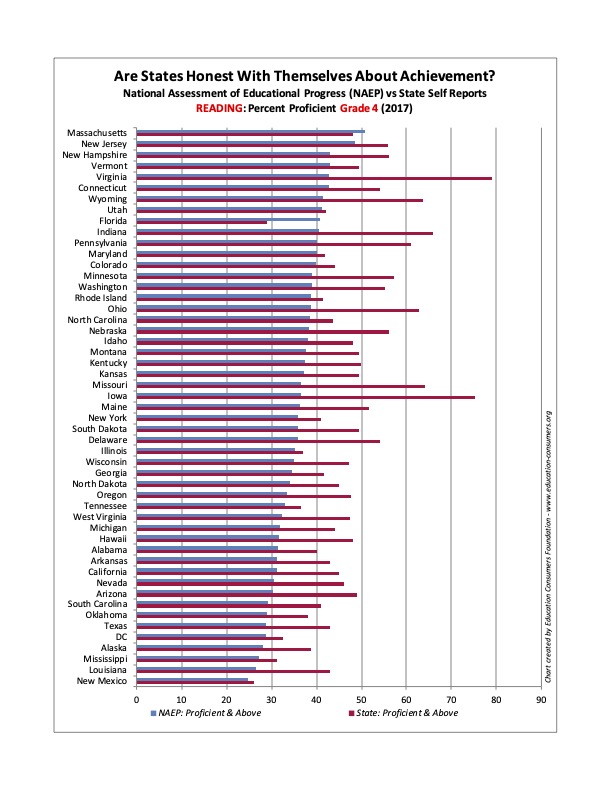
While Mississippi’s 2019 NAEP reading scores for 4th grade were heralded as an aspirational outlier, Mississippi is not alone in its effective political game of smoke and mirrors using reading proficiency scores; see the following comparison of state proficiency scores compared to national NAEP data:

Most states have some degree of lower standards for proficiency than NAEP, but the issue is not that NAEP is a credible measure of reading (it isn’t); the issue is that state-level reading proficiency is a political tool of elected officials.

While the media and political leaders in Mississippi have claimed “miracle” for the state, the data show otherwise:

As the scatterplot suggests, Mississippi has a fairly normal strong correlation between socioeconomic status and reading achievement (low poverty correlated with high scores and high poverty correlated with low scores). Yes, Mississippi has had a long pattern of raising reading scores since the 1998 while not closing key achievement “gaps” (see NAEP longitudinal data), but the state is not somehow miraculously serving high-poverty students (because of the “science of reading”) in a way that is superior to other states (whose failures are being falsely attributed to an absence of the “science of reading”).

While a perverse way to say it, Mississippi reading achievement isn’t a “miracle” (and there currently is no scientific evidence that reading achievement gains are caused by a switch to the so-called “science of reading”) but is mostly “normal” in terms of producing measurable student achievement that is more a reflection of socioeconomic status (and race) that actual achievement.

In short, if you look at the data from all states, you will find a pattern of political hype (lies) not matching the data.

Similar to Mississippi, my home state of South Carolina tends toward that normal, but since this tool allows adding charter schools, please note how charter school (red dots) achievement (as I have documented before) mostly matches traditional publics schools (TPS), with a few outperforming and several underperforming when compared based on similar demographics:

The key to charter school analysis is to compare charter and traditional public schools with similar demographics (in the scatterplot above, that is the vertical axis); note that most charter schools cluster with TPS, but several fall lower on achievement when compared to TPS.

None the less, a great deal of political capital has been and is currently being spent on claiming the “science of reading” has created “miracles” (a lie) and that charter schools save children in poverty and Black/brown students (another lie).

Reading achievement is once again a hot media and political topic, but that discourse and legislation coming from it, are mostly lies that are serving the needs of political leaders and not students.

Dear Legislators: Your Job Is Funding, Not Dictating, Education

Let’s start with a thought experiment.

Your elected state legislators are confronted with a series of bills addressing crumbling bridges and roads in your state. After a period of typical partisan debate, a final bill is proposed that not only funds new bridge and road construction, but also dictates how those bridges and roads must be constructed.

Most of the legislators who wrote and voted on the bill have laws degrees or career experiences in business; none of the legislators are structural engineers, and thus, no expertise in constructing bridges or roads.

Structural engineers and those whose profession is building bridges and roads note that the legislation is dangerous, ill conceived, and certainly will result in bridges and roads that will cost people’s lives.

None the less, the bill passes and then is signed by your governor.

This thought experiment likely seems outlandish, but it represents a key distinction about the role of legislators as that impacts public institutions (in this hypothetical situation, our highway/road infrastructure). In brief, it is the role of legislators to fund and ensure at least adequate if not excellent public institutions; it is not the role of legislators to dictate how those public institutions should be realized since a legislative body often lacks the expertise to create those mandates.

This brings me to my primary area of expertise, education.

Specifically since the last months of the Trump administration, there has been a wave of state-level legislation censoring curriculum, banning books and ideas, and mandating all aspects of formal education (curriculum and instruction)—often including mechanisms for parents to trigger censorship and even dismissal of teachers and professors based on personal ideologies and perceived “discomfort” by students.

This partisan political trend fits into a larger contemporary and century-long history of legislators mandating not just that education by provided but what and how that education must include.

As one example, since about 2018, states have proposed and passed very detailed and prescriptive reading legislation, a movement that fits into the accountability era of education that began in the late 1970s and early 1980s.

My home state of South Carolina is a powerful example of good intentions that have gone terribly wrong.

Under the guidance of then-governor (and future Secretary of Education under Bill Clinton) Richard Riley, SC established the now-familiar structure of K-12 public education, broadly labeled as accountability—state-level standards (approved by legislators), state-level high-stakes testing (approved by legislators), and various consequences for schools and teachers meeting or not those mandated parameters.

Throughout the 1980s and into the 1990s, bolstered by the misleading and partisan A Nation at Risk report released under Ronald Reagan, governors increasingly discovered that focusing on education reform paid significant political dividends (regardless of political party).

The narrative was simple, although deeply misleading: U.S. public education is failing students and the country because of the inherent flaws of the education establishment; therefore, it is the responsibility of elected officials to mandate all aspects of education.

By the mid-1990s into the 2000s, George W. Bush pushed the envelope of being an education governor onto the national stage; Bush created another false narrative around his so-called “Texas Miracle” (along with Rod Paige as Texas superintendent of education) that helped propel Bush to the White House and then take the state-level template for education reform to the federal level with No Child Left Behind (NCLB).

While NCLB floundered, never producing the results promised in the same ways that state-level accountability never fulfilled promises, the template was set for governors and presidents; the Obama administration (embodied by Arne Duncan as Secretary of Education) doubled-down on the Bush/ Paige/ Spellings model, in fact.

In many ways, the current wave of curriculum gag orders and book censorship (as well as the copy-cat legislation imposing a misguided “science of reading” mandate on reading instruction) is the logical progression within that accountability approach to education.

In that model, authority is centered in elected officials, and expertise is trumped by that political authority.

Since the 1980s, accountability legislation and political micromanaging have not improved education in the U.S. (at regular intervals, the same crisis discourse is repeated, followed by the same strategies for reform, just under different political leaders), but that model has served political careers well at the expense of education, democracy, and now, academic freedom.

Legislators, then, have replaced their democratic responsibilities for funding and ensuring public institutions with using education, for example, as a political football for their own careers.

Just as legislators should fund but not mandate how to build our roads and bridges, they should fully fund but not dictate how or what teachers teach—especially when their mandates are serving ideological agendas and not teaching or learning in a country that claims to respect individual liberty, democracy, and academic freedom.

The “Science of Reading” Multiverse

Published in 1947 in The Elementary English Review, a flagship journal of the National Council of Teachers of English (NCTE) that later became Language Arts, “Research in Language” is one of the most cited pieces by Lou LaBrant in my scholarship and public writing about education and literacy.

LaBrant served as president of NCTE in the 1950s, and along with being an active and influential literacy scholar, LaBrant was a practitioner over a staggering 65 years of teaching.

LaBrant made two incisive claims in this article:

A brief consideration will indicate reasons for the considerable gap between the research currently available and the utilization of that research in school programs and methods. (p. 87)

It is not strange, in view of the extensive literature on language, that the teacher tends to fall back upon the textbook as authority, unmindful of the fact that the writer of the text may himself be ignorant of the basis for his study. (pp. 88-89)

LaBrant, L. (1947, January). Research in language. Elementary English, 24(1), 86-94. http://www.jstor.org/stable/41383425

Having written an educational biography of LaBrant for my doctoral dissertation, I am vividly aware that LaBrant taught and wrote as a complex progressive who used the term “research” in broad Deweyan terms that included everything from gold-standard experimental research to the daily observations made by classroom teachers.

I cite her because as a practitioner and scholar I also embrace a very complicated understanding of “research,” “evidence,” and the word of the moment, “science.” I am also deeply skeptical of textbooks and programs.

Since early 2018, the phrase “science of reading” has entered and often dominated media, public/parental, and political discourse around the teaching and learning of reading in the U.S.

Almost for as long—I discovered the movement a few months after it began—I have been waving a red flag, advocating for skepticism and extreme caution about that discourse, the media, public/parental, and political rhetoric. For that reason, I persist in placing the phrase in quote marks since I am specifically criticizing the discourse.

If anything, my criticism is having far too little impact on the consequences of the “science of reading” discourse that is driving many states to adopt new reading legislation. And on social media, I am routinely attacked, often quite aggressively, as a science denier and someone intent on hurting children (although I have been a life-long educator across five decades as both a K-12 classroom teacher and a college professor).

I am also often discredited and told that journalists, parents, and politicians understand my own field better than I do.

Part of the problem with debating the “science of reading” movement is the term itself, one that has at least three different meanings, a multiverse if you will (although absent, darn it, Doctor Strange or Wanda).

Before anyone can, or should, answer “Do you support/reject the ‘science of reading’?” we must first clarify exactly what the term means; therefore, here, then, I want to detail the three ways the phrase currently exists since it entered mainstream use in the media during 2018.

“Science of Reading” as Media, Public/Parental, and Political Discourse. Beginning with Emily Hanford and then perpetuated by mainstream media (Education Week and the New York Times, notably), the “science of reading” is a narrative that claims teachers are not teaching students to read using the “science of reading” because teacher educators have failed to teach the “science of reading” in teacher prep programs. Concurrently, this discourse also blames low student reading achievement on the dominance of balanced literacy reading programs (often erroneously) since, as advocates claim, balance literacy is not grounded in the “science of reading.” This version of the “science of reading” maintains that primarily (or even only) cognitive science research is the “science” that counts and that the “simple view” of reading is the one valid theory of reading supported by the “science of reading.” [Note: This is the version of the “science of reading” that most of my scholarly and public writing challenges as misguided and harmful; see here, here, and here.]

“Science of Reading” as Marketing and Branding. Since the “science of reading” advocacy identified above has been extremely effective, states are adopting new reading legislation, some of which directly bans popular reading programs and then narrowly mandates the use of materials and programs that meet the narrow characterization above. This means education companies, especially ones focusing on literacy, have begun to brand and rebrand their materials as programs with the “science of reading.” For example:

As a market response to legislation, as well, some popular reading programs have responded to this version of the phrase. This marketing dynamic is very common in education. Many years ago, I attended a state-level literacy conference where Smokey Daniels spoke. Daniels is one of the top literacy scholars associated with the term “best practice”; however, he warned then that the term had been quickly co-opted by textbook publishers and that there was no mechanism for insuring that something labeled “best practice” was, in fact, demonstrating those concepts (the same problem exists for “whole language” and “balanced literacy”).

“Science of Reading” as Shorthand for the Research Base for Teaching Reading. This is what LaBrant referred to as the “research currently available” in 1947. The irony in this use of the phrase is that many people have been using some form of this phrase for a century—”research,” “science,” “evidence.” And of course, scholars and practitioners are often aware of and practicing many aspects of that “science”—even though science, research, and evidence are all necessarily in a state of flux (and thus, LaBrant’s nod to “currently available”). To be blunt, no reasonable or informed person would reject this use of the “science of reading.” However, I must note that this use is almost entirely absent in public discourse; it remains used almost exclusively among researchers and some practitioners. Another irony, in fact, is that the first use of the phrase above is itself a gross mischaracterization of this complex and broad use.

Because of these different and often conflicting uses of the “science of reading,” we are experiencing incredibly jumbled and even nonsensical outcomes such as teachers being required to attend training in programs that are not supported by research (LETRS) and states adopting reading legislation that implement practices that are not supported by research (grade retention).

So, if you return to LaBrant’s claims above, you may notice an eerie similarity between her valid assertions and the current “science of reading” discourse that is not credible even as it is highly effective.

The problem is that teaching, learning, and literacy are extremely complex human behaviors that resist simple labels or explanations—and also defy efforts to prescribe templates that will magically fulfill the urge for “all students must.”

Alas, in this multiverse there is no magic.


Recommended

Dr. Paul Thomas on the Multiverse that is the Science of Teaching Reading

Paul Thomas How to End the Reading War and Serve the Literacy Needs of All Students

What You Should Learn in the Classroom about Expressing Your Opinion (Especially in College)

Watershed moments in your life can be exaggerated I am sure through the lens of memory, but I have a vivid recollection of one such moment in my 10th-grade English class with Mr. Harrill.

English throughout junior high had been a series of grammar book exercises and what felt like an entire year of sentence diagramming in 9th grade. Then one day in Mr. Harrill’s class we had a full-class discussion.

Except for the weekly tedium of vocabulary tests, Mr. Harrill taught us that English class was about reading, writing, and thinking—often aloud. In other words, English became a place where we all explored ideas as a community in order to shape our own views of the world around us.

One day Mr. Harrill was being observed by the principal, Mr. Simpkins (his two sons, one a year ahead and one a year behind me, were friends), who just about 8 years later would be my principal as I took Mr. Harrill’s position and entered that same room as a high school English teacher.

The class quickly slipped into debate (I am not sure that was Mr. Harrill’s lesson plan) about whether or not we would serve in war if drafted. The class quickly divided into two camps—all the boys except me proclaimed their patriotic zeal for serving while I joined the girls in saying I would not serve because I rejected the concept of war.

Years later when I interviewed with Mr. Simpkins, he recalled that day, and pushed me on whether or not I was serious (Mr. Harrill had apparently explained after that class that I was prone to being the devil’s advocate in the class).

One of Mr. Harrill’s many gifts as a teacher was his ability to instill in us both passion for ideas and words as well as a sense of community; we listened and we shared. I genuinely don’t recall anyone being inappropriately upset even though I recall many of us being uncomfortable.

Another lesson came in college—where professors and classmates were incredibly smart, where professors began to define boundaries for sharing our comments in informed and credible ways.

The best thing about college for me was learning to listen and recognizing that being smart was mostly about stepping back, acknowledging your assumptions, and then moving forward grounded in evidence. Honestly, despite the popular narrative that being an English major is a wasted major, I learned much of this through the demands of literary analysis.

In short, don’t say something about a text unless you can ground your comments in the actual text.

Being a student was such a vibrant and important experience for me, I became an English teacher. As I noted above, I entered my old English classroom as the teacher in the fall of 1984 (an ominous year it seems now in the current climate of educational gag orders).

For 18 years, I committed myself to providing the same sort of experiences for my students that Mr. Harrill gave to me; it was a gift and I was determined to pay it forward.

Classes were discussion-based and my students wrote a tremendous amount. English was about ideas, and the focus was teaching my students in ways that helped them become the people they wanted to be.

Many class sessions were uncomfortable, even tense, because we confronted race/racism and religion quite often—among the many complex topics raised over and over in literature.

Students were often frustrated at each other, and several were deeply frustrated with me.

But we were a community, and my students learned the boundaries of academic discussion much earlier than I did. For many years, I had former students reach out from college to thank me for my classes and those lessons (often about their ability to write, but that was also about their ability to think in informed and complex ways).

I have now been teaching at a selective university for twenty years, since the fall of 2002.

One of the hardest parts of that transition is that my university students are very quiet; classroom discussions have often paled when compared to my own experiences as a student and my 18 years teaching high school English.

That dynamic was very frustrating in my first years so I began collecting anonymous survey about student attitudes surrounding talking aloud in class.

Consistently for many semesters, I found a pattern. Students did not like to speak aloud in class for a few reasons: (1) Not wanting to be “wrong” in front of peers, (2) not wanting to be “wrong” in front of the professor, and (3) not wanting to “give away” knowledge to peers who hadn’t done the reading.

What I must stress is that the survey and discussions about that feedback were very clear that the hesitations about talking in class have been academic, not ideological. Students are quiet because of their fear of being graded, evaluated, not because they felt they were being ideologically silenced.

In fact, student feedback I receive regularly describes my class as a safe space to express student views. But students also recognize that our classes are spaces where evidence and awareness are expected.

Since I teach first-year students and several introductory class, we often explore what students should avoid expressing aloud in terms of eroding their credibility (not in terms of hiding their ideologies).

For example, I just explained to a student about the problems behind the term “hysterical,” and cautioned them to stop using the word now that they are better informed.

Learning to be careful with language is not censorship or being cancelled; learning to be careful with language is a part of being an educated and ethical human.

The standards for discussion are much higher in the classroom than among friends at the bar, or even for presidential debates. Claims must be supported in the classroom.

And of course, this is a long and winding way to confront the recent Op-Ed in the New York Times and then referenced in The Chronicle of Higher Education.

The commentary by Emma Camp speaks into a very lazy and (ironically) ideologically skewed narrative that colleges are liberal echo chambers where conservative students are silenced and shamed.

As Oyin Adedoyin examines in The Chronicle, however, evidence doesn’t clearly support that narrative:

In surveys, there’s some evidence that students are worried about how their beliefs will be viewed by their peers. Yet there’s also evidence that most students, across all political affiliations, feel encouraged by their institutions to speak freely and have never experienced discrimination based on their beliefs. In those surveys, a higher proportion of students of color report feeling unsafe on campus because of others’ speech.

Do Students Self-Censor? Here’s What the Data Tell Us

Camp’s piece presents a much different message than intended, I think, because the experiences she details seem to suggest that she did not learn the lessons I have identified above.

Academic discussions and debates are not about expressing your opinion, and certainly are not about expressing your opinion without consequences.

One incredibly important lesson of the classroom is that when you say something not credible, you should expect to be challenged, and even corrected.

I have had many students boldly express claims about people in poverty (characterizing them as poor), about gun violence, and such, prompting me to pull up research and evidence in order to show those claims are based in stereotypes and ideology but not evidence.

And then stressing that classroom discussions should be grounded in evidence. In academia, we value informed opinions.

Often, when students are corrected, they are not upset, or triggered; many, if not most of them, express aloud in class that they didn’t know that and appreciate the new information.

They experienced discomfort, and they started (or continued) a journey in personal growth.

These moments with my college students—incredibly bright and driven students—often remind me of those nonsense days of teaching high school English in the 1980s when we were tasked with test-prep during the early days of the standards and accountability.

One of the reading standards prescribed teaching the difference between fact and opinion. The prep material had nonsense examples such as noting “blue is the best color” is an opinion but “the sky is blue” is a fact.

Even my high school students would interrogate that by nothing that air is clear and that the blue is refracted light (and students also noted that we color bodies of water blue because even though water is also clear, large bodies of water reflect the sky). In other words, my high school students understood that there actually is no real clear distinction between fact and opinion.

There are credible claims, and there are claims without credibility.

What you should learn in the classroom about sharing your opinion, then, is not that all opinions are welcomed without consequence (which is what conservatives seem to be demanding for themselves while simultaneously advocating for actual state-imposed censorship), but that sharing your opinion carries with it a responsibility to ground that opinion in evidence—and then being prepared to be challenged.

A significant aspect of formal education dedicated to individual freedom and democracy is to avoid at all cost indoctrination while affording students many opportunities to interrogate their assumptions, stereotypes, and unexamined ideologies; formal education is a ticket out of provincialism.

Learning and growth are uncomfortable, in fact.

“A foolish consistency is the hobgoblin of little minds, adored by little statesmen and philosophers and divines,” Ralph Waldo Emerson writes in Self-Reliance. “With consistency a great soul has simply nothing to do. He may as well concern himself with his shadow on the wall.”

Commentaries such as Camp’s seems to be seeking the sort of intellectual and ideological spaces that leave you alone with the shadow on your wall, trapped in your own little mind.

What you should learn in the classroom about sharing your opinion is that there is much more in this world than your own opinions.

Recommended: John Oliver on CRT

As an educator spanning five decades and as an education scholar, I fully endorse the following coverage of the CRT debate as an exceptionally accurate and complex examination of this manufactured crisis:


See Also

Gag Orders, Loyalty Oaths, and the New McCarthyism

Bully Politics and Political Theater in an Era of Racial Shift

Curriculum as Windows, Mirrors, and Maps

Critical Race Theory: The Facts and Irony (for White People)

Understanding Critical Race Theory: A Reader for Educators

Educational Gag Orders: Legislative Interference in Teaching About Race

Educational Gag Orders

Bully Politics and Political Theater in an Era of Racial Shift

Florida Governor Ron DeSantis (R) recently bullied students about wearing masks as he prepared to give a press conference. DeSantis called wearing masks “Covid theater,” but it seems more likely his petulant behavior is his own political theater since DeSantis immediately turned the embarrassing behavior into a fundraising gimmick.

That a sitting governor publicly and brazenly chastised students—behavior that no student would be allowed toward other students or adults while in school—is a snapshot of the broader attack on K-16 education in the U.S., also driven entirely by Republicans.

Curriculum gag orders, anti-CRT legislation, and book bans all seek to censor any mentioning of race or racism as well as topics related to gender or sexuality (the latter repeatedly identified by Republicans as “pornography”).

Copy-cat legislation across Republican-led states is far less about teaching and learning than about the tremendous racial shift occurring in the U.S.—and the immediate tension in K-12 public education because of that shift.

The 2020 Census has revealed, as reported in USA Today: “The white, non-Hispanic population, without another race, decreased by 8.6% since 2010, according to the new data from the 2020 census. The U.S. is now 57.8% white, 18.7% Hispanic, 12.4% Black and 6% Asian.”

In short, the white racial majority in the U.S. is shrinking quickly, and the future of racial balance in the U.S. is now reflected in K-12 education, where white students constitute less than half of students:

However, K-12 education remains a very white space except for that student population.

Almost 80% of teachers are white, and despite the false claims made in curriculum gag orders and anti-CRT legislation, K-12 curriculum and texts remain disproportionately white:

Research on U.S. history textbooks indicate White, European Americans are featured in over half of pictorials and illustrations. In some cases, it is more than 80 percent. Representation of people from BIPOC backgrounds are rarely featured, with some ethnic groups featured as low as 1 percent.

These racial and ethnic representations do not reflect demographics given in the 2020 U.S. Census, where 61.6 percent of the population is identified as White, 18.7 percent Hispanic or Latinx, 12.4 percent Black or African American, 6 percent Asian, 1.1 percent American Indian and Alaska Native, 0.2 percent Native Hawaiians and other Pacific Islanders, 8.4 percent some other racial population, and 10.2 percent multiracial….

In sum, studies on books and other materials reveal that White characters are more prominent than BIPOC characters. The data suggest that it is likely that students who identify as White will see mirrors of themselves more often than students from BIPOC communities.

The Representation of Social Groups in U. S. Educational Materials and Why it Matters, Amanda LaTasha Armstrong

DeSantis, then, personifies the resulting bully politics of Republicans as a response to the racial shift occurring in the U.S.

An examination of bullying in academia offers an important frame for understanding the larger phenomenon of bully politics:

What makes bullying an unethical, yet effective, means to rise through the ranks? An emerging body of research suggests that mediocre academics in particular resort to bullying, to remove their competition. Experimental research has shown that when male hierarchies are disrupted by women, this incites hostile behaviour specifically from poorly performing men, because they stand to lose the most.

Members of underrepresented groups report they are the targets of bullying with the intent to sabotage their careers. Some anecdotes suggest that bullies spring into action when their targets become too successful for their liking — and thus viable competition.

How bullying becomes a career tool, Susanne Tauber and Morteza Mahmoudi

This unpacking of bullying in academia fits well into understanding the bully politics of Republicans, often mediocre white men, like DeSantis, who feel threatened and cultivate political capital by stoking racial animosity through misinformation.

As I have noted before, K-12 public education is quite conservative and, as shown above, very white. While curriculum gag orders have characterized teachers and schools as hostile to white students (legislating bans on making students uncomfortable)—without evidence—and rampant with CRT—which isn’t occurring in K-12 schools—few people are directly exposing why bully politics is on the rise—the significant racial shift in society and schools in tension with the static whiteness of teachers and curriculum.

Unlike the ways in which Republicans have characterized U.S. schooling, Ranita Ray has witnessed a much different reality for students:

What I discovered was rampant racism, cruelty, and indifference from teachers working inside public schools. Most of the teachers I observed were not, in fact, teaching about America’s racist history but instead were perpetuating everyday racial violence against their students inside the classroom. While the idea is not prominent in public discourse, I am not alone in finding teacher racism to be an everyday presence in the American classroom. One recent study, for example, found that teachers hold as much implicit and explicit pro-white racial bias as nonteachers do. Education scholar Michael Dumas has written about teacher racism and Black suffering inside the classroom, showing that these attitudes have concrete outcomes. And students themselves know this. Social media is replete with students talking about teacher racism, and they have often taken to the streets to protest it.

It Never Seems to Be a Good Time to Talk About Teachers’ Racism

The irony of the racial shift spurring bully politics lies in ground zero, the backlash against the 1619 Project, which represents not a rewriting of history but a confronting of what history is—stories of the past shaped by who ever has power.

The facts of history do not necessarily change but the power behind what facts are told and why does shift. The 1619 Project changes what is centered in the telling of U.S. history (moving it away from the idealized founding and toward the grim reality of the institution of slavery)—in a similar way to the shifting racial centering of the U.S. in the 2020s.

Republicans are scrambling not to protect history or Truth, but to further entrench a mythology, an aspirational white-washed version of the country.

The impetus behind the 1619 Project and diversity, equity, and inclusion efforts is well expressed in Adrienne Rich’s poem:

I came to explore the wreck.

…the thing I came for:
the wreck and not the story of the wreck
the thing itself and not the myth
the drowned face always staring
toward the sun
the evidence of damage
worn by salt and sway into this threadbare beauty
the ribs of the disaster
curving their assertion
among the tentative haunters.

“Diving into the Wreck”

The facts of history and even the present—and not the myths—are disturbing, uncomfortable (“the drowned face always staring”).

Some of us, like the speaker in Rich’s poem, accept the discomfort as motivation to work toward a better world for everyone.

Others are petulant, bullies, carelessly grabbing all their toys and threatening to go home.

DeSantis and the other mediocre Republicans are playing political theater but their bully politics is all too real and has devastating consequences for academic freedom and democracy.

Histrionics characterizing masks as “Covid theater” are masking white fear that has reduced the Republican Party to bully politics in the service of a misguided whiteness—and to the exclusion of democracy and basic human dignity.

Gag Orders, Loyalty Oaths, and the New McCarthyism

Out of the rack and ruin of our gangster death,
The rape and rot of graft, and stealth, and lies,
We, the people, must redeem
The land, the mines, the plants, the rivers.

“Let America Be America Again,” Langston Hughes

An avalanche of gag order bills are being proposed in South Carolina—H.4325H.4343H.4392H.4605, and H.4799. While my home state of SC often likes to brag about being the first state to secede in order to maintain slavery (an uncomfortable fact many of these laws would ban from being taught), these bills represent the sort of crass copy-cat legislation that is also sweeping across other Republican-led states.

Not only is there nothing original in these bills (or even evidence-based or logical), but also there is a profoundly disturbing repetition of one of the lowest points in U.S. history—the New McCarthyism.

Let’s start with facts, which Republican legislation seeks to censor:

  • “Critical Race Theory” as it is mischaracterized by Republicans does not exist in K-12 schools.
  • CRT as properly defined (a scholarly theory created primarily by Black scholars for the the field of law and adapted in a few other fields such as education and sociology) does not exit in K-12 schools.
  • Systemic racism is a fact of the founding of the U.S. and a fact of the U.S. in 2022, supported by irrefutable evidence that defies simplistic explanations (such as individual racism).
  • Race is a social construct and not a matter of biology.
  • History is a living field for considering the facts of the past; there is no one true history.
  • Intellectual discomfort is often a necessary aspect of new learning when anyone must confront misconceptions or missing knowledge in order to better understand and navigate the world.

The gag orders such as those listed above in SC are blunt partisan politics driven by orchestrated lies that have nothing to do with protecting students or with teaching factual history or excellent literature/texts.

Curriculum and book censorship in 2022 is our New McCarthyism because the CRT veneer is being used to promote ideological agendas aimed at Black people and LGBTQ+ people.

The McCarthy Era, also known as the Red Scare, was confronted in The Crucible by Arthur Miller, who uses allegory to warn the U.S. at mid-twentieth century that McCarthy’s cries of “communism” were partisan lies similar to the Salem witch trials.

There were no witches.

There were no lists of communists.

There is no CRT poisoning U.S. schools.

Yet, in their extreme forms, some gag orders include requirements for loyalty oaths and mechanisms for withholding state funding for a decade. Even for private organizations.

The ultimate horror of these gag orders from Republicans is that by legislating censorship of what history and texts students are allowed to learn, we will be insuring the most damning of ideas about history itself—those who ignore history are doomed to repeat it, often the very worst of it.

Yesterday I saw the following Tweet about the Russia invasion of Ukraine:

While I endorse the sentiment, I have been watching for over a year while most of the U.S. fails to resist censorship right here in the so-called land of the free and home of the brave.

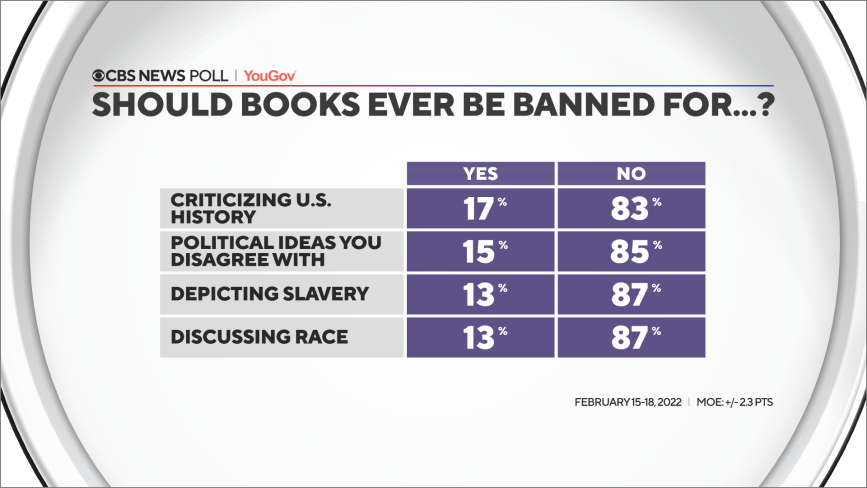
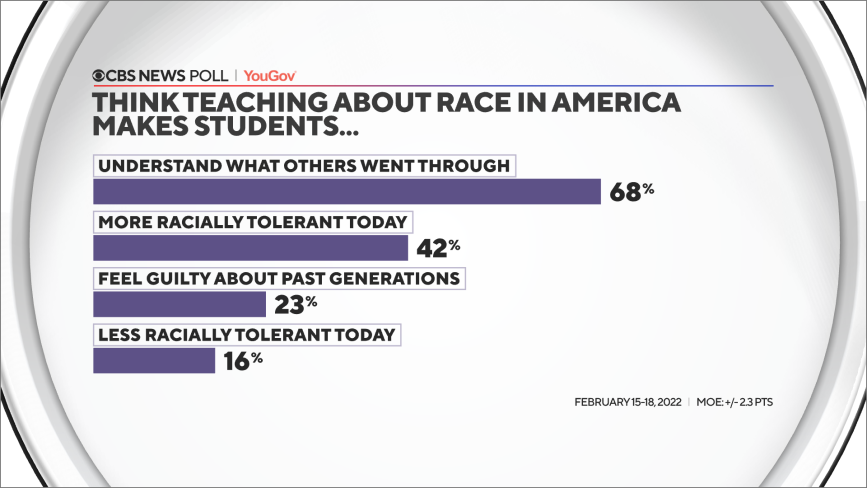
Republicans are running roughshod over freedom, pushing the U.S. toward banning abortion (despite a majority of Americans supporting maintaining Roe v. Wade) and enacting curriculum and book bans (despite large majorities of Americans rejecting censorship):

CBS news poll

Ultimately, gag orders, loyalty oaths, and censorship are un-American and anti-democratic, as ALAN notes in their Intellectual Freedom Statement:

We know that intellectual freedom is foundational to an educated citizenry and essential to the preservation and practice of democracy. We are dedicated to protecting this natural human right, and therefore, we insist on open access to all school reading materials for all students.

Intellectual Freedom Statement

The New McCarthyism exposes the Republican Party as a party of oppression, the exact sort of fact that should make everyone of us uncomfortable.


Anti-CRT Gag Orders Lack Evidence, Logic

My home state of South Carolina, one of the solid red states in the U.S., is jumping on the anti-CRT gag order bandwagon, proposing copy-cat legislation that is repeated across Republican-led states.

As Dr. Susi Long carefully detailed, anti-CRT legislation lacks evidence since CRT is not being taught in K-12 schools and since the laundry list of what the legislation is supposed to prohibit in SC schools simply does not occur in our schools either.

That is part of the reason I have called anti-CRT gag orders a manufactured crisis.

But these partisan attacks on schools and teachers lack more than evidence; they lack a fundamental logic.

The racial make up of SC is 64% white (non-Hispanic), 27% Black, and 6% Hispanic.

However, the public school student population is 48% white, 32% Black, and 12% Hispanic. Like the rest of the U.S., SC public schools are now majority-minority schools.

Here is where anti-CRT gag orders make no sense; the teacher demographics in SC are 79% white, 13% Black, and 3% Hispanic.

SC public schools have a student population significantly unlike the racial demographics of the state, and then teacher demographics are dramatically unlike the state as well as the student population they serve.

Here is where logic falls apart. If we believe anti-CRT gag orders are needed, we must believe that teachers who are almost entirely white are making white students uncomfortable because they are spreading CRT propaganda.

These demographics not only challenge the logic of anti-CRT gag orders, they also expose what is really driving this legislation—white fright.

Demographics of U.S. public schools are a harbinger of the reality that white people will soon constitute less than 50% of the country, while likely remaining the largest racial group for some time.

Schools, curriculum, and teachers are not hostile to white students or white people, but white fright is targeting schools as one of many ways white Americans are clinging to their majority status, a majority status that has an ugly history and an ugly present that some white Americans want hidden.

One of the ugliest truths beneath this fear is that white Americans know exactly what many white people did with majority power—and now they fear what may happen when someone else has that power.

Despite the shifting demographics of students and false claims made by Republicans pushing anti-CRT gag orders, schools remain extremely white-centered and white friendly. And that is the real problem that should be addressed for the good of those students.

National Days of Teaching Truth to Power

Speaking at a recent hearing on yet another copy-cat bill in South Carolina to censor curriculum (targeting Critical Race Theory [CRT]), Dr. Susi Long, professor of early childhood education (University of South Carolina) offered a measured but pointed dismantling of the partisan misinformation in this legislation:

Not to oversimplify, but Long clarifies that CRT is not taught in K-12 (or even K-16) education, adding specifically that the laundry list of issues addressed in these bills are not how teachers teach or treat our students.

Last summer, I emphasized similar points, adding what does occur in schools in terms of race and equity. At one point, Long calmly suggests legislators should be learning from educators instead of legislating what teachers can and cannot teach, what students can and cannot learn.

One of the great ironies of efforts to ban CRT (beyond that CRT isn’t something taught in K-12 education) is that a key tenet of CRT is in order to overcome racism/inequity, everyone needs to be better educated, better informed—exactly what teachers offer students across the U.S.

Here, then, is my modest proposal: National days of teaching truth to power.

As a recent post of mine details, students and teachers are vividly aware of the rise in censorship as well as the potential negative consequences of those bans, such as self-censorship grounded in fear.

Will, for example, Paul Laurence Dunbar be erased from classrooms or will teachers be fired for honoring Dunbar’s voice that continues to resonate in 2022?:

“We Wear the Mask,” Paul Laurence Dunbar

Let’s identify days when we will target lessons and texts that are being misrepresented purely for political gain.

Lessons on race and racism, lessons on academic freedom and censorship, lessons on gender and sexuality—ultimately lessons one what it means to be educated in a country that claims to be free.

This semester I plan to dedicate a day in my courses to Langston Hughes’s “Let America Be America Again.”

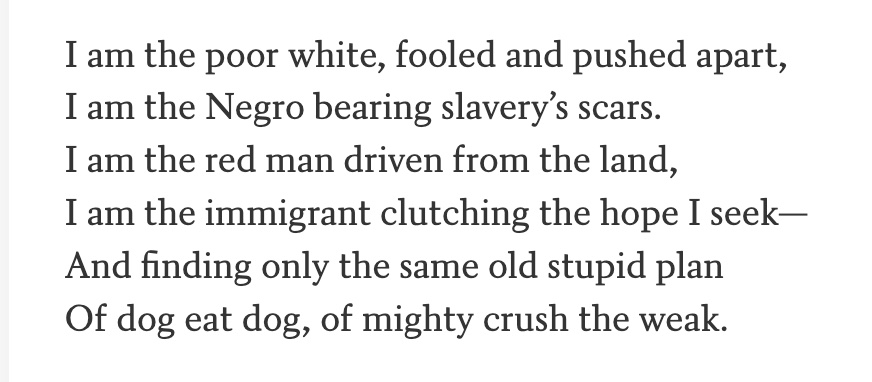
Like Dunbar’s poem reflecting the realities of being Black during Reconstruction and Jim Crow, Hughes creates a complex unpacking of many minoritized groups during the 1930s:

And Hughes also resonates today in his confronting of the failures of the American Dream, an ideal not yet realized even in 2022:

“The land that never has been yet” is facing us all now in the U.S. as Republicans are in denial and have turned to the antithesis of freedom, censorship, in order to cling to power.

As educators, as professionals charged with honoring the dignity of every student’s mind, we have only truth to break the cycle of oppressive power.

Teaching truth is the key. Can we do this, and do this now?

As James Baldwin implored, “[T]he time is always now.”

If you will join me, I will identify dates and lessons below, updating over the coming weeks with full lesson plans, texts being taught, etc.

[email: paul.thomas@furman.edu]


P.L. Thomas, Furman University

Lesson: “Let America Be America Again,” Langston Hughes

Date: TBD