Schedule: Thursday, February 3, 2022, 5:00 pm – 6:00 pm est
Session Strand: Leadership in Literacy
Session Title: FS21 – The State of the Reading War: Not Simple, Not Settled
Description:A new round of the Reading War embraces the “simple” view of reading, arguing that the “science of reading” is settled. This session interrogates the “science of reading” movement by placing it in historical context and refuting its central claims based on a more complex view of reading and science.
Topics: Equity in Education, Literacy Leadership, Reading
How can historical perspective help direct teaching and learning?
When trying to solve problems, humans are prone to looking for a “silver bullet” which often bypasses the learning process. Educational trends prove this theory. The hot teaching movement today may not have solid research behind it. History shows us that we are not good at being patient students throughout life’s journey.
Our guests Dr. Michele Dufresne, President and founder of Pioneer Valley Books and Dr. Paul Thomas at Furman University share that while K-12 education may be a basic right, not everyone has equal access to it. If every child is capable of learning and no one progresses at the same rate, then how can teachers better support student growth? Having an educated society impacts all facets of our communities.
With public schools poised to reopen for the 2021-2022 academic year, South Carolina faces the challenges of dealing with another wave of a Covid variant, a challenge made more complicated because of political theater by Republicans.
Columbia (SC) Mayor Steve Benjamin issued a mask requirement for students in the city, and immediately Governor Henry McMaster responded: “’This is another attempt to force children to wear masks in schools without a bit of consideration for a parent’s right to make that decision,’” said Brian Symmes, McMaster’s spokesman.”
The political theater of invoking “parental rights” by Republicans and conservatives falls apart at several levels.
First, if parents do have the right to demand that their children not wear masks (see below), those parents do not have the right to endanger other people—and the mask mandate in schools is primarily about community safety.
“Freedom” in this case is once again not license; parents choosing to keep their children unmasked must also address the consequences of that decision. Those parents then are obligated to provide their children proper education since the unmasking means those children cannot attend K-12 public schooling.
Just as adults are free to drink alcohol, but restricted from driving while impaired (a mandate that addresses community safety), parents and their children may remain unmasked but that means there are restrictions on where they can go and what they can do.
Choice has consequences.
But, there is a much larger issue here about parental rights and how that impacts the rights of children.
Republicans such as McMaster either are unaware of the law or are intentionally dishonest with their “parental rights” rhetoric.
What role should the state play in the transmission of values? What values can the state successfully transmit? How can it do so? To approach these questions, this Article begins with principles laid down by the Supreme Court. It is the state’s duty to ensure that all schools, public or private, inculcate habits of critical reasoning and re- flection, a way of thinking that implies a tolerance of and respect for other points of views. In pursuit of this lofty goal, the state need not make public schooling compulsory. However, the state must see that all children are provided an education that is, in the fullest sense, public—a schooling that gives children the tools they will need to think for themselves, a schooling that exposes children to other points of view and to other sources of meaning and value than those they bring from home. This effort may well divide child from parent, not because socialist educators want to indoctrinate children, but because learning to think for oneself is what children do. It is one facet of the overall movement toward the individuation and autonomy that is “growing up” and is, perhaps, the most natural and vital part of healthy maturation.
There is, then, a long legal history in the U.S. that simply doesn’t recognize parental rights as monolithic, or even sacred.
One way parental rights are limited is directly embedded in the commitment to universal public education:
The state as educator, then, is no ideologically neutral actor. The philosophical foundations supporting a truly public education are the liberal biases of our nation’s intellectual forbearers, biases in favor of a non-authoritarian approach to truth, of free argument and debate (what Jefferson called truth’s “natural weapons”), and of a healthy sense of human fallibility—the foundation, in other words, of our nation’s governmental blueprint. Unless children are to live under “a perpetual childhood of prescription,” they must be exposed—intellectually, morally, and spiritually—to the dust and heat of the race. Whether one considers the formation of moral commitments a matter of choice or duty, of reflective self-directedness or cultural embeddedness, the child must not be denied the type of education that will allow him, as an adult, to choose whether (and in what way and to what degree) to honor those commitments. A public education is the engine by which children are exposed to “the great sphere” that is their world and legacy. It is their means of escape from, or free commitment to, the social group in which they were born. It is their best guarantee of an open future.
The great irony here is that the courts have recognized that public education, the state, has the obligation to protect the individual intellectually freedom of children, even when that conflicts with parental wants or demands that are framed in rugged individualism rhetoric.
That legal recognition creates a tension that is rarely voiced in public discussions:
We are cautioned by family law historian Barbara Bennett Woodhouse that “[s]tamped on the reverse side of this coinage of family privacy and parental rights are the child’s voicelessness, objectification, and isolation from the community.” It is often assumed that state control of education “disserve[s] the values of pluralism and experimentation,” but public education can bring its students a much needed respite from the ideological solipsism of the enclosed family. Public education can physically and intellectually transport the child across the boundaries of home and community. Of course, this transportation comes at a cost. It disrupts the intramural transmission of values from parent to child. It threatens to dismantle a familiar world by introducing the child to multiple sources of authority—and to the possibility that a choice must be made among them.
And thus, the masking debate exposes a couple elements of legal obligations to the community, to children, and to parents since the requirement (or not) to mask impacts children’s opportunities to learn in contexts where academic freedom is protected and where all the people involved are safe as reasonably possible from infectious disease.
However, ultimately, the rights of children must be protected:
No one would suggest that parents may not introduce their children to personal sources of moral or religious meaning. However, to those parents who want their children untouched by other points of view, the state must say that the rights of parents, while profound, are circumscribed—contingent, as the Supreme Court has always noted, on preparing the young for the additional obligations they will take on as members of a pluralistic society. “In a democracy,” political theorist William Galston writes, “parents are entitled to introduce their children to what they regard as vital sources of meaning and value, and to hope that their children will come to share this orientation.” Yet, children have freestanding intellectual and moral claims of their own, claims that Galston goes on to remind us, “imply enforce- able rights of exit from the boundaries of community defined by their parents.” If children are granted this right of exit, they must be able to exercise it freely. They must not be disempowered from making their own intellectual and moral claims in the first place. The state has a duty to make sure they are not disempowered, and one of its best resources to that end is public schooling.
The state is charged with protecting children intellectually and physically when parents do not share that goal (risking the child’s health by refusing to mask, indoctrinating the child in singular beliefs by restricting that child’s access to knowledge and critical thinking):
The full capacity for individual choice is the presupposition of First Amendment freedoms. It is for this reason that the state has a strong obligation to see that free choice is not strangled at its source. The state may not sponsor particular religious or political beliefs, but that is not enough; it must protect children from being forced to adopt particular religious or political beliefs. The state must work to protect the moral and intellectual autonomy of all children. Further, if the state has the obligation to ensure the child’s opportunity to become autonomous, that obligation, as educational theorist Harry Brighouse has pointed out, “cuts against the differential regulation of public and private schools with respect to religious instruction.” Children are owed this obligation “regardless of whether it is the state, their parents, or a religious foundation that pays for their education, and regardless of whether they attend privately-run or government-run schools.” The constitutional freedom to choose is not guaranteed only to be so circumscribed that it exists in principle but not in fact.
The Republican political theater of “parental rights” rhetoric exposes that conservatives are intellectually and legally bankrupt, but it also exposes the essential need for the state to protect children, who have essentially no political power.
McMaster and other Republican governors are clearly speaking to the adults who are likely to vote for them, and not in any way addressing the education and health of children.
The continuing political theater surrounding Covid and public schooling is too often ignoring the children at the center of that storm.
Since children have no political authority or autonomy, the state must function in ways that support parents who honor their children’s intellectual freedom and personal health and safety but also protect children when their parents have motives not in the interest of their children’s ability to think critically and live safely.
My neighboring state of North Carolina has filed copy-cat legislation being proposed across the U.S. by Republicans as part of the manufactured Critical Race Theory (CRT) crisis.
As Justin Parmenter explains, “Among other things, the bill would make it illegal for teachers to promote feelings of racial discomfort and would require schools to prominently post information about diversity training on their websites for public review.”
Republicans and conservatives have launched a campaign grounded primarily in several false claims, including a drastic misrepresentation of what CRT is (a graduate-level theoretical lens primarily found in law schools) and that CRT exists in any significant way in K-12 public education (it doesn’t).
Since the public and political rhetoric is both misleading and false, and since the legislation is written in coded ways, those of us who recognize that this movement is an insidious lie (political leaders claiming to be protecting academic freedom by banning CRT from academic spaces) must now call Republicans on their bluff, specifically addressing the concept of “racial discomfort.”
As an educator for almost 40 years, I find no real evidence that white third graders across the U.S. are being told in schools that they are personally culpable for racism and slavery simply because they are white.
And as a scholar who understands and embraces CRT, I also know if CRT were being practiced with children across the U.S. in public school, that theoretical lens focuses on systemic racism, not individual racism. In other words, white students in U.S. public education would be well served by CRT that emphasizes the role of systemic racism regardless of individual beliefs.
CRT is one way to raise everyone’s awareness of racism and inequity so that we can all behave in ways that lead the country toward equity and meritocracy.
The only blame anyone should suffer (in the context of CRT) is a refusal to recognize systemic racism and then a refusal to behave in ways that are equitable.
Republican legislation is prescribing, then, that students remain ignorant, and ironically, passively complicit in systemic racism.
But the primary unwritten/unspoken given in the claimed concern about “racial discomfort” is that the term addresses only white racial discomfort—as if being white is somehow a greater burden, for example, than being Black and actually experiencing racism.
Is hearing or reading “n—–” not a form of racial discomfort?
Is being told you are “articulate” while Black not a form of racial discomfort?
Is being asked “Can I touch your hair?” while Black not a form of racial discomfort?
Is being paid less even though you the same educational attainment while Black not a form or racial discomfort?
Since this movement is ambiguous on the surface, we must call their bluff by acknowledging “racial discomfort” among all races.
Black students, for examples, must not be asked to read The Adventures of Huckleberry Finn, To Kill a Mockingbird, Of Mice and Men, or The Great Gatsby.
Imagine being a Black teenager in a room filled with white peers and a white teacher, reading from Gatsby [1]:
“Civilization’s going to pieces,” broke out Tom violently. “I’ve gotten to be a terrible pessimist about things. Have you read The Rise of the Colored Empires by this man Goddard? … Well, it’s a fine book, and everybody ought to read it. The idea is if we don’t look out the white race will be – will be utterly submerged. It’s all scientific stuff; it’s been proved … This fellow has worked out the whole thing. It’s up to us, who are the dominant race, to watch out or those other races will have control of things … The idea is that we’re Nordics. I am, and you are, and … And we’ve produced all the things that go to make civilization – oh, science and art, and all that. Do you see?”
Or the repeated use of “n—–” in Huck Finn, Mockingbird, and Of Mice and Men.
And let’s not stop there.
Shakespeare is filled with sexism, bigotry, and racism It must go. No more Shakespeare because children and teens might feel discomfort.
And honestly, who didn’t feel discomfort when confronted with the Pythagorean Theorem.
It must go also.
In the context of the legislation being proposed and passed, we must demand that all texts and topics causing anyone (regardless of race) “racial discomfort” be removed from the curriculum.
The logical extension of this nonsense is the total erasure of curriculum; there simply is nothing left to teach if we mobilize and demand that legislation be applied evenly for everyone.
It shouldn’t be on the shoulders of minoritized peoples to call this bluff, but a widespread effort to take this legislation to its logical conclusions would cause the movement to collapse under its own dishonesty.
Republicans and conservatives do not care about everyone’s discomfort, let’s note. How trans students feel has been repeatedly disregarded, for example.
Legislation aimed at CRT is a Great White Lie, but if we call them on their bluff, that lie will be exposed when we find ourselves with a total erasure of the curriculum.
While on vacation, a friend and I were discussing the paradox of parenting.
A parent often feels a tension between fostering and supporting a child to be the person they want to be as that contrasts with dictating what is best for the child (knowing as adults do that children, teens, and young adults often make decisions necessarily without the context of experience that would certainly change many decisions).
That paradox, that tension has existed for me as a teacher/professor, parent, grandparent, and coach.
I am constantly checking myself in roles of authority to determine if I am imposing my authority onto children and young people (authoritarian) or if I am mentoring and fostering those humans in the cone of my authority in ways that support their own autonomy and development along lines they actively choose for themselves (authoritative).
This is a dichotomy examined by Paulo Freire [1], and a central concern for any critical educator.
The current misguided attacks on anything “critical” is particularly frustrating for critical educators since these attacks are designed to fulfill the demands of authoritarian systems, partisan politics and formal education.
It has occurred to me recently that I have been in roles of authority for a very long time, beginning with working as a lifeguard in my mid- to late teens. My role of authority literally began, then, with the expectations that I would guard human life—any human life that came into the sphere of the pool where I was charged with monitoring swimming and the safety of not only individual swimmers but all of the people in the pool.
I was a very good and capable swimmer, and for a teen, I was reasonably responsible (although I cringe thinking about being a head lifeguard when only 17 or so). But having the level of authority and responsibility that being a lifeguard entails was quite likely asking far more of me that I deserved.
Those days of lifeguarding set me on course for being the responsible person for the next 40-plus years, exacting a significant toll on me psychologically and emotionally.
Maintaining a critical authoritative pose when in positions of authority is extremely hard, much harder than being authoritarian.
Way back in the 1980s and 1990s, I was practicing in many ways the sort of critical teaching that is coming under attack in 2021, even resulting in a teacher in Tennessee being fired:
At issue was Hawn assigning the essay “The First White President” by Ta-Nehisi Coates to students in his Contemporary Issues class in February, and later in March, playing a video of “White Privilege,” a spoken word poem by Kyla Jenée Lacey to the same students.
Many conservatives see the work of Coates, for example, as radical, while those of us on the left would argue Coates’s work is quite mainstream and accessible—but far from radical. This is the same dynamic around Barack Obama, for example; Obama is a moderate and an incrementalist, but certainly not a radical leftist or Marxist (as conservatives like to suggest).
While I taught high school English in the very conservative rural South, I was mostly allowed to teach texts with only occasional complaints from parents. What looks quite odd now is that I included Howard Zinn in my classes for many years without a peep from anyone (Zinn is a key target of the ant-CRT movement now).
But I also included Joseph Campbell’s comparative mythology in my classes in order to help students navigate metaphorical approaches to narratives (a key skill needed in the Advanced Placement course I taught and as preparation for college).
Including Campbell did cause problems since his work complicated the literalism many of students experienced in their religious lives. Fundamentalist Christianity was the background of nearly all my students, and Campbell’s casual claims that all religions and mythologies told similar archetypal stories stepped on the toes of arguments that accepting Jesus was the only way into heaven.
I aroused similar complaints by including Gandhi in my Emerson/Thoreau/MLK unit.
The parental challenges to Campbell and Gandhi were grounded in a type of insecurity that had never been examined critically by those parents, all of which was the result of having been raised in authoritarian environments.
I did have my students interrogate that Sunday school and preaching were not places where they were encouraged to ask questions or challenge any of the “lessons” they received.
So in 2021, I cannot stress too much that the Republican attack on critical race theory and how history is taught is simply a battle for the integrity of the mind of children, teens, and young adults.
Learning and knowledge—especially if we genuinely believe in human autonomy and democracy—are not simply about accumulating facts determined to be true or important by some authority, but are about learning how to know what we believe is true and why.
Human freedom is most threatened by unexamined beliefs, not by the act of questioning itself.
Authority doesn’t just resist questioning, but entirely rejects it as an act.
Republicans and the conservatives drawn to authoritarianism do not trust human agency, do not believe in the free exchange of ideas, and do not believe in the essential power of questioning, especially when the questions are aimed at their authority.
Nothing is as simple as “both sides,” and certainly we should never fall into traps of “only know this.”
There can never be free people, however, without free minds cultivated in the guarantee of academic freedom.
And the free exchange of ideas will never be spaces without discomfort, which now seems to be a smokescreen used by Republicans in their pursuit of securing authority.
Suddenly, Republicans are concerned about uncomfortable white students, but seem oblivious to the discomfort, for example, of thousands and thousands of Black students experience reading The Adventures of Huckleberry Finn or To Kill a Mockingbird.
Teachers must now tip-toe around the uncomfortable texts and conversations about race and racism because of the possibility of white discomfort (note that Black discomfort about Huck Finn has been repeatedly swept aside under the guise of “classic literature”)—a stance once again disregarding the daily discomfort of Black children experiencing racism.
Intellectual discomfort (what texts and discussions prompt in formal schooling) is often necessary for learning, but existential discomfort (what targets of racism and sexism experience) are not necessary and are essentially harmful.
Authoritarian education is willing to sacrifice the existential comfort of marginalized children in order to shield some children from intellectual discomfort.
Even more disturbing, however, is that what is really being protected is the frailty of those students’ parents and those people in authority who are not willing to risk being challenged or questioned in any way.
Freire’s early call for a “horizontal” relationship generated a staggering amount of debate over the teacher’s role in a democratic classroom. In his later writings, Freire refined his notion of directivity and the teacher-student relationship. In Pedagogy of Hope, he explained: “Dialogue between teachers and students does not place them on the same footing professionally; but it does mark the democratic position between them” (Freire, 1994, p. 116-117). In his “talking” books of the 1980s and 90s, Freire distinguished between authoritative and authoritarian teachers:
“I have never said that the educator is the same as the pupil. Quite the contrary, I have always said that whoever says that they are equal is being demagogic and false. The educator is different from the pupil. But this difference, from the point of view of the revolution, must not be antagonistic. The difference becomes antagonistic when the authority of the educator, different from the freedom of the pupil, is transformed into authoritarianism. This is the demand I make of the revolutionary educator. For me, it is absolutely contradictory when the educator, in the name of the revolution, takes power over the method and orders the pupil, in an authoritarian way, using this difference that exists. This is my position, and therefore it makes me surprised when it is said that I defend a nondirective position. How could I defend the fact that the nature of the educational process is always directive whether the education is given by the bourgeoisie or the working class” (Freire 1985, p. 76).
Anti-bias training and other anti-racism efforts could be curtailed or canceled
Administrators will have to change their curriculum
Teachers and administrators will have to restrict conversations about sexism and gender identity
Many states, such as my home state of South Carolina, are also prescribing that schools adopt patriotic approaches to teaching history, citing the debunked 1776 Project directly.
These attacks on teaching race, racism, and history—directly mentioning CRT—however, are ultimately unmasked as political theater since CRT is not a part of K-12 teaching:
Greenville County Schools, the largest district in the state, has over 76,000 students enrolled. All of them are taught state-approved curriculum, said Tim Waller, spokesperson for the school district.
“Critical race theory is not something that actually happens in schools,” he said. “With the pandemic last year, most of our conversations have been around operating schools safely.”
And when critics are pushed for evidence of CRT, this is what happens:
Burns said an example of critical race theory in South Carolina includes a student in the Upstate who told him coursework including writing an essay on why “whiteness is bad.” Burns would not name the school, the student or the assignment.
Texas’ new law in fact has two major problems. First, and most alarmingly for educators, it bans public school teachers from requiring students to read specific educational materials or even learn about particular ideas — specifically the idea that “the advent of slavery … constituted the true founding of the United States.” The law also forbids teachers from even teaching the 1619 Project.
But there’s a second and even more fundamental problem with bills like this one: they are inherently self-contradictory. They require teachers to present specific people and ideas in American history. Then they also aim to prevent teachers from discussing anything in those stories that might hint at inherent racism or slavery. Lawmakers may wish to maintain this contradiction, but when teachers teach these stories and documents, the contradiction cannot stand.
The Republican attack on critical race theory (CRT) and the 1619 Project is shockingly similar to China’s mandates controlling how children are taught; from Vivian Wang and Alexandra Stevenson in the New York Times:
The Hong Kong government has issued hundreds of pages of new curriculum guidelines designed to instill “affection for the Chinese people.” Geography classes must affirm China’s control over disputed areas of the South China Sea. Students as young as 6 will learn the offenses under the security law.
Lo Kit Ling, who teaches a high school civics course, is now careful to say only positive things about China in class. While she had always tried to offer multiple perspectives on any topic, she said, she worries that a critical view could be quoted out of context by a student or parent.
Ms. Lo’s subject is especially fraught; the city’s leaders have accused it of poisoning Hong Kong’s youth. The course had encouraged students to analyze China critically, teaching the country’s economic successes alongside topics such as the Tiananmen Square crackdown.
Officials have ordered the subject replaced with a truncated version that emphasizes the positive.
“It’s not teaching,” Ms. Lo said. “It’s just like a kind of brainwashing.” She will teach an elective on hospitality studies instead.
While many conservatives and Republicans have tried to frame China as some sort of threat to the American way of life—notably related to the spread of Covid—the truth is that the Republican Party is practicing China’s indoctrination strategies across the country.
The best way I can express it, I think, is that I have always wanted to be smart.
“Always” in the sense of whenever I first had something like independent awareness, which I assume occurred gradually as my autonomous self slowly and painfully separated myself from the powerful urge to remain at the center of my mother’s universe.
I idealized being “smart,” and thus “knowing stuff,” as essential for that autonomy.
I have never wanted to be smart to lord it over others (although I am still accused of being arrogant, a misreading of passion, I think), but I have always sought out and consumed knowledge as my lifelong quest to be my own person.
This urge has put me in a sort of Emerson/Thoreau camp that cherishes the individual mind and rejects organizations and group-think—a sort of libertarian intellectualism that now sits uncomfortably where that intellectual individuality has led me.
Over my first couple years of college—spent at a junior college where more of my energy was dedicated to playing pick-up basketball and drinking beer than my studies—I was eagerly reading and studying on my own existential philosophy and literature.
On the day Ronald Reagan was shot, I sat in the college library reading Sartre.
My mind and soul teetered on a dangerous edge during my teen years and into early adulthood; I was a perfect candidate for the sort of adolescent Ayn Rand know-it-all-ism many young white men fall into—and never escape.
Something, maybe just dumb luck, never allowed me to stop learning and thinking; something never allowed me to think I was “finished” learning or to assume that my current state of knowing was finished.
This is where my story includes Karl Marx. This is where the story of my mind looks absolutely nothing like what conservative Americans think Marxism and “critical” look like.
I found a copy of Marx’s non-economic writing that included a section on education. Having grown up in the rural South in the 1960s and 1970s, I picked up Marx with all the misconceptions you can imagine about communism, socialism, and such.
That paperback still sits on my shelf in my office and is heavily underlined with (mostly embarrassing) comments scribbled in the margins.
Just as I self-taught about existentialism, I was becoming a Marxist educator on my own time while I went through my final 2.5 years of college, majoring in secondary English education.
My certification program was extremely moderate even though my education professors were uniformly white progressives who tip-toed around being confrontational or in any way revolutionary.
These experiences were steeped in idealism and painful naivety.
I entered the K-12 classroom as a high school English teacher in 1984, none the less, with the belief that I could help change the lives of my students and even change the world. This ambition was based on my own experiences since my life was profoundly changed by formal education, teachers and professors, and my own relentless self-education.
That belief was grounded in wanting not to shape what my students thought but in helping them develop the tools needed for how to think independently, including how to step back from beliefs and assumptions about the world in order to make their knowledge their own.
As an English teacher, I knew those tools were mostly literacy—reading and writing as essential for human autonomy and dignity.
Over about a decade, I did this work often badly but with a great deal of earnestness. College had humbled me so I was determined to help my students avoid skipping off to college with the sort of redneck provincialism that had shot out of my mouth in several college classes.
Again, contrary to what conservatives often claim, the only places I was indoctrinated had been in my home, my community, and my church. The students in my hometown had also experienced mostly authoritarian homes, authoritarian schools and classes, and authoritarian churches.
They had lived unexamined lives because that had been demanded of them.
At times, then, I was a very unpopular redneck among rednecks.
Things changed dramatically for me as a person, an educator, and a scholar when I entered my doctoral program in 1995.
Dots were connected from those naive days reading the non-economic writings of Marx and discovering that a complex and vibrant world of Marxist education scholars existed.
Reading Paulo Freire was switching on a light in my brain and my soul. Freire had thought through all the lazy and careless ideas that had led me to the classroom. But Freire also confirmed that my intentions were valid even as they needed a great deal of development and rethinking.
Another decade passed before one of my scholarly mentors, Joe Kincheloe, wrote exactly what it means to be a critical educator, an explanation that expresses almost perfectly the critical educator I had become:
Thus, proponents of critical pedagogy understand that every dimension of schooling and every form of educational practice are politically contested spaces. Shaped by history and challenged by a wide range of interest groups, educational practice is a fuzzy concept as it takes place in numerous settings, is shaped by a plethora of often-invisible forces, and can operate even in the name of democracy and justice to be totalitarian and oppressive.
Critical pedagogy was, then, a body of thought that aggressively rejected indoctrination and recognized that traditional approaches to education were in fact mostly indoctrination, as Kincheloe adds:
Recognition of these educational politics suggests that teachers take a position and make it understandable to their students. They do not, however, have the right to impose these positions on their students [emphasis in original]….
In this context it is not the advocates of critical pedagogy who are most often guilty of impositional teaching but many of the mainstream critics themselves. When mainstream opponents of critical pedagogy promote the notion that all language and political behavior that oppose the dominant ideology are forms of indoctrination, they forget how experience is shaped by unequal forms of power. To refuse to name the forces that produce human suffering and exploitation is to take a position that supports oppression and powers that perpetuate it. The argument that any position opposing the actions of dominant power wielders is problematic. It is tantamount to saying that one who admits her oppositional political sentiments and makes them known to students is guilty of indoctrination, while one who hides her consent to dominant power and the status quo it has produced from her students is operating in an objective and neutral manner.
In the most succinct expression of what it means to be a critical educator, Kincheloe concludes, ““Critical pedagogy wants to know who’s indoctrinating whom.”
As a critical educator whose teaching and scholarship are informed by Marxist ideology (although not exclusively), I enter my 40th year watching conservatives and Republicans present a cartoon version of what I actually practice in order to institutionalize further the indoctrination they seek.
Who’s indoctrinating whom?
If Republicans and conservatives have it their way, it will be conservatives indoctrinating everyone.
So here are the commitments of my work as a critical educator and scholar, commitments that refute the many and ugly lies coming from Republicans and conservative talking heads:
The most sacred thing is the autonomy of the human mind and life, especially when a person with power has authority over children and young adults.
The work of being “critical” must interrogate the role of power in all human action—who has power over whom and why.
Any idea or system that has become “normal” or dominant must be challenged regularly in order to protect the sacred nature of human autonomy.
All human interaction is political and no human action is “objective.”
The needs and interests of all and the needs and interests of one are not mutually exclusive, but interrelated realities that must be openly and freely negotiated by humans with protected autonomy (life, liberty, and the pursuit of happiness).
Love and kindness are the very best qualities of humans.
And the ultimately irony, I think, is that we critical educators are the ones most dedicated to the pursuit of democracy, as Freire expains:
To the extent that I become clearer about my choices and my dreams, which are substantively political and attributively pedagogical, and to the extent that I recognize that though an educator I am also a political agent, I can better understand why I fear and realize how far we still have to go to improve our democracy. I also understand that as we put into practice an education that critically provokes the learner’s consciousness, we are necessarily working against the myths that deform us. As we confront such myths, we also face the dominant power because those myths are nothing but the expression of this power, of its ideology. (p. 41)
I entered public education in the fall of 1984, a naive and idealistic first-year English teacher vividly aware of the literary significance of that year.
Of course, I was not yet aware that I was completely wrong about the essential purposes of public education because I had been gifted parents who trusted not only my intellect but the foundational good of knowledge and academic freedom.
My parents were wrong about quite a lot, it turns out, but they were magnificent in the freedom they allowed my mind and the support they gave to my often wonderful teachers.
The first few years of my teaching career included a series of visits to the principal’s office to discuss complaints from parents. It was something akin to the hazing period people experience when joining fraternities.
One of the earliest clashes I had with parents—and I should note that my students were often deeply appreciative of my classes, supportive of the work I was doing—centered on complaints about my assigning John Gardner’s Grendel to my advanced tenth graders (students on track to take Advanced Placement their senior year).
Grendel is a retelling of the Beowulf epic poem in novel form, and it does include a few graphic scenes and some so-called adult language. But these were 15 and 16 year olds planning to go to college, and unbeknownst to their parents, many of these students were sexually active and used language that was far more profane that the few “offensive” words in the novel. (Treating young adults as intellectual children when they are asserting adult behavior in their lives outside of school is inexcusable, I think.)
Yet, a few (maybe only two) parents launched a campaign to teach this new teacher a lesson about what parents expected from their children’s teachers.
Of course, the short version of this is that the novel was removed from my required list (although I left copies on my shelf and many students continued to choose the novel along with many other commonly banned works).
This pattern continued for several years: I was challenging my students intellectually, often seeking ways to prepare them for college, and parents here and there asserted disproportionate influence on whether or not I was allowed to do my work as an educator.
A key moment in those first years was me sitting once again in the principal’s office listening to Mr. Simpkins (also the man who was principal when I attended this school and father of two of my childhood friends) chastise me about crossing lines parents created; these sessions were also punctuated with not-so-subtle threat that my teaching career could be ended at any moment (South Carolina is a right-to-work state, by the way).
One time, exasperated, I responded with, “Mr. Simpkins, I am simply trying to teach these students to think.”
With a half-smile and without hesitation, Mr. Simpkins replied, “Paul, some parents don’t want their children to think.”
It is important to emphasize here that his comment carried the implication “and thus, we have no right to make those students think.”
Fast forward almost 40 years, over which I have been in education in SC the entire time, and consider that those experiences I encountered in the mid-1980s are now how the entire nation is dealing with K-12 education in the U.S.
Republicans are creating a false narrative about public schools indoctrinating students in leftwing ideologies (often mislabeled as Critical Race Theory or Marxism) and whipping up parental anger at their local schools.
And the paradox, of course, is that Republicans are passing and signing legislation that is designed to indoctrinate:
Florida Gov. Ron DeSantis announced new state programs for students Tuesday that will require civics and patriotism education as well as CPR training.
“Once students graduate high school, some will go to college, some of them will do other things…whatever you do, this civics is gonna be relevant because you are going to be a citizen,” DeSantis said at an afternoon news briefing in Fort Myers.
It will also require high school students to learn about “the evils of communism and totalitarian ideologies.”
Currently, about 25 states are doing something similar to Florida—mandating what and how schools teach about race, racism, and history.
Two points need to be made about these efforts.
First, K-12 public education in the U.S. has always been and remains very conservative.
Let me emphasize that my experience noted above is common for new teachers, who quickly learn to self-censor and avoid parental complaints and administrative reprimands.
As I have written about before, I taught with a wonderful young teacher, himself a well-known and well-loved active Christian in the church just across the street from the high school, who taught geography. He found himself “in trouble” because he taught Middle East geography, including how the countries were aligned with different religions.
One parent was outraged, and asked that his son be moved to another teacher because the parent didn’t want his son to know there were religions other than Christianity.
What did the principal do? Moved the student to a geography class taught by a coach (a very conservative man who taught in ways that would likely thrill Republicans).
This leads to a second point: Conservatives are deeply confused about indoctrination and education.
And a great example of that misconception comes from an unlikely place, a brilliant response from chairman of the Joint Chiefs of Staff, Gen. Mark Milley, about charges by Republicans that the military is “woke” (another misuse of a term designed by conservatives to be a criticism):
“I’ve read Mao Zedong. I’ve read Karl Marx. I’ve read Lenin. That doesn’t make me a communist. So what is wrong with understanding — having some situational understanding about the country for which we are here to defend?” Milley said.
He continued brusquely: “And I personally find it offensive that we are accusing the United States military, our general officers, our commissioned, noncommissioned officers of being, quote, ‘woke’ or something else, because we’re studying some theories that are out there.”…
“I want to understand white rage, and I’m white, and I want to understand it,” he said. “So what is it that caused thousands of people to assault this building and try to overturn the Constitution of the United States of America? What caused that? I want to find that out.”
Gen. Milley understands—like my parents—that knowledge, reading, and awareness are powerful, but that simply being exposed to an idea doesn’t mean anyone is immediately indoctrinated by those ideas.
Most of us have studied the Holocaust, and we know the ideology of Hitler and the Nazis. Yet, most people decide to reject those ideas and beliefs.
I also want to emphasize that Gen. Milley is defending academic freedom, the essential nature of an academic institution and the sacredness of the human mind.
These are concepts entirely lost on Republicans who seek ways to use schools to decide for students what they learn and what they believe.
I want to end by returning to the central point everyone should understand, especially parents: U.S. K-12 public education is extremely conservative.
A vivid example of that is the enduring ways that children are taught about Hellen Keller, through the play The Miracle Worker.
Keller has been and remains a tool of educational indoctrination aimed at inculcating into children a belief in rugged individualism; if a person such as Keller can overcome her many sensory challenges, the message goes, then anyone can pull themselves up by the bootstraps.
But just like the mis-teaching of Martin Luther King Jr. in public schools (the overemphasis on his “I Have a Dream” speech and the de-contextualizing of his “content of their character” assertion), Keller of The Miracle Worker is not the full and complicated (or even accurate) story of this woman.
The Miracle Worker is the sort of “safe” text that most teachers default to, like King’s “I Have a Dream,” in order to avoid the relentless interference of parents and administrators.
K-12 public education is mostly conservative because teachers learn to self-censor, to tip-toe around anything that the most extreme parents may complain about.
Critical Race Theory and liberal indoctrination simply do not exist in K-12 public schools in the U.S.
But there is a problem parents should be concerned about; your children are often being cheated out of knowledge and awareness because academic freedom died a long time ago when the first administrator defaulted to parental complaints at the expense of any student’s right to read and think widely and openly.
My career as an educator has spanned five decades and included 18 years as a high school English teacher in rural upstate South Carolina and another 19 years (and counting) as a professor at a selective liberal arts college in the same area.
As a lifelong Southerner and a critical educator, I have always included lessons addressing social class and race in my classes when teaching high school and now as a university professor.
My goals as a high school English teacher concerning race and racism were primarily to introduce my students to the broad and complex range of Black writers and thinkers, including a historical overview of 20th century Black history that most of my students had never examined.
Students read Martin Luther King Jr. with Malcolm X, and we discussed the tensions among Black intellectuals such as Marcus Garvey, W.E.B. DuBois, and Booker T. Washington. They also read the literature of Alice Walker, Toni Morrison, Langston Hughes, Toni Cade Bambara, Countee Cullen, and Ralph Ellison.
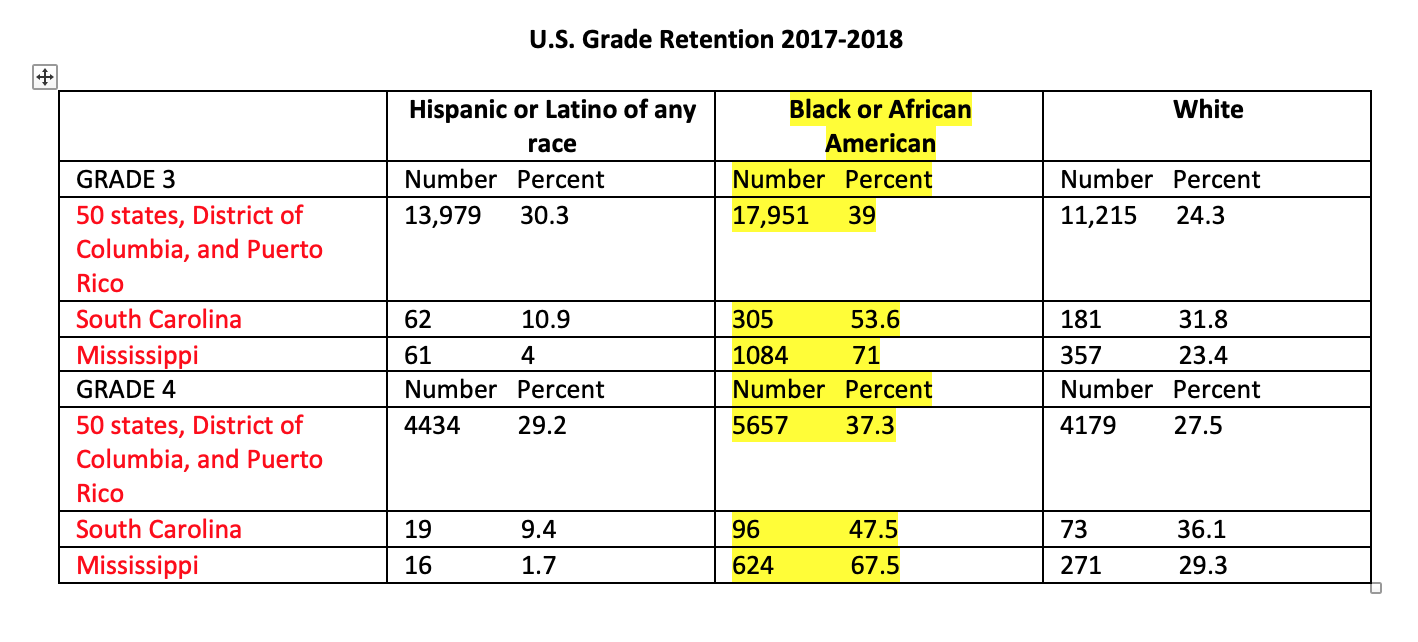
This was my work toward diversifying the curriculum as an English/ELA teacher, and we definitely had some hard conversations about race and racism. Notably, I introduced my students to the power of racial majorities and minorities by examining the percentages of races among states in the U.S. compared to the U.S. as a nation (our home state of SC disproportionately included a much higher percentage of Black people that the U.S., about 30+% compared to 12%) and acknowledging that while white people were a significant majority in the U.S., white people are a small minority of races in the world.
Of course, these lessons are all based in facts and data along with highly regarded texts by the most accomplished writers and leaders among Black Americans in the history of the U.S. Nothing about these lessons was an effort to demonize white people or propagandize students; but my mission was certainly political in the sense that students had different worlds, ideas, and perspectives offered to them than in most high school English courses throughout the 1980s and 1990s.
As a critical educator, I see education as opportunity to question our assumptions and broaden our perspectives beyond our own race, social class, and geographical setting. I also respect that what ideas and belief students draw from the experiences is theirs to navigate.
But in terms of racism and all types of oppression and inequity, I never avoided confronting clear ethical and moral distinctions. There is not “both sides” to U.S. slavery just as there is no “both sides” to the Holocaust. This was SC and our conversations around the Civil War and the Confederate battle flag were very hard for many students who had been raised with profoundly distorted views of race and racism (states’ rights and Lost Cause perspectives).
Again, I did not badger or indoctrinate my students, but I did introduce them to the history of when and how the Confederate Battle flag was placed on the SC statehouse—as an act of rebellion against integration occurring in the 1960s (and not some historical remnant of the 1800s).
For these high school students, these lessons were primarily about awareness and rethinking assumptions and previously unexamined biases (and stereotypes).
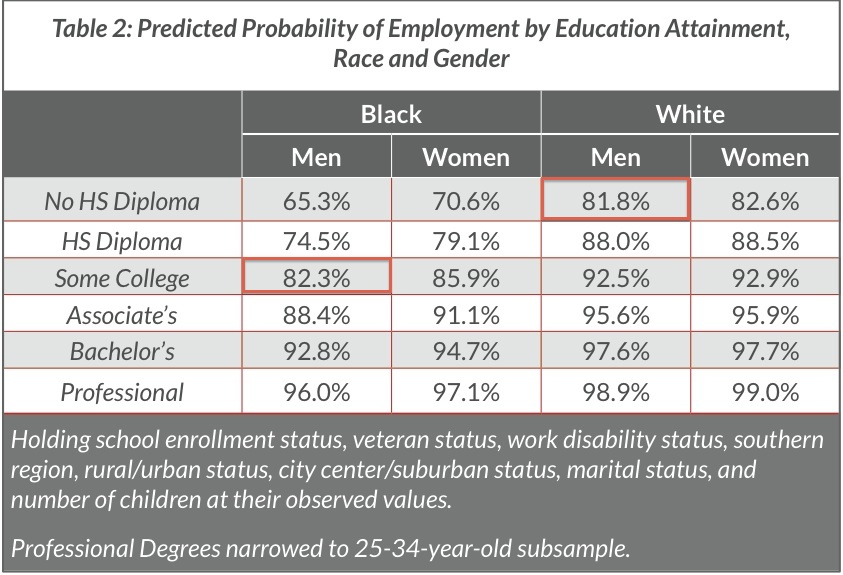
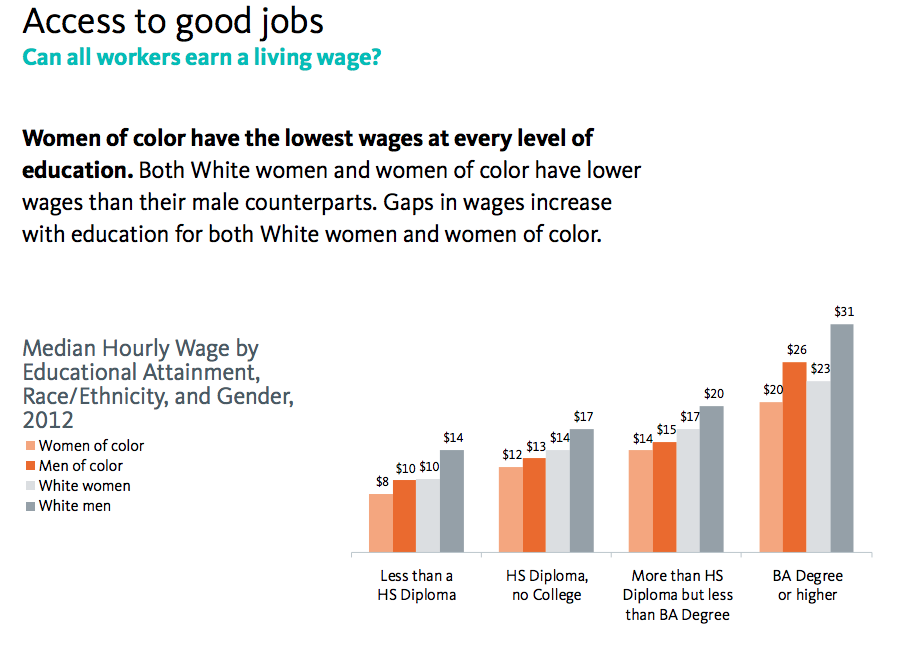
My university courses almost always start with data, such as the following (see here):
Typically, I start these lessons by asking students if they had seen the typical charts showing that people tend to earn more money as their level of educational attainment increases; almost always, they nod that they have. I then ask what the first chart above suggests about “education being the great equalizer.”
Eventually, we agree that education does matter, but more education tends to give a person economic advantages within their race but not among races (in other words, education is not an equalizer in terms of racial inequity).
The second chart is even more powerful since we discuss the message students receive about the horrors of dropping out of high school (I teach at a selective college where students uncritically value education). That white people with no high school diploma have about the same opportunities for employment as Black people with some college is deeply disorienting for students.
The third chart, then, adds even more complexity to the messages students have received about education, race, and gender (note that the inequity of gender and race are intensified when combined).
These lessons are similar to how I addressed race and racism for high school students since I am not propagandizing students but offering a more complex and nuanced approach to race and history than they had experienced before.
Critical educators are apt to provide information often omitted in traditional classrooms.
These charts lead to discussion about race being a social construct (and not biological), systemic racism, white privilege, and unconscious bias.
And those discussions are not about blaming white people, or demonizing white people; they are ways to ask questions that recognize racial inequity and racism are not simply the result of individuals who are racists. We do address blame, but that focuses on behavior (not racial status) in terms of those who actively promote racism, those who passively promote racism, and those who actively acknowledge and resist racism.
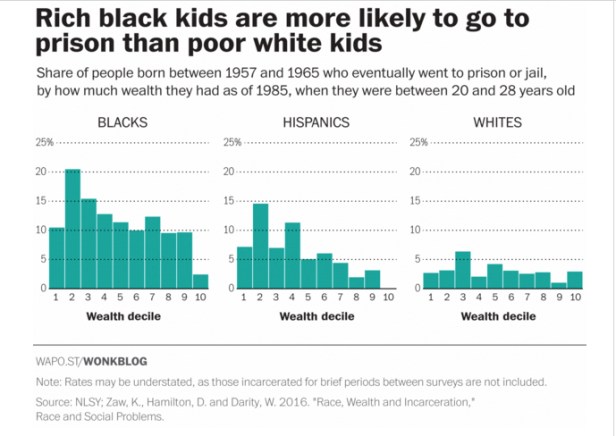
We are ultimately interrogating the ways in which racial inequity is built into systems. I introduce students to Michelle Alexander’s The New Jim Crow and have them consider inequities such as this:
Again, we are examining data and asking questions—one of which is trying to understand why police are likely to do drug sweeps through poor Black neighborhoods and not affluent college campuses; in other words, criminality is not necessarily about individual behavior but about who and why people are targeted by police.
Finally, here is an important point that speaks to the current attacks by Republicans on critical race theory (CRT) and the 1619 Project: My teaching is very consistent over almost 40 years, but my lessons about race and racism in the 1980s and 1990s came before my doctoral program and before I was aware in any way of critical pedagogy and CRT.
The great and ugly irony here is that Republicans are not opposing CRT or the 1619 Project, but are trying to deny students historical facts and data that make them and their power uncomfortable. Republicans are unabashedly trying to politicize the classroom in order to protect their own power.
There is no grand conspiracy in K-12 or undergraduate education to blame all white people for racism; in fact, most students in K-16 education still receive content that under-represents Black people and racism and are taught by a disproportionately white faculty.
Most traditional education in the U.S. still centers whiteness and emphasizes equal opportunity and rugged individualism.
The current attack on CRT is an ugly political lie, but it is also an assault on education—one of the founding principles of the U.S. that Republicans seem far too eager to cancel.
MacPhee, D., Handsfield, L.J., & Paugh, P. (2021). Conflict or conversation? Media portrayals of the science of reading. Reading Research Quarterly, TBD. https://doi.org/10.1002/rrq.384
Bowers, J. S., & Bowers, P. N. (2021, January 22). The science of reading provides little or no support for the widespread claim that systematic phonics should be part of initial reading instruction: A response to Buckingham. https://doi.org/10.31234/osf.io/f5qyu



 dr. p.l. (paul) thomas