As a literacy educator for over 40 years, specifically as a teacher of writing, I have stated a solid “no AI” policy both in my courses and as a public stance.
While I am certainly not anti-technology, I am a technology skeptic and have acknowledged that popular technology used in education tends to be quite bad—for example, Turnitin.com.
My core reason for a “no AI” policy in my courses, specifically my writing courses, is that AI such as ChatGPT tends to do for students the very behaviors they need to be practicing in order to learn.
As a comparison, I have a “no AI” policy for the same reason I reject rubrics and writing prompts for teaching writing since rubrics and prompts, again, are making decisions for students that they need to be making as developing writers.
Here are key findings that support my “no AI” policy:
I want to stress that my experience with students is that they often either fail to use useful technology (such as the grammar and spelling check in Word) or they are quite bad at using technology, despite being seen as technology natives.
That students need help in formal education with being better at using technology is a given, but it is not a contradiction to acknowledge that some technology is counter-educational; and that is the case with AI/ChatGPT.
“Red herring” perfectly describes the bulk of education reform in the US since the Reagan administration because thosee reforms have been based on false claims to distract from needed social and educational reform in the interests of students, teachers, and public education.
The US (and many English-speaking nations around the world) have remained in a perpetual state of education and reading crises for decades.
The US has never stopped using crisis rhetoric or blaming schools, teachers, and students, but policy has been a revolving door of new standards, new tests, and new “miracle” solutions—none of which ever produce the positive outcomes promised.
The dirty little secret is that perpetual crisis/reform in education (and reading) is its own goal because constant crisis/reform is politically and economically profitable to those fanning the flames of crisis.
In 2018, the “science of reading” (SOR) became a tired and constant refrain of the media, spreading to parent advocacy and then legislation and policy.
By 2025, the “science of” has added “math” and “learning,” including many English-speaking countries where a reading crisis is the norm.
And thus, education reform in the US and other countries has now adopted at the core of education reform “science of” rhetoric, claims, blame, and policy.
Parallel to education reform since the 1980s, the “science of” education reform is not grounded in credible claims about education crisis or problems, and therefore, the blame and solutions are also not credible or effective.
The “science of” approach to education reform has been extremely effective since “science” is being weaponized, and when anyone dare to challenge the movement, those people are accused of being anti-science, often compared to the anti-vaccination movement.
Here’s the problem: Those of us challenging the “science of” movement are not rejecting scientific research in education; we are acknowledging that “science of” advocacy is misrepresenting educational challenges, educational research, and educational practice for ideological, political, and market purposes.
Journalists, educators/scholars, education “celebrities,” the education marketplace, and politicians have made their careers on false “science of” claims and unfounded attacks on anyone calling them out for not being credible.
Ironically, the evidence supports those of us who are critics of “science of” education/reading reform, and consequently, “science of” claims are red herrings, distractions from the valid education challenges and potential reforms that would serve the interests of students, teachers, and public education.
Here, then, is the core evidence that the “science of” movements are, in fact, red herring education reform.
Further, “science of” advocates tend to move quickly from the false claims of “crisis” to offering false blame.
Just as there is no evidence of crisis, there is simply no scientific studies showing, for example, that the US has a reading crisis caused by a few reading programs, the implementation of balanced literacy, or the failure of teacher education to prepare teachers.
Again, there is a paradox in the “science of” movement whereby the advocates of “science of” themselves do not adhere to the narrow use of “science” to support their major claims.
For example, in the US, SOR advocates and SOR-based policy and legislation include support for a number of practices, claims, and programs that lack scientific evidence—decodable texts, LETRS, 95% rule, Orton-Gillingham, systematic phonics first for all students, nonsense word assessments (DIBLES), etc.
Broadly, also, “science of” advocates’ most damning red herring is that they are weaponizing “science” as a veneer to take a non-ideological pose although “science of” advocates are themselves mostly making ideological claims.
Direct instruction and skills-based instruction have long been at the core of conservative ideology.
Once we acknowledge that “science of” claims of crisis and who/what they blame are not evidence-based, we can also acknowledge they are mostly making ideological arguments, and then, we must unpack why.
Noted above, there is a great deal of profit in crying education/reading crisis and maintaining a constant state of reform.
As long as that reform never works.
And it never has, it never will.
The “science of” movements, then, are grounded in misinformation, oversimplification, and ideological bias.
The “science of” movements are another form of red herring education reform.
The distraction is also ideological, grounded in a rejection of the power of systemic forces and a belief in rugged individualism as well as the bootstrapping myth.
The “science of” movement is also a distraction from other ulterior motives, such as de-professionalizing teachers with scripted curriculum and imposing AI/computer program approaches for teaching students.
More irony: Education reform is designed to keep our eyes on individual people—students, teachers—and not the overwhelming evidence:
Almost 63% of the variance in test performance was explained by social capital family income variables that influence the development of background knowledge. Background knowledge is a known predictor of standardized test results. Family income variables are immutable by schools. Only public policies, outside the control of school personnel, can influence family income….
Policy makers and education leaders should rethink the current reliance on standardized test results as the deciding factor to make decisions about student achievement, teacher quality, school effectiveness, and school leader quality. In effect, policies that use standardized test results to evaluate, reward, and sanction students and school personnel are doing nothing more than rewarding schools that serve advantaged students and punishing schools that serve disadvantaged students. (Maroun and Tienken, 2024)
Here is the science that critics of the “science of” movement recognize.
And fun fact, we are not trying to sell you anything or get your vote.
Aydarova, E. (2023). “Whatever you want to call it”: Science of reading mythologies in the education reform movement. Harvard Educational Review, 93(4), 556–581, https://doi.org10.17763/1943-5045-93.4.556
Aydarova, E. (2024). What you see is not what you get: Science of reading reforms as a guise for standardization, centralization, and privatization. American Journal of Education. https://www.journals.uchicago.edu/doi/10.1086/730991
Reinking, D., Hruby, G.G., & Risko, V.J. (2023). Legislating phonics: Settle science of political polemic? Teachers College Record. https://doi.org/10.1177/01614681231155688
Thomas, P.L. (2025). Navigating (another) reading crisis as an administrator: Rethinking the “science of reading” movement. Journal of School Administration, Research and Development, 10(1), 38-48. https://ojed.org/JSARD/article/view/6706
Tierney, R.J., & Pearson, P.D. (2024). Fact-checking the Science of Reading: Opening up the conversation. Literacy Research Commons. https://literacyresearchcommons.org
While there is ample and disturbing evidence to keep our focus on the tremendous destructive outcomes of the second Trump administration, we should also recognize that the seeds of these worst policies for education were planted by George W. Bush as both governor of Texas and president of the US.
So, first, we must note that Bush education agenda in Texas included scripted curriculum, and then, more significantly, Bush’s signature No Child Left Behind (NCLB) was grounded in mandating “scientifically based” instruction and programs.
Ironically, despite NCLB’s “scientifically based” mandate, in the second decade after implementation, the media, politicians, and pundits declared a reading crisis and ascribed the cause to teacher education and teachers failing to know and use the “science of reading” (SOR).
SOR has, then, spawned the “science of math” and more broadly the “science of learning.”
Similar to the bi-partisan support for NCLB and most education reform since the 1980s, a politically diverse coalition has embraced and endorsed the “science of” movement, although few people have acknowledged that the agenda is mostly conservative ideology.
Some are, however, starting to recognize that “science of” policies are working to de-professionalize teachers through mandating scripted curriculum.
There is not enough evidence behind the science of learning to justify it being enshrined in our education system, Jefferson contends.
“It posits science really as an absolute, and it also suggests explicitly that nobody can question its authority because it is the ‘science’ of learning.
“In other words, ‘whatever [teachers have] been doing for the last few decades is unimportant now, we all need to conform to the science’.
“That’s a very heavy-handed way of approaching pedagogy and also approaching teachers in the field who are very, very experienced in this,” Jefferson tells EducationHQ.
The problem here is not “science,” but who controls what counts as science and how “science” is used as control.
What counts as “science” and credible evidence in education—and all fields—should not be abdicated to government bureaucracy (as evidenced by the current Trump administration).
Ultimately, the “science of” movement has proven to be less about teaching and learning or reforming education, and more about political and ideological control (parallel to the current misuse of “science” by Health and Human Services [HHS] Secretary Robert F. Kennedy Jr.)
For teaching and learning, scientific research certainly provides important and powerful evidence for teaching and teachers; however, the “science of” movement is distorting and controlling what counts as “science” for ideological and political agendas.
The Trump agenda for so-called “gold-standard science” is the logical and catastrophic logical outcome of many decades of political mandates for education reform.
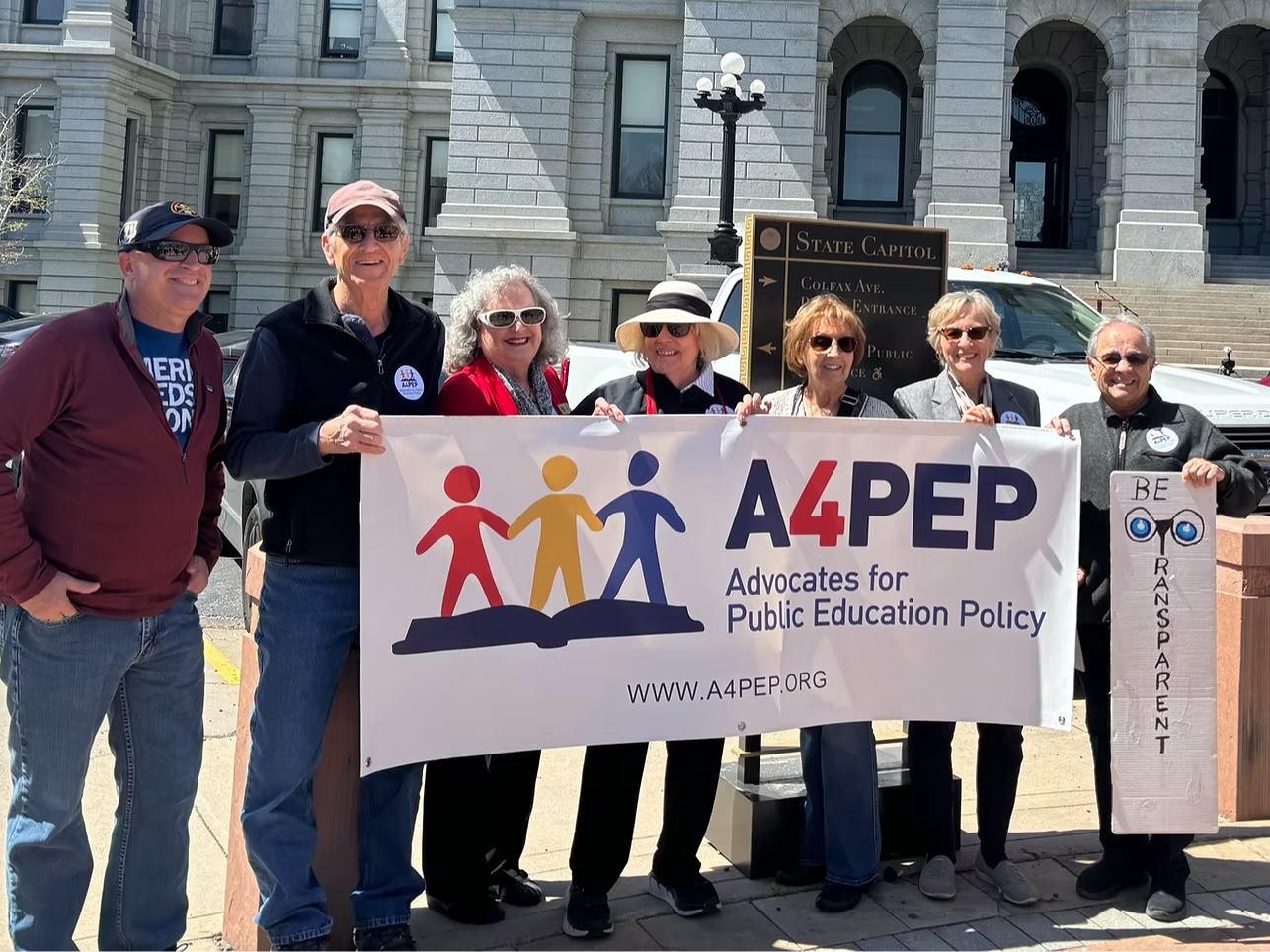
Rob Rogers and Melissa Hendrixunpacked the history and grave threat that Christian nationalism is posing to our public education system.
Paul Thomasrevealed how lies and false messaging from the media have been used to try and convince the public that schools are failing, when in fact, they are not.
Derek Blackoutlined some of the history behind this movement and how it still is so relevant today as the Trump administration promotes federal vouchers and more money for charter schools.
Upcoming
Faith, Power, and Public Schools: Christian Nationalism’s Assault on Education in Colorado and Beyond, Katherine Stewart
I began my teaching career in 1984, coinciding with the current era of high-stakes accountability driving education reform in the wake of A Nation at Risk.
One of my favorite units as a teacher of American literature to tenth and eleventh graders in the rural South was the Transcendentalism era—Ralph Waldo Emerson, Henry David Thoreau, and (the often ignored) Margaret Fuller.
Students did not enjoy reading these authors, I must confess, but the unit itself was often very compelling.
In the late 1980s, I added a consideration of the “Reeboks let U.B.U” campaign featuring Emerson:
I tracked down the advertising agency responsible for the ad, and my students wrote a letter calling out the campaign for being contradictory.
Shockingly, we did receive a letter from the person over the campaign. They confessed that my students’ were on target with their criticism, but added that Reebok believed they were a unique shoes company and felt their campaign highlighted that fact.
As a part of that unit also I had a recording from MTV News covering a Madonna look-alike contest.
Among the dozens of prepubescent girls, one was interviewed and she excitedly stated that the girls were there to express their individuality.
While students were no more eager to read Emerson, teens soon found themselves compelled by Emerson’s “A foolish consistency is the hobgoblin of little minds, adored by little statesmen and philosophers and divines.”
Over the past 40-plus years, I think about this unit and my students often—as well as Emerson’s enduring arguments in “Self-Reliance.”
The world of education reform, I regret to acknowledge, is dominated by “little minds,” drawn to and selling the same false stories of educational crisis and miracles.
I would amend Emerson’s list a bit, adding to “statesmen” education journalists.
The current reading crisis, often identified as the “science of reading” (SOR) movement, is yet another example of selling the manufactured reading crisis and education reform miracles that are actually mirages.
Since the 1980s, no education reform has worked.
New standards after new standards have not worked.
New high-stakes tests after new high-stakes tests have not worked.
Accountability for students, teachers, and schools has not worked.
No a single fear-mongering prediction or promise has been fulfilled.
With each new hot reform, the missionary zeal doesn’t fades; it just switches teams.
I am drawn to a line from Blade Runner as I contemplate the fate of the current SOR movement: “The light that burns twice as bright burns half as long – and you have burned so very, very brightly, Roy” (Tyrell).
The uncritical support for the SOR story has been as fervent as any reform movement, so I must wonder if we are on the cusp of buyer’s remorse.
Are these canaries in the coalmine foreboding an end to yet another era of unfounded claims of a reading crisis?
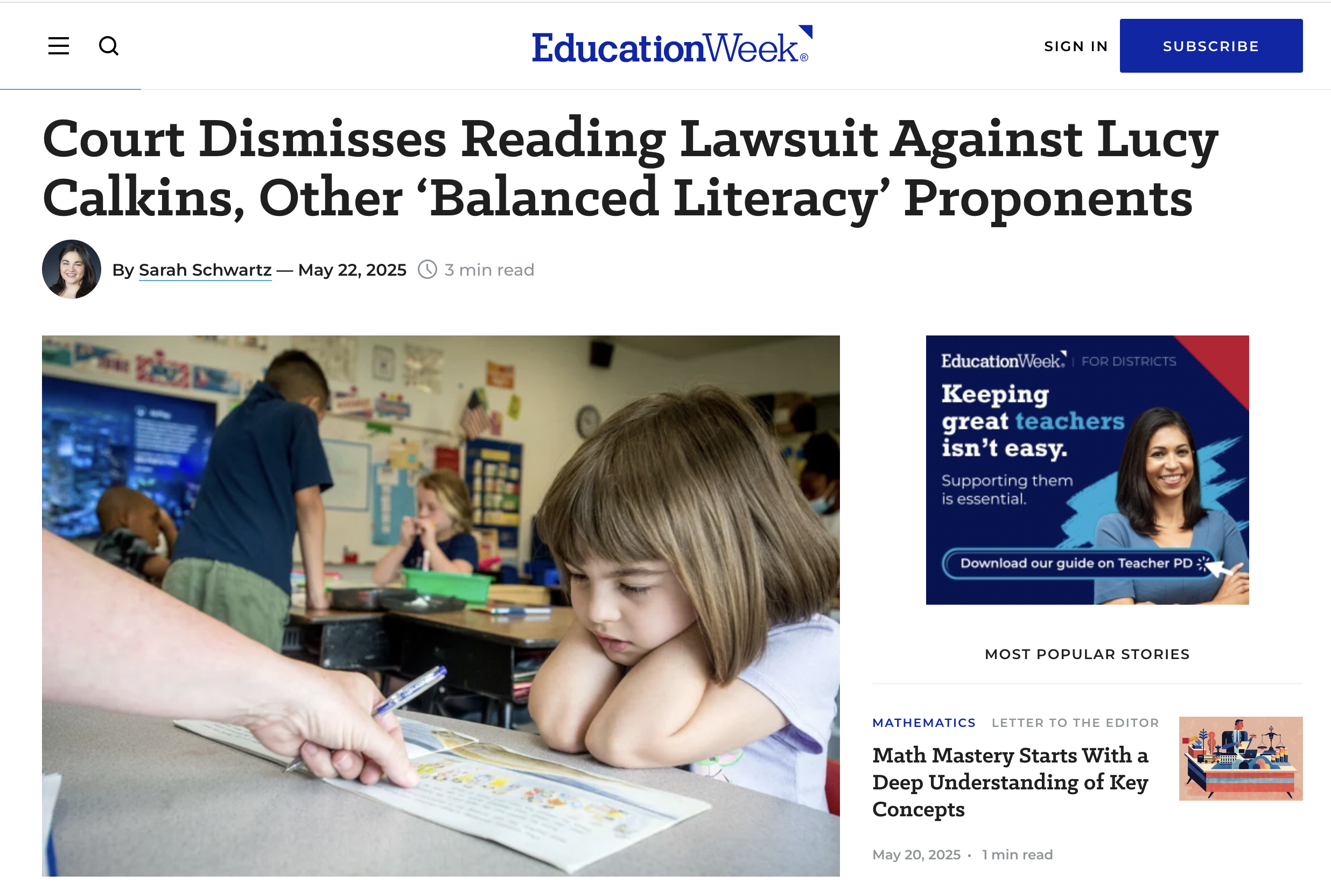
A judge in Massachusetts rejected a frivolous lawsuit grounded in the story being sold that a reading crisis was caused by a few reading programs and the scapegoat of the moment, balanced literacy (and three cueing).
Unlike mainstream media, Snopes corrected Trump-appointed Secretary of Education’s claim about student reading proficiency based on the Big Lie about NAEP.
Possibly most surprising is this call from Perry Bacon Jr. to set aside the crisis rhetoric around education, including this acknowledgement about NAEP:
The overwhelming majority of American students are reaching “baseline proficiency” in math, reading and science, according to PISA. That’s almost certainly because of our public school systems, where about 87 percent of students in grades K-12 get their education. U.S. politicians for a while were pushing the aspirational idea that most students should score proficient or above on the NAEP tests. That is a very high and probably unrealistic standard. Most of America’s students are reaching the NAEP “basic” level, mirroring the PISA results.
The impending buyer’s remorse for buying the reading story being sold will come with tremendous costs.
As Bacon warns: “But the alarmist portrayals of our schools are wrong and undermine support for public education.”
The SOR movement has wasted huge amounts of public funding and time; students are also paying a high price because of the caustic nature of scripted reading programs and grade retention.
As I read mainstream journalists and political leaders parrot the same false reading story over and over, I cannot help thinking about the preteen girls dressed like Madonna and the Reebok add that even my high school students were able to shake their heads at in disappointment.
Responding to the symposium question “What Shall We Do about Reading Today?” Emmett A. Betts, professor of Education at Pennsylvania State College, opened the first article in a professional journal for elementary education with a broad claim:
In a democracy, the people get the kind of schools they want. One of the many functions of an educator is to point the way to ever better schools. If the people want many public and private institutions for the preparation of teachers regardless of the quality of the work or the teacher supply and demand, the people get them. If the people want better schools plants and instruction, they make their will known at the polls and they get what they want. In a democracy, the quantity and quality of educational opportunity is the product of what people want, and what they want is to no small degree conditioned by the educational leadership they have elected to follow. (p. 226)
This may read a bit idealistic or naive, but Betts, I think, offers an accurate characterization of the very complex public education system in the US—a system bound necessarily to the political system itself.
Betts then warns:
Very soon strong pressure will be felt by elementary school teachers to intensify instruction in certain areas, such as reading. This pressure will be brought to bear by non-educators who have found a deficiency but who may may offer no other solution than a “stronger prescription.” Years of fruitful research on learning many be cast aside in order to “do something about reading instruction….” To prevent this wastage, educators must be prepared to bring to bear a considerable accumulation of information that permits an adequate resolving of this problem. (p. 226)
Later in that issue, William S. Gray, University of Chicago, expands on Betts’s warning:
[R]ecent editorials…maintain that current deficiencies in reading are the product of “pseudo-scientific bungling and the innovation of so-called progressive methods of teaching. The solution advocated by one editor was the elimination of “impractical non-essentials,” which were not defined, and of “undisciplined dabbling with practical essentials. The implication of these vague criticisms is that recent innovations in teaching reading have been adopted without due consideration of essentials and of methods of achieving desired ends. Such assumptions are as unsound and merit no more consideration than a purely defensive attitude. (p. 235)
In forty-plus pages, eleven literacy scholars confront the same problems with a reading crisis that may sound familiar to people in 2025.
However, this is from 1942
And in a mere two decades, guess what the state of reading the US entailed?
“After half a century of [progressive reform and expanding public education],” wrote Jacques Barzun in Tomorrow’s Illiterates: The State of Reading Instruction Today (1961), “we who run businesses, carry on professions, work for the government, or engage in teaching itself are forced to admit that illiteracy is still with us” (xii-xiii).
Barzun adds, “the citizen who is interested (and who has managed to learn to read) [may have their] hair [stand] on end at hearing what folly has been condoned as educational theory during the past thirty years” (p. xiv).
Editor of this volume and author of chapters 1 and 7, Charles Child Walcutt argues: “One way to describe the reading problem is to say that it is a teacher problem and—even more—that it is a problem of the teaching of teachers” (p. 18).
And of course: “The assertion that the reading experts do not understand the theory of their system can be demonstrated if we point out the false assumptions, the faulty extrapolations from scientific research, and the absolute contradictions that appear in its central propositions and procedures” (pp. 19-20).
Over sixty years ago, a reading crisis was declared (twenty years after on just before it), teachers were blamed, and reading experts were accused of not understanding the science behind their own field.
Déjà vu all over again.
There is a recurring story—one that is profitable and easy to sell—that education in the US is a failure, notably reading and math education.
The problem with this story is that it has existed since the mid-1800s in some fashion; but as I share above, an intense era of education (reading and math) crisis is at least 80 years and running.
And then, the last 40 years has been characterized by perpetual education reform, several cycles of new standards, new tests, and constant high-stakes accountability.
At no point in the US has the public, the media, or political leaders declared education (reading or math) effective.
But since the 1980s, after the hyper-crisis panic of A Nation at Risk, the US has doubled and tripled down on in-school only reform—”pressure will be brought to bear by non-educators,” as Betts noted in 1942.
The story that isn’t compelling and is hard to sell is this: The history of education crisis and reform has been grounded in misdiagnosing educational problems, casting misguided blame, and mandating solutions that are destined to fail—and even cause harm.
However, here is a story told in research that the US will not accept:
Almost 63% of the variance in test performance was explained by social capital family income variables that influence the development of background knowledge. Background knowledge is a known predictor of standardized test results. Family income variables are immutable by schools. Only public policies, outside the control of school personnel, can influence family income….
Policy makers and education leaders should rethink the current reliance on standardized test results as the deciding factor to make decisions about student achievement, teacher quality, school effectiveness, and school leader quality. In effect, policies that use standardized test results to evaluate, reward, and sanction students and school personnel are doing nothing more than rewarding schools that serve advantaged students and punishing schools that serve disadvantaged students. (Maroun and Tienken, 2024)
In other words, the ways we measure school and teacher effectiveness as well as student achievement are in fact mostly measuring out-of-school factors.
So, what is really wrong with education?
Ideology/politics and market forces.
The disconnect between public, political, and media beliefs about education and decades of research reinforced by Maroun and Tienken is entirely ideological/political.
Many people in the US are bound to rugged individualism and the meritocracy myth, both of which feed into another belief that education transforms society.
So we are now at the story the US hates, refuses to acknowledges, and thus, does not sell: Schools reflect our society, but do not (cannot) transform it (reread the opening quote from Betts above).
There is a core libertarian belief in the US rejecting the dominance of systemic forces that drives crisis rhetoric about education as well as the politics and policy mandating how we implement our schools.
US public education has never been a singular process. There has never been one program or learning/teaching theory driving schools.
However, the ideological attacks on schools, teachers, and students have always reduced claims of crisis to simplistic problems and blame (reading the entire journal issue from 1942 or the book from 1961 is eerie and frustrating).
But possibly as powerful and problematic as ideology/politics is the impact of market forces on educational practices.
To be blunt, the education market benefits from perpetual education crisis, not from successful education reform. (See also: The healthcare market benefits from perpetual illness, not curing diseases and healthy people.)
Education crisis and reform, then, have been almost entirely ideological/political and market driven.
Ironically, perpetual crisis/reform benefits both ideology/politics and the market.
Regretfully, perpetual crisis/reform does not benefit schools, teachers, or students.
This also is a story that doesn’t sell: The current “science of” movement (science of reading, science of math, science of learning) is nothing new; in fact, this is simply the science of ideology (again).
Because of the outsized impact of ideology/politics and the market on how we talk about, judge, and implement schooling in the US, we do not have a crisis, but an entrench set of failures we lack the political will to address: perpetual opportunity and achievement gaps between affluent, white students and minoritized/marginalized students (Black and brown students, impoverished students, multilingual learners, and special needs students).
Yet those gaps have been about the same for many decades and across all areas of learning (there is no gap in reading, for example) that isn’t also in math or science, or even civics).
But as Maroun and Tienken show, those measured gaps are more about social inequity than education—even though those measures also show in-school inequity as well that magnifies systemic inequities.
The ideology/politics driving how we view and implement our schools is corrupted by a fatalism about needed social reform.
It isn’t that we cannot build a better society; it isn’t that we cannot build better schools.
It is that we simply have chosen that neither matters more than our sacred—and misguided—beliefs and market.
The overwhelming majority of American students are reaching “baseline proficiency,” in math, reading and science, according to PISA. That’s almost certainly because of our public school systems, where about 87 percent of students in grades K-12 get their education. U.S. politicians for a while were pushing the aspirational idea that most students should score proficient or above on the NAEP tests. That is a very high and probably unrealistic standard. Most of America’s students are reaching the NAEP “basic” level, mirroring the PISA results.
While many fear the irrevocable decline of the US from Presidential executive orders, there appears to be some hope that courts may save us—and recently specifically save public education.
Although likely not as prominent on the national radar, more good news:
While parents, the media, and political leaders have uncritically supported false claims about reading for about a decade now, this ruling supports what scholars have noted about the “science of reading” (SOR) movement.
Now moving to the reading instruction, there’s a narrative that has been sold to the American public and policymakers. There’s a literacy crisis because teachers do not teach the science of reading because they were not taught the science of reading in colleges of education. I have tried to identify the evidence that was used to construct this claim, and I actually have not found this evidence yet.
A perceived crisis demands attention and creates an impetus for urgently needed solutions. The Course takes that tack, arguing that there is a national crisis in reading and then promoting phonics as the cause (there is not enough of it) and the solution (more of it is needed). As we argue here, there is no indisputable evidence of a national crisis in reading, and even if there were a crisis, there is no evidence that the amount of phonics in classrooms is necessarily the cause or the solution.
To be blunt, the mainstream argument that the US has a reading crisis caused by a few balanced-literacy based reading programs lacks scientific research—a disturbing fact considering that claim is the basis for the SOR movement.
This court decision also comes on the heals of Snopes confronting Secretary of Education McMahon’s claim on social media, “When 70% of 8th graders in the U.S. can’t read proficiently, it’s not the students who are failing—it’s the education system that’s failing them”:
National Assessment of Educational Progress scores are not representative of grade-level performance, per the Department of Education’s website. According to 2022 data, most state reading standards are closer to the NAEP Basic level, and 67% of eighth-graders in 2024 met that standard.
You can add to the fact-free claims of the SOR movement, then, that 2/3 of students are not “proficient” (used incorrectly to mean not on “grade level”) readers based on misrepresenting or misunderstanding NAEP data.
As a country, we have never been happy with the reading achievement of our students. But decades of education reform and the current reading crisis based in misinformation and hyperbole are not serving our students, teachers, or schools well.
All of this reinforces a garbled truism: “A lie can travel halfway around the world while the truth is still putting on its shoes” (a quote misattributed to Mark Twain, somewhat ironically).
Maybe the truth about reading is finally putting on its shoes and will finds its legs.
In the pages of English Journal, we look to publish well-crafted poems that connect our readers to topics central to English education: the impact of reading and writing on young people, words and language, classroom stories, and reflections on teaching and learning. Poetry reminds us, as educators, how to live in this world. Submit your work by emailing a Word doc attachment to paul.thomas@furman.edu. Use the subject line “Poetry Submission for Review.” The first page of the attached document should be a cover sheet that includes your name, address, and email, as well as a two-sentence biographical sketch. In your bio, include how long you have been a member of NCTE, if applicable, and a publishable contact email. Following the cover sheet, include one to five original poems in the same document. Finally, please fill out and attach this form granting English Journal permission to publish your poem: https://ncte.org/app/uploads/2018/10/NCTE-Consent-to-Publish-No-Assignment-EJ-poems-Collective-Work-4845-4342-1491-1.pdf
Though we welcome work of any length, shorter pieces (30 lines and under) often work best for the journal. Poems must be original and not previously published. Simultaneous submissions are welcome, though writers must immediately withdraw from consideration any poems that are to be published elsewhere by contacting the editors via email.
Poets whose work is published will receive two complimentary copies of the issue in which their work appears. Additional inquiries about poetry submissions may be directed to the editor at paul.thomas@furman.edu. We look forward to reading and celebrating your work.
Poets
Please submit poem(s) as a Word doc only.
Use this form to grant English Journal permission to publish your poem: Poet CTP
Likely the most influential standardized test in the US is the National Assessment of Educational Progress (NAEP), under the purview of the beleaguered US Department of Education.
Also without question, NAEP is one of the most misunderstood and misrepresented standardized tests since the mainstream media, political leaders, pundits, and the public routinely shout “Crisis!” with each release of NAEP data.
NAEP’s achievement levels are misleading at best, but at worst, those achievement levels were designed to create the appearance of perpetuate educational failure, and yes, crisis.
“Proficient” is almost always conflated with “grade level” resulting in false claims, for example, that 2/3 of fourth graders are reading below grade level. NAEP’s “basic” is approximately what most states identify as “proficient”—suggesting on grade level (see an extensive analysis here).
What most people misunderstand as well about NAEP is its purpose: NAEP was born in the fertile soil of high-stakes accountability education reform spurred by the Reagan administration’s propaganda A Nation at Risk. Reagan sought to reintroduce forced prayer in schools and wanted to close the Department of Education, labeled an “abomination.”
However, what Reagan spawned was over four decades of ever-changing standards and tests to hold schools, teachers, and students accountable. In short, NAEP was created as a test of random samples of students to hold states accountable for their educational standards and outcomes (historically, public education has been the responsibility of the states, and NCLB in 2001 was a departure toward more federal oversight).
Frankly, NAEP was designed as an accountability mechanism, not a way to provide feedback on individual student achievement. (Note that state-level accountability testing was designed to provide individual student assessment that should provide evidence for instruction.)
In 2025, on the heels of recent shouts of “Crisis!” (again) because almost everyone has misunderstood and misrepresented NAEP scores across math, reading, and even civics, Reagan’s dream may be coming true since the Trump administration has promised to end the USDOE, and that move imperils the future of NAEP.
As Peter Greene has confronted, some have taken this uncertainty about NAEP to propose turning NAEP into (you should pause here to prepare yourself for the inanity) the failed Common Core experiment that sought to replace the state-based public education accountability process with national standards and testing.
Into the nonsense that is NAEP historically and the current doubling-down on Common Core Redux, I want to make a modest proposal about the future of NAEP.
Actually I want to make two modest proposals, acknowledging that the first is never going to happen (although it is the one more strongly supported by empirical data; you know, the “science” that so many education reformers claim to worship).
I strongly reject standardized testing as well as traditional classroom testing and grades. That has been at the core of my 40-plus-year career, and again, this is informed not just by my experiences as an educator but by a very robust body of research.
Therefore, my first modest (and completely unrealistic in the US) proposal is the conclusions reached by Maron and Tienken:
Almost 63% of the variance in test performance was explained by social capital family income variables that influence the development of background knowledge. Background knowledge is a known predictor of standardized test results. Family income variables are immutable by schools. Only public policies, outside the control of school personnel, can influence family income.
The United States has one of the highest levels of childhood poverty among Organisation of Economic Co-operation and Development (OECD) countries. It is well known that the social safety net in the United States is not as strong as some nations in Europe and other parts of the world [20]. Neoliberal policies have greatly reduced government support for families in the United States. Important social policy frameworks that reduce poverty, such as monetary, labor, fiscal, and health policies, have been weakened over the last 40 years, causing increases in childhood poverty in the United States compared to other democratic countries [41].
Although some education policy makers in the United States claim that standardized test results are an important component of a comprehensive system of educational quality control, the results from decades of research on the topic suggest otherwise [42]. The influence of family social capital variables manifests itself in standardized test results. Policy makers and education leaders should rethink the current reliance on standardized test results as the deciding factor to make decisions about student achievement, teacher quality, school effectiveness, and school leader quality. In effect, policies that use standardized test results to evaluate, reward, and sanction students and school personnel are doing nothing more than rewarding schools that serve advantaged students and punishing schools that serve disadvantaged students.
Alas, the US will never follow this last point because we refuse to acknowledge systemic forces and remain a people fatally committed to rugged individualism and bootstrap mythologies.
And thus, here is my compromise, a modest proposal that can and should be explored for the future of NAEP:
Rename achievement levels in standardized testing that share a national standard metric for the levels (all states and NAEP would share the same achievement levels and metric).
Achievement levels must be age-level and not grade-level(currently, using “grade level” allows states to game scores through grade retention, for example). A clear system of “below age level,” “age level,” and “above age level” would simplify reporting and allow for more accurate political, media, and public responses to data.
This proposal would be a first step, I hope. The problem at first is that this doesn’t address the excessive testing culture the US has embraced without positive outcomes for over forty years.
This first step, I think, can create a new basis for evaluating and viewing our public schools, and then, we may be primed to begin dismantling the standardized testing machine—or at least become more acclimated to reducing it dramatically.
The great irony of the power of high-stakes testing in the education accountability era is that it has proven only one thing: Weighing a pig does not make it fatter.
Testing, testing, and testing has not improved schools, teachers, or students, but it has created a perpetuate state of educational crisis.
Perpetual educational crisis serves only political agendas and the unquenchable education marketplace.
If we can entertain for a moment of idealism that the Trump disaster doesn’t destroy both the USDOE and public education, let’s consider how to more forward in ways that better serve the promise of public education and our fragile democracy.
If not an end to NAEP, at least a better NAEP that serves the interest of students and not political or market agendas?
The story is simple and may sound obvious: Poor children suffer from a significant “word gap” (WG) when compared to middle-class and affluent children.
To re-cap, the WG Story runs as follows: Parents from lower-class backgrounds do not talk enough to their children in the early years of life, in contrast to affluent European American parents who talk a great deal. This relative deficit impedes children’s vocabulary development, which, in turn, leads them to under achieve in school. It is a small step from this narrative to a rationale for intervention: If these parents could be taught to behave more like their privileged counterparts, marginalized children would develop larger vocabularies, which would boost their success in school.
As is typical in the Big Lies of Education, compelling and enduring stories do not necessarily prove to be accurate. And the resilience of Big Lies often rests on a complex matrix of causes, detailed by Miller, Sperry, and Sperry:
In sum, nearly 20 years after its inception, the WG Story had gone from academic obscurity to celebrity status. Biases of class, race, and method paved the way for this juggernaut, which gathered force with the convergence of two events, NCLB and LENA, in its Life History. The WG Story flourished by traveling back and forth between academic, policy, and public spheres, illustrating the permeability of discourses (Bakhtin,1981), and inadvertently reproducing the educational inequality it was intended to reduce.
The WG Story and its impact are driven by deficit ideologies (what most people believe regardless of empirical evidence) despite flawed methodology in the foundational research, which, according to Miller, Sperry and Sperry, “did not arise from virgin ground but rather from soil already cultivated with the language deprivation story” that began in the 1960s.
They also acknowledge the role of the media and advocacy:
But the WG Story did not remain sealed off in the academy (Bakhtin, 1981, 1986). It was widely covered in the popular press, and high-profile foundations amplified the Story by funding initiatives to close the Gap.
Again, uncritically embracing the WG Story reflects core deficit beliefs: “The most fundamental historical through-line between the WG Story and its backstory is the fixation on the language defects of marginalized families.”
There is an enduring and false set of beliefs that link deficit ideologies about social class and language: So-called nonstandard or underdeveloped literacy reflects moral and intelligence deficits in not just individual people but entire classifications of people.
In short, any person’s functional vocabulary is not a measure of that person’s character or intelligence, particularly when framed against a norm or standard based on cultural and ideological beliefs instead of valid empirical evidence.
Dyson, A. H. (2015). Research and Policy: The Search for Inclusion: Deficit Discourse and the Erasure of Childhoods. Language Arts, 92(3), 199-207. http://www.jstor.org/stable/24575568









 dr. p.l. (paul) thomas