Category Archives: Educational Research

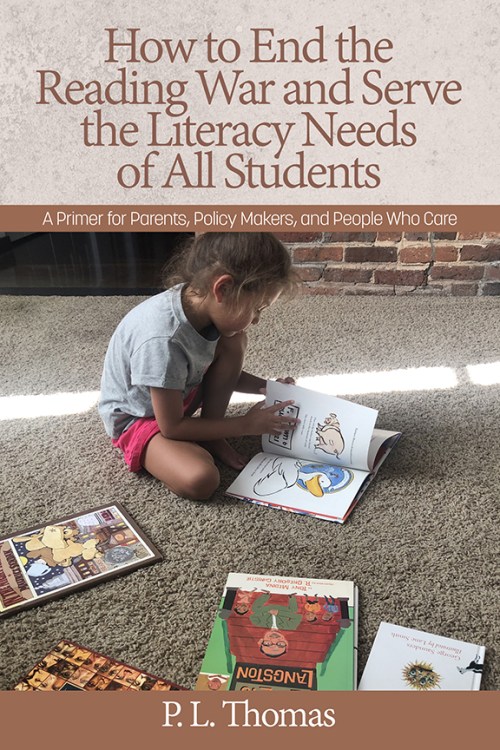
NEW: How to End the Reading War and Serve the Literacy Needs of All Students: A Primer for Parents, Policy Makers, and People Who Care (IAP)

How to End the Reading War and Serve the Literacy Needs of All Students: A Primer for Parents, Policy Makers, and People Who Care (IAP)

amazon

Barnes and Noble

ThomasCase2

[excerpt from Introduction]

How to End the Reading War and Serve the Literacy Needs of All Students: An Overview

The chapters that follow are not intended to document how we should or can teach reading. In fact, there is abundant work that has existed since the early twentieth century to document the many and varied ways we know we should help foster students as readers from the first days of school to the last. As well, this entire book is working well outside being a how-to on teaching reading or a storehouse of research—even as I am advocating that test-driven reading policy and instruction are asking way too little of students and their teachers.

Instead, this is an informative work, focusing on the historical and current Reading War, that builds to a framework for moving beyond that war, and as the subtitle states, serving the literacy needs of all students.

Chapter 1 (A Historical Perspective of the Reading War: 1940s and 1990s Editions) offers a historical overview of crisis responses to reading, focusing on the 1940s (WWII literacy rates of soldiers) and a 1990s report spurred by NAEP. This historical perspective is often missing from media coverage of reading and reading policy debates and decisions made at the federal and state levels.

In Chapter 2 (The Twenty-First Century Reading War: “The Science of Reading,” Dyslexia, and Misguided Reading Policy), I examine the current “science of reading” phenomenon in mainstream media driven by mainstream media, Emily Hanford and Education Week as key examples, but also fueled by dyslexia advocacy, all of which has manifested themselves in education policy such as adopting grade retention based on 3rd-grade test scores and training teachers in the “science of reading.”

Chapter 3 (Misreading Reading: The Good, the Bad, and the Ugly) addresses key concepts and topics that are misunderstood but central to the media coverage of the recent Reading War, such as the following: The National Reading Panel (NRP), reading programs, balanced literacy (BL), whole language (WL), phonics, scientific research, grade retention, teacher education, and teacher autonomy.

Finally, in Chapter 4 (How to End the Reading War and Serve the Literacy Needs of All Students: Shifting Our Deficit Gaze, Asking Different Questions about Literacy), the following reforms needed to end the Reading war will be explored:

  • Social policy must be implemented to address inequity and the homes, communities, and lives of children; these socioeconomic reforms must be viewed as central to reading policy.
  • The mainstream media must abandon Christopher Columbus and both-sides journalism that addresses education/reading.
  • Reading policy must abandon ineffective and hurtful commitments that include standards, high-stakes testing, grade retention, etc.
  • Classroom and school practices must abandon reading programs and silver-bullet approaches to literacy; and teaching must be far more individualized and patient.
  • Evidence-based teaching of reading must expand the meaning of “scientific” and evidence.

In the Conclusion (The Science of Literacy: A 36-Year Journey and Counting), I challenge a narrow view of “science,” especially in terms of education and literacy.

As you read the following chapters, I want you to keep some big-picture concerns in mind: What do we ultimately mean when we talk about teaching children to read? And what does it mean for a student to be able to read?

I want you to consider this story from a high school ELA class discussion on capital punishment. As the teacher led a discussion on the death penalty, a student interjected that Texas currently uses decapitation for the death penalty. The teacher paused, and then suggested that this wasn’t true. The student hurriedly explained it was true, and that he had proof.

The student took out his smartphone, pulling up an article to show the teacher. The article was from The Onion.

Patiently, the teacher informed the student that The Onion is satire, to which the student replied, “No, it isn’t.” Keep in mind that this high school student can pronounce the words in the article; he had read the entire piece.

Are our reading standards, sacred high-stakes tests, and reading programs fostering the sort of students who are critical readers, capable of navigating a complex world better than the student above? Is this Reading War in any way addressing that problem?

Recommended

Policy Statement on the “Science of Reading”

Did Balance Literacy Fail to Teach Your Child to Read?

For 36 years now, I have been teaching people to write; that journey is a large subset of my own being and becoming a writer, an experience that is captured well in an old Nike poster I used to hang on the wall of my high school classroom, proclaiming “There is no finish line.”

there is no finish line

For the last decade-plus, I have taught first-year college students to write. While I am teaching writing, however, I also am teaching young people how to do college, how to make the important transition from being a student to being a scholar.

Part of that work is unlearning bad habits from high school embedded in traditional approaches to writing essays.

Here is one of the worst: Many students come to college having followed a narrow writing process in which teachers require students to submit a one-paragraph introduction with a direct thesis statement. Once approved, the student is then released to write an essay that fulfills that approved essay thesis.

This instills in students two incredibly misguided practices. One is writing with a level of certainty that an 18-year-old has yet to reach (particularly on topics about which they have only second-hand knowledge); and another is failing to see drafting and writing as an act of discovery, as a journey to understanding ideas better.

Neither of these lessons from high school serve young people well in their quest of becoming more educated, being a scholar. Scholarship and deep understanding of a field or discipline comes mostly from interrogating ideas, not from grand pronouncements.

Knowledge is living forest; dogma is a rigid stone slowly wearing away to nothing in its resistance to the elements.

This also comes into play when anyone is trying to understand a situation outside their own areas of expertise. As Ballantyne explains about epistemic trespassing:

First, the intellectual characters of trespassers often look unsavoury. Out of their league but highly confident nonetheless, trespassers appear to be immodest, dogmatic, or arrogant [emphasis added]. Trespassers easily fail to manifest the trait of intellectual humility and demonstrate one or another epistemic vice (Whitcomb et al. 2017, Cassam 2016). Second, it’s useful to distinguish between trespassers holding confident opinions and investigating questions in another field [emphasis in original]. I assume it can be epistemically appropriate for people to look into questions beyond their competence, even when it would be inappropriate for them to hold confident opinions.

This is a key distinction (arrogance v. modesty) for an enduring question in the U.S., one that has remained at the forefront of public and political debate since at least the 1940s: Why are students not learning to read?

If we are going to focus on asking questions and not making grand pronouncements, we probably should first interrogate the question, and confirm whether or not students are learning to read in reasonable ways and when they genuinely need to read independently.

Here we have a serious problem because at no period in the U.S. has anyone pronounced reading achievement to be satisfactory; thus, the somewhat bell-shaped curve of reading achievement among school-age students could very likely simply be normal.

Yet, most of us view education as a 100% attainable venture—all students can and should learn to read by X age. This is a valuable ideal, but it certainly isn’t a reasonable measure for any sort of accountability (see the disaster that was No Child Left Behind).

We are left then with an enduring question that I think is valid and worth considering: Why do some students not become eager and critical readers at the same rate as most of their biological peers?

Data for many decades have shown that all sorts of achievement gaps, reading included, are strongly correlated with the socioeconomic status of any student’s parents, home, and community as well as the educational attainment of the parents (notably the mother). [Every administration of the SAT reflects those patterns, for example.]

Especially over the past forty or so years, however, emphasizing the correlation between inequity and academic achievement has been discounted with making “excuses.” Public and political concern for any problem seeks to find individual causes to blame, but Americans tend to balk at systemic explanations for negative outcomes.

When the U.S. declared a reading crisis in the 1940s during WWII, many immediately blamed progressive education, then strongly associated with John Dewey. But there were three practical problems with that blame.

First, as Alfie Kohn has explained, Dewey’s progressive education has never been implemented on any wide scale in the U.S. Despite mainstream arguments to the contrary, formal education in the U.S. has almost always been primarily conservative and traditional.

Second, as Lou LaBrant carefully detailed in 1942:

1. Not many men in the army now have been taught by these newer methods [emphasis in original]. Those few come for the most part from private or highly privileged schools, are among those who have completed high school or college, and have no difficulty with reading.

2. While so-called “progressive” schools may have their limitations, and certainly do allow their pupils to progress at varied rates, above the second grade their pupils consistently show superior ability in reading. Indeed, the most eager critics have complained that these children read everything they can find, and consequently do not concentrate on a few facts. Abundant data now testify to the superior results of purposeful, individualized reading programs [emphasis in original].

3. The reading skills required by the military leaders are relatively simple, and cause no problem for normal persons who have remained in school until they are fourteen or fifteen. Unfortunately the large group of non-readers are drop-outs, who have not completed elementary school, come from poorly taught and poorly equipped schools, and actually represent the most conservative and backward teaching in the United States [emphasis in original]. (pp. 240-241)

Third, and this is possibly the most important point for understanding our current reading crisis, many students were unsuccessful in situations where educators claimed to be practicing progressive education, but in fact, were not.

Let me offer an example—Dewey’s project method.

First, Dewey tended to offer philosophical and theoretical parameters for teaching, but refused to offer models and never templates or programs. This made, ironically, a practitioner of pragmatism (Dewey’s philosophical roots shared with William James) quite impractical for day-to-day teaching and the running of schools.

William Heard Kilpatrick, however, seized the moment and packaged the project method, which did find its way into schools, often ones that claimed to be progressive.

Here comes the real but complicated problem.

In 1931, LaBrant (the subject of my dissertation and a devout Deweyan progressive) launched into the use of the project method in classes where students are supposed to be learning reading and writing:

The cause for my wrath is not new or single. It is of slow growth and has many characteristics. It is known to many as a variation of the project method; to me, as the soap performance. With the project, neatly defined by theorizing educators as “a purposeful activity carried to a successful conclusion,” I know better than to be at war. With what passes for purposeful activity and is unfortunately carried to a conclusion because it will kill time, I have much to complain. To be, for a moment, coherent: I am disturbed by the practice, much more common than our publications would indicate, of using the carving of little toy boats and castles, the dressing of quaint dolls, the pasting of advertising pictures, and the manipulation of clay and soap as the teaching of English literature. (p. 245)

Let’s imagine that some students did not grow as readers or writers if they were crafting, and not reading or writing (as LaBrant argued for over six decades), and let’s also imagine that if there was poor reading growth in these classrooms, people certainly associated that with progressive practices since it was explicitly using the project method.

To untangle this, we need to recognize that as LaBrant admonished, using the project method to craft instead of having students read and write was a misuse and misunderstanding of progressive philosophy.

Neither the project method nor progressivism failed these students, but the misuse of both certainly did.

This pattern has repeated itself at both small and large levels for decades.

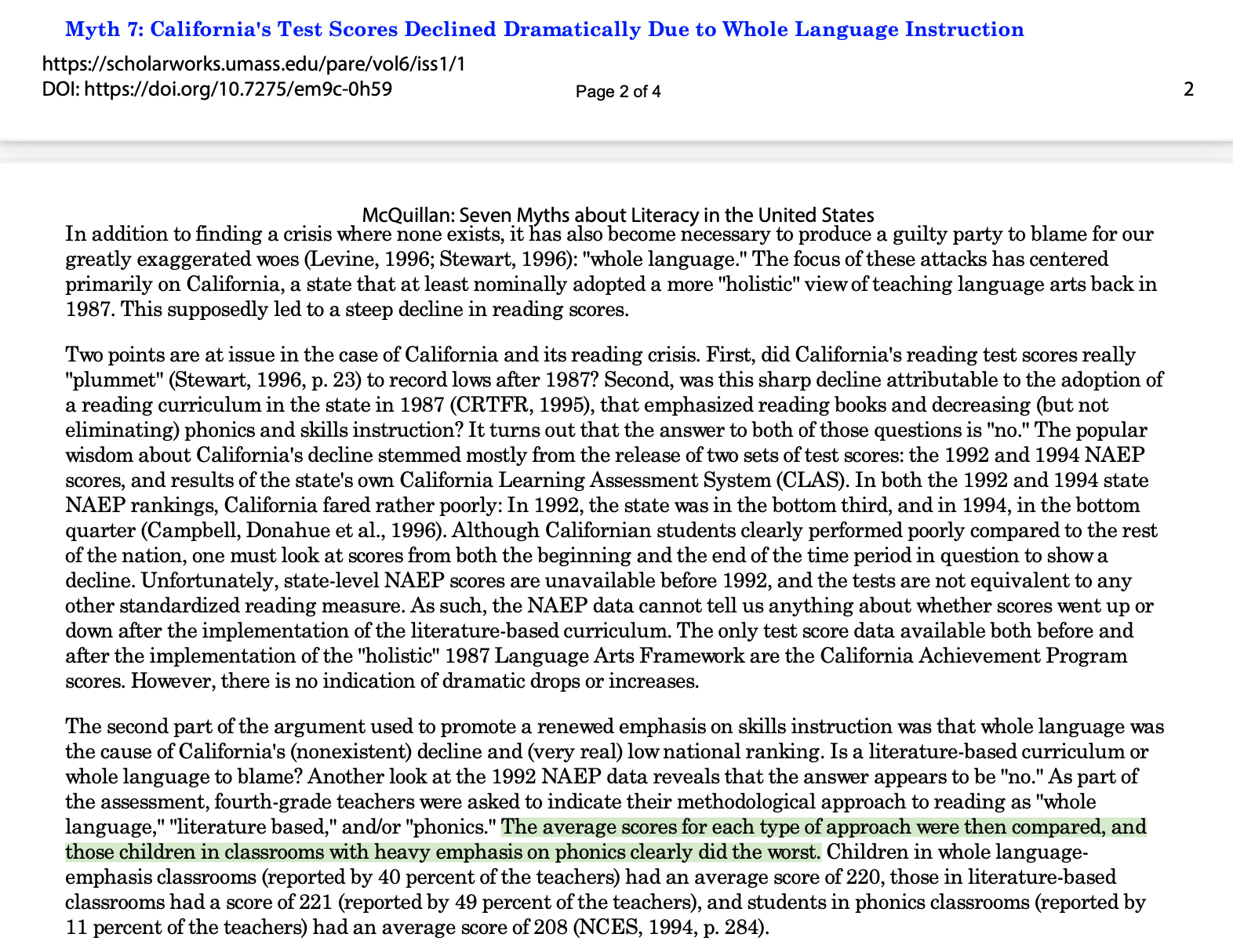
The 1980s-1990s reading crisis was blamed on whole language, but almost no one was implementing whole language and the drop in test scores were easily connected to systemic factors such as reduced funding and an influx of English language learners (Emergent Bilinguals).

It is also interesting to investigate the many misuses of the term “best practice” and the instructional strategy literature circles, both important aspects of Harvey “Smokey” Daniels educational work and regrets he has explained in detail about too many people misunderstanding and misapplying the terms and practices.

At a state-level ELA teacher conference many years ago, I listened to Daniels explain that he wishes he could distance himself from the term “best practice” because nothing stopped publishers from slapping the term on any book because publishers knew the concept was in vogue. In short, like Dewey, Daniels was aware that he had no control over whether or not anything labeled “best practice” was in fact best practice (supported by evidence and research).

So this all leads to the blog post’s title: Did balance literacy fail to teach your child to read?

I suspect if you have made it this far and if you have fully interrogated the information I have provided, you can expect that the answer is very unlikely.

Are too many students not acquiring reading at rates we would prefer in the U.S.? Absolutely.

Are identifiable subgroups particularly mis-served in reading in our public schools—students with dyslexia, poor students, students of color, English language learners (Emergent Bilinguals)? Absolutely and inexcusably so.

Have these students who have experienced educational inequity sat in classrooms and schools that have adopted and implement reading programs labeled “balanced literacy”? There is no question this has happened, and continues to happen.

The paradox about blaming balanced literacy is that as a guiding reading philosophy and theory, balanced literacy supports that every student should receive whatever reading instruction the student needs (systematic intensive phonics, reading authentic texts, read alouds, special needs intervention, etc.); therefore, if a student isn’t receiving what they need, then the fault doesn’t lie with balanced literacy—just as Kilpatrick’s project method was being misused in the 1930s.

This may seem like a trivial distinction, but I think it is important because the current “science of reading” movement is laser-focused on blaming balanced literacy and offering a silver-bullet solution, systematic intensive phonics for all students.

This bodes poorly for students because with a false diagnosis, you are likely endorsing a flawed cure.

It is compelling to identify one thing to blame and to embrace a structured single solution, but that is a historically failed strategy.

Over the last few decades, we have no evidence that reading has ever been taught in any sort of uniform way, even in the same school (although analyses from the 1990s showed a positive correlation between whole language classes and higher NAEP reading scores). The causes for low reading achievement are incredibly complex, linked to out-of-school factors as well as teaching and learning conditions in schools.

We should focus more directly on out-of-school factors, but if we insist on in-school only reform to increase reading achievement, we would do better to start with teaching and learning conditions (low student/teacher ratios for struggling students, better funding) and then to abandon lock-step implementation of any reading program (not ones labeled “balance literacy” or ones prescribing systematic intensive phonics for all students).

And the one real reform we refuse to acknowledge or address is making sure every child and young person in the U.S. has access to reading in their homes, communities, and schools. When people wield “science of reading” like a hammer, they fail to acknowledge the enormous research base showing access to texts as the strongest indicator of students acquiring literacy.

In fact, the more things change, the more they stay the same. We are about 80 years late on listening to LaBrant:

An easy way to evade the question of improved living and better schools for our underprivileged is to say the whole trouble is lack of drill. Lack of drill! Let’s be honest. Lack of good food; lack of well-lighted homes with books and papers; lack of attractive, well equipped schools, where reading is interesting and meaningful; lack of economic security permitting the use of free schools—lack of a good chance, the kind of chance these unlettered boys are now fighting to give to others. Surround children with books, give them healthful surroundings and an opportunity to read freely. They will be able to read military directions—and much more. (p. 241)

What Federal and State Reading Legislation Should and Should Not Do

Since the early 1980s, a significant role of state government has included funding and mandating public school practices and policies. Spurred by A Nation at Risk under Ronald Reagan, most states committed to the accountability era in U.S. public education grounded in state standards and high-stakes testing.

Bringing that state-based process to the federal level, George W. Bush ushered in the federal role in the accountability era with No Child Left Behind in the early 2000s.

The federal and state templates for education policy and reform have been fairly consistent for forty years, and currently, most political leaders and media pundits continue to claim that public education is failing, specifically targeting reading achievement by students.

Since most states have passed or are rushing to pass education legislation targeting reading practices and policies, here are guiding principles for what any federal or state legislation directly or indirectly impacting reading should and should not do:

  • Should not publicly fund private vendor comprehensive reading programs.
  • Should not endorse private vendor reading programs or reading materials.
  • Should not adopt “ends justify the means” policies aimed at raising reading test scores in the short term (for example, 3rd-grade retention policies).
  • Should not prescribe a narrow definition of “scientific” or “evidence-based.”
  • Should not prescribe a “one-size fits all” approach to teaching reading, addressing struggling readers or English language learners, identifying and serving special needs students, or teacher education and preparation of teachers of reading.
  • Should not ignore the limited impact in-school only practices have on measurable student outcomes (test scores).
  • Should not prioritize reading test scores over a wide range of targets and types of evidence to insure all students have high-quality access to learning to read.
  • Should not teacher-proof reading instruction or de-professionalize teachers of reading or teacher educators through narrow prescriptions of how to teach reading and serve struggling readers, English language learners, or students with special needs.
  • Should not prioritize advocacy by parents and non-educators over the expertise and experiences of K-12 educators and university-based scholars of reading and literacy.
  • Should not conflate general reading instruction policy with the unique needs of struggling readers, English language learners, and special needs students.
  • Should not over-react to short-term measurements of reading achievement (test data).

And thus,

  • Should fully fund and guarantee to all students the highest quality teaching and learning conditions for learning to read: low student/teacher ratios, well funded and supported instructional materials for learning to read chosen by teachers to fit the needs of their unique populations of students (prioritizing authentic texts for students in the classroom and in their homes), guaranteed and extensive time to read and learn to read daily.
  • Should reduce significantly the amount of and consequences for standardized testing and adopt accountability structures that include a wide range of types of evidence of student learning over a long period of time.
  • Should support the professionalism of K-12 teachers and teacher educators.
  • Should adopt a complex and robust definition of “scientific” and “evidence-based.”
  • Should embrace a philosophy of “first, do no harm.”
  • Should acknowledge that students needs across the general population, struggling readers, English language learners, and special needs students are varied and complex.
  • Should acknowledge the teacher as the reading expert in the care of unique populations of students and prioritize evidence-based student needs over complying with uniform standards or prescriptive programs.
  • Should provide funding and oversight for guaranteeing all students access to high-quality teachers (certified, experienced) and challenging, rich reading/literacy experiences regardless of student background or geographical setting (equity [input] standards over accountability [output] standards).
  • Should recognize that the research base and evidence base on reading and teaching reading is diverse and always in a state of change (i.e., there is no settled science of reading).
  • Should acknowledge and support that the greatest avenue to reading for all students is access to books and reading in their homes, their schools, and their access to libraries (school or community).
  • Should prioritize longitudinal data (test scores) on reading achievement as guiding evidence among a diversity of evidence for supporting instruction and teaching/learning conditions.
  • Should guarantee that all students are served based on their identifiable needs in the highest quality teaching and learning conditions possible across all schools.

Education legislation targeting reading needs to be guiding concepts and not prescriptions. But the overarching guiding principle should be grounded in the abundant evidence of failure by education reform over the past four decades; at the very least, federal and state legislation should not continue to do the same things over and over while expecting different outcomes.

Education Reform De-professionalizes Women Educators

Who were your teachers?

In elementary school, nearly 9 of 10 teachers are women; by high school, about 6 of 10 are women. And nearly all of your teachers, 80%, were white (see NCES data).

As a student and a teacher, then, I have spent a great deal of my life in spaces where women are the overwhelmingly majority; often I am the only man in the room.

Recently, while I was presenting at two education conferences (South Carolina Council of Teachers of English and Wisconsin State Reading Association), I had several important experiences with recognizing teaching as a profession constituted by mostly women.

At SCCTE, I attended a session led by SC for Ed, making eye contact with one of the organization’s leaders at one point in recognition that I was the only man in the room. This session was on teacher activism and the need to inform state legislators about education while the state considers a major education bill.

As the discussion focused on many of the state representatives being condescending, I offered to the group that many of the problems faced in education can be traced to men in political leadership (and administration) not trusting or allowing the full professionalism of teachers since the field is primarily women.

Alia Wong explains that teaching continues to see a rise in the percentage of women in the field while other professions have the opposite gender trajectory:

Ingersoll and his research team highlight the rising proportion of women who are, for example, physicians (from 10 percent in 1972 to 40 percent in 2018, according to Bureau of Labor Statistics data and federal surveys), lawyers (from 4 percent to 37 percent over the same time period), and pharmacists (13 percent to 63 percent).

Wong then confirms what we confronted at the SC for Ed session at SCCTE:

What explains these contradictory trends? Much of it comes down to misunderstandings of what teaching entails and how those assumptions intersect with gender norms. Unlike in many other countries, in the United States, teaching has long been seen as a relatively low-status profession. In 2018, a survey of people in roughly three dozen countries asked respondents to rank 14 different professions—including teaching, medicine, law, social work, and website engineering—by each career’s perceived social status. On the one hand, survey participants in the United States gave teachers a middling ranking, and tended to liken them to librarians; respondents in countries such as China and Malaysia, on the other hand, put teachers in first place, analogizing them to doctors.

This cultural disregard for teaching has a gendered consequence: The status of a given career tends to correlate with the share of men in that profession—higher status equals more men, generally speaking. And that has its own consequence: Research has found that employers place less value on work done by women than on that done by men. These trends reinforce each other in perpetuity.

Even in education, as the status of the position within education rises, so does the proportion of men, Wong notes: “Notably, close to half of all principals today, including two-thirds of those serving high schools, are men, as are more than three-quarters of school-district superintendents.”

Administration also reflects greater power and higher pay than classroom teachers.

I gave a presentation and spoke on a panel just a week later at WSRA; my session was attended by almost all women, and then I was the only man on a 6-person panel.

During my presentation, Misreading Reading Again and Again: The Media, Reading Policy, and Teaching Reading, two comments by teachers and the discussions around them help navigate the nearly constant state of reform occurring in education and more directly the current “science of reading” movement that is driving many states to adopt new reading legislation.

First, as I was discrediting the myth that whole language failed in California in the 1980s and 1990s—when the state experienced a significant drop in education funding and an increase in English language learners—a woman interjected that she taught in California during this time.

Her class was 32 second graders, including 6 ELL students (hers was an inclusion/ELL class). Her direct statement was that the teaching and learning conditions made effective teaching of reading (or anything) nearly impossible, regardless of the reading program or philosophy she implemented.

Here, we must recognize that teaching and learning conditions can and often do de-professionalize teachers.

Later, I was discussing the recent attacks on Lucy Calkins Units of Study reading program, emphasizing first that I do not endorse any reading programs (including Calkins’s). Many attending the session clapped for the idea that schools should not spend funding on programs, but provide teachers all the books and materials needed to teach reading.

But as we interrogated the problem with Calkins’s program, several teachers enthusiastically announced their hatred for not only the program but Calkins herself, as the name on the program.

What we unpacked was that even despite Calkins own warning not to implement the program as a structured mandate to teachers, many administrators have turned this and other reading programs into a way to manage and monitor teacher practice.

In other words, the valid anger felt by teachers about Unit of Study is their awareness that the program is used to further de-professionalize them.

And that brings us back to the “science of reading” movement that has some disturbing elements. First is the argument that the “science of reading” is settled (suggesting that science is a fixed prescription)—even though the evidence on teaching reading is rightfully described as compelling even as that evidence base is diverse (both in types of research and what that evidence supports).

Next, building off that misrepresentation of science, this movement is calling for systematic intensive phonics (phonics first) for all students; without too much imagination here, we can see that this is a blanket mandate that de-professionalizes teachers and certainly will have the same negative impact on teacher attitudes that misguided implementation of Calkins’s program currently exposes.

But the most disturbing aspect of the “science of reading” movement is that it is the next step feeding the over forty years of education reform that has plagued U.S. education.

Public education has experienced relentless political intrusion since the early 1980s, mandates standards, testing, and programs that have erased nearly every aspect of professionalism from the field of teaching.

And political intrusion, we must recognize, is almost entirely the work of men.

Think of the recent anti-abortion laws in Alabama. While the press highlighted a woman governor signing the bill, Alabama has 23 women out of 140 legislators, a mere 16.4% (see gender balances in state government here).

As has been dramatized brilliantly in Margaret Atwood’s The Handmaid’s Tale (and the Netflix adaptation), tokenized women, such as the governor of Alabama, often work in the service of men.

While many faces on the “science of reading” movement are women, their agenda is being used mostly by men in political power to mandate education policy and further de-professionalize teachers.

My home state of South Carolina has about the same gender imbalance as Alabama (28 women out of 170 legislators, 16.5%), and many of the SC for Ed teachers interacting with state representatives and senators are receiving angry and condescending responses that demonstrate a lack of respect for teachers.

What people fail to recognize about the systematic intensive phonics movement as an attack on balanced literacy is that phonics programs fit well into the top-down authority model implemented in many schools and driven by accountability mandates (legislation included). Balanced literacy, on the other hand, is intended as a guiding philosophy of literacy that depends on teacher autonomy and professionalism to provide all students what they need to learn.

Balanced literacy does not mandate any practice for all students, and does not bar any practice where students demonstrate a need.

Accountability, education legislation, and reading programs have mostly worked against teacher professionalism, against the autonomy and professionalism of women.

Teachers need teacher and learning conditions that make their work as professionals possible, but the current movement to legislate the “science of reading” will further erode teacher autonomy and distract from the real work needed.

Teachers do not need yet more reform; teachers need their profession to be respected and supported.

UPDATED: Understanding the “Science of Reading”: A Reader

UPDATE

See Fact checking @DanaGoldstein phonics article @nytimes – a thread

See Also: Gerald Coles, Cryonics Phonics: Inequality’s Little Helper


In one way, ground zero for the “science of reading” movement can be traced to Emily Hanford in 2018, but cognitive scientists (Daniel Willingham and Mark Seidenberg, for example) focusing on reading and advocacy for students with dyslexia (or struggling to read in ways that some label as dyslexia) have also played key roles in the movement.

The “science of reading movement” has not been simply a media event, however. That advocacy has resulted in state education/reading legislation that has included third-grade retention of students based on reading test scores, mandating systematic intensive phonics (phonics first) for all students, and new mandates for teachers of reading and teacher education programs.

What is absent in most of the media and political endorsement of the “science of reading” is a critical lens for the claims as well as historical context.

The “science of reading” narrative, at best, is incomplete, and at worst, is deeply misleading.

Below are the key elements and links to help anyone better understand the issues:

Historical Perspective

What Shall We Do About Reading Today?: Looking Back to See Now More Clearly

Back to the Future of Reading Instruction: 1990s Edition

Recommended: Literacy Crises: False Claims and Real Solutions, Jeff McQuillan

The “Science of Reading,” an Overview

The Big Lie about the “Science of Reading” (Updated)

The Big Lie about the “Science of Reading”: NAEP 2019 Edition

Systematic Intensive Phonics (Phonics First, Phonics versus Whole Language/Balanced Literacy)

Reconsidering the Evidence That Systematic Phonics Is More Effective Than Alternative Methods of Reading Instruction, Jeffrey S. Bowers (2020)

To Read or Not to Read: Decoding Synthetic Phonics, Andrew Davis

Does Phonics Deserve the Credit for Improvement in PIRLS? Stephen Krashen

The Problem with Balanced Literacy

Progressivism and Whole Language: A Reader

National Reading Panel (NRP)

The Enduring Influence of the National Reading Panel (and the “D” Word)

Reading Programs (Lucy Calkins)

Reading Programs Put Reading Last

In Defense of Balanced Literacy: Understanding and Responding to Student Achievement Partners’ Critique of Units of Study

Teacher Education and National Council on Teacher Quality (NCTQ)

Twitter thread on NCTQ

Measuring Up: The National Council on Teacher Quality’s Ratings of Teacher Preparation Programs and Measures of Teacher Performance

If Teacher Education Is Failing Reading, Where Is the Blame?

Mississippi 2019 NAEP Reading Scores

UPDATED: Mississippi Miracle or Mirage?: 2019 NAEP Reading Scores Prompt Questions, Not Answers

See Also

Checklist: Media Coverage of the “Science of Reading”

Fact-checking Phonics, NRP, and NCTQ

The “science of reading” movement often claims that a systematic intensive phonics-first approach to teaching reading is endorsed by science that is settled, that the National Reading Panel (NRP) is a key element of that settled science, and that teacher education is mostly absent of that “science of reading” (a message that has been central to NCTQ for many years).

These claims, however, misrepresent what evidence actually shows. Here, then, are some evidence-based fact-checks of phonics, NRP, and NCTQ.

Phonics

Reconsidering the Evidence That Systematic Phonics Is More Effective Than Alternative Methods of Reading Instruction, Jeffrey S. Bowers (2020)

Abstract

There is a widespread consensus in the research community that reading instruction in English should first focus on teaching letter (grapheme) to sound (phoneme) correspondences rather than adopt meaning-based reading approaches such as whole language instruction. That is, initial reading instruction should emphasize systematic phonics. In this systematic review, I show that this conclusion is not justified based on (a) an exhaustive review of 12 meta-analyses that have assessed the efficacy of systematic phonics and (b) summarizing the outcomes of teaching systematic phonics in all state schools in England since 2007. The failure to obtain evidence in support of systematic phonics should not be taken as an argument in support of whole language and related methods, but rather, it highlights the need to explore alternative approaches to reading instruction.

[For context, note some of the problems remaining in how whole language is addressed in this post.]

National Reading Panel

The Federal Government Wants Me to Teach What?: A Teacher’s Guide to the National Reading Panel Report, Diane Stephens (NCTE, 2008)

An Ever-So-Brief Summary with Book Recommendations

1. Phonemic Awareness. According to the studies cited in the NRP report, this is best taught to very young children (K–1) using letters, and when letters are used, PA instruction is considered to be phonics. Therefore, it is not necessary to have a separate instructional time for PA. Rather, children should have opportunities to learn about how language is made up of parts (e.g., onsets and rimes, or word families) as part of phonics instruction. An effective way to do this in the classroom? Provide time for students to write using invented spelling (pp. 2-1 through 2-86). (See Strickland, 1998, for further information about invented spelling.)

2. Phonics. According to the studies cited in the NRP report, there is no evidence that phonics instruction helps in kindergarten or in grades 2 to 9. It does help first graders learn the alphabetic principle—that there is a relationship between letters and sounds. No one method is better than any other. For example, for at-risk first graders, a modified whole language approach and one-on-one Reading Recovery–like instruction both helped children with comprehension (pp. 2-89 through 2-176). This phonics instruction should be conducted in the context of whole, meaningful text. (See Moustafa, 1997, for information on embedded, whole-part-whole instruction.)

3. Fluency. According to the authors of the Fluency report, the practice of round robin (at any age) does not help children and can indeed hurt them. However, according to the studies cited in the Fluency report, repeated oral reading (K–12) helps with comprehension because reading to readers fluidly instead of word-by-word reading helps them better understand the text. Ways to help with this? Try such things as readers theater (pp. 3-1 through 3-43). (See Opitz and Rasinski’s Good-bye Round Robin: 25 Effective Oral Reading Strategies [1998] for additional instructional suggestions.)

4. Vocabulary (grades 3 to 8). One method is not better than another. Children learn most of their vocabulary incidentally (pp. 4-15 through 4-35). (For further information about vocabulary learning, see Nagy, 1988.)

5. Comprehension (grades 3 to 6). Children need to learn that print makes sense and to develop a variety of strategies for making sense of print (pp. 4-39 through 4-168). (For further information on teaching for comprehension, see the references listed in Chapter 8: Beers, 2002; Sibberson & Szymusiak, 2003; Taberski, 2000; Tovani, 2000; see also Harvey & Goudvis, 2000.)

Across all of these recommendations? According to the studies cited in the NRP report, if we want children to learn something, we need to teach them that something. Want great readers? Then teach children what great readers do.

NCTQ (Teacher Education)

NOTE: This is more complicated, but first I am posting an older (2006) and new (2020) report from NCTQ both making essentially the same claims that teacher education fails to teach the “science of reading.” Then, I include a link to several reviews that show that NCTQ’s “reports” are methodologically flawed and essentially propaganda, not “science.”

What Education Schools Aren’t Teaching (2006)

2020 Teacher Prep Review: Program Performance in Early Reading Instruction

NEPC reviews of NCTQ reports

NCTQ on States’ Teacher Evaluation Systems’ Failures, Again

Reading Programs Put Reading Last

girl reading book
Photo by Jerry Wang on Unsplash

While rewatching Zombieland recently, I noticed that this version of the zombie genre was not only a blend of horror and comedy but also a slightly different take on the zombie mythology; a central character, Columbus (played by Jesse Eisenberg), embodies a motif focusing not on the zombies but on the survivors, and their survival techniques often grounded in anxiety and other compulsions that are often a burden in the so-called normal world.

Zombie narratives are enduring in popular culture throughout history because reanimation of life and the near impossibility of killing the reanimated are truly horrifying elements. But zombie narratives are also highly adaptable to many cultural perspectives.

Currently the Reading War has been reanimated around the branding of the “science of reading,” and this version seems even harder to kill than previous iterations; the effectiveness of the double tap perfected by Columbus in the film would be deeply appreciated in this circumstance.

As we wander into 2020, the “science of reading” movement has developed a few new approaches grounded in the foundational arguments that have made “science of reading” as compelling as a zombie story: discrediting popular reading programs as not scientific and reanimating Reading First (the program built on the National Reading Panel).

Central to these developments in the “science of reading” onslaught on reading are two key names: Timothy Shanahan and Lucy Calkins.

In many ways, Shanahan (a member of NRP) has emerged as a key voice in rewriting the history of both the NRP and Reading First. Calkins, as the name on a widely adopted reading program, now represents the so-called failed balanced literacy movement.

Here we have names and people superimposed onto the false war between phonics (Shanahan) and balanced literacy/whole language (Calkins).

Calkins has posted a defense of her programs, and Shanahan has recently posted a somewhat garbled defense of Reading First.

However, there is no value in mainstream media pointing fingers at Calkins, charging her with a self-serving agenda, while supporting Shanahan, who is conducting his own PR campaign for his role in the NRP. Let them without agendas cast the first stone. (Hint: There are plenty of agendas to go around on this.)

Yet, it is a negative review of Calkins’s program that has found a home in the mainstream media:

A new player has moved into the curriculum review market: Nonprofit consulting group Student Achievement Partners announced this week that it is going to start evaluating literacy curricula against reading research.

The group released its first report on Thursday: an evaluation of the Units of Study for Teaching Reading in grades K-5, a workshop style program designed by Lucy Calkins and published through the Teachers College Reading and Writing Project.

The seven literacy researchers who reviewed the program gave it a negative evaluation, writing that it was “unlikely to lead to literacy success for all of America’s public schoolchildren.”

This last point quoted from the review is incredibly important to unpack, as is the urgency with which the mainstream media reports this review mostly uncritically.

First, there is a serious contradiction and hypocrisy when the mainstream media commit to a term such as the “science of reading,” demanding that reading instruction is always grounded in a narrow concept of “scientific” (the so-called gold standard of cognitive psychology, specifically), but participate in press release journalism.

We must ask about the review endorsed by EdWeek: Is it scientific? Has it been blind peer-reviewed? Do the authors have any agendas that would skew the findings?

And then we must argue: If mainstream journalists are now demanding that educators implement only practices supported by high-quality scientific studies, those journalists should not report on any reviews or studies that themselves are not also high-quality scientific studies.

This contradiction in which the media have lower standards for their reporting than for the agenda they are promoting is a window, however, into what is really going on, bringing us back to the conclusion about Calkins’s reading program.

All reading programs can and should be viewed through that conclusion: “unlikely to lead to literacy success for all of America’s public schoolchildren.”

In fact, like the Orwellian named Reading First, reading programs always put reading last because reading programs are inevitably linked over the past 40 years to the accountability movement; teachers and students have been disproportionately held accountable for implementing and following the programs and not for authentic reading.

Reading First did in fact fail, despite arguments to the contrary, because the bureaucracy allowed the natural corruption inherent in the market; funding for reading became inappropriately tied to specific reading programs and textbook companies using the label of “scientifically based” (a central element of No Child Left Behind and the NRP almost twenty years ago).

Reading was last in the Reading First scandal because the focus became adopting and implementing Open Court.

The real irony here is that the market/accountability dynamic is at the heart of why it makes perfect sense to conclude that Calkins’s program is “unlikely to lead to literacy success for all of America’s public schoolchildren.”

And the bigger irony is that whole language and balanced literacy were attempts to pull back from scripted and prescriptive program approaches to teaching reading and to provide philosophical and theoretical frameworks within which teachers could use their professional autonomy to shape reading instruction to the needs of “all of America’s public schoolchildren.”

This is a much ignored truism found in John Dewey: In education, we must resist reducing philosophical and theoretical truths to fixed templates that then become not guiding principles but simplistic mandates to be fulfilled.

Children reading eagerly and critically—this is the real goal of teaching reading in our public schools; that is putting reading first, not any commercial program whether it be systematic intensive phonics or one promoted as balanced literacy.

Reanimating NRP and Reading First is, I concede, on its second round so I can hold out hope that a vigilant double tap may put these zombies back in the ground permanently.

None the less, I will remain anxious like Columbus, skeptical that we are safe.

See Also

Reading First: Hard to Live With—or Without, P. David Pearson

Pearson Reading First

Recommended: Literacy Crises: False Claims and Real Solutions, Jeff McQuillan [Update 2 February 2023]

[UPDATE]

After posting this in 2019 while working on the first edition of How to End the Reading War and Serve the Literacy Needs of All Students: A Primer for Parents, Policy Makers, and People Who Care, I have published the second edition and continued to work on the “science of reading” movement.

Regretfully, McQuillan’s work is even more relevant in 2023 because the media and political response to the SOR movement has gained momentum despite the evidence that it is mostly misinformation and another round of the exact reading war McQuillan debunked in the 1990s.

I highly recommend accessing this (which I will cite/quote below in the update of the original post):

McQuillan, Jeff (1998) “Seven Myths about Literacy in the United States,” Practical Assessment, Research, and Evaluation: Vol. 6 , Article 1.
DOI: https://doi.org/10.7275/em9c-0h59
Available at: https://scholarworks.umass.edu/pare/vol6/iss1/1 [1]


Recently, I have been (frantically but carefully) drafting a new book for IAP about the current “science of reading” version of the Reading War: How to End the Reading War and Serve the Literacy Needs of All Students: A Primer for Parents, Policy Makers, and People Who Care.

Those familiar with this blog and my scholarly work should be aware that I often ground my examinations of education in a historical context, drawing heavily on the subject of my dissertation, Lou LaBrant. The book I am writing begins in earnest, in fact, with “Chapter 1: A Historical Perspective of the Reading War: 1940s and 1990s Editions.”

As I have posted here, the “science of reading” over-reaction to reading and dyslexia across mainstream media as well as in state-level reading legislation has a number of disturbing parallels with the claims of a reading crisis in the 1980s and 1990s. Few people, I explained, are aware of the 1997 report authored by Linda Darling-Hammond on NAEP, reading achievement in the U.S., and the positive correlations with whole language (WL) practices and test scores.

I imagine even fewer  education journalists and political leaders have read a powerful and important work about that literacy crisis in the 1990s, Literacy Crises: False Claims and Real Solutions by Jeff McQuillan.

In his Chapter 1, “What Isn’t Wrong with Reading: Seven Myths about Literacy in the United States,” McQuillan admits, “Serious problems exist with reading achievement in many United States schools,” adding, “Yet in the midst of media coverage of our (latest) ‘literary crisis,’ we should be very clear about what is and is not failing in our schools” (p. 1).

This leads to his list of myths ([1] updated with material from McQuillan’s article noted above), which are again being recycled in the “science of reading” version of the Reading War:

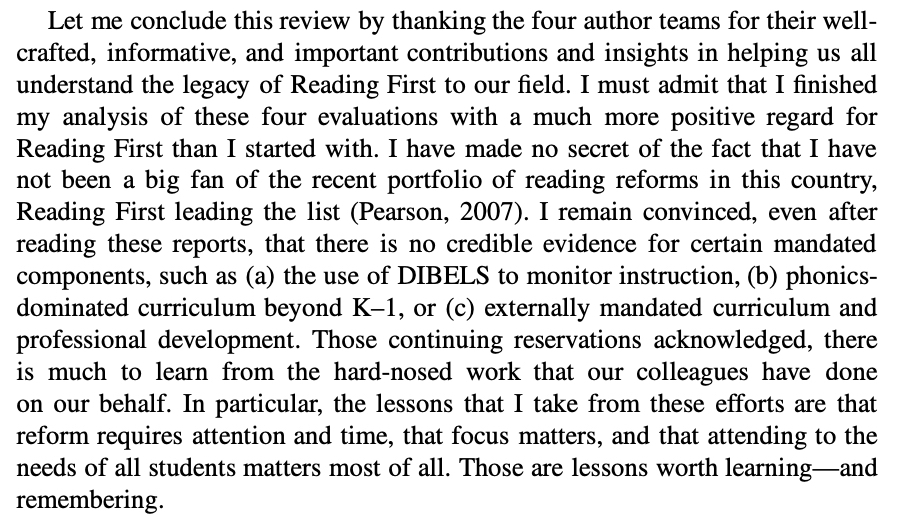
Myth 1: Reading Achievement in the United States Has Declined in the Past Twenty-Five Years.

Myth 2: Forty Percent of United States Children Can’t Read at a Basic Level.

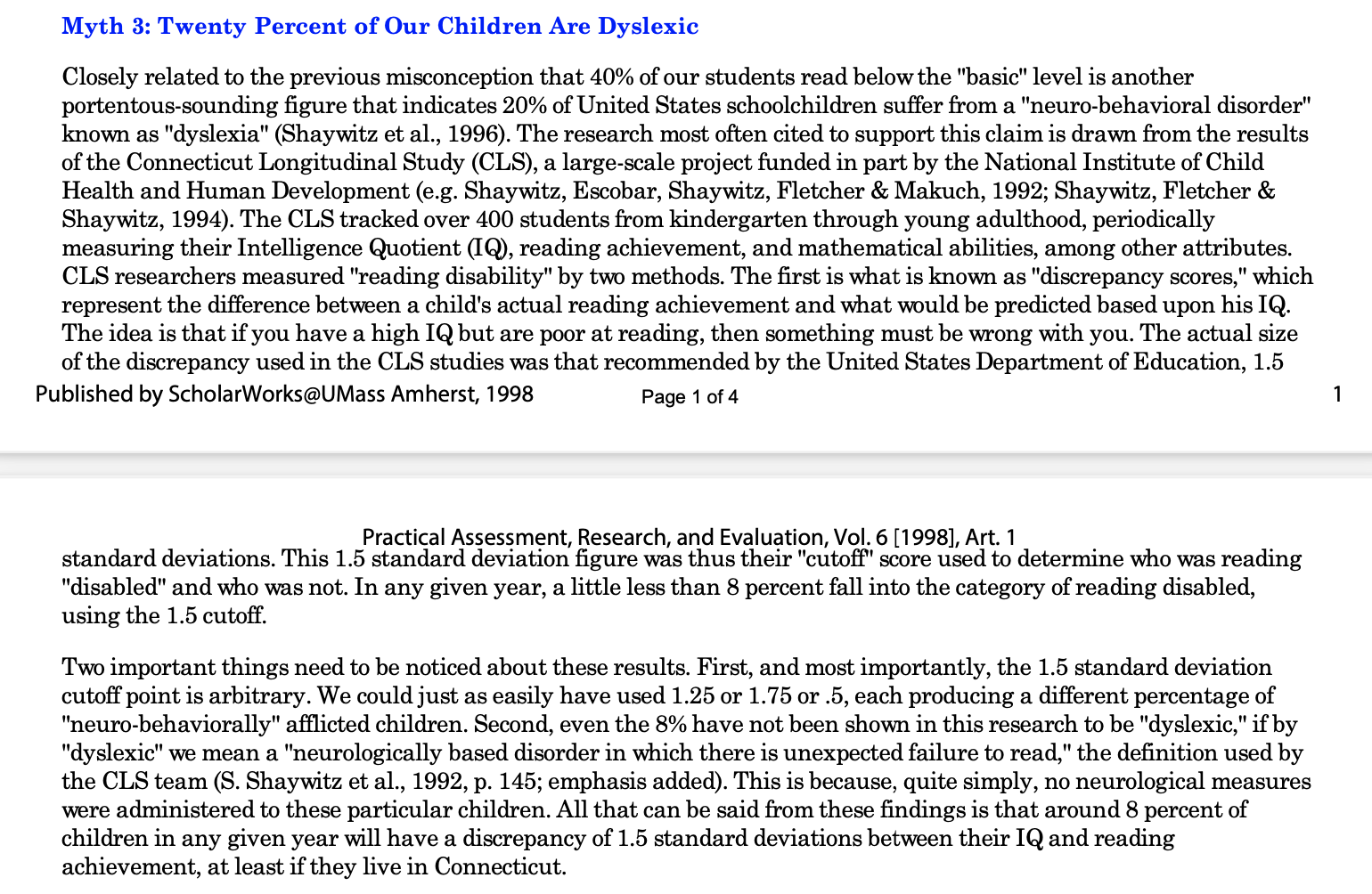
Myth 3: Twenty Percent of Our Children Are Dyslexic.

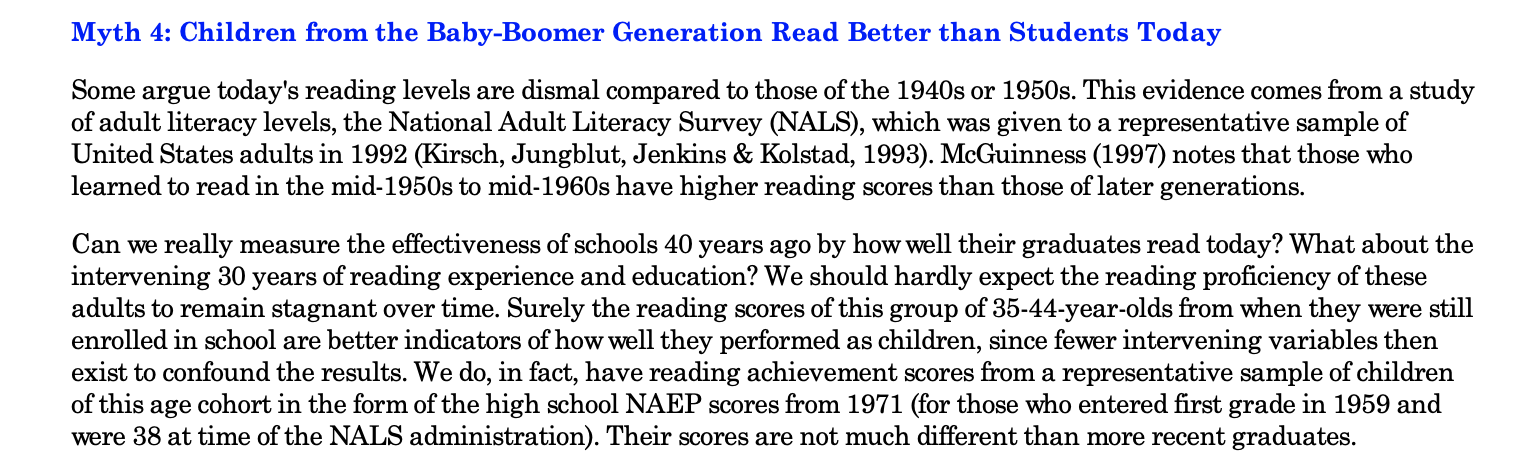
Myth 4: Children from the Baby Boomer Generation Read Better than Students Today.

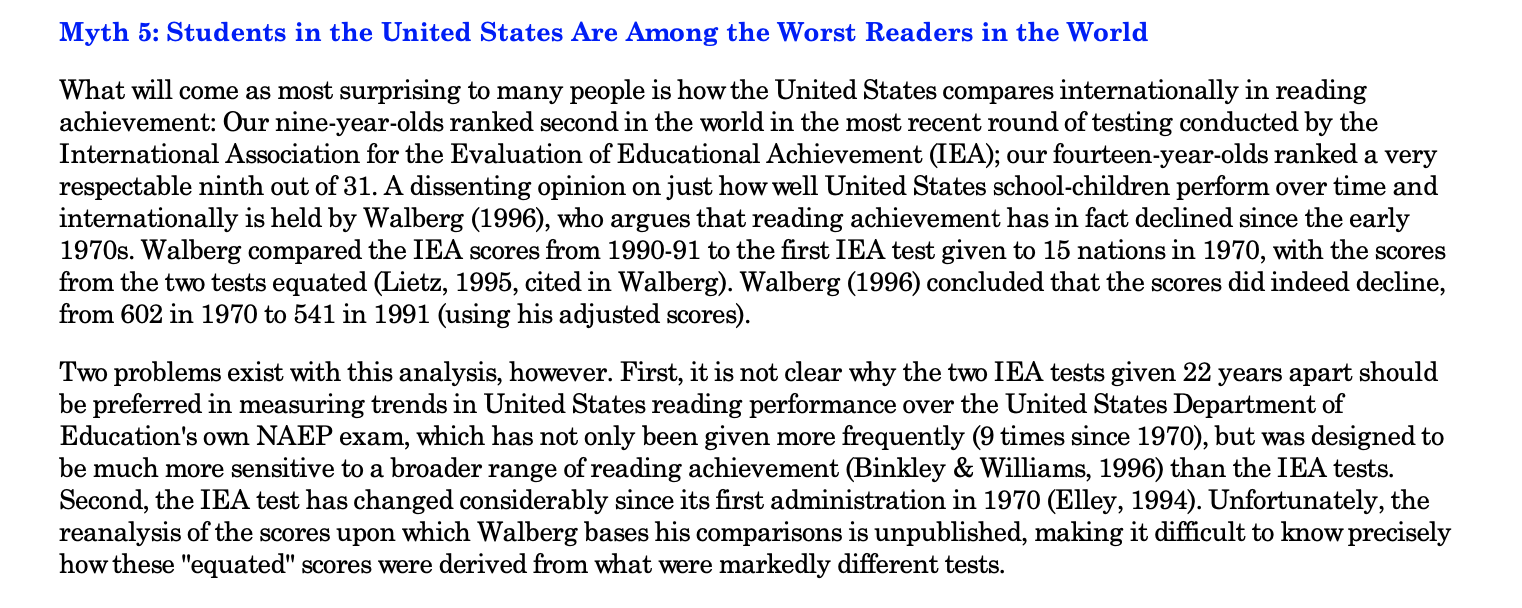
Myth 5: Students in the United States Are Among the Worst Readers in the World.

Myth 6: The Number of Good Readers Has Been Declining, While the Number of Poor Readers Has been Increasing.

Myth 7: California’s Test Scores Declined Dramatically Due to Whole Language Instruction.

DOI: https://doi.org/10.7275/em9c-0h59

McQuillan carefully dismantles each of these, with evidence, but many today continue to make the same misguided and unsupported claims.

In 2019 (and 2023), McQuillan’s work remains important, and relevant, both for understanding how we should teach better our students to read and how the current version of the Reading War is wandering once again down very worn dead-end roads.

The Science of Writing: A 36-Year Journey and Counting

[Header Photo by Ron Otsu on Unsplash]

Science is not a hammer.

Science is an old-growth forest, each tree an organic thing. Think of a tree as a theory. At any moment that tree (theory) is fully a tree but not the tree it will be.

As a tree grows, it becomes more robust, a stronger trunk, deeper roots. If we inspect that trunk, we find rings detailing the history of how that tree became stronger with age. Theories too are not simply the result of fixed evidence, but an accumulation of evidence, an accumulation that evolves over time.

Science, like that old-growth forest, is never settled, but it is always at any moment the best that it can be in terms of being a forest and in terms of the trees being the tress of that moment. You see, science is also organic, not yet the forest or trees it can and will be.

Old-growth forests are also characterized by being untouched by humans, and while science is the product of humans, science often seeks ways to limit the flaws of that human contact (a lofty and unattainable goal, but one that helps science aspire toward truth and Truth).

Science ultimately is aspirational; it can never be settled, fixed, and anyone using science as a hammer is, in fact, not being scientific.

Science is not a hammer.

Science is an old-growth forest, each tree an organic thing.

#

Viewing science as a hammer is the fatal flaw of the “science of reading” (SoR) movement that has gained momentum in 2019. Advocates of SoR begin by claiming that this science is settled:

In spite of the current discussions, the science on this instructional issue is settled. Castles, Rastle, & Nation (2018) lay out that there is a clear progression to effective literacy instruction. First and foremost, children need to understand the principles of spelling-sound correspondences and to solidify a store of high-frequency words to read words and phrases fluently. Most children need explicit teaching to build this knowledge. After decoding and high-frequency words are established, more attention can be devoted to comprehension with a focus on making meaning. Castles et al. (2018) offer a logical and research-based model. In spite of this research, educators remain without consensus about what is most important—phonics instruction or a focus on comprehension.

Science is not a hammer, neither is it to be used to bludgeon nor is it a singular tool.

In fact, especially for education as well as teaching literacy, science is a much broader spectrum of evidence than SoR advocates are arguing, steeped as they are in the neurosciences.

The science needed to guide real-world teaching of literacy is an old-growth forest of many types of trees at different stages of growth.

For example, I primarily have been a teacher of writing for 36 years and counting. I have taught students from 9th grade through graduate courses.

As a scholar of teaching writing, I am well versed in the experimental/quasi-experimental research base on teaching writing as well as a huge and complex body of qualitative research.

I also have 36 years of experience with thousands of students.

All of that is at my disposal as I teach any student to write, an act that for me is highly individualized—even when I taught 100-125 high school students five days a week.

The generalizations and controls that result from and govern experimental/quasi-experimental research (which is dominant in neuroscience) are informative (not prescriptive) for me as a teacher, but my work tends to be with many different outliers—humans, that is—who may thrive with practices outside the constraints of narrow types of science.

I don’t use science as a hammer because students are fragile things, and instruction that treats them all as ten-penny nails is unwarranted.

#

You may be thinking about climate change, evolutionary science, or vaccinations—all of which many people would argue are settled science.

“Settled,” I think, remains a problematic word even in those contexts.

All science based in experimental/quasi-experimental research when properly vetted is compelling, compelling to the point that it feels settled, compelling to the point that we must act in ways that confirm it is settled even as we are aware this tree may grow.

Since all sciences remain in the replication loop, we are best off calling even the largest tree with the most powerful trunk and deepest roots “compelling,” not settled.

In qualitative research, “compelling” is the best we can hope for, but much of that research is compelling, although with caveats about the evidence not reaching standards of generalizability and the conditions of the evidence not bound by controls.

#

Let me end with an anecdote, what some would call not scientific. It is the story of having taught writing for 36 years and counting, and still being very cautious about my practice and very nervous about the fate of my field of teaching writing.

Actually this is an anecdote about gathering anecdotal evidence, the sort of scientific teaching that John Dewey envisioned for progressive educators.

I always spend the last class of my first-year writing seminars by discussing with students what has worked and what I should do differently in the future.

I also use this class to re-emphasize that my overarching goals for these classes are about fostering in them greater authority and autonomy as students and writers about to run the gauntlet of three-and-a-half additional years (or more) of college.

This fall, students argued for having Essay 1 turned in earlier, allowing more time and class sessions for Essay 3 (the academically cited essay), and moving Essay 4 earlier to leave more time for the revised submission.

We fleshed out these requests against the goals of the course, and ultimately, I found their anecdotal feedback compelling. My schedule for fall 2020 will be revised.

As the professor, as well, I have reflected on how to better encourage students to revise their essays and not simply address what I have marked for them. I discussed this problem with another teacher, and am considering a new policy on how students should resubmit their essays.

In the past, I have required students to resubmit essays in clean Word files, track changes, comments, and highlighting all removed. Part of that requirement was aimed at helping students better use Word as a tool, but I also have trouble with Word files that are busy.

However, as I discussed student revision with a friend who teaches writing, I thought about how students having the track changes visible for their revisions would show them how much, or how little, they actually revised. Visible track changes can be a very effective teaching tool.

So my new policy may be that students submit two Word files, one clean and one with only the track changes of their revisions (with the file including “TC”).

This, then, is a brief anecdote about how I teach scientifically as a professional educator, a writer, and an expert in literacy. I teach with caution, I resist teaching with a hammer.

This means that when some students demonstrate a need for a type of instruction not supported by a narrow type of research, I still provide the student with that instruction. We may even experiment with a range of strategies until the student feels capable on their own.

I am always cautious, but I am also nervous because while the “science of reading” mania is in full stride, I see on the horizon a similar fate for the teaching of writing: Scientific evidence on how to teach writing is slim.

I suspect the mainstream media will discover a field that already exists, has for a century or more. I suspect the allure of “science” will blind that media and those who also feel passionate about the dismal state of student writing.

So somewhat preemptively, I want to offer about the teaching of writing:

Science is not a hammer.

Science is an old-growth forest, each tree an organic thing.


Back to the Future of Reading Instruction: 1990s Edition

[Header Photo by Javier Allegue Barros on Unsplash]

The year is 1997 and the topic, of course, is improving a failing education system in the U.S. Linda Darling-Hammond explains in the Preface [1]:

This follow-up report, Doing What Matters Most: Investing in Quality Teaching, seeks to gauge the nation’s progress toward the goal of high-quality teaching in every classroom in every community. It draws on data about the conditions of teaching that have become available since the original Commission report was released, and it examines policy changes that have occurred.

This report has five recommendations that may sound familiar:

I. Standards for teachers linked to standards for students….

II. Reinvent teacher preparation and professional development….

III. Overhaul teacher recruitment and put qualified teachers in every classroom….

IV. Encourage and reward knowledge and skill….

V. Create schools that are organized for student and teacher success.

We need better standards for teachers and students, better teacher education, better recruitment of teachers focusing on high quality, better reward systems for teacher expertise and outcomes, and better teaching and learning conditions.

Yet, the report also offers some sobering information:

Over the last decade, reforms have sought to increase the amount of academic coursework and the numbers of tests students take, in hopes of improving achievement. These initiatives have made a great difference in coursetaking: In 1983, only 14% of high school students took the number of academic courses recommended in A Nation at Risk—4 units in English and 3 each in mathematics, science, and social studies. By 1994, more than half (51%) had taken this set of recommended courses.

Despite these changes, achievement scores have improved little, and have actually declined slightly for high school students in reading and writing since 1988 (see figure 3). [emphasis added]

Let’s look at that figure 3:

NAEP trends 1980 1990

Notice anything familiar above when we look at 4th and 8th grade reading since the early 1990s?

trend grade 4 reading
trend grade 8 reading

While this report concedes what research has long shown—the largest influences on measurable student outcomes are out-of-school factors (parent income, level of education, etc.)—the focus remains on teacher practices, offering a rare set of correlations between scores and those practices:

Correlates of reading NAEP 1992

Here is where I want to pause to note that while no one has conducted even a correlational graph such as the one above—and no one has conducted scientific research to identify causal relationships—to draw conclusions about 2017 and 2019 NAEP scores, this chart raises some key questions about the current “science of reading” claims about teacher education and the need for systematic intensive phonics (and not whole language or balanced literacy).

Note above that whole literacy practices and training correlate with higher scores.

Twenty years after this report from Darling-Hammond have seen at least two significant additional rounds of educational reform, one driven by No Child Left Behind and another sputtering one connected to Common Core.

Just as educational leaders were in the 1990s, we are left with the same data problems, notably flat or dismal reading scores, and can only reach for the same lazy arguments that have never worked before.

The five recommendations from 1997 are echoed today by political leaders and the “science of reading” crowd, all bashing teacher education, teacher expertise, and focusing on standards, tests, and programs.

And little to nothing is done about food and work security, healthcare, or class size—even though these conditions combined would dwarf any measurable impact of teacher quality or program/standards quality.

Ultimately, the “science of reading” and NAEP-crisis rhetoric are doomed because the Christopher Columbus syndrome (thinking you have discovered something that others you ignore or marginalize have known forever) insures that one truism will remain true—those ignorant of history are doomed to repeat it.

Today’s reading crisis is that, back to the future of reading, a 1990s edition recast [2].


[1] Credit and appreciation to Diane Stephens, literacy expert and former professor at the University of South Carolina, who brought this report to my attention.

[2] Don’t forget the 1940s also: “What Shall We Do About Reading Today?”