Category Archives: Educational Research

Shifting Disciplinary Gears as Student Writers

These may have seemed petty or just pet peeves to my students, but I would not tolerate this sort of framing in student essays about literature:

Emily Dickinson says, “Because I could not stop for Death – /He kindly stopped for me –.”

William Shakespeare is often quoted as saying “brevity is the soul of wit.”

In the first example, I would note that poems have speakers, some personae that may or may not be the poet. I encouraged students to take great care to identify “speaker” if a specific voice isn’t identified in the poem along with nudging them to avoid the lazy “say” verb choice.

The second example is far more vexing since it makes the same error (the line is spoken by Polonius in Hamlet, and is not Shakespeare expressing a pithy idea); however, it is far more flawed since the phrase absent the context of the character speaking and the play itself allows people to completely misrepresent the line as a truism—instead of acknowledging that it is a hollow claim of a blowhard.

What I was teaching students included a couple of broad and narrow lessons about writing: one, broad, captures the need for precision in writing that is far more nuanced than what many expect in speaking, for example, and two, narrow, teaches some of the nuances of writing in the discipline of literary analysis.

It is at that second and narrow lesson I want to focus on some of the strategies connected with helping students develop a toolbox as writers that supports them shifting gears among different disciplines.

For example, let’s think about how students must navigate (too often without explicit instruction) the conventions of the humanities (writing in English or history courses) and the conventions of the social sciences (writing in psychology, sociology, education).

Two ways we fail students in those contexts include laying almost all of writing instruction at the feet of English teachers (K-12) and first-year writing instructors (as a one-shot inoculation), and then focusing too narrowly on the mechanics of citation style sheets (MLA, APA, Chicago, etc.) instead of the broader approaches to writing in the disciplines that those styles support.

In all of my courses—first-year writing, foundations education, upper-level writing/research, graduate—I require extensive writing assignments, and students consistently demonstrate a lack of awareness about disciplinary expectations for writing. Primarily, they come to writing assignments with literary analysis and MLA “rules” that they impose on all types of writing.

Therefore, some of the nuances I must address include the following:

  • In the humanities, source-based writing tends to focus on textual analysis of a primary source supported by secondary sources. Writing in the social sciences rarely involves textual analysis (except when including critical discourse analysis), but asks the writer to synthesize bodies of research to address key topics or questions.
  • Therefore, writing in the humanities often explicitly identifies authors and titles directly in the flow of sentence and discussions: “In her ‘Vesuvius at Home,’ poet Adrienne Rich explains, ‘But of course Dickinson’s relationships with women were more than intellectual.'” As well, writers in the humanities may explore one source at a time (both primary and secondary) to make a larger case about the primary source being addressed (for example, Rich examining the poetry of Dickinson).
  • However, writing in the social sciences synthesizes patterns of claims and conclusions across several sources, and thus, authors and titles rarely appear in the flow of sentences with attributions mostly parenthetical or in end/footnotes: “For this volume on comic books, then, interrogating the medium in the context of race is extremely complex because comic books are a significant subset of popular culture (increasingly so with the rise of superhero films based on comic books throughout the late twentieth and into the early twenty-first centuries), which necessarily both reflects and perpetuates all aspects of the culture it serves—including bigotries such as sexism, racism, classism, jingoism, and homophobia (McWilliams, 2009; Rhoades, 2008a, 2008b; Singer, 2002; Thomas, 2010; Wright, 2001).”
  • In the context of the second and third bullet, then, students must confront that writing in the humanities often requires direct quoting, but writing in the social sciences prefers synthesis (often oversimplified as paraphrasing*). Here, there are disciplinary contexts for how a writer supports claims that contradicts most students’ belief that all writing requires quoting.

These problems for students as writers and for teachers of writing also complicate my argument against templates and my commitment to students choosing their type of essays and topics.

Since writing and teaching writing are extremely complicated, then, I want to end here with how I have organized my upper-level writing/research course around commitments to scaffolding assignments, student topic choices, and supporting students as writers confronted with a variety of writing modes and disciplinary expectations.

Students have three major writing assignments—annotated bibliographies (sources that serve as the foundation for their scholarly essay), a major scholarly essay on an educational topic of their choice, and a public commentary incorporating hyperlinks for support and addressing the same topic as their scholarly essay but for a lay audience.

After students gather evidence that an educational topic has been covered often in the mainstream media, they choose that topic to investigate the research base, producing 8-10 annotated bibliographies of high-quality sources. In this process, students practice evaluating sources and also refine their skills in APA formatting (focusing on the bibliographies).

After they submit the first draft of the annotated bibliographies, we discuss how social scientists write, contrasting that to their humanities/MLA assumptions (addressed above). In a class workshop format, I then ask them to revise the annotations (and edit the bibliographies) by focusing on discussing the content of the research, and not announcing authors and titles. For example, a first draft includes: “DeLeon suggests that the archetype of the “urban” criminal stems from colonial portrayals of African Americans, which sought to paint a picture of savage, uncivilized peoples.” Then revised as: “The archetype of the ‘urban’ criminal stems from colonial portrayals of African Americans, which sought to paint a picture of savage, uncivilized peoples.”

The major scholarly essay challenges them next in several ways. The recommended structure includes the following: a personal narrative or narrative opening (supported by Robert Nash’s Liberating Scholarly Writing: The Power of Personal Narrative), a section applying critical discourse analysis to several media reports on an educational topic (requiring them to analyze text and quote, similar to their humanities background), a section that is a mini-literature review of the research on the topic of choice (requiring them to write as a social scientist, synthesizing their annotated bibliographies, and practice the nuances of APA citation), and a closing (introducing them to the concept of framing, in which they return to their opening narrative in order to frame their essay focus—either that the media misrepresent or credibly represent the topic they chose).

The scholarly essay demands that students shift modes and investigate purpose as writers; the assignment is not prescriptive or narrowly prompted, but it is structured while also being demanding (although each student and I discuss how to revise that initial plan if the topic demands a different approach).

After drafting a scholarly essay using formal citation, students then condense what they have discovered into a much briefer (750-1250 words) commentary that incorporates hyperlink support and addresses a lay audience. Here, students must reconsider diction and sentence formation while also being more selective about using evidence. On that last point, we discuss the need to use individual examples that are accurate reflections of generalizations; in other words, focusing on one source but being careful that it fairly represents the body of research they have examined in their scholarly work.

This process, I think, helps represent how complex both writing and teaching writing are. Further, it shows that we serve our students best by avoiding writing assignments and instruction that oversimplifies the writing process and products (not asking students to write a narrative, but inviting them to integrate the narrative mode in service of a larger cohesive essay, genre, and discipline).

Where templates and prescription fail, we must seek ways to provide structure and scaffolding so that students can have multiple experiences shifting disciplinary gears as writers.


* Students admit that they have tended to use a passage from one source at a time and paraphrased by looking up synonyms one word at a time in that passage.

The Politics of Education Policy: Even More Beware the Technocrats

Man Prefers Comic Books That Don’t Insert Politics Into Stories About Government-Engineered Agents Of War (The Onion) includes a simple picture of a 31-year-old white male with the hint of a soon-to-be Van Dyke:

The fictional “man,” Jeremy Land, explains:

“I’m tired of simply trying to enjoy escapist stories in which people are tortured and experimented upon at black sites run by authoritarian governments, only to have the creators cram political messages down my throat,” said Land, 31, who added that Marvel’s recent additions of female, LGBTQ, and racially diverse characters to long-running story arcs about tyrannical regimes turning social outsiders into powerful killing machines felt like PC propaganda run amok. “Look, I get that politics is some people’s thing, but I just want to read good stories about people whose position outside society makes them easy prey for tests run by amoral government scientists—without a heavy-handed allegory for the Tuskegee Study thrown in. Why can’t comics be like they used to and just present worlds where superheroes and villains, who were clearly avatars for the values of capitalism, communism, or fascism, battle each other in narratives that explicitly mirrored the complex geopolitical dynamics of the Cold War?”

The satire here is the whitesplaining/mansplaining inherent in the politics of calling for no politics.

It strains the imagination only slightly to understand how this commentary on comic book fanboys also parallels the persistent combination in education of calling for no politics while using policy and a narrow definition of data and evidence to mask the racial and gender politics of formal schooling.

Let’s imagine, then, instead of the fictional Land an image of David Coleman (who parlayed his Common Core boondoggle into a cushy tenure as the head of the College Board) or John Hattie (he of the “poverty and class size do not matter” cults that provide Hattie with a gravy train as guru-consultant).

A close reading of David Coleman’s mug shot reveals a whole lot of smug.
In his “visible learning” hustle, John Hattie likely prefers to keep his enormous profits invisible.

Coleman and Hattie as technocrats feed the systemic racism, classism, and sexism in formal education policy and practice by striking and perpetuating an objective pose that serves as a veneer for the normalized politics of political and economic elites in the U.S.

As Daniel E. Ferguson examines, Coleman’s Common Core propaganda, the rebranded traditional mis-use of New Criticism into “close reading,” argues:

Close reading, as it appears in the Common Core, requires readers to emphasize “what lies within the four corners of the text” and de-emphasize their own perspective, background, and biases in order to uncover the author’s meaning in the text.

However, Ferguson adds,

Critical reading, in contrast, concerns itself with those very differences between what does and does not appear in the text. Critical reading includes close reading; critical reading is close reading of both what lies within and outside of the text. For Paulo Freire, critical reading means that “reading the world always precedes reading the word, and reading the word implies continually reading the world.”

And thus, close reading serves the cult of efficiency found in the high-stakes standardized testing industry that depends on the allure of believing all texts have singular meanings that can be assessed in multiple-choice formats—a dymanic Ferguson unmasks: “The story beyond the four corners of Coleman’s video is one of a man whose agenda is served by teachers following a curriculum that requires students to read in a way assessable through standardized tests he oversees and profits from.”

Simultaneously, of course, keeping students and teachers laser-focused on text only detracts them from the richer context of Martin Luther King Jr. and the broader implications of racism and classism informed by and informing King’s radical agenda.

Simply stated, close reading is a political agenda embedded in the discourse of objectivity that whitewashes King and denies voice and agency to King, teachers, and students.

Concurrently, Hattie’s catch phrase, “visible learning,” serves the same political agenda: Nothing matters unless we can observe and quantify it (of course, conveniently omitting that this act itself determines what is allowed to be seen—not the impact of poverty or the consequences of inequity, of course).

Hattie’s garbled research and data [1] match the recent efforts in education reform to isolate student learning as the value added (VAM) by individual teachers, yet another off-spring of the cult of efficiency manifested in high-stakes standardized testing.

Just as many have debunked the soundness of Hattie’s data and statistics, the VAM experiment has almost entirely failed to produce the outcomes it promised (see the school choice movement, the charter school movement, the standards movement, etc.).

Coleman and Hattie work to control what counts and what matters—the ultimate in politics—and thus are welcomed resources for those benefitting from inequity and wishing to keep everyone’s gaze on anything except that inequity.

The misogyny and racism among comic book fanboys allows the sort of political ignorance reflected in The Onion‘s satire.  If we remain “within the four corners of the text” of Marvel’s Captain America, for example, we are ignoring that, as I have examined, “Captain America has always been a fascist. … But … Captain America has always been our fascist, and that is all that matters.”

3e281
Captain America: Steve Rogers #1 (c) Marvel

The politics of education policy seeks to point the accusatory finger at other people’s politics, and that politics of policy is served by the technocrats, such as Coleman and Hattie, who feed and are fed by the lie of objectivity, the lie of no politics.


[1] See the following reviews and critiques of Hattie’s work:

Scholarship, “Lived Reality,” and “the Validity of a Thing”

In the beginning of my experiment as a public intellectual, I was a lowly high school English teacher who on occasion had a letter to the editor in the Herald-Journal (Spartanburg, SC).

These brief efforts at speaking to a general public as an informed voice taught me some valuable and enduring lessons—one of which included feedback from that general public.

My letters to the editor prompted long, rambling messages on my phone answering machine and incoherent typed letters mailed to my home and the high school where I taught.

Many of the phone messages were irate retired people who proved beyond a shadow of a doubt that they had no real understanding of Social Security or the workings of government and the free market. The typed letters (some on manual typewriters) were often single-spaced with almost no margins and punctuated with slurs and threats.

One frequent letter writer opened his diatribe with “Dear African American Homosexual”—all meant as slurs, and none accurately identifying me.

These early experiences with being misunderstood and ineffective were mostly interactions with anonymous and angry readers.

Eventually, mostly because I moved to higher education after earning my doctorate (although only a lowly EdD), I have been afforded a larger stage—Op-Eds in local, state, and national publications as well as a well-read personal blog, invited public and university-based talks, and a substantial collection of published work.

Responses to my public claims, now, are typically not as often public, but those responses continue to teach me valuable lessons—mostly how often and how easily words and claims can be misunderstood and even work in ways that are the opposite of my intent.

Here I want to examine two experiences, one from 2014 and another recent, that help shape who I seek to be as a person, a writer, a teacher, and a scholar.

First, some context.

As a redneck from rural South Carolina who had working-class parents, attended state universities, and has embraced critical pedagogy as my scholarly self, I am regularly marginalized in scholarly and academic contexts because of those identities; my writing is brushed aside as “polemics,” and my Southern drawl is noted with passive-aggressive disdain.

In personal spaces with family and friends as well as in my public writing and speaking, I am there marginalized as “just a scholar”—another pointed-headed intellectual with no real-world experience.

Let me stress here that as a white man with an advanced degree and a prestigious position at a universities, I am acknowledging these experiences but in no way suggesting they are nearly as consequential as simply being a woman, a person of color, or gay (for example). This is not a whine-fest, but I am trying to discuss the challenges of navigating public spaces as a perceived scholar.

Several years ago, I was invited to speak at the University of Arkansas by good friends who are professors there; I had written a book on poverty, and they were kind enough to ask me to speak at a week-long focus on poverty and education.

The University of Arkansas happens also to be home to a Walton-funded graduate department that is staffed by faculty who universally reject my scholarly perspective, and in some cases, me specifically.

Based on that talk, some of those antagonistic professors mentioned me in a piece for Education Next. In their defense of “no excuses” ideologies (specifically KIPP charter schools, both of which I reject), they openly mischaracterized me in order to discredit me:

Like all charter schools, KIPP schools are chosen by parents, but critics fear that disadvantaged parents do not know enough to choose wisely, or else do not have their children’s best interest at heart. Leaving aside whether the critics patronize the people of color KIPP schools serve, we propose that KIPP and similar schools are not nearly as militaristic as critics, who may have never been inside them, fear.

Recently, Andre Perry has confronted that charter advocates tend to smear critics of charter schools as “against parental choice,” something I have examined critically as well.

Even though I am skeptical of most charter and choice advocates, I learned an important lesson, and was confronted with a real dilemma: How do I challenge charter schools and “no excuses” ideologies in the context of black, brown, and poor families voluntarily choosing them?

Michelle Alexander offered me a solution in her confronting of The New Jim Crow:

This last point – that African Americans seem to support both the war on crime and “no excuses” charter schools – presents the most problematic aspect of charges that mass incarceration and education reform are ultimately racist, significant contributions to the New Jim Crow.

For example, Carr reports that African American parents not only choose “no excuses” charter schools in New Orleans, but also actively cheer and encourage the authoritarian policies voiced by the schools’ administrators. But Alexander states, “Given the dilemma facing poor black communities, it is inaccurate to say that black people ‘support’ mass incarceration or ‘get-tough’ policies” because “if the only choice that is offered blacks is rampant crime or more prisons, the predictable (and understandable) answer will be ‘more prisons.’ ” (p. 210)

New Orleans serves as a stark example of how this dynamic works in education reform: Given the choice between segregated, underfunded and deteriorating public schools and “no excuses” charters – and not the choice of the school environments and offerings found in many elite private schools – the predictable answer is “no excuses” charters. (Education Reform in the New Jim Crow Era)

As a result, I now try to frame my rejecting of charter schools and “no excuses” by clarifying that all parents regardless of social class or race deserve high-quality schools without need to choose or compete; I also confront directly how choice advocates tend to embrace a false choice (as exposed by Alexander).

My second example happened just yesterday on Twitter when Angela Dye and I interacted about the “word gap,” which I have often rejected.

I consider Dye a comrade, virtual colleague, and someone whose public voice informs my own; in those ways, this experience was not like the one above, but it forced me once again to confront how good intentions are not enough, especially when that intent is perceived as silencing or ignoring the exact people I seek to support.

Several of Dye’s comments are powerful checks on how I have examined the “word gap”:

You’re talking as a scholar. I respect that. I’m talking as a person living in a specific community with a specific lived reality. I’m hoping the respect can be mutual.

— Angela Dye, PhD (@ejuc8or) December 25, 2017

It pains me when we limit the validity of a thing to research–silencing or debating the voices of those living it.

— Angela Dye, PhD (@ejuc8or) December 25, 2017

So you have to excuse me if I am unwilling to invalidate an experience because “research” doesn’t prove it.

— Angela Dye, PhD (@ejuc8or) December 25, 2017

This Twitter moment also serves to prove John Warner’s point about the value of social media.

Dye’s challenges asked me to reconsider how my work perpetuated the voice of a scholar that uses research to “invalidate” “lived reality”—especially since I in no way sought to have that impact.

Just as I have afforded a fuller context to my rejecting charter schools and “no excuses,” I must seek ways to examine the “word gap” with Dye’s powerful concerns in mind.

Rejecting the “word gap,” I must clarify, is not rejecting the lived reality of significant and consequential differences among the social classes in terms of literacy. Yes, people living in poverty are denied access to and marginalized by privileged language.

Too often formal education works to perpetuate that equity gap resulting in the so-called “word gap” that works as a term and in reality similar to the “achievement gap.”

This lived reality in which some people due to race and social class are excluded from life, liberty, and the pursuit of happiness through formal gatekeeping of who has access to privileged language and who does not, I think, is what Dye is speaking for and through.

So as I navigate still how to express more clearly why I reject the “word gap” as a term and how it works against marginalized and vulnerable populations, I offer two contexts for what I am rejecting.

First, Virginia Eubanks confronts in The Digital Poorhouse:

The most marginalized in our society face higher levels of data collection when they access public benefits, walk through heavily policed neighborhoods, enter the health care system, or cross national borders. That data reinforces their marginality when it is used to target them for extra scrutiny. Groups seen as undeserving of social support and political inclusion are singled out for punitive public policy and more intense surveillance, and the cycle begins again. It is a feedback loop of injustice.

And, Annette Lareau unpacks in Unequal Childhoods: Class, Race, and Family Life (see online)

The differences are striking….

Neither the approach of concerted cultivation or the accomplishment of natural growth is without flaws. Both have strengths and weaknesses [emphasis added]. Middle-class children, for example, are often exhausted, have vicious fights with siblings, and do not have as much contact with their extended families as working-class and poor children. But when children enter institutions such as schools and health care settings, the strategy of middle-class child rearing of concerted cultivation is far more in compliance with the current standards of professionals than is the approach of the accomplishment of natural growth. There are signs that middle-class children gain advantages, including potentially in the world of work, from the experience of concerted cultivation. Working-class and poor children do not gain this benefit.

Therefore, I argue that the “word gap” fails for the following reasons:

  • Literacy is reduced and distorted to quantifying vocabulary (data collecting) as the sole proxy for literacy. Literacy is far more complex.
  • That use of data serves to frame poor children and their parents as having incomplete or inadequate literacy and idealizes middle-class and affluent literacy without acknowledging that this imbalance is an issue of power.
  • The “word gap” keeps the evaluative gaze on children and their parents (how to give the children more vocabulary and how to blame poor parents for literacy-deficient homes) and allows education and education reform to remain focused on “fixing” children and their parents and in-school reform only while ignoring the larger and more powerful social inequities reflected in schools and homes.
  • Research confirming the “word gap,” notably by Hart and Risley, is compelling not because of the quality of the research but because it confirms race and class biases in both conservative and liberal narratives. Media/journalists, pundits, and the public rush to cite Hart and Risley for reasons that must be unpacked—even as we acknowledge the inequities of literacy correlated with social class.

Because of an uncritical embracing of the “word gap” as a concept (not the acknowledging of the inequity of literacy among social classes), vulnerable populations of students have been mis-served through reductive vocabulary drill-and-kill, narrow high-stakes testing, and the lack of political will to address their access to rich literacy in their homes, communities, and schools (experiences afforded middle-class and affluent children that results in their identifiable vocabulary differences).

Because of an uncritical embracing of the “word gap” as a concept (not the acknowledging of the inequity of literacy among social classes), poor children and families are characterized primarily through deficit lenses that ignore their literacy strengths that simply do not match privileged literacy.

Because of an uncritical embracing of the “word gap” as a concept (not the acknowledging of the inequity of literacy among social classes), the barriers to literacy, academic, economic, and judicial equity remain mostly unexamined—out of sight, out of mind.

By confronting scholarly debates about the “word gap,” Dye has exposed the problematic relationship among scholarship, “lived reality,” and “the validity of a thing.”

I must do a better job with that dynamic if I want to be the sort of voice for social equity and justice that I seek to be.

UPDATE

Angela Dye has taken the exchange above and examined how our Twitter interaction confronts a tension around public discourse and elements of power and privilege; see Pissing on My Pee.


For Further Reading

What These Children Are Like, Ralph Ellison

If Black English Isn’t a Language, Then Tell Me, What Is?, James Baldwin

This Is Not My Opinion

“Many people call for an end to politics in the classroom, as this is seen as the source of the problem,” writes Nicole Truesdell, concluding: “Now is not the time to side with neutrality.”

Mainstream and rightwing pundits have long promoted the idea that K-12 and higher education in the US are rife with liberal indoctrination. One of my long-time colleagues often told the story of his own father periodically lamenting that he had allowed my colleague to go to college because the experience had turned him into a liberal.

Evidence, however, is another thing when framed against these standard railings against a Left in the US that simply does not exist.

As the country stumbles toward its first year in Trumplandia, a new but also misleading mantra is lamenting fake news in post-truth America. The misleading part is that these phenomena are somehow new or spawned by Trump and his serial lies as well as his ability to avoiding any consequences for his outlandish racism, sexism, and xenophobia.

The US has a long and disappointing history with choosing ideology over evidence, and public discourse has often been grounded in framing opinion in a cloak of false equivalence.

The term “opinion” itself has worked throughout modern history to suggest that no person has any more credibility than another since “both sides” are simply sharing their opinion. How often do we listen as debate is resolved with “Let’s just agree to disagree”?

So as 2017 comes to an end, and the Trumplandia nightmare of the unreasonable continues, I want to take this opportunity to state clearly: This is not my opinion.

While socializing with good friends just yesterday, I was reminded once again that to be informed places anyone in a stressful situation throughout our day-to-day life since the vast majority of people are uninformed about the many things they none the less feel compelled and justified to weigh in on.

I, on the other hand, have the annoying habit of reserving comments unless I am well informed and being disturbingly honest and blunt when I do weigh in myself.

Yes, I do hold my tongue often in social situations—but that is quite challenging since most people spend their lives in the actual realm of “opinion” as it is commonly used to suggest that no evidence exists to confirm if that “opinion” is valid or not.

Formal schooling traditionally reinforces this lazy approach to how we explore ideas by plodding students through overly simplistic “fact v. opinion” worksheets.

What we should be teaching instead is that all of us make claims (not that everyone has an opinion) and that we are all ethically responsible for making claims that are credible, supported by evidence or solid logic.

As two examples, I often contribute to public discussions about the so-called “word gap” and corporal punishment—both of which are illustrative of the problems inherent with seeing the world as awash in “opinion.”

The “word gap” represents an interesting phenomenon since those who appeal to the term and the idea that social class is strongly correlated to literacy (wealthy children are exposed to and know more words than poor children) do take the initiative to cite evidence, almost always one study by Hart and Risley.

This appeal to the “word gap,” however, has two critical flaws: it is driven by a social class and racist bias hiding beneath a flawed view of literacy (number of words in any person’s vocabulary is not a valid single proxy for literacy), and since the “word gap” appeals to a common-sense view of how to support better children in poverty, the average person and journalist have failed to investigate Hart and Risley, whose study has itself been discredited.

Understanding the complex relationship between social class/race and literacy and then how to educate better vulnerable populations of students are not served well by a culture of “opinions.” Here is an important context for why expertise (making claims grounded in evidence) is important—and how all discourse is political.

Journalists perpetuating the “word gap” without critically unpacking the concept or confronting Hart and Risley are themselves being political—even as they hide behind the veneer of “just reporting” and “both sides” journalism.

As a literacy professor, I cannot avoid being political—there is no neutral pose—when I teach literacy courses. But I have an ethical obligation to be well informed on the topics I teach. And thus, just as when I blog or weigh in on topics in public spaces, when I teach, this is not my opinion.

While the “word gap” continually is reanimated as a fact that isn’t true, the corporal punishment debate is a disturbing example of how “both sides” discourse and “just an opinion” have real and negative consequences—especially for the powerless (such as children).

As I have explained before, public debate about domestic violence is quite distinct from public debate about corporal punishment—the former is always examined as something no one can support or defend, but the latter is always framed as a “both sides” argument.

If we consider the rush to cite Hart and Risley when promoting the “word gap,” we must wonder how domestic violence is universally rejected in mainstream discussions (and with no need to cite research[1]) but corporal punishment remains a debate—despite decades of research and virtually all medical and psychological professional organizations clearly showing there is no acceptable amount of physical punishment.

This often ignored distinction between how we frame domestic violence and corporal punishment again highlights that all human discourse is political.

In her rejecting calls for classrooms that are somehow not political, Truedell offers the words of James Baldwin so here I want to make my case by merging their ideas myself:

While Truesdell argues, “Now is not the time to side with neutrality,” Baldwin admonished us: “The challenge is in the moment, the time is always now.”

A democracy cannot afford teachers, professors, journalists, or public intellectuals who choose the veneer of neutrality as long as inequity and injustice rule the day.

This is not my opinion.


[1] Note that discussions of domestic violence often do include statistics about who is involved and how many women suffer domestic violence, corporal punishment debates may note how may states allow it in schools, but rarely identify the number of actual children impacted; thus, domestic violence is more humanized than corporal punishment even in the numbers. This is political; this is about power.

The Lingering, and Powerful, Legacy of “Scientific Racism” in America

Writing about the class of 2017’s performance on the newly redesigned SAT, Catherine Gewertz notes, “The number of students taking the SAT has hit an all-time high,” and adds cautiously:

What appear to be big scoring increases should be understood not as sudden jumps in achievement, but as reflections of the differences in the test and the score scale, psychometricians said.

More test takers and higher scores, albeit misleading ones, are the opening discussion about one of the most enduring fixtures of U.S. education—standardized testing as gatekeeping for college entrance, scholarships, and scholastic eligibility.

However, buried about in the middle of Gewertz’s article, we discover another enduring reality:

The 2017 SAT scores show inequities similar to those of earlier years. Asian (1181), white (1118), and multiracial (1103) students score far above the average composite score of 1060, while Hispanic (990) and African-American (941) students score significantly below it.

Throughout its long history, the SAT, like all standardized testing, has reflected tremendous gaps along race, social class, and gender lines; notable, for example, is the powerful correlation between SAT scores and takers’ parental income and level of education as well as the fact that males have had higher average scores than females for the math and verbal sections every year of SAT testing (the only glitch in that being the years the SAT included a writing section).

The SAT is but one example of the lingering and powerful legacy of “scientific racism” in the U.S. Tom Buchanan, in F. Scott Fitzgerald’s The Great Gatsby, punctuates his racist outbursts with “‘It’s all scientific stuff; it’s been proved.'”

Buchanan represents the ugly and rarely confronted relationship between “scientific” and “objective” with race, social class, and gender bigotry. In short, science has often been and continues to be tainted by bias that serves the dominant white and wealthy patriarchy.

Experimental and quasi-experimental research along with so-called standardized testing tends to avoid being implicated in not only identifying racism, classism, and sexism, but also perpetuating social inequity.

As I noted recently, since Carol Dweck and Angela Duckworth have produced mainstream scientific studies and published in reputable peer-reviewed journals, their inherently biased work has been nearly universally embraced—among the exact elites who tend to ignore or outright reject the realities of inequity and injustice.

As just one example, Duckworth grounded her work in and continues to cite a Eugenicist, Francis Galton, with little or no consequences.

Racism, classism, and sexism are themselves built on identifying deficits within identifiable populations. Science allows these corrupt ideologies to appear factual, instead of simple bigotry.

“Scientific” and “objective” are convenient Teflon for bias and bigotry; they provide cover for elites who want evidence they have earned their success, despite incredible evidence that success and failure are more strongly correlated with the coincidences of birth—race, social class, gender.

It takes little effort to imagine a contemporary Tom pointing to the 2017 SAT data and arguing, “‘It’s all scientific stuff; it’s been proved.'”

Such ham-fisted scientism, however, mutes the deeper message that SAT data is a marker for all sorts of inequity in the U.S. And then when that data have the power to determine college entrance and scholarships, the SAT also perpetuates the exact inequities it measures.

The SAT sits in a long tradition including IQ testing that speaks to a jumbled faith in the U.S. for certain kinds of numbers and so-called science; when the data and the science reinforce our basest beliefs, we embrace, but when data and science go against out sacred gods, we refute (think climate change and evolution).

Science that is skeptical and critical, questioning and interrogating, has much to offer humanity. But science continues to be plagued by human frailties such as bias.

Science, like history, is too often written by the winners, the oppressors. As a result, Foucault details, “[I]t is the individual as he[/she] may be described, judged, measured, compared with others, in his[/her] very individuality; and it is also the individual who has to be trained or corrected, classified, normalized, excluded, etc.” [1]

“Scientific racism,” as a subset of science that normalizes bigotry, allows the accusatory white gaze to remain on groups that are proclaimed inherently flawed, deficient, in need of correction. “Scientific racism” distracts us from realizing that the tests and science themselves are the problem.

And thus, we must abandon seeking ever-new tests, such as revising the SAT, and begin the hard work of addressing why the gaps reflected in the tests exist—a “why” that is not nested in any group but our society and its powerful elite.


[1] Foucault, M. (1984). The Foucault reader. Ed. P. Rabinow. New York: Pantheon Books, p. 203.

See this thread:


SC Fails Students Still: More on Grade Retention and Misreading Literacy

But their remedies do not cure the disease: they merely prolong it. Indeed, their remedies are part of the disease.

Oscar Wilde (1891), The Soul of Man under Socialism

Bells will certainly continue to signal class changes in public schools all across South Carolina this fall, but there is a much more serious (and unwarranted) bell of doom for many third-graders because of SC’s punitive Read to Succeed legislation.

Paul Hyde’s Furman professor: Read to Succeed retention policy ‘a disaster’ offers a primer on the politically and publicly popular move across the U.S. to retain students based in part or fully on third-grade high-stakes tests of reading.

Once again, literacy policy often fails to address valid literacy practices or to acknowledge that literacy proficiency is strongly correlated with systemic conditions beyond the walls of the school or the control of teachers.

Worksheets on literacy skills, test-prep for state assessments of reading and writing, linking teacher evaluations to students’ test scores, and retaining children are simply not only flawed literacy policies, but also negative influences on children’s literacy and academic achievement.

And decades of creating ever-new standards and then purchasing ever-new reading textbooks and programs have utterly failed children and literacy.

For about a century, in fact, we have known what is needed to help students develop literacy—but the political will remains lacking.

A robust literacy strategy for schools must include instead the following:

  • Addressing access to books in all children’s homes.
  • Insuring access to books in all children’s schools.
  • Providing all students ample and extended time in class to read by choice.
  • Guaranteeing every student balanced literacy instruction based on each student’s demonstrated literacy needs (not the prescriptions of literacy programs).
  • Discontinuing the standards and testing disaster dominating schools and classrooms by providing teachers the materials, time, and professional autonomy to teach literacy in evidence-based ways.

Just as education policy ignores a rich research base, political leaders and the public refuse to address how public policy directly and indirectly impacts student achievement; the following would create higher student achievement and literacy:

  • Eradicating food deserts and insuring food security.
  • Providing universal healthcare to children and families with children.
  • Creating job security for families with children.

Finally, we must acknowledge that grade retention fulfills a cultural negative attitude about children and people in poverty among the U.S. public—one grounded in individual blame and punishment.

But decades of research has shown (yes, even with the failed Florida policy that serves as a template for many states such as SC) that grade retention may raise test scores short term, but that gain disappears in a few years and the many negative consequences of retention remain.

As the National Council of Teachers of English detail in their position statement on grade retention and high-stakes testing, grade retention fails in the following ways:

  • retaining students who have not met proficiency levels with the intent of repeating instruction is punitive, socially inappropriate, and educationally ineffective;
  • basing retention on high-stakes tests will disproportionately and negatively impact children of color, impoverished children, English Language Learners, and special needs students; and
  • retaining students is strongly correlated with behavior problems and increased drop-out rates.

Of course all children need and deserve rich and rewarding literacy experiences and growth, but third grade literacy is both a manufactured metric (by textbook and testing companies) and a misleading emergency.

Grade retention and skills- and standards-based literacy instruction and testing have failed and continue to fail horribly the students who need authentic literacy instruction the most—black and brown children, English language learners (who may need a decade to acquire a second language), students in poverty, special needs students.

These populations are a significant portion of the students served in SC public schools; our hateful and misguided policies are created and tolerated by a more white and affluent political leadership and public who have racist and classist biases against “other people’s children.”

In fact, failed literacy policy in SC can be linked directly to how the U.S. demonizes and fails the impoverished:

It all starts with the psychology concept known as the “fundamental attribution error”. This is a natural tendency to see the behavior of others as being determined by their character – while excusing our own behavior based on circumstances.

For example, if an unexpected medical emergency bankrupts you, you view yourself as a victim of bad fortune – while seeing other bankruptcy court clients as spendthrifts who carelessly had too many lattes. Or, if you’re unemployed, you recognize the hard effort you put into seeking work – but view others in the same situation as useless slackers. Their history and circumstances are invisible from your perspective.

Struggling students in SC are viewed as lacking or broken, in need of repair and/or punishment to correct.

If you think this is harsh, compare how mostly white and more affluent students learn literacy in advanced and gifted classes in public schools (a dirty little secret about how we have maintained segregation) and most private schools.

Like No Child Left Behind and Every Student Succeeds Act, Read to Succeed is an Orwellian name for a horrible way to view, treat, and teach children.

SC continues to be a morally bankrupt state, calloused and driven to punish instead of offering our citizens, especially our children, the compassion and opportunities all people deserve.

For Further Reading

At Duke, I realized how badly many South Carolina schools are failing students like me, Ehime Ohue

Grade Retention Research

Executive Summary: THE EFFECTS OF MANDATED THIRD GRADE RETENTION ON STANDARD DIPLOMA ACQUISITION AND STUDENT OUTCOMES OVER TIME: A POLICY ANALYSIS OF FLORIDA’S A+ PLAN (9 January 2017)

THE EFFECTS OF MANDATED THIRD GRADE RETENTION ON STANDARD DIPLOMA ACQUISITION AND STUDENT OUTCOMES: A POLICY ANALYSIS OF FLORIDA’S A+ PLAN, Kathleen M. Jasper (2016)

NCTE: Resolution on Mandatory Grade Retention and High-Stakes Testing

Retain to Impede: When Reading Legislation Fails (Again)

Confirmed: SC Implementing Retain to Impede

Beware Grade-Level Reading and the Cult of Proficiency

Teaching Reading and Children: Reading Programs as “Costume Parties”

Florida Retention Policy a Blight on Literacy, Children across US


Reformed to Death: Discipline and Control Eclipse Education

An enduring gift of being a student and a teacher is that these experiences often create lifelong and powerful personal and professional relationships. Reminiscing about these experiences, however, is often bittersweet because we are simultaneously reminded of the great promise of education as well as how too often we are completely failing that promise.

After writing about my two years as as a co-lead instructor for a local Writing Project summer institute, the former student I discussed called me, and we found ourselves wading deeply into the bittersweet.

She has in the intervening years been a co-facilitator in the same workshop where I taught her now more than 15 years ago; she also has worked in many capacities providing teachers professional development and serving as a mentor to pre-service teachers completing education programs and certification requirements.

As we talked, the pattern that emerged is extremely disturbing: the most authentic and enriching opportunities for teachers are routinely crowded out by bureaucratic and administrative mandates, often those that are far less valid as instructional practice.

In my chapter on de-grading the writing classroom, I outlined how the imposition of accountability ran roughshod over the rise of the National Writing Project (NWP), which embodied both the best of how to teach writing and a gold standard approach to professional development.

What is best for teachers and what is best for students, however, are mostly irrelevant in the ongoing high-stakes accountability approach to education reform, a process in which discipline and control eclipse education.

Local sites of the NWP are crucibles of how the reform movement is a death spiral for authentic and high-quality teaching and learning as well as teacher professionalism.

At the core of the NWP model is a charge that teachers must experience and become expert in that which they teach; therefore, to guide students through a writing workshop experience, teachers participate in extended summer writing workshop institutes.

While NWP site-based institutes and other programs thrived against the weight of the accountability era, that appears to be waning under the weight of accountability-based mandates that are in a constant state of reform; teachers are routinely required to seek new certification while they and their students must adapt to a perpetually different set of standards and high-stakes tests.

That bureaucracy is often Orwellian since “best practice” and “evidence-based”—terminology birthed in authentic contexts such as the NWP—have become markers for programs and practices that are aligned with standards and testing, not with the research base of the field. The logic is cripplingly circular and disturbingly misleading.

This erosion and erasing of teaching writing well and effectively is paralleled all across the disciplines in K-12 education, in fact—although how writing is particularly ruined in standards- and testing-based programs and practices remains our best marker of accountability as discipline and control, not as education.

I want to end here by staying with writing, but shifting to the sacred cow of the reform movement: evidence.

High-stakes testing of writing has been a part of state accountability and national testing (NAEP and, briefly, the SAT) for more than 30 years since A Nation at Risk ushered in (deceptively) the accountability era of K-12 public education in the U.S.

What do we know about high-stakes testing as well as the accountability paradigm driven by standards and tests?

George Hillocks has documented [1] that high-stakes testing of writing reduces instruction to training students to conform to anchor papers, template writing, and prescriptive rubrics. In other words, as I noted above, “best practice” and “evidence-based” became whether or not teaching and learning about writing conformed to the way students were tested—not if students had become in any way authentic or autonomous writers, and thinkers.

My own analysis of NAEP tests of writing [2] details that standardized data touted as measuring writing proficiency are strongly skewed by student reading abilities and significant problems with the alignment of the assessment’s prompts and scoring guides.

And now, we have yet more proof that education reform is fundamentally flawed, as Jill Barshay reports:

“(T)he use of the computer may have widened the writing achievement gap,” concluded the working paper, “Performance of fourth-grade students in the 2012 NAEP computer-based writing pilot assessment.”  If so, that has big implications as test makers, with the support of the Department of Education, move forward with their goal of moving almost all students to computerized assessments, which are more efficient and cheaper to grade.

Not only does high-stakes testing of writing fail the research base on how best to teach composition [3], but also the pursuit of efficiency [4] continues to drive all aspects of teaching and learning, effectively contradicting the central claims of reformers to be pursuing seemingly lofty goals such as closing the achievement gap.

Writing instruction and assessment are prisoners of the cult of proficiency that is K-12 education reform, and are just one example of the larger accountability machine that has chosen discipline and control over education.

Reform has become both the means and the ends to keeping students and teachers always “starting again,” “never [to be] finished with anything,” as Gilles Deleuze observed [5].

Barshay ends her coverage of the IES study on computer-based writing assessment with a haunting fear about how evidence drives practice in a high-stakes accountability environment, a fear I guarantee will inevitably become reality:

My fear is that some educators will respond by drilling poor kids in the QWERTY keyboard, when the time would be better spent reading great works of literature and writing essays and creative stories.

As long as reforming and accountability are the masters, we will continue to make the wrong instructional decisions, we will continue to be compelled to make the wrong decisions.


[1] See Hillocks’s “FightingBack: Assessing theAssessments” and The Testing Trap: How State Writing Assessments Control Learning.

[2] See 21st Century Literacy: If We Are Scripted, Are We Literate?, co-authored with Renita Schmidt.

[3] See The Impact of the SAT and ACT Timed Writing Tests – NCTE.

[4] See NCTE Position Statement on Machine Scoring.

[5] See Gilles Deleuze, Postscript on the Societies of Control:

The administrations in charge never cease announcing supposedly necessary reforms: to reform schools, to reform industries, hospitals, the armed forces, prisons….In the disciplinary societies one was always starting again (from school to barracks, from barracks to the factory), while in the societies of control one is never finished with anything—the corporation, the educational system, the armed services being metastable states coexisting in one and the same modulation, like a universal system of deformation….In the disciplinary societies one was always starting again (from school to the barracks, from the barracks to the factory), while in the societies of control one is never finished with anything.

UPDATED: Beware the “Miracle” School Claim: “Why not tell the whole story?”

UPDATE 19 February 2019

With Seanna Adcox’s Bill seeks to expand successes of Charleston’s Meeting Street Schools (Post and Courier) and the release of SC state report cards, it is time to completely unmask how Meeting Street (and other charter schemes) float on claims absent evidence.

Just consider a few report card comparisons among elementary schools with similar poverty indexes (PI) in Charleston:

If Meeting Street is a miracle school (it isn’t) then so are these schools, but the cold hard truth is charter schools are mostly advocacy absent evidence.

The media and politicians must stop promoting the propaganda at the expense of students and the public.

UPDATE 19 April 2017

Since my post below, Benjamin Navarro, founder of Meeting Street Schools, submitted a Lady Macbeth-esque protest about the article linked below.

Navarro, I believe unintentionally, poses a very important question while challenging how the Post and Courier reported the excessive suspensions at Meeting Street Elementary @Brentwood: “Why not tell the whole story?”

While Navarro bristles at the suspension data, he is quick to offer a partial story about data he prefers, test scores:

And most important of all [emphasis added], why not talk about the enormous impact that Brentwood’s higher test scores have on the likely outcomes for these children? Why not report the fact that our students scored in the 71st percentile in reading and 73rd percentile in math (almost eliminating the bottom quartile), while other North Charleston Title One schools scored on average in the 42nd and 39th percentile respectively in 2016?

So let’s have a shot at the whole story because that is the problem with Meeting Street Elementary @Brentwood, with all so-called alternative approaches to public schools such as charter schools.

Currently, South Carolina is not holding schools accountable by the usual school report card until fall 2018. But the media, in fact, has been reporting glowing depictions of Brentwood, depending almost entirely on the school’s founder and leaders who are incentivized to paint the best picture possible of their experiment while concurrently (and dishonestly) falsely trashing Charleston public schools (see Navarro’s letter).

Navarro’s reference to test scores looks impressive; yet, he fails to provide the whole story about that data—and as I detail below, virtually every time the whole story comes out about miracle schools, that whole story proves there are no miracles.

Here, then, is what we need to know:

  • What test data are being cited? It is likely he is citing practice test data (such as MAP and ACT testing). We must confront if we truly believe that intensive test-prep and test scores are what any child deserves from formal schooling, if these claimed higher scores are from test prep, and why we allow this reduced form of education for poor and black/brown students while affluent and white students receive advanced courses, gifted programs, and all sorts of enrichment.
  • What is the attrition rate for Brentwood—the number of students originally enrolled compared to the number of students tested? Are suspension/expulsions and counseling out creating skewed test score data?
  • What percentage of English language learners (ELLs) and students with special needs are being tested, and then, are data from Brentwood being compared to other schools with similar demographics (and not just all Title One schools)?
  • Has Brentwood controlled for the extended school day/year to account for these claimed higher test scores, or are we being asked to compare student data under different conditions of learning? More teaching and learning time should produce higher scores; thus, Brentwood may have higher scores while not being able to claim that anything other than more time created that difference.
  • If, as advocates and Navarro claim, some unique practices by Meeting Street are causing greater student achievement, how can they prove those practices are causal and then that they are scalable? For example, what is the per-pupil expenditure, what are class sizes and student/teacher ratios, and what can Brentwood do that traditional public schools cannot (such as refuse to serve ELLs or special needs students)?
  • What race and social class biases are driving our willingness to create schools for high poverty and black/brown students that are committed to “no excuses” and zero tolerance discipline practices?

Advocates for Brentwood, including Navarro, are trafficking in partial stories by failing to be transparent about their claims of miracles while refusing to accept data that tarnishes those claims.

Until all of the questions above are answered by making that data transparent to independent analysis (not by those invested in the success of Brentwood), we are forced to suffer under partial stories that serve no one well.


Original Post: Beware the “Miracle” School Claim

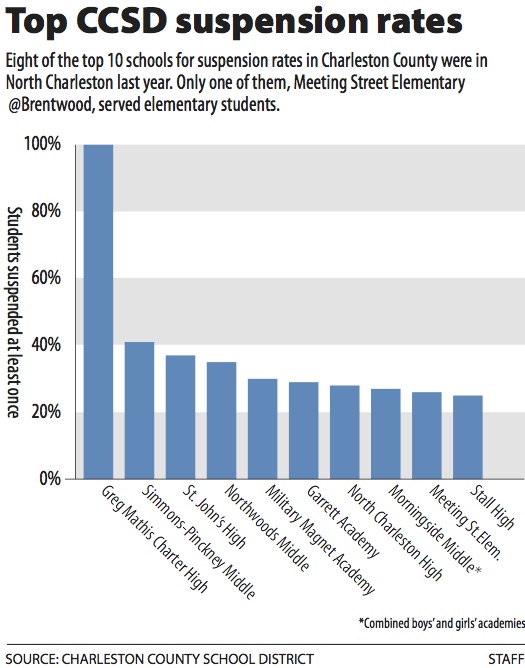
Published on Easter Sunday 2017 in the Post and Courier, Paul Bowers offered what I suspect will be a slow and painful series of unfortunate evidence that will discredit claims of educational miracles at Meeting Street Elementary @Brentwood; in this case, the public/private partnership elementary school has a unique and extreme suspension problem:

Meeting St suspensions copy

As a public/private venture, as a school choice and reform mechanism, Meeting Street Elementary @Brentwood is trapped in the need to advocate, sell its process. And since South Carolina has not held this experiment to the traditional school report card transparency, we are left only with the claims of school leaders.

However, we have well over a decade of “miracle” school bluster, all of which has been dismantled—suggesting that, I am sorry to say during this holiday season, there are no miracles.

While the school report card based mostly on high-stakes testing data is a significant failure of education reform, South Carolina’s report card system has included a key way to know if schools are in fact outperforming other schools, using the “Schools with Students Like Ours” metric (which I have detailed multiple times exposes that charter schools are no different, and possibly less effective, than traditional public schools in our state):

However, analyses from two years of report cards for charter schools in SC reveal the clear picture that more investment is not justified (see below for complete analysis of both years’ comparisons):

  • Using 2011 SC state repost cards and the metric “Schools with Students Like Ours,” charter schools performed as follows: 3/53 ABOVE Typical, 17/53 Typical, and 33/53 BELOW Typical.
  • Using 2013 SC state repost cards and the metric “Schools with Students Like Ours,” charter schools performed as follows: 2/52 ABOVE Typical, 20/52 Typical, 22/52 BELOW Typical.

And thus, this disturbing suspension data about an elementary school are just the beginning of what I can predict will happen as the evidence grows against the claims of this school somehow is accomplishing what other schools have not, cannot accomplish.

First, the evidence is very clear that “high-flying schools” are extreme outliers, constituting about 1.1% of high-poverty schools. This means two things: (1) if Meeting Street does achieve some sort of high-flying status, it will be in extremely rare company, and thus, (2) outliers prove virtually nothing about what most schools can and should accomplish (outliers often include key elements that cannot be scaled to all schools).

Next, the huge caution about any claims of miracle success on test scores at Meeting Street must be couched in their extended day and academic year. This technique has driven the false but powerful propaganda from KIPP charter schools that conveniently leave out that when you identify learning as months or years of growth, and you extend the learning time, the raw data growth is actually the same growth rate as other schools.

Comparing students with more teaching and learning time to other students with less is just one way advocates of charters and miracle schools mislead the public.

Remaining questions—some linked to suspension and expulsion patterns—include how any school’s test scores are impacted by student attrition (counseling out, expulsion, etc.), the percentage of special needs and English language learners served (when compared to traditional public schools), and the impact of self-selection (which can skew even claims that a school is serving a high-poverty population of students).

Meeting Street Elementary @Brentwood will prove, once again, to be evidence of the inherent problems with education form, and no miracle at all.

Our most vulnerable students—impoverished, black and brown students, English language learners, and special needs students—are disproportionately the targets of educational reform/experiments grounded in test-mania and harsh discipline policies and outcomes (see here, here, and here).

To be blunt, good intentions of administrators and teachers in our traditional public schools have not been enough, and now, those same good intentions among reformers cannot be justification for false claims and failed policies and practices.

Practices and fads such as exit exams, “no excuses” mantras, “grit” and  growth mindset, zero-tolerance discipline, and the larger accountability movement churning through standards and high-stakes testing—these have all increased the existing problems with inequity in our schools and society, and have miserably failed the students who need nurturing and effective schooling the most.

Miracle school claims are that human-sized Easter bunny; but that is just some stranger in a suit pretending to be a bunny, and it isn’t really appealing so much as something we should be very leery of approaching, especially with children.

bunny3

Don’t Buy Bluster from Teacher Quality VAM-pires

The responses are predictable online and through social media any time I address teacher quality and policy focusing on teacher evaluation such as my recent commentary on Charleston adopting value-added methods (VAM).

How dare I, some respond, suggest that teacher quality does not matter!

The pattern is exhausting because most responding in indignation first misrepresent what I have claimed and then make the most extreme arguments themselves in order to derail the conversation along their own agenda, usually linked to the charter school movement grounded in teacher bashing and making unobtainable promises.

So let me state here that the central elements of what we know about teacher quality and efforts such as VAM-based teacher evaluation is that teacher quality is not an independent variable (any teacher may be effective for one student and ineffective for another, for example) and, since student high-stakes testing is not designed to measure teacher quality and is more strongly linked to out-of-school factors, VAM is both a horrible technique for identifying teacher quality and, ironically, a guaranteed process for devaluing the importance of teachers.

Teacher quality is unparalleled in importance in terms of student learning, but it is also nearly impossible to measure, quantify—especially through student scores on high-stakes standardized tests.

Teacher quality VAM-pires, then, often have agendas [1] that are masked by their bluster about teacher quality.

Trying to measure and quantify teacher quality is a mistake; linking any evaluation of teacher quality to student test scores lacks validity and reliability—and VAM discourages teachers from teaching the most challenging populations of students (high-poverty, special needs, English language learners).

Focusing on simplistic and inappropriate measures reduces teacher impact to 10-15% of what high-stakes standardized testing measures; in other words, VAM itself devalues teacher quality.

My informed argument, based on 18 years as a public school classroom teacher and 15 years as a teacher educator and scholar, then, is that we must recognize teacher quality is impacted by teacher preparation, teaching/learning conditions, student characteristics, and dozens of other factors inside and outside of schools—many of which are beyond the control of teachers or students.

As well, we must address the teacher quality issues that political and administrative leaders can control: class size, school funding, and most important of all, teacher assignment.

Just as decades of research have revealed that teacher quality accounts for no more than 10-15% of student test scores, decades of research show that affluent and white students are assigned the most experienced and certified teachers while poor and black/brown students are assigned new/inexperienced and un-/under-certified teachers.

The charter school crowd’s bluster about teacher quality is pure hokum because charter schools increase that inequity of teacher assignment by depending on new and uncertified teachers such as candidates from Teach For America.

No one is saying teacher quality does not matter—I clearly am not saying that—but dishonesty about teacher quality does lay at the feet of the edu-reformers and the VAM-pires who wave their collective arms any time we call them on their failed policies and their political agendas.


[1] See the evangelical urge of Broad-trained acolytes, the resume building and cut-and-run patterns of edu-reformers, and the post-truth practices of turn-around and charter advocacy.

“We Teach English” Revisited

At times quaint and oddly misguided but unflinchingly confrontational and assertive—the signature tone of her work—Lou LaBrant’s We Teach English (1951) was a rare book-length text over her 65 years as an educator.

While this text for teachers of ELA/English never garnered the status of Louise Rosenblatt’s Literature as Exploration (LaBrant and Rosenblatt were colleagues at NYU), both works represent a long history of trying to coral the field of ELA/English teaching.

A recent conversation and debate on NCTE’s Connected Community about teaching whole-class, assigned novels has reminded me of the enduring tensions of what it means to teach ELA/English—tensions that span K-12 grade levels as well as being grounded in responsibilities to student needs and interests, the field or discipline of English, and literacy broadly.

Historically and then magnified during the past thirty years of high-stakes accountability, ELA/English has shared with math demands and expectations that are not as pronounced in other disciplines; despite the limitations and problems with the terms, I characterize those demands as addressing disciplinary knowledge (or content) and literacy skills.

Our disciplinary knowledge obligations rest with the compulsion to cover established content, such as identifying the parts of speech, analyzing the main characters in The Scarlet Letter, or explaining the key ideas expressed by Ralph Waldo Emerson and Henry David Thoreau as American Transcendentalism.

Literacy skills comprise reading, writing, speaking, and listening—how we as humans navigate the world through literacy. Some see these skills as a different way to think about content, skills such as comprehension, predicting, narration, and persuasion.

At best, these obligations can and possibly should work in tandem. When we teach a poem, Langston Hughes’s “Harlem,” for example, we are introducing students to key content about American literature and the Harlem Renaissance while also teaching them about the elements poetry, reading skills (such as analysis), and reading like a writer so they can transfer those rhetorical and literary strategies into their own writing.

Let me pause here to stress that at all levels from K-12, this is a damn high bar for any teacher. It takes a great deal of time and expertise to learn to manage all that effectively.

At worst, these obligations become professional and disciplinary battles—ones waged among practitioners often at the expense of students we should be serving.

We must teach phonics, but what about the children acquiring the desire and ability to read?

We must teach grammar, but what about the children acquiring the desire and ability to write?

Everyone must read The Great Gatsby, but what if that requirement creates nonreaders?

When we form ideological camps about disciplinary knowledge or literacy, we often fail both our field of ELA/English and students.

We teach English means something extremely complex and difficult, something that in fact may be too much to expect of any teacher.

But this is what we do, this is who we are.

If we return to the debate and discussion about teaching whole-class novels, we are revisiting an enduring debate that captures exactly what teaching English means.

To resolve that debate, I believe, we must remain focused on our students, and not on whether or not we address either area of demands in our field.

It is not a simple way to resolve the questions, but it is rather simple: When we attend to either disciplinary knowledge (and we should) or literacy skills (and we must), what are the consequences of those lessons in the evidence of learning by our students?

If we require our students to read Charles Dickens, and many do not read because they dislike the work, and many begin or continue the journey to being a nonreader, then we have failed dramatically any obligations as teachers of ELA/English.

If a whole-class unit on Lord of the Flies or The Hunger Games becomes a vibrant adventure in the novel and literacy, and most if not all read the novel, if several become hooked on literature, then we have accomplished everything that can be expected of teaching ELA/English.

In terms of both student reading and writing, there are decades of evidence that show how student choice in what they read and write is most effective in both fostering disciplinary knowledge (because they actually read and write) and literacy skills as well as literacy engagement (because they become eager to read and write).

But we as teachers of ELA/English are confronted with the essential problem beneath the call for student choice: students must have acquired some disciplinary and skills knowledge and proficiencies in order to make those choices.

If we can keep a critical eye on the outcomes of the instructional decisions we make—if we can resist dogged commitments to ideologies—then we can make informed choices about what best serves our students in terms of both what disciplinary knowledge they acquire and whether or not they develop as proficient and eager readers and writers.

Staying big picture is important—always asking what we are trying to accomplish with students and then paying close attention to what our students show us we are teaching.

In 2004, Donald Graves looked over his career seeking ways to teach students writing; he offered some enduring ideas about “what remains the same”:

The following fundamentals have remained unchanged in the teaching of writing:

  1. Children need to choose most of their own topics. But we need to show them all the places writing comes from, that it is often triggered by simple everyday events.
  1. Children need regular response to their writing from both the teacher and other readers.
  1. Children need to write a minimum of three days out of five. Four or five days are ideal.
  1. Children need to publish, whether by sharing, collecting, or posting their work.
  1. Children need to hear their teacher talk through what she is doing as she writes on the overhead or the chalkboard. In this way, the children witness their teacher’s thinking
  2. Children need to maintain collections of their work to establish a writing history. Collections show that history when they are used as a medium for evaluation. (Language Arts, Vol. 82 No. 2, November 2004)

In the same way as the debate over whole-class novel instruction, if we view Graves’s fundamentals as strict rules and teach to these rules—instead of to how we are fostering students as writers—we become lost, and we likely fail.

So, yes, students choosing what they read, especially something as daunting as a novel, is a fundamental, but that doesn’t necessarily discredit the possibility of whole-class novels.

To answer any instructional questions, then, as a teacher of ELA/English is in our students, not our obligations to disciplinary knowledge or literacy skills—and especially not in covering the mandated standards or preparing students for high-stakes tests.

The questions are worthy of discussion and debate among teachers of ELA/English, but ultimately we must each answer them with each unique group of students we teach.

When faced with the debates and questions about teaching ELA/English, LaBrant could be harsh and demanding—often seeming to teeter on the edge of, if not crossing over into, prescription. However, what LaBrant was demanding about in terms of “we teach English” is not that we follow her rules, or any rules, but that we remain committed to our students and their journeys in both literature and literacy.

During war, in 1942, LaBrant became frustrated with national concerns about literacy:

The induction of American youth into the armed forces, and the attendant examinations and classifications have called attention to a matter long of concern to those who teach reading or who are devoted to the cause of democracy: the fact that in a land which purports to offer universal education we have a considerable number of youth who cannot read intelligently. We are disturbed now because we want these men to be able to read military directions, and they cannot. A greater tragedy is that they are and have been unable to read with sufficient understanding to be constructive peace-time citizens.

As is to be expected, immediate explanations have been forthcoming, and immediate pointing-of-fingers has begun. Most of the explanations and pointing have come from those who have had least to do with teaching reading, and who are least conversant with the real problem.

Sound familiar?

LaBrant argued against what became a recurring political and public hand wringing about a reading crisis:

An easy way to evade the question of improved living and better schools for our underprivileged is to say the whole trouble is lack of drill. Lack of drill! Leťs be honest. Lack of good food; lack of well-lighted homes with books and papers; lack of attractive, well equipped schools, where reading is interesting and meaningful; lack of economic security permitting the use of free schools—lack of a good chance, the kind of chance these unlettered boys are now fighting to give to others. Surround children with books, give them healthful surroundings and an opportunity to read freely. They will be able to read military directions—and much more.

Here and for over six decades, LaBrant was a champion of the we who teach English but in the name of those students we teach, especially the most vulnerable students.

To that end, when we teach English, we teach students.

And there is where our commitments must lie.