The fall of 2024 will mark year 41 for me as a literacy educator, scholar, and advocate.
About half of that career was spent in K-12 public education in rural Upstate South Carolina, where I was born and live. I have witnessed daily race, social class, and gender inequity at some of the most extreme levels in the US.
At the core of my work as an educator, as well, I have named, challenged, and advocated to correct all forms of inequity. That work has often been in very hostile environments in the South where the power structures deny these inequities exist and persist at calling for traditional values as code for maintaining the status quo.
Also throughout my career as an educator and scholar, I have developed a solid grounding in the history of education and the field of literacy. Having written an educational biography of Lou LaBrant and serving as Council Historian for the National Council of Teachers of English were foundational experiences for that commitment to the history of education.
Further, having begun as an educator in 1984, I have lived and worked my entire career in the high-stakes accountability era of education reform. At every point along the way, I have raised a hand in opposition to this reform paradigm because it is driven by media, the market, and politicians who are more committed to education reform as industry than to serving the needs of our students or honoring the professionalism of America’s teachers, who are more than 70% women.
The “science of reading” movement and the offspring “science of” reform agendas are nothing new, except they are incredibly harmful—notably for the very students some of the advocates use as shields against criticism.
Once again, “science,” “crisis,” and “miracle” are being weaponized to not only label and punish students but also de-professionalize teachers.
One of the most effective and dishonest tactics is the “crisis” claim about reading in the US.
First, this claim lacks a basic understanding of educational testing, and further, the claim is ahistorical.
At least since the 1940s in the US, two facts can be proven: (1) at no point has student reading achievement (“proficiency”) been declared adequate; there has been a perpetual cry of reading “crisis” in every decade by media and political leaders, and (2) throughout the history of US public education, there has been a pervasive so-called “achievement gap” (better referred to as an “opportunity gap”) with marginalized populations of students performing well below average or white and affluent students.
That means that current reading achievement however measured and current “achievement gaps” are not a crisis but a historical and current reality maintained by political negligence.
Since current “science of” advocates have a fetish for misrepresenting and citing NAEP, let’s look at how NAEP in fact proves my point.
Consider Mississippi, the darling of reading reform and media crowning as a “miracle:
At grades 4 and 8 in reading, Black students in MS were BELOW basic (approximately below grade level) at a rate of 51%, about the national rate for Black students.
Note that despite well over a decade of SOR reading reform, the achievement gap for Black students remains about the same as in 1998.
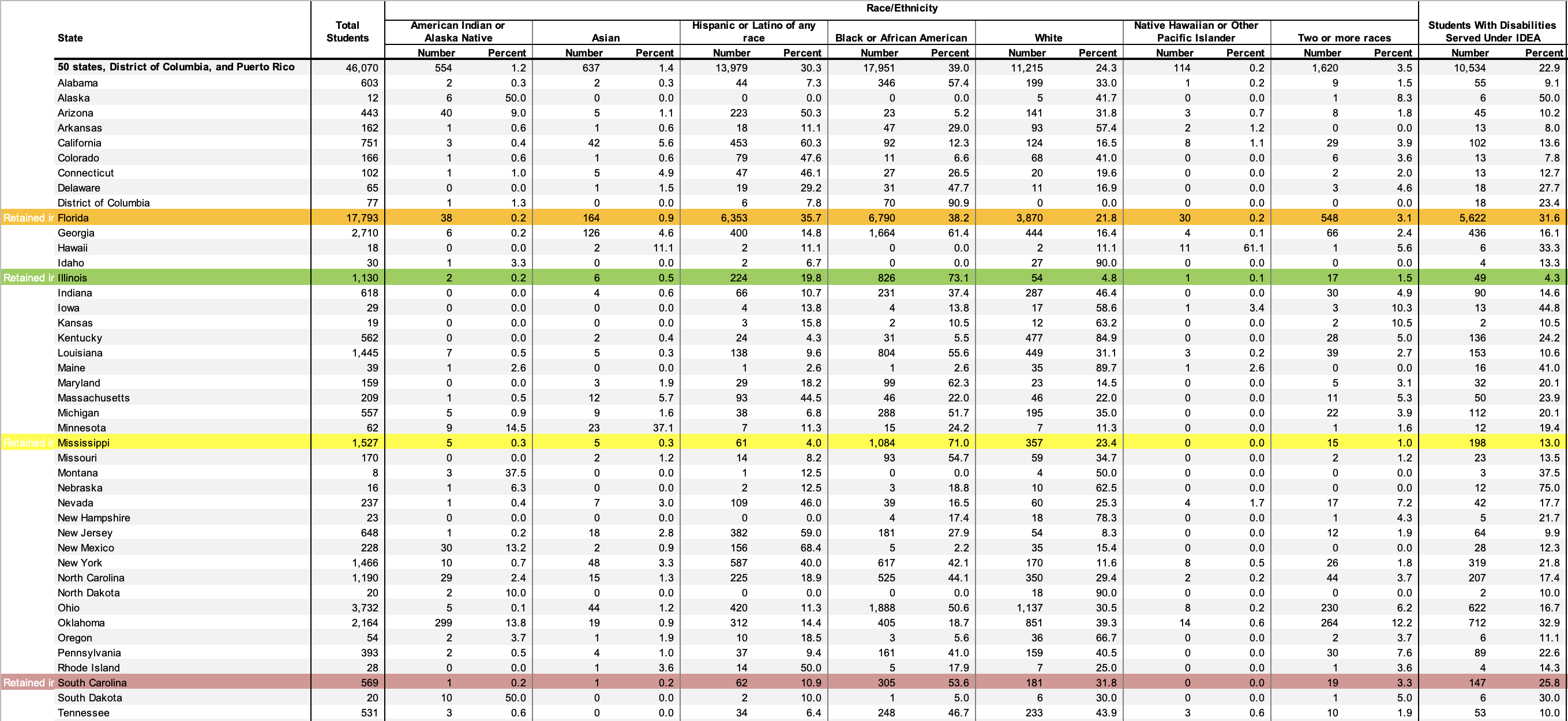
Education and reading reform is not addressing the inequity Black students suffer in MS or anywhere in the US. However, the SOR movement has been doubling down on labeling and punishing Black students through grade retention, which serves to inflate grade 4 scores but not better prepare students.
MS has consistently retained about 9000-12000 students (mostly Black students) since 2014; if SOR policy and instruction were actually working, these retention number should drop or even disappear (since SOR advocates claim to be able to have 95% students reach proficiency).
And thus, my advocacy for my entire career has been for both social and education reform that focuses on equity and refuses to blame teachers and students for that inequity.
For the past forty-plus years, however, education reform has solely targeted blame on schools, teachers, and students.
Those racially minoritized students and students living in poverty have routinely been characterized by deficit ideology, and reform has sought to “fix” those students by inculcating grit or growth mindset—or simply imposing a systematic phonics regime on those students, treating them all as if they have reading “disorders.”
And if those students don’t perform, retain them (punish them) and label them. Yet, there is never any consequences for the reformers when none of their reform promises are fulfilled (see the charter fiasco in New Orleans).
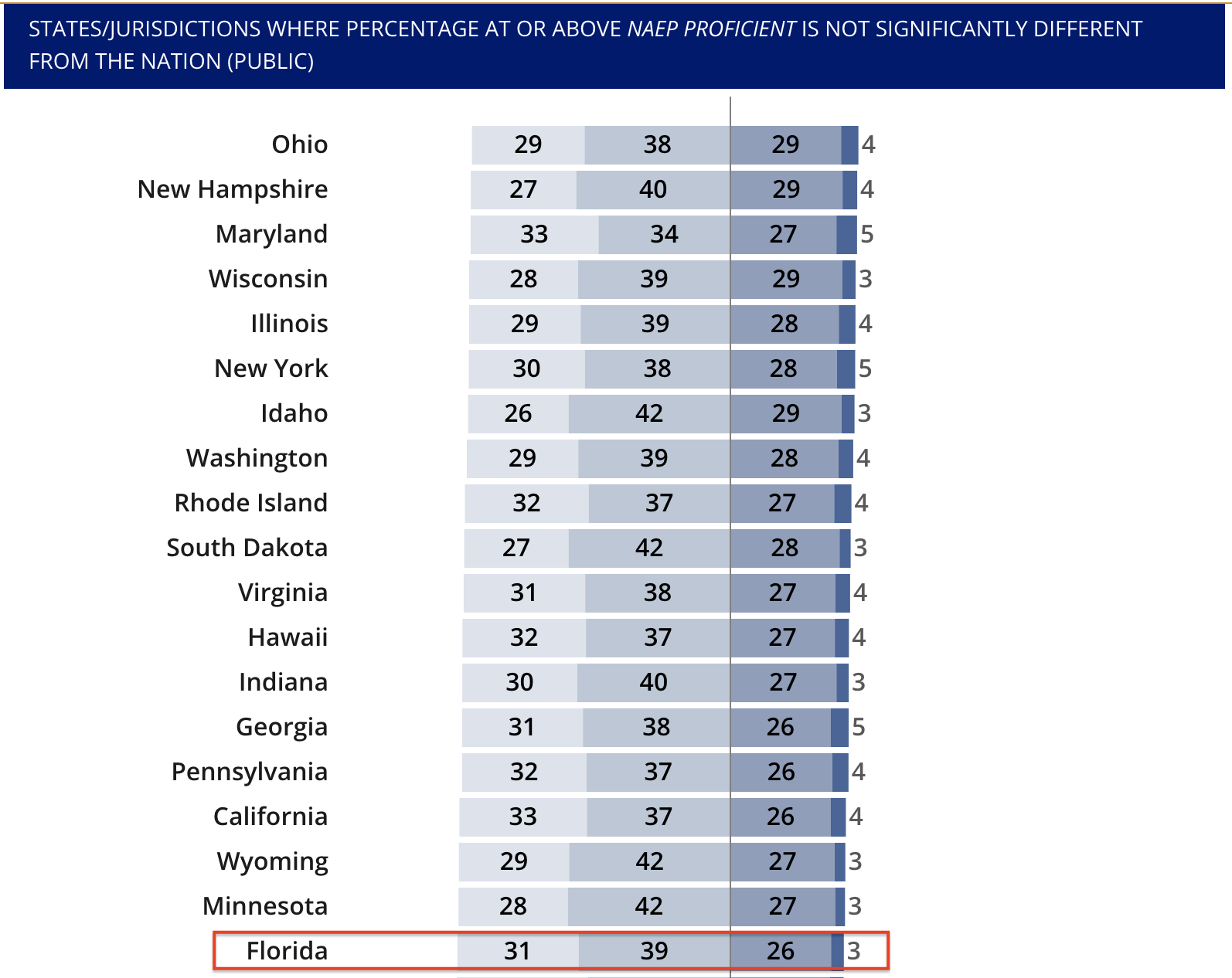
Hyper-focusing on MS (and Florida) is not just a lie, but a distraction.
Students in military families are often from impoverished backgrounds, yet Black students BELOW basic are at rates of 25% (grade 4) and 18% (grade 8), dramatically less than the national average and MS.
And here is what the media, the market, and politicians refuse to acknowledge: DODEA students have medical care, food security, housing security, and parents with work stability.
Also, DODEA teachers are paid above most public school teachers.
Unlike the false claims about MS, DODEA achievement shows that both in- and out-of-school reform must be addressed for the in-school achievement to rise in authentic ways.
I am tempted to say the real crisis is how media and political leaders mislead the public about education and education reform—as well as demonize students and teachers.
But that is also nothing new.
There is great profit in perpetual crisis so don’t hold your breath that anything will change any time soon.
There is a story education journalists love to tell; it is so innocent and compelling that even Florida wouldn’t bother to ban it.
Here is the story:
For decades, reading teachers in the United States have been teaching children to read using balanced literacy.
Balanced literacy was created by the Three Evil Witches—Calkins, Fountas, and Pinnell.
Under the spell of balanced literacy, reading teachers use three-cueing on all the children. What is three-cueing?
Well, three-cueing is putting picture books in front of all the children and asking them to look at the pictures and guess at the words on the page!
Such fun!
Sadly, however, now only two-thirds of children can read proficiently!
Despite how many have eagerly believed this fairy tale, it is nearly entirely caricature, misinformation, and lies. But it works so well that almost every education journalist in the US has recycled the story to fit their area or state, pulling from the original holy text.
Predictably, this retelling includes the usual list of misinformation and lies:
The beginning of the article is a litany of misinformation about NRP, NAEP, and reading proficiency (see below about how this piece focuses on grade 4 but ignores grade 8).
NCTQ is cited as a credible source although the conservative think tank has never released a peer-reviewed report that meets even the minimum standards of valid research.
Orton-Gillingham is referenced as moving toward “‘a more scientific approach'” although O-G (multisensory instruction) is not supported by the most recent scientific studies.
The piece allows Moates to promote her own commercialproduct, LETRS, although, as with O-G, no scientific research exists showing that the program results in higher student reading proficiency.
As I have noted, for at least 40 years, education reform has suffered under a crisis/miracle dichotomy that has failed students, teachers, and education.
The current crisis/miracle dichotomy is the manufactured reading proficiency crisis and the Mississippi “miracle.”
However, MS is based on the Florida model, which is now two-decades old.
Ironically, both FL and MS prove to be not models for reform but models for how political manipulation of education causes great harm to children (like the dark underbelly of fairy tales).
Yes, FL has found a process by which the state’s grade 4 reading scores on NAEP sit high in the national rankings; that “achievement” sacrifices almost 20,000 retained third graders a year (Black, MLL, and poor children disproportionately among those retained).
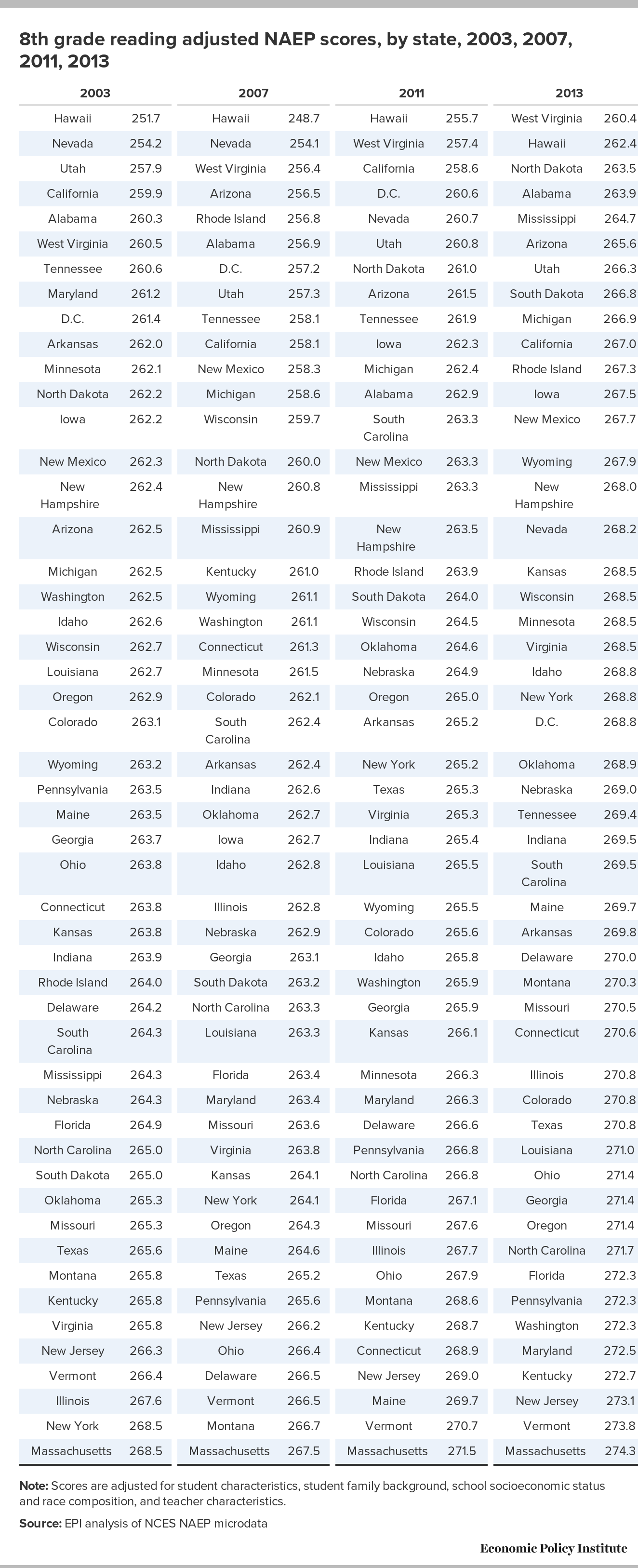
Here is the key problem not being fully addressed by media or reformers: FL also represents one of the states with the largest drop in achievement from grades 4 to 8, because the retention-driven grade 4 scores are mirages:
· Florida kids regress dramatically as they age in the system. Since 2003, Florida’s eighth grade rank as a state has never come close to its fourth grade rank on any NAEP test in any subject.
· The size of Florida’s regression is dramatic and growing, especially in math. Florida’s overall average NAEP state rank regression between fourth and eighth grade since 2003 is 17 spots (math) and 18 spots (reading). But since 2015, the averages are 27 spots (math) and 19 spots (reading).
So what about VT? Well, despite the handwringing over VT’s grade 4 NAEP and reading proficiency, the state sits high in the national rankings of grade 8 reading on NAEP:
Florida is well behind VT in grade 8 reading:
And MS remains at the bottom of grade 8 reading:
Like the entire US, VT simply is not experiencing a reading crisis. And certainly not because of the witches brew of balanced literacy stealing children’s ability to receive effective reading instruction.
VT may be, in fact, a better model for our need to add patience and nuance to our evaluation of reading proficiency, how we teach reading, how we measure proficiency, and when students need to reach our benchmarks as developing readers.
And thus, VT should not mimic MS since that would be throwing out the baby with the cauldron water.
For people not in the field of education, A Nation at Risk is either a hazy (or nonexistent) footnote of history or a pedestrian (and obvious) claim that didn’t need a government committee to announce—US public education is a failure.
However, for all its fanfare and eager media coverage, the real significance of the politically driven report is that it set in motion a pattern still vibrant in 2023; mainstream media is constantly fanning the flames of “manufactured crisis.”
A Nation at Risk was a media, public, and political hit, but scholars were quick to note that the claims in the report were overstated, oversimplified, and lacking any credible evidence [1].
In short, manufactured.
From the early 1980s and into the 2020s, mainstream education journalism has hopped feverishly from crisis to crisis and endorsed boondoggle after boondoggle—never once stopping to say “My bad!” or to pause, step back, and reconsider their template.
When the state takes the quantified depiction of schooling that educational researchers provide and uses it to devise a plan for school reform, the best we can hope for is that the reform effort will fail. As the history of school reform makes clear, this is indeed most often the outcome. One reform after another has bounced off the classroom door without having much effect in shaping what goes on inside, simply because the understanding of schooling that is embodied in the reform is so inaccurate that the reform effort cannot survive in the classroom ecology. At worst, however, the reform actually succeeds in imposing change on the process of teaching and learning in classrooms. Scott provides a series of horror stories about the results of such an imposition in noneducational contexts, from the devastating impact of the collectivization of agriculture in the Soviet Union to the parallel effect of imposing monoculture on German forests. The problem in all these cases is that the effort to impose an abstract technical ideal ends up destroying a complex distinctive ecology that depends on local practical knowledge. The current efforts by states across the globe to impose abstract technical standards on the educational village bear the signs of another ecological disaster.
As a result, a stunningly harmful pattern has emerged:
Amanda Ripley was wrong about Michelle Rhee.
Jay Matthews and Paul Tough were wrong about “no excuses” charter schools and Teach For America.
David Brooks was wrong about “miracle” charter schools (and everything else).
[Insert journalist] was wrong about Common Core and VAM.
And now, rest assured it will come to pass, Emily Hanford and Natalie Wexler are wrong about the “science of reading.”
Remember Waiting for Superman?
Sold a Story and The Truth about Reading are the same melodramatic misinformation campaign depending on an uninformed public to sell yet another educational crisis.
There will be no reckoning; there never is.
But some day (soon?) the “science of reading” histrionics will be a faint memory while everyone scrambles to the next education manufactured crisis.
The only things not to be addressed, of course, are the actual needs of students, teachers, and universal public education.
One of the key flaws of education reform since the 1980s is that education policy tends to be more about political and popular fads resulting in copy-cat state education policy than about addressing provable educational need.
For example, as Cummings, Stunk, and De Voto show about state reading policy:
Florida, which passed it’s Just Read, Florida! retention-based third-grade literacy policy in 2002, is largely considered the trailblazer of such policies (CCSSO, 2019). Florida’s policy includes several provisions designed to improve students’ literacy in grades K-3, including early identification of students who need additional supports, ongoing monitoring and communication with families, a range of literacy interventions, and third-grade retention for students who do not meet a certain score on the state assessment. By 2021, 19 states had adopted retention-based third-grade literacy policies that contained several elements of Florida’s policy.
However, with the release of the 2019 NAEP reading scores, Mississippi supplanted Florida as the miracle-du-jour.
These copy-cat urges have been grounded in almost exclusively grade 4 standardized test scores.
As I have documented about the over-reaction to Mississippi, the 2019 grade 4 scores were in line with decades of steady progress (thus no miracle), but most people failed to put the grade 4 scores in broader contexts that showed Mississippi grade 8 scores remained low and the racial gap remained steady even as Mississippi improved average scores.
Mississippi, in fact, was benefitting from the Florida model, mostly driven by grade retention.
New for 2023 is a moment of reckoning for Florida: “a Stanford University study of state-level standardized tests showed that Florida’s ‘learning rate’ was the worst in the country — by a wide margin.”
This analysis is taking into account longitudinal test scores instead of focusing only on early grades:
· Florida kids regress dramatically as they age in the system. Since 2003, Florida’s eighth grade rank as a state has never come close to its fourth grade rank on any NAEP test in any subject.
· The size of Florida’s regression is dramatic and growing, especially in math. Florida’s overall average NAEP state rank regression between fourth and eighth grade since 2003 is 17 spots (math) and 18 spots (reading). But since 2015, the averages are 27 spots (math) and 19 spots (reading).
Therefore, political leaders have tried to keep the focus on grade 4: “Tellingly, DeSantis ignored the eighth grade results, which came out far worse than fourth grade — just as they have in every NAEP cycle since 2003.”
So here is the dirty little secret about education reform and education policy.
First, test data are weak reflections of learning, and how we measure learning significantly impacts those scores.
Next, at the earlier grades, testing tends to reflect reductive versions of skills. For example, many states test pronunciation of nonsense words (thus, there is no meaning or comprehension) and call that “reading.”
Research for decades has shown that systematic phonics instruction can raise those scores, especially for young students, but that increase in pronunciation is not correlated with comprehension and that advantage disappears by middle school.
There is a similar pattern to how grade retention can raise test scores in the short term but those retained students fall behind again in a few years and are more likely to drop out.
In short, increased test scores in the early grades are often test-based achievement mirages, not increased learning.
As students and assessments become more sophisticated, these early increases are much harder to maintain for a number of reasons—some related to brain and overall development, and some related to teaching and learning conditions as well as instructional challenges.
This reckoning for Florida is a clarion call for all education reform across the U.S.
We must stop playing partisan politics with our schools, and we must resist copy-cat fadism when it comes to education reform.
Thomas, P.L. (2022). The Science of Reading movement: The never-ending debate and the need for a different approach to reading instruction. Boulder, CO: National Education Policy Center. http://nepc.colorado.edu/publication/science-of-reading
In his stand-up comedy days, Steve Martin had a routine about a TV evangelist. This character had, he believed, stumbled across the perfect TV evangelist sale: He announced that he had spoken to God and God had assured him he was the only person God was speaking to—so viewers should not listen to any other TV evangelist who claimed to know the word of God.
Yes, this was a stinging satire of religion, but at its core, Martin is unmasking the scam grounded in claims too good to be true—the “miracle” claim.
Read to Succeed was indeed a success in Florida. Since the year before the retention policy came into effect, the percentage of Florida students scoring low enough to qualify for retention has fallen by 40 percent. More Florida children are learning how to read during the developmentally critical period. The students at the bottom proved the biggest winners from Florida’s no-nonsense reforms.
Setting aside that the Florida policy is actually Just Read, Florida! (Read to Succeed is SC’s version), reading policies based on standards, high-stakes testing, and grade retention (very much a Florida model) are a subset of the Florida “miracle” scam driven by Jeb Bush—a set of policies grounded in rhetoric and ideology but regularly refuted by careful analysis.
Between leaving office as governor of Florida and running for president, in fact, Jeb Bush shuttled around the U.S. selling his education reform—not unlike Martin’s TV evangelist: “These reforms include assigning letter grades to schools, high-stakes testing, promotion and graduation requirements, bonus pay, a wide variety of alternative teacher credentialing policies, and various types of school choice mechanisms.”
The allure, now, reaches beyond the states and into the federal Department of Education headed by Betsy DeVos, who is a one-trick pony for school choice.
Public schools now have been besieged by this scam for decades—the Texas “miracle,” the Chicago “miracle,” the Harlem “miracle,” and the Florida “miracle.”
Political careers and horrible education policy have been driven by the power of showmanship and snake-oil sales pitches.
For well over a decade, education “miracles” have nearly all been fully debunked. The need to continually refute claims that are too good to be true is part of the strategy in fact since the media are a willing customer to these lies and then the careful analysis needed to show the claims to be false is simply lost in the shuffle of the next “miracle” story.
So just as I have pointed out about charter advocacy, those pushing the Florida model for education reform and reading policy are trafficking in mostly rhetoric in the absence of evidence.
Smith’s jumbled plea to give Read to Succeed a chance is yet another trap; these claims fail his argument, and ultimately, students and teachers in SC:
Florida education reform and reading policy simply have not succeeded. And what is more troubling, key elements such as standards and high-stake testing, grade retention, school choice, and charter schools have all been strongly discredited as effective reforms by dozens of studies over more than a decade. The big scam in promoting Florida reading policy is that grade retention based on high-stakes testing does bump test scores short term (which benefits politicians and their rhetoric), but that bump fades and the negative consequences of grade retention remain (see Jasper, 2016).
SC has no reading “crisis,” or education “crisis” for that matter. Crisis rhetoric is one of the most corrosive aspects of the education reform debate. First, low literacy test scores in SC are strongly correlated with high poverty rates; our state’s high poverty is not a crisis, but an on-going reality with deep historical roots nurtured by political cowardice and lingering racism. SC’s literacy struggles are cousins to our political failure to address race and social class inequity in our state. Shouting “reading crisis” is yet another distraction from the political will needed to address poverty. Simply put, education is not the great equalizer, and thus, education reform will not eradicate larger social problems.
Smith touts teacher buy-in for Read to Succeed—a dubious claim about legislation and policy that are imposed on teacher certification programs, schools, and teachers who have no option accept to comply. But the bigger issue about buy-in is worth a moment, again about Florida. In the early days of Florida reform, a school receiving multiple years of failing report card grades triggered parental school choice; however, only about 3% of parents took that choice, and then within a couple years, about half of those parents chose to return to the failing schools. So here is my challenge: Talk to current SC teachers when they are free to share their opinions and find some actual parents of school-aged children and teachers from Florida. The messages you receive about buy-in, I suspect, will cast a dark cloud on the claims by Smith.
The final, and maybe ugliest, trigger is framing reading policy as an either/or prospect—grade retention or “social promotion” (an outdated but powerful term that certainly spurs the All-American hatred of giving people anything—especially if we believe those “people” to be black or poor). Either/or thinking is always misleading since the research on grade retention also addresses what best serves students other than retention or simple promotion, and since grade retention based on test scores can and often retains students who have achieved passing grades for the academic year. Grade retention as the antithesis to “social promotion” has some really ugly roots in ignoring how grade retention has and will disproportionately impact negatively poor and black student.
While we may agree that Read to Succeed is “in its infancy,” as Smith concludes, we must also confront that it is a clone of policies and programs that have already failed; Read to Succeed is finding yourself in a hole and continuing to dig, while shouting platitudes you hope can be heard by those choosing to avoid falling into the same trap once again.
Bells will certainly continue to signal class changes in public schools all across South Carolina this fall, but there is a much more serious (and unwarranted) bell of doom for many third-graders because of SC’s punitive Read to Succeed legislation.
Once again, literacy policy often fails to address valid literacy practices or to acknowledge that literacy proficiency is strongly correlated with systemic conditions beyond the walls of the school or the control of teachers.
Worksheets on literacy skills, test-prep for state assessments of reading and writing, linking teacher evaluations to students’ test scores, and retaining children are simply not only flawed literacy policies, but also negative influences on children’s literacy and academic achievement.
And decades of creating ever-new standards and then purchasing ever-new reading textbooks and programs have utterly failed children and literacy.
For about a century, in fact, we have known what is needed to help students develop literacy—but the political will remains lacking.
A robust literacy strategy for schools must include instead the following:
Addressing access to books in all children’s homes.
Insuring access to books in all children’s schools.
Providing all students ample and extended time in class to read by choice.
Guaranteeing every student balanced literacy instruction based on each student’s demonstrated literacy needs (not the prescriptions of literacy programs).
Discontinuing the standards and testing disaster dominating schools and classrooms by providing teachers the materials, time, and professional autonomy to teach literacy in evidence-based ways.
Just as education policy ignores a rich research base, political leaders and the public refuse to address how public policy directly and indirectly impacts student achievement; the following would create higher student achievement and literacy:
Eradicating food deserts and insuring food security.
Providing universal healthcare to children and families with children.
Creating job security for families with children.
Finally, we must acknowledge that grade retention fulfills a cultural negative attitude about children and people in poverty among the U.S. public—one grounded in individual blame and punishment.
But decades of research has shown (yes, even with the failed Florida policy that serves as a template for many states such as SC) that grade retention may raise test scores short term, but that gain disappears in a few years and the many negative consequences of retention remain.
retaining students who have not met proficiency levels with the intent of repeating instruction is punitive, socially inappropriate, and educationally ineffective;
basing retention on high-stakes tests will disproportionately and negatively impact children of color, impoverished children, English Language Learners, and special needs students; and
retaining students is strongly correlated with behavior problems and increased drop-out rates.
Of course all children need and deserve rich and rewarding literacy experiences and growth, but third grade literacy is both a manufactured metric (by textbook and testing companies) and a misleading emergency.
Grade retention and skills- and standards-based literacy instruction and testing have failed and continue to fail horribly the students who need authentic literacy instruction the most—black and brown children, English language learners (who may need a decade to acquire a second language), students in poverty, special needs students.
These populations are a significant portion of the students served in SC public schools; our hateful and misguided policies are created and tolerated by a more white and affluent political leadership and public who have racist and classist biases against “other people’s children.”
It all starts with the psychology concept known as the “fundamental attribution error”. This is a natural tendency to see the behavior of others as being determined by their character – while excusing our own behavior based on circumstances.
For example, if an unexpected medical emergency bankrupts you, you view yourself as a victim of bad fortune – while seeing other bankruptcy court clients as spendthrifts who carelessly had too many lattes. Or, if you’re unemployed, you recognize the hard effort you put into seeking work – but view others in the same situation as useless slackers. Their history and circumstances are invisible from your perspective.
Struggling students in SC are viewed as lacking or broken, in need of repair and/or punishment to correct.
If you think this is harsh, compare how mostly white and more affluent students learn literacy in advanced and gifted classes in public schools (a dirty little secret about how we have maintained segregation) and most private schools.
Like No Child Left Behind and Every Student Succeeds Act, Read to Succeed is an Orwellian name for a horrible way to view, treat, and teach children.
SC continues to be a morally bankrupt state, calloused and driven to punish instead of offering our citizens, especially our children, the compassion and opportunities all people deserve.
Executive Summary: THE EFFECTS OF MANDATED THIRD GRADE RETENTION ON STANDARD DIPLOMA ACQUISITION AND STUDENT OUTCOMES OVER TIME: A POLICY ANALYSIS OF FLORIDA’S A+ PLAN (9 January 2017)
Although this report offers several charts detailing an analysis of SC and FL National Assessment of Educational Progress (NAEP) tests data (some of which is aggregated by race, disabilities, and poverty, but focusing on 4th grade reading), the report proves to be overly simplistic and an incomplete picture of student achievement in both states—with the ham-fisted data analysis serving as a thin veneer for advocacy unsupported by valid research and a more nuanced analysis of data.
In short, this report proves to be significantly inadequate evidence to support the ideologically-driven recommendations offered at the end—recommendations this conservative think tank would make regardless of the evidence (mostly a mishmash of school choice policy). There simply is no credible link between the shallow analysis of SC/FL NAEP scores and the call for policy as solutions to the manufactured problems.
Let me outline here both the flaws of the data analysis and then the folly of the recommendations.
The foundational flaw of both reports is suggesting some sort of value in comparing SC to FL and the persistent but discredited claim that FL has successful education reform. In fact, the so-called Florida “miracle” has been strongly refuted, notably its grade-retention policy based on high-stakes test scores.
By comparison, SC is slightly more impoverished than FL, and SC (27%) has a higher percentage than FL (16%) of blacks (both metrics used in the report analysis). However, this report from PPI makes no effort to show how their raw comparisons are actually apples-to-apples, or valid.
While adjusted trend data on NAEP continues to show 4th grade FL reading scores better than SC scores, by 8th grade (see Table 6B1, 2013 data) SC (269.5) and FL (272.3) have nearly identical adjusted scores.
Here is a key point about FL’s retention policy: Retaining students can inflate short-term test data, but those gains erode over time. Further, grade retention [2] maintains a strong correlation with students dropping out of school and an inverse correlation with students receiving a diploma (see Jasper, 2016 [3]).
Ultimately, the data analysis and charts in this report are overly simplistic on purpose because PPI has an agenda: argue against increased school funding and promote school choice.
The report uses bold face, lazy math, and insufficient statistical methods to dramatize a baseless claim: “Simple funding comparisons indicate quite the opposite. Over the twelve year period between 1999 and 2011, South Carolina spent a total of $6,920 more per student, or an average of $692 per year.”
Without proper statistical analysis, using controls and making causal claims, this raw data approach, like the NAEP analysis, means almost nothing.
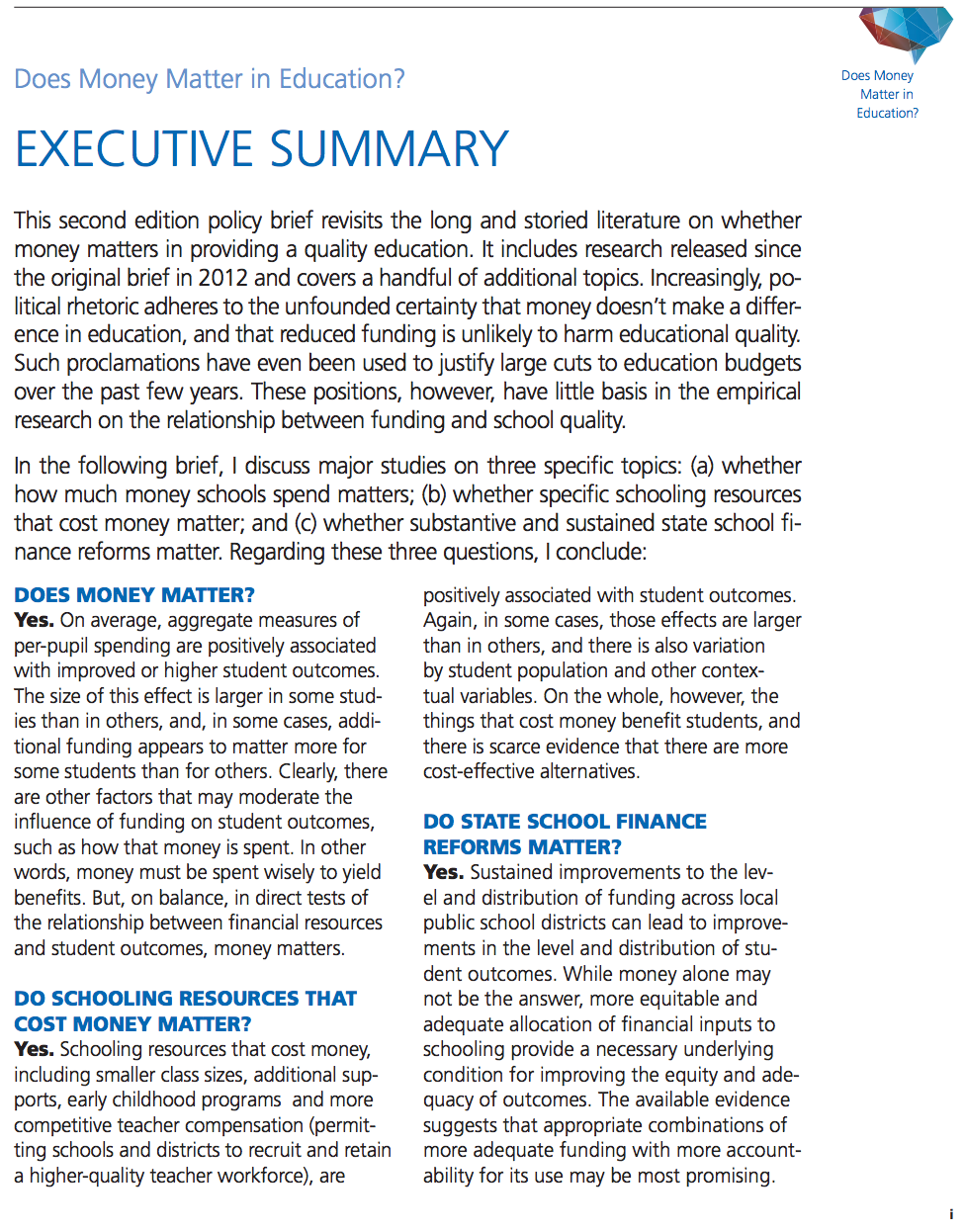
The body of educational research, in fact, shows that funding does matter (see Baker, 2016) [4].
Both, then, the NAEP analysis and the related argument that SC school funding is somehow excessive/wasteful are statistically inadequate and useless for making the recommendations at the end of the report.
Those recommendations fall into two broad categories: accountability and school choice.
SC and FL jumped on the accountability bandwagon early, about three decades ago, and remain completely unsatisfied with their educational outcomes, despite huge amounts of tax dollars and immeasurable time spent on ever-new standards and ever-new high-stakes tests.
Calling for accountability ignores the research base that shows accountability based on standards and testing has failed, will continue to fail:
There is, for example, no evidence that states within the U.S. score higher or lower on the NAEP based on the rigor of their state standards. Similarly, international test data show no pronounced tests core advantage on the basis of the presence or absence of national standards. Further, the wave of high-stakes testing associated with No Child Left Behind (NCLB) has resulted in the “dumbing down” and narrowing of the curriculum….
As the absence or presence of rigorous or national standards says nothing about equity, educational quality, or the provision of adequate educational services, there is no reason to expect CCSS or any other standards initiative to be an effective educational reform by itself. (Mathis, 2012)
The evidence on school choice also contradicts the report because choice fails to increase student achievement, but it is strongly associated with increasing segregation and inequity (see here and here).
Let’s summarize the major points of the report:
The report claims SC lags FL in academic achievement and education reform while spending more per pupil. However, the analysis offered here is an incomplete picture and statistically flawed. None of the claims made in the report are proven, and more nuanced and longitudinal analyses of NAEP greatly erode the premise of PPI’s report (grounded also in the debunked Florida “miracle” claim).
The report’s major recommendations about school funding, accountability, and school choice are all strongly contradicted by the research base, which the report fails to acknowledge.
Ultimately, as a colleague responded when I shared this report, PPI has published “a five page Op-Ed with bar graphs,” and I would add, not a very good one at that.
SC should in no way be influenced by this report when making education policy.
However, SC should heed a kernel the report’s conclusion: “The disparity between the stewardship of resources in Florida and our struggling education system in South Carolina is apparent.”
As I have detailed, while most educational rankings and comparisons prove to be hokum, what evidence from our schools and reform policies shows is that SC ranks first in political negligence.
Ironically, this report is calling for more negligence in the pursuit of market ideology.
Grade retention, the practice of holding students back to repeat a grade, does more harm than good:
retaining students who have not met proficiency levels with the intent of repeating instruction is punitive, socially inappropriate, and educationally ineffective;
basing retention on high-stakes tests will disproportionately and negatively impact children of color, impoverished children, English Language Learners, and special needs students; and
retaining students is strongly correlated with behavior problems and increased drop-out rates.
[3] Jasper’s abstract captures the ultimate failure of FL’s reform:
In 2003-2004 approximately 23,000 third graders were retained in Florida under the third grade retention mandate outlined in the A+ Plan. Researchers in previous studies found students who were retained faced difficulty in catching up to their peers, achieving academically, and obtaining a high school diploma (Anderson, Jimerson, & Whipple, 2005; Andrew, 2014; Fine & Davis, 2003; Jimerson, 1999; Moser, West & Hughes, 2012; Nagaoka, 2005; and Ou & Reynolds, 2010). In this study I examined educational outcomes of students retained in a large southwest Florida school district under the A+ Plan in 2003-2004. I used a match control group, consisting of similarly nonretained students, who scored at level one on the Grade 3 Reading FCAT. I then compared the control group to the retained group. I also compared achievement levels on the Grade 10 Reading FCAT of the retained and non-retained group. I evaluated longitudinal data, for both the retained and non-retained students, and found 93% of the retained students continued to score below proficiency (below a level 3) seven years after retention on the Grade 10 Reading FCAT as compared with the 85.8% of the non-retained students. I also compared standard diploma acquisition of the retained and non-retained group. The non-retained group was 14.7% more likely to obtain a standard high school diploma than the retained group. Finally, I used data from previous studies to extrapolate economic outcomes.
[4] Baker’s analysis has key points detailed in the Executive Summary (p. i):
educator, public scholar, poet&writer – academic freedom isn't free












 dr. p.l. (paul) thomas