Category Archives: Media

From Stereotypes to Policy: Understanding the Relationship between Media and Education

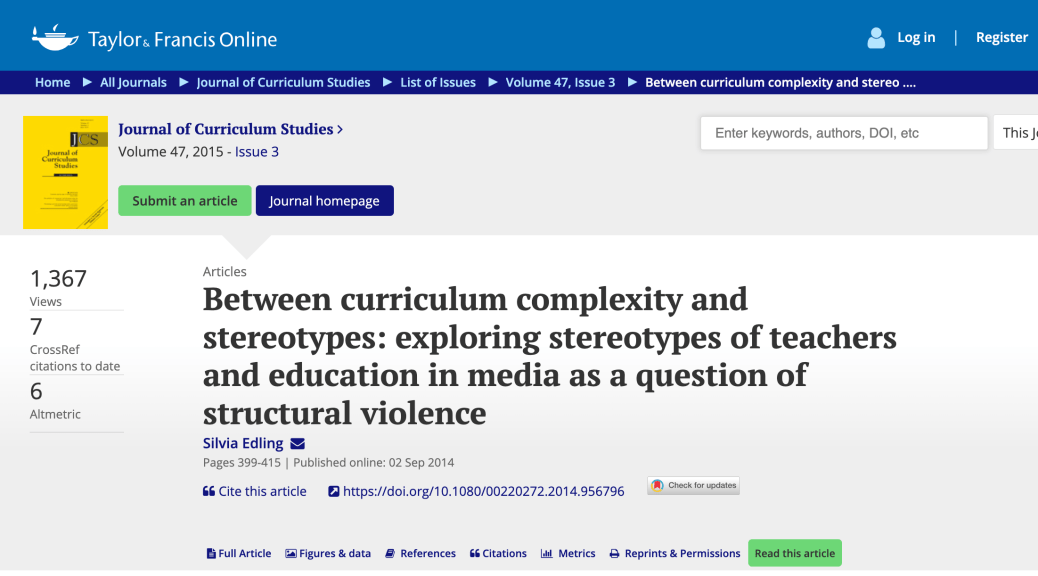
This is a brief overview of the following article:

Edling, S. (2015). Between curriculum complexity and stereotypes: Exploring stereotypes of teachers and education in media as a question of structural violence. Journal of Curriculum Studies, 47(3), 399-415. https://doi.org/10.1080/00220272.2014.956796

For many years I have been raising concerns about the use of “crisis” rhetoric around education [1], specifically challenging the default use of “crisis” and “miracle” in mainstream media.

The central role of “crisis” rhetoric in the accountability era of education reform has been characterized as a “manufactured” [2] crisis.

The current subset of education reform, the “science of reading” (SOR) movement, fits into the same patterns of the broader accountability era of education reform, I have argued.

Here, I am using Edling excellent work on the relationship between mainstream media and education to reinforce the claims that SOR as a reform movement is both mainstream accountability reform and essentially conservative.

I want this overview to be accessible, but I also highly recommend reading the piece in it entirety (click title above for access).

Edling’s first sentence establishes: “What is of particular interest in this paper is how professional teachers repeatedly, although not always, seem to be pictured in a de-contextualized and non-relational manner by actors outside education, and especially how the media often fails to take educational complexity and practice into account.”

Media representations of education, then, are often overly simplistic. Note that a key aspect of the SOR movement [3] is the claim that reading science is simple (the simple view of reading) and settled, effectively erasing the complexity of reading science and of reading instruction.

Edling’s explanation about the relationship between media and education also describes well the story of reading found in the SOR movement:

Newspapers do not just write about education, they also represent to their readers what education is ‘about’ (p. 392, see also McLure, 2003; Thomas, 2004). Similarly, Fairclough (1995) stresses that the media has the power: ‘to shape governments and parties … influence knowledge, beliefs, values, social relations, social identities’ (p. 2). From this way of reasoning, the media can be seen as an important power source for the construction of certain ideologies that can either exclude or include (Fairclough, 1995, p. 14), depending on how they are positioned and what sets the agenda for what is to be framed as true or false in society (cf. Johnson-Cartee, 2005).

There is no doubt that critical analyses of education in general are necessary in order to improve quality. Education is here understood as a broad concept that includes institutions such as (pre)schools, teacher education and the ideas behind them (cf. Sa ̈fstro ̈m & Ekerwald, 2012). However, what is highlighted here is not criticism of the media itself, but how the media’s recurring simplifications and often negative images of education and teachers are understood and how they might affect people who are seen or define themselves as teachers. Moreover, teachers in teacher education and teachers at (pre)schools are dialectically interconnected, in that teacher education aims to educate teachers, who are capable of acting as professionals in various educational positions—not the least in (pre) schools. For that reason, the term teacher includes teachers at (pre) schools and teacher education (cf. Hallse ́n, 2013).

In the paper, four interrelated propensities are problematized concerning the media’s portrayals of teachers and education:

  •  Viewing education as being in more or less permanent crisis
  •  Taking the role as a spokesperson for teachers and on behalf of the field of education
  •  Excluding the knowledge and experiences of teacher(s), educators and/or educational researchers in the public press
  •  Simplifying the notion of being a good teacher through stereotypes and dualistic frameworks that overlook task and relational complexity.
Between curriculum complexity and stereotypes

The SOR movement is yet another reading crisis in a long line of similar reading crises reaching back to the 1940s. Also the SOR movement is being driven by journalists who are identified as literacy experts, and those journalists have repeatedly characterized teachers as ill-equipped to teach reading because the entire field of teacher education has failed those teachers.

As the fourth bullet point above notes, as well, the SOR movement depends on simplistic characterizations of balanced literacy and reading programs as well as cartoonish caricatures of “three cueing” and “guessing” as pervasive failures of reading instruction across the entire US.

Edling details next “educational crisis discourse”:

Although crisis in the media is generally pictured as having specific causes that can be limited to a certain time in history (Wiklund, 2006), research indicates that the notion of educational crisis has been used as a more or less constant image ever since the 1950s and 1960s, and can be associated with the progressive school vs. conservative school problematic…. [C]risis is something that originates in the clash between different world views. As it is reasonable to assume that different world views will exist as long as there are humans, it is equally reasonable to assume that crises—including educational crises—will too.

The repetition of the word crisis is closely related to ideas that teachers and teacher education are incapable of dealing with education in a proper way. Crisis is used as a blanket to cover the field of education and, as in a situation of social crisis, groups outside education feel the need to step in and take control. The phenomenon can be described as an outside-in vs. an inside-out professionalism (cf. Stanley & Stonach, 2013). It is argued that the way in which people from the outside have assumed the right to define what is good and bad education has created a systematic disbelief in teachers in ways that have reduced their professional autonomy (Ball, 2011; Beach & Bagley, 2012; Krantz, 2009; Lauder, Brown, & Halsey, 2009).

Other researchers point to how the media refers to teacher education and teachers as lacking the necessary qualities and blames them for the crisis in school without taking the purposes and contexts of education into account (cf. Cochran-Smith & Fries, 2008; MacLure, 2003; Thomas, 2004; Warburton & Saunders, 1996).

Between curriculum complexity and stereotypes

The SOR movement has manufactured a reading crisis (mostly from misrepresenting NAEP data) and then placing soft or indirect blame on reading teachers and direct blame on teacher educators.

Edling notes that blame for educational crises do vary across countries (Sweden, for example, portrays teachers as victims of the crisis as well as the authorities who can overcome that crisis, contrary to the SOR story of teacher blaming). However, Edling adds that in most crisis discourse about education “teacher educator(s) and educational researchers were degraded and silenced,” similar to the current SOR movement.

Broadly, Edling emphasizes “a tendency to repeatedly fixate the debate on education in a dualistic and simplified image that omits the task and relational complexity,” resulting in “[s]tructural violence”:

Structural violence is generated through social practice and law, and hence becomes closely entwined in a specific culture and the norms that govern it, which implies that people in general, including members of group who suffers from their consequences, risks upholding the norms in their every-day actions since the norms are taken for granted as true. From this sense, people or groups of people, such as teachers, are not neutral or simply passive victims but partakers in the weaving of social structures. Violence is produced as a recurring beat through endorsed ideals, speech, gestures, choice of focus and solutions to world problems. The violence that becomes materialized as a consequence of these structures does not necessarily have to do with ill-will, as in deliberately wanting to do harm. On the contrary, what characterizes these acts is that they appear to be normal, harmless and sometimes have the ambition to do good, whereas in reality, they make life difficult for certain groups of people (cf. Cudd, 2006, p. 127, Epp & Watkinsson, 1997, p. 6).

Between curriculum complexity and stereotypes

Here is a key point: Journalists and teachers do not need to be bad actors for the media stories and resulting consequences to be bad actions. Hanford and other journalists as well as elected officials likely see their work as good work even as their messaging and policy endorsements are oversimplified, misguided, and harmful (to teachers and students).

This helps explain why Hanford and other journalists have teacher support:

She argues that our identity is not just shaped by how we see ourselves, but also through the way others see us, and that seeing is often coloured by stereotypes and norms (Young, 1990, p. 46–47). In accordance with the associative model, teachers can choose to see themselves as part of the professional group of teachers, which research describes as complex and multidimensional. At the same time, the group affinity model helps to illuminate how teachers’ identity as a group is shaped from the outside based on stereotyped and simplified images of teachers and educational researchers. Hence, people can identify themselves as members of the group known as ‘teacher professionals’ that is associated with certain practices. At the same time, they may have to face contrasting images of a teacher created by the media.

Between curriculum complexity and stereotypes

Parallel to the role of NAEP in the media-manufactured reading crisis, the role of standardized tests is acknowledged by Edling: “In a sense, one could argue that reports such as TIMMS and PISA have presented evidence of the failure of education in many countries, which might suggest that the negative criticism of teachers and education is justified. The results in the reports have been used to motivate several reforms focusing on measurability, accountability and control.”

Ultimately the stories perpetuated by media are stereotypes: “Once people have become accustomed to stereotypical thinking, they may not be able to see individuals or situations for what they are. Accordingly, a problem with stereotypes is that they are used to judge and pigeonhole people, without really taking into account context and unique individuals.”

The crisis story of reading in SOR is a simplistic story of caricature about teachers, teacher educators, balanced literacy, and reading programs. the complexity of the real world of teaching and learning reading are erased. As Edling notes:

Parallel with the recurring waves of crisis that wash over the field of education and the recurring stereotyped images of teachers, the curriculum complexity of the purposes and practices of education generally goes unnoticed in the media debate on education. What is forgotten is that teachers are not free to do as they want, even though their profession often allows them some kind of freedom to judge. Indeed, as the teaching profession is politically defined, it is obliged to pay attention to a multitude of different policies (Ball et al., 2012) and curriculum purposes (Hopmann, 2007). In a sense, it is possible to assert that teaching in many countries have come to be restricted to a standard and accountability movement; and hence, rendered more mechanical and simplified than before—very much following the logic presented in media (cf. Apple, 2011; Berliner, 2013).

Between curriculum complexity and stereotypes

Consequently, Edling explains: “Rather than beginning the discussion with the various demands that are embedded in teachers’ professional assignments, there are tendencies within the media to portray the good teacher as someone who is capable of efficiently transferring knowledge to pupils, where the epistemology of knowledge stems from science rendering it equal with truth and fact about a world (Wiklund, 2006, p. 177).”

The weaponizing of “science” in the SOR movement, in fact, has begun to creep broader into the science of learning, the science of writing, and the science of math.

The great paradox of crisis rhetoric in media coverage of education is it insures failure:

The implication is that whatever they do, they will end up as failures in the sense of being unable to embrace the multitude of requirements at the same time. Hence, drawing on the task and relational complexity of teachers’ work, one might ask whether it is possible to be an impeccable teacher in the relational midst of education if a multitude of educational purposes and relational inconsistencies have to be taken into account. If it is not, perhaps there is a point in adhering to more nuanced judgements of teachers’ quality in accordance with curriculum content, purposes and the ways in which relations are played out in educational spaces.

Between curriculum complexity and stereotypes

Edling warns: “[T]he power of the media and the damaging consequences of repeatedly judging groups of people through a grid of stereo- types need nevertheless to be taken seriously,” concluding:

Consequently, when the media systematically define teachers as working in a field of crisis and need exterior help to sort things out, it automatically excludes the professional knowledge and experiences of teachers and educational researchers and their task and relational complexity, which are already present in their day-to-day work, from the debate.

In the light of these tendencies, research on structural violence helps to remind us that: (a) teachers are unwillingly forced into a paradoxical (in)visibility (even in Sweden, where it is pointed out that their voices need to be heard), (b) they are squeezed in-between two pressuring external demands, namely the complexities in their professional assignment that are politically steered and stereotypes of the good and bad teacher produced by, in this case, the media, (c) they risk wasting time and energy on addressing prejudices that have nothing to do with the specific work they are expected to do, and d) the logic of binary stereotypes is a power issue that brands teachers into a position of permanent failure.

Between curriculum complexity and stereotypes

While Edling is writing about media coverage of education in general, her examination matches exactly how the SOR movement works as well as how that movement is grounded in misinformation to the detriment of teachers, students, and democracy.


[1] Thomas, P.L. (2015). Ignored under Obama: Word magic, crisis discourse, and utopian expectations. In P. R. Carr & B. J. Porfilio (Eds.), The phenomenon of Obama and the agenda for education: Can hope (still) audaciously trump neoliberalism? (pp. 45-68). Charlotte, NC: Information Age Publishing.

[2] Berliner, D. C., & Biddle, B. J. (1997). The manufactured crisis: Myths, fraud, and the attack on America’s public schools. Longman.

[3] See an overview of the story about reading now commonplace in media, grounded in Emily Hanford’s journalism, specifically her article “Hard Words.”


Public Education Deserves Better Journalism in 2024: Reading Edition

There is an incredibly powerful and frustrating dynamic about mainstream media in the US: While common knowledge claims mainstream media is liberal media, actual mainstream journalism in the US perpetuates as fact conservative ideology.

And the topic that suffers the most from that contradiction is education.

We are but 8 days into 2024, and the self-proclaimed Queen of US journalism, the New York Times, has offered up what may prove to be one of the classic examples of that liberal/conservative contradiction (see, for example, the NYT covering poverty at the level of The Onion).

Currently, media has renewed interest in college admissions, specifically using standardized tests such as the SAT or ACT for admissions. Progressive/liberal advocates call for not using SAT/ACT for admissions ; conservatives support maintaining standardized tests in admissions.

And right on cue, the NYT: The Misguided War on the SAT.

The article is a lazy argument, but also careless in its cherry picking of evidence:

The Leonhardt article uses the California faculty senate article as a proof point (the one that mentions College Board over 50 times) but fails to cite the rebuttal by the person who has researched the topic more than anyone, and who found serious problems with the research study.

Aw Jeez, not this shit again

This college admissions/SAT example parallels the NYT piece on grocery shopping by people in poverty; the claims of the articles are driven by normative conservative ideology (poor people buy junk food and standardized tests measure merit) not empirical evidence.

Mainstream media misrepresenting education and educational research, then, is normal in the US. In fact, far more coverage of education is misleading or outright false than is credible.

One of the best examples of this problem is coverage of reading proficiency and the current reading crisis, specifically the “science of reading” movement.

Along with many others, I have documented that media coverage of reading is both “holy text” and significantly misleading.

Key elements of that misguided coverage include the following:

  • Misrepresenting “reading proficiency” based on misunderstanding NAEP achievement levels. Media makes the claim 1/3 of students are not proficient readers when, in fact, NAEP shows 2/3 of students read at grade level or above.
  • Misrepresenting balanced literacy, three cueing, guessing, and popular reading programs. Essentially, no evidence exists showing balanced literacy has created a reading crisis or that any sort of uniform approach to reading exists across the US since many programs and interpretations of reading co-exist now and throughout the history of the US.
  • Misrepresenting teacher knowledge and practice related to reading as well as broadly discrediting teacher education, primarily based on a think-tank (NCTQ) agenda and not empirical evidence.
  • Misrepresenting reading science by distorting conclusions from NRP and ignoring or cherry-picking from the two decades of research since NRP.
  • Claiming reading science is settled and asserting that brain research is also settled. Both reading and brain science are evolving, each ripe with debate and room for greater understanding.
  • Simultaneously narrowing the reading science to only experimental/quasi-experimental research while using as evidence anecdotes and endorsing practices (grade retention, systematic phonics instruction for all students) and programs (LETRS, Orton-Gillingham) lacking scientific support.
  • Aligning SOR with social justice agendas although a growing body of research shows SOR contradicts equity goals.

In short, reading proficiency and reading instruction deserve better than mainstream media is providing.

Education journalists need in 2024 to step back from the “holy text” template, re-engage with the full story and body of evidence, and then provide the sort of critical coverage students, teachers, and our democracy deserve.

To that end, consider the following:

Critiques of Media Story about SOR

Recent Research Challenging SOR Policy/Legislation


See Also


Media Misreads Reading Science (Again)

For more than five years, mainstream media has been obsessed with two false but compelling stories: (1) there is a national reading crisis caused by balanced literacy programs that rely on three cueing, and (2) the solution is the “science of reading” (SOR).

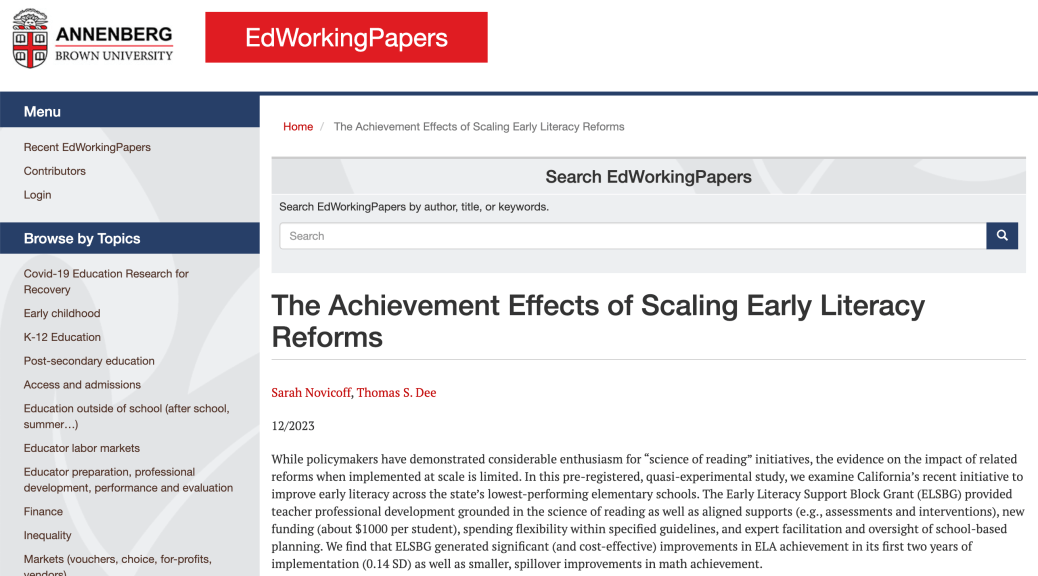
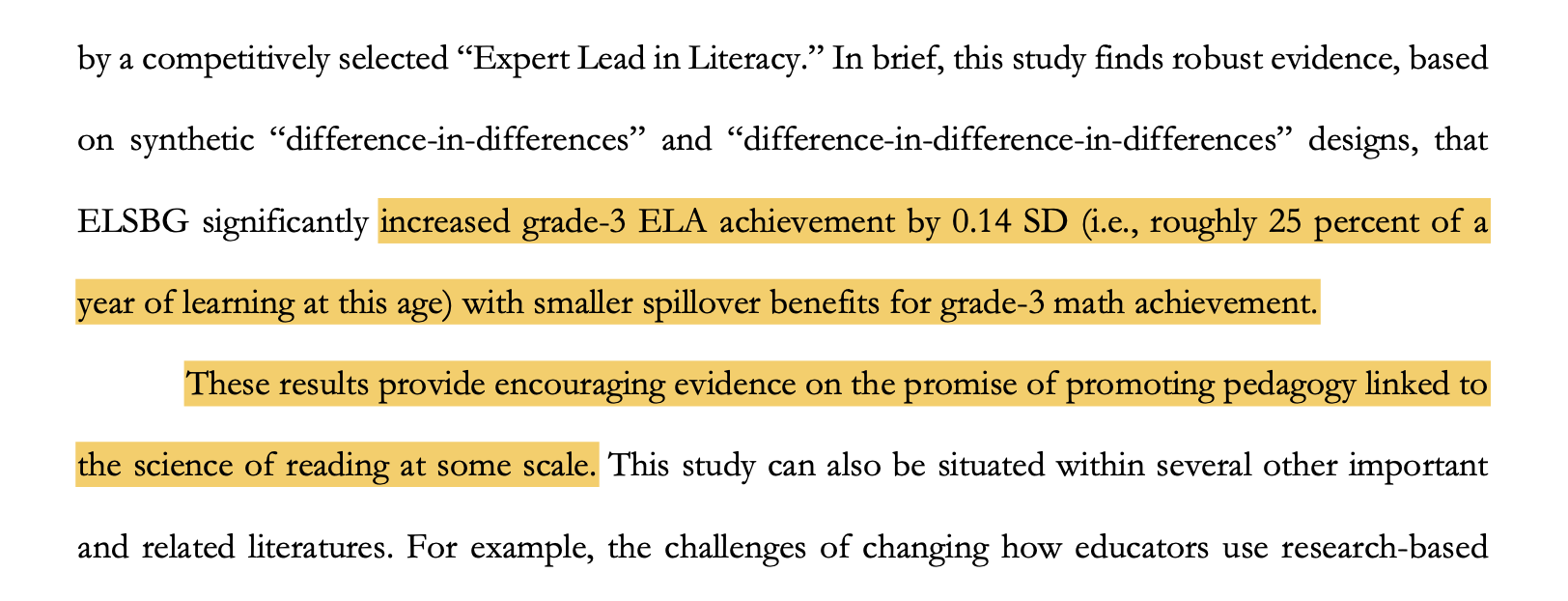
So it is no surprise that a working paper on the outcomes from a right-to-read lawsuit in California has prompting immediate high-profile coverage in The Hechinger Report and The New York Times.

Before I examine the paper itself, let’s remind ourselves of two foundational aspects of the SOR movement that is primarily media- and politically based.

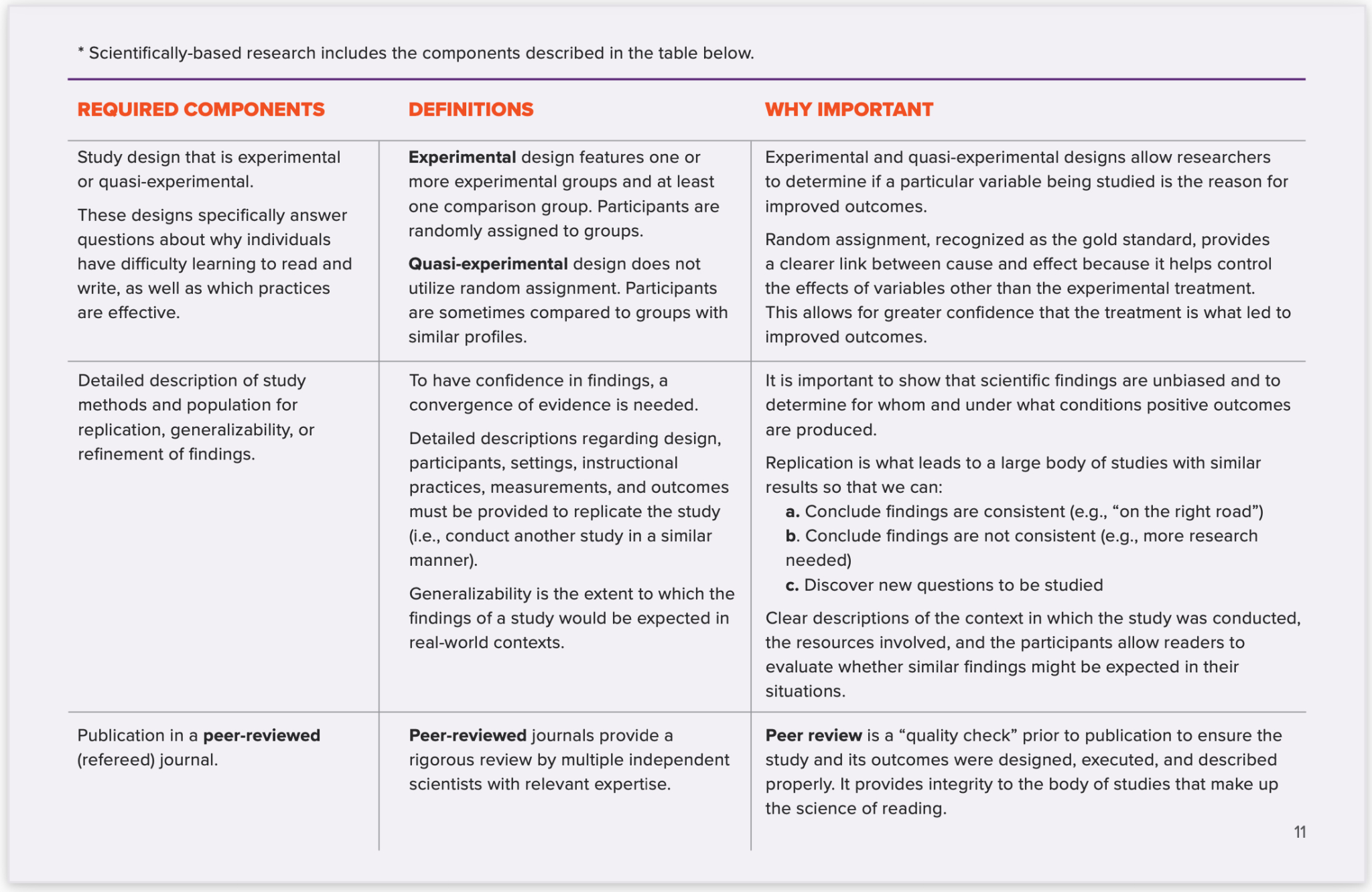
First, The Reading League has established what counts as “scientific”:


Second, advocates for SOR instruction such as NCTQ promise that SOR policy and practices will result in 90% of students reading at grade level proficiency:

Reading Foundations: Technical Report

If we maintain the essential foundations established by the SOR movement itself, we must conclude that the working paper itself should garner no media coverage because it fails to meet the standard of “scientific” and that even if we consider the findings of the paper credible, SOR policy has significantly failed in CA:

Now I want to unpack why the paper should never be covered at this level and with such a positive spin by journalists (including within the paper itself).

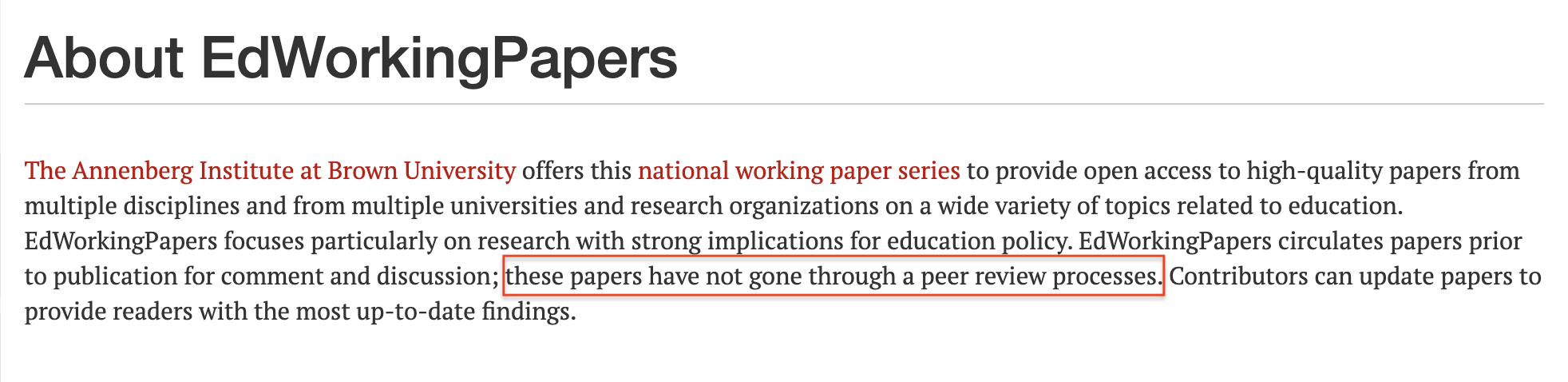
The most important issue is that a working paper is not peer-reviewed or published, thus not “scientific” per expectations identified above:

About EdWorking Papers

And as noted by Barshay: “The working paper, ‘The Achievement Effects of Scaling Early Literacy Reforms,’ was posted to the website of the Annenberg Institute for School Reform at Brown University on Dec. 4, 2023. It has not yet been published in a peer-reviewed journal, and may still be revised.”

Next, since there is a great deal of misinformation in the paper about NAEP and literacy, we should be concerned that the authors have backgrounds in social studies and economics, not literacy:

For scholars and journalists, not knowing enough to know what you don’t know can erode the credibility of research and journalism. This paper represents misrepresentations far too common in both research and media—misunderstanding NAEP reading proficiency:

Since “Basic” and not “Proficient” approximates grade level reading proficiency, NAEP data show that about 2 out of 3 students are at or above proficiency—not 1 out of 3.

Whether or not the US has a reading crisis and how scientific research can address reading proficiency in the US is negatively impacted by this simple fact: There is no standard metric for “proficiency” in reading, and NAEP along with each state sets the cut scores for proficiency differently.

Another misrepresentation or oversimplification in the paper is the failure to define clearly what counts as SOR as well as recycling oversimplified characterizations of whole language and balanced literacy:

At the center of misrepresenting reading theory and practices, this paper again significantly skews both what three cueing is and how it has or hasn’t impacted reading proficiency. [1]

The paper acknowledges two important points often misrepresented in the media: the Mississippi “miracle” is more story than science, and the last twenty years include research showing little to no positive impact from SOR policies grounded in NCLB, Reading First, and NRP:


Yet despite the high standard SOR has set for reading proficiency and the minimal gains shown in this paper, the authors slip into advocacy for SOR:


The paper lacks a clear definition of what counts as SOR (except it appears anything not including three cueing counts) [2] or reading proficiency, and skirts over that the policy implemented in CA includes far more than SOR literacy practices (suggesting any gains could be more from extra funding and other practices):


Media’s outsized coverage of this paper also raises questions about outliers and selective coverage.

The paper again notes a history of SOR practices not resulting in promised gains:


However, neither the paper nor mainstream media choose to focus on substantial evidence from England about failed SOR policies over almost two decades, and one must wonder why there isn’t the same media coverage for research on high-volume reading that has been peer-reviewed and published: The Effects of Bookworms Literacy Curriculum on Student Achievement in Grades 2-5.

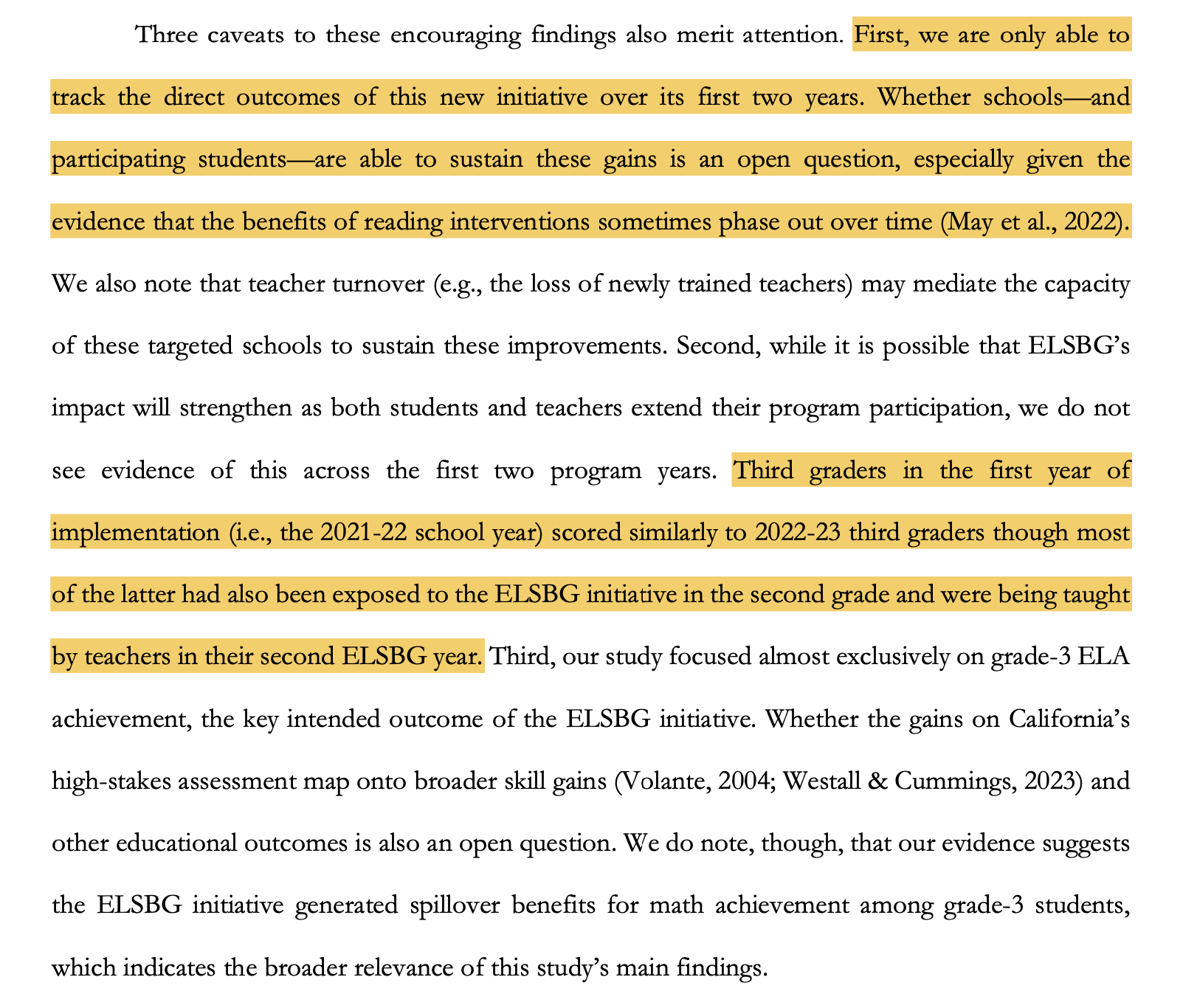
The paper’s caveats also deserve far more emphasis than the findings:

Again, decades of research and contemporary examples from MS and FL have shown repeatedly that raising reading scores in the short term and early grades almost never continues into middle school, and thus are mirages, not miracles.

Finally, the paper represents two significant problems with so-called high-quality research in education: (1) using metrics such as “X [time] of learning” and (2) judging policy and practice in terms of “cost effective” (one researcher, again, has an economics background):


Finally, then, if we circle back to the standards and promises within the SOR movement, this working paper should not be covered at all by media (a working paper is more press release than science), but if anything, the results signal a significant failure of SOR practices to meet the 9 of 10 students reaching reading proficiency.

The media coverage of this working paper could be considered much ado about nothing except it will serve to continue the manufactured crisis campaign about reading that is ultimately, and again, mis-serving children, teachers, and the promises of public education.


[1] See the following:

[2] Since no standard exists for what counts as SOR practices, many states and schools seem to cherry pick what to ban and what to implement. For example, three cueing is often banned, but state and schools implement practices and programs also not supported by science such as LETRS training for teachers, grade retention, decodable texts, and multi-sensory (O-G) programs; see Teacher Prep Review: Strengthening Elementary Reading Instruction (NCTQ) and The Science of Reading: A Literature Review:

Lost in Translation: Science of Reading Edition

When Anders Ericsson, an internationally renowned cognitive psychologist, died in 2020, a New York Times article included as a subhead: “His research helped inspire ‘Outliers,’ Malcolm Gladwell’s best-selling book on the keys to excelling.”

In short, the general public was more aware of Gladwell’s popularized version of Ericsson’s work than Ericsson, and likely, nearly no one in the general public had read Ericsson’s scholarship.

As a result, Ericsson penned a clarification that includes a key point:

Although I accept that the process of writing an engaging popular article requires considerable simplification, I think it is essential that the article does not contain incorrect statements and misinformation. My primary goal with this review is to describe several claims in Jaffe’s article that were simply false or clearly misleading and then discuss how APS might successfully develop successful methods for providing research summaries for non-specialists that are informative and accurately presents the major views of APS members and FellowsAt the very least they should not contain factually incorrect statements and avoid reinforcing existing misconceptions in the popular media.

The Danger of Delegating Education to Journalists: Why the APS Observer Needs Peer Review When Summarizing New Scientific Developments

Ericsson is confronting an essential problem when journalists and mainstream media seek ways to translate scholarship, research, and science into accessible and engaging media for the public. Journalists prioritize narratives, stories, as the primary mode to accomplish that translation.

Several months ago, I thought again about Ericsson’s valid concerns about Gladwell’s very popular but reductive Outliers:

[An article by Jaffe] goes on to state that “Ericsson and his colleagues found in a 1993 study that professional musicians had accumulated about 10,000 hours of deliberate practice over the course of a decade. The results became the basis of Ericsson’s deliberate practice theory of elite performance, also called the 10,000 hour rule” (Jaffe, 2012, p. 13). With these two sentences Jaffe reinforces misconceptions in some popularized books and internet blogs that incorrectly infer a close connection between deliberate practice and the “10,000 hour rule”.  In fact, the 10,000 hour rule was invented by Malcolm Gladwell (2008, p. 40) who stated that “researchers have settled on what they believe is the magic number for true expertise: ten thousand hours.” Gladwell cited our research on expert musicians as a stimulus for his provocative generalization to a magical number. 
The Danger of Delegating Education to Journalists: Why the APS Observer Needs Peer Review When Summarizing New Scientific Developments

Ericsson came to mind as I was having an extended phone conversation with a producer at 60 Minutes about the current “science of reading” (SOR) movement and the significant amount of misinformation being presented in mainstream media and then driving state-level reading legislation (now in about 47 states).

While the producer was thoughtful and receptive to my concerns about media misrepresenting NAEP data, student reading proficiency, and the so-called failure of popular reading programs and balanced literacy, he ultimately concluded after we talked almost two hours, that there is no story in the truth, thus he would not be able to produce a story about that truth.

As Ericsson’s career demonstrates, the public finds misinformation in the form of simplistic stories more compelling than nuanced and messy research; further, most people, including politicians, have read or viewed the journalism, but not the actual research (notably because too much research is behind a pay wall and/or nearly impossible for the average person to comprehend).

The Ericsson/Gladwell/”grit” dynamic is now being replicated with even greater consequence in the SOR movement that has been codified in legislation banning and mandating programs and practices primarily or even exclusively grounded in media misinformation, and not the full reading science.

For example, the recent controversy about a co-authored article in The Reading Teacher perfectly highlights the essential problem.

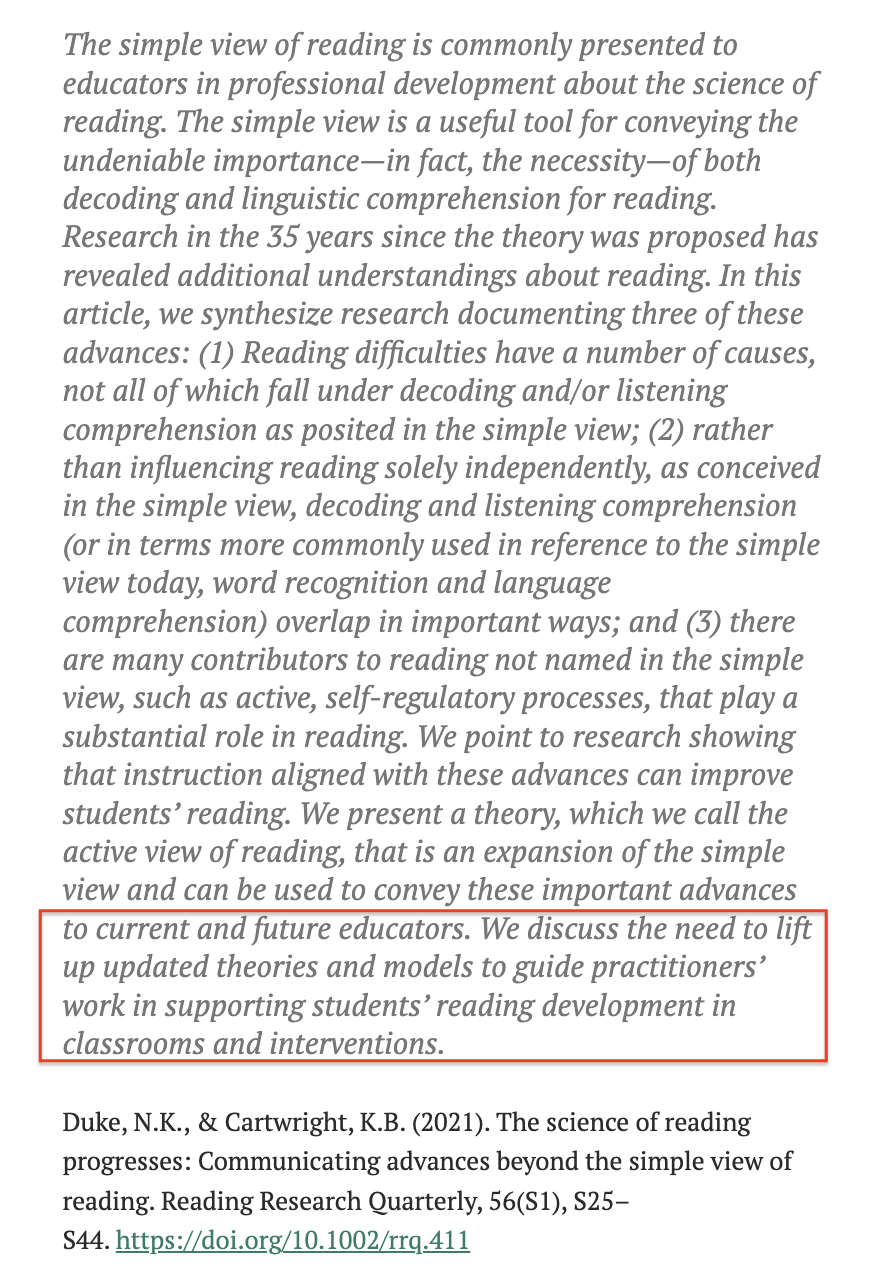
Let’s do a thought experiment for a moment: Which do you think the general public and political leaders are more familiar with (or familiar with at all), Emily Hanford’s Sold a Story or Nell Duke’s (with colleagues) work on the active view of reading?

And, importantly, which of those two do you think is a better representation of the current state of reading science (or full body of research on reading and teaching reading)?

Now let’s explore some artifacts to answer those questions.

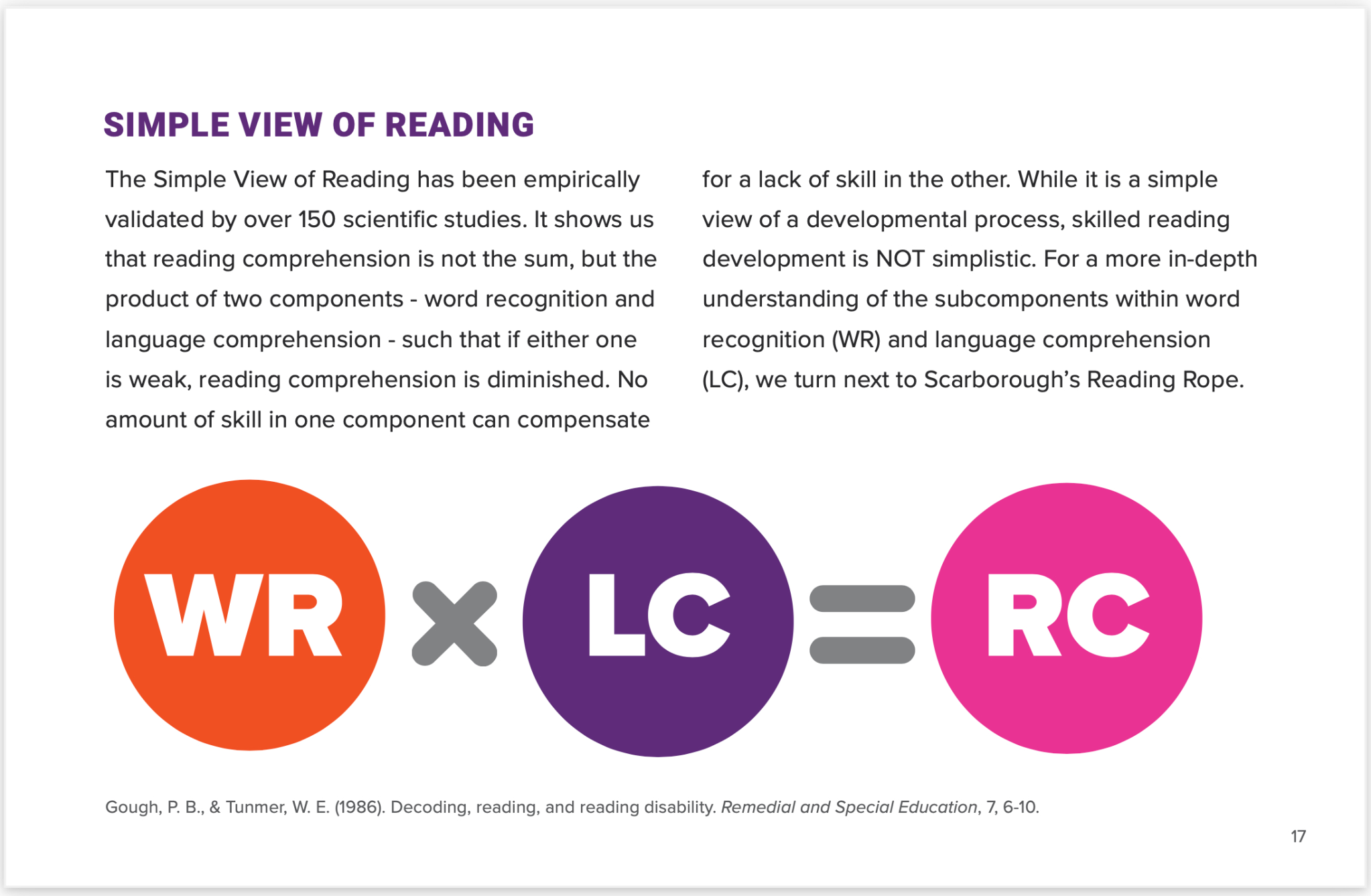
First, Hanford in her journalism has repeated that SOR is “settled science” called the simple view of reading (SVR):

Covering How Students Learn to Read: Tips to Get Started
There Is a Right Way to Teach Reading, and Mississippi Knows It

The “simple and settled” mantra has been a central part of Hanford’s print journalism and her more popular podcast.

But that same mantra is central to the claims made by The Reading League, likely the leading organization promoting SOR:

Science of Reading: Defining Guide

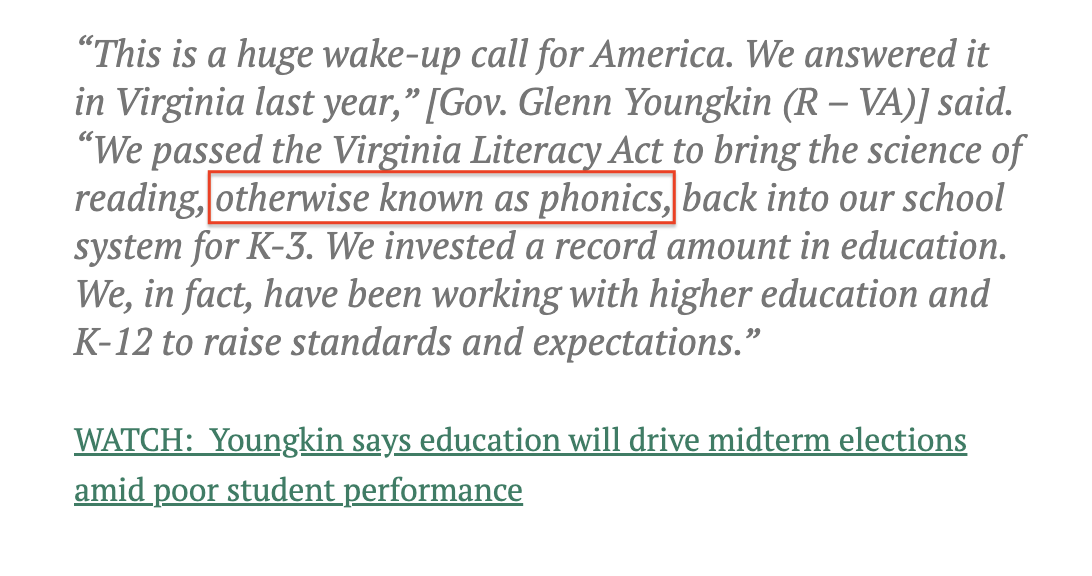
Now let’s note how these misleading and oversimplified claims about reading science have manifested themselves in political rhetoric and then state legislation:

WATCH:  Youngkin says education will drive midterm elections amid poor student performance
‘The evidence is clear’: DeWine pushes for ‘Science of Reading’ as only approach in Ohio classrooms

While this is only one example [1] of the caution Ericsson raised, the misrepresentation of reading science as “simple and settled” has become holy text and then spurred misguided reading legislation and policy.

The more nuanced and on-going body of reading science is much better represented by the research from literacy scholars:

Duke, N.K., & Cartwright, K.B. (2021). The science of reading progresses: Communicating advances beyond the simple view of reading. Reading Research Quarterly, 56(S1), S25–S44. https://doi.org/10.1002/rrq.411

From Arkansas to New York City, political leaders have misrepresented dyslexia, reading proficiency, reading instruction, and reading programs in ways that parallel the stories found in mainstream media.

Like Gladwell, Hanford and dozens of mainstream journalists are reaping the rewards of compelling stories that misinform while also feeding commercial and political interests that are mis-serving students, teachers, and public education.

Once again, we find ourselves not only in the tired and false rhetoric of reading crisis but also lost in translation because a sensationalistic podcast tells a melodramatic story that runs roughshod over anything resembling a fair representation of student reading proficiency, teacher expertise, or our obsession with finding the next reading program.


Note

[1] For a more detailed examination of the misinformation in media, see the following:

Recommended

The Danger of Delegating Education to Journalists: Why the APS Observer Needs Peer Review When Summarizing New Scientific Developments, K. Anders Ericsson 

Reading Educational Research: How to Avoid Getting Statistically Snookered, Gerald Bracey

Setting the Record Straight: Responses to Misconceptions About Public Education in the U.S., Gerald Bracey

NAEP, Media Fuel Manufactured Reading Crisis

Consider how people would respond to the two following statements for a survey:

  1. About 2/3 of US students read below “proficient” on national testing.
  2. About 2/3 of US students read at or above “grade level” on national testing.

We don’t need to imagine, however.

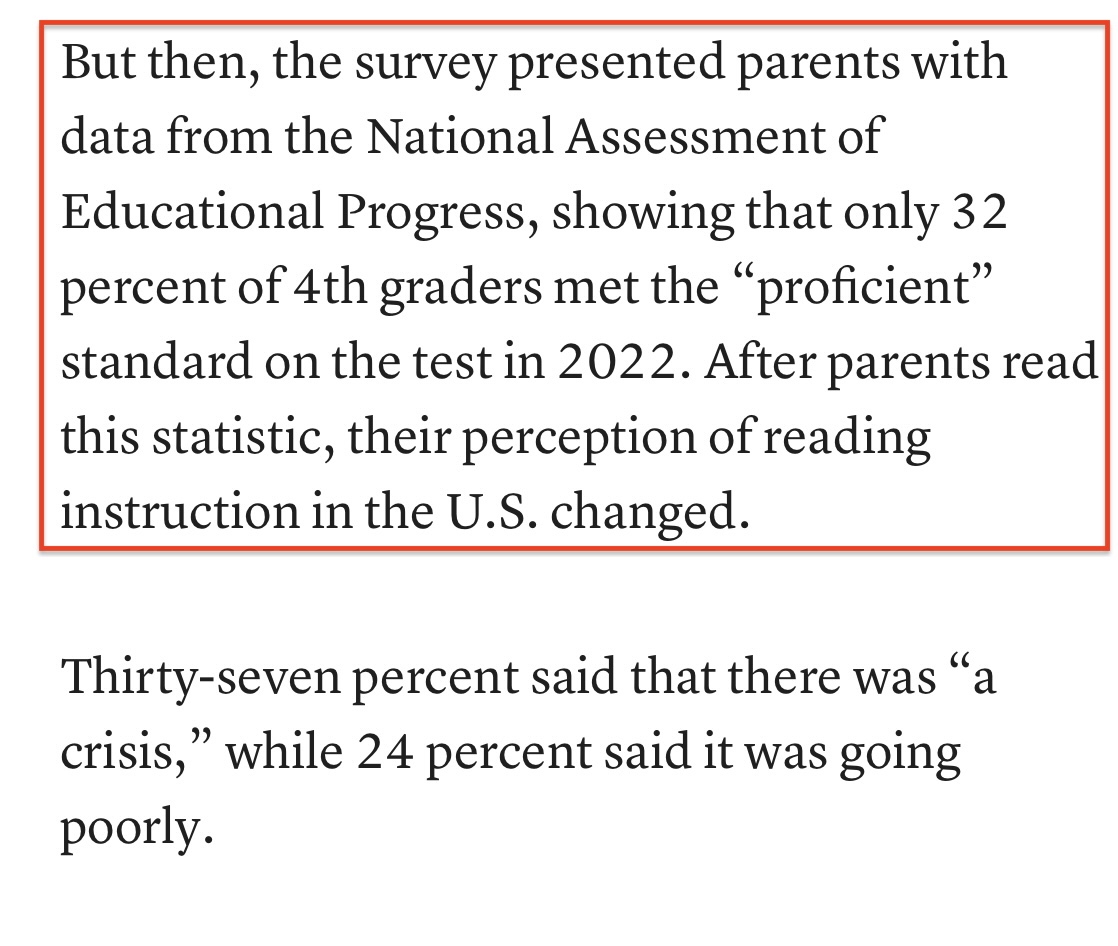
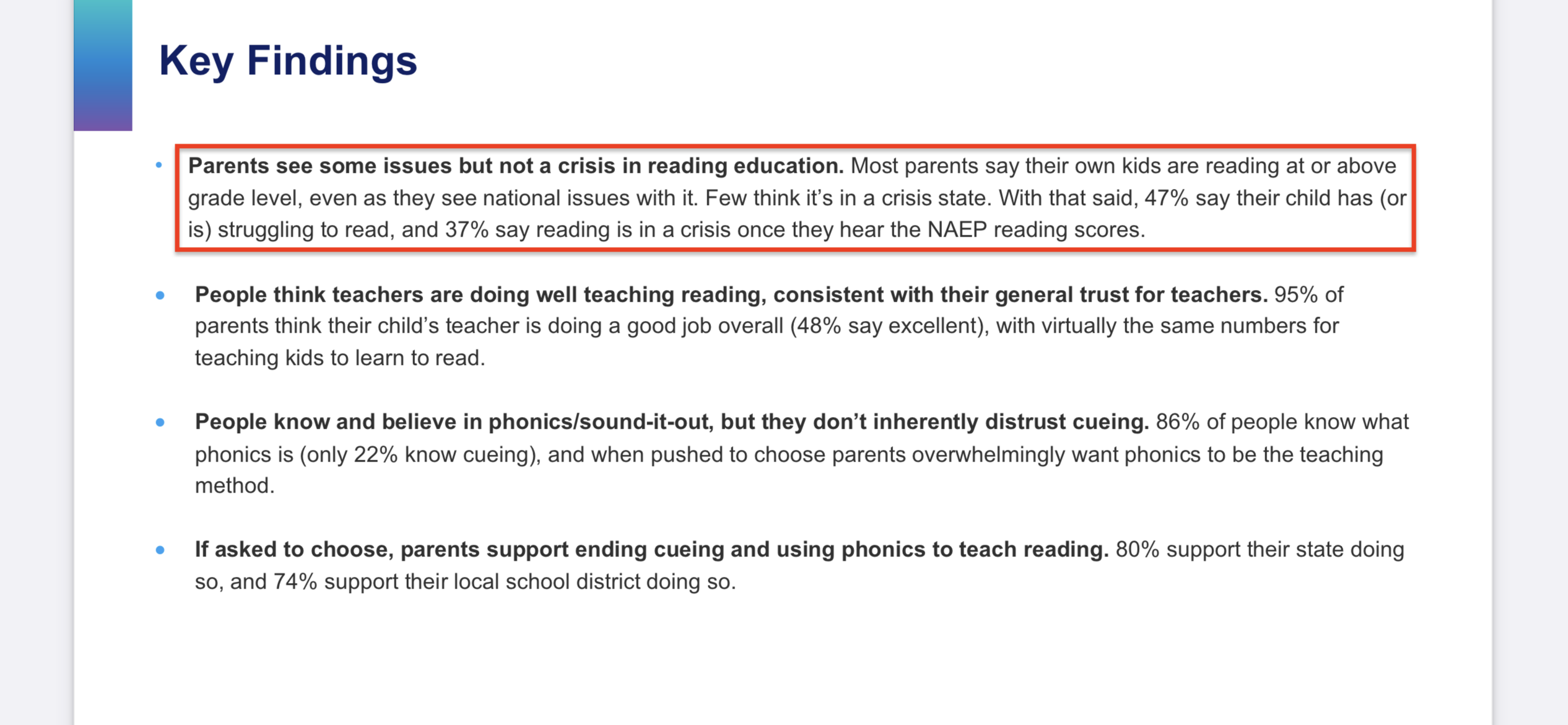
Coverage in Education Week of a new survey on parents’ perceptions of reading reveals incredibly damning findings—damning not about reading achievement or teaching but about NAEP and media:

The survey’s findings reflect that damning dynamic:

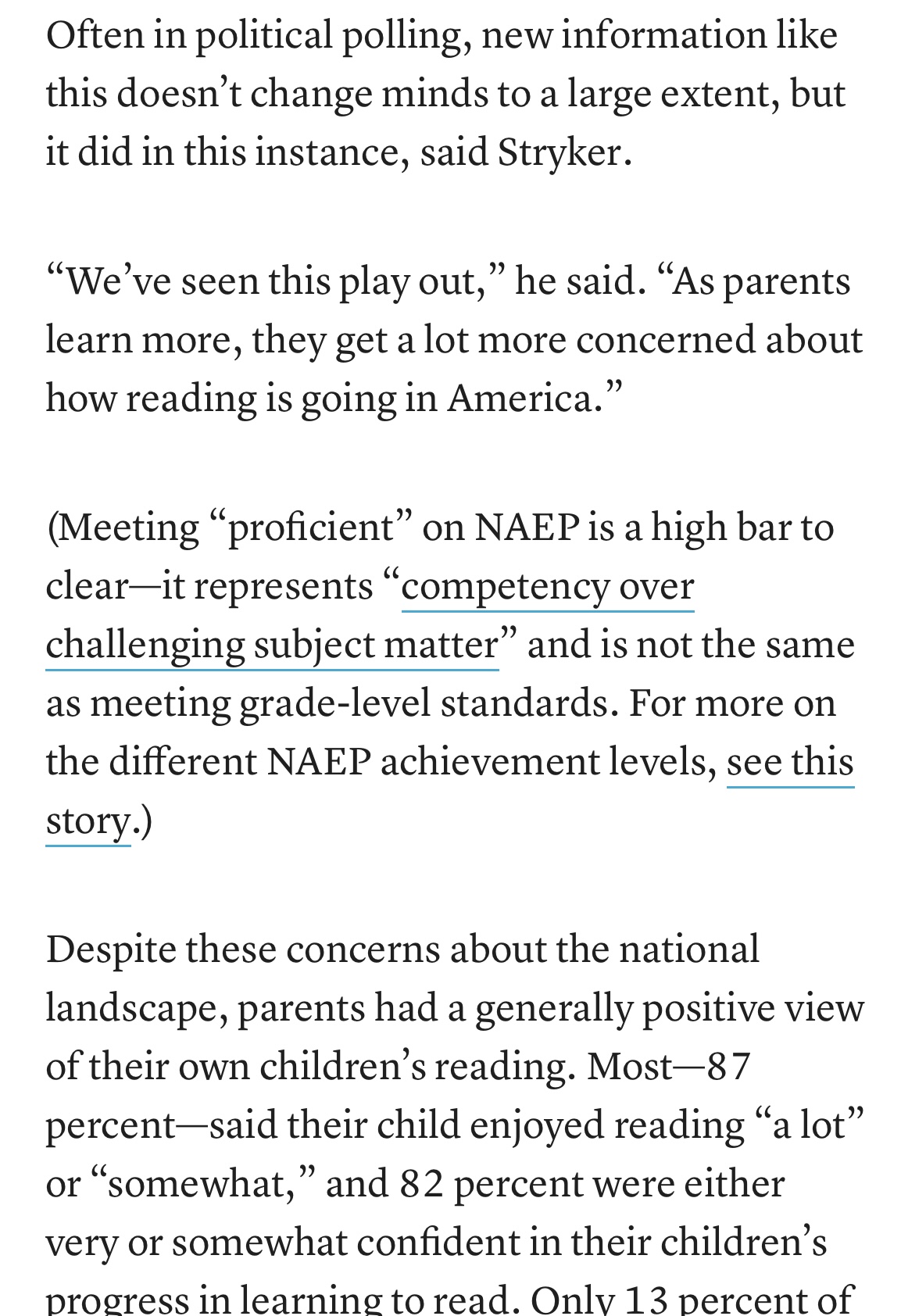
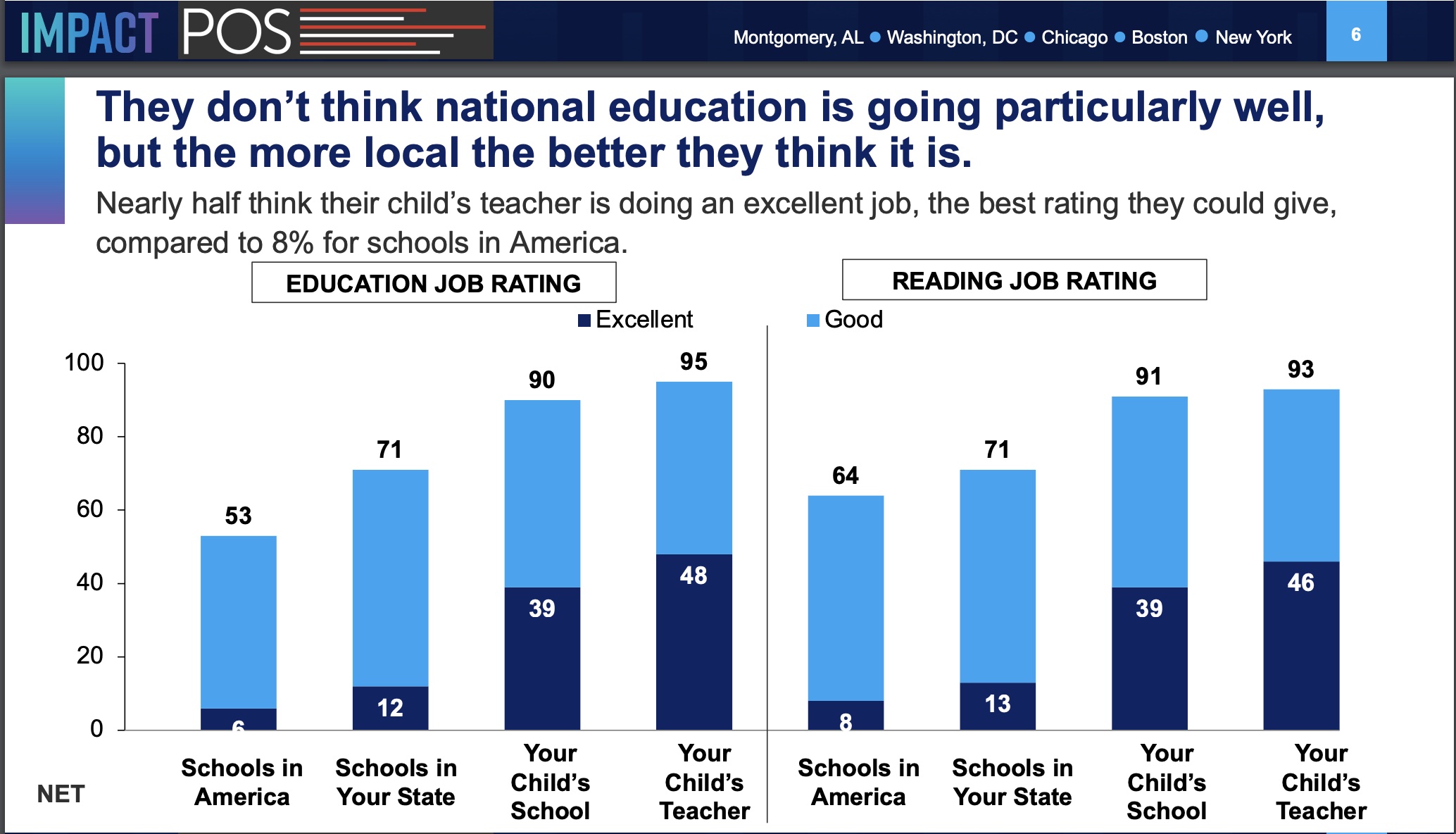
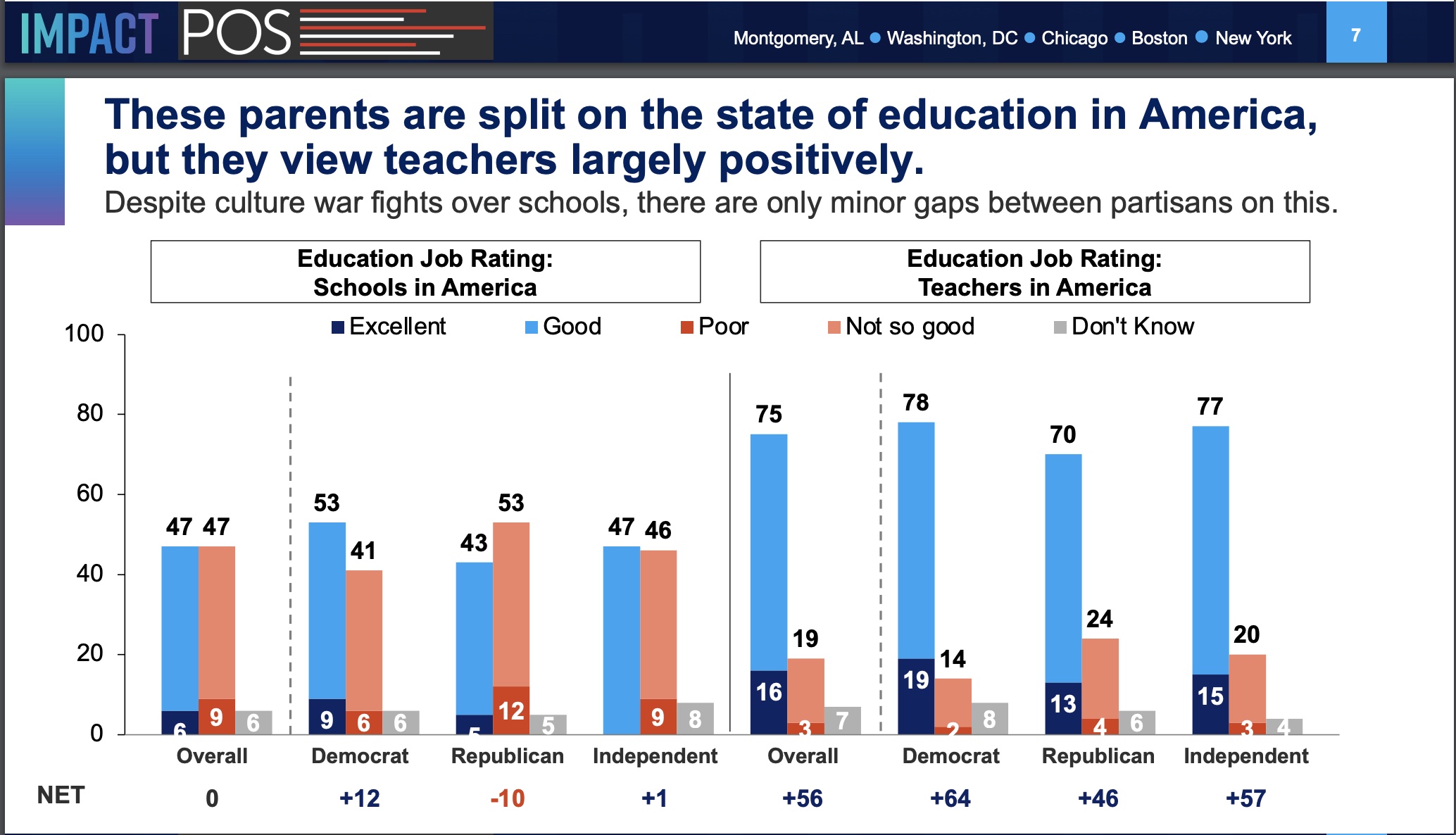
Yet, despite the misinformation about NAEP, these survey findings reflect decades of surveys showing parents generally have positive views of their children’s schools and teachers but believe public education nationally is failing:

This survey, though, exposes the source of that disconnect—media coverage of NAEP data, which seems to be designed more to manufacture a crisis than to assess student reading achievement.

The opening two hypothetical statements show where the problem lies because the first is an accurate statement about NAEP and the second is an accurate statement about reading at grade level.

As NAEP explains and others have addressed for years (see below), NAEP “proficiency” is well above grade level and “basic” represents something close to grade-level proficiency. However, the larger problem is the US has no standard criteria for “grade-level proficiency” and states set their own levels with NAEP using terminology that is at least confusing if not intentionally misleading.

Another problem, as I have argued, is that “grade level” is likely a worse metric than “age level” since many states now implement grade 3 retention based on reading tests, corrupting populations of students being assessed since data show that student scores on early reading are strongly correlated with birth month.

See the following to better understand NAEP and media misinformation about reading proficiency:

The US has a long and troubling history of media and political leaders being more invested in a manufactured education crisis than actually investing in better public education.

As a result, parents and students are trapped between their own genuine appreciation and need for effective, responsive reading instruction and a media-fueled political campaign to misinform the public because a constant state of reading crisis benefits a contracting media and generates political capital.

The reading crisis in the US is that the public is reading misinformation about reading and teachers, grounded in a national testing program designed to manufacture crisis.


NOTE

The survey also shows how misinformation about three cueing and phonics misleads parents and distorts their perception of reading instruction:

The framing of the survey misrepresents both cueing and guessing; see the following:

EWA Doubles Down on Media Misinformation Campaign about Reading

Although the “science of reading” (SOR) is now essentially the law of the land in the US—nearly every state has passed some form of reading legislation grounded in SOR—the Education Writers Association (EWA) has decided to double down on the media misinformation campaign about reading: Covering How Students Learn to Read: Tips to Get Started.

Not surprisingly, this brief overview for journalists relies heavily on the work of Emily Hanford (whose career was significantly boosted by EWA’s support for her relentless coverage of SOR) and repeats a number of claims in the SOR movement that have been discredited by scholars of literacy (see below).

The SOR education reform movement, however, is yet another neoliberal reform movement grounded in the “bad teacher” narrative (see the second excerpt below).

Education reform since the 1980s is mostly about creating churn and crisis for the benefit of media (sensational stories attract an audience for floundering outlets such as APM), the education marketplace (out with the old and in with the new—the same entities make money off Heinemann and the “new” structured literacy programs), and political grandstanding (despite none of the education reforms ever working).

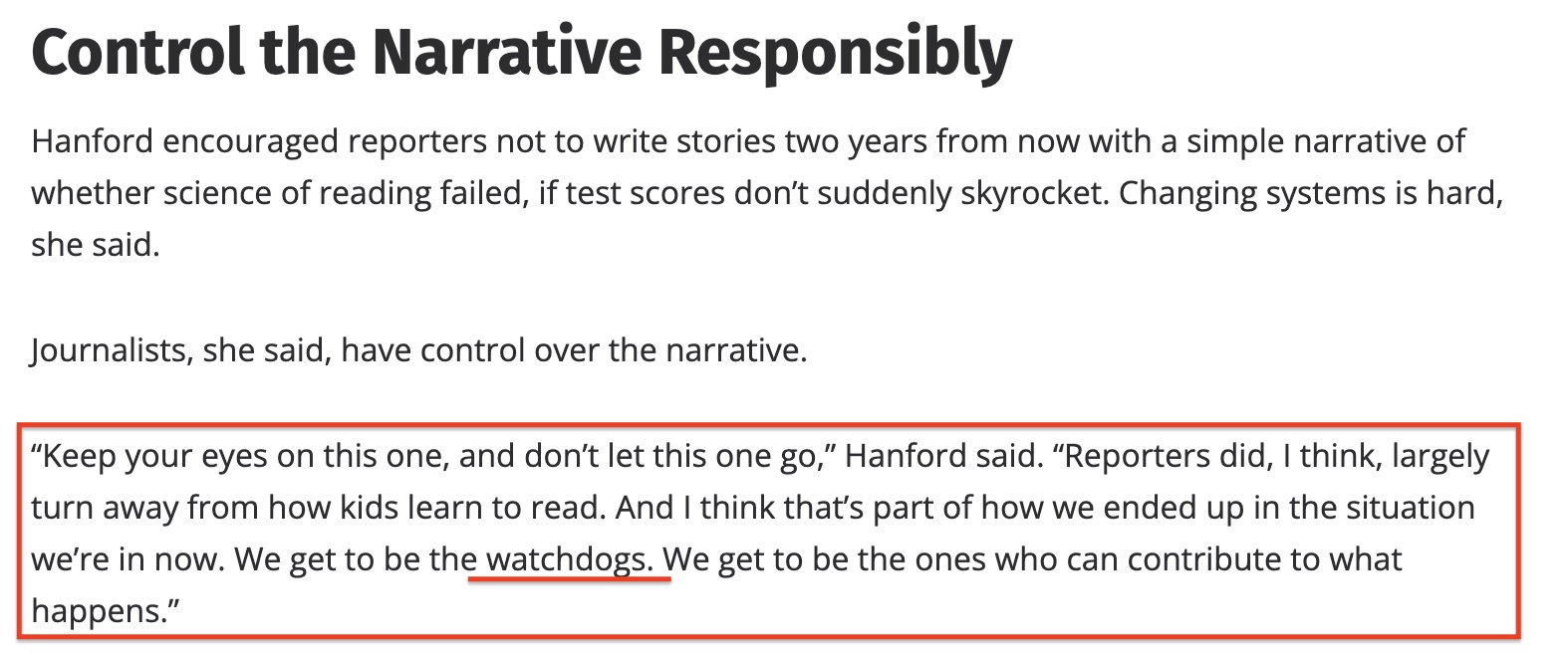
Let me draw your attention to two passages from EWA and then offer a reader that dismantles the false stories and offers the full picture of what we know (and don’t know) about teaching reading):

The research on reading is not in fact settled (see here) and this last passage exposes the fundamentally negative attitude (“watchdogs”) about teachers at the core of the SOR movement and its public and political appeal.

The media has been and seems determined to be irresponsible with their reporting about reading, students, and teachers.

For the full and complicated story, here are alternative texts:


Recommended

The Press: All the News about Public Schools They Feel Like Printing, Susan Ohanian

ILEC Response: Mainstream media coverage of reading proficiency, teachers of reading, NAEP scores, and teacher preparation

International Literacy Educators Coalition

ILEC Vision: To promote literacy learning practices that enable all children and youth to realize their full potential as literate, thinking human beings.

Download a PDF of the response.


ILEC Response: Mainstream media coverage of reading proficiency, teachers of reading, NAEP scores, and teacher preparation

Mainstream media such as Education Week, the New York Times[1], APM, and Forbes persist in recycling a compelling but misleading story about reading proficiency, teachers of reading, NAEP scores, and teacher preparation that is not supported by the full body of evidence. As Aukerman explains:

From how much of the media tells it, a war rages in the field of early literacy instruction. The story is frequently some version of a conflict narrative relying on the following problematic suppositions:

  • a) science has proved that there is just one way of teaching reading effectively to all kids – using a systematic, highly structured approach to teaching phonics;
  • b) most teachers rely instead on an approach called balanced literacy, spurred on by shoddy teacher education programs;
  • c) therefore, teachers incorporate very little phonics and encourage kids to guess at words;
  • d) balanced literacy and teacher education are thus at fault for large numbers of children not learning to read well.[2]
The Science of Reading and the Media: Is Reporting Biased?, Maren Aukerman

In fact, Reinking, Hruby, and Risko concluded, “there is no indisputable evidence of a national crisis in reading, and even if there were a crisis, there is no evidence that the amount of phonics in classrooms is necessarily the cause or the solution.”

ILEC Concerns:

  1. Hoffman, Hikida, and Sailors note that “the SOR community do[es] not employ the same standards for scientific research that they claimed as the basis for their critiques.” While individual stories of parents and students are compelling, anecdotes are not scientific and do not provide valid evidence for generalizations about reading proficiency or reading instruction.
  2. Longitudinal and recent NAEP scores on reading are misrepresented by mainstream media. “Proficiency” on NAEP is well above grade level, and “basic” is a closer measure of grade level (Loveless, 2023; Loveless, 2016).
  3. Any claim of “crisis” or “miracle” in education is misleading. Specifically, the Mississippi “miracle” does not have scientific evidence to show NAEP increases are caused by instructional reform, but appear linked (as with Florida) to punitive uses of grade retention that disproportionately impact minoritized students.[3]
  4. Mainstream media misrepresents teacher education, reading programs, reading instructional practices, brain research, and the complex body of reading research to promote a compelling story that is melodramatic and anecdotal.
  5. Citing NCTQ, NRP, and surveys fails to meet the level of “scientific” that SOR advocacy requires of teachers.

[1] The NY Times Again Goes After Public Schools, Susan Ohanian

[2] See The Science of Reading and the Media: Is Reporting Biased?, Maren Aukerman; The Science of Reading and the Media: Does the Media Draw on High-Quality Reading Research?, Maren Aukerman; The Science of Reading and the Media: How Do Current Reporting Patterns Cause Damage?, Maren Aukerman

[3] A Critical Examination of Grade Retention as Reading Policy (OEA)

Education in the Media: A Reader, August 2023

Fall sessions of a new school year have begun or are soon beginning across the US.

Just as predictable as a new academic year, the media maintains its constant negative drumbeat about schools, education, students, and teachers. Below is a reader of some of the issues and coverage of education, including the rise in censorship and curriculum bans as well as the tired arguments about a reading crisis.

Notable is Susan Ohanians piece about the NYT, but this reader includes both samples of really bad journalism and excellent coverage of key education issues:

Neoliberal Education Reform: “Science of Reading” Edition

[Header Photo by Mike Erskine on Unsplash]

Cliches become cliches often because they do capture a truth, and “fish don’t know they are in water” may sound trite, but the saying captures well our five decades of education reform in the US.

Since A Nation at Risk under Ronald Reagan and then reinforced and expanded under George W. Bush (with Rod Paige and Margaret Spelling as Secretaries of Education), education reform in the US has been grounded in neoliberal ideology, the foundational beliefs of Republicans and conservatives.

“Neoliberalism” is a challenging term. First, it is hard to define, and second, the use of the word “liberal” has two contrasting meanings in the US—”liberal” as in “classic liberalism” is “conservative” or politically “right,” yet in common usage “liberal” is typically associate with “progressive” or politically “left.”

However, to simplify, in education reform, we can fairly interchange “neoliberal” with “conservative” and “Republican”—even though, as I want to discuss here, it is incredibly important to understand that neoliberal education reform is embraced and perpetuated by both Republicans and Democrats.

Look at the education reform landscape since the 1980s to understand.

A Nation at Risk established the neoliberal education reform playbook: manufacture an education crisis; declare that students, teachers, and public schools are failing; and mandate accountability policies to “fix” students, teachers, and schools (in-school reform only).

Insiders exposed that Reagan gave marching orders to the committee that created A Nation at Risk; Reagan wanted the US to embrace school choice (neoliberalism is a market ideology) and to “put prayer back in schools” (although voluntary prayer has always been allowed in public education, Reagan and Republicans depended on culture wars).

A key component of neoliberal education reform is the buy-in of the media. Until decades later, after numerous scholars discredited the report as a “manufactured crisis,” the media uncritically declared US education—teachers and students—failures.

And thus we set out on several cycles of the same accountability reform grounded in new standards, new tests, and new political mandates.

Governors scrambled to show they took education seriously, and George W. Bush in Texas turned his role as education reform governor into a launching pad for the White House.

Here is another key element.

Although Bush claimed a Texas “miracle,” again as with A Nation at Risk, after the political success and media as well as public buy-in, scholars showed that the “miracle” was a “mirage” (or better yet, a lie).

None the less, Bush took Paige into his administration and No Child Left Behind (NCLB) was modeled in the Texas “miracle”/”mirage”—and just as Democrats rushed to embraced Reagan’s lie, Democrats joyfully made NCLB one of the most prominent federal bi-partisan accomplishments in recent US history.

Few things show how pervasive neoliberal (Republican/conservative) education reform has become the water to the fish (education) than the Barack Obama/Arne Duncan education era.

Instead of ushering in a progressive or critical response to the Bush education policy, Obama/Duncan doubled down—fueling the draconian value-added method era of teacher evaluation, launching the deceptive and austere education career of Michelle Rhee, and supercharging the charter school movement (a “school-choice lite” movement that fulfills the market beliefs of neoliberalism).

At 40 years since A Nation at Risk, all we have to show for the constant reform in education is a series of claims of “crisis” and a smattering of “miracles”—both of which are always manufactured.

But if we reach back further, into the 1940s, we see that neoliberalism also depends on sparking culture wars. For example, the reading wars have always been about attacking progressive/liberal ideologies—Dewey in the early to mid-1900s, whole language in the 1990s, and now, balanced literacy.

So now we come to the “science of reading” (SOR).

SOR has its roots firmly in NCLB and the National Reading Panel (SOR cites the NRP report as much or more than any other evidence)—the peak of neoliberal education reform.

SOR was also fueled throughout the 2000s by the Florida model, which depends heavily on grade retention and laser-focusing on grade 3 reading.

Around 2013, states began to revisit or reimagine reading legislation, but in 2018, the media supercharged the SOR movement, echoing the “manufactured crisis” approach of A Nation at Risk.

Notably, the “manufactured crisis” of the SOR movement is firmly grounded in NAEP testing; first, the media misrepresents NAEP data, and second, NAEP is purposefully designed (the test is a neoliberal tool) to create the veneer of failure by students, teachers, and schools.

NAEP allows media and political leaders to shout that 2/3 of students are not proficient in reading even though that claim isn’t what most people think.

Therefore, at its core, the SOR movement is another neoliberal education reform movement, a tool of Republican/conservative ideology and politics.

SOR has the student/teacher/school failure rhetoric, the “miracle” that is a “mirage,” the eager and uncritical compliance of the media, and the compelling use of standardized tests data (NAEP). But most importantly to understand how SOR is neoliberal education reform, the policies are repackaging Jeb Bush’s Florida model, emphasizing punitive reading policies such as grade retention.

However just like all the other neoliberal education reform since the 1980s, it will not work because it isn’t designed to work.

We are only 20 years since NCLB/NRP which mandated scientifically based reading instruction, yet there is a reading crisis?

Here is the dirty little secret about neoliberal education reform: It is a distraction for political gain.

Neoliberalism keeps the public’s gaze on individuals (students, teachers) and away from systemic forces; SOR wants people to believe that a couple reading programs are to blame for reading failures instead of poverty and inequity.

And the neoliberal attacks in SOR on people are yet another swipe at progressive and critical educators.

Like fish, many educators cannot see they are willing participants in neoliberal education reform; almost all Democrats cannot see they are willing participants in neoliberal education reform.

Fish don’t know they are in water, but with the SOR movement (and whatever crisis comes next), the better analogy may be lobsters in a slowing boiling pot.

Mainstream Media Fails Educational Research (Still)

From CNN: How long you breastfeed may impact your child’s test scores later, study shows.

This sounds really compelling; it fits into a cultural narrative that breast feeding is superior to using baby formula.

This sounds really compelling until about ten paragraphs in and then:

“Though the results are certainly interesting, you have to bear in mind the limitations that inevitably arise in research using observational data from major cohort studies,” McConway added….

The fact that the study was observational means it followed people’s behavior rather than randomly assigning the behavior in question, McConway noted.

Consequently, the results only show a correlation between breastfeeding and test scores — not causation.

“It’s not possible to be certain about what’s causing what,” he said.

How long you breastfeed may impact your child’s test scores later, study shows

Few people will read that far, and even most who do will likely take away a careless claim that the research doesn’t justify.

Therefore, this article should never have been written—similar to many articles about educational research.

One enduring example of media repeating a misunderstanding of educational research is the word gap myth. Media repeat that number of words in children’s vocabulary is connected to economic status (again, this sounds right to most people).

Yet, the Hart and Risley study this myth is based on has been debunked often, and the word gap myth itself is based on flawed logic about literacy [1].

Media has ben shown, in fact, to cover education quite badly, typically overemphasizing think tank research versus university-based research (the former far less credible than the latter) and featuring the voices of non-educators (reformers and innovators) over educators:

Currently, the misinformation campaign, ironically, related to education is the “science of reading” (SOR) movement that repeatedly misrepresents NAEP data, makes claims that have no scientific evidence (relying on anecdote [2]), and repeatedly relies on think tank “reports” (NCTQ, for example) that are also not scientific [3].

A subset of the SOR movement is also grade retention. High-profile coverage of Mississippi has made the exact breast feeding mistake from above: “’It’s not possible to be certain about what’s causing what,’ he said.”

Recently in the NYT, a think-tank funded report on MS grade retention is cited; however, the report itself notes that outcomes cannot be linked to grade retention itself [3].

In short, the report proves nothing about retention—just as the study on breast feeding proves nothing about student achievement.

The breast feeding story, the word gap myth, and the SOR story are all compelling because they sound true, but they are all false narratives that fails educational research—and public education.


[1] The “Word Gap”: A Reader

[2] Hoffman, J.V., Hikida, M., & Sailors, M. (2020). Contesting science that silences: Amplifying equity, agency, and design research in literacy teacher preparation. Reading Research Quarterly, 55(S1), S255–S266. Retrieved July 26, 2022, from https://doi.org/10.1002/rrq.353

[3] See:

[3] Scroll to end HERE.