Category Archives: memoir

Aftermath

But the stars collide
They’re beautiful and much maligned
In a universe where you see the worst
And it’s up to you to fix it

“Aftermath,” R.E.M.

I am not in Kansas…
Move back home with mom and dad…
My bedroom is a stranger’s gun room…
I can’t go back there anymore

“Not in Kansas,” The National

Dorothy’s journey in The Wizard of Oz was a quest and a mantra—”There’s no place like home”—but Thomas Wolfe has warned us otherwise, You Can’t Go Home Again.

I have been thinking a great deal about nostalgia, the urge to return to something from before, something assumed to be better and normal. The Covid-19 pandemic has coincided with my oldest nephew finally having the time needed to scan hundreds of family photos gathered after the deaths of my parents over a six-month period a couple years ago.

The images are haunting and fill me with nearly overwhelming melancholia. The newest and last batch of scans forced me to consider both the allure of back then and if any moment is really better; is there ever really such a thing as the good old days?

These photographs span decades and generations; many of the oldest black-and-white photos are faded, blurred, but they capture people mostly unsure of how to be while being photographed. There is an awkwardness that puts up masks to whether or not these days were more than the old days, but also “good.”

And family photographs are rich with babies and children, especially babies on people’s laps. There are two in the newest batch that I can’t quite fully process, babies on laps—one of my mother and me, obscured by finger prints, and another of my oldest nephew sitting on my mother’s lap, her beside my father in an eerily red-hued picture from 1983:


There are about 20-plus years between these images of my mother, and I am turned inside out by my parents’ faces, both looking away and appearing to be quite distant from the moment then in the early 1980s, there with the beginning of a life that will always be inextricably intertwined with theirs.

My oldest nephew, who we call Tommy on our side of the family, carried a tremendous bulk of the responsibility as my parents’ health declined and once they died. His earnest duty to them has persisted as he has scanned these hundreds of photos, I assume, in one effort to hold onto a home that we shared at different times.

I look at these images and feel like Dorothy:

Well, I, I think that it, that it wasn’t enough just to want to see Uncle Henry and Auntie Em. And it’s that if I ever go looking for my heart’s desire again, I won’t look any further than my own backyard. Because if it isn’t there, I never really lost it to begin with. Is that right?

But I also know this to be misguided nostalgia—that you can’t go home again.

The urge to go back to seemingly better times is a powerful political message, however, one resonating in a different way in 2020 during a pandemic that has erased normal from most of our days and nights.

Political messages about reclaiming the good old days has had mixed results.

In 1996, Bill Clinton levered the future over the past:

“The real choice is about whether we will build a bridge to the future or a bridge to the past; about whether we believe our best days are ahead or behind us; about whether we want a country of people working together, or one where you’re on your own,” Clinton said.

But Ronald Reagan and Donald Trump have shared political success by taking the opposite stance:

“We ran on a theme: ‘Make America Great Again.’ And a lot of people are saying that may have been the greatest theme ever in politics. Ronald Reagan had a small thing called ‘Let’s Make America Great.’ That was good,” Trump said earlier in the evening. “I don’t like it as much. And he sure as hell didn’t use it as much.”

Those of us leery of the good old days often ask people to specifically identify when and what was “great” in the past, specifying the when but also acknowledging how it was “great” and for whom.

At whose expense is anyone’s happiness?

Bob Dole seems to have lost due to his failure to recognize that a nostalgia for a 1950s U.S. ignored that mid-twentieth century America was often anything except great for large populations of people not like him.

However, even as 2020 is a presidential election year, throughout the world, all of us are now confronted with wanting to return to normal, desiring through a haze of nostalgia to go back to the time before the pandemic.

I have been struck by how unfamiliar now images of crowds seem to me—major sporting events, music concerts.

I am reminded of going with friends to see The National in an outdoor venue in Pittsburg just after the Las Vegas mass shooting. It was a challenging and disorienting experience, but many of us simply attended the event to cling in part to something we considered normal.

It seems entirely reasonable in our current medical crisis to want things as they were before the pandemic. But it is also completely irrational to want to return to the world that brought us to this shut down.

Thinking everything was better in the past is not just nostalgic, but negligent.

Before the pandemic, people across the U.S. lacked health care and stable well-paying jobs. Those facts increased the crisis.

I have been looking through hundreds of photographs and missing the people and the times; it is a powerful thing to want to go home again.

But we can’t go home, we will never go back to normal.

In the aftermath of crisis, in fact, the greatest honor we can pay to our past is to move forward, better people and seeking the very best of Maggie Smith’s final lines to “Good Bones”: “This place could be beautiful,/right? You could make this place beautiful.”


When the World Wakes Up, and We Are All Inside


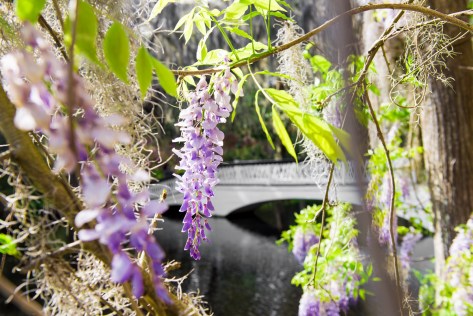
Magnolia Wisteria and Bridge
Magnolia Wisteria and Bridge (Steven Hyatt)

“I can’t look at everything hard enough.”

Emily in Our Town by Thornton Wilder

Most of my life, I have been an outside person, but never much of a nature person. I am drawn, you see, to the sun more so than the natural world because, in part, I am allergic to much of that natural world.

I have been thinking a lot about this during the current Covid-19 pandemic and the expectations of social distancing and staying, mostly, at home (which means indoors).

My childhood throughout the 1960s and 1970s occurred in the South where my working-class parents practiced under the expectation that children played outside if the weather in any way made that possible. In fact, my sister and I gleefully raced outside much of our childhood.

I recall very fondly playing pick-up sports in the large field near our rented house in Woodruff, South Carolina (the field on the property of the adjacent junior high school) and the variety of make-believe adventures we neighborhood children constructed in the large field on the other side of the house that stored giant mounds of gravel.

Once we moved to the house my parents built on the town golf course, Three Pines, I was ten and soon found refuge in the huge expanse of woods surrounding our large lot as well as spending a great deal of my life playing golf or outdoors pick-up basketball.

My entire adult life has been spent as a recreational cyclist, riding for many hours each week on the roads and trails around upstate South Carolina and the mountains of North Carolina.

One of the great ironies of my life is that when I was a child my parents often wanted to go driving in the mountains of NC (along the highway where my parents spent their secret honeymoon after a hushed marriage at the courthouse), but I fought these trips with the sort of pettiness children excel in showing; as an adult, I have ridden my bicycle thousands of times along those same roads.

It is in my cycling life, I think, that I can best describe the dichotomy of being an outdoor person but not a nature person.

One of the more common cycling loops we did for many years throughout the spring (and more) included climbing up Hogback Mountain near Tryon, NC. The climb is anywhere from 3-5 miles of climbing depending on the turn-around point (and the paved road has been extended over the years of doing this ride).

Once just before starting the ride with a cyclist I hadn’t done the climb with before, he said that he loved riding Hogback because of the view at the top. I immediately said, “What view?” You see, I really never saw the climb as a way to see the view or take in the surroundings because it was a physically and psychologically demanding feat.

But I worshipped every chance I had to be outside, to be in the sunshine for hours at a time.

With our brave new world of social distancing and commitments to staying at home, I have had an unexpected shift in how I view the natural world.

A week or so ago, I noticed the large amount of wisteria in the area. I wrote a poem about that, but I have continued to see and think about the blossoming of spring all around us while most of us have our heads and our minds focused on an invisible virus, a pervasive threat that is not just beyond our senses but may actually disrupt our senses of taste and smell.

As with forms of socializing, the recommendations and mandates restricting groups to fewer than 3 people have brought to an end group cycling, something that has been at the center of my adult life as well.

So my lifelong need to be outside has taken on a new form and a new importance.

Each day, a friend and I schedule one outdoor activity, road cycling, mountain biking, or a walk/hike. Instead of a hobby or a form of leisure, these have transformed into a necessity, an elixir against the terror of the pandemic and the claustrophobia of social distancing and staying home.

But as the world wakes up around us this spring, the world available to us is shrinking. In my home state, all the state parks have closed—no hiking or mountain biking trails left open.

Since road cycling alone or in pairs is less safe than larger groups, mostly, we had been mountain biking and walking/hiking a great deal. And all while flowers and trees are bursting to life and everything has a dull yellow layer of pollen announcing the coming of spring to the South.

Wisteria and Dogwood trees are going about their usual business, oblivious to Covid-19, social distancing, or stay-at-home mandates. Pollen dusts everything in sight while we sit inside staring at our variety of screens.

Nature without the interference of humans will persist as nature. In Margaret Atwood’s post-apocalyptic Oryx and Crake, Snowman, believing himself the last human, witnesses just that:

The buildings that didn’t burn or explode are still standing, though the botany is thrusting itself through every crack. Given time it will fissure the asphalt, topple the walls, push aside the roofs. Some kind of vine is growing everywhere, draping the windowsills, climbing in through the open windows and up the bars and grillwork. Soon this district will be a thick tangle of vegetation. If he postponed the trip much longer the way back would have become impassable. It won’t be long before all visible traces of human habitation will be gone. (pp. 221-222)

Early in the move to social distancing, we drove the hour to Dupont forest to hike. The hiking trails to waterfalls are always popular, but on this trip, the crowd was disturbing since we were confronted with a dilemma—the need to be outside and our commitment to avoiding large groups of people, particularly strangers.

Regretfully, this experience was an omen of the new restrictions that now ban anyone hiking those exact trails, just as most of our mountain biking trails are now officially closed.

Covid-19 is exposing some of our greatest urges and weaknesses as humans. We desire community, socializing, but we are often our own worst enemies, especially when the greatest threat to our safety is unseeable and each other.

“We have met the enemy and he is us.”

For me, the new reality has forced me to rethink my relationship with the outdoors I have cherished my entire life, a new recognition of the natural world.

As we were cycling laps around a park in my hometown, a friend and I talked about my new fascination with wisteria and we both acknowledged not really knowing the names of trees and plants all coming to bloom around the lake at the center of this park.

It seems a different kind of important now to see the various plants and trees individually, and to know their names.

That day we were climbing Hogback I recall now that I did pause at the top, I did look at the view, and I had to agree it was more than worth my time to not just look, but really see the view from above the trees and across the valley.

Misreading Academia, and Why Education?

While I was teaching high school English in rural South Carolina, I became close friends with a colleague; I was English Department chair and also taught Advanced Placement, and he was the chair of history and also taught A.P.

But the strongest bond we shared was our similar life experiences of having been born, raised, and educated in the Deep South. We came to be ideologically quite different (radical, progressive) than how we were raised (traditional, conservative) in redneck and racist homes. And we both quickly attributed this transformation to our educations, although in slightly different ways.

My colleague often noted that when he and his father fought as they grew older and farther apart intellectually (as I did with my father), his father would often end those fights by declaring that the biggest mistake he ever made was sending my colleague to college.

While I did in fact attribute my liberation from all sorts of negative -isms to wonderful and thoughtful professors and classes in my undergraduate education, my colleague actually graduated college mostly unfulfilled, but motivated to self-educate by reading widely and deeply. Yes, college helped his transition, but he did a great deal of his own intellectual soul-searching after he graduated.

Both of us also eventually sought doctoral degrees later in life and then moved on to higher education. As a result of our backgrounds and experiences in K-12 and higher education, I think, I have noticed two important conversations on social media that at first may not to seem related, but they highlight how often the media and the public misread higher education and the larger question of why we have formal education.

One debate is about political alliances in higher education:

Embedded in this question (an interesting and valid one in many ways) is a couple assumption: (1) the monolithic progressive (liberal) professorate, and (2) a hidden class division within academia that avoids the institutional hierarchy of academia (tenure and promotion structures).

Here is an often ignored fun fact about higher education: Professors and contingent faculty are not monolithically progressive, liberal, and/or leftists.

In fact, some disciplines highly influential beyond the academy are the most moderate and conservative—economics, psychology, political science.

But professors are disproportionately among a privileged class due to their academic status in the academy (although how we arrived here does create some tensions, speaking as a working-class academic). That intellectual privilege skews academia toward a very moderate progressive-leaning middle.

Those of us who embrace and practice a genuine leftist or radical approach to academics and life are outliers, often marginalized in ways that publicly marginalized groups are not overtly treated in academia. For example, higher education is quick to give lip service to inclusion for LGBTQ+ individuals and communities but not to openly Marxist professors (and for the record, stating inclusion doesn’t magically create inclusion even in higher education).

The key distinction between academia and the so-called real world, then, is about the norms of discourse in each setting. Yes, higher education is more aggressively complex and progressive in how many topics are discussed and examined. To people outside academia, this discourse norm seems left of mainstream society (I imagine that is a fair assessment) and likely seems more permissive and less traditional.

It is at this tension where misreading academia can be more directly examined. That tension is captured well in this exchange on social media:

Jason Myers is making a case for a utilitarian, or essentially conservative, view of formal education—to prepare anyone for the world as it exists (in the U.S., that is to create workers). Erin Bartram, however, is speaking for a much broader purpose of education, essentially progressive, one that contributed heavily to my colleague’s and my transformation—to foster critical consciousness and autonomous citizens.

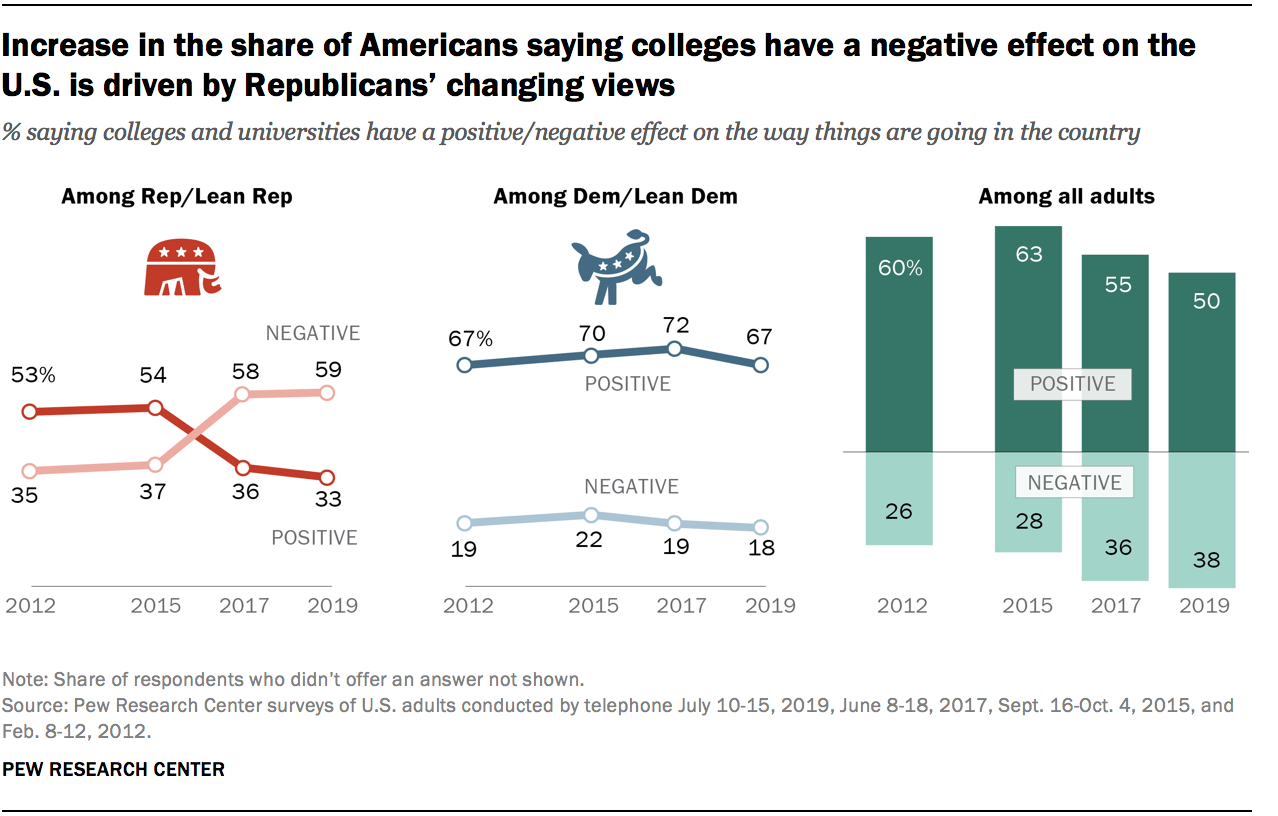
The tension in these Tweets is reflected in the difference between Democrats and Republicans on college:

Increase in the share of Americans saying colleges have a negative effect on the U.S. is driven by Republicans' changing views

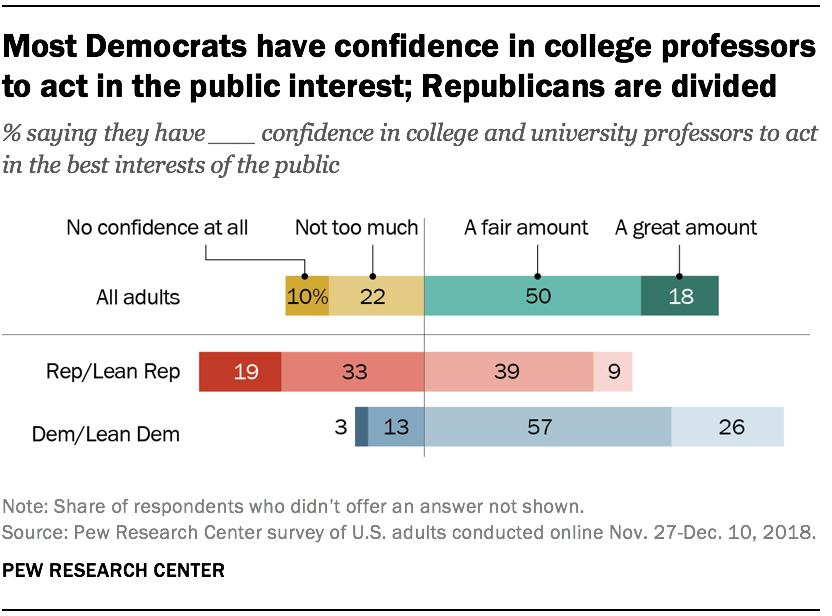
There is a similar partisan contrast in terms of perceptions about professors as well:

Most Democrats have confidence in college professors to act in the public interest; Republicans are divided

Misreading academia as uniformly progressive or leftist is grounded in how anyone views the purpose of formal education. Many in the U.S. are ideologically conservative and traditional so anything that seems to challenge that tradition or call for change is viewed skeptically if not cynically.

The current fear-mongering around single-payer health care is an excellent example of how a relatively moderate idea (universal health care) is framed as radical or “socialism” by a conservative culture (media and the public see the status quo as predictable and safe; therefore, change is to be feared).

As a Southerner raised in a conservative home and community, I can attest that formal education has the potential to be transformative—it worked for me—but as someone who is a leftist, I can also attest to the fact that academia is no progressive playground of fair-minded and ideological leftists.

Structures of higher education and the disciplines are too often inequitable and conservative, protective of the status quo even when that reality reflects and perpetuates the worse aspects of society.

Is there more space for equity and inclusion, diversity of radical thought, in higher education? Yes, and when formal education is about interrogating the world, then we are experiencing a more progressive environment. But that is not the norm of higher education because all institutions are prone to self-preservation.

The possibility of education in the pursuit of interrogating the world will always feed the tension between formal education and the so-called real world, leading some to misread higher education for its outlier qualities.

But the greatest tension of all may be at the root of the skepticism among conservatives about higher education (and all formal schooling); education is a debate about who decides what knowledge matters.

For children and young adults, universal public education and public higher education may provide some of the few safe spaces for a young person to discover a rich knowledge base that allows them to rise above indoctrination, bigotry, and uninformed lives.

This is, I admit, as ideal I aspire to as a teacher/professor, something I work hard to nudge my school toward. And simply by hoping a formal education can be a doorway into the life any person wants and deserves, I am that liberal professor people who misread higher education warn you about.

Songs of Innocence, Songs of Experience

I am deeply indebted to the academic and personal kindness and mentoring afforded me during my undergraduate education by one of my English professors, Dr. Nancy Moore.

Dr. Moore combined an admirable ability to challenge students academically while also being sincerely supportive and encouraging. I probably did not need or even deserve her praise, but Dr. Moore always made me feel like a successful student, budding scholar, and most of all, credible writer.

She was one of the first people to treat me as a poet, inviting me to read and share my work in various settings.

But I also recall that she regularly chided me about my literary affections, warning me that I would grow out of some of my favorite authors. Part of that rested on one of my proclivities for authors who dwelled on innocence, such as J.D. Salinger and e.e. cummings.

While my literary tastes have in fact changed and even matured (in the sense that my critical sensibilities are sharper as I have aged), as I am staring down the barrel of turning 60, I remain deeply drawn still to the poetry of cummings, even as my discomfort with him as a person has grown with each biography I read.

This blog post title refers directly to William Blake’s major poetry collection that remains also a favorite of mine since it captures why these works still resonate with me; the tension between innocence/youth and experience/maturity fascinates me since both phases of life are often simultaneously idealized and criticized.

And, of course, it is an existential fact of being human that we experience both phases as well as live through the transition in ways that are often difficult.

I have recently written about the difficulties of physical decline as I age, and that experience sits beside major life changes and being an active grandfather for a five-year-old girl and three-year-old boy.

So yesterday, while spending a few hours with my grand-daughter after picking her up from school before taking her back to her father, I was struck by one of those sudden realizations that she is securely into childhood, no longer any sort of baby. She is very bright, energetic, incredibly loving, and distinctly sensitive in the ways that suggest she has inherited some of the anxiety that runs through my side of the family.

My grand-children have spent their lives navigating fractured families, and she has come to see the world through “whose week is it?” This is sad, but it also shows how she is coming to know the complexity of the world, how she is experiencing the transition from innocence to experience even at the tender age of five.

As our afternoon unfolded, the time together was ripe with the tensions of being a small child in the harsh reality of living. We saw a homeless man sitting by the highway on our way to dinner. At the restaurant, a woman making balloon animals gave her a balloon butterfly that filled her with dread over the probability that the balloons would burst.

I took a picture of her with the balloon butterfly:

balloon butterfly sky

Ad even a video of her talking about navigating the fear of the balloon popping. Eventually, I wrote a new poem, a theory of balloons, which is heavily influenced by [in Just-] by cummings.

On the video, my grand-daughter explains her theory of balloons (slightly edited in the poem):

balloons pop if there’s something spiky
then you cry & cry & then you get one later
i’ve got a balloon butterfly
& i’m never going to pop it
sometimes i’m going to pop it
& that’s okay i’m going to stop thinking about it

Listening to my grand-daughter and thinking about the balloon woman, I was immediately reminded of cummings and [in Just-], which still represents my key moment in life when I made the turn toward English student and writer.

I left high school only modestly drawn to so-called literature, even as I was a voracious reader of science fiction and comic books. I was tepid on poetry and had written some, but it wasn’t until a speech class in my first year of college when discussing this poem by cummings really struck me.

Unlike many poems by cummings, this one is very accessible and powerful in its seeming simplicity. But it also is an effective glimpse into the tension between innocence (the children playing in the poem) and the allure of the balloonman (a real-world Pied Piper and Pan hyrbid that represents the allure of maturity, including budding sexuality).

But I had never, I think, really considered the genius of using the balloon symbolically in the poem until my impromptu philosophical moments with my grand-daughter and the complete accident of her being given a balloon butterfly.

Like a ballon, like a butterfly, our humanity is very frail and fleeting, regardless of where we are on the continuum from innocence to experience.

And as I worked on the poem, blending things that really happened with my own fabrications for effect, I became more and more aware of the bond between my frailty of aging and my grand-daughter’s frailty of being just a child.

She is tiny and very thin, but she also has the tenderest of hearts.

Finding form is always a challenge of poetry, but I also feel the pressure of making sure every poem ends some way that is fulfilling without stooping to anything heavy-handed.

Satisfying to me at least, the last section pulls together an image of heaviness and lightness to combine with the tension of innocence (my grand-daughter) and experience (me) as I carried her inside after our afternoon together:

she falls asleep as we drive
the balloon butterfly clinging
to her tiny child’s arm
too beautiful & terribly frail
i carry her in sleep-heavy in my arms
like a balloon or a butterfly

This morning when I checked on her, I also asked if her balloon butterfly had survived the night.

I am relieved to find out that it has as I recall her sleep-heavy in my arms, completely dependent on my care in that moment, this old man who loves her.

My Dysfunctional Relationship with Sugar, Salt, and Protein: Chasing Fitness, Sacrificing Health

For much of my adult life, well over 30 years, I have spent a significant portion of my time as a serious recreational cyclist, endurance cycling. Most of those years, I rode my bicycle about 5,000 to 6,000 miles a year, but for many years from about 2004 until 2016, I rode about 9,000 to 10,000+ miles a year.

While I found myself well suited to endurance and intense cycling because I have a high ability to suffer even though I am physically limited, to ride at the higher levels I wanted to achieve, I often dealt with being prone to cramping, and struggling to keep up with energy reserves (carbohydrates) and fighting to maintain enough protein in my diet (I was for almost 30 years not eating beef) to make up for how much intense cycling tears down the body.

As I was approaching 60, I had to change insurance companies for the first time in almost 40 years. My university requires blood tests and screening when you choose new coverage. Late in 2019, my blood work labeled me pre-diabetic and pre-hypertensive.

In that moment, I was forced to admit that I had spent much of my life chasing a level of fitness that sacrificed my health in ways that may not be recoverable.

Sugar and salt, especially, had dominated my life purely for performance on the bicycle; I have never been one much for sweets in my normal diet. But cycling food, sports drinks, and supplements were pervasive parts of how I navigated fueling and refueling around my riding, often 5 or more days a week.

High-intensity cycling and training have kept me in a constant state of physical discomfort since the 1980s. Sore muscles, tight muscles, a general state of fatigue—these became what I considered normal.

After a serious car/cyclists accident on Christmas Eve 2016, I was forced to reset my life, especially my cycling life. I was 55, about to turn 56, and the few years since then have included exponential physical decline, both in my abilities as a cyclist but also my daily life.

For about a year, I semi-retired from cycling, no longer riding on the road and mountain biking fewer days a week than I had ridden most of my life until then. The troubling health warnings from the blood work a few months ago has forced me to acknowledge those physical declines—almost constant fatigue, muscular soreness and stiffness, far less agile and stiff hands, weak and aching shoulders.

To be honest, none of these aches and pains are new; they have been a part of my life for as long as I can remember. But with less and less intense cycling, they haven’t improved; they have in some cases gotten worse and more intrusive in my life and happiness.

I live a life now that includes avoiding added sugar in my food, eating one or two vegan meals a day, and lowering dramatically the intensity and amount of exercise I do.

But it remains very discouraging since I often do not feel better and likely am dwelling on those discomforts and changes more now since I am not distracted by my excessive cycling and relentless training. I also think I am recognizing that decline due to aging combined with decades of abusing my body and health is exponential, the consequences are magnified and cumulatively more noticeable than the expected decline I experienced in my 40s and early to mid-50s.

What may also be contributing to the discouragement is that my peak as a cyclist quantifiably occurred from my mid-40s into my early 50s, when I had some of my top finishes in key cycling competitions and events. That achievement helped mask that I was sacrificing health for fitness, but it also lulled me into thinking I could experience endless improvement (not a rational belief, of course).

So I was struck by the opening paragraph of Haruki Murakami’s newest short story, “With the Beatles”:

What I find strange about growing old isn’t that I’ve got older. Not that the youthful me from the past has, without my realizing it, aged. What catches me off guard is, rather, how people from the same generation as me have become elderly, how all the pretty, vivacious girls I used to know are now old enough to have a couple of grandkids. It’s a little disconcerting—sad, even. Though I never feel sad at the fact that I have similarly aged.

Like this narrator, I too am often thrown off when I see someone from my youth after many years without contact; their having aged is very jarring. Unlike the narrator, I have such jarring moments about myself from time to time—looking in the mirror, seeing an older photograph, simply rolling over to get out of bed.

These moments are not just “people age, people die,” but “I am aging, I will die.”

Cycling provided me for more than three decades proof that I could demand more of my body than it was willing to concede. I was quite good at pushing myself beyond the margins and seemingly willing my body beyond its capacity. In the moment, this made me feel good about myself, quelling my low self-esteem and my fears that I would never be the athlete I had always aspired to be (that I had imagined my father wanted me to be).

There is, however, another capacity that would have served me better—the ability to recognize those margins, those limitations as part of who I am and to accept that instead of trying to push beyond them.

Fewer days now find me on the bicycle, almost none riding at high intensity or long distances.

Instead, I walk into the grocery store, pulling items off the shelf, slipping on my readers, and checking for added sugar.

Today I bought sparkling water, no added sugar, and found new protein bars, also no added sugar, my new Holy Grail in a life seeking better and longer health and no longer hyper-focused on fitness.

A Picture’s Worth

I found this photograph
Underneath broken picture glass
Tender face of black and white
Beautiful, a haunting sight

“Photograph,” R.E.M. with Natalie Merchant

but if you look long enough,
eventually
you will be able to see me.

“This Is a Photograph of Me,” Margaret Atwood

I’m afraid of everyone

“Afraid of Everyone,” The National

There’s a joke I repeat quite often: When I was in high school, I had scoliosis, owned 7000 comic books—and no girlfriend.

People usually laugh, and then I add: That isn’t funny; it’s true.

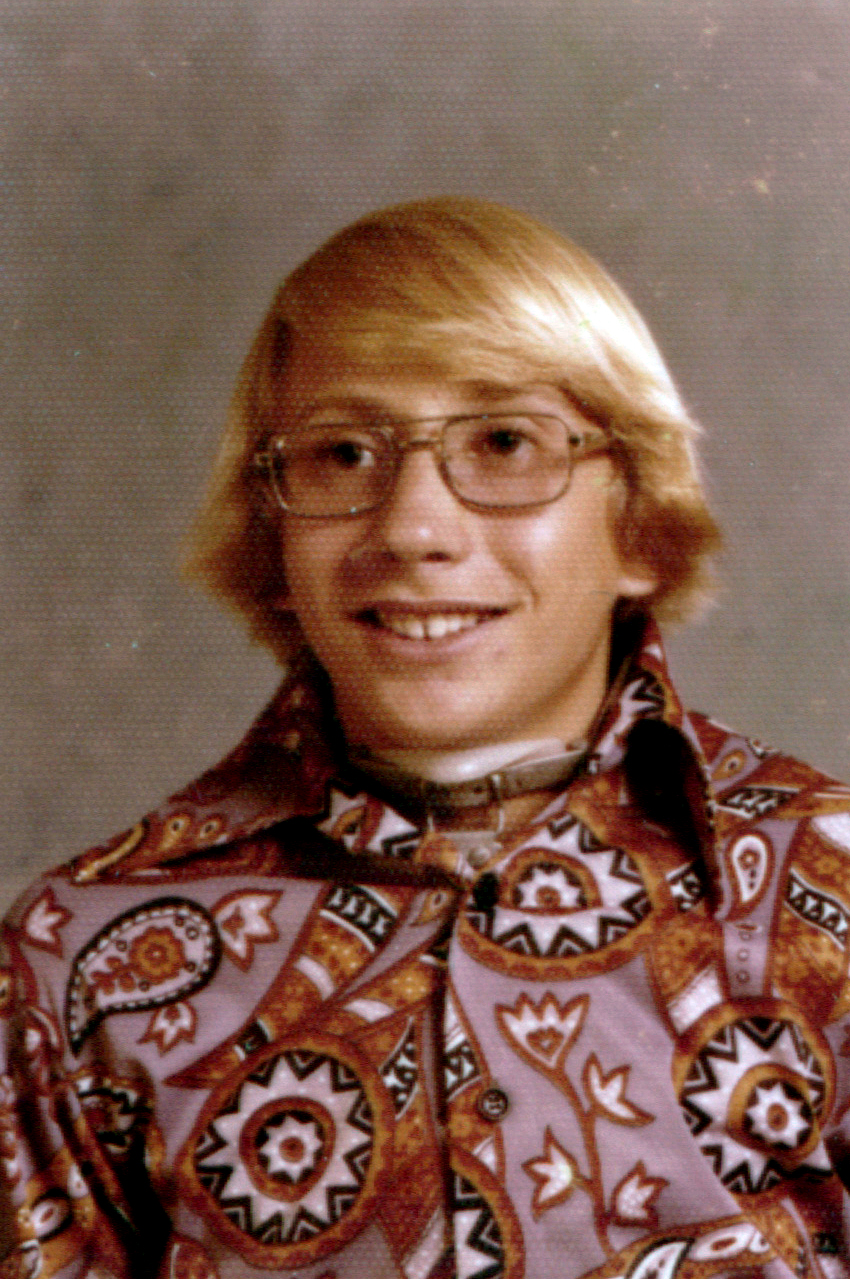
This is me circa mid- to late 1970s, silk shirt and barely visible brace for scoliosis:

00441_p_19at5jxk6m0502

The hair, glasses, and 70s fashion weren’t exactly working for me then. But many years before the four years in a full-body brace, I had already begun practicing all the survival skills needed for my anxiety, introversion, and crippling low self-esteem (terrified I was not and never would be the sort of masculine man that my father had imprinted on me).

It has been a couple years now since my parents died. My nephews, who my parents raised, and I cleaned out my parents’ house, and my oldest nephew, Stephen (who we call Tommy) gathered all the photographs, himself a photographer, to have them scanned. He sent the first almost-900 files yesterday.

Stephen (Tommy) and I also share a namesake, my grandfather, Paul Lee Thomas (I am the second) who everyone called Tommy.

00154_p_19at5jxk6m0193
A young Stephen (Tommy) with Paul (Tommy).

As I looked through the collection, I was texting Stephen, and we agreed that this experience is bittersweet, deeply sad but quite wonderful. The pictures are jumbled in time, and most have no information or date, forcing anyone looking into memory.

Here I am in Enoree and Woodruff (childhood homes) on a tricycle and bicycle.

These are my parents, and I assume they are holding me, but the baby certainly could be my sister—although I think the collection reflects how parents over-photograph a first child (me) and then under-photograph the others.

These are certainly my parents, each with me.

The mandatory family photographs of the 60s are both wonderful and eerie (I looked drugged in one, and the outfits and colors, well, one must wonder). The one on the right brings to mind Buddy Holly and Mary Tyler Moore.

While I have no recollection, or would be guessing, with many of the photographs, some of the pictures have very vivid stories (which may be jumbled, I realize). I know once my mom sent a picture to her mother (Deed, who we called Granny); Granny told my mom she cried because we were so skinny. This is from the summer of 1968, and very well could be that photograph.

00308_p_19at5jxk6m0347

For three or four years, we rented a house in Woodruff, moving there from Enoree before moving to Three Pines in 1971. The rented house felt like my childhood home, and here is Mom lying in the sun in that backyard.

00549_p_19at5jxk6m0610

It is in that backyard (the mulberry tree my sister and I loved to play in out of frame to the left) where my sister, angry, threw a large pot at me, hitting my head and face, leaving a huge scab that was captured in my school picture that year.

00418_p_19at5jxk6m0471

But there are other childhood pictures that genuinely baffle me. Like why did my parents dress me as Inspector Gadget (well before there was Inspector Gadget)?

00691_p_19at5jxk6m0753

But mostly, looking through the photographs leaves me with a great deal of melancholy. My life-long battle with low self-esteem about my manhood seems wonderfully captured in these images—my dad in his Woodruff High basketball uniform and me in my WHS uniform, both number 3.

I was never the athlete my father was (him a four-sport letterman and captain of the first state championship football team), but I was always trying.

And I could not have anticipated that one of the most upsetting images is this one—my father (left), my grandfather (middle), and my uncle (right).

00540_p_19at5jxk6m0601

Looking through almost 900 photographs, a few times now, certainly has been a heavy task confirming a picture’s worth. It is a picture I have no recollection of, and little information about, however, that I think may be the me I recognize the most.

00713_p_19at5jxk6m0775

I did not yet know about the scoliosis, eight years before that would be discovered, but I am sitting as I would come to do, toward the edge of the footstool. My hands clutching my knees, I am fretful, an anxious face that I think no one really recognized as anxious or fretful.

I am scrawny. I seem to have a bruise or abrasion on my thigh. I am not sure I knew someone was taking this picture or I would have put on my show.

I was always trying to be funny, self-deprecating humor was my speciality.

My spine would curve, I would discover comic books and science fiction, and I would navigate high school with my jaw clenched to an adult life where the no-girlfriend joke always draws a laugh.

Steeling Myself

Forget it, nothing I change changes anything

“Walk It Back,” The National

Just come outside and leave with me

“The Day I Die,” The National

Yesterday I met with my four classes for the last time this semester. The classes include about 75% first-year students, something I very much enjoy about teaching at the college level.

As I have started doing more purposefully, I ended these last class sessions by telling the students I feel very fortunate to have taught them, that I love them, and that I am always here to help if they need anything since once they have been my students, they are always my students.

While I was telling the first class of the day, my foundations education course, all of this, I felt myself flushed with cold chills, the urge to cry rising up through my chest toward my eyes.

This is nothing unusual because I am a world-class crier, but except for people very close to me, my crying is usually reserved for times when I am alone—often in the car listening to music and being very melodramatically maudlin.

I toyed with that this morning, in fact, as I sang along to The National’s Sleep Well Beast; the rising music of the opening of the album, “Nobody Else Will Be There,” always pulls at my chest and then by “Hey baby,” the wonderful sadness of wanting to cry.

It’s a hobby of mine, sadness and crying; the type of hobby that is a purging and starting over.

But it isn’t something I have chosen to do or the person I have decided to be.

I am simply the victim of hyper-awareness. I am perpetually aware of everything, and I feel the entirety of the universe far too deeply and incessantly.

When I told my education class I love them, they moaned with genuine affection. I could see each one of them, and all of them, and I felt it all far too deeply. My unscientific hypothesis is that when humans become overfull with feelings, the body must purge something, and that something is usually tears.

We humans are biologically and genetically predisposed to equilibrium, I think.

Stasis, calm, and maybe even peace.

These are conditions I understand at only an intellectual level. I suspect there are conditions like peace, and happiness. But my hyper-awareness, my proclivity for depression, my (likely) ADHD and OCD, among many other labels I am sure—these have an intersection called “anxiety.”

I live, then, in a constant state of impending doom, or more rightly explained, in a constant state of anticipating impending doom.

Living is a perpetual series of mild to severe electrical shocks to my emotional self. Therefore, as a coping mechanism, I steel myself, intellectually and physically, pushing my frail and exhausted emotional self well below the surface, far away from others and with any luck myself.

As a consequence, many people find me stoic, reserved, uncaring, distant, arrogant, aloof—I could go on.

I practiced the art of steeling myself for about 40 years before it all fell apart. And then briefly, I was a participant in prescription pharmaceuticals until I decided:

The more level they have me
The more I cannot stand me
I have helpless friendships
And bad taste in liquids (“I’ll Still Destroy You,” The National)

After about four years of a peach-colored pill that had me level and gaining weight, I have since then self-medicated. I have somewhat low-brow but nevertheless discerning taste in beer.

Of course, the problem with self-medicating is proper dosage, and I suspect as with prescription drugs, over time, our medications come to do us more harm than good.

I stood there feeling the urge to cry after telling my class I love them, in part, because the end of fall semester always comes between Thanksgiving and Christmas—by far my worst time of the year.

I feel a tug of fear at Summer Solstice each June. By Halloween and the end of daylight savings time, I am deeply aware of the most inevitable impending doom, the contracting of daylight around me at both morning and evening.

Thanksgiving signals for me the downward spiral toward Christmas, which corresponds with the Winter Solstice, the shortest daylight of the year. Darkness, cold weather, dead leaves cover over everything.

I really hate the holidays, especially Christmas, but it took me many years after naming my hyper-awareness, anxiety, and Sundowner’s syndrome to really understand why.

Three of us sat together this past Saturday afternoon at a local taphouse. We share varying spectrums of anxiety and depression; most importantly we have some community in our shared outlier qualities.

One friend noted this is the closest he comes to being happy; we have joked about our goal being just not being depressed or sad. The absence of sadness is quite enough. No need to push it.

Later, after the exhaustion had set in from a hard cycling ride earlier in the day and the creeping weight of a few beers, we found ourselves watching Elf. We are not religious, not the types who will be found watching Christmas movies.

We laughed, justified the watching because it is a Will Ferrell movie (oddly, we had caught the end of Talladega Nights right before Elf).

Sometimes in our separateness we find a sort of solace by our proximity.

And laughing, I think, is very similar yet distinct from crying. A sudden laugh is a purging, like crying, but it is also a much different kind of oasis, itself a burst that is briefly static but fleeting.

The unselfconsciousness of laughing is quite peaceful for the anxious.

Until we return to life, to living, to the universe brilliantly around us.

I am quite glad I take the time to tell my students I love them. I regret I have not done that more intentionally and throughout my career.

It is a way to steel myself against the impending doom of things being over.

I really hate Christmas and the contracting daylight surrounding me, however, as another semester is also coming to a close.

“Nothing I do makes me feel different,” I sang alone driving to work this morning, considering a good cry to make up for steeling myself yesterday as I spoke to my students for the last time this semester.

Rule 5: HTFU

In many ways, this past Tuesday was mostly a typical flight night at a local tap house, Growler Haus. We gathered and took over the room to the right, what we have come to call “The Office.”

But this Tuesday we were 15 gathered to say goodbye to a friend moving, as we say around here, “up North,” or in his case, back up North.

CJennings FW3-X2

The “we” in this case is the Spartanburg, SC, cycling community—or at least a part of it. Cycling is vibrant—although the people change and the intensity shifts over the years—in the Upstate of SC from Spartanburg to Greenville especially.

Chris, pictured above holding a mock-up of a plaque in his honor, is moving away, and we spent a couple hours over pints, flights, and food smiling and laughing about his moving to Spartanburg years ago and finding his way into our not-so-warm-and-fuzzy cycling clique; in many ways we are worse than high school, we road and MTB cyclists who have also branched out to gravel riding (anything to justify even slightly the code of bicycle ownership—Rule #12: The correct number of bikes to own is n+1).

If you zoom in, you see the plaque mock-up includes below his name Rule #5—one of the dilemmas faced by those organizing the gesture of farewell.

You see Rule #5, among The Rules at Velominati, is mostly NSFW—Harden the fuck up, or as we say in most public settings, HTFU.

The 15 in attendance and pictured above range in ages from their 20s into their 60s, much like our cycling community, and we all at one point or another have found ourselves stressed to our limits, probably questioning why we were voluntarily participating in a hobby, for fun, something that left us near the brink of death—or simply wishing death would offer a bit of relief.

Recreational cycling is often competitive, both spontaneously on any bicycle ride including more than one rider and during organized events (even the ones that explicitly announce “this is not a race”).

When we are the ones dishing out the pace and pain (a few above are always in that group), we smile and quip: “You know what to do when you are getting dropped? Speed up.”

It is that sort of nonsense that has bonded this group, nonsense that is about the same percentage sincerity as nonsense.

I have been cycling “seriously,” as we say, for well over thirty years. Those early years, I was mere fodder, a peon, but several of the elite locals gave me the treatment that we honor to this day, a sort of loving hazing, a relentless demand that “do better, damnit” is about the same as saying “love you.”

One of my friendly torturers was Fred; I still see him from time to time at mountain biking trails. He has shifted to solitary riding, and I have throttled back significantly my mileage and intensity. But I feel something unnameable every time I see Fred (Rule #3: Guide the uninitiated).

Fred was ruthless and his ability on a bicycle left me in awe. I never came close to Fred in ability, but I creeped toward his tenacity—and I certainly for a few years was a much better cyclist.

And I still know a hell of a lot about bicycling.

Several people in the photograph were shepherded into the flock as I was many moons ago. Now the grasshoppers have become masters; we guard our own Rules vigilantly even as we quote The Rules with a bit of a smile.

I hear our 20 and 30 somethings sigh and lament things aren’t like they used to be, shaking their heads at new riders. And I understand.

We are varied people. Bicycles and most of all riding bicycles join us, even when we don’t think alike, even when we can barely raise our heads or turn the crank in exhaustion.

Maybe especially when things are the toughest.

Only a few years ago four of us above were struck by a motorist (with six others), and a few of us were injured, some badly, one permanently.

And very recently, we were all visiting Chris in the hospital after a freak cycling crash that sent him to the hospital with a broken collarbone that put his cycling on pause for many weeks.

You see, it is just riding a bicycle, something children do, and it is far more than just riding a bicycle.

Cycling is not our entire lives—we have family, careers, and beer—but most of us cannot imagine our lives without cycling.

We will miss Chris, and I am sure, Chris will miss us, and this community.

In any moment of sadness, tugs of weakness, however, we have something to guide us through—HTFU.

Rule #1: Obey the rules.

Dog in the Sink

She is five or six years old, my daughter, sitting in the backseat and requesting “Dog in the Sink” from the R.E.M. mix-tape I made her.

Mishearing the line “dogging the scene,” she renamed “What’s the Frequency, Kenneth?” as she did several songs, including another favorite “That’s great it starts with an earthquake birds and snakes and aeroplanes.”

We spent a great deal of time in the car together. To and from school. To and from soccer practice. To and from soccer matches and tournaments.

Typically, my daughter would ask me to play songs, often R.E.M. since that is what I was listening to almost all the time, and to sing along while she watched me singing in the rearview mirror. Once she had the lyrics, she would tell me to stop, and she would then sing.

By the time she was 10 or so, she could sing all of “Its the End of the World as We Know It (And  feel Fine)”—much to the amazement of family and friends.

R.E.M. is re-releasing Monster, a 25th anniversary edition, so “Kenneth” has been on a loop in my head for several days.

Monster 25th Anniversary - Expanded 2-CD Set - R.E.M.
REMhq

The song permanently blurs with life with my daughter as a child, her asking about the end of “Kenneth” when “I never understood the frequency” becomes the closing “I never understood, don’t fuck with me.”

As she grew up, of course, she understood more and more of the lyrics, including the profanity. I never shielded her from the music I listened to so our adventure with music morphed a bit from those mostly innocent early days.

Another album just passing its 23rd anniversary is CAKE’s Fashion Nugget. My daughter was fascinated by “Nugget” as an early teen; it is profane and in your face.

When she would climb into the car with some of her soccer teammates, as we drove to lunch between matches, she would ask me to play “that song,” and I would survey the friends—”Your parents are ok with this?”—and we’d listen to “Nugget,” her face beaming.

I have several of these song moments permanently imprinted in my memory—my daughter singing “O, my, my, O, tell yea” unaware of “hell” as an option while singing along to Tom Petty, for example.

But as “Kenneth” has been on a permanent loop in my mind, I have realized that I struggle to recreate in those memories my daughter sitting in the back seat. I have this vague awareness of that, but I often lose her face and child self behind the more immediate image of my granddaughter, who I see often and spend a good deal of time interacting with in her carseat.

I will never get back “Dog in the Sink,” my daughter at 5, 6, 7, 8, 9, 10 …

I have lost forever a world of mixtapes and spending every waking moment in the service of a child.

“Kenneth” on a loop in my mind makes me very happy and deeply sad all at once.

I also will never again have a new R.E.M. album. I have, in fact, just redecorated my office, replacing some of the R.E.M. posters with The National—a band I found through R.E.M.

No photo description available.

I have always been haunted by Emily in Our Town, after her death realizing that we can’t and don’t look at anything hard enough in the moment.

“The world is too much with us,” Wordsworth warns; we are too busy living to really appreciate the moment.

My daughter used to come down stairs and repeatedly run and jump on me on the couch. She was rambunctious and laughing. But I was too often easily exhausted by that.

It deserved more. It deserved the same care and attention as those times we spent in the car, me playing songs she requested and her eventually telling me to stop singing so she could.

I was too easily distracted in my 30s and 40s: “Getting and spending, we lay waste our powers”; squandering, I would add.

I am better now in some ways. I will sit on the floor with my grandchildren, even when it is exhausting and even when I know it will last only a moment before they are off to something else.

I have sat hours quite still with each of those grandchildren in my lap, sleeping or watching TV or their iPad. I used to joke I was my granddaughter’s recliner.

It is a pose I am happy to hold—now.

We carry always with us these things we lose, these things we cannot hold onto no matter how deeply we want to make the world, time stand still.

It is a bit overwhelming to realize I have lost those images of my daughter as a child, her voice even, and her mannerisms and personality. All of that morphing into my granddaughter.

When I confuse the names of my daughter and granddaughter it may be the most honest moments of my life. They have piled up inside me in a way that I cannot untangle, a way that I would never want to untangle because I would be afraid of completely unraveling it all. Losing again what I have lost already.

“Papa, look!” my granddaughter demands as I am driving; I struggle to make her happy, but I have to explain I can’t turn around while driving.

I try to use the rearview mirror, but my granddaughter will have none of that. She wants my full attention, not some indirect reflection.

The rearview mirror was enough for my daughter.

It’s a shame mirrors reflect only the moment. It’s a shame we often don’t enjoy those moments.

Isn’t This What School Should Be About?

My chest swelled and I cried when I opened the text: “Her artwork is displayed in the hallway.”

Skylar 5K artwork

“Her” is my granddaughter, Skylar, in her first few weeks of 5K in the rural primary school serving my hometown. Skylar is biracial and her parents are divorced; her school sits in a relatively high-poverty area of Upstate South Carolina, about the 11th most impoverished state in the U.S. and a deeply inequitable state by economics, race, and gender.

Usually, still, Skylar climbs onto my lap or beside me on the couch, just to be physically against me; I often hold tightly one of her small feet or she hooks an arm through mine as if we are tumbling through space and she needs to make sure we are tethered together forever.

This past weekend I watched her play at a bounce house and party facility, there for my grandson’s (Brees) third birthday party. Skylar ran with earnestness to maintain pace with a some of the children, her friends, but balked at a few of the bounce houses.

She stood nervously at one before turning to me and asking, “Is it dangerous in there?”

At another bounce house earlier, she initially refused to go in, shuffling up against my legs and softly telling me she didn’t like it. Later, she scrambled in, and as she had on another trip there, became trapped so an older boy went in to help her.

She crawled out crying.

As I looked at this artwork of hers, I was reminded of the weekend party, the bounce houses and peer pressure that proved to be nearly unbearable delight and fright for my dearest granddaughter who I love far too much.

When my daughter began to light my grandson’s birthday cake, Skyler warned her to move the cake back with “Remember. Safety first.”

Skylar, you see, already exhibits some of the anxiety and hyper-awareness I know all too well. She is a deeply sensitive child who is powerfully drawn to and deeply wary of the world she inhabits.

She inspires in me as my daughter did the urge to lift her into my arms and hold her close to me. Forever.

Of course, that is not love and that is not even remotely desirable since it would be an act (literally or metaphorically) of denying this beautiful girl her full and complicated life.

As my existential self-education taught me, our passions are our sufferings; if we seek ways not to suffer, we then must abandon our passions.

My precious Skyler will hurt in her life, be disappointed in very real ways. That’s being fully human.

I am disappointed and even angry, however, that she like all children in the U.S. is being handed a country that remains far too calloused about children, girls and women, and the many inequities that much of the country simply pretends do not exist.

I am disappointed and even angry, however, that the schooling she can expect is almost never like her artwork being displayed in the hallways but more like a prison, or a hospital.

As I told a class last night, her 3K, 4K, and 5K experiences already contain assessments of her “readiness” and how well she meets standards—and ultimately, she must meet the demands of being on grade level for that most important grade of all, third.

Many loving, kind, and gifted teachers will work uncritically as agents of this terribly flawed educational system even as they show her their love and kindness. School, then, will be one of the things I cannot protect her from, one of the things that will hurt her.

Despite Skyler’s disadvantages of race, gender, and a fractured family, she has what Barbara Kingsolver calls a “family fortune” in the love and care offered by both sets of grandparents and access to race and economic privileges in that extended family.

I often look at Skylar and Brees, recognizing that Skyler will mostly be viewed as white (although people routinely mention her tan, even in the dead of winter) and Brees will mostly be viewed as black.

Sky and Brees

Their lives will remained colored by the centering of whiteness in the U.S., again something I cannot protect either of these children from.

Skylar will be pushed a little, or even a lot, behind boys just because she is a girl, and will likely grow up to earn a fraction of those some young men who more often than not are just a fraction of her.

So my heart ached at the bounce houses as I walked around just to keep an eye on her, just to be there when she wanted to say she was feeling shy or afraid.

And I cried when I saw the artwork now hanging in her school.

I am trying very hard with my grandchildren and reminded of the speaker in Maggie Smith’s “Good Bones”:

…Life is short and the world
is at least half terrible, and for every kind
stranger, there is one who would break you,
though I keep this from my children. I am trying
to sell them the world.

And then the end of Smith’s poem, mixed as it is with tortured optimism:

This place could be beautiful,
right? You could make this place beautiful.

As I look at the artwork of a 5-year-old child, I am left with a question as well: Isn’t this what school should be about?