The bait in this misinformation is almost always misrepresenting NAEP scores. Again, the confusion and misinformation is grounded in NAEP’s achievement levels that use “proficient” as an aspirational goal for students that is well above grade-level reading as measured on state assessments of reading, as I recently explained:
The disconnect lies with the second benchmark, “proficient.” According to the NAEP, students performing “at or above the NAEP Proficient level … demonstrate solid academic performance and competency over challenging subject matter.” But this statement includes a significant clarification: “The NAEP Proficient achievement level does not represent grade level proficiency as determined by other assessment standards (e.g., state or district assessments).”
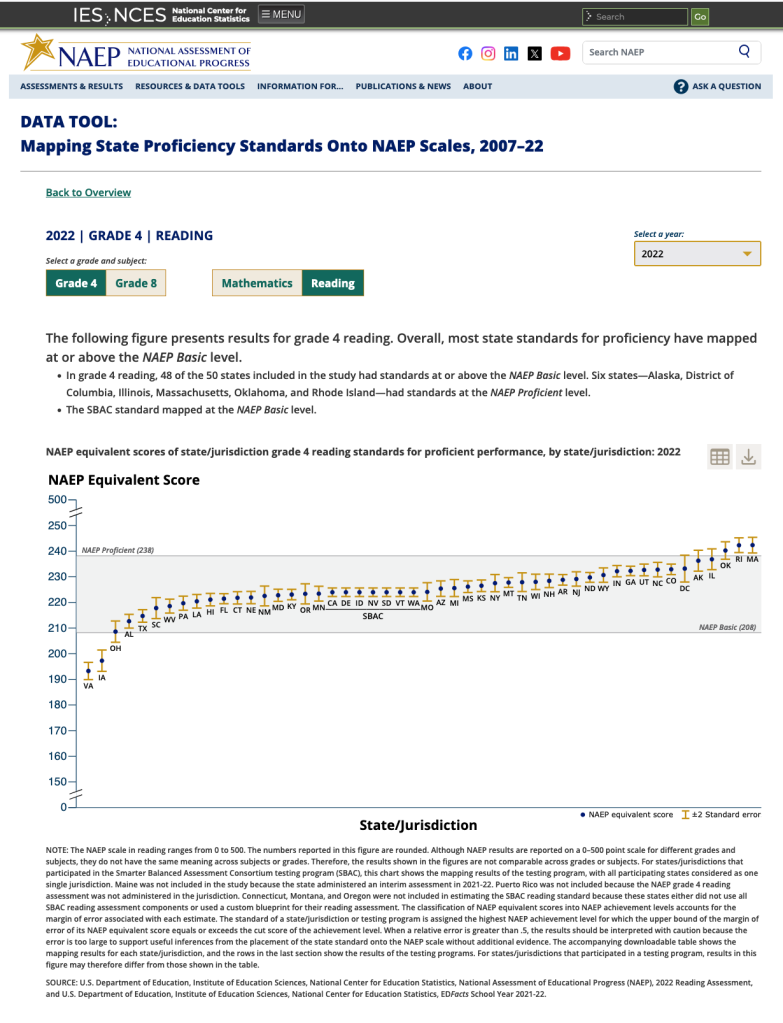
NAEP provides a correlation that shows almost all states set “proficient” at the NAEP basic level:
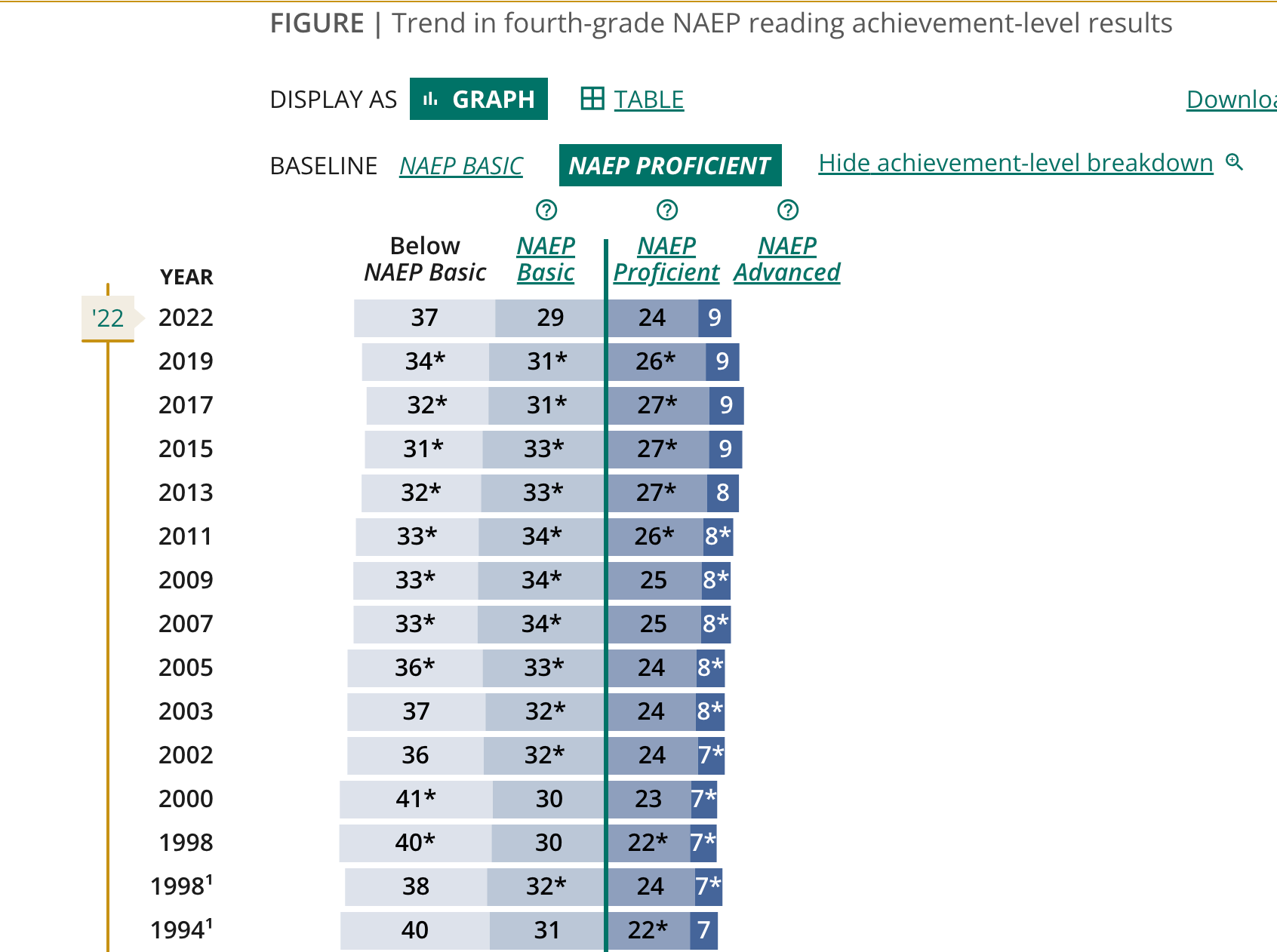
The bait, however, manufactures the perception of a crisis by making claims about NAEP proficient—2/3 of students are not proficient—that at least exaggerates the state of reading achievement among students:
Next, the switch.
Since about 2012, most states have revised or introduced new reading legislation grounded in the “science of reading” (SOR); in other words, states have made significant political and financial investments in both that there is a reading crisis and that the reforms will improve student reading achievement.
Mississippi, for example, has been christened a “miracle” and many states are rushing to copy their reforms despite a lack of research or evidence about the impressive grade 4 reading scores (which disappear by grade 8). [See three questions that need to be answered about MS.]
Many states are also beginning to adjust their proficiency cut scores [1], complicating any claims of reform being effective versus a misleading change in how students are labeled:
Wisconsin isn’t the only state that recently instituted changes that effectively boost proficiency rates. Oklahoma and Alaska recently made similar adjustments. New York lowered passing or “cut” scores in reading and math last year, while Illinois and Colorado are considering such revisions.
Now, here is the switch.
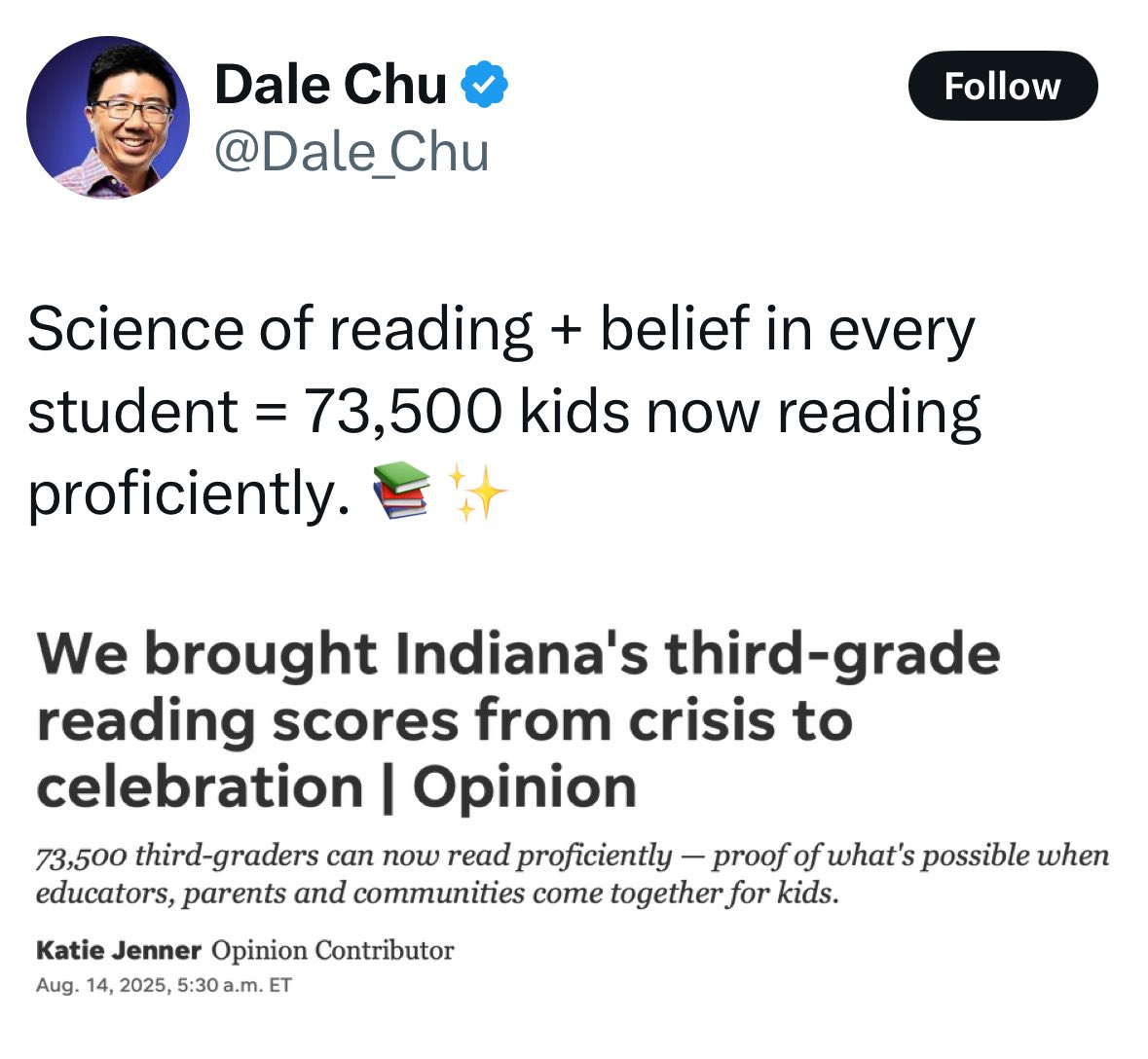
SOR advocates use the proficient level of NAEP to manufacture a crisis, but then celebrate state-level proficiency (that correlates with NAEP basic) to make claims that the SOR reforms are working:
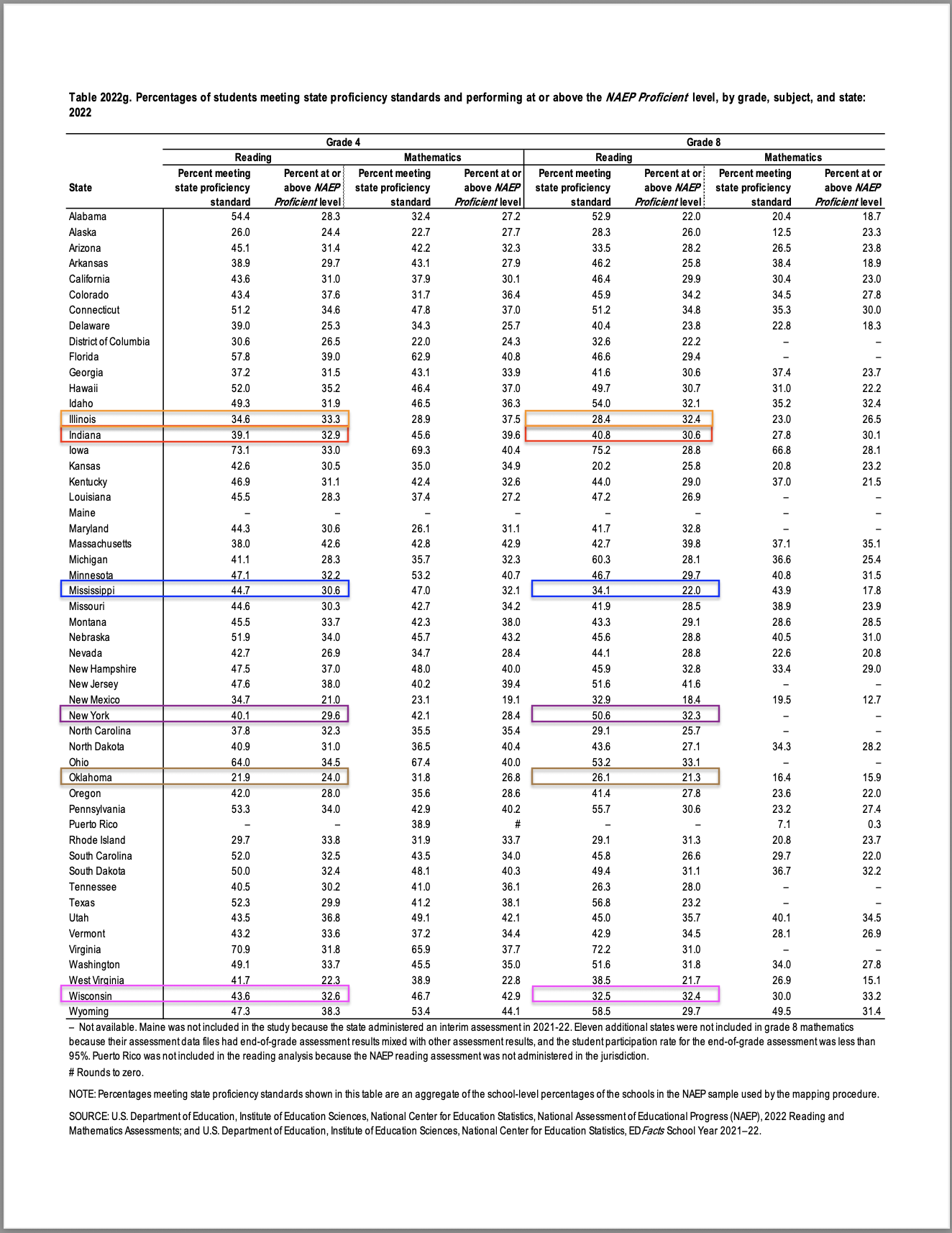
Here are some fun facts, however, about Indiana and other states: These state proficiency gains are equal to NAEP basic, which, again, SOR advocates refuse to acknowledge when discussing the state of reading the US today; note the correlations below of states with NAEP proficient (appears to be nothing to celebrate, right, if we accept the original bait that NAEP proficient is the correct standard?):
While I do maintain that crisis rhetoric isn’t an effective approach to education reform—especially when that crisis is built on misinformation and misunderstanding test data—I will concede there is a reading reform crisis driven by market, political, and ideological agendas among the adults who seem more interested in scoring gotcha points and profiting off reform than improving student reading.
First, the most current evidence available suggests that reading reform that appears to raise test scores in the short term only is primarily driven by grade retention, not changing reading programs, teacher training, or instruction.
Next, recent research again reveals “63% of the variance in test performance was explained by social capital family income variables that influence the development of background knowledge,” leading the researchers to argue:
The influence of family social capital variables manifests itself in standardized test results. Policy makers and education leaders should rethink the current reliance on standardized test results as the deciding factor to make decisions about student achievement, teacher quality, school effectiveness, and school leader quality. In effect, policies that use standardized test results to evaluate, reward, and sanction students and school personnel are doing nothing more than rewarding schools that serve advantaged students and punishing schools that serve disadvantaged students.
One of the political purposes of NAEP is to hold states accountable for state assessments. If you look carefully at the correlation above, students moving from one state to another would result in that student being labeled differently in terms of reading achievement [2].
Despite the negative responses to my argument, I maintain that the US needs a common standard for age-level reading that includes clear achievement levels that can support valid reading reform and develop a data base that better reflects if reform produces higher student achievement.
We cannot and should not be shouting “crisis” because we do not have the data to draw any valid conclusions about the overall state of reading in the US.
What we do have is permanent reform for the market and political benefit of those perpetuating crisis rhetoric and selling solutions.
The current state of NAEP and state testing allows rampant market and political manipulation of claims about reading and reading reform.
To maintain permanent crisis and reform, many are willing to sacrifice students, teachers, and public schools.
I am not.
[1] For some background on changes to how tests measure student achievement, I recommend exploring the controversial and often misunderstood re-centering of the SAT.
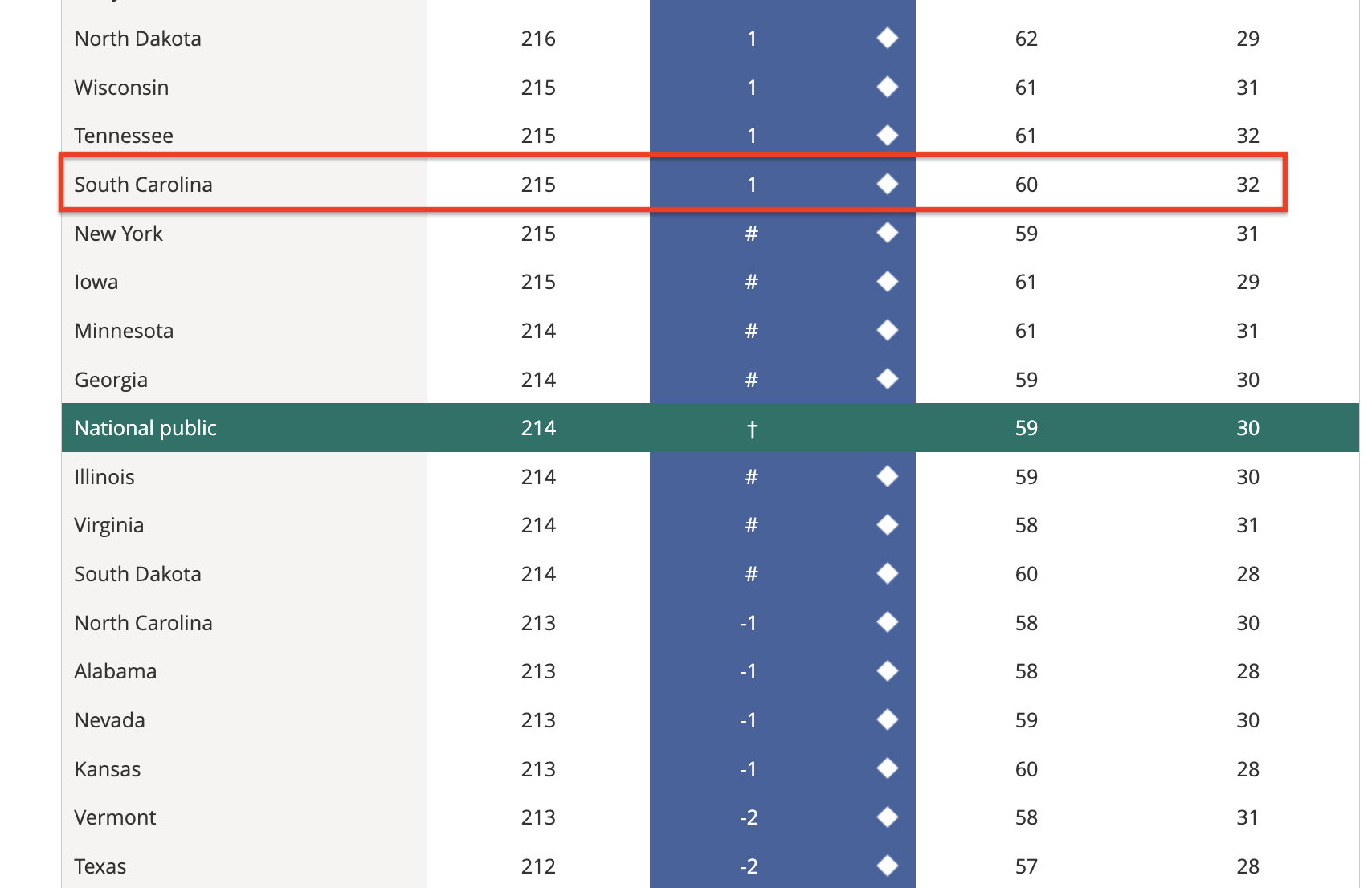
The reading proficiency bait-and-switch has come to South Carolina (another grade retention state that has much lower grade 8 reading scores than grade 4; see below):
This is more partisan political grandstanding, but the grandstanding in on incredibly thin ice.
SC, like IN above, sets state reading proficiency in the NAEP basic range; however, note that SC is toward the lower end of basic (see the correlations above).
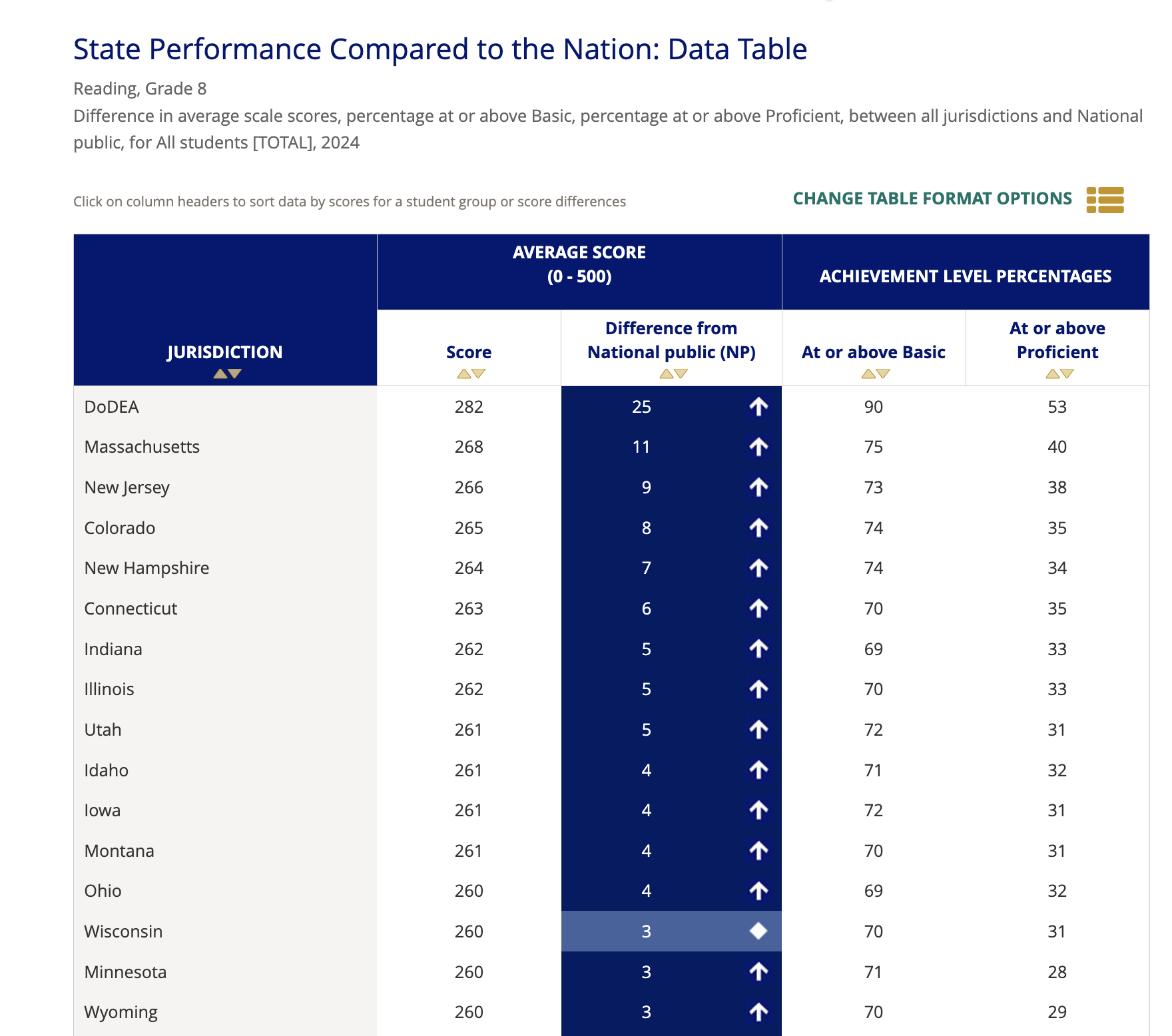
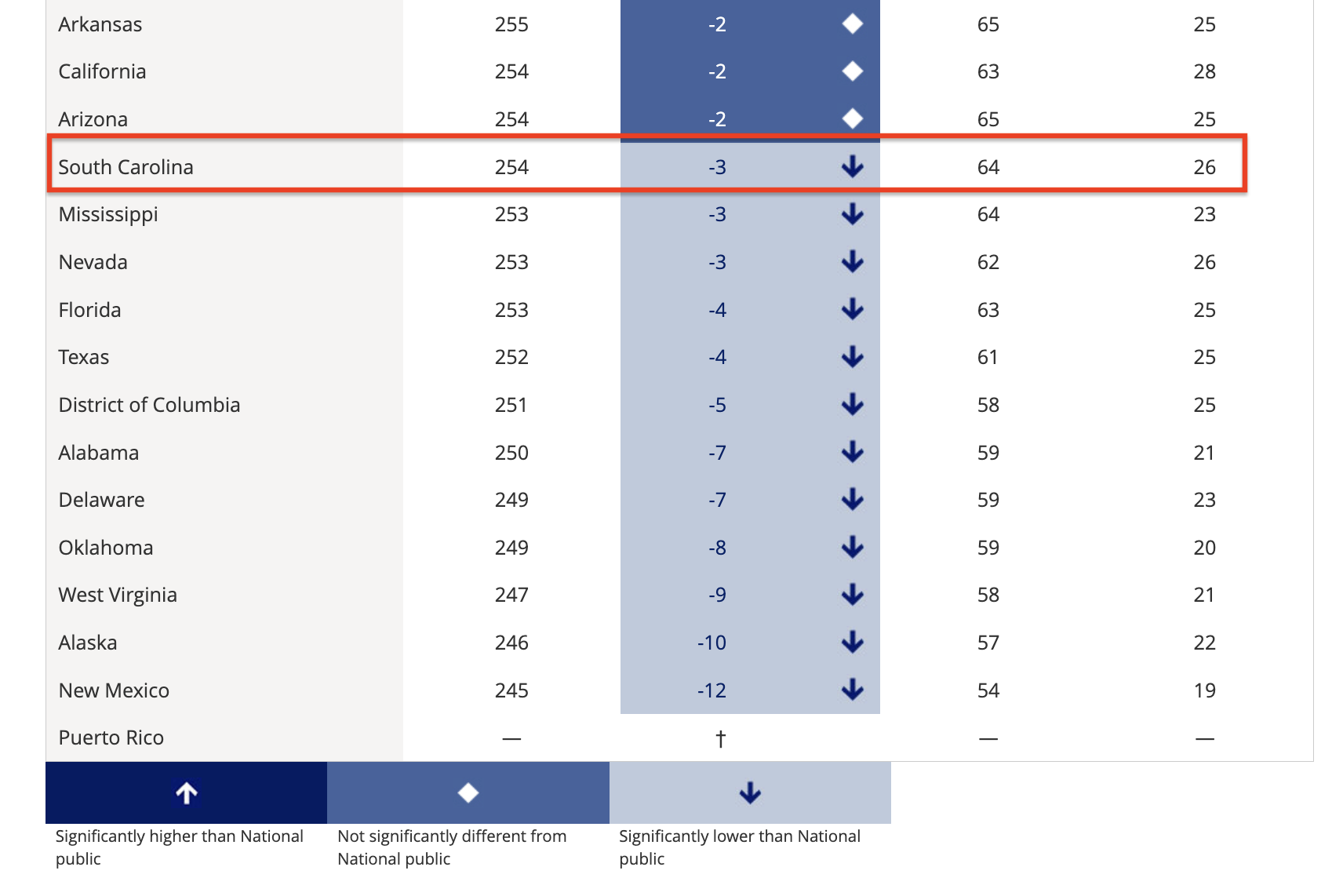
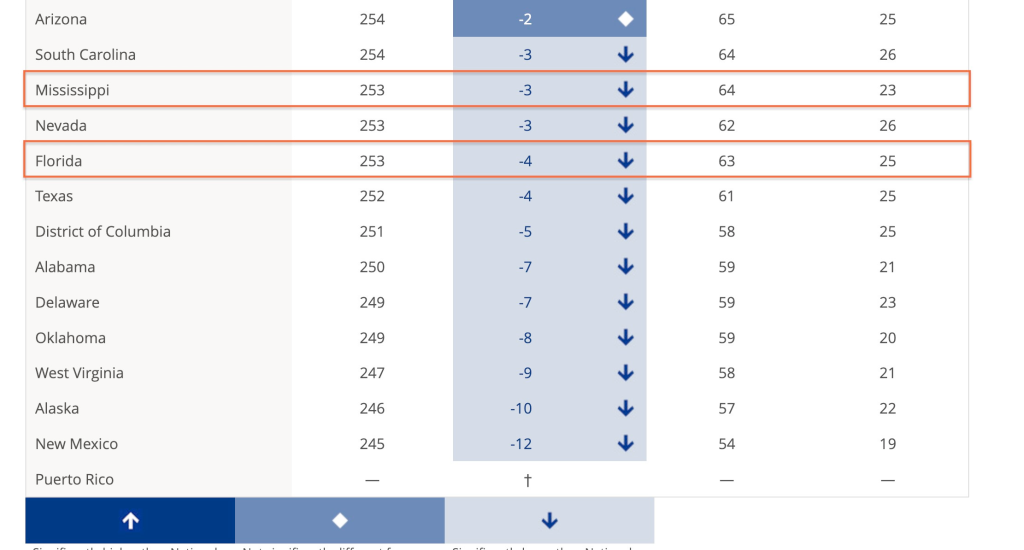
SC sits just above the national average in grade 4 reading (2024), but like MS and FL, the impact of grade retention seems to be in play because by grade 8, SC falls down toward the bottom, again similar to MS and FL:
Here are the highlights, although I recommend reading the entire piece:
In 1748, famed Scot David Hume defined nature. He elaborated such a law as “a regularity of past experience projected by the mind to future cases”. He argued that the evidence for a miracle is rarely sufficient to suspend rational belief because a closer look has always revealed that what was reported as a miracle was more likely false, resulting from misperception, mistransmission, or deception….
A careful examination confirms that enthusiasm to emulate Mississippi should be tempered with scepticism….
This provides a boost of about $111.63 of extra funding annually for each pupil. Comparing this amount to what are annual contemporary per pupil expenditures nationally, we have to agree that if such small expenditures can make a visible difference in student performance it truly is a miracle – a Mississippi version of St. John’s loaves and fishes.
But it was the second component of the Mississippi Miracle, a new retention policy, perhaps inspired by New Orleans’ Katrina disaster a decade earlier, that is likely to be the key to their success….
Prior to 2013, a higher percentage of third-graders moved on to the fourth grade and took the NAEP fourth-grade reading test. After 2013, only those students who did well enough in reading moved on to the fourth grade and took the test.
It is a fact of arithmetic that the mean score of any data set always increases if you delete some of the lowest scores (what is technically called “left truncation of the score distribution”)….
Strangely though, for the eighth-grade literacy test, the state’s rank dropped to a tie for 42nd place!…
(Note that this works especially well for student height, for after retaining the shortest third-graders for an extra year they will likely be taller when they are measured again a year later. It would be nice if the same were true for students struggling in academic subjects.)…
Were we to do this we would find that most of Mississippi’s gains are due to the retention rate.
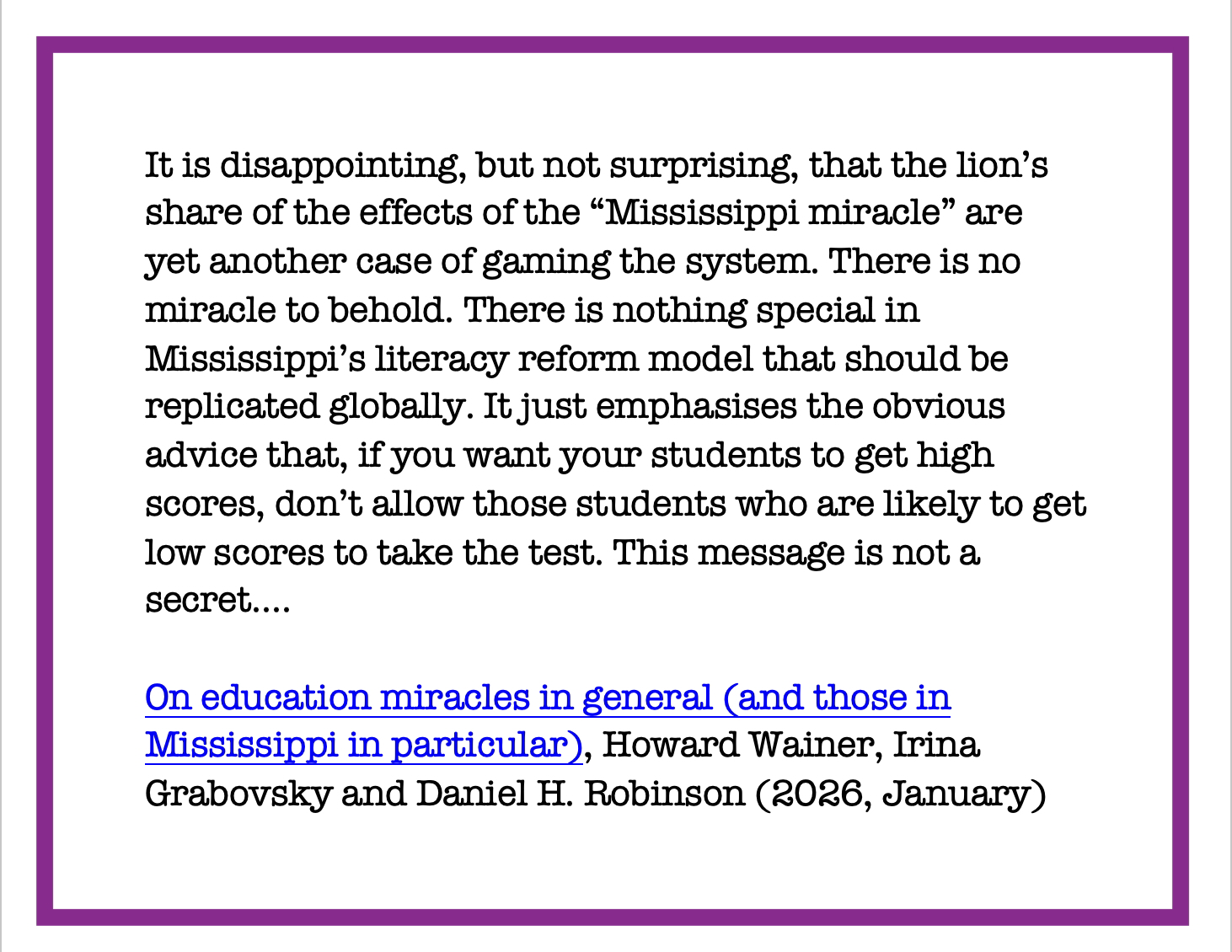
It is disappointing, but not surprising, that the lion’s share of the effects of the “Mississippi miracle” are yet another case of gaming the system. There is no miracle to behold. There is nothing special in Mississippi’s literacy reform model that should be replicated globally. It just emphasises the obvious advice that, if you want your students to get high scores, don’t allow those students who are likely to get low scores to take the test. This message is not a secret….
Find a way to prevent the lowest test scorers from taking the exam and the average score will increase….
Second, besides weak empirical data, educational reformers like Patrinos should have given greater weight to the extant literature on the Mississippi Miracle. The miracle had already been convincingly debunked.10 Fourth-grade gains had vanished by the time the students reached eighth grade.
Question 1: Why is Mississippi retaining about 9000-12,000 K-3 students annually since 2014?
One of the key assertions of the “science of reading” (SOR) movement is that students across the US are mostly not proficient readers because teachers rely on balanced literacy to teach reading.
Certainly, a decade is enough time to reach the 95% rate of proficiency, and thus, retention numbers should have dropped dramatically or be near 0.
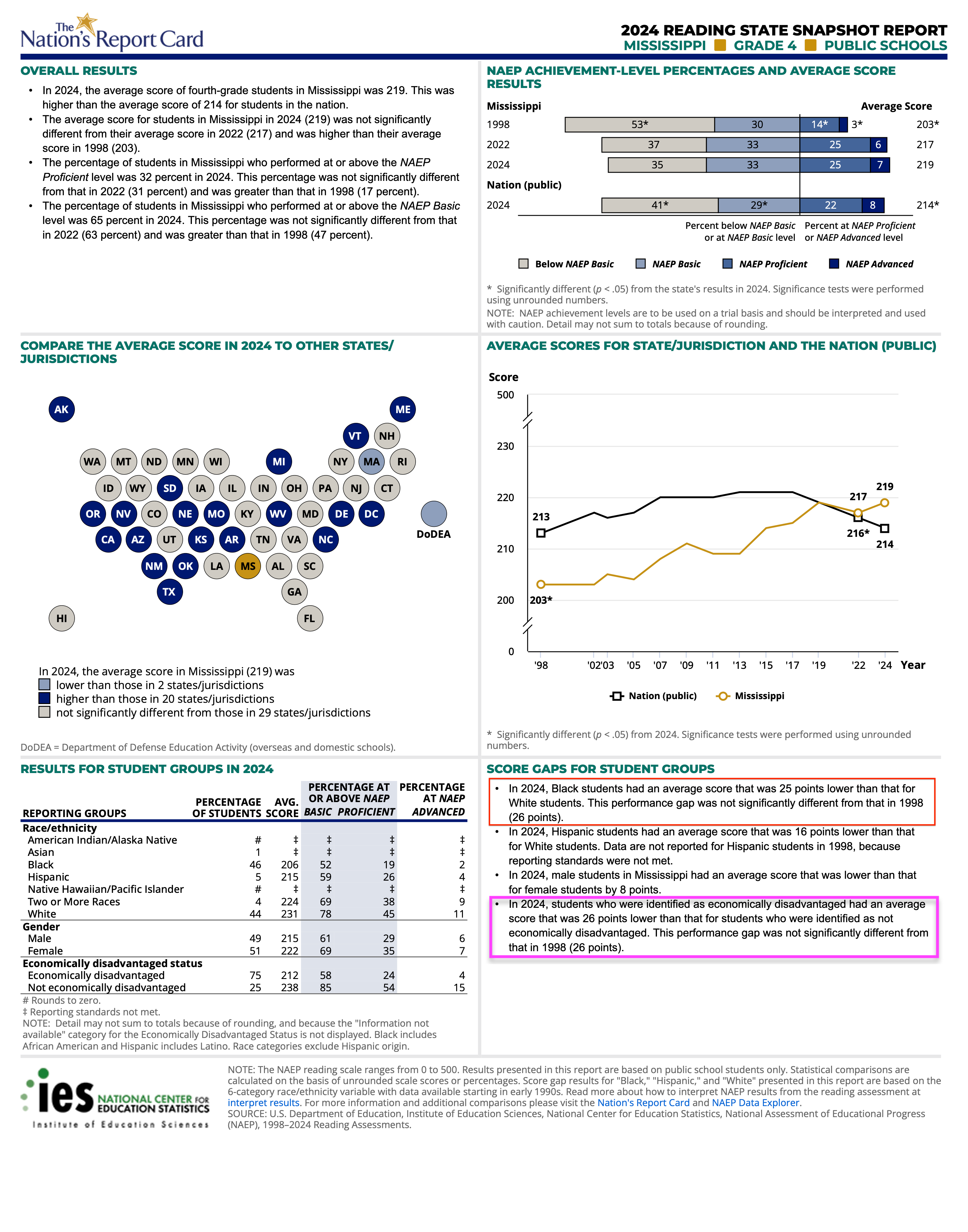
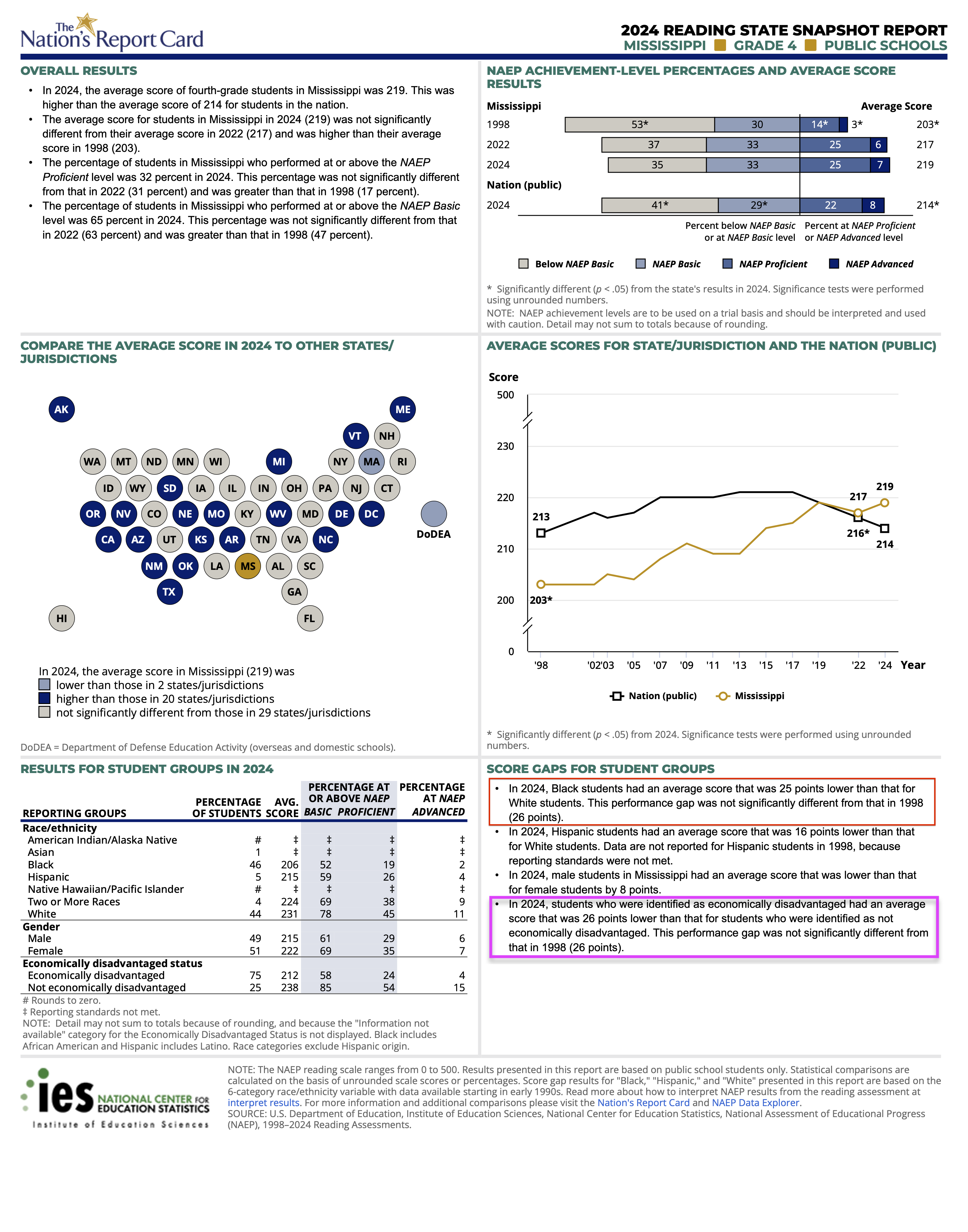
Question 2: How is Mississippi a “miracle” if the achievement gap for race and socioeconomic status is the same as 1998?
As shown in MS’s 2024 NAEP reading scores for grade 4:
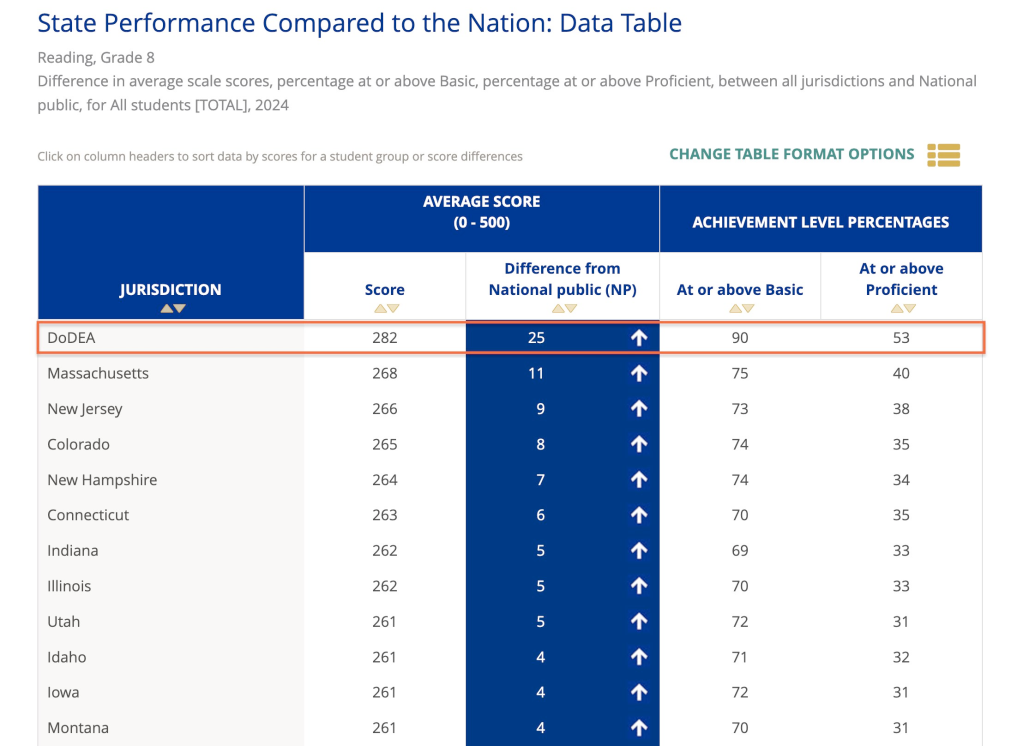
Question 3: Why has Mississippi’s grade 8 NAEP scores remained in the bottom 25% of states despite the grade 4 NAEP scores jumping into the top 25%?
For 2024, MS NAEP grade 8 reading scores drop to eleventh from the bottom of state scores:
An analysis of reading reform found that states with comprehensive reform that includes grade retention have experienced short-term increases in test scores.
However, the analysis does not identify why these comprehensive reforms (including grade retention) are correlated with those short-term scores increases.
Research on education “miracles” have found that virtually none exist, and even when a school or program appears to be “high flying” there is little evidence those can be scaled up meaningfully.
Mississippi’s grade 4 NAEP scores in reading, then, raise questions that must be answered; instead, it is now politically cool to adopt copy-cat legislation from the state without proper evidence that there is valid success or a solid understanding of what is happening and why.
Likely the most influential standardized test in the US is the National Assessment of Educational Progress (NAEP), under the purview of the beleaguered US Department of Education.
Also without question, NAEP is one of the most misunderstood and misrepresented standardized tests since the mainstream media, political leaders, pundits, and the public routinely shout “Crisis!” with each release of NAEP data.
NAEP’s achievement levels are misleading at best, but at worst, those achievement levels were designed to create the appearance of perpetuate educational failure, and yes, crisis.
“Proficient” is almost always conflated with “grade level” resulting in false claims, for example, that 2/3 of fourth graders are reading below grade level. NAEP’s “basic” is approximately what most states identify as “proficient”—suggesting on grade level (see an extensive analysis here).
What most people misunderstand as well about NAEP is its purpose: NAEP was born in the fertile soil of high-stakes accountability education reform spurred by the Reagan administration’s propaganda A Nation at Risk. Reagan sought to reintroduce forced prayer in schools and wanted to close the Department of Education, labeled an “abomination.”
However, what Reagan spawned was over four decades of ever-changing standards and tests to hold schools, teachers, and students accountable. In short, NAEP was created as a test of random samples of students to hold states accountable for their educational standards and outcomes (historically, public education has been the responsibility of the states, and NCLB in 2001 was a departure toward more federal oversight).
Frankly, NAEP was designed as an accountability mechanism, not a way to provide feedback on individual student achievement. (Note that state-level accountability testing was designed to provide individual student assessment that should provide evidence for instruction.)
In 2025, on the heels of recent shouts of “Crisis!” (again) because almost everyone has misunderstood and misrepresented NAEP scores across math, reading, and even civics, Reagan’s dream may be coming true since the Trump administration has promised to end the USDOE, and that move imperils the future of NAEP.
As Peter Greene has confronted, some have taken this uncertainty about NAEP to propose turning NAEP into (you should pause here to prepare yourself for the inanity) the failed Common Core experiment that sought to replace the state-based public education accountability process with national standards and testing.
Into the nonsense that is NAEP historically and the current doubling-down on Common Core Redux, I want to make a modest proposal about the future of NAEP.
Actually I want to make two modest proposals, acknowledging that the first is never going to happen (although it is the one more strongly supported by empirical data; you know, the “science” that so many education reformers claim to worship).
I strongly reject standardized testing as well as traditional classroom testing and grades. That has been at the core of my 40-plus-year career, and again, this is informed not just by my experiences as an educator but by a very robust body of research.
Therefore, my first modest (and completely unrealistic in the US) proposal is the conclusions reached by Maron and Tienken:
Almost 63% of the variance in test performance was explained by social capital family income variables that influence the development of background knowledge. Background knowledge is a known predictor of standardized test results. Family income variables are immutable by schools. Only public policies, outside the control of school personnel, can influence family income.
The United States has one of the highest levels of childhood poverty among Organisation of Economic Co-operation and Development (OECD) countries. It is well known that the social safety net in the United States is not as strong as some nations in Europe and other parts of the world [20]. Neoliberal policies have greatly reduced government support for families in the United States. Important social policy frameworks that reduce poverty, such as monetary, labor, fiscal, and health policies, have been weakened over the last 40 years, causing increases in childhood poverty in the United States compared to other democratic countries [41].
Although some education policy makers in the United States claim that standardized test results are an important component of a comprehensive system of educational quality control, the results from decades of research on the topic suggest otherwise [42]. The influence of family social capital variables manifests itself in standardized test results. Policy makers and education leaders should rethink the current reliance on standardized test results as the deciding factor to make decisions about student achievement, teacher quality, school effectiveness, and school leader quality. In effect, policies that use standardized test results to evaluate, reward, and sanction students and school personnel are doing nothing more than rewarding schools that serve advantaged students and punishing schools that serve disadvantaged students.
Alas, the US will never follow this last point because we refuse to acknowledge systemic forces and remain a people fatally committed to rugged individualism and bootstrap mythologies.
And thus, here is my compromise, a modest proposal that can and should be explored for the future of NAEP:
Rename achievement levels in standardized testing that share a national standard metric for the levels (all states and NAEP would share the same achievement levels and metric).
Achievement levels must be age-level and not grade-level(currently, using “grade level” allows states to game scores through grade retention, for example). A clear system of “below age level,” “age level,” and “above age level” would simplify reporting and allow for more accurate political, media, and public responses to data.
This proposal would be a first step, I hope. The problem at first is that this doesn’t address the excessive testing culture the US has embraced without positive outcomes for over forty years.
This first step, I think, can create a new basis for evaluating and viewing our public schools, and then, we may be primed to begin dismantling the standardized testing machine—or at least become more acclimated to reducing it dramatically.
The great irony of the power of high-stakes testing in the education accountability era is that it has proven only one thing: Weighing a pig does not make it fatter.
Testing, testing, and testing has not improved schools, teachers, or students, but it has created a perpetuate state of educational crisis.
Perpetual educational crisis serves only political agendas and the unquenchable education marketplace.
If we can entertain for a moment of idealism that the Trump disaster doesn’t destroy both the USDOE and public education, let’s consider how to more forward in ways that better serve the promise of public education and our fragile democracy.
If not an end to NAEP, at least a better NAEP that serves the interest of students and not political or market agendas?
Yesterday, we had our last class session in my upper-level writing and research course that is grounded in students analyzing and evaluating how media covers a chosen education topic.
In that last class, we debriefed about what students concluded about media coverage of education. While some found the coverage valid and informative, much of the discussion focused on why media perpetuates misinformation more often than not—notably about student reading proficiency in the US.
Right on cue, then, I saw this posted on social media, Teaching reading is rocket science, with these two recurring claims that are, in fact, misleading at best and false at worst (see “Recommended” links below):
Eli’s story, and the stories of all my students, are not the exception. They represent the shared reality for two-thirds of our children, here in California and across the country since the 1990s. My students are not at risk because they cannot yet read — they are at risk because not knowing how to read limits their access to opportunities, both academically and beyond.
Research shows when we teach students to read by directly guiding them to break the code of how sounds in letters work, about 95% of them can become strong readers — including multilingual learners and those with dyslexia. So why have only one-third of our fourth graders been reading at grade level for the past three decades? This gap persists because students haven’t had access to evidence-based literacy instruction drawn from decades of vast interdisciplinary research in areas such as cognitive psychology, linguistics, communication sciences and education.
The “2/3 of students are not reading a grade level” claim is one of the most powerful recurring claims in the media. Note these high-profile examples:
The stakes were high. Research shows that children who don’t learn to read by the end of third grade are likely to remain poor readers for the rest of their lives, and they’re likely to fall behind in other academic areas, too. People who struggle with reading are more likely to drop out of high school, to end up in the criminal justice system, and to live in poverty. But as a nation, we’ve come to accept a high percentage of kids not reading well. More than 60 percent of American fourth-graders are not proficient readers, according to the National Assessment of Educational Progress, and it’s been that way since testing began in the 1990s.
One of the most bearish statistics for the future of the United States is this: Two-thirds of fourth graders in the United States are not proficient in reading.
Despite ample evidence to the contrary and repeated clarifications from many educators and scholars (See “Big Lie” link in “Recommended” below), media characterizations of student reading proficiency continues to be misrepresented, primarily by misunderstanding NAEP achievement levels, because the public has always believed that “kids today can’t read”—despite there being little evidence of a reading “crisis” over the recurring claims of “crisis” reaching back into at least the 1940s.
Two points are important to clarify:
NAEP achievement levels are confusing because “basic” is approximately what most states consider “proficient” and by implication “grade level.” NAEP “proficient” is well above grade level, set at an “aspirational” [1] level that is misleading and creates a perpetual appearance of failure for students, teachers, and schools.
Most states—notably Mississippi and Louisiana—set their “proficient” level just above the mid-point of NAEP “basic” (MS) or just below (LA):
In short, if we consider NAEP and state assessments of reading valid, about 1/3 of students have over the last couple of decades performed below “basic” (NAEP) and thus seem to be below grade level in grade 4.
While the NAEP misinformation and misunderstanding is grounded in the “aspirational” use of “proficient,” the “95% of students can be on grade level” claim is just wildly overstated, and ironically, not based on scientific evidence (despite this being a refrain by the “science of” movement).
Historically and currently, many in the US have been and are concerned about student reading acquisition; this, of course, is a valid concern, notably that marginalized and vulnerable populations of students are disproportionately struggling to meet whatever standard we set for “proficient” or “grade level” (see HERE that explores how MS has not closed the race or socioeconomic achievement gaps, for example).
There is an insidious zombie politics to claims about 2/3 of students not reading at grade level, but that if we just did the right thing, 95% of students would read at grade level.
Since neither claim is empirically true, we must confront that basing education claims and reform on misunderstanding and misinformation have not yet worked and are unlikely to work moving forward.
Note
[1] Rosenberg, B. (2004, May). What’s proficient? The No Child Left Behind Act and the many meanings of proficiency. Washington, DC: American Federation of Teachers. https://files.eric.ed.gov/fulltext/ED497886.pdf
Join us for a timely and vital conversation on April 16 at 6:30 p.m. ET with Dr. P.L. Thomas, Professor of Education at Furman University. For decades, media and policymakers have pushed a narrative that America’s public schools are “failing.” But who benefits from this story, and who is harmed by it? Dr. Thomas will expose how the education reform industry has fueled a false crisis, undermining trust in public schools while advancing corporate-driven reforms. Drawing on his experience as a teacher, scholar, and national award-winning writer, Dr. Thomas will offer critical insights into how we can challenge disinformation and reclaim a narrative rooted in equity, democracy, and community empowerment.
Education reform, however, was never about improving learning or teaching, but about ideological agendas, conservative agendas.
The crisis/miracle cycles started with that Texas “miracle,” but included the Chicago “miracle” (to bolster Arne Duncan), the DC “miracle” (to promote Michelle Rhee’s grift), and the Harlem “miracle” (that solidly merged education reform as bi-partisan under Obama with the help of grifter Duncan).
What may prove to be the most successful (and harmful) “miracle,” however, is the media manufactured Mississippi “miracle,” grounded in 2019 NAEP scores.
Six years later, the real end game of these manufactured and false “miracles” are merging with an initial effort by W. Bush—de-professionalizing teachers with scripted curriculum. Note the connection in a recent misleading but recurring endorsement by Patrinos (from the Department of Education Reform, funded by Walton money in Arkansas) of that Mississippi “miracle”:
After taking a swipe at NCTE, Korbey makes the same but false connection as Patrinos above:
Nearly all the states that have seen reading scores improve recently – including Mississippi, Louisiana, Tennessee and Alabama – have changed state law to encourage districts to choose from approved lists of HQIM.
Conveniently omitted in public advocacy and endorsements of scripted curriculum, is that this is a correlation; however, research has shown that curriculum, instruction, and teacher training are not the keys to increased test scores. Grade retention is:
[S]tates whose policies mandate third-grade retention see significant and persistent increases in high-stakes reading scores in all cohorts…. [T]here is no consistent evidence that high-stakes reading scores increase in states without a retention component.
And another omission is that research has shown scripted reading programs de-professionalize teachers, fail to serve the individual needs of students, and have “whitewashed” the curriculum, alienating the most under-served students in our schools [see Recommended below].
And thus, the end game:
Musk: If you have a classroom of 25 or 30 kids, it is literally impossible to spend time with every kid individually or you can spend to little time.. But what you can do is set them up with ai.. pic.twitter.com/tAcySW2zTE
Education reform is dedicated to perpetual education crisis for market and political goal.
Scripted curriculum, then, is not designed to improve reading proficiency, but to create one more step toward AI replacing teachers the same way self-checkout replaced cashiers in our grocery stores.
I almost feel sorry for Louisiana. (See Update 2 below)
When the 2024 reading scores for NAEP were released, LA seemed poised to be the education “miracle” of the moment for the media and political leaders.
Since mainstream media seems to know only a few stories when covering education—outliers, crises, and miracles—the outlier gains by LA compared to the rest of the nation, reportedly still trapped in the post-Covid “learning loss,” was ripe for yet another round of manufacturing educational “miracles.”
To maintain the MS “miracle” message, journalists must work incredibly hard to report selectively, and badly.
For example, Aldeman celebrates, again, MS as a outlier for for the achievement of the bottom 10% of students (carelessly disregarding that outlier data is statistically meaningless when making broad general claims):
But one state is bucking this trend: Mississippi. Indeed, there’s been a fair amount of coverage of Mississippi’s reading progress in recent years, but its gains are so impressive that they merit another look.
Next, Aldeman highlights reading gains by Black students in MS, omitting a damning fact about the achievement of Black (and poor) students in MS (which mirrors the entire nation):
That’s right, MS has the same racial and socio-economic achievement gaps since 1998, discrediting anything like a “miracle.”
But the likely most egregious misrepresentation of MS as a reading “miracle” is Aldeman “debunking” claims that MS gains are primarily grounded in grade retention, not the “science of reading.”
Notably, Aldeman seems to think linking to the Fordham Institute constitutes credible evidence; it isn’t.
So let’s look at the full picture about grade retention and MS’s reading scores on NAEP.
First, the research on increased reading achievement has found that only states with retention have seen score increases. Westall and Cummings concluded in a report on reading policy: “[S]tates whose policies mandate third-grade retention see significant and persistent increases in high-stakes reading scores in all cohorts…. [T]here is no consistent evidence that high-stakes reading scores increase in states without a retention component [emphasis added].” [Note that Aldeman selective refers to this study late in the article, but omits this conclusion.]
The positive impact of retention on test scores has not been debunked, but confirmed. What hasn’t been confirmed is that test score gains are actual achievement gains in reading acquisition.
Next, MS (like FL and SC, for example) has risen into the top 25% of states in grade 4 reading on NAEP, but then plummets into the bottom 25% of states by grade 8 (despite their reading reform having been implemented for over a decade), suggesting those grade 4 scores are a mirage and not a miracle:
A final point is that media always omits the most important story, what research has shown for decades about student achievement:
Almost 63% of the variance in test performance was explained by social capital family income variables…. The influence of family social capital variables manifests itself in standardized test results. Policy makers and education leaders should rethink the current reliance on standardized test results as the deciding factor to make decisions about student achievement, teacher quality, school effectiveness, and school leader quality. In effect, policies that use standardized test results to evaluate, reward, and sanction students and school personnel are doing nothing more than rewarding schools that serve advantaged students and punishing schools that serve disadvantaged students.
High-poverty states and states with high percentages of so-called racial minorities are not, in fact, beating the odds—again, note that states have not closed the racial achievement gap or the socio-economic achievement gap.
Yes, too often our schools are failing our most vulnerable students. But the greater failures are the lack of political will to address the inequity in the lives of children and the lazy and misleading journalism of the mainstream media covering education.
The goal is de-professionalizing teachers and teaching, not improving student reading proficiency.
Updated 2
The political, market, and media hype over both MS and LA are harmful because that misrepresentation and exaggeration drive the fruitless crisis/reform cycles in education and distracts reform from the larger and more impactful causes of student achievement.
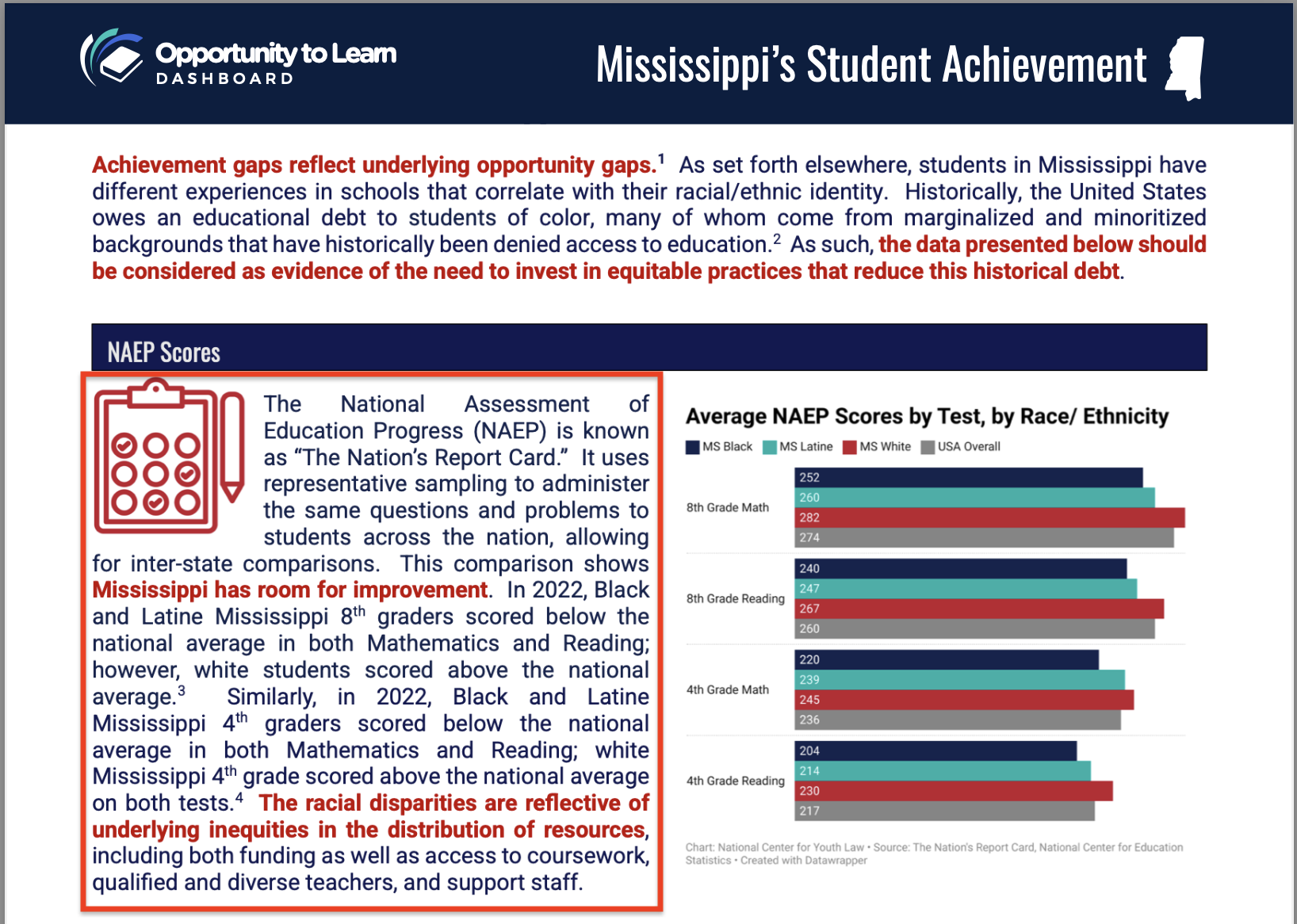
Funded and maintained by the National Center for Youth Law (NCYL) and The Schott Foundation for Public Education, the Opportunity to Learn Dashboard tracks 18 indicators across 16 states. The project seeks to provide information about factors impacting the degree to which children of different ethnicities and races are exposed to environments conducive to learning.
However, indicators directly related to schools explain only a minority of the variation in achievement-related outcomes. Therefore, the dashboard includes out-of-school factors such as access to health insurance and affordable housing, as well as within-school factors such as exposure to challenging curricula and special education spending.
For both MS and LA, we must acknowledge the significant and robust systemic (out-of-school) disadvantages minoritized and impoverished students continue to face in both states:
Note here my points raised about lingering opportunity/achievement gaps exposed by NAEP scores in both states:
To emphasize again, NAEP scores do not reveal education “miracles” in either MS or LA. In fact, NAEP scores continue to show that education reform as usual is a failure.
Returning Pencil Buster Dr. Paul Thomas joins us to help us break down the “science of reading.” This is a topic we’ve covered frequently, most recently with Dr. Nancy Carlsson-Paige this week. But Dr. Paul brings a uniquely nuanced and deep knowledge of the marketing scheme/regressive conservative political tool masquerading as a curriculum set to the show. Because Dr. Paul’s dug deep, and with his 40+ year career as a literacy educator, writer, and speaker he is one educated educator on the topic. Don’t be fooled by their talk of “science”, Dr. Paul urges us. It is a method for censorship and limiting of educators. We can do so much better. And our students deserve so much better. Yet conservative lawamakers have written laws literally banning the teaching of anything except the so-called “science of reading.” Come on, let’s not remove tools from our educators’ literacy teaching kits. That’s just foolish.
BustED Pencils: Fully Leaded Education Talk is part of Civic Media. Subscribe to the podcast to be sure not to miss out on a single episode! To learn more about the show and all of the programming across the Civic Media network, head over to https://civicmedia.us/shows. Join the conversation by calling or texting us at 608-557-8577 to leave a message!
educator, public scholar, poet&writer – academic freedom isn't free














 dr. p.l. (paul) thomas