George W. Bush built his path to the presidency on education reform, the discredited Texas “miracle,” and manufacturing his persona as a kinder and gentler conservative. One of his most effective rhetorical flourishes was evoking the “soft bigotry of low expectations.”
During the Bush era of education reform in the 1990s and 2000s, charter schools increasingly received bipartisan support, notably under the Barack Obama administration.
The darling of that charter school movement was KIPP charter schools that popularized “no excuses” education.
More recently, declaring poverty an excuse in education was established in the “science of reading” manufactured reading crisis: “One of the excuses educators have long offered to explain America’s poor reading performance is poverty” (Emily Hanford, Hard Words).
While Hanford’s misleading and false story caught fire, fueling another reading crisis and state-by-state dismantling of reading instruction, Gerald Coles‘s careful and evidence-based discrediting of Hanford’s claims went mostly unacknowledged:
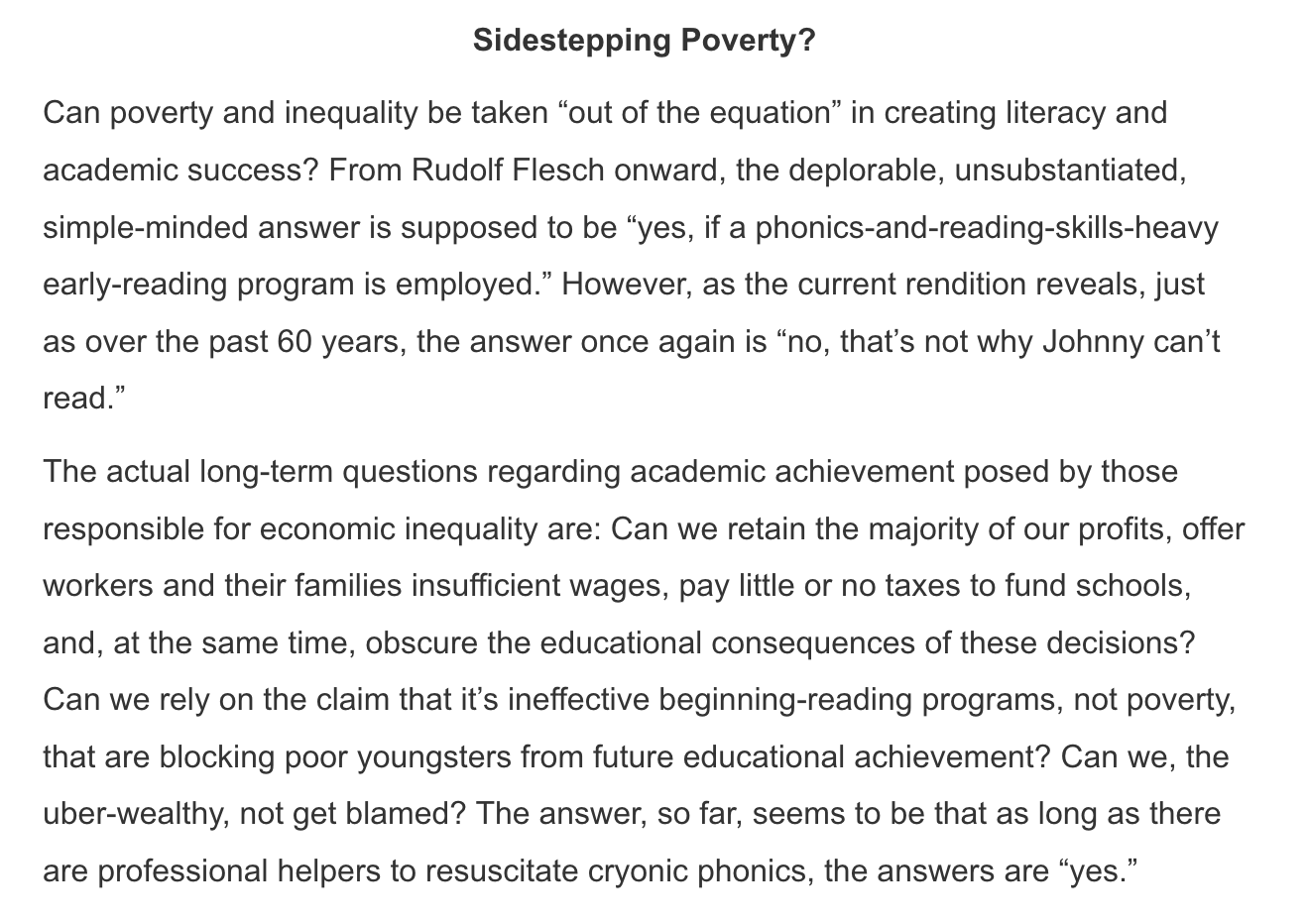
Can poverty and inequality be taken “out of the equation” in creating literacy and academic success? From Rudolf Flesch onward, the deplorable, unsubstantiated, simple-minded answer is supposed to be “yes, if a phonics-and-reading-skills-heavy early-reading program is employed.” However, as the current rendition reveals, just as over the past 60 years, the answer once again is “no, that’s not why Johnny can’t read.”
Decades of research, notably including the evidence created by the value-added methods of teacher education under Obama, confirm Coles, not Hanford or Bush or KIPP.
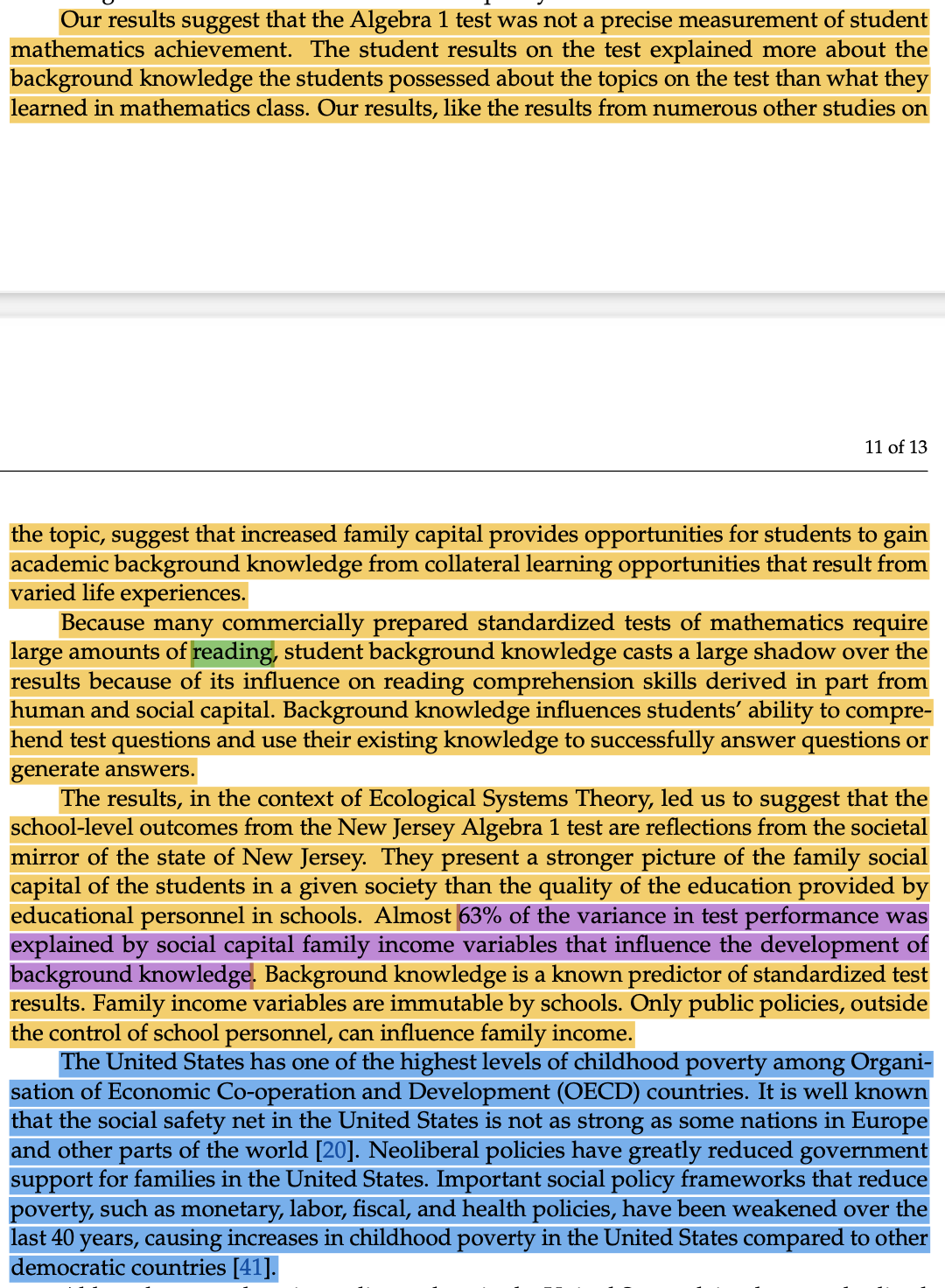
For example, consider the overwhelming evidence that poverty and out-of-school factors are causally linked to at least 60% of measurable student achievement:
Maroun, Jamil, and Christopher H. Tienken. 2024. “The Pernicious Predictability of State-Mandated Tests of Academic Achievement in the United States” Education Sciences 14, no. 2: 129. https://doi.org/10.3390/educsci14020129
For any education reform to work, out-of-school factors must be addressed along with confronting the impact of inequity in schools.
Poverty is not an excuse, but a reality that education reformers refuse to acknowledge to the detriment of students, teachers, and public education.
Burrell, N., & Harbatkin, E. (2024). Beyond the school building: Examining the association between of out-of-school factors and multidimensional school grades. Education Policy Analysis Archives, 32. https://doi.org/10.14507/epaa.32.8497
Update 3
Dearing, E., Bustamante, A. S., Zachrisson, H. D., & Vandell, D. L. (2024). Accumulation of Opportunities Predicts the Educational Attainment and Adulthood Earnings of Children Born Into Low- Versus Higher-Income Households. Educational Researcher, 0(0). https://doi.org/10.3102/0013189X241283456
Abstract
Scholars theorize that “opportunity gaps” drive achievement disparities between children born into poverty versus affluence. In a 26-year longitudinal study (N = 814), we examine (a) economic disparity in children’s accumulation of opportunities—from birth through high school—at home, childcare, school, afterschool, and in the neighborhood; (b) the extent to which opportunity is linked with educational attainment and earnings in early adulthood; and (c) whether opportunity is most strongly associated with these adult outcomes for children from low-income households. We document large opportunity gaps between children from low- versus higher-income households. These opportunity gaps are strongly linked with educational attainment and earnings, particularly for low-income children, helping explain why household income in early childhood predicts these outcomes in adulthood.
Many educational philosophers have set forth relatively brief “What I Believe” statements, such as John Dewey. Also common is asking perspective teachers to express their beliefs about teaching, learning, students, assessment, etc.
Teachers are disproportionately practical and often balk at discussions of educational philosophy. But I argue that if we fail to express and examine our beliefs in the context of our practices, we are apt to behave in ways that contradict those beliefs.
As well, many of the important people in educational thought are consistently misunderstood and misrepresented (Dewey becomes the caricature of “learning by doing,” for example, the simplistic project method confronted by Lou LaBrant); therefore, the need to state in direct and somewhat accessible ways exactly what someone believes can be important, especially in the context of public discourse and debate.
As a critical educator and scholar, I find myself often an alien in almost all discussions and debates on education, not finding a home with any mainstream ideologies. Folk on many sides accuse me of being on the other side, and much of the debate is mired in false assumptions and accusations.
Many years ago when I was speaking in Arkansas about my then current book on poverty and education, some nasty “no excuses” advocates significantly misrepresented me in Education Next. Despite the author admitting the characterization wasn’t fair, the false attack remains in the article to this day.
That pattern of false assumptions has repeated itself in the “science of reading” (SOR) debate in part because SOR as reading reform is a subset of the larger 40-year accountability reform movement that I have long opposed: Fix the students by fixing the teachers, and fix the teachers by fixing the programs they are required to teach (with fidelity or as a script); all policed by standardized tests (that we know are biased by race, class, and gender).
The problem for me is that I oppose both the status quo and that standard reform paradigm, and my position garners me false attacks. The position, however, is expressed well in a work I co-edited almost a decade ago: Social context reform: A pedagogy of equity and opportunity.
The description of that work, I think, has an excellent and brief explanation:
Currently, both the status quo of public education and the “No Excuses” Reform policies are identical. The reform offers a popular and compelling narrative based on the meritocracy and rugged individualism myths that are supposed to define American idealism. This volume will refute this ideology by proposing Social Context Reform, a term coined by Paul Thomas which argues for educational change within a larger plan to reform social inequity—such as access to health care, food, higher employment, better wages and job security.
Also in our Introduction (which you can read here), we included a couple foundational paragraphs from my blogging in 2011:
“No Excuses” Reformers insist that the source of success and failure lies in each child and each teacher, requiring only the adequate level of effort to rise out of the circumstances not of her/his making. As well, “No Excuses” Reformers remain committed to addressing poverty solely or primarily through education, viewed as an opportunity offered each child and within which … effort will result in success.
Social Context Reformers have concluded that the source of success and failure lies primarily in the social and political forces that govern our lives. By acknowledging social privilege and inequity, Social Context Reformers are calling for education reform within a larger plan to reform social inequity—such as access to health care, food security, higher employment along with better wages and job security. (Thomas, 2011b, emphasis in the original)
Mainstream education reform is in-school only, and it makes demands on individual students and teachers, seeks the “right” instruction, the “right” program, and the “right” tests. It feeds what I consider to be racist and classist ideologies such as “grit” and growth mindset because everything depends on individual choices, standards, and behaviors (poverty, they say, is an excuse).
Simply stated, until social and school inequities are addressed, in-school only reform will always fail and continue to feed the crisis/reform cycle we have been mired in like Groundhog Day since A Nation at Risk.
When I show that SOR is a deeply misleading and doomed-to-fail reform movement, I am not endorsing the status quo; in fact, I have been fighting the literacy and school status quo since August 1984 when I entered the classroom.
I don’t really believe, I know that US society is criminally inequitable for children, amplified by social class, race, and gender.
I also know that formal schooling tends to amplify, not ameliorate, that inequity—and one of the greatest forces perpetuating inequity is the education reform movement grounded in accountability based on standardized testing.
I also know that petty adult fights about the “right” instruction or the “right” programs is always at the expense of a much more important question: How can we serve the needs of each and every student both in their lives and in their learning?
The false choice being presented between the status quo and education reform is a distraction from the work we should be doing (a distraction like the manufactured religion in Kurt Vonnegut’s Cat’s Cradle).
Both the status quo of formal education and the education reform movement are the work of authority, not the sort of radical change children and democracy deserve.
In the immortal words of John Mellencamp: “I fight authority, authority always wins.”
The key here is that the first article feeds into the misleading “miracle” narrative popular in media and political rhetoric about schools and the second asserts the “crisis” rhetoric about public education.
Media struggles with the third article topic—the exceptional achievement found in Department of Defense schools—and possibly the most telling quote in the article hits the nail on the head:
“If the Department of Defense schools were a state, we would all be traveling there to figure out what’s going on,” said Martin West, an education professor at Harvard who serves on the national exam’s governing board.
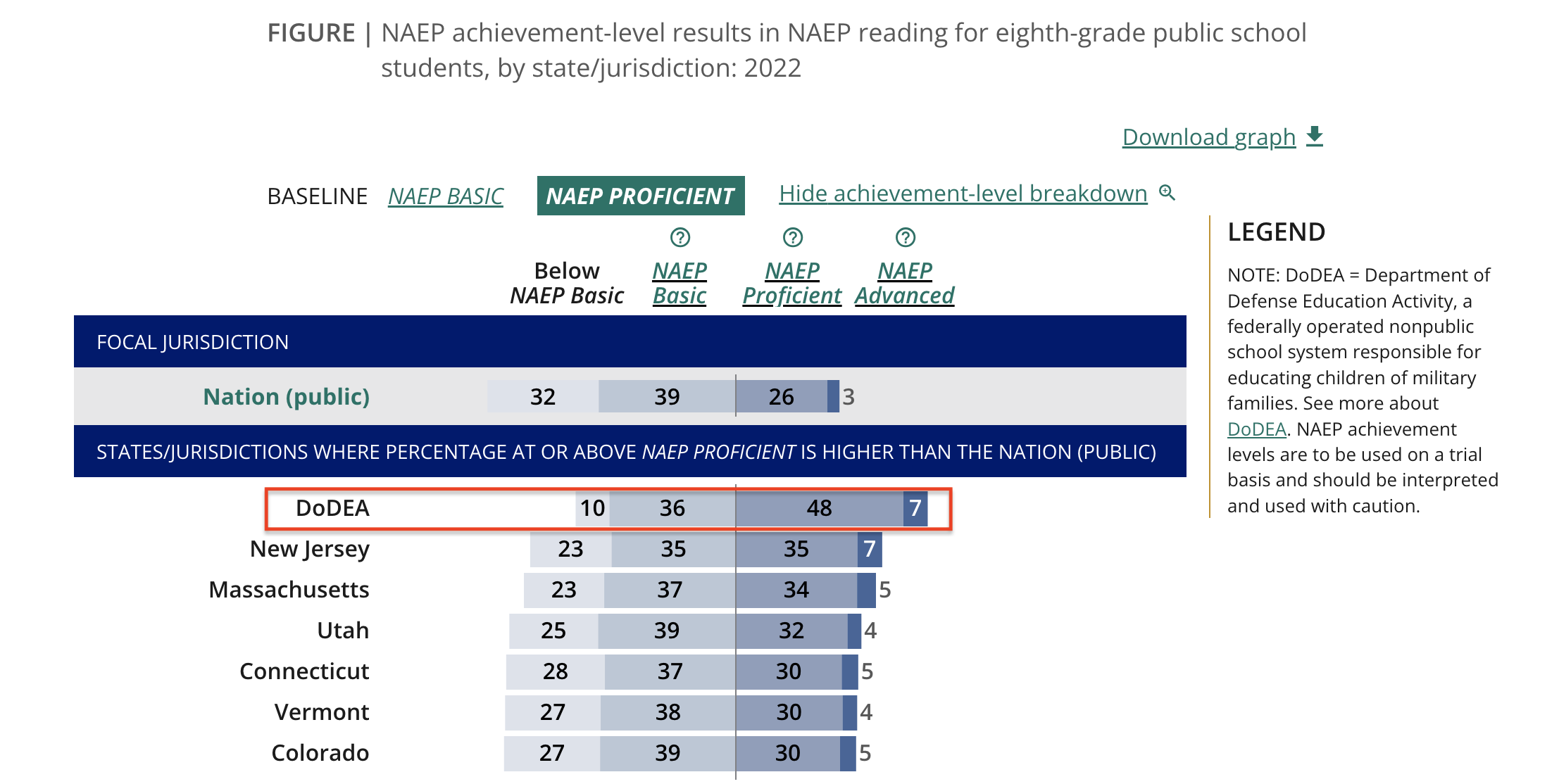
In a rare moment of almost getting things right about education and testing, the article highlights the outstanding achievement found in DoDEA schools:
Looking at reading achievement levels of NAEP is even more revealing:
While the media has dubbed MS a “miracle,” that same media struggles to understand the DoDEA success.
Why? Well, a few clues are in the article itself:
How does the military do it? In large part by operating a school system that is insulated from many of the problems plaguing American education.
Defense Department schools are well-funded, socioeconomically and racially integrated, and have a centralized structure that is not subject to the whims of school boards or mayors….
But there are key differences.
For starters, families have access to housing and health care through the military, and at least one parent has a job.
“Having as many of those basic needs met does help set the scene for learning to occur ,” said Jessica Thorne, the principal at E.A. White Elementary, a school of about 350 students.
Her teachers are also well paid, supported by a Pentagon budget that allocates $3 billion to its schools each year, far more than comparably sized school districts. While much of the money goes toward the complicated logistics of operating schools internationally, the Defense Department estimates that it spends about $25,000 per student, on par with the highest-spending states like New York, and far more than states like Arizona, where spending per student is about $10,000 a year .
“I doubled my income,” said Heather Ryan, a White Elementary teacher . Starting her career in Florida, she said she made $31,900; after transferring to the military, she earned $65,000. With more years of experience, she now pulls in $88,000.
Competitive salaries — scaled to education and experience levels — help retain teachers at a time when many are leaving the profession. At White Elementary, teachers typically have 10 to 15 years of experience, Ms. Thorne said.
Children with access to healthcare and food security, parents with stable incomes and housing, and well-paid faculty—these are all key to educational outcomes, many of us have argued for years, but the mainstream approach in the US for decades has been entirely focusing on in-school reform only—because the education establishment, conservatives argue, have used poverty as an excuse.
The reason DoDEA success is handled with a question and “may be” is that the evidence here is a message that is politically uncomfortable in the US: Education reform needs to be both social reform and school reform.
Credible reading scores (beyond grade 4) are about more than reading instruction or reading programs, but the DoDEA forces us to reconsider the “crisis”/”miracle” rhetoric and move beyond blaming teachers, reading ideologies, and reading programs.
Media and political leaders likely will let this story pass because “Logistical planning, including a predictable budget, ‘isn’t very sexy,’ but it is one key to success, said Thomas M. Brady, the director of Defense Department schools since 2014.”
So here is something we do know, but we are mostly unwilling to admit it: Poverty and inequity are not excuses, but tremendous barriers to the sort of opportunities all children deserve.
The success at DoDEA is certainly no miracle, but that success is the sort of model we should be using instead of the manufactured “miracle”/mirage of the day.
[NOTE: A PDF of this post as a presentation can be accessed HERE. See also a slightly revised presentation HERE. Please do not edit and please acknowledge this is my work if you use for instructional or public purposes.]
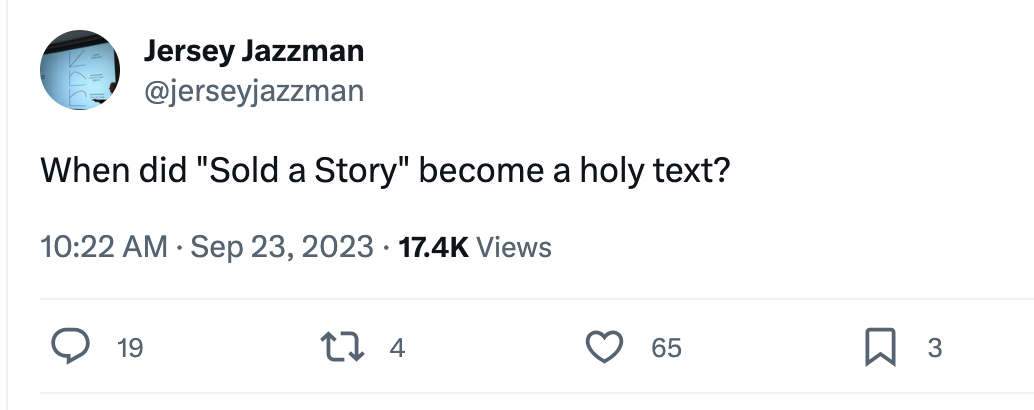
The answer is the anatomy of how media misinformation in 2018 wrapped in sensationalistic anecdotes has been replicated uncritically by dozens and dozens of journalists, resulting in that misinformation becoming “holy text,” or in other words, sacrosanct Truth.
Here, I offer the template that “Hard Words” created, and unlike journalists, I include links to research showing why the claims throughout the piece (and in its cousin, “Sold a Story”) are both false and shoddy journalism.
I.
The article begins with the Big Lie, one of the three biggest lies (along with citing the NRP report and NCTQ reports) in the “science of reading” (SOR) movement:
This is a fundamental misunderstanding of NAEP data. NAEP “proficient” is well above grade level, but “basic” is approximately what most states consider “grade level,” and thus, if anything, about 60-65% of students for several decades have been at or above grade level. That isn’t sensational enough for reporters, however.
The Evidence:
From NAEP:
NAEP student achievement levels are performance standards that describe what students should know and be able to do. Results are reported as percentages of students performing at or above three NAEP achievement levels (NAEP Basic, NAEP Proficient, and NAEP Advanced). Students performing at or above the NAEP Proficient level on NAEP assessments demonstrate solid academic performance and competency over challenging subject matter. It should be noted that the NAEP Proficient achievement level does not represent grade level proficiency as determined by other assessment standards (e.g., state or district assessments). See short descriptions of NAEP achievement levels for each assessment subject.
As I have pointed out about NCTQ (see more below on NCTQ and LETRS/Moats), much of the SOR advocacy has a market interest behind it and the SOR movement is grounded in the myth of the bad teacher, attacking classroom teachers and teacher educators:
Here and throughout mainstream media, including “Sold a Story,” the SOR movement relies on anecdotes, regardless of how well those stories reflect accurate claims:
The Evidence:
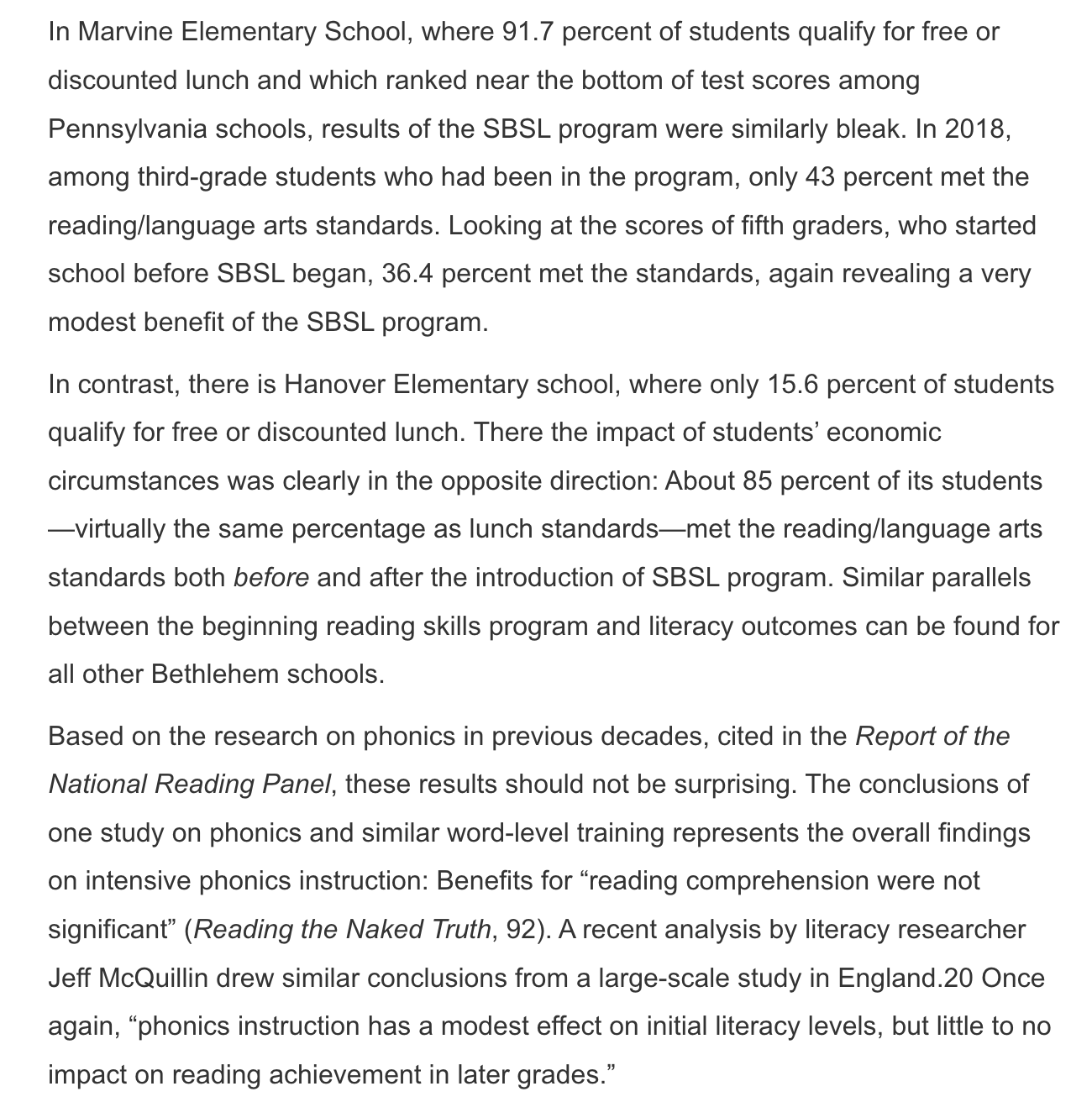
Claims of miracles in Pennsylvania (similar to those made about Mississippi) fall apart once the full picture is examined. Inflated gains at early grades routinely disappear in later grades; this score increases are mirages, not miracle, and ironically, the NRP report showed that reality despite SOR advocates ignoring that fact; see again: Cryonics Phonics: Inequality’s Little Helper, Gerald Coles.
V.
A persistent set of lies in the SOR media campaign concerns misrepresenting “guessing” and three cueing:
Compton-Lilly, C.F., Mitra, A., Guay, M., & Spence, L.K. (2020). A confluence of complexity: Intersections among reading theory, neuroscience, and observations of young readers. Reading Research Quarterly, 55(S1), S185-S195. https://doi.org/10.1002/rrq.348 [access HERE]
The SOR misinformation campaign relies on making false claims and definitions about balanced literacy (and whole language, see below):
The Evidence:
Spiegel, D. (1998). Silver bullets, babies, and bath water: Literature response groups in a balanced literacy program. The Reading Teacher,52(2), 114-124. www.jstor.org/stable/20202025
VII.
The misrepresentation of whole language also has a marketing element; Moats markets SOR-branded materials and thus has a financial interest in discrediting BL and WL:
Semingson, P. & Kerns, W. (2021). Where is the evidence? Looking back to Jeanne Chall and enduring debates about the science of reading. Reading Research Quarterly, 56(S1), S157-S169. https://doi.org/10.1002/rrq.405.
VIII.
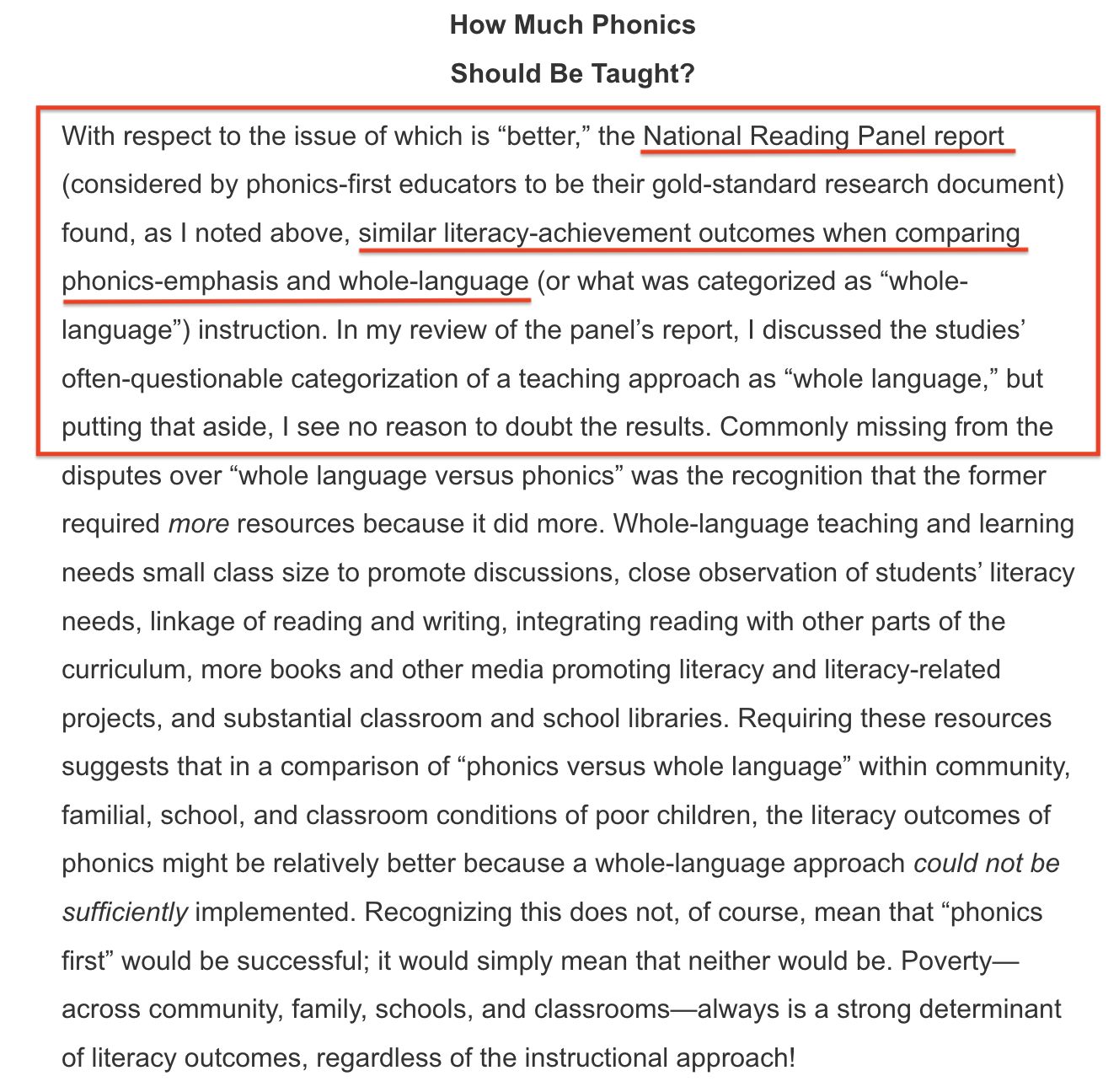
Misrepresenting WL/BL is solidly linked to a complete misreading of the NRP reports (another Big Lie):
Shanahan, T. (2005). The National Reading Panel report: Practical advice for teachers. Learning Point Associates. Retrieved June 7, 2022, from https://files.eric.ed.gov/fulltext/ED489535.pdf
Shanahan, T. (2003, April). Research-based reading instruction: Myths about the National Reading Panel report. The Reading Teacher, 56(7), 646-655.
Bowers, J.S. (2020).Reconsidering the evidence that systematic phonics is more effective than alternative methods of reading instruction. Educational Psychology Review, 32(2020), 681-705. Retrieved July 26, 2022, from https://link.springer.com/article/10.1007%2Fs10648-019-09515-y
Collet, V.S., Penaflorida, J., French, S., Allred, J., Greiner, A., & Chen, J. (2021). Red flags, red herrings, and common ground: An expert study in response to state reading policy. Educational Considerations, 47(1). Retrieved July 26, 2022, from https://doi.org/10.4148/0146-9282.2241
Garan, E.M. (2001, March). Beyond smoke and mirrors: A critique of the National Reading Panel report on phonics. Phi Delta Kappan, 82(7), 500-506. Retrieved July 26, 2022, from https://doi.org/10.1177/003172170108200705
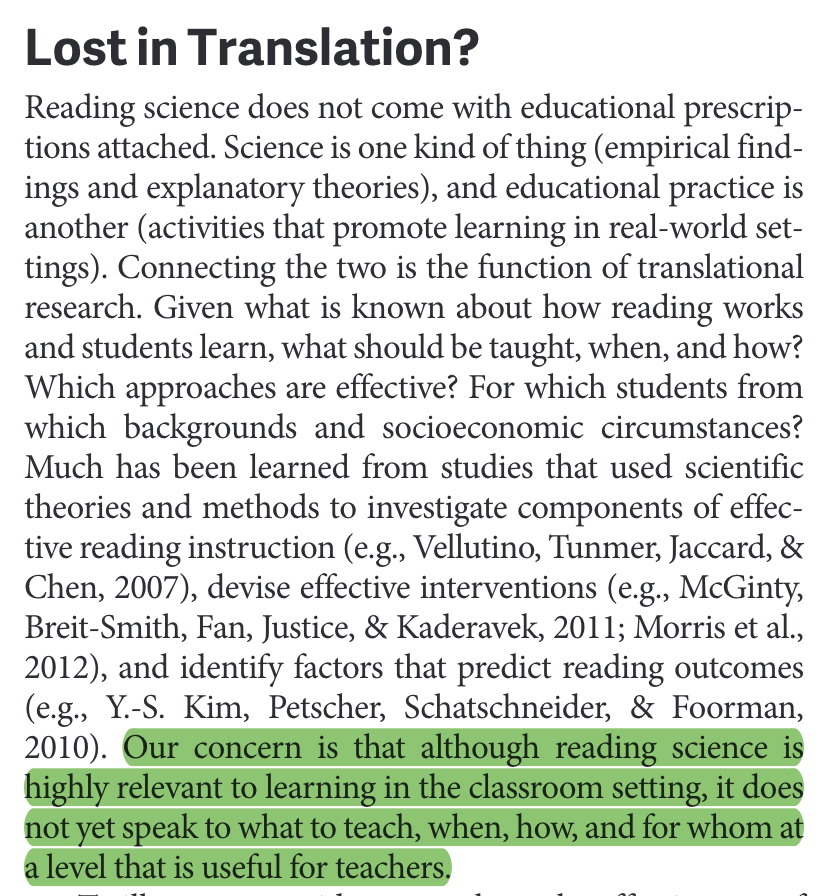
Seidenberg, M.S., Cooper Borkenhagen, M., & Kearns, D.M. (2020). Lost in translation? Challenges in connecting reading science and educational practice. Reading Research Quarterly, 55(S1), S119–S130. Retrieved July 26, 2022, from https://doi.org/10.1002/rrq.341
Yatvin, J. (2002). Babes in the woods: The wanderings of the National Reading Panel. The Phi Delta Kappan,83(5), 364-369
As many scholars have noted, the SOR movement including “Sold a Story” is driven by sensationalistic anecdotes, stories:
The Evidence:
Hoffman, J.V., Hikida, M., & Sailors, M. (2020). Contesting science that silences: Amplifying equity, agency, and design research in literacy teacher preparation. Reading Research Quarterly, 55(S1), S255–S266. https://doi.org/10.1002/rrq.353
X.
SOR advocacy regularly demands only a narrow use of “scientific” in reading instruction while also endorsing practices and programs not supported by that same rigor, such as LETRS:
The Evidence:
Hoffman, J.V., Hikida, M., & Sailors, M. (2020). Contesting science that silences: Amplifying equity, agency, and design research in literacy teacher preparation. Reading Research Quarterly, 55(S1), S255–S266. https://doi.org/10.1002/rrq.353
A third Big Lie is using unscientific and discredited reports from the conservative think tank NCTQ to claim that teacher educators are incompetent and/or willfully misleading teacher candidates.
Fuller, E. J. (2014). Shaky methods, shaky motives: A critique of the National Council of Teacher Quality’s review of teacher preparation programs. Journal of Teacher Education, 65(1), 63-77. https://journals.sagepub.com/doi/10.1177/0022487113503872
Cochran-Smith, M., Stern, R., Sánchez, J.G., Miller, A., Keefe, E.S., Fernández, M.B., Chang, W., Carney, M.C., Burton, S., & Baker, M. (2016). Holding teacher preparation accountable: A review of claims and evidence. Boulder, CO: National Education Policy Center. http://nepc.colorado.edu/publication/teacher-prep
One of the most damning aspects of the SOR movement has been the embracing of and rise in grade retention policies; grade retention is not supported by research and both creates false test score gains while harming children:
The SOR movement grossly overstates brain science as well as the essential nature of science:
The Evidence:
Seidenberg, M.S., Cooper Borkenhagen, M., & Kearns, D.M. (2020). Lost in translation? Challenges in connecting reading science and educational practice. Reading Research Quarterly, 55(S1), S119-S130. https://doi.org/10.1002/rrq.341
Yaden, D.B., Reinking, D., & Smagorinsky, P. (2021). The trouble with binaries: A perspective on the science of reading. Reading Research Quarterly, 56(S1), S119-S129. https://doi.org/10.1002/rrq.402
XV.
The SOR movement has hyper-focused on dyslexia, but again, mostly offering misinformation:
The Evidence:
Johnston, P., & Scanlon, D. (2021). An examination of dyslexia research and instruction with policy implications. Literacy Research: Theory, Method, and Practice, 70(1), 107-128. https://doi.org/10.1177/23813377211024625
Stevens, E. A., Austin, C., Moore, C., Scammacca, N., Boucher, A. N., & Vaughn, S. (2021). Current state of the evidence: Examining the effects of Orton-Gillingham reading interventions for students with or at risk for word-level reading disabilities. Exceptional Children, 87(4), 397–417. https://doi.org/10.1177/0014402921993406
Hall, C., et al. (2022, September 13). Forty years of reading intervention research for elementary students with or at risk for dyslexia: A systematic review and meta-analysis. Reading Research Quarterly. https://doi.org/10.1002/rrq.477
Odegard, T. N., Farris, E. A., Middleton, A. E., Oslund, E., & Rimrodt-Frierson, S. (2020). Characteristics of Students Identified With Dyslexia Within the Context of State Legislation. Journal of Learning Disabilities, 53(5), 366–379. https://doi.org/10.1177/0022219420914551
“Sold a Story” became a “holy text” because dozens of journalists and politicians repeated the misinformation and lies begun in “Hard Words,” identified above.
This is not good journalism, but it does prove that sensationalistic stories will ultimately trump evidence, even the “science” SOR advocates are so apt to reference.
As a teacher for forty years and a teacher educator for more than half of that career, I have always struggled with the tendency to oversell teacher quality and instructional practice.
Does teacher quality matter? Of course.
Does instructional practice matter? Again, of course.
But both teacher quality and instruction (pedagogy) are dwarfed by teaching and learning conditions within schools and more significantly by the conditions of any child’s life.
As I have noted recently, the peak era of focusing on teacher quality, the value-added movement (VAM) occurring mostly under the Obama administration, instead of identifying high-quality teachers as a driver for improving student achievement found out something much different than intended:
VAMs should be viewed within the context of quality improvement, which distinguishes aspects of quality that can be attributed to the system from those that can be attributed to individual teachers, teacher preparation programs, or schools. Most VAM studies find that teachers account for about 1% to 14% of the variability in test scores, and that the majority of opportunities for quality improvement are found in the system-level conditions. Ranking teachers by their VAM scores can have unintended consequences that reduce quality.
Teacher quality necessarily includes two types of knowledge by a teacher—content knowledge and pedagogical knowledge.
Yet the VAM experiment revealed something we have known for decades—standardized tests of student learning mostly reflect the student’s relative privilege or inequity outside of school.
Despite the refrain of Secretary Duncan under Obama, schools have never in fact been “game changers.”
While neoliberal/conservative education reforms leveraged the “soft bigotry of low expectations” and unsubstantiated claims that the Left uses poverty as an excuse, people all along the ideological spectrum are over-focused on instructional practices. And that overemphasis is used to keep everyone looking at teachers, students, and instruction instead of those more impactful out-of-school (OOS) influences on student learning.
A companion to the cult of pedagogy in education reform is the “miracle” school claim, but “miracle” schools rarely (almost never) exist once the claim is interrogated, and even if a “miracle” school exists, it is by definition an outlier and essentially offers no guidance for scaling outward or upward.
The paradox of the cult of pedagogy in education reform is that until will directly address OOS factor we will never have the context for better teasing out the importance of teacher quality and instructional practices.
The current education reform trapped in the cult of pedagogy is the “science of reading” (SOR) movement which oversells the blame for student reading achievement as well as oversells the solutions in the form of different reading programs, reading instructional practice, and teacher preparation and professional development.
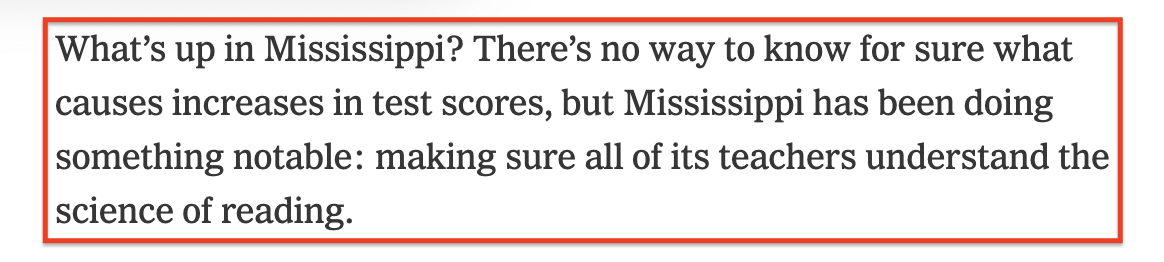
The “miracle” of the day in the SOR propaganda is Mississippi, which is very likely a mirage based on manipulating the age of students being tested at grade level and not on teacher quality and instructional practices.
Not a single education reform promise since the 1980s has succeeded, and the US remains in a constant cycle of crisis and reform promises.
Yet, the evidence is overwhelming that many OOS factors impact negatively student learning and that social reform would pay huge dividends in educational outcomes if we simply would move beyond the cult of pedagogy in education reform.
Okano, K., Kaczmarzyk, J.R., Dave, N. et al. Sleep quality, duration, and consistency are associated with better academic performance in college students. npj Sci. Learn.4, 16 (2019). https://doi.org/10.1038/s41539-019-0055-z
My entire career has existed within the neoliberal accountability era of education reform that oversells education as a “game changer” and oversells teacher quality and instructional practices.
Like time-share frauds, we are being duped, and teachers and students need us to move beyond the cult of pedagogy in education reform and focus on the much larger influences on students being able to learn and teachers being able to show that their quality and instruction can matter.
Increasingly, I am contacted by email or spoken to in person by teachers with a similar and disturbing series of experiences.
These teachers ask to remain anonymous out of fear of retaliation because they have already been reprimanded or dismissed for simply asking questions about their school/district’s implementing the “science of reading.”
One recent communication I received represents well that pattern (I am paraphrasing and reducing specifics to protect anyone trying to identify the specific teacher, and this is representative of dozens and dozens of similar communications).
The teacher has been a literacy educator well over a decade and also has earned a doctorate. A few years ago, this teacher had a first experience with LETRS training being required for university faculty where they were on one-year contracts.
After asking about why LETRS was being required and noting that the research base doesn’t support that training as effective, the teacher was shunned by their administrator and then their contract wasn’t renewed.
Before leaving that school, they noticed some faculty had simply stopped attending the training, but the administrator sought other faculty to log in to complete that training. The teacher grew concerned that there seemed to be some incentive for simply having many faculty trained.
At a new school, that teacher was immediately required to go through LETRS training. They described the training as a “cult” experience in which professional educators were handed pipe cleaners and asked to make models of the “simple view” of reading (Scarborough’s rope).
While I have repeatedly documented (along with several other scholars; access materials HERE) that the “science of reading” movement is primarily over-simplified narratives and misinformation, I want here to address that the central flaw in the movement is one we have seen in recent history regarding education reform: missionary zeal.
It is important to emphasize that I am aware of no one who rejects that a body of reading science/research exists and that should be a significant part of what drives classroom practice.
However, the media-driven SOR movement and the political consequences of that advocacy that has resulted in SOR-labeled policy are oversimplified and misguided versions of that research base.
And that new policy is often unscientific and harmful such as the pervasive implementation of grade retention.
Further the SOR movement fails to ground the narrative in the history of the field of reading and education reform.
For example, during the “miracle” school/teacher era spanning from George W. Bush through Barack Obama, missionary zeal drove Teach For America, charter schools, “miracle” school claims, and value-added methods for evaluating teachers.
At the core of these connected elements of education reform is a missionary zeal that ultimately failed to produce what was guaranteed, primarily because the reformers misidentified the problems and offered misguided solutions. In the case of the SOR movement, the same mistake is being made by claiming that reading science is simple and settled.
Currently, the “science of reading” movement has fallen into the missionary zeal trap as represented by The Reading League:
The similarities in these two recent movements are important and damning:
The criticisms I have raised are directly targeting the missionary zeal and misinformation found in the media story [1] and the political reaction [2] to that false narrative.
Reading proficiency in the US is about the same now as well before anyone implemented balanced literacy or current popular (and demonized) reading programs. And persistently over the last 80 years, scholars have lamented the “considerable gap” between research and practice in all aspects of K-12 education.
Throughout those 80-plus years, no one has ever been satisfied with student reading achievement regardless of the reading theory being implemented or the reading programs being adopted.
And teacher preparation has been significantly hampered for the past 40 years by top-down accountability mandates that have reduced most teacher certification to more bureaucracy than preparation. A dirty little secret that SOR advocates ignore is that how teachers are prepared to teach reading matters little because most teachers are bound to reading programs and reading standards once they enter the classroom. A huge gap exists between how teachers are prepared and how they are allowed to teach.
But manufacturing a crisis, perpetuating melodramatic stories, and casting simplistic blame are doing the same things we have done in education reform for decades without ever truly supporting teachers or better serving all students.
Just like the TFA and charter/”miracle” school era immediately behind us, the SOR movement is anti-teacher and anti-schools. The public and political leaders have been well primed since the 1980s to believe that schools are horrible and that teachers are incompetent. Regardless of what SOR advocates intend, that is what most people hear.
SOR advocates have falsely attacked teacher expertise, both that of K-12 teachers and that of teacher educators (many of whom had long careers as K-12 teachers); these attacks are often grounded in agendas and reports that are not themselves scientific (such as reports from NCTQ), and solutions offered (LETRS) lack scientific grounding as well.
Just as there is a robust and deep body of reading science, there are sincere educators who are engaged with that research base but also recognize that the SOR movement and SOR policy are not aligned with the complex and still developing reading science.
The SOR movement and much of SOR implementation are corrupted by missionary zeal that creates a veneer for the essentially anti-teacher elements—scripted curriculum (structured literacy), mandated retraining (LETRS), and caricatures of teacher educators, teacher education, balanced literacy, three cueing, and reading programs
An authentic embracing of reading science would acknowledge that current research is complex and evolving, that the causes of students struggling to read are also complex and include influences beyond and in the classroom (not just teacher practice but teaching/learning conditions such as class size and funding), that professionals engaging with research should raise questions and challenge conventional wisdom and traditional assumptions in order to serve the individual needs of students, that one-size-fits-all solutions for students and teachers don’t exist, and that educational practices should be grounded in teacher expertise—not journalists, parents, and politicians.
Missionary zeal is problematic in the same way as people who claim to know the mind of god (I unpack that in the newest arc of Daredevil), creating tunnel vision and arrogance while casting blame and judgment toward anyone or anything that dare raise a valid question or concern.
Just as TFA lured thousands into the program and thousands more to champion the idealistic (and unrealistic) blame-game as well as promises of miracles only to collapse under the weight of its own propaganda, SOR is following the same guaranteed-to-fail strategy.
And, yes, many good people jump on bandwagons with good intentions (I have several people I greatly admire who came through TFA), but eventually, we must all come to terms with the deeply flawed elements of this SOR movement. We must remain committed to individual student needs and teacher autonomy—not movements, slogans, and market boondoggles.
The reasons students have struggled for decades to acquire reading as well or as soon as we’d like are multi-faceted and mostly grounded outside of schools; therefore, the solutions are also complex and quite large.
From the TFA/”miracle” school era to today’s SOR movement, these false narratives are compelling because they are simple (simplistic), but they are destined to cause far more harm than good to students, teachers, and schools.
Beware missionary zeal—especially when dealing with why our schools and students struggle and what solutions advocates offer with passionate certainty.
Hoffman, J.V., Hikida, M., & Sailors, M. (2020). Contesting science that silences: Amplifying equity, agency, and design research in literacy teacher preparation. Reading Research Quarterly, 55(S1), S255–S266. Retrieved July 26, 2022, from https://doi.org/10.1002/rrq.353
MacPhee, D., Handsfield, L.J., & Paugh, P. (2021). Conflict or conversation? Media portrayals of the science of reading. Reading Research Quarterly, 55(S1), S145-S155. Retrieved July 26, 2022, from https://doi.org/10.1002/rrq.384
[2] Thomas, P.L. (2022). The Science of Reading movement: The never-ending debate and the need for a different approach to reading instruction. Boulder, CO: National Education Policy Center. http://nepc.colorado.edu/publication/science-of-reading
First, simply stating something (or posting on Twitter) doesn’t make it true.
And, second, good intentions are not enough—especially in education.
Before considering whether or not the “science of reading” movement is fulfilling social justice and equity goals in education, let’s acknowledge how two relatively recent movements in education help inform a credible answer to that question.
For many years now, educators have been embracing both grit and growth mindset uncritically, promoting these concepts and practices as both scientific and especially necessary for marginalized and vulnerable populations of student (Black students, poor students, multi-language learners, and special needs students). [See HERE and HERE for research and examinations of grit and growth mindset.]
However, two important aspects of these movements must be considered: the science and research base is increasingly challenging the initial claims of both grit and growth mindset, and the appeal of both are grounded in deficit ideologies that are essentially racist and classist.
Grit and growth mindset prove to be cautionary tales, in fact, because education is often victim of faddism that spreads before the full science is understood and that is embraced without critical analysis of how well the concepts and practices actually accomplish what advocates claim.
Grit and growth mindset speak to a cultural belief that struggling students (disproportionately minoritized racial groups, speakers of languages other than English, impoverished students, and special needs students) lacks experiences and qualities existing in students who excel (disproportionately students who are white and affluent).
These beliefs are a subset of the rugged individualism mythology of the U.S. that needs success and failure to be centered in who people are and whether or not people work hard, even in the face of substantial challenges not of their making (and even when we are dealing with children).
This is why faddism in education is often driven by sloganism also—“no excuses” charter schools thrived even as they harmed the vulnerable and marginalized populations that they were disproportionately marketed to.
That belief system either carelessly ignores or brazenly rejects the power of systemic forces such as racism and classism.
Over the past few years, the “science of reading” movement has ridden a similar wave of claiming “scientific” paired with advocates associating the movement with social justice and equity goals. As a result, the “science of reading” movement is still in the uncritical phase of fadism.
What complicates this dynamic is that we have a century of evidence that the students who struggle the most as learners and as readers are the very vulnerable and marginalized groups that these fads’ advocates target, and justifiably so.
This brings us to the opening points: Saying the “science of reading” movement is a social justice and equity movement doesn’t make it true, and those very real and justifiable good intentions simply are not enough to ignore that the “science of reading” movement, in fact, is harming the students who need reading reform the most (see, for example, HERE).
Over the course of a 65-year career, educator Lou LaBrant lived and worked through multiple back-to-basic movements, lamenting those cycles in her memoir.
In the U.S., we seem fatally attracted to viewing children and students in the most harsh and deficit perspectives, determined to prove that those who succeed and those who fail somehow deserve those outcomes.
The “no excuses” movement has been one of the worst examples of demanding that children/students and their teachers somehow ignore the realities of their lives when they enter schools and just suck it up and learn.
Like grit and growth mindset, the “science of reading” is a reductive and deficit belief system that diagnoses students struggling to read as lacking structure and basics (the exact same claim that has been made without success for a century, LaBrant lived and documented).
The result is reading policy that promotes scripted curriculum that erases teacher autonomy and student individual needs and then reduces reading in the early grades to pronouncing nonsense words.
The social justice and equity reckoning hasn’t quite taken hold yet with the “science of reading” [1], as it has with grit and growth mindset, and the “science of reading” movement has successfully deflected that the practices and policies actually are not supported by science (see HERE).
But the evidence is starting to build as critics have warned.
First, the education miracle machine is being unmasked. Florida, for example, represents how political marketing can use early test-based achievement mirages to mask that the entire system still fails to meet the needs of all students (see also Mississippi where celebrating 2019 NAEP grade 4 reading scores masked their persistent achievement gap and struggling students at later grades).
And, reading programs marketed as meeting the “science of reading” mandate are being exposed as failing to meet social justice and equity goals.
Consider for example two reading programs heavily marketed as “science of reading” endorsed: Wonders and HMH Into Reading [1].
An analysis from NYU of three programs, including these two, found the following:
1. All three curricula were Culturally Destructive or Culturally Insufficient.
2. All three curricula used superficial visual representations to signify diversity, especially skin tone and bodily presentation, without including meaningful cultural context, practices or traditions.
3. All three curricula were dominated by one-sided storytelling that provided a single, ahistorical narrative.
4. All three curricula used language, tone and syntax that demeaned and dehumanized Black, Indigenous and characters of color, while encouraging empathy and connection with White characters.
5. All three curricula provided little to no guidance for teachers on engaging students’ prior knowledge, backgrounds and cultures; or reflecting on their own bias, beliefs and experiences.
We found that these three curricula, which collectively reach millions of students across the country, have deficits that are mostly not being raised in the current public debate about curriculum. Their texts, language, tone and guidance communicate harmful messages to students of all backgrounds, especially Black, Indigenous, students of color, LGBTQIA+ students, and students with disabilities.
The “science of reading” movement is often championed for legitimate concerns about learning and students and by people with good intentions. But that movement is also another example of faddism and marketing boondoggles at the expense of the vulnerable and marginalized students who need and deserve a reckoning for reductive mythologies and deficit ideologies.
Ultimately, the “science of reading” movement is not fulfilling social justice and equity goals in education, and like grit and growth mindset, the reckoning is one the horizon, but our students and teachers deserve better and now.
Burns, M. K., Duke, N. K., & Cartwright, K. B. (2023). Evaluating components of the active view of reading as intervention targets: Implications for social justice. School Psychology, 38(1), 30–41. https://doi.org/10.1037/spq0000519
I entered the classroom as a high school English teacher in Upstate South Carolina in the fall of 1984, coinciding with the start of the high-stakes accountability movement in my home state as well as across the U.S.
Many people identify the Nation at Risk report under Ronald Reagan as ground zero for the accountability movement that entrenched patterns of school reform lasting until today—ever-changing standards, ever-changing high-stakes tests, and a never-ending refrain that schools are failing.
George W. Bush brought state-level education reform/accountability to the federal level with the bi-partisan No Child Left Behind, and then Barack Obama doubled down on the same basic concepts and approaches despite decades of accountability measures not working.
As a result, when I entered the world of blogging and public commentary during Obama’s administration, I found two enduring and powerful metaphors for the essential flaws of the accountability/education reform movement.
One is from Oscar Wilde: “But their remedies do not cure the disease: they merely prolong it. Indeed, their remedies are part of the disease.”
And the other is inspired by a scene from Alice Walker’s The Color Purple, detailed in a letter from Nettie to Celie:
The first thing I should tell you about is the road. The road finally reached the cassava fields about nine months ago and the Olinka, who love nothing better than a celebration, outdid themselves preparing a feast for the roadbuilders who talked and laughed and cut their eyes at the Olinka women the whole day. In the evening many were invited into the village itself and there was merrymaking far into the night. I think Africans are very much like white people back home, in that they think they are the center of the universe and that everything that is done is done for them. The Olinka definitely hold this view. And so they naturally thought the road being built was for them [emphasis added]. And, in fact, the roadbuilders talked much of how quickly the Olinka will now be able to get to the coast. With a tarmac road it is only a three-day journey. By bicycle it will be even less. Of course no one in Olinka owns a bicycle, but one of the roadbuilders has one, and all the Olinka men covet it and talk of someday soon purchasing their own.
Well, the morning after the road was “finished” as far as the Olinka were concerned (after all, it had reached their village), what should we discover but that the roadbuilders were back at work. They have instructions to continue the road for another thirty miles! And to continue it on its present course right through the village of Olinka. By the time we were out of bed, the road was already being dug through Catherine’s newly planted yam field. Of course the Olinka were up in arms. But the roadbuilders were literally up in arms. They had guns, Celie, with orders to shoot!
It was pitiful, Celie. The people felt so betrayed! They stood by helplessly—they really don’t know how to fight, and rarely think of it since the old days of tribal wars—as their crops and then their very homes were destroyed. Yes. The roadbuilders didn’t deviate an inch from the plan the headman was following. Every hut that lay in the proposed roadpath was leveled. And, Celie, our church, our school, my hut, all went down in a matter of hours. Fortunately, we were able to save all of our things, but with a tarmac road running straight through the middle of it, the village itself seems gutted.
Immediately after understanding the roadbuilders’ intentions, the chief set off toward the coast, seeking explanations and reparations. Two weeks later he returned with even more disturbing news. The whole territory, including the Olinkas’ village, now belongs to a rubber manufacturer in England. As he neared the coast, he was stunned to see hundreds and hundreds of villagers much like the Olinka clearing the forests on each side of the road, and planting rubber trees. The ancient, giant mahogany trees, all the trees, the game, everything of the forest was being destroyed, and the land was forced to lie flat, he said, and bare as the palm of his hand.
From this, I drew a conclusion that has served as a guiding metaphor for my criticism of the education reform movement and the title of one of my books, Beware the Roadbuilders: Literature as Resistance (Garn Press): “Beware the roadbuilders. They are not here to serve you, they are on their way to bulldoze right over you.”
I have come back to this metaphor as both ongoing criticism and confirmation that accountability is a failed approach to education reform.
One element of the tension between the accountability/education reform movement and those of us committed to education and social reform grounded in equity (and not accountability) is the shared acknowledgement that universal public education has a long history of failing marginalized and oppressed populations of students, reflecting the larger failures of communities, states, and the broader U.S. to serve marginalized and oppressed people.
It is 2021, and in my home state of SC, the metaphor I have depended on is being vividly and callously brought to reality:
The dismantling of Black communities for state and federal highways is not just a thing of the past. It’s happening now a few miles north of Charleston with the proposed West I-526 Lowcountry Corridor, at a time when President Biden and his transportation secretary have vowed to stop it.
South Carolina is proposing to sweep aside dozens of homes, and potentially hundreds of people, to widen a freeway interchange choked with traffic in this booming coastal region. The $3 billion project is expected to begin about two years after the plan becomes final. …
Under the state’s preferred proposal for the interchange upgrade, 94 percent of people and structures that would be displaced live in environmental justice communities mostly composed of Black and Brown residents.
It is 2021, and I must reach the same conclusion I drew in 2014: Beware the roadbuilders. They are not here to serve you, they are on their way to bulldoze right over you.
Racial and economic segregation in urban communities is often understood as a natural consequence of poor choices by individuals. In reality, racially and economically segregated cities are the result of many factors, including the nation’s interstate highway system. In states around the country, highway construction displaced Black households and cut the heart and soul out of thriving Black communities as homes, churches, schools, and businesses were destroyed. In other communities, the highway system was a tool of a segregationist agenda, erecting a wall that separated White and Black communities and protected White people from Black migration. In these ways, construction of the interstate highway system contributed to the residential concentration of race and poverty, and created physical, economic, and psychological barriers that persist.
Today, the interstate highway system is on the verge of transformational change as aging highways around the country are crumbling or insufficient to meet growing demand and must be rebuilt or replaced. The possibility of significant infrastructure development offers an opportunity to redress some of the harm caused by the interstate highway system, to strengthen impacted communities, and to advance racial equity. Still, there is a risk that federal, state, and local highway builders will repeat the sins of the past at the expense of communities of color whose homes, businesses, and community institutions again stand in the path of the bulldozers. Moreover, there is reason to believe that traditional civil rights laws, standing alone, are insufficient to redress the structural and institutional racism that shaped the interstate highway system and continues to threaten communities of color as the highways are rebuilt.
This Article is the first in the legal literature to explore in depth the racial equity concerns and opportunities raised by modern highway redevelopment. It also builds upon the work of legal scholars who advocate for addressing systemic racial inequality by requiring that policymakers conduct a thorough and comprehensive analysis of how a proposed action, policy, or practice will affect racial and ethnic groups. The Article concludes by proposing a way forward for highway redevelopment projects: requiring jurisdictions to complete comprehensive racial equity impact studies prior to any construction. Racial equity impact studies have been used or proposed in various contexts to reform racialized institutions and structures. This Article argues that highway redevelopment projects should join this growing list.
Archer, Deborah N., ‘White Men’s Roads Through Black Men’s Homes’: Advancing Racial Equity Through Highway Reconstruction (February 18, 2020). 73 Vanderbilt Law Review 1259 (2020), NYU School of Law, Public Law Research Paper No. 20-49, Available at SSRN: https://ssrn.com/abstract=3539889
Sarah Karp offers a long overdue and somewhat surprising opening lede for WBEZ Chicago, home to a number of charter school chains:
Chicago’s largest charter school network sent a letter to alumni this week admitting that its past discipline and promotion policies were racist and apologizing for them. The apology is notable not just as an acknowledgment of misguided policies, but as a repudiation of the “no-excuses” philosophy adopted by many charter schools during the 2000s.
“No excuses” ideologies and practices have been a foundational staple of charter schools disproportionately serving Black students, Hispanic students, and poor students well back into the 1990s but blossoming in the 2000s since both political parties jumped on the charter school bandwagon. By the late 2000s, mainstream media and the Obama administration were all-in on charter schools as “miracles.”
There were always two problems with the charter school mania and propaganda—data never supported the “miracle” claims (see my “Miracle School Myth” chapter), and worse of all, “no excuses” ideology has always been racist, shifting the blame and gaze onto students and teachers in order to ignore systemic inequity and racism.
“No excuses” schools always began with the assumption that Black, Hispanic, and poor students are fundamentally “broken” and must be “fixed”—an ugly and racist version of deficit thinking.
Almost a decade ago, I spoke at the University of Arkansas after the publication of my book on poverty and education; in that work and talk, I directly challenged “no excuses” ideologies and charter chains as harmful and, yes, racist.
In the wake of that talk, I was discounted and mis-characterized in Education Next, along with an equally unfair swipe at another KIPP critic, Jim Horn: “critics fear that disadvantaged parents do not know enough to choose wisely, or else do not have their children’s best interest at heart.”
Neither Horn nor I hold those views, and our criticisms were firmly and clearly grounded in arguing that “no excuses” is essentially racist and classist.
As I have documented, when I contacted the article authors about the false narrative they created around Horn and me, Maranto both admitted the framing was unfair and claimed the article would be updated; it never was.
The Noble charter chain mea culpa is likely too little, too late, but it is a serious crack in the facade perpetuated by “no excuses” advocates over the last two decades, included so-called “scholars” at the Department of Educational Reform (University of Arkansas) where Maranto works.
Our work, along with many other scholars and educators committed to equity and anti-racism, has been ignored and often directly attacked, primarily because we dare to name racism as “racism.”
While I am not suggesting that Noble’s confession trumps our scholarship and work that has spanned multiple decades, I do want anyone concerned about education, education reform, and educational equity to step away from assumptions and see clearly how harmful “no excuses” ideologies and practices have been for students and their teachers.
“No excuses” ultimately fails for many reasons—being trapped in “blame the victim” approaches that normalize an unspoken white and affluent standard against which marginalized populations of students are judged, and harmed.
“No excuses” has been compelling because in the U.S. we are prone to seeing all problems as individual and not systemic. But it has also been compelling because education reform has always been tragically drawn to silver-bullet solutions and the shiny mirages seen as “miracles.”
K-12 education in the U.S. is mostly a reflection of the communities schools serve; our schools tend to house and perpetuate our social inequities, but schools do very little to overcome racism, sexism, classism, etc.
Education reform has for nearly four decades refused to acknowledge systemic inequity, choosing instead to punish students, teachers, and schools. The many policies and fads of education reform over those decades have been themselves racist and classist, ultimately doing more harm than good to students, teachers, and education.
Karp includes an important realization by Jennifer Reid Davis, chief equity officer for Noble:
“It’s important to own it,” she said. “I think you have to say it, I think you have to be honest. Part of what it truly means to be anti-racist is to be honest about the circumstances in which you are in and or created.”
The list is quite long still of those who need “to own it” and allow confronting racism to be the first step to ending racism in our schools and our society.
educator, public scholar, poet&writer – academic freedom isn't free






























 dr. p.l. (paul) thomas