Category Archives: No Excuses Reform

Civil Rights Issue of Our Time?

While the credibility of challenges leveled at the current education reform agenda—such as commitments to Common Core or the rise of “no excuses” charter schools—is often called into question throughout social and mainstream media, I see little to no questioning of political mantras of education crisis, utopian expectations for schools, and the consistent refrain of education reform being the civil rights issue of our time.

In fact, even reports coming from the USDOE show that if education reform is the civil rights issue of our time, the policies are certainly not doing what is needed to combat the demonstrable failures of the public school system.

Problem #1: Discipline in schools remains incredibly inequitable by race:

Disparate Discipline Rates and Arrests and Referrals to Law Enforcement

[click to enlarge]

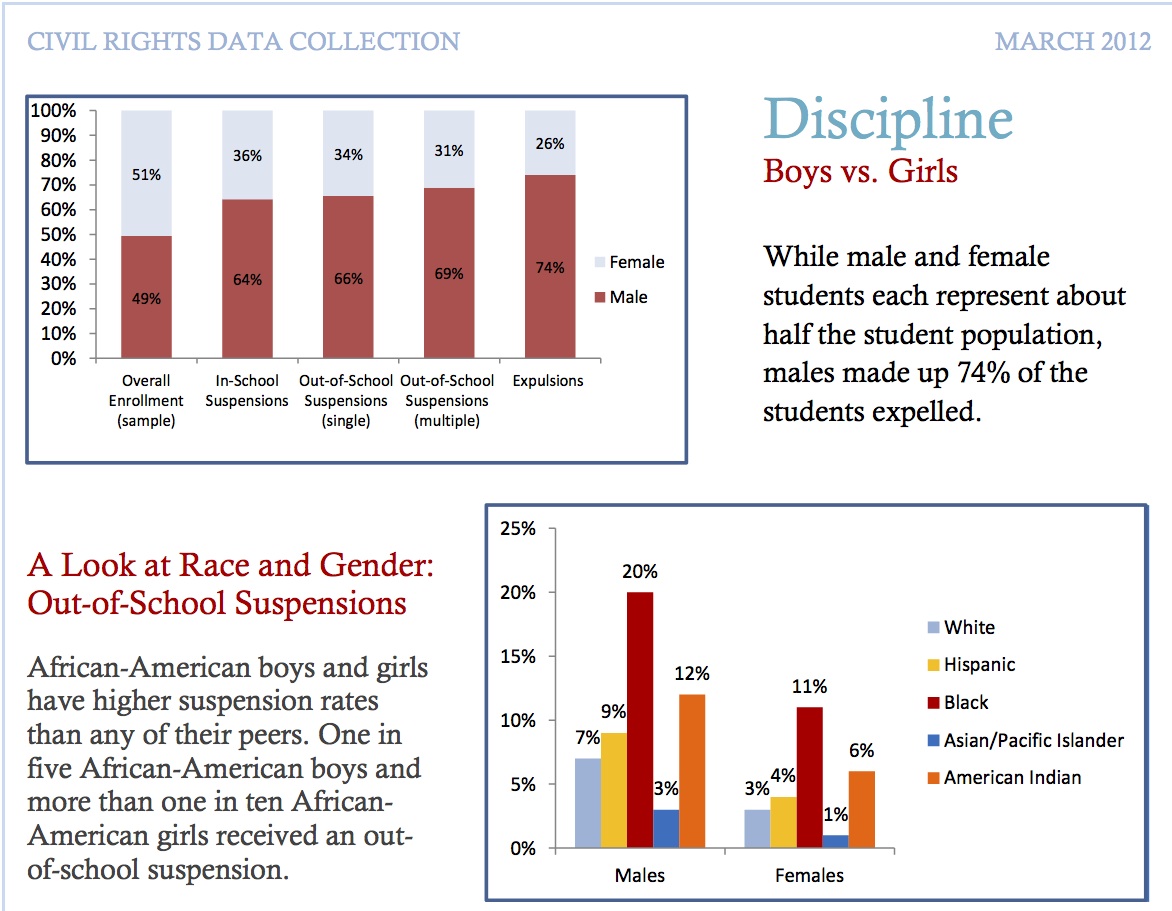
Problem #2: Discipline in schools is inequitable by gender, complicating inequity by race:

Discipline Boys vs. Girls and A Look at Race and Gender: Out-of-School Suspensions

[click to enlarge]

Problem #3: Access to advanced courses and retention rates are inequitable by race:

GandT.suspension
Access to Gifted and Talented Education (GATE) Programs and Retention Rates

[click to enlarge]

Problem #4: Teacher assignment and compensation are inequitable by race:

Teacher Assignments: First and Second Year Teachers and Teacher Salary Differences

[click to enlarge]

Problem #5: School discipline policies such as zero tolerance policies are racially inequitable and parallel to the current era of mass incarceration disproportionately impacting African American males:

There is abundant evidence that zero tolerance policies disproportionately affect youth of color. Nationally, black and Latino students are suspended and expelled at much higher rates than white students. Among middle school students, black youth are suspended nearly four times more often than white youth, and Latino youth are roughly twice as likely to be suspended or expelled than white youth. And because boys are twice as likely as girls to receive these punishments, the proportion of black and Latino boys who are suspended or expelled is especially large.  Nationally, nearly a third (31 percent) of black boys in middle school were suspended at least once during the 2009–10 school year. Part of this dynamic is that under-resourced urban schools with higher populations of black and Latino students are generally more likely to respond harshly to misbehavior. (p. 3)

As I have stated before, if education reform is the civil rights issue of our time, federal and state reform agendas would end zero tolerance policies, eradicate “no excuses” ideologies, and stop retention practices—as well as address the measurable inequities by race, class, and gender marring public schools in the U.S.

GUEST POST: Let’s Nurture Inner-Directed Students and Ignore the “No Excuses” Crowd, John Thompson

Let’s Nurture Inner-Directed Students and Ignore the “No Excuses” Crowd

John Thompson

Early in my career, Latifa taught me an important lesson about the teaching of noncognitve skills.  Latifa’s dress-for-success style and leadership made it easy to forget her unhappy childhood in foster homes.  When she got up, shut both doors, and walked to the front of the classroom, it was my time to take a seat in a desk.  Latifa often did this when she and her classmates were angry about something at school that offended their senses of fairness.  Once they had their say and articulated solutions, Latifa would reopen the doors so I could get back to teaching Government standards.

When participating in our discussions, I drew upon my decade living in a neighborhood in the middle of the “Hoova” set of the Crips street gang turf, as well as lessons learned from students, counselors, therapists, and fellow teachers at an alternative school for juvenile felons. I also drew on techniques for getting along with people gained from extensive hitch-hiking, roughnecking in the oil fields, and lobbying Oklahoma legislators. Yes, I drew on eclectic real-world experiences to help mentor students.  No, I did not impose some primitive KIPP-style cognitive behavioral model.

Yes, my inner city students drew on diverse experiences and, yes, they wrestled with many issues that were no different than suburban kids raised in two-parent families.  No, I don’t believe that many affluent classrooms had as many survivors of extreme trauma.

Yes, I used my generation’s vocabulary, as I coached students on making sense of the world from their generation’s perspective.  I recounted the theme of “the Lonely Crowd” and instructed them on the distinction between “other-directed” versus “inner-directed” persons.  I presented my belief that adults needed to help young people develop an internal locus of control. I offered my opinion that a key purpose of schooling is helping to nurture creative insubordination.

No, I did not push “grit,” “true grit,” or a John Wayne value system. Back then, the term of art was “character education.”  That name bothered me more than today’s word, “grit.” I had bigger concerns, however, than the label that we attached to the qualities which we now call “the socio-emotional.”

By the way, often it was a dispute over our school’s periodic enforcement of the dress code that sparked our confabs. During these spasms of “No Excuses” for their outer appearances, my students and I discussed the best ways to respond.  We knew that the “this too shall pass” nature of these crackdowns would soon reinsert itself. I would volunteer that the dress code isn’t my priority, but supporting my colleagues is.  I would spell out my desire for a balance between supporting my students, while fulfilling my job’s responsibility.  We’d discuss how to deal with the rules as a team until the enforcement frenzy burned out.

Students voiced their anger about the system’s priorities. Untucked shirt tails wasn’t seen as the key to overcoming the effects of generational poverty and the legacies of Jim Crow. They also articulated their pain, being treated as objects to be ordered around.  And, as David said, “I don’t feel whole without my hat …”

Yes, David’s expression of his divided consciousness prompted a serious discussion.  Yes, some themes we had learned from studying Ralph Ellison and James Baldwin were recalled. No, we didn’t tell him to just conform and grit it out.

So, I thank Paul Thomas and Lelac Almegor for reminding me about those wonderful experiences. Thomas has long criticized the work of Angela Duckworth, Paul Tough, and James Heckman and their support of KIPP’s pedagogy.  He now adds a link to Almegor’s “The Inherent Flaws in Character Education.” Almegor astutely writes in opposition to the current emphasis on character education that sounds “like a magic wand. Working kid by kid and school by school, we can fix what is wrong with our historically struggling student populations while implicitly laying the blame on the students or their parents or their communities.”

If I read them correctly, there are two issues.  The first is rooted in the conversation which grew heated in the 1960s when Patrick Moynihan used the phrase “a culture of poverty.” Sometimes that debate was a nuanced academic dispute; other times it was an avoidable conflict dividing liberals from ourselves. Conservatives got a kick out the fights between the various wings progressives, but there were important scholarly points to be made. I also agree with Paul Tough that these disputes were a part of “liberal posttraumatic shock” for supposedly losing the War on Poverty.

The second issue involves recent research on the socio-emotional, and the unfortunate term “grit,” which are being coopted by reformers “No Excuses” schools, it seems to me, are teaching an other-directed value system and doing so in the name of inner-directedness. To paraphrase Karen Lewis, accountability hawks are claiming that their schools liberate poor children so they can become Masters of the Universe, when they are actually training students to become Walmart greeters. Only in our Orwellian education reform era, could behaviorist indoctrination to pass bubble-in tests be branded as the cultivation of qualities such as adaptability and empathy.

On this issue, again, Almegor provides a wise explanation. At his school, “we do character education not because our children are disadvantaged but because they are children. It belongs within our school building not because nobody else is doing it, but because everyone does it. Our school is a part of our community and so we share in its responsibilities.”

He notes that teaching character should be about “being more independent, assertive, and persistent, but often it is not.” He observes:

We are not trying to fix them so they are more like middle-class kids. We are trying to get them ready to compete from behind. But some of it isn’t about character at all, only the appearance of it. When we teach a kid to give a firm formal handshake, we are not strengthening his character. We are teaching him how to translate his strength into a language that people in power will understand.  

It seems to me, however, that most non-reformers will read the research of Duckworth, Heckman, and Tough as incompatible with accountability-driven reform. Their criticism of achievement tests, and their inability to predict success in school and in life, applies equally to standardized testing. Even those who believe that school choice is a key to improving schools, I suspect, would prefer Almegor’s approach to character education to KIPP’s structure. Or, they would at least choose Almegor’s nurturing over a competitive, top down approach to produce higher “outcomes,” i.e. test scores. I have to believe that parents prefer the already huge and growing social science on the need for high-quality early education over the drill and kill school of reform.

So, I have to wonder why Thomas, Almegor, and others are so upset that some scholars and reformers overuse the word grit.  Are they afraid that reformers will do something crazy like impose bubble-in testing and test prep on young children?  Seriously, Gary Rubenstein’s “My Daughter’s Kindergarten Common Core Workbook” shows the extremes to which reformers will go.

As during the battles over the “culture of poverty,” we in the progressive tradition have no choice but to live by our values and debate ideas in public.  It is tricky to do so in an era when reformers are likely to take any concept or word and turn it into a weapon to advance their agenda. But, it is the price we play for being committed to democratic education for all. Our job is preparing kids for an Open Society.

End Zero-Tolerance Policies: A Reader

What do zero-tolerance policies, “no excuses” practices, and grade retention have in common?

They all negatively and disproportionately impact children from poverty, minority children, English language learners, and boys; and nearly as disturbing, all are discredited by large bodies of research.

Is the tide turning against at least zero-tolerance policies? Lizette Alvarez reports:

Faced with mounting evidence that get-tough policies in schools are leading to arrest records, low academic achievement and high dropout rates that especially affect minority students, cities and school districts around the country are rethinking their approach to minor offenses.

Zero-tolerance policies, “no excuses” practices, and grade retention have something else in common: they should all be eradicated from our schools. And thus, here is a reader to help support calls for ending these practices and policies:

Police in the Hallways: Discipline in an Urban High School, Kathleen Nolan

Review: Police in the Hallways: Confronting the “Culture of Control,” P. L. Thomas

The School-to-Prison Pipeline, Journal of Educational Controversy (vol. 7, issue 1, Fall/2012-Winter 2013)

Hope Against Hope: Three Schools, One City, and the Struggle to Educate America’s Children, Sarah Carr

New Schools, Old Problems [Review: Hope Against Hope], P. L. Thomas

Education Reform in the New Jim Crow Era

Truthout TV Interviews P.L. Thomas About the New “Jim Crow” Era of Education Reform

Just Say No to Just Read, Florida, South Carolina [includes retention research]

Implementing Policies to Reduce the Likelihood of Preschool Expulsion, Walter S. Gilliam, PhD

Prekindergarteners Left Behind: Expulsion Rates  in State  Prekindergarten Programs, Walter S. Gilliam, PhD

Henry Giroux on the “School to Prison Pipeline”

The Mis-education of the Negro, Carter Godwin Woodson

Arresting Development • Zero Tolerance and the Criminalization of Children, Annette Fuentes

Misreading “Grit”: On Treating Children Better than Salmon or Sea Turtles

Rob McEntarffer (@rmcenta) Tweeted a question to me about my blog post, The Poverty Trap: Slack, Not Grit, Creates Achievement, asking: “can Grit research (Duckworth, etc) be used as a humanizing/empowering tool, rather than a weapon against schools/kids?”

Rob’s question is both a good one and representative of the numerous challenges I received for rejecting “grit”—some of the push-back has been for my associating “grit” and “no excuses,” but many of the arguments (some heated) I have read simply rest on a solid trust that “grit” matters and thus should be central to what educators demand from their students, regardless of their students’ backgrounds (and possibly because many students have impoverished backgrounds).

I remain adamant that demanding “grit” is deeply misguided and harmful to children, especially children living in poverty. But I also acknowledge that a large percentage of educators who embrace “grit” are genuinely seeking ways in which we can help children in poverty succeed. In other words, many “grit” advocates share my educational goals.

So I think Rob’s question needs to be answered, and done so carefully. Let me start with a nostalgic story.

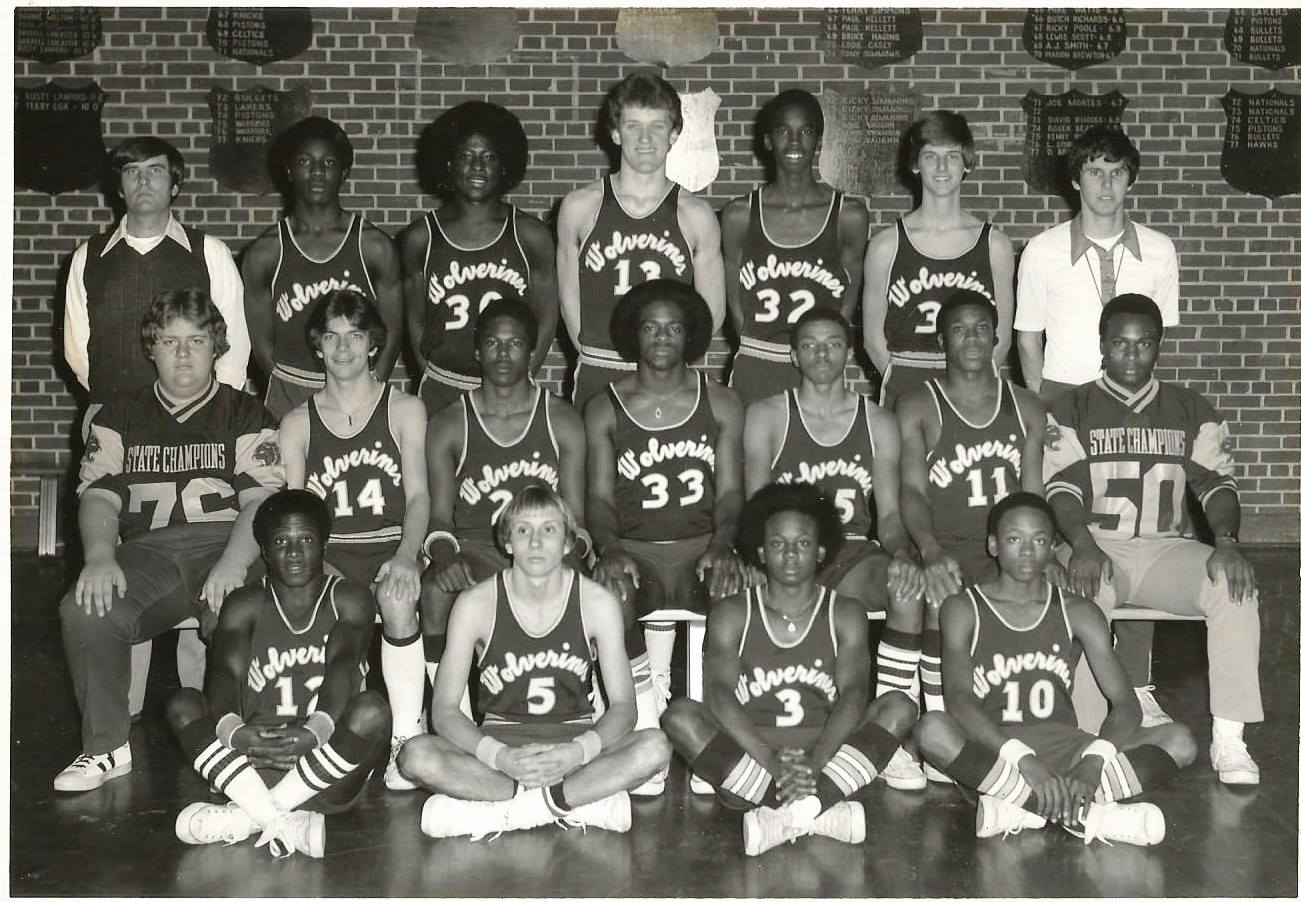
A Facebook post from a former high school friend and basketball teammate is the basis of this story—my junior year high school basketball team:

WHS basketball jr year

I am number 5, and other than wondering why I was looking away and seemingly disengaged, I am struck by my socks.

Throughout junior high and high school, I suffered the delusion I was an athlete, spending most of my free time either playing basketball or golf. My heart and soul longed for being a basketball player, and on my bedroom wall (along with the required poster of Farrah Fawcett) hung a poster of Pete Maravich who wore the same socks superstitiously every game, two pairs pushed down and tattered.

I wanted few things more than being Pistol Pete. Maravich was smart, skilled, and hard-working. Even after his career on the court, Maravich remained the personification of practice and drills: If you work hard enough, Maravich seemed to represent, you too can be a magician on the basketball court.

Soon after Maravich, I added Larry Bird to my list of role models, again latching on to his working-class ethic as an athlete. Bird prompted mythological tales—Larry Legend—about his breaking into Boston Garden to shoot in the dark when the facility was closed.

That’s right, I was a child and teenager smitten by “grit.”

After being diagnosed with scoliosis the summer before my ninth grade, I became an exercise fanatic, possibly as a response to the genetic failure of my body. I created a year-long daily calendar on poster-board each year from ninth through twelfth grades to list and monitor my workouts. For those four years, I wore ankle weights most days and jumped rope at least 300 times each night with those weights on. Every day. Four years.

My Holy Grail was dunking the basketball*—despite my being about 5’10” and around 130 pounds.

My fanaticism about practice carried over onto the driving range in good weather also. I often hit 300 range balls on the golf course practice range before setting out to play 18-27 holes.

And what did all that get me?

Look back to that junior-year photograph above. In my high school during the late 1970s, letterman jackets were the greatest treasure for want-to-be athletes like me (I often wore my father’s jacket from the 1950s to school, a jacket he earned as captain of the first state championship football team at that same high school). But the rules of receiving a letterman’s jacket revolved around lettering your junior year—no other year of lettering resulted in a jacket.

I lettered every year of high school except junior year—a year I spent almost totally on the bench. I never earned a letterman’s jacket in high school, despite lettering in two sports my senior year.

And all that golf practice resulted in a huge amount of callouses and a year on the golf team at junior college.

But I was never Pistol Pete or Larry Legend, and certainly never close to Arnold Palmer (yes, my golf fantasies had working-class heroes also).

So what is my point? I am not trying to suggest that my anecdotes of my life prove my point, but they certainly make an important case for answering Rob’s question.

You see, throughout junior high, high school, and college, I never really tried at school—I was too busy trying to be Pistol Pete and then Larry Legend. And if anyone looked at the outcomes of these two different spheres—my grades in my classes and my scrawny, blond self riding the bench of countless high school basketball games—which do you think appears to be the result of “grit,” effort?

Despite my growing up in a working class family, I thrived when I did because of a number of privileges—being white, male, and prone to math and verbal skills cherished by the school system.

And the evidence is powerful that privilege trumps effort and that human behaviors are greater reflections of the conditions of their lives (abundance or scarcity) than the content of their character.

When my junior year ended without my having earned that letterman’s jacket, I began carrying with me until this day a deep and genuine sense of failure because I wanted few things more than to hand my father back his jacket and to stand before him in the one I earned, to show him I was the man I wanted to be, which was the man he was. That was a boy’s dream, of course, because my father could not have loved me more then or now than he does.

I trust, as well, that my experiences with trying very hard at things I could never excel in and then excelling in things that required very little effort on my part do inform what I argue is a misguided commitment to “grit” in calls for education reform and in school and classroom practices, even among educators with the best of intentions. So I want to end by answering Rob with a few observations and questions I think should help us at least reconsider commitments to “grit”:

  • How do we know when one child is trying and another isn’t? And how do we know why one child works hard and another seems not to make the same effort? I recently arrived at my first year seminar class upset that so many students had failed to submit their essays on time for that class session. My assumptions were all focused on them, but once I arrived in class, I discovered they had all been having technical trouble—the campus email system wasn’t allowing attachments. The focus on “grit,” then, often maintains a singular and accusatory eye on the child, and thus ignores the context, which may be the source of the behavior.
  • How often do we misread “privilege” as “grit”? My argument is—almost always. Even when privileged people excel because of their “grit,” the distinguishing aspect of that success remains the privilege. As well, when impoverished people overcome their hurdles due to hard work and “grit,” they remain outliers, and while they should be applauded, their outlier success isn’t a credible template for everyone else struggling under the weight of poverty.
  • As I note below, “grit” may be a distorted quality among leaders because our culture is competition-based, and our leaders both feel like winners and are praised as winners. Winning is linked to effort in our society even when the effort is not the key to that success. Leaders as winners, then, tend to project their “grit” onto others—not unlike the messages found in Maravich’s basketball training videos—”Just work hard, like I did, and you can do anything!” While such messages may be inspiring, they are at least incomplete, if not mostly untrue; my efforts in high school were not failures due to my lack of effort, but due to my genetic ceiling.
  • And finally, Rob’s question directly: Can “grit” research and ideology be used as a humanizing and empowering tool, rather than a weapon against schools and children? To which I say: If we dedicate ourselves to creating the slack necessary for that “grit” to matter and for such demands to be equitable, then yes. In other words, “grit” fails when it becomes the initial and primary demand of children, superseding commitments to creating the equitable conditions that all children need in their lives and schools. My conclusion about “grit,” then, is that the ultimate concern of mine may be where we prioritize and emphasize it—and how it is used as a spotlight on children in poverty almost exclusively.

On this last point, I think, I can make my best case about why emphasizing “grit” is both misguided and harmful.

From the authoritarian extremes of “no excuses” schools such as KIPP to the more progressive embracing of “grit” that many may call “tough love,” when we honor “grit” we reduce our children to salmon and sea turtles, we create schools that perpetuate a Social Darwinism that is human-made. School, like life, for these children becomes something to survive, a mechanism for sorting.

I think we can and should do better than treating our children like salmon and sea turtles—even when we do so with love in our hearts.

* By the way, yes, I could occasionally dunk in my late teens and early twenties.

Pete Maravich: A Tribute

The Poverty Trap: Slack, Not Grit, Creates Achievement

Poverty is a trap children are born into:

brown wire crab cage
Photo by James Lee on Unsplash

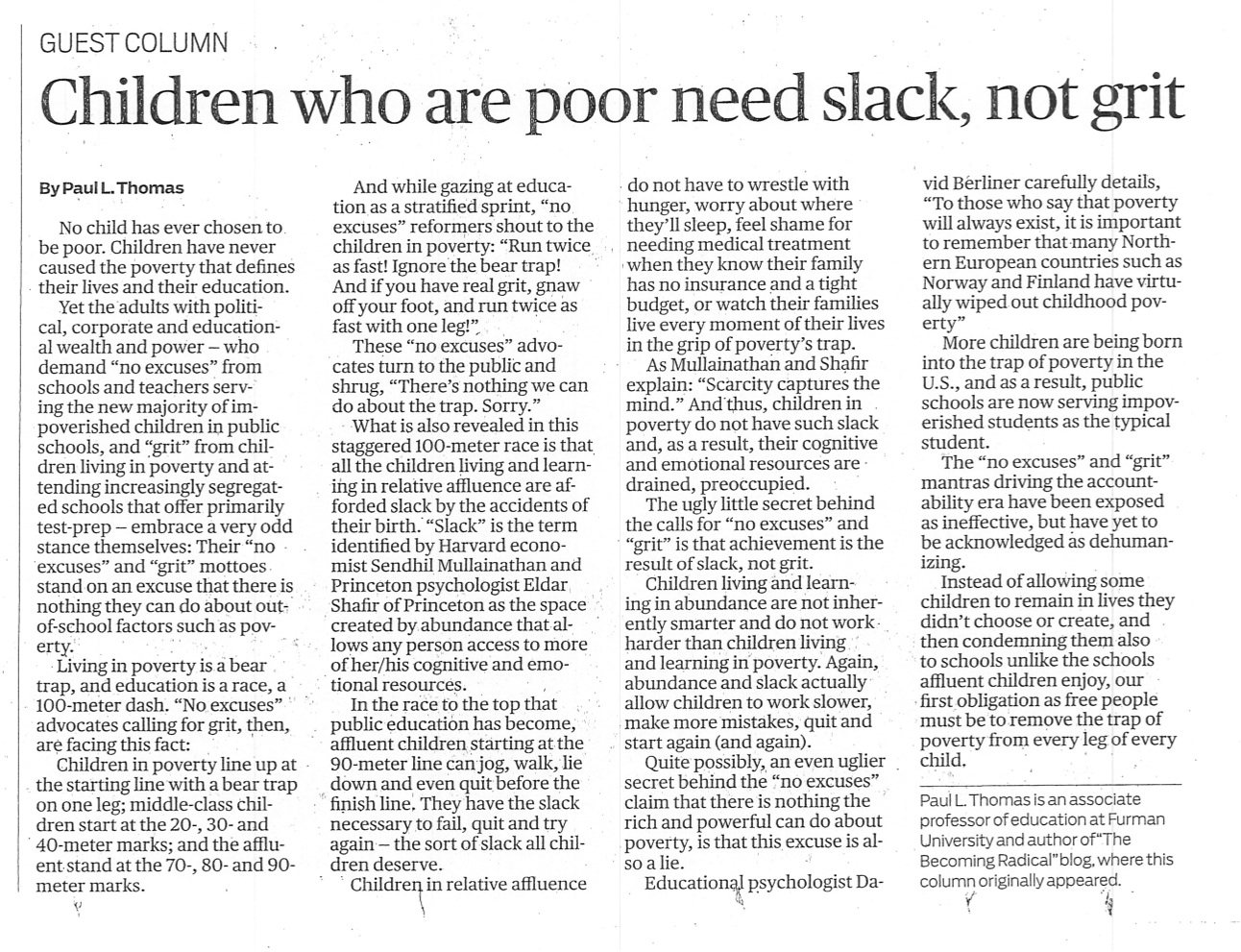
No child has ever chosen to be poor. Children have never caused the poverty that defines their lives, and their education.

Yet, the adults with political, corporate, and educational wealth and power—who demand “no excuses” from schools and teachers serving the new majority of impoverished children in public schools and “grit” from children living in poverty and attending increasingly segregated schools that offer primarily test-prep—embrace a very odd stance themselves: Their “no excuses” and “grit” mottos stand on an excuse that there is nothing they can do about out-of-school factors such as poverty.

Living in poverty is a bear trap (and it is), and education is a race, a 100-meter dash.

“No excuses” advocates calling for grit, then, are facing this fact:

Children in poverty line up at the starting line with a bear trap on one leg; middle-class children start at the 20-, 30-, and 40-meter marks; and the affluent stand at the 70-, 80-, and 90-meter marks.

And while gazing at education as a stratified sprint, “no excuses” reformers shout to the children in poverty: “Run twice as fast! Ignore the bear trap! And if you have real grit, gnaw off your foot, and run twice as fast with one leg!”

These “no excuses” advocates turn to the public and shrug, “There’s nothing we can do about the trap, sorry.”

What is also revealed in this staggered 100-meter race is that all the children living and learning in relative affluence are afforded slack by the accidents of their birth: “Slack” is the term identified by Mullainathan and Shafir as the space created by abundance that allows any person access to more of her/his cognitive and emotional resources.

In the race to the top that public education has become, affluent children starting at the 90-meter line can jog, walk, lie down, and even quit before the finish line. They have the slack necessary to fail, to quit, and to try again—the sort of slack all children deserve.

Children in relative affluence do not have to wrestle with hunger, worry about where they’ll sleep, feel shame for needing medical treatment when they know their family has no insurance and a tight budget, or watch their families live every moment of their lives in the grip of poverty’s trap.

As Mullainathan and Shafir explain: “Scarcity captures the mind.” And thus, children in poverty do not have such slack, and as a result, their cognitive and emotional resources are drained, preoccupied.

The ugly little secret behind calls for “no excuses” and “grit” is that achievement is the result of slack, not grit.

Children living and learning in abundance are not inherently smarter and they do not work harder than children living and learning in poverty. Again, abundance and slack actually allow children to work slower, to make more mistakes, to quit, and to start again (and again).

Quite possibly, an even uglier secret behind the “no excuses” claim that there is nothing the rich and powerful can do about poverty is that this excuse is also a lie.

David Berliner (2013) carefully details, “To those who say that poverty will always exist, it is important to remember that many Northern European countries such as Norway and Finland have virtually wiped out childhood poverty” (p. 208).

More children are being born into the trap of poverty in the U.S., and as a result, public schools are now serving impoverished students as the typical student.

The “no excuses” and “grit” mantras driving the accountability era have been exposed as ineffective, but have yet to be acknowledged as dehumanizing.

Instead of allowing some children to remain in lives they didn’t choose or create and then condemning them also to schools unlike the schools affluent children enjoy, our first obligation as free people must be to remove the trap of poverty from every leg of every child.

Reference

David C. Berliner (2013) Inequality, Poverty, and the Socialization of America’s Youth for the Responsibilities of Citizenship, Theory Into Practice, 52:3, 203-209, DOI: 10.1080/00405841.2013.804314

UPDATE

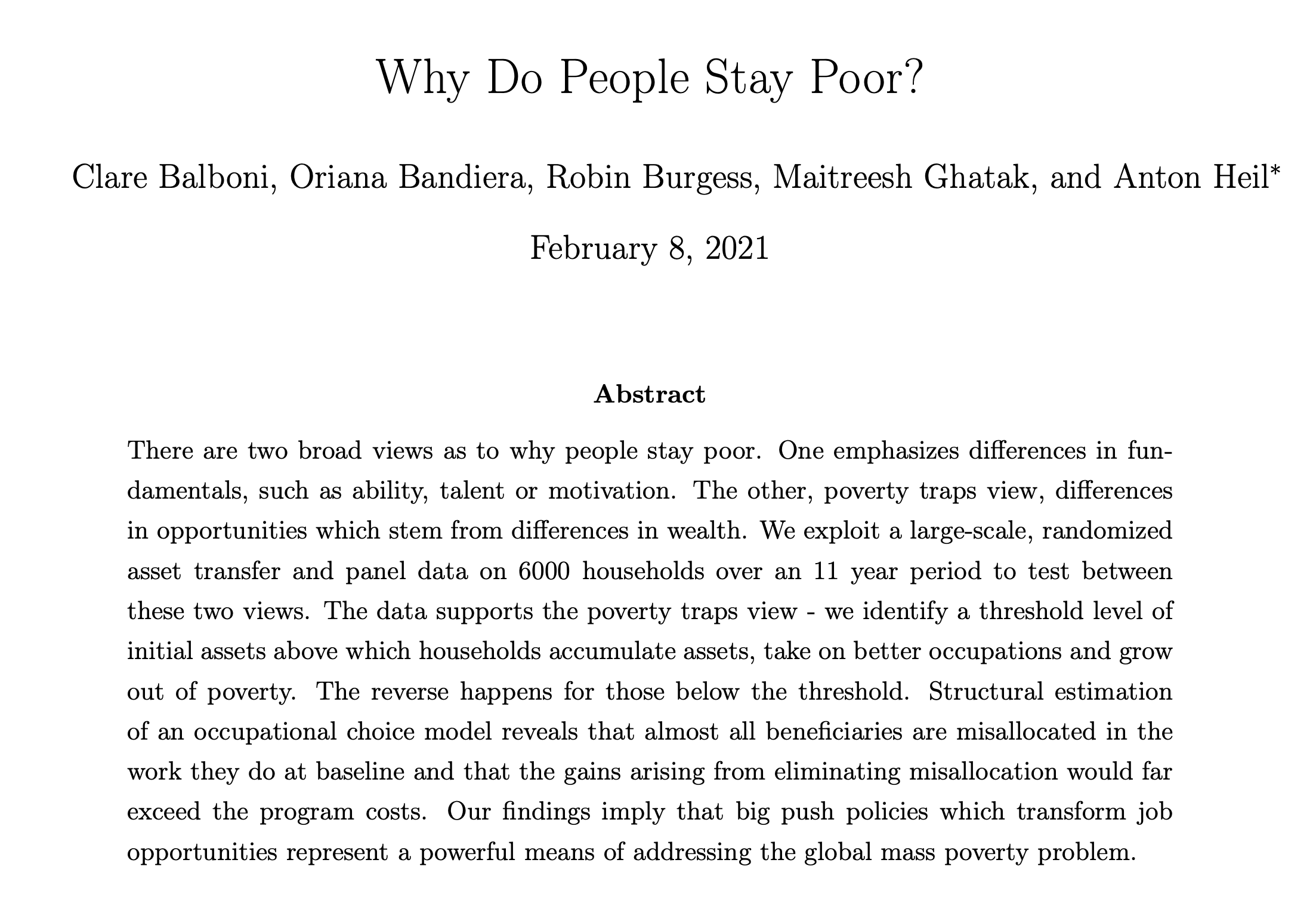
Why Do People Stay Poor? Clare Balboni, Oriana Bandiera, Robin Burgess, Maitreesh Ghatak, and Anton Heil

Image

Zombies, “Scarcity,” and Understanding Poverty

The original comic book series The Walking Dead opens with “This is not good” in the panel depicting police officers pinned behind their patrol car by gun fire. The page ends with officer Rick Grimes being shot, followed by a full-page panel on the next page of Rick waking with a gasp in the hospital. Zombies are soon to follow.

Preceding this first story is an introduction from creator Robert Kirkman, who explains:

I’m not trying to scare anybody….

With The Walking Dead, I want to explore how people deal with the extreme situations and how these events change [emphasis in original] them. I’m in this for the long haul.

While the AMC television series is an adaptation of the comic book (and not bound to Kirkman’s graphic narrative), this central premise tends to remain true in both the comic book and the TV series, notably in the “Isolation” episode (October 27, 2013):

AMC’s The Walking Dead picked up right where it left off, exploring the mental and emotional toll Karen’s and David’s deaths has had on the group and specifically Tyreese, who experienced the loss of someone close to him for the first time in this new world….

The biggest reveal of the hour, however, came in the final moments after Rick (Andrew Lincoln) uses his sheriff skills and pieces together that it was Carol (Melissa McBride) who was the one who killed Karen and David in a bid to contain the deadly illness threatening the group’s safe haven.

When asked by Rick and with a calm matter-of-fact detachment, Carol confesses to killing, dragging outside, and then setting on fire Karen and David. While there is certainly tension and shock created by this confession, the more powerful point may be that Carol has acted in a way that she feels is justified by the shared human condition: the pervasive threat of zombies surrounding the prison along with that anybody who dies, including those living in close quarters with Carol and the others, will reanimate as a zombie.

Two of the most compelling aspects of the AMC series are that zombies are omnipresent and that every human is a walking potential for becoming a zombie. Now that the main characters have positioned themselves in a prison behind two layers of fences, viewers watch as the characters go about their reduced lives (sometimes casually hoeing the garden) with zombies always moaning and clawing at the fence.

There is only one world for these characters—a world saturated with zombies. And a world defined by zombies is a world that has redefined the nature of human free will and choice.

On Rationality and Free Will (Choice)

Western culture honors rational behavior above emotional responses, and particularly in the U.S., choice is a nearly sacred value. That prejudice for rationality tends to normalize rational behavior creating the appearance that rationality is objective. Yet, in fact, rationality is always bound by context.

Consider the hiker, Aron Ralston, who would not have been rational for amputating a limb in his day-to-day life, but once Ralston was confronted with being trapped by a boulder while hiking, amputating a limb became not only rational, but also life-saving. The context changes and so does rationality.

In The Walking Dead TV series narrative, Carol’s murderous acts raise the same sort of debate about her behavior: Considering the threat of the newly spreading flu in the prison, is Carol’s behavior rational?

Certainly in a world without zombies, Carol has no justification for murder and burning the corpses, but in the realities of The Walking Dead, context dictates behaviors—and colors our judgment of those behaviors.

While rationality is contextual and subjective, choice as a sacred value in the U.S. is popularly idealized and misrepresented.

Choice is not a foundational aspect of being human. In fact, being human is about basic behaviors about which humans have no choice: breathing, eating, seeking shelter, attending to ones health. And broadly, survival (think Ralston).

Zombie narratives are speculative stories of humans reduced to a single basic human necessity, consumption. Zombies are perpetual and relentless consumers—to the extreme that renders them simultaneously campy and terrifying.

The Western fetish for choice is an exaggeration of a great human hope or quest: The human faith in free will, the human faith that our free will lifts us above the rest of the earth’s beasts.

“So it goes” is the now-iconic phrase that provides Kurt Vonnegut’s Slaughterhouse-Five the coherence of a refrain against the staccato of Vonnegut’s time-traveling narrative.

At its essence “So it goes” is an acknowledgement of the human condition, one in which humans cling to a belief in free will that doesn’t exist. When a Tralfamadorian explains to Billy Pilgrim that Pilgrim is on the planet Tralfamadore, the conversation turns to free will:

“Where am I?” said Billy Pilgrim.

“Trapped in another blob of amber, Mr. Pilgrim….”

“How—how did I get here?”

“It would take another Earthling to explain it to you. Earthlings are the great explainers, explaining why this event is structured as it is, telling how other events may be achieved or avoided. I am a Tralfamadorian, seeing all time as you might see a stretch of the Rocky Mountains. All time is all time. It does not change. It does not lend itself to warnings or explanations. It simply is. Take it moment by moment, and you will find that we are all, as I’ve said before, bugs in amber.”

“You sound to me as though you don’t believe in free will,” said Billy Pilgrim.

•••

“If I hadn’t spent so much time studying Earthlings,” said the Tralfamadorian, “I wouldn’t have any idea what was meant by ‘free will.’ I’ve visited thirty-one inhabited planets in the universe, and I have studied reports on one hundred more. Only on Earth is there any talk of free will.”

Do the characters in The Walking Dead have the choice to live as if zombies do not exist?

Do people living in poverty have the choice to live as if they are not in poverty?

Free will and choice—like rationality—are bound by context. But neither free will nor choice is basic to being human since our basic human nature consists of those thing about which we have no real choice.

Choice, in fact, is not an essential aspect of a free people. Choice is the result of a free people collectively insuring that all people have the essentials of life protected so that the human longing to choose becomes possible and even ethical.

Simply stated, choice and being free are luxuries that exist toward the top of the triangle representing Maslow’s hierarchy of needs: choosing between a Camry and an Accord is of little importance to a person starving. If nothing else, The Walking Dead highlights how trivial our choices about materialistic lives become once the human condition is reduced to survival within an ever-present threat.

Before Free Will: Zombies and Understanding Poverty

Sendhil Mullainathan and Eldar Shafir in Scarcity: Why Having Too Little Means So Much explain:

Poverty is surely the most widespread and important example of scarcity….

One cannot take a vacation from poverty [emphasis added]. Simply deciding not to be poor—even for a bit—is never an option….Our data suggest causality runs at least as strongly in the other direction: that poverty—the scarcity mindset—causes failure.

In other words, poverty is as omnipresent for the poor as the threat of zombies is for the characters in The Walking Dead. Just as the threat of zombies and reanimation into zombies weigh on the characters’ minds and drive their actions 24 hours a day and every day of their lives, poverty too dictates who poor people are and what they do.

Living in constant vigilance against the threat of zombies, ironically, reduces all living humans to their basic compulsions, rendering even living humans more zombie-like than they would want to admit: zombies are only consumers, and humans living under the threat of zombies are primarily survivors.

Living under the weight of poverty is a very real condition that zombie narratives represent in metaphor.

Human behavior, then, is likely a window into larger social contexts and less a reflection of individual strengths and weaknesses.

Because of cultural stereotypes that marginalize and even demonize people in poverty, Mullainathan and Shafir caution against drawing conclusions from observable behaviors by people living in poverty:

Given that we hold highly negative stereotypes about the poor, essentially defined by a failure (they are poor!), it is natural to attribute personal failure to them….Accidents of birth—such as what continent you are born on—have a large effect on your chance of being poor….The failures of the poor are part and parcel of the misfortune of being poor in the first place. Under these conditions, we all would have (and have!) failed.

In The Walking Dead, Carol-as-killer is a consequence of the existence of zombies in the same way people in poverty have their mental capacities drained by the state of poverty in which they are trapped. As well, poverty may be as unavoidable as zombies for people who find themselves born into impoverished homes (considering that in the U.S., affluence and poverty are highly “sticky”—most people remain in the social class into which they are born, especially at the extreme ends of the class spectrum).

The Walking Dead‘s central relevance as it speaks to the power of poverty is that becoming a zombie in this narrative is simply the result of dying; everyone is a potential zombie (unlike the traditional need to be bitten by a zombie). Zombies in The Walking Dead and poverty, then, are unavoidable and pervasive.

Depending on evidence instead of metaphor, with unintended zombie flair, Mullainathan and Shafir argue, “Scarcity captures the mind.”

For example, Carol’s entire existence now tunnels (Mullainathan and Shafir’s term for an intense form of focus) on surviving zombies. For example before she kills Karen and David, she offers the children in the prison covert lessons on killing zombies swiftly by using knives and weapons to execute effective blows to the brain.

In a world devoid of zombies, Carol’s behavior would be warped. In her previous life, in fact, Carol has been a different person.

Zombie narratives as well as Mullainathan and Shafir’s work on scarcity help highlight an understanding of poverty that rejects stereotypes as well as what people and children living and learning in poverty need: Their state of scarcity must be alleviated.

Until we alleviate poverty, however, we must be vigilant not to increase the consequences of scarcity (such as artificially ramping up stress for teachers and students) and we can no longer ask children and their teachers to work as if poverty doesn’t exist.

Social programs addressing poverty and education reform targeting the achievement gap must begin with embracing a closing claim from Mullainathan and Shafir: “We can go some way toward ‘scarcity proofing’ our environment.”

But that goal cannot be achieved within a deforming idealism that asks impoverished people to live as if poverty doesn’t exist, that asks children living in poverty to pretend they are not impoverished during the school day. It deserves repeating: “One cannot take a vacation from poverty.”

For the Record: Should We Trust Advocates of “No Excuses”?

The short answer is, No.

When “The Softer Side of ‘No Excuses'” was published at Education Next, I posted a comment* and then emailed one of the authors, Robert (Bob) Maranto, an endowed chair in the Department of Education Reform at the University of Arkansas.

My initial email stated directly that one implication in the article is blatantly untrue and essentially nasty:

Like all charter schools, KIPP schools are chosen by parents, but critics fear that disadvantaged parents do not know enough to choose wisely, or else do not have their children’s best interest at heart.

I adamantly renounce this implication, and genuinely do not know a single critic of “no excuses” policies who believes this.

While it took a few emails to push home my point, Bob and I appeared to reach some common ground—we share some background characteristics and he was polite and willing to discuss my concern.

In fact, Bob directly by email agreed I have reason to be upset, and even offered to post an apology on the article (although I specifically asked for a retraction and do not need an apology).

To date, despite a few follow-up emails promising the apology, nothing has been posted.

And thus I feel it is fair to post this “for the record” and to ask, Should we trust advocates of “no excuses”?

If they are willing to make outrageous slurs directly refuted by evidence to the contrary in order to sway readers to their claims, then, again, I say, No.

* I strongly recommend reading the comment posted by Catherine M. Ionata.

On Children and Kindness: A Principled Rejection of “No Excuses”

In matters of style, swim with the current; in matters of principle, stand like a rock.

—Thomas Jefferson

The Furman University spring commencement in 2008 was mostly overshadowed by two events—the speech presented by President George W. Bush and the protest and controversy surrounding that speech in the weeks leading up to and during the speech.

A concurrent controversy to Bush’s commencement address centered on the large number of faculty at the center of the protest, a protest named “We Object.” South Carolina is a traditional and deeply conservative state, and Furman tends to have a distinct contrast between the relatively conservative student body and the moderate/leaning left faculty. The Bush protest of 2008 exaggerated that divide—notably in the reaction of the Conservative Students for a Better Tomorrow (CSTB) organization and an Op-Ed in The Greenville News by two Furman professors opposing the protesting faculty.

The conservative faculty view expressed in the Op-Ed is important because it characterized the protesting faculty as post-modern, the implication being that protesting faculty held liberal/left views that were grounded in relativism (a common use of “post-modern” in public discourse). In other words, the implication was that protesting faculty were motivated by an absence of principle, or at least only relative principle.

The irony here is that the protesting faculty (among whom I was one, despite my having not yet achieved tenure) tended to reject both the post-modern label and post-modernism; in fact, our protests were deeply principled.

Having been born and raised in SC and having now lived my entire life and taught for over thirty years in my home state, I am an anomaly in both my broad ideology (I lean Marxist—although it is more complicated than that) and my principles (I am deeply principled in ways that contrast with the dogma and tradition of my treasured South).

My focal point during the Bush debate and protest (my name was frequently in news accounts and in rebuttals from CSTB) was an exaggerated but representative example of the tension that my ideology and principles create in my daily work at Furman, particularly in the classroom.

For example, I often teach an introductory education course, and one topic we address in that course very much parallels the more publicized conflicts surrounding Bush’s appearance at the 2008 graduation—corporal punishment.

When the topic comes up, students tend to support corporal punishment, reflecting the general embracing of the practice throughout the South. Many students are quick to qualify their support for corporal punishment with the “spare the rod, spoil the child” justification of their Christian faith.

I often explain to my students that I was spanked as a child in the 1960s, but that I had not spanked my daughter (who often announced to her friends that I didn’t spank, including a story of the one time I did when she ran away from us in the mall as a small child). I then add that a considerable body of research [1]  has shown that corporal punishment has overwhelming negative consequences and only one so-called positive outcome (immediate compliance).

My principled stance against corporal punishment creates noticeable tension with students’ dogmatic faith in corporal punishment. This same dynamic occurs when I confront the public and political support for grade retention, which I regularly refute—again based on a substantial body of evidence (which parallels in many ways the research on corporal punishment in that both practices have some quick and apparently positive outcomes but many long-term negative consequences).

As the Jefferson quote implores, in my positions on corporal punishment and grade retention, I stand like a rock.

And this helps explain my principled stance rejecting “no excuses” ideologies and practices as well as deficit views of children, race, and class.

Some Issues Beyond Debate

Three ideologies are powerful and foundational in both traditional educational practices and recent education reform agendas over the past thirty years—paternalism, “no excuses” ideology, and deficit perspectives (of children and impoverished people).

Traditional schooling is typified by behaviorism: in the grading, in the classroom management. Punishing and rewarding are types of paternalism and are justified by the belief that children are lacking something that some authority must provide.

Ironically, education reform committed to accountability driven by standards and high-stakes testing is really no reform at all since many of the reform policies are simply exaggerated versions of traditional practices—both of which are grounded in paternalism, “no excuses” ideology, and deficit perspectives.

“No excuses” practices (represented by KIPP charter schools, but certainly not exclusive to that chain or charter schools since the ideology permeates almost all schooling to some degree) match social norms in the U.S., and in fact, aren’t very controversial. Yet, since “no excuses” policies are part of the dominant reform agenda, advocates feel compelled to justify those policies and practices.

To be honest, critics of “no excuses” ideology are in the minority and tend to be powerless. Nonetheless, Alexandra Boyd, Robert Maranto and Caleb Rose have published an article in Education Next designed to refute “no excuses” critics and to justify KIPP charters narrowly and “no excuses” ideology more broadly.

While I will not elaborate here on this, advocates of deficit-based strategies aimed at children in poverty and popularized by Ruby Payne tend to make parallel arguments as those endorsing “no excuses” schools and practices.

Corporal punishment, grade retention, paternalism, “no excuses” ideologies, and deficit perspectives of children, class, and race—all of these ideologies and concurrent practices conform to social norms of the U.S. (politicians and the public support them overwhelmingly) and tend to be discredited by large and robust research bases. All of these ideologies and practices also produce the appearance of effectiveness in the short term but create many long-term negative outcomes.

Paternalism, “no excuses” ideologies, and deficit perspectives reflect and perpetuate racism, classism, and sexism—even though many of the people who are and would be negatively impacted by these beliefs are often actively participating in and supporting institutions, policies, and practices driven by all three.

History has revealed numerous examples of people in reduced circumstances behaving in ways that were counter to their and other people’s freedom and equity. Margaret Atwood’s The Handmaid’s Tale remains to me one of the best literary cautionary tales of that disturbing and complicated reality; Atwood dramatizes the historical reality of women contributing to the oppression of women. As a powerful work of scholarship, Michelle Alexander’s The New Jim Crow details well that a culture of mass incarceration (an era paralleling the accountability era in education) has reduced the lives of many minorities living in poverty to the point that they appear to support practices that, in fact, as Alexander describes, constitute the new Jim Crow—as I have explained while connecting mass incarceration with education reform:

This last point – that African Americans seem to support both the war on crime and “no excuses” charter schools – presents the most problematic aspect of charges that mass incarceration and education reform are ultimately racist, significant contributions to the New Jim Crow.

For example, Carr reports that African American parents not only choose “no excuses” charter schools in New Orleans, but also actively cheer and encourage the authoritarian policies voiced by the schools’ administrators. But Alexander states, “Given the dilemma facing poor black communities, it is inaccurate to say that black people ‘support’ mass incarceration or ‘get-tough’ policies” because “if the only choice that is offered blacks is rampant crime or more prisons, the predictable (and understandable) answer will be ‘more prisons’” (p. 210).

New Orleans serves as a stark example of how this dynamic works in education reform: Given the choice between segregated, underfunded and deteriorating public schools and “no excuses” charters – and not the choice of the school environments and offerings found in many elite private schools – the predictable answer is “no excuses” charters.

And all of this, I suppose, may have been more than many people wanted to read for me to reach my big point, which is this:

There is no evidence that will convince me to reverse my stance against “no excuses” practices.

There is no evidence that will convince me to reverse my stance against deficit perspectives.

There is no evidence that will convince me to reverse my stance against paternalism.

There is no evidence that will convince me to reverse my stance against corporal punishment.

There is no evidence that will convince me to reverse my stance against grade retention.

Period.

Especially when it concerns children, the ends can never justify the means so I couldn’t care less about test scores at KIPP schools.

Can we debate these? Sure, but if you want to debate me in order to change my mind, you would be wasting your time.

I am approaching 53, and I remain a work in progress. There is much I do not know, and there remains much that I am deeply conflicted about. But there is one thing that I know deep into my bones—children are wonderful and precious.

Children are wonderful and precious and there isn’t a damned thing you can show me or argue that can justify anything that is unkind to a child.

Not one damn thing.

For the adults who disagree with me and believe I am wrong or fool-headed, I love you too. But if you force me to choose, you lose.

Few things fill me with confidence in my principles like the novels of Kurt Vonnegut. Vonnegut and I see the same world, have the same regrets about that would, but also share the same idealistic hope. In the beginning of his Slaughterhouse-Five, Vonnegut blends confessional memoir with his fiction as he explains how the novel came to have the full title Slaughterhouse-Five, or The Children’s Crusade: A Duty-Dance with Death.

While visiting a fellow veteran of WWII and his friend Bernard V. O’Hare, Vonnegut is confronted by O’Hare’s wife Mary, who is angry about Vonnegut’s considering writing a novel about his experience at the firebombing of Dresden:

“You were just babies then!” [Mary] said.

“What?” I said.

“You were just babies in the war—like the ones upstairs!”

I nodded that this was true. We had been foolish virgins in the war, right at the end of childhood. (p. 14)

And from this Vonnegut promised Mary not to glorify war and to add the extended title.

There is something sacred about childhood, about innocence. Something sacred that deserves and should inspire all humans toward kindness.

I see little evidence we are inspired, but I remain committed to the possibility of the kindness school—and even a kind society populated by kind people.

Nothing there to debate.

For Further Reading

anyone lived in a pretty how town, e. e. cummings

[1] See Is Corporal Punishment an Effective Means of Discipline? (APA); and Spanking and Child Development Across the First Decade of Life.