Category Archives: poetry

Investigating Poetry Because We Love It (and Our Students)

When it comes to love, to falling in love, I remain quite contentedly always a teenager.

I fall hard and with such passion that I think I come close to losing my mind. I am reminded of terms like “gah-gah” and cartoon depictions of people floating off the ground they are so enthralled.

But this falling in love like a teenager is mostly about my love affairs with writers and artists. I discover a writer I love and I am consumed with consuming that writer’s work—all of it, immediately if possible. I discover a new musical group and I am consumed with consuming that group’s work—all of it, immediately if possible.

And with it all, that desire includes returning to those works over and over with nearly the same glee as the first blush.

While my current appointment is in the education department, and I am no longer technically an English teacher, my soul will always be an English teacher. So as I was driving to work yesterday, my granddaughter in her carseat as my dear daughter was well over two decades ago, I was signing loudly (and badly) from The National (my daughter suffered years of R.E.M.).

As I was murdering The National’s “Wasp Nest,” and glancing at my granddaughter in the backseat to see her smiling, my eternal English-teacher Self kicked into motion.

To appease my urge always to be teaching English, including those glorious days of teaching poetry, I began cobbling together a poetry lesson grounded in “Wasp Nest.”

In my ELA methods seminar, then, we did a meta-lesson (talking about what I was doing and why while I was teaching my four teacher candidates the lesson) combining “Wasp Nest” with Langston Hughes’s “Harlem.”

Here I want to highlight some of the key strategies and goals I have found to be both effective and enduring when investigating text, notably poetry, because we love it (and our students).

I often use popular music with high-quality lyrics (in terms of lyrics that include *craft* [1]) as an entry point to the more traditional focus on so-called established or canonized poetry.

Songs allow me to emphasize an important move many students have yet to embrace—repeated experiences with a text, or for print texts, *re-reading*.

In their lives outside of school, lives deeply rooted in pop culture, children and young people do embrace repeated experiences with songs, TV shows, movies, and choice reading (such as comic books).

But since the required reading of traditional schooling—that teachers assign texts we decide or are decided for us and our students in order to analyze the texts in ways that will be repeated on tests—is mostly a chore, students don’t want to read the text the first time, much less more than once.

So my approach is to ask students simply to listen to the song the first time, not handing out the lyrics or demanding any sort of “school” response. I then ask for their thoughts, again emphasizing I have no predetermined expectations—class discussions are not to be about right and wrong, presided over by the teacher-as-authority.

Students often talk about how the song sounds, the music, and typically are perceptive about the tone.

Next, I hand out the lyrics [2] and ask them to *annotate*, but this second time, I still do not guide that annotating.

We share again, often allowing me several teachable moments (please keep in mind that a tremendous amount of good teaching can never be planned, but if a teacher trusts and listen to her/his students, lessons will always blossom).

Finally, I ask student to listen a third time, guiding them to look carefully at the distinction between *literal and figurative language*. Depending on the students, we may revisit what they know about metaphor and simile, but by the teen years, all students have some sense of figurative language.

“Wasp Nest” is a wonderful text for this exploration so I suggest students mark the figurative language. After the third listening, students share the figurative language identified: “cussing a storm” and “killing clothes” two wonderful examples of grammatical constructions of figurative language that challenge students having simplistic views of metaphor and similes.

Yes, we delve into adjective, gerund, and participle because grammatical constructions are part of the writer’s craft.

The discussion of literal and figurative language leads to (or I guide them to) *diction*, *tone*, and *motif*. Two points are key here in my effort to avoid the literary technique hunt.

First, I reserve the use of technical terms mostly to my role in the discussion; I model using technical language, and over the course of the year, students gradually acquire this.

Second, I monitor carefully that discussions of literary and rhetorical techniques remain broad (we frame all technique as “craft”) and within our exploring *what, how, and why*—What is the writer doing? How (technique and craft) is the writer accomplishing the “what”? And why does it matter to the reader?

In “Wasp Nest,” there is a vivid scene with characters (I always emphasize that poetry is *concrete*, depending on *imagery*), but the use of “wasp nest,” “cutting,” “poison,” and “killing” juxtaposed with the speaker’s desire suggests an intriguing tension in the song.

Throughout the discussion of the song, we try to enjoy the lyrics, the song, and the discussion through our analysis—and avoid making a technical and predetermined analysis the goal of the experience with the song.

For a 30 minute lesson, however, the song discussion necessarily gives way to shifting to “Harlem.”

I have always defaulted to the mini-lesson approach, and weave in my content concerns as I keep the focus on text. Yes, I introduce my students to Hughes, the Harlem Renaissance, and related literature and history content, but none of that is preparation for a test; nor do I expect students to learn or care about any of that which is so much trivia.

Over a course, much of that will stick and some if not many students will be drawn to our field of literature. But in the grand scheme, as I noted, this is simply authorized trivia.

We’ve more important things to worry about.

The beauty of moving from “Wasp Nest” to “Harlem” is returning students to focus on the literal/figurative language distinction.

While the song is mostly literal with figurative language serving to reinforce the plot and characters, “Harlem” is about “a dream deferred” and drives the tension of this work with mostly metaphorical language, ripe for celebrating the power of imagery (triggering the reader’s five senses) to make meaning more rich than simple literal statements.

“Harlem” as well challenges students in terms of what makes poetry, poetry; the use of *punctuation* as craft; and the power of the *rhetorical question*.

I won’t belabor further the details of a discussion, but with the poem, we follow similar patterns including my reading the poem aloud multiple times, students annotating, and discussions in which I model technical language while students are encouraged to have their wide range of affective and cognitive responses, including making claims beyond the text and asking questions.

While discussing “Wasp Nest,” we distinguish between details of the scene and characters we can confirm with the text along with our impressions, noting both are important but in formal schooling that impressions not supported by the text are often not accepted.

“Harlem” allows a similar examination of “dreams”—Hughes has a racial and historical context literally in mind, but the poem can be applied to a wide range of “dreams” other than those.

I want end here by stressing that no lesson should be restricted by trying to do everything possible with any text; set a time, let it happen, and move on once the time passes.

And above all else, exploring text is about the joy of language, the love of text and your students—and not about sacrificing that text on the alter of the literary technique hunt.

“Wasp Nest” and “Harlem” make me happy to be alive, happy to be human, happy to be fully human because of the magic that is language. My students deserve the opportunity to see that joy in me, and to come to that joy themselves.

School can be and should be a sanctuary for that joy—not a place where joy goes to die.


[1] Throughout, I will place key instructional goals between asterisks.

[2] The lyrics for “Wasp Nest”:

The National, Cherry Tree

You’re cussing a storm in a cocktail dress
Your mother wore when she was young
Red sun saint around your neck
A wet martini in a paper cup
You’re a wasp nest

Your eyes are broken bottles
And I’m afraid to ask
And all your wrath and cutting beauty
You’re poison in the pretty glass
You’re a wasp nest

You’re all humming live wires
Under your killing clothes
Get over here I wanna
Kiss your skinny throat
You’re a wasp nest
Essential Questions: Confessions of My Life as a Misguided Teacher

My seniors returned yesterday to our ELA methods seminar after an extended 2.5 months of their field placement, our program’s condensed version of what most people would call student teaching.

After teaching high school English for almost two decades, and now an additional 14 years as a teacher educator, I am even more aware of how challenging beginning to teach is.

One of the hurdles to entering the field of teaching is the mentoring paradox. As teacher candidates approach receiving their degrees and attaining teacher certification, they are likely to focus more on how they are taught as well as how their mentors teach.

Their university professors, I regret to say, often appear very polished and expert, but even their education professors fail to practice what they preach—endorsing an array of instructional and assessment practices that the professors do not implement in the course (thus, candidates have never experienced these practices as students, never seen what they look like).

As well, teacher candidates are routinely observing formally and informally experienced teachers, who seem far more casual and extemporaneous than they are; as well, these experienced teachers are the culmination of years of failures, fits and restarts that teacher candidates have no way of knowing, have no access to witnessing.

The same sorts of problems exists when candidates are placed with teachers in field experiences and student teaching. Those teachers of record present similar paradoxes of their experience and expertise—questionable pedagogy or classroom management practices appear effective to the novice teacher candidate, teacher planning and instructional implementation seem effortless.

These issues along with how my program compresses methods coursework (and thus restricts my own ability to model how to teach ELA) have been bothering me in the wake of more than two months of weekly observations of four teacher candidates in secondary ELA.

Since my candidates returned in the middle of National Poetry Month, poetry and the teaching of poetry have been much on my mind as well—leading to my starting our first seminar back with Nick Flynn’s “Forty-Seven Minutes.”

From that, I was planning to confront the problem of the literary technique hunt in ELA courses, especially those courses preparing students for high-stakes testing and not a love of language and literature.

As I waded into my opening comments and questions, the result became a confession of my own journey from a beginning teacher with good intentions who felt and believed one thing but his practices were resulting in the exact opposite of those beliefs.

My young teacher Self was also a young writer, including being a poet, but my young teacher Self strangled any life that was there in both the poetry we decimated or the students’ own affection for words, language, and text of any kind.

My young teacher Self was fully aware that formal schooling was doing something wrong—actually many things wrong—in the context of authentic responses to text and writing.

However, my initial strategy was bound by my missionary zeal (oh my god!) and the seductive allure of a technocratic grip on teaching and students.

Probably the very worst manifestation of this was my early efforts at teaching poetry.

For my candidates yesterday, I outlined my transitions from a teacher destroying a form I love to a teacher who taught poetry with fidelity. Allow me here to offer those briefly:

  • In the beginning, I painstakingly taught students my glorious “four characteristics of poetry”—using a wide range of wonderful (I thought) poems to model these four characteristics. This adventure in transmissional instruction was designed to culminate in students choosing a poem (my very progressive element!) we had not covered in class to write a formal essay illuminating the four characteristics of poetry I had “taught” them. Those essays were abysmal.
  • Failing to see the essential failure of this approach, I tried to resurrect my poetry unit by pairing the songs of the alternative group R.E.M. with the poems we examined in class (see the unit here and There’s Time to Teach: Making Poetry Sing with R.E.M.). And while this certainly infused the unit on poetry with some life, my commitment to transmissional and template pedagogy continued to result in fatal blows to any sort of fidelity to poetry, writing, or humanity.
  • The two key moments of transition for me and my practices (which during my doctoral program became more intentionally critical) included having my former English teacher and mentor Lynn Harrill guest teach Emily Dickinson and then my abandoning the four characteristics of poetry for an essential question: What makes poetry, poetry?
  • As I observed Lynn teach Dickinson, I was able to see, confront, and reject how my teaching practices were trapped in a false linear, sequential, and analytic view of learning. I demanded part-to-whole approaches to text, an approach grounded in an uncritical deference to New Criticism. Lynn, however, allowed and encouraged students to make the responses they felt were important—often huge and sweeping responses that were both cognitive and affective—and then he helped guide them to clarifying—and thus proving—how their responses were valid or not. In short, Lynn honored that most people have holistic responses, working whole-to-part, to make meaning.
  • Related to that epiphany, I simply had to admit that my four characteristics of poetry routine was inane—mostly manageable but quite inauthentic. Embracing the essential question approach to genre, form, and text in general allowed every lesson to be about investigating text and reaching conclusions grounded in those texts and not just reaching conclusions determined for all texts and all students by the teacher as authoritarian. The beauty of “What makes poetry, poetry?” is that with each poem, students and I must confess that it may be the purposeful composing of text in lines and stanzas (in contrast to forming text in sentences and paragraphs for prose), but even that is disrupted by prose poetry.

Teaching poetry with fidelity, then, is about the possibilities of poetry, of language. It is about those investigations and interrogations that we must not prescribe, unless we have resigned ourselves to formal schooling being about compliance.

My young teacher Self dedicated in my belief system (although not yet aware these existed) to social reconstruction and critical pedagogy was implementing practices that resulted in student compliance, student dread, and student apathy for the very stuff I myself embraced with joy, best represented by poetry.

My teacher candidates have never seen that foolish young man with good intentions, missionary zeal, and daily failures.

And despite what a monumental task becoming a teacher is, I am in awe each year of these candidates, already well past that early Me.

After her extended field experience, one candidate told me she has realized teachers really don’t teach anyone anything; she’s already reached an awareness of the paradoxes that took me a decade to confront.

As I continue to contemplate teaching poetry with fidelity, then, I am more cautious and intentional about teaching future teachers with fidelity as well: Are any of us practicing what we preach? Are we stepping back and observing the consequences of what we teach and holding that against what we believe?

Here, then, in teacher education we confront more essential questions.

Teaching Poetry with Fidelity: “Does it matter?”

My take on Sandra Cisneros’s “Eleven” has always focused on the callousness of her math teacher and the subsequent marginalizing of Rachel, who represents for me all students and especially vulnerable students.

Due to both historical and recent (the accountability movement) pressures, teachers fail when they see their work as teaching content instead of teaching students.

Students as well as their love of literature and language and poetry are often sacrificed at the alter of the literary technique hunt so that they can answer questions correctly on a standardized test.

Thus we teach Langston Hughes’s “Harlem” to identify the metaphors and similes; we assign Gwendolyn Brooks’s “We Real Cool” for a daring look at rhyme scheme.

What a bloody waste.

For those who teach, and teach poetry, and love poetry—and probably lose a piece of their soul each time they teach poetry—I recommend the brief poem “Forty-Seven Minutes” by Nick Flynn.

The beauty of the poem is that it sets up a classroom situation in which a student pushes back against the literary technique hunt with “Does it matter?

The persona of the poem is forced to conclude:

I smile—it is as if the universe balanced on those three words & we’ve landed in the unanswerable. I have to admit that no, it doesn’t, not really, matter, if rain is an image or rain is an idea or rain is a sound in our heads. But, I whisper, leaning in close, to get through the next forty-seven minutes we might have to pretend it does.

We must ask, then, when teaching poetry, what it is we are about.

Do we owe anything to our students, to our students’ love of language, literature, poetry? Do we owe anything to our fidelity to poetry itself?

If yes—and I think it is yes—it does not matter if we name the techniques; but otherwise, if poetry is simply one of many sacrifices to the standards and testing gods, then let us reduce all the beauty that is poetry to covering the curriculum, meeting the obligations of accountability.

And all else be damned.


National Poetry Month 2016: Recommending Nick Flynn

Along with my early recommendation this month of Dorothea Lasky, I want to guide readers to the poetry, and other writing, of Nick Flynn.

“[Y]ou are being continually/tattooed, inked,” Flynn write in “Tattoo,” “with the skulls of/everyone.”

His poetry is vivid and daring within a style that seems effortless and inviting. As with Lasky’s poetry, I want to linger on Flynn’s words, and I often find myself smiling—sometimes from the humor, but mostly from the joy of reading his work.

For the English teacher especially, I highly recommend “Forty-Seven Minutes.”

Please visit and enjoy:

2016 Tattoo Nick Flynn
2014 Forty-Seven Minutes Nick Flynn
2013 harbor (the conversion) Nick Flynn
2011 forgetting something Nick Flynn
2007 Emptying Town (audio only) Nick Flynn
2004 Father Outside Nick Flynn
2002 Swarm Nick Flynn
The Incomprehensibility Nick Flynn

National Poetry Month 2016: Recommending Dorothea Lasky

A couple of years ago, I blogged in defense of poetry for National Poetry Month.

This morning, on the most loathed for me of holidays, April Fool’s Day, I happened to discover through Twitter the poetry of Dorothea Lasky.

In my formative years of college, possibly the first thing I came to recognize that I am is that I am a poet. It is in my bones, and not something I decided or even control.

So for National Poetry Month 2016, I invite you to share the pleasure I did in discovering Lasky’s work, starting with these:

A Poem about a Painting about a Myth: The Female as Allegory

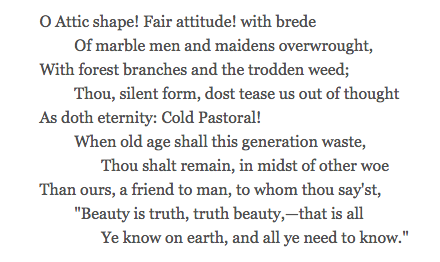
Grecian Urn

“Ode on a Grecian Urn,” John Keats

As an undergraduate, I fell in love with the British Romantics—in part, I think, because of their melodramatic bombast about Art! and Poetry! and Beauty!

“I fall upon the thorns of life! I bleed!” writes Percy Bysshe Shelley, who I must confess I preferred among the lot.

And all this stuff about art and beauty has not left me as both a poet/writer and a teacher because I do believe in art for art’s sake as well as art as activism.

Between the two, however, I have grown to recognize a serious tension that is problematic for my critical consciousness. The art-for-art’s-sake crowd has always pressed and continues to press, both consciously and unconsciously, I think, for the possibility of art that is somehow apolitical—to which I say poppycock.

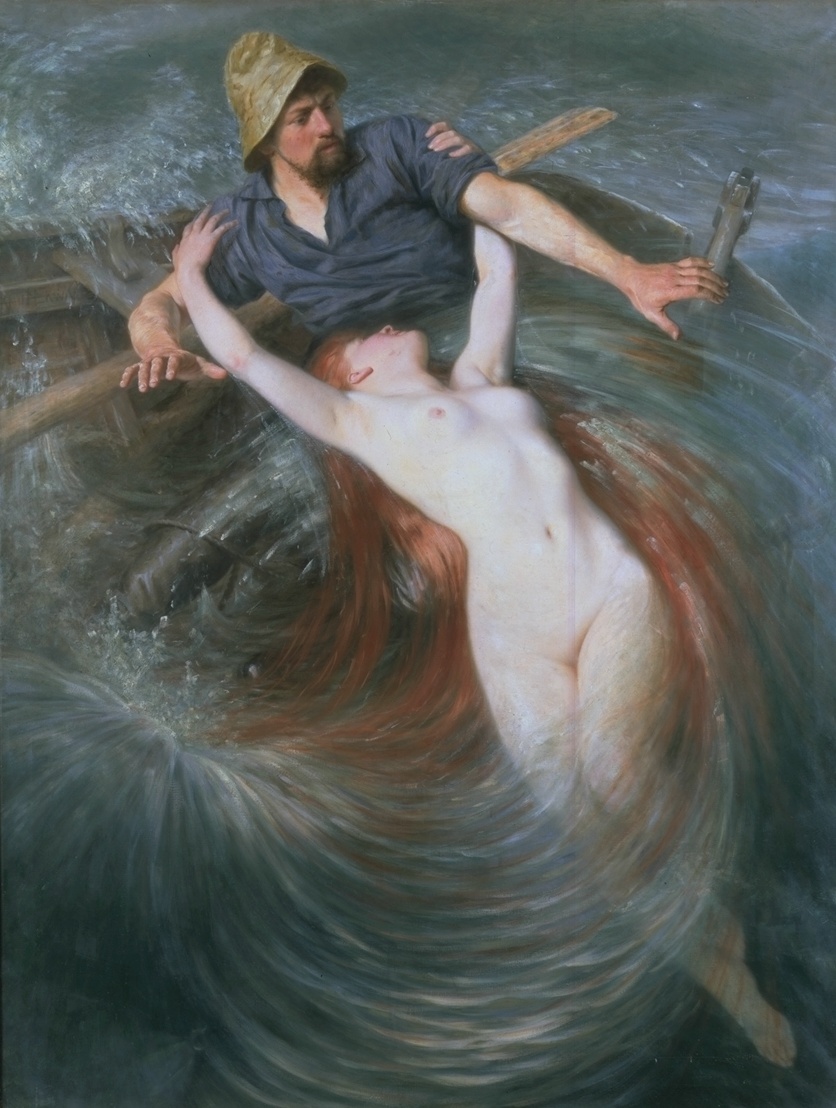
So as I was reposting a poem of mine about a Knut Ekwall painting, which is itself a rendering of mythology, I was drawn again to the painting that depicts a fisherman flailing against the clutches of a prominently nude siren who is pulling him quite literally into the vortex of her seduction:

knut_ekwall_fisherman_and_the_siren
Knut Ekwall (Swedish, 1843-1812) A Fisherman engulfed by a Siren, c. 1860s, oil on canvas, 194 x 149 cm, private collection. (Source)

And here we are confronted with aesthetic beauty, the question of whether it can exist in something like an objective context. The siren of Ekwall’s painting is but one of uncountable thousands of such representations of women in literature as well as visual art—Pandora, the sirens, Eve—that reduce the female to seductress and centers that seduction in her nudity.

The female nipple has been tabooed to such a degree in contemporary Western culture that we are now more frightened of the exposed female nipple than gun violence. But while Ekwall’s nude siren is from a much different era, viewing this painting today must also recognize the role of taboo in defining beauty, must confront the very white representation of the siren and beauty as well.

The female as allegory—whether Hester in The Scarlet Letter, Eve in the Garden of Eden myth, or a tempting but unnamed siren in a realistic painting—persists in so-called serious art but also in pop art. Our films in the U.S. remain an endless stream of functional females serving the needs of the white male savior: the fetishized Eastern woman; the white, blonde, young Girl-as-Trophy.

So in 2016, we can have a painting of this siren, nipples and all, yet women cannot by choice post pictures on Instagram that include their nipples, even if the photographs are deemed art—the first, of course, proclaimed as art by a man, and in the case of social media, let us not honor a woman’s right to choose if and how the world views her own body.

In 2016, as well, we are witnessing the demise of nudity in Playboy, that perversely sophisticated publication of objectifying an incredibly sterilized and idealized female as allegory. Some have noted that Playboy‘s no-nude policy has simply shifted how the publication panders to fetishes that continue to dehumanize women by reducing them to mechanisms of those fetishes.

The Internet has neutered the tabooing of nudity and graphic sex so Playboy has had to shift its game plan—but it is the same old game plan rendered in a really thin veneer (likely often to be quite literally a really thin veneer).

As a critical white male, I am confronted, then, by the world of art and the world of pop art as they have shaped my perception of females, from the female form to the fully realized female as a real person walking this planet.

That is my vortex, I believe, and thus, my poem sought to wrestle from the painting and the myth some balance that may occur between two lovers, caught in their love and desire but also trapped in a wider vortex that shapes them as unequal.

Love and desire, like art, are never apolitical—as Laurie Penny recognizes in her musing about Valentine’s Day:

Buried under the avalanche of hearts and flowers is an uncomfortable fact: romantic partnership is, and always has been, an economic arrangement. The economics may have changed in recent decades, as many women have gained more financial independence, but it’s still about the money. It’s about who does the domestic labour, the emotional labour, the work of healing the walking wounded of late capitalism. It’s about organising people into isolated, efficient, self-reproducing units and making them feel bad when it either fails to happen or fails to bring them happiness.

And in her Drawing Blood, Molly Crabapple connects the dots:

Artists are not supposed to care about commerce. The lies told to artists mirror the lies told to women: Be good enough, be pretty enough, and that guy or gallery will sweep you off your feet, to the picket-fence land of generous collectors and 2.5 kids. But make the first move, seize your destiny, and you’re a whore.

My poet/writer Self, my teacher Self, and my authentic Self as a man have always recoiled in fear that none of us can ever pull free of the very real vortex that is patriarchy, that casts and recasts the female as allegory—to be worshipped, to be owned, to be guarded.

But it is my poet/writer Self who continues to believe that “Beauty is truth, truth beauty,” and hopes there is love and desire that can honor lovers as equals who rise above the larger failures of humanity.

My Romantic side persists—despite all the evidence to the contrary.

See Also

Emily Ratajkowski: Baby Woman

What Makes Poetry, Poetry?

It is Valentine’s Day 2016, and I have been spending the morning with poetry. So when I came across Peter Anderson’s Line and Stanza Breaks in Free Verse Poetry – NVWP Summer Institute – Day 5 pt. 1, I was suitably primed to do something I believe I have failed to do here on my blog—write about teaching poetry as a poet.

A couple years before I would discover that I am a teacher (the fall of my junior year of college), I was sitting in my first-year dorm room in the spring when I wrote my first real poem, and thus, had that quasi-religious experience of becoming a poet.

Being a poet is not something I chose to do, not something I can control. There are weeks, maybe months, when no poems come, and then there are manic days and days and days when they come like tidal waves, avalanches—unbidden but gathered frantically out of the writer’s fear that at any moment this may end, abrupt as a fatal aneurism.

Now comes the really embarrassing part, where poet/writer intersects with teacher.

The first moment my foot touched the floor of my classroom, I envisioned myself as a teacher of writing, but also a teacher who would instill in my students my love for reading (devouring) literature, especially poetry.

I worked hard, intensely—as I am prone to do—to teach my students to write, willing all the while the love of literature and poetry into their adolescent hearts and minds.

Yet—this is embarrassing—I was casually murdering everything I loved, and scrubbing the life and blood from my students’ possibilities as writers, poets, and the sorts of joyous readers I had envisioned.

My godawful teaching of poetry and efforts at having my students write poetry—despite my precious poetry unit built around the music of R.E.M.—were all mind and no heart.

The most important aspect of ending these horrible practices as a teacher who had divorced himself uncritically from his Poet Self was dropping my transactional methods (opening the poetry unit by giving students “the four characteristics of poetry” [all nonsense, by the way] and then asking them to apply those to their analysis of a poem they chose [I thought the choice part was awesome]) and embracing an overarching discovery approach driven by a broad essential question: What makes poetry, poetry?

Early and often as we meandered through dozens of poems and R.E.M. lyrics, my students and I kept returning to a Thoreau moment: “Simplify, simplify, simplify.”

No matter how hard we tried, we could discover nothing a poet did that writers of other types of writing didn’t also do—except for the purposeful formation of lines and stanzas (including that prose poets create poetry by the negative of avoiding the conventions of lines and stanzas in poetry).

Prose, we recognized, is driven by the formation of sentences and paragraphs, as a contrast, but poetry is almost exclusively as well composed of complete sentences (despite the argument by most students that poetry is a bunch of “fragments,” leading to examinations of enjambment).

Reading and writing poetry became investigations, opportunities to play with words and witness the joy they can bring.

All writing, including the work of the poet, including the work of any artist, is a creative act endured in the context of some structures that the writer/artist either embraces or actively reaches beyond.

What makes poetry, poetry? The purposeful construction of words into lines and stanzas.

“A poem should not mean/But be,” poses Archibald MacLeish. But as a young teacher, I sullied that simple dictum.

Instead, I committed the act of teaching, about which Marianne Moore declares: “I, too, dislike it: there are things that are important beyond/all this fiddle.”

School and teaching can and often are the death of poetry, of writing, of the magnificent joy of human expression.

As poet/writer and teacher, mine is to resist “all this fiddle,” and to allow for students the moment when poetry comes, unexpectedly while your dog sleeps on your feet.

Valentine’s Day: A Reader

love is more thicker than forget

e.e. cummings

Love does not begin and end the way we seem to think it does. Love is a battle, love is a war; love is a growing up.

“In Search of a Majority,” James Baldwin

Maybe you should just be single, Laurie Penny

Buried under the avalanche of hearts and flowers is an uncomfortable fact: romantic partnership is, and always has been, an economic arrangement. The economics may have changed in recent decades, as many women have gained more financial independence, but it’s still about the money. It’s about who does the domestic labour, the emotional labour, the work of healing the walking wounded of late capitalism. It’s about organising people into isolated, efficient, self-reproducing units and making them feel bad when it either fails to happen or fails to bring them happiness.

The Truth the Dead Know, Anne Sexton

My darling, the wind falls in like stones
from the whitehearted water and when we touch
we enter touch entirely. No one’s alone.
Men kill for this, or for as much.

I don’t need any help to be breakable, believe me
I know nobody else who can laugh along to any kind of joke
I won’t need any help to be lonely when you leave me

“Slipped,” The National

Love Poems | Academy of American Poets

What Depression Is Really Like

In a piercing letter to his brother, Vincent van Gogh captured the mental anguish of depression in a devastatingly perfect visceral metaphor: “One feels as if one were lying bound hand and foot at the bottom of a deep dark well, utterly helpless.” Anyone who has suffered from this debilitating disease knows that the water in that well is qualitatively, biochemically different from the water in the puddle of mere sadness. And yet, even as scientists are exploring the evolutionary origins of depression and the role REM sleep may play in it, understanding and articulating the experience of the disease remains a point of continual frustration for those afflicted and a point of continual perplexity for those fortunate never to have plummeted to the bottom of the well.

somewhere i have never travelled,gladly beyond, e.e. cummings

(i do not know what it is about you that closes
and opens;only something in me understands
the voice of your eyes is deeper than all roses)
nobody,not even the rain,has such small hands

i carry your heart with me(i carry it in, e.e. cummings

here is the deepest secret nobody knows
(here is the root of the root and the bud of the bud
and the sky of the sky of a tree called life;which grows
higher than soul can hope or mind can hide)

Coda

these boxes (an antiquarian’s Valentine’s Day card)

Fisherman and The Siren (vortex of desire)

“Please—a little less love, and a little more common decency.”

I wish that people who are conventionally supposed to love each other would say to each other, when they fight, “Please—a little less love, and a little more common decency.”

Slapstick or Lonesome No More!, Kurt Vonnegut

I was a public high school English teacher for almost two decades in the rural upstate of South Carolina.

My first years were nearly overwhelming—as they are for most beginning teachers. And I would concede that much of that struggling could easily be categorized as classroom management challenges (although having five different preps, 15 different textbooks, and classes as large as 35 students certainly didn’t help).

Yet, then and now, as I approach the middle of my third decade teaching, I tend to reject the terms “discipline” and “classroom management” because they carry connotations I cannot endorse.

First, framing classroom management as something separate from pedagogy, I believe, is a mistake. In other words, effective and engaging pedagogy creates the environment that renders so-called (and generic) classroom management strategies unnecessary.

Next, most claims about “discipline” and “classroom management” remain trapped in reductive behavioristic ideology as well as authoritarian views of the teacher (in which authority is linked by default to the position).

As a critical educator, I seek to be authoritative, not authoritarian (see Paulo Freire). In other words, I forefront the human dignity and agency of my students, I seek always to model the person and learner I feel my students should emulate, and I work diligently to earn the respect of my students, in part, because of my expertise and credibility in terms of what content I am teaching.

But having taught public school, I know the real world is messy: students become confrontational with their peers and even teachers. School can be (and in some places often is) a physically and psychologically dangerous and uncomfortable place, rendering learning less important.

And I also recognize that each teacher is legally and morally the central figure of authority in any classroom. Yes, as a teacher, I must assert that authority any time the safety, health, or opportunity to learn of any students is threatened.

So when I am teaching pre-service teacher candidates, I urge them to take certain steps in their day-to-day interactions with students as well as in confrontational events.

I urge them always to speak to students with “please” and “thank you.” I stress that whenever students become loud, belligerent, or threatening, the teacher must lower her/his voice, mediate her/his language, increase her/his patience, and seek ways to give the student space and time in order to protect all innocent students and the upset student.

I say “yes, sir” and “no ma’am” to students because my father raised me that way. However, my father’s own authoritarian style (“do as I say, not as I do”) also imprinted on me my fear of hypocrisy; therefore, I seek always to have higher standards for my own behavior than for the behavior of my students.

All of that—and more—is to say that when I read A ‘No-Nonsense’ Classroom Where Teachers Don’t Say ‘Please’ I was horrified because of both the abusive treatment of children and the (not surprising) cavalier endorsement by NPR.

The problems are almost too numerous to list, but I’ll try.

First, the so-called “unique teaching method”—”no-nonsense nurturing”—is a program (from “Center for Transformative Teacher Training, an education consulting company based in San Francisco”), and thus, NPR’s reporting proves to be little more than a PR campaign for that company.

Next, these harsh and dehumanizing methods are yet more of the larger “no excuses” ideology that targets primarily children in poverty and black/brown children. In other words, there is a general willingness to endorse authoritarian methods as long as the children are “other people’s children”—code for the poor and racial minorities.

And then, related, the direct justification for that authoritarianism is that parents choose this for their children.

Here, I want to stress again what I have examined before (see here and here):

  • Be skeptical of idealizing parental choice. Parents can and do make horrible choices for their children, and children should not be condemned only to the coincidences of their births.
  • Many scholars have addressed the self-defeating choices within racial minority communities that stem from unhealthy dynamics related to being a marginalized and oppressed people; see Michelle Alexander on black neighborhoods calling for greater police presence and Stacy Patton (here and here) on blacks disproportionately embracing corporal punishment. I have applied that same dynamic to blacks choosing “no excuses” charter schools.

While the NPR article notes that these practices “[make] some education specialists uncomfortable,” I must note this is not about being “uncomfortable.”

These practices are not providing “structure,” but are dehumanizing.

As well, these practices are racist and classist, and ultimately abusive. Period.

Our vulnerable populations of students already have unfair and harsh lives outside of school. Doubling down on indignity during the school day is not the answer.

If we cannot change the world (and I suspect we can’t), we can provide all children the sorts of environments all children deserve in their school day—environments of kindness, compassion, safety, and challenges.

To paraphrase Vonnegut, then, Please—a little less “no nonsense,” and a little more common decency.

See Also

If you’re a teacher, say “please” and “thank you,” Ray Salazar

Schools, black children, and corporal punishment

figure-1

Anatomy of a Political/Personal Poem

Politics, succinctly stated, is the negotiation of power among agents (humans, mostly, but one could argue along literary lines, humans versus nature, etc.). As a critical educator, I argue we cannot avoid being political; to claim you are not being political is being political—as expressed in Howard Zinn’s observation that you cannot be neutral on a moving train.

Below, I want to annotate a new poem of mine, as it represents the inescapable intersection of the political and the personal. As a writer, I occasionally bring my own writing into the classroom in order to be a witness to investigating a text.

My high school English students always felt very skeptical of English-teacher-as-text-authority holding forth about Writer X or Writer Y using this metaphor or symbol. Students often asked, How do you know Writer X did that on purpose?

So with my own work, I can truly reveal what is beneath a poem (the iceberg metaphor about art is useful here, but inadequate, I think, because I want something more organic such as a huge root system beneath a tree that continues to spread). I can help a student tease through my intent as well as how meaning may spring from those places where my conscious intent was lacking in the original writing.

On a companion blog, I have discussed this more broadly before, but my Poet Self is a different beast than my prose self. Poetry tends to come to me (often the first lines simply ask/demand to be written, feeling mostly not of my making but more that I have received them), and then I typically compose the full poem over several recursive hours of writing, reading, reading aloud, and re-shaping as I discover what the poem is intending to say.

What films I am watching, what books I am reading, what music I am listening to—these all become dialogues with my Poet Self, many times fueling the initial inspiration to write (and thus, many of my poems have quotes at the beginning, as below).

In an effort to avoid the cumbersome (and possibly slipping directly into the cumbersome), I am using bracketed notation, including the notations first, and then including the entire poem last—as I am not completely sure how best to format all this on a blog.

Anatomy of a Political/Personal Poem

[1] After talking to a friend who also loves The National, I have been listening to several of their albums over and over while driving to work. I love “Slipped” and noticed its use of season and that overlapped my spring motif for this piece. These lines also speak to the central two repeated lines about the inadequacy of making guarantees.

[2] One Monday, two hail storms pelted my university, the first during the morning while I sat in my office. That day was eerie in the changing weather patterns and this opening did just come to me, the first line and then I began to play with radar representations of storms, which established “screen” and “color” motifs for the poem.

[3] Pollock, O’Keefe, and cummings helped me think about representation of reality through art (what is True versus what is true/fact). The poem (as are many of my poems) is a not-so-subtle tribute to cummings in the lower-case versus uppercase as well as the use of & to suggest two/multiple things as one.

[4] Since #BaltimoreUprising has emerged as the shorthand for the current unrest in Baltimore, I have not been able to shake the power of “rising”—I think of The Dark Knight Rises, Phoenix/Jean Grey from the X-Men, and the enduring myths of rebirth.

[5] Although ending the first section, I came back to these lines over and over until I recognized the need to emphasize this poem is about calls to notice what we ignore, miss—on both personal and political levels. Nature demands we pay attention to our puniness, but humans fail again and again due to our arrogance. Humility comes from looking up and then really looking.

[6] Yes, literally I sat through two hail storms, and yes, literally, I am addressing my granddaughter. Throughout my poetry, I have examined the weight of not noticing until too late “the last time,” but with my granddaughter, I have become more aware of “first times.” The hyperlink is to my first poem about my granddaughter, written before she was born and even before we knew her gender. I use “sky” in poems about her as her name is Skylar.

[7] As I continued to shape and re-shape the poem—polish, prune, and always choosing the right (only?) word—I recognized that the piece demanded a “mother” motif—one I allowed to remain fairly hidden or mostly implied. In a blog post, I have examined more directly the Western/Christian use of Nature to mythologize human ideas about evil/good (specifically with snakes), and those ideas are suggested here.

[8] Storytelling, mythologizing—what story does weather radar tell? What about mainstream cable news? I am almost always thinking about Margaret Atwood’s examination of telling and retelling (notably in The Handmaid’s Tale). As I was coming to see the poem as “finished,” I realized the power of repeating these lines in both the context of my granddaughter (the personal) and the uprising in Baltimore (the political). I hope the “we” and “you” are both necessarily ambiguous and directly evocative of real people in real situations of passion and human frailty.

[9] Although this section, I feel, pulls together central motifs about “motherhood,” “Nature,” and storytelling/mythologizing, I must again confess this actually happened. People have been telling my daughter this “story” about snakes in springtime, and she paused sharing this with me one morning on her way out to work as I was there to provide care for my granddaughter. My daughter and I are worriers, anxious souls. We don’t need to hear such things. Here I also decided to use italics to offer some sense of discourse, some agents of actual telling. Again, as part of my visual self (cummings, comic books, films), I feel the poem sporadically zooming in and then pulling back—both the writer telling a story but also the camera capturing the story.

[10] The cable news section builds and then extends the motifs, but I struggled with how to blend this element with the personal sections that were much easier, natural to compose. I watched the Baltimore coverage as it happened, mostly flipping between CNN and MSNBC, using Twitter to guide me—experiencing how an event unfolding in real time is shaped by who and how the story if composed.

[11] My poem titles tend to include a main and then parenthetical title. Typically, as I start a poem I have only the main title and then a parenthetical reveals itself. “Baltimore is burning” was that organic element here, simple and alliterative as well as disturbing.

[12] These two lines echo and reinforce the first two lines with the “screen” and “color” motifs. The use of “yellow” and “black” also carry layers of connotation. The “yellow” of literal fire on the TV screen but “yellow” carries both “cowardice” and “caution” while “black” captures the literal night as well as race. “Blossom” also is central to the concepts of spring (as seasonal and as political renewal) while adding some tension to images that are positive and negative, sometimes simultaneously (flowers and fires can blossom).

[13] The hardest and slowest developing lines of the poem are these four. I struggled against slipping into mere commentary (losing the poetic), but I also wrestled with my urge to confront “minstrel show” and “black face” as part of the unmasking of racist mainstream media coverage while striking an objective pose of presenting both sides. The allusion to Fox News remains, but I never fully formed the thought of MSNBC being “Minstrel Show NBC.” The puppeteering and make-up (masking) felt necessary, but not satisfying until I placed this section as parenthetical, a bit of mechanical cloaking to reinforce the masking motif.

[14] The Baltimore refrains originally were all “is” sentences, but despite the importance of “Baltimore is burning,” I moved toward “Baltimore [verb]” and played with quite a number of combinations of verbs. “Witnesses” is a very subtle allusion to James Baldwin, and more directly, “explodes” (as I hyperlink) is an allusion to Langston Hughes’ “Harlem.” The natural and human-made storms are blended by the last section, framing the poem with storm, hail, and wind.

[15] I return to italics to suggest someone is speaking to some audience, but here the ambiguity is much more significant and purposefully broad. I like the rhythm of the “if” statements, and one of the best edits of the poem, I think, was being drawn to one of my favorite R.E.M. songs, “The Flowers of Guatemala,” a beautiful and powerful political song about Central America/U.S. politics. I lift almost directly “The flowers cover everything,” and share the song’s focus on paying attention to the masked, invisible: “There’s something here I find hard to ignore.”

[16] Completing the news image earlier of “minstrel show,” I return to the soot of the Baltimore fires turning everyone black, in black face, as a plea to “If everyone looked the same, would we do better?” The repetition of “recognize” also links back to the parenthetical commentary on the news media and reinforces the tension between paying attention and masking.

[17] Especially in poems, but essays as well, I seek always to frame so I had to return to “Baltimore is rising” even though I had elected to use the “Baltimore [verb]” constructions to open the last section. I was stuck for a while with “Baltimore is Phoenix,” which seemed both to work and falter. Here is where my revision strategy of reading aloud over and over was key. “Baltimore is burning/ Phoenix rising” sounded right aloud. Alluding to Harlem, directly addressing Baltimore, and Phoenix as a city name felt suggestive as well.

[18] I liked these lines as a bit of sincere resignation of grandparent/parent to child when I first wrote them (never edited, and felt right immediately). In the context of Baltimore and the ambiguity of that last section about “we” and “you,” I think, the lines work well to pull most of the key motifs and themes together, specifically the idea of “story telling” as both seeking and blurring Truth/truth.

first spring (Baltimore is burning)

“It’ll be summer in Dallas/ Before you realize/ That I’ll never be/ Anything you ever want me to be”
“Slipped,” The National [1]

thunderstorms blossom on the radar
green yellow red maroon [2]

like animated flower bouquets created by
Jackson Pollock Georgia O’Keefe & e.e. cummings [3]

because springtime is rising again [4]

hail taps my office window
rattled by wind gusts in shared rhythm

this season demands i pay attention
this building storm lifts my eyes [5]

/

precious child of my child
this is your first spring [6]

your first angry sky
your first thunder&lightning

we will hold&comfort you
but only you can understand Mother Nature [7]

we can tell you stories in soothing tones
but we cannot guarantee anything [8]

except our hearts are filled with you
etched forever into the bones of us

/

this is the story they are telling my daughter

snakes can smell when you are nursing
slithering into your house for the milk

snakes will strangle nursing babies
sleeping&dreaming in their cribs alone

my child who is a mother tells me this
her eyes&voice beg of me a mother’s plea

what is a mother to do what is a mother to do
if even Nature conspires against her baby [9]

/

the news tells me this story in the last days of April [10]

Baltimore is burning [11]
thugs rioting&looting

flames blossom on the TV screen
yellow black yellow black [12]

(if you look close enough you can recognize
the strings&make-up but not the puppeteers

performing this 21st-century minstrel show
masquerading as fair&balanced reality TV) [13]

/

Baltimore cries
Baltimore witnesses

like the first thunderstorm of spring
tossing hail&wind against your window

Baltimore shouts
Baltimore explodes [14]

if the fires are large enough
if the fires burn long enough

if the soot covers over everything [15]
painting every single face black

will you listen will you look
will you recognize will you act [16]

Baltimore is burning
Phoenix rising [17]

we can tell you stories in soothing tones
but we cannot guarantee anything [18]

—P.L. Thomas