Category Archives: Poverty

The Doable We Refuse to Do: End Poverty, Confront Privilege

Since I have recently challenged the word magic behind claims that education is the one true path out of poverty and that the free market can ever address poverty and inequity, I want to highlight that the unwillingness of political leaders and the public to acknowledge the importance and potential of the Commons results in a refusal to end directly poverty and confront privilege.

Austin Nichols offers a powerful argument that We can end child poverty. Or, at least, do more:

We could effectively end child poverty now, at least in the short run. The question is whether we’re willing to do that.

If the United States offered cash benefits to children in poor families, we could cut child poverty by more than half. According to calculations using the 2012 Current Population Survey, poor children need $4,800 each, on average, to escape poverty. That’s $400 a month for each child.

If we issued a $400 monthly payment to each child, and cut tax subsidies for children in  higher-income families, we would cut child poverty from 22 percent to below 10 percent. If we further guaranteed one worker per family a job paying $15,000 a year, and each family participated, child poverty would drop to under 1 percent.

A child benefit is now common across developed countries, with amounts of about $140 a month in the UK, $190 in Ireland, $130 in Japan, $160 in Sweden, and $250 in Germany.  A smaller child benefit of $150 per month would chop child poverty from 22 percent to below 17 percent. Adding the job guarantee would lower child poverty to 8 percent.

As important as the need and ability to end poverty directly is the need to face the power of privilege, as detailed by Richard Fry’s The growing economic clout of the college educated. Note specifically the following data displays:

Fry explains the growing disparity:

For the first time on record, households headed by someone with at least a bachelor’s degree received nearly a majority (49.7%) of aggregate U.S. household income; nearly one out of every two dollars went to the college educated.  In 2012 one-in-three households was college educated, so, put another way, half of the aggregate U.S. income goes to one third of the households.

Buried in the strong correlation between level of education attained and household income is the very real causational relationship between privilege and access to that education (both the quality and attainment). While it remains statistically true that higher earning is associated with higher educational attainment, it is also likely that higher educational attainment is simply a marker for the privilege that led to that attainment.

In other words, identifying any person’s educational attainment may be more about that person’s relative privilege or poverty and not that person’s effort, ability, or genuine achievement. (Please note Bruenig’s recognition that birth-wealth without college still has higher income potential than birth-poverty and college attainment.)

The evidence is overwhelming that poverty and affluence are destiny, that inequity is growing in the U.S., and that the best and most effective methods for ending poverty and closing the equity gap is through direct action by our publicly funded institutions (and not waiting on the magic of the Invisible Hand).

The Libertarian Faerie: A Fable

Americans watched as their leaders battled: Senate versus House over the fate of food stamps:

Republicans have emphasized that the bill targets able-bodied adults who don’t have dependents. And they say the broader work requirements in the bill are similar to the 1996 welfare law that led to a decline in people receiving that government assistance.

“Politically it’s a great issue,” says Rep. Tim Huelskamp, R-Kan., one of the conservatives who has pushed for the larger cuts. “I think most Americans don’t think you should be getting something for free, especially for the able-bodied adults.”

House Minority Leader Nancy Pelosi, D-Calif., said Tuesday that Democrats are united against the bill.

“Maybe I’m just hoping for divine intervention, but I really do believe that there are enough Republicans that will not identify themselves with such a brutal cut in feeding the American people,” Pelosi said at a news conference.

Hearing this, the Libertarian Faerie appeared before Congress and proclaimed: “I can grant you all one wish—that all people of this great land will have only that which they have earned!”

House and Senate alike nodded their heads and the Libertarian Faerie waved his arms.

And thus, that day, the entire House and Senate stood naked and penniless before the American public, and few times in recent history had so many white men wandered also naked and penniless across the US of A.

Moral: Oops.

[Thanks to @alexisgoldstein]

—–

Version 2

The Ghost of Ayn Rand: A Horror Story

Americans watched as their leaders battled: Senate versus House over the fate of food stamps:

Republicans have emphasized that the bill targets able-bodied adults who don’t have dependents. And they say the broader work requirements in the bill are similar to the 1996 welfare law that led to a decline in people receiving that government assistance.

“Politically it’s a great issue,” says Rep. Tim Huelskamp, R-Kan., one of the conservatives who has pushed for the larger cuts. “I think most Americans don’t think you should be getting something for free, especially for the able-bodied adults.”

House Minority Leader Nancy Pelosi, D-Calif., said Tuesday that Democrats are united against the bill.

“Maybe I’m just hoping for divine intervention, but I really do believe that there are enough Republicans that will not identify themselves with such a brutal cut in feeding the American people,” Pelosi said at a news conference.

Hearing this, the ghost of Ayn Rand appeared before Congress and proclaimed: “I declare that all people of this great land will have only that which they have earned!”

House and Senate alike nodded their heads as the ghost of Ayn Rand waved her arms.

And thus, that day, the entire House and Senate stood naked and penniless before the American public, and few times in recent history had so many white men wandered also naked and penniless across the US of A.

Moral: Oops.

Recommended: “Social Class and the Hidden Curriculum of Work,” Jean Anyon

Abstract

It’s no surprise that schools in wealthy communities are better than those in poor communities, or that they better prepare their students for desirable jobs. It may be shocking, however, to learn how vast the differences in schools are – not so much in resources as in teaching methods and philosophies of education. Jean Anyon observed five elementary schools over the course of a full school year and concluded that fifth-graders of different economic backgrounds are already being prepared to occupy particular rungs on the social ladder. In a sense, some whole schools are on the vocational education track, while others are geared to produce future doctors, lawyers, and business leaders. Anyon’s main audience is professional educators, so you may find her style and vocabulary challenging, but, once you’ve read her descriptions of specific classroom activities, the more analytic parts of the essay should prove easier to understand. Anyon is chairperson of the Department of Education at Rutgers University, Newark.

Please read “Social Class and the Hidden Curriculum of Work,” Jean Anyon*:

In the two working-class schools, work is following the steps of a procedure….

In the middle-class school, work is getting the right answer….

In the affluent professional school, work is creative activity carried out independently.

Consider also how things have changed little:

Studies Suggest Economic Inequity Is Built Into, and Worsened by, School Systems

Education Reform in the New Jim Crow Era

*(This essay first appeared in Journal of Education, Vol. 162, no. 1, Fall 1980.) “Thank you” to Adam Golub (@adamgolub) for posting this on Twitter.

Who Benefits from Ignoring Poverty and Race?

In his spring 2013 commencement address at Morehouse College, Barack Obama offered a compelling message:

Obama said he was lucky to have his mother and grandparents, who raised him, and said that under different circumstances, he could have ended up in prison or unemployed.

‘I might have been in prison. I might have been unemployed. I might not have been able to support a family — and that motivates me,’ he said.

While he urged graduates to not use race as an excuse for their failures, he acknowledged that the ‘bitter legacy’ of discrimination still exists in America.

‘At some point in life as an African American you have to work twice as hard as anyone else if you want to get by,’ he said.

Coming from the first African American president in the U.S., this call for personal grit and refusing to make excuses speaks to a central narrative found in the current education reform debate.

Bill Cosby has offered a similar message, prompting even supporters of Cosby to raise concerns:

There are some obvious concerns with Cosby’s rhetoric. First is the justifiable, and quite accurate concern that his critiques ignore structural inequality and place too much emphasis on individual responsibility. Then there is the fear that such commentary might be used as weaponry for conservatives in ways that both blacks and whites, conservatives and liberals, have historically used black deviance to achieve ideological and policy goals. Indeed, when conservative mogul Rupert Murdoch (chairman of the News Corporation, which owns the New York Post that Cosby published in) cosigned with Cosby’s comments, you know it’s not a good look.

However, messages of grit and “no excuses” remain prominent among advocates of education reform committed to charter schools and other market-based policies as well as the growing standards and high-stakes components of the accountability era.

For example, Steve Perry continues to attack teachers unions as “roaches” and relentlessly tweets his message of grit, “no excuses,” and claims of his own success as an educator (although these claims have been debunked, challenged as side-show, and exposed as misleading). Perry’s Twitter feed (@DrStevePerry), in fact, represents well the dominant themes running through the most widely embraced attitudes about race and poverty in the U.S., beliefs that have been driving education reform for three decades:

If America’s ed failures were just about ‘poverty’ then why is the entire country at the bottom of international competition?

I’m tired of this solutionless dribble… Poverty, waaa.. Privitaization.. waaa Corportaions, waaa Since when do you work for free!

Poverty has been w use since beginning of recorded history. Yet then as now ppl make it out thru education. Good education = end 2 poverty.

If you believe poverty is stopping your students from learning please turn in your letter of resignation today before the end of business.

I believe that Dr. King’s dream and Prez Obama’s hope are one in the same. We can overcome because we do overcome. Education is the key.

The only people who believe that poverty can’t be overcome are people who have never overcome poverty.

Great educators don’t whine when parents expect that they’ll deliver an education. They don’t blame poverty. They accept responsibility.

Stop saying poverty is more important than good teachers. You’re wrong & you sound nuts. There’s NO causal relationship.

The rhetoric is compelling, but are the claims accurate?

Is the U.S. at the bottom of international comparisons, and if so, is poverty irrelevant to those rankings? Carnoy and Rothstein have shown:

In a new EPI report, What do international tests really show about U.S. student performance?, we disaggregate international student test scores by social class and show that the commonplace condemnation of U.S. student performance on such tests is misleading, exaggerated, and in many cases, based on misinterpretation of the facts. Ours is the first study of which we are aware to compare the performance of socioeconomically similar students across nations….

Yet a careful analysis of the PISA database shows that the achievement gap between disadvantaged and advantaged children is actually smaller in the United States than it is in similar countries. The achievement gap in the United States is larger than it is in the very highest scoring countries, but even then, many of the differences are small….

The share of disadvantaged students in the U.S. sample was larger than their share in any of the other countries we studied. Because test scores in every country are characterized by a social class gradient—students higher in the social class scale have better average achievement than students in the next lower class—U.S. student scores are lower on average simply because of our relatively disadvantaged social class composition [emphasis added].

In 2010, Mel Riddile exposed the same flawed rankings that ignore poverty, concluding:

Truthfully, you and I know all too well that Secretary Duncan, who led schools in Chicago, is aware of the relationship between poverty and student achievement, but he doesn’t trust us enough to tell us the truth. He is afraid that we will use poverty as an excuse and that we will forget about our disadvantaged students. Ironically, by not acknowledging poverty as a challenge to be overcome, Duncan is forgetting about our disadvantaged students. Duncan needs to deliver the message that all our students deserve not only access to an education, but access to an excellent education. He needs to repeatedly remind us that, when it comes to school improvement, it’s poverty not stupid.

Which is a more powerful influence on measurable student outcomes, poverty or teacher quality? Di Carlo explains about the evidence:

But in the big picture, roughly 60 percent of achievement outcomes is explained by student and family background characteristics (most are unobserved, but likely pertain to income/poverty). Observable and unobservable schooling factors explain roughly 20 percent, most of this (10-15 percent) being teacher effects. The rest of the variation (about 20 percent) is unexplained (error). In other words, though precise estimates vary, the preponderance of evidence shows that achievement differences between students are overwhelmingly attributable to factors outside of schools and classrooms (see Hanushek et al. 1998Rockoff 2003Goldhaber et al. 1999Rowan et al. 2002Nye et al. 2004).

Is poverty destiny in the U.S.? As I have examined before, research from 2012, “A Rotting Apple” (Schott Foundation for Public Education) and “Housing Costs, Zoning, and Access to High-Scoring Schools” (Brookings), confirms that the socioeconomic status of any child’s home is a strong predictor of that child’s access to high- or low-quality schools. While not a politically appealing statement, in the U.S., poverty is destiny—and so is race.

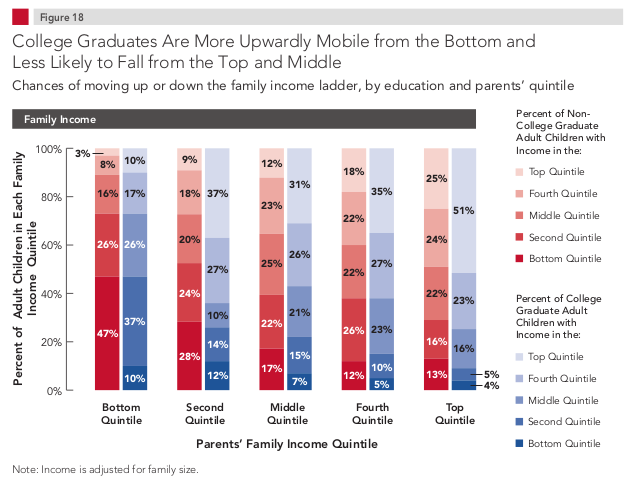
Is education the ticket out of poverty? Based on Pew’s Economic Mobility Project, Matt Bruenig has concluded:

So, you are 2.5x more likely to be a rich adult if you were born rich and never bothered to go to college than if you were born poor and, against all odds, went to college and graduated. The disparity in the outcomes of rich and poor kids persists, not only when you control for college attainment, but even when you compare non-degreed rich kids to degreed poor kids!

Therefore, the answer to the question in the title is that you are better off being born rich regardless of whether you go to college than being born poor and getting a college degree.

Yet, President Obama has committed to arguing that African Americans must work twice as hard to succeed, while his Secretary of Education Arne Duncan offers this about the rise of segregation in U.S. schools:

So whatever we can do to continue to increase integration in a voluntary way—I don’t think you could force these kinds of things—we want to be very, very thoughtful and to try to do more in that area quite frankly.

Duncan, as the very public face and voice of Obama’s education agenda, has echoed that school reform is the civil rights issue of our time, and Duncan tends to pepper his education talks with civil rights rhetoric. But in the end, even as the federal government does force many policies onto states, the Secretary is careful to note “I don’t think you could force these kinds of things.”

Ultimately—even when messages come from prominent African American leaders, entertainer, and educators—the “no excuses” effort to ignore race and poverty serve only the interests of politicians and the affluent. How?

If poverty is the result of individual laziness and thus can be overcome by simply doubling down on effort, then the responsibility of overcoming poverty lies entirely in people who are poor.

Politicians and the affluent, then, are absolved of their culpability in the existence of poverty or their need to be proactive in eradicating poverty. Political, cultural, and educational leaders can continue to float on the breeze of rhetoric and never stoop to confronting the evidence they are wrong or that they need to act in any way.

Another powerful message beneath ignoring race and poverty is that the affluent deserve their affluence just as the impoverished deserve their poverty, as detailed by Chris Arnade:

When you’re wealthy you make mistakes. When you are poor you go to jail.

Yes, it is like comparing apples and oranges. That is the point though. We have built two very different societies with two very different sets of values. Takeesha [prostitute, drug addict] was born into a world with limited opportunities, one where the black market has filled the void. In her world transgressions are resolved via violence, not lawyers. The law as applied to her is simple and stark, with little wiggle room.

Mr one-glove [Wall Street trader] was born into a world with many options. The laws of his land are open for interpretation, and with the right lawyer one can navigate in the vast grey area and never do anything wrong. The rules are often written by and for Mr one-glove and his friends.

The successful and affluent, regardless of race, must preserve the myth that success in the U.S. is earned, that the U.S. has achieved meritocracy.

If Clarence Thomas, as an African American, can achieve his position as a Supreme Court judge, that is all the proof we need that effort trumps race (and that we no longer need affirmative action)—goes the twisted logic.

And finally, the “don’t force it” message is bowing to the allure in the U.S. of the Invisible Hand of the market and skepticism about the intrusive government.

Again, however, this message ignores evidence. Left to market forces, charter schools have increased the exact rise in segregated schools that is currently also plaguing traditional public schools.

The Invisible Hand is not an ethical force, and issues such as segregation, economic equity, and racial equity are ethical issues—requiring ethical (and thus social) forces and solutions.

Let’s return to Obama’s commencement speech:

During the address, the president rallied against the racism of the 1940s and 50s and the Jim Crow laws.

He told the graduates that despite the obstacles, people like Dr King were able to learn how to be ‘unafraid’.

He said: ‘For black men in the forties and fifties, the threat of violence, the constant humiliations, large and small, the gnawing doubts born of a Jim Crow culture that told you every day you were somehow inferior, the temptation to shrink from the world, to accept your place, to avoid risks, to be afraid, was necessarily strong.

‘And yet, here, under the tutelage of men like Dr. Mays, young Martin learned to be unafraid.  He, in turn, taught others to be unafraid.’

Here, again, like Duncan’s talks on education, rhetoric that directly mentions the inequities associated with race and class—a similar pattern found in Perry’s outbursts—are designed to mask and ignore the lingering corrosive influence of race and class in the lives and schools of a growing population of people and children in the U.S.

We must ask who it benefits to raise a fist against the Jim Crow Era while ignoring that the New Jim Crow Era of mass incarceration is destroying the lives of African American males, that urban schools serving disproportionately impoverished African American and Latino/a children are increasingly school-to-prison pipelines and schools-as-prisons, and that the rise of charter schools in abandoned cities like New Orleans are segregating schools and providing “other people’s children” schools unlike the schools for privileged children.

Certainly it doesn’t benefit the victims of cultural and institutional racism and classism that remain in the U.S.

The MLK Imperative in an Era of “No Excuses”

My father was a hard-ass, €”a Southern version of the Red Forman-type made popular in That 70’s Show. I grew up, then, in a “no excuses” environment rooted in the 1950s work ethic my father personified. [1]*

Mine was a working-class background: My paternal grandfather (for whom I was named) ran the small-town gas station where I grew up, and my maternal grandfather worked in the yarn mills in the hills of North Carolina.

Way before the “no excuses” ideology consumed the education reform movement of the 21st century, “no excuses” ruled my childhood and teen years. My behavior at home and school? No excuses. My academic achievement? No excuses.

Two important realizations, however, stem from that childhood and young adulthood of mine.

First, most of my academic, scholarly, and personal success occurred in spite of (not because of) that “no excuses” upbringing.

And second, in retrospect I recognize that the central element in that success, feeding my working-class roots, was enormous privilege driven by the coincidences of my being male, white, and possessing the academic acumen preferred by social and educational norms.

Privilege, Humility, and Community

Nestled somewhat silently and invisibly beneath the “no excuses” atmosphere of my childhood was two wonderfully loving parents €”and a culture of literacy that can clearly be identified as the source of my academic success.

The line from Dr. Seuss to Kurt Vonnegut is being necessarily oversimplified here, but from my earliest recollections, I loved reading and books. And by my late adolescence and young adulthood, I became an avid reader of Kurt Vonnegut, through whom I came to know alternative views of history (Sacco and Vanzetti by way of Jailbird, for example).

The most powerful lesson I have drawn from Vonnegut, however, has been the words, life, and actions of Eugene V. Debs:

Your Honor, years ago I recognized my kinship with all living beings, and I made up my mind that I was not one bit better than the meanest on earth. I said then, and I say now, that while there is a lower class, I am in it, and while there is a criminal element I am of it, and while there is a soul in prison, I am not free.

From Debs I have come to understand that anyone’s privilege is the foundation for humility, not arrogance (no “I deserve this unlike others” attitude), and that all people bestowed with privilege should feel compelled to work diligently for the equity of others, with Debs’ works and life serving as models.

The key to that understanding of and praxis drawn from privilege is my embracing critical pedagogy:

Thus, proponents of critical pedagogy understand that every dimension of schooling and every form of educational practice are politically contested spaces. Shaped by history and challenged by a wide range of interest groups, educational practice is a fuzzy concept as it takes place in numerous settings, is shaped by a plethora of often-invisible forces, and can operate even in the name of democracy and justice to be totalitarian and oppressive. (Kincheloe, 2005, p. 2)

My critical commitment, then, to equity is grounded in my work as an educator and scholar as well as my foundational focus on democracy, equity, and agency.

And it is there that I now turn to examining the Martin Luther King Jr. imperative in an era of “no excuses.”

Claim One: Poverty and Privilege Are Destiny

“No excuses” has a specific meaning and context in 2012, one associated with corporate education reform endorsed by Secretary of Education Arne Duncan, Bill Gates, Michelle Rhee, and a long list of self-proclaimed reformers who have little or no experience as educators or scholars. Nonetheless, these reformers drive their agendas with slogans such as “poverty is not destiny.”

While this and other slogans are culturally compelling, factually in the U.S., poverty is destiny, and that reality is often as much linked to socioeconomic status as race.

Some acknowledgement exists for the school-to-prison pipeline that plagues poor and minority students; for example, the Justice Department in Mississippi has concluded, as Ferriss reports:

The suit alleges that the state, county and city “help to operate a school-to-prison pipeline in which the rights of children in Meridian are repeatedly and routinely violated,” said a Department of Justice press release.  “As a result, children in Meridian have been systematically incarcerated for allegedly committing minor offenses, including school disciplinary infractions, and are punished disproportionately without due process of law.”

The school-to-prison pipeline, I fear, is ultimately an inadequate metaphor for the current “no excuses” policies in many high-poverty and high-minority public and charter schools that are better described with schools-as-prisons.To understand the need to change the metaphor, we must first acknowledge that in the U.S. white males outnumber Latino and African American males about 3 to 1, but in U.S. prisons, Latino and African American males outnumber white males about 10 to 1.

The race and class implications of the causes behind these data are captured, I think, in James Baldwin’s assessment in “No Name in the Street” (1972):

The truth is that the country does not know what to do with its black population now that the blacks are no longer a source of wealth, are no longer to be bought and sold and bred, like cattle; and they especially do not know what to do with young black men….It is not at all accidental that the jails and the army and the needle claim so many….€

The blurring of public institutions used for control instead of their democratic purposes has been questioned by Michel Foucault:

The practice of placing individuals under ‘observation’ is a natural extension of a justice imbued with disciplinary methods and examination procedures. Is it surprising that the cellular prison, with its regular chronologies, forced labour, its authorities of surveillance and registration, its experts in normality, who continue and multiply the functions of the judge, should have become the modern instrument of penality? Is it surprising that prisons resemble factories, schools, barracks, hospitals, which all resemble prisons? (Discipline & Punish, 1975)

The evidence that poverty is destiny is disturbingly reflected in our schools. Pre-kindergarten expulsions—€”overwhelmingly male and then disproportionately African American males—€”foreshadow our imprisonment inequities; and our “no excuses” school discipline policies, such as zero tolerance, have directly transformed the school-to-prison pipelines into schools-as-prisons:

These findings show that urban youth get subjected to levels of surveillance and repression that are not the same as long-term incarceration, but nonetheless, as the school merges with an ideology of street policing, the courts, and even the prison, a particular culture of penal control becomes an aspect of everyday life at school and beyond….

Despite the trouble it caused students, there was an important ideological dimension to their refusal to comply with law enforcement. Their contestations during interactions with police and agents contained within them a decisive critique of disciplinary practices. Policing practices, especially the demand to see ID, conflicted with students’ sense of justice and fairness and their imagined ideal of schooling. Kathleen Nolan, Police in the Hallways

While “No Excuses” Reformers (NER) issued a manifesto claiming that a child’s ZIP code does not determine access to educational quality, several recent studies show that ZIP code determines a child’s school [2], and then that school’s policies and quality further entrench that child’s future. For many African American males, ZIP code determines school quality and then that school experience is both like prison and a precursor to prison.These damning facts associated with schools, however, are but microcosms of larger social inequities. The U.S. is no longer a model of social mobility (Sawhill & MortonNorton & Ariely), and the U.S. ranks near the bottom when compared with other industrialized countries in the percentage of childhood poverty, well over 20%.

Public schools in the U.S. fail in two ways that are masked by claims that “poverty is not destiny” and school reform alone will allow schools to reform society: (1) Schools reflect the inequities of the wider society, and (2) schools perpetuate social inequities.

One of the most powerful examples of how schools reflect society is that student achievement is correlated between 60% and over 80% with out-of school factors (BerlinerJoseph Rowntree Foundation, ETS 2007 and 2009).

Yet, the current agenda coming from the NER remains blind to social realities and the inadequacy of their reform agenda, as Berliner explains:

Because of our tendency to expect individuals to overcome their own handicaps, and teachers to save the poor from stressful lives, we design social policies that are sure to fail since they are not based on reality. Our patently false ideas about the origins of success have become drivers of national educational policies. This ensures that our nation spends time and money on improvement programs that do not work consistently enough for most children and their families, while simultaneously wasting the good will of the public (Timar & Maxwell-Jolly, 2012). In the current policy environment we often end up alienating the youth and families we most want to help, while simultaneously burdening teachers with demands for success that are beyond their capabilities.

Claim Two: “No Excuses” Reform Entrenches Status Quo of Inequity

The discourse of NER has successfully framed a “failed public schools” narrative that receives the shorthand “status quo.” A central part of that narrative is built on the argument that school reform alone can change society, but these claims, in fact, create a logic problem for NER: For schools to change society (and for which there is no evidence this has ever happened), those schools must be unlike the society, yet both public schools and NER mirror and perpetuate social inequities:

Public School Problem
“No Excuses”€ Reform
Poor, Latino/Black, special needs, and ELL students assigned disproportionately inexperienced and un-under-certified teachers
Assign poor, Latino/Black, special needs, and ELL students Teach for America recruits (inexperienced and uncertified)
Public schools increasingly segregated by race and socioeconomic status
Charter schools, segregated by race and socioeconomic status
Three decades of standards-based testing and accountability to close the test-based achievement gap
Common Core State Standards linked to new tests to create a standards-based testing and accountability system
Inequitable school funding that rewards affluent and middle-class schools in affluent and middle-class neighborhoods and ignores or punishes schools in impoverished schools/neighborhood
Drain public school funding for parental choice policies that reinforce stratification found in those parental choices
State government top-down and bureaucratic reform policies that ignore teacher professionalism
Federal government top-down and bureaucratic reform policies that ignore teacher professionalism
Rename high-poverty schools “academy”€ or “€œmagnet”€ schools
Close high-poverty public schools and open “€œno excuses” charters named “€œhope”€ or “€œpromise”€ [see above]
Ignore and trivialize teacher professionalism and autonomy
Erase experienced teachers and replace with inexperienced and uncertified TFA recruits [see above]
Poor, Latino/Black, special needs, and ELL students assigned disproportionately to overcrowded classrooms
Poor, Latino/Black, special needs, and ELL students assigned to teachers rewarded for teaching 40-1 student-teacher ratio classrooms
Poor, Latino/Black, special needs, and ELL students tracked into test-prep classrooms
Poor and Latino/Black students segregated into test-prep charter schools; special needs and ELL students disregarded [left for public schools to address; €”see column to the left]
Teacher preparation buried under bureaucracy at the expense of content and pedagogy
Teacher preparation rejected at the expense of content and pedagogy
Presidents, secretaries of education, governors, and state superintendents of education misinform and mishandle education
Presidents, secretaries of education, governors, and state superintendents of education [most of whom have no experience as educators] misinform and mishandle education
Fail to acknowledge the status quo of public education [see above]: Public schools reflect and perpetuate the inequities of U.S. society
Fail to acknowledge the status quo of public education [see above and the column to the left]: NER reflect and perpetuate the inequities of U.S. society

For example, the opting out of NCLB policy under the Obama administration successfully combines the failures of traditional public schooling with the failures of “no excuses” ideology, notably the senseless consequences of the NCLB waiver in New Jersey:

Demographic Composition of New Jersey’s Priority, Focus and Reward Schools

Classification
# of Schools
Black/Latino
Free/Reduced Lunch
ELL
Student Mobility Rate
Priority
75
97%
81%
7%
24%
Focus
183
72%
63%
10%
15%
Reward
112
20%
15%
2%
5%

NER advocates depend on a narrative maintaining a focus on a fabricated status quo of failed public education in order to continue the same failures of that status quo under the mask of NER.

Claim Three: Social Context Reform Seeks Equity

While often discredited by NER narratives as embracing the status quo or, most inaccurately, suggesting children in poverty cannot learn, Social Context Reformers (SCR) are primarily educators and education scholars who call for a combination of social and education reforms committed to addressing equity: Poverty is destiny, in society and schools, but poverty should not be destiny, argues SCR.

SCR is committed to the Martin Luther King Jr. imperative from 1967:

“As a consequence, fragmentary and spasmodic reforms have failed to reach down to the profoundest needs of the poor….In addition to the absence of coordination and sufficiency, the programs of the past all have another common failing — they are indirect. Each seeks to solve poverty by first solving something else….We are likely to find that the problems of housing and education, instead of preceding the elimination of poverty, will themselves be affected if poverty is first abolished.

Instead of calling again for indirectly addressing inequity and poverty (NER), SCR seeks to reform directly both society and education:

Social Context Reform
Social Commitments to Equity
School-based Commitments to Equity
Universal healthcare (including eye care, dental care) for children and families with children
End high-stakes testing and accountability; implement teacher/school autonomy and transparency (what schools offer and how v. student outcomes)
Childhood family food security
End labeling and sorting students
Stable and well-paying work for families (reform healthcare so jobs and healthcare are not linked); increase worker’s right and empowerment
Insure equitable teacher assignments
Re-commit to fully funding and supporting universal public education
Confront inequitable discipline policies and outcomes related to race, gender, and class
Insure universal public college access for all students
Reject the traditional deficit perspectivedriving public schooling and reflecting cultural deficit view of poverty
Honor and support school, teacher, and student AUTONOMY (current accountability culture is about complianceanti-democratic)

The King imperative, address poverty and inequity directly, must be acknowledged and embraced; the first step to direct action is to unmask the paradoxes of NER.

Ellison and Baldwin Speak to the King Imperative

Ralph Ellison’s address to teachers in 1963 exposes that social and educational failures have been historically intertwined, as he confronted “‘these children,’ the difficult thirty percent. We know this very well; it has been hammered out again and again.”

Ellison asserted, “There is no such thing as a culturally deprived kid,” concluding:

I don’t know what intelligence is. But this I do know, both from life and from literature: whenever you reduce human life to two plus two equals four, the human element within the human animal says, ‘I don’t give a damn.’ You can work on that basis, but the kids cannot. If you can show me how I can cling to that which is real to me, while teaching me a way into the larger society, then I will not only drop my defenses and my hostility, but I will sing your praises and help you to make the desert bear fruit.

Embedded in the narratives of Ellison, and James Baldwin (see blow), are the threads that show education is not experiencing a crisis, but a systemic reality of the inequity in the culture and institutions of the U.S. We have no “achievement gap,” but we do have an equity gap that metrics such as the “achievement gap” reflect. Ursula K. LeGuin’s “The Ones Who Walk Away from Omelas,” an allegory of privilege, exposes that privilege exists upon the back of oppression:

They all know it is there, all the people of Omelas. Some of them have come to see it, others are content merely to know it is there. They all know that it has to be there. Some of them understand why, and some do not, but they all understand that their happiness, the beauty of their city, the tenderness of their friendships, the health of their children, the wisdom of their scholars, the skill of their makers, even the abundance of their harvest and the kindly weathers of their skies, depend wholly on this child’s abominable misery. (Le Guin, 1975, p. 282)

This SF allegory is the story of the U.S., the story of ignoring the oppressed child that our privilege depends on by acknowledging “it,” or simply walking away.

As James Baldwin states in “Lockridge: ‘The American Myth'” (1948): “The gulf between our dream and the realities that we live with is something that we do not understand and do not wish to admit. It is almost as though we were asking that others look at what we want and turn their eyes, as we do, away from what we are….”

NER in education maintains the idealism that privilege can somehow be separated from inequity. SCR, however, seeks to pull aside the rugged individualism myth in order to pursue the King imperative that we seek equity in society and schools in the U.S.—by genuine social reform that is then wedded to educational reform.

We must no longer justify inequity with our privilege, and taking an objective, apolitical pose is a “walking away” we can no longer afford.

Direct action is the only solution to the problem of inequity.

* This is a reposting from October 27, 2012, in honor of the 50th Anniversary March on Washington.

[1] This blog is a narrative/expository version of a talk I delivered at the University of Arkansas on 18 October 2012; you can view the presentation PP here.

[2] See (a) “A Rotting Apple: Education Redlining in New York City” from the Schott Foundation for Public Education; (b) The Brookings report, “Housing Costs, Zoning and Access to High-Scoring Schools”; and (c) “Is Demography Still Destiny?” from the Annenberg Institute for School Reform.

An Alternative to Accountability-Based Education Reform

During three decades of accountability based on standards and high-stakes testing at the state level and another decade-plus of federal oversight of that accountability, the overwhelming evidence has exposed accountability as a failed network of policies in education reform.

Education reform in the U.S. now faces a potential watershed moment in which setting aside accountability and embracing a school reform agenda that acknowledges social and educational inequity offer a promise of success that accountability, standards, and high-stakes testing have failed to achieve.

First, education does not exist in a vacuum. Teaching and learning are impacted by out-of-school factors and impact the world beyond the walls of schools; thus, the primary foundation upon which education reform must be built is acknowledging that the U.S. currently has one of the highest childhood poverty rates among nations against which U.S. schools are commonly compared:

Relative child poverty rates

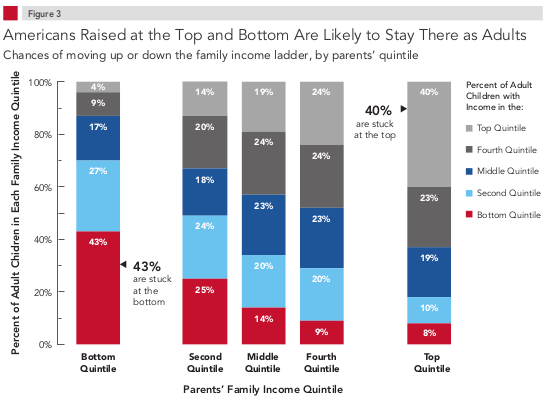
Next, another powerful example of inequity in the U.S. is that upward mobility has stagnated—notably in the top and bottom fifths—and, as Matt Bruenig has explained “you are better off being born rich regardless of whether you go to college than being born poor and getting a college degree”:

The third and final context for understanding an alternative to accountability-based education reform is the rise in the working poor in the U.S. and the increase in part-time work that leaves many working-poor families with adults holding multiple jobs but not having access to health care or retirement benefits.

Education reform must be built on policies that directly address the rising social inequity in the U.S. The essential shift away from accountability, then, must begin with social reform that addresses inequity. Social reform is necessarily the responsibility of state and federal legislation; thus, some of the policy targets addressing social inequity that are likely to impact positively a new vision of school-based reform include the following:

  • Food security: Children in poverty face food insecurity, but also suffer from access to low-quality foods (for example, fast food). Nutrition during pregnancy for women in poverty, early childhood nutrition, and nutrition during school ages are all essential elements for providing children the equity of opportunities that schools could provide.
  • Health care: Children and families in poverty tend to avoid needed preventative health care, and then are forced to seek out the least economically efficient avenues for receiving basic and urgent care, emergency rooms. If public education is to transform society and the lives of children, all children must be guaranteed the health (and nutrition) that children in affluence experience.
  • Stable work with rewarding salaries: Children and families in poverty often experience instability in the work of the parents and their homes since impoverished workers are competing with each other for entry-level and transient jobs. A stable workforce and increasing full-time jobs with benefits provide the basis upon which education can succeed where it has traditionally failed.

Certainly, many other social policies need to be addressed, but the foundational point here is that social inequity currently overwhelms public education in the U.S. A first step to education reform is social reform. As well, the public in the U.S. currently supports seeking greater equity: “The Pew Research Center has found that some 90 percent of Americans believe that the government should do everything it can to ensure equality of opportunity” (NYT February 16, 2013). What is lacking is the political will to make commitments to social equity of opportunity for all in the U.S.

Within the larger commitment to social reform, a new vision of education reform must include a broad commitment to providing an equity of opportunity for all children, and some of the policy changes must include the following:

  • End accountability based on standards and high-stakes testing: A growing body of research has shown that the accountability era has failed: “the absence or presence of rigorous or national standards says nothing about equity, educational quality, or the provision of adequate educational services, there is no reason to expect CCSS or any other standards initiative to be an effective educational reform by itself” (Mathis, 2012). A first and essential step to a new vision of education reform is to end the accountability era by shifting away from focusing on outcomes and toward attending to the conditions of teaching and learning—with an emphasis on equity of opportunity.
  • Implement a small and robust measurement system: As Stephen Krashen and others have argued, the existing National Assessment of Educational Progress (NAEP) assessment system in the U.S. provides a more than adequate foundation upon which the U.S. can develop a systematic and limited process for administering tests to random samples of students in all states and gathering descriptive data on the effectiveness of schools. This new system must be low-stakes and should dramatically reduce the funding committed to testing in the U.S.
  • Scale back and eventually end tracking: The most accurate criticism of U.S. education is that it has historically perpetuated and currently perpetuates social inequity. Tracking remains grounded in data that reflect out-of-school influences and tends to funnel impoverished students into narrow academic settings and affluent children into rich educational experiences.
  • Focus on equitable teacher assignments: The focus on teacher quality within the accountability movement has tended to mislead the public about the importance of teacher quality connected to measurable outcomes while ignoring that impoverished, minority, and special needs students along with English language learners disproportionately are assigned to inexperienced and un-/under-certified teachers. Education reform committed to equity must monitor teacher assignments so that no students experience inequitable access to high-quality, experienced teachers.
  • Decrease bureaucracy of teacher licensing and increase academic quality of education degrees: Another legitimate criticism of traditional education is that teacher licensing has many flaws built into the bureaucracy of attaining a teaching certificate. Certification and accreditation mandates and systems tend to fail educators, and thus students. However, as in other fields, the quality of education degree programs still offer a tremendous promise for preparing teachers well for the teaching profession.
  • Honor school and teacher autonomy: Individual schools and classrooms vary dramatically across the U.S. School autonomy and teacher professionalism are the greatest sources of understanding what populations of students need. The current move toward national standards and tests is inherently a flawed concept since student needs in Orangeburg, SC, are dramatically different than student needs in Seattle, WA.
  • Replace accountability with transparency: High-stakes accountability has not only failed to produce outcomes promised by its advocates, but also has created negative unintended consequences (cheating scandals, for example). A more promising approach to insuring that a public institution provides that public with needed services is to require schools to be transparent: identifying educational needs and providing evidence for practices being implemented to meet those needs.
  • Address wide range of issues impacting equity—funding, class size, technology, facilities: Moving away from accountability and toward equity is a shift in the goals and then standards against which education policy is evaluated. Issues of funding, class size, technology, and facilities must be addressed to assure all children experience an equity of opportunities in every school.
  • Abandon ranking: Education in the U.S. has suffered the negative consequences of ranking for over a century. Ranking nearly always distorts data and typically fails goals of equity. Instead of ranking, education should honor how conditions of learning match clearly identified learning goals.
  • Rethink testing and grades: Tests and grades have been the foundation upon which education in the U.S. rests, but both tend to distort education seeking equity, autonomy, and democracy. Rich feedback that challenges learners and contributes to learning, however, is the lifeblood of learning.
  • Practice patience: Crisis and urgency have characterized the accountability era, and both states have contributed to the failure of accountability. Teaching and learning are complex and unpredictable, requiring political and public patience for reaching the goals that everyone seeks.

The points identified above are not intended to be exhaustive, but the evidence is clear that education reform has been on the wrong path for three decades. Accountability has failed, but that experiment has exposed a wealth of data that should inform a new vision of the need to address social and educational inequity through policies that fulfill the promises driving our democracy and our commitment to universal public education.

For Further Reading

Closing the Opportunity Gap: What America Must Do to Give Every Child an Even Chance, Carter and Welner, eds.

Reign of Error: The Hoax of the Privatization Movement and the Danger to America’s Public Schools, Ravitch (September 17, 2013)

Social Context Reform: A Pedagogy of Equity and OpportunityThomas, Porfilio, Gorlewski, and Carr, eds. (under contract, Routledge)

What We Know Now (and How It Doesn’t Matter)

Randy Olson’s Flock of Dodos (2006) explores the evolution and Intelligent Design (ID) debate that represents the newest attack on teaching evolution in U.S. public schools. The documentary is engaging, enlightening, and nearly too fair considering Olson admits upfront that he stands with scientists who support evolution as credible science and reject ID as something outside the realm of science.

Olson’s film, however, offers a powerful message that rises above the evolution debate. Particularly in the scenes depicting scientists discussing (during a poker game) why evolution remains a target of political and public interests, the documentary shows that evidence-based expertise often fails against clear and compelling messages (such as “teach the controversy”)—even when those clear and compelling messages are inaccurate.

In other words, ID advocacy has often won in the courts of political and public opinion despite having no credibility within the discipline it claims to inform—evolutionary biology.

With that sobering reality in mind, please identify what XYZ represents in the following statement about “What We Know Now”:

Is there a bottom line to all of this? If there is one, it would appear to be this: Despite media coverage, which has been exceedingly selective and misrepresentative, and despite the anecdotal meanderings of politicians, community members, educators, board members, parents, and students, XYZ have not been effective in achieving the outcomes they were assumed to aid….

This analysis is addressing school uniform policies, conducted by sociologist David L. Brunsma who examined evidence on school uniform effectiveness (did school uniform policies achieve stated goals of those policies) “from a variety of data gathered during eight years of rigorous research into this issue.”

This comprehensive analysis of research from Brunsma replicates the message in Flock of Dodos—political, public, and media messaging continues to trump evidence in the education reform debate. Making that reality more troubling is that a central element of No Child Left Behind was a call to usher in an era of scientifically based education research. As Sasha Zucker notes in a 2004 policy report for Pearson, “A significant aspect of the No Child Left Behind Act of 2001 (NCLB) is the use of the phrase ‘scientifically based research’ well over 100 times throughout the text of the law.”

Brunsma’s conclusion about school uniform policies, I regret to note, is not an outlier in education reform but a typical representation of education reform policy. Let’s consider what we know now about the major education reform agendas currently impacting out schools:

Well into the second decade of the twenty-first century, then, education reform continues a failed tradition of honoring messaging over evidence. Neither the claims made about educational failures, nor the solutions for education reform policy today are supported by large bodies of compelling research.

As the fate of NCLB continues to be debated, the evidence shows not only that NCLB has failed its stated goals, but also that politicians, the media, and the public have failed to embrace the one element of the legislation that held the most promise—scientifically based research—suggesting that dodos may in fact not be extinct.

* Santelices, M. V., & Wilson, M. (2010, Spring). Unfair treatment? The case of Freedle, the SAT, and the standardization approach to differential item functioning. Harvard Educational Review, 80(1), 106-133.; Spelke, E. S. (2005, December). Sex differences in intrinsic aptitude for mathematics and science? American Psychologist, 60(9), 950-958; See page 4 for 2012 SAT data: http://media.collegeboard.com/digitalServices/pdf/research/TotalGroup-2012.pdf

Class Grades

Since I am quick to criticize the media for its role in the failures of the current education reform movement—such as PBS, The Charleston Post and Courier, and Education Week—I must also recognize when a media outlet provides much needed insight into education policy that has clearly run off the tracks, such as the so-called Florida miracle and the enduring practice of assigning letter grades to schools.

In “Low-income schools struggle under state’s grading system” (Miami Herald, August 10, 2013), Michael Vasquez and David Smiley offer a clear but disturbing picture of accountability in Florida:

With dozens of changes in just the past three years, the formula behind Florida’s A-to-F school grading system has been criticized as a confusing mess. But there’s been at least one constant in Miami-Dade and Broward results: The wealthiest schools never get Fs, and schools with high populations of poor students face an uphill battle to even get a C.

The trend is visible through a decade-plus of school grade results, dating back to the first grades issued in 1999.

Vasquez and Smiley, along with the Miami Herald, represent a needed aspect of journalism addressing education reform: Recognizing large and compelling patterns, and thus the consequences of education policy.

The analysis of assigning letter grades to schools in Florida exposes some important conclusions:

•  Although high poverty rates don’t necessarily doom a school to a subpar grade, D and F schools are overwhelmingly serving students from poor neighborhoods, and the few schools that do overcome poverty to achieve an A are outliers. (There were nine such schools this year, all in Miami-Dade).

•  Of the 209 schools in Miami-Dade and Broward with at least 90 percent of students receiving free or reduced lunch, 78 percent received a grade of C or worse. Roughly 39 percent of these high-poverty schools received a D or F.

•  Of the 43 local schools with much lower poverty rates (30 percent or fewer students receiving free or reduced lunch), 86 percent received an A, and none received a D or F.

Despite efforts to identify educational quality among schools by focusing on growth models, data used in accountability policies remain primarily a reflection of out-of-school factors. Further, the schools that sit outside the typical patterns are rightfully identified by Vasquez and Smiley as “outliers.”

This analytical report on letter grades for schools in Florida is a strong example of quality journalism that seeks out and presents complex and detailed evidence, placing that data in the broader context of the many factors that impact not only the evidence we gather on our schools but also what conclusions we draw as well as how we draw those conclusions.

In the article, Miami-Dade Superintendent Alberto Carvalho explains, “‘Just as much as poverty can’t be an excuse, the exclusion of poverty as a factor is immoral.'”

Rare is the news article that allows a perspective this complex.

No Child Left Behind (NCLB) ushered in several grand promises in 2001, such as closing the achievement gap, but one of the central requirements of the legislation—the use of scientifically based research—is now poised to dismantle the entire accountability movement, including policies such as labeling schools with letter grades based primarily on test scores.

The evidence is clear that thirty years of accountability built on standards and high-stakes testing has failed. The next step is composing and sharing a unified message of that fact, while also building a coalition to reset the reform agenda so that we address poverty, equity, and opportunity in the lives of children and their families as well as in the schools those children attend.

Made in America: Segregation by Design

“The woman in the gold bracelets tells her friend:,” begins a poem by Barbara Kingsolver from her collection Another America/Otra America. A careful reading notices “gold bracelets,” suggesting more than affluence, opulence. The poem continues:

I had to fire another one.
Can you believe it?
She broke the vase
Jack gave me for Christmas.
It was one of those,
you know? That worked
with everything. All my colors.
I asked him if he’d mind
if I bought one again just like it.
It was the only one that just always worked.

Her friend says:
Find another one that speaks English.
That’s a plus.

The woman in the gold agrees
that is a plus.

The two women speak interchangeably about the fired domestic worker and the vase, both reduced to “one,” and “worked” is repeated about only the broken vase, an object for decoration and a Christmas gift. “It” and “colors” also haunt the conversation. In this brief poetic scene, the callousness of two affluent women about the value of an ornament over a worker (one who apparently is not a native speaker of English, and as suggested by the Spanish/English versions of all the poems and title of the collection, likely Latino/a) is couched in a larger context found in the poem’s title, “What the Janitor Heard in the Elevator.”

This flippant conversation is overheard by another worker, a janitor (who do you see as the “janitor”?), standing essentially unseen, unacknowledged beside these women (who do you see as these women?), trapped momentarily in an elevator.

Kingsolver’s stark and vivid poem captures, as does Kingsolver’s entire collection, the existence of two Americas, a slogan trivialized by politicians and ignored like the janitor by much of the public in the U.S.

The two Americas include the few and affluent, mostly white, who have virtually all the power and, as the poem shows, a voice in the nation and the remaining many, disproportionately middle-class, working-class, working poor, and poor as well as African American and, increasingly, Latino/a.

Let’s consider for a moment what students may be asked to do if presented with this poem in a public high school in the U.S., specifically in this expanding era of accountability and the encroaching specter of Common Core and the concurrent new high-stakes tests.

Based on my having been an educator during the entire past thirty years of the accountability era, I would suggest that this poem would be reduced to mechanistic analysis, in much the same way we have treated F. Scott Fitzgerald’s The Great Gatsby for decades.

While many are rightfully concerned that the Common Core will significantly decrease the focus on fiction and poetry in schools, we have yet to address that even if we maintain great poetry and fiction in the education of our children, we do them or that literature little service to allow those works to be reduced only to their literary parts, mere interchangeable fodder for identifying lination, stanzas, diction, symbolism, narration, characterization, setting, and the endless nuts and bolts deemed worthy of dispassionate analysis in school.

How many generations of students, for example, have examined at length the symbolism of the green light at the end of Daisy’s dock and Gatsby’ yellow car? How many students have been guided through the technical precision of Fitzgerald’s novel while never confronting his vivid challenge to the American Dream?

Have students been asked to look carefully at the corpses of Myrtle and George (the wrong kind of people, George a mere worker and Myrtle left like roadkill in the middle of the road) as well as Gatsby (the wrong kind of rich) floating dead in his pool? Have students been asked why Tom and Daisy (the right kind of rich) go on vacation in the wake of these deaths, seemingly untarnished because of the Teflon coating of their affluence?

Have students been asked to consider carefully why Tom hits Myrtle but bends to Daisy’s taunts?

These are distinctions of analysis—suggesting that Common Core and curriculum are trivial debates if we do not address what happens in the classroom and for whom.

Made in America: Segregation by Design

The technical approach to literature that ignores critical literacy is a subset of the larger technical debate about education and education reform that focuses policy and public attention on the details of schooling (public versus charter and private, Common Core, high-stakes testing, value added methods of evaluating teachers) and ignores the substance of schooling like a janitor trapped in an elevator with two wealthy women.

The substance of schooling today is a stark contrast to the moment of cultural consciousness stretching from the early 1950s into the 1970s when separate but equal was confronted and rejected. As society in the U.S. wrestled with integration of institutions, the cancer of segregation was merely shifted from separate schools to schools-within-schools: White and affluent students tend to sit in Advanced Placement, International Baccalaureate, and honors classes with experienced and qualified teachers and low student-teacher ratios while AA/ Latino/a and impoverished students tend to sit in remedial, test-prep, and tech-prep classes with new and unqualified teachers (in the twenty-first century that means often Teach for America recruits as temporary workers) and high student-teacher ratios.

In-school segregation has been driven by affluent parents, who use their privilege to insure that their children get theirs, and damn the rest. But segregation by design has now been joined by two powerful and corrosive mechanisms—charter schools and segregated higher education access.

Charter schools (see Charter Schools: A Primer and Current Education Reform Perpetuating, Not Curbing, Inequity) have failed to achieve the academic miracles proponents have promised, but charter schools have exposed the most predictable outcome of choice, segregation. As Sarah Carr has shown, New Orleans is a disturbing record of the charter schools flood, the role disaster capitalism plays in destroying equity and opportunity for “the deliberately silenced, or the preferably unheard,” African Americans and people trapped in poverty.

While schools-within-schools and charter schools highlight K-12 segregation by design in the U.S., as troubling is the entrenched privilege of affluence found in higher education, augmenting Matt Bruenig’s conclusion: “you are better off being born rich regardless of whether you go to college than being born poor and getting a college degree.”

Carnevale and Strohl have identified the separate and unequal access to higher education that constitutes the full picture of segregation by design in the U.S.:

The postsecondary system mimics the racial inequality it inherits from the K-12 education system, then magnifies and projects that inequality into the labor market and society at large….

Whites have captured most of the enrollment growth at the 468 most selective and well-funded four-year colleges, while African Americans and Hispanics have captured most of the enrollment growth at the increasingly overcrowded and under-resourced open-access two- and four-year colleges….

These racially polarized enrollment flows have led to an increasing overrepresentation of whites at the 468 most selective four-year colleges….

At the same time, African Americans and Hispanics are increasingly underrepresented at the most selective 468 four-year colleges….

At the same time, African Americans and Hispanics are increasingly underrepresented at the most selective 468 four-year colleges…. (Executive Summary, pp. 3, 6, 10, 12)

The inequitable access to elite higher education mirrors the inequitable access to quality K-12 education and to experienced and qualified teachers. Inequitable access, then, creates inequitable outcomes:

[H]igh-scoring African Americans and Hispanics are far more likely to drop out of college before completing a credential….

Among high-scoring students who attend college, whites are far more likely to complete a BA or higher compared to African Americans or Hispanics….

Each year, there are 111,000 high-scoring African-American and Hispanic students who either do not attend college or don’t graduate.

About 62,000 of these students come from the bottom half of the family income distribution….

Racial inequality in the educational system, paired with low social and economic mobility in the United States, produces enormous differences in educational outcomes: Whites are twice as likely as African Americans and three times as likely as Hispanics to complete a BA or higher…. (Carnevale and Strohl, 2013, Executive Summary, pp. 24, 26, 28, 37)

Despite the meritocracy myth at the heart of the American Dream, then, Carnevale and Strohl conclude: “In the United States, parents’ education determines the educational attainment of their children” (Executive Summary, p. 38).

The cruel irony of education in the U.S. includes that most privileged children will find themselves in classrooms where color imagery (the gold bracelet in Kingsolver’s poem, the green dock light and yellow car in The Great Gatsby) will be the key to the already unlocked door leading to college and secure, high-paying jobs while AA and Latino/a as well as impoverished students are shown quite a different door.

All the while, the colors that matter—black, brown, white, and green—remain invisible and unspoken under the veneer of the American Dream of meritocracy that is less credible than any work of fiction soon to be dropped from the school day.

“The Deliberately Silenced, or the Preferably Unheard”

No rhetorical sleight of words should mask that Trayvon Martin was a son. He had parents.

No rhetorical sleight of words should allow us to ignore that any child is everyone’s child.

Trayvon Martin was killed in part because he was reduced to a stereotype, and after his death, Trayvon was again reduced—often by well-meaning people—to an icon, the hoodie.

In his death, as well, Trayvon has been spoken about, spoken for—and I am compelled to argue that he has also been rendered voiceless.

But, as Arundhati Roy has explained, “We know of course there’s really no such thing as the ‘voiceless’. There are only the deliberately silenced, or the preferably unheard.”

I am also compelled to speak beyond Trayvon, about “the deliberately silenced, or the preferably unheard” Others, African American males.

At mid-twentieth century, as the US was fighting against its racist heritage, African American males demanded to be heard—Martin Luther King Jr., Malcolm X, Ralph Ellison, James Baldwin, Richard Wright and many others took the stage as artists, public intellectuals, and civic leaders.

Wright’s Black Boy and Ellison’s Invisible Man represent in fictional narrative a powerful and disturbing image of the African American male; for Ellison, the guiding metaphor of that narrative is invisibility. The killing of Trayvon and the subsequent trial may suggest that African American males no longer suffer from invisibility but from how they are seen, how they are silenced, and how they are unheard: Trayvon seen (and reduced) as black male, thus necessarily a thug, a threat, and then Trayvon, the hoodie, the icon of the disposable African American male.

The fact of being seen and reduced as African American males are too often results in violent deaths and prison. And the intersection of race, class, and gender with education has paralleled the rise of mass incarceration over the past thirty-plus years.

Just as Wright’s and Ellison’s fiction captures the African American male experience at mid-twentieth century, continuing to speak to the complex and entrenched conditions that contributed to Trayvon’s killing, Ellison’s and Baldwin’s concerns about the failure of education to see clearly and holistically—and humanely—African American males remain ominous and powerful messages in 2013.

In 1963, Ellison spoke to teachers:

At this point it might be useful for us to ask ourselves a few questions: what is this act, what is this scene in which the action is taking place, what is this agency and what is its purpose? The act is to discuss “these children,” the difficult thirty percent. We know this very well; it has been hammered out again and again. But the matter of scene seems to get us into trouble.

Ellison recognized the stigma placed on African American students, a deficit view of both an entire race and their potential intelligence (marginalized as insufficient language skills):

Some of us look at the Negro community in the South and say that these kids have no capacity to manipulate language. Well, these are not the Negroes I know. Because I know that the wordplay of Negro kids in the South would make the experimental poets, the modern poets, green with envy. I don’t mean that these kids possess broad dictionary knowledge, but within the bounds of their familiar environment and within the bounds of their rich oral culture, they possess a great virtuosity with the music and poetry of words. The question is how can you get this skill into the mainstream of the language, because it is without doubt there. And much of it finds its way into the broader language. Now I know this just as William Faulkner knew it. This does not require a lot of testing; all you have to do is to walk into a Negro church.

But Ellison rejected this deficit perspective: “Thus we must recognize that the children in question are not so much “culturally deprived” as products of a different cultural complex”:

As we approach the dropouts, let us identify who we are and where we are. Let us also have a little bit of respect for what we were and from whence we came. There is a bit of the phony built into every American. This is inevitable in a conscious society that has developed as swiftly as ours has. We are faced with endless possibilities for change, for metamorphosis. We change our environment, our speech, our styles of living, our dress, and often our values. So, in effect, we become somebody else–or so we are tempted to believe–and often we act as though we have no connection with our past. We are all tempted to become actors, and when we forget who we are and where we are from, our phony selves take command.

Finally, Ellison demanded that the human dignity of all children be honored:

I don’t know what intelligence is. But this I do know, both from life and from literature: whenever you reduce human life to two plus two equals four, the human element within the human animal says, “I don’t give a damn.” You can work on that basis, but the kids cannot. If you can show me how I can cling to that which is real to me, while teaching me a way into the larger society, then I will not only drop my defenses and my hostility, but I will sing your praises and help you to make the desert bear fruit.

Baldwin addressed teachers in that same year, 1963: “Let’s begin by saying that we are living through a very dangerous time.  Everyone in this room is in one way or another aware of that.  We are in a revolutionary situation, no matter how unpopular that word has become in this country.  The society in which we live is desperately menaced, not by Khrushchev, but from within.”

Then, Baldwin unmasked the cruel tension between the promise of universal public education and the inequity found in the lives of African American children:

Now, if what I have tried to sketch has any validity, it becomes thoroughly clear, at least to me, that any Negro who is born in this country and undergoes the American educational system runs the risk of becoming schizophrenic.  On the one hand he is born in the shadow of the stars and stripes and he is assured it represents a nation which has never lost a war.  He pledges allegiance to that flag which guarantees “liberty and justice for all.”  He is part of a country in which anyone can become president, and so forth.  But on the other hand he is also assured by his country and his countrymen that he has never contributed anything to civilization – that his past is nothing more than a record of humiliations gladly endured.  He is assumed by the republic that he, his father, his mother, and his ancestors were happy, shiftless, watermelon-eating darkies who loved Mr. Charlie and Miss Ann, that the value he has as a black man is proven by one thing only – his devotion to white people.  If you think I am exaggerating, examine the myths which proliferate in this country about Negroes….

The point of all this is that black men were brought here as a source of cheap labor.  They were indispensable to the economy.  In order to justify the fact that men were treated as though they were animals, the white republic had to brainwash itself into believing that they were, indeed, animals and deserved  to be treated like animals.  Therefor it is almost impossible for any Negro child to discover anything about his actual history.  The reason is that this “animal,” once he suspects his own worth, once he starts believing that he is a man, has begun to attack the entire power structure.  This is why America has spent such a long time keeping the Negro in his place.  What I am trying to suggest to you is that it was not an accident, it was not an act of God, it was not done by well-meaning people muddling into something which they didn’t understand.  It was a deliberate policy hammered into place in order to make money from black flesh.  And now, in 1963, because we have never faced this fact, we are in intolerable trouble.

Ultimately, education, for Baldwin, is revolutionary, an act of social justice:

I began by saying that one of the paradoxes of education was that precisely at the point when you begin to develop a conscience, you must find yourself at war with your society.  It is your responsibility to change society if you think of yourself as an educated person.  And on the basis of the evidence – the moral and political evidence – one is compelled to say that this is a backward society.  Now if I were a teacher in this school, or any Negro school, and I was dealing with Negro children, who were in my care only a few hours of every day and would then return to their homes and to the streets, children who have an apprehension of their future which with every hour grows grimmer and darker, I would try to teach them –  I would try to make them know – that those streets, those houses, those dangers, those agonies by which they are surrounded, are criminal.  I would try to make each child know that these things are the result of a criminal conspiracy to destroy him.  I would teach him that if he intends to get to be a man, he must at once decide that his is stronger than this conspiracy and they he must never make his peace with it.  And that one of his weapons for refusing to make his peace with it and for destroying it depends on what he decides he is worth.  I would teach him that there are currently very few standards in this country which are worth a man’s respect.

No rhetorical sleight of words should mask that Trayvon Martin was a son. He had parents.

No rhetorical sleight of words should allow us to ignore that any child is everyone’s child.

However if the killing of Trayvon does not haunt us, if the killing of Trayvon slips beneath the next tragedy-of-the-moment—as the Sandy Hook shooting has beneath the Zimmerman trial—then society and schools will continue to be mechanisms that shackle “the deliberately silenced, or the preferably unheard.”

And I suppose that is ultimately the cruel paradox, rendering Trayvon a ghost in this American house he was never allowed to enter, invisible again as Ellison’s unnamed narrator.